CHD refers to any structural abnormality in the heart that is present at birth. It is the most common birth defect,Reference Zaidi and Brueckner1 affecting approximately—six to eight individuals in every 1000 live births globally.Reference Hoffman and Kaplan2 About half of newborns with CHD will require surgery or intervention.Reference Blue, Kirk, Sholler, Harvey and Winlaw3 Due to advances in detection, surgery, and interventions, the childhood mortality rate has decreased with the majority of patients surviving to adulthood,Reference Khairy, Ionescu-Ittu, Mackie, Abrahamowicz, Pilote and Marelli4,Reference van Engelen, Baars, van Rongen, van der Velde, Mulder and Smets5 such that the adult CHD population now outnumbers the paediatric CHD population.Reference Marelli, Ionescu-Ittu, Mackie, Guo, Dendukuri and Kaouache6
In most cases, the cause of CHD is unknown and believed to be multifactorial, implicating genetic and environmental factors in disease causation.Reference Azhar and Ware7,Reference Bijanzadeh8 In the past, gene discovery research into familial forms of CHD has been limited to linkage analysis requiring large families with multiple affected family members, which is often not the case with CHD. However, with the emergence of genetic technologies such as chromosomal microarray, targeted gene panels and whole exome/genome sequencing, establishing a molecular diagnosis for patients with CHD, are fast becoming a reality, even in those with sporadic forms of disease.Reference Blue, Kirk and Giannoulatou9,Reference Dykes, Al-mousily and Abuchaibe10
An important question asked by many parents at the time of diagnosis is “how and why did this happen?”.Reference Kasparian, Fidock and Sholler11 A lack of understanding leaves many parents with feelings of “transmission guilt,” which may progress to feelings of distress and shame over their perceived wrongdoing in passing on the disease, and ultimately manifesting into depression, anxiety, and stress.Reference Blue, Kasparian, Sholler, Kirk and Winlaw12 Mothers, in particular, experience greater psychological distress when they have a poor understanding of the diagnosis.Reference Doherty, McCusker and Molloy13 An assessment of psychosocial functioning in parents of children with CHD found that mean scores for depression and stress were more than twice the levels of documented Australian norms with mean anxiety scores more than three times Australian documented norms,Reference Kasparian, Fidock and Sholler11 highlighting a need for more psychosocial support in this group.
While parents of children with CHD have an acceptable understanding about the name and anatomy of their child’s heart condition, their knowledge about the inheritance thereof, is poor.Reference Chessa, De Rosa and Pardeo14 Furthermore, adult CHD patients have a poor knowledge about CHD inheritance,Reference Moons, De Volder and Budts15 with only one-third recalling having received information about the inheritance of CHD.Reference van Engelen, Baars, van Rongen, van der Velde, Mulder and Smets5 Genetic counselling has been shown to increase parent knowledge, decrease feelings of guilt and shame, and increase perceived personal control through the provision of individualised information and psychosocial supportReference Blue, Kasparian, Sholler, Kirk and Winlaw12; however, the majority of CHD parents do not receive this service. The American Heart Association recommends genetic counselling as part of the transition to adult services for patients with CHDReference Sable, Foster and Uzark16; however, recent studies signify the need for a similar service to be available in the paediatric setting.Reference Blue, Kasparian, Sholler, Kirk and Winlaw12,Reference Kasparian, De Abreu Lourenco, Winlaw, Sholler, Viney and Kirk17
In the absence of formal genetic counselling, written resources providing accurate information may improve understanding of CHD inheritance and assist in reducing anxiety among parents of children with CHD.Reference Blue, Kasparian, Sholler, Kirk and Winlaw12,Reference Jackson, Baird, Davis-Reynolds, Smith, Blackburn and Allsebrook18 At present, and to the best of our knowledge, there is no written resource in Australia specifically designed to provide information about the causes and inheritance of CHD to parents of children with CHD. The aims of this study were therefore to develop an information resource for parents of children with CHD, addressing “how and why” this has happened and providing empiric recurrence risk estimates, and assess parental knowledge about CHD causation and inheritance as well as psychosocial functioning, using purpose-designed and validated measures pre- and post-reading of the resource.
Materials and methods
Resource development
Design and content
A draft brochure was developed with the written content measured against several readability scalesReference Mc Laughlin19,Reference Crossley, Allen and McNamara20 to ensure that a recommended 8th grade reading level was achieved.21 The brochure contained sections describing:
Prevalence of CHD and an overview of the causes
Known causes, including genetic and non-genetic
Unknown causes
Recurrence risks
Sources of further information and support
Where possible, pictographs and images were created and used in place of text to describe concepts.Reference Hoffmann and Worrall22 A detailed outline of the content of the final version of the brochure is presented in Supplementary material S1.
Pilot process
Seven parents of children with CHD were approached while attending the cardiac surgery preadmission clinic at the Heart Centre for Children, The Children’s Hospital at Westmead. They were asked to read the draft brochure and complete a pilot questionnaire containing 23 questions, adapted from a previous study.Reference Wakefield, Meiser and Homewood23 The pilot participants were satisfied with the design and content of the draft brochure and thought it was clearly presented and easy to read. Minor modifications were made to the phrasing of the text in the “Unknown causes” section, according to the pilot participants’ feedback.
Participants
Parents of children aged 3 months to 10 years attending the surgical preadmission clinic at the Heart Centre for Children for elective cardiac surgery between May and September 2018 were invited to participate. Parents were excluded if their child had a genetic diagnosis or if they had previously seen a genetics professional or if they had insufficient English language skills.
Procedure
Parents who agreed to participate provided written consent and completed a pre-questionnaire. Following their child’s surgery, and once the child was out of the intensive care unit, participants were given the brochure on the ward and asked to complete the post-questionnaire after reading the brochure. Parents were asked not to refer to the brochure during completion of the post-questionnaire. To address potential social desirability bias, study questionnaires were anonymous, labelled with unique participant identifiers with no identifying information included or requested. Additionally, questionnaires were returned via self-addressed envelopes provided by the department to further preserve anonymity. The study procedure is summarised in Figure 1.
Study procedure and participant responses.

Measures
The pre- and post-questionnaires comprised purpose-designed and validated measures to evaluate parents’ knowledge and psychosocial functioning, as described below and in detail in Supplementary material S2.
Demographic factors (11 items) – pre-questionnaire only
Included items related to the participants, as well as their child with CHD. One item asked specifically about any known family history.
Knowledge (10 items) – pre- and post-questionnaire
A knowledge measure previously used to assess parental knowledge about the causes and inheritance of CHD was adapted for this study.Reference Blue, Kasparian, Sholler, Kirk and Winlaw12 Participants were asked to respond either “True,” “False,” or “Unsure” to 10 statements relating to information provided in the brochure. A greater number of correct answers indicated a greater level of knowledge.
Sources of information about CHD (eight items) – pre-questionnaire only
Participants were asked to respond either “Yes,” “No,” or “Unsure” to statements about the sources of information provided to them about CHD in the past.
Emotional aspects of having a child with CHD (seven items) – pre-questionnaire only
Participants were asked to respond either “Yes,” “No,” or “Unsure” to statements that explored a range of issues regarding having a child with CHD.
Perceived personal control (nine items) – pre- and post-questionnaire
The perceived personal control measureReference Berkenstadt, Shiloh, Barkai, Katznelson and Goldman24 can detect immediate changes in well-being and has been used to evaluate the benefit of genetic counselling.Reference Davey, Rostant, Harrop, Goldblatt and O’Leary25 The measure was designed for families with genetic conditions for which the genetic cause is known, unlike the majority of CHD; as such the measure was modified slightly as per a previous study.Reference Blue, Kasparian, Sholler, Kirk and Winlaw12 Participants were asked to indicate whether they “Completely agree,” “Somewhat agree,” or “Do not agree” with each statement. A higher number of points indicated a greater degree of perceived personal control.
Brochure design, content, and function (19 items) – post-questionnaire only
This measure was modified from a previous studyReference Wakefield, Meiser and Homewood23 and included Yes/No style items, Likert scale items, and open-ended items with free text boxes to assess participants’ thoughts about the brochure design, content, function, and emotional impact of the information.
Statistical analysis
Analysis of the data was completed using the Statistical Package for the Social Sciences version 24 (IBM Corp. Released 2016, Armonk, New York, United States of America). Descriptive statistics were used to analyse the demographic factors, sources of information about CHD, emotional aspects of having a child with CHD, and feedback measures. Wilcoxon Signed Rank tests were used to compare the differences between pre-questionnaire and post-questionnaire scores for both knowledge and perceived personal control. As appropriate, Mann–Whitney U-tests or independent t-tests were used to analyse associations between categorical predictors and continuous outcomes measures. Pearson’s Chi-square tests and, where appropriate, Fisher’s Exact tests, were used to assess associations between the information, feelings and feedback responses, and demographic factors.
Ethical approval
The Sydney Children’s Hospitals Network Human Research Ethics Committee granted ethics approval (LNR/17/SCHN/375) and site-specific approval (LNRSSA/17/SCHN/454).
Results
Response rate and demographic characteristics
Seventy-one parents were approached and seventy-one consented to participate in the study. Of these, 52 completed and returned both the pre- and post-questionnaires (response rate = 74%). Participants who did not complete both questionnaires were excluded from the analysis. Reasons for non-completion included language difficulties only identified after consent and logistical issues such as rescheduled surgery or being discharged home prior to completing the questionnaires.
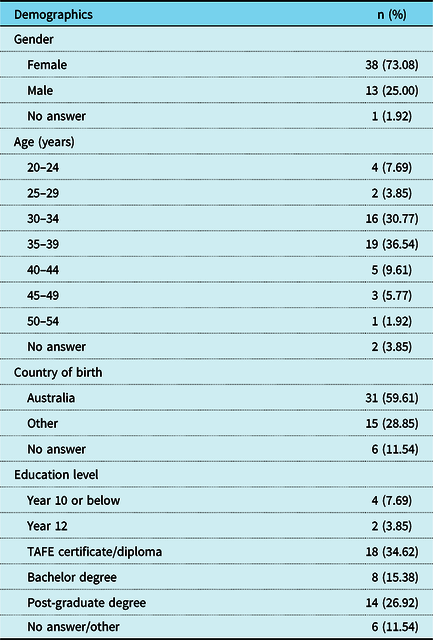
Participant demographic information is summarised in Table 1. Thirty-eight (73%) of the participants were female and thirty-one (60%) were born in Australia. Ages ranged from 22 to 54 years with a mean age of 35.22 years (sd = 6.31). Most participants (77%) had completed some form of tertiary education.
Participant demographic information

TAFE, Technical and Further Education.
Knowledge
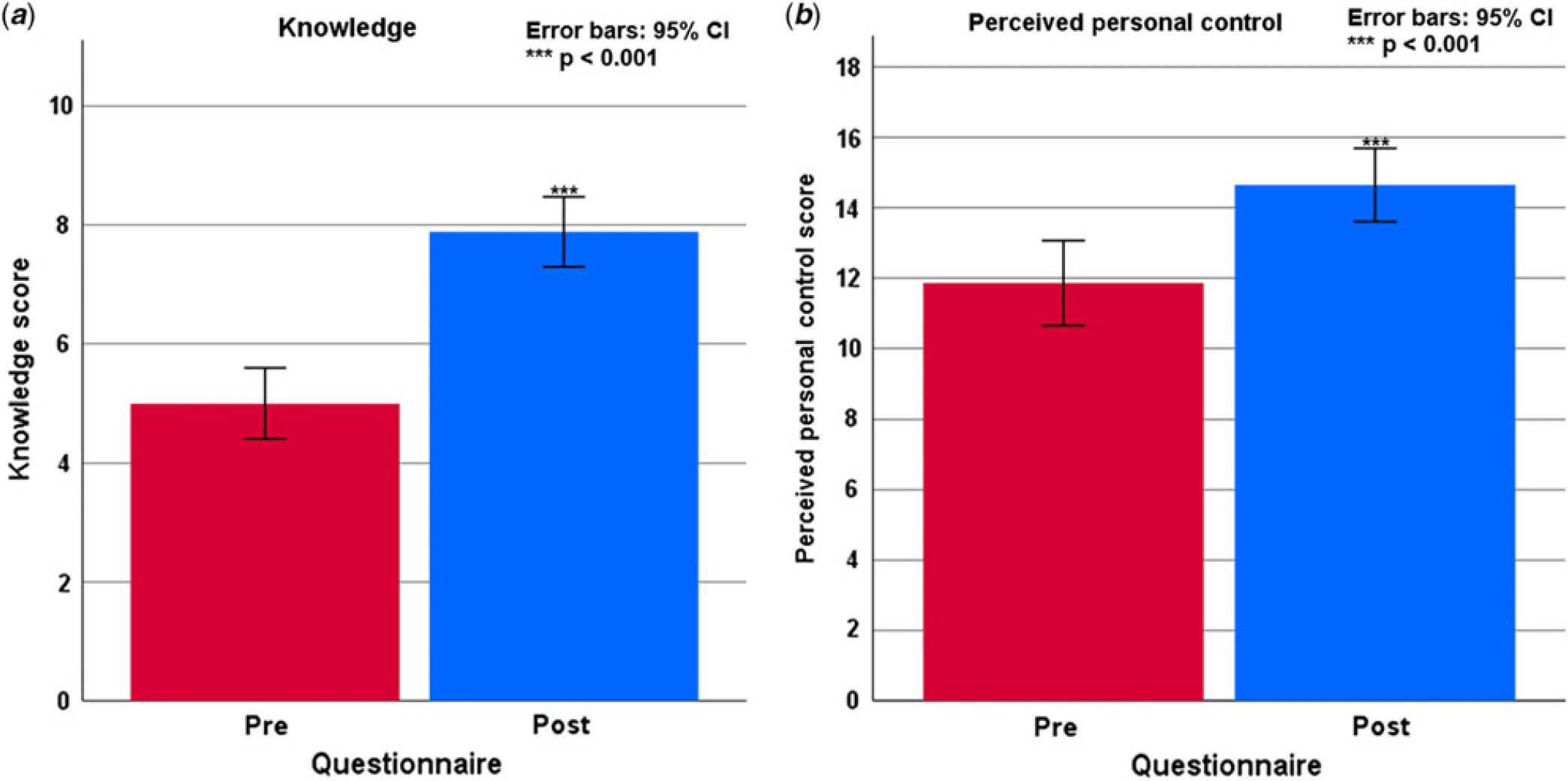
Mean knowledge scores significantly increased between the pre-questionnaire ( $\overline x\, = \,5/10$
, sd = 2.086) compared with the post-questionnaire (
 $\overline x\, = \,7.88/10$
, sd = 2.094, p < 0.001) (Fig 2). Interestingly, after reading the brochure, all participants correctly answered the question “CHD can be caused by genetic factors” in the post-questionnaire. In contrast, the only question that less than two-thirds of participants answered correctly in the post-questionnaire was “Most cases of CHD occur with a family history of heart disease.” Participants demonstrated the greatest improvement in questions relating to recurrence risks, with the number of participants correctly answering these questions more than doubling between the pre- and post-questionnaires. Higher post-knowledge scores were significantly associated with being female (p < 0.05) and having a university education (p < 0.005).
(a) Mean knowledge scores pre-questionnaire and post-questionnaire. (b) Mean perceived personal control scores pre-questionnaire and post-questionnaire. *** p < 0.001; Error bars = 95% confidence intervals.

Perceived personal control
There was a significant increase in perceived personal control scores from the pre-questionnaire ( $\overline x\, = \,11.856/18$
, sd = 4.339) to the post-questionnaire (
 $\overline x\, = \,14.644/18$
, sd = 3.733, p < 0.001) (Fig 2). The statement “I have a good understanding of what factors may have contributed to CHD” showed the greatest point increase among participants after reading the brochure, while participants’ responses to the statement “I think I understand why information on the causes and inheritance of CHD may be important for families with CHD” did not change, with most participants agreeing with this statement pre-brochure.
Information on CHD
Less than half of the participants (21/51 (41%), 1 non-responder) reported receiving information about the causes of CHD from a medical professional. Even fewer participants (9/52, 17%) could recall receiving information about the recurrence risks, despite all participants considering this information important. Thirty-six participants (69%) reported obtaining information about the causes through their own research, and 18 participants (35%) reported obtaining information about the inheritance and recurrence risks of CHD through their own research.
Forty-four participants (85%) reported that they would like to receive more information about the causes of CHD, while 48 (92%) reported they would like more information about recurrence risks.
Feelings and thoughts about CHD
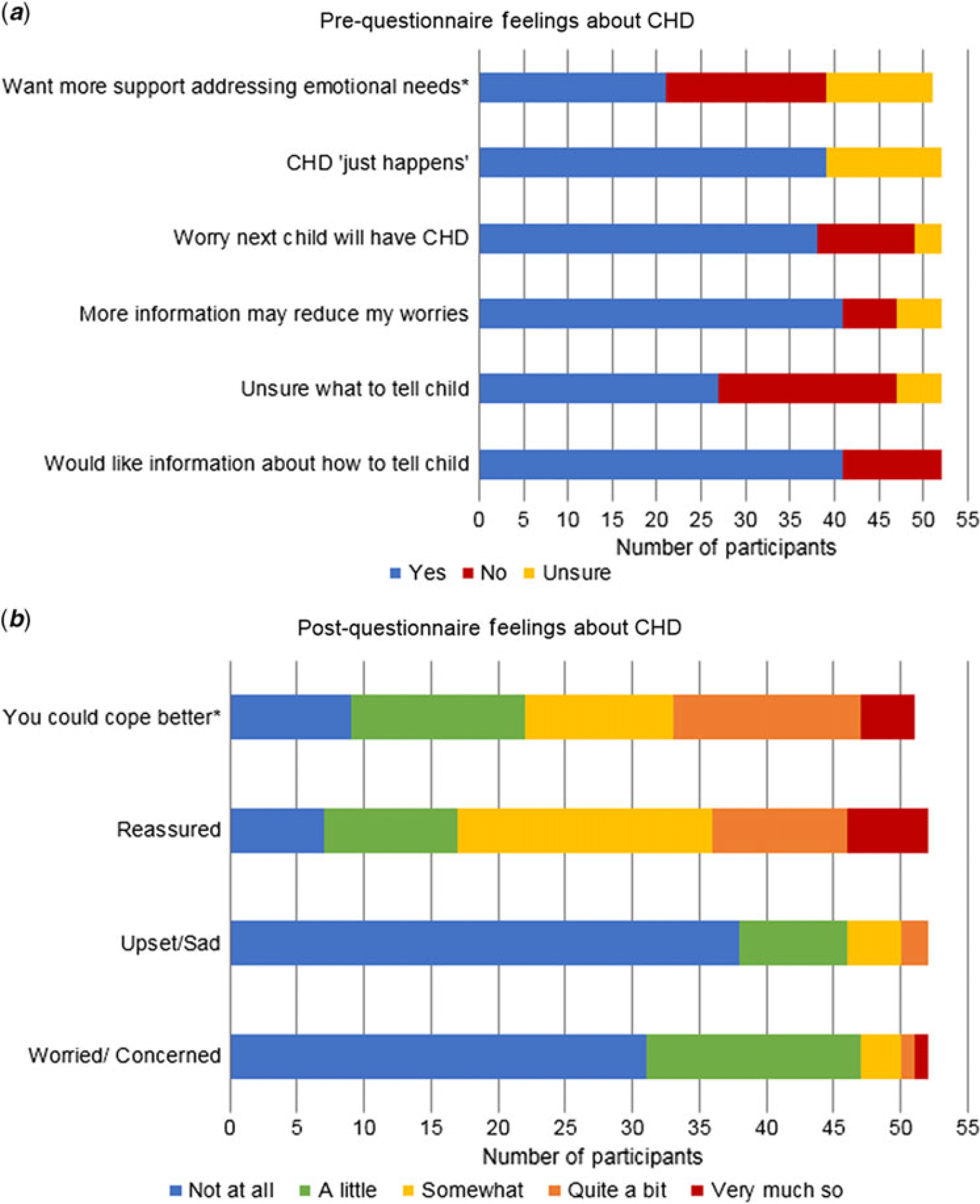
When asked why they believed their child had CHD, some participants responded with “genetics” (8/52, 15%), “(bad) luck” (7/52, 13%), and “pregnancy-related issues” (6/52, 12%); however, the majority were unsure (18/52, 35%) or did not respond (10/52, 19%). Twenty-one participants (40%) indicated they would like more emotional support, and 18 participants (35%) indicated that they would not like additional support, with 12 (23%) not sure (1 non-responder). Most participants worried that their next child would also have a CHD (73%); however, almost all felt that receiving more information about the causes may help reduce their worries (79%). Importantly, 86% of participants reported that they felt reassured after reading the brochure, and 82% felt that they could cope better with their situation. Figure 3 summarises responses from participants regarding their feelings about CHD.
(a) Pre-questionnaire responses to feelings about CHD. (b) Post-questionnaire responses to feelings about CHD.

Brochure development and utility
Most participants reported that the brochure was very clearly presented (81%), very informative (75%), very easy to read (83%), relevant (88%), and very appealing to look at (75%). Importantly, most participants reported feeling “Not at all” worried/concerned or upset/sad after reading the brochure, 60 and 73%, respectively (Fig 3). The one participant who reported feeling “very much” worried/concerned did not provide additional details as to why this might be; of the two participants who reported feeling “quite a bit” upset or sad after reading the brochure, one reported that this was because they “don’t know why he got it [CHD].”
Participants provided general feedback about brochure function and design through open-ended responses. In terms of content, participants appreciated the “short informative explanations” and that “the pie chart and images explained things well”. Participants felt reassured (“it was reassuring it wasn’t my fault”) and supported (“Good to be able to know some current facts. Very relevant … good to know we can explain some things to our heart kid”).
Several participants requested more individualised information regarding recurrence risks. Several participants also commented on the timing of receipt of the brochure: “would have been helpful at diagnosis, not post-surgery,” “it should be given at the birth of a CHD baby,” “more support from the beginning would be helpful,” underscoring the need for information about the causes and inheritance of CHD at the time of their child’s diagnosis. However, some parents thought that “a conversation with a professional would set one’s mind more ease & to use brochure as reference following consult,” indicating that a brochure is a useful tool but should not replace formal genetic counselling. Importantly, 79% of participants requested additional information about how to explain the “why” and “how” of CHD to their child, highlighting an unmet need.
Overall, the brochure met the expectations of 58% of participants, and “exceeded” or “greatly exceeded” the expectations of a further 38%. Of the two participants who felt the brochure did not meet their expectations, one wanted more information about diagnosis and prognosis, which is outside the scope of this resource, and the other wanted more details about gene–environment interactions. Eighty-eight percent of participants would recommend the brochure to other parents of children with CHD, with the remaining 12% being unsure.
Discussion
In this study, we assessed the effectiveness of an information resource in providing parents of children with CHD information on the causes and inheritance of CHD. Parent’s knowledge about CHD genetics significantly increased in the post-questionnaire, demonstrating the efficacy of this resource in delivering complex information in the absence of formal genetic counselling. While we cannot discount the confounding effect time as an in-patient may have had on knowledge gain, it is unlikely to be significant as it is well documented that discussions about CHD causes and inheritance between non-genetic clinical staff attending to these patients and families do not often occur.Reference van Engelen, Baars, van Rongen, van der Velde, Mulder and Smets5,Reference Kasparian, Fidock and Sholler11,Reference Blue, Kasparian, Sholler, Kirk and Winlaw12
Pre-knowledge scores were not impacted by demographic factors; however, post-knowledge scores were significantly impacted by parent gender and level of education. Females had higher post-knowledge scores than males perhaps indicating a difference in information-seeking styles, as mothers are more often described as being active information seekers.Reference Lee26 Also, those with a university level education had significantly higher post-knowledge scores than those who did not attend university. This could indicate that the readability of the brochure content was still too high, even though a recommended eighth-grade reading level was achieved during brochure development. However, information about genetics and inheritance, particularly regarding CHD, is complex and difficult to communicate within the limitations of a brochure format. This reinforces the importance of individualised genetic counselling when communicating complex information, especially to those without a tertiary education, as the level of information can be tailored to suit the individual, and time can be taken to ensure that the complex information is being understood.Reference Blue, Kasparian, Sholler, Kirk and Winlaw12
The participants’ varied responses to the question about the reason for their child’s CHD in the pre-questionnaire that included genetic factors, (bad) luck, and pregnancy-related issues indicate that many parents are unsure about the cause of CHD, prior to receiving this information. This may be due to traditional views that the majority of CHD has an unknown causeReference Azhar and Ware7; however, following significant advances in genetic technologies, establishing molecular diagnoses for this patient group is becoming a reality and, in some cases, comparable to diagnostic yields achieved for other genetic conditions.Reference Blue, Kirk and Giannoulatou9,Reference Alankarage, Ip and Szot27 As more children with CHD are surviving into adulthoodReference van Engelen, Baars, van Rongen, van der Velde, Mulder and Smets5 and considering families of their own, it will become increasingly important that parents are able to communicate accurate information to their children about the causes and recurrence risks of CHD. An important area that requires further attention that was not addressed in the brochure was how to support this communication.
There was a significant increase in participant’s perceived personal control after reading the brochure. When faced with a threat to health beyond their control, individuals may experience feelings of uncertainty and hopelessness leading to poor coping. One way to regain control over the situation is to search for information to better understand the condition, know what to expect, and how to prepare for future obstacles, thereby promoting better coping.Reference Berkenstadt, Shiloh, Barkai, Katznelson and Goldman24,Reference Shiloh, Berkenstadt, Meiran, Bat-Miriam-Katznelson and Goldman28 The demonstrated improvements in knowledge and understanding of CHD causation and inheritance may have restored perceived control for participants which in turn resulted in the majority reporting that they felt the brochure “‘helped them cope better with their situation.” The information provided by the brochure was also able to offer reassurance to one-third of participants, with most feeling at least “somewhat reassured.” Furthermore, the brochure was able to reduce feelings of guilt in participants with participants commenting “it was reassuring it wasn’t my fault.” Importantly, the brochure did not upset or elicit any feelings of worry, concern, or sadness for most participants.
Similar to a previous study, only 21 (41%) participants could recall receiving information about the causes of CHD from a medical professional, and only 9 (17%) participants could recall receiving information about recurrence risks.Reference Blue, Kasparian, Sholler, Kirk and Winlaw12 While this could in part be due to recall bias (i.e. parents receiving this information at the time of diagnosis but not able to recall it for various reasons), the brochure is an important addition to clinical workflow by addressing basic information needs of parents and directing them to appropriate resources for further information and support. Additionally, the brochure could be used by non-genetics professionals to aid discussion.
Overall, the feedback received from participants indicated that they were happy with the design, content, and layout of the brochure with comments such as “simple format makes it easy to read,” “not too much written info to read,” and “clearly presented.” Furthermore, most participants indicated that they would recommend the brochure to other parents, demonstrating the value of this resource to them. Several participants requested more individualised information regarding treatments and recurrence risks with comments such as “more information to families needed.” While the provision of this information is outside the scope of this brochure, it further highlights the desire these parents have for more information about their child’s heart condition. Future research may help to clarify a more appropriate time for the provision of this resource, up-skilling of non-genetics professionals to deliver this information, and additional resources to assist parents in communicating this information to their children.
Implications for practice
The need for early and timely information delivered by an expert professional reported in this study aligns with findings from a previous study where parents indicated that they would like more information about why their child has CHD in prenatal and/or neonatal discussions with their cardiologists.Reference Arya, Glickstein, Levasseur and Williams29 The findings also echo those findings from a previous study suggesting that written resources may be used to complement a genetic counselling session but should not replace this service.Reference Blue, Kasparian, Sholler, Kirk and Winlaw12
We therefore make the following recommendations:
Upon a child receiving a diagnosis of CHD, all parents should be provided with accurate and current information about CHD causation and inheritance, even if this is in the form of a written resource, initially.
Written material on CHD causation and inheritance is a valuable resource for parents of children with CHD; however, it should not replace formal genetic counselling when required or requested.
Limitations
A limitation of this study was the relatively small sample size, which consisted mostly of females, many of whom had a tertiary education. Furthermore, given the short time frame of this study, it is unclear whether the findings would be sustained in the long term. Due to logistic reasons, we were unable to administer the pre-questionnaire post-surgery and immediately prior to receiving the brochure. While the child’s surgery occurred between completion of the pre- and post-questionnaires and confounding factors relating to the surgery may have had some effect on perceived personal control scores, these are likely to be minimal as demonstrated by a previous study which clearly showed that an increase in perceived personal control was a direct result of information provision and counselling.Reference Blue, Kasparian, Sholler, Kirk and Winlaw12
Conclusions
The information resource developed as part of this study was effective, acceptable, and well received by participants and did not cause emotional concerns. While genetic counselling should be considered as part of “best care” practices in families affected by CHD,Reference Blue, Kasparian, Sholler, Kirk and Winlaw12,Reference Sable, Foster and Uzark16 in reality, most families do not receive this service. A brochure providing information on the causes and inheritance of CHD is therefore an effective interim solution, addressing the basic information needs of parents of children with CHD and directing them to appropriate resources for further information and support as required.
Supplementary Material
To view supplementary material for this article, please visit https://doi.org/10.1017/S1047951119003226
Acknowledgements
We would like to thank the parents and their families from the Heart Centre for Children for participating in this study.
Financial Support
GMB is supported by a Heart Foundation Postdoctoral Fellowship (101894).
Conflict of Interest
The authors declare no conflict of interest and have nothing to disclose.
Ethical Standards
The authors assert that all procedures contributing to this work comply with the ethical standards of the relevant national guidelines on human experimentation and with the Helsinki Declaration of 1975, as revised in 2008, and has been approved by the institutional committees (Sydney Children’s Hospitals Network Human Research Ethics Committee, Sydney, Australia.)