Hypertrophic cardiomyopathy (OMIM 192600) is the most frequent genetic disease of the heart in adult. Reference Sabater-Molina, Pérez-Sánchez, Hernández del Rincón and Gimeno1 Hypertrophic cardiomyopathy is characterised clinically by hypertrophy of the left ventricle unexplained by secondary causes, with preserved systolic function and impaired relaxation. Reference Garfinkel, Seidman and Seidman2 The cumulative morbidity and mortality of hypertrophic cardiomyopathy are substantial. Reference Ho, Day and Ashley3
The prevalence of hypertrophic cardiomyopathy was estimated to be 0.16 to 0.29% (~1:625–1:344 individuals). Reference Maron, Gardin, Flack, Gidding, Kurosaki and Bild4–Reference Zou, Song and Wang7 It comprises about 30–40% of cardiomyopathies in children. Reference El-Saiedi, El Ruby and El Darsh8 Paediatric cardiomyopathy is rare with an incidence of 1 case per 100,000 person-years in children <20 years of age. Reference Arola, Jokinen and Ruuskanen9–Reference Nugent, Daubeney and Chondros11
Cardiomyopathy is endemic in Africa and constitutes a big challenge because of its great prevalence, the difficult diagnosis often requiring specialised diagnostics that are not feasible in low- and middle-income countries, and the unavailability of effective interventions (e.g., heart transplantation). Reference Sliwa, Damasceno and Mayosi12 Data on the magnitude of cardiomyopathy as a health problem in Egypt are scarce due to the lack of a national registry. Reference Elmasry, Kamel and El-Feki13
In general, the high prevalence of genetic disorders became a great public health problem in Egypt. Reference Shawky, Elsayed, Ibrahim and Seifeldin14 This is mainly because of the poor access to the genetic services due to the limited resources, the lack of trained medical genetists, Reference Al-Gazali, Hamamy and Al-Arrayad15 and the cultural and financial constraints impeding the implementation of preventive genetic programs. Reference Temtamy and Aglan16 Another factor is the high rate of consanguinity. It is estimated that prevalence of consanguinity in different parts of Egypt ranges from 29 to 70%, Reference Saadallah and Rashed17 up to 86% of consanguineous marriages are between the first cousins. Reference Shawky, Elsayed, Ibrahim and Seifeldin14 This high rate of consanguinity rate led to the high birth prevalence of recessive disorders, Reference Tadmouri, Nair, Obeid, Al Ali, Al Khaja and Hamamy18 the appearance of new autosomal recessive diseases, the homozygosity in autosomal dominant disorders, and the higher risk of infant and child mortality. Reference Shawky, Elsayed, Ibrahim and Seifeldin14 In an Egyptian study of 50 children having cardiomyopathy at Sohag University Hospital, Egypt, consanguinity was positive in 64% of patients, and family history was present in 22% patients. Reference Abd Elaal Bakeet, Mohamed Mohamed, Ahmed Allam and Gamal19 Despite that autosomal dominant inheritance pattern in hypertrophic cardiomyopathy is agreed upon in most studies, in a study by El-Saiedi et al which involved 10 familial hypertrophic cardiomyopathy Egyptian children, autosomal recessive inheritance was the most common mode of inheritance. Reference El-Saiedi, El Ruby and El Darsh8
Understanding the underlying mechanisms of cardiomyopathy in specific populations is necessary to develop careful strategies for its treatment and prevention. The diagnostic work-up of paediatric hypertrophy cardiomyopathy is complex and may necessitate an interdisciplinary approach to unravel the underlying cause. Reference Rupp, Felimban and Schänzer20 The rapid advancement of personalised and genomic medicine offered a great opportunity in this concern. Reference Manolio, Collins and Cox21 Genetic testing is particularly valuable for the diagnosis and classification of paediatric hypertrophy cardiomyopathy. Reference Lipshultz, Law and Asante-Korang22
Many of published studies on paediatric hypertrophic cardiomyopathy have used Sanger sequencing. Reference Morita, Rehm and Menesses23–Reference Kindel, Miller and Gupta25 Moreover, these studies were focussed on patients from North America and Europe and tested only sarcomeric genes. Reference Hayashi, Tanimoto and Hirayama-Yamada26 Only 18 studies reported on the hypertrophic cardiomyopathy genetics in Africa; 15 in South Africa, and three in Egypt, Tunisia, and Morocco. Reference Shaboodien, Spracklen, Kamuli, Ndibangwi, Van Niekerk and Ntusi27 Only three of those studies employed the next-generation sequencing technology. Reference Lahrouchi, Raju and Lodder28–Reference Jaafar, Girolami, Zairi, Kraiem, Hammami and Olivotto30
At Cairo University Children’s Hospital, the biggest tertiary hospital in Egypt, the prevalence of paediatric hypertrophic cardiomyopathy was 50/10,000 cardiac cases presenting to the hospital in 1 year. Reference El-Saiedi, El Ruby and El Darsh8 In a retrospective study at the same hospital (2004–2016), hypertrophic cardiomyopathy accounted for 260/1282 (20%) of cardiomyopathy cases Reference Selim, El Saiedi, Ammar, Esmail and El Satar31 and they had a relatively worse prognosis than the previously reported in Western and Asian patients. Reference El-Saiedi, Seliem and Esmail32 Despite the high number of hypertrophic cardiomyopathy patients presenting to the cardiomyopathy clinic of the hospital, Reference El-Saiedi, El Ruby and El Darsh8 genetic testing has not been routinely performed due to the limited resources. To elucidate the genetic background of hypertrophic cardiomyopathy in Egyptian children, we established a next-generation sequencing program at Cairo University Children’s Hospital as a nationally-funded project. As a pilot study, 24 paediatric hypertrophic cardiomyopathy patients were tested using a next-generation targeted sequencing panel.
Materials and methods
The current study tested 24 unrelated patients aged <16 years who presented to the Paediatric Cardiomyopathy Clinic of Cairo University Children’s Hospital with primary idiopathic hypertrophic cardiomyopathy. Exclusion criteria included patients older than 16 years, infants of diabetic mothers, patients with secondary causes such as systemic hypertension, aortic stenosis (valvular and sub-valvular), infiltrative cardiomyopathies, storage disorders, and other metabolic causes or intake of drugs causing cardiac hypertrophy. Syndromic patients and patients with extracardiac manifestations were also excluded. Included cases were subjected to the following clinical and genetic evaluations:
-
1. Clinical workup: A) A complete medical history including antenatal, natal histories, any maternal chronic illness, exposure to drug intake, and history of cardiac symptoms especially those favouring the diagnosis of cardiomyopathy, such as dyspnea, palpitation, recurrent chest infections, and syncopal attacks, B) A full family history along with a three-generation pedigree that includes information on consanguinity, similar conditions in the same family or other genetic diseases. Familial hypertrophic cardiomyopathy was considered if at least one of the family members of the proband was diagnosed with the disease, Reference Bottillo, D’Angelantonio and Caputo33 C) Anthropometric measurements (e.g., weight, height, and head circumference), D) Full clinical examination, E) Measurement of the blood pressure to exclude systemic hypertension, F) Plain chest X-ray, and G) Electrocardiogram and echocardiography (M-mode and Doppler). Electrocardiogram and echocardiography were done for the cases and parents as well. Echocardiographic parameters included left ventricular end-systolic dimension, left ventricular end-diastolic dimension, maximum left ventricular wall thickness, interventricular septal thickness, left ventricular fractional shortening, left ventricular ejection fraction, and left ventricular outflow tract pressure gradient. Patterns of hypertrophy were also reported. Reference Elliott and McKenna34 The left ventricular diastolic wall thickness > 2 SD from the predicted mean was the base of diagnosis of hypertrophic cardiomyopathy (z-score > 2, and z-score is defined as the number of SD from the body surface area adjusted mean in the normal population). Reference Simpson and Chubb35 Hypertrophic obstructive cardiomyopathy was considered if the left ventricular outflow tract pressure gradient is more than 30 mmHg, Reference Maron, Olivotto and Betocchi36 H) Heart failure was assessed according to ROSS/NYHA functional classification, Reference Yancy, Jessup and Bozkurt37 I) Other investigations were performed as appropriate, for example, for the exclusion of inborn errors of metabolism presenting with cardiomyopathy, laboratory assessment included routine lab investigations (complete blood picture, liver and kidney function tests, electrolytes, creatine kinase, and blood glucose), and specialised lab investigations (extended metabolic screen for the exclusion of amino acid, fatty acid and organic acid disorders, and enzymatic assays for lysosomal and storage diseases).
-
2. Genetic Testing. Targeted enrichment next-generation sequencing was performed on Illumina MiSeq system using TruSight Cardio panel (Illumina, San Diego, CA, USA). Reference Pua, Bhalshankar and Miao38 This panel contains 174 genes with known associations to 17 inherited cardiac conditions.
DNA Extraction and quantification. Genomic DNA was extracted using a DNA extraction kit (NucleoSpin Blood QuickPure, Macherey Nagel GmbH & Co., Germany). The DNA was quantified using Qubit® dsDNA HS assay kit (Invitrogen, Grand Island, NY, USA) and the Qubit 2.0 Fluorimeter (Thermo Fisher Scientific, CA, USA).
Library preparation. Target regions were captured by in-solution hybridisation according to the manufacturer protocol. The targeted regions were sequenced using the MiSeq platform, generating two million of 150 bp paired-end reads for each sample (Q30 ≥ 90%).
Bioinformatic data analysis and variant classification. The MiSeq Reporter software installed on-instrument was used for demultiplexing the data and raw FASTQ file generation. Bam files were made using the Burrows–Wheeler Aligner Reference Li and Durbin39 which aligned the reads against the human reference genome GRCh37/hg19. Variants were called using the Genome Analysis Toolkit Reference Van der Auwera, Carneiro and Hartl40 and variant call format files were created. A run is called accepted if at least 95% of the target regions were covered with an average depth of coverage 100X. Integrated Genome Viewer 2.4 was used to visually inspect sequence reads and variant positions. Reference Thorvaldsdóttir, Robinson and Mesirov41 A variant was accepted if it had a quality score > 100 and covered by at least 50 reads. The variant call format files were then annotated using in-house developed scripts based on the ANNOVAR knowledge database. Reference Wang, Li and Hakonarson42 The annotation included information about the physical position of the variant in the genome and the protein using SnpEff (v4.3 T) Reference Cingolani, Platts and Wang43 (http://snpeff.sourceforge.net/) and the minor allele frequency of variants in public databases such as Genome Aggregation Database (http://gnomad.broadinstitute.org/), 1000 genome, and dbSNP (V138) (www.ncbi.nlm.nih.gov/SNP/). The effect of the variants on the protein structure was predicted using bioinformatics’ algorithms such as Sorting Tolerant From Intolerant (http://sift.jcvi.org/), PolyPhen-2 (http://genetics.bwh.harvard.edu/pph2/), and Combined Annotation Dependent Depletion (CADD). Reference Rentzsch, Witten, Cooper, Shendure and Kircher44 Clinical annotation was performed using Online Mendelian Inheritance in Man (https://omim.org), Human Gene Mutation Database (HGMD Professional 2019.4; http://www.biobase-international.com/), and ClinVar Reference Landrum, Lee and Riley45 (http://www.ncbi.nlm.nih.gov/clinvar/).
The variants were filtered to exclude non-relevant variants (e.g., synonymous and intronic variants). Variants with minor allele frequency >0.01% in population databases were considered frequent and excluded. Exonic variants predicted to be tolerant/benign by Sift/Polyphen/CADD were also excluded. The remaining variants were evaluated by investigating their records in Online Mendelian Inheritance in Man, Human Gene Mutation Database, and ClinVar. The panel included 15 recessive genes related to cardiomyopathy (ALMS1, COX15, DMD, FKRP, FKTN, FXN, GAA, GATAD1, HADHA, LAMA2, SCO2, SDHA, SGCB, SGCD, and SGCG). Online Mendelian Inheritance in Man was used to check the inheritance model of the gene, and a variant not matching the model was excluded. Specifically, a heterozygous variant in a gene whose inheritance model was autosomal-recessive was considered a carrier and not considered the disease cause. The pathogenicity of the variant was evaluated using the Human Gene Mutation Database and ClinVar, any variant classified as benign was also excluded. The remaining variants were examined by extensive literature search to evaluate their contribution to the disease. Finally, the variants were classified according to the American College of Medical Genetics and Genomics guidelines Reference Richards, Aziz and Bale46 as a pathogenic, likely pathogenic, variant of uncertain significance, benign or likely benign.
The identified variants were confirmed by Sanger sequencing using the ABI 3730XL DNA analyzer (Applied Biosystems, Foster, CA, USA).
Results
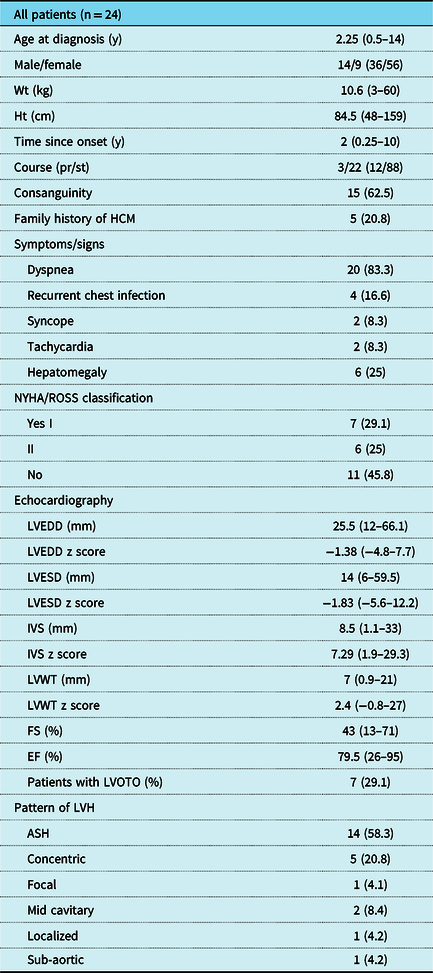
The current study included 24 hypertrophic cardiomyopathy patients (15 males and 9 females) presented to Cairo University Children’s Hospital. The patients’ age ranged from 0.5 to 14 years with a median of 2.75 years. The initial age of presentation was below 2 years in 18/24 (75%) of patients. Consanguinity was positive in 15/24 (62.5%) of patients. Positive family history was present in 5/24 (20.8%) of patients. The main presenting symptoms were dyspnea (83.3%) followed by recurrent chest infections (16.6%). Asymmetrical septal hypertrophy was the most common phenotype (58.3%). Left ventricle outflow tract obstruction was present in 7/24 (29%) of patients. The electrocardiogram of all patients showed a varying degree of sinus tachycardia and high voltage left ventricular preponderance and no one had arrhythmia. Demographic, clinical, and echocardiography data of the patients are summarised in Table 1. Full clinical data can be found in supplementary Table 1.
Demographic, clinical and echocardiographic characteristics of the studied group

Data are presented as n (%) or Median (interquartile range). ASH: asymmetric septal hypertrophy, HCM: Hypertrophic Cardiomyopathy, IVS: Interventricular septal thickness, LVEDD: Left ventricular end-diastolic dimension, LVESD: Left ventricular end-systolic dimension, LVH: Left ventricular hypertrophy, LVOTO: left ventricular outflow tract obstruction, LVWT: Left ventricular wall thickness, NYHA: New York Heart Association, Pr: Progressive, St: Stationary, Y: Year
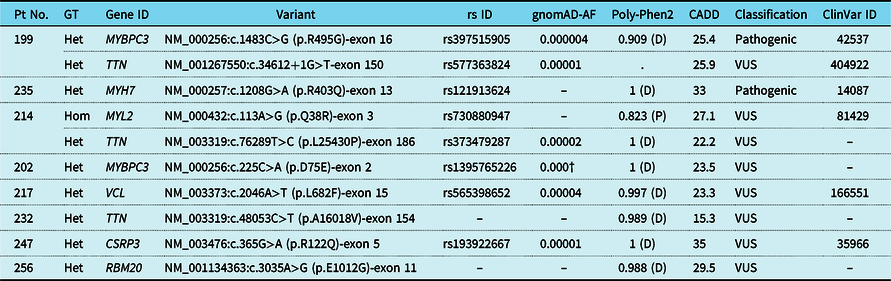
Among the 24 patients, 10 rare variants were detected in 8 patients. Per the American College of Medical Genetics and Genomics guidelines, Reference Richards, Aziz and Bale46 we classified MYBPC3:p.R495G, MYH7:p.R403Q as “Pathogenic” explaining only 2/24 (8.3%) of patients. Four other variants, that were reported in ClinVar: MYL2:p.Q38R, CSRP3:p.R122Q, VCL:p.L682F, and TTN:c.34612+1G>T, were classified as variants of uncertain significance. We also identified four rare variants (TTN:p.L25430P, TTN:p.A16018V, MYBPC3:p.D75E; RBM20:p.E1012G) that have not been previously reported in hypertrophic cardiomyopathy patients. These variants were also classified as variants of uncertain significance per the American College of Medical Genetics and Genomics guidelines (Table 2). Reference Richards, Aziz and Bale46
Variants identified in eight HCM patients

D: damaging, GT: Genotype, Het: heterozygous, Hom: homozygous, P: probably damaging, Pt No.: Patient Number, VUS: variant of unknown significance.
* Allele Count is zero (i.e., no high-confidence genotype)
The pathogenic variant MYBPC3:p.R495G was detected in a 14-year-old male (patient 191) who presented at the age of 4 years with low cardiac output symptoms mainly dyspnea on exertion. Echocardiography examination revealed hypertrophic obstructive cardiomyopathy. The patient was born to consanguineous parents who were examined by echocardiography and were healthy. The proband had a younger brother who presented at the age of 3 years with the same symptoms and was diagnosed with hypertrophic obstructive cardiomyopathy as well. This variant had been previously reported in children (sporadic Reference Morita, Rehm and Menesses23 and familial Reference Frisso, Limongelli and Pacileo47 ), in adult patients with overt phenotype Reference Page, Kounas and Syrris48 and non-affected family members. Reference Yiu, Atsma and Delgado49
The pathogenic variant MYH7:p.R403Q was detected in a 13-year-old male (patient 235) presented at the age of 3 years with dyspnea on exertion and tachycardia. Electrocardiogram was normal and echocardiography was consistent with hypertrophic cardiomyopathy. The patient was born to non-consanguineous parents. The patient’s father had hypertrophic cardiomyopathy and died at the age of 40 and he had two uncles died with hypertrophic cardiomyopathy as well. This variant had been reported many times in association with hypertrophic cardiomyopathy, either familial Reference Geisterfer-Lowrance, Kass and Tanigawa50–Reference Norrish, Jager and Field52 or sporadic Reference Atiga, Fananapazir, McAreavey, Calkins and Berger53 in both children Reference Kaski, Syrris and Esteban24 and adults. Reference Van Driest, Jaeger and Ommen54 Some of the previously reported patients presented with early-onset, severe phenotype, or premature death. Reference Kaski, Syrris and Esteban24,Reference Geisterfer-Lowrance, Kass and Tanigawa50 Many functional studies using animal models Reference Tyska, Hayes, Giewat, Seidman, Seidman and Warshaw55,Reference Lowey, Bretton, Gulick, Robbins and Trybus56 and in vitro testing supported the functional impact of this variant. Reference Abraham, Bottomley and Dimaano57 This variant has also been reported in a patient with left ventricular non-compaction (OMIM 300183) Reference Miller, Hinton and Czosek58 and another patient with hypertrophic cardiomyopathy, left ventricular non-compaction, and coronary fistulae. Reference Delgado, Moreira and Rodrigues59
Discussion
Paediatric cardiomyopathies are progressive and often lethal disorders and the most common cause of heart failure in children. Reference Vasilescu, Ojala and Brilhante60 Despite their severe outcomes, their genetic etiology is still poorly characterised. Reference Vasilescu, Ojala and Brilhante60 The massively parallel sequencing capabilities of next-generation sequencing made it possible to study many or even all genes simultaneously at an affordable cost and time. Reference Faita, Vecoli, Foffa and Andreassi61 A guideline by the Heart Failure Society of America and the American College of Medical Genetics and Genomics recommended genetic testing for cardiomyopathies using multi-gene panel testing. The most important indication for genetic testing in hypertrophic cardiomyopathy patients is the identification of the causative variant that enables screening the relatives who are at risk, early diagnosis, and identifying young mutation carriers many years before clinical disease onset. This enables clinical surveillance of mutation carriers and prevents unnecessary follow-up of non-carriers. Reference Mogensen, Van Tintelen and Fokstuen62
Sarcomeric variants are the most common cause of hypertrophic cardiomyopathy in children. Reference Kaski, Syrris and Esteban24 Mutations in MYH7 and MYBPC3 are the most common cause of paediatric hypertrophic cardiomyopathy, which is similar to the adult hypertrophic cardiomyopathy. Reference Morita, Rehm and Menesses23,Reference Reza, Musunuru and Owens63 Mutations in other sarcomere genes, TNNT2, TNNI3, TPM1, ACTC1, MYL2, and MYL3, can also cause hypertrophic cardiomyopathy in children. Reference Maron, Maron and Semsarian64 Non-sarcomeric genetic variants had been identified in children with ventricular hypertrophy and malformation syndromes, inborn errors of metabolism, or neuromuscular disorders. Reference Colan, Lipshultz and Lowe65
In the current study, cardiomyopathy associated genes were analysed in 24 unrelated paediatric hypertrophic cardiomyopathy patients. Ten variants were detected in eight patients; two variants were pathogenic (MYBPC3 p.R495G and MYH7:p.R403Q) explaining only 8.3% of patients, and eight variants of uncertain significance in MYBPC3, MYL2, RBM20, CSRP3, VCL, and TTN. Those variants of uncertain significance are rare and predicted in Silico to be damaging; however, further studies including functional studies and segregation analyses remain to be done to confirm their potential role in the pathogenesis of hypertrophic cardiomyopathy.
In this study, 22 (91.6%) patients remained genetically unsolved, of which 3 had a positive family history of hypertrophic cardiomyopathy. Studies from the National Heart, Lung, and Blood Institute-funded Paediatric Cardiomyopathy Registry have shown that causes are established in very few children with cardiomyopathy, yet genetic causes are likely to be present in most. Reference Wilkinson, Landy and Colan66 The positive detection rate (8.3% with a pathogenic or likely pathogenic variant) reported in the current study is lower than that (26–39%) of reported in other populations. Reference Vasilescu, Ojala and Brilhante60,Reference Ouellette, Mathew and Manickaraj67,Reference Li, Bainbridge, Tan, Willerson and Marian68 The differences in the total positive rate among the different population studies could be attributed to the different genetic causes, the phenotypic composition of the cohorts, the inclusion of secondary cardiomyopathy, different next-generation sequencing strategies used, and including different age groups Reference Lu, Wu and Liu69 as shown in Supplementary Table 2. The lower positive genetic detection rate in the studied group suggests that the genetics of hypertrophic cardiomyopathy in Egyptian patients might be different, particularly with the high rate of consanguinity.
Studies had investigated a few hypertrophic cardiomyopathy genes (MYBPC3, MYH7, and TNNT2) in Egyptian patients Reference Kassem, Azer and Ayad70,Reference Sh Kassem, Walsh and Barton71 using different methodologies from denaturing high-performance liquid chromatography/Sanger technologies to targeted next-generation sequencing panels. These studies tested patients with a wide range of age of onset (2–70 years with 53% <40 years), whereas the current study exclusively investigated children <16 years. This is the first national study analysing sarcomeric and non-sarcomeric mutations in a cohort of Egyptian paediatric hypertrophic cardiomyopathy patients using next-generation sequencing. This work had a number of limitations including the small sample size that limited statistical analysis, lack of segregation analysis, and functional studies. In addition, although there is no sequencing database of Egyptian population, we used gnomAD, which is the largest publicly available dataset for population-based allele frequencies, for our analyses.
In Egypt, with the high burden of consanguinity and inherited diseases, including genetic testing in the routine diagnostic service is important. Currently, in Egypt, even the major sarcomere genes are not routinely tested in cardiomyopathy patients. One of the most important steps to promote the practice of genomic medicine is improving the knowledge of physicians about the benefits of proper genetic testing for better patient outcomes through timely therapeutic strategies and early intervention in at-risk cases.
Conclusion
Similar to adult hypertrophic cardiomyopathy, mutations in MYPC3 and MYH7 are the major cause of hypertrophic cardiomyopathy in children. Next-generation sequencing is an important tool for uncovering the genetic background of idiopathic paediatric hypertrophic cardiomyopathy. Our data suggests a hypothesis that the genetics of paediatric hypertrophic cardiomyopathy might be different in Egyptian patients. Genome-wide tests (i.e., whole exome/genome sequencing) might be more suitable than a targeted testing approach, to improve our understanding of the genetics and management of paediatric cardiomyopathy among Egyptian children. Segregation analysis, functional studies, and the development of a large Egyptian control database are highly needed for genetic testing in Egypt, especially to confirm the pathogenicity of the potential variants of uncertain significance.
Supplementary material
To view supplementary material for this article, please visit https://doi.org/10.1017/S1047951120003157
Acknowledgements
We thank the patients and their families for participating in this study. The authors thank Christine Seidman, M.D., Professor of Medicine at Harvard Medical School and director of the Cardiovascular Genetics Center at Brigham and Women’s Hospital for her scientific guidance to conduct this study.
Financial support
This work was supported by the Science and Technology Development Fund (Centers of Excellence grants) (grant number 5288), Cairo, Egypt. The funder had no role in study design, data collection, and analysis, or preparation of the manuscript. Dr. Alireza Haghighi is funded by the American Heart Association and Saving tiny Hearts Society.
Conflicts of interest
None.
Ethical standards
The authors assert that all procedures contributing to this work comply with the ethical standards of the relevant national guidelines on human experimentation and with the Helsinki Declaration of 1975, as revised in 2008, and has been approved by the institutional committees (the ethical committee of the Faculty of Medicine, Cairo University).