Research on how personal variables or parental variables influence acculturation stress in first and second generation adolescent immigrants is scarce. This study intends to explore whether motivational values of these immigrants and their parents are useful to explain their experiences of discrimination.
We have chosen to explore the associations between these variables among Romanian and Moroccan first and second generation young immigrants in Spain. Romanian and Moroccan immigrants are the two largest immigrant groups in Spain. There are 913,000 Romanians and 859,000 Moroccans (17% and 16% of the immigrant population respectively) living in Spain (Secretaría General de Inmigración y Emigración, 2012). It is estimated (European Social Survey Round 6 data, 2012) that almost 14% of immigrants in Spain perceive group discrimination, in contrast to a smaller percentage (5%) of people born in the country. The European Social Survey also indicates that 2% of Spaniards feel they belong to a minority, whereas 21% of Moroccans and 9% of Romanians in Spain see themselves as a minority. Additionally, roughly one fifth of Moroccans and of Romanians (19% and 23% respectively) feel they are discriminated against in the country. Consistent with these figures, Gil-González, Vives-Cases, Borrell, Agudelo-Suárez, and Álvarez-Dardet (Reference Gil-González, Vives-Cases, Borrell, Agudelo-Suarez and Álvarez-Dardet2013) state that 17% of male and 21% of female immigrants from low-income countries perceive discrimination. Additionally, Moroccans and Romanians are not only subject to discrimination by Spaniards, since they are the least valued groups of immigrants by other immigrant groups, including themselves when valuing each other (Cuadrado, López-Rodríguez, & Navas, Reference Cuadrado, López-Rodríguez and Navas2016).
Regarding their acculturative experience, immigrant adolescents show less life satisfaction compared to host society adolescents. First generation immigrant adolescents also show greater acculturative stress (Briones, Reference Briones2010). Moreover, although North African immigrants report the lowest difficulty in adapting to Spain (Zlobina, Basabe, Páez, & Furnham, Reference Zlobina, Basabe, Páez and Furnham2006), Moroccan children and adolescents show more social anxiety than host society adolescents (León, Felipe, Gómez, Gozalo, & Latas, Reference León, Felipe, Gómez, Gozalo and Latas2007).
One of the biggest sources of acculturation stress is perceived discrimination. Perceived discrimination is the individual’s subjective perception of being treated unfairly for being member of a particular group. Thus, discrimination may happen without being perceived by the individual or it may be perceived in situations where it does not exist. Perceived discrimination, in contrast with actual discrimination, may be directly influenced by personal variables, but little attention has been paid to psychological factors within the individual that influence the extent to which they perceive discrimination (Phinney, Madden, & Santos, Reference Phinney, Madden and Santos1998).
Perceived discrimination is related to a number of negative effects for the individual. There is a strong relationship between perceived discrimination and, among other variables, psychological stress (Jasinskaja-Lahti, Liebkind, & Perhoniemi, Reference Jasinskaja-Lahti, Liebkind and Perhoniemi2006; Liebkind & Jasinskaja-Lahti, Reference Liebkind and Jasinskaja-Lahti2000); psychological well-being (Banerjee, Reference Banerjee2008); psychological adjustment (Jasinskaja-Lahti & Liebkind, Reference Jasinskaja-Lahti and Liebkind2001) stressful experiences and psychological symptoms (Neto, Reference Neto2006); childhood anxiety (Suárez-Morales & López, Reference Suárez-Morales and López2009); depression and depressive moods (Mesch, Turjeman, & Fishman Reference Mesch, Turjeman and Fishman2008; Phinney et al., Reference Phinney, Madden and Santos1998), and in general more negative mental and physical health (Pascoe & Richman, Reference Pascoe and Richman2009). Delgado, Updegraff, Roosa, and Umaña-Taylor (Reference Delgado, Updegraff, Roosa and Umaña-Taylor2011) also argue that perceived discrimination is related to an increase in risky behaviors, affiliation with delinquent peers and depression symptoms. Additionally, Bobowik, Basabe, and Páez (Reference Bobowik, Basabe and Páez2014) found that explaining negative outcomes as a result from other people’s prejudice is negatively correlated to well-being.
Motivational values and acculturation
Schwartz’s (Reference Schwartz and Zanna1992) universal motivational values model provides a suitable frame to analyze the link between motivational values, perceived discrimination and acculturation stress in immigrants. His theory of universal basic values arranges values into ten motivational value types: benevolence (preserving and improving the welfare of close ones); tradition (commitment to cultural and religious practices and ideas); conformity (restraint of impulses and to violate social expectations or norms); security (security and stability in society, relationships and the self); power (control over people and resources); achievement (displaying personal competence according to social standards); hedonism (pleasure and sensual gratification); stimulation (search for excitement, challenges and novelty); self-direction (independent thinking and action); and universalism (tolerance and protection for all people and nature).
In turn, these ten value types are arranged into two bipolar dimensions. One dimension opposes openness to change orientation (self-direction, hedonism and stimulation) to conservation (conformity, tradition and security). The second dimension opposes self-transcendence (universalism and benevolence) to self-enhancement (power, achievement and hedonism).
Values may influence immigrant’s acculturation stress both directly and indirectly due to the existing discrepancies between immigrant values and host culture values. In the case of Spain, Spaniards and nationals from the largest immigrant groups have both a high orientation towards benevolence and a disregard for power and stimulation values. However, immigrants value security, tradition and power more, and hedonism and stimulation less compared to Spaniards (World Values Survey, 2010–2014). In the case of Moroccans, both first and second generation immigrants hold very traditional values compared to other immigrants (Arends-Tóth & van de Vijver, Reference Arends-Tóth and van de Vijver2009), and Moroccan adolescents have a stronger bond with their parents and are also less autonomous than host society adolescent (Huiberts, Oosterwegel, Vandervalk, Vollebergh, & Meeus, Reference Huiberts, Oosterwegel, Vandervalk, Vollebergh and Meeus2006).
Concerning the role of values in immigrants’ perception of their acculturation experience, variables in the openness to change vs. conservation dimension from Schwartz’s model have been associated to acculturation stress in previous research. Fassaert et al. (Reference Fassaert, De Wit, Tuinebreijer, Knipscheer, Verhoeff, Beekman and Dekker2011) found that conservative and traditional values were related to less psychological distress among Moroccan and Turkish immigrants in the Netherlands. Similarly, Jasinskaja-Lahti and Liebkind (Reference Jasinskaja-Lahti and Liebkind2001) report that traditional values in immigrants were related to better psychological adjustment.
As regards openness to change, Idemudia (Reference Idemudia2011) showed that openness values are relevant to explain acculturation stress since they predicted higher perceived discrimination in immigrants. Additionally, he found that self-enhancement values are related to increased stress and poorer mental health in African immigrants in Germany, whereas self-transcendence values were related to good mental health. There are some other evidences of the role of openness in acculturation. For instance, Tartakovsy and Schwartz (Reference Tartakovsky and Schwartz2001) argue that self-development, which can be construed as an expression of openness to change that emphasizes self-direction, creativity and challenge, is a component of the motivation to emigrate.
Values influence the interplay between immigrant expectations and experiences. Yijälä, Lönnqvist, Jasinskaja-Lahti, and Verkasalo (Reference Yijälä, Lönnqvist, Jasinskaja-Lahti and Verkasalo2012) argue that immigrants high in openness to change may expect less difficulties in adapting when moving to a new country and will be more inclined to interact with the host culture members. In this line, Mähönen, Leinonen, and Jasinskaja-Lahti (Reference Mähönen, Leinonen and Jasinskaja-Lahti2013) found that the more the immigrants’ expectations are exceeded, the better their well-being after migration. The flip side, as Mähönen and Jasinskaja-Lahti (Reference Mähönen and Jasinskaja-Lahti2013) point out, is that immigrants who had anticipated less difficulties before migration than what they actually experienced had a low psychological well-being. They argue that the extent to which post-migration experiences confirm or disconfirm previous expectations affects psychological adaptation, and that psychological distress increased in case of negative disconfirmation. Hence, people with positive expectations about interactions will tend to approach members of other groups and this may result in a mismatch between expectations and reality. Ward, Leong, and Low (Reference Ward, Leong and Low2004), also support this assumption. Contrary to their hypothesis, they did not find openness to change to be related to better psychological adjustment and less depression in immigrants. A possible explanation is that openness to change leads to being more sensitive to perceiving discrimination, which increases psychological and acculturation stress.
Openness to change is also associated to acculturative assimilation strategies in immigrants (Zlobina, Basabe, & Páez, Reference Zlobina, Basabe and Páez2008). Assimilation involves seeking acceptance and interaction with the dominant group and it may be the case that immigrants higher in openness values using an assimilation strategy will be more sensitive to the perception of discrimination due to this increased interaction. Adolescents oriented towards assimilation tend to have more intergroup contact with host society peers (Agirdag, van Houtte, & van Avermaet, Reference Agirdag, van Houtte and van Avermaet2010), and ethnic minority children with high intergroup contact were more likely to rate race-based exclusion as wrong (Ruck, Park, Killen, & Crystal, Reference Ruck, Park, Killen and Crystal2011).
In addition, Gungor (Reference Gungor2007) argues that value orientations are important to grasp the dynamics of immigrant adaptation and acculturation. Immigrants oriented towards conformity tended to maintain their culture, while those with a separational or individualist orientation were more open to contact with the host society and seek assimilation. However, immigrants with a separational orientation had poorer psychological adaptation. Arguably, an orientation towards conformity favors maintaining the immigrant’s culture while an orientation towards openness to change is more likely to seek assimilation in the host culture, thus increasing contact with host society members. Hence, we expect values to be also related to perceived discrimination, since assimilation in the host culture involves both pursuing acceptance and perceiving that one is being accepted.
Parental influence on motivational values
It is also important to consider that parents influence the acquisition of value orientations in children. Tam, Lee, Kim, Li, and Chao (Reference Tam, Lee, Kim, Li and Chao2012) found that values that parents consider important are to some extent internalized by children, and Knafo and Schwartz (Reference Knafo and Schwartz2001) show that children’s personal values are related to parent’s socialization values.
Parental values are an important predictor of immigrant adolescents’ values (Pérez-Brena, Updegraff, & Umaña-Taylor, Reference Pérez-Brena, Updegraff and Umaña-Taylor2015), particularly in the case of values associated to tradition and conformity. Friedlmeier and Trommsdorff (Reference Friedlmeier and Trommsdorff2011) state that there is a moderate correlation between immigrant mothers’ and their children’s collectivistic values and that similarities between mother and child are stronger for collectivistic than for individualistic values. Schönpflug (Reference Schönpflug2001) states than although most adolescents values are positively correlated to parental values among immigrants, collectivistic values serve group preservation and cooperation so they are more readily transmitted. In this sense, Stewart, Bond, Deeds, and Chung (Reference Stewart, Bond, Deeds and Chung1999) found that family interdependence persists despite the adoption of individualist values in collectivistic cultures in the process of modernization, as it can be the case of immigrant families from collectivistic countries exposed to an individualist host culture.
There are some studies that specifically highlight the role of parental transmission of values in second generation immigrants as a relevant influence. Cultural values and parental variables have been found to influence the acculturative experiences of immigrant adolescents (Jasinskaja-Lahti & Liebkind, Reference Jasinskaja-Lahti and Liebkind2001), and Phalet and Schönpflug (Reference Phalet and Schönpflug2001) show that Muslim immigrant parents in different acculturation contexts transmit collectivistic values both directly and indirectly and suppress autonomy and achievement values, with the exception of more achievement oriented parents who have comparatively less collectivistic children. Additionally, Schönpflug and Yan (Reference Schönpflug and Yan2013) argue that the relative parental motivation to transmit either individualism o collectivism values mediates in children’s acquisition of values, which suggests that the transmission mechanism is not straightforward.
Parental influence on perception of discrimination in immigrants
Parents who experience discrimination may be more likely to think that their children will be exposed to discrimination too and to provide their children with tools for coping with it. In particular, they are likely to implement Preparation for Bias socialization for children and other forms of racial socialization (Hughes, Reference Hughes2003). Racial discrimination is associated with racial socialization and to socialize children according to parental experiences of discrimination, partly in fear they may become targets for discrimination (Berkel et al., Reference Berkel, Murry, Hurt, Chen, Brody, Simons and Gibbons2009; Hughes & Johnson, Reference Hughes and Johnson2001; Smith, Reynolds, Fincham, & Beach, Reference Smith, Reynolds, Fincham and Beach2016). Additionally, Benner and Kim (Reference Benner and Kim2009) found that immigrant parent’s perception of discrimination influenced their children perception of discrimination, and León (Reference Leon2014) states that acculturative stress in parents relates to anxiety in children.
Hughes et al. (Reference Hughes, Rodriguez, Smith, Johnson, Stevenson and Spicer2006) argue that parents draw on ethnic and racial socialization to make their children aware of discrimination and able to cope with it. Children’s experiences of discrimination also prompt parents to discuss discrimination with them and they warn them about other groups or barriers they may encounter due to their ethnicity.
Berkel et al. (Reference Berkel, Murry, Hurt, Chen, Brody, Simons and Gibbons2009) provide insight into the intergenerational transmission of discrimination. They argue that adolescents who receive more ethnic-racial socialization messages are more likely to report experiencing discrimination across contexts, and they are more likely to report acculturative stress. The amount of socialization messages is associated with reports of discrimination in adolescents. Moreover, adolescents may witness their parents’ discrimination experiences and this may heighten their awareness towards discrimination against them. Parents stress over being discriminated as foreigners mediates the relationship their experiences of discrimination and their children’s. Thus, adolescents may not be directly victims of discrimination, but they can be influenced by their parents’ experiences. Nevertheless, experiences of discrimination between parents and youths are generally significantly correlated.
Our main interest in the current study was to examine, following Schwartz’s model, the role of motivational values in the explanation of the experience of discrimination among first and second generation young immigrants. While there has been little support for the influence of the self enhancement vs. self transcendence dimension in previous research, some evidence has been found regarding openness to change and conservation values. Thus, the following hypothesis was proposed:
The openness to change vs. conservation dimension will be related to the experience of discrimination among young immigrants.
We expect that the above relationships also hold true for their parents, so a similar hypothesis will be tested regarding them:
The openness to change vs. conservation dimension will be related to the experience of discrimination among immigrant parents.
Parental experiences and motivations are expected to shape young immigrants experienced discrimination and values orientation relationship, and thus a final hypothesis is proposed:
Parental experience of discrimination will mediate the relationship between young immigrants’ values and experiencing discrimination.
Method
Participants
Participants in the study were recruited through immigrant associations or in places were immigrants usually meet, like cafeterias popular with immigrants or mosques. After dropping from the study a number of participants who were either too old or whose parents had arrived to Spain too recently, the sample consisted of 193 pre-adolescents to young adult first and second generation immigrants paired with one of their parents. Young immigrants were aged 11 to 22 (M = 14.90, SD = 3.19). A total of 19% of Moroccan origin and 4% of Romanian origin immigrants were born in Spain. For those born abroad, the average length of stay was 7.04 years (SD = 4.18) for Moroccans and 4.56 years (SD = 4.36) for Romanians. Their parents were aged 28 to 70 (M = 45.42; SD = 8.23), and had lived from 2 to 31 years in Spain (M = 8.72; SD = 5.29). The sample was evenly distributed for gender (54% male, 46% female). Paired parents were also evenly distributed for gender (48% male and 52% female). Parents had either low-skill jobs or were unemployed (14%). They were evenly divided by country of origin: 107 were Romanian and 86 were Moroccan.
Procedure and design
Romanian and Moroccan native students fluent in Spanish were recruited and trained as interviewers to administer the study measures. The measures were administered in interview format and were initially given in Spanish, since our participants were fluent in Spanish, attended to school in Spain, and 94% of adolescent participants and 97% of parents spoke Spanish on a daily basis. Nevertheless, whenever clarification was needed, as much of the interview as requested was translated to their national languages by our interviewers. The study was advertised in immigrant associations. Parents were approached first or showed up together with their children. Prior to the interview consent was obtained from parents and children. Second generation participants and parents were interviewed separately in a quiet room in immigrant associations’ facilities. Participants were rewarded with a €10 voucher.
Measures
Young immigrants and their parents answered to measures on their experience of being discriminated against and motivational values. These measures were kept the same, as far as possible, for parents and their children in order to have comparable scores for the responses of the dyads in the study.
Experience of discrimination
Both young participants and their parents completed the Adolescent Discrimination Distress Index (ADDI; Fisher, Wallace, & Fenton, Reference Fisher, Wallace and Fenton2000) measures perceived discrimination and socio-cultural stress on three different contexts: institutional (“You were hassled by a store clerk or a store guard”); educational (“You were given a lower grade than you deserved”); and peer (“Others your age did not include you in their activities”). Parents did not answer to the educational discrimination questions, so the questionnaire was 15 questions long for the adolescent participants and 11 for their parents. Participants answered on a 5-point scale ranging from 1 (not at all) to 5 (extremely), whether they have experienced the described situation because of their race or ethnicity, and if they had, how much it had upset them. The adaptation of the ADDI to parents was not problematic, since it accounted for situations adults could also encounter in their everyday lives and the authors had initially adapted it from measures designed for adults.
Since we were interested in the global perceived discrimination and stress in our participants rather than the specific contexts of discrimination, we considered the ADDI as single scales. Additionally, since perception of discrimination and discrimination stress were highly correlated, we aggregated both variables into a single index to summarize discrimination experienced by immigrants. The reliability score for this aggregate measuring the experience of discrimination was high (α = .97) in young participants, and similar results were obtained for parents (α = .95).
Motivational values
Parents and adolescents answered to the Schwartz Values Survey (SVS; Schwartz, Reference Schwartz and Zanna1992). This questionnaire describes 56 values and participants indicate their identification with these values using a scale ranging from 7 (maximum importance) to –1 (opposed to my values).
SVS measures the ten motivational value types present in Schwartz’s model. These value types are grouped into four orientations. In turn, these orientations are arranged into two bipolar dimensions (openness to change vs. conservation and self enhancement vs. self transcendence). The SVS has been found to be adequate for measuring values in children and adolescents (Páez & De-Juanas, Reference Páez and De-Juanas2015).
The variable of interest in our study, Openness to change vs. conservation had a Cronbach’s alpha of .86 for the young participants and .85 for their parents.
Data analyses
Data transformation
SVS values were centered following the procedure described in Schwartz (Reference Schwartz and Zanna1992). To account for both Schwartz’s value dimensions, scores for conservation orientation were subtracted from openness to change orientation to obtain an openness to change vs. conservation score and self enhancement vs. self transcendence scores were obtained in the same way.
Mediation analysis
In order to test the three hypothesis in the study we used AMOS 18.0 (Arbuckle, Reference Arbuckle2009) to test a Structural Equation Model (SEM) were the relationship between parental motivational values and experience of discrimination mediated this same relationship in young immigrants. We checked the explanatory potential of motivational values on the experience of discrimination and whether this relationship was mediated by parental influences. We also performed separate analyses for both Romanian and Moroccan immigrants within the same model.
The SEM analysis was performed using bootstrapping resampling (2000 resamples; 95% bias-corrected confidence interval). Specifically, we tested the total effect of openness to change vs. conservation Schwartz’s value dimensions on experienced discrimination in young participants and its direct effect after parental openness to change and experienced discrimination were introduced in the model. Potential control variables were dropped from the model after checking that they had no significant relationships with other variables in the proposed model and did not contribute to the prediction of experienced discrimination. These variables were sex and age.
Results
Descriptive analysis
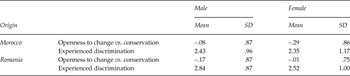
A descriptive analysis was carried out dividing our sample by origin and gender. The results for young immigrants for openness to change vs. conservation showed slightly negative results, indicating that both Romanian and Moroccan, male and female participants were somewhat oriented towards conservation. They also show moderate means for the experience of discrimination scale, ranging from 2.35 to 2.84 (in a 5-point scale). Romanian participants, in particular males, scored higher, as Table 1 shows.
Descriptive statistics for variables in the model: Young immigrants

Morocco: male, N = 55; female, N = 31 / Romania: male, N = 49; female, N = 58.
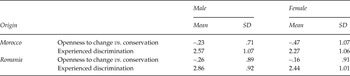
The same pattern of results was reproduced for the parents, as Table 2 shows:
Descriptive statistics for variables in the model: Parents

Morocco: male, N = 41; female, N = 45 / Romania: male, N = 51; female, N = 56.
Comparisons by country of origin, gender and age
In order to test whether participants differed in the target variables according to their gender or country of origin, several t-tests were performed. There were no differences in young immigrants by country of origin. There were gender differences for young participants, and males experienced significantly more discrimination than females, t(193) = 1.12, p < .05, d = .16; M = 2.62, SD = .94, vs. M = 2.46, SD = 1.06. Age did not correlate either with any of the variables analyzed.
Parents did not differ by country of origin or gender in any of the variables in the study. Parent age correlated modestly with their own experiences of discrimination, r = .23, p < .001, and their children’s, r = .27, p < .01.
Mediation analysis
Variables in the model showed differences depending on the country of origin and gender of the participants. However, as described in the data analyses section, neither parents’ or young immigrants’ gender or age contributed to improve the model, and they were subsequently dropped from it.
As table 3 shows, both for Moroccans and Romanians, experiencing discrimination in young participants and their parents was highly inter-correlated, while correlations of the experience of discrimination with values dimensions in parents and their children were moderate.
Bivariate correlations for variables in the mediation model

Upper half: Moroccans (N = 86), Lower half: Romanians (N = 107).
* p < .05; **p < .01; ns = non significant.
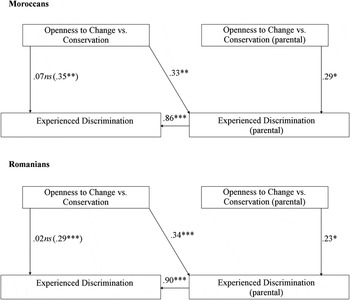
The SEM model had an adequate fit, χ2(2, N = 193) = 2,272 p = .321; RMSEA = .027; CFI = .999; NFI = .994. The model for both Romanian and Moroccan participants is convergent. It yielded a large R 2 for experience of discrimination in young immigrants, both for the Moroccan group (R 2 = .79, p < .01, 95% CI [.68, .88]), and the Romanian group (R 2 = .80, p < .01, 95% CI [.71, .86]). The critical ratios for differences between parameters shows no differences between Romanian and Moroccan participants in any path of the model. In both samples the total effect for openness to change vs. conservation on experienced discrimination (Moroccans: β = .35, p < .01; Romanians β = .29, p < .001) changed to a non-significant direct effect after parental variables were introduced in the model, and the relationship between openness to change vs. conservation and parental experienced discrimination was also significant (Moroccans: β = .33, p < .01; Romanians β = .34, p < .01) showing a full mediation effect in both cases. Figure 1 shows the standardized direct effect paths in the model. Significant standardized total effects are also included (in brackets).
Direct effects in the Mediation model for parental variable on the relationship between Motivational Values and Discrimination in second generation immigrants.
*p < .05; **p < .01; ***p < .001; ns = non significant. Values in brackets are total effects. Model chi-square (2, N = 193) = 2.272, P = .321; RMSEA = .027; CFI = .999; NFI = .994.

Discussion
Our results show that motivational values and parental influences are relevant for explaining the experience of discrimination among young immigrants, and that these relationships persist across different groups of immigrants.
The proposed model accounts for the hypotheses in the study. Looking at the total effects in both samples, young immigrants’ openness to change vs. conservation dimension predicts the experience of discrimination (perceived discrimination and discrimination stress), supporting our first hypothesis. Parental openness to change vs. conservation dimension shows the same relationship with their experienced discrimination, showing support for our second hypothesis.
Both samples shows great convergence in the model, and parental values predict the parental experience of discrimination, which in turn predicts the same variable in their children.
A possible explanation for our results regarding openness to change vs. conservation is that both young immigrants and parents high in openness to change are likely to pursue contact with the host culture more intensely, and thus increase the probability of interactions involving discrimination. These immigrants may also have higher expectations for their interactions with host culture members and become disappointed more often. Furthermore, immigrants high in conservation orientation are known to suffer from less psychological distress (Fassaert et al., Reference Fassaert, De Wit, Tuinebreijer, Knipscheer, Verhoeff, Beekman and Dekker2011), either because the conformity values related to conservation leads to higher compliance with a distressful environment, or because being more strongly rooted in their own tradition acts as a shelter against acculturation stress. On top of this, not only their own values, but also parental influences play a significant role in immigrant adolescents’ experience of discrimination.
Banerjee (Reference Banerjee2008) finds that long-term immigrant status is positively related to perceived discrimination. This is congruent with our hypotheses, since longer-term immigrants are more likely to pursue integration or assimilation and thus being more involved with the host community. Pérez, Fortuna, and Alegría (Reference Pérez, Fortuna and Alegría2008) also found that more acculturated immigrants and those more exposed to the host culture perceived more discrimination. In turn, Ethnic identification buffers the effects of perceived discrimination (Maes, Stevens, & Verkuyten, Reference Maes, Stevens and Verkuyten2014). Having a strong ethnic identity may increase immigrants’ self-esteem and protect them from perceiving discrimination (Phinney, Madden, & Santos, Reference Phinney, Madden and Santos1998). Conversely, as immigrants become more assimilated, they develop a greater sensitivity to discrimination. This assimilation process is likely to be accelerated for immigrants high in openness to change.
Correlation between parents and their children values are moderate, in line with results obtained in general population samples (Friedlmeier & Trommsdorff, Reference Friedlmeier and Trommsdorff2011; Grønhøj & Thøgersen, Reference Grønhøj and Thøgersen2009), where correlations between parental and adolescents’ values are moderate. Results also show a very high relationship between parents and their children’s experience of discrimination. This correlation is less surprising if we consider that possibly both parents and children are experiencing the same type of acculturation experiences, share their acculturation experiences at home, mutually shape their interpretation to these experiences and/or hold matching attitudes about discrimination. Although this is an interesting finding in itself, the lack of information about the extent to which parents and children share experiences of discrimination is a limitation in our study and needs to be accounted for in future research, since there is a lack of studies comparing this variable in parents and their children. The moderate relationship of openness to change vs. conservation dimension with experienced discrimination shows it is just one of a number of possible external and internal influences on immigrants’ acculturation experience.
These results may have important implications for intervention. In accordance to Briones (Reference Briones2010), interventions fostering social support towards immigrants and improving social institutions aimed at immigrants can lessen their perception of discrimination. Our results suggest that these interventions must also take into account the parent’s role in the transmission of strategies to cope with discrimination and parent’s own experience of discrimination. Fostering the best parental socialization strategies may moderate acculturation stress. For instance, Maes, Stevens, and Verkuyten (Reference Maes, Stevens and Verkuyten2014) state that while ethnic socialization buffers the effects of perceived discrimination, religious identification is related to perceiving more discrimination. Also, as Berkel et al. (Reference Berkel, Murry, Hurt, Chen, Brody, Simons and Gibbons2009) point out, adolescents may be secondary victims of their parents’ experiences of discrimination, and interventions on acculturation stress must take into account what happens in the family context to provide optimal strategies to cope with discrimination.
However, we must approach our results with caution. Cross-sectional studies often assess mediation to understand the interactions between variables in a model, but correlational research is unable to test causation. The concurrent nature of our data does not allow to draw causal conclusions, so we cannot rule out other possibilities to explaining the proposed association between the variables in our study. Nevertheless, mediation models are still useful in correlational studies for predictive purposes and to test the role of mediator variables.
Apart from its correlational nature, there are a number of issues that need to be taken into account in further research. Collecting data from dyads of immigrant participants entails certain difficulties, but the age range for our sample wider than desirable, so further research should focus on more specific age groups. In order to provide further insight on how values, parental variables and the experience of discrimination relates, it would be useful to re-test our hypotheses with bigger and more diverse immigrant samples in different countries, focusing also on possible gender differences undetected in this study. A longitudinal approach would provide a better comprehension on the mechanisms relating motivational values and acculturation experiences. Our partial approach in this study does not show possible interactions with other variables. For a more detailed picture of the role of values and parental influences in acculturation stress, other internal and external variables ought to be taken into account. For instance, it would be interesting to include variables to account for intergenerational relations that may have an effect on adolescents’ acculturation (Kwak, Reference Kwak2003). Parent-child conflict or acculturation and value transmission discrepancies might moderate the effects of acculturation stress in adolescents.