This report highlights two exceptional cases of 14-year-old girls diagnosed with rare cardiomyopathies, both presenting with the unusual finding of bidirectional ventricular tachycardia.
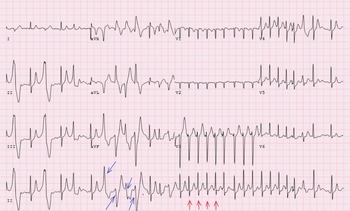
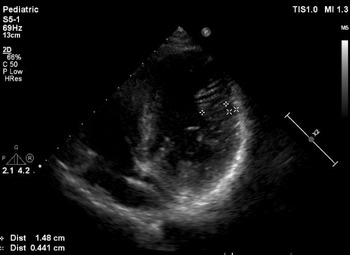
The first patient was referred, for her recurring symptomatic episodes of palpitations, particularly during physical exertion, for one year. An exercise stress test showed an increased frequency of polymorphic premature ventricular complexes, emerging in couplets, triplets, and episodes of bidirectional ventricular tachycardia (Fig. 1). Concurrently, the patient also exhibited atrial tachycardia. On an echocardiogram, the patient was confirmed to have left ventricular non-compaction cardiomyopathy) (Fig. 2). The diagnosis was further supported with cardiac MRI, and a positive LDB3 gene mutation linked to left ventricular non-compaction cardiomyopathy. The patient has been treated with propranolol and flecainide successfully.
The exercise stress test of the first patient shows bidirectional ventricular tachycardia (blue arrows) and atrial tachycardia (red arrows).

Transthoracic echocardiography of the first patient demonstrates left ventricular non-compaction.

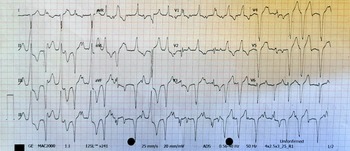
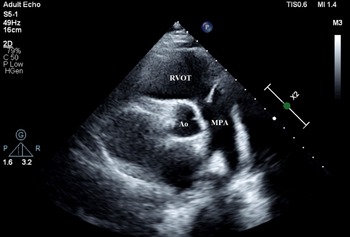
The second patient, with no significant past medical history, was noted to have non-sustained ventricular tachycardia while being treated for new-onset heart failure at another centre. The patient’s 12-lead electrocardiogram confirmed the presence of bidirectional ventricular tachycardia (Fig. 3). After a comprehensive evaluation, including echocardiography (Fig. 4), cardiac MRI, and ECG, the patient was diagnosed with arrhythmogenic right ventricular cardiomyopathy with severe biventricular systolic dysfunction. This diagnosis was based on meeting the arrhythmogenic right ventricular cardiomyopathy Task Force criteria. Reference Marcus, McKenna and Sherrill1
Electrocardiography of the second patient shows bidirectional ventricular tachycardia.

Transthoracic echocardiography of the second patient with arrhythmogenic right ventricular cardiomyopathy demonstrates the enlarged right ventricle outflow tract. Ao=aorta; MPA=main pulmonary artery.

Bidirectional ventricular tachycardia is a rare but severe form of ventricular tachycardia and is typically associated with catecholaminergic polymorphic ventricular tachycardia, Anderson-Tawil syndrome, and digoxin toxicity. Exceeding rarely, it can also be seen in other cardiomyopathies, such as arrhythmogenic right ventricular cardiomyopathy and left ventricular non-compaction cardiomyopathy, as they were present in our patients. Reference Haghjoo, Arya, Alizadeh and Sadr-Ameli2 The observed coexistence of bidirectional ventricular tachycardia in both arrhythmogenic right ventricular cardiomyopathy and left ventricular non-compaction cardiomyopathy could result from underlying genetic mutations and myocardial structural abnormalities. This could give rise to a pro-arrhythmic substrate that makes the ventricular myocardium more susceptible to multiple arrhythmic foci. The novel message conveyed from these two cases is the association of bidirectional ventricular tachycardia with two distinct cardiomyopathies, emphasising the diverse clinical presentations of arrhythmia and cardiomyopathy during childhood.
Acknowledgements
None.
Financial support
This research received no specific grant from funding agencies in the public, commercial, or not-for-profit sectors.
Competing interests
None.
Ethical standard
Informed consent was obtained from the patient’s parents.