INTRODUCTION
In a dynamic high-tech firm, new product development (NPD) is one of the most important functions for growth and survival. However, the complex and rapidly changing business environment makes predicting market demand and consumer preferences much more difficult, resulting in the high failures rates of such efforts (Ernst, Hoyer, Kraft, & Krieger, Reference Espinosa, Kraut, Slaughter, Lerch, Herbsleb and Mockus2011). Therefore, the ability to adapt to radical change within firms has become increasingly important. Specifically, because NPD always involves the combination of various resources, thus making it difficult for firms to develop new products by using individual-based designs, companies need to move from being individual-based to team-based (West & Markiewicz, Reference West2004; Lawler & Worley, Reference Lee2006).
Based on the resource-based view (RBV), organizations will benefit from the resources that team members from different functional areas may bring to the NPD projects, while at the same time sharing common objectives. However, an effective NPD team is often difficult to achieve, because of the different backgrounds, norms, and languages of NPD team members (McDonough, Reference McClough and Rogelberg2000; Haon, Gotteland, & Fornerino, Reference Im and Workman2009). Due to this, organizations have become increasingly dependent on NPD teams to boost the success rates of these projects.
When reviewing the current literature about how to improve NPD team effectiveness, more recent studies are increasingly aware of the importance of team reflexivity in this context. According to team reflexivity theory (West, Reference West and Markiewicz2000), reflexivity among team members is one of the most critical factors that leads to NPD project success (Schippers, West, & Dawson, Reference Schippers, Den Hartog, Koopman and van Knippenberg2015). Team reflexivity involves the conscious reflection that team members perform regarding the current functions, goals, and processes related to NPD (Schippers, Homan, & van Knippenberg, Reference Schippers, Edmondson and West2013). As such, team reflexivity may strengthen both teamwork and NPD performance (Konradt, Schippers, Garbers, & Steenfatt, Reference Konovsky and Pugh2015). NPD teams can be seen as systems that need to deal with high levels of uncertainty to perform their tasks (Kim & Wilemon, 2003). Following this theory, team reflexivity can be understood as a practice that allows NPD teams to process a huge amount of information, thus enabling team members to have deeper discussions, and then select the best strategies to meet customer preferences (Ellis, Carette, Anseel, & Lievens, Reference Emerson2014). While a growing number of academics are increasingly aware of the influence of team reflexivity on NPD, several research gaps still exist that need to be addressed.
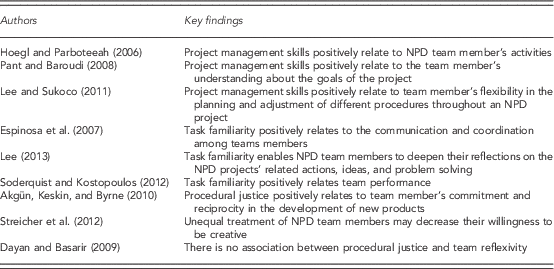
There are three project team management factors that seem to be relevant to the enhancement of team reflexivity when reviewing the current literature on this subject, namely project management skills, task familiarity of the project team, and procedural justice in the project operation process (Hoegl & Parboteeah, Reference Johnson, Arya and Mirchandani2006; Espinosa, Slaughter, Kraut, & Herbsleb, Reference Espinosa, Slaughter, Kraut and Herbsleb2007; Akgün, Keskin, & Byrne, Reference Akgün, Lynn and Yilmaz2010). Noticeably, there exists a lack of conceptual clarity and an integrative investigation regarding the effects of these factors on team reflexivity and product performance. More specifically, previous studies have diverse theoretical views on the impacts of project management skills, task familiarity, and procedural justice on NPD. For example, some draws from the Knowledge-based view (KBV) to explain the impact of task familiarity on NPD (Lee, Reference Lee and Sukoco2013), while some studies, based on the organizational justice theory (OJT) and organizational support theory (OST), demonstrate the influence of procedural justice on NPD (Schepers & van den Berg, Reference Schepers and van den Berg2007). Another research stream focuses on the effect of project management skills on NPD by using the RBV or communication perspective to provide theoretical insights on the subject (Pant & Baroudi, Reference Pant and Baroudi2008; Lee & Sukoco, Reference Lewis, Lange and Gillis2011). These varying interpretations make it difficult to compare results across studies because of the different natures and premises of the various theoretical viewpoints. Moreover, the previous empirical findings regarding the impacts of project management skills, task familiarity, and procedural justice on product performance are also ambiguous and inconsistent, as shown in Table 1. This ambiguity limits practitioners with regard to effectively developing and assessing how their project management endeavors affect team reflexivity and product performance. It is thus necessary to develop an integrative framework that brings more conceptual clarity to the nature of these project management practices in relation to NPD, and this is one aim of the current work.
Selected empirical studies regarding the antecedents of team reflexivity and product performance

Note. NPD=new product development.
Given that the results of previous studies regarding the influences of task familiarity, procedural justice, and project management skills on team reflexivity and product performance are not conclusive, this study aimed to develop a more comprehensive framework to focus on the following three research questions: (1) What are the interrelationships among task familiarity, procedural justice, and project management skills? (2) What are the influences of these factors on NPD? (3) What is the role of team reflexivity in product performance? For example, team members with high levels of project management skills tend to absorb knowledge about the NPD tasks more easily, as well as provide knowledge to support NPD decisions. In addition, task familiarity may also improve procedural justice, because greater knowledge about a task can enhance the degree of perceived justice, and lead to more understanding of the reasons for the procedures that a firm has implemented (Colquitt, Conlon, Wesson, Porter, & Ng, Reference Colquitt, LePine, Piccolo, Zapata and Rich2001). Therefore, this study aims to identify the combined effects of the above three antecedents on team reflexivity and product performance.
This work will also examine the role of team reflexivity and product performance in this context. One of the possible explanations for the mixed findings in previous studies regarding the direct effects of task familiarity, procedural justice, and project management skills on product performance could be that these relationships are indirect, and team reflexivity plays a mediating role in them. By adopting the source – positional advantage – performance outcome framework from Day and Wensley (Reference Day and Wensley1988), this study proposes team reflexivity as a positional advantage mediator that mediates the influences of task familiarity, project management skills, and procedural justice on product performance.
The remainder of this study is organized as follows. First, the relevant literature is reviewed, and then the conceptual model and hypotheses are discussed. Following this, the empirical results are presented and validated, while the main conclusions and managerial implications of this work are given in the final section.
THEORETICAL BACKGROUND
Reflexivity as the key factor of NPD
Teams may implement different types of information processes that depend on their ability to use, integrate, and distribute information among their various members (Konradt et al., Reference Konovsky and Pugh2015). Moreover, the effectiveness of decision making depends on the team’s capacity for reflection (Stasser, Vaughan, & Stewart, Reference Stasser, Vaughan and Stewart2000; Schippers, Homan, & Knippenberg, Reference Schippers, Edmondson and West2013). Through reflection, teams are more likely to adjust and take corrective actions that are aligned with the changing market environments, as well as with their projects’ stated goals (Schippers, Den Hartog, Koopman, & Wienk, Reference Schippers, West and Dawson2003). Team reflexivity enables teams to improve their understanding of how the team functions, and this may have positive impacts on innovative processes (Schippers, Den Hartog, Koopman, & van Knippenberg, Reference Schippers, Homan and van Knippenberg2008). At the same time, team members’ reflexive discussions allow them to assess their current progress through the implementation of specific actions, strategies, and decisions (Schippers, Homan, & Knippenberg, Reference Schippers, Edmondson and West2013).
This study argues that learning within organizations only happens by the sharing of different knowledge, visions, beliefs, and mental structures (Templeton, Lewis, & Snyder, Reference Teo, Wei and Benbasat2002). In this way, team reflexivity can enhance the organization’s ability to use knowledge efficiently in the development of new products (Subramaniam & Youndt, Reference Subramaniam and Youndt2005; Alegre & Chiva, Reference Anderson and Reeb2008). Following Tjosvold (Reference Tjosvold, Tang and West1991), reflection is a key element in learning, while Argyris (Reference Argyris1992) analyzed the cognitive benefits of working in teams, which team reflexivity plays a very important role in generating (West, Reference Widmer, Schippers and West1996). West (Reference Widmer, Schippers and West1996) further stated that under higher levels of uncertainty, which are characteristic of NPD projects, team reflexivity may strengthen decision making (Hoegl & Parboteeah, Reference Johnson, Arya and Mirchandani2006), thus making it easier for the team to achieve its goals.
Furthermore, Paulus and Yang (Reference Paulus and Yang2000) found that reflexivity in groups may improve innovation and creativity, which further influences the outcomes of NPD. Aligned with this, Tjosvold, Tang, and West (Reference Tjosvold2004) argued that team reflexivity improves the development innovative products, which have to meet customers’ emerging preferences.
Conceptualization of the research constructs
According to West (Reference Widmer, Schippers and West1996, Reference West and Markiewicz2000), team reflexivity is defined as the extent to which team members are able to reflect on or analyze their objectives, strategies, and processes. Teams that possess higher levels of reflexivity may be better able to recognize inappropriate tactics or strategies that may lead to failure, and thus be able to take corrective action.
Following Hoegl and Parboteeah (Reference Johnson, Arya and Mirchandani2006), this study defines project management skills as the team members’ capability to organize and manage projects. More specifically, this refers to the ability to assign team members tasks and arrange workflows (Gladstein, Reference Goodman and Garber1984), which are essential to NPD project success. In order to be efficient, team members must have the capacity to self-organize and align their tasks so that confusion and potential overlaps are avoided (Stevens & Campion, Reference Stevens and Campion1994).
Following Adams, Roch, and Ayman (Reference Adams, Roch and Ayman2005), task familiarity can be defined as the knowledge that team members possess regarding their specific tasks, as well as about other team members (Goodman & Garber, Reference Greenberg1988; Littlepage, Robison, & Reddington, Reference Luca and Atuahene-Gima1997). Task familiarity may help teams to more effectively manage complexity, as members who are familiar with their tasks and their specific settings tend to have extensive knowledge, are more able to use this, and thus have better problem-solving abilities (Espinosa et al., Reference Espinosa, Slaughter, Kraut and Herbsleb2007; Haon, Gotteland, & Fornerino, Reference Im and Workman2009).
Drawing on Greenberg (Reference Hair, Sarstedt and Ringle1987), procedural justice is defined as the team members’ perception of fairness of the procedures used to evaluate both team and team member outcomes (Colquitt et al., Reference Colquitt, LePine, Piccolo, Zapata and Rich2001; Akgün, Keskin, & Byrne, Reference Akgün, Lynn and Yilmaz2010). More specifically, procedural justice is the NPD team member’s opinions regarding the fairness of the project manager’s decisions involving the norms and procedures related to their teamwork.
PROPOSED FRAMEWORK AND HYPOTHESES DEVELOPMENT
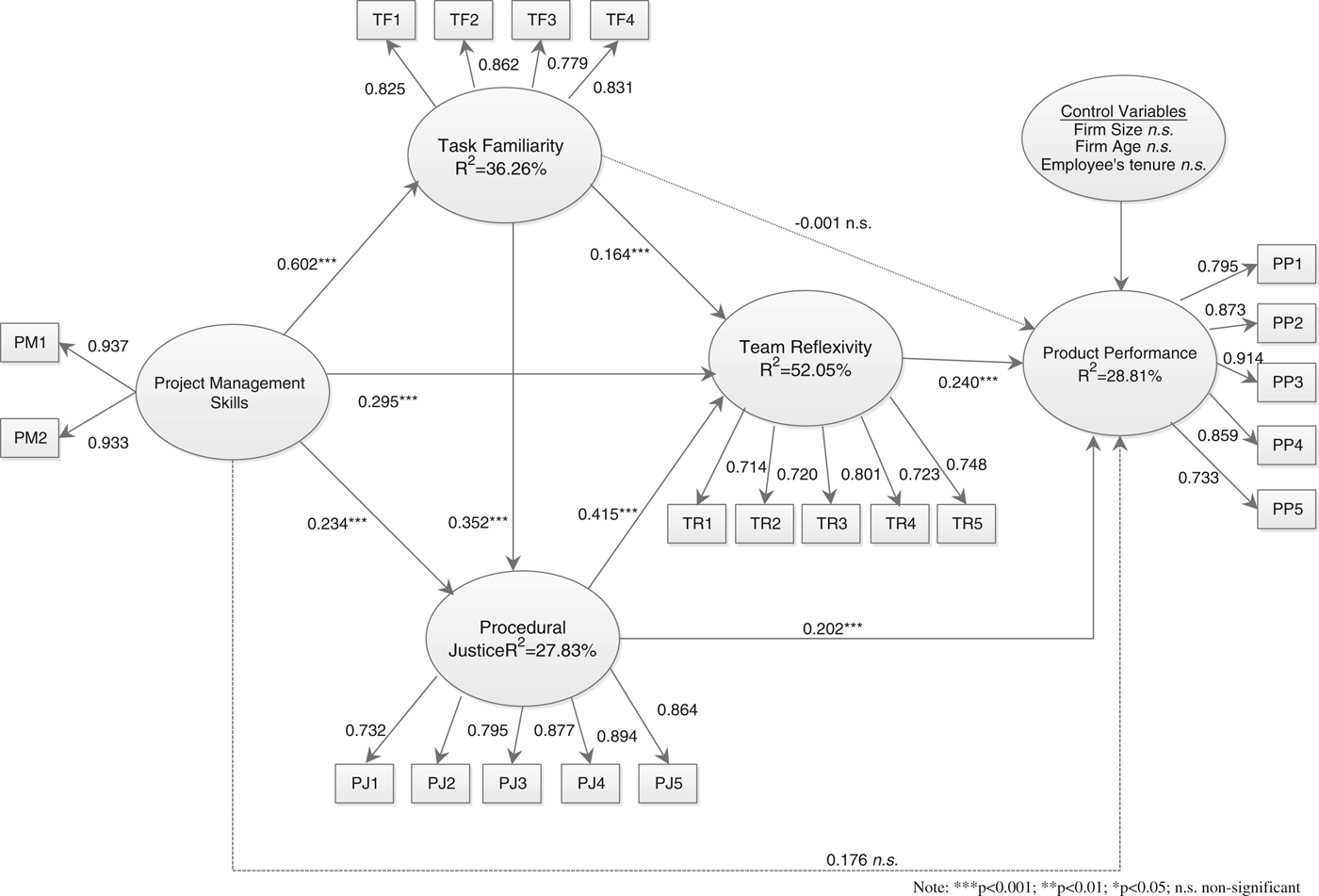
By applying Day and Wensley’s (Reference Day and Wensley1988) framework, this study develops the model shown in Figure 1. This framework introduces the simple causal chain of source → positional advantage → performance. First of all, the sources or skills underlying positional advantages are the superior abilities that organizations have and that distinguish them from their competitors. Several critical superior sources or skills are proposed in the literature, such as project management skills, task familiarity, and procedural justice (Reimann, Schilke, & Thomas, Reference Reimann, Schilke and Thomas2010).
Results of path analysis. ***p<.001, **p<.01, *p<.05

Second, positional advantages are the activities or characteristics that can differentiate a firm from its competitors, and therefore create greater value for customers. This study incorporates team reflexivity as an important positional mediator which may improve NPD team member’s capacity for discussing and dealing with obsolete procedures and strategies that are not in line with the current environmental opportunities. Finally, performance outcomes are the indicators that show that organizations have achieved some specific competitive advantages. As such, this study considers product performance as the focal performance outcome (Im & Workman, Reference Haon, Gotteland and Fornerino2004).
Project management skills and task familiarity
This study adopts the RBV (Barney, Reference Barney1991) to explain the role of project management skills in product performance. Hoegl and Parboteeah (Reference Johnson, Arya and Mirchandani2006) argued that project management skills are desirable in that they may help to develop the organization’s capacity for adding value in its NPD projects. Project management skills represent firm-specific human capital that may determine NPD team members’ abilities with regard to organizing the NPD projects, avoiding overlapping activities, and ensuring the workflow is effective (Slaughter & Ang, Reference Slaughter, Ang and Fong Boh2007). McClough and Rogelberg (Reference Marcoulides and Saunders2003) contended that team members who show better project management skills tend to receive higher evaluations from their peers in the implementation of new projects. Therefore, this study argues that team members who have better project management skills are more able to develop deeper understanding of their task. As such, the following hypothesis is developed:
Hypothesis 1: The project management skills of NPD team members have a positive influence on task familiarity.
Project management skills and procedural justice
Giving that NPD tasks are highly complex and function-specific, team members should have good skills to coordinate their teamwork and allocate resources to pursue the organization’s goals (Faraj & Xiao, Reference Folger and Cropanzano2006). According to organizational justice theory (Greenberg, Reference Hair, Sarstedt and Ringle1987), team members’ positive perceptions of the justice of the procedures and norms implemented by managers may enhance cohesiveness, thus improving interactions and collaboration (Akgün, Keskin, & Byrne, Reference Akgün, Lynn and Yilmaz2010).
Procedural fairness is also related to the implementation of impartial processes that guide the searching for, creating, evaluating, and testing of new products (Luo, Reference Luo2008). Team members who have better project management skills have an increased capacity to understand the procedures of the NPD task (Pant & Baroudi, Reference Pant and Baroudi2008). Moreover, it is possible that team members will negatively evaluate organizational justice if they are not able to fully comprehend the organization’s procedures (Dayan & Basarir, Reference Dayan and Basarir2009). With these results in mind, this study proposes that team members who have better project management skills tend to perceive higher levels of fairness. Therefore, the authors propose the following relationship:
Hypothesis 2: The project management skills of NPD team members have a positive influence on procedural justice.
Project management skills and team reflexivity
According to reflexivity theory (West, Reference West and Markiewicz2000), reflexivity gives team members the freedom to express their own opinions without being afraid of criticism from other members, and these opinions are thus more likely to focus on finding the best solution for the team’s problems (Rogelberg, Barnes-Farrell, & Lowe, Reference Rogelberg, Barnes-Farrell and Lowe1992). Hoegl and Parboteeah (Reference Johnson, Arya and Mirchandani2006) argued that team members’ project management skills are related to their levels of reflection. Therefore, a team that possesses higher levels of project management skills should have higher levels of team reflexivity. Reflective team members are better able to periodically review their processes and reconsider current task strategies, and the greater the team members’ project management skills, the higher the capacity for team reflection. Therefore, the following hypothesis is proposed:
Hypothesis 3: The project management skills of NPD team members have a positive influence on team reflexivity.
Task familiarity and procedural justice
Drawing on the RBV, Barney (Reference Barney1991) argued that intangible resources may help to build up an organization’s competitive advantage and therefore support its long-term survival. Task familiarity is considered as a critical resource for NPD performance. It is reasonable to assume that the more task-related knowledge team members have, the greater the level of perceived justice or understanding of organizational procedures (Alavi & Leidner, Reference Alegre and Chiva2001; Colquitt et al., Reference Colquitt, LePine, Piccolo, Zapata and Rich2001; Lewis, Lange, & Gillis, Reference Li, Bingham and Umphress2005). Specifically, based on fairness theory (Greenberg, Reference Hair, Sarstedt and Ringle1987) this study argues that team members measure the fairness of outcomes via three possible scenarios: ‘could have been different,’ ‘should have been different,’ or ‘would have been different’ (Folger & Cropanzano, Reference Fornell and Larcker2001). These include rules that demonstrate the level of trust in the decision-maker. Therefore, a manager who implements procedures that fail to adjust to the established rules may violate procedural justice. In other words, task familiarity improves the perceived fairness of an organization’s procedures, as stated in the following hypothesis:
Hypothesis 4: The task familiarity of NPD team members has a positive influence on procedural justice.
Task familiarity and team reflexivity
As mentioned above, task familiarity is related to the deep knowledge that team members hold about their principal task (Goodman & Garber, Reference Greenberg1988; Harrison, Mohammed, McGrath, Florey, & Vanderstoep, Reference Hoegl and Parboteeah2003), as well as the knowledge they have about each other (Littlepage, Robison, & Reddington, Reference Luca and Atuahene-Gima1997). With this in mind, being familiar with any task will enhance the learning process of NPD team members, and thus team members will be able to stop and think more often, so increasing reflexivity, the sharing of opinions, and general interactions with each other (Schippers, Edmondson, & West, Reference Schippers, Den Hartog, Koopman and Wienk2014). Based on the shared mental model theory (Lim & Klein, Reference Littlepage, Robison and Reddington2006), task familiarity can improve the organized knowledge structures that team members use to interact with the environment (Mathieu, Heffner, Goodwin, Salas, & Cannon-Bowers, Reference Macklem2000; Neill, McKee, & Rose, Reference Neill, McKee and Rose2007). These organized structures may permit individuals to better reflect on their current behaviors, and so identify possible opportunities for improvement (Lee, Reference Lee and Sukoco2013). Therefore, task familiarity can enhance team reflexivity and reduce uncertainty about the tasks that should be performed, as stated in the following hypothesis:
Hypothesis 5: The task familiarity of NPD team members has a positive influence on team reflexivity.
Procedural justice and team reflexivity
Based on organizational support theory (Emerson, Reference Ernst, Hoyer, Kraft and Krieger1976), greater perceptions of fairness will lead employees to develop higher levels of trust. In other words, team members who perceive higher levels of fairness may be more involved in working to enhance teamwork (Konovsky & Pugh, Reference Laughlin, Zander, Knievel and Tan1994). Similarly, higher levels of perceived procedural justice may result in team members reducing behaviors such as seeking prestige and personal benefits (Colquitt, LePine, Piccolo, Zapata, & Rich, Reference Colquitt, Conlon, Wesson, Porter and Ng2012). Therefore, the more the team members perceive higher levels of procedural justice, the greater their capacity for team reflection. As such, the following hypothesis is developed:
Hypothesis 6: The perceived procedural justice of NPD team members has a positive influence on team reflexivity.
Direct effects of project management skills, task familiarity, procedural justice, and team reflexivity on product performance
Team members with high levels of project management skills may possess better capacities to organize their work, thus improving the development of new products and therefore the performance of NPD projects (Hoegl & Parboteeah, Reference Johnson, Arya and Mirchandani2006). Moreover, based on the shared mental theory (Mathieu et al., Reference Macklem2000), team members that possess high levels of task familiarity may be able to overcome the problems associated with overlapping shared knowledge, and so produce stronger mental models of the common parts of the NPD projects (Espinosa, Kraut, Slaughter, Lerch, Herbsleb, & Mockus, Reference Faraj and Xiao2002). In short, task familiarity can improve productivity, reduce the time for NPD, and increase efficiency (Espinosa et al., Reference Espinosa, Slaughter, Kraut and Herbsleb2007).
According to Dayan and Basarir (Reference Dayan and Basarir2009), the functioning of NPD teams is likely to be further advanced if the members perceive that they are being treated fairly. Cropanzano and Greenberg (Reference Cropanzano and Greenberg1997) further argued that team members who perceive more procedural justice are more willing to discuss and communicate about work-related issues (Ramamoorthy, Flood, Slattery, & Sardessai, Reference Ramamoorthy, Flood, Slattery and Sardessai2005). In addition, Streicher, Jonas, Maier, Frey, and Spiebberger (Reference Streicher, Jonas, Maier, Frey and Spiebberger2012) demonstrated that unequal treatment of NPD team members may decrease their willingness to be creative.
A major challenge faced by NPD teams is the continuous changes that affect the business environment. As such, team reflexivity is critical for situations where task complexity and ambiguity may hinder achievement of the teams’ goals (Gale, Church, & Yarowsky, Reference Gladstein1992). In general, team reflexivity tends to help team members track actions that best enhance the effectiveness of the NPD (Schippers et al., Reference Schippers, West and Dawson2003; Akgün, Lynn, & Yilmaz, Reference Alavi and Leidner2006). Moreover, if team members engage in continuous reflection then this may help to generate higher levels of innovation and better NPD performance (Carter & West, Reference Carter and West1998; Tjosvold, Tang, & West, Reference Tjosvold2004; Schippers, Edmondson, & West, Reference Schippers, Den Hartog, Koopman and Wienk2014).
In addition, following Templeton, Lewis, and Snyder (Reference Teo, Wei and Benbasat2002), in an NPD context teams are seen as information-processing structures (De Brentani & Reid, Reference De Brentani and Reid2012), through which team members are able to disseminate and examine different types of information. As team members possess several different cognitions about the same issues, there is the possibility that some flawed information (Schippers, Edmondson, & West, Reference Schippers, Den Hartog, Koopman and Wienk2014) will damage the NPD process. Team reflexivity can help in this context, as it encourages members to interact with each other in order to assess the best work strategies, thus contributing to higher levels of NPD performance (MacCurtain, Flood, Ramamoorthy, West, & Dawson, Reference Mathieu, Heffner, Goodwin, Salas and Cannon-Bowers2010). Therefore, the authors propose the following hypotheses:
Hypothesis 7: NPD team members’ project management skills have a positive influence on product performance.
Hypothesis 8: NPD team members’ task familiarity has a positive influence on product performance.
Hypothesis 9: NPD team members’ perceived procedural justice has a positive influence on product performance.
Hypothesis10: NPD team members’ team reflexivity has a positive influence on product performance.
METHODS
Data collection
This study focused on NPD projects in the high-tech industry in Taiwan. Taiwan has built up one of the most developed high-tech markets worldwide due to its advanced products, availability of resources and assets, and its specialized human capital recourses. Taiwanese organizations also have highly skillful R&D teams that have supported the development of sustainable competitive advantages in this context (Chen, Reference Chen2011). As such, the high-tech industry represents one of the pillars of the Taiwanese economy, with companies that are among largest suppliers of computer monitors, accessories, and circuit boards in the world, with healthy double-digit growth rates (Johnson, Arya, & Mirchandani, Reference Konradt, Schippers, Garbers and Steenfatt2013). It can thus be concluded that such organizations are committed to the creation of new products, and thus provide a good sample for this study.
In order to ensure the correct implementation of the survey tool, this research followed the steps outlined in Akgün, Lynn, and Yilmaz (Reference Alavi and Leidner2006). First, telephone calls were made to the human resource managers of each firm to identify the presence of NPD teams. Letters were then sent to the firms asking for their voluntary participation. Third, 1 week after the first formal letter, NPD team leaders were identified and chosen as the contact person in charge of coordinating the data collection within the firm. Fourth, an envelope was sent to these individuals containing five copies of the self-administered surveys to be filled out by the team members.
The sample was composed of 186 NPD team members (82.4% male). Among these, 40 came from the service industry, while other 146 were from the high-tech industry. To meet the purposes of this study, the 40 samples from the service industry were deleted from further analysis. The remaining sampled team members came from high-technology firms that were situated in three of the principal science parks in Taiwan; namely, Hsin-Chu Science Park, Taichung Science Park, and Tainan Science Park. Approximately 74% of the sampled firms had been in business for more than 16 years, and 87.5% had sales volumes over US$200 million. In terms of the organizational size, 71% of the firms had <500 employees, while the rest had over 500. Of the team members surveyed in this research, 78% had been employed for more than 10 years, and most had participated in at least five NPD projects. As a consequence, the individuals surveyed in this work were all NPD team members actively engaged in the development of new products.
Measurement items
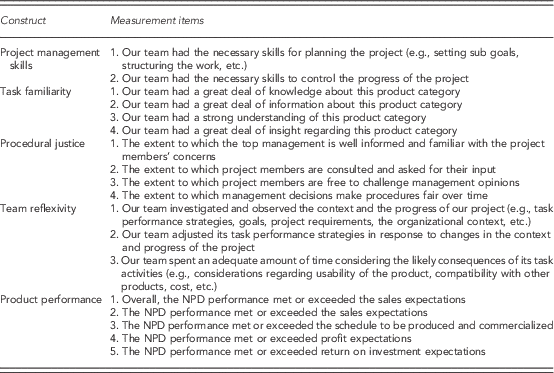
As the study sample firms were located in different science parks in Taiwan, the research constructs were adopted from previous studies with minor revisions. Before finalizing these measurement items, 55 MBA students from a major university in Taiwan were used in a pilot-test to check the appropriateness of the survey. Project management skills were measured by a 2-item scale adapted from Gladstein (Reference Goodman and Garber1984) and Hoegl and Parboteeah (Reference Johnson, Arya and Mirchandani2006). A Cronbach’s α of 0.856 corroborated the reliability of this measure.
Team reflexivity was measured with a 5-item scale adapted from Hoegl and Parboteeah (Reference Johnson, Arya and Mirchandani2006), with a Cronbach’s α of 0.796 supporting the reliability of this measure. Task familiarity was operationalized by a 4-item scale adapted from Moorman and Miner (Reference Moorman and Miner1997) and Brockman and Morgan (Reference Brockman and Morgan2006), with a Cronbach’s α of 0.843 indicating its reliability. Procedural justice was measured by a 5-item scale adapted from Li, Bingham, and Umphress (Reference Lim and Klein2007), and it had a Cronbach’s α of 0.890, and thus was reliable. Product performance was measured by a 5-item scale adapted from Cooper and Kleinschmidt (Reference Cooper and Kleinschmidt1987), and Akgün, Lynn, and Yilmaz (Reference Alavi and Leidner2006), which also had a reliable Cronbach’s α of 0.893.
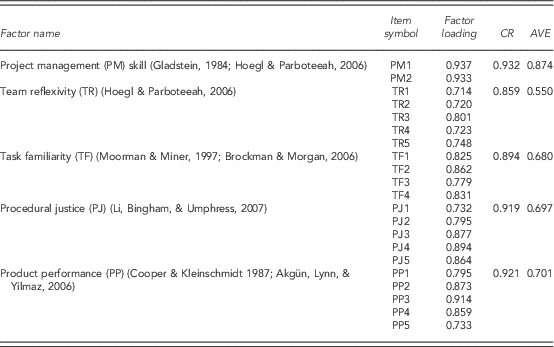
All construct responses used a 7-point Likert scale (1=‘strongly disagree,’ to 7=‘strongly agree’). The results of these tests are shown in Table 2, while the Appendix shows the corresponding measurement items.
Items and scales sources

AVE=average variance extracted; CR=composite reliability.
Control variables
In addition to the main research constructs, several organization-specific factors were measured as the control variables, including firm size, firm age, and team members’ tenure. Following Luca and Atuahene-Gima (2007), firm size was assessed with the logarithm of the number of employees. Firm age was assessed using the logarithm of the number of years since the firm had been established (Anderson & Reeb, Reference Akgün, Keskin and Byrne2004). Team members’ tenure also was assessed using the logarithm of the number of years that each team member had been with an NPD team. All the measurement items for the control variables were computed through the use of a self-reported single item.
Construct reliability and validity
Because the all data were collected from NPD team members, there is a possibility of common method bias. Using Podsakoff, MacKenzie, Lee, and Podsakoff (Reference Podsakoff, MacKenzie, Lee and Podsakoff2003) as a guideline, the potential for common method bias was evaluated in the following ways: first, this research employed a strict measurement procedure to avoid any misunderstandings which could affect the clarity of the measurement items. Second, in order to increase the reliability of the measures, the anonymity of all the respondents was maintained. Finally, the authors applied the Harmon one-factor method to estimate the effect of potential common method bias. Through the implementation of the unrotated solution, the first factor showed an explained variance of 32.50%, which was less than the ceiling of 50% suggested by Podsakoff et al. (Reference Podsakoff, MacKenzie, Lee and Podsakoff2003).
Several analytical methods were used to assess the construct validity and reliability. Based on the results from partial least square (PLS), all measurement items reached significant levels (p<.01), and their values were all higher than .5. Convergent validity was computed by obtaining the average variance extracted, with the results shown in Table 2. Almost all the results surpassed the standard criteria of 0.50 proposed by Chin (Reference Chin1998). In addition, the composite reliability was computed to assess the construct validity, and all composite reliability values ranged from 0.859 to 0.932, thus ensuring appropriate levels of reliability for all the constructs.
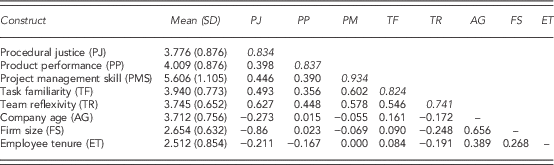
The techniques recommended by Fornell and Larcker (Reference Gale, Church and Yarowsky1981) were applied to assess discriminant validity, examining whether the squared roots of the average variances extracted surpassed the correlations among the rest of the constructs in the research model. The results are shown in Table 3, and it can be seen that all the measurement items were suitable for use in the validation of the hypotheses.
Assessment of discriminant validity

Note. The italicized diagonal values are the square root of the average variance extracted for each construct.
RESULTS AND DISCUSSION
After the convergent and discriminant validities of each research construct were validated, the proposed hypotheses were tested using SmartPLS (Ringle, Wende, & Will, Reference Ringle, Wende and Will2005). PLS was chosen for several reasons. First, the sample size was not large, and PLS is more suitable for small data samples (Marcoulides & Saunders, Reference MacCurtain, Flood, Ramamoorthy, West and Dawson2006; Sosik, Surinder, & Piovoso, Reference Sosik, Surinder and Piovoso2009). Second, PLS is more appropriate to use when the research model has not been extensively validated (Teo, Wei, & Benbasat, Reference Templeton, Lewis and Snyder2003). Third, PLS has a powerful advantage in which both the measurement and structural models can be tested at the same time (Hair, Sarstedt, & Ringle, Reference Harrison, Mohammed, McGrath, Florey and Vanderstoep2012).
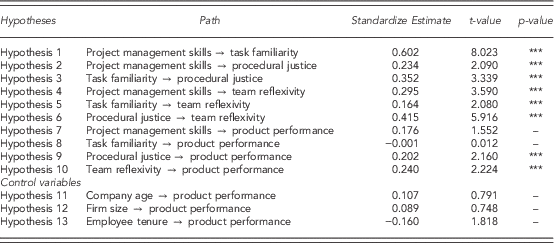
Two important measures that the PLS technique offers are R 2 (Hair, Sarstedt, & Ringle, Reference Harrison, Mohammed, McGrath, Florey and Vanderstoep2012) and the goodness-of-fit of the model (Vinzi, Trinchera, & Amato, Reference Vinzi, Trinchera and Amato2010). As shown in Figure 1, the computed R 2 values ranged from 0.278 to 0.520, suggesting that model had moderate explanatory power. Furthermore, the goodness-of-fit value was 0.425, which was above the cut-off value of 0.36 for large effect sizes of R 2 (Cohen, Reference Cohen1988). In other words, this index showed that this model had greater estimation power compared with the standard criteria (i.e., the goodness-of-fit criteria).
The path loadings shown in Table 4 and Figure 1 are used to test the research hypotheses. Project management skills had a significant, positive influence on task familiarity (β=0.602; p<.01) and procedural justice (β=0.234; p<.01), thus supporting Hypotheses 1 and 2. Task familiarity also had a significant, positive influence on procedural justice (β=0.352; p<.001) and team reflexivity (β=0.164; p<.01), and so Hypothesis 3 is supported.
Evaluation of structural model and hypothesis testing

***p<.001.
The path from project management skills to team reflexivity was also significant (β=0.295; p<.001), indicating the importance of strong project management skills in improving reflexivity within the team, supporting Hypothesis 4. Task familiarity also had a significant, positive influence on team reflexivity (β=0.164; p<.01), and so Hypothesis 5 is supported. Similarly, the path from procedural justice to team reflexivity was significant and positive (β=0.415; p<.01), and so Hypothesis 6 is supported. However, the path from project management skills to product performance was not significant (β=0.176; p<.01), and thus Hypothesis 7 is not supported. The path from task familiarity to product performance was also not significant (β=−0.001; p>.05), failing to support Hypothesis 8. However, the relationships that procedural justice and team reflexivity had with product performance were significant and positive (β=0.202; p<.01; β=0.240; p<.01), supporting Hypotheses 9 and 10. Of the three control variables incorporated in the path analysis, neither of them showed any significant effect on product performance, which suggests that firm size, firm age, and team members’ tenure are not influential variables in the context.
Test of mediation
As discussed earlier, due to the importance of team reflexivity with regard to improving the rates of NPD success, this research posited that there are some relevant factors that need to be further analyzed. As such, it examined team reflexivity as a potential mediator of the relationships that project management skills, task familiarity, and procedural justice have with product performance. To test these relations, this study applied the mediation processes proposed by Baron and Kenny (Reference Baron and Kenny1986).
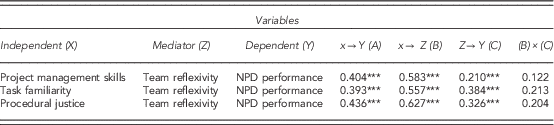
As a first step to test for the presence of a mediation effect of team reflexivity, the relationship between project management skills and product performance was examined, and the results show that there was a significant relationship (β=0.404; p<.001). Next, team reflexivity was included in the new model, and the results demonstrate that the direct impact of project management skills and product performance decreased as a consequence of this (β=0.210; p<.001). The authors thus argue that there is a partial mediation effect of team reflexivity. Moreover, the R 2 value for product performance improved after adding team reflexivity to the model (6.20 percentage points from 0.205 to 0.267). These results were also supported by implementing Sobel’s (Reference Sobel1982) test. According to Sobel (Reference Sobel1982), the mediating effect is significant if the Z value is greater than the threshold value of the t-value=1.96. Specifically, the association of project management skills → team reflexivity → product performance was 3.163 (p<.001)>t-value=1.96.
Following the same procedure, the relationship between task familiarity and product performance was computed (β=0.393; p<.001). Team reflexivity was then added to the new research model, and the results confirm that the direct impact of task familiarity and product performance deceased (β =0.141; p<.001). Consequently, the results show that the strength of the path from task familiarity and product performance was reduced but still significant, which supports the presence of a partially mediated relationship. Furthermore, the R 2 value for product performance improved after adding team reflexivity to the model (7.10 percentage points from 0.184 to 0.255). Based on these results, the authors argue that team reflexivity is likely a good partial mediator of the task familiarity–product performance link, and the Sobel test was used to confirm this. The results show that the Z-test value for the associations of task familiarity → team reflexivity → product performance was 3.942 (p<.001)>t-value=1.96.
Finally, to assess the mediation effect, the relationship between procedural justice and product performance was assessed (β =0.393; p<.001). It was then necessary to add team reflexivity (β=0.326; p<.001), and the results show that the direct effect of procedural justice on product performance decreased because of this (β =0.237; p<.001). These results suggest that team reflexivity was an important partial mediator for the path of procedural justice – product performance. In order to confirm these results, a Sobel test was performed. The results show that the Z-test value for the relationship of procedural justice → team reflexivity → product performance was 3.444 (p<.001)>t-value=1.96.
Following Baron and Kenny (Reference Baron and Kenny1986), the presence of partial mediation occurs when there is no bigger difference between the direct effect of the independent variable on the dependent variable, and the indirect effect of the independent variable via the mediator. The mediating effects of team reflexivity were computed, and the results are shown in Table 5.
Mediation results

Note. NPD=new product development.
***p<.001.
In summary, our findings suggest that team reflexivity plays an important role, with a fully mediating effect on the impacts that project management skills and task familiarity have on product performance. However, the results just show a partial mediating effect of team reflexivity on the relationship between procedural justice and product performance.
Conclusion
The aim of this study was to examine the antecedents and consequences of team reflexivity. Several conclusions can be drawn from the results of this research, as follows. First, team reflexivity is one of the main factors that stimulate innovation and product performance (Schippers et al., Reference Schippers, Homan and van Knippenberg2008; Widmer, Schippers, & West, Reference West2009), and thus the ways in which team reflexivity can be promoted are very important for organizations.
Second, the findings show that team members with high project management skills may have specific abilities that help them comprehend the complex knowledge related to an NPD task and workflow, thus enhancing the NPD team members’ familiarity with the focal tasks. In addition, project management skills and deep knowledge with regard to an NPD task can together enhance team members’ understanding of the decisions taken by the R&D managers, as well as their perceived fairness. Thus, increasing their sensitivity to the dynamic market environment, which is an essential characteristic of successful NPD projects. In the same way, team members with high levels of task familiarity may possess and allocate more of the resources needed to fully understand the norms, goals, and outcomes set up by managers.
Third, according to the results of the current study, project management skills, task familiarity, and procedural justice lead to team reflexivity. As such, NPD organizations should consider project management skills as desirable (Gladstein, Reference Goodman and Garber1984), as these help team members organize their tasks and the workflow of NPD development, thus increasing reflexivity and strengthening the team as it faces numerous challenges in volatile environments.
More precisely, the results of this research show that procedural justice is effective at nurturing team reflexivity. Team members who perceive high levels of fairness toward the processes and norms employed by managers tend to develop more trusting relationships with each other, which can then improve the sharing of ideas, reduce the fear of losing face in front of others, and increase the willingness to participate in actions that enhance and express team reflexivity (Folger & Cropanzano, Reference Fornell and Larcker2001).
Indeed, the relationship between team reflexivity and product performance is clearer when taking into consideration the direct and indirect effects of project management skills, task familiarity, and procedural justice. These results highlight the importance of the proposed drivers of team reflexivity, which can induce improved product performance in the high-tech industry.
Regarding the direct effects of project management skills, task familiarity, and procedural justice on product performance, the findings of this work show there is no evidence of a direct effect of project management skills and task familiarity on product performance. Even though team members may be highly skillful in handling NPD projects, these skills are not enough to achieve higher product performance. This implies that while project management skills may help to organize the NPD project and workflow, they will not help team members to develop new solutions or reconfigure current competencies to produce new products.
Furthermore, the nonsignificant result of task familiarity can be explained by the menton theory (Davies & Fortney, Reference Davies and Fortney2012), which proposes that each individual is endowed with physiological resources, called mentons, that will be employed for the execution of different tasks. A minimum amount of mentons are required for performing a task, and there is the possibility of boredom when the current number of mentons exceeds that required for carrying out the task (Macklem, Reference McDonough2015).
As such, task familiarity may not have direct influence on product performance. However, task familiarity will have a direct influence on team reflexivity, because NPD teams normally consist of experts from different disciplines. All NPD members have to contribute their mentons through the interaction and integration of knowledge from different disciplines. As a result, task familiarity should influence product performance through team reflexivity, particularly in the process of NPD.
Finally, the results show that the team members’ perceptions of fairness will positively influence product performance. A higher level of perceived fairness may help trust to develop among team members and R&D managers, thus producing better relational exchanges which generate a collaborative environment that enhances product performance. This result supports commitment trust theory (Morgan & Hunt, Reference Morgan and Hunt1994), which asserts that trust will increase the willingness to share ideas and knowledge. Moreover, high levels of perceived fairness will nurture the reciprocal behavior that may lead team members to behave in accordance with the organization’s aims, and thus in support of NPD projects.
Second, product performance is influenced by team reflexivity. However, team reflexivity is a variable that mediates the influences of project management skills, task familiarity, procedural justice, and product performance. Specifically, project management skills will not directly result in better product performance. According to group dynamic theory, there is the possibility that individuals will increase or reduce their performance based on the dynamics that arise within a group (Laughlin, Zander, Knievel, & Tan, Reference Lawler and Worley2003). Therefore, when a skillful team member feels that the level of team reflexivity among members is high, they will try to contribute their best knowledge to the team as a signal of exchange, thus resulting in better product performance. If team reflexivity is low, the team member may believe that there is no need to share their skills with the team, and these skills are irrelevant to product performance. Similarly, task familiarity will not directly result in product performance. Following the menton theory (Davies & Fortney, Reference Davies and Fortney2012), task familiarity may provide a vast range of knowledge that can be seen as the mental resources that are utilized to perform several tasks. Therefore, when NPD team members who have high levels of task familiarity aim to engage in team reflexivity, they will try to interact by introducing their knowledge into discussions on the current stage of the NPD project. In doing so, NPD team members are able to find and adopt better approaches which then lead to better product performance. Team members who have higher levels of task familiarity may possess valuable and extensive knowledge that needs to be further reflected on in order to assess obsolete procedures, norms, and ideas that do not allow the organization to adjust to the dynamic environment it faces.
To summarize, our research findings indicate that team reflexivity plays a critical role as a fully mediating variable in the effects that project management skills and task familiarity have on product performance. The results of this study show the full mediating effect of team reflexivity on the relationships among project management skills, task familiarity, and product performance. However, the results only show a partial mediating effect of team reflexivity with regard to the relationship between procedural justice and product performance.
Academic implications
This study contributes to the innovation and NPD literature in three principal ways. First, compared to the RBV, KBV, organizational justice theory and OST, Day and Wensley (Reference Day and Wensley1988) ‘source – positional advantage – performance outcome’ – is a more comprehensive and powerful theoretical lens through which to understand the interrelationships among project management practices, team reflexivity, and product performance in the NPD context. According to the RBV, knowledge is one of the critical resources that a firm can have, but it is vital to discover how to turn knowledge into positional advantages that enhance product performance (Barney, Reference Barney1991). Specifically, this study incorporates project management skills, task familiarity, and procedural justice as important sources of developing a positional advantage to achieve better rates of product performance. By addressing the influences of project management skills, task familiarity, and procedural justice on product performance, this study presents the role of team reflexivity as a mediating positional advantage in the NPD projects. That is, team reflexivity can be seen as a positional advantage through which the benefits from project management skills, task familiarity, and procedural justice may nurture product performance. Although previous studies have theorized about the linkages between our proposed sources and product performance (Espinosa et al., Reference Espinosa, Slaughter, Kraut and Herbsleb2007; Lee & Sukoco, Reference Lewis, Lange and Gillis2011; Streicher et al., Reference Streicher, Jonas, Maier, Frey and Spiebberger2012), there has been no empirical validation that integrates and analyzes them in a single research framework. The evidence presented in this study thus contributes to the innovation literature by adding a new perspective by which team reflexivity plays a mediating role in the relationships that project management skills, task familiarity, and procedural justice have with product performance.
Second, this study contributes to the innovation and reflexivity literature by perhaps being the first to empirically validate the interrelationships among management skills, task familiarity, and procedural justice, and their effects on team reflexivity. In particular, the finding of no significant effect of task familiarity on product performance has new theoretical implications that cannot be found in the current literature. More specifically, this indicates that while greater task familiarity may contain deep knowledge about the task itself, it may also induce boredom due to the surplus of knowledge with which team members have with regard to developing new products. As such, task familiarity may need team reflexivity in order to have beneficial effects on new product performance. Future research should thus examine the appropriate usage of the knowledge that NPD team members have. For example, NPD team leaders should work to organize activities and processes that enhance the use of knowledge while avoiding boredom, such as by increasing team reflexivity and encouraging more brainstorming (Davies & Fortney, Reference Davies and Fortney2012).
Third, the findings have implications for the mediating role of team reflexivity in an organization’s NPD performance. More specifically, team reflexivity was substantially explained (R 2=52.05%) by the proposed antecedents, but product performance only had an R 2 value of 28.81%. This implies that reflexivity could be a critical factor in the initial phases of NPD. For example, at the beginning NPD teams may spend more time analyzing, searching, planning, and observing the opportunities that exist in the environment. Therefore, the self-reflection of NPD team members may be essential to developing the main idea of the new product. It is worth noting that in the implementation stages of an NPD project, NPD teams need to concentrate on the development of previous decisions. As such, team reflexivity may not be so important in the final stages of NPD projects. Therefore, the influences of team reflexivity on product performance may be different in different stages of the NPD process. Future research should thus examine the mediating role of team reflexivity in different NPD stages to improve our understanding of this issue.
Managerial implications
From a managerial point of view, this research highlights that team reflexivity has an important role in cultivating product performance. Organizations should thus be conscious of the need for developing team reflexivity, specifically in high-tech industries. Given the dominant role of team reflexivity in product performance, managers, and new product performance team leaders must actively help their team members develop reflection from three directions, as follows.
First, as the results of this study have demonstrated, managers should focus on the building of NPD teams in which team members have sufficient project management skills. To do so, managers should evaluate the types of skills that members need, identify the nature of these skills, and expand on the strategies that develop them. Second, because of the high pressure and competitive environment faced by NPD teams, it is essential for team leaders to establish a fair working environment and reward team members according to the contributions they make.
Third, even though previous research has not shown any indirect impact of procedural justice on team reflexivity (Dayan & Basarir, Reference Dayan and Basarir2009), this study found evidence that there is an important indirect effect of procedural justice on product performance. In summary, managers should consider these influences with regard to cultivating team reflexivity, as this is key to improving product performance.
Limitations and future research
The current research extends the product innovation literature by providing both academic and managerial implications. However, there are some limitations that should be considered when drawing more generalized conclusions. First, this study used a total sample of 146 team members from a single collection effort. As such, even though the authors made many attempts to reduce its effects, there is still a chance that common method bias may have affected all the cross-sectional data. Further research should thus examine longitudinal data to better understand the development of team reflexivity over time, or it could combine different data sources to reduce the possibility of bias.
Second, this study used a specific NPD context which has unique characteristics, and so the generalizability of the findings may be limited by this (Calder, Phillips, & Tybout, Reference Calder, Phillips and Tybout1981). Future studies should thus examine the proposed drivers in more varied team contexts to check whether there are different results in different research settings. Third, in order to maintain the parsimony of the proposed model, this study was not able to include all the factors that may enhance team reflexivity. Finally, this study focused on a sample of high-tech firms in Taiwan, and cultural effects may have influenced the results. As such, any conclusions drawn may not be applicable to other cultures. Therefore, further research is required to shed light on the possible effects of culture on the relationships tested in this study.