Introduction
Chinese historical documents show that since 111 BC, the Western Han Emperor Wu Di established maritime trade routes from southern China through Southeast Asia to India (Ban Reference Ban2011 [AD 82]). During this same period, Indian traders were travelling around or across the Indian Ocean to reach as far as Bali (Ardika & Bellwood Reference Ardika and Bellwood1991; Calo et al. Reference Calo, Prasetyo, Bellwood, Lankton, Gratuze, Pryce, Reinecke, Leusch, Schenk, Wood, Bawono, Gede, Yuliati, Fenner, Reepmeyer, Castillo and Carter2015). Imported goods, including glass (beads, ear pendants, rings and vessels), garnet, amber, rock crystal, beryl, agate, etched carnelian beads, gold polyhedral beads, pearls and other exotic objects, such as a Persian glazed ceramic pot and a bronze cymbal, both from the Parthian Empire, have been found at Hepu, in Guangxi in southern China (Xiong Reference Xiong2014), one of the most important ports of the Maritime Silk Roads at that time.
While written documents attest to the involvement of Han and Indian traders in the inter-regional maritime networks of 2000 years ago, the archaeological record of Taiwan presents different types of trade goods that carry new implications for the complexity of movement in the ancient South China Sea (Hung et al. Reference Hung, Nguyen, Bellwood and Carson2013; Bellina Reference Bellina2014). The Formosan (Austronesian-speaking) people of Taiwan had no script, and the island was not mentioned in any detail in Chinese and European historical documents until the seventeenth century. Separated from the influence of potent kingdoms or empires, Taiwan's prehistory offers a unique perspective on how the world's early globalised economies affected a peripheral location, particularly at the beginning of Taiwan's Metal Age.
It has been presumed, because of Taiwan's location, that the earliest metalworking technologies were introduced either from the Dong Son culture of northern Vietnam (Kano Reference Kano1955), or directly across the Taiwan Strait from Mainland China to the north (Ling Reference Ling and Li1962; Liu Reference Liu1963; Chang Reference Chang1969: 219). New discoveries in south-eastern Taiwan suggest, however, that the earliest metallurgical activity, along with a set of novel body ornaments, was introduced from the southern region of Mainland Southeast Asia. In this article, we review the current evidence from Jiuxianglan and other sites relating to the origins of the Taiwan Metal Age.
Contextual background to metal goods and working in Taiwan
Although occasional metal fragments have been recorded at a few Taiwan Late Neolithic sites (from the mid second to late first millennia BC), they are regarded as the result of limited contacts with the Asian mainland (Chen Reference Chen2011). This is because the Bronze Age of China commenced by 1900 BC (Liu & Chen Reference Liu and Chen2012), and in Thailand and Vietnam between 1100 and 1000 BC (Higham et al. Reference Higham, Douka and Higham2015), at least more than 500 years before the recognised Metal Age began in Taiwan. Diagnostic features of the latter include the contemporaneous appearance of artefacts made of bronze, iron, gold, silver and glass. Furthermore, the presence of in situ metallurgical activity (see below) implies the transference of techniques. The simultaneous appearance of these various materials and techniques indicates that Taiwan did not undergo separate Bronze and Iron Ages, unlike South China and Vietnam.
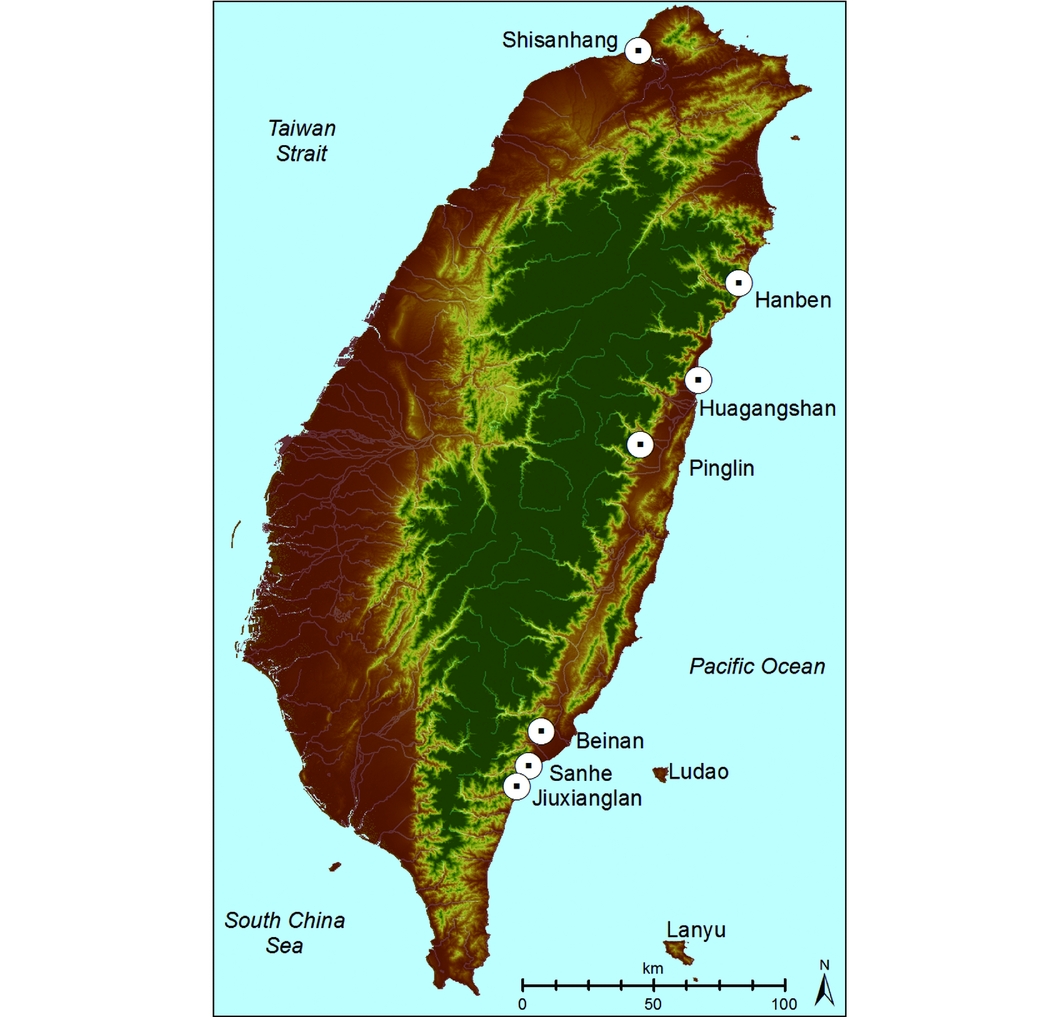
Previous studies have proposed that the Metal Age began on the north-western coast of Taiwan around AD 200–500, followed by an initial spread down the west coast of the island, and eventually across to the east coast (Liu Reference Liu2002: 112). Numerous excavated items from Shisanhang near Taipei, in northern coastal Taiwan, are recognised as trade goods from the Chinese Tang Dynasty (AD 618–907). Since 2003, however, new excavations in south-eastern Taiwan have provided more than 10 radiocarbon dates that are much earlier than Shisanhang and associated with quite different assemblages; for instance, as documented at sites of Sanhe, Beinan (the upper layer of this site) and Jiuxianglan (Figure 1).
Locations of the Taiwan Metal Age sites mentioned in the text. The earliest components are represented in the south-east coast sites of Beinan (upper layer), Sanhe and Jiuxianglan (see Table 1 for 14C dates).

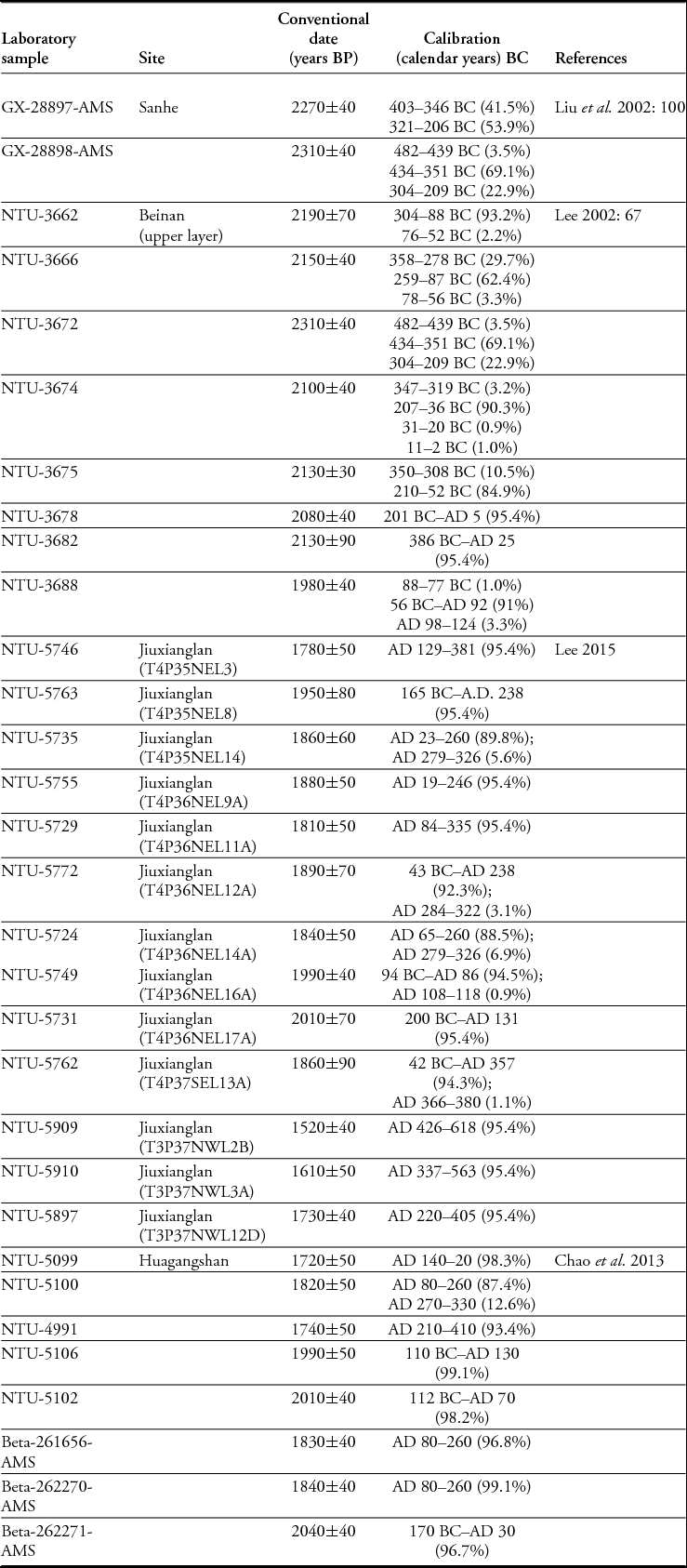
These new dates suggest that the beginning of the Taiwan Metal Age occurred as early as 400 BC along the south-eastern coast (Table 1, Lee Reference Lee2002: 67; Liu et al. Reference Liu, Yen, Chen, Dai and Lewa2002: 100; Kuo Reference Kuo, Gadu and Lin2010). The oldest Metal Age sites include Sanhe, Jiuxianglan and the upper layer of Beinan, which have yielded various ornaments made of glass, agate/carnelian, iron, bronze and gold that represent the beginning of this new period in Taiwan's prehistory. The upper layer of Huagangshan, near Hualien on the central-eastern coast of Taiwan, dates from 100 BC onwards, and represents one of the oldest Metal Age sites outside of the south-eastern coastal area.
Radiocarbon dates from Early Metal Age site contexts of eastern Taiwan.

Note: all dated samples are charcoal.
Bronze, iron and gold
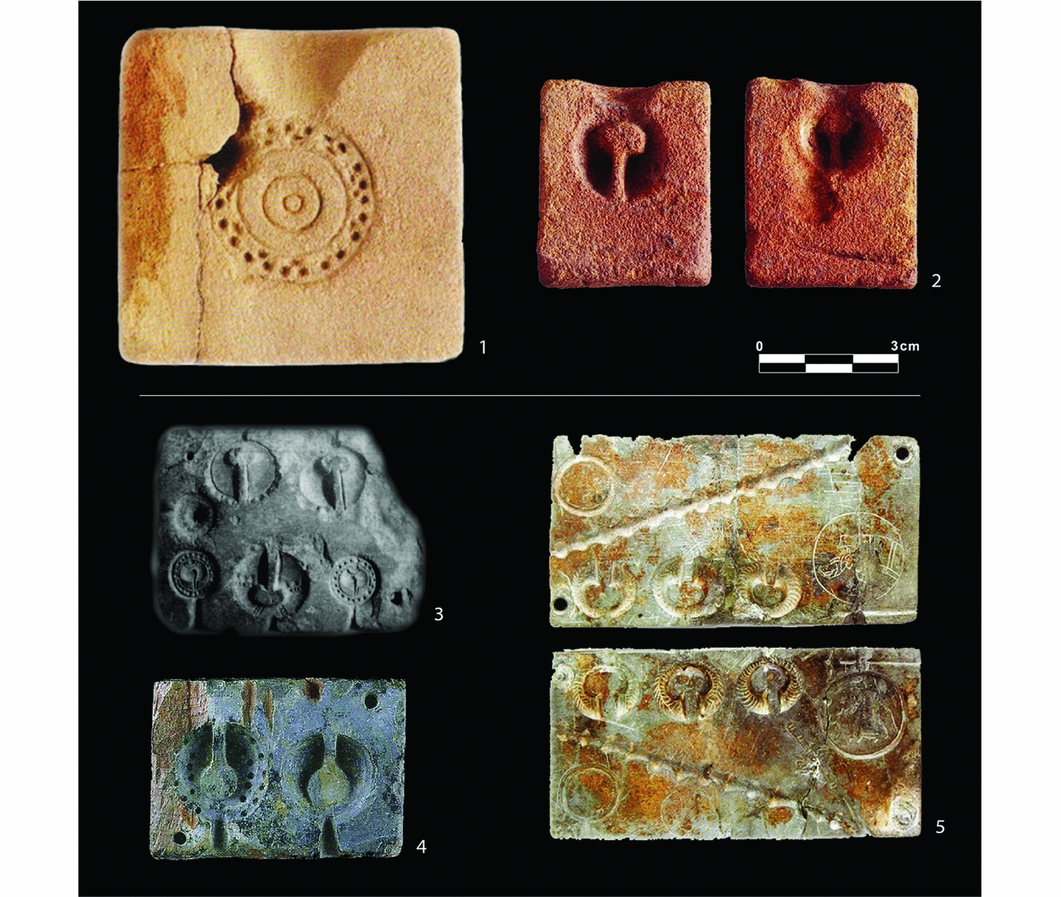
Jiuxianglan (see Figure 1), excavated between 2003 and 2007, is one of the largest Metal Age sites in Taiwan, belonging to the Sanhe cultural phase (Lee Reference Lee2005, Reference Lee2007). Based on a comparative study of pottery styles and designs with the assemblage unearthed from the upper layer of Beinan, the lowest cultural deposit with iron artefacts and glass beads at Jiuxianglan is estimated to date to as early as 400–300 BC (Kuo Reference Kuo, Gadu and Lin2010). The oldest such items are assumed to be trade goods from overseas. The upper portion of the cultural layer at Jiuxianglan has yielded casting moulds that suggest that local manufacture dated to as early as 100 BC (Lee Reference Lee2015). The artefacts recovered from the site include 10 bronze objects, such as a bell and chain, together with 61 casting moulds carved from soft sandstone for the production of earrings, small ornaments and possibly knife handles. Some of the casting moulds contained a bronze residue.
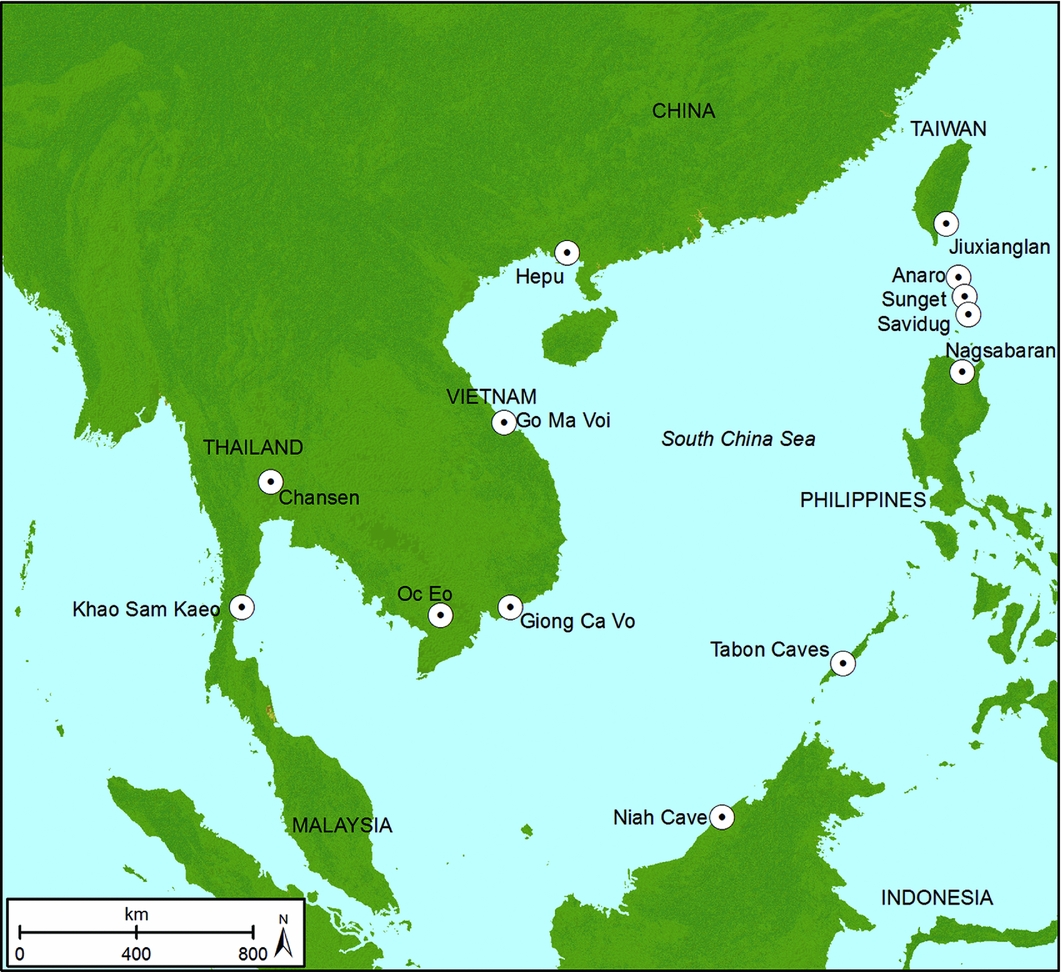
The particular styles and forms of casting moulds found at Jiuxianglan do not occur at contemporary sites in China, but they resemble moulds found in Thailand and southern Vietnam. Examples from the Chansen site in central Thailand date to between 100 BC and AD 100 (Indrawooth Reference Indrawooth, Glover and Bellwood2004: 133), while sites in southern Thailand (Pongpanich Reference Pongpanich2009: 142 & 214) and Vietnam, such as Oc Eo (‘Funan’) at My Lam date to between AD 200 and 500 (Malleret Reference Malleret1960: pl. XCVII; Tan Reference Tan2008: 60; Tingley Reference Tingley2010: 138–39) (Figures 2 & 3).
Locations of Southeast Asian sites mentioned in the text.

Examples of stone casting moulds from Jiuxianglan in eastern Taiwan (1 & 2), which are very similar to those unearthed from Chansen in central Thailand (3), other sites in Thailand (4), and Oc Eo, My Lam, in southern Vietnam (5) (courtesy: 1: Lee Reference Lee2007: 76; 2: Lee Reference Lee2005: 277; 3: Indrawooth Reference Indrawooth, Glover and Bellwood2004: 133; 4: Pongpanich Reference Pongpanich2009: 214; 5: Tan Reference Tan2008: 60; no scales for 3, 4 and 5).

Intriguingly, the sandstone used for making the Jiuxianglan moulds can be traced to a geological source in southern Taiwan (Yang et al. Reference Yang, Lee and Chen2012), meaning that they were not imported. Instead, this style of mould, and by extension the artefacts made from it, reflect the transmission of knowledge from southern Vietnam or central/southern Thailand, even though local production began around 100 BC. Geological data suggest that copper, lead and zinc are extremely rare in Taiwan, and no evidence yet exists of any ore-mining activity prior to the Japanese occupation that began in 1895. Thus, the raw metals might have been imported (Chen Reference Chen2011), unless bronze artefacts were melted down and cast anew.
Along with the bronze artefacts, Jiuxianglan yielded at least 91 pieces of iron slag and 47 iron objects. The latter are mostly unidentifiable fragments, other than a few probable fish-hooks and arrowheads. So far, no baked clay tuyères (air pipes) or other formal forge features have been reported, yet extensive accumulations of ash may hint at local iron smelting, at least in the mode of secondary production. A clear change is evident a few centuries later from the large amount of slag (several tonnes) unearthed from the sites of Hanben and Shisanhang (Figure 1). Only one gold bead has been reported from Jiuxianglan, but gold fragments attached to baked clay suggest the probability of gold production at the site.
Glass
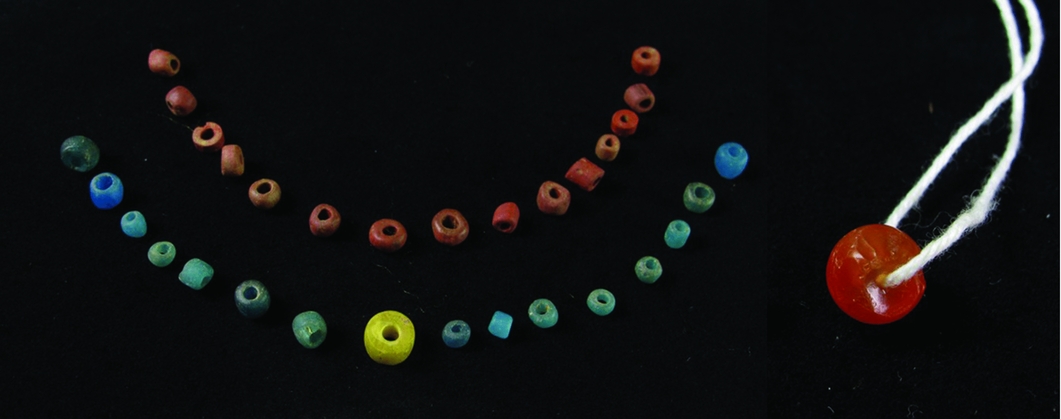
Beads are by far the most numerous glass artefacts from the Early Metal Age of Taiwan, typically categorised as Indo-Pacific glass beads (Hung Reference Hung2005). The earliest known glass beads in Taiwan came from the upper layer of Beinan around 400–300 BC, yet they represent trade goods from overseas. Of the 3326 glass objects found at Jiuxianglan, 3234 (more than 97%) are beads, while the remainder include bracelets and other small fragments. Indo-Pacific glass beads are sometimes called “trade wind beads” (van der Sleen Reference van der Sleen1956: 27–29), and they could appear in monochrome varieties such as red, blue, green, yellow or orange. Some regard them as the most important trade beads in human history (Francis Reference Francis2002) because of their widespread distribution over a long duration. Production originated in India, but other manufacturing sites are reported from Sri Lanka, Thailand, Malaysia, Vietnam and Sumatra (Francis Reference Francis2002: 27–41). Early examples date to 500 BC in Mainland Southeast Asia (Carter Reference Carter2015), but the oldest confident dating in Taiwan is about 400–300 BC, from the upper level of Beinan (Lee Reference Lee2002). More than 600 Indo-Pacific beads were also found as grave goods in the upper layer of Huagangshan, dated to between 100 BC and AD 400 (Chao et al. Reference Chao, Liu and Chung2013) (Figure 4), together with an agate/carnelian bead, and small earrings made of nephrite (jade) and glass.
Indo-Pacific beads (left) and agate/carnelian bead (right) from Huagangshan, Hualien.

The Indo-Pacific glass beads found in Taiwan exhibit particularly close similarities with those found in the Philippines, and in Southeast Asia more generally. These include a preference for the colours of monochrome yellow, green, blue and red. Indeed, the chemical compositions of first-millennium AD beads from several sites in Taiwan relate to Southeast Asia rather than South China (Wang & Jackson Reference Wang and Jackson2014). Analysis of 25 glass beads from the upper layer at Huagangshan, using both Raman spectroscopy and μXRF analysis (Chao Reference Chao2015), suggests at least two compositional groups. The dominant group (n = 19) consists of ‘mineral soda’ (m-Na-Al) glass, rich in soda (Na2O between 15 and 23%) and with relatively high aluminium oxide (Al2O3 between 6 and 10%), but low in potash (mostly <3.5%). Such a composition is similar to that of many other Southeast Asian glass beads (Dussubieux et al. Reference Dussubieux, Gratuze and Blet-Lemarquand2010). Of the remaining six tested beads, three form a group with high potash (K2O >16%), relatively high CaO (around 5%) and moderately low alumina (Al2O3 around 3%), yet this group is not particularly low in soda (Na2O 14–17%) compared to typical m-Na-Al glass. This tentative grouping may represent a unique variety of mixed alkali glass with moderate amounts of CaO and Al2O3 (both around 4–5%), which are comparatively less well known in prehistoric Southeast Asia (Lankton & Dussubieux Reference Lankton and Dussubieux2006). In addition to the glass beads, distinctive bead spacers made of bone have been discovered in several sites in Taiwan (Lee Reference Lee2005: 193; Tsang & Li Reference Tsang and Li2013: 256) and Island Southeast Asia (Chin Reference Chin1987: 10), but so far not in Mainland China.
Agate/carnelian beads
Agate and carnelian beads occur in the Taiwan Metal Age but are few in number and are often only recovered from a few select contexts. For instance, 30 slate coffins were excavated at Jiuxianglan, but only one contained agate and carnelian beads (n = 10). At Huagangshan, at least 16 burials have glass beads, but only one agate/carnelian bead was found. So far, there is no evidence of local production in Taiwan from this period, but such materials became widespread with Indian contact throughout Southeast Asia between 500 BC and AD 500 (Bellina & Glover Reference Bellina, Glover, Glover and Bellwood2004; Carter Reference Carter2015).
Taiwan nephrite jade ornaments
Taiwan was a source of green nephrite that was traded over long distances through prehistoric Southeast Asia, reaching a peak of its geographic extent during the Metal Age. Hung (Reference Hung2008: 252–75) identified two phases in the prehistoric movement of this raw material beyond Taiwan: an earlier phase restricted to the northern Philippines between 2000 and 500/400 BC, and then a dominant phase after 500/400 BC, when exportation expanded markedly. This included not just finished ornaments but also worked fragments and square blanks that now occur in workshop sites in both Island and Mainland Southeast Asia. Sites outside Taiwan where these imported jades or evidence for jade-working have been found include Anaro, Sunget, Savidug, Nagsabaran and the Tabon Caves in the Philippines; Niah in Sarawak; Go Ma Voi and Giong Ca Vo in coastal Vietnam; and Khao Sam Kaeo in Peninsular Thailand (Hung et al. Reference Hung, Iizuka, Bellwood, Nguyen, Bellina, Silapanth, Dizon, Santiago, Datan and Manton2007; Hung & Iizuka Reference Hung, Iizuka, Bellwood and Dizon2013, in press) (Figure 2).
The cut square blanks of Taiwan jade from Giong Ca Vo in southern Vietnam and Khao Sam Kaeo in Peninsular Thailand are identical in material type, size and form to those in the Pinglin jade workshop, located near Hualien in eastern Taiwan, and close to the sole geological source of Taiwan jade at Fengtian. The Pinglin workshop was active from 2000 BC onwards, but its upper cultural deposit contained iron objects, glass beads and other Metal Age materials dated from 400 BC through to AD 1 (Liu Reference Liu and Tsang2003: 10). Similar dates for exported Fengtian nephrite come from the Tabon Caves, Giong Ca Vo and Khao Sam Kaeo (Hung & Iizuka in press).
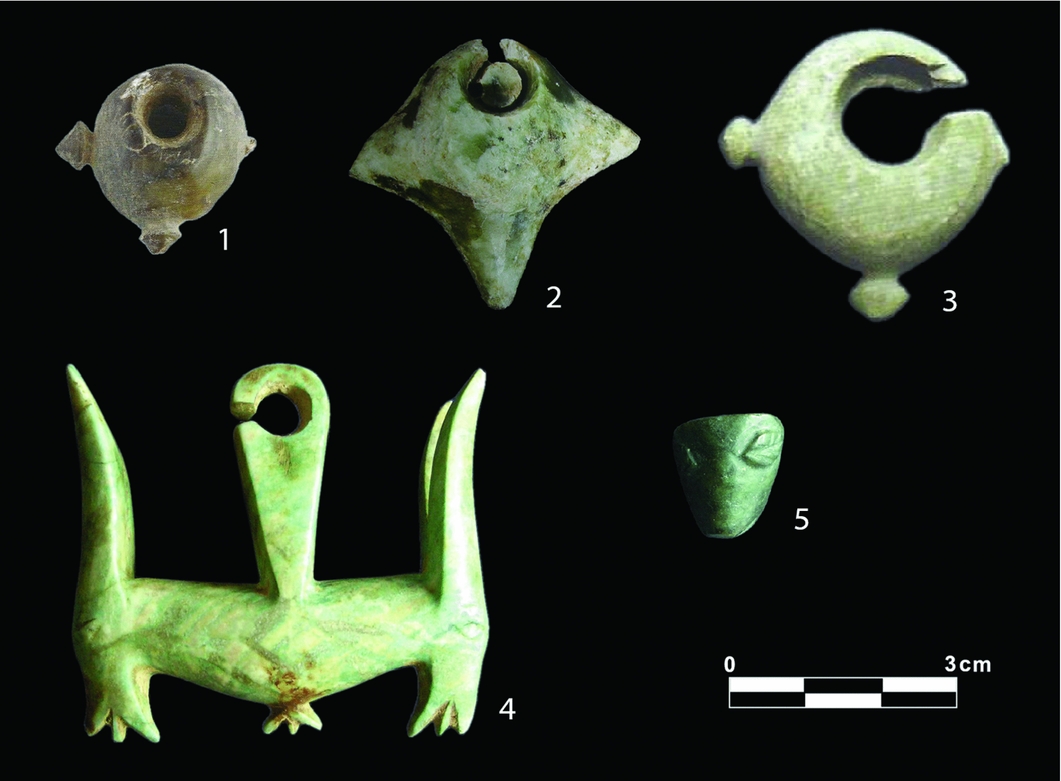
During the Metal Age, identical forms of jade ornaments became popular around the northern peripheries of the South China Sea, from southern Thailand to Borneo. Evidence from shaped raw materials found at workshop sites suggests the possibility of itinerant specialist craftsmen. In Taiwan itself, however, the traditional Neolithic styles of jade ornaments rapidly lost popularity during the Metal Age, when two particularly widespread forms of ear ornament, especially popular in contemporary southern Vietnam, became dominant. These are the three-pointed lingling-o earrings and the double animal-headed ear pendants, which appeared at the same time in rather small numbers in south-eastern Taiwan itself (Lee Reference Lee2007, Reference Lee, Gadu and Lin2010; Hung & Bellwood Reference Hung, Bellwood, Bellina, Bacus, Pryce and Christie2010) (Figure 5). These jade earrings, of a typical Southeast Asian style, strengthened the close cultural affiliations between Taiwan and Southeast Asia during this time, whether they were manufactured in Taiwan or elsewhere. Overall, the trading networks of Taiwan jade illustrate how Taiwan was linked with Southeast Asian communities since its Neolithic Age, facilitating the later Metal Age networks.
Southeast Asian style of jade earrings, including the three-pointed lingling-o earrings and the double animal-headed ear pendants, found in south-eastern Taiwan. 1, 2 and 5 from Jiuxianglan; 3 from Lanyu Island; 4 from Changguang of the Changbin area. 1, 2 and 3 were all probably made of Taiwan jade, but 4 was suspected to come from southern Vietnam originally (courtesy: 1, 2 & 3: Lee Reference Lee, Gadu and Lin2010; 4–5 private collection of Lai Peng-ju).

Discussion: Taiwan's position in the ancient world economy
The Metal Age marked a critical transformation in Taiwan prehistory. A variety of new materials were introduced to the island, sometimes with new manufacturing technologies. Along with these transformations, at least some continuity with the Neolithic past was sustained throughout the Early Metal Age. Slate coffins, typical of the late Neolithic Beinan phase in eastern Taiwan, continued to be used during the Metal Age at Jiuxianglan, but during this later phase, the deceased were buried with glass and agate/carnelian beads along with other accoutrements of the Metal Age instead of jade implements and ornaments.
We propose a three-part sequence for the Metal Age in Taiwan, accommodating newer and more diverse materials and technologies over time, consisting of Early (400 BC–AD 200), Middle (AD 200–800) and Late (AD 800–1624) phases, ending finally when the Dutch arrived. Following the initial use of metals and glass around 400–300 BC, we see evidence in eastern Taiwan for indigenous metalworking. Expanded Metal Age inventories are recorded by AD 200–500, such as the recently excavated Hanben assemblage in the north-east, and at Shisanhang. Later still, between AD 800 and the AD 1600s, various metalworking practices (including those using gold and silver), glass, Chinese porcelain, stoneware and other goods or technologies effectively replaced the older Neolithic material culture throughout the island, although some simple stone implements (e.g. adzes) were still used by communities in remote mountain areas.
Regarding Metal Age sea lanes, several transit patterns can be observed:
-
1) Finished goods: Indo-Pacific glass and agate/carnelian beads arrived from Southeast Asia, and Taiwan jade artefacts were exported back to Southeast Asia.
-
2) Technologies: bronze, iron and glass production technologies were introduced to Taiwan from Mainland Southeast Asia.
-
3) Raw materials: copper and lead were imported to Taiwan, probably from Mainland Southeast Asia, perhaps in the form of artefacts for reworking. Taiwan nephrite (jade) raw material was exported into Southeast Asia, but so far none has been reported from China.
-
4) Craft specialisation: specialists may have travelled to Taiwan in connection with the introduction of new manufacturing technologies, especially copper and iron metallurgy and glass working.
The overseas transfer of metalworking technology raises questions about the roles of skilled practitioners who could execute complicated procedures (Roberts et al. Reference Roberts, Thornton and Pigott2009; Higham et al. Reference Higham, Higham, Ciarla, Douka, Kijngam and Rispoli2011). Did migrant craftsmen travel to Taiwan? We cannot be sure, but historical documents of one Formosan group offer an interesting analogy. As recorded by Spanish Father Jacinto Esquivel in 1632 (Alvarez Reference Alvarez1930; Wong Reference Wong and Huang1995: 107, Reference Wong, Huang and Wong1999; Borao Reference Borao2001: 166), the Basai people of northern Taiwan possessed three impressive talents: their multilingualism, their business acumen (as brokers) and their waterborne navigation techniques. With these talents, the Basai travelled between different ethnic groups along Taiwan's northern and eastern coasts. They exchanged their labour and craft skills (especially in ironworking), gathered products for rice, millet and other subsistence needs, and they excelled as trading middlemen. People with cultural traditions similar to the lifestyle of the Basai may have played important roles in introducing new ideas, technologies, products and services into ancient Taiwan.
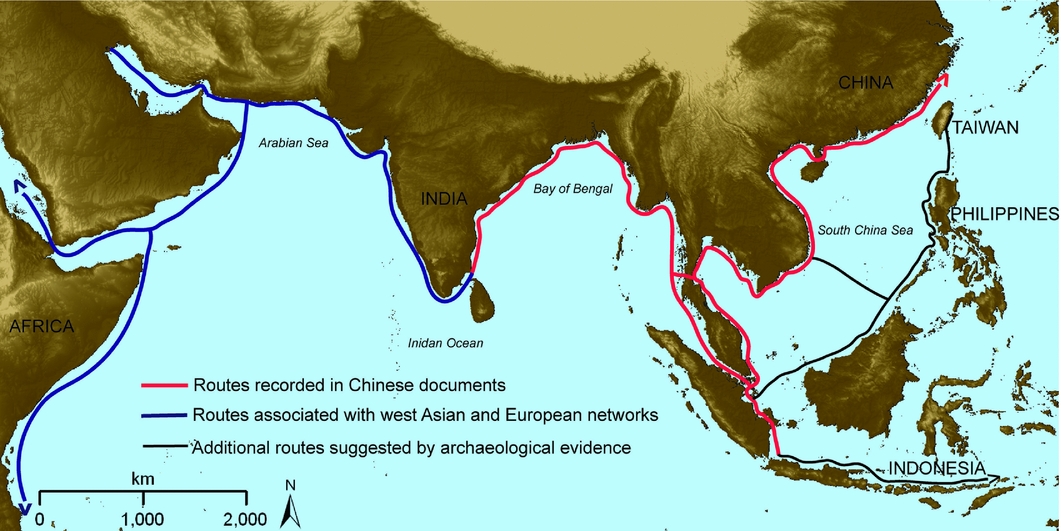
Overall, Taiwan's early trading networks differed from those of the contemporary Han Chinese, although some overlap probably existed (Figure 6). Han commerce involved centralised political and economic control and command of extensive overseas and overland routes. The Maritime Silk Roads carried silk, gold and other highly valued goods from China, whereas trade between Taiwan and Mainland Southeast Asia was conducted on a smaller scale and mainly involved the exchange of knowledge and raw materials for making ornaments. This smaller scale may, however, have been rather impressive when considering the size of Taiwan Island as compared to the larger total region controlled by the Han Empire.
Reconstructed ancient maritime trade routes (also called ‘Maritime Silk Roads’) connecting Southeast Asia and other regions, c. 400 BC through to AD 200.

Conclusion
While the Han Empire in China increasingly engaged in trade with India and the Western world, a different set of trade routes linked Taiwan, the Philippines, Borneo and the southern portion of Mainland Southeast Asia. These separate coastal communities on distant shores of the same sea have shared much in common with each other (Lape Reference Lape and Fitzpatrick2002). The South China Sea presents one case in point, where cultural practices and histories have been shared across remotely separated areas, but not necessarily among nearest-neighbour communities (Hung et al. Reference Hung, Nguyen, Bellwood and Carson2013). The archaeological evidence suggests very intensive cross-regional exchange, at least since 400 BC.
Living beyond the borders of the Han Empire, the Formosan traders in Taiwan interacted with overseas communities of related Austronesian-speaking populations. These people shared not only their language family, but also their preferred methods of craft production. The emergence and development of a Metal Age in Taiwan presented a range of surprising links with Southeast Asia, and especially with southern Thailand, Vietnam and the Philippines, although notably not China. Even though direct links with Khao Sam Kaeo cannot yet be demonstrated, the probable contemporary existence at that site of local populations, South Asians and both continental and insular Southeast Asians, together possibly with Han Chinese (Bellina Reference Bellina2014), informs us about how cultural exchanges might have been undertaken between distant communities around 2000 years ago.
Current archaeological data indicate that Early Metal Age sites first occurred in south-eastern Taiwan, rather than along the western coast. During the Han Empire, did the people of Taiwan completely ignore everything on the mainland to their immediate west? If so, did such a choice cause the Formosan people to continue with independent, non-state social groups for the following 16 centuries until more intensive encounter with Chinese Han immigrants and European foreigners? Further research may yet compare Jiuxianglan and Khao Sam Kaeo at the two ends of a 2700km-long distance across the South China Sea maritime network; for instance, in terms of their labour organisation and the origin(s) of their craftsmen. All of these issues need future investigation.
Acknowledgements
The authors would like to thank Mike Carson of the University of Guam, Peter Bellwood at the Australian National University and two anonymous reviewers for their comments to improve this manuscript.