Prospective descriptive pathology studies have characterized the prevalence and etiology of anorexia nervosa (AN), bulimia nervosa (BN), and binge eating disorder (BED), as well as subthreshold levels of these disorders and purging disorder (PD), which are classified as Other Specified Feeding and Eating Disorders (OSFED) per DSM-5 [American Psychiatric Association (APA), 2013], revealing that adolescent girls with both threshold and subthreshold eating disorders show significantly greater functional impairment, emotional distress, suicidality, unhealthy body weights, and mental health services utilization compared to those without eating disorders (Allen, Byrne, Oddy, & Crosby, Reference Allen, Byrne, Oddy and Crosby2013; Stice, Marti, & Rohde, Reference Stice, Marti and Rohde2013b; Swanson, Crow, Le Grange, Swendsen, & Merikangas, Reference Swanson, Crow, Le Grange, Swendsen and Merikangas2011). Indeed, adolescent girls with threshold v. subthreshold eating disorders do not significantly differ on these impairment indices (Stice et al., Reference Stice, Marti and Rohde2013b), 30% of adolescent girls with subthreshold eating disorders subsequently develop threshold eating disorders (Glazer et al., Reference Glazer, Sonneville, Micali, Swanson, Crosby, Horton and Field2019), and 30% of individuals who seek treatment for an eating disorder have an OSFED (Mancuso et al., Reference Mancuso, Newton, Bosanac, Rossell, Nesci and Castle2015; Thomas et al., Reference Thomas, Eddy, Murray, Tromp, Hartmann, Stone and Becker2015), signaling the importance of including OSFED cases in etiological studies of eating disorders. Unfortunately, most individuals with threshold and subthreshold eating disorders do not receive treatment for their eating disorder (Swanson et al., Reference Swanson, Crow, Le Grange, Swendsen and Merikangas2011).
Studies have explored potential risk factors for eating disorders. Stice and van Ryzin (Reference Stice and van Ryzin2019) examined the temporal sequencing of risk-factor emergence, finding that perceived pressure to be thin and pursuit of the thin ideal temporally precede emergence of body dissatisfaction, which temporally precedes emergence of dieting and negative affect, which temporally precede emergence of BN, BED, or PD among a community-recruited sample of adolescent girls. Other studies found that eating problems and negative weight-related attitudes were correlated with later pathological eating (Harle et al., Reference Harle, De Stavola, Hübel, Abdulkadir, Ferreira, Loos and Micali2020; Sharpe et al., Reference Sharpe, Griffiths, Choo, Eisenberg, Mitchison, Wall and Neumark-Sztainer2018; Sonneville et al., Reference Sonneville, Grilo, Richmond, Thurston, Jernigan, Gianini and Field2015). However, few studies have tested whether prodromal symptoms increase risk for future onset of each eating disorder among a cohort of participants who did not have the eating disorders when the prodromal symptoms were assessed, which provides the most rigorous evidence that a variable is a risk factor for a psychological disorder (Kraemer et al., Reference Kraemer, Kazdin, Offord, Kessler, Jensen and Kupfer1997). To our knowledge, no study has tested whether the full spectrum of prodromal eating-disorder symptoms increase risk for future onset of specific eating disorders using data from a community sample of adolescent girls.
Prodromal symptoms are required by DSM-5 (APA, 2013) for a diagnosis of an eating disorder, including binge eating, compensatory weight-control behaviors, weight/shape overvaluation, fear of weight gain, and feeling fat (Stice, Desjardins, Rohde, & Shaw, Reference Stice, Desjardins, Rohde and Shaw2021). Understanding the order of symptom emergence for each eating disorder and the predictive relation of prodromal symptoms to future onset of each disorder should advance knowledge of etiological processes of these disorders, guide etiologic models for specific eating disorders, highlighting similarities and differences in their development, and inform the design of effective prevention programs. Data might reveal that certain prodromal symptoms increase risk for future emergence of eating disorders and that etiologic models should be refined to include prodromal symptoms.
One prior study addressed these questions with a large high-risk sample (N = 1952) of young women with appearance concerns followed over 3 years (Stice et al., Reference Stice, Desjardins, Rohde and Shaw2021). Regarding behavioral symptoms, compensatory weight-control behaviors typically emerged first for AN, BN, and PD, whereas binge eating typically emerged first for BED. Regarding cognitive symptoms, for AN weight/shape overvaluation typically emerged first, whereas for BN, BED, and PD all cognitive symptoms typically emerged simultaneously. All behavioral and cognitive symptoms predicted BN, BED, and PD onset, whereas weight/shape overvaluation, fear of weight gain, and lower-than-expected BMI predicted AN onset, showing small to large effects.
Although these findings made a novel contribution to the literature, it is unclear whether they generalize to adolescence when eating disorders typically emerge (Hudson, Hiripi, Pope, & Kessler, Reference Hudson, Hiripi, Pope and Kessler2007; Stice et al., Reference Stice, Marti and Rohde2013b) and to youth who are not at high-risk for eating disorders. Thus, we analyzed data from a non-high-risk community sample of adolescent girls who completed annual diagnostic interviews that assessed symptoms on a month-by-month basis over 8 years. Aim 1 was to characterize the order of prodromal symptom emergence among adolescents who developed threshold/subthreshold AN, BN, BED, or PD during follow-up. We hypothesized that compensatory behaviors would typically emerge before binge eating, and that cognitive symptoms would typically emerge before or concurrently with compensatory behaviors. Theoretically, weight/shape overvaluation, feeling fat, and fear of weight gain prompt weight-control behaviors, which subsequently increase risk for binge eating (Stice et al., Reference Stice, Desjardins, Rohde and Shaw2021). Aim 2 was to test whether prodromal symptoms that emerge during the study period, including lower-than-expected BMI, increased risk for subsequent onset of each eating disorder type, with a focus on which prodromal symptoms show the strongest predictive effects for each eating disorder.
Method
Participants and procedures
We collected data from 496 adolescent girls recruited from public and private schools. Parents provided informed consent, which was described as an investigation of physical and mental health among adolescent girls. The return rate was approximately 56%, which was similar to the rates reported in other longitudinal studies (e.g. Striegel-Moore, Seeley, & Lewinsohn, Reference Striegel-Moore, Seeley and Lewinsohn2003). The average age of the participants was 13.02 years (s.d. = 0.73; range = 11–15) at baseline, and 67.7% of participants were White, 18.1% Hispanic, 7.3% Black, 1.6% Asian, 0.8% Native American, and 3.8% other. We confirmed that our sample was representative in terms of race/ethnicity and socioeconomic status to the city from which we sampled (Stice, Marti, Shaw, & Jaconis, Reference Stice, Marti, Shaw and Jaconis2009).
Measures
Eating pathology
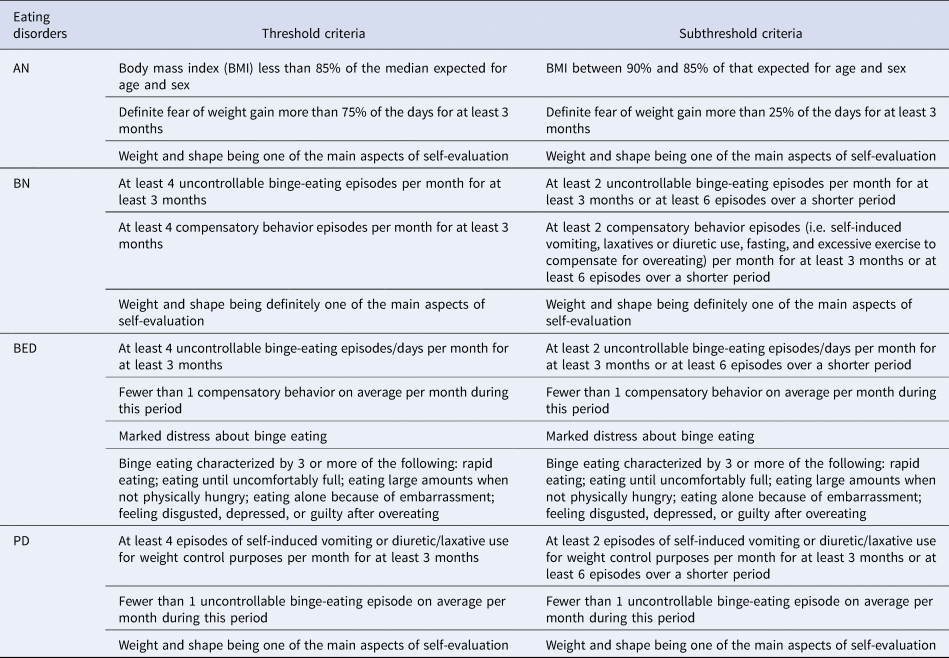
The semi-structured Eating Disorder Diagnostic Interview (EDDI; Stice, Gau, Rohde, & Shaw, Reference Stice, Gau, Rohde and Shaw2017) assessed eating disorder symptoms over the past 3 months at baseline (Wave 1) and since the previous interview at each annual follow-up on a month-by-month basis using time-line follow-back over the next 7 years (Waves 2–8). These data allowed us to determine the month during which participants showed emergence of diagnostic levels of each prodromal symptom that cross-cut the four eating disorders for those who developed threshold/subthreshold AN, BN, BED, or PD over 8 years. We used DSM-5 criteria for eating disorders (see Table 1 for diagnostic criteria of threshold and subthreshold eating disorders). Female assessors with a B.A./B.S., M.A., or Ph.D. in psychology attended 24 h of training in which they received instruction in structured interview skills, reviewed the diagnostic criteria, observed simulated interviews, and role-played interviews. Assessors were required to demonstrate inter-rater agreement (k > 0.80) with supervisors on 12 tape-recorded interviews prior to collecting data. Assessors also completed annual refresher training to prevent diagnostic drift, further ensuring the reliability and validity of the diagnostic interviews over the 7-year period.
Classification criteria of threshold and subthreshold eating disorders

AN, anorexia nervosa; BN, bulimia nervosa; BED, binge eating disorder; PD, purging disorder.
Emergence of behavioral symptoms was defined as the timing of engaging in at least six binge-eating and/or compensatory behaviors, including self-induced vomiting, laxative/diuretic abuse, fasting, and excessive exercise, within a 3-month period. Emergence of cognitive symptoms was defined as the timing of experiencing a certain level of weight/shape overvaluation, fear of weight gain, and/or feeling fat over a 3-month period. Participants rated weight/shape overvaluation on a six-point scale ranging from 0 = no importance to 6 = supreme importance (nothing is more important in terms of self-evaluation); a response of at least 4 = moderate importance (definitely one of the main aspects of self-evaluation) across 3 consecutive months was considered symptom emergence. Participants rated fear of weight gain on a seven-point scale ranging from 0 = 0 days per week in the past month (no definite fear of fatness or weight gain) to 6 = 6–7 days per week in the past month (definite fear of fatness or weight gain present every day); a response of at least 5 = 5–6 days per week in the past month (definite fear of fatness of weight gain for 75% of the days in the past month) across 3 consecutive months was considered symptom emergence. Participants rated feeling fat on a seven-point scale ranging from 0 = 0 days per week in the past month (has not felt fat) to 6 = 6–7 days per week in the past month (has felt fat every day); a response of at least 5 = 5–6 days per week in the past month (felt fat 75% of the days in the past month) across 3 consecutive months was considered symptom emergence. The last month of the consecutive 3-month period was treated as the onset month. We used the same criteria for prodromal symptoms used in a study that examined at-risk, older females (Stice et al., Reference Stice, Desjardins, Rohde and Shaw2021), because an objective was to determine if sequencing of symptom emergence was similar in this community sample of adolescents. We could not determine the month in which participants first reached lower-than-expected BMI because BMI was only measured annually. We did not assess the highest past weight, which is necessary for a diagnosis of atypical AN, because atypical AN was introduced after we started data collection.
To assess test-retest reliability for the EDDI, 416 participants from this study repeated the EDDI with the same assessor; 1-week test-retest reliability was k = 0.94 for binge eating, k = 0.79 for compensatory behaviors, k = 0.93 for weight/shape overvaluation, k = 0.83 for fear of weight gain, and k = 0.82 for feeling fat. To assess inter-rater agreement for the EDDI, 418 participants from this study completed an EDDI with a second assessor within 1–3 days; inter-rater agreement was k = 0.81 for binge eating, k = 0.68 for compensatory behaviors, k = 0.87 for weight/shape overvaluation, k = 0.82 for fear of weight gain, and k = 0.87 for feeling fat. Participants with v. without threshold/subthreshold DSM-5 EDDI-diagnosed eating disorders show greater functional impairment, emotional distress, and service utilization (Stice et al., Reference Stice, Marti and Rohde2013b).
Body mass index (BMI)
BMI (kg/m2; Pietrobelli et al., Reference Pietrobelli, Faith, Allison, Gallagher, Chiumello and Heymsfield1998) was used to reflect height-adjusted body mass. Height was measured to the nearest millimeter with portable stadiometers. Weight was measured to the nearest 0.1 kg with digital scales (participants wore only light indoor clothing without shoes). Age- and sex-adjusted BMI centiles indicated if participants' BMI was lower than 85% (for threshold AN) or 90% (for subthreshold AN) of that expected for their sex and age. BMI has shown convergent validity (r = 0.80–0.90) with direct measures of body fat (Pietrobelli et al., Reference Pietrobelli, Faith, Allison, Gallagher, Chiumello and Heymsfield1998) and predictive validity for the future onset of AN (Stice et al., Reference Stice, Gau, Rohde and Shaw2017).
Statistical methods
Emergence of symptoms
We determined the order of symptom emergence among participants who developed subthreshold/threshold AN, BN, BED, or PD during the 8-year study. For behavioral symptoms, we examined whether binge eating or compensatory behavior emerged first or simultaneously. For cognitive symptoms, we examined whether weight/shape overvaluation, fear of weight gain, or feeling fat emerged first or simultaneously. Next, we examined if any behavioral or any cognitive symptom emerged first or simultaneously. This sequential approach was utilized because if we tried to characterize the emergence order of all prodromal symptoms in one step, it would be difficult to detect distinctive trends due to the high number of symptom-onset combination patterns (i.e. 32 potential combinations).
Relation of prodromal symptoms to future onset of eating disorders
We tested whether prodromal symptoms that emerged during the study period (modeled with dichotomous variables) predicted future onset of a threshold/subthreshold eating disorder using logistic regression. When a model showed a perfect or near-perfect separation between participants who did and did not show particular eating disorder onset, Firth's logistic regression was used (Heinze & Schemper, Reference Heinze and Schemper2002). We estimated a series of models that tested whether the prodromal symptom univariately predicted eating disorder onset. When multiple symptoms displayed significant predictive effects for an eating disorder, we tested a multivariate model that evaluated the unique effects of each prodromal symptom. The success rate difference (SRD) for each prodromal symptom was unconditionally estimated as a measure of effect size. Based on Cohen's criteria (Cohen, Reference Cohen1992), SRDs of 0.11, 0.28, and 0.43 indicated small, medium, and large effects, which are equivalent to Cohen's d of 0.2, 0.5, and 0.8, respectively (Kraemer & Kupfer, Reference Kraemer and Kupfer2006). The predictive accuracy, sensitivity, and specificity of the set of prodromal symptoms were also evaluated. For statistical analyses, SPSS ver. 26, R (R Core Team, 2020), and R package for Firth's logistic regression (Heinze, Ploner, & Jiricka, Reference Heinze, Ploner and Jiricka2020) were used.
Missingness and attrition
Missing data occurred at the baseline assessment for BMI (0.2%), weight/shape overvaluation (1.2%), feeling fat (1.6%), and fear of weight gain (1.8%). Moreover, 0.6% of those who later developed an eating disorder missed diagnostic data for at least one eating disorder. Because missing data were minimal, we focused on participants with complete data at baseline. Attrition ranged from 1% for Wave 2 to 6% for Wave 8. We sometimes collected data from participants who skipped an earlier assessment. Attrition was not significantly correlated with any study variables.
Results
Preliminary analyses
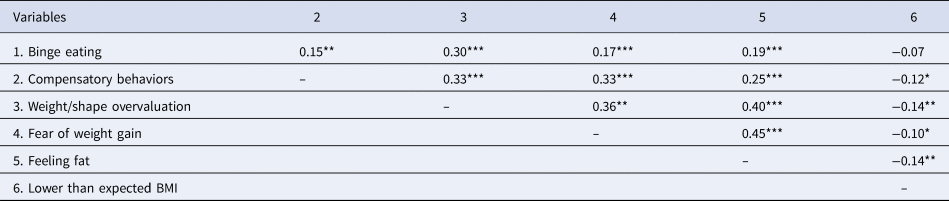
Among 496 participants, 487 participants did not have an eating disorder at baseline. During the 7-year follow-up, 24 participants developed AN (21 subthreshold, 4 threshold), 30 developed BN (29 subthreshold, 8 threshold), 13 developed BED (12 subthreshold, 3 threshold), and 25 developed PD (13 subthreshold, 18 threshold). A few participants within each group developed a subthreshold eating disorder first, then a threshold eating disorder later. Moreover, 11 participants met criteria for more than one type of eating disorder across follow-up. To increase sensitivity, we included them in models for each eating disorder they experienced. Lastly, the correlations among prodromal symptoms are reported in Table 2.
Correlation matrix of six independent variables

Note: *p < 0.05, **p < 0.01, ***p < 0.001.
Symptom emergence
Order of symptom emergence by eating disorder is presented in Table 3. For all eating disorders, compensatory behavior typically emerged before binge eating. The percentage of those who displayed compensatory behavior first ranged from 53.8% for BED to 92.0% for PD. Regarding cognitive symptoms, weight/shape overvaluation typically emerged first for all eating disorders, ranging from 32.0% for PD to 62.5% for AN. Lastly, emergence order of any behavioral and any cognitive symptom by eating disorder is shown in Table 4. For all eating disorders, cognitive symptoms typically emerged before behavioral symptoms, ranging from 50.0% for AN to 84.6% for BED.
Temporal sequencing of prodromal symptom emergence in anorexia nervosa, bulimia nervosa, binge eating disorder, and purging disorder

Note: ED, eating disorder; AN, anorexia nervosa; BN, bulimia nervosa; BED, binge eating disorder; PD, purging disorder. The most common order of symptom emergence for each eating disorder is bolded.
Temporal sequencing of the emergence of any behavioral or any cognitive symptom in anorexia nervosa, bulimia nervosa, binge eating disorder, and purging disorder

Note: Behavioral represents the number and percent of participants where binge eating and/or compensatory behavior emerged before cognitive symptoms. Cognitive represents the number and percent of participants where weight/shape overvaluation, fear of weight gain, and/or feeling fat emerged before behavior symptoms. Behavioral and cognitive represents the number and percent of participants where at least one behavioral and one cognitive symptom emerged in the same month. All five represents the number and percent of participants where all five symptoms emerged in the same month. The most common order of symptom emergence for each eating disorder is bolded.
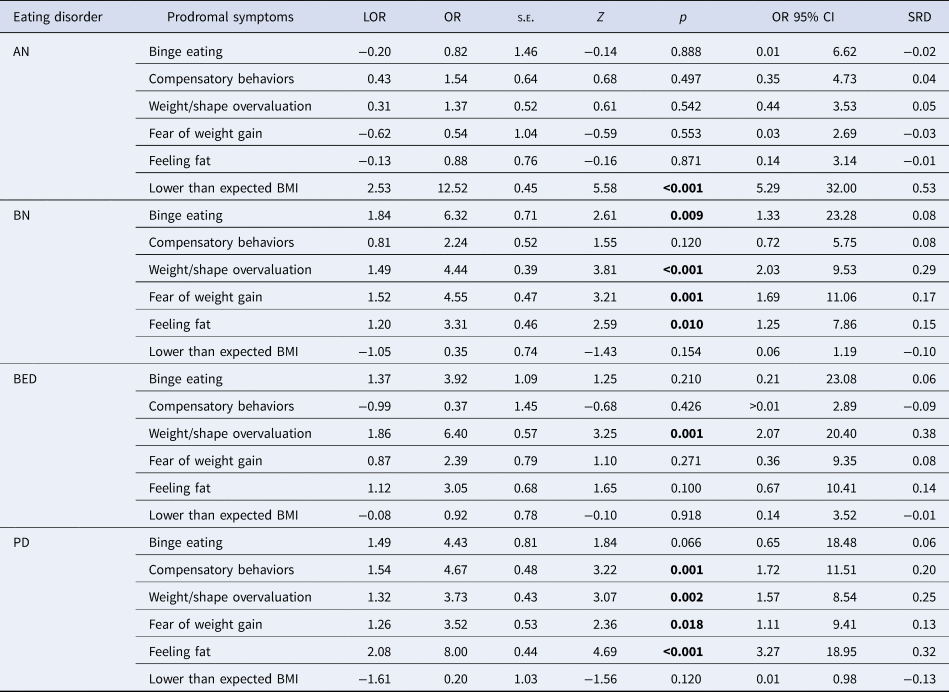
Prediction of onset of eating disorders
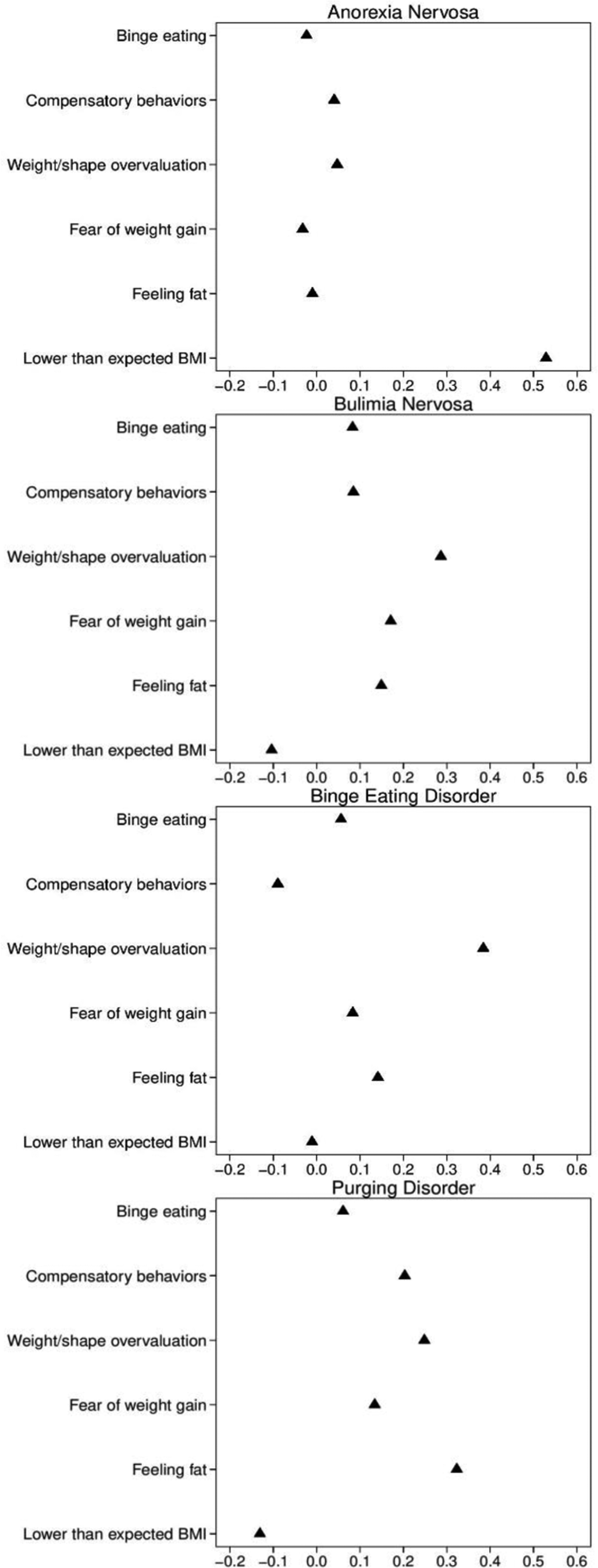
Analyses tested whether prodromal symptoms predicted future onset of each eating disorder (see Table 5). For AN, only lower-than-expected BMI was a significant predictor (OR = 12.52, 95% CI 5.29–32.00, p < 0.001) with a large effect (SRD = 0.53). For BN, binge eating (OR = 6.32, 95% CI 1.33–23.28, p = 0.009), weight/shape overvaluation (OR = 4.44, 95% CI 2.03–9.53, p < 0.001), fear of weight gain (OR = 4.55, 95% CI 1.69–11.06, p = 0.001), and feeling fat (OR = 3.31, 95% CI 1.25–7.86, p = 0.010) were significant predictors, with small to medium effect sizes (SRDs = 0.08–0.29). For BED, only weight/shape overvaluation was a significant predictor (OR = 6.40, 95% CI 2.07–20.40, p = 0.001) with a large effect (SRD = 0.38). For PD, compensatory behavior (OR = 4.67, 95% CI 1.72–11.51, p = 0.001), weight/shape overvaluation (OR = 3.73, 95% CI 1.57–8.54, p = 0.002), fear of weight gain (OR = 3.52, 95% CI 1.11–9.41, p = 0.018), and feeling fat (OR = 8.00, 95% CI 3.27–18.95, p < 0.001) were significant predictors, with small to medium effects (SRDs = 0.13–0.32). Figure 1 depicts a plot of SRDs as a function of prodromal symptoms by eating disorder.
Plot of success rate difference (SRD) by prodromal symptom by eating disorder. Note: SRDs of 0.11, 0.28, and 0.43 correspond to small, medium, and large effects, respectively.

Logistic regression models where eating disorder was regressed onto prodromal symptoms

Note: AN, anorexia nervosa; BN, bulimia nervosa; BED, binge eating disorder; PD, purging disorder; LOR, log odds ratio; OR, odds ratio; SRD, success rate difference. SRDs of 0.11, 0.28, and 0.43 correspond to small, medium, and large effects, respectively. Significant p-values are bolded (p < .05). All significant p values remained significant when the Benjamini–Hochberg correction was applied.
To examine the unique predictive effects of prodromal symptoms, multivariate backward stepwise logistic regressions were tested for BN and PD as multiple prodromal symptoms showed significant univariate predictive effects. At each step, a symptom with the smallest p value was removed from a model and the AIC was utilized to generate the most parsimonious models. For BN, only weight/shape overvaluation showed a significant unique predictive effect (p = 0.005), with fear of weight gain showing a marginal relation (p = 0.098) in the final model (AIC = 216.49). As for PD, only feeling fat showed a significant unique predictive effect (p < 0.001), with compensatory behavior showing a marginal relation (p = 0.065) in the final model (AIC = 182.43). The highest variance inflation factor in the multivariate models was 1.72, which was well below the recommended cutoff of 10 (Neter, Wasserman, & Kutner, Reference Neter, Wasserman and Kutner1989), thus the collinearity between predictors was not excessive.
Regarding overall classification accuracy, the set of prodromal symptoms that emerged during the study period showed high predictive accuracy for all eating disorders ranging from 83% for BN to 87% for BED. See online Supplementary material for the sensitivity and specificity.
Discussion
The first aim was to determine the order of prodromal symptom emergence among adolescent girls who developed subthreshold/threshold AN, BN, BED, or PD. Regarding behavioral symptoms, compensatory behaviors typically emerged before binge eating for all eating disorders, which was the same pattern for AN, BN, and PD in Stice et al. (Reference Stice, Desjardins, Rohde and Shaw2021), though for BED, binge eating typically emerged first in that high-risk sample. Our finding is interesting because compensatory behaviors are not a diagnostic symptom of BED (but the absence of compensatory behaviors is), yet more than half (53.8%) of participants who developed BED first engaged in compensatory behaviors rather than binge eating. As the number of participants who developed BED was small (n = 13), the findings need to be interpreted cautiously, but results suggest that many people who develop BED engage in compensatory behaviors during the early prodromal stage but over time, binge eating escalates while compensatory behaviors attenuate.
Regarding cognitive symptoms, weight/shape overvaluation tended to emerge first for all eating disorders, whereas Stice et al. (Reference Stice, Desjardins, Rohde and Shaw2021) found that all three cognitive symptoms emerged simultaneously for BN, BED, and PD. This finding may imply that girls acknowledge the importance of weight/shape by early adolescence, but as many of them have not gone through puberty, they typically have not experienced excess weight gain or felt fat. Participants' average BMI across the 7-year follow-up period was relatively low (median = 21.31), which might have mitigated against fear of weight gain or feeling fat. This finding needs to be confirmed with data from a larger sample.
Concerning whether any behavioral or any cognitive symptom emerged first or simultaneously, a cognitive symptom tended to emerge first for all eating disorders. Of note, virtually no participants showed simultaneous emergence of all prodromal symptoms. This finding is novel and different from Stice et al. (Reference Stice, Desjardins, Rohde and Shaw2021), which found that the most common pattern was for one behavioral and one cognitive symptom to emerge simultaneously and that a small subset showed emergence of all prodromal symptoms simultaneously. Given that the present study examined the developmental period during which eating disorders typically emerge, we conclude that most individuals who develop an eating disorder show emergence of a cognitive symptom before emergence of a behavioral symptom. Another possible explanation for the different finding between Stice et al. (Reference Stice, Desjardins, Rohde and Shaw2021) and our study may be that the former study examined a high-risk sample, whereas we examined a non-high-risk sample. It is possible that behavioral symptoms escalated faster for individuals at high-risk for eating pathology.
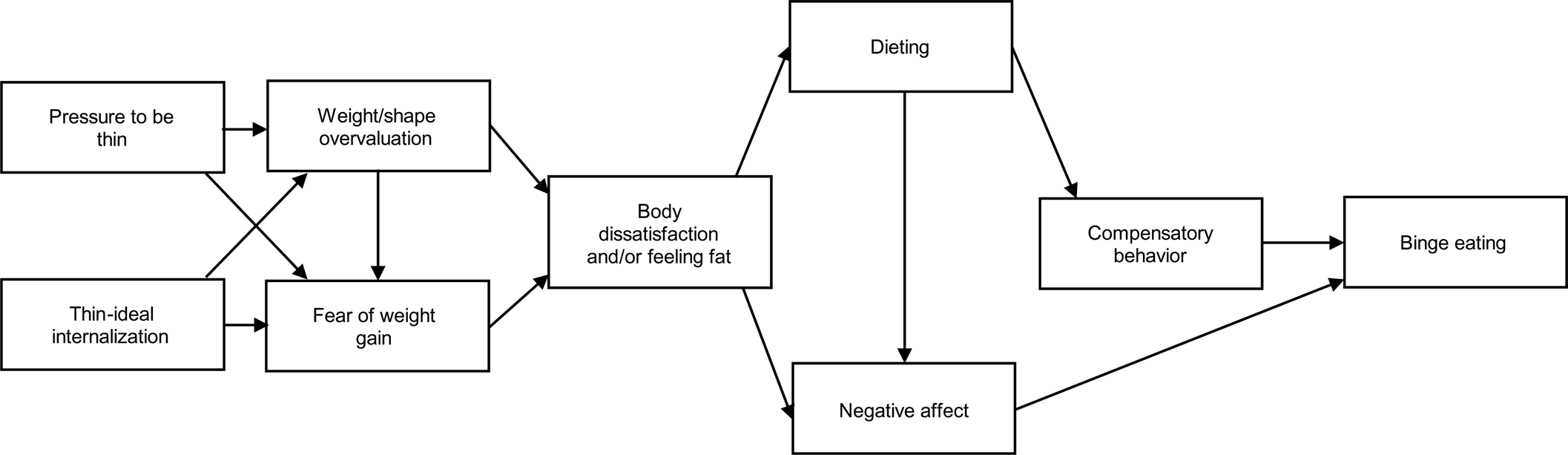
In sum, our findings are consistent with the thesis that weight-related cognitive symptoms may prompt adolescent girls to use compensatory weight-control behaviors, but many of them eventually show emergence of binge eating (Stice et al., Reference Stice, Desjardins, Rohde and Shaw2021). Compensatory weight-control behaviors, such as fasting, increase the reward value of high-calorie binge foods according to brain imaging data (Leidy, Lepping, Savage, & Harris, Reference Leidy, Lepping, Savage and Harris2011; Stice, Burger, & Yokum, Reference Stice, Burger and Yokum2013a), which is theorized to increase risk for binge eating. What is noteworthy is that eating disorders seem to develop as a result of weight-oriented cognitions, rather than these cognitions emerging secondary to binge eating. These inferences are compatible with etiological models of eating disorders, such as the dual pathway model of binge/purge eating disorders (Stice, Reference Stice1994) and the cognitive-behavioral theory of BN (Fairburn, Reference Fairburn, Clark and Fairburn1997), which propose that weight-oriented cognitions such as pursuit of the thin ideal and weight/shape overvaluation contribute to the development of eating disorders characterized by compensatory behaviors and/or binge eating. Because our findings suggest that prodromal symptoms should be incorporated into multifactorial etiological models of eating disorders, we propose a refined version of the dual pathway model (see Fig. 2), postulating that perceived pressure for thinness and thin-ideal internalization lead to prodromal cognitive symptoms, which, in turn, leads to self-perception of fatness and body dissatisfaction. Self-perception of fatness and body dissatisfaction then putatively lead to dietary restriction and negative affect, followed by compensatory weight-control behaviors. This refined etiologic model posits that it might be useful to reduce weight/shape concerns and self-perception of fatness to prevent future eating disorders.
Refined version of the dual pathway model.

The second aim was to test whether prodromal symptoms predicted future onset of each eating disorder over a 7-year follow-up. Analyses suggested that only lower-than-expected BMI predicted AN onset, whereas only weight/shape overvaluation predicted BED onset. Binge eating and all cognitive symptoms predicted BN onset. Compensatory behavior and all cognitive symptoms predicted PD onset. These findings suggest important developmental differences in risk factors that predict future onset of eating disorders, though they should be confirmed with data from larger samples. Thus, it might be best to screen adolescent girls for prodromal symptoms around age 14 or 15 for optimal identification for those at greater risk for developing eating disorders.
There is a possibility that the heterogeneity of compensatory behavior compromised the sensitivity to predict future onset of eating disorders. Though both types of compensatory behaviors are used to control body weight, purging behaviors (i.e. self-induced vomiting and laxative/diuretic use) and excessive exercise/fasting may predict different disorders. For instance, the former might predict future onset of BN or PD, whereas the latter might predict future onset of AN. To address this possibility, we conducted exploratory analyses that separated purging behaviors and excessive exercise/fasting, and evaluated how they predicted future eating disorder onset using univariate logistic regressions. We found that there was no difference from the original findings; neither type of compensatory behavior predicted AN, BN, or BED onset, but both types of compensatory behaviors predicted PD onset.
The effect sizes for prodromal symptoms in predicting each eating disorder show that the most potent predictors differ across disorders. The only predictor for AN was lower-than-expected BMI, and its effect size was much bigger than that of any other prodromal symptom. This suggests that it might be most useful to screen adolescent girls for a low BMI between the ages of 14 and 16 instead of earlier. Regarding BN, though all cognitive symptoms predicted BN onset, the most potent predictor was weight/shape overvaluation followed by fear of weight gain with near medium effects and feeling fat with a small effect. The most potent predictor for BED was weight/shape overvaluation with a large effect. Lastly, feeling fat was the strongest predictor of PD, followed by compensatory behavior and weight/shape overvaluation with medium effects.
Multivariate analyses indicated that among binge eating and all cognitive symptoms, only weight/shape overvaluation showed a unique significant predictive relation with future BN onset. Moreover, among compensatory behavior and all cognitive symptoms, only feeling fat showed a unique significant predictive relation with future PD onset. One potential explanation for the fact that only one prodromal symptom showed unique predictive effects is that the prodromal symptoms operate in a mediational fashion. Cognitive symptoms may typically emerge in early adolescence and increase risk for future emergence of compensatory weight-control behaviors, which increases risk for binge eating. Future research should investigate if prodromal symptoms operate in a mediational fashion.
The predictive accuracy of the set of prodromal symptoms that emerged during adolescence ranged 83–87%, suggesting that prodromal symptoms have a high predictive accuracy. The current study and Stice et al. (Reference Stice, Desjardins, Rohde and Shaw2021) both suggest that we can predict future eating disorder onset with reasonably high accuracy via a self-report survey and/or clinical interview among early adolescent girls and at-risk young women. Hence, it should be possible to target those at the greatest risk for eating disorders with selective prevention programs.
Limitations of our study should be noted. First, the average age of participants was 13 at baseline and 20 at study completion. This age range covers the average onset age of AN from representative data (17.5) but not that of BN (20.6) and BED (23.3) (Hudson et al., Reference Hudson, Hiripi, Pope and Kessler2007; Kessler et al., Reference Kessler, Berglund, Chiu, Deitz, Hudson, Shahly and Xavier2014; Nicholls & Viner, Reference Nicholls and Viner2009). Therefore, the current sample may be able to characterize factors that emerge before onset of AN, but may not fully capture these processes for BN and BED. Second, as participants were females recruited from one state, the generalizability of the findings to those from different regions and males may be limited. Third, prodromal symptoms were retrospectively assessed over a 1-year period, which might not be precise enough in detecting the exact timing of symptom emergence. However, the average test-retest and inter-rater reliability coefficient for prodromal symptoms was high (mean k = 0.86 and 0.81, respectively), implying that self-reported timing of prodromal symptoms onset is reliable. Moreover, results indicated that the monthly assessed prodromal symptoms could predict future eating disorder onset, suggesting that EDDI-assessed prodromal symptoms have predictive validity. Fourth, because we conducted 24 inferential tests with an α of 0.05, it is possible that some of the observed significant findings might have occurred by chance. Further, when the Benjamini–Hochberg correction was applied to control the false discovery rate, only one significant p value became marginal (the p value of ‘fear of weight gain at baseline’ that we do not report in this paper changed from 0.02 to 0.06). Fifth, the number of participants who developed BED during follow-up was small, which increased the risk of making Type-II errors (false-negative findings) and the confidence intervals were relatively large. The detected effect sizes suggest that although we had power to detect small effects for most eating disorders, we did not have power to detect small effects in the prediction of BED onset. Thus, caution should be used when interpreting these relations. However, our findings are valuable as our data set is novel and unique; this is the first study to characterize the emergence of eating pathology among a sample of adolescent girls on a monthly basis for 8 years. Moreover, data collection spanned the developmental period during which eating disorders typically emerge. Nonetheless, it would be useful for other research teams to collect detailed data on the pattern of symptom emergence in eating disorders from a larger sample.
Our findings suggest that weight-oriented cognitive symptoms and compensatory weight-control behaviors may be critical gateway symptoms to eating disorders. Therefore, it might be useful to incorporate these prodromal symptoms into multifactorial etiological models of eating disorders, though the models may need to be somewhat distinct for different disorders. Regarding clinical implications, the fact that prodromal symptoms have predicted future eating disorder onset in two studies suggests it may be useful to screen adolescents for these prodromal symptoms and implement prevention programs that have produced a 54–77% reduction in future eating disorder onset in controlled trials (Ghaderi, Stice, Andersson, Enö Persson, & Allzén, Reference Ghaderi, Stice, Andersson, Enö Persson and Allzén2020; Stice, Marti, Spoor, Presnell, & Shaw, Reference Stice, Marti, Spoor, Presnell and Shaw2008, Reference Stice, Rohde, Shaw and Gau2020). Implementing such prevention programs has the potential to reduce the population prevalence of these disorders.
Supplementary material
The supplementary material for this article can be found at https://doi.org/10.1017/S0033291722001568.
Financial support
This research was supported by NIH grants (grant numbers MH01708 and MH64560).
Conflict of interest
None.