Particular sounds carry temporal information through association. Three temporal qualities are explored in this paper; (1) temporal setting, which conveys temporal information from the embedded surrounding environment of a recorded sound; (2) allusive duration, which refers to time periods associated with extra-musical experiences; and (3) chronological order, which refers to the emergence of order of events that results in the formation of continuous timescales, and to the disturbance of order that causes destruction of temporal linearity and reorganisation of material according to associations.
Associations may also arise from source-cause patterns, creating spatio-temporal trajectories, which are explored in the last section. When examining temporal associations, we need to focus on the esthesic dimension, where meaning is constructed upon reception (Nattiez 1990).
1. Extra-musical associations
This first section briefly describes the relation between sounds and extra-musical associations in general.
Recognisable sound events carry extra-musical associations that draw on listeners’ experiences. A sound coming from an identifiable source has an explicit meaning, or at least a meaning broadly agreed upon by members of the same culture. This denotational meaning of the sound is the direct reference of the sonic image to the source-cause. For example, the sound of a clock points to the existence of a clock; the reference to the object ‘clock’ is the denotation that the clock sound carries. Listeners are able to detect the source-cause, because the sound reveals through its spectromorphology many properties of the medium with which it was produced. For example, the sound of a bell has several qualities of the source-cause imprinted: source and excitation material (metal, revealed through its resonance), size, thickness and heaviness connect the sound to the image of the bell. This denotational meaning is shared between the composer and the listener; in this case, the poietic and the esthesic meet. As Nattiez points out, ‘denotation designates a constellation of interpretants that are common to the poietic and the esthesic’ (1990: 24).Footnote 2
Recognisable sounds can also originate sets of associations: connotational meanings, in addition to their denotational ones. The sound of a bell denotes the metal body of a bell, but it also connotes, at least for Western society, some form of religious worship and connection with the sacred. Connotations may vary because of socio-cultural and personal associations, they can be related with particular generations and eras, and they are subject to change over time.
Recognisability of source-cause is not always straightforward, because there are different degrees of source bonding (Smalley Reference Smalley1997). The less a sound appears to be connected with a known source-cause, the more ambiguous the denotations are, and the more the connotations are left to be influenced by the imagination of the listener and the particular context of a composition.
2. Temporal qualities
Temporal qualities are not only connected with musical syntax (for example duration, rhythms, and density of events), but can also be suggested by particular sound images through their extra-musical associations. In this case, it is difficult to name all possible temporal qualities, because temporal information depends on the sound. Different sounds may carry different temporal messages through association, or even none at all; it is the responsibility of the composer to select sounds that carry specific temporal associations when needed. Three temporal qualities are introduced below, which certainly do not constitute an exhaustive list. They include temporal setting, allusive duration and chronological order, and have arisen from examining particular pieces and studying audio fragments composed specifically to test related hypotheses.
2.1. Temporal setting
A temporal setting, or a sense of place in time, can be suggested through association. For example, the characteristic sound of the nocturnal cricket that lives in Mediterranean countries connotes night; it implies night-time when one knows the sound and can therefore deduce the setting. However, this is a message that makes sense to people who come from those areas, and only to few others who have connected that particular sound with night. This connotational meaning targets a specific group of people, who are familiar with this particular sound.
Two well-known compositions that use cicadas and crickets to connote day and night are Luc Ferrari's Presque Rien No. 1 and No. 2 (composed in 1970 and 1977 respectively). Ferrari uses the sound of these two species to differentiate between day and night, in addition to other associative material, such as scops-owls in the night scene, and human activity normally occurring during the day in the day scene. In Presque Rien No. 1, the cicadas connote day. They start at 1′10″ in the second part of the piece and last for 13 minutes until the end of the composition (the entire duration of the piece is about 20 minutes). In Presque Rien No. 2, Ferrari presents crickets and owls to connote night. The crickets start from the beginning of the piece (quickly followed by the owl) and last for the entire first part, which is about 12 minutes long (the entire piece lasts for 21′30″).
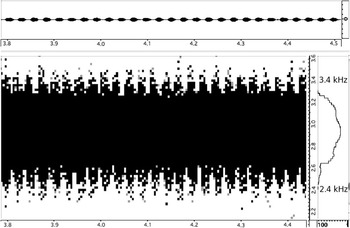
In the case of cicadas and crickets, as in many cases involving recorded environmental sounds, the temporal setting is incorporated into a spatio-temporal setting, because information about time and space is embedded in the sonic material. The temporal setting cannot be separated from its space. If the parameter of space changes, and, for example, the nocturnal crickets are positioned in a virtual room, the sound is deprived of its original environment, resulting in the loss of the temporal setting. The resulting sound does not seem to originate in nocturnal crickets but, in this particular case, in synthesised sound. Similarities to synthesised sound are due to the regular occurrence of grains and to narrow and concentrated frequency content between ∼2.4 and 3.4 kHz (see figure 1).
Sonogram analysis of a cricket sound (c. 0.7 sec long. Horizontal line: time in seconds). The waveform at the top window shows the regularity of grains. The spectrum at the right shows the average amplitude (from c. −110 dB to 0 dB) of the frequencies between 2.4 and 3.4 kHz.

In the resulting sound there is no more ‘open space’, but ‘enclosed environment’; no more ‘night’, but ‘any time’; no more ‘countryside’ but ‘laboratory’. The loss of temporal setting is demonstrated with two audio examples. In the first example, the original recording of a cricket is played back, with the environment left intact (Sound example 1).Footnote 3 In the second example, the surrounding environment of the cricket is artificially removed in the studio, and only the isolated sound of the cricket remains (Sound example 2). In the latter case it is obvious that, when the spatial setting changes, any temporal connotations regarding the sense of time also change. Because the environment is missing, and we normally connect the sound of the cricket with open spaces and additional distant sounds, it is difficult for the listener to associate the isolated sound with a familiar place and time.
Temporal setting does not only relate to day and night, but also to musical characteristics. Suggestive temporal information is carried by the pace and momentum implied by the associations of sounds. For example, recognition of day and night is associated with light versus dark, clear versus obscured vision, safe versus threatened or vulnerable, awake versus asleep, and busy versus calm. If we consider the last juxtaposition, we can detect similarities between busy/calm and opposite states of sonic material densities. In a music composition, a dense section combined with a sense of daytime (e.g. busy traffic) would imply a more hurried feeling than if the same section were combined with a sense of night (e.g. nocturnal crickets). A dense section combined with the relative tranquillity of night attempts to mix the opposites ‘busy state’ and ‘calmness’ (haste and languor), which present contrasting meanings. Contrasting haste and languor leads to the separation of timescales; that is, if there is different material representing each state. The listener then shifts attention between the two extremes – the two timescales do not support each other in terms of pace. One can think of sound environments, for example dense and distant crickets, where the association wins over density and the listener perceives a nocturnal tranquil scene. However, in this case, density and association are presented by the same material (crickets). My intuition is that the state of density and quick succession of events usually wins the attention when it is juxtaposed with associative tranquillity (when each state is expressed by different material), unless the associations are particularly strong.
2.2. Allusive duration
The second temporal quality examined here is allusive duration. The sound image of the sea offers a suitable example, as it refers, among other things, to everlasting existence. Murray Schafer, in his book The Tuning of the World, introduces the sound of the sea as an archetypal image, symbolic of eternity and ceaseless presence (Schafer Reference Schafer1997: 170). However, the association between the sea and its lasting duration does not simply mean that the listener will refer to that particular temporal characteristic while listening to sea sounds. Whether a reference to the temporal quality of ‘allusive duration’ is made depends on how this aspect is used in a composition, and whether the listener is drawn to that aspect. Suitable structures are needed in order to emphasise this symbolism of permanence.
In an electroacoustic piece for six channels I composed in 2005 (Vessel@Anchor), there are temporal qualities referring to the sonic image of the sea and its timelessness. The structure of sections, and of the composition as a whole, plays a primary role in emphasising long durations and the suggested permanence. The piece attempts to play with the listener's perception of duration by extending sections psychologically; this is conducted by exposing static textures and repeated gestures. Repetition seems to suspend time as experiences are relived through a cycling process. A particular case of interest in Vessel@Anchor is the last section, which comprises the last two minutes of the piece; it employs a combination of (1) remembered connotational temporal information originating from previously heard sea sounds; (2) contrast with the previous section (current languor versus preceding haste); and (3) pace, manifested in slowly developing gestures, which are reminiscent of slow waves. These last gestures carry temporal suggestions of ‘perpetuity’, and the section has been invariably perceived as being much longer than it actually is, when heard in the context of the entire composition.Footnote 4 The result is not the same when the ending section is presented alone, because the connection between the slowly evolving gestures and the sea is not made apparent. In order to experience the everlasting quality of the sea – that is, the connotational temporal information it carries – one has to listen to the entire composition. The previously heard sounds of the sea survive their disappearance. The last section does not contain any recognisable water sounds, but it alludes to them through the slow gestures and their shapes (morphologies) which emphasise the profile of undulation and the image of waves. Sound example 3 contains a stereo reduction of the last five minutes of the piece; although not as effective as listening to the entire composition, the excerpt will give the reader/listener a good idea of the method used to suggest long duration.
The composer can effectively employ different techniques to allude to permanence, or to long duration. Hildegard Westerkamp and Barry Truax, discussed below, may not have used their techniques intentionally to suggest a lasting temporal quality, but their tactics can provide useful paradigms for our purpose.
Hildegard Westerkamp, in her composition Kits Beach Soundwalk Reference Westerkamp(1989), uses narrative to guide the listener through different sounds recorded at the Kitsilano Beach in Vancouver. The spoken voice not only narrates, but also influences the listener's perception of the soundscape by guiding the attention to various sonic images. It is not only the quiet splashing that gives the impression of a permanent soundscape, but also the distant sounds of the city; the listener, based on experience, postulates that the environmental and man-made sounds are still being generated and were being generated before the making of the recording. The attention is drawn to the city through the narrative at 1′29″. At 3′03″, the piece moves from the documented sound to the processed material in the studio. However, it still feels that the seashore does not disappear, and that the area of Kitsilano Beach continues to produce sounds very similar to those already heard in the piece. When the city sounds are no longer audible, Westerkamp informs the listener that this is because she has erased them in the studio: ‘Luckily, we have band-pass filters and equalisers. We can just go into the studio and get rid of the city; pretend it's not there’ (Westerkamp, 3′03″; transcribed from the CD recording). Her statement makes a reference to the city sounds and reminds us that they have not really disappeared; her words emphasise their permanence.
Barry Truax's Pacific Rim Reference Truax(1990) follows a different strategy to allude to permanence. The piece is in four movements (‘Ocean’, ‘Fog’, ‘Harbour’ and ‘Dragon’); the first uses time-stretched ocean waves, and creates resonances by overlapping different granulated versions and by using filtering techniques. Due to the continuous repetition of long gestures and the reference to sea, the listener (after having followed the piece for a while) does not expect any major changes. The first movement (‘Ocean’) has a perpetual quality. Perpetuity must have been in Truax's mind, as he hints in the analysis of his work; regarding the second movement, Truax states that ‘[t]he sustained boat-horn sounds are stretched even further to create a texture of seemingly timeless proportions’ (Truax Reference Truax1992: 38). It could be argued that this is the case for most of Truax's acousmatic pieces due to time-stretched material and the granulation techniques involved. However, his time-stretching technique combined with repeated long gestures are a matter of interest and importance when examining temporal processes. Environmental associations urge the listener to think beyond the sounds and make connections with the real world, and ultimately with the conditions of the source-cause in actuality. Combining these associations with prolonged structures emphasises the temporal span of the sounds and their state of continuity in the real world.
2.3. Chronological order
Associations can link successive sound events together and generate a temporal linearity, a narrative, through natural development and interrelations. Events may connect to each other in a chronological order, which is the third temporal quality addressed in this paper. Associations bind material together temporally and are involved in the formation of timescales.Footnote 5
However, maybe even more interestingly, associations can also disturb the chronological order of events by rearranging them. Some composers might want to subvert the perception of chronological order imbedded in their source materials. Disturbing the chronological order can be achieved by introducing flashbacks of previously presented material, by interjecting scenes that take the narrative back in time, or by quoting older compositions.
Francis Dhomont's Cycle du Son (1998) provides a suitable example of engagement with this temporal quality. The work consists of four acousmatic compositions; Objets Retrouvés, AvatArsSon, Novars and Phonurgie. Dhomont employs material from older compositions (by Pierre Schaeffer, Michel Chion and Pierre Henry, amongst others), while making cross-references among his four pieces. Part of the sound material used in all four compositions is drawn from Schaeffer's Étude aux Objets. Dhomont states that ‘these four pieces go through a process where they develop out of each other, question each other, and complete each other through allusions, commentaries, metonymies, and continuations’ (Dhomont Reference Dhomont2001). This type of recurrence forces the mind to visit past events, thus breaking the linearity of time, and also causing a re-interpretation of the present material through juxtaposition; the perceived flow of time is affected by memory. At some points the quotations are clear for the initiated listener, but in other instances the allusion is obscured. Disturbance of order depends entirely on how familiar the listener is with the quotation, and on how noticeable the quotation, the flashback or the interjected scene is within the work. In other words, it depends on the clarity of the material and the listener's familiarity with it. Associating a series of sonic images with a particular past event binds those images together.
Recurring themes and musical ideas that retain their identity even if modified (e.g. leitmotif) occur in most types of music, including electroacoustic music. Moreover, recurring images can be based on extra-musical associations and meanings. Sound events may have different spectromorphologies, yet still retain their common identity; for example, water drops have different spectromorphologies from the continuous flow of water, and they operate in different timescales regarding their temporal structure, but they connect to each other through their extra-musical relationship. Sometimes, extra-musical relationships and autobiographical experiences may link sound images in unexpected ways thus rearranging their structure, resulting in a personalised interpretation of a musical section.
3. Spatio-temporal trajectories
Sound events carry extra-musical associations, not only through their conspicuous or ambivalent semantic meanings, but also through their spectromorphological characteristics. That is, their references depend on intrinsic form, rather than on narrative content or representation. Dynamic patterns of spectromorphologies can display characteristics that relate to human gesture, or to motion unfolded in various source-cause patterns. Real, implied or imagined gestures are dynamic spatio-temporal trajectories and as such, they display energy and various degrees of urgency. This type of extra-musical association, which is related to spectromorphology, emerges more clearly when semantic meaning is missing, is illusive, or ambiguous, or is suppressed. There can be combinations of semantic meanings and dynamic patterns that work together and complement each other; for example, a dense music section combined with sounds of busy traffic results in an implied perceptual increase of speed. Complex spectromorphologies combined with sounds carrying connotations of intense activity should result in an increased feeling of haste, because there is no clash between messages, since they all point towards one type of rate; that is, high speed.
Lack of explicit meaning may cause the listener to direct attention to the spectromorphological characteristics of sound events.Footnote 6 Therefore, it can be argued that there are sounds that encourage ‘reduced listening’, where the listener may choose to disregard causal references of sounds (where causal references carry less weight) and engage with the intrinsic morphological qualities of the sonic material.
Extra-musical associations and relation of sonic material to real or imagined events depend on structure and context. Spectromorphologies stretch out through associations and connect to neighbouring events, expanding their original meaning, or even acquiring a new meaning. The description of three audio examples demonstrates the acquisition of meaning by three sounds, seemingly unrelated in their initial isolated stage. The first sound event is a short broadband noise that fades in and out quickly (Sound example 4); no associations arise automatically by listening to the event at this stage. In the second example, the broadband noise is heard in quick succession with an impact sound (Sound example 5); associations with known situations and past listening experiences start to build. The broadband noise becomes a ‘whooshing’ noise, the sonic portrayal of the moving action of an object;Footnote 7 the gesture ends after the first object comes forcibly into contact with another. The last audio example brings in a third sound (a short human cry denoting pain) that gives us information about the object being hit (Sound example 6). The associations are now clear. Three very different sounds (a broadband noise, a percussive sound and a voice) refer to a specific event when they are placed together; the image of a person hit by an object, possibly a punch, is very likely the widespread interpretation. Qualities of the first sound are carried to the second, and from there to the third, giving a meaning to the sequence. The velocity of the hitting object is relatively easy to interpret, based on the duration of the broadband noise and the force of the hit deduced from the energy of the percussive sound. One can also notice that the implied space has changed from the first example to the last. Whereas the space involved with the isolated broadband noise is vague and undefined, in the complete sequence the size of space becomes clear. From what we hear, the space involved must be proportional to a human, and the initial position of the object that hits the person should be more or less at arm's length. Association creates spaces and compels the listener to recognise spatio-temporal trajectories.
4. Summary
Different temporal qualities can be suggested by extra-musical associations of sound events, and comprise temporal setting, allusive duration and chronological order. Temporal setting indicates a place in time, and can be connected with musical characteristics such as pace and momentum. Although references to duration can be made by using various methods such as narrative and time-stretching combined with extra-musical associations, suitable structures are needed in order to draw attention to this temporal quality. Associations link successive sound events and form continuous timescales, but they can also rearrange the chronological order of events through quotations, flashbacks and interjected scenes that take the narrative back in time. When explicit meaning is missing, the listener may focus on the spectromorphological characteristics of sound, forcing relationships among sound images to arise and form spatio-temporal trajectories, thus linking them to possible extra-musical events that allude to particular spaces and velocities.
Although controlling time perception in music is an ambitious enterprise, it may come as a result of knowing more about the behaviour of timescales and of the temporal messages carried by sound images. Temporal qualities suggested by extra-musical associations can be used for creation and also for analysis of musical works, in order to study and predict the behaviour of structures.