Cancerisation of the lobules (CL), an uncommon pathologic finding, can be found in association with ductal carcinoma in situ (DCIS) of the breast. CL accounts for 12–19% of DCIS in large patient experiences.Reference Dillon, McDermott, O'Doherty, Quinn, Hill and O'Higgins1, Reference Fisher, Land, Saad, Fisher, Wickerham, Wang, Costantino and Wolmark2 Most descriptions of CL have come from pathologists concentrating more on the histopathological features than on biological behaviour, treatment and prognosis. We reviewed our experience about this pathologic entity focusing on the employed methods of treatment and oncological outcome.
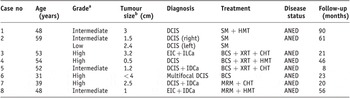
The records of 876 women with a histologic diagnosis of invasive breast cancer (BCA) or DCIS listed in the tumour registry database of the Louisiana State University Health Sciences Center in Shreveport during an 8-year period (1999–2006) were examined for the occurrence of CL. Eight cases were identified after a review of pathology reports (Table 1). CL was defined as intra-luminal extension of carcinoma from ducts and ductules into the breast lobules. Follow-up data was obtained from the surgeons’ notes and tumour registry information. Survival was measured from the time of CL diagnosis until last follow-up.
Clinical summary in cancerisation of the lobules with pre-invasive or invasive breast carcinomas

aGrading system for invasive carcinoma (Nottingham modification of the Elston-Ellis and Bloom-Richardson systems) and for DCIS (categorised using cyto-nuclear features, cell polarization and the presence of necrosis).
bSize based on pathology report findings. ANED, alive without evidence of cancer; BCS-XRT, breast conservation surgery and irradiation; CHT, chemotherapy; DCIS ductal carcinoma in situ; EIC, extensive intra-ductal carcinoma; HMT, hormonal manipulative therapy; IDCa, invasive ductal carcinoma; ILCa, invasive lobular carcinoma; MRM, modified radical mastectomy; SM, simple mastectomy.
The tumours were diagnosed as Breast Imaging Reporting and Data SystemReference Liberman, Abramson, Squires, Glassman, Morris and Dershaw3 (BI-RADS) four or five abnormalities (which meant findings suspicious or highly suggestive of malignancy) on mammograms. The mean patient age was 48 years and mean tumour size was 2.4 cm. The neoplasm was mostly intermediate or high grade in histological appearance. Four women had breast conservation surgery (with radiotherapy administered to only three patients because of non-compliance of the remaining individual); whole breast megavoltage irradiation consisted of a minimum dose of 50 Gray (Gy) plus a supplemental tumour bed dose of 10 Gy applied in two women. The other four patients submitted to simple or modified radical mastectomy; postoperative radiotherapy was deemed not indicated based on observed histopathology (such as T1-T2 tumours, metastatic disease absent or present in fewer than four axillary nodes). In all patients, the resection margins were histologically free of tumour.
Local, regional or distant neoplastic relapse was not observed in any patient during a mean follow-up period of 40.6 months. Disease-free survival extended from 8 to 46 months in the organ-preserved treated women and from 20 to 90 months in the mastectomy patient group.
Does the concept of “field cancerisation” (which describes the tendency of patients with pre-malignant and malignant lesions of the head and neck to develop multiple carcinomas of the upper aero-digestive tract) have a similar connotation in these women? Invasive BCA is commonly thought to develop through a succession of events involving hyperplasia, atypical ductal hyperplasia (ADH) and in situ carcinoma. The distinction between ADH and DCIS is believed to be difficult and highly subjective. ADH seems to be associated with a four-to five-fold increased risk of subsequent development of cancer relative to the general populationReference Page and Dupont4 whereas, with DCIS, there is a greater likelihood of the occurrence of the unfavourable event with high-grade lesions. Approximately, one-third of the patients with low-grade DCIS will eventually experience invasive BCA after 30 years if left untreated.Reference Page, Dupont, Rogers, Jensen and Schuyler5 On the other hand (as found in some of our patients), there is a possibility of finding a coexisting invasive cancer along with DCIS. Implicated risk factors have included lesion size and the presence of comedonecrosis. Patients with DCIS lesions which are smaller than 4.5 cm rarely had a simultaneous invasive BCA admixed in; in contrast, invasion was a frequent accompaniment of in situ lesions larger than 4.5 cm.Reference Lagios, Margolin, Westdahl and Rose6 In an examination of 19 DCIS specimens with comedonecrosis, 53% had associated micro-invasive disease.Reference Schwartz, Patchefsky, Finklestein, Sohn, Prestipino and Feig7 None of our patients with invasive BCA and DCIS possessed any of the preceding adverse features.
A problem of DCIS with CL is distinguishing it from lobular carcinoma in situ. There are, however, several histologic features (such as partial involvement of the normal size acinar units, residual lumina in involved acini, nuclear pleomorphism, mitotic activity, architectural patterns characteristic of DCIS and foci of necrosis) described by Kerner and LichtigReference Kerner and Lichtig8 which suggest the former diagnosis. Fisher and colleaguesReference Fisher, Land, Saad, Fisher, Wickerham, Wang, Costantino and Wolmark2 reviewed the pathology of 1,456 participants with DCIS in the National Surgical Adjuvant Breast Project (NSABP) protocol B-24 and found that the presence of moderate to marked CL has a significant correlation to ipsilateral breast tumour recurrence. Moreover, in view of the fact that CL is frequently seen in the periphery of a coexisting DCIS lesion, its presence, especially if extensive, could portend a greater risk of recurrent disease.Reference Goldstein, Lacerna and Vicini9 Oncologists should, therefore, be mindful of CL as a form of intra-ductal malignancy and note its important association with the surgical margin. It is generally recognised that incomplete surgical excisions in patients with DCIS lesions carry a high probability of residual tumour and local relapse.
The long-term efficacy of wide excision with radiotherapy in comparison to that of mastectomy for DCIS has not yet been fully documented. The experience with CL in association with DCIS or invasive BCA is still too limited. Given its infrequency, randomised trials to determine the optimal management would be difficult to conduct. The only well-known fact is the need for evidence-based treatment protocol. The retrospective nature of the study involving a small number of individuals treated in a non-uniform manner notwithstanding, we believe that breast conservation surgery with radiotherapy is a worthy management alternative when mastectomy is not preferred or performed in this particular cohort of patients. Its sustained efficacy, however, remains to be ascertained.