Introduction
Several theorists, including Sigmund Freud, have stressed the importance of early life circumstances and early development in the growth and development of personality. While the idea that adult personality originates in early development has been discussed in many contexts (e.g. attachment theory), there is still a limited amount of empirical documentation on the importance of early developmental precursors of personality. This lack of documentation is mainly due to a lack of the complex longitudinal data that would be suitable to perform such analyses.
The hypothesis of neurodevelopmental precursors of personality traits has primarily been explored by researchers using The Helsinki Birth Cohort Study 1934–1944. Analyses based on these data have shown that especially birth weight, length and head circumference are associated with cognitive abilities, temperament, hostility, trait anxiety, depression and attention deficit-hyperactivity disorder (ADHD) symptoms later in life (Raikkonen et al. Reference Raikkonen, Pesonen, Kajantie, Heinonen, Forsen, Phillips, Osmond, Barker and Eriksson2007, Reference Raikkonen, Pesonen, Heinonen, Kajantie, Hovi, Jarvenpaa, Eriksson and Andersson2008; Raikkonen & Pesonen, Reference Raikkonen and Pesonen2009; Lahti et al. Reference Lahti, Raikkonen, Wahlbeck, Heinonen, Forsen, Kajantie, Pesonen, Osmond, Barker and Eriksson2010). Data are, however, lacking on the association of developmental milestones during the first years of life with comprehensive follow-up measures on personality and cognition in adulthood.
Studies investigating early developmental factors in relation to mental outcomes have mainly concentrated on psychopathology, especially schizophrenia and alcohol-related disorders, with focus on early weaning (Sørensen et al. Reference Sørensen, Mortensen, Reinisch and Mednick2006), later attainment of motor developmental milestones (Cannon et al. Reference Cannon, Caspi, Moffitt, Harrington, Taylor, Murray and Poulton2002; Manzardo et al. Reference Manzardo, Penick, Knop, Nickel, Hall, Jensen and Gabrielli2005; Sørensen et al. Reference Sørensen, Mortensen, Schiffman, Reinisch, Maeda and Mednick2010b), childhood motor coordination (Schiffman et al. Reference Schiffman, Walker, Ekstrom, Schulsinger, Sorensen and Mednick2004, Reference Schiffman, Sorensen, Maeda, Mortensen, Victoroff, Hayashi, Michelsen, Ekstrom and Mednick2009), physical anomalies (Schiffman et al. Reference Schiffman, Ekstrom, LaBrie, Schulsinger, Sorensen and Mednick2002, Reference Schiffman, Maeda, Hayashi, Michelsen, Sorensen, Ekstrom, Abe, Chronicle and Mednick2006), laterality deviance (Schiffman et al. Reference Schiffman, Pestle, Mednick, Ekstrom, Sorensen and Mednick2005) and general lowering of cognitive ability preceding the disorder (Batty et al. Reference Batty, Mortensen and Osler2005; Mortensen et al. Reference Mortensen, Sørensen, Jensen, Reinisch and Mednick2005; Sørensen et al. Reference Sørensen, Mortensen, Schiffman, Ekstrøm, Denenney and Mednick2010a). The personality dimension of neuroticism seems to be a general risk factor for psychopathology (Boyce & Parker, Reference Boyce and Parker1985; Krabbendam et al. Reference Krabbendam, Janssen, Bak, Bijl, de Graaf and van Os2002; Goodwin et al. Reference Goodwin, Fergusson and Horwood2003; Hettema et al. Reference Hettema, Neale, Myers, Prescott and Kendler2006; Barrantes-Vidal et al. Reference Barrantes-Vidal, Ros-Morente and Kwapil2009), but evidence on associations between early developmental precursors and personality traits is almost non-existent. Since later attainment of milestones has been demonstrated to be associated with psychopathology, and the personality trait of neuroticism has been shown to be a general risk factor for psychopathology (Ormel et al. Reference Ormel, Rosmalen and Farmer2004; Griffith et al. Reference Griffith, Zinbarg, Craske, Mineka, Rose, Waters and Sutton2010), it was hypothesized that early developmental milestones would be associated with this trait. The aim of this study was to investigate whether early motor developmental milestones in the first year of life are associated with adult personality, in particular neuroticism.
Method
Study population
The study objectives were investigated using data from the Copenhagen Perinatal Cohort (CPC) and from a follow-up study of this birth cohort: The Prenatal Development Project. The CPC was initially established with data on 8949 mothers and their 9125 consecutive deliveries born at the University Hospital in Copenhagen during the period 1959–1961. Information on demographic, socio-economic, prenatal and postnatal factors were recorded prospectively during pregnancy, at delivery, and at a 1-year examination (Zachau-Christiansen & Ross, Reference Zachau-Christiansen and Ross1975). The mothers were mainly residents in Copenhagen, but some were admitted due to obstetrical complications or because of single-mother status (Villumsen, Reference Villumsen1970). A total of 8400 infants survived the first month after birth. On the basis of pre- and perinatal records, a subsample comprising 1575 members of the CPC was selected for participation in The Prenatal Development Project between 1982 and 1994 (Reinisch et al. Reference Reinisch, Mortensen and Sanders1993, Reference Reinisch, Sanders, Mortensen and Rubin1995). In this subsample, data on personality were available for 1182 individuals, and among these participants information on at least one developmental milestone was available for 968 individuals who comprise the present study sample.
Developmental milestones
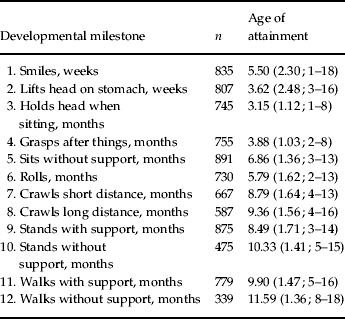
Developmental milestones were obtained from the mothers who were instructed to use a standardized diary to record the ages in weeks or months at which the child reached 12 developmental milestones. At a 1-year follow-up examination, the diary was brought to the hospital (Zachau-Christiansen & Ross, Reference Zachau-Christiansen and Ross1975). If the mother did not return the diary, an effort was made to obtain retrospective data on milestones. Table 1 shows the recorded milestones during the first year of life.
Descriptive characteristics of milestones

Data are given as mean (standard deviation; range).
Adult follow-up
The adult follow-up took place when the participants were at the age of 20.3–34.5 years (s.d. = 4.3). The full test battery included a 2–4 h home visit by a social worker and an 8–11 h psychological evaluation conducted at the Institute of Preventive Medicine (Reinisch et al. Reference Reinisch, Mortensen and Sanders1993). Several personality inventories were administered as part of the follow-up, but only the Eysenck Personality Questionnaire (EPQ) (Eysenck & Eysenck, Reference Eysenck and Eysenck1975) will be analysed in this paper. The EPQ was developed in 1975 (Eysenck & Eysenck, Reference Eysenck and Eysenck1975), and the Danish version comprises 101 binary ‘yes’ or ‘no’ questions from which scores on the personality traits of neuroticism, extraversion and psychoticism are derived. Neuroticism as measured by the Danish EPQ has been shown to correlate 0.76 with neuroticism measured with the NEO Personality Inventory-Revised (Hansen & Mortensen, Reference Hansen and Mortensen2004). According to Eysenck, the traits associated with neuroticism are: a tendency to be anxious, depressed, tense, irrational, shy, moody, emotional and to suffer from guilt feelings and low self-esteem (Eysenck & Eysenck, Reference Eysenck and Eysenck1985). At the adult follow-up, the complete Wechsler Adult Intelligence Scale was also administered (Wechsler, Reference Wechsler1958). Since intelligence may mediate associations between milestone attainment and personality traits, the full-scale intelligence quotient (IQ) was included in a separate statistical model.
Covariates
Of the originally registered variables for the CPC, sex of the child, single-mother status, parity, mother's age, father's age, parental social status and birth weight were included in statistical models to adjust for sex and family background. Parity was included as a binary variable coding whether this was the mother's first pregnancy or not. Parental social status coded on an eight-point scale, with higher scores indicating higher status, was included as a linear continuous variable together with birth weight and parental age (preliminary analyses showed no significant quadratic trend for these variables). There were no missing data on sex of the child and birth weight, while the missing data rate was less than 1% for single-mother status, parity and mother's age. However, missing data were 1.2% for father's age and 9.6% for parental social status. The EM (expectation–maximization) algorithm was used to impute values replacing missing data for the covariates to avoid diluting the sample in regression analyses (Schafer, Reference Schafer1997).
Statistical analyses
The rate of missing data on individual milestones varied from 8.0% to 65.0% depending on the recorded milestone. In addition to the individual milestones, the overall mean of the 12 milestones and the three factors derived from a principal components analysis by Sørensen et al. (Reference Sørensen, Mortensen, Schiffman, Reinisch, Maeda and Mednick2010b) were also analysed: the smiling and lifting head factor comprised milestones 1–3 (see Table 1), the rolling, crawling, sitting and grabbing factor milestones 4–8, and the standing and walking factor milestones 9–12 (for details, see Sørensen et al. Reference Sørensen, Mortensen, Schiffman, Reinisch, Maeda and Mednick2010b). To derive composite scores on the overall mean and on the three factors, the individual milestones were standardized to a mean of 0 and s.d. of 1, and the composite scores were calculated as the mean of the included individual milestone scores. For the present study these composite scores were restandardized to a mean of 0 and s.d. of 1. If data were missing on one or more milestones included in a composite mean, the mean of the available milestone scores was calculated. Since data were available for at least one milestone for all participants, there were no missing data on the overall mean of the 12 milestones, while the percentages of missing data were 4.0, 8.7 and 3.0 for the factor means respectively. Thus, the sample sizes were 968 for the overall mean and 928, 884 and 939 for the three factors.
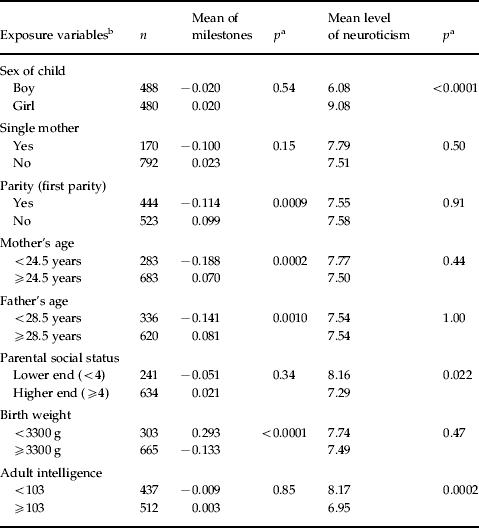
Participants with incomplete information on a milestone were excluded from the analysis of this particular milestone. We used χ2 tests and analysis of variance to evaluate associations of potential confounding factors with the mean age of attainment of all milestones and the level of neuroticism (Table 2). Estimates of the associations between age of attainment of milestones and level of neuroticism in adulthood were estimated in several multiple linear regression models (Rothman, Reference Rothman1998). The unadjusted model only included the relevant milestone score, another model also included sex, and the fully adjusted model additionally included single-mother status, parity, mother's age, father's age, parental social status, birth weight and age at follow-up. In separate analyses, adult intelligence was added to the fully adjusted model to evaluate whether intelligence mediated the association between milestone attainment and neuroticism.
Association of possible confounding factors with the overall mean of milestone scores and neuroticism
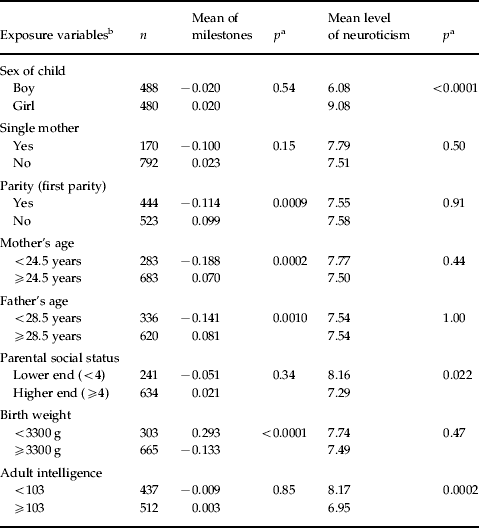
a t Test.
b Exposure variables were divided to achieve approximately 50% in each category.
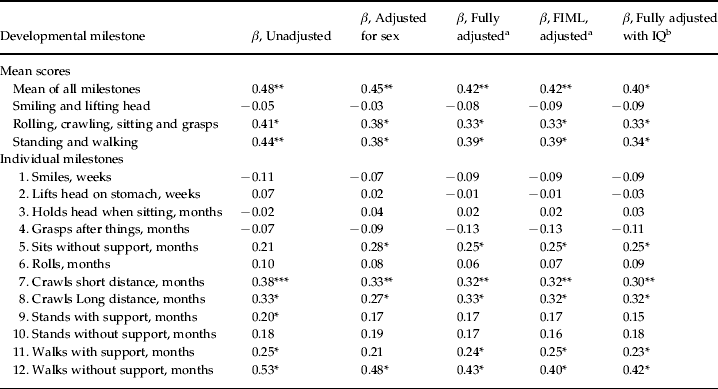
To evaluate the influence of missing data on the milestone variables, we used the structural equation modelling facilities of Stata 12 (StataCorp LP, USA) to repeat all regression analyses using full information maximum likelihood (FIML; Graham, Reference Graham2009). These analyses use all available information, including information on covariates and neuroticism for participants without information on the milestone variable included in a particular analysis. The results for the fully adjusted FIML model will be presented together with the corresponding model based on the subsample of participants with data on the milestone being analysed (Table 3).
Regression coefficients for milestones in models predicting level of neuroticism
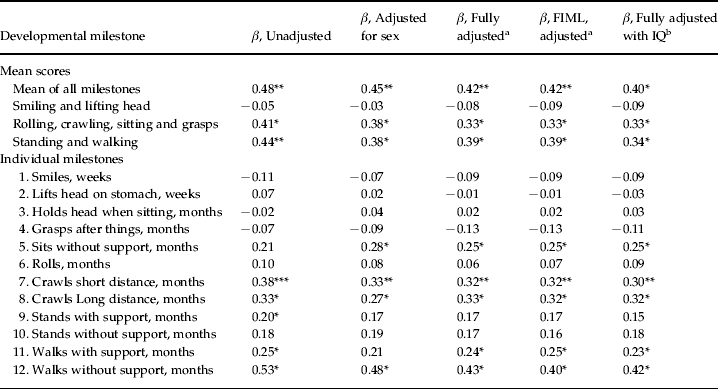
FIML, Full information maximum likelihood; IQ, intelligence quotient.
a Sex, single-mother status, parity, mother's age, father's age, parental social status, age at home visit and birth weight.
b Sex, single-mother status, parity, mother's age, father's age, parental social status, age at home visit, birth weight and adult intelligence.
* p ⩽ 0.05, ** p ⩽ 0.01, *** p ⩽ 0.001.
The assumption of normal distribution of residuals of the outcome variable was evaluated graphically and only showed minor deviations, which should not bias estimates or standard errors. The assumption of linearity was evaluated graphically and showed no deviations. Additionally, linearity of regression was analysed by testing the significance of a quadratic component for all milestones. This component was not found significant for any the individual milestones or the composite milestones variables. Finally, analyses were conducted to evaluate whether binary milestone attainment scores showed stronger associations with neuroticism. For these analyses the 85% percentiles were used as cut-offs for deriving the binary milestone score.
Since the sample consisted of an index group of individuals exposed to steroid hormones and psychoactive drugs and matched controls, the interaction of prenatal exposure status and each milestone was tested, but not found significant in supplementary analyses (data not shown).
All statistical analyses were conducted by means of the statistical software package Stata 12 (StataCorp LP, USA).
Results
Table 1 shows the number of observations, mean age of attainment, standard deviation and range for the 12 milestones. Table 2 shows associations between the possible confounding factors and the mean of all milestones and scores on neuroticism. Parity, mother's age, father's age and birth weight were all significantly associated with the overall mean of the 12 milestones. Sex, parental social status and adult intelligence were associated with level of neuroticism in adulthood.
Table 3 presents the results of the main analyses. Both unadjusted and adjusted analyses showed patterns of significant associations between high neuroticism in adulthood and the overall mean of the 12 milestones as well as of two of the factor scores (the rolling, crawling, sitting and grabbing factor and the standing and walking factor). The early development factor (smiling and lifting head) was unrelated to adult neuroticism.
The significant associations for individual milestones reflected the pattern of significant associations for the composite milestones scores. The unadjusted analyses showed significant associations between high neuroticism in adulthood and late attainment of standing with support, crawling short and long distances, and walking with support and without support. Adjusting for all covariates did not change the results substantially. Sitting without support became significant in the adjusted analyses, while standing with support became non-significant. The results of the FIML analyses incorporating all available information were essentially the same as those of the regression analyses based on subsamples with information on the relevant milestone outcome variable. Analyses based on binary milestone scores showed a similar pattern of results as analyses based on continuous milestone scores, but a number of non-significant trends seem to reflect lack of statistical power because of the dichotomization (data not shown).
Analyses including adult IQ as covariate showed the same pattern of significant associations as the fully adjusted model.
Results for extraversion and psychoticism mainly showed insignificant associations with attainment of milestones. Crawling a short distance (β = –0.26, p = 0.022) was significant for extroversion and so was the factor rolling, crawling, sitting and grabbing (β = 0.33, p = 0.025). No significant associations were observed between the psychoticism scale and any of the milestone variables.
Discussion
Main findings
Our analyses reveal associations between delays in early developmental milestone attainment and a higher level of neuroticism in adulthood. Infants who grew up to have high scores on neuroticism tended to sit without support, crawl, as well as walk with and without support later than individuals with low scores on neuroticism. The findings for the individual milestones were reflected in the overall mean milestone score and two composite factor scores. Furthermore, these associations were independent of a wide range of potentially confounding factors, and they were apparently not mediated by associations between milestone attainment and adult intelligence. The personality traits of extraversion and psychoticism were generally not associated with later attainment of motor developmental milestones.
Methodological issues
The main advantage of this study is the prospective design including real-time documentation of milestone attainment by mothers. Nevertheless, the frequency of missing data tended to be high, especially for standing and walking without support. The most likely explanation for this is that these milestones may not have been attained by some children at the time of the 1-year follow-up and therefore were not recorded. Since this source of missing data primarily concerns late-developing individuals, systematic selection bias may have attenuated the observed associations between milestones and neuroticism, with the present results most probably underestimating the associations. A further limitation of the study is that type I error is a possibility, as we conducted tests on 12 milestones in addition to the composite means of milestone scores. However, the fact that only ‘late milestones’ were associated with level of neuroticism seems to point towards a consistent pattern and thus a non-incidental finding. The late milestones had most missing data, but significant results were apparently independent of attrition in milestone data (see Table 3), which strengthens the interpretation of the findings.
As in all observational studies, there may be unrecognized confounding. Sex, single-mother status, parity, age of parents at delivery, parental social status and birth weight were considered confounding factors in the linear regression models. However, there may be other unobserved confounding factors. Factors associated with both age of attainment of motor developmental milestones and level of neuroticism could be genetic factors influencing brain development, in particular development of the cerebellum. Environmental factors such as attachment to the primary caregiver, early neglect, or reduced stimulation in the first months, but also biophysical factors such as nutrition, including breastfeeding, could also influence mother motor and personality development. These factors were not included in the analyses, as appropriate data were not available, which makes the interpretation of the present results complex. Thus, it remains an open question whether late attainment of motor developmental milestones reflects direct influences of early motor development on neuroticism in adulthood, or whether milestones are markers of some underlying factors influencing both motor development and personality. The present study sample was selected based on perinatal records, but statistical tests of interactions did not indicate that prenatal exposure status influenced the associations between milestone attainment and adult neuroticism.
Previous studies
One of the most consistent findings from previous longitudinal studies investigating motor development in relation to psychopathology is that later age when first standing and walking is related to the risk of schizophrenia (Jones et al. Reference Jones, Rodgers, Murray and Marmot1994; Walker et al. Reference Walker, Savoie and Davis1994; Jones & Tarrant, Reference Jones and Tarrant2000; Isohanni et al. Reference Isohanni, Jones, Moilanen, Rantakallio, Veijola, Oja, Koiranen, Jokelainen, Croudace and Jarvelin2001; Cannon et al. Reference Cannon, Caspi, Moffitt, Harrington, Taylor, Murray and Poulton2002). Results based on the Northern Finland 1966 Birth Cohort found that non-psychotic disorders were not related to milestones (Isohanni et al. Reference Isohanni, Jones, Moilanen, Rantakallio, Veijola, Oja, Koiranen, Jokelainen, Croudace and Jarvelin2001, Reference Isohanni, Murray, Jokelainen, Croudace and Jones2004), but the present results suggest that late attainment of these milestones is not necessarily specific to the psychopathology of schizophrenia, but is also associated with the broad personality dimension of neuroticism. Neuroticism has been linked with depression (Boyce & Parker, Reference Boyce and Parker1985), various anxiety disorders (Hettema et al. Reference Hettema, Neale, Myers, Prescott and Kendler2006), schizophrenia (Krabbendam et al. Reference Krabbendam, Janssen, Bak, Bijl, de Graaf and van Os2002; Goodwin et al. Reference Goodwin, Fergusson and Horwood2003; Barrantes-Vidal et al. Reference Barrantes-Vidal, Ros-Morente and Kwapil2009) and somatoform disorders (Hankin & Abela, Reference Hankin and Abela2005). Thus, neuroticism seems to be an indicator of risk of psychopathology in general, and the present findings may be of interest for a broad spectrum of psychiatric disorders. Similarly, developmental milestones seem to be general risk factors of psychopathology. Thus, Sørensen et al. (Reference Sørensen, Mortensen, Schiffman, Reinisch, Maeda and Mednick2010b) found that the association with delayed attainment of developmental milestones was not specific to schizophrenia, since other psychiatric disorders were also associated with late motor development. These results are supported by other studies finding that late attainment of motor developmental milestones is associated with both low cognitive functioning (Taanila et al. Reference Taanila, Murray, Jokelainen, Isohanni and Rantakallio2005) and alcohol dependence (Manzardo et al. Reference Manzardo, Penick, Knop, Nickel, Hall, Jensen and Gabrielli2005). The current findings suggest that delayed milestones may be an early key phenotype associated with both personality development and adult psychopathology or that personality development, in particular development of neuroticism, may mediate the link between milestones and psychopathology. Thus, the present findings support a neurodevelopmental model of psychopathology.
No other studies have found motor developmental milestones to be associated with personality traits or found factors measurable during the first year of life to be associated with adult neuroticism, but other indicators of early development have been associated with personality development. Thus, the Helsinki Birth Cohort found birth weight, length and head circumference to be associated with cognitive abilities, temperament, hostility, trait anxiety, depression and ADHD symptoms later in life (Raikkonen et al. Reference Raikkonen, Pesonen, Kajantie, Heinonen, Forsen, Phillips, Osmond, Barker and Eriksson2007, Reference Raikkonen, Pesonen, Heinonen, Kajantie, Hovi, Jarvenpaa, Eriksson and Andersson2008; Raikkonen & Pesonen, Reference Raikkonen and Pesonen2009; Lahti et al. Reference Lahti, Raikkonen, Wahlbeck, Heinonen, Forsen, Kajantie, Pesonen, Osmond, Barker and Eriksson2010).
In the present study, delays in ‘very early’ developmental milestones such as smiling, and lifting and holding the head were not associated with level of neuroticism in adulthood. Except for standing, it was the ‘later’ milestones such as sitting without support, crawling and walking which were significant in the adjusted analyses. These milestones all require complex motor coordination (perhaps more than standing) and only these late milestones reflect development during most of the first year. This may explain the observed significant associations, but the present results may also reflect environmental factors influencing both milestone attainment and personality development. Late milestones to a greater extent than smiling and lifting the head depend on the interaction between the child and the parents (Broberg et al. Reference Broberg, Mothander, Granqvist and Ivarsson2010), as demands for ‘good parenting’ and stabile attachment gradually increase from early infancy (Bowlby, Reference Bowlby1988; Rochat & Striano, Reference Rochat and Striano1999; Rochat, Reference Rochat2009; Broberg et al. Reference Broberg, Mothander, Granqvist and Ivarsson2010) parallel to the infant's motor and self development (Bowlby, Reference Bowlby1988; Rochat & Striano, Reference Rochat and Striano1999; Rochat, Reference Rochat2009). In early infancy the cues from the child represent needs that are very basic and require less advanced parental judgment and feedback with regard to the infant's mobility and perception of self (Bowlby, Reference Bowlby1988; Rochat, Reference Rochat2009; Broberg et al. Reference Broberg, Mothander, Granqvist and Ivarsson2010). The more important socially dependent motor and language development has its onset from 7 months and onwards (Rochat & Striano, Reference Rochat and Striano1999; Rochat, Reference Rochat2009; Broberg et al. Reference Broberg, Mothander, Granqvist and Ivarsson2010). Thus, it is plausible that attachment and the parent–child dynamics are more central to ‘later’ and more motor-advanced neurodevelopment. In accordance with these and the present results, attachment to the mother at 15 months has been demonstrated to be associated with level of neuroticism at 8–9 years of age (Hagekull & Bohlin, Reference Hagekull and Bohlin2003).
The temperament of the child may be another factor contributing to the observed association between developmental delay and higher risk of neuroticism (Molfese & Molfese, Reference Molfese and Molfese2000). Early attainment of milestones might be related to temperamental traits such as high activity level and lack of inhibition, and late attainment might be related to low activity and inhibition. While a recent study was unable to demonstrate associations between motor competences and measures of temperament (DeSantis et al. Reference DeSantis, Harkins, Tronick, Kaplan and Beeghly2011), another found associations between motor regulation and self-regulation (DeGangi et al. Reference DeGangi, Breinbauer, Roosevelt, Porges and Greenspan2000). In addition it has been found that lower motor performance at 3 and 30 days was associated with negative affectivity at 4 months (Canals et al. Reference Canals, Hernandez-Martinez and Fernandez-Ballart2011), suggesting a possible causal pathway from late motor development to adult neuroticism (Watson & Clark, Reference Watson and Clark1984).
Conclusion
The results suggest that the personality trait of neuroticism may be associated with delayed attainment of developmental milestones requiring complex motor coordination and developing during the second half of the first year of life such as sitting without support, crawling and walking. As this is the first study to investigate motor developmental milestones in relation to adult personality traits, more research should be conducted in the area. In particular, with neuroticism being an indicator of risk of psychopathology in general, we emphasize the importance of investigating delayed milestone attainment as an early precursor of adult neuroticism. Future research should obtain reliable measures of specific milestones and early temperament and should investigate a broader range of personality traits and include measures of psychopathology.
Acknowledgements
The present study was supported by a grant to T.F-M. from the IMK Almene Fond. In addition, the study was supported by grants no. HD-17655 and no. HD-20263 from the National Institute of Child Health and Human Development to June Reinisch, grant no. DA-05056 from the National Institute of Drug Abuse to June Reinisch, grant no. 9700093 to E.L.M. from the Danish Research Council and grant no. 1400/2-4-1997 to E.L.M. from the Danish National Board of Health.
Declaration of Interest
None.