Introduction
Most work on visual word processing in bilinguals has been conducted with same-script bilinguals, namely speakers of two languages that share the same orthographic system, most commonly the Roman alphabet (e.g., Dutch–English, Spanish–Catalan, etc., for review see e.g., Dijkstra, Reference Dijkstra, Kroll and De Groot2005). Accordingly, theoretical modeling of visual word processing in bilinguals, and cross-language influences in particular, mostly depart from assumptions of a shared orthographic system across languages (e.g., BIA+, Dijkstra & Van Heuven, Reference Dijkstra and Van Heuven2002; for an exception see Miwa, Dijkstra, Bolger & Baayen, Reference Miwa, Dijkstra, Bolger and Baayen2014). However, these assumptions do not describe the general case for visual word processing in bilinguals, and specifically might not capture the dynamics of this process in different-script bilinguals, for whom bottom-up orthographic activation is by definition limited to a single language system. In the current study, we describe cross-language influences during visual word processing among different-script bilinguals, and present an adaptation of existing models of bilingual word recognition (BLINCS, Shook & Marian, Reference Shook and Marian2013; BIA+, Dijkstra & Van Heuven, Reference Dijkstra and Van Heuven2002) to accommodate the present findings.
Examining cross-language influences among different-script bilinguals is important for two reasons. First, there are many different-script bilinguals and their performance cannot necessarily be explained with existing theories developed based on same-script bilinguals. Second, different-script bilinguals allow a complete decoupling of cross-language phonological overlap from cross-language orthographic overlap, an issue that has received much attention in the literature, and is difficult to investigate in same-script bilinguals (Dijkstra, Grainger & Van Heuven, Reference Dijkstra, Grainger and van Heuven1999; Lemhöfer & Dijkstra, Reference Lemhöfer and Dijkstra2004). Thus, investigating different-script bilinguals can allow us to identify the unique contribution of phonological overlap to cross-language influences in visual word processing.
Research with same-script bilinguals converges on the finding that lexical stimuli automatically activate candidates in both languages, which results in cross-language influences (e.g., Dijkstra et al., Reference Dijkstra, Grainger and van Heuven1999; Dijkstra, Miwa, Brummelhuis, Sappelli & Baayen, Reference Dijkstra, Miwa, Brummelhuis, Sappelli and Baayen2010; for review see Dijkstra, Reference Dijkstra, Kroll and De Groot2005; Degani & Tokowicz, Reference Degani and Tokowicz2010). For instance, Libben and Titone (Reference Libben and Titone2009) found that when French–English bilinguals were reading sentences in their L2, representations from the non-target language were nonetheless activated to result in facilitation for cognate words (which overlap in both form and meaning across languages) and interference for false-cognates (which overlap in form but not in meaning across languages) during the early stages of word processing. Thus, even when the experimental context explicitly refers same-script bilinguals to use only one of their languages (e.g., reading sentences exclusively in the L2), there is evidence that non-target language representations (both phonological and semantic) become activated and influence target-language processing (see also Van Assche, Drieghe, Duyck, Welvaert & Hartsuiker, Reference Van Assche, Drieghe, Duyck, Welvaert and Hartsuiker2011).
Critically, however, orthographic representations for same-script bilinguals are ambiguous with respect to language membership because a given orthographic input could correspond to semantic and phonological representations in both languages (creating cognates and false-cognates). For different-script bilinguals, in contrast, the orthography could theoretically serve to eliminate activation of the non-target language because it is a 100% valid and unambiguous cue to target language membership.
Evidence for the possible contribution of orthographic cues to language membership comes from a recent line of studies investigating language specific orthographic patterns in same-script bilinguals. In a study with bilinguals of partially overlapping orthographies (Norwegian and English), Van Kesteren, Dijkstra, and de Smedt (Reference Van Kesteren, Dijkstra and de Smedt2012) demonstrated that bilinguals could utilize language specific cues (unique letters and bigram frequency) during lexical decision tasks. Interestingly, based on comparisons across different tasks, Van Kesteren et al. (Reference Van Kesteren, Dijkstra and de Smedt2012) suggested that this information is used to influence the decision but is unlikely to influence the degree of activation within the bilingual lexicon. In contrast, a recent line of research by Casaponsa and colleagues (Casaponsa, Carreiras & Duñabeitia, Reference Casaponsa, Carreiras and Duñabeitia2014; Casaponsa & Duñabeitia, Reference Casaponsa and Duñabeitia2016; Casaponsa, Carreiras & Duñabeitia, Reference Casaponsa, Carreiras and Duñabeitia2015), demonstrates that the presence of sub-lexical orthographic cues to language membership (bigram frequency) reduces non-target language activation and facilitates word processing in same-script bilinguals (see also Oganian, Conrad, Aryani & Spalek, Reference Oganian, Conrad, Aryani and Spalek2015).
Following these recent findings, one might predict that when orthographic input is completely language specific, bilinguals would be able to limit activation exclusively to the target language. Specifically, if the presence of language specific sub-lexical features is enough to reduce cross-language activation (Casaponsa et al., Reference Casaponsa, Carreiras and Duñabeitia2014, Reference Casaponsa, Carreiras and Duñabeitia2015; Casaponsa & Duñabeitia, Reference Casaponsa and Duñabeitia2016), it is possible that completely non-overlapping orthographic systems would allow bilinguals to eliminate cross-language activation altogether. This is because in such a case not only are there abundant bottom-up orthographic cues to target language membership, but there is also no bottom-up support for the non-target language. The current study directly tests the possibility that for different-script bilinguals orthographic input could eliminate activation of the non-target language because the presented sub-lexical orthographic representations are not linked to sub-lexical phonological representations in the non-target language (see also Miwa et al., Reference Miwa, Dijkstra, Bolger and Baayen2014). As a result, when the orthography is present, different-script bilinguals may be able to utilize its uniqueness to avoid bottom-up activation of non-target lexical candidates.
Notably, previous research shows that the presence of orthography in one language does not prevent different-script bilinguals from unconsciously translating presented words into the non-target language (Degani, Prior & Tokowicz, Reference Degani, Prior and Tokowicz2011; Thierry & Wu, Reference Thierry and Wu2007; Wu & Thierry, Reference Wu and Thierry2010). Such unconscious translation can then cause bilinguals to show sensitivity to form overlap of the activated translations in the non-target language when processing the presented stimuli. For instance, Thierry and Wu (Reference Thierry and Wu2007) reported that Chinese–English bilinguals showed ERP N400 modulations when presented with English word pairs whose Chinese translations overlapped in form. They thus concluded that translations are automatically activated even for different-script bilinguals in the context of a single orthography.
In the current study, we do not ask whether translations are automatically activated in different-script bilinguals, but rather whether an orthographic form presented in one language automatically activates phonological lexical candidates in both languages. Thus, rather than tapping translational links, we wished to probe cross-language activation mediated via cross-language phonological form overlap, which is of special interest in different-script bilinguals. Previous research did examine phonologically mediated cross-language activation in different-script bilinguals, but these studies either did not present orthographic stimuli at all, or presented orthographic stimuli in both languages, as detailed below.
Phonologically mediated cross-language influences among different-script bilinguals were investigated in several studies where no orthography was presented. For instance, in a picture naming task Hoshino and Kroll (Reference Hoshino and Kroll2008) demonstrated cognate facilitation for different-script (Japanese–English) bilinguals, suggesting cross-language phonological activation. Similarly, using a visual-world paradigm, Spivey and Marian (Reference Spivey and Marian1999) showed that Russian–English bilinguals fixate on cross-language phonological competitors during auditory word recognition (see also Marian & Spivey, Reference Marian and Spivey2003). This body of literature suggests that in different-script bilinguals, as in same-script bilinguals, both languages are co-activated from phonological input and in the absence of a clear (orthographic) signal to language membership. Thus, a tentative conclusion would be that the basic organization of the lexical system of different-script bilinguals does not fundamentally diverge from that of same-script bilinguals. However, these studies do not shed light on the question of whether the presence of orthography, which could serve as a clear bottom-up signal to language membership, might eliminate activation of non-target language candidates.
A complementary body of literature has examined phonological cross-language influences among different-script bilinguals, utilizing paradigms in which both orthographies are present in the experiment. These include cross-language priming and masked-priming experiments in which a prime is presented in one language and processing of a target word in the other language is examined (Bowers, Mimouni & Arguin, Reference Bowers, Mimouni and Arguin2000, with Arabic–French; Dimitropoulou, Duñabeitia & Carreiras, Reference Dimitropoulou, Duñabeitia and Carreiras2011, with Greek–Spanish; Gollan, Forster & Frost, Reference Gollan, Forster and Frost1997, with Hebrew–English; Kim & Davis, Reference Kim and Davis2003, with Korean–English; Nakayama, Sears, Hino & Lupker, Reference Nakayama, Sears, Hino and Lupker2012; Reference Nakayama, Sears, Hino and Lupker2013; Nakayama, Verdonschot, Sears & Lupker, Reference Nakayama, Verdonschot, Sears and Lupker2014, with Japanese–English; Voga & Grainger, Reference Voga and Grainger2007, with Greek–French; Zhou, Chen, Yang & Dunlap, Reference Zhou, Chen, Yang and Dunlap2010, with Chinese–English). For instance, in a masked translation priming study with Japanese–English bilinguals, Nakayama et al. (Reference Nakayama, Sears, Hino and Lupker2013) found stronger priming for cognate translations than for non-cognate translations, suggesting that the phonological overlap between the prime and the target facilitated processing of the target, above and beyond the contribution of the semantic overlap between the translation pair. Kim and Davis (Reference Kim and Davis2003) also examined whether phonological overlap between the prime and the target, in the absence of orthographic and semantic overlap, could facilitate processing. They found significant priming from cross-script homophones when the task required access to phonology (i.e., in a naming task) but not in lexical decision or semantic categorization (but see Zhou et al., Reference Zhou, Chen, Yang and Dunlap2010 for homophone priming even in lexical decision). Using longer delays between prime and target, Bowers et al. (Reference Bowers, Mimouni and Arguin2000) observed that presenting Arabic–French bilinguals with a cognate word during the first phase of the experiment, either orthographically or aurally, facilitated later processing of a target word in the other language in a lexical decision task. Using cognate translations and phonologically overlapping stimuli, the findings therefore suggest phonologically mediated cross-language influences even from primes in a different orthography. Notably, however, because both orthographies were presented in these studies, bottom-up activation is provided to both languages (but see Bowers et al., Reference Bowers, Mimouni and Arguin2000 who also included phonological presentation of the prime). Thus, both languages become relevant to the task, albeit without participants' awareness.
A single recent study examined cross-language influences in different-script bilinguals while presenting only the target language orthography. Miwa et al (Reference Miwa, Dijkstra, Bolger and Baayen2014) presented different-script Japanese–English bilinguals with a lexical decision task on English words exclusively. They examined the contribution of three cross-language dimensions to the performance in the lexical decision task and to the accompanying eye fixations. The results showed that cross-script phonological overlap, non-target lexical characteristics (Japanese word frequency) and cross-script semantic overlap all influenced performance. Of relevance, they observed that cross-language phonological overlap was initially inhibitory, but then led to facilitation. Semantic similarity across translations further facilitated performance, mostly during later processing stages. These findings support the presence of cross-language influences in different-script bilinguals even in the absence of bottom-up orthographic activation of the non-target language. Notably, although phonological and semantic overlap were examined separately, they were not contrasted. Thus, it remains to be examined whether cross-language semantic influences would surface when non-target language activation could hinder performance, as in the processing of false-cognates, which overlap across-languages in phonology but not in meaning.
The current study sets out to examine whether cross-language activation can influence performance of different-script bilinguals in an experimental situation in which only a single-language orthography is presented. Further, we probed for facilitation in the case where there is concurrent phonological and semantic cross-language overlap (cognates), and possible interference in the case where cross-language phonological overlap is accompanied with no semantic overlap (false-cognates).
To this end, we compared the performance of Arabic–Hebrew (different-script) bilinguals to that of native Hebrew speakers with no knowledge of Arabic in a visually presented semantic relatedness task. Participants were asked to decide whether two visually presented Hebrew words were related in meaning, using two types of experimental stimuli. The first type of stimuli included prime words that were cognates between Arabic and Hebrew (overlap in both phonology and meaning across languages), and target words that were related to this shared meaning, requiring a ‘yes’ response. The second type of stimuli included prime words that were false-cognates between Arabic in Hebrew (overlap in phonology but not in meaning across languages). In this case, the target word was related to the meaning of the false-cognate in the non-target (Arabic) language, but not to its Hebrew meaning, thus requiring a ‘no’ response. In both conditions, performance on critical trials was compared to performance on targets following control primes with no cross-language phonological overlap. Activation of the non-target meaning of the prime should thus result in cognate facilitation relative to control and false-cognate interference relative to control, for bilinguals but not for native Hebrew speakers. Because stimuli were presented visually using the Hebrew orthography exclusively, and because Hebrew and Arabic do not overlap in orthography at all (see Figure 1), no cross-language influence (either facilitation or interference) should be observed if bilinguals could utilize the unambiguous orthographic information to eliminate activation of the non-target language. Moreover, the fast presentation rate (SOA=250ms) reduced strategic processing.
The Hebrew orthography and the Arabic orthography. Note the complete lack of overlap between the two scripts.

Method
Participants
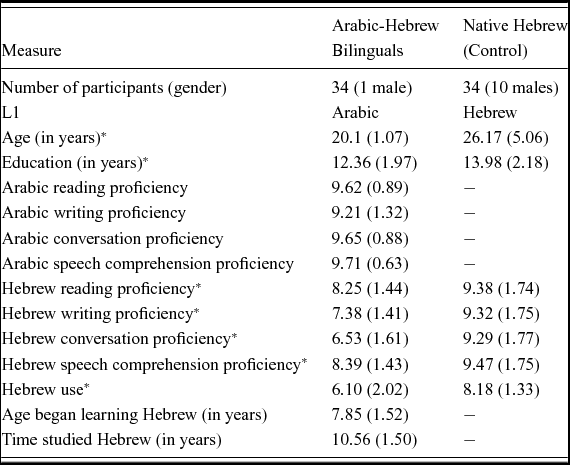
Thirty-Four native Hebrew speakers and 34 Arabic–Hebrew bilingual students at the University of Haifa participated in the experiment. All participants were right-handed, and were compensated for their participation. The native Hebrew speakers had no knowledge of Arabic.Footnote 1 The Arabic–Hebrew bilinguals were native Arabic speakers who started learning Hebrew as a second language in elementary school, and were partially immersed in a Hebrew speaking environment at the time of the study. All participants signed an informed consent in which they approved their participation in the current study. See Table 1 for background information on the participants.
Participants’ characteristics as a function of group.

Note: Self-rated proficiency is on a scale of 0 to 10, with 0 indicating the lowest level of ability and 10 indicating the highest level of ability. Hebrew use is the averaged rated use in speaking, writing, reading, listening to radio and watching TV on a scale of 0 to 10, with 0 indicating the lowest level of use and 10 indicating the highest level of use. Standard deviations appear in parentheses. * marks a significant difference between the groups at the p < .05 level.
Stimuli
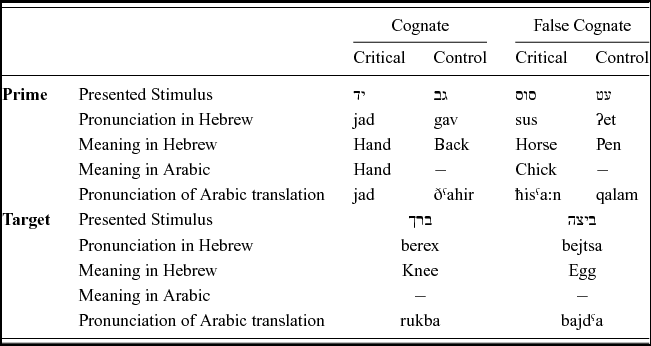
Forty-two critical cognate primes which were phonologically and semantically similar in Arabic and Hebrew were selected. For example, the word /jad/ in both Hebrew and Arabic, means ’hand’. Mean phonological similarity of the Hebrew and Arabic forms as rated by at least 10 native Hebrew speakers with no knowledge of Arabic was 3.79 (SD = .66) on a scale of 1–5. Critical cognate primes were paired with a semantically related Hebrew target word (e.g., ‘knee’, /berex/). For each critical cognate prime, a control prime, which did not overlap phonologically across the two languages (e.g., back in Hebrew /gav/ and in Arabic /ðˤahir/), was selected. Target words had no phonological overlap across Hebrew and Arabic. Across participants, experimental targets were presented half of the time following a critical prime (n = 21) and half of the time following a control prime (n = 21). Each participant saw each target word only once, in either the critical or the control conditions. In both cases a ‘yes’ related response was expected (see Table 2 for a full example).
Example stimuli in the critical and control conditions as a function of type.

Note: Pronunciations are given in IPA. Arabic translations are based on spoken Arabic dialect characteristic of the north of Israel, and were never presented during the experiment.
In addition, 42 Critical false-cognate primes, which were phonologically similar in Arabic and Hebrew but did not share meaning, were selected. For instance, the phonological form /sus/ is a word in both languages, meaning 'chick' in Arabic and 'horse' in Hebrew. Mean phonological similarity of the Hebrew and Arabic forms as rated by at least 10 native Hebrew speakers with no knowledge of Arabic was 3.89 (SD = .85) on a scale of 1–5. Critical false-cognate primes were paired with Hebrew targets related to the Arabic but not the Hebrew meaning of the word (e.g., 'egg'). Control primes, which did not share phonological or semantic overlap across the two languages (e.g., 'pen', /et/ in Hebrew and /qalam/ in Arabic) were also selected. As in the cognate type, target words had no phonological overlap across languages, and each participant saw each target word only once, following either the critical (n = 21) or the control prime (n = 21). In both cases, a ‘no’ unrelated response was expected because the Hebrew meanings were unrelated.
Filler pairs were added in order to conceal the purpose of this experiment. In particular, 39 semantically related pairs and 39 semantically unrelated pairs were added, with the restriction that words in the filler pairs were neither cognates nor false-cognates across Hebrew and Arabic. Therefore, each participant was presented with a total of 324 Hebrew words (162 pairs), of which only 13% (42 words) overlapped phonologically between Hebrew and Arabic
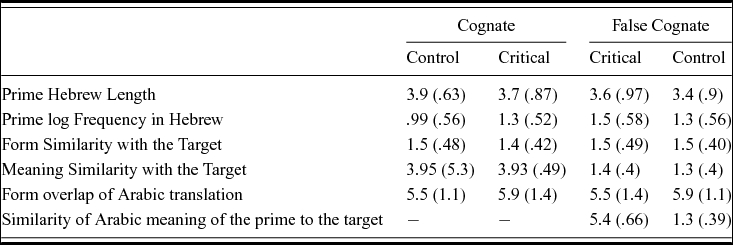
Critical and control primes for each type of stimuli were matched. Critical cognate primes and their controls did not differ significantly in Hebrew length in letters (t(41) = 1.48, p = 0.15), or in Hebrew frequency (t(39) = 1.3, p = 0.2), based on HebWaC corpus via SketchEngine, see Kilgariff, Reddy, Pomikálek & Avinesh, Reference Kilgarriff, Reddy, Pomikálek and Avinesh2010; Kilgariff, Baisa, Bušta, Jakubíček, Kovář, Michelfeit, Rychlý & Suchomel, Reference Kilgarriff, Baisa, Bušta, Jakubíček, Kovář, Michelfeit, Rychlý and Suchomel2014). Similarly, critical false-cognates and their controls did not differ significantly in either Hebrew length (t(41) = 0.18, p = 0.86) or Hebrew frequency (t(40) = 1.34, p = 0.19).
In addition, semantic and form similarity judgments for the prime-target pairs (critical and control) were collected from 10 native Hebrew speaking university students (who did not know Arabic) on a scale of 1–7, for course credit. Two versions of a computerized questionnaire were created, such that each target word appeared once in each version, but across participants each target word was presented with both critical and control primes. There were no significant differences in the rated semantic similarity of the critical primes and the control primes with the target words for cognates (t(41) = 0.58, p = 0.56), or for false cognates (t(41) = 1.39, p = 0.17. Similarly, critical and control primes were well matched on their form similarity with the target words. For cognates (t(41) = 1.6, p = 0.13); for false cognates (t(41) = 0.8, p = 0.41).
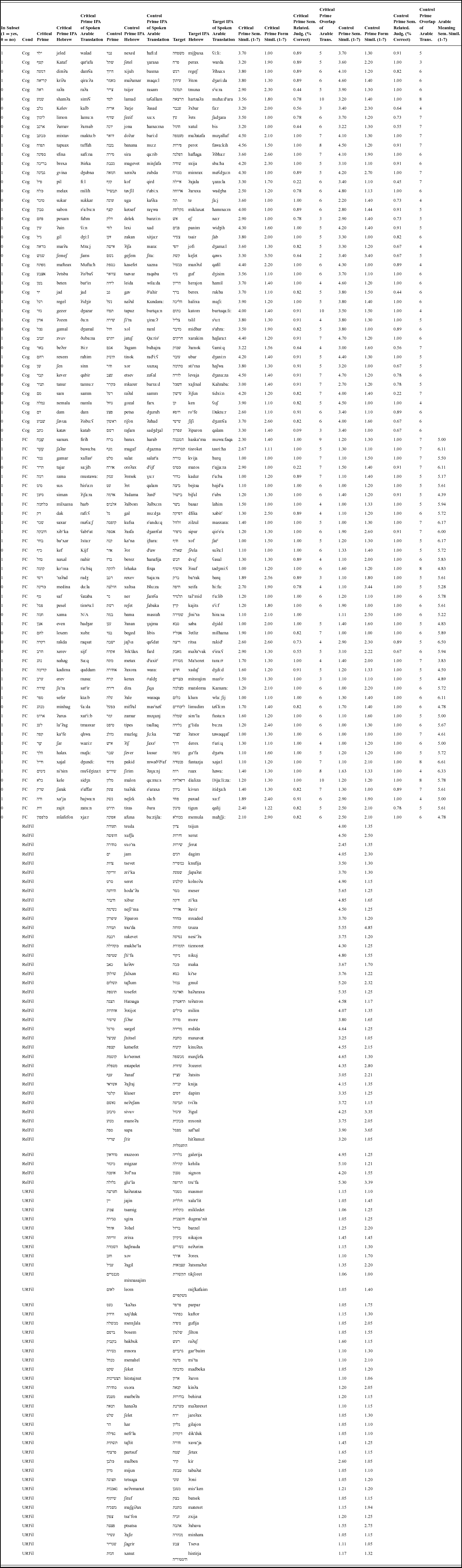
To alleviate any concerns that the possible cross-language influence might be mediated via form similarity of the Arabic translations (as in Wu & Thierry, Reference Thierry and Wu2007), we computed Levenshtein distance on the IPA transliterations of the spoken Arabic translations of the Hebrew words, created by a proficient Arabic–Hebrew bilingual (author WH). These transliterations are presented in Appendix A. Critically, based on this measure, the form-similarity of the Arabic translation of the critical prime with the Arabic translation of the target did not significantly differ from the form-similarity of the Arabic translation of the control prime with that same Arabic translation of the target, t(82) < 1. This was true irrespective of stimulus type F(1,81) < 1 (for cognates, t(41) < 1; for false-cognates, t(40) < 1).
Finally, a separate group of 18 native Hebrew speakers with no knowledge of Arabic rated the meaning similarity of the Arabic meaning of the primes in the false-cognate type with the meaning of the Hebrew target on a scale of 1–7. As expected, the Arabic meaning of the false-cognate primes was significantly more similar to the meaning of the targets than was the Arabic meaning of the control primes with the same targets, t(82) = 31.57, p < .001.
Two experimental lists were constructed, each completed by half of the participants in each group. Each experimental list contained all 162 target words. For each type of stimuli, half of the targets were presented with the critical prime and half with the control prime. Thus, 21 targets were presented with a related cognate prime and 21 with a matched related control prime. Similarly, 21 targets were presented with an unrelated false-cognate prime, and 21 with a matched unrelated control prime. Each participant saw each target word only once, but each target appeared with control and critical primes for different participants. Stimuli were presented in random order to each participant.
Despite the fact that critical and control primes were rated offline as equally similar in meaning and form to the target words, and were well matched on length and frequency, an initial analysis with the full set of cognates and false-cognates indicated that there were some non-negligible differences between the critical and control items in the experimental (timed) relatedness judgment task for the native Hebrew control group (for full details of this analysis see Appendix C).
This difference cannot be the result of cross-language influence because these participants did not know Arabic, and is likely due to limitations in the original stimulus selection. In particular, critical primes were selected from a restricted set of cross-language phonologically similar words whereas control primes were not similarly constrained. Thus, despite the norming procedure, critical primes elicited the unexpected response more than the control primes. Thus, in the cognate type there were pairs in which the critical prime (e.g., ‘raʔa’ meaning ‘saw’) was judged as unrelated to the target (‘tmuna’ meaning ‘painting’) more often than the control prime (‘tsijer’ meaning ‘painted’). Similarly, in the false-cognate type, some of the critical prime (‘lexem’ meaning ‘meat’ in Arabic but ‘bread’ in Hebrew) carried some semantic relation to the Hebrew target (‘ʔetliz’ meaning ‘butcher shop’), yielding a ‘yes’ response from native Hebrew speakers rather than the expected ‘no’ response.
To identify a better matched set of materials we thus opted to rely on yes/no judgments from a timed semantic relatedness task to replace the norming procedure. We collected data from an additional group of 30 native Hebrew speakers with no knowledge of Arabic in a timed semantic relatedness judgment task, similar to the experimental task in the current study (see Prior, Degani, Awawdy, Yassin & Korem, in press). Based on the performance of this separate group of participants, we selected a subset of items for which accuracy rates for both critical and control primes were above 85%, resulting in 19 cognate and 30 false-cognate stimuli. If a critical prime was excluded so was its control prime and corresponding target, or the reverse. For full information on excluded and retained items see Appendix A.
Notably, as was the case for the full set of materials, in this selected subset, critical and control primes were matched on Hebrew length and log frequency, form and meaning similarity ratings with the target word, and form overlap of the Arabic translations (all ps > .05). Further, as in the full set, the Arabic meaning of the false-cognate primes was significantly more similar to the target than that of the control primes (t(58) = 29.76, p < .001, see Table 3). In the Result sections we report the analyses for this subset of better matched items.
Subset stimuli characteristics. Means (SD).

Procedure
Stimuli were presented in the center of a computer screen using E-prime software (Psychology Software Tools, Pittsburgh, PA). A fixation cross was presented for 2000 ms, followed by the prime word presented for 200 ms. A blank screen was then presented for 50 ms, followed by the target word which remained on the screen until participants' response or for a maximum of 8 sec. Participants were instructed to respond as quickly and accurately as possible by pressing the right button if the prime and the target were semantically related and the left button if they were not.
Following the semantic relatedness task, participants completed a Hebrew picture naming task including 30 pictures of common objects, and Arabic–Hebrew bilinguals also completed an Arabic picture naming task on a different set of 30 objects (taken from the Moreno-Martínez & Montoro, Reference Moreno-Martínez and Montoro2012 set of 360 colored pictures; see Appendix B). Further, bilinguals completed a post-test in which they listened to the Arabic translations of the critical words from the semantic relatedness task, and were asked to translate each word into Hebrew. However, performance on this task was extremely low (M = 61%, SD = 11%) and likely reflects the difficulty of L2 production tasks under time pressure. These data were therefore not considered further. Finally, all the participants completed a language history questionnaire (based on LEAP-Q; Marian, Blumenfeld & Kaushanskaya, Reference Marian, Blumenfeld and Kaushanskaya2007) and a short handedness questionnaire.
Results
Results were analyzed separately for cognates and false-cognates, using linear mixed effects models, as implemented in the lme4 library (Baayen, Davidson & Bates, Reference Baayen, Davidson and Bates2008) in R (version 3.3.1, R Core Team, 2016). RTs were calculated on correct responses only. Prior to analysis, these RTs were trimmed by excluding RTs that were 2.5 standard deviations away from the mean of each participant in each stimulus type or away from the mean of each item (less than 5% of the data). To reduce skewness in the distribution, RTs were log-transformed. Indeed, this transformation reduced Skewness from 2.1 to 0.6 and Kurtosis from 6.8 to 0.6. For ease of interpretation, we present the means in ms rather than log transformed. Degrees of freedom for the RT analyses were estimated using the Satterthwaite approximation for degrees of freedom. Accuracy analyses were conducted using a logistic regression model (Jaeger, Reference Jaeger2008).
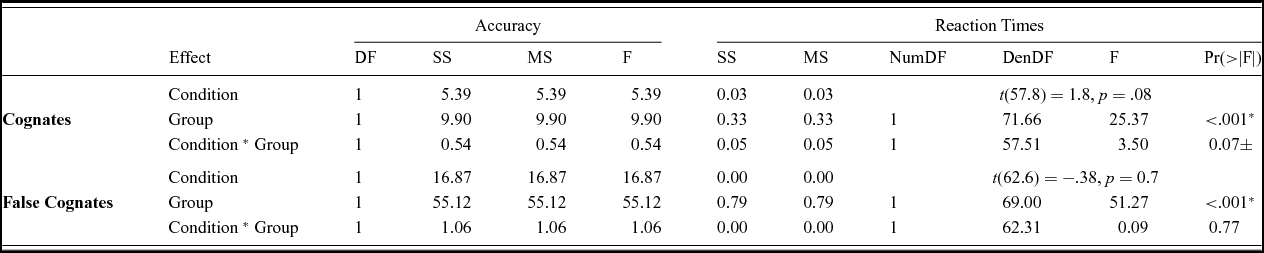
In the models, fixed effects included participant group (Arabic–Hebrew, Hebrew) with the Arabic–Hebrew speakers set as the reference, condition (control, critical) with the control primes set as the reference, and the interaction between condition and group. Because the main focus of this investigation is the performance of the Arabic–Hebrew bilinguals, planned comparisons for each group were conducted regardless of the significance of this interaction. In the RT analyses, the model included random effects of intercepts for participants and items (i.e., targets) as well as by-participant random slope for condition and by-item random slope for group. In the accuracy analyses, the models included only by-participant and by-item intercepts, because more complex random structures failed to converge. Table 4 presents the anova output summary of the reported models, and Table 5 reports the output from the summary function separately for each group. Further, Appendix D provides complementary analyses using by-participant (F1) and by-item (F2) repeated-measures ANOVAs.
Linear Mixed Effect model results based on anova() function.

Note: For the RT analysis, the difflsmeans() function from the lmertest package was used to estimate the effect of condition. * denotes significant effect with p < .05. ± denotes a marginally significant effect with p < .1.
Effect of condition (critical vs. control) as a function of Participant Group from the Linear Mixed Effect models reported in the text.

Note: * denotes significant effect with p < .05. ± denotes a marginally significant effect with p < .1.
Cognates
The main effect of group was significant in the accuracy analysis (F(1) = 9.90, see Tables 4 and 5) and in the RT analysis (t(72) = 5.04, p < .001). Native Hebrew speakers were overall more accurate (M = 96%) and faster (M = 713) than the Arabic–Hebrew bilinguals (M = 90%; M = 958). The main effect of condition was significant in the accuracy analysis (F(1) = 5.39) and marginally significant in the RT analysis (t(58) = 1.80, p = .08), such that critical primes were responded to more accurately (M = 95%) and marginally faster (M = 813) than control primes (M = 92%; M = 839). The interaction between group and condition was not significant in the accuracy analysis (F < 1) but was marginally significant in the RT analysis (F(1,58) = 3.50, p = .07).
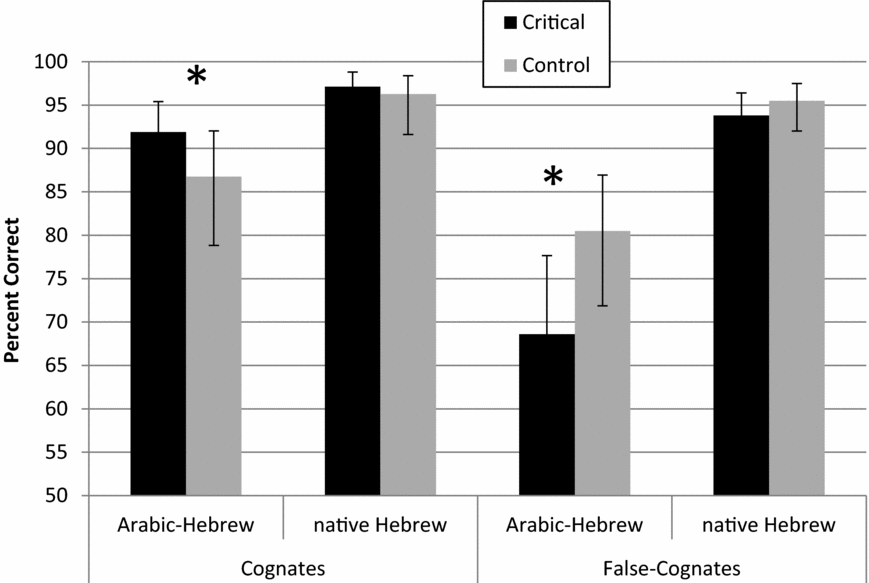
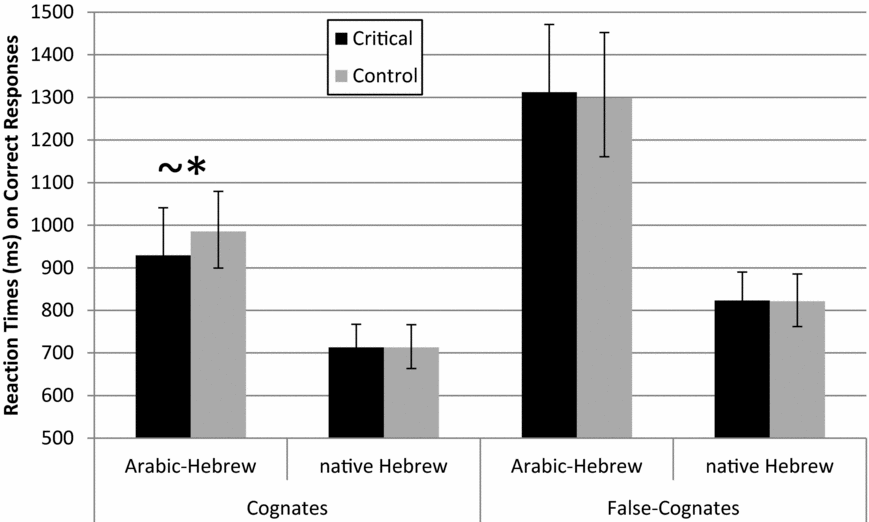
Critically, Arabic–Hebrew bilinguals were more accurate and marginallyFootnote 2 faster in responding to critical cognate primes relative to control primes (see Figures 2 and 3, and Table 5). In contrast, native Hebrew speakers responded in the same manner to both conditions.
Model estimated percent correct on the semantic relatedness task as a function of condition, type, and language background. Error bars represent the 95% confidence intervals of the estimated means.

Model estimated reaction times (ms) on correct responses on the semantic relatedness task as a function of condition, type and language background. Error bars represent the 95% confidence intervals of the estimated means.

False-Cognates
The main effect of group was significant in the accuracy analysis (F(1) = 55.12) and in the RT analysis (t(69) = 7.16, p < .001). Native Hebrew speakers were overall more accurate (M = 95%) and faster (M = 821) than the Arabic–Hebrew bilinguals (M = 75%; M = 1039). The main effect of condition was significant in the accuracy (F(1) = 16.87, Mcritical = 85%, Mcontrol = 90%) but not in the RT analysis (t(63) < 1, p = .7, Mcritical = 1039, Mcontrol = 1033). The interaction between group and condition was not significant in either the accuracy analysis (F(1) = 1.06) or the RT analysis (F(1, 62) = .09, p = .77).
Critically, as shown in Figure 2, Arabic–Hebrew bilinguals were less accurate in responding to critical false-cognate primes relative to control primes, whereas native Hebrew speakers were equally accurate in both conditions. In the RT analysis (see Figure 3), the effect of condition was not significant for either group of participants (see also Table 5).
Effects of L2 Proficiency
To examine the possibility that the influence of Arabic (L1) on Hebrew (L2) might be modulated by participants' proficiency in their L2, we examined whether the effect of condition differed as a function of L2 proficiency. As an L2 proficiency measure we used Arabic–Hebrew bilinguals' accuracy on a picture naming task in Hebrew (see Method section above). In our sample, this objective proficiency measure was correlated significantly with participants' subjective Hebrew proficiency rating (r = .611, p < .001) and self-reported Hebrew use (r = .547, p = .001) from the language-history questionnaire. Although higher levels of Hebrew proficiency led to higher overall accuracy in the semantic relatedness task (F(1) = 9.39, β = 1.95, SE = .64, Z = 3.06, p = .002), L2 proficiency did not influence RTs (F(1,32) = 2.85, p = .10, β = −.20, SE = .11, t(31) = −1.69, p = .10) and critically did not interact with the condition effect for either cognates (ps > .15) or false-cognates (ps > .36). Thus, across the range of L2 proficiency sampled in the current study, all participants were similarly influenced by cross-language phonological overlap.
General discussion
In the present study we demonstrate phonologically mediated cross-language influences during visual word processing for different-script bilinguals even when only one orthography is presented. Specifically, in a semantic relatedness task on visually presented Hebrew words, Arabic–Hebrew bilinguals were sensitive to the meaning associated with the phonological form of the prime word in the non-target language (Arabic). When the prime word was a cognate between Hebrew and Arabic (sharing phonology and meaning but not the written form), bilinguals were more accurate at correctly designating the prime and target Hebrew words as semantically related. Conversely, when the prime word was a false-cognate between Hebrew and Arabic (sharing phonology but not meaning or the written form), bilinguals were more likely to erroneously designate the prime and target Hebrew words as semantically related, because the meaning of the false-cognate prime in Arabic was indeed semantically related to the meaning of the Hebrew target. Together, this pattern of results demonstrates influence from the non-target language (Arabic) in an exclusively Hebrew task. Therefore, Arabic–Hebrew different-script bilinguals were unable to use the orthographically unambiguous information to eliminate activation of the non-target language.
Because participants in the current study use languages that do not share a script, visually presented stimuli could have theoretically allowed orthography to serve as an unambiguous language cue. In previous work with different-script bilinguals, cross-language influence was evident in conditions where either no orthography was presented (Hoshino & Kroll, Reference Hoshino and Kroll2008; Spivey & Marian, Reference Spivey and Marian1999) or both orthographic systems were presented (Dimitropoulou et al., Reference Dimitropoulou, Duñabeitia and Carreiras2011; Gollan et al., Reference Gollan, Forster and Frost1997; Kim & Davis, Reference Kim and Davis2003; Nakayama et al., Reference Nakayama, Verdonschot, Sears and Lupker2014, Voga & Grainger, Reference Voga and Grainger2007, but see Miwa et al., Reference Miwa, Dijkstra, Bolger and Baayen2014), or when cross-language influences were mediated via translation links (Degani et al., Reference Degani, Prior and Tokowicz2011; Thierry & Wu, Reference Thierry and Wu2007; Wu & Thierry, Reference Wu and Thierry2010). The current study extends these findings by showing that bilinguals were unable to eliminate activation of the non-target language even when the experimental setting included a single orthography, which is a valid cue of target language identity, and in the absence of bottom-up activation for the non-target language. Further, the cross-language activation evident in the current study originated in cross-language phonological overlap and was not mediated via translation, semantic, or orthographic links.
These findings resemble recent findings in the spoken modality demonstrating bilinguals' limited use of peripheral cues to change the balance between target and non-target language activation. In particular, native (non-accented) speech could serve as a cue to limit activation to the target language in comparison to accented speech. However, Lagrou, Hartsuiker, and Duyck (Reference Lagrou, Hartsuiker and Duyck2011) found that Dutch–English bilinguals did not show reduced non-target language activation when exposed to native vs. accented speech. This finding suggests that bilinguals did not make use of the peripheral auditory cue to reduce cross-language activation. Notably, however, accented speech provides not only a cue to the relevance of the language but also activates non-target language representations through sub-phonological information in a bottom-up fashion. Moreover, the validity of the accented speech as a cue to language membership is lower in comparison to the validity of orthography for different-script bilinguals, because bilinguals hear accented speech more often than they are likely to see one language written in the orthography of the other language. Nonetheless, even when provided a strong and valid (orthographic) cue to language membership, bilinguals in the current study still show robust phonologically mediated activation of the non-target language.
In same-script bilinguals, cross-language influences in visual word processing could be the result of overlap in orthography and/or in phonology. Although some research has attempted to dissociate these two sources by aiming to independently manipulate orthographic overlap and phonological overlap (Dijkstra et al., Reference Dijkstra, Grainger and van Heuven1999; Lemhöfer & Dijkstra, Reference Lemhöfer and Dijkstra2004), these two types of overlap are inherently linked for same-script bilinguals. In contrast, in the current study with different-script bilinguals, cross-language overlap was exclusively phonological in the total absence of orthographic overlap, because the Hebrew and Arabic orthographies do not share any letters (see Figure 1). Thus, we demonstrate robust cross-language influences in visual word recognition mediated exclusively by phonology.
Bilinguals were faster and more accurate in responding to pairs including critical cognate items showing cross-language facilitation when phonology and semantics are shared. False-cognate interference, however, was evident only in reduced accuracy for bilinguals but not in latency measures. As suggested by Bruyer and Brysbaert (Reference Bruyer and Brysbaert2011), reaction time data are less revealing when accuracy levels are low, as was the case for bilingual participants for false-cognates.
Cross-language influences in the current study were not only strong enough to lead to erroneous decisions but were also very rapid. Because prime-target SOA was relatively short (250 ms), the current findings suggest that during this brief interval bilinguals were able to activate phonology from print (in the L2), access semantic representations of the activated phonology in the L1, and have that meaning influence semantic decisions in the L2. These cross-language semantic influences emerged despite the fact that bottom-up activation was restricted to a single language.
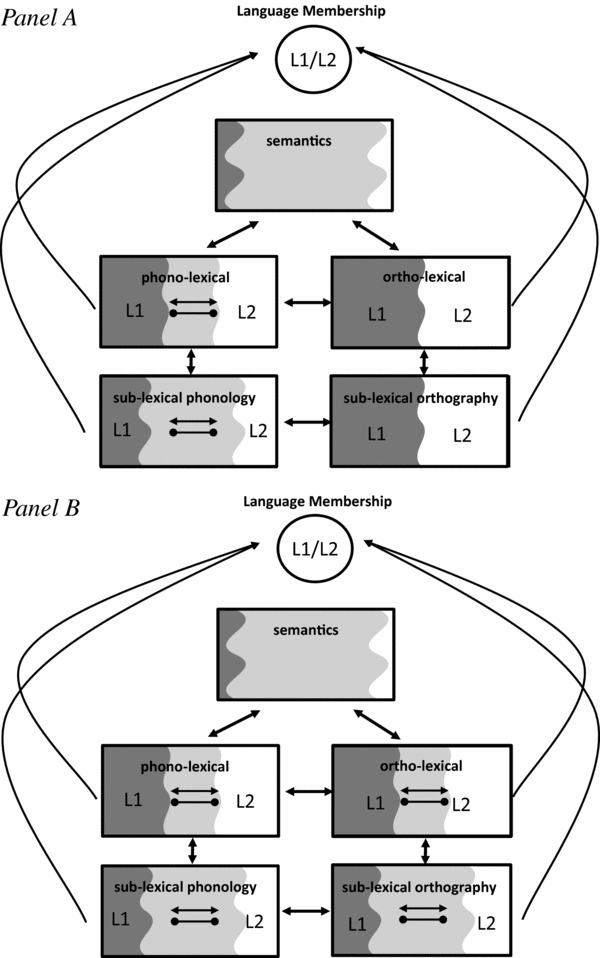
To accommodate the above described phonology-mediated cross-language influences in visual word processing of different-script bilinguals, we present a model which refines existing models of bilingual visual word recognition in same-script bilinguals (Dijkstra & van Heuven, Reference Dijkstra and Van Heuven2002; Van Kesteren et al., Reference Van Kesteren, Dijkstra and de Smedt2012; but see Miwa et al., Reference Miwa, Dijkstra, Bolger and Baayen2014) by incorporating elements from BLINCS (Shook & Marian, Reference Shook and Marian2013), a model of bilingual spoken word recognition. In this refined model, we maintain the basic architecture of the BIA+ (Dijkstra & van Heuven, Reference Dijkstra and Van Heuven2002) and BIA+ extended (Van Kesteren et al., Reference Van Kesteren, Dijkstra and de Smedt2012) models in that we include sub-lexical and lexical phonological and orthographic representations. Further, we retain the notion of forward-only links from sub-lexical and lexical representations to the language nodes, and assume that the lexical identification system communicates with a task/decision system.
In the model, both phonological and orthographic lexical and sub-lexical representations are linked to the language membership node (see also BIA, Dijkstra & Van Heuven, Reference Dijkstra, Van Heuven, Grainger and Jacobs1998, BIA+ Dijkstra & van Heuven, Reference Dijkstra and Van Heuven2002 and Van Kesteren et al., Reference Van Kesteren, Dijkstra and de Smedt2012). In the current study, under task-demands which were unequivocally driven by a single language, and when bottom-up activation from the visual input was limited to the same (target) language, we nonetheless observed influences from non-target language activation. These findings suggest that despite language unique information at the orthographic level, bilinguals were not able to utilize language membership information to eliminate phonological activation of the non-target language, or to disregard such activation at the task-decision level. Previous research with same-script bilinguals did observe that orthographic unique cues influence performance (Casaponsa et al., Reference Casaponsa, Carreiras and Duñabeitia2014, Reference Casaponsa, Carreiras and Duñabeitia2015; Casaponsa & Duñabeitia, Reference Casaponsa and Duñabeitia2016), but the present findings show that in the extreme case of completely non-overlapping orthographies, language membership information accumulated in the language nodes, is not sufficient to turn off activation and influences from the non-target language.
Critically, the refined model we present explicitly focuses on the variability in cross-language overlap of sub-lexical and lexical representations across bilingual populations. For example, the BIA+ (Dijkstra & van Heuven, Reference Dijkstra and Van Heuven2002) assumes orthographic overlap across the languages of the bilingual, and thus a given orthographic input automatically provides bottom-up activation for both languages. In the case of different-script bilinguals, this assumption does not hold. Thus, we refine the BIA+ model by explicitly allowing various degrees of overlap at different representational levels (orthography, phonology, semantics). To this end, we adopt the representation suggested by the BLINCS model (Shook & Marian, Reference Shook and Marian2013) while adding to it a dynamic component, as described below.
As depicted in Figure 4, the model includes sub-lexical orthographic and phonological representations, orthographic and phonological lexical representations, a shared semantic network and a language membership node, following the architecture of the original BIA+ (Dijkstra & van Heuven, Reference Dijkstra and Van Heuven2002). The proposed model emphasizes the degree of overlap between the two languages of the speaker. For different-script bilinguals of the kind tested in the current study, both sub-lexical and lexical orthographic representations are completely non-overlapping between L1 and L2 (Panel A). However, the model enables overlapping representations at the levels of sub-lexical and lexical phonology. Moreover, the degree of overlap is flexible, and is likely larger at the sub-lexical than the lexical phonological levels for such bilinguals. As advocated by most models of the bilingual lexico-semantic system (The Revised Hierarchical Model, Kroll & Stewart, Reference Kroll and Stewart1994, Distributed Feature Models, van Hell & de Groot, Reference Van Hell and de Groot1998; for review see Francis, Reference Francis, Kroll and Groot2005), the semantic network is mostly shared by both languages, but still allows for some language-unique meanings (Pavlenko, Reference Pavlenko and Pavlenko2009). As shown in Panel B, for same-script bilinguals, both phonological and orthographic representations (sub-lexical as well as lexical) are partially overlapping.
A model depicting the architecture of the lexico-semantic system of different-script bilinguals (Panel A) and same-script bilinguals (Panel B). See text for details.

Notably, we consider the extent of shared representations for L1-L2 across all levels of the model as a continuous and dynamic variable (see supplementary online materials depicting the dynamic nature of this variable, http://ejsafra.edu.haifa.ac.il/language-membership). Specifically, the degree of overlap at any level of representation is co-determined by characteristics of the specific language pair and the individual bilingual speaker. In terms of the language pair, at the orthographic level, we depict two extreme cases of (completely) different-script vs. same-script bilinguals. However, we suggest that in fact bilingual populations fall along a continuum, where the degree of overlap varies by language pair. One can consider partially orthographically shared scripts (Greek–French, Voga & Grainger, Reference Voga and Grainger2007, Norwegian–English, van Kesteren et al., Reference Van Kesteren, Dijkstra and de Smedt2012), or unique orthographic features (e.g., Caspanosa et al., Reference Casaponsa, Carreiras and Duñabeitia2014) as falling in between the two cases depicted here. Along the same lines, phonological overlap may also vary by language pair, such that specific language pairs could have more similar phonological inventories than other language pairs (e.g., Spanish–Italian vs. Chinese–English). Similarly, the degree of overlap at the lexical level may change by language pair, such that typologically-similar languages may have a larger proportion of cognate words than typologically different languages (e.g., Catalan–Spanish vs. Chinese–Spanish). The degree of overlap in the model is captured by the shared (light grey) areas.
Additionally, the degree of overlap may evolve over time for a given bilingual. For instance, the shared sub-phonological space may decrease with increased L2 proficiency as L2 phonological representations become more distinct from those of L1 (Major, Reference Major, Edwards and Zampini2008). Likewise, language unique meanings may occupy a larger part of the semantic network with increased L2 proficiency (e.g., the Lemma Mediation Hypothesis, Jiang, Reference Jiang2000). Future studies may use the proposed framework to further investigate these dynamic changes. In addition, computational implementation of the proposed framework may prove useful in deriving concrete predictions regarding the role of language similarity and language proficiency in shaping multilinguals’ performance.
To conclude, a complete understanding of the bilingual lexical system requires characterization of the pattern of cross-language influences in different bilingual populations. To illustrate the importance of investigating different types of bilinguals, the different-script bilinguals described in the current study allow one to dissociate orthographic from phonological cross-language influences, which in same-script bilinguals are inherently linked. Thus, the model we propose treats cross-language overlap at different levels of representation as a dynamic continuous variable accommodating the wide variety of possible language pairs and bilingual profiles. The model and the current findings suggest that even the absence of cross-language overlap at one level of representation (as for orthographic representation for the different-script bilinguals tested here) does not prevent cross-language influences throughout the bilingual lexicon, and is not eliminated by language membership information. Thus, cross-language influences can be viewed as a fundamental and prominent feature of the bilingual lexicon.
Complete set of stimuli

Appendix B. – Picture Naming Task Used as a Proficiency Measure
Thirty pictures were presented in random order, preceded by four practice pictures. Items were drawn from Moreno-Martínez and Montoro (Reference Moreno-Martínez and Montoro2012) set of 360 colored pictures. Below we list the experimental materials along with the expected Hebrew response: עבוכ (cap); הריט (castle); הגוחמ (compasses); הבוב (doll); ליצח (eggplant); גלזמ (fork); תבחמ (frying_pan); חדקא (gun); דופיק (hedgehog); הדסק (helmet); תישופיח (ladybird); רולדגמ (lighthouse); קסרפא (peach); דדחמ (pencil_sharpener); הנוי (pigeon); ריס (pot); טבחמ (racket); לגרס (ruler); ףיעצ (scarf); גרבמ (screwdriver); רודכ (soccer_ball); הפס (sofa); שיבכע (spider); םייסנכמ (trousers); בצ (turtle); היפוג (undershirt); רוניכ (violin); קנרא (wallet); תיקורשמ (whistle); סובוטוא (bus). Practice materials: ץע (holm_oak); זופת (orange); טע (pen); הטימ (bed). A different set of 30 pictures from the same database was used for a picture-naming task in Arabic and was not analyzed further in the current study.
Appendix C. –Analysis with full set of stimuli
Three items in the false-cognate condition were excluded from analysis because the target word was a cognate between Arabic and Hebrew (‘הזילאיד’), the critical prime was a cognate (‘ףיכ’) or the critical prime was unfamiliar to Arabic–Hebrew bilinguals (‘המח’).
Cognates
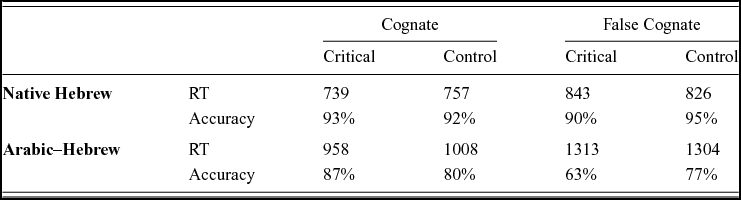
The main effect of group was significant in the accuracy analysis (F(1) = 13.37, see Tables C1, and C2) and in the RT analysis (t(72) = 5.08, p < .001). Native Hebrew speakers were overall more accurate (M = 93%) and faster (M = 748) than the Arabic–Hebrew bilinguals (M = 84%; M = 984). The main effect of condition was significant in the accuracy (F(1) = 9.90) and in the RT analysis (t(57) = 3.19, p = .002), such that critical primes were responded to more accurately (M = 90%) and faster (M = 842) than control primes (M = 87%; M = 874). The interaction between group and condition was not significant in the accuracy analysis (F(1) = 2.83) or in the RT analysis (F(1,57) = 1.51, p = .22).
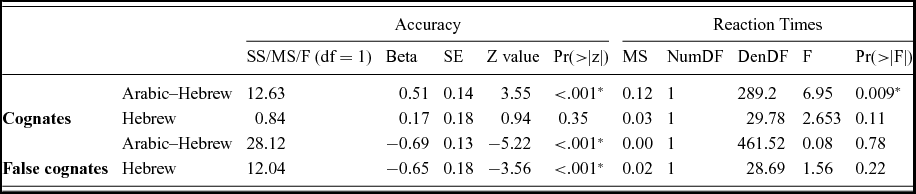
Critically, Arabic–Hebrew bilinguals were more accurate and faster in responding to critical cognate primes relative to control primes (see Table C3, Accuracy: F(1) = 12.63, β = .51, SE = .14, Z = 3.55, p < .001, RT: F(1,289) = 6.95, β = −.02, SE = .01, t(289) = −2.64, p = .009). In contrast, native Hebrew speakers responded in the same manner to both conditions (Accuracy: F < 1, β = .17, SE = .18, Z = .94, p = .35; RT: F(1,30) = 2.65, β = −.01, SE = .01, t(30) = −1.63, p = .11).
False-Cognates
The main effect of group was significant in the accuracy analysis (F(1) = 62.35) and in the RT analysis (t(70) = 6.81, p < .001). Native Hebrew speakers were overall more accurate (M = 92%) and faster (M = 834) than the Arabic–Hebrew bilinguals (M = 71%; M = 1310). The main effect of condition was significant in the accuracy (F(1) = 36.82, Mcritical = 79%, Mcontrol = 88%) but not in the RT analyses (t(689) = −1.05, p = .03, Mcritical = 1053, Mcontrol = 1038). The interaction between group and condition was not significant in either the accuracy analysis (F < 1) or the RT analysis (F < 1, p = .62).
Critically, as shown in Table C2, Arabic–Hebrew bilinguals were less accurate in responding to critical false-cognate primes relative to control primes, (F(1) = 28.12, β = −.68, SE = .13, Z = −5.22, p < .001). However, a similar effect was observed for native Hebrew speakers (F(1) = 12.04, β = −.65, SE = .18, Z = −3.55, p < .001). In the RT analysis (see Table C3), the effect of condition was not significant for either group of participants (Arabic–Hebrew: F < 1, β = .003, SE = .01, t(462) = .29, p = .78; Hebrew speakers: F = 1.56, β = .01, SE = .01, t(29) = 1.25, p = .22).
Linear Mixed Effect model results based on anova() function.

Effect of condition (critical vs. control) as a function of Participant Group from the Linear Mixed Effect models reported in the text.

Mean RTs and Percent Correct by participant group, stimulus type and condition based on full set of items

Appendix D. –ANOVA Analyses with subset of stimuli
Performance on the better matched subset (see text for details and Appendix A for the list of items) was analyzed separately for cognates (n = 19) and false-cognates (n = 30), using a mixed design repeated measures ANOVA. In the by-participant F 1 analysis, condition (control, critical) was treated as a within-participant factor and language background (Arabic–Hebrew, Hebrew) as a between-participant factor. In the by-item F 2 analysis, condition (control, critical) and language background (Arabic–Hebrew, Hebrew) were treated as within-item factors. Reaction times (RTs) were calculated on correct responses only. Prior to analysis, these RTs were trimmed by excluding RTs that were 2.5 standard deviations away from the mean of each participant and of each item (less than 5% of the data), and were then log-transformed to reduce skewness in the distribution (skewness was reduced from 2.1 to 0.6 and Kurtosis from 6.8 to 0.6).
Cognates
The main effect of group was significant in the accuracy analysis (F1(1,66) = 8.86, MSE = .03, p = .004, ηp 2 = .12, F2(1,18) = 13.86, MSE = .01, p = .002, ηp 2 = .44) and in the RT analysis (F1(1,66) = 27.69, MSE = .02, p < .001, ηp 2 = .30, F2(1,18) = 107.30, MSE = .002, p < .001, ηp 2 = .86). Native Hebrew speakers were overall more accurate (M = 93%) and faster (M = 713) than the Arabic–Hebrew bilinguals (M = 85%; M = 953). The main effect of condition was significant in the accuracy analysis by participants (F1(1,66) = 7.15, MSE = .01, p = .009, ηp 2 = .10, F2(1,18) = 1.24, MSE = .02, p = .28, ηp 2 = .06), such that critical primes were responded to more accurately (M = 91%) than control primes (M = 87%). The condition effect was not significant in the RT analysis (F1(1,66) = 2.44, MSE = .002, p = .12, ηp 2 = .04, F2(1,18) = 1.75, MSE = .004, p = .20, ηp 2 = .09) but there was no indication of tradeoff because critical primes were responded to numerically faster (M = 813) than control primes (M = 836). The interaction between group and condition was marginally significant in the accuracy analysis by participants (F1(1,66) = 2.90, MSE = .01, p = .09, ηp 2 = .04, F2(1,18) = 1.88, MSE = .01, p = .19, ηp 2 = .10) and was not significant in the RT analysis (F1(1,66) = 2.18, MSE = .002, p = .14, ηp 2 = .03, F2(1,18) = 1.48, MSE = .002, p = .24, ηp 2 = .08).
Because the focus of this investigation is the performance of the Arabic–Hebrew bilinguals, planned comparisons for each group were conducted regardless of the significance of this interaction.
Critically, in the by-participant analyses, Arabic–Hebrew bilinguals were significantly more accurate and marginally faster in responding to cognate primes relative to control primes (Accuracy: (F1(1,33) = 8.39, MSE = .01, p = .010, ηp 2 = .20, F2(1,18) = 1.73, MSE = .02, p = .21, ηp 2 = .09), RT: (F1(1,33) = 3.26, MSE = .003, p = .08, ηp 2 = .09, F2(1,18) = 2.58, MSE = .003, p = .13, ηp 2 = .13). In contrast, native Hebrew speakers responded in the same manner in both prime conditions (Accuracy: (F1 < 1; F2 <1); RT: (F1 <1; F2 < 1)).
False Cognates
The main effect of group was significant in the accuracy analysis (F1(1,66) = 49.15, MSE = .03, p < .001, ηp 2 = .43, F2(1,29) = 97.71, MSE = .01, p < .001, ηp 2 = .77) and in the RT analysis (F1(1,66) = 51.54, MSE = .03, p < .001, ηp 2 = .44, F2(1,29) = 171.75, MSE = .01, p < .001, ηp 2 = .86). Native Hebrew speakers were overall more accurate (M = 91%) and faster (M = 822) than the Arabic–Hebrew bilinguals (M = 70%; M = 1303). The main effect of condition was significant in the accuracy analysis (F1(1,66) = 15.54, MSE = .01, p < .001, ηp 2 = .19, F2(1,29) = 4.42, MSE = .03, p = .044, ηp 2 = .13), such that critical primes were responded to less accurately (M = 78%) than control primes (M = 84%). The condition effect was not significant in the RT analysis (F1 < 1; F2(1,29) = 1.33, MSE = .004, p = .26, ηp 2 = .044) but there was no indication of tradeoff because critical primes were responded to numerically slower (M = 1040) than control primes (M = 1030). The interaction between group and condition was significant in the accuracy analysis (F1(1,66) = 6.09, MSE = .01, p = .02, ηp 2 = .08, F2(1,29) = 4.93, MSE = .01, p = .03, ηp 2 = .15) and was not significant in the RT analysis (F1 < 1; F2 < 1). As in the cognate type, because the focus of this investigation is the performance of the Arabic–Hebrew bilinguals, planned comparisons for each group were conducted regardless of the significance of this interaction.
Critically, Arabic–Hebrew bilinguals responded significantly less accurately following false-cognate primes (M = .65) relative to control primes (M = .75), (F1(1,33) = 13.79, MSE = .01, p = .001, ηp 2 = .30, F2(1,29) = 7.01, MSE = .02, p = .01, ηp 2 = .20). In contrast, native Hebrew speakers responded in the same manner in both priming conditions (Mcontrol = .92, Mcritical = .90, F1(1,33) = 2.13, MSE = .004, p = .15, ηp 2 = .06; F2 < 1).
There was no difference between critical and control false-cognate primes in the RT data in either group. (Arabic–Hebrew: F1 <1; F2(1,29) = 1.26, MSE = .01, p = .27, ηp 2 = .04; native-Hebrew: F1 <1; F2 < 1).