


1. Introduction
It is well established the optimality of models with infinitely lived agents endowed with perfect foresight in the absence of market imperfections such as external effects or frictions in the trade process. Furthermore, in these models, money is usually not positively valued and in any case neither its amount nor its growth rate produce any short-run or long-run effects on the real economy. In this paper, we relax the very demanding assumption of perfect foresight and consider agents who, despite being infinitely lived, are endowed with limited foresight or, equivalently, myopia and in each date formulate consumption and investment plans only for a finite number of periods ahead. This framework, combined with a technology compatible with sustained growth, allows us testing the impact of myopia on growth and understanding the mechanism leading to equilibria where money is not only positively valued but also non-neutral.
The assumption of myopic agents is easily justified in light of recent events, which have challenged people’s ability to anticipate the future accurately and to plan their lives accordingly. There is indeed a broad consensus on the fact that the recent crises experienced by the world economy are also the result of unpredictable shocks. Most of the time, even their consequences are unknown and may require policy responses totally new. Crisis and economic recovery are usually analyzed within dynamic general equilibrium models where agents are endowed with perfect foresight and thus able to forecast, at least in terms of probabilistic distributions derived from past observations. Usually, consumers, firms, and policymakers may set contingent plans, if markets are complete, for a potentially infinite number of periods. Unfortunately, the traditional risk assessment analysis cannot apply to recent events, as the pandemics, the looming climate change and the harsh and prolonged geopolitical tensions. Such events seem in fact not to be easily reducible to probability distributions and to fall into the category of “uncertainty” rather than that of “risk” (Knight Reference Knight1921); in presence of uncertainty, agents neither know the possible states of the world nor the probabilities associated with them. It follows the lack of realism to assume agents endowed with perfect foresight and adopt traditional stochastic optimization techniques.
Several attempts to tackle such problematic issues linked to the prediction of future, as already stressed by Robinson (Reference Robinson1980), have been proposed in a recent literature. In the wake of the seminal work of Simon (Reference Simon1955, Reference Simon1991), some authors introduce bounded rationality as the outcome of limited foresight, for example by assuming agents to form expectations using adaptive learning or to neglect some variables in the budget constraint when maximizing utility, because information is costly (Evans and Honkapohja Reference Evans and Honkapohja2001; Gabaix Reference Gabaix2020). Other studies (Lovo and Polemarchakis Reference Lovo and Polemarchakis2010; Woodford Reference Woodford2019; Woodford and Xie Reference Woodford and Xie2022), by contrast, model bounded rationality by supposing agents, despite having an infinite life horizon in front of them, to behave as they were short-lived. i.e. to formulate consumption and investment plans only for a limited number of periods ahead and to revise these plans in each date, by taking into account the arrival of new information included, may be, unpredictable events.
There are several important works in the literature which, even without specifically dealing with forms of bounded rationality, propose to build bridges between models with short and longer planning horizons. Already Grandmont and Younes (Reference Grandmont and Younes1972), in a temporary equilibrium framework à la Hicks (Reference Hicks1975), study equilibrium prices emerging in a specific period for given expectations on the infinite sequence of prices prevailing in the future. Later, several studies, as in Grandmont (Reference Grandmont1998), identify appropriate learning processes ensuring the convergence of expectations towards the rational ones. Aiyagari (Reference Aiyagari1987, Reference Aiyagari1992) shows that it is possible to mimic an infinite horizon model by introducing a bequest motive in individuals’ utility function of an OLG economy. Huo (Reference Huo1987) proves that the introduction of cash-in-advance constraints in infinte horizon models can reproduce the behavior of an OLG economy. On the other hand, the finance constrained economy studied by Woodford (Reference Woodford1986) generate equilibrium dynamics equivalent to that of a two-period OLG economy. Note that Woodford (Reference Woodford1986) model has proven to be very useful for simulating short-run dynamics and thus has been used extensively for this purpose, e.g. by Grandmont et al. (Reference Grandmont, Pintus and De Vilder1998) and Cazzavillan et al. (Reference Cazzavillan, Lloyd-Braga and Pintus1998), while Bosi and Magris (Reference Bosi and Magris2002) test the robustness of the model when the financial constraint is progressively relaxed. Nevertheless, these contributions are not able to establish functional equivalences between infinite horizon economies and OLG ones when individuals have lifespans longer than two periods (as in Raurich and Seegmuller Reference Raurich and Seegmuller2022, with three-period lived agents) which is the case that is empirically relevant.
The concept of myopia as an outcome of bounded rationality is explicitly introduced by Michel and de La Croix (Reference Michel and de La Croix2000) and Lovo and Polemarchakis (Reference Lovo and Polemarchakis2010). However, in Michel and de La Croix (Reference Michel and de La Croix2000) myopia is just the consequence of agents’ incapability of correctly forecasting future prices and thus make it necessary to infer them by means of retrospective expectations. Assuming myopic behavior within a model with production and constant money supply, Lovo and Polemarchakis (Reference Lovo and Polemarchakis2010) frame instead limited foresight as a truncated agents’ planning horizon despite their infinite lifespan. They prove the existence of monetary equilibrium and its local (in)determinacy for any arbitrary degree of myopia.
In two related papers, Woodford (Reference Woodford2019) and Woodford and Xie (Reference Woodford and Xie2022) formalize limited foresight assuming stochastic environment, absence of capital accumulation, articulated learning processes and specific monetary policies aimed at pegging the interest rate. These studies frame limited foresight by assuming agents to formulate their plans in terms of consumption and savings only for a finite number of periods. However, assets held in the last period of the planning horizon are not equal to zero, in view of a specific continuation function evaluating positively their stock, although it does not reflect the true state the economy is actually experiencing, but an hypothetical stationary state that agents expect in view of a long enough learning process.
In this paper we apply this definition of limited foresight, or equivalently of myopia, to real and monetary
 $Ak$
growth models. Following analogous lines as in Lovo and Polemarchakis (Reference Lovo and Polemarchakis2010), we do not assume any specific money demand on the ground of some market imperfection, as financial frictions (Stockman Reference Stockman1981; Abel Reference Abel1985) and/or borrowing constraints (Woodford Reference Woodford1986; Grandmont et al. Reference Grandmont, Pintus and De Vilder1998). The adopted framework allows us to obtain a wide set of innovative results as well as to provide a reliable interpretation, missing or not clear enough in related works, for the main economic mechanisms at work.
First, we demonstrate that, in the real model, the growth rate of the economy increases as the degree of myopia is progressively relaxed, provided agents do not place too much importance on the utility of the last period of their short optimization horizon. However, the transition from the limited foresight economy to the rational expectations one is smooth: as soon as myopia is continuously removed, the economy converges monotonically to the perfect foresight model.
In a second step, we introduce money in the model. The demand of money is purely speculative since it is not motivated on the ground of some market imperfections. As a consequence, money and physical capital are perfectly substitutable assets, sharing at equilibrium the same return. We prove the existence of monetary equilibria in which real balances are not equal to zero. The only requirement to get such monetary equilibria is a steady contraction of the money supply. In addition, we provide conditions for the non-neutrality of money, i.e. for the growth rate of money to influence the real sector of the economy. Notice that these features are often missing in infinite horizon economies deprived of market imperfections or frictions in the trading process.
Our model specification allows us to obtain closed-form solutions and thus compare the growth rates of the different economies analyzed as well as to carry out a complete stability analysis not only from a local perspective but also from a global one. Namely, we prove that when the sign of real balances is positive (negative) there arises a globally unstable (stable) monetary
 $BGP$
along which money is non-neutral, and a globally stable (unstable) monetary
 $BGP$
along which money is neutral. Finally, we characterize the optimal monetary policy by showing that it requires money balances to be withdrawn at the growth-to-interest ratio factor.
Almost all of the results we obtain strongly depend upon the assumption of myopia and are no longer true otherwise. More specifically, the non-neutrality of money arises from the money illusion affecting agents with limited planning horizons. Such illusion, indeed, provokes the failure of the Ricardian equivalence and makes agents, by ignoring future nominal transfers, to confuse money endowments with net income.
The remainder of the paper is organized as follows. In Section 2 we present the real economy with limited foresight while Section 3 is devoted to the study of the monetary model. We gather in Section 4 some concluding remarks.
2. A real model with limited foresight
In this Section we formalize limited foresight and myopic behavior within a simple real economy displaying unbounded growth and characterized by the presence in dates
 $t=0,1,2,\ldots$
of a representative agent. Before formally explaining to what extent we refer to limited foresight, we first describe the fundamentals of the economy, i.e. technology and preferences.
We focus on a basic endogenous growth model with a production function linear in capital (Barro and Sala-i Martin Reference Barro and Sala-i Martin2004; Aghion and Howitt Reference Aghion and Howitt2009). Under this hypothesis, sustained growth does not require any external effect, as in Romer (Reference Romer1986) and Barro (Reference Barro1990) and one obtains closed-form solutions. Namely, we assume a representative competitive firm producing in each period
 $t$
the final good
 $y_t$
by using only capital according to the CRS technology
 $y_t=H k_t$
, with
 $H$
being the constant productivity of capital. Profit is
 \begin{equation} \Pi _t=H k_t -r_t k_t. \end{equation}
where
 $r_t$
is the real rental price of capital. Since markets are competitive, zero profit condition requires:
 \begin{equation} r_t=H. \end{equation}
Preferences of the representative agent are described by a CRRA utility function
 $u(c_t)=c_{t}^{1-\varepsilon }/\left ( 1-\varepsilon \right )$
with
 $\varepsilon \gt 0$
the inverse of consumption intertemporal elasticity of substitution. Households endowed with perfect foresight maximize the infinite stream of utility functions
 \begin{equation} \sum _{t=0}^{+\infty }\beta ^t c_{t}^{1-\varepsilon }/\left ( 1-\varepsilon \right ) \end{equation}
where
 $\beta \in (0,1)$
is the discount factor. In each date
 $t$
, they must respect the dynamic budget constraint
 \begin{equation} k_{t+1}+c_{t}=r_t k_{t}+(1-\phi )k_t \end{equation}
where
 $\phi \in [0,1]$
stands for the capital depreciation rate. Combining (2) with the FOCs of the individual maximization problem and setting
 $A\equiv H+\left ( 1-\phi \right )$
, one obtains the unique equilibrium Balanced Growth Path (
 $BGP$
) where all the variables grow at the common factor
 \begin{equation} \gamma ^{AkPF} \equiv (\beta A)^{ \frac {1}{\varepsilon }}. \end{equation}
To ensure positive growth, we introduce the following restriction on the parameter values that we suppose to hold all throughout the paper:
Assumption 1.
 $(\beta A)^{1/\varepsilon }\gt 1.$
It is well known that the
 $BGP$
in (5) is globally unstable and thus the economy does not display any transitional dynamics.
We now turn attention to individual behavior under the hypothesis that the representative agent is not endowed with perfect foresight and introduce myopia following Lovo and Polemarchakis (Reference Lovo and Polemarchakis2010): despite having an infinite lifespan, agents formulate plans only for a finite number of periods. We will make the planning horizon
 $n$
to increase from one (extreme myopia) to infinite (perfect foresight). Thus
 $n$
represents the inverse of the degree of myopia: in any period
 $t$
agents chose how much to consume and invest only for the following
 $n$
periods ahead, i.e. in
 $t$
,
 $t+1$
, …
 $t+n$
. At date
 $t+n$
the whole income is therefore devoted to finance consumption.
As a consequence, myopic agents solve a finite maximization problem, subject to the initial capital stock
 $k_{t}$
and to the final condition
 $k_{t+n+1}=0$
. This makes it possible to derive the whole sequence of consumption and investment plans from
 $t$
up to
 $t+n$
. Nevertheless, at
 $t+1$
agents realize that they have in front of them not just
 $n-1$
residual periods of life but again
 $n$
and accordingly reformulate their plans, taking the implemented investment
 $k_{t+1}$
as the new initial condition. Notice that plans formulated in such way are generically time inconsistent. This procedure will be iterated infinitely many times to obtain the law of capital accumulation
 $ k_{t+1}=f^{n}\left ( k_{t}\right )$
indexed with respect to the (inverse) degree
 $n$
of myopia. By relaxing
 $n$
from one to infinite, one then obtains a sequence of well-defined functions.
Formally, the maximization problem at date
 $t$
of the representative agent endowed with the capital stock
 $k_{t}$
and planning for
 $n$
periods ahead is
 \begin{equation} \max _{\left \{ c_{t+j},k_{t+j+1}\right \} _{j=0}^{n}}\sum \limits _{j=0}^{n-1}\beta ^{t+j}\frac {c_{t+j}^{1-\varepsilon } }{1-\varepsilon }+\delta \beta ^{t+n}\frac {c_{t+n}^{1-\varepsilon }}{ 1-\varepsilon } \end{equation}
subject to constraints
 \begin{equation} c_{t+j}+k_{t+1+j}=r_{t+j}k_{t+j}+\left ( 1-\phi \right ) k_{t+j} \end{equation}
for
 $j=0,..,n-1$
and
 \begin{equation} c_{t+n}=r_{t+n}k_{t+n}+\left ( 1-\phi \right ) k_{t+n}, \end{equation}
where
 $r_{t+j}$
is the real rental price of capital and
 $\delta \gt 0$
is a positive weight according to which agents evaluate last period utility, to be viewed as a proxy of all future utilities (Lovo and Polemarchakis Reference Lovo and Polemarchakis2010).Footnote
1
By integrating backward constraints (7) and (8) and setting
 $ R_{t+j}\equiv r_{t+j}+\left ( 1-\phi \right )$
the gross real interest rate, we can write the intertemporal budget constraint in the form
 \begin{equation} c_{t}+\frac {c_{t+1}}{R_{t+1}}+\frac {c_{t+2}}{R_{t+1}R_{t+2}}+\ldots +\frac { c_{t+n}}{R_{t+1}R_{t+2}..R_{t+n}}=R_{t}k_{t} \end{equation}
The individual program can be thus reformulated as to maximize (6) subject to (9). The FOCs are easily obtained as
 \begin{equation} c_{t+j-1}^{-\varepsilon }=\beta c_{t+j}^{-\varepsilon }R_{t+j} \end{equation}
for
 $j=1,..,n-1$
and
 \begin{equation} c_{t+n-1}^{-\varepsilon }=\beta \delta c_{t+n}^{-\varepsilon }R_{t+n} \end{equation}
together with the budget constraint (9). The time inconsistency of individual plans is immediately appraised once one observes that, in each period
 $t$
, the consumption plans obtained from (10) and (11) will not be implemented for each
 $j\gt 1$
since agents will reformulate plans in any future date. The phenomenon of time inconsistency has been studied in depth since the contributions of Kydland and Prescott (Reference Kydland and Prescott1977) and Barro and Gordon (Reference Barro and Gordon1983) concerning the behavior of a public authority. In our model, by contrast, time inconsistency affect households’ behavior: plans programmed by the representative agent in a given period are no longer optimal in the future since, moving his life horizon forward, he will revise them.
For all these reasons, in the limited foresighted economy, the weaker concept of perfect foresight spot equilibrium (PFSE) must be applied (Lovo and Polemarchakis Reference Lovo and Polemarchakis2010). According with this definition, while the FOCs hold from
 $t$
up to
 $t+n$
, market clearing is required only at the time of optimization, because future markets are not required to clear.Footnote
2
In such way, individuals can borrow or lend only for one period ahead.
Definition 1.
A PFSE for the economy is a sequence of rental prices of capital
 $\left \{ r_{i}\right \} _{i=0}^{\infty }$
such that, in every date
 $t$
, plans are optimal for individuals and firms, and the spot markets for capital and consumption are in equilibrium:
 \begin{equation} r_{t}=H \text{ and }k_{t+1}=A k_{t}-c_{t}. \end{equation}
From the definition of PFSE, one has that individuals make plans in terms of future consumption on the basis of their expectations about the future spot price. It is then immediate to verify that a PFE is also PFSE but not conversely.
By combining the FOCs (9), (10) and (11) with the equilibrium ones (12), one can express all consumption decisions as a function of initial consumption
 $c_{t}$
:
 \begin{equation} c_{t+j}=\left ( \left ( A\beta \right ) ^{\frac {1}{\varepsilon }}\right ) ^{j}c_{t}, \end{equation}
for
 $j=0,\ldots,n-1$
and
 \begin{equation} c_{t+n}=\left ( A\beta \right ) ^{\frac {1}{\varepsilon }}\delta ^{\frac {1}{ \varepsilon }}c_{t}. \end{equation}
At the same time, at PFSE, the intertemporal budget constraint is:
 \begin{equation} c_{t}+A^{-1}c_{t+1}+\ldots +A^{-n}c_{t+n}=Ak_{t} \end{equation}
From Equations (13), (14) and (15), it is possible to obtain the explicit expression for
 $c_{t}$
as a function of the initial capital endowment
 $k_{t}$
:
 \begin{equation} c_{t}=\left [ \frac {1-\left [ (\beta A)^{\frac {1}{\varepsilon }}A^{-1}\right ] ^{n}}{1-(\beta A)^{\frac {1}{\varepsilon }}A^{-1}}+\left [ (\beta A)^{\frac {1}{ \varepsilon }}A^{-1}\right ] ^{n}\delta ^{\frac {1}{\varepsilon }}\right ] ^{-1}Ak_{t} \end{equation}
Exploiting period
 $t$
market clearing conditions (12), we can finally write the equilibrium law of capital accumulation corresponding to the (inverse) degree
 $n$
of myopia:
 \begin{equation} k_{t+1}=\gamma ^{AkLF}\left ( n\right ) k_{t} \end{equation}
where
 \begin{equation} \gamma ^{AkLF}\left ( n\right ) \equiv \frac {k_{t+1}}{k_{t}}=A\left [ 1-\left ( \frac {1-\theta ^{n}}{1-\theta }+\theta ^{n}\delta ^{\frac {1}{\varepsilon } }\right ) ^{-1}\right ] \end{equation}
is the (constant)
 $BGP$
of the economy and
 $\theta \equiv (\beta A)^{\frac {1}{\varepsilon }}A^{-1}$
. Notice that
 $\gamma ^{AkLF}\left ( n\right )$
is increasing in
 $\delta$
, as the latter provides an incentive to invest in capital. As usual, for the
 $BGP$
to be well defined and economically meaningful, one needs to introduce a restriction on the parameter values in order to prevent the rate of growth to be larger than the interest rate:
Assumption 2.
 $(\beta A)^{1/\varepsilon }/A\lt 1$
. It is immediate to verify that when the (inverse) degree
 $n$
of myopia is progressively relaxed and tends to infinite, under Assumption 2 one has
 \begin{equation*} \lim _{n_{\rightarrow +\infty }}\gamma ^{AkLF}\left ( n\right ) =(\beta A)^{ \frac {1}{\varepsilon }}\equiv \gamma ^{AkPF}. \end{equation*}
It is worth noticing that
 $\gamma ^{AkPF}$
is the same growth factor one gets in the standard
 $Ak$
models with agents endowed with perfect foresight as shown, among the others, in Romer (Reference Romer1986) and Barro (Reference Barro1990). Therefore we have build a bridge between myopic economies and infinite-horizon ones and established a clear continuity criterion.
One may now wonder whether the sequence
 $\gamma ^{AkLF}\left ( n\right )$
is increasing or decreasing in
 $n$
. To this end, one must compute the derivative of
 $\gamma ^{AkLF}\left ( n\right )$
with respect to
 $n.$
It is immediate to prove that such derivative is positive, and thus the sequence
 $\gamma ^{AkLF}\left ( n\right )$
is increasing in
 $n$
, if and only if
 $\frac {1-\theta ^{n}}{1-\theta }+\theta ^{n}\delta ^{\frac {1}{ \varepsilon }}$
is increasing in
 $n.$
This in turn is true if and only if
 $\delta \lt \left ( 1-\theta \right ) ^{-\varepsilon }\equiv \hat {\delta }$
with
 $\hat {\delta }\gt 1$
. As a consequence, when
 $\delta \lt \hat {\delta }$
, the sequence
 $\gamma ^{AkLF}\left ( n\right )$
is monotonically increasing and otherwise monotonically decreasing.
The interpretation of these results is rather intuitive. For
 $\delta$
low enough, agents do not place too much importance on last period planned consumption and therefore the lengthening of the planning horizon will make it appropriate to decrease initial consumption and increase investment to finance a longer sequence of consumption streams. On the other hand, if last period planned consumption matters enough, an extension of the planning horizon will decrease the importance of intermediate consumption streams and therefore discourage initial investment. The above results are gathered in the following Proposition.
Proposition 1.
In the limited foresighted
 $Ak$
model with (inverse) degree
 $n$
of myopia, under Assumptions 1 and 2, it is:
-
(i) For each
 $n\gt 1$
,
$\gamma ^{AkLF}\left ( n\right ) \gt 1$
.
-
(ii)
$\lim _{n_{\rightarrow +\infty }}\gamma ^{AkLF}\left ( n\right ) =(\beta A)^{\frac {1}{\varepsilon }}\equiv \gamma ^{AkPF}$
. -
(iii)
$\frac {\partial \gamma ^{AkLF}\left ( n\right ) }{\partial n}\gt 0$
if and only if
$\delta \lt \hat {\delta }$
with
$\hat {\delta }=\left ( 1-\theta \right ) ^{-\varepsilon }\gt 1$
.



A consequence of Proposition1 is that the growth factors
 $\gamma ^{AkLF}\left ( n\right )$
of the myopic economies, for any
 $n$
, are lower than the growth factor of the perfect foresight economy
 $\gamma ^{AkPF}$
if and only if
 $\delta \lt \hat {\delta }.$
In fact, from (15), discounted income is invariant to
 $n$
but, as
 $n$
increases, it must be spread over a larger number of periods. This requires a contraction in current consumption (Equation 16) and an increase in capital accumulation.
Having analyzed the real limited foresight economy, we now turn the attention to its monetary extension.
3. A monetary model with limited foresight
In this Section we extend the real model with myopia previously analyzed by introducing fiat money as an asset alongside productive capital. It is well known that in infinite horizon models with perfect foresight, money can influence the real economy only in presence of some market imperfections and financial frictions, as it is the case when liquidity or borrowing constraints are introduced (Abel Reference Abel1985; Woodford Reference Woodford1986; Grandmont et al. Reference Grandmont, Pintus and De Vilder1998; Bloise Reference Bloise2006). Also the money-in-utility function approach (Sidrauski Reference Sidrauski1967; Brock Reference Brock1975) assumes implicitly the existence of transactions costs that can be partially avoided by using money in the trade process. Actually, Feenstra (Reference Feenstra1986) assesses the functional equivalence between the reduced forms of all these frameworks.
By contrast, in our economy we do not assume any specific market imperfection motivating money demand. Nevertheless, we prove the existence of equilibria where money is positively valued, i.e. equilibrium prices are bounded, and non-neutral, i.e. the growth rate of money affects the real economy. Bounded rationality is thus a key factor in assigning an active role to money and make its management to entail real economic consequences.
For the purpose of a clear exposition of our results, let’s first discuss the monetary extension of the real infinite horizon economy described in Section 2. The problem faced by the representative agent is to maximize (3) subject to the budget constraint for each
 $j\gt 0$
, including both money demand and money income
 \begin{equation} M_{t+j+1}^{d}+p_{t+j}c_{t+j}+p_{t+j}k_{t+j+1}=p_{t+j}r_{t+j}k_{t+j}+p_{t+j} \left ( 1-\phi \right ) k_{t+j}+M_{t+j}^{d}+\tau _{t+j} \end{equation}
where
 $M_{t+j}^{d}$
is agent’s demand of money,
 $p_{t+j}$
the price of the consumption good,
 $r_{t+j}$
the real rental price of capital and
 $\tau _{t+j}$
the Central Bank monetary transfers or withdrawals to the households, all evaluated at period
 $t+j$
. No additional liquidity or borrowing constraint beside the budget one (19) is introduced, so money is held exclusively as a store of value.
We assume the Central Bank to peg money growth at the constant rate
 $\mu \gt -1$
, so at equilibrium money transfers satisfy
 $\tau _{t+j}=\mu M_{t+j}$
and money supply
 $M_{t+j}$
evolves according to
 $M_{t+j+1}=(1+\mu )M_{t+j}$
. Since at equilibrium the gross real interest rate is
 $R_{t+j}=A$
, the FOCs for an interior solution of the maximization problem with positive demand both for capital and money are
 \begin{equation} c_{t+j}=\left ( \left ( A\beta \right ) ^{\frac {1}{\varepsilon }}\right ) ^{j}c_{t}, \end{equation}
and
 \begin{equation} p_{t+j-1}/p_{t+j}=A \end{equation}
for
 $j=0,1,2,\ldots$
Notice that the no-arbitrage condition (21) claims that the real rate of return of money holding, namely the deflation factor, must be equal to the gross return
 $A$
on capital investment. By combining expressions (20) and (21) with the good market clearing condition
 $c_{t+j}+k_{t+1+j}=Ak_{t+j}$
, one obtains the unique equilibrium
 $BGP$
as in (5). Therefore, along such
 $BGP$
, capital and consumption grow at the same rate:
 \begin{equation} \frac {k_{t+1}}{k_{t}}=\frac {c_{t+1}}{c_{t}}=(\beta A)^{\frac {1}{\varepsilon } } \equiv \gamma ^{AkPF} \end{equation}
while the dynamics of real balances
 $m_{t}=M_{t}/p_{t}$
evolves according to
 \begin{equation} \frac {m_{t+1}}{m_{t}}=A\left ( 1+\mu \right ). \end{equation}
In order for the
 $BGP$
to be consistent with individual optimization behavior, it must also respect the transversality condition
 \begin{equation} \lim _{t\rightarrow \infty }\beta ^{t}m_{0}\left ( A\left ( 1+\mu \right ) \right ) ^{t}c_{0}^{-\varepsilon }(\beta A)^{-t}=0. \end{equation}
Equation (24) deserves some important comments. Let’s first observe that the initial amount
 $m_0$
of real balances depends on the initial price level
 $p_0$
, which represents a jump variable adjusting to achieve equilibrium. However, for (24) to be satisfied, it is required either
 $m_0=0$
or
 $m_0 \neq 0$
and
 $\mu \lt 0$
. In the first case, being real balances the nominal balances-to-price ratio,
 $p_0$
, as well as the whole equilibrium price sequence, need to be infinite. Since the price of money is the reciprocal of the price level, money is zero valued. We refer to such case as the non-monetary equilibrium. By contrast, when
 $\mu \lt 0$
, condition (24) is respected for any
 $m_0 \neq 0$
, i.e. for any
 $p_0 \gt 0$
generating a sequence of strictly positive and bounded prices. Money is thus positively valued and we define this equilibrium the monetary one. Notice that the sign of real balances will be equal to that of nominal ones. Nevertheless, in view of (22) and (23), the money growth rate does not entail any real effects and the dichotomy between real and monetary sectors is confirmed: money, although being positively valued, is neutral. The definition of monetary equilibrium as well as money neutrality and non-neutrality is thus the following:
Definition 2. A monetary equilibrium is an equilibrium where money is positively valued. At the monetary equilibrium, money is neutral if its growth rate does not influence the real economy, and non-neutral otherwise.
By contrast, introducing myopia allows to obtain monetary equilibria where money is positively valued and non-neutral, since its growth rate affects the real sector of the economy. Although Lovo and Polemarchakis (Reference Lovo and Polemarchakis2010) also obtain monetary equilibria in myopic economies, they rely on non-growing economies and on constant money supply, preventing them from evaluating money neutrality as well as performing monetary policy.
By introducing money in the real myopic economy introduced in Section 2 and characterized by an (inverse) degree
 $n$
of myopia, the sequence of budget constraints faced by an agents planning in time
 $t$
writes
 \begin{equation} M_{t+j+1}^{d}+p_{t+j}c_{t+j}+p_{t+j}k_{t+j+1}=p_{t+j}r_{t+j}k_{t+j}+p_{t+j} \left ( 1-\phi \right ) k_{t+j}+M_{t+j}^{d}+\tau _{t+j} \end{equation}
for
 $j=0,\ldots,n-1$
and
 \begin{equation} p_{t+n}c_{t+n}=p_{t+j}r_{t+n}k_{t+n}+p_{t+n}\left ( 1-\phi \right ) k_{t+n}+M_{t+n}^{d}+\tau _{t+n}, \end{equation}
where all the variables have been previously defined. By integrating backward the budget constraints (25) and (26), after some straightforward computations, one obtains the intertemporal budget constraint
 \begin{align} &p_{t}c_{t}+\ldots +p_{t+n}c_{t+n}+p_{t}k_{t+1}+\ldots +p_{t+n-1}k_{t+n}\nonumber\\&\quad =p_{t}\left [ r_{t}+\left ( 1-\phi \right ) \right ] k_{t}+\ldots +p_{t+n}\left [ r_{t+n}+\left ( 1-\phi \right ) \right ] k_{t+n}+M_{t}^{d}+\tau _{t}+\ldots +\tau _{t+n}. \end{align}
The individual program in time
 $t$
can be thus reformulated as to maximize (6) subject to (27). Its solution yields the following FOCs:
 \begin{equation} c_{t+j-1}^{-\varepsilon }=\frac {p_{t+j-1}}{p_{t+j}}\beta c_{t+j}^{-\varepsilon }, \end{equation}
 \begin{equation} c_{t+n-1}^{-\varepsilon }=\frac {p_{t+n-1}}{p_{t+n}}\beta \delta c_{t+n}^{-\varepsilon } \end{equation}
and
 \begin{equation} p_{t+j-1}/p_{t+j}=r_{t+j}+\left ( 1-\phi \right ) \end{equation}
for
 $j=1,..,n-1$
, together with the budget constraint (27). Notice that (30) represents the no-arbitrage condition equalizing money and capital returns. Exploiting (30), the budget constraint (27) can be rewritten as
 \begin{equation} p_{t}c_{t}+\ldots +p_{t+n}c_{t+n}=p_{t}\left [ r_{t}+\left ( 1-\phi \right ) \right ] k_{t}+M_{t}^{d}+\tau _{t}+..+\tau _{t+n}. \end{equation}
As in the previous Section, we now introduce the PFSE.
Definition 3.
A PFSE for the monetary economy is a sequence of consumption prices and rental prices of capital
 $ \{ p_{t},r_{t} \} _{t=0}^{\infty }$
such that, in every date
 $t$
, plans are optimal for individuals and firms, and the spot markets for capital, consumption and money balances are in equilibrium:
 \begin{equation} r_{t}=H,\text{ }p_{t}/p_{t+1}=A \text{, }k_{t+1}=A k_{t}-c_{t}, M_t=M^d_t\text{ and }\tau _{t}=\mu M_{t}. \end{equation}
Combining the FOCs with equilibrium conditions (32), one gets
 \begin{equation} c_{t+j}=\left ( \left ( A\beta \right ) ^{\frac {1}{\varepsilon }}\right ) ^{j}c_{t}, \end{equation}
 $j=0,\ldots ,n-1$
, and
 \begin{equation} c_{t+n}=\left ( \left ( A\beta \right ) ^{n}\right ) ^{\frac {1}{\varepsilon } }\delta ^{\frac {1}{\varepsilon }}c_{t} , \end{equation}
while the intertemporal budget constraint boils down to
 \begin{equation} c_{t}+A^{-1}c_{t+1}+\ldots +A^{-n}c_{t+n}=Ak_{t}+m_{t}\left ( 1+\mu \right ) ^{n+1}. \end{equation}
From (33), (34) and (35), one can express initial consumption
 $c_{t}$
as a function of the initial stock of capital
 $k_{t}$
and real balances
 $m_{t}$
:
 \begin{equation} c_{t}=\left [ Ak_{t}+m_{t}\left ( 1+\mu \right ) ^{n+1}\right ] \left ( \frac { 1-\theta ^{n}}{1-\theta }+\theta ^{n}\delta ^{\frac {1}{\varepsilon }}\right )^{-1}. \end{equation}
Plugging (36) into the resource constraint
 $k_{t+1}=Ak_{t}-c_{t}$
, the equilibrium law of capital accumulation writes
 \begin{equation} k_{t+1}=Ak_{t}-\left [ Ak_{t}+m_{t}\left ( 1+\mu \right ) ^{n+1}\right ] \left ( \frac {1-\theta ^{n}}{1-\theta }+\theta ^{n}\delta ^{\frac {1}{\varepsilon } }\right ) ^{-1}, \end{equation}
while the equilibrium dynamics of real balances
 \begin{equation} m_{t+1}=A\left ( 1+\mu \right ) m_{t}. \end{equation}
A PFSE with (inverse) degree
 $n$
of myopia is thus fully described by a sequence
 $ \{ k_{t},m_{t} \} _{t=0}^{\infty }$
satisfying Equations (37) and (38) in each time
 $t$
and subject to the initial conditions
 $k_{0}\gt 0$
and
 $M_{0}$
. Combining (37) and (38) and defining
 $x_{t}\equiv k_{t}/m_{t}$
the capital-to-real balances ratio, we obtain the following first-order difference equation:
 \begin{equation} A\left ( 1+\mu \right ) x_{t+1}=Ax_{t}-\left [ Ax_{t}+\left ( 1+\mu \right ) ^{n+1}\right ] \left ( \frac {1-\theta ^{n}}{1-\theta }+\theta ^{n}\delta ^{ \frac {1}{\varepsilon }}\right ) ^{-1}. \end{equation}
One immediately verifies that the unique stationary solution of (39) is given by
 \begin{equation} x=-\frac {1}{A}\frac {\left ( 1+\mu \right ) ^{n+1}\left ( \frac {1-\theta ^{n}}{ 1-\theta }+\theta ^{n}\delta ^{\frac {1}{\varepsilon }}\right ) ^{-1}}{\mu +\left ( \frac {1-\theta ^{n}}{1-\theta }+\theta ^{n}\delta ^{\frac {1}{ \varepsilon }}\right ) ^{-1}} \end{equation}
From (40) one has that
 $x$
is finite provided
 $\mu \neq -\big ( \frac {1-\theta ^{n}}{1-\theta }+\theta ^{n}\delta ^{\frac {1}{ \varepsilon }}\big ) ^{-1}$
. In addition
 $x$
, and thus real balances, are positive if and only if
 $-1\lt \mu \lt -\big ( \frac {1-\theta ^{n}}{1-\theta }+\theta ^{n}\delta ^{\frac {1}{ \varepsilon }}\big ) ^{-1}$
. Moreover, to the stationary solution (40) is associated the following
 $BGP$
 \begin{equation} \gamma ^{MoneyLF}=(1+\mu )A. \end{equation}
Since in (40)
 $x$
is finite and represents the capital-to-real balances ratio, at the corresponding
 $BGP$
in (41) money is positively valued. In addition, such
 $BGP$
depends on the money growth rate
 $\mu$
. As a consequence, in view of Definition2,
 $\gamma ^{MoneyLF}$
corresponds to a monetary
 $BGP$
where money is non-neutral. Notice that
 $\gamma ^{MoneyLF}$
is independent on the (inverse) degree
 $n$
of myopia but depends uniquely on capital productivity
 $A$
and on the money growth rate
 $\mu$
. Moreover, alongside (41) one has:
 \begin{equation} c/k=-\mu A. \end{equation}
In light of (42), it is required
 $\mu \lt 0$
to ensure positive consumption. Since monetary transfers respect
 $\tau _t=\mu M_t$
, the Central Bank must in each period implement monetary withdraws in correspondence to a positive monetary endowment and monetary transfers in correspondence to a negative one. In any case, myopia invalidates money neutrality characterizing perfect foresight models.
We now characterize the stability of
 $x$
in (40). Notice that, in view of the linearity of (39), the stability analysis turns out to be valid not only from a local perspective but also from a global one. Observe also that since
 $x$
depends upon the price level, it is a non predetermined variable. As a consequence equilibrium will be globally determinate (indeterminate) if and only if
 $x$
is globally unstable (stable). To this end, let’s compute the Jacobian
 $J$
of (39) evaluated at (40). Its expression is
 \begin{equation} J \equiv \frac {dx_{t+1}}{dx_{t}}=\frac {1-\left ( \frac {1-\theta ^{n}}{1-\theta } +\theta ^{n}\delta ^{\frac {1}{\varepsilon }}\right ) ^{-1}}{1+\mu }. \end{equation}
It is easy to verify that
 $J\gt 1$
when
 $-1\lt \mu \lt -\big ( \frac {1-\theta ^{n}}{ 1-\theta }+\theta ^{n}\delta ^{\frac {1}{\varepsilon }}\big ) ^{-1}$
and
 $0\lt J\lt 1$
otherwise. Comparing these intervals with those establishing the sign of money balances, one has that
 $x$
is globally unstable when the sign of real balances is positive, and it is globally stable when the sign of real balances is negative.
When
 $x$
is globally unstable, equilibrium requires the initial capital-to-real balances ratio
 $x_{0}$
to jump since the beginning on
 $x$
, i.e. the initial price level to satisfy
 $ p_{0}=\left ( M_{0}/k_{0}\right ) x$
. As a consequence, this steady state is locally determinate. However, any alternative sequence
 $\{x_t\}_{t=0}^{+\infty }$
starting from some
 $x_{0}\gt x$
will generate an explosive dynamics converging toward the BGP of the real myopic model. In this case, in fact, being
 $x_t=k_t/m_t$
,
 $m_t$
become more and more negligible with respect to capital. As a consequence, in equation (37),
 $m_t$
can be progressively ignored, so that Equation (37) boils down to (17), describing capital accumulation in the real model, where the growth rate is
 $\gamma ^{AkLF}\left ( n\right )$
. Here, money, although being positively valued, is neutral in the long run. According to Definition2,
 $\gamma ^{AkLF}\left ( n\right )$
is a monetary
 $BGP$
where money is neutral.
By contrast, the whole transitional dynamics is affected by
 $\mu$
. As a consequence, money is non-neutral in the short-run.Footnote
3
Finally, any initial condition
 $x_0\lt x$
generates a dynamics along which the real variables become at the end negative, which is not consistent with equilibrium. The global dynamics associated to positive real balances is depicted in Figure 1.
 $-1\lt \mu \lt -(\frac {1-\theta ^{n}}{1-\theta }+\theta ^{n}\delta ^{\frac {1}{\varepsilon }} )^{-1}$
.

 $-(\frac {1-\theta ^{n}}{1-\theta }+ \theta ^{n}\delta ^{\frac {1}{\varepsilon }} )^{-1}\lt \mu \lt 0$
.

When
 $\mu$
falls instead in
 $\big ( -\big ( \frac { 1-\theta ^{n}}{1-\theta }+\theta ^{n}\delta ^{\frac {1}{\varepsilon }}\big )^{-1}\!,0\big )$
, the sign of real balances at the steady state (40) is negative. Since the Jacobian
 $J$
in (43) is now included in (0,1), the steady state (40) is globally stable, thus indeterminate, while
 $\gamma ^{AkLF}\left ( n\right )$
will be globally unstable, thus determinate. In Figure 2 we have depicted the phase diagram corresponding to negative real balances. The red vertical line defines the domain of definition for
 $x_{t}\lt \hat{\,x}$
compatible with positive consumption and the initial condition
 $x_0$
must fall on the left of this line.
The next proposition summarizes the equilibrium features of the myopic monetary economy:
Proposition 2.
In the monetary
 $Ak$
model with limited foresight, under Assumptions 1 and 2, there exist two monetary
 $PFSE$
 $BGPs$
,
 $\gamma ^{MoneyLF}=(1+\mu )A$
and
 $\gamma ^{AkLF}=A\big [ 1-\big ( \frac { 1-\theta ^{n}}{1-\theta }+\theta ^{n}\delta ^{\frac {1}{\varepsilon }}\big ) ^{-1}\big ]$
, if and only if
 $\mu \lt 0$
. In addition:
-
(i) When
$-1\lt \mu \lt -\big ( \frac {1-\theta ^{n}}{1-\theta }+\theta ^{n}\delta ^{\frac {1}{\varepsilon }}\big ) ^{-1}$
, money is positive.
$\gamma ^{MoneyLF}$
is globally unstable with non-neutral money, while
$\gamma ^{AkLF}$
is globally stable with neutral money.
-
(ii) When
$-\big (\frac {1-\theta ^{n}}{1-\theta }+\theta ^{n}\delta ^{\frac {1}{\varepsilon }} \big )^{-1}\lt \mu \lt 0$
, money is negative.
$\gamma ^{MoneyLF}$
is globally stable with non-neutral money, while
$\gamma ^{AkLF}$
is globally unstable with neutral money.


In light of Proposition2, a monetary PFSE requires a money contraction. Conversely, when
 $\mu \geq 0$
, consumption is driven either to zero or becomes negative. As a consequence, equilibrium requires
 $m_t \equiv 0, \forall t$
. It follows that (37) boils down to (17) and one obtains a unique non-monetary equilibrium replicating the real model with limited foresight analyzed in Section 2.
Proposition2 includes the more relevant departures of economies with limited foresight from those with perfect one. Specifically, myopia, by preventing to correctly evaluate future monetary transfers, makes agents to mistakenly confuse initial monetary assets for net income and to become victims of a monetary illusion that is ultimately responsible for the emergence of monetary equilibria with non-neutral money. In the next section we discuss in depth the mechanisms leading to monetary equilibria with non-neutral money and to what extent it is possible to establish functional equivalences between myopic economies and OLG ones.
3.1 Discussion
To understand why in myopic economies money could be not only positively valued but also non-neutral, let first analyze the monetary policy implemented by the Central Bank and appraise its impact on households’ intertemporal budget constraint. In particular, let’s discuss conditions ensuring the intertemporal balance sheet for the Central Bank to be balanced, assuming that the latter is endowed with perfect foresight, independently on households’ degree of myopia. To this end, observe that in correspondence to an initial monetary endowment
 $M_0$
(that could be positive as well as negative) the present value of the infinite stream of future constant monetary transfers is
 \begin{equation} \mu M_0 + \mu M_1 +\ldots = \mu M_0 + \mu (1+\mu )M_0+ \mu (1+\mu )^2M_0+\ldots = \mu M_0 \sum _{t=0}^{+\infty } (1+\mu )^t. \end{equation}
It follows that the intertemporal Central Bank balance sheet
 $BCB$
writes:
 \begin{equation} BCB = M_0+\mu M_0 \sum _{t=0}^{+\infty } (1+\mu )^t . \end{equation}
It is immediate to verify that for
 $\mu =0$
total transfers in (44) are zero and according to (45)
 $BCB=M_0$
. On the other hand, when
 $\mu \gt 0$
, it is
 $\sum _{t=0}^{+\infty } (1+\mu )^t=+\infty$
and therefore
 $BCB=+\infty$
(
 $-\infty$
) for
 $M_0\gt 0$
(
 $M_0\lt 0$
). By contrast, for
 $\mu \lt 0$
, it is
 $BCB=0$
. Since total money supply represents a net nominal income for the representative household,Footnote
4
for
 $\mu \geq 0$
agents would perceive money as a net increase in their nominal income. Were agents endowed with perfect foresight, the investment-consumption decisions would be inconsistent with long term equilibrium behavior since there would be an over-accumulation of real balances, violating the transversality condition (24). The unique equilibrium outcome would require zero real balances i.e. the entire price sequence to be infinite. Conversely, when
 $\mu \lt 0$
, the initial amount of positive (negative) money endowment
 $M_0$
would be perfectly compensated by future money withdrawals (transfers). As a consequence, discounted monetary income would be zero and would not affect the consumption-investment decisions. Perfect foresighted agents would thus respect the Ricardian equivalence by fully anticipating future withdrawals (transfers) in exchange to the initial positive (negative) monetary income
 $M_0$
. There would then emerge equilibria consistent with non zero real balances, although the real sector of the economy would undertake a dyanimc path totally independent on that of real balances and reproducing the non-monetary economy.
By contrast, when agents are endowed with limited foresight, they are victim of a form of monetary illusion. Namely, in correspondence to an initial positive (negative) money endowment, they discount only the monetary withdrawals (transfers) implemented within their finite planning horizon
 $n$
. Therefore their perceived discounted monetary income is not zero, as one can verify from (35), where a net monetary wealth adds up to real income, provided the planning horizon
 $n$
is finite. In other words, although Central Bank budget identity (45) is balanced, the Ricardian equivalence does not more hold at the individual level since, in view of the short planning horizon, a monetary increase or decrease in net income is accounted, influencing in turn consumption-investment decisions. Nevertheless, since the rate of growth of real balances determines that of the real economy, for
 $\mu \geq 0$
capital would grow at a unsustainable rate requiring consumption to be driven below zero. By contrast, when
 $\mu \lt 0$
, capital growth is fully compatible with positive consumption all along the equilibrium dynamics.
It is worth noticing that our framework reproduces some features of productive OLG models (Diamond Reference Diamond1965). Nevertheless, in OLG models agents’ lifespans are finite, hence the trade mechanism diverges from that at work in limited foresight economies for different reasons.
First, in OLG economies trade in assets occur between individuals belonging to different generations, in contrast to limited foresight models characterized by a representative agent. In particular, in OLG models young agents buy assets from old ones. Thus, the existence of monetary equilibria depends on the existence of an infinite chain of investors. By contrast, in our model with myopic representative agent, each individual in every period is at the same time a buyer and a seller. However, the illusion of a truncated planning horizon makes him to behave similarly to young agents of OLG models, who can resell assets to next generations once old. This is exactly the mechanism making in our model money non-neutral as in OLG ones.
In addition, in OLG models young agents finance investment out of labor income while old agents consume out of capital one. By contrast, in myopic economies at each date the whole income is earned by the representative agent. As discussed in Lovo and Polemarchakis (Reference Lovo and Polemarchakis2010), this is one of the reasons making problematic to establish some clear functional equivalence between these models. This difficulty in our case comes also from the assumption of Ak model where capital is the unique productive factor. However, we obtain a number of results rather different and even more general than Lovo and Polemarchakis (Reference Lovo and Polemarchakis2010). If they prove in their non-growing economy the existence of a stationary monetary equilibrium and its indeterminacy, they obtain the sign of the real balances to depend on the individual time preference. By contrast in our Ak model the sign of real balances depends on the rate of money contraction. In addition, our
 $BGP$
with non-neutral money is invariant with respect to the length
 $n$
of the planning horizon. Finally, Lovo and Polemarchakis (Reference Lovo and Polemarchakis2010) subordinate the existence of a non-monetary state state to the existence of a monetary steady state with a positive sign for real balances, while we extend such a result also to the case of a monetary steady state where the sign of real balances is negative.
Another important comparison must be made between our myopic economies and those studied in Woodford (Reference Woodford2019) and Woodford and Xie (Reference Woodford and Xie2022), focusing on New Keynesian models with monopolistic competition. Besides the absence of sustained growth, they differ from our model for the presence at the end of the agents’ planning horizon of a continuation value function defined on that stationary income level that should emerge if households and firms were optimizing using model-consistent expectations (perfect foresight). In view of bounded rationality, this in turns requires to specify some learning process. Instead, in our model we introduce in the final utility of the planning horizon the parameter
 $\delta$
representing a proxy of total utility enjoyed in the future. This hypothesis mimics the introduction of the continuation function in Woodford (Reference Woodford2019) and Woodford and Xie (Reference Woodford and Xie2022) but exempts from the need to specify complex learning processes and to incorporate elements of the perfect foresight economies into the myopic ones.
In any case, in our model we depart both from Lovo and Polemarchakis (Reference Lovo and Polemarchakis2010) and Woodford (Reference Woodford2019) and Woodford and Xie (Reference Woodford and Xie2022) by considering a monetary policy with constant money growth or withdrawal. Finally, we are able to obtain closed-form solutions allowing to test analytically how equilibria vary when the degree of myopia progressively vanishes as well as we fully evaluate the effects of monetary policy on welfare.
One may wonder at this point if is possible to rank, in terms of size as well as welfare, the different
 $BGPs$
obtained in the economies we have analyzed. This also allow to draw important implications in terms of optimal monetary policy.
3.2 Comparing growth rates
In the previous sections we have provided the explicit expressions for the
 $ BGPs$
of the infinite horizon economy (
 $\gamma ^{AkPF}$
), and that of the real and monetary economies with limited foresight (respectively,
 $ \gamma ^{AkLF}$
and
 $\gamma ^{MoneyLF}$
). We now rank the size of such
 $BGPs$
, recalling to mind that larger growth rates do not imply necessarily a Pareto improvement, in view of possible phenomena of capital over-accumulation. Observe that only
 $\gamma ^{AkLF}$
depends upon the preference parameter
 $\delta$
and the degree
 $n$
of myopia, while the rate
 $ \mu$
of money growth influences only
 $\gamma ^{MoneyLF}$
. We have proved in Section 2 that
 $\gamma ^{AkLF}\lt \gamma ^{AkPF}$
if and only if
 $\delta \lt \hat {\delta }$
. Furthermore, it is easy to prove that
 $\gamma ^{MoneyLF}\lt$
 $\gamma ^{AkLF}$
when
 $\mu \in \big ( -1,-\big ( \frac {1-\theta ^{n}}{1-\theta }+\theta ^{n}\delta ^{\frac {1}{\varepsilon }}\big ) ^{-1}\big )$
, being
 $\gamma ^{AkLF}\lt \gamma ^{MoneyLF}$
otherwise. Finally,
 $\gamma ^{MoneyLF}\lt \gamma ^{AkPF}$
for
 $\mu \lt \theta -1$
, and
 $\gamma ^{AkPF}\lt$
 $\gamma ^{MoneyLF}$
for
 $\theta -1\lt \mu \lt 0$
, being
 $\gamma ^{MoneyLF}=\gamma ^{AkPF}$
at
 $\mu =\theta -1$
. These pieces of information gathered together allow to prove the following Proposition:
Proposition 3. Under Assumptions 1 and 2, one has:
Let
 $\delta \lt \hat {\delta }= ( 1-\theta ) ^{-\varepsilon }$
. Then:
-
(i) When
$\mu \in \big ( -1,-\big ( \frac {1-\theta ^{n}}{1-\theta }+\theta ^{n}\delta ^{\frac {1}{\varepsilon }}\big ) ^{-1}\big )$
, one has
$\gamma ^{MoneyLF}\lt \gamma ^{AkLF}\lt \gamma ^{AkPF}$
. -
(ii) When
$\mu \in \big ( -\big ( \frac {1-\theta ^{n}}{1-\theta }+\theta ^{n}\delta ^{\frac {1}{\varepsilon }}\big ) ^{-1},\theta -1\big )$
, one
$ \gamma ^{AkLF}\lt \gamma ^{MoneyLF}\lt \gamma ^{AkPF}$
. -
(iii) When
$\mu \in [ \theta -1,0 )$
, one has
$\gamma ^{AkLF}\lt \gamma ^{AkPF}\leq \gamma ^{MoneyLF}$
. -
Let
$\delta \gt \hat {\delta }=\left ( 1-\theta \right ) ^{-\varepsilon }$
. Then:
-
(iv) When
$\mu \in \left ( -1,\theta -1\right ]$
, one has
$\gamma ^{MoneyLF}\leq \gamma ^{AkPF}\lt \gamma ^{AkLF}$
. -
(v) When
$\mu \in \left ( \theta -1,0\right )$
, one has
$\gamma ^{AkPF}\lt \gamma ^{AkLF}\lt \gamma ^{MoneyLF}$
.


Proposition3 shows in particular that the monetary authority can implement the
 $BGP$
of the perfect foresight model,
 $\gamma ^{AkPF}$
, by pegging monetary growth at rate
 $\mu =\theta -1$
. In the next Section we prove that such monetary growth rate corresponds to the optimal monetary policy maximizing aggregate welfare.
3.3 Welfare and optimal monetary policy
We have seen that in the monetary economy with limited foresight the growth factor evaluated along the
 $BGP$
coincides with the growth factor
 $A(1+\mu )$
of real balances. Money thus is not neutral and the monetary authority can set the growth rate of money supply
 $ \mu$
in the interval
 $ \left ( -1,0\right )$
, ensuring in view of (40) positive consumption, to promote aggregate welfare. To compute the welfare maximizing
 $ \mu$
, we need to underline once again that the planning horizon of the monetary authority is infinite, despite household’s limited one. Therefore, along the monetary
 $BGP$
, consumption plans consistent with agents decisions and concretely implemented from period
 $t$
up to infinite satisfy for all
 $j\geq 1$
 \begin{equation*} c_{t+j}=\left ( A(1+\mu )\right ) ^{j}c_{t} \end{equation*}
At the individual optimum utility is thus
 \begin{equation*} u\left ( c_{t+j}\right ) =\frac {\left [ \left ( A(1+\mu )\right ) ^{j}c_{t}\right ] ^{1-\varepsilon }}{1-\varepsilon }. \end{equation*}
Since initial consumption satisfies
 $c_{t}=-\mu Ak_{t}$
, we can therefore write total discounted utility as a function of
 $\mu$
:
 \begin{equation*} V(\mu )=\frac {(Ak_{t})^{1-\epsilon }}{1-\varepsilon }\sum \limits _{j=0}^{\infty }\left ( -\mu \right ) ^{1-\varepsilon }\beta ^{j}\left [ \left ( A(1+\mu )\right ) ^{j}\right ] ^{1-\varepsilon } \end{equation*}
Provided the above sequence is convergent, i.e.
 $\beta \left [ A(1+\mu )\right ] ^{1-\epsilon }\lt 1$
(this requires
 $ \varepsilon$
to be not too much close to zero from below), the expression of aggregate welfare is
 \begin{equation} V(\mu )=\frac {(Ak_{t})^{1-\epsilon }}{1-\epsilon }\frac {(-\mu )^{1-\epsilon } }{1-\beta \left [ A(1+\mu )\right ] ^{1-\epsilon }}. \end{equation}
It is easy to verify that
 $V(\mu )$
describes in
 $ \left ( -1,0\right )$
a bell-shaped curve starting from some finite value at
 $\mu =-1$
, then growing monotonically (indeed
 $\partial V(\mu )/\partial \mu \gt 0$
) until it reaches a maximum at
 $\mu =\theta -1$
. Increasing further
 $\mu$
, one has that
 $V(\mu )$
, being its derivative negative, decreases monotonically up to zero when
 $\mu =0$
. Welfare is thus maximized at
 $\mu =\theta -1$
, that should be the target of a benevolent monetary authority. Note that at
 $\mu =\theta -1$
the growth factor
 $ \gamma ^{AkPF}$
of the myopic monetary economy reproduces that emerging in the optimal perfect foresight one. Finally, observe that the monetary target
 $\mu =\theta -1$
corresponds to the Friedman’ rule, according to which the Central Bank must withdraw money at a factor equal to the growth-to-interest ratio one.Footnote
5
In Figure 3 we have depicted (46). Observe that for
 $\mu \lt \theta -1$
, the economy rate of growth is too low (even negative) to be efficient, since it is detrimental to long run consumption. On the other hand, when
 $\mu \gt \theta -1$
, the growth rate becomes too large to ensure optimality, since it requires to sacrifice a too large amount of initial consumption.
Welfare.

4. Concluding remarks
In this paper we have studied real and monetary growth models by assuming households to be endowed with limited foresight. Accordingly, at each date, they formulate plans only for a finite number of periods. These plans are in turn revised in each subsequent period, on the ground of past investment decisions. We have shown that limited foresight may lead to capital under-investment and be thus growth-detrimental. However, by relaxing progressively the degree of myopia, the BGP converges monotonically to that of the economy with perfect foresight. We have thus established a bridge between economies with a short horizon and those with a longer and even infinite one. Our framework is further enriched by introducing fiat money as an asset beside physical capital. In contrast to infinite horizon economies with perfect foresight and free from market imperfections, as financial or borrowing constraints, we have proved that money can be not only positively valued, but also non-neutral, its rate of growth influencing the real sector of the economy both in the short as well as in the long run.
We identify the optimal monetary policy with the Friedman’ rule according to which money must be withdrawed at a steady factor equal to the growth-to-interest ratio one. We have also ranked the
 $BGPs$
emerging in real and monetary myopic economies and compared them with those arising in perfect foresight models. Finally, and most importantly, we have proved that when the sign of money is positive (negative), the stationary capital-to-real balances ratio is globally unstable (stable). However, there arises an alternative and globally stable (unstable) stationary equilibrium where money is neutral. Therefore there is a continuum of initial price levels generating equilibrium trajectories so that global indeterminacy arises.
Limited foresight can be easily applied to a large number of dynamic economies. A natural extension is to account for a specific money demand by introducing cash-in-advance constraints on real expenditures (Abel Reference Abel1985), financial frictions (Bosi et al. Reference Bosi, Le Van and Pham2022), borrowing constraints (Woodford Reference Woodford1986; Grandmont et al. Reference Grandmont, Pintus and De Vilder1998) or by adopting a money-in-utility function approach (Sidrauski Reference Sidrauski1967). By contrast, a direct comparison with
 $OLG$
models, as already discussed in Lovo and Polemarchakis (Reference Lovo and Polemarchakis2010), is more problematic.
Notice that we have shaped a simple monetary policy consisting in a steady money growth rate. One could then account for alternative monetary policies, as those implemented according to Taylor rules and aimed at pegging the nominal interest in reaction to some objective gap, as in Woodford (Reference Woodford2019). Finally, it could be possible to couple long-term growth with risk and/or uncertainty to obtain a model more suitable to account for structural and unpredictable change, as the environmental and climate ones, in respect to which standard
 $DSGE$
models seem to perform poorly. We leave such proposals for future research.
Acknowledgements
We would like to thank G. Bloise, S. Bosi, L. Clain-Chamosset-Yvrard, G. Codognato, E. Indurain, L. Julien, G. Levieuge, L. Modesto, A. Munarriz, H. Polemarchakis, X. Raurich, T. Seegmuller, S. Tonin, A. Venditti, E. Wasmer, and participants to LAGV 2023, SAET 2023, FIRE 2023, GDRE 2024, PET 2024, SI & GE XII 2024 for helpful suggestions. Any errors are our own.


 −1<μ<−(1−θn1−θ+θnδ1ε)−1
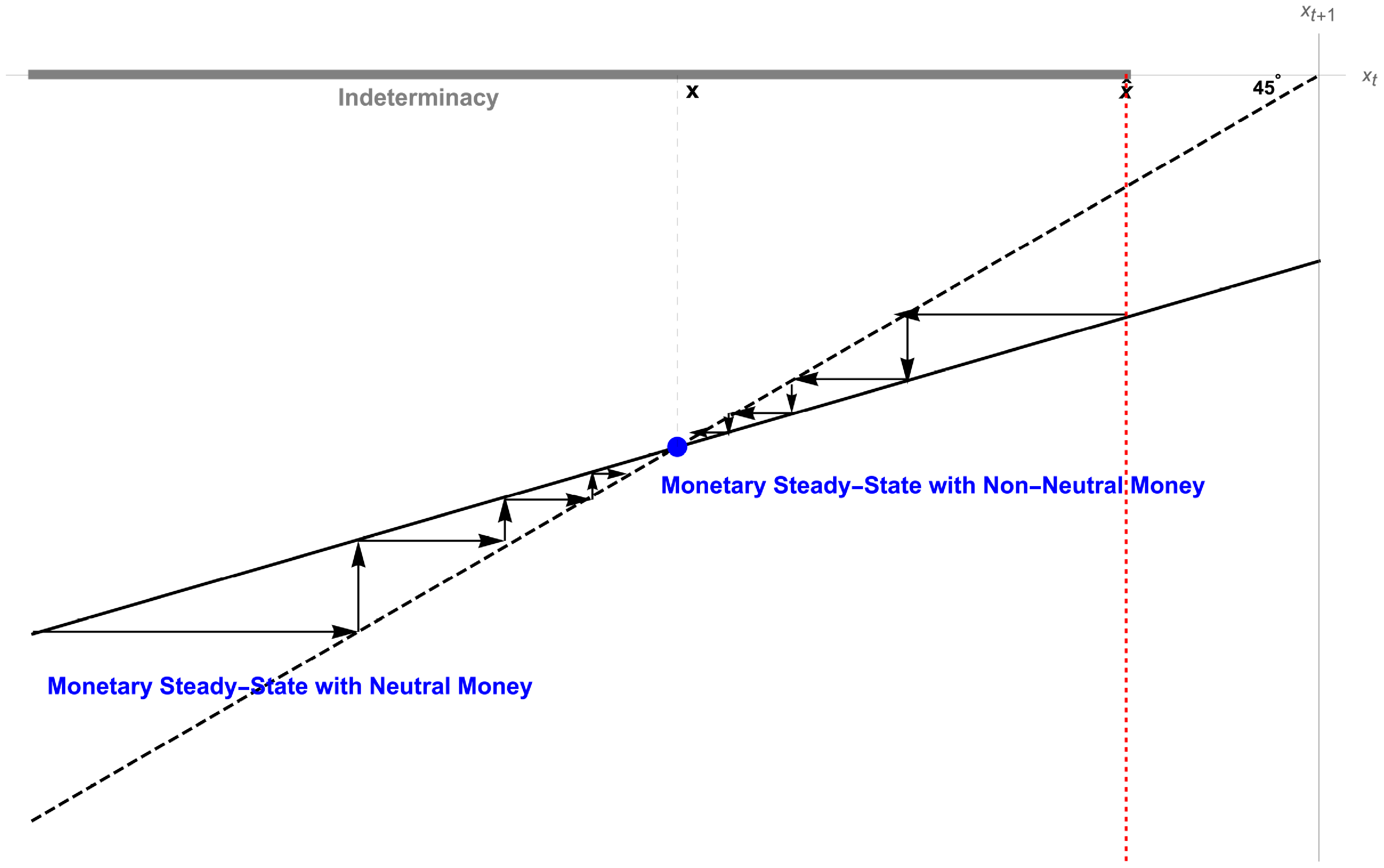
 −(1−θn1−θ+θnδ1ε)−1<μ<0



