Introduction
Louisiana is as associated with political corruption as it is with Mardi Gras and gumbo. In the 1991 Louisiana gubernatorial race, the unofficial campaign slogan for one candidate that made its way on bumpers across the state was ‘Vote for the crook. It's important’.Footnote 1 While Louisiana is consistently shown to be one of the most corrupt states in the country, how the Pelican State became so corrupt has largely not been addressed. However, corruption does not appear randomly. I argue in this paper that the underlying cause is Louisiana's historical influence in French civil law.
French civil law officially originated in 1804, though the preliminary plans had been in place since 1799, as a means to centralize authority to the administrative branch of government. This legal system was then spread during the Napoleonic Wars to French colonies. Its main distinction from common law comes from its focus on removing judicial decision-making and centralizing collective decisions to the executive and legislative branch. In such a system, previous case work cannot be the main decision criteria in rulings. A bounty of literature has related this legal influence to high levels of corruption and lackluster government effectiveness today (Djankov et al., Reference Djankov, La Porta, Lopez-de-Silanes and Shleifer2002; La Porta et al., Reference La Porta, Lopez-de-Silanes, Shleifer and Vishny1998). Overall, the goal of this paper is to show how historical influences can have persistent effects that can help us to understand why Louisiana is corrupt, has poor institutions, and overall bad outcomes.
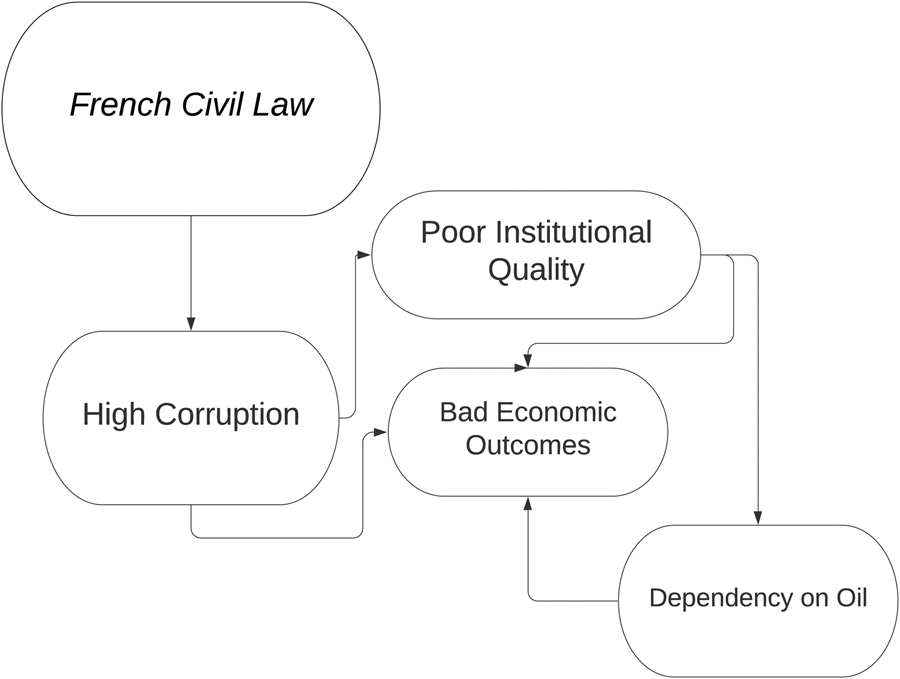
The argument put forth in this paper can be summarized in Figure 1. The historical influence that French civil law had on the state – one unlike any other state's legal system – leads to higher levels of corruption today. The high levels of corruption lead to poor economic institutions, and through those economic institutions, Louisiana is overly reliant on oil and experiences overall bad economic performance.Footnote 2
Impact of French civil law in Louisiana.

I argue that French civil law leads to corruption largely through regulation and the centralization of decision-making. For example, higher levels of regulation help explain why civil law countries tend to be corrupt (Djankov et al., Reference Djankov, La Porta, Lopez-de-Silanes and Shleifer2002). French civil law, as opposed to common law, puts a heavier emphasis on the state's role. While decision-makers in common law countries tend to limit the state's actions, political actors in civil law countries often create institutions that give power to the state (Hayek, Reference Hayek1960, Reference Hayek1973; Mahoney, Reference Mahoney2001). Mahoney (Reference Mahoney2001), for instance, found that different levels of property rights protections help explain why civil law countries have different and worse outcomes from their common law counterparts.
French civil law has roots in Roman law that were lost in the Dark Ages and then rediscovered by the Catholic Church in the 11th century. Napoleon then transported this legal structure to other territories, eventually making its way to Louisiana. Glaeser and Shleifer (Reference Glaeser and Shleifer2002) show that this choice was clearly efficient for French; similarly, the English system was efficient for England at the time of implementation. The judiciary in France during Napoleon's reign was largely men who were trained in prerevolutionary times. They did not share the same political and legal preferences as Napoleon, so the Code was formed in such a manner that decreased their political power. While this was an efficient choice for France (and thus explains why corruption in France is lower than many of its former territories), the above-cited paper makes the case that this was not nearly as efficient for areas that did not choose this system. In the case of those territories, this legal system was not an efficient response to their own legal environment. When civil law was implemented into places with already poor-performing governments, property rights were often not well-protected.
French law emphasizing the centralization of power likely helps explain why Louisiana's governors yield more political power and influence than their counterparts. This drift toward centralized power was an evolutionary process stemming from ‘three centuries of colonial experience’ (Edwards, Reference Edwards1974: 101). The power of the governorship is closely related to the historical influence and cultural attitudes unique to Louisiana. One clear example comes from a ‘veto-override veto’ that effectively gives the governor a second chance to veto a bill (Holmes 1992: 226). This ‘second veto’ comes into play due to the governor's relationship with the state's litigation tactics (through the attorney general). If a bill passed by the legislature was vetoed by the governor, he or she would still have an option to decline an appeal of an unsuccessful defense.Footnote 3
By explaining the way these mechanisms relate to each other, I am contributing to two distinct literatures. I first contribute to the literature on the impact that legal origins have on governance quality and corruption. This literature has tied French civil law origins to poor financial institutions, corrupt governments, and overall poor economic development (Djankov et al., Reference Djankov, La Porta, Lopez-de-Silanes and Shleifer2002; La Porta et al., Reference La Porta, Lopez-de-Silanes, Shleifer and Vishny1999; Merryman, Reference Merryman1996). I also contribute to the literature that discusses resource curses and its implications on economic outcomes and institutional quality. The work done in this paper fits most closely to Mehlum et al. (Reference Mehlum, Moene and Torvik2006), who show that resource dependency is bad for development conditional on low levels of institutional quality. This argument emphasizes that the mechanisms are institutions, not resource abundance.
The rest of the paper is organized as follows: section 2 provides a historical account of the Napoleonic Code and its influence on Louisiana. I also discuss the relationship between French civil law and corruption. Section 3 provides an overview of the impact corruption has on economic performance. The section later discusses the regional resource curse and makes the case that Louisiana suffers from one. I conclude with section 4, where I summarize the argument and put forth other potential research avenues.
Relationship between French civil law and corruption
Historical background
After a new regime took over the French government in 1799, its constitution needed to be rewritten. Eleven countrymen, along with Napoleon Bonaparte (the legal code's namesake), were chosen to draft the constitution. Napoleon pushed to have all power governed through the First Consul (Holtman, Reference Holtman1981: Ch 2). Others, however, wished to have three consuls: one to attend to domestic matters, one for foreign affairs, and a third whose primary role was ceremonious, essentially acting as a figurehead. This secondary plan wished for Napoleon to be the third. However, Napoleon's wishes succeeded.Footnote 4 Napoleonic Law, otherwise referred to as French civil law, was first officially established in France in 1804. Before this system was put in place, French law was mostly a set of local customs. These customs were usually privileges granted from the king, either directly or through feudal lords. Under Napoleon's rule, it took about five years for this concept of a legal system to be officially implemented by the French Consulate.
One of the major outcomes of this legal system was to provide the executive power with a centralized and sole authority over legislative decisions.Footnote 5 The legislative branch was set up in such a way where those who drew up bills were also selected by the First Consul (Holtman, Reference Holtman1981: Ch. 4). This new legal system also tended to slight the judiciary branch. Courts were not to interpret law; rather, Napoleon gave himself this authority in 1806. This move essentially eliminated jurisprudence from the French legal system (Levine, Reference Levine2005).
While other similar civil-based legal systems came before this particular one, it was the first to be adopted across Europe.Footnote 6 This was largely the result of the Napoleonic Wars. Where France conquered, this legal system was put in place. This legal code also later influenced legal systems in Latin America, the Middle East, Sub-Saharan Africa, and the Caribbean Islands (La Porta et al., Reference La Porta, Lopez-de-Silanes, Shleifer and Vishny1998). Today, 40 countries can be labeled as having a French civil law tradition (Djankov et al., Reference Djankov, La Porta, Lopez-de-Silanes and Shleifer2002). The major difference between this French civil law and English common law comes from a state of principle. Civil law cases are decided by what the law says, while common law is usually decided on how it has been interpreted in previous cases.
The French legal system can be seen as rigid and formal when compared to common law. This rigidity, in many legal scholars' views, puts civil law countries at a disadvantage to common law systems. Common law systems can adapt better to the needs of the citizenry, since bad laws can be re-litigated and removed, leading the way to more efficient outcomes (Priest, Reference Priest1977; Rubin, Reference Rubin1977). Not only can law itself be changed more easily, but the judicial system has the ruling capacity to act. Posner (Reference Posner1973) sees the judicial branch as having the right institutional arrangements that would make it more likely to adopt efficient systems than legislative and administrative rulings.
France, in the 11th to 13th century, had a high level of disorder when compared to England. This made their potential institutional arrangements less attractive than England (Djankov et al., Reference Djankov, Glaeser, La Porta, Lopez-de-Silanes and Shleifer2003). Since France was concerned with disorder at the time, they choose an institutional framework that restrained disorder, but with higher levels of dictatorship.Footnote 7 While the decision for France to adopt civil law may have been efficient, the issue comes when the same system was forced into other areas that might have had different legal preferences (Glaeser and Shleifer, Reference Glaeser and Shleifer2002). Transplanting this system into areas that did not have similar historical backgrounds like France will actually lead to inefficient protection of property rights, higher regulations, and worse performing government.
Hayek on legal origins
This paper follows the works of Hayek (Reference Hayek1960, Reference Hayek1973) and Mahoney (Reference Mahoney2001), who argue the chief difference between French civil law and English common law is the heavy emphasis that French civil law puts on the role of the state. Civil law focuses on creating institutions that strengthen the state, while common law's subsequent institutions are meant to limit the state's actions. These differences in legal systems stem from collective choices made in those countries based on divergent preferences.
Hayek (Reference Hayek1960) seeks to point out the fundamental differences between the two laws. Thinkers who focused on individual freedom, like Locke and Hume, motivated the English law. English tradition retained most of the medieval ideal of supremacy of law. On the other hand, Hobbes and Rousseau, who saw government as a means of promoting collective ends, were influencers of French law. French tradition sought to remove the beliefs of English common law and its fundamental basis of individual liberties. Here, we see the divergence between the methods in which state action takes place. Civil law puts collective rights over those of the individual, leading to more decisions being made at the administrative level.
Influenced by Hayek's historical accounts, Mahoney (Reference Mahoney2001) attests English common law developed as it did because landed aristocrats and merchants wanted a system of law that would provide strong protections for property and contract rights and limit the Crown's ability to interfere in markets. French civil law, by contrast, developed as it did because the revolutionary generation, and Napoleon after it, wished to use state power to alter property rights and attempted to ensure that judges could not interfere (p. 504–505).
Napoleon was more concerned with judges overstepping his rule, while English law feared the monarchic ruling class seizing the citizenry's property.
Despite having an English common law tradition, the American revolution inspired the French revolution. However, the French failed to achieve what the major result of the American revolution bred: a constitution with limits on legislative and executive power (Hayek, Reference Hayek1960: 292–293). The French legal system intended to make laws easy to follow, but a consequence of this led to strengthened powers of the administration. The Napoleon regime was focused on higher efficiency and power at the expense of individual liberties.
These fundamental differences in policies translated to different institutional settings where market activity could take place. Mahoney (Reference Mahoney2001) runs an empirical test comparing common law countries with civil law ones. He finds that common law countries are associated with higher incomes today. Specifically, French civil law countries grow (on average) about 0.6 percentage points less per year. Furthermore, he uses legal origin as an instrumental variable to show that property rights protections are one mechanism through which these origins affect economic outcomes, which coincide well with the historical differences.
French civil law and corruption in Louisiana
Louisiana was sold to the United States in 1803, so the state never officially was ruled by the Napoleonic law. However, some areas not controlled by Napoleon still adopted a modified version of the code (Holtman, Reference Holtman1981: Ch. 4). Louisiana was one of such cases. Nonetheless, it is incorrect to say that Louisiana's laws come directly from Napoleonic law. Spanish law heavily influenced the state as well.Footnote 8 The original Louisiana code was written in 1808 by attorneys trained in Paris, but their intended purpose was to model this code after Spanish law (de Pedro, Reference de Pedro2000). However, in 1825, Louisiana adopted a new code. This new code largely stripped the Spanish influence, thus allowing the French legal traditions to be at the forefront of this new document (Fernandez, Reference Fernandez2001). This new constitution bared a much closer resemblance to the legal system found in France itself (Holtman, Reference Holtman1981: Ch 4). The bulk of this influence impacts Louisiana's private law system. As a result, there are stark differences between private law in Louisiana and other states. In Louisiana, for instance, the judges decide cases based on his or her interpretation of the code – not from previous court's rulings.Footnote 9
This heavy influence of French civil law fundamentally impacts how Louisiana private law is practiced. Through this influence, we see more actions in the state decided at the executive level. These large bureaucratic decisions have led to an institutional environment where corruption can exist. The following subsection shows evidence that on a country-level, French legal origins have higher levels of corruption. I contend that this holds for Louisiana as well.Footnote 10
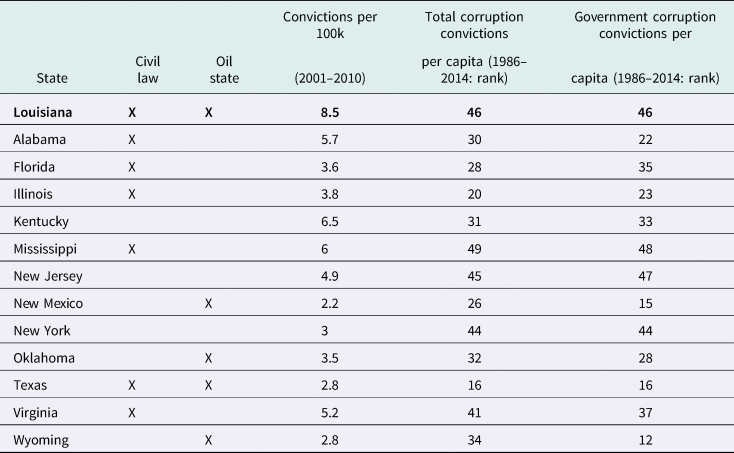
Table 1 compares three indicators of corruption for Louisiana and other states.Footnote 11 Specifically, I compare Louisiana to other states with civil law backgroundsFootnote 12 and those that are a top-10 oil-producing state. I also include three states with high levels of corruption but no background in civil law or oil. From the table, it is clear to see that Louisiana scores unique high on these corruption variables.Footnote 13 It does not appear that oil-producing states have significantly higher levels of corruption, giving credence to Mehlum et al. (Reference Mehlum, Moene and Torvik2006) findings that resource dependency harms economic activity only in areas with low institutional quality. Civil law states such as Louisiana, Alabama, Mississippi, and Virginia tend to have higher levels of corruption.
Corruption rankings by state

Determining if a state has a historical background in civil law was taken from Berkowitz and Clay (Reference Berkowitz and Clay2006). Oil state indicates if the state is a top-10 oil-producing state. This data was provided by the US Energy Information Administration. Convictions per 100k were calculated by combining data from the Justice Department's Public Integrity Section and the US Census Bureau. The rankings of the last two columns were found in Cordis and Milyo (Reference Cordis and Milyo2016). Lower rankings correspond to higher corruption.
Corruption has long had a deep influence on Louisiana. A recent, endogenous shock in Hurricane Katrina brought to the forefront some of the corrupt practices occurring in the state. Leeson and Sobel (Reference Leeson and Sobel2008), for instance, found that FEMA funding is a significant correlative with higher levels of corruption. However, there is an abundance of anecdotal instances unrelated to the storm and FEMA to showcase the deep roots that corruption has in Louisiana.Footnote 14 The entire tutelage of Huey Long and his less famous but similarly corrupt brother, Earl, encapsulates much of the political situation in the state. Governor Huey Long even sought to silence a critic shortly before his Senate bid in what was referred to as ‘the most heinous public crime in Louisiana history’ (Kolbert, Reference Kolbert2006). Another infamous governor, Edwin Edwards, spent the majority of this third gubernatorial term on trial for mail fraud and bribery. This was followed by his reelection in 1991, where he and his son were arrested for illegally selling licenses and contracts.
Louisiana's corrupt culture has become a strange source of pride amongst its citizens (Kushner, Reference Kushner2010). Such corrupt practices riddle the state's governments at all levels, not just the top. A US attorney assigned to the New Orleans area issued over 200 corruption indictments from 2005 to 2010. Jefferson Parish judges were charged with the crime of reducing bonds for cash in 2004. A school board president in New Orleans spent time in jail for accepting bribes in return for contracts. All across the state, corruption can be seen as a way of life.
While reliable quantitative data on state-level corruption does not exist for the 1800s, there are some famous historical examples that showcase Louisiana's corruption even from the beginning. Perhaps the most famous example is the Slaughterhouse Case in 1873. Four years prior, Louisiana passed a law granting a sole monopoly to the Crescent City Livestock Landing & Slaughterhouse Company in the New Orleans area. It was clear from the start that this law was riddled with corruption and controversy. Many state legislatures were found to have been offered speculative stock in return for their support on this law (Jensen, Reference Jensen2019: 23). Furthermore, Judge William H. Cooley found that New Orleans officials were bribed and the governor's signature on the bill was obtained corruptly (Barnett, Reference Barnett2016: 301). Another similar example is the Louisiana State Lottery Company, which was granted the monopoly in lotteries in 1868 after providing numerous bribes to state officials (Baker, Reference Baker1985). Note that these corruption cases occurred before the 1900s, which was when the first commercial oil company opened in the state.Footnote 15 This gives some confidence that the high levels of corruption do not come from a reliance on oil and is instead the result of the historical influence in French civil law.
The autocratic heritage that Louisiana learned from its French roots has led to the chief executive of the state taking an active political role. Such a role was not even disputed in the Constitution of 1812 (Edwards, Reference Edwards1974: 106). Historically, the governor was put in charge of appointments such as sheriffs, judges, secretary of state, and attorney general. Despite no longer appointing many of those positions, ‘only the evolutionary process has provided the appearances of change’ (Edwards, Reference Edwards1974: 108). New appointment powers include roles on various boards, agencies, and commissions that have grown with the size of the state government's activities.
Louisiana's constitutions are notoriously longFootnote 16, which has led to some potential channels of further corruption and centralization of power to the governor. Three of the state's constitutions are of particular importance for this paper: 1812, 1879, and 1913. Many of these constitutions had a few things in common – length, detail, and many amendments. The 1812 Constitution largely replicated much of the state's earlier influences of autocratic political institutions (Edwards, Reference Edwards1974). This document outlined a continuation of executive power experienced during its time as a territory. The Constitution of 1879 set a framework for future constitutions. In particular, this constitution sought to limit the powers of the governor and legislatures. However, the powers of the legislatures were cut much deeper than those of the governor, effectively leaving the functions of government to the governor (Powell, Reference Powell and Martin1954). Finally, the Constitution of 1913 is considered the ‘longest […] and by far the worst of Louisiana's many constitutions’ (Powell, Reference Powell and Martin1954: 461). Delegates were only allowed to discuss and implement changes on two matters (debt and the New Orleans Sewerage and Water Board), effectively banning any chance for reform to the executive branch of state government.
French civil law and corruption
In this paper, I argue that the history of French civil law is the driver of corruption in Louisiana. By any metric used, Louisiana seems to stand apart from other states in its high levels of corruption. Louisiana is also the only state with deep roots in French civil law that stands today. Clearly, both of these being true does not in and of itself mean that this relationship is causal. So far, I have shown that the legal system set up in Louisiana was closely related to that of Napoleon's France, especially in its passing of the 1825 constitution. Now, I seek to offer references that show the connection between corruption and having a French civil code, as well as why the foundational purposes of this legal system make it so.
As pointed out by Berkowitz and Clay (Reference Berkowitz and Clay2005), ten American states have roots in civil law legal systems. Louisiana is the only state that has officially retained that influence. However, the other nine states have some, albeit less pronounced persistent effects from that historical influence. For example, the previously cited study shows that this influence led to longer constitutions that were more detailed than their common law counterparts.Footnote 17 This constitutional length created an increase in demand for constitutional change, which led to constitutional instabilityFootnote 18 and lower court quality. The authors argue in a subsequent study that civil-law states allow less judicial independence due to the different preferences regarding the balance of power between the legislative and judicial branch (2006). Since judges can be more easily bullied by local elites and political agents in civil law traditions, one might expect higher corruption in those areas (Glaeser and Shleifer, Reference Glaeser and Shleifer2002).
Merryman (Reference Merryman1996) provides perhaps the clearest connection between French civil law, corruption, and centralization of power. The ‘French deviation’ Merryman argued in his paper is focused on the different institutions that became a part of exporting French law to other non-European colonies. While France and other countries knew the façade of the separation of powers, its later colonies did not understand the true way the legal system was practiced in France precisely because it was not written, and therefore not passed down to them. This led to major perverse effects that, in part, explain why we see so many former French colonies have broken judicial systems crippled with corruption and abuse of power.Footnote 19
In the heavily influential piece by La Porta et al. (Reference La Porta, Lopez-de-Silanes, Shleifer and Vishny1999), they find that poor government performance is strongly correlated with having a French legal origin and a high proportion of Catholics. They also find that poor governance quality is harmful to economic performance.Footnote 20 They argue that this is the case because ‘bureaucracy [in French civil law countries] was built to be powerful and largely unconstrainted’ (p. 232). French origin countries also tend to pay out higher wages to bureaucrats, but those payments do not lead to greater efficiency and effectiveness – in fact, such countries tend to have less efficient governments and be more corrupt.
The higher corruption levels in civil law countries come from the fact that they are more heavily regulated (Djankov et al., Reference Djankov, La Porta, Lopez-de-Silanes and Shleifer2002). In this piece, they argue that ‘corruption may be the price to pay for addressing market failures’ (p. 28). Through government action in market activity, they find higher levels of corruption. Those countries with higher regulations and corruption do not have better provision of either public or private goods. They claim these findings are inconsistent with the public interest view and add weight to the public choice theory of public goods provision.
French civil law areas tend to be heavily correlated with higher barriers of entry in business, stricter labor regulations, and stricter legal formalism (La Porta et al., Reference La Porta, Lopez-de-Silanes and Shleifer2008). Furthermore, since common law countries have greater legal flexibility, they are inherently better equipped to adapt to changing circumstances and preferences amongst its citizenry.Footnote 21 This legal rigidity helps explain why civil law countries tend to address social issues through government rules, while the more flexible common law countries will more likely address such issues through private contracts and litigation.
Numerous additional studies have shown strong relationships between French legal origins and bad outcomes. Each of these outcomes can be traced back to its relationship with corruption. For instance, French civil countries tend to have worse share holder protection rights (Levine, Reference Levine2005). They also have worse property rights protections than similar common law countries (Beck et al., Reference Beck, Demirgüç-Kunt and Levin2003). Financial institutions are more efficient and market-oriented in common law countries (La Porta et al., Reference La Porta, Lopez-de-Silanes, Shleifer and Vishny1997, Reference La Porta, Lopez-de-Silanes, Shleifer and Vishny1998). Even studies that find French origins to be correlated to seemingly better outcomes argue that this is the case only because of more bureaucratic methods.Footnote 22 This can be tied back to their founding principles.
French civil law was founded on the idea that higher levels of government action are needed for the state to function. The higher corruption found in these areas is simply a necessary consequence of French legal origins. Napoleon founded a system that empowered the state to be the lone source and interpreter of the law (Levine, Reference Levine2005). Political actors like judges could no longer interpret the laws, in essence banning precedent law making and further centralizing political power and decision making to the executive branch. By stripping power from the judges in decision making and giving more power to the executive branch, legal professionals were incentivized to participate in the legal process through other means. No longer were judges the brightest legal scholars in the field. Legal professionals no longer viewed judges as the most qualified to uphold the law, so giving them additional power would be irresponsible. Therefore, any subsequent proposal to give power back to the judges was met with skepticism.
In summary, the influence of the French civil law to the Louisiana law we see today greatly impacted its corruption through its concentration of political power and disregard for judicial discretion. This rigid legal structure has been unable to adapt. As later argued, this culture and general acceptance of corruption has led to quite perverse economic outcomes.
The persistence of civil law on corruption and other outcomes
This paper argues that corruption leads to poor economic institutions.Footnote 23 Poor economic institutions then cause poor economic performance and dependency on oil for economic activity. In the next two subsections, I show the link between corruption, economic institutions, and economic performance. In the final subsection, I address why Louisiana's corruption and poor economic institutions can help explain its dependency on oil.
Corruption and economic performance
Louisiana thrives on marketing its uniqueness, as well as a peculiar pride in its historical culture of corruption. Only a few decades ago, Louisiana had three consecutive insurance commissioners convicted for fraud and official misdeeds. It is the only state that ranks in the top 10 in three categories of corruption: survey of journalists, guilty per capita, and number of officials found guilty (Jurkiewicz, Reference Jurkiewicz2009). We might expect corruption to have a bidirectional impact on economic institutions, but corruption might be prevalent because the economic institutions in place do not allow for productive economic activity.Footnote 24
Corruption, defined as the misuse of public office for private gain, is not conducive to economic growth internationally and holds true across states as well (Alt and Lassen, Reference Alt and Lassen2003; Serra, Reference Serra2006; Treisman, Reference Treisman2000). Corruption tends to be bidirectionally and causally related to income inequality (Apergis et al., Reference Apergis, Dincer and Payne2010; Dincer and Gunalp, Reference Dincer and Gunalp2012). The former study shows that Louisiana appears in both the top five of corruption and income inequality measures within states. Johnson et al. (Reference Johnson, LaFountain and Yamarik2011) find that corruption also lowers growth and investment across states. Johnson et al. (Reference Johnson, Ruger, Sorens and Yamarik2014) show that in states with high regulations, corruption harms economic development. However, in states with low levels of regulation, corruption is an insignificant factor in determining growth. Akai et al. (Reference Akai, Horiuchi and Sakata2005) look at the time horizon effect that corruption has on economic growth. Their main findings show causal evidence of corruption hurting in the long run, but corruption has insignificant effects in the short term.
An abundance of studies exists connecting larger government power and spending with higher levels of political corruption. Fisman and Gatti (Reference Fisman and Gatti2002) find that more federal transfers correlate with future corruption rates. Goel and Nelson (Reference Goel and Nelson1998) empirically show a positive relationship between government size and corruption. The most well-cited piece on this topic, Glaeser and Saks (Reference Glaeser and Saks2006) show that corruption occurs most prevalent in poorly educated states with high income inequality. Furthermore, they find some evidence of corruption levels impacting economic development.
Poor institutional quality can oftentimes be a result of a corrupt political environment. Through poor institutional quality, we find bad economic outcomes.Footnote 25 The next subsection points out that Louisiana has bad institutional quality, measured by four different indices. Through these bad institutions, we notice restrictive opportunities for employment and low levels of productive entrepreneurship.
Louisiana's institutional quality
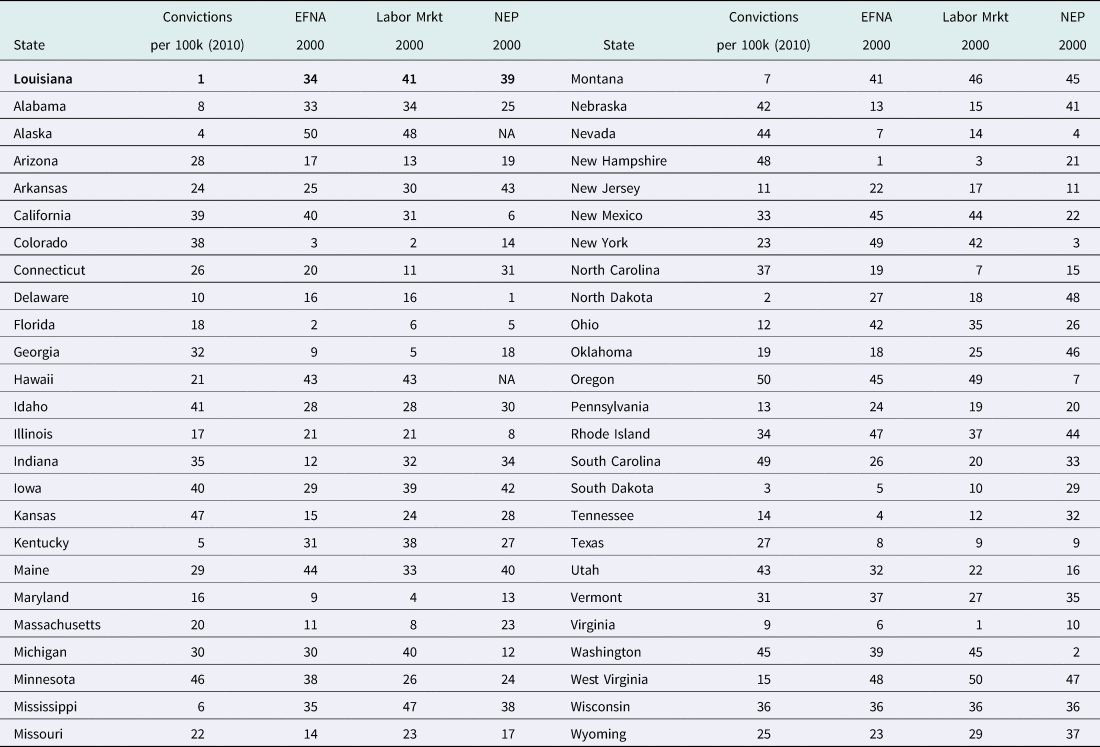
When it comes to economic freedom, as measured by Stansel et al. (Reference Stansel, Torra and McMahon2019), Louisiana fairs poorly when compared to similar states. In 1990, 2000, and 2017, Louisiana ranked 34th, 35th, and 26th, respectively. Other Gulf South states fared much better. Texas and Florida ranked consistently in the top 10 in all three years. Alabama (17th, 31st, 35th) ranks marginally better than Louisiana in two of the three periods. Mississippi (30th, 39th, 42nd), though, ranks fairly worse in the latter two periods. Louisiana also fairs poorly next to an oil-dependent state like North Dakota, who has steadily increased their ranking in those same time periods (37th, 25th, and 12th). However, Murphy (Reference Murphy2020) points out the EFNA index does not address differences in legal system and property rights between states. After constructing a new index that tackles these differences, Louisiana's rank plummets to 38th.
One of the more direct ways poor economic institutions appear is through burdensome regulations that make market activity difficult. The Institute for Justice publishes a ‘License to Work’ study that compares the harshness of each state's occupational licensing laws (Carpenter et al., Reference Carpenter, Knepper, Sweetland and McDonald2017). They find that Louisiana requires licenses for more low-income jobs than any other state (71 out of 102 occupations). For instance, they are the only state that requires a license to become a florist and are one of only a few states that require licensing for professions like home entertainment installer, interior designer, shampooer, and tree trimmers. Overall, they have the eighth most burdensome licensing laws. These burdensome licensing laws are likely the result of a politically corrupt environment that is quite conducive for rent-seeking and generally unproductive activities.
If a state's citizenry is succumbed to heavy regulation, then many will turn their entrepreneurial efforts to unproductive, rent-seeking manners. Sobel (Reference Sobel2008) calculates an index of ‘net entrepreneurial productivity’ that measures the difference in a state's productive and unproductive entrepreneurship. Productive entrepreneurship is measured using indicators such as venture capital, patents, establishment birth rates, and sole proprietorship growth. Unproductive entrepreneurship is measured with variables such as number of lobbying organizations and judicial practices. This index supposedly measures the amount of productive entrepreneurship that drives economic growth. Out of the 48 continental states, Louisiana ranked 39th. Each Gulf Coast state ranked better. Florida was 5th, Texas 9th, Alabama 25th, and Mississippi was 38th.
Thus far, I have argued that through the persistent effects of legal origins in civil law, corruption harms economic institutions, which consequently harms economic performance. Another consequence between corruption and economic institutions is the lack of alternative opportunities beyond those naturally endowed. In the next subsection, I argue that Louisiana suffers from a regional resource curse that is inflated due to their poor institutions.
Regional resource curse and oil dependency
A resource curse refers to the phenomenon in which areas with an abundance of natural resources tend to have poor economic and political outcomes. Sachs and Warner have written a series of influential studies on the topic. They find that higher levels of natural resource exports tend to correlate to lower growth (Reference Sachs and Warner1995). Specifically in Latin America, they show that booms in natural resources are sometimes followed by declining incomes (Reference Sachs and Warner1999). Sachs and Warner (Reference Sachs and Warner2001) extend their previous studies and find that this resource curse holds and is quite robust to the inclusion of other potential confounding factors such as geography and climate. Others have attempted to follow their work. Mehlum et al. (Reference Mehlum, Moene and Torvik2006), for example, challenge the previous findings. Their findings suggest that institutional quality is the main driver between whether a country experiences negative effects from an abundance of resources. The theory behind these results suggests that poor institutions lead to rent-seeking behavior that negates the gains from resource endowments. Others have argued the causality runs in the opposite direction, meaning that resource richness is the driver of poor institutions (Acemoglu et al., Reference Acemoglu, Johnson, Robinson and Thaicharoen2003; Collier, Reference Collier2010; Isham et al., Reference Isham, Woolcock, Pritchett and Bushby2005).
Some studies have focused particularly on oil and its implications on growth and institutional quality. Arezki and Bruckner (Reference Arezki and Bruckner2011) find that increases in oil rents are associated with higher corruption, lower political rights, and worse civil liberties. They follow the work of Karl (Reference Karl and Cleveland2004), who argued that oil-dependent areas have poor governance quality and a culture of rent-seeking. Brooks and Kurtz (Reference Brooks and Kurtz2016), on the other hand, challenge these findings and show that resource endogeneity determines democratic outcomes.
While there is no consensus, there is some heavy evidence that under certain circumstances, we find a resource curse. The next question asked in the literature addressed if this resource curse holds within the United States, a much more homogenous group. Papyrakis and Gerlagh (Reference Papyrakis and Gerlagh2007) find that there is some evidence of a regional resource curse. Natural resource abundance had a negative effect on growth, as well as a negative relationship with education and investment. Abundance was also positively correlated with corruption. James and Aadland (Reference James and Aadland2011) corroborate these findings and show that their results suggest drastic differences in the standards of living to future generations.Footnote 26
The oil and gas industry contributed, directly and indirectly, about $72.8 billion to the state's economy in 2018 (Scott, Reference Scott2018: iii). Considering Louisiana's total GDP in 2018 was $251.1 billion, it is clear that Louisiana is heavily dependent on oil as a source of economic activity in the state. Port Fourchon – a hub for oil in southeast Louisiana – for instance, services around 90% of the drilling sites (p. 48). While Louisiana is fortunate to have this geographic and natural resource advantage, the health of its economy is heavily based on the health of the oil industry.
The previously cited Scott (Reference Scott2018) report shows that Louisiana produces the second most oil of any state in the country, only behind Texas. So why is it that Louisiana suffers from a regional resource curse, yet Texas is one of the richest states in the union? I argue this is because it is not oil dependency that makes Louisiana poor; instead, corruption leads to poor institutional quality and, through this mechanism, causes Louisiana to be heavily dependent on oil. Texas is an example of a state that has a high-resource abundance but is less dependent due to its high economic institutional quality. Texas has one of the highest EFNA scores, a top-10 net entrepreneurial productivity index, and requires licenses for only 34 of 102 lower-income occupations.Footnote 27 Texas provides its citizens with alternative opportunities, while Louisiana's environment is such that it necessarily must be dependent on oil.
Given the conflicting research on the resource curse and corruption, it could be the case that Louisiana is corrupt because of its reliance on oil and not Civil Law. Simply put, Figure 1 might have arrows pointing in the wrong direction. To make matters more complicated, the oil industry started in Louisiana at the turn of the 20th century. This makes parsing out the civil law versus oil argument difficult due to the lack of available corruption data in that time period. However, if we refer back to Table 1, we find some evidence against this point. When comparing Louisiana to the other large oil-producing states, there is a stark contrast. What seems to be more prevalent is the background in civil law. In this table, civil law states average (excluding Louisiana) 4.5 convictions per 100,000, while oil-producing states only average 2.8 convictions per 100,000.
Civil law was an efficient institutional outcome for France, but this legal system was likely not efficient for areas where France transported its legal institutions. This might explain the resource curse in Louisiana. Louisiana was essentially forced into a legal system that it did not choose. Civil law tends to concentrate power to a centralized government. In France, this was chosen as a tradeoff in favor of dictatorship as a means of lowering disorder (Djankov et al., Reference Djankov, Glaeser, La Porta, Lopez-de-Silanes and Shleifer2003). What this means for Louisiana, and other transplant areas more generally, is that centralized control leads to ineffective governance and corruption. Through corruption, more authoritarian regimes were able to take advantage of their resource abundance. This abundance was good for those in power, yet lowered opportunities for the economy as a whole to invest and produce in alternative industries.
Goldberg et al. (Reference Goldberg, Wibbels and Mvukiyehe2008) examine Louisiana as being the ‘perfect case’ if one wants to ‘make a case that petroleum rents can fuel an authoritarian regime even in the United States’ (p. 503). In Louisiana, brothers Earl and Huey Long were able to use this dependency on oil for its populist policies. Huey Long, the 40th and perhaps most notable governor of Louisiana, admits in his autobiography that he used his ownership in oil companies to influence and regulate the industry (Long Reference Long1964). Specifically, he would control the prices and volume of oil pumped into the state. These sorts of corrupt practices were long accepted in the state, but the Long brothers have become the poster boys for corruption in Louisiana.
Conclusion
Louisiana is corrupt, has low quality of economic institutions, and relatively poor. Other studies have found a relationship between these variables. What has been less discussed is why Louisiana became so corrupt in the first place. Much work has found that a country with historical ties to French civil code has higher corruption, poor governance quality, and overall poorer economy. However, Louisiana is a unique case of a state that has a legal system tied to French civil origins that is unlike any other state in the United States. I make the point that this French legal influence on the state has had a similar effect on corruption as the countries with this legal origin have. Through the relationship between corruption and French legal origins, we can better understand why Louisiana has poor economic institutions, a reliance on oil, and overall bad outcomes. This relationship also shines a light on why the lackluster recovery after Hurricane Katrina should have been no surprise.
A litany of work has already shown that Louisiana had a poor recovery after Hurricane Katrina (Congleton, Reference Congleton2006; Leeson and Sobel, Reference Leeson and Sobel2008; Shughart, Reference Shughart2006; Sobel and Leeson, Reference Sobel and Leeson2006). This is likely due to the fact that corrupt states fail to provide public goods. As the spread of COVID-19 continues to rise throughout the world, further research could highlight how Louisiana was able to handle this pandemic and if the relationship between civil law, corruption, and poor economic institutions had anything to do with their recovery.
As pointed out by La Porta et al. (Reference La Porta, Lopez-de-Silanes, Shleifer and Vishny1999), both French legal origin and a high proportion of Catholics correlated to worse government performance. This finding reveals a potential alternative explanation. It is possible that the Catholic Church's influence might explain the high levels of corruption in Louisiana, especially given its hierarchical structure that could lead to corruption. The empirical literature on this relationship is mixed. While La Porta et al. (Reference La Porta, Lopez-de-Silanes, Shleifer and Vishny1999) found that higher proportions of Catholics in a country correlate to higher levels of corruption, the results are not robust once controlling for some basic factors such as GDP per capita. Shadabi (Reference Shadabi2013) finds no significant effect of religion on corruption. North et al. (Reference North, Orman and Gwin2013) show that rule of law is actually higher in places where the largest religious groups are either Protestant, Catholic, or Hindu. While some evidence has found that Catholicism might be correlated to higher levels of corruption, the relationship between civil law and corruption seems to be more robust. Similarly, within the United States, there seems to be no overarching evidence that higher proportions of Catholics have more corruption. According to a 2014 Pew Research Study, there are 13 states with 25% or more Catholics.Footnote 28 Of those 13 states, six are in the top half of rankings of corruption according to Cordis and Milyo (Reference Cordis and Milyo2016), while seven are in the bottom half of corruption, where lower rankings of corruption correspond to more corruption.
Glaeser and Shleifer (Reference Glaeser and Shleifer2002) point to three potential avenues as to why civil law, one of them, being related to a country's predisposition to Catholicism. However, they show that this argument ignores all countries in Europe during the 11th and 12th centuries were heavily Catholic yet many chose secular legal systems. This further points against Catholicism being the direct catalyst of corruption.Footnote 29
It is important to note that this paper has simply pointed to legal origins as a potential mechanism to explain the economic and political outcomes in Louisiana. Legal origins, through its centralization of political power, provide opportunities for corruption, as well as stifles opportunities to fight corruption. This paper suggests that this relationship could be causal, yet nevertheless it is difficult to claim true causation without a robust empirical analysis. More work can be done to provide an empirical, causal link between legal origins, corruption, and various outcomes.
Using three distinct metrics used to measure corruption, Louisiana is the only state to appear in the top 10 every time (Jurkiewicz, Reference Jurkiewicz2009). While this makes clear the distinct position Louisiana is in, it does not address why other states are corrupt. Further research could look more closely into the different ways other highly corrupt states became corrupt.
Appendix
Corruption, economic freedom, regulation, and entrepreneurship rankings by state