1. Introduction
Bivalves do not rival the spectacular, excellently preserved fossils known from the Lower Cretaceous lake deposits of western Liaoning (Jehol Biota) and from the Jurassic Daohugou Fossil Beds of Inner Mongolia (e.g. Chang et al. Reference Chang, Chen, Wang, Wang and Miao2003; Wang et al. Reference Wang, Zhou, He, Jin, Wang, Zhang, Wang, Xu and Zhang2005; Huang, Reference Huang2014; Sullivan et al. Reference Sullivan, Wang, Hone, Wang, Xu and Zhang2014). In fact, their preservation in the well-laminated sediments is usually quite poor, and for this reason they have received little attention in the past, apart from records of their presence and taxonomic affiliation (Jiang, Reference Jiang2006; Duan et al. Reference Duan, Zheng, Hu, Zhang and Wang2009). Bivalves occur abundantly at the base of the Lower Cretaceous Yixian Formation in marginal lacustrine deposits where they were reworked and concentrated by high-energy events (Li et al. Reference Li, Sha, Wang and Chen2007; Pan, Sha & Yao, Reference Pan, Sha, Fürsich, Wang, Zhang and Yao2012). The present paper deals with their comparatively rare occurrence in finely laminated offshore sediments, that is, in the facies characterized by the exceptional preservation of vertebrate fossils.
Apart from their significance for the evolution of several major clades such as birds and angiosperms and for the reconstruction of both the lacustrine and terrestrial ecosystems surrounding the lakes, the exceptionally preserved fossils are ideal objects for deciphering the processes that led to their preservation. The poor state of preservation of the bivalves (and this is also true of other elements with a calcareous shell, i.e. gastropods and ostracods) seems to have little to offer in this respect. However, as will be shown below, the reconstruction of their taphonomic pathways substantially adds to our knowledge of the physico-chemical conditions of the lake waters and of the diagenetic environment. This way, the taphonomic analysis of the bivalves also contributes to our understanding of the taphonomic processes that were responsible for the excellent preservation of many other groups of organisms living in these lakes.
2. Material and methods
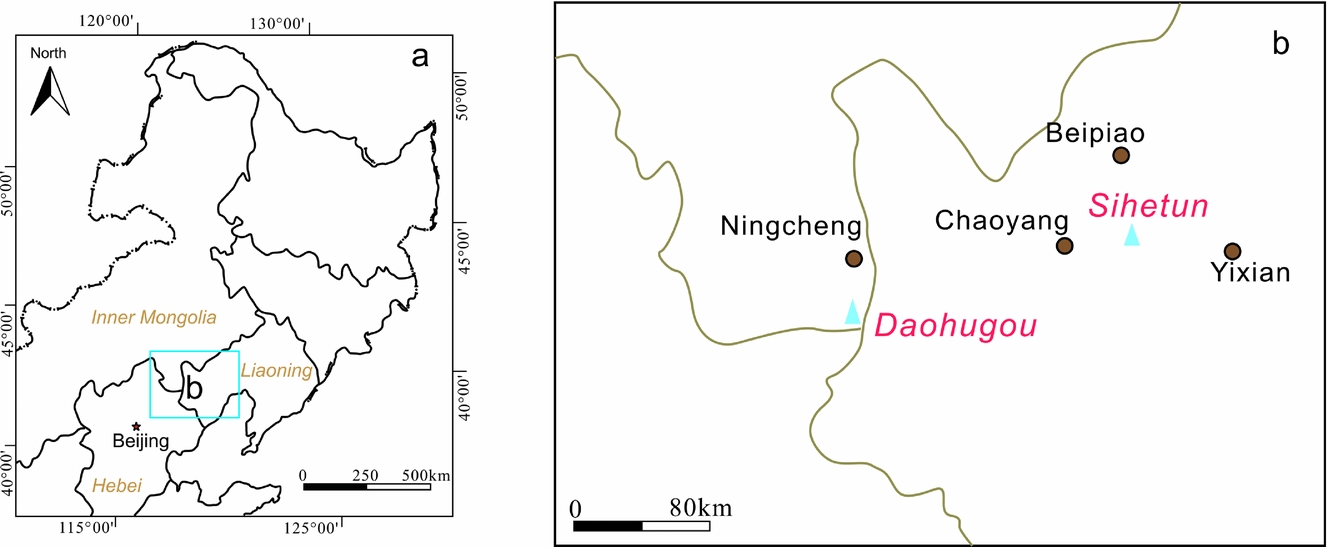
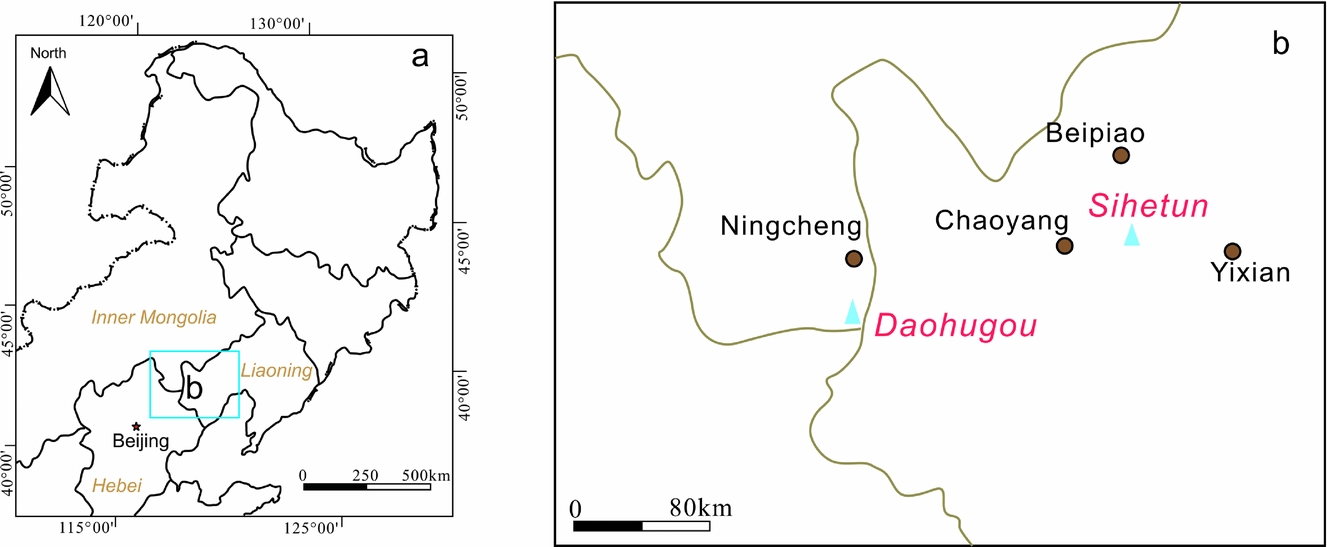
From the Jurassic Daohugou Fossil Beds, 40 small slabs (NIGP160867–160905) were available for study, each containing a bivalve, or rarely two or more specimens (maximum four). The slabs range from 0.5–1.5cm in thickness and have a surface area between 10 and 50cm2. The material comes from several localities near the village of Daohugou situated in the easternmost part of Inner Mongolia (Fig. 1; 41°19′N; 119°14′E). As all the material was acquired from farmers, the up–down orientation of the slabs is unknown. From the Lower Cretaceous Yixian Formation, approximately 120 bivalves (NIGP160906–160964) were investigated. The material comes partly from two excavations in the Sihetun area (Erdaogou: 41°31.942′N, 120°47.747′N; Zhangjiagou: 41°36′13.3″N, 120°49′28.7″E) (Fig. 1) and partly from scree. As in the Daohugou material, original up–down orientation is in most cases unknown.
Map of northeastern China with position of the Daohugou area of Inner Mongolia, and the Sihetun area of western Liaoning.
The material was cleaned, prepared where necessary and, as a first step, it was observed under the binocular microscope. This step led to recognition of several preservation types. The uncoated examples of each type were then investigated under the scanning electron microscope (SEM Leo1530VP) with a Variable Pressure Secondary Electron (VPSE) Detector. An energy dispersive X-ray spectrometer (EDS) was used for selected point analysis of elemental compositions. All EDS data of the uncoated samples were collected at 20 keV accelerating voltage, at a working distance of 10mm and for 120 seconds.
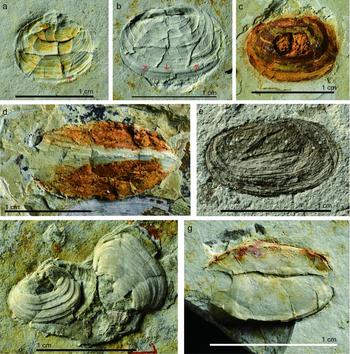
The Jurassic bivalves belong to Ferganoconcha sibirica Chernyshev (Fig. 2e) and recently have been described by Jiang (Reference Jiang2006); the Lower Cretaceous ones belong to Arguniella ventricosa Martinson (Fig. 2b, c, g) and Sphaerium anderssoni Grabau (Fig. 2a, f).
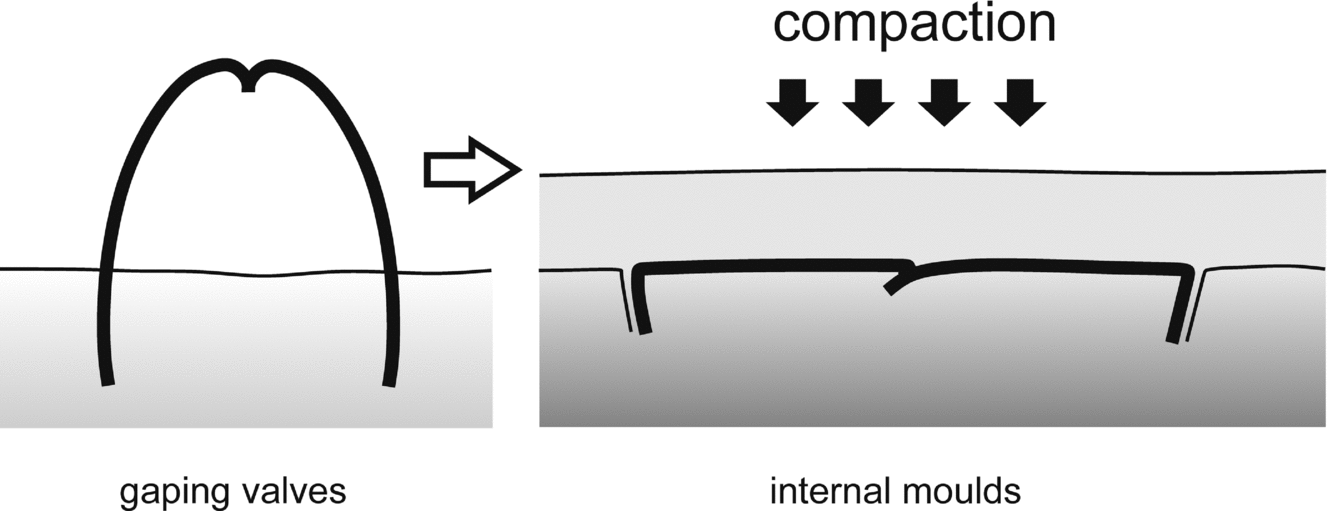
Modes of preservation of bivalves from the Jurassic Daohugou Fossil Beds and the Lower Cretaceous Yixian Formation of northern China. Scale: 1cm. (a) External mould of articulated Sphaerium anderssoni. The intensive in situ fragmentation indicates the presence of shell material at the time of compaction. Sihetun area; NIGP 160907. (b) External mould of articulated Arguniella ventricosa with compactional fractures. The smooth ventral part is the cast of the internal surface of the upper valve, whereas the remaining fossil is the cast of the external surface with growth lines of the lower valve. The boundary between the two valves is arrowed. Sihetun area; NIGP 160908. (c) Ferruginous internal mould of articulated Arguniella ventricosa. The original pyritic steinkern has been changed into iron hydroxide during late diagenesis/weathering. Sihetun area; NIGP 160909. (d) Articulated Arguniella or Sphaerium preserved in growth position (ventral view). The originally aragonitic shell has been replaced by pyrite, which during late diagenesis/weathering has been oxidized to iron hydroxides (see also Fig. 9). Sihetun area; NIGP 160910. (e) Strongly compacted articulated composite moulds of Ferganoconcha sibirica. Note the lack of compaction-induced radial fractures, a sign that the shell had been dissolved at the time of compaction. Daohugou area; NIGP 160874. (f) Compacted Sphaerium anderssoni; aragonitic shell replaced by silica. Note the compaction-induced radial fractures near the ventral margin. Erdaogou, Sihetun area; NIGP 160912. (g) Articulated internal mould of Arguniella ventricosa in partial butterfly position (see Fig. 5 for explanation of the peculiar preservation caused by strong compaction of partially opened valves oriented with the plane of commissure at right angles to the bedding plane). (a–d, f, g) Lower Cretaceous Yixian Formation; (e) Jurassic Daohugou Fossil Beds.

3. Sedimentary and biostratinomic features
As the biostratinomy of the bivalves will be treated elsewhere, the main results are briefly summarized here.
3.a. Yixian Formation
The Yixian Formation of western Liaoning is composed of lacustrine deposits with interbedded volcanic rocks and has been explained as the fill of a lake created by volcanic processes (Jiang et al. Reference Jiang, Fürsich, Sha, Wang and Niu2011) called Lake Sihetun by Pan et al. (Reference Pan, Sha, Fürsich, Wang, Zhang and Yao2012). The bivalves studied occur on smooth bedding planes of silty clay and argillaceous silt of volcanic origin, laminated on a sub-millimetric scale. This facies has been interpreted as representing lake-floor sediments originating from turbidity currents and suspension-fallout (Jiang, Fürsich & Hethke, Reference Jiang, Fürsich and Hethke2012). The lamination, consisting of several-tens-of-micron-thick clay–silt couplets (Hethke et al. Reference Hethke, Fürsich, Jiang and Klaus2013a , Reference Hethke, Fürsich, Jiang and Pan b ), is undisturbed showing no evidence of any organisms such as bivalves moving on or within the sediment. Intercalations of sub-millimetric to centimetric tuff layers are common. These tuffs are made up mainly of varying amounts of Na–Ca silicates and rock fragments, with biotite being a common accessory mineral in some layers (Hethke et al. Reference Hethke, Fürsich, Jiang and Pan2013b ).
Nearly all bivalves are preserved with their commissure concordant to bedding and most are articulated. On some bedding planes, the butterfly position is common. Rarely, articulated bivalves occur in a vertical position, i.e. with their commissure normal to the bedding plane (Fig. 2d). Fürsich et al. (Reference Fürsich, Sha, Jiang and Pan2007) regarded the bivalves as autochthonous based on the preferredly articulated valves, but here they are regarded more likely as allochthonous. They could have been transported in suspension from the lake shores to more central areas during storm events. The rare vertically embedded ones probably were still alive when reaching their final destination but died soon after.
3.b. Daohugou Fossil Beds
The bivalves come from the Daohugou area, Ningcheng county, of Inner Mongolia but their position within the succession is unknown. So far, no analysis of the Daohugou Fossil Beds providing sedimentological and taphonomic information has been carried out. The bivalves occur on centimetre-thick slabs of argillaceous siltstones to fine-sandy tuff that exhibit no or only faint signs of lamination, but commonly grading. The coarser-grained slabs exhibit fairly rough bedding planes. Benthic elements are rarely associated with the bivalves, but remains of insects are common and millimetre- to centimetre-sized plant fragments, often showing preferred orientation, are abundant. On some slabs, however, abundant individuals of the spinicaudatan Euestheria co-occur with the bivalves (Jiang, Reference Hethke, Fürsich, Jiang and Klaus2006). The sedimentation rate appears to have been considerably higher than in the case of the lake-floor sediments of the Yixian Formation.
All the bivalves are arranged with their commissure parallel to bedding. They are invariably articulated, although no calcareous shells are preserved. Instead, the external moulds of the two valves with remains of the organic periostracum are superimposed and often contorted. In most cases a thin layer of fine-grained internal sediment and veneers of clay minerals separate the two external moulds. Butterfly preservation is rare. Altogether, the style of preservation is fairly uniform. Most likely, the bivalves were transported to their burial site by hyperpycnal flows. This is corroborated by the fact that some occur at or near the base of thin graded beds.
4. Fossil diagenesis
Even though final burial of the shells in the Yixian Formation was, as a rule, not instantaneous, any shells must have soon been covered with a thin layer of sediment, at some levels probably in connection with a microbial film according to the model of rainfall events supplying fine-grained sediment to offshore lake areas (Fürsich et al. Reference Fürsich, Sha, Jiang and Pan2007; Hethke et al. Reference Hethke, Fürsich, Jiang and Pan2013b ). After the shells became buried they experienced a similar diagenetic history, minor differences in their diagenetic pathway being apparently related to slightly differing starting conditions and/or reflecting minor fluctuations in the diagenetic regime of the lake system.
In the Daohugou Fossil Beds, in contrast, burial of bivalve shells appears to have been faster, taking place in connection with high-density currents, and all bivalves followed the same diagenetic pathway.
Altogether, the bivalves from both formations represent the following five preservational types: (a) strongly compressed external moulds of articulated valves (e.g. Fig. 2a, b, e); (b) ferruginous internal moulds (steinkerns), usually in combination with non-ferruginous external moulds (e.g. Fig. 2c); (c) shells replaced by iron oxides and iron hydroxides (e.g. Fig. 2d); (d) internal moulds of single valves; (e) shells preserved in silica (e.g. Fig. 2f).
4.a. Shell microstructure of modern relatives
The bivalves Arguniella ventricosa (Kolesnikov), Ferganoconcha sibirica Chernyshev and Sphaerium anderssoni (Grabau) all belong to the superfamily Sphaerioidea of the order Venerida (Bieler, Carter & Coen, Reference Bieler, Carter and Coen2010). Their shell was originally composed of aragonite and covered by an organic periostracum.
In order to evaluate the various diagenetic changes displayed by the bivalves, some knowledge of their shell microstructure is a prerequisite. For this purpose, the microstructure of a modern relative, Sphaerium lacustre (Mueller), family Sphaeriidae, common in lakes of present-day China, has been investigated. The microstructure of the bivalves Arguniella ventricosa from the Lower Cretaceous and Ferganoconcha sibirica from the Jurassic, both belonging to the family Ferganoconchidae, is thought to have been similar.
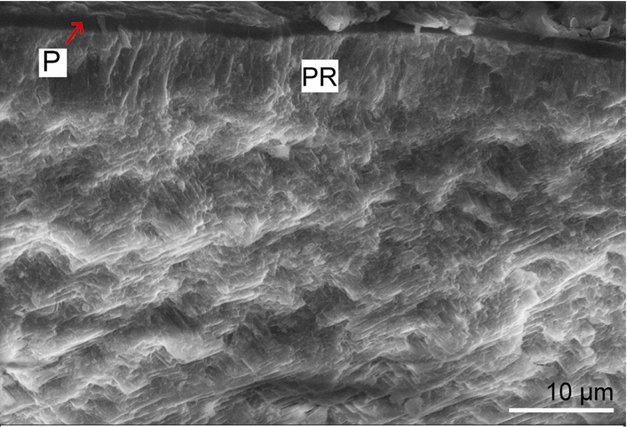
The shell of the modern aragonitic Sphaerium lacustre is very thin (50μm), the dense, structureless periostracum being just 1.3μm thick. The shell microstructure consists of a 6 to 7μm thick irregular simple prismatic outer layer (terminology after Carter, Reference Carter and Carter1990), underlain by a 40 to 45μm thick crossed-lamellar layer (Fig. 3). Traces of the latter are commonly encountered in shells from the Yixian Formation. Arguniella and Ferganoconcha originally had been placed in the order Unionoida (e.g. Cox, Reference Cox and Moore1969; Jiang, Reference Jiang2006) and as such should have had a prismatic outer layer underlain by a much thicker sheet nacreous layer. In none of the fossils was any trace of a nacreous layer seen, instead occasionally traces of a crossed-lamellar microstructure, confirming the placement of these bivalves in Venerida rather than Unionoida.
Microstructure of the shell of modern Sphaerium lacustre (Mueller) from Yunnan, southern China. The very thin, structureless periostracum (P) is underlain by a thin simple prismatic outer layer (PR). The bulk of the shell consists of crossed-lamellar aragonite.

4.b. Mechanical compaction
All the bivalve shells occurring in the finely laminated sediments of the Yixian Formation have been affected by mechanical compaction to various degrees. Quite commonly, the bivalves are completely flattened, regardless of whether they are preserved with or without a shell. As a result, they exhibit radial fractures. Depending on the degree of compaction, these fractures are developed only near the ventral margin (Fig. 2f) or extend further into the shell and in extreme cases led to in situ fragmentation of the valves (Fig. 2a). Such fractures are also seen in bivalves preserved as articulated external moulds. The fractures are invariably filled with sediment, except in the case of minute fractures, which are preserved as thin vertical sheets of silica. The ubiquitous fracturing of the bivalve shells indicates that in the Yixian Formation compaction invariably pre-dated final dissolution of the shell material.
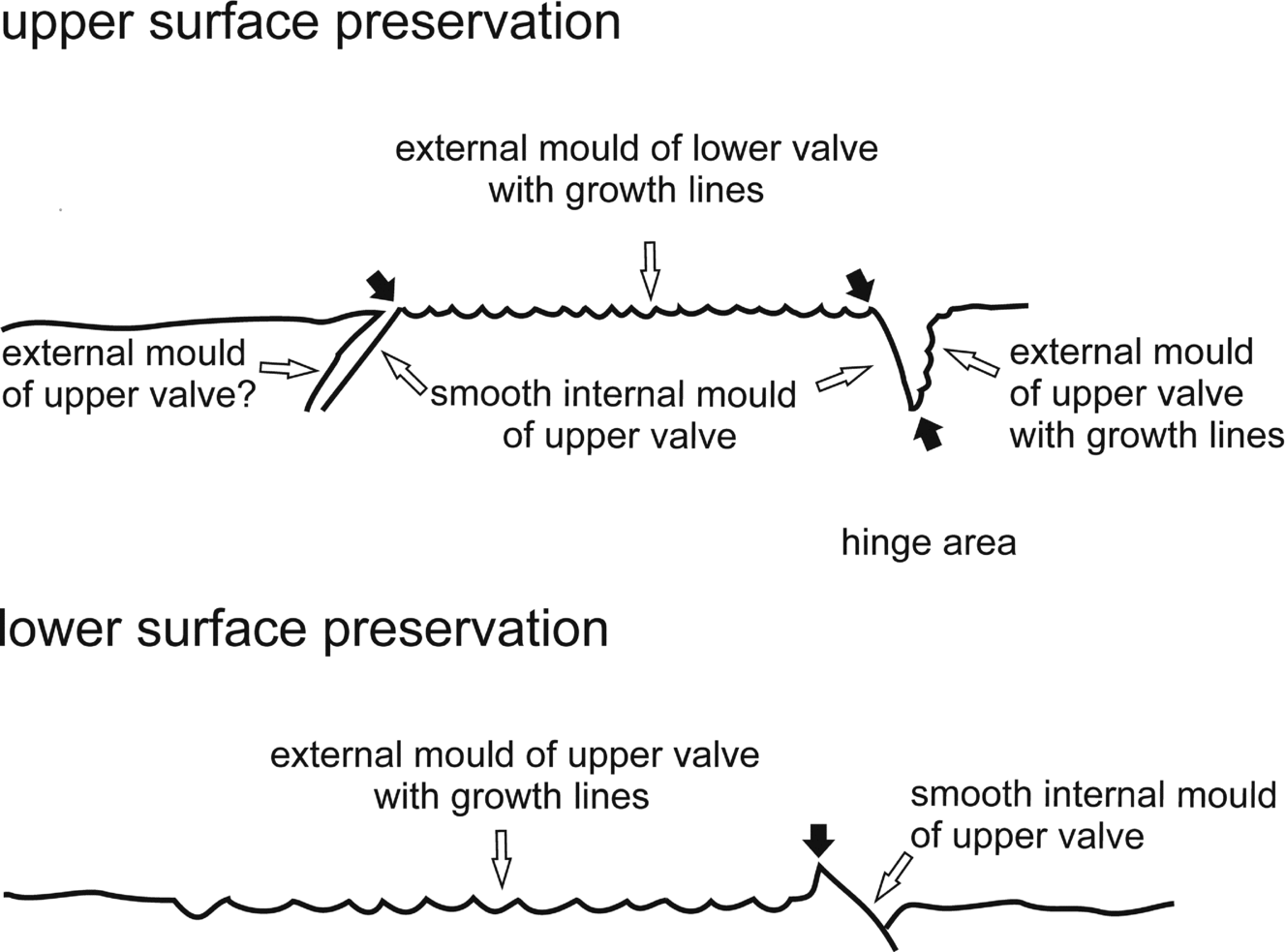
The mouldic preservation of the shells commonly exhibits a peculiar pattern produced by extreme compaction in connection with dissolution of the shell (Fig. 2a, b). The flat or somewhat undulating surface is covered with fine concentric lines corresponding to commarginal growth lines and thus clearly constitutes an external mould. Close to the ventral and the dorsal margin there is a distinct kink (arrowed in Fig. 2a, b). Ventrally of the former kink a smooth cast extends for some distance into the sediment, from which it is separated by a narrow gap. Likewise, dorsally of the dorsal kink a smooth surface extends obliquely into the sediment, again separated by a gap from the undisturbed sediment. The outer wall of this gap clearly exhibits imprints of growth lines. This preservation suggests that we are dealing with an articulated, strongly compacted valve where segments of the smooth inner and serrated outer surface of the two valves are preserved on the bedding plane (Fig. 4). In the case of articulated valves, parts of the smooth internal mould of one valve and parts of the external mould with growth lines of the other valve are preserved. The dorsal furrow may be quite wide in some specimens as it not only represents the void of the dissolved dorsal shell, but also of the thick hinge area. This feature allows us to deduce that we are dealing with an upper bedding plane, whereas on the corresponding undersurface a positive feature (ridge) exists close to the dorsal margin (Fig. 5). There are numerous minor modifications of this common mode of bivalve preservation.
Preservation of articulated bivalves as strongly compacted moulds. Smooth surfaces are moulds of the inner surface of valves, whereas surfaces depicting the growth line pattern are casts of the outer surface. The strong compaction fused segments of the two types of surfaces, separated by distinct kinks.

Model explaining compaction-induced butterfly position of bivalves (e.g. Fig. 2g). Necessary for this preservation is the vertical orientation of the bivalve with the valves gaping.

In the case of the Jurassic bivalve Ferganoconcha, which occurs as a rare element in the thinly bedded lacustrine sediments of the Daohugou Fossil Beds, the situation is quite different: Although all 40 specimens available for study are strongly compacted, preserved as superimposed articulated external moulds or arranged parallel to bedding but occasionally also somewhat contorted and wrinkled, none of them shows signs of radial shell fractures (Fig. 2e). This indicates that, in contrast to the Lower Cretaceous bivalves, dissolution of the shell carbonate occurred before compaction affected the remainder of the valves, the organic periostracum.
4.c. Chemical changes
4.c.1. Replacement of shell carbonate by silica
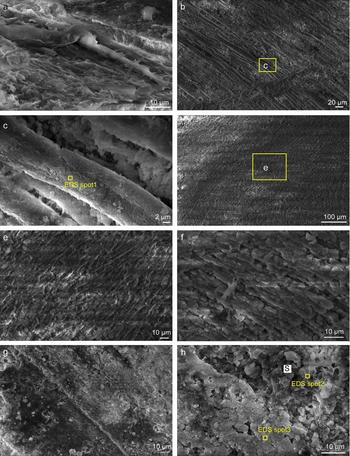
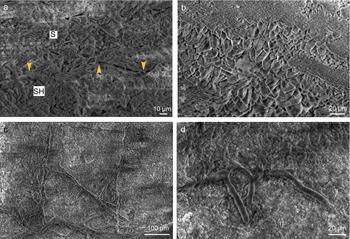
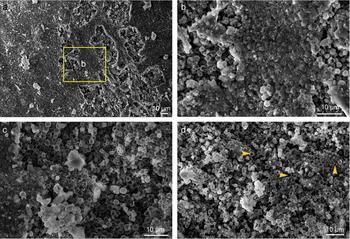
The shell carbonate of bivalves from the Yixian Formation is not preserved. Instead, where shell material is present it has been replaced by silica. Silica replacing shell carbonate occurs either in the form of crystals of fairly uniform size (granular texture) and random orientation, or else as crystals forming patterns consisting of interlocking crystals (Fig. 6f). Such patterns may consist of bundles of parallel lamellae which meet at high angles (Fig. 6d, e) or of tongue-like overlapping shingles arranged at low angle to the shell surface. In both cases silica apparently was fabric-replacive, preserving the original microstructure of the shell. Silicification was generally pervasive. The textural replacement by silica preceded the replacement by granular texture. The latter appears to have taken place when the remaining aragonitic shell had already been dissolved. In some bivalves, megaquartz crystals (up to 15μm in diameter, 20 to ≥30μm in length) fill parts of the interior of valves. They are tightly interlocked, increase in size in one direction (Fig. 7b) and seem to have filled voids created by the dissolution of carbonate. Rarely, traces of spherulitic chalcedony have been observed associated with microcrystalline granular quartz.
SEM micrographs of surface features of diagenetically altered bivalve shells from the Lower Cretaceous Yixian Formation of the Sihetun area. (a) Detail of the periostracum of Recent Sphaerium lacustre, surface view. (b) Parallel bands on top of composite moulds of Sphaerium anderssoni, interpreted as remnants of the periostracum, now preserved as aluminosilicate minerals, most likely clay. NIGP 160913. (c) Detail of (b). The band consists of densely packed tabular aluminosilicate crystals (see EDS spot 1 in Fig. 8a). (d) Crossed-lamellar microstructure of Arguniella ventricosa preserved in silica microcrystals. Erdaogou; NIGP 160914. (e) Detail of (d). (f) Densely packed microcrystals of silica tracing the primary microstructure of the shell of Arguniella ventricosa. Erdaogou; NIGP 160914. (g) Thin sheet of authigenic aluminosilicate minerals covering the external mould of Sphaerium anderssoni; NIGP 160915. (h) Margin of presumable clay mineral sheet forming the external mould of Sphaerium anderssoni with the sediment (S). The contrasting lithologies are shown in EDS spots 2 and 3 (Fig. 8b, c); NIGP 160915.

SEM micrographs of microstructural features and trace fossils from the Lower Cretaceous Yixian Formation. (a, b) Cross-section through silicified shell of Sphaerium anderssoni from Erdaogou, Sihetun area. (a) Sine-shaped boundary between sediment (above, S) and shell (below, SH) corresponds to a cross-section through the growth lines. The thin void is interpreted as the site of the degraded periostracum. NIGP 160916. (b) Megaquartz crystals as late stage silicification, filling remaining pore space left after dissolution of the shell carbonate. NIGP 160917. (c, d) Branching tunnels of cylindrical burrows, somewhat reminiscent of Arachnostega, occurring on the top surface of some internal moulds. The irregular structures associated with the burrows are the infillings of cracks of the shell created during compaction. Sihetun area; NIGP 160912.

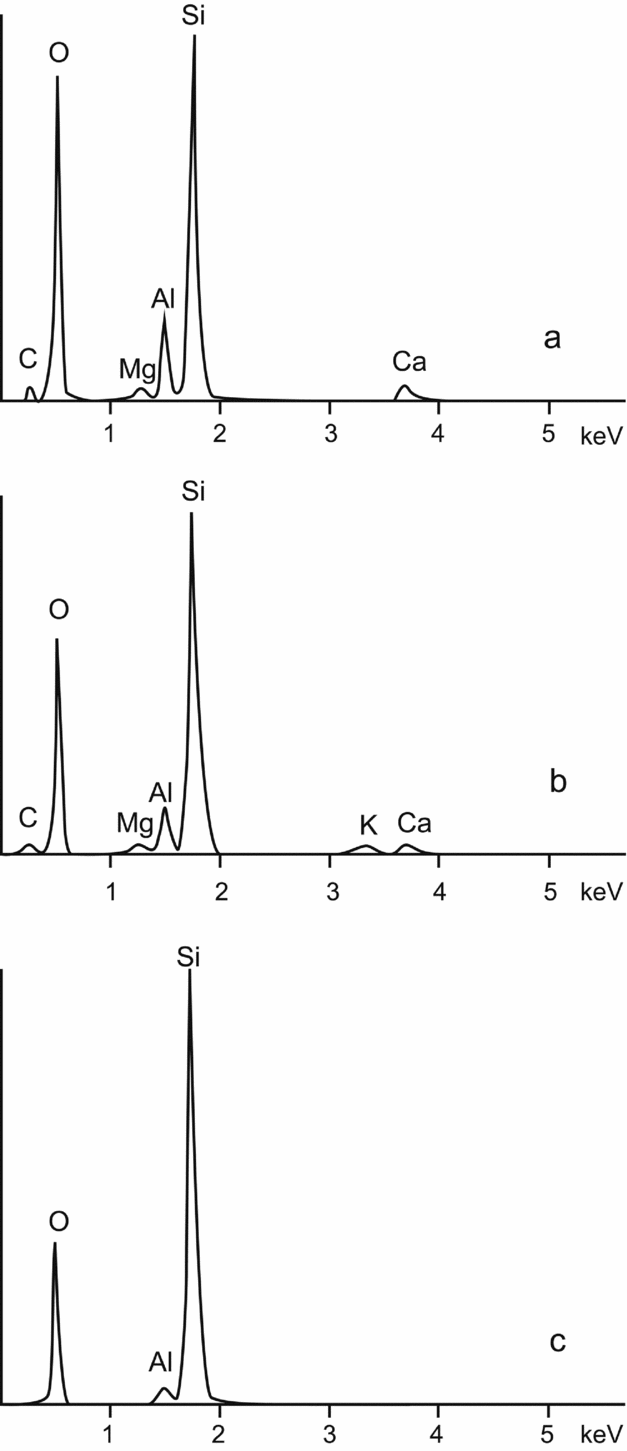
Silica also occurs as replacement of thin veneers of clay particles covering the external moulds (see Section 5 below). Ribbons consisting of closely packed tabular crystals (Fig. 6b, c), presumably clay minerals, as is suggested by EDS (Fig. 8a), are also replaced by silica. These ribbons, which are also seen in cross-section (Fig. 7a), depict the growth lines of the shell and possibly were part of the organic periostracum.
EDS graphs illustrating elemental compositions of altered bivalve shells. (a) The relicts of the periostracum of Sphaerium anderssoni are preserved as presumable clay minerals (EDS spot 1 in Fig. 6c). (b) Mineral composition of the external mould of Sphaerium anderssoni (EDS spot 2 in Fig. 6h). (c) Elemental composition of the sediment next to Sphaerium anderssoni (EDS spot 3 in Fig. 6h).

4.c.2. Replacement of shell material by iron minerals
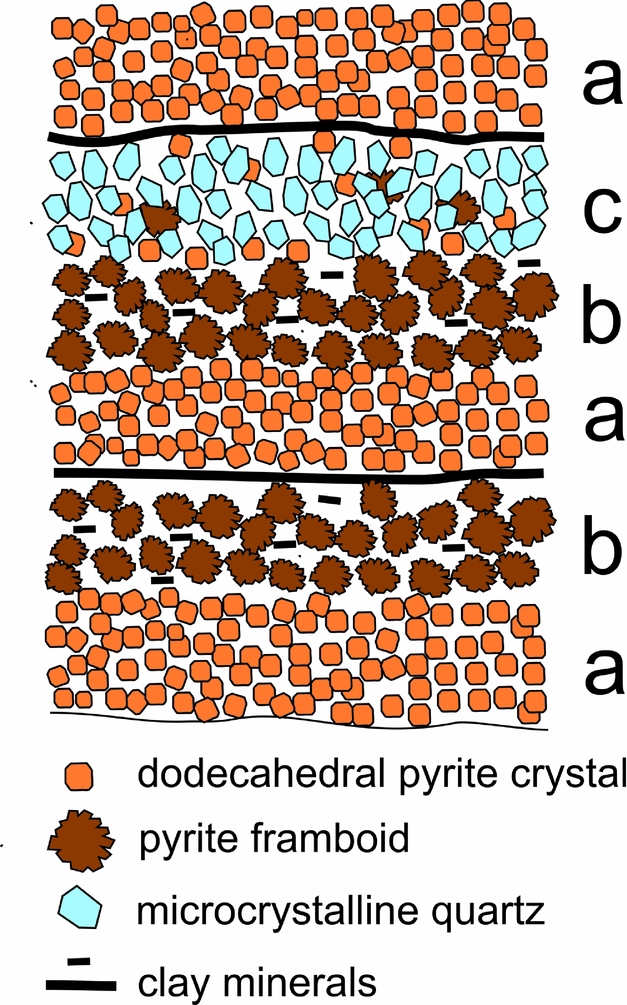
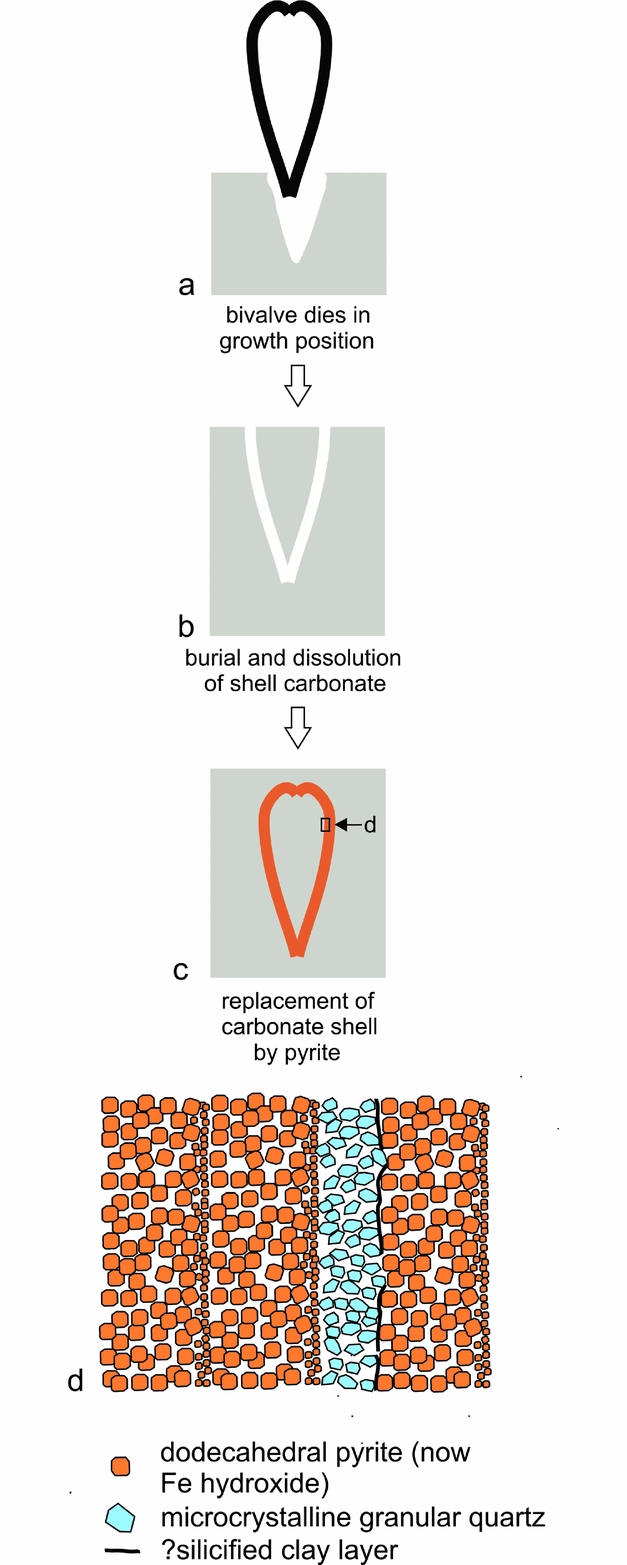
In rare cases, the shell of the articulated bivalves has been replaced by iron minerals, now iron hydroxides but originally pyrite. In the example investigated in detail, which is the vertically embedded bivalve shown in Figure 2d, the shell cavity has been filled with fine-grained sediment and the space originally occupied by the shell is filled with brown iron minerals arranged in numerous sub-millimetric layers with smooth surfaces. SEM and EDS investigations show the layers to consist of loosely packed dodecahedral, rarely modified cubic, pyrite pseudomorphs, 1.5–2μm in diameter (Fig. 9c, d). Occasionally, the crystals exhibit pitted surfaces caused by corrosion (Fig. 9d). The smooth surfaces of the layers consist of approximately 10μm thick sheets of densely packed dodecahedra of pyrite pseudomorphs, 0.5μm or less in diameter (Fig. 9a, b). Between these alternating layers there are rare intercalations, several microns thick, that consist of microcrystalline granular quartz covered with smooth sheets of either silicified aluminosilicate minerals or cryptocrystalline quartz. Similarly, a very thin layer of quartz or clay separates the shell from the surrounding sediment and internal mould.
SEM photographs of bivalve shell composed of thin sheets of pyrite, which has been secondarily oxidized to iron hydroxides, from the Lower Cretaceous Yixian Formation of the Sihetun area. NIGP 160910. (a) Layer of densely packed small dodecahedra. Underneath, another layer composed of larger crystals is seen. (b) Detail of the two layers. (c) Detail of layer with larger crystals. (d) Layer of larger crystals. Note that many dodecahedra show signs of corrosion. See Figure 14 for arrangement of the various layers.

4.c.3. Formation of aluminosilicate layers
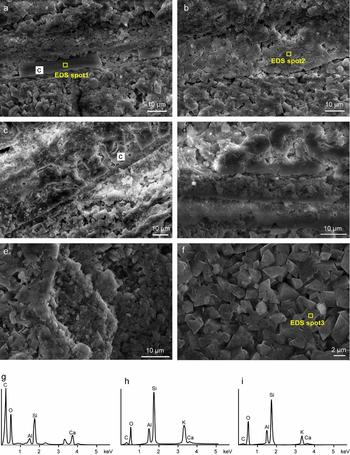
Aluminosilicate minerals form thin sheets on external and internal moulds in both the Jurassic and Lower Cretaceous occurrences and also occur as thin sheets within ferruginous internal moulds and shells replaced by iron minerals. In Jurassic specimens tabular rhombic crystals of uniform size are arranged with their large surfaces parallel to the external mould, forming an up to approximately 5μm thick lining (Fig. 10b, e, f). EDS analysis yielded silicon, oxygen, aluminium, potassium and calcium (Fig. 10h, i), which suggests that the crystals consist of K, Ca-silicates, most likely clay minerals. These minerals engulf and cover the organic remains of the periostracum (see Sections 4.c.4 below).
SEM micrographs of composite moulds of Ferganoconcha sibirica from the Jurassic Daohugou Fossil Beds near Daohugou village, Inner Mongolia. NIGP 160874. (a, c, d) Relicts of the periostracum preserved as carbonized bands or sheet. EDS spot 1 analysis (g) reveals abundant carbon. In (d), the periostracum has been replaced by presumable clay minerals. The sheets of clay occurring below and above the carbonized relicts, well seen in (a), are interpreted as authigenic. (b, e, f) Smooth layer of authigenic clay crystals originally forming sheets on the inside and outside of the now dissolved shell. The clay composition is confirmed by EDS analysis (h, i). (g) EDS analysis of spot 1 in (a). (h) EDS analysis of spot 2 in (b). (i) EDS analysis of spot 3 in (f).

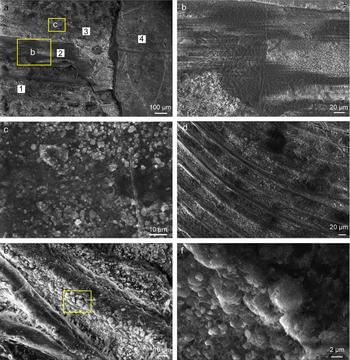
In external moulds from the Yixian Formation, SEM investigation showed smooth structureless ridges and ridges of densely interlocking silica crystals, tracing growth lines and separated by smooth areas (Fig. 11d). The latter are composed of tabular, commonly rhombic crystals, 1–3μm in diameter, oriented with their large surface parallel to bedding (Fig. 6g, h). EDS shows them to consist exclusively of silica, which most likely replaced an original aluminosilicate mineralogy (Fig. 8c). In some specimens, aluminosilicates clearly replaced thicker parts of the periostracum (Fig. 6b, c), which show a striking similarity to the surface of the periostracum of modern Sphaerium (Fig. 6a). The aluminosilicates form spaced bands of densely packed crystals (Fig. 6c), on which, in some cases, a second generation of aluminosilicate minerals produced scattered hemispherical structures (Fig. 11e, f). Between the bands smooth areas dominated by clay minerals represent the layer of aluminosilicate minerals originally covering the periostracum on the outside.
SEM micrographs of surface features of diagenetically altered Sphaerium anderssoni from the Lower Cretaceous Yixian Formation of Erdaogou, Sihetun area; NIGP 160918. (a) Overview of external mould with indication of growth lines of the now degraded periostracum (1), remnant of the lower valve (2), sheet of authigenic aluminosilicates, presumably clay (3), and internal mould (4). (b) Remnant of the lower valve preserved in silica (microcrystalline quartz sheets and some areas with megaquartz crystals). (c) Thin authigenic aluminosilicate layer casting the inner surface of the lower valve. (d) Growth lines of external mould. (e) Detail of growth lines which are composed of aluminosilicates and overgrown by hemispherical clumps of a later generation of ‘clay’ minerals. (f) Detail of (e) with the hemispherical clusters of a second ‘clay’ mineral generation.

4.c.4. Preservation of organic skeletal material
In the Daohugou Fossil Beds, parts of the organic layer of the bivalve skeleton, i.e. of the periostracum, are preserved as carbonized material. They form commarginal, structureless carbonaceous strings, 5–6μm in width (Fig. 10a), and less commonly more extensive sheets, 40μm across, which appear to have suffered in situ fracturing (Fig. 10c, d). The strings and sheets are engulfed by a layer of aluminosilicate minerals (see Section 4.c.3 above). The carbonaceous nature is documented by EDS analysis, which shows a very high carbon content (Fig. 10g).
The selective preservation of organic skeletal material in strings and sheets might reflect differences in the thickness of the periostracum, thicker bands standing a higher potential to be preserved (e.g. Orr, Briggs & Kearns, Reference Orr, Briggs and Kearns2008).
4.c.5. Formation of ferruginous internal moulds
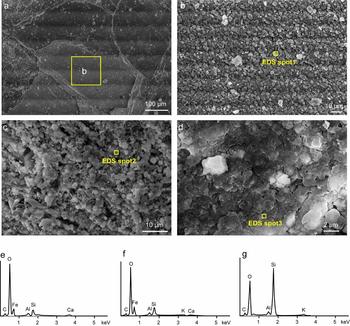
Bivalves with a ferruginous internal mould occasionally occur in the Yixian Formation. They now consist of Fe-hydroxides, a weathering product of original pyrite. The moulds either correspond more or less to the shape of the internal cavity of the bivalve shells, are mainly or completely confined to the dorsal part of the internal cavity, or form a very thin sheet between the two valves. SEM and EDS investigations document that the internal moulds consist of numerous thin layers of oxidized pyrite dodecahedra, usually occurring in two size classes (0.5μm and 1–2μm, more rarely also 6–8μm in diameter). In addition, layers of oxidized pyrite framboids in different stages of disintegration with some plate-like aluminosilicate crystals (Fig. 12a–c, e–f) and 1 to 2μm thick dense sheets of aluminosilicate crystals (Fig. 12d) occur. In one case, cylindrical branching structures, 8μm in diameter, running parallel to the surface of the layer, were found within one of the framboid sheets. They are identical in shape and branching pattern to those encountered in one of the non-ferruginous internal moulds (Fig. 7c, d).
SEM micrographs of laminated ferruginous internal moulds, originally composed mainly of pyrite, now secondarily oxidized to iron hydroxides, from the Lower Cretaceous Yixian Formation at Erdaogou, Sihetun area. NIGP 160919. (a) Thin sheets of framboids. (b) Enlargement of framboid layer. EDS analysis of spot 1 (e) indicates iron minerals. (c) Layer consisting of pyrite crystals of two distinct size classes and thin lenses of aluminosilicate minerals. EDS analysis of spot 2 (f) indicates iron minerals. (d) Detail of thin aluminosilicate lamina, now replaced by silica, as shown by EDS analysis of spot 3 (g). See Figure 13 for cyclic arrangement of the various layers.

4.c.6. Late diagenetic changes
Late diagenetic changes include weathering phenomena, such as degradation of silicified shell material into a powdery material covering the moulds and partial dissolution of silica, producing a cellular structure of the remaining shell.
None of the internal moulds of the single valves investigated are the result of early diagenetic processes. Rather they indicate dissolution of the silicified shell during later stages of diagenesis or during weathering, or else are an artefact created by splitting the rock along the bedding plane on which the bivalve occurs. In the latter case, the shell adheres to one of the slabs, leaving the other one with an internal mould. This is shown by the common occurrence of small remains of shell on the internal moulds. Invariably, there is a gap between the internal mould and matrix indicating that, at the time of removal of the shell, the sediment had been completely consolidated.
Oxidation of pyrite, which had formed internal moulds or replaced shell material, to iron hydroxide most likely also took place during weathering. The pitted surface of oxidized dodecahedra (Fig. 9d) and the irregular shape of some framboids (Fig. 12c) are signs of corrosion that took place during weathering.
5. Discussion
5.a. Silicification
None of the bivalves from the Daohugou and Yixian formations is preserved with its pristine shell, but all suffered extensive physical and chemical changes that seriously impaired their preservation quality. Where shell material is preserved, the original aragonite has been replaced by silica. Precipitation of silica involves several steps: it starts with polymerization of silicic acid to a silica gel, which dehydrates to form unstable opal, chalcedony and finally quartz (Fairbridge, Reference Fairbridge, Larsen and Chilingar1983). According to Maliva & Siever (Reference Maliva and Siever1988), quartz may directly precipitate at thin solution films at which carbonate dissolves and silica precipitates. Provided conditions are right, silicification can occur very fast (e.g. Kremer et al. Reference Kremer, Kazmierczak, Łukomska-Kowalczyk and Kempe2012).
Cryptocrystalline silica replaced parts of the periostracum in bivalves from the Daohugou Fossil Beds. Silica replacement of carbonate shells in the Yixian Formation apparently occurred either as preserving the original shell microstructure, as randomly arranged equant crystals or as larger elongated quartz crystals (Figs 7b, 11a, b). In the first two cases silica is microcrystalline, but the packing density of the crystals strongly varies. The randomly arranged crystals are loosely packed, whereas in the case of the replaced microstructures the crystals are commonly fused (Fig. 6f). The comparatively large, densely packed euhedral megaquartz crystals occupying the middle part of valves (Fig. 7b) indicate that fabric-replacive silicification was apparently restricted to the outer parts of valves, adjacent to the authigenic aluminosilicate layers, whereas in more central areas silica filled voids left by the dissolved carbonate, a process that probably occurred at a later stage (e.g. Schmitt & Boyd, Reference Schmitt and Boyd1981).
Holdaway & Clayton (Reference Holdaway and Clayton1982) assumed a close relationship between carbonate dissolution and silica precipitation. Dissolution of carbonate and precipitation of silica is favoured by low pH conditions brought about by decomposition of organic material by sulphate-reducing bacteria (Holdaway & Clayton, Reference Holdaway and Clayton1982; Loope & Watkins, Reference Loope and Watkins1989; Butts & Briggs, Reference Butts, Briggs, Allison and Bottjer2011). The fact that both lakes existed in a volcanic environment and that sedimentation involved ash falls and input of scarcely altered volcaniclastic material (Jiang et al. Reference Jiang, Fürsich, Sha, Wang and Niu2011; Jiang, Fürsich & Hethke, Reference Jiang, Fürsich and Hethke2012) must have strongly influenced both the chemistry of the lake waters and the diagenetic environment within the sediment. Chemical conditions in the lakes must have varied through time, and volcanic lakes are especially driven by intervals of ongoing hydrothermal activity and active volcanism (e.g. Haberyan & Hecky, Reference Haberyan and Hecky1987 for the African Lake Kivu). The molluscs of the present study lived during such a volcanically active phase. Furthermore, in the Yixian Formation thin levels of carbonate also exist, which have been interpreted as possible summer precipitates (Hethke et al. Reference Hethke, Fürsich, Jiang and Klaus2013a , fig. 9).
Lake Sihetun has been compared with the African Lake Kivu as a modern analogue (Hethke et al. Reference Hethke, Fürsich, Jiang and Klaus2013a ). Nowadays, Lake Kivu is permanently stratified, anoxic and characterized by syngenetic pyrite-framboid formation, which has also been proposed for Lake Sihetun (Hethke et al. Reference Hethke, Fürsich, Jiang and Pan2013b ). Hence, the waters of Lake Sihetun must have been alkaline. Alkaline waters are the agent for the decomposition of pyroclastic sediments, which may have created silica-rich pore waters. A similar mechanism has been observed in the African Lake Magadi, which is marked by the formation of silica sols (Behr, Reference Hethke, Fürsich, Jiang and Klaus2002). Thus, in Lake Sihetun both lake and pore waters were probably highly alkaline and acidic owing to the reaction of tuff with the lake waters, which resulted in supersaturation with respect to silica (e.g. Wise, Weaver & Guven, Reference Wise, Weaver and Guven1973; Calvert, Reference Calvert, Hsü and Jenkyns1974; Wise & Weaver, Reference Wise and Weaver1979; Carson, Reference Carson, Allison and Briggs1991). Consequently, dissolution of carbonate on the one hand and its replacement by silica on the other hand were common processes.
5.b. Timing of shell dissolution
When discussing the timing of dissolution of bivalve shells from the Yixian Formation one has to differentiate between dissolution of the carbonate shell (and its potential replacement by silica) and dissolution of secondarily silicified shells. Dissolution of shell carbonate probably occurred quite early during diagenesis and might have been facilitated by a low pH due to weathering of volcanic ash, the volcanic setting and the presence of highly alkaline pore waters, rich in CO2 (e.g. Murata, Reference Murata1940). It probably progressed along a solution front whereby calcium carbonate was replaced by silica, in some cases preserving the original microstructure. Bivalves that are now preserved as compressed external moulds still had a shell when compaction set in as is shown by the ubiquitous presence of radial fractures and signs of in situ fragmentation (Fig. 2a). Thus, dissolution of the silicified shell clearly was post-compactional but occurred before the sediment became too rigid for closure of the void created by the dissolution process. Dissolution of silicified shells affected the bivalves to a very variable degree. Between the two extremes – completely preserved shells on the one hand and completely dissolved shells on the other hand – there are numerous cases where shells are preserved with a reduced thickness. Even on some internal moulds, faint traces of the original shell microstructure may be found. The reason for this wide variety of preservational modes is the fact that the bivalves come from different levels within the succession, which probably varied slightly with respect to their diagenetic history.
In the Daohugou Fossil Beds, dissolution of the carbonate shell took place before compaction set in, as is shown by the lack of any evidence of fracturing preserved in the strongly compressed moulds. The timing of carbonate dissolution may have been very similar to that of the Yixian Formation, the main difference being that no diagenetic replacement of shell carbonate by silica occurred. This, together with the common preservation of organic skeletal material in the periostracum, might point to important differences in the diagenetic regime of the two lake systems. Thus, in the Jurassic lake, pore waters might not have been supersaturated with respect to silica at the time when bivalves populated the lake.
5.c. Formation of authigenic aluminosilicates
The formation of the aluminosilicate layers that cast the growth line topography is most likely partly related to the presence of recalcitrant organic material, the periostracum. It appears, however, that the presumed clay layers formed not only on the outer surface of the shell, covering the periostracum, but also lined the inside of the valves (Fig. 11a, c). This is supported by the observation that crystals engulf the remains of the organic periostracum on both sides. The timing of formation of the aluminosilicate layers is not quite clear. It may have post-dated compaction (radial fracture lines evidence that at that time a mineralized, most likely silicified shell still existed), it may have occurred after the shell had been dissolved, but most likely it occurred very early on during diagenesis. The perfect shape of the crystals and the fact that they are closely aligned to the original shell surface clearly identifies them as authigenic. This is shown, for example, by the smooth silicified aluminosilicate layer covering an external mould, which contrasts with the random orientation of aluminosilicate crystals in the surrounding sediments (Figs 6h, 8b, c). The aluminosilicates could have repli-cated the recalcitrant organic periostracum by becoming attached to it just after the shells had come to rest on the surface as envisaged by Pan, Sha & Fürsich (Reference Pan, Sha and Fürsich2014) in the case of mayfly larvae (Ephemeropsis trisetalis) from the same facies. Alternatively, they could have formed in place, both on the inner and outer surface of the shell, tracing its morphology.
Authigenic formation of clay minerals probably was also facilitated by biofilms, bacteria and extracellular polymeric substance (EPS), which most likely covered the inside and outside of shells after the death of the bivalves. Authigenesis of clay minerals, initiated by freshwater biofilms and bacteria, has been experimentally demonstrated by Konhauser & Urrutia (Reference Konhauser and Urrutia1999). Similarly, Ferris, Fyfe & Beveridge (Reference Ferris, Fyfe and Beveridge1987) have documented that bacterial cells and their remains served as nucleation sites for (Fe, Al)-silicates in Lower Moose Lake, Canada.
The thin sheets of aluminosilicates sandwiched between layers of framboids and dodecahedral pyrite crystals in ferruginous internal moulds and shells are also authigenic, having formed when the microenvironment caused temporary cessation of pyrite growth.
Surdam & Parker (Reference Surdam and Parker1972) convincingly argued for the alteration of volcanic glass to clay minerals in the Eocene Green River Formation of the western USA. In sedimentary environments like the ones represented by the two lake systems under discussion, where deposition of tuffs took place even much more frequently than in the Green River Formation, reaction of volcanic glass from tuffs with the lake waters should have produced authigenic clay minerals such as montmorillonite (Berner, Reference Berner1971) or smectite (Wise, Weaver & Guven, Reference Wise, Weaver and Guven1973) even more commonly. Authigenic clay minerals are also invoked to partly explain the excellent preservation of fossils, e.g. in the Middle Cambrian Burgess Shale (Conway Morris, Reference Conway Morris1990; Orr, Briggs & Kearns, Reference Orr, Briggs and Kearns1998) and in the Upper Carboniferous Castlecomer fauna of Ireland (Orr, Briggs & Kearns, Reference Orr, Briggs and Kearns2008).
5.d. Formation of pyrite
Compared to the importance of pyrite in preserving plants and insects in the Yixian Formation (e.g. Leng & Yang, Reference Leng and Yang2003; Wang et al. Reference Wang, Zhao, Zhang, Fang and Zheng2012; Pan, Sha & Fürsich, Reference Pan, Sha and Fürsich2014) and in the Daohugou Fossil Beds (Wang et al. Reference Wang, Zhang, Jarzembowski, Fang and Zheng2013), the mineral appears to have played only a minor role in the taphonomy of the bivalve shells. Clearly, abundant pyrite formation was confined to the microenvironments provided by the shell cavity and more rarely by voids of dissolved shell material. In some cases, early diagenetic pyrite partially filled the shell cavity and these shells only suffered limited compaction. The thinly laminated internal moulds consist of alternations of (1) layers of now oxidized dodecahedral pyrite crystals, framboids and occasional clay crystals, (2) thin layers, in which oxidized pyrite framboids in various stages of disintegration co-occur with silica microcrystals, and (3) micrometre-thick smooth sheets composed of tabular crystals, the EDS signal of which indicates a ferruginous nature, but this may be a measuring artefact owing to the thinness of the layer (Fig. 13). More likely, the layer consists of aluminosilicate minerals. Thus, it appears that, owing to small changes in the microenvironment of the shell cavity, formation of the internal mould proceeded in a rhythmic way leading from deposition of pyrite to pyrite–silica layers, and to formation of sheets of authigenic aluminosilicates.
Ferruginous internal moulds consist of rhythmic alternations of thin layers of pyrite dodecahedra, pyrite framboids, aluminosilicate minerals and microcrystalline granular quartz. During late diagenesis and/or weathering, pyrite has been transformed into iron hydroxides, and some of the crystals have been corroded.

The branching cylindrical structures observed within one of the framboid layers are clearly biogenic in origin. Their presence is difficult to explain in such a microenvironment. Apparently, they represent one of the rare cases when conditions were right for some organism, adapted to dysoxic conditions, to burrow within the layer. Similar traces have been found also in non-ferruginous internal moulds (Fig. 7c, d). They resemble burrows described by Bertling (Reference Bertling1992) as Arachnostega from internal moulds of Late Jurassic bivalves from northern Germany, but differ in being smaller and do not form an anastomosing pattern as Arachnostega does.
In the rare cases where iron minerals replaced the shell carbonate of articulated valves, replacement of the shell was likewise very early as all ferruginous layers, which are arranged parallel to the surface of the internal mould (and thus to the inner and outer surface of the valve), show signs of compaction. Apparently, a sub-millimetric layer of quartz separated the void left by the dissolved carbonate shell from the surrounding uncompacted sediment and prevented sediment from entering the void. The different minerals (pyrite dodecahedra of different size classes, aluminosilicates and microcrystalline granular quartz) formed thin alternating sheets reflecting fluctuations of the microenvironment within the void (Fig. 14).
Replacement of shell carbonate by rhythmic alternations of several minerals. Apart from abundant pyrite dodecahedra, thin sheets of aluminosilicate minerals and rare layers of microcrystalline granular quartz occur (d). A thin sheet of quartz minerals at the inner and outer surface of the valve, forming at the time of shell dissolution, prevented the collapse of the void created by the dissolution of the shell carbonate. After replacement by pyrite, the shell suffered compaction (not shown).

In the case of ferruginous internal moulds, too, pyrite formation must have occurred very early on during diagenesis as it pre-dates compaction. Only in cases where the internal mould did not extend to the ventral margin of the valves have the latter been flattened by compaction. Pyrite preferentially formed in the area where most of the visceral mass of the bivalves was located, i.e. in the dorsal part of the shell cavity. This suggests that pyrite formation was related to the decay of the soft tissue of the bivalve, and was facilitated by the microenvironment within the bivalve shell. The ferruginous moulds are built of rhythmic alternations of thin layers that exhibit a very similar composition to those in the iron-replaced shells (Fig. 14), except that they contain, in addition, sheets of now heavily corroded oxidized framboids (Fig. 13).
5.e. Taphonomic pathways (Figs 15, 16)
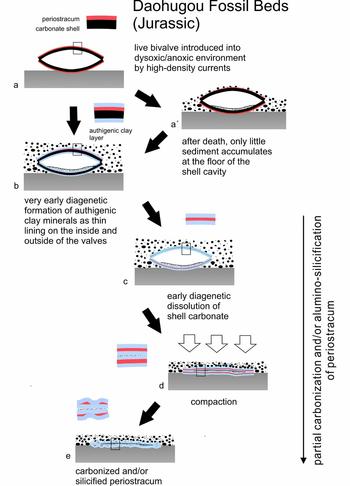
In the Jurassic Daohugou Fossil Beds (Fig. 15), live bivalves occasionally came to rest in dysoxic/anoxic parts of the lake where they died, having been introduced by high-density currents initiated by floods or storms. Most likely the shells were immediately covered, at least partially, with sediment and thus remained articulated, but no or only very little sediment entered the shell cavity. Very early on during diagenesis, authigenic aluminosilicates, most likely clay minerals formed under alkaline conditions as volcanic ash reacted with lake waters. Settling on the periostracum and also on the inner surface of the shells, these minerals formed thin layers that cast the morphology of the valves: smooth on the inside, with parallel crests and furrows (depicting growth lines) on the outside. The acidic lake waters dissolved the carbonate shells. Subsequent compaction created more or less flat compressions of the periostracum, the authigenic clay layers and of any internal sediment. During subsequent diagenesis the recalcitrant periostracum gradually decayed, but enveloped by the authigenic clay layers, parts of the organic layer remained as narrow bands or sheets; others were replaced by authigenic clay crystals. It should be kept in mind that our material might not represent the full range of preservation of the bivalves as only limited material was available for study.
Taphonomic pathways of bivalves from the Jurassic Daohugou Fossil Beds.

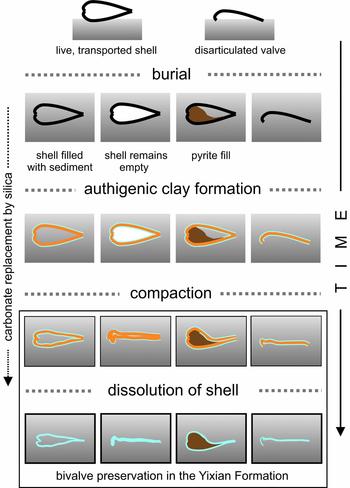
Taphonomic pathways of bivalves from the Lower Cretaceous Yixian Formation. The lower eight preservational modes have been encountered. Note that the dissolution of shell carbonate probably started very early. Different types of silica demonstrate that silicification was partly texture replacive and thus must have occurred very early on during diagenesis, partly filled voids created by the dissolution of carbonate at a slightly later stage. The space created by dissolution of the silicified shells partly remained a void and partly was closed by ongoing compaction. For further explanation see text.

In contrast to the fairly uniform diagenetic pathway of shells from the Daohugou Fossil Beds, bivalves from the Yixian Formation display a much greater variety of preservational types, as they come from different localities and different bedding planes. Apart from variable degrees of compaction (mainly depending on the degree to which the shell cavity was filled with sediment) bivalves are preserved as internal moulds, external moulds or in shell, the latter widely varying in thickness.
Figure 16 schematically depicts the main taphonomic pathways of bivalves from the Yixian Formation. As in the case of the Jurassic bivalves, the scattered occurrences suggest that bivalves, owing to seasonal or more extensive anoxia or dysoxia, did not colonize the basinal lake floor but were introduced from marginal areas, either articulated or disarticulated. At least some of the bivalves appear to have been still alive when settling on the lake floor as is shown by the rare vertical orientation of the shells. As they left no traces on the lake floor they appear to have died very quickly. Most articulated shells remained closed and no sediment entered the shell; in others the shell cavity became partially or completely filled with sediment. In some cases, empty shells became partially filled with pyrite. Pyrite was concentrated in the dorsal part of the shell cavity, the space occupied by the visceral mass of the bivalve while alive. Pyrite formation was probably initiated by the decay of organic soft parts and a reducing microenvironment within the shell and thus appears to have taken place very early after the death of the bivalves. Also, very early on authigenic clay minerals formed thin layers lining the outside and inside of the shells, and thin sheets between pyritic layers of ferruginous internal moulds. At the same time, silicification of the shell carbonate started whereby the microstructure of the shells was partly faithfully recorded.
Subsequent compaction of the fine-grained sediment led to substantial flattening of the shells, depending on the amount of internal sedimentation. Shells that remained empty (the majority) became strongly flattened, which resulted in the formation of large radial and commarginal fractures and often led to complete fracturing of the shells (Fig. 2a). In the shells partially filled with sediment, compaction was less pronounced but still sufficient to produce radial fractures. In the few cases where early diagenetic pyrite partly filled the shells, compaction was mainly limited to the ventral areas of the shell that had remained empty.
It seems likely that at the time of compaction all shell carbonate was replaced by silica or pyrite. Carbonate dissolution was caused by the low pH of the pore waters and the bottom layer of the lake waters, which was a result of the volcanic environment. Dissolution of silicified shells set in at the earliest after compaction and most likely was a relatively late diagenetic process that continued up to present-day weathering. It led to either complete or partial loss of shell material, in the latter case often resulting in a cellular appearance of the shell surface. We cannot, however, exclude the possibility that, in some cases, the reduced thicknesses of the silicified shell might not be due to partial dissolution of silica but to a more rapid early dissolution of shell carbonate material than could be replaced by silica and closure of the resulting void by incipient compaction.
Another weathering process oxidized the pyritic internal moulds to iron hydroxides and, in rare cases, produced thin films of iron hydroxides on shells and the surrounding bedding plane.
5.f. Environmental implications
The preservation of bivalves allows us to draw some conclusions concerning the chemistry of the lake waters. The presence of films of authigenic clay crystals on the shell surfaces suggests that the breakdown of volcanic glass particles from volcanic ash reacting with lake water produced alkaline conditions. The lakes were probably eutrophic, as is evidenced by high densities of spinicaudatans, mayfly larvae and the crustacean Liaoningogriphus at numerous levels (Fürsich et al. Reference Fürsich, Sha, Jiang and Pan2007; Pan et al. Reference Pan, Sha, Fürsich, Wang, Zhang and Yao2012) as well by the abundant plant material. Breakdown of organic material and corresponding release of CO2 increases the acidity (e.g. Froelich et al. Reference Froelich, Klinkhammer, Bender, Luedtke, Heath, Cullen, Dauphin, Hammond and Hartman1979) and this was most likely true of the water bodies of the two lakes. More important was the role of volcanic ash and scarcely altered volcaniclastic material that dominated sedimentation within the lakes. Moreover, outgassing of CO2 by volcanic processes may also have influenced the chemistry of the lake waters (see also Hethke et al. Reference Hethke, Fürsich, Jiang and Klaus2013a ), although no structures produced by gas bubbles, which may have been quite localized, have been found so far. Increased CO2 decreased the pH of the lake waters, but at the same time did not affect the alkalinity created by the decomposition of volcanic glass. As a result, the lake waters were both acidic and alkaline. Volcanic processes are episodic; therefore, the chemistry of the lake waters most likely fluctuated through time, similar to fluctuations in the degree of stratification (meromictic/holomictic) and oxygenation (anoxic/dysoxic/oxic) assumed by Hethke et al. (Reference Hethke, Fürsich, Jiang and Klaus2013a ) for the Cretaceous lake.
The two lakes differ, however, in one important aspect: In the Jurassic Daohugou Fossil Beds, silicification is confined to local replacement of the organic periostracum and of the authigenic clay minerals, but did not replace any shell carbonate. This suggests that the two lakes probably differed in their degree of silica supersaturation, probably related to their degree of alkalinity, with the Jurassic lake having been less supersaturated with respect to silica than the Early Cretaceous lake.
6. Conclusions
Bivalves occurring as rare elements in offshore lake deposits of the Jurassic Daohugou Fossil Beds and the Lower Cretaceous Yixian Formation are thought to be allochthonous, having been swept to offshore parts of the lakes from marginal areas. In contrast to the excellently preserved taxa of other invertebrate groups (e.g. spinicaudatans) and of vertebrates such as fishes, the preservation of the bivalves varies considerably but on the whole is rather poor. In no case is shell carbonate preserved. Bivalves range in preservation from external moulds, internal, occasionally ferruginous, moulds and composite moulds to silicified shells differing substantially in thickness; rarely also ferruginous shells occur. All bivalves exhibit signs of compaction and often occur as flattened individuals on bedding planes. In the Yixian Formation, distinct radial cracks on composite moulds and in situ fragmented moulds prove that dissolution of mineralic shell material post-dated compaction and affected shells, which at that stage had been already silicified. In the Daohugou Fossil Beds, in contrast, no primary or secondarily modified mineralic shell material is preserved, and the lack of radial fractures in the composite moulds indicates that shell dissolution pre-dated compaction. Thus, no silicification of shells took place. Excellent preservation of external moulds depicting minute details of growth lines is the result of authigenic aluminosilicate minerals, which, very early on during diagenesis, formed thin sheets covering the inside and outside of the valves, possibly initiated by the presence of biofilms and bacteria. In the case of the Daohugou Fossil Beds, parts of the recalcitrant organic periostracum is preserved as carbonaceous material, forming bands and thin sheets, and partly the organic material has been replaced by silica. In contrast to the preservation of other fossil groups such as insects, pyrite played only a minor role in the preservation of the bivalves.
The diagenetic pathways of the bivalves involved early diagenetic formation of aluminosilicate mineral sheets, early diagenetic dissolution of shell carbonate and its early replacement by silica in the case of the Yixian Formation as well as partial preservation of the periostracum as carbonaceous material or replacement by silica (Daohugou Fossil Beds). This allowed us to deduce the environmental conditions prevailing in these lakes. Apart from at least seasonal dysoxic or anoxic conditions at the bottom in offshore lake areas, the lake waters appear to have been alkaline, acidic and supersaturated with respect to silica, which promoted the formation of authigenic clay minerals and the dissolution and replacement of carbonate shells by silica. These conditions were created by the volcanic setting with numerous ash falls and sedimentation of little-altered volcaniclastic material. The role of pyrite in the diagenetic history of the bivalves was confined to microenvironments within the shell cavity of articulated valves and to voids created by the dissolution of carbonate shells.
Acknowledgements
FTF acknowledges a Visiting Professorship for Senior International Scientists of the Chinese Academy of Sciences and the hospitality of the Nanjing Institute of Geology and Palaeontology (NIGPAS). We thank Tian Ying, Dalian, for providing Recent Sphaerium for microstructural comparison; Wang Chunzhao, NIGPAS, for technical assistance on the scanning electron microscope and X-ray spectrometer. Huang Diying kindly donated the specimens from the Daohugou Fossil Beds. The manuscript benefitted from the critical remarks and useful suggestions of Manja Hethke, Erlangen, and Jiang Baoyu, Sha Jingeng, Huang Diying, Wang Bo and Zhou Chuanming (all from Nanjing). The study was financed by the National Natural Science Foundation of China (91114201, 41472009), and the National Basic Research Programme of China (973 programme; 2012CB821906). This article is a contribution to UNESCO-IUGS-IGCP Project 632. Last not least we acknowledge the constructive criticism of the two reviewers.