




No CrossRef data available.
Article contents
Parasite dose, prevalence of infection and local adaptation in a host–parasite system
Published online by Cambridge University Press: 01 March 2004
Abstract
Parasites have been found to be more infective to sympatric hosts (local adaptation) in some systems but not in others. The variable nature of results might arise due to differences in host and/or parasite migration rates, parasite virulence, specificity of infection, and to differences in the dose–response functions. We tested this latter possibility by manipulating the dose of trematode (Microphallus sp.) eggs on sympatric and allopatric host populations (Potamopyrgus antipodarum). We found that infection rapidly increased to a high asymptote (0·88±0·02, 1 S.E.) in the sympatric host population, but infections were low and surprisingly unrelated to dose in the allopatric host. We also found that host survival and growth rate were not negatively affected by increasing parasite dose in either population. These results suggest that defences in the allopatric host were not overwhelmed at high parasite doses, and that any life-history costs of defence are not plastic responses to parasite dose.
Keywords
Information
- Type
- Research Article
- Information
- Copyright
- 2004 Cambridge University Press
INTRODUCTION
Parasites and pathogens have been found to be more infective to sympatric hosts (locally adapted) in a number of different studies (Parker, 1985; Lively, 1989; Ballabeni & Ward, 1993; Ebert, 1994; Lively & Dybdahl, 2000; McCoy et al. 2002). However, the result is not general, as other studies have found either no difference in infectivity on sympatric versus allopatric hosts, or that parasites are less infective to sympatric hosts (Roy, 1998; Kaltz et al. 1999; Oppliger, Vernet & Baez, 1999; Mutikainen et al. 2000; Kraaijeveld & Godfray, 2001). The variance in results is not necessarily inconsistent with theory, since models have shown that local adaptation depends on the amount of gene flow between host and parasite populations, parasite virulence, and the degree of genetic specificity for infection (Gandon et al. 1996; Lively, 1999; Gandon, 2002). The outcome of reciprocal cross-infection experiments might also be dose dependent. In this paper, we compare dose–response curves for a trematode parasite (Microphallus sp.) on sympatric and allopatric populations of its snail host (Potamopyrgus antipodarum).
Different dose–response functions for hosts could be caused by genetic differences between host populations. For example, the frequency distribution of infective host–parasite combinations would determine the shape of the curve for a dose–response relationship, where the shape of the curve depends on 2 key parameters: the rate of increase and the asymptote (Fig. 1). Locally adapted parasites might be expected to have higher rates of increase and higher asymptotes on sympatric host populations. However, many outcomes are possible, depending on the difference in rate and asymptote between the populations (Fig. 1A–D, Table 1). For example, increasing parasite dose alone could cause infection if otherwise resistant hosts are simply overwhelmed by parasites at some threshold density (Fig. 1E–F).

Fig. 1. Possible dose–response functions on sympatric and allopatric hosts. Allopatric combinations are in bold. For both hosts (A–D) are increasing functions to an asymptote. The rate is dependent on the frequency of infective combinations and the asymptote is dependent on the number and frequency of infective combinations. In A, B, and C the statistical ability to detect local adaptation will be greatly influence by dose. In B, the result of local adaptation or maladaptation will depend on experimental dose. For E and F, prevalence is dependent on some threshold exposure density or some combination of exposure density and genetic combinations. For all possible outcomes, fitness should be negatively related to dose if there is any cost of defence that is a plastic response to parasite exposure level.
Table 1. The experimental outcome of a reciprocal infection experiment between two hosts populations when comparing the rate and asymptote of dose–prevalence curves (LA means local adaptation is found, and MA means that local maladaptation is found.)

In this paper, we compare the infectivity of 2 P. antipodarum populations over an experimental gradient of Microphallus exposure. One of the host populations was sympatric, and the other host population was allopatric, to the parasite population. We were specifically interested in the shape of the exposure–prevalence function for both host populations. We found that the 2 host populations differ greatly in the exposure–prevalence function, such that local adaptation does not depend on exposure rate. We also show that host growth and survival does not depend on exposure rate, which suggests that the cost of defence, in terms of growth and survival, is not a plastic response to parasite dose.
MATERIALS AND METHODS
Study system
We used the freshwater prosobranch snail Potamopyrgus antipodarum as the host, and trematode, Microphallus sp., as the parasite. The snail is common in lakes and streams of New Zealand and is host to about 14 species of trematodes, of which Microphallus is the most common and widespread (Winterbourn, 1970, 1974; Lively, 1987). Microphallus-infected and -uninfected snails were collected from Lake Alexandrina at the ‘West Bay’ site (Jokela & Lively, 1995) in January 2001. This lake is at about 750 m above sea level in the MacKenzie District on New Zealand's South Island (Livingston, Biggs & Gifford, 1986). Snails for the allopatric host combination were similarly collected from Lake Poerua, which is at about 125 m above sea level in the Westland district of New Zealand's South Island (Livingston et al. 1986). Lake Poerua is warmer, in general, with summer-time temperatures up to 23 °C (Livingston et al. 1986 and personal observations); Lake Alexandrina, in contrast, is much cooler, with summer-time temperatures of 16–20 °C at the water's surface (personal observations). Snails were transported under permit to Indiana University in February and stored in aquaria until the experiment was begun on 7 March 2001.
Microphallus sp. is a widespread and locally common undescribed parasite in New Zealand lakes and streams (Lively, 1987; Jokela et al. 1995). Multilocus allozyme genotype data show that Microphallus is a single outbred species with high levels of gene flow among South Island populations (Dybdahl & Lively, 1996). The parasite exclusively uses P. antipodarum as the intermediate host; the final hosts are waterfowl. Embryonated Microphallus eggs hatch in the snail's gut, penetrate the intestine, and migrate to the gonads and digestive gland. Following successful establishment, the parasite then undergoes asexual reproduction, replacing much of the host's reproductive tissue and digestive gland, which results in complete sterilization of the snail. Both males and females are sterilized. Metacercariae are produced within the snail in about 3 months. The cycle is completed when the metacercariae are consumed by waterfowl.
Parasite culture
Previous studies have found that laboratory mice can be substituted for the natural definitive host for Microphallus (Lively & McKenzie, 1991). Each of 7 mice was fed between 30 and 37 Microphallus-infected snails collected from Lake Alexandrina. Faeces from the mice were collected 4 times daily starting 24 h after infection and continuing through day 5 post-infection. Mouse faeces were immediately placed in 5 l of pond water after collection, and the water was changed twice a day. The faeces were allowed to soak for 7 days after the last collection. This treatment allowed the eggs to be stored in an aqueous environment and to dilute soluble waste from the faeces.
Experimental design
One hundred snails from Lake Alexandrina were randomly selected and placed into each of 51, 2 l plastic containers; 100 snails from Lake Poerua were similarly selected and placed into 21 containers of the same type. Parasites were then added to the experimental containers as follows. First, water was decanted from the egg/faeces mixture so that only 1 l remained. A serological pipette was then used to measure and transfer the remaining faeces-egg mixture to each container according to dose. Doses ranged from 1 ml to 70 ml and were administered to the containers in random order; the egg/faeces mixture was continuously stirred to prevent settling of parasite eggs in the mixture. The number of replicates for each dose varied from 1 to 4.
Because of the temperature differences between the two lakes, the Lake Alexandrina snails were kept at 17 °C, and the Lake Poerua snails were kept at 20 °C. The difference in temperature was meant to reflect the observed difference in the wild, discussed above. All snails were fed dried spirulina algae 2–3 times a week, given fresh water in the containers weekly, and rotated among room positions weekly until they were sampled for infections.
Sampling procedure
The experimental containers of Lake Alexandrina snails (sympatric host) were sampled for infection in random order starting at 77 days post-exposure (henceforth called ‘early samples’). Starting at 90 days post-exposure, the Poerua snails (allopatric host) were sampled for infection. Finally, 26 containers of Lake Alexandrina snails were sampled for infection after 139 days post-exposure (‘late samples’) to determine if some infections were missed in the earlier samples due to slow developing parasites that were undetectable. From earlier studies (Krist et al. 2000), we knew that most infections are visibly detectable by 75 days post-infection in both sympatric and allopatric combinations. Therefore, the later sampling of the Alexandrina population was done only to be sure that the asymptote was well estimated and not biased due to missing a small proportion of infections. Because of past work on parasite growth rate (Krist et al. 2000), we knew that we should not have missed a large number of infections in the Poerua infected snails. Shell length was also recorded in all the early samples of Lake Alexandrina snails and in 9 samples of Lake Poerua snails.
At the time of sampling, each snail in each container was examined under a dissecting microscope to determine if it was alive or dead and occasionally measured for length (as above). If the snail was alive, it was also examined for the presence of parasites by cracking the shell and teasing through the digestive gland and gonads. Presence or absence and species of parasite were recorded. Parasites that had not reached the mature metacercariae stage were assumed to be experimental infections.
Statistical analysis
The prevalence of infection by Microphallus for each container was calculated, and nonlinear regression was used to fit the exposure–prevalence function

In this equation, y(d) is the prevalence of infection at experimental dose d in ml of egg/faeces mixture, A is the asymptotic prevalence of infection, B is the prevalence of infection prior to experimental exposure (i.e, in wild field-collected snails), and R is a rate parameter that determines how fast prevalence approaches the asymptote. We chose this function because the increase in prevalence from the intercept at zero dose (B) to the asymptote at infinite dose (A) was a constant proportion of the distance to the asymptote (A−y(d)), which fit the expectation of a simple genetic model. Parameter estimates for A and B were constrained between zero and 1. For the Alexandrina host we first fit the function for early and late samples separately. We then fit the function to the pooled early and late data because the all parameter estimates overlapped from the separate analyses. For the Poerua (allopatric) hosts we also fit a linear regression because there was no clear non-linear relationship.
Simple linear regression was used to test for a relationship between parasite dose and mean host final length, and between parasite dose and host survival. All analyses were done on container means. We first used the mean calculated from all snails in a container for survival and length as the dependent variable. Second, we used the mean length for infected and uninfected snails in a container separately as the dependent variable. We then used linear regression to test for an effect of dose, infection status, and their interaction. We did this separately for both the Alexandrina and Poerua populations. Survival could not be analysed separately for infected and uninfected snails because it is not possible to determine infection status in dead snails due to decay of snail and parasite tissue. All analyses were done in SPSS version 11.0 (2001).
RESULTS
Host infection and parasite dose
Both early and late samples of Lake Alexandrina snails (sympatric host) fit the prevalence–exposure function well (r2=0·97 and 0·85, respectively, Fig. 2). The asymptote for the early samples was 0·89±0·02 (mean±1 S.E.), and the estimate for the late samples was 0·86±0·03 (Table 2). The pooled estimate of the asymptote for Alexandrina hosts was less than one (0·88±0·02; Table 2). These results indicate that approximately 12±0·04% (1−Asymptote±2 S.E.) of the snails in the Alexandrina samples were resistant to sympatric parasites.

Fig. 2. The relationship between parasite dose and percentage infection for sympatric (Lake Alexandrina) and allopatric (Lake Poerua) snail treatments. All parasites were from Lake Alexandrina. The Lake Alexandrina snail treatments were sampled at 2 different times. The later sample was to check for missed infections during the early sampling period. Parameter estimates are in Table 2. The lines show the nonlinear regression for each host population. The regression shown for the Lake Alexandrina host was fit to the pooled early and late samples.
Table 2. Nonlinear regression estimates for the dose–infection function for each host population exposed to parasites from Lake Alexandrina (All model fitting was done in SPSS. Asymptote and Intercept were constrained between zero and 1.)

A small proportion of Lake Poerua snails were infected by the Alexandrina parasites, as indicated by the low prevalence in all exposure treatments (Fig. 2). For the nonlinear model, none of the parameter estimates were significantly different from zero and the r-squared was low (0·25, Table 2). The estimate for the asymptote under the nonlinear model was 0·16±0·32 (1 S.E.). The linear model showed that prevalence was related to dose (b=0·001, F=6·30, D.F.=1,19, P=0·02) but the r-squared (0·25) was the same as for the nonlinear model.
Host survival and growth
Survival of the Alexandrina host was not related to dose for either the early (b=−0·0008, F=1·53, D.F.=1,23, P=0·23) or late samples (b=0·0001, F=0·05, D.F.=1,24, P=0·83). Mean final length of the Alexandrina host was also not related to dose for the early sampled treatments (b=0·004, F=0·12, D.F.=1,21, P=0·74). Survival of the Poerua host was not related to dose (b=0·002, F=1·58, D.F.=1,19, P=0·22), and mean final length was also not related to dose (b=0·004, F=0·01, D.F.=1,8, P=0·92).
When separate means for infected and uninfected snails were analysed, length of Alexandrina snails increased with dose (b=0·059, t=2·79, D.F.=46, P=0·008) but this depended on infection status (interaction: b=−0·062, t=−2·06, D.F.=46, P=0·045) such that length increased with dose for uninfected snails but not for infected snails. For Poerua snails, infected snails were shorter (b=−7·364, t=−3·80, D.F.=16, P=0·002), but this did not depend on dose (b=0·007, t=0·25, D.F.=16, P=0·804) or on the interaction (b=−0·003, t=−0·08, D.F.=16, P=0·939).
DISCUSSION
The results show that Microphallus were more infective on sympatric than allopatric host snails. One possible explanation for this result is that the sympatric Lake Alexandrina snails were simply more susceptible to infection from any parasite source. However, a fully reciprocal cross-infection experiment conducted using the same snail populations in the same year showed that both parasites populations (Alexandrina and Poerua) were more infective to sympatric hosts than allopatric hosts (Dybdahl et al., manuscript submitted). The paper showed further that the observed local adaptation was due to epistasis (gene interactions) rather than to simple dominance or additive effects of alleles at different loci. In addition, a meta-analysis of 32 different sympatric-allopatric combinations showed strong adaptation by Microphallus to its local population of hosts (Lively et al., manuscript in preparation). The overwhelming majority of studies showing local adaptation occur despite variation among studies due to parasite dose, lab conditions (including temperature), and host–parasite condition. Hence, local adaptation is overcoming any variance in the system that might be introduced by conditions experienced in the field prior to collection or in the lab due to the effects of ambient temperature on snail physiology. Thus, the present results are most likely due to Microphallus parasites being more infective to snails collected from the same lake as a result of coevolutionary interactions.
The primary aim of the present study was to determine if local adaptation in this system depended on the exposure dose to parasites. Such dependence could easily exist if parasites saturate the susceptible pool of allopatric hosts, but at a higher dose than for sympatric hosts. We expected this result, under the reasoning that both host populations contained the same set of possible genotypes, but that they existed at different frequencies. Hence, locally adapted parasites might be expected to infect the common genotypes at relatively low doses in sympatric hosts, but reach the same asymptote in allopatric hosts at higher doses. Another reason that the detection of parasite local adaptation might depend on dose is that parasites might overwhelm the defences of both sympatric and allopatric hosts at some threshold dose. However, there was no indication of a threshold in the allopatric hosts and the proportion of uninfected sympatric hosts remained unchanged even at extreme doses. For these reasons, we do not believe that host defences were overwhelmed, although this possibility cannot be completely dismissed.
The results suggest that local adaptation is not dependent on parasite dose, at least over the 70-fold difference in exposure that we employed. We found that sympatric hosts rapidly developed a clear asymptotic exposure–prevalence relationship, while allopatric hosts failed to develop such a relationship, even though experimental infections were produced. This combination of results suggests that parasites did not simply overwhelm host defences in either population, even at the highest doses, which we believe greatly exceeded any expected natural dose over the short period of this study. The results also suggest, contrary to our expectation, that compatible genetic combinations were very rare in the allopatric host population. This finding suggests that the allopatric host population might have unique ‘resistance’ genotypes. In other words, the host populations may have diverged not only in genotype frequencies, but also in the genes available for resistance. This is an important consideration, as most models of coevolutionary interactions (e.g. Lively, 1999) that have been designed to examine the conditions for local adaptation have assumed that it is only genotype frequencies, and not the genes themselves, that diverge in the absence of gene flow.
This is the first experiment of which we are aware that estimates dose–prevalence functions for both a sympatric and allopatric combination in any host–parasite system. For the sympatric host population, the monotonically increasing function fit the data very well (r2=0·86–0·97, Table 1). For the allopatric host population, however, the same function did not fit as well (r2=0·25, Table 1), and there was no large increase in host infection. We also found that a small proportion (8–16%) of sympatric hosts were resistant to all the parasite genotypes that could be assembled in a large random sample of parasite diversity. In contrast, microparasitic bacteria and fungi in Daphnia infected all hosts at high dose (Ebert, Zschokke-Rohringer & Carius, 2000).
We also found that neither host survival nor host growth decreased with parasite dose, suggesting that any cost of defence, as reflected in these key life-history traits, was not a plastic response to parasite exposure level. Instead, growth of uninfected hosts increased with increasing parasite exposure for the sympatric Alexandrina population, which may be a plastic life-history response to parasite exposure (e.g. Minchella et al. 1985) or reflect nutritional gain from the parasite inocula.
In summary, we found that for a sympatric host–parasite combination infection increased rapidly with parasite dose whereas in the allopatric combination infection increased very little with dose. The difference in dose–response curves indicates that compatible combinations are very rare in allopatric host–parasite combinations in this system. The patterns observed here could be due to a highly specific genetic determination of compatibility where the allopatric host and/or parasite populations do not share respective genotypes that determine infection. We also found that survival and growth of the host did not decrease with parasite dose. This result is consistent with either of 2 mechanisms. First, incompatible combinations are easily detected by the self/non-self recognition system and easily defeated with constitutive levels of defence even at high dose. Second, the mechanism might be a ‘lock and key’ type interaction where the parasite must possess the appropriate surface molecules for the parasite to invade host tissue. These mechanisms are not mutually exclusive and both might lead to costs that are independent of dose and to the patterns of local adaptation observed here. Both mechanisms could be modeled by ‘matching alleles’ type models (Frank, 1994; Hamilton, Axelrod & Tanese, 1990).
Support was provided by NSF grant DEB 9904840 and the Center for the Integrative Study of Animal Behavior, Indiana University, Bloomington, IN. We thank J. Jokela and 2 anonymous referees for careful review of the original paper, which led to a clarification of ideas presented here.
References
REFERENCES
BALLABENI, P. & WARD, P. I.
(1993).
Local adaptation of the tremadote Diplostomum phoxini to the European minnow Phoxinus phoxinus, its 2nd intermediate host. Functional Ecology 7, 84–90.CrossRefGoogle Scholar
DYBDAHL, M. F. & LIVELY, C. M.
(1996). The geography of coevolution: comparative population structures for a snail and its trematode parasite. Evolution 50, 2264–2275.CrossRefGoogle Scholar
EBERT, D.
(1994). Virulence and local adaptation of a horizontally transmitted parasite. Science 265, 1084–1086.CrossRefGoogle Scholar
EBERT, D.,
ZSCHOKKE-ROHRINGER, C. D. & CARIUS, H. J.
(2000). Dose effects and density-dependent regulation of two microparasites of Daphnia magna. Oecologia 122, 200–209.CrossRefGoogle Scholar
FRANK, S. A.
(1994). Recognition and polymorphism in host–parasite genetics. Philosophical Transactions of the Royal Society of London, B 346, 283–293.CrossRefGoogle Scholar
GANDON, S.
(2002). Local adaptation and the geometry of host–parasite coevolution. Ecology Letters 5, 246–256.CrossRefGoogle Scholar
GANDON, S.,
CAPOWIEZ, Y., DUBOIS, Y., MICHALAKIS, Y. & OLIVIER, I.
(1996). Local adaptation and gene-for-gene coevolution in a metapopulation model. Proceedings of the Royal Society of London, B 263, 1003–1009.CrossRefGoogle Scholar
HAMILTON, W. D., AXELROD, R. & TANESE, R.
(1990). Sexual reproduction as an adaptation to resist parasites (a review). Proceedings of the National Academy of Sciences, USA 87, 3566–3573.CrossRefGoogle Scholar
JOKELA, J. & LIVELY, C. M.
(1995). Spatial variation in infection by digenetic trematodes in a population of fresh-water snails (Potamopyrgus antipodarum). Oecologia 103, 509–517.CrossRefGoogle Scholar
KALTZ, O., GANDON, S., MICHALAKIS, Y. & SHYKOFF, J. A.
(1999). Local maladaptation in the anther-smut fungus Microbotryum violaceum to its host plant Silene latifolia: Evidence from a cross-inoculation experiment. Evolution 53, 395–407.Google Scholar
KRAAIJEVELD, A. R. & GODFRAY, H. C. J.
(2001). Is there local adaptation in Drosophila-parasitoid interactions? Evolutionary Ecology Research 3, 107–116.Google Scholar
KRIST, A. C., LIVELY, C. M., LEVRI, E. P. & JOKELA, J.
(2000). Spatial variation in susceptibility to infection in a snail–trematode interaction. Parasitology 121, 395–401.CrossRefGoogle Scholar
LIVELY, C. M.
(1987). Evidence from a New Zealand snail for the maintenance of sex by parasitism. Nature, London 328, 519–521.CrossRefGoogle Scholar
LIVELY, C. M.
(1989). Adaptation by a parasitic trematode to local-populations of its snail host. Evolution 43, 1663–1671.CrossRefGoogle Scholar
LIVELY, C. M.
(1999). Migration, virulence, and the geographic mosaic of adaptation by parasites. The American Naturalist 153, S34–S47.CrossRefGoogle Scholar
LIVELY, C. M. & DYBDAHL, M. F.
(2000). Parasite adaptation to locally common host genotypes. Nature, London 405, 679–681.CrossRefGoogle Scholar
LIVELY, C. M. & McKENZIE, J. C.
(1991). Experimental infection of a freshwater snail, Potamopyrgus antipodarum, with a digenetic trematode, Microphallus sp. New Zealand Journal of Zoology 18, 59–62.Google Scholar
LIVINGSTON, M. E., BIGGS, B. J. & GIFFORD, J. S. (1986). Inventory of New Zealand Lakes. Part II South Island: Water and Soil Directorate, Ministry of Works and Development. Wellington North, New Zealand.
McCOY, K. D., BOULINIER, T., SCHJORRING, S. & MICHALAKIS, Y.
(2002). Local adaptation of the ectoparasite Ixodes uriae to its seabird host. Evolutionary Ecology Research 4, 441–456.Google Scholar
MINCHELLA, D. J., LEATHERS, B. N., BROWN, K. M. & McNAIR, J. N.
(1985). Host and parasite counter adaptations: an example from a freshwater snail. The American Naturalist 126, 843–854.CrossRefGoogle Scholar
MUTIKAINEN, P., SALONEN, V., PUUSTINEN, S. & KOSKELA, T.
(2000). Local adaptation, resistance, and virulence in a hemiparasitic plant–host plant interaction. Evolution 54, 433–440.Google Scholar
OPPLIGER, A., VERNET, R. & BAEZ, M.
(1999). Parasite local maladaptation in the Canarian lizard Gallotia galloti (Reptilia: Lacertidae) parasitized by haemogregarian blood parasite. Journal of Evolutionary Biology 12, 951–955.CrossRefGoogle Scholar
PARKER, M. A.
(1985). Local population differentiation for compatibility in an annual legume (Amphicarpaea bracteata) and its host-specific fungal pathogen (Synchytrium decipiens). Evolution 39, 713–723.CrossRefGoogle Scholar
ROY, B. A.
(1998). Differentiating the effects of origin and frequency in reciprocal transplant experiments used to test negative frequency-dependent selection hypotheses. Oecologia 115, 73–83.CrossRefGoogle Scholar
spss (2001). SPSS for Windows. Chicago: SPSS Inc.
WINTERBOURN, M. J.
(1970). Population studies on the New Zealand freshwater gastropod Potamopyrgus antipodarum (Gray). Proceedings of the Malacological Society of London 39, 139–149.Google Scholar
WINTERBOURN, M. J.
(1974). Larval Trematoda parasitizing the New Zealand species of Potamopyrgus (Gastropoda: Hydrobiidae). Mauri Ora 2, 17–30.Google Scholar

Fig. 1. Possible dose–response functions on sympatric and allopatric hosts. Allopatric combinations are in bold. For both hosts (A–D) are increasing functions to an asymptote. The rate is dependent on the frequency of infective combinations and the asymptote is dependent on the number and frequency of infective combinations. In A, B, and C the statistical ability to detect local adaptation will be greatly influence by dose. In B, the result of local adaptation or maladaptation will depend on experimental dose. For E and F, prevalence is dependent on some threshold exposure density or some combination of exposure density and genetic combinations. For all possible outcomes, fitness should be negatively related to dose if there is any cost of defence that is a plastic response to parasite exposure level.

Table 1. The experimental outcome of a reciprocal infection experiment between two hosts populations when comparing the rate and asymptote of dose–prevalence curves
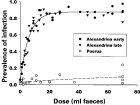
Fig. 2. The relationship between parasite dose and percentage infection for sympatric (Lake Alexandrina) and allopatric (Lake Poerua) snail treatments. All parasites were from Lake Alexandrina. The Lake Alexandrina snail treatments were sampled at 2 different times. The later sample was to check for missed infections during the early sampling period. Parameter estimates are in Table 2. The lines show the nonlinear regression for each host population. The regression shown for the Lake Alexandrina host was fit to the pooled early and late samples.

Table 2. Nonlinear regression estimates for the dose–infection function for each host population exposed to parasites from Lake Alexandrina
 You have
Access
- 35
- Cited by