Externalizing and internalizing difficulties can co-occur and share similar emotional, cognitive, and interpersonal processes (Costello et al., Reference Costello, Egger and Angold2005). Indirect aggression is a prominent form of externalizing behavior that becomes increasingly used from childhood to adolescence (Björkqvist et al., Reference Björkqvist, Lagerspetz and Kaukiainen1992). Also referred to as social or relational aggression, indirect aggression is characterized by circuitous behavior aimed at harming interpersonal relationships including gossiping, social exclusion, and rumor spreading (Archer & Coyne, Reference Archer and Coyne2005). This form of aggression can be used as an adaptive strategy to covertly gain or maintain popularity during a developmental period when social status becomes progressively salient (Vaillancourt & Hymel, Reference Vaillancourt and Hymel2006). Despite the potential social benefits, indirect aggression has been associated with costs to psychological adjustment including anxiety (Card et al., Reference Card, Stucky, Sawalani and Little2008). Preventing indirect aggression is therefore critical to prevent the harm inflicted on targets, as well as the internalizing difficulties experienced by perpetrators. One method of prevention includes early identification of individuals at-risk for using indirect aggression. For example, young people with antisocial personality dispositions such as a lack of empathy or concern for others have been found to use indirect aggression (Batanova & Loukas, Reference Batanova and Loukas2011). Therefore, the longitudinal associations among indirect aggression, anxiety, and empathy were examined in a community sample of individuals assessed annually between ages 11–16.
Developmental trends of aggression and anxiety
Aggressive behavior has generally demonstrated curvilinear patterns with a peak during childhood or adolescence (e.g., Karriker-Jaffe et al., Reference Karriker-Jaffe, Foshee, Ennett and Suchindran2008). However, there is variability in these trends across different forms of aggression. In contrast to direct aggression which has shown decreases for most individuals across childhood, indirect aggression has shown peaks during adolescence and continuity especially among high users (e.g., Côté et al., Reference Côté, Vaillancourt, Barker, Nagin and Tremblay2007; Vaillancourt & Farrell, Reference Vaillancourt and Farrell2021). As indirect aggression becomes increasingly used with age, few sex differences in mean levels are evident (Card et al., Reference Card, Stucky, Sawalani and Little2008), despite girls proportionally using more indirect aggression than boys (Björkqvist et al., Reference Björkqvist, Lagerspetz and Kaukiainen1992). Indirect aggression can also be perceived as a more socially tolerated form of aggression relative to physical aggression and is often less reprimanded (Vaillancourt & Krems, Reference Vaillancourt, Krems, Coyne and Ostrov2018). The social-cognitive intelligence features of indirect aggression additionally allow perpetrators to strategically tarnish others’ interpersonal relationships (and indirectly enhance their own social status in comparison), while simultaneously appearing to be unintentional (Kaukiainen et al., Reference Kaukiainen, Björkqvist, Lagerspetz, Österman, Salmivalli and Rothberg1999; Vaillancourt, Reference Vaillancourt2013; Vaillancourt & Hymel, Reference Vaillancourt and Hymel2006). Despite these potential social benefits, the continued vigilance to successfully execute covertly aggressive behavior can be associated with anxiety.
Anxiety can be conceptualized as a biologically-rooted basic human emotion characterized by tendencies to worry, hypervigilance to real or perceived threats, and repetitive cognitions related to adverse outcomes (Rapee, Reference Rapee1991; Vasey et al., Reference Vasey, Bosmans, Ollendick, Lewis and Rudolph2014). Prominent outcomes of extreme symptoms include anxiety disorders, which are characterized by uncontrollable fears and worries that cause impairment including catastrophizing, overgeneralizing, and personalizing (American Psychiatric Association [APA], 2013; Huberty, Reference Huberty2012; Kessler et al., Reference Kessler, Berglund, Demler, Jin, Merikangas and Walters2005; Vasey et al., Reference Vasey, Bosmans, Ollendick, Lewis and Rudolph2014). Although relatively stable, anxiety symptoms demonstrate a similar developmental pattern as indirect aggression in that a degree of social-cognitive maturation is needed for the capacity to worry (e.g., Muris, Reference Muris2006). Symptoms are typically evident during middle to late childhood. In one nationally representative sample of individuals from the United States, the median age of onset of anxiety was 11 (Kessler et al., Reference Kessler, Berglund, Demler, Jin, Merikangas and Walters2005), and in a recent meta-analysis of 192 studies, 38.1% of individuals had onset of anxiety or fear-related disorders before the age of 14 with a median age of 17 (Solmi et al., Reference Solmi, Radua, Olivola, Croce, Soardo, de Pablo and Fusar-Poli2021). Some evidence indicates overall increases in trajectory patterns from childhood to adolescence (Broeren et al., Reference Broeren, Muris, Diamantopoulou and Baker2013; Rapee, Reference Rapee1991) and other evidence indicates curvilinear patterns of an initial increase followed by a decrease (e.g., across ages 10–12; van Oort et al., Reference Van Oort, Greaves-Lord, Verhulst, Ormel and Huizink2009). Several theoretical models help explain the developmental trends and associations between indirect aggression and anxiety.
Theoretical models of aggression and anxiety
Theories of developmental psychopathology propose that development occurs a result of multiple transactional patterns involving successful and unsuccessful adaptive responses to surrounding biological, individual, social, and environmental processes (Cicchetti & Cohen, Reference Cicchetti, Cohen, Cicchetti and Cohen1995). Indirect aggression can result from alleviating anxious tendencies or can result in worries that others will aggress against them. Specifically, the “acting out model” suggests that underlying internalizing symptoms can manifest through externalizing behavior (Carlson & Cantwell, Reference Carlson and Cantwell1980). This model has been primarily investigated with depression symptoms and externalizing behavior (e.g., Blain-Arcaro & Vaillancourt, Reference Blain-Arcaro and Vaillancourt2017, Reference Blain-Arcaro and Vaillancourt2019), but can also be applied to anxiety symptoms and indirect aggression. Granic (Reference Granic2014) explains that individuals higher on anxiety symptoms are hypervigilant to threats, which can result in the depletion of cognitive resources that would typically inhibit aggressive impulses. Moreover, Grotpeter and Crick (Reference Grotpeter and Crick1996) explain that relationally aggressive children maintain control over a few select friendships, while simultaneously excluding others. Individuals can therefore use indirect aggression to manage anxiety by deflecting attention from themselves and placing that attention on others’ shortcomings (Loudin et al., Reference Loudin, Loukas and Robinson2003). From this perspective, indirect aggression can serve as a strategic tool to reactively regulate anxious emotions (e.g., Kunimatsu & Marsee, Reference Kunimatsu and Marsee2012) and proactively apply control over peers, solidify social resources, and reduce further feelings of anxiety.
The limited number of longitudinal studies on aggression and anxiety provide some support for the acting out model. In a short-term longitudinal study over a 1-year period, anxiety symptoms in elementary school-aged children positively predicted relational aggression, but anxiety was not assessed at the second time point (Cooley et al., Reference Cooley, Frazer, Fite, Brown and DiPierro2017). In addition, Vitaro et al. (Reference Vitaro, Brendgen and Tremblay2002) found that youth across ages 10–12 classified into a “reactively aggressive” group had higher levels of anxiety at age 6 relative to individuals in a “proactively aggressive” group, but similar to Cooley et al. (Reference Cooley, Frazer, Fite, Brown and DiPierro2017), all variables were not assessed at all time points. In another study, Meeus et al. (Reference Meeus, Van de Schoot, Hawk, Hale and Branje2016) examined direct aggression with anxiety across 5 years through a latent transition analysis in a cohort of early to middle adolescents and a cohort of middle to late adolescents. Evidence supported an acting out model in the early to middle adolescent cohort only, as there were transitions from anxiety profiles to direct aggression profiles (for boys). Some gender effects were also found as increases in anxiety and decreases in the aggression and comorbid patterns were more evident among girls than boys. Therefore, there is some longitudinal evidence for the acting out model, but these studies have primarily been short-term longitudinal studies and included a variety of assessments of aggression (reactive aggression, direct aggression) rather than indirect aggression.
In contrast to the acting out model, the “failure model” proposes that internalizing difficulties result from externalizing difficulties (Capaldi & Stoolmiller, Reference Capaldi and Stoolmiller1999). Specifically, failed experiences in social relationships can lead to feeling a loss of control over these relationships and result in negative feelings about the self and others, including heightened stress-responses (e.g., fight-or-flight response; Rudolph et al., Reference Rudolph, Flynn, Abaied, Abela and Hankin2008). In the context of aggression, indirectly aggressive behavior could elicit negative responses from peers including peer rejection or failed interpersonal relationships (Capaldi, Reference Capaldi1991, Reference Capaldi1992; Coie et al., Reference Coie, Terry, Lenox, Lochman and Hyman1995). These adverse responses can be interpreted as peers threatening one’s social standing, or as a projection of one’s own goals for using indirect aggression. Indeed, projection is a defence mechanism that is increasingly used during late childhood and adolescence and involves attributing one’s own thoughts onto others, which often results in perceptions of others as threatening and hostile (Cramer, Reference Cramer2012). These adverse or failed relationships would act as mediating mechanisms between indirect aggression and anxiety. Therefore, after engaging in indirect aggression and receiving poor peer responses, anxiety or worry about threats to oneself can increase (e.g., Bubier & Drabick, Reference Bubier and Drabick2009; Granic, Reference Granic2014; Meeus et al., Reference Meeus, Van de Schoot, Hawk, Hale and Branje2016).
Some researchers have found support for the failure model, but the majority of these studies included assessments of global externalizing problems and specific behavioral disorders instead of indirect aggression and anxiety symptoms (e.g., Blain-Arcaro & Vaillancourt, Reference Blain-Arcaro and Vaillancourt2019). In one study, an externalizing composite of aggression and delinquency among children (ages 4–16 at the first time point) predicted anxiety disorders 14 years later (Roza et al., Reference Roza, Hofstra, Van Der Ende and Verhulst2003). However, this study did not include all assessments at all time points, making it difficult to discern whether this was true evidence in support of the failure model. Oh et al. (Reference Oh, Greenberg and Willoughby2020) helped reduce some of these methodological limitations by conducting a random intercept cross-lagged panel model (RI-CLPM). In this model, a composite of externalizing problems (i.e., fighting, loss of temper) and a composite of internalizing problems (i.e., worry, depressed, anxious) were examined in children followed annually for 5 years from kindergarten to grade three. After accounting for between-person effects, within-person effects revealed that higher externalizing problems predicted higher internalizing problems the following year. However, the between-person component of an RI-CLPM examines the random intercept only and therefore important information on the trajectory shapes (i.e., slopes) of externalizing and internalizing problems were not considered in this study. Taken together, there are mixed findings on the association between indirect aggression and anxiety with some evidence supporting the acting out model and other evidence supporting the failure model. Examining other individual differences that could help identify youth at-risk for developing these difficulties such as antisocial personality traits could further clarify directional associations between indirect aggression and anxiety symptoms.
The role of empathy
A common antisocial tendency associated with aggression includes a lack of empathy. Empathy is a multidimensional personality trait encompassing the understanding, sharing, and feeling of others’ distress (Davis, Reference Davis1980). Empathic concern, considered one aspect of affective empathy, is the extent to which an individual is worried about the emotional distress experienced by others (Decety & Cowell, Reference Decety and Cowell2014a; Jordan et al., Reference Jordan, Amir and Bloom2016). Empathic concern is in contrast to perspective taking, which is an aspect of cognitive empathy and refers to the extent to which an individual is able to recognize and understand the emotions of others. Researchers have noted that a lack of empathic concern rather than perspective taking reflects a motivational component of empathy aimed at alleviating others’ emotional pain and is therefore more strongly negatively associated with antisocial and aggressive behavior (Decety & Cowell, Reference Decety and Cowell2014a, Reference Decety and Cowell2014b; Jordan et al., Reference Jordan, Amir and Bloom2016).
Similar to indirect aggression and anxiety symptoms, empathic concern has demonstrated gradual increases across early adolescence (Davis & Franzoi, Reference Davis and Franzoi1991) and stability during late adolescence (Eisenberg et al., Reference Eisenberg, Cumberland, Guthrie, Murphy and Shepard2005). Some researchers have found differences between girls and boys, with girls demonstrating stability across ages 13–16 and boys demonstrating decreases between 13–16 followed by an increase (Van der Graaff et al., Reference Van der Graaff, Branje, De Wied, Hawk, Van Lier and Meeus2014). Increases have been attributed to advanced social-cognitive skills and the ability to discern between one’s own distress and the distress of others (Davis, Reference Davis1980; Decety & Svetlova, Reference Decety and Svetlova2012). Despite the similarities in developmental trends with indirect aggression and anxiety, empathic concern appears to have opposite directional associations with these two constructs.
Empathic concern and aggressive behavior have been consistently negatively associated. In one study of adolescents followed across 2 time points 1 year apart, higher empathic concern predicted decreases in relational aggression (Batanova & Loukas, Reference Batanova and Loukas2011). Higher empathy also mitigated the impact of social anxiety on relational aggression. Similarly, in a study of Latinx adolescents followed across 2 time points assessed 3 months apart, affective empathy was inversely associated with indirect aggression at higher levels of social anxiety (Tarlow & La Greca, Reference Tarlow and La Greca2021). In contrast to the association with indirect aggression, empathic concern appears to be positively associated with anxiety. Among adolescent inpatients, affective empathy was concurrently positively associated with anxiety symptoms (Gambin & Sharp, Reference Gambin and Sharp2018) and in a longitudinal study of adolescents, higher empathic concern predicted higher anxiety 1 year later (Llorca et al., Reference Llorca, Malonda and Samper2017). These researchers explained that worry about one’s own social relationships may be related to strategically using covertly aggressive behavior to obtain social status, whereas concern over others’ well-being could prevent individuals from harming others. It is noteworthy that the majority of these studies were on empathic concern with social anxiety rather than general anxiety. Accordingly, it is unclear how empathic concern would be temporally and directionally associated with indirect aggression and general anxiety symptoms across adolescence when examined in a single comprehensive model.
In sum, several limitations of previous studies on indirect aggression, anxiety, and empathy should be addressed. First, assessments of the key constructs have differed across studies. Composite scores of externalizing or internalizing difficulties have been examined (e.g., Oh et al., Reference Oh, Greenberg and Willoughby2020) or the form of aggression and anxiety assessed has varied (e.g., direct aggression, Meeus et al., Reference Meeus, Van de Schoot, Hawk, Hale and Branje2016; reactive aggression, Vitaro et al., Reference Vitaro, Brendgen and Tremblay2002; social anxiety, Batanova & Loukas, Reference Batanova and Loukas2011). Thus, it is undecided whether these patterns of findings apply specifically to indirect aggression and general anxiety symptoms, which are increasingly salient across adolescence. Second, longitudinal methods have varied in assessing between-person, variable-centered associations (e.g., regression based; Cooley et al., Reference Cooley, Frazer, Fite, Brown and DiPierro2017), a mix of between-person and within-person development (e.g., latent transition analysis, Meeus et al., Reference Meeus, Van de Schoot, Hawk, Hale and Branje2016), or within-person change after accounting for between-person variation (e.g., RI-CLPM; Oh et al., Reference Oh, Greenberg and Willoughby2020). Thus, it is unclear how much of the longitudinal associations between aggression and anxiety are due to true between-person trait-like effects versus within-person intra-individual change. Finally, it is uncertain whether examining associations with antisocial traits such as a lack of empathic concern can clarify temporal associations between indirect aggression and anxiety symptoms and help identify individuals at-risk for developing these specific externalizing and internalizing difficulties.
Current study
Our primary goal was to examine the between- and within- person longitudinal associations of indirect aggression, anxiety symptoms, and empathic concern across childhood and adolescence from age 11 (Grade 5) to age 16 (Grade 10). We chose to focus on late childhood to early adolescence as this developmental period coincides with increases in the use of indirect aggression (Björkqvist et al., Reference Björkqvist, Lagerspetz and Kaukiainen1992), likely in response to the increased importance placed on social status and peer relationships (Vaillancourt & Hymel, Reference Vaillancourt and Hymel2006), as well as the onset of anxiety disorders (Kessler et al., Reference Kessler, Berglund, Demler, Jin, Merikangas and Walters2005; Solmi et al., Reference Solmi, Radua, Olivola, Croce, Soardo, de Pablo and Fusar-Poli2021). Adolescence is therefore an important developmental period to examine the temporal precedence of indirect aggression, anxiety symptoms, and related individual differences like empathy. To disaggregate between- and within- person relations, we used an autoregressive latent trajectory model with structured residuals (ALT-SR; Berry & Willoughby, Reference Berry and Willoughby2017; Curran et al., Reference Curran, Howard, Bainter, Lane and McGinley2014). This way, we could examine the: (a) between-person associations including the starting point (i.e., intercepts) and shape (i.e., slopes) of overall trajectories (e.g., an individual’s level of indirect aggression over time relative to other individuals’ levels over time), and (b) within-person associations (e.g., an individual’s level of indirect aggression over time relative to their own previous level).
For goal (a), we predicted significant between-person developmental trajectories reflecting trait-like differences between individuals. Indirect aggression, anxiety symptoms, and empathic concern were predicted to increase across development (i.e., significant intercepts and slopes). Between individuals, anxiety was expected to be positively associated with indirect aggression and empathic concern (i.e., positive associations between intercepts and slopes) and indirect aggression and empathic concern were expected to be negatively associated. For goal (b), we predicted within-person stability of indirect aggression, anxiety symptoms, and empathic concern. We also predicted that within each time point, anxiety symptoms would be positively correlated with indirect aggression and empathic concern and that indirect aggression would be negatively correlated with empathic concern. For cross-lagged associations, we did not have predictions on temporal precedence due to previous mixed support for the acting out and failure models. However, we predicted anxiety symptoms would have positive cross-lagged associations with indirect aggression and empathic concern, and indirect aggression would have negative cross-lagged associations with empathic concern. Finally, we controlled for demographic factors that have been previously associated with aggression, anxiety, and empathy including sex (e.g., Meeus et al., Reference Meeus, Van de Schoot, Hawk, Hale and Branje2016), socioeconomic status, and race/ethnicity (e.g., Oh et al., Reference Oh, Greenberg and Willoughby2020). Direct aggression was also controlled for as this form of aggression has been correlated with indirect aggression in particular during earlier in childhood (Vaillancourt et al., Reference Vaillancourt, Brendgen, Boivin and Tremblay2003).
Method
Participants
A longitudinal study called the McMaster Teen Study examining bullying, mental health, and academic achievement was conducted in the spring of 2008 and 51 randomly selected schools from a school district in southern Ontario, Canada were invited to participate. All participants were in Grade 5 at Time 1 of the study (M age = 10.91 years; SD = 0.36) and participants have been followed up annually until age 24, with the study on-going. Parent reported annual household income at Time 1 was $70,000–$80,000, which was similar to the city ($76,222) and province of recruitment ($70,910; http://statscan.gc.ca). In the longitudinal part of the study, 875 participants agreed to participate and 703 (80.5%) participated in at least one of the follow-up time points between Time 1 to 8. The analytic sample was restricted to participants who provided data on indirect aggression, anxiety, and empathy in at least one time point between Time 1 and 6 (i.e., time points when key variables were measured). For simplicity, these time points will be referenced by participant age at each time point, with ages being rounded to the mean. Therefore, the time points reflected ages 11 (Time 1) to 16 (Time 6). There were 700 participants in the analytic sample (52.9% girls; 76.0% White). The median parent reported annual household income for the analytic sample was between $70,000 and $80,000 and the median completed parent education level was a college diploma or trades certificate.
Procedure
At Time 1 of the study, ethics approval from the school district was received and ethics approval was received annually from the university ethics boards. Parental consent and participant assent were collected annually until Time 6 (age 16), from which only participant consent was collected annually. At Time 1, participants completed measures using paper and pencil in school classrooms and in subsequent years participants completed measures at home either online or with paper and pencil. Parents completed interviews over the telephone with trained research assistants. As compensation, participants received gift cards that increased in value annually (see Vaillancourt et al., [Reference Vaillancourt, Brittain, McDougall and Duku2013] for additional details).
Measures
Indirect aggression
Indirect aggression was measured using 12 self-report items from the Aggressive Behavior Scale (Little et al., Reference Little, Henrich, Jones and Hawley2003). This measure has previously demonstrated reliability and validity in child and adolescent samples. An item included, “I’m the kind of person who ignores others or stops talking to them.” Items were rated on a four-point scale (0 = not at all true to 3 = completely true). Items were averaged to create a composite at each time point, with higher scores indicating higher indirect aggression perpetration (Cronbach’s α = .79 to .85).
Anxiety symptoms
Anxiety symptoms were measured using 10 self-report items from the Behavioral Assessment System for Children-Second Edition (Reynolds & Kamphaus, Reference Reynolds and Kamphaus2004). The child version was assessed at ages 11 and 12 and the adolescent version was assessed at ages 13 onwards. Only items consistent across both versions of the measure were used to create the composite at each time point. Items were rated either on a four-point scale (0 = never to 3 = almost always; e.g., “I worry about what is going to happen.”) or on a dichotomous response (0 = false and 2 = true; e.g., “I worry about little things.”). Items were summed using typical scoring procedures to create a composite at each time point with higher scores indicating higher anxiety symptoms (Cronbach’s α = .85 to .90).
Empathic concern
Empathic concern was measured using seven self-report items from the Interpersonal Reactivity Index (Davis, Reference Davis1980). An item included, “When I see someone treated poorly, it bothers me.” Items were rated on a five-point scale (0 = not at all like me to 4 = always like me). Items were averaged to create a composite score at each time point with higher scores indicating higher empathic concern (Cronbach’s α = .86 to .87).
Control variables
Data on sex and race/ethnicity were collected at Time 1. Data on parent reported annual household income were assessed at Times 1, 3, and 5. Due to the small number of races reported, race was recoded into White (82.4%) or from underrepresented racial groups (17.6%). Household income was on an eight-point scale increasing in increments of $10,000 (e.g., 1 = <$19,999; 2 = $20,000–29,999; to 8 = >$80,000). An average was created for income (r = .80 to .88). Direct aggression was measured annually using 12 items from the Aggressive Behavior Scale (Little et al., Reference Little, Henrich, Jones and Hawley2003). This measure has previously demonstrated reliability and validity in child and adolescent samples. An item included, “I’m the kind of person who hits, kicks, or punches others.” Items were rated on a four-point scale (0 = not at all true to 3 = completely true). Items were averaged to create a composite at each time point, with higher scores indicating higher direct aggression perpetration (Cronbach’s α = .86 to .89).
Analytic plan
Analyses were conducted in MPlus 7.4 (Muthén & Muthén, Reference Muthén and Muthén1998-2017) using full information maximum likelihood estimation to deal with missing data and maximum likelihood robust (MLR) estimation to deal with slight skewness in indirect aggression. Model fit was evaluated for each model based on the following criteria: the comparative fit index (CFI) values >.95, the Tucker−Lewis index values >.95, the root mean square error of approximation (RMSEA) values <.06, and the standardized root mean square residual (SRMR) values <.08 (Browne & Cudeck, Reference Browne and Cudeck1992; Hu & Bentler, Reference Hu and Bentler1999). The χ2 test of significance was also reported, although this test is sensitive to large sample sizes (Kline, Reference Kline2016).
ALT-SR were tested using procedures outlined by Berry and Willoughby (Reference Berry and Willoughby2017) and Curran et al. (Reference Curran, Howard, Bainter, Lane and McGinley2014) to account for between-person associations while examining within-person associations among indirect aggression, anxiety, and empathy. Between-person associations, otherwise known as stable, trait-like variations were examined by estimating an intercept (latent mean) and slope (trajectories) for indirect aggression, anxiety, and empathy. Although univariate growth models demonstrated that a quadratic model fit the trajectories best, the ALT-SR model did not converge with the addition of a quadratic growth factor. As such, linear slopes only were estimated and each individual linear growth curves demonstrated adequate fit (all CFI > .93, RMSEA ≤ .08, SRMR ≤. 08 except empathy which was .106).Footnote 1 All intercepts and slopes were allowed to covary with one another and nonsignificant slope (co)variances were constrained to zero for parsimony. Demographic control variables were included as time-invariant covariates. Paths were added from parent reported household income, race, and participants’ sex at birth to each latent intercept and slope. The demographic control variables were also allowed to covary with one another.
Within-person associations were examined by estimating structured residuals which involved constraining residual variances of each observed variable to zero. One-year autoregressive paths between the structured residuals were estimated (e.g., residual of age 11 indirect aggression to residual of age 12 indirect aggression). Within-time covariance terms between the structured residuals were also estimated for each variable (e.g., residual of age 11 indirect aggression correlated with residual of age 11 anxiety). Cross-lagged paths between the structured residuals at each adjacent time point were also estimated (e.g., residual of age 11 indirect aggression to residual of age 12 anxiety). Finally, the autoregressive paths, within-time covariances, and cross-lagged paths were tested for invariance using a series of nested models with the Satorra−Bentler scaled χ2 test (Satorra & Bentler, Reference Satorra and Bentler2001). When no significant differences were found for nested models (p > .05), constraints were retained for parsimony. The stability of each variable was first tested individually (Models 2a to 2d), followed by the within-time covariances for each pair of variables (Models 3a to 3f), and then the cross-lagged paths to each variable (Models 4a to 4d). Direct aggression was included as a time-varying covariate by modeling the between- and within-person components the same way that indirect aggression, anxiety, and empathy were modeled (i.e., linear growth model at between-person level, structured residuals at within-person level testing for invariance of autoregressive paths, within-time covariances, and cross-lagged paths). Finally, the Benjamini−Hochberg (BH) correction was applied to reduce Type I error as a result of multiple testing (Benjamini & Hochberg, Reference Benjamini and Hochberg1995).
Results
Missing data and descriptive statistics
Using chi-square and t-tests, the analytic sample (n = 700) was compared against participants in the larger longitudinal study on demographic variables. There was a significant difference by race, χ2(1) = 23.965, p < .001 and household income, t(162.271) = −5.893, p < .001. The analytic sample was comprised of more White participants and had a higher level of household income. Missingness was also examined within the analytic sample across the key study variables (Time 1–6 indirect aggression, anxiety symptoms, empathic concern, and Time 1–6 direct aggression). Little’s MCAR test indicated data were missing at random, χ2(1111)= 1175.594, p = .087.
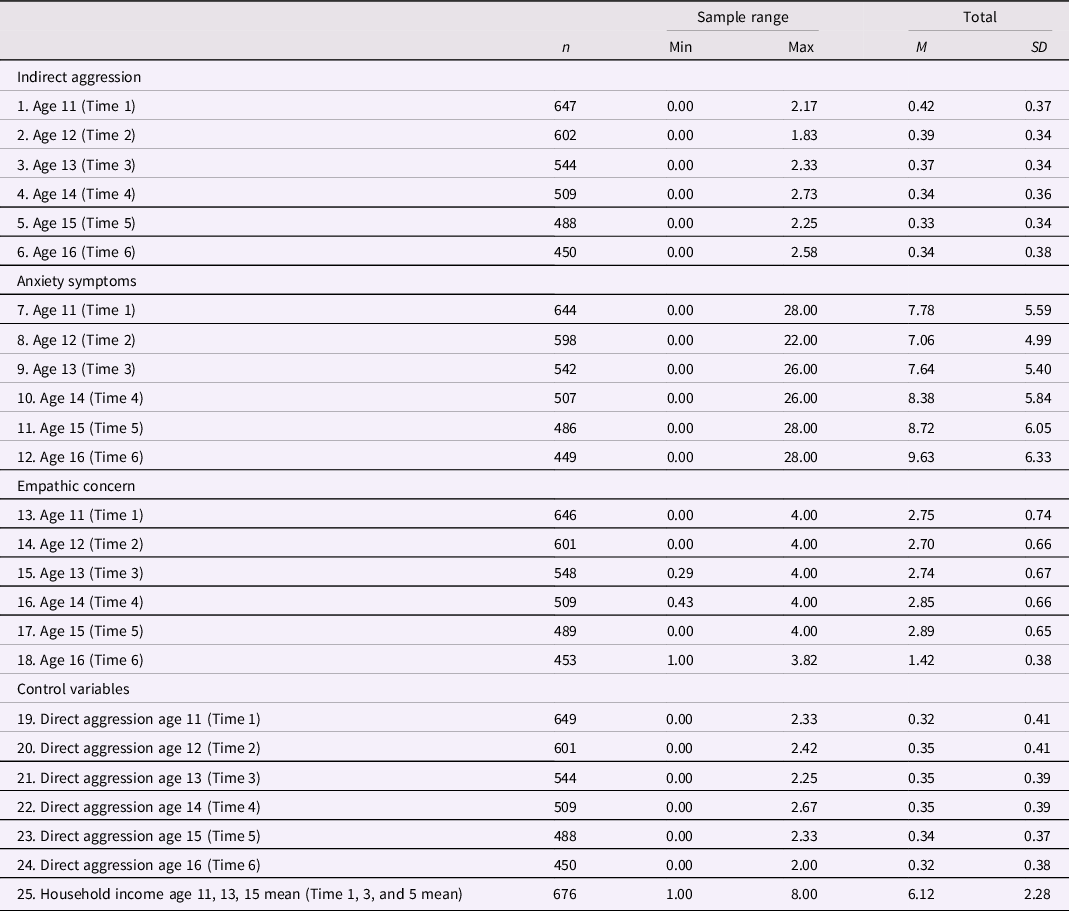
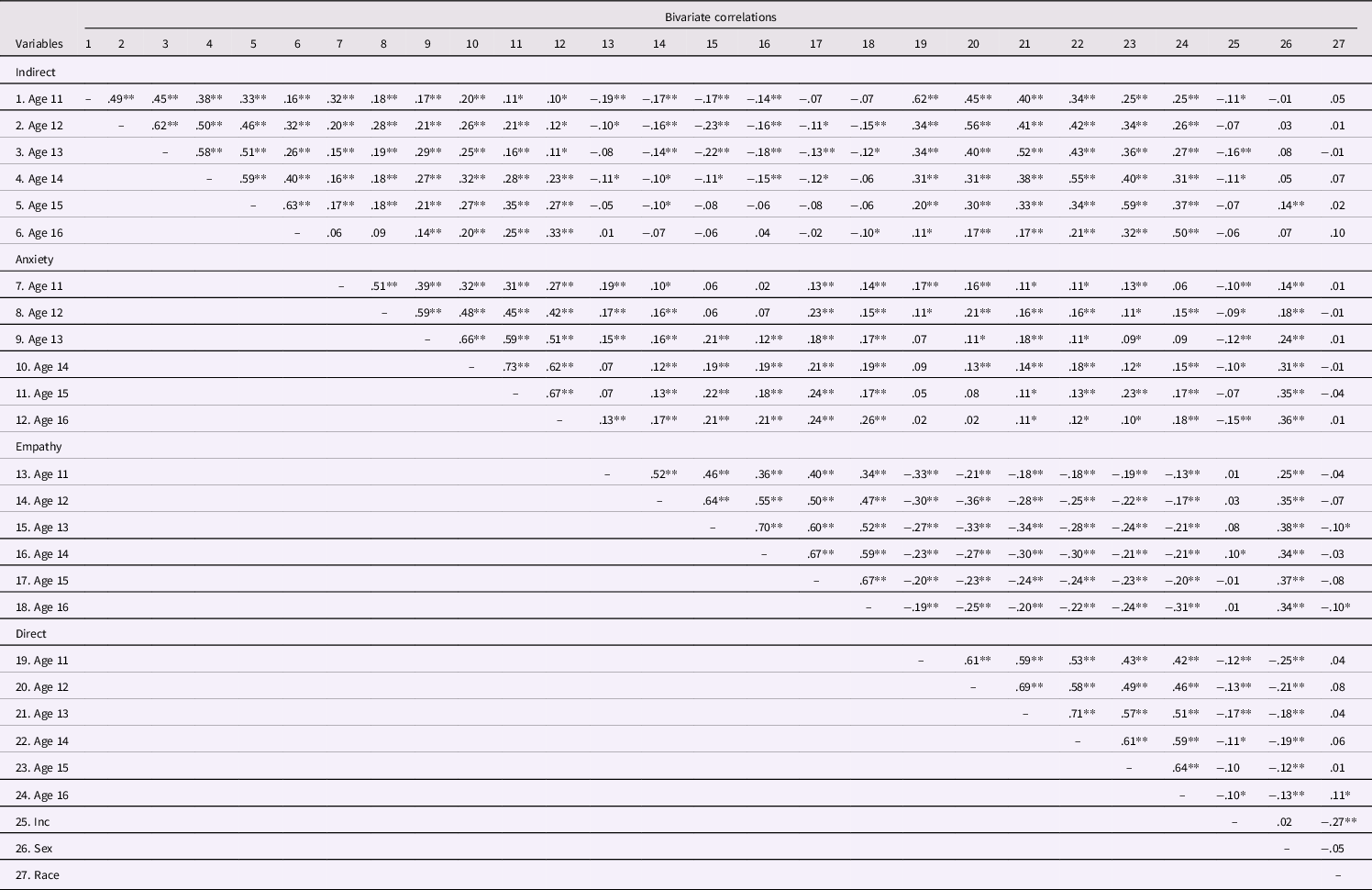
The descriptive statistics for all continuous study variables are in Table 1. All variables demonstrated skewness and kurtoses values within limits (under 3 for skewness, under 10 for kurtosis, Kline, Reference Kline2016). However, the distributional shape of indirect aggression was positively skewed (range: 1.19–2.17) and leptokurtic (values range: 1.40–6.40), as typically found for aggressive behavior. Accordingly, MLR estimation was used to account for this distributional shape. Within each time point there were significant positive bivariate correlations between indirect aggression and anxiety, empathy and anxiety, and significant negative correlations between indirect aggression and empathy (except at age 15; see Table 2 for correlations among all study variables including control variables).
Descriptive statistics of continuous study variables for analytic sample

Correlations of study variables
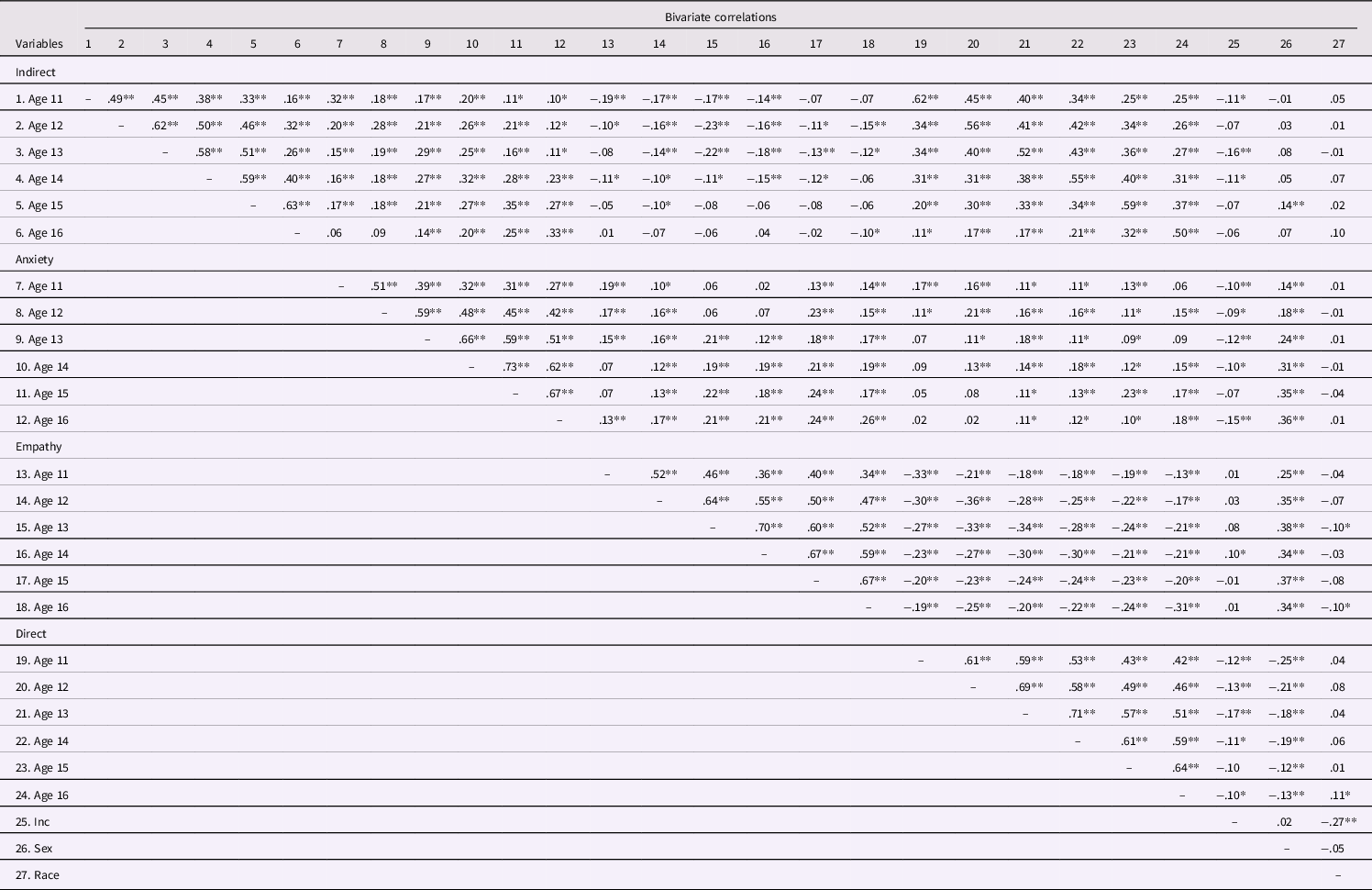
Note. Indirect = indirect aggression; Anxiety = anxiety symptoms; Empathy = empathic concern; Direct = direct aggression; Inc = household income; Sex coded with 0 = boy and 1 = girl; Race/Ethnicity coded with 0 = White and 1 = Underrepresented Racial Groups.
*p < .05. **p < .01.
Autoregressive latent trajectory model with structured residuals
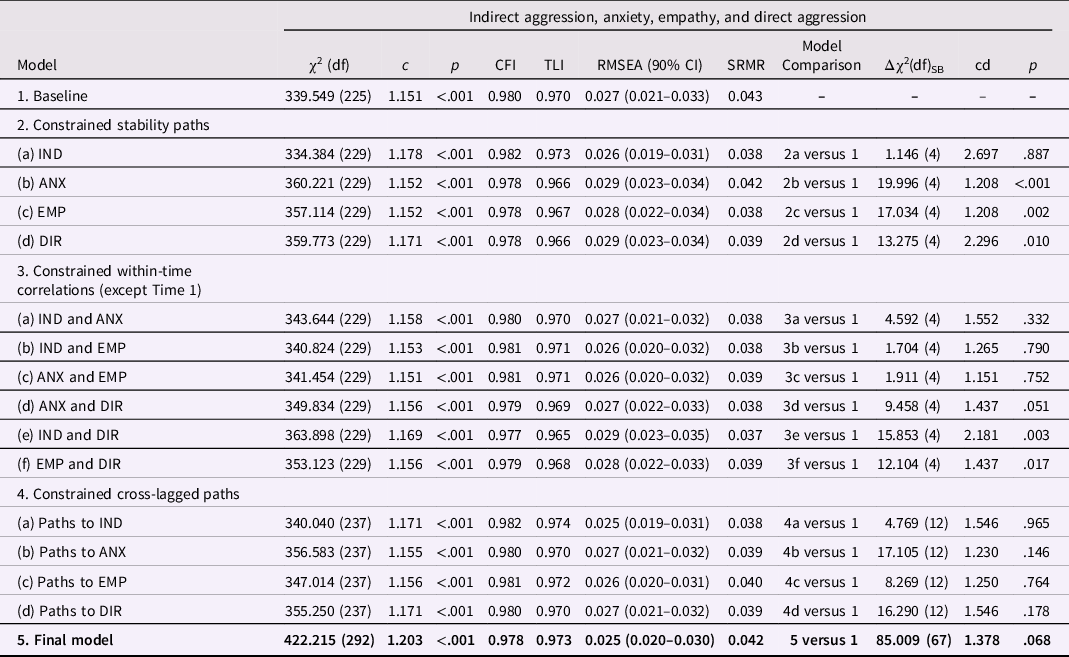
The ALT-SR model was estimated by including latent intercepts and linear slopes for indirect aggression, anxiety symptoms, empathic concern, and direct aggression (time-varying covariate), covariance terms between the intercepts and slopes, autoregressive paths of structured residuals, within-time covariance terms between the structured residuals, and cross-lagged paths between structured residuals across time. Paths were also estimated from demographic control variables (sex,Footnote 2 household income, and race) to the intercepts and slopes and demographic control variables were allowed to covary with one another. Indirect aggression and direct aggression had significant variation in the slope factor. Therefore, the (co)variances involving the slope factors for empathy and anxiety were fixed to zero for parsimony. Results indicated that with the exception of the covariance between the intercept and slope of indirect aggression, the intercept and slope of direct aggression, and the intercept of direct aggression and the slope of indirect aggression, all other covariances between the intercepts and slopes were not significant and were also fixed to zero.Footnote 3 This yielded a baseline model that had excellent fit to the data (see Table 3, Model 1). The addition of equality constraints on the autoregressive paths between each adjacent time point for indirect aggression (Model 2a) indicated no significant difference in model fit compared to the baseline model, whereas constraints on the autoregressive paths for all other variables significantly deteriorated model fits (Models 2b to 2d). Therefore, equality constraints on the autoregressive paths for indirect aggression only were retained. The addition of equality constraints on the covariance terms between all structured residuals within each time point (except at the first time point; Curran et al., Reference Curran, Howard, Bainter, Lane and McGinley2014) indicated no significant differences in model fits from the baseline model (Models 3a to 3d) with two exceptions. Equality constraints on the covariance terms between structured residuals of direct aggression with indirect aggression and direct aggression with empathy significantly deteriorated model fit (Models 3e to 3f) and therefore these covariance terms were free to vary. The addition of equality constraints on all cross-lagged paths of structured residuals across each adjacent time point indicated no significant differences in model fits (Models 4a to 4d) compared to the baseline model and all constraints were retained. The final model including constrained autoregressive paths for indirect aggression, constrained within-time covariance terms (except at the first time point) for all variables except for direct aggression with indirect aggression and direct aggression with empathy, and constrained cross-lagged paths for all variables had excellent fit to the data and was not significantly different from the baseline model (Model 5). Findings reported are based on results after applying the BH correction for multiple testing.
Summary of model fit statistics for the ALT-SR analyses
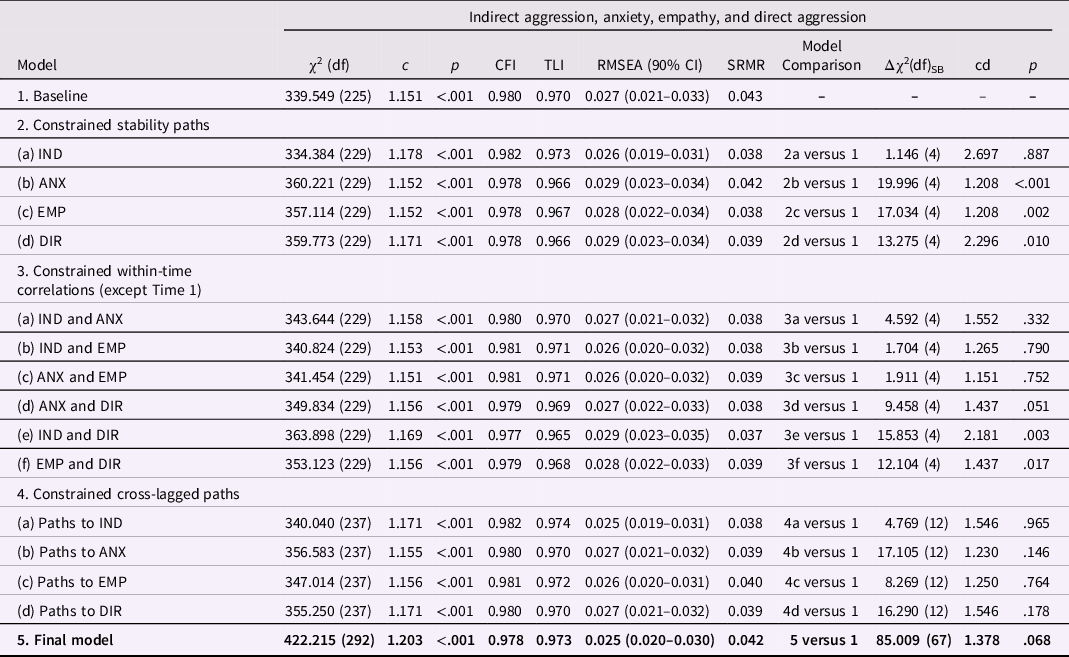
Note. IND = indirect aggression, ANX = anxiety, EMP = empathy, DIR = direct aggression; Final selected model is bolded and included constrained stability paths for indirect aggression, constrained within-time covariance terms among indirect aggression, anxiety, and empathy, and anxiety and direct aggression (except at Time 1), and all constrained cross-lagged paths; χ2 = chi-square; df = degrees of freedom; c = correction factor; CFI = comparative fit index; TLI = Tucker–Lewis index; RMSEA = root mean square error of approximation; SRMR = standardized root mean square residual; Δχ2 SB = Satorra–Bentler scaled Chi-square difference test; CD = difference test scaling correction (Models 2, 3, 4, and 5 compared to Model 1).
Between-person associations
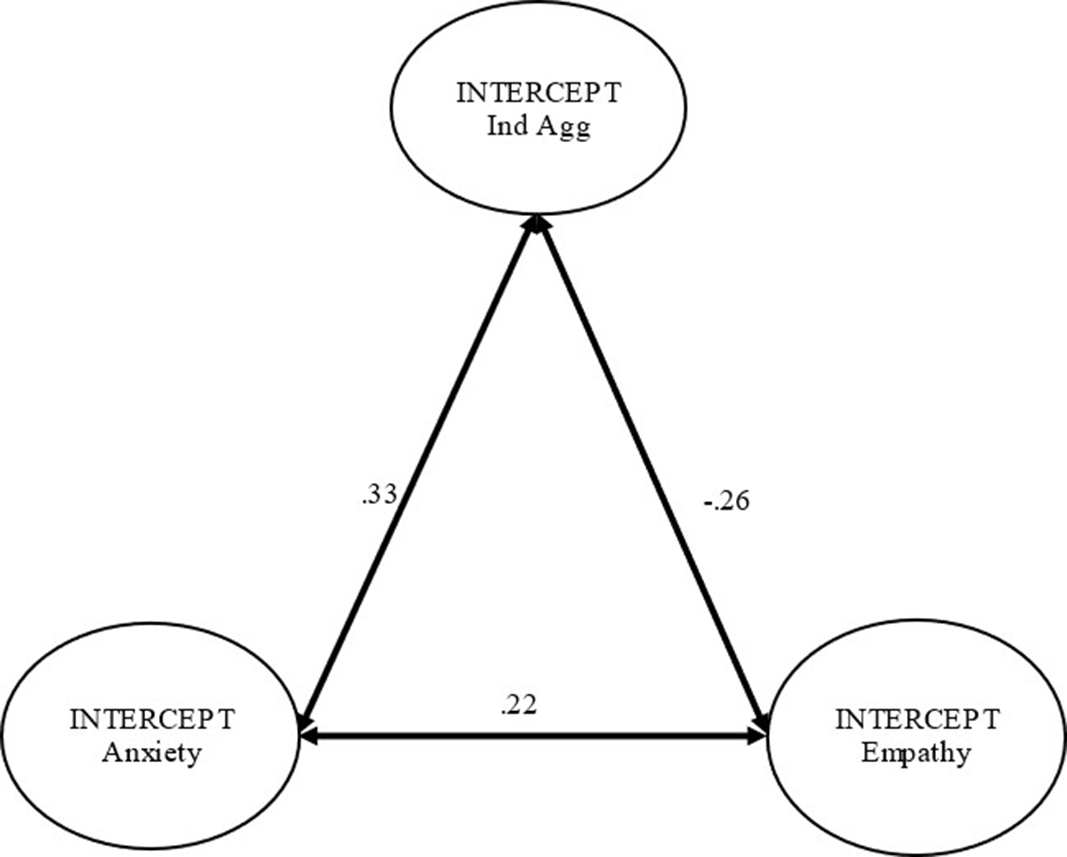
For the covariates, lower household income significantly positively predicted the intercept of indirect aggression and anxiety. Being a girl significantly positively predicted the intercept and slope of anxiety and the intercept of empathy. The intercept of direct aggression was significantly positively associated with the intercepts of indirect aggression and anxiety, and negatively associated with the intercept of empathy. After accounting for the demographic control variables, the latent means and slopes were statistically significant (indirect aggression: intercept = 0.407, slope = −0.014; anxiety symptoms: intercept = 7.162, slope = 0.406; empathic concern: intercept = 2.688, slope = 0.037; ps < .001). Direct aggression had a significant intercept only (intercept = 0.342, p < .001, slope = 0.004, p = .305). At the between-person level, the intercepts showed significant associations (see Figure 1). The intercept of indirect aggression was significantly positively associated with the intercept of anxiety symptoms and negatively associated with the intercept of empathy. The intercepts of anxiety and empathy were significantly positively associated. There were no other significant correlations with slopes. Significant standardized between-person effects were small to moderate in effect size.
Between-person associations of ALT-SR model for the intercepts of indirect aggression, anxiety symptoms, and empathic concern; Ind Agg = indirect aggression; Anxiety = anxiety symptoms; Empathy = empathic concern; Solid lines represent significant correlations at the Benjamini–Hochberg adjusted p value. Nonsignificant associations, slopes, and control variables are not presented for ease of interpretation. Between-person control variables included sex, race, household income, and the intercept and slope of direct aggression. Values represent standardized coefficients (r).

Within-person associations
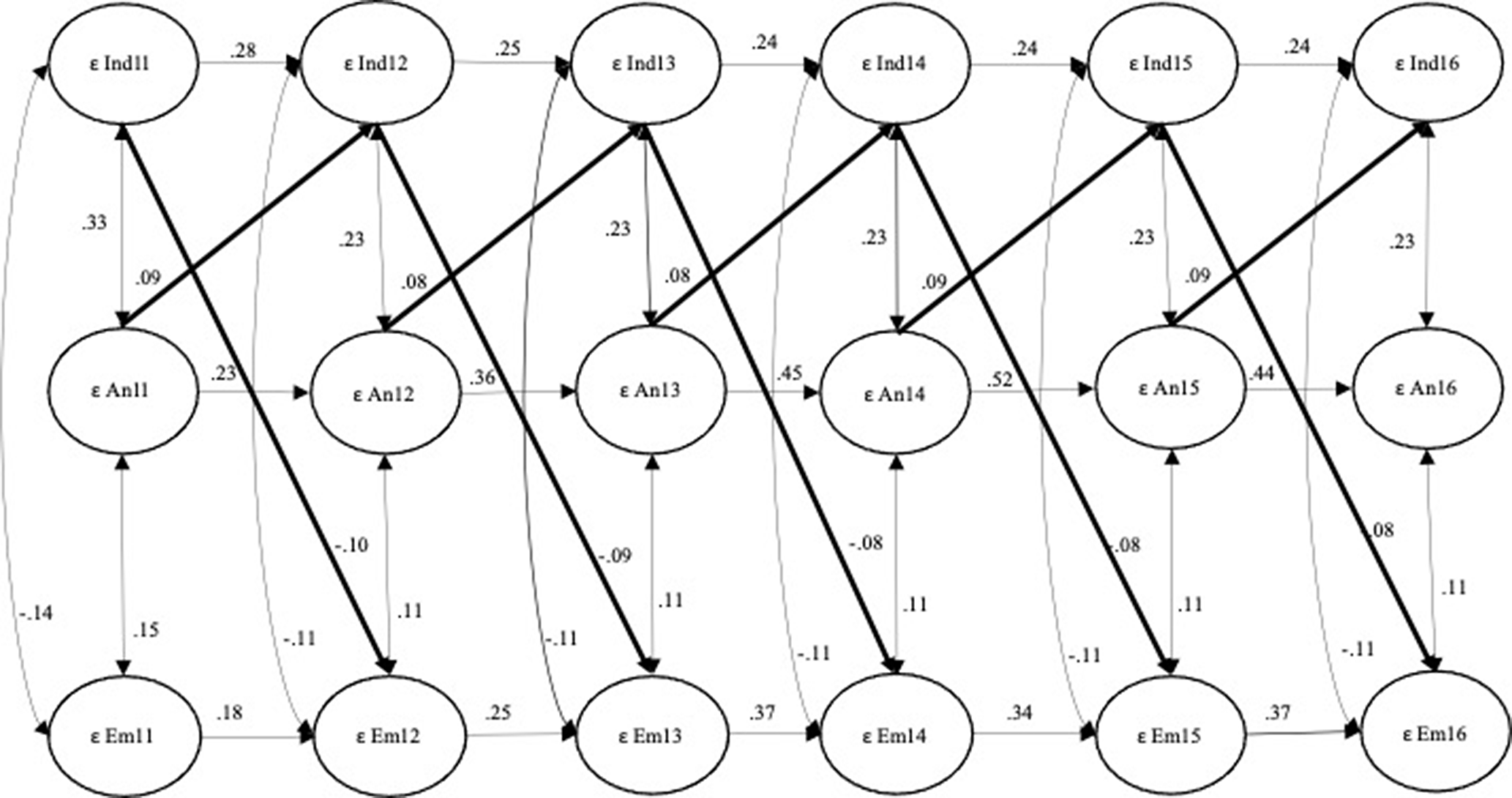
After accounting for the between-person associations, at the within person level, direct aggression was accounted for as a time-varying covariate by estimating all autoregressive paths, within-time correlations, and cross-lagged paths. Autoregressive paths for direct aggression were significant from ages 12 to 13 and 13 to 14. Direct aggression was significantly correlated positively with indirect aggression (time-varying) and anxiety (time-invariant) at all time points and negatively with empathy at all time points except for ages 14 and 15 (time-varying). In addition, indirect aggression consistently predicted direct aggression across all adjacent time points (time-invariant). After controlling for direct aggression, the autoregressive paths were consistently stable across all time points for indirect aggression (time-invariant) and stable across all time points for anxiety and empathy although these paths varied across time (see Figure 2 and Supplementary Table S1 for unstandardized and standardized estimates). Within time, all associations were time-invariant. Anxiety symptoms were significantly positively associated with indirect aggression and empathic concern (see Figure 2). Empathic concern was significantly negatively associated with indirect aggression. At each adjacent time point, there were significant positive cross-lagged paths from anxiety to indirect aggression and negative cross-lagged paths from indirect aggression to empathy (all time-invariant). These cross-lagged paths indicated that deviations from an individual’s average trajectory in anxiety at a given time point positively predicted deviations from that individual’s expected trajectory of indirect aggression. In addition, an individual’s deviations from their average trajectory of indirect aggression negatively predicted deviations from that individual’s average trajectory of empathic concern. Significant standardized within-person effects were small in effect size. Finally, given that some pathways spanned three time-points (anxiety to indirect aggression to empathy), indirect effects were tested. Since these pathways were constrained across time, we created interaction terms (i.e., anxiety to indirect aggression as path [a] and indirect aggression to empathy as path [b]; Berry & Willoughby, Reference Berry and Willoughby2017) and estimated bootstrapped confidence intervals with 5,000 draws. However, the indirect effect was not significant (p > .05).
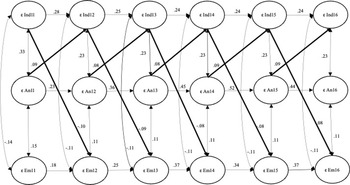
Within-person associations of ALT-SR model for the structured residuals of indirect aggression, anxiety symptoms, and empathic concern across ages 11 to 16; ϵ (epsilon) = residual variance; Ind = indirect aggression; An = anxiety symptoms; Em = empathic concern; Solid lines represent significant parameters at the Benjamini–Hochberg adjusted p value. Significant cross-lagged paths are bolded for ease of interpretation. Nonsignificant associations and control variables are not presented for ease of interpretation. Within-person control variables included structured residuals of direct aggression at each time point. All autoregressive paths, within-time correlations, and cross-lagged paths with direct aggression were estimated. Values represent standardized coefficients (ß/r).
Discussion
Although evidence supports longitudinal associations between externalizing and internalizing difficulties, as well as concurrent associations between different forms of aggression and anxiety, the temporal associations between indirect aggression and anxiety symptoms and the personality traits affiliated with these at-risk developmental patterns are uncertain. To clarify these associations, we disaggregated the between- and within-person associations among indirect aggression, anxiety symptoms, and empathic concern from age 11 to age 16 using autoregressive latent trajectory modeling with structured residuals while controlling for direct aggression and demographic variables (ALT-SR; Berry & Willoughby, Reference Berry and Willoughby2017; Curran et al., Reference Curran, Howard, Bainter, Lane and McGinley2014). This analytic technique allowed us to examine true age-related changes among indirect aggression, anxiety symptoms, and empathic concern overtime, which support the interrelatedness of individual differences in personality and internalizing symptoms in relation to indirect aggression.
Between-person associations
At the between-person level, findings largely supported our predictions and previous between-person associations found on aggression, anxiety, and empathy. The intercepts were significantly associated in the expected directions; anxiety was positively associated with indirect aggression and empathy and indirect aggression was negatively associated with empathy. That is, individuals starting with higher levels of indirect aggression perpetration at age 11 were more likely to experience higher levels of anxiety and lower levels of empathy at age 11 at least relative to individuals with lower levels of indirect aggression. However, individuals with higher levels of anxiety were more likely than individuals with lower levels of anxiety to also experience higher levels of empathy at age 11. The intercept of direct aggression, which was included as a control variable, demonstrated the same pattern of associations with the other variables as indirect aggression. The slopes were also generally consistent with previous latent growth curve modeling findings; anxiety symptoms and empathic concern increased across adolescence (e.g., Broeren et al., Reference Broeren, Muris, Diamantopoulou and Baker2013; Davis & Franzoi, Reference Davis and Franzoi1991), whereas indirect aggression decreased (Karriker-Jaffe et al., Reference Karriker-Jaffe, Foshee, Ennett and Suchindran2008). These findings also support proposals that there are trait-like stable differences and patterns of personality, cognitions, and behavior between people.
Although the significant slopes indicate between-person changes in these constructs over time, there were no significant associations between the intercepts and slopes. The significant associations among intercepts only demonstrate that the starting point of indirect aggression, anxiety, and empathy have important developmental implications in the long-term and highlight the need for early intervention and prevention. Our between-person results extend existing cross-sectional (Gambin & Sharp, Reference Gambin and Sharp2018; Loudin et al., Reference Loudin, Loukas and Robinson2003) and short-term longitudinal evidence (Batanova & Loukas, Reference Batanova and Loukas2011) by demonstrating these previous patterns across a longer time frame using latent growth trajectories. Given that these associations are concurrent and there were no significant associations between intercepts and slopes, the between-person associations did not provide evidence for temporal priority. Instead, temporal priority was evident in the within-person associations.
Within-person associations
In line with our predictions, the within-person associations largely mirrored the between-person associations during each time point. Anxiety was positively associated with indirect aggression and empathic concern and indirect aggression was negatively associated with empathic concern. These findings demonstrate that after accounting for an individual’s average trajectory of indirect aggression, anxiety symptoms, and empathic concern, any deviations of anxiety from that individual’s trajectory in a given time point was simultaneously associated with any deviations of empathy and indirect aggression at that same time point. In addition, deviations of empathy at that same time point were inversely associated with deviations of indirect aggression at that time point. These within-person within-time associations were time-invariant, demonstrating that the pattern within each time point was generally consistent across adolescence.
In contrast to the within-person within-time associations, the within-person stability paths demonstrated time-invariant patterns for indirect aggression but patterns for anxiety and empathy varied across time with all stability paths being significant. These findings are generally consistent with developmental and personality literature in that individuals show higher rank-order stability (i.e., between-person stability) in comparison to within-person stability (e.g., De Fruyt et al., Reference De Fruyt, Bartels, Van Leeuwen, De Clercq, Decuyper and Mervielde2006). The high stability found within individuals for these constructs is troublesome and indicate entrenched dispositions, cognitions, and behavior that would be difficult to intervene. For example, excessive worries can cause impairment and result in anxiety disorders, which are one of the most common forms of adolescent psychopathology (Costello et al., Reference Costello, Egger and Angold2005). Moreover, an excessive lack of empathic concern is associated with a host of antisocial behavior during childhood and adolescence (see Frick & White, Reference Frick and White2008 for a review). Intervention and prevention of these stable cognitions, traits, and behavior earlier in development including early childhood is likely to help mitigate some of these pervasive long-term impacts. The significant cross-lagged associations provide some potential pathways to intervene and help prevent the development of these problematic outcomes.
Although we did not have specific predictions on the temporal precedence of indirect aggression and anxiety symptoms due to the mixed support for the acting out and failure models, findings predominately supported the acting out model. Anxiety symptoms positively predicted indirect aggression across ages 11–16, with this association being time-invariant. The temporal direction of anxiety to aggression was supported in some longitudinal studies on relational aggression (e.g., Cooley et al., Reference Cooley, Frazer, Fite, Brown and DiPierro2017) and reactive aggression (e.g., Vitaro et al., Reference Vitaro, Brendgen and Tremblay2002). Our results contrast some previous longitudinal studies that examined aggression and anxiety using different analytic methods and found support for the reverse temporal direction of aggression or externalizing behavior to anxiety or internalizing problems (e.g., Blain-Arcaro & Vaillancourt, Reference Blain-Arcaro and Vaillancourt2019; Oh et al., Reference Oh, Greenberg and Willoughby2020; Roza et al., Reference Roza, Hofstra, Van Der Ende and Verhulst2003). However, some of these previous studies either did not assess all variables at all time points or assessed composites of externalizing and internalizing difficulties. Therefore, our study provides novel evidence on the temporal associations of indirect aggression with general anxiety after assessing these constructs annually across 6 years. These associations were also robust after controlling for the between- and within-person effects of direct aggression. Indeed, in contrast to the consistent patterns with indirect aggression, direct aggression showed more variability in stability paths and in within-time correlations with the other constructs. Direct aggression also did not have any significant cross-lagged associations with anxiety or empathy, providing further confidence that our results are unique to indirect aggression.
By disaggregating between- and within-person associations through an ALT-SR model, our results provide novel evidence on true age-related mechanisms between indirect aggression and anxiety symptoms. As explained in the acting out model, underlying anxiety symptoms and hypervigilance to threats can result in the use of indirect aggression to regulate and alleviate anxiety, while gaining a sense of control (e.g., Granic, Reference Granic2014). Indirectly aggressing against peers can also be a strategic method of finding control over worries such as one’s social standing. The covert circuitous nature of this behavior further helps to strategically mitigate the social costs of being aggressive (e.g., Kunimatsu & Marsee, Reference Kunimatsu and Marsee2012). Indeed, some researchers have explained that indirect aggression can help manage anxiety by deflecting attention from oneself onto the shortcomings of peers (Loudin et al., Reference Loudin, Loukas and Robinson2003). Indirect aggression thus serves a reactive and proactive function within individuals experiencing anxiety symptoms.
The temporal associations found with empathic concern further help clarify the outcomes of indirect aggression. Across ages 11–16, indirect aggression consistently negatively predicted empathic concern. This temporal direction contrasts results from short-term longitudinal studies that showed empathic concern inversely predicted aggression (Batanova & Loukas, Reference Batanova and Loukas2011; Tarlow & La Greca, Reference Tarlow and La Greca2021). However, these previous studies assessed aggression and empathic concern across only two time points, and primarily focused on the interactions between empathic concern and anxiety in predicting aggression. Simultaneously examining the direct associations across multiple time points, while accounting for between-person associations, is likely to have helped clarify these temporal associations. Although empathic concern is considered a personality trait rather than an internalizing difficulty, the temporal association with empathic concern can potentially be evidence in support of the failure model in so far as indirect aggression can elicit conflict or adverse responses from peers, and in turn these interpersonal failures can lead to negative feelings toward others (Capaldi & Stoolmiller, Reference Capaldi and Stoolmiller1999). After using indirect aggression with peers, individuals may develop increased feelings of callousness or a lack of concern, worry, or guilt as a means to justify or reinforce any cognitive dissonance from harming others. Indeed, meta-analytic findings show that aggressive behavior is positively associated with moral disengagement, which involves justifying immoral behavior, cognitively distancing oneself from the consequences, and dehumanizing targets in order to reduce aversive feelings such as guilt (Gini et al., Reference Gini, Pozzoli and Hymel2014). Indirectly aggressive behavior can therefore result in worry about the self and simultaneously a lack of worry for others. However, given that we did not have a direct assessment of interpersonal failure, future research should explore mediating mechanisms of interpersonal failure such as peer rejection, in addition to other individual differences such as moral disengagement.
Across ages 11–16, empathic concern did not have any significant cross-lagged paths with anxiety symptoms, despite this temporal path being previously supported (e.g., Llorca et al., Reference Llorca, Malonda and Samper2017). Generally, worry about the self (personal distress) and worry about others (empathic concern) become increasingly distinct across childhood and adolescence as individuals are able to distinguish the emotions and cognitions of the self from others (Davis & Franzoi, Reference Davis and Franzoi1991). Given that empathy and anxiety had opposing directional associations with indirect aggression, this may further support the distinct developmental trends of empathy and anxiety, despite significant within-time correlations. Together, these within-person cross-lagged findings demonstrate a complex interrelated pattern of indirect aggression, anxiety symptoms, and empathic concern. Individuals who start with higher levels of indirect aggression simultaneously start with higher anxiety and lower empathic concern at least between people. However, evidence for temporal priority was evident only within individuals. Higher anxiety can increase the use of indirect aggression within an individual. Indirect aggression can also perpetuate a cycle of harm within individuals by decreasing concern or worry for others. Accordingly, it is critical to separate the between- from the within-person effects to fully understand the longitudinal associations among indirect aggression, anxiety, and empathy.
Limitations
Although our study provides novel patterns of between- and within-person associations among indirect aggression, anxiety symptoms, and empathic concern, there were several limitations. First, the ALT-SR model was quite complex and there were some limitations in the parameters that were able to be estimated. For example, the individual latent growth curves indicated that growth curves with a quadratic slope fit best for indirect aggression, anxiety, and empathy, but the ALT-SR model did not converge when estimating quadratic slopes. Complexity has previously been recognized a limitation for the ALT-SR model with the need for larger sample sizes to model this complexity (e.g., Lee & Vaillancourt, Reference Lee and Vaillancourt2019; Vaillancourt & Brittain, Reference Vaillancourt and Brittain2019). Therefore, our between- and within-person conclusions are based on the assumption that the constructs assessed in this study demonstrate a linear developmental pattern, but researchers should examine whether between- and within-person associations are replicated in larger sample sizes that would allow for conducting ALT-SR models with linear and quadratic growth factors. Second, the participants were from a randomly drawn community school-based sample and therefore we do not know the extent to which our results generalize to clinical populations of youth experiencing anxiety disorders or forensic populations of youth experiencing more severe lack of empathy or extreme antisocial personality. The sample was also representative of the school board from which they were recruited, but the participants that remained in the longitudinal arm of the study were predominately White and from economically advanced households. Therefore, replication studies must be conducted in community, clinical, and forensic samples with diverse economic, racial, and geographical backgrounds. Third, all of the measures used in the present study were self-reports, and future studies should incorporate additional informants, such as peer nominations of aggression. Although, it is difficult to conduct longitudinal peer nomination studies in Canadian adolescents because teens are only assigned to homerooms at the beginning of the day and typically only for attendance. They then transition into different cohorts based on the subjects they are taking. Fourth, we also used a state-based assessment of anxiety symptoms as opposed to trait-based anxiety, which is thought to be a more stable disposition (e.g., Endler et al., Reference Endler, Parker, Bagby and Cox1991). We also do not know the extent to which these findings apply to specific forms of anxiety such as social anxiety. We initially predicted that generalized anxiety would be related to indirect aggression due to excessive worry about one’s social standing such as gaining or maintaining social status and using aggression to regulate anxiety (e.g., Granic, Reference Granic2014). Social anxiety includes fear of social interactions and negative evaluation resulting in distress during social situations or the avoidance of social interactions (APA, 2013). It is possible that social anxiety could be managed by using aggressive behavior. For example, in some studies of nonclinical samples, social anxiety concurrently predicted relational aggression (Loudin et al., Reference Loudin, Loukas and Robinson2003). However, given that extreme social anxiety can also result in social withdrawal, it is possible that social anxiety would not be associated with strategic use of indirect aggression. Accordingly, longitudinal associations with different forms and severity of anxiety including, state-based, trait-based, and social anxiety, should be examined with indirect aggression. Fifth, despite examining temporal precedence, we are unable to draw conclusions regarding causality in the absence of experimental data (Lee & Vaillancourt, Reference Lee and Vaillancourt2019).
Conclusions
This was the first study to our knowledge that examined the between- and within-person associations among indirect aggression, anxiety symptoms, and empathic concern. At the between-person level, indirect aggression was positively associated with anxiety and negatively associated with empathy, whereas anxiety and empathy were positively associated. At the within-person level, anxiety symptoms consistently positively predicted indirect aggression and indirect aggression consistently inversely predicted empathic concern. These findings indicate that methods of preventing insecurities and worries in the form of anxiety and helping build healthy self-confidence among youth can reduce the use of indirect aggression within individuals and in turn reduce a lack of empathy. Indeed, compassion and emotional concern have previously been associated with positive affect (e.g., Gambin & Sharp, Reference Gambin and Sharp2018; Goetz et al., Reference Goetz, Keltner and Simon-Thomas2010; Klimecki et al., Reference Klimecki, Leiberg, Ricard and Singer2014). These positive experiences could further encourage positive feelings about the self and build affiliative, kind, and warm prosocial relationships that would reduce the need for indirect aggression.
Supplementary material
The supplementary material for this article can be found at https://doi.org/10.1017/S0954579421001450.
Data availability statement
Data are available from the corresponding author upon reasonable request and are not publicly available due to privacy or ethical restrictions.
Acknowledgments
Ann H. Farrell was supported by a Social Sciences and Humanities Research Council of Canada Banting Postdoctoral Fellowship to conduct this research at the University of Ottawa. Farrell conducted this research at the University of Ottawa and is now at Brock University.
Funding statement
This work was funded by grants awarded to Tracy Vaillancourt by the Social Sciences and Humanities Research Council of Canada [grant numbers 833-2004-1019, 435-2016-1251]; Ontario Mental Health Foundation [grant number PA-13-303]; and Canadian Institutes of Health Research [grant numbers 201009MOP-232632-CHI-CECA-136591, 201603PJT-365626-PJT-CECA-136591].
Conflicts of interest
The authors declare no known conflicts of interest.