1. Introduction
One of the greatest challenges that second-language (L2) learners face is the perception and production of non-native speech sounds. Languages differ as to which acoustic-phonetic cues (e.g., spectral, durational, voicing cues) signal distinctions between speech sounds. Therefore, native language experience with specific cues may influence the perception of speech sounds in a second language (Iverson, Kuhl, Akahane-yamada & Diesch, Reference Iverson, Kuhl, Akahane-yamada and Diesch2003).
Several models have been proposed to account for the process of L2 speech sound acquisition (Best, Reference Best and Strange1995; Best & Tyler, Reference Best, Tyler, Bohn and Munro2007; Flege, Reference Flege and Strange1995; Escudero, Reference Escudero2005). These share the perspective that learning speech sounds of a foreign language occurs under the influence of the already-established native language system. The specific nature of perceptual/acoustic similarities between L1 and L2 separates these models. The Speech Learning Model (SLM: Flege, Reference Flege and Strange1995) focuses on speech perception and production of non-native speech sounds, and posits that when the learner is familiar with the L2 sound system, dissimilarities between L2 speech sounds and the closest L1 congeners facilitate phonetic learning. The Perceptual Assimilation Model (PAM: Best, Reference Best and Strange1995) provides an account for non-native speech perception in naïve listeners by predicting the discriminability of non-native speech sound contrasts, depending on how specific contrasts are assimilated to L1 speech categories. The PAM-L2 (Best & Tyler, Reference Best, Tyler, Bohn and Munro2007), an extension of PAM, has focused on L2 learners. This model proposes four scenarios in which L2 phonological categories are assimilated to pre-existing L1 speech categories, and predicts the likelihood of L2 new category formation under each set of conditions. In the first of these four scenarios, only one member of an L2 phonological contrast is assimilated to an existing L1 category. In this case, the other member of an L2 contrast could be perceived as either not being part of any L1 category, or assimilated to two L1 categories. Therefore, the discrimination and formation of a new L2 category is predicted for this member of the contrast. In a second scenario, both L2 phonological categories are assimilated to a single L1 category. However, one member of the contrast is perceived as being more deviant than the other, rendering the formation of a new L2 category contingent on the extent to which this member of the contrast is distinct from the L1 category. A third scenario describes a more difficult process, where both L2 categories are perceived as equally good exemplars of only one L1 category, and the formation of a new L2 category is predicted to be unlikely. In the fourth scenario, there is no L1-L2 phonological assimilation, and therefore either sound (or both) could be easy to categorize, depending on how the specific L2 sound compares to other L1 categories (Best & Tyler, Reference Best, Tyler, Bohn and Munro2007; Flege, Reference Flege and Strange1995). Similar to PAM-L2, the L2 Linguistic Perception model (L2LP; Escudero, Reference Escudero2005, van Leussen & Escudero, Reference van Leussen and Escudero2015) states that new L2 speech sounds are influenced by the production of those sounds in L1 environments. In a so-called ‘new scenario’, similar to the second scenario in PAM-L2, the learner has difficulty learning non-native contrasts, because the L2 contrast is acoustically close to a specific L1 sound. In a ‘similar scenario’, two L2 sounds are acoustically close to two different L1 sounds; this makes learning of new speech sound contrasts easier, because there is no need to create a new category, and the learner simply shifts existent perceptual categories to accommodate the L2 contrast. Finally, the ‘subset scenario’, in which one non-native sound is perceived as belonging to multiple L1 categories, represents less of a challenge for the learner. Based on these models the perceptual challenges encountered by Spanish-speaking learners of AE are predicted for certain AE vowel contrasts – namely, those in which L2 contrasts are acoustically similar to L1 speech sounds.
The vowel systems of Spanish and AE differ both in the number of contrasting categories and in the number of cues necessary for the vowel sounds to be accurately distinguished. The vowel system in Spanish consists of five vowels (/i/, /e/, /a/, /o/, /u/), which is a small inventory compared to the 11 monophthong vowels of American English (/i/, /ɪ/, /e/, /ɛ/, /ɜ/, /ʌ/, /æ/, /ɑ/, /ɔ/, /ʊ/, /u/; Bradlow, Reference Bradlow1995; Clopper, Pisoni & De Jong, Reference Clopper, Pisoni and De Jong2005). Unlike vowels in AE, Spanish vowels are differentiated only spectrally; durational cues are not used to signal lexical differences (Cebrian, Reference Cebrian2006; Hammond, Reference Hammond2001; Harris, Reference Harris1969). Despite the overlapping use of phonetic symbols for Spanish and some AE vowels, Spanish vowels do not have direct counterparts in the English vowel system, because of these representational differences.
Although studies have shown that consonants are relevant for lexical access (Nespor, Peña & Mehler, Reference Nespor, Peña and Mehler2003), vowels play a decisive role in intelligibility (Bent, Bradlow & Smith, Reference Bent, Bradlow, Smith, Bohn and Munro2007). For example, in tasks that require listeners to change a nonsense word into a real word, listeners tend to change vowels rather than consonants (Cutler, Sebastián-Gallés, Soler-Vilageliu & Van Ooijen, Reference Cutler, Sebastián-Gallés, Soler-Vilageliu and Van Ooijen2000; Van Ooijen, Reference Van Ooijen1996), suggesting that vowel intelligibility is a heavily-weighted cue for speech perception (Fogerty & Kewley-Port, Reference Fogerty and Kewley-Port2009; Kewley-Port, Burkle & Lee, Reference Kewley-Port, Burkle and Lee2007). In addition, previous studies have shown that L2 learners have more difficulties learning L2 vowels than consonants (Munro & Derwing, Reference Munro and Derwing2008).
Distinctions between some English vowel pairs (e.g., /i/-/ɪ/) constitute common perceptual confusions for Spanish speakers. Extensive work has been done on perception by Spanish speakers of the English vowel contrast /i/-/ɪ/, from different dialect variations (AE: Bohn, Reference Bohn and Strange1995; Flege, Reference Flege1991; Flege & Munro, Reference Flege and Munro1994; Fox, Flege & Munro, Reference Fox, Flege and Munro1995; Flege, Bohn & Jang, Reference Flege, Bohn and Jang1997; British English: Escudero, Reference Escudero2005; Escudero & Boersma, Reference Escudero and Boersma2004; Escudero & Chládková, Reference Escudero and Chládková2010; Canadian English: Morrison, Reference Morrison and Diaz-Campos2006; Reference Morrison2008; Reference Morrison2009). These studies demonstrated that L1-Spanish listeners rely mostly or exclusively on durational cues to distinguish between these vowels, at least at some stages in the learning process (Escudero, Reference Escudero2005), while native AE speakers use spectral cues as primary and duration as a secondary cue. Interestingly, the reliance of Spanish-speaking listeners on durational cues has also been demonstrated for the perception of Dutch vowels (long /aː/ and short /ɑ/, spectrally similar to Spanish /a/; Lipski, Escudero & Benders, Reference Lipski, Escudero and Benders2012), suggesting that Spanish listeners may rely on durational cues specifically for perceiving non-native vowel contrasts that are similar to native Spanish vowels. A similar reliance on durational cues is observed when other listeners who employ no durational cues in their L1 phonology process English vowel contrasts (e.g., Mandarin–English: Bohn, Reference Bohn and Strange1995; Russian–English: Kondaurova & Francis, Reference Kondaurova and Francis2008).
To explain this preference for durational cues despite the lack of specific phonological relevance in certain languages, Bohn (Reference Bohn and Strange1995) proposed that when spectral cues are not accessible (e.g., when spectral differences between speech sounds are small, as for AE vowels), non-native listeners rely on psychoacoustically more salient durational information to perceive L2 vowel contrasts. Conversely, Escudero (Reference Escudero2005) argues that L1 Spanish listeners rely more on durational cues because this dimension is a ‘blank slate’ (since it is not a phonetic cue in Spanish), and it is therefore easier for learners to create new speech-sound categories along this dimension.
With respect to similarity/proximity between Spanish and AE vowels, contrasts other than the much studied /ɪ/-/i/ pair, such as /ɑ/-/ʌ/, may be equally or even more challenging. For the /ɑ/-/ʌ/ contrast this could be due to the similarity of both non-native vowels to the Spanish vowel /a/, and to the existence of other mid to low AE vowels (/ɑ/, /ʌ/, /æ/) that could cause perceptual confusion. Specifically, Fox et al. (Reference Fox, Flege and Munro1995) compared acoustic characteristics of AE and Spanish vowels and found that formant values for the Spanish low central vowel /a/ fall between those for English /ʌ/ and /ɑ/. Acoustic comparison of AE vowels and Spanish (Madrid) vowels (Bradlow, Reference Bradlow1995) revealed that mean formant values for Spanish /a/ (F1 = 683Hz, F2 = 1353 Hz) are very close to formant values for AE /ʌ/ (F1 = 640 Hz, F2 = 1354 Hz) in CVC contexts. AE vowel /ɑ/ had a higher F1 (780 Hz), while the F2 (1244 Hz) was lower compared to AE /ʌ/ and Spanish /a/. Spanish-speaking learners of English may find it difficult to distinguish among these non-native vowels because they are not part of their native vowel inventory, they are so close to each other in the vowel space, and they are also close to the native Spanish vowel /a/. Escudero and Chládkova (Reference Escudero and Chládková2010) reported that Peruvian Spanish speakers classified AE vowels /ɑ/-/ʌ/ as Spanish /a/ 99% and 53% of the time respectively. Based on these findings, it is predicted that the AE vowel contrast /ɑ/-/ʌ/ should pose difficulties for L1-Spanish listeners because both vowels would be perceived as similar to Spanish /a/. However, as reported for the vowel pair /ɪ/-/i/ (Bohn, Reference Bohn and Strange1995; Flege Reference Flege1991; Flege & Munro, Reference Flege and Munro1994; Fox et al., Reference Fox, Flege and Munro1995; Flege et al., Reference Flege, Bohn and Jang1997), it is possible that at least at some point in their learning process, L1-Spanish listeners rely primarily on durational cues to differentiate these vowels.
Perceiving difficult non-native speech sound contrasts may also be affected by attentional factors. Gordon, Eberhardt and Rueckl (Reference Gordon, Eberhardt and Rueckl1993) found that native listeners weighted speech cues differently when distracted from or attending to speech sounds, indicating that speech sound classification is influenced by attention. Similarly, Hisagi, Strange, Shafer and Sussman (Reference Hisagi, Shafer, Strange and Sussman2010) found differences in neurophysiological responses to Japanese vowel duration contrasts between Japanese and AE listeners when they were distracted from the vowel sounds.
Speech perception processes like the ones described so far unfold over milliseconds, and by the time a behavioral response is recorded, perceptual processing has already taken place in the brain (Hickok & Poeppel, Reference Hickok and Poeppel2007). To further understand how acoustic-phonetic cues are weighted when perceiving non-native contrasts, it is helpful to investigate early brain responses indexing sensory perception of speech sounds. One way of examining brain processes associated with speech sound distinctions is through electrophysiological methodologies, such as event related potentials (ERP).
Two specific ERP components have been identified as having specific importance in speech sound processing, and attentional resource allocation: the Mismatch Negativity (MMN) and the P300. Both the MMN and the P300 have been well studied and their respective properties are understood to reflect subtle changes in speech segments (e.g., vowels, consonants) at both acoustic and phonetic levels.
The MMN is a negative voltage deflection that peaks at 150 to 250 milliseconds (ms) after the onset of an unexpected or ‘deviant’ stimulus in a series of expected or ‘standard’ stimuli. It has been shown to reflect attention-independent processing of change detection in auditory stimuli, which makes it appropriate for use as an index of central auditory stimulus representation (Näätänen, Reference Näätänen1995; Näätänen, Paavilainen, Rinne & Alho, Reference Näätänen, Paavilainen, Rinne and Alho2007). The MMN also indexes language-specific representation of speech sounds (Näätänen, Lehtokoski, Lennes, Cheour, Huotilainen, Iivonen Vainio, Alku, Ilmoniemi, Luuk, Allik, Sinkkonen & Alho, Reference Näätänen, Lehtokoski, Lennes, Cheour, Huotilainen, Iivonen, Vainio, Alku, Ilmoniemi, Luuk, Allik, Sinkkonen and Alho1997), and it has been shown that native speech sounds elicit larger MMN amplitudes and shorter latencies than non-native speech sounds (Näätänen & Alho, Reference Näätänen and Alho1997; Ylinen, Shestakova, Huotilainen, Alku & Näätänen, Reference Ylinen, Shestakova, Huotilainen, Alku and Näätänen2006; Kirmse, Ylinen, Tervaniemi, Vainio, Schröger & Jacobsen, Reference Kirmse, Ylinen, Tervaniemi, Vainio, Schröger and Jacobsen2008; Lipski & Mathiak, Reference Lipski and Mathiak2008; Hisagi et al., Reference Hisagi, Shafer, Strange and Sussman2010). Furthermore, the MMN is also elicited by changes in temporal aspects of auditory stimulation, such as sound duration (Deouell, Karns, Harrison & Knight, Reference Deouell, Karns, Harrison and Knight2003; Grimm, Snik & Van Der Broek, Reference Grimm, Snik and Van Der Broek2004; Ylinen et al., Reference Ylinen, Shestakova, Huotilainen, Alku and Näätänen2006). Speakers of languages that use durational differences to contrast meaning show enhanced MMN responses to changes in vowel duration, relative to speakers of languages that do not use durational cues (Minagawa-Kawai, Mori, Sato & Koizumi, Reference Minagawa-Kawai, Mori, Sato and Koizumi2004; Ylinen, Huotilainen & Näätänen, Reference Ylinen, Huotilainen and Näätänen2005; Ylinen et al., Reference Ylinen, Shestakova, Huotilainen, Alku and Näätänen2006; Tervaniemi, Jacobsen, Rottger, Kujala, Widmann & Vainio, Reference Tervaniemi, Jacobsen, Rottger, Kujala, Widmann and Vainio2006; Kirmse et al., Reference Kirmse, Ylinen, Tervaniemi, Vainio, Schröger and Jacobsen2008; Hisagi et al., Reference Hisagi, Shafer, Strange and Sussman2010; Nenonen, Shestakova, Huotilainen & Näätänen, Reference Nenonen, Shestakova, Huotilainen and Näätänen2005). Moreover, amplitude and latency of the MMN change as a result of perceptual training (Ylinen, Uther, Latvala, Vepsäläinen, Iverson, Akahane-Yamada & Näätänen, Reference Ylinen, Uther, Latvala, Vepsäläinen, Iverson, Akahane-Yamada and Näätänen2010), suggesting that second language learners can change their weightings of specific cues for non-native vowel discrimination. The MMN response is usually preceded by an earlier (around 100ms after stimulus onset) negative component, and a positive component (200ms after stimulus onset) elicited by both the standard and the deviant sounds, namely the N1 and P2 respectively (Tremblay, Kraus, McGee, Ponton & Otis, 2001). These responses have been associated with the detection of differences in physical properties of the stimuli, and they often overlap with the MMN (Campbell, Winkler & Kujala, Reference Campbell, Winkler and Kujala2007).
MMN responses to speech sounds have been observed in both left and right hemispheres of the brain. For example, Csépe (Reference Csépe1995) reported that vowels elicited larger MMN responses from right hemisphere generators, and MMN responses to plosive consonants showed larger amplitudes from the left hemisphere. It has also been reported that MMN responses to the syllable /da/ showed similar amplitude over both hemispheres when the syllable signaled a pitch change, but the response amplitude was larger from the left hemisphere when a phonetic change was signaled (Sharma, Kraus, McGee & Nicol, Reference Sharma, Kraus, McGee and Nicol1997). In addition, symmetric MMN responses to non-native speech sounds can become left-lateralized after perceptual training (Tremblay, Krauss, Carell & McGee, Reference Tremblay, Kraus, Carell and McGee1997). According to Näätänen (Reference Näätänen2001), both hemispheres contribute to analysis of acoustic characteristics of speech stimuli, while speech-specific analysis occurs mainly in the left hemisphere.
While the MMN can be elicited without attention, it has been established that the P300 component indexes attention allocation and cognitive effort when listeners focus on detecting basic and high-order perceptual changes in speech (e.g., Polich, Reference Polich2007). The P300 is a positive voltage deflection that peaks around 300–800ms after stimulus onset when elicited by auditory stimuli in adults (Polich & Kok, Reference Polich and Kok1995; Toscano, McMurray, Dennhardt & Luck, Reference Toscano, McMurray, Dennhardt and Luck2010). This component is considered an index of updating working memory representations, attention allocation and cognitive effort (Näätänen, Reference Näätänen1990; Donchin & Coles, Reference Donchin and Coles1988) since it can be elicited during conscious auditory discrimination tasks (Polich, Reference Polich2007). A subcomponent of the P300, the P3a, indexes attention orientation to a distractor stimulus that is not task-relevant (Spencer & Polich, Reference Spencer and Polich1999), and its peak amplitude is observed over central scalp locations that are associated with anterior cingulate cortical generators (Dien, Spencer & Donchin, Reference Dien, Spencer and Donchin2003). In contrast, the P3b subcomponent has a maximum peak observed at parietal scalp electrodes, and has been associated with context-updating processes and memory storage related to temporo-parietal association cortex (Polich, Reference Polich2007). Hisagi et al. (Reference Hisagi, Shafer, Strange and Sussman2010) studied how selective attention to a non-native vowel duration contrast could yield improvement in discrimination as indexed by ERP responses to Japanese vowels in AE listeners. They found that, during a visual-attend condition where listeners were attending to shapes on a screen and not to auditory input, AE listeners had attenuated MMN responses to the Japanese vowel durational contrast compared to native speakers of Japanese. Conversely, in the auditory-attend condition, which required listeners to count deviant stimuli, AE listeners showed enhanced MMN responses. P300 responses to the durational contrast were similar between groups, again suggesting that attention modulates perception of non-native speech sound contrasts.
Against this background of behavioral and neurophysiological experimentation in cross-linguistic speech perception, two questions motivate this study: 1. Do adult sequential Spanish–English bilingual listeners show discrimination and/or identification of the AE vowel contrast /ɑ/-/ʌ/ at early stages of speech perception (at the pre-attentional and/or attentional levels), as indexed by behavioral (accuracy and reaction time) and neurophysiological measures (MMN and P300); and 2. In the case that adult Spanish–English bilingual listeners perceive the AE vowel contrast /ɑ/-/ʌ/, do they rely more on durational differences to discriminate the vowels, or do they use spectral cues?
The study consisted of two perceptual listening tasks, carried out under two different testing conditions, by both Spanish–English bilingual and AE monolingual listeners. In the first condition, natural vowel duration, listeners were presented with AE /ɑ/-/ʌ/ tokens spoken by a native AE speaker, with all spectral and durational cues intact. In the case that bilingual listeners had non-native perception of the vowel contrasts (heavily influenced by their native language categories), we expected them to be less accurate and slower to identify the vowels compared to the AE monolingual group, and that these behavioral differences would be accompanied by attenuated MMN (pre-attentional discrimination of the vowel sounds) and P300 (attentional identification) responses compared to monolingual listeners. However, if bilingual listeners had learned to perceive the subtle differences between the AE vowel pair /ɑ/-/ʌ/, through their experience with the language, their behavioral and neurophysiological measures were expected to resemble those of monolingual listeners.
In the second condition, neutral vowel duration, the duration of each vowel was neutralized – that is, duration for each member of the vowel pair was manipulated so that they did not differ from one another. By neutralizing vowel duration, listeners could only use spectral cues to obtain information about the identity of the vowels. It was expected that, under these listening conditions, the bilingual group would exhibit lower accuracy and slower reaction times when consciously identifying both vowels, and attenuated MMN and P300 responses compared to monolingual AE listeners. Such responses would indicate that bilingual listeners ignored informative spectral differences between vowels in favor of durational information, which is absent. Alternatively, if spectral information is sufficient for the bilingual group to discriminate and/or identify the AE vowels, the behavioral and neurophysiological responses would be similar to those elicited from the monolingual group. Monolingual AE listeners were expected to rely primarily on spectral cues to identify the vowels, and to be unaffected by the lack of durational differences, since durational cues are secondary for them.
2. Methods
2.1. Participants
Eleven adult sequential bilingual Spanish–English listeners (bilingual group) and 14 monolingual AE listeners (monolingual group) consented and received compensation to participate in the study. All participants were right-handed and passed a hearing screening at 20 dBHL (1000, 2000, and 4000 Hz bilaterally). No participants reported any history of neurological, hearing or language-related disorders. All procedures were carried out under IRB approval in the Neurocognition of Language Laboratory at Teachers College, Columbia University.
Bilingual participants were from various countries in Latin America (6 female, mean age 28.01 years, SD 3.98), learned English in their home countries through formal English courses between the ages of 3 and 20 (mean age 9.4 years, SD 5.31), their formal instruction in English ranged from 2 to 15 years (mean 9.1 years, SD 4.39), and they came to live in the United States (New York area) between 19 and 34 years of age (mean arrival age 26.8 years, SD 4.66). The length of residence of the Spanish-speaking participants in the USA before testing ranged from 6 months to 5 years (mean 1.6 years, SD 1.42). Bilingual participants reported using English from 25% to 100% percent of the day (mean 66.4%, SD 22.59). This bilingual group is a typical representation of adult immigrants who have learned their L2 from a combination of classroom instruction with non-native teachers, followed by naturalistic exposure when immigrating to the host country after puberty. It may be that initial classroom instruction in the home countries is not sufficient for these listeners to acquire L2 vowel categories resembling those of monolingual listeners (Peltola, Kujala, Tuomainen, Ek, Aaltonen & Näätänen, Reference Peltola, Kujala, Tuomainen, Ek, Aaltonen and Näätänen2003). However, exposure to native L2 speech sounds after immigration to the U.S. may have positively influenced their perception of the non-native vowel sounds (Winkler, Kujala, Tiitinen, Sivonen, Alku, Lehtokoski, Czigler, Csépe, Ilmoniemi & Näätänen, Reference Winkler, Kujala, Tiitinen, Sivonen, Alku, Lehtokoski, Czigler, Csépe, Ilmoniemi and Näätänen1999). Although there is a wide range in the age of initial exposure to non-native sounds (19–35 years of age), no participants were exposed prior to adulthood. Best and Tyler (Reference Best, Tyler, Bohn and Munro2007) suggested that, while 6–12 months of experience with the non-native sounds is enough to show significant L2 perceptual learning in second language learners, there is little perceptual benefit from additional experience.
The 14 adult monolingual English-listeners (8 female, mean age 24.01 years, SD 3.48) were from various regions in the United States. All reported no foreign language instruction beyond high school level; all were unable to hold a conversation in any language other than English.
Five participants (1 bilingual, 4 monolingual) were excluded from ERP analysis due to large numbers of artifacts (more than 20% noisy channels) in the EEG data; this left ten participants in each group for analysis.
2.2. Stimuli
The experimental stimuli consisted of four naturally produced monosyllables containing the target vowels produced by a female AE talker in citation form (/bɑb/-/bʌb/). Recently, an examination of the effect of consonant context on vowel sensorimotor adaptation revealed that contexts with mainly inter-articulator co-articulation and dynamic articulatory patterns, such as bilabials and stops, facilitate vowel sensorimotor adaptation, compared to contexts with larger intra-articulator co-articulation and static articulatory postures such as alveolars and fricatives (Berry, Jaeger, Wiedenhoeft, Bernal & Johnson, Reference Berry, Jaeger, Wiedenhoeft, Bernal and Johnson2014). Hence, the bilabial context /bVb/ was chosen, to minimize effects of consonant-to-vowel and vowel-to-consonant tongue co-articulation (Strange, Weber, Levy, Shafiro, Hisagi & Nishi, Reference Strange, Weber, Levy, Shafiro, Hisagi and Nishi2007).
2.2.1. Stimuli recording
Stimuli were recorded in a sound-attenuated chamber using Sound Forge System 8.0. A Shure SM58 Dynamic Microphone was placed 8 centimeters away from the talker's mouth. A female talker was instructed to read a list of ten repetitions of the syllables, written in IPA, at a normal speaking rate, enunciating each word clearly without exaggeration.
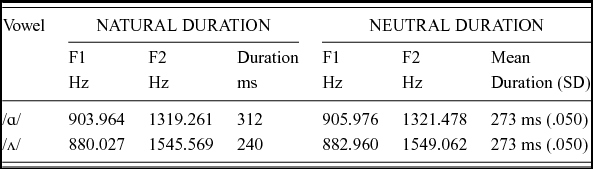
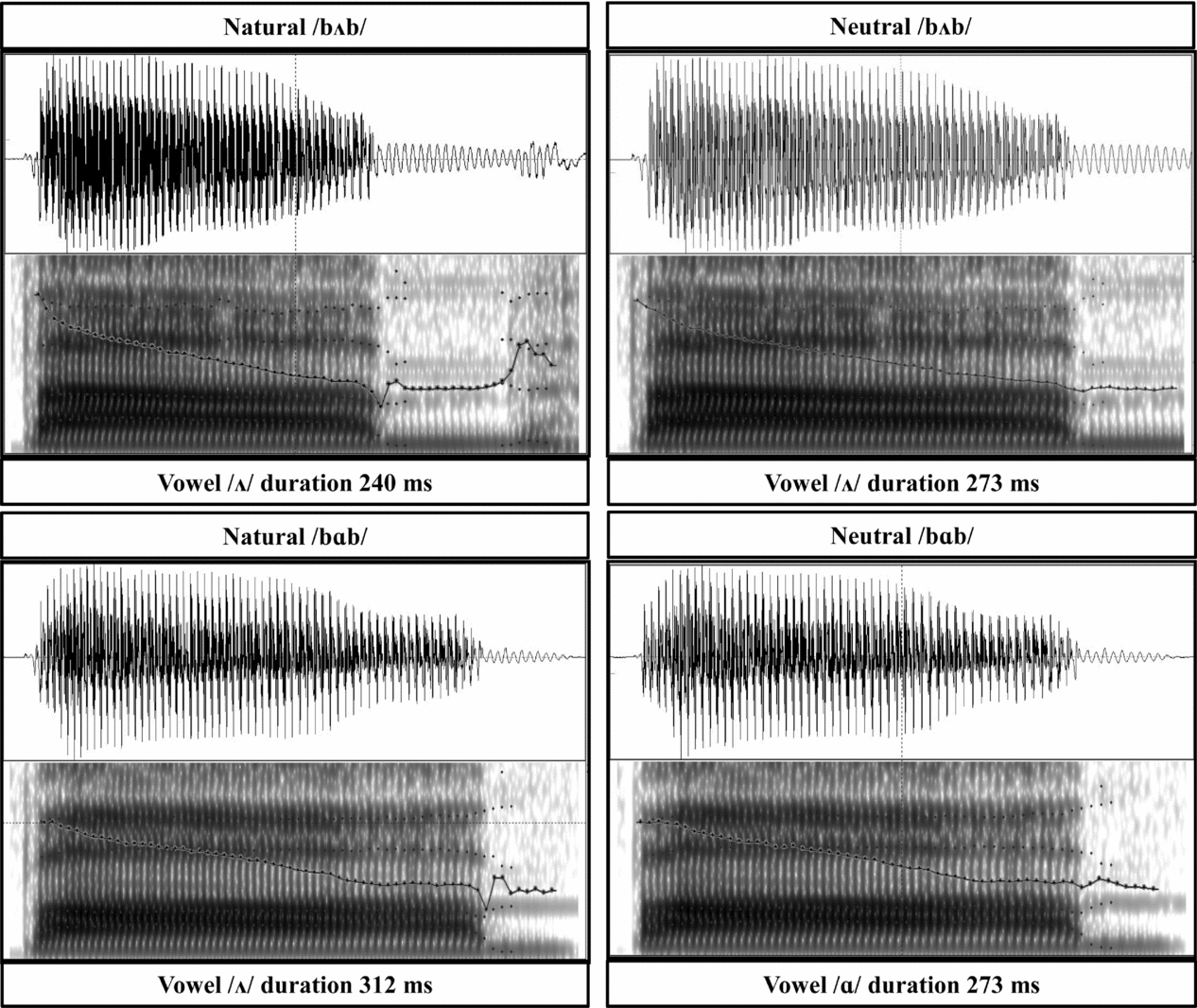
All audio files were amplitude-normalized in Praat 5.3 (Boersma & Wenink, Reference Boersma and Weenink2013) using the ‘Scale to Peak’ function. The duration of target vowels in the stimulus syllables /bʌb/-/bɑb/ was modified in Praat, to provide stimuli with natural and neutralized vowel durations for both testing conditions. Vowel duration was measured from the first positive peak in the periodic portion of each waveform to the constriction of the post-vocalic consonant. For the natural-duration vowel condition, each vowel kept its own natural duration. For the neutral-duration vowel condition, duration of both vowels was manipulated to a neutral value derived from the combined mean durations for each vowel in the pair. This mean relative duration was imposed on the manipulated files to obtain the neutral vowel stimuli (see Table 1). Figure 1 shows the spectrograms of the stimuli in both natural and neutral duration conditions.
Vowel duration and formant frequencies for AE vowels /ɑ/-/ʌ/ as produced by a female AE talker in the CVC contexts /bɑb/ - /bʌb/. Vowel duration means are calculated for the neutral vowel duration vowels.

Paired time waveforms and spectra representing the four experimental syllables bʌb and bɑb in the natural (left) and neutral (right) vowel duration conditions.

In order to ensure that recorded vowel sounds were heard as the intended vowels by native AE listeners before being implemented as experimental stimuli, five native AE listeners (from the New York area) were asked to listen to 10 repetitions of each syllable. The instructions were identical to those later provided to the experimental participants: “Listen to the sounds coming through the speakers; they are made up words containing American English vowels. If the word contains a vowel sound like in luck/gum (/ʌ/), please press button 1. If the word contains a vowel sound like in hot/mop (/ɑ/), please press button 2.” Correct identification response percentages for vowel /ɑ/ were 97% and 100%, and for vowel /ʌ/ were 96% and 97%, in the natural and neutral conditions respectively. The high vowel identification accuracy obtained from five native AE listeners suggested that the recorded experimental stimuli contained the intended AE vowels.
2.3. Experimental Tasks
Participants were seated in a sound-attenuated chamber in front of a computer monitor that displayed a movie without sound. They were instructed to watch the movie and ignore the sounds coming through the speaker. Auditory stimuli were presented at 65 dB SPL through an external RME Hammerfall DSP audio card connected to a Tannoy OCV 6 full bandwidth pendant speaker suspended 27 cm directly above the participant. Timing offset of auditory stimuli was verified using a Cedrus StimTracker. The experimental tasks were divided into two different sessions. In each session, listeners performed a passive non-attended and an attended task. The instructions for each of the tasks are presented below. Breaks were built into the experimental procedures to ensure participant comfort (every 300 trials in the pre-attentional task, and every 75 trials in the attentional task).
2.3.1. Electrophysiological recordings
a. Non-attended task
In a passive task requiring no behavioral response from the listeners, all participants were asked to ignore auditorily presented AE vowel stimuli (the syllables /bɑb/-/bʌb/). Participants watched a silent movie while EEG was recorded. The instructions to participants were: “Please watch the silent movie and ignore the sounds coming through the speaker”. Stimuli were presented in an oddball paradigm with an inter-stimulus interval (ISI) of 800ms. According to Werker and Logan (Reference Werker and Logan1985), an ISI of 800ms will tap into phonetic/phonemic levels of phoneme representation, not only acoustic cues. Standard stimuli were presented in 85% of the trials (256 out of 300) during each block, and the roles of standards and deviants (44 deviant trials per block, for a total of 88 deviants per condition) were reversed in the second and fourth blocks (e.g., if vowel /ɑ/ was standard in the first block, it was deviant in the second).
b. Attended task
In the attended task, while EEG was recorded, participants decided via button press, trial-by-trial, which vowel (/ʌ/ or /ɑ/) was being presented in the oddball paradigm. The task included four blocks of 75 trials each. The presentation of the next stimulus was initiated when the participant responded. The instructions for this task were: “Listen to the sounds coming through the speakers; they are made up words containing American English vowels. If the word contains a vowel sound like in luck/gum, please press button 1. If the word contains a vowel sound like in hot/mop, please press button 2.” As in the Non-attended task, standard stimuli were 85% of the trials during each block, and the roles of standards and deviants were reversed in the second and fourth blocks. All instructions appeared in text form on the computer screen prior to the experimental sessions, and stayed onscreen to minimize additional working memory load.
2.3.2. Second session of electrophysiological recordings
The second session (conducted on a different day from the first) was identical to the first session, except for the experimental condition. Participants always completed the Non-attended task (MMN) before the Attended task to avoid possible learning effects. However, the order of presentation for the natural/neutral vowel duration conditions was counterbalanced across participants; those who heard natural duration stimuli on the first day of recording heard neutral duration stimuli on the second day, and vice versa.
All behavioral responses obtained during the experimental tasks were recorded through E-Prime 2.0 (Psychology Software Tools, Pittsburg, PA).
2.4. EEG Recording
During EEG data acquisition, scalp voltages were recorded with a high-density 128-channel hydrocel net connected to a high-input impedance amplifier (NetAmps300, Electric Geodesics Inc., Eugene, OR). Amplified analog voltages (0.1-100 Hz band pass) were digitized at 250 Hz. Individual sensors were adjusted until impedances were below 40 kΩ (Ferree, Luu, Russell & Tucker, Reference Ferree, Luu, Russell and Tucker2001), and all electrodes were referenced to the vertex (Cz) during recording. Electrodes above and below the eyes, and at the outer canthi, allowed for identification of electro-oculographic artifacts (EOG, associated with eye blinks and eye movements).
2.5 Data analysis
Behavioral responses in the attended task were analyzed for each vowel /ɑ/-/ʌ/ in the two duration conditions (natural and neutral). Accuracy was measured by counting correct responses out of all trials presented, and error trials were omitted from analysis. Ninety percent (90%) of trials per participant were included in statistical analysis. Percent correct responses were transformed to Rationalized Arcsine Units (RAU – Studebaker, Reference Studebaker1985) to approximate a normalized distribution. Reaction time (RT) was recorded as the time elapsed from onset of stimulus presentation to execution of a button-press response. RT values were log-transformed to approximate a normal distribution, hence diminishing the likelihood of type I and type II errors (Cohen & Cohen, Reference Cohen and Cohen1983). Accuracy and reaction time were investigated as dependent variables in a three-factor mixed-designed ANOVA, to determine the significance of changes in behavioral indices of vowel identification between condition 1 (natural vowel duration) to condition 2 (neutral vowel duration) between groups (bilingual vs. monolingual) and between vowels (/ɑ/-/ʌ/). In addition, planned comparisons (independent and paired-samples t-tests) were conducted to determine statistically significant differences within and between groups.
2.5.1. EEG data pre-processing and analysis
Recorded raw EEG data were digitally filtered offline using a 0.1-30 Hz bandpass filter, and subjected to automatic and manual artifact rejection protocols for removal of movement and physiological artifacts. Noisy channels were interpolated using spherical spline modeling, based on recorded data from surrounding sensors. Data were re-referenced to the average to eliminate the influence of an arbitrary recording reference channel.
Recorded data were segmented into epochs of 800ms: 700ms following the onset of each stimulus, and a 100ms pre-stimulus baseline period, to minimize the effects of long latency artifacts (such as amplifier drift). Trials were discarded from analysis if they contained eye movements (variance greater than >70 µV in one epoch), or if more than 20% of the channels were noisy (average amplitude over 100 µV in one epoch). Only recordings with more than 75% of uncontaminated trials were included in analysis. The average numbers of accepted trials across groups were 482 standards (SD = 41.47) and 87 deviants (SD = 0.95) in the Natural condition and 504 standards (SD = 6.50) and 87 deviants (SD = 2.07) in the Neutral condition. Response-locked ERPs were computed within epochs, starting at stimulus onset. Individuals’ averaged data were grand-averaged within groups to enhance statistical power and reduce variance due to random noise.
2.5.2. Extraction of the components
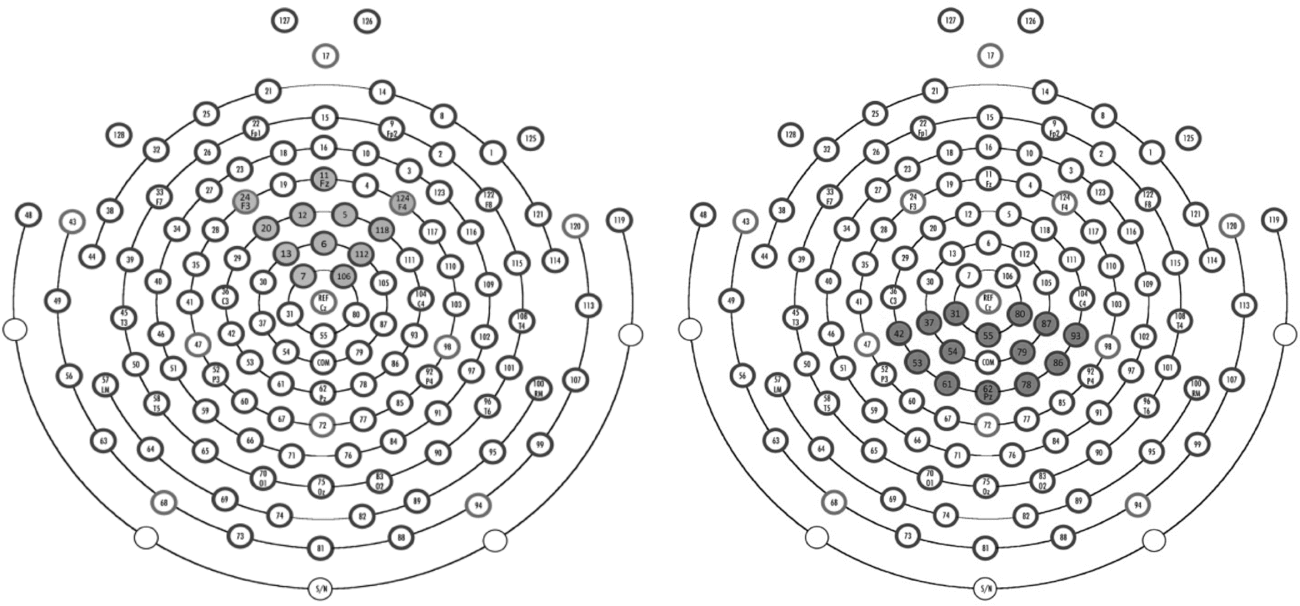
EEG data were analyzed according to a pre-determined region of interest for each ERP component: for MMN this was the frontal-central region, and for P300 the central-parietal region. To investigate possible hemispheric differences in MMN responses to speech stimuli for each group, the amplitudes of MMN responses were analyzed in three different electrode montages: Left (electrodes 7, 13, 20 and 24); Central (electrodes 11, 6, 12, 5); and Right (electrodes 106, 112, 118 and 124). The P300 montage corresponding to the central-parietal area included electrodes 31, 55, 80, 37, 54, 79, 87, 42, 53, 61, 62, 78, 86, and 93 (see figure 2). Responses over sensor montages were examined during specific time windows post-stimulus onset (100-300 ms, when MMN is expected, and 250–500 ms, when P300 is typically observed).
The figure on the left side represents the electrodes analyzed for the MMN response. The left-most line of electrodes correspond to the left-hemisphere montage (electrodes 7, 13, 20 and 24), electrodes in the center correspond to the central montage (electrodes 11, 6, 12, 5), and the right most line of electrodes correspond to the right-hemisphere montage (electrodes 106, 112, 118 and 124). The figure on the right side represents the electrodes analyzed for the P300 response. The electrodes correspond to the central-parietal area (31, 55, 80, 37, 54, 79, 87, 42, 53, 61, 62, 78, 86, and 93).

MMN is usually presented as a difference wave, obtained by subtracting the ERP to standard stimuli from the ERP response to deviants. Since the subtraction involves brain responses to two physically different speech sounds, it is possible that physical differences in the stimuli might elicit different early components associated with physical features of the sounds, and this could influence the MMN. To ensure that the potential contributions of other components were removed, the identity MMN technique (Pulvermüller & Shtyrov, Reference Pulvermüller and Shtyrov2006) was implemented. This requires subtracting the ERP elicited in response to standard stimuli from the ERP elicited to the same stimuli presented as deviants. This is possible in this experiment, since both vowel sounds were presented in standard and deviant status in separate blocks in the experiment. Therefore, the average responses to standard stimuli for each participant in each condition were subtracted from responses to physically identical deviants (e.g., deviant /ɑ/ - standard /ɑ/). Difference waves were computed for each participant, and individual difference waves were grand-averaged by condition (natural and neutral duration), vowel (/ɑ/-/ʌ), and group (bilingual and monolingual). The grand averaged negative (MMN) peaks for the two vowels in each condition were derived by examining grand averaged waveforms for the right, central and left montages during the time window 100–300ms post stimulus onset. MMN mean amplitude was calculated as the mean voltage during a 60ms interval centered around the most negative peak observed in each condition and each hemisphere (see Table 4 for the MMN peak latencies). Similarly, peak latency of the P300 component was defined as the largest positive peak in the 250–500ms time window, identified by examining the grand averaged difference waveforms for the central-parietal montage. P300 mean amplitude was calculated as the mean voltage during a 60ms interval period centered on the most positive peak latency. Individual grand-averaged difference waves were subjected to independent-samples t-tests to determine whether they were significantly different from zero. Individual mean amplitude and latency measures were submitted to repeated measures analyses of variance (ANOVA) with factors group (bilingual vs. monolingual), montage (Left vs. Central vs. Right), condition (natural vs. neutral), and vowel (/ɑ/-/ʌ/). The Greenhouse-Geisser correction was reported to adjust the associated degrees-of-freedom when the sphericity assumption was violated. All analyses were conducted with an alpha level of 0.05.
3. Results
3.1. Behavioral Results
3.1.1. Accuracy
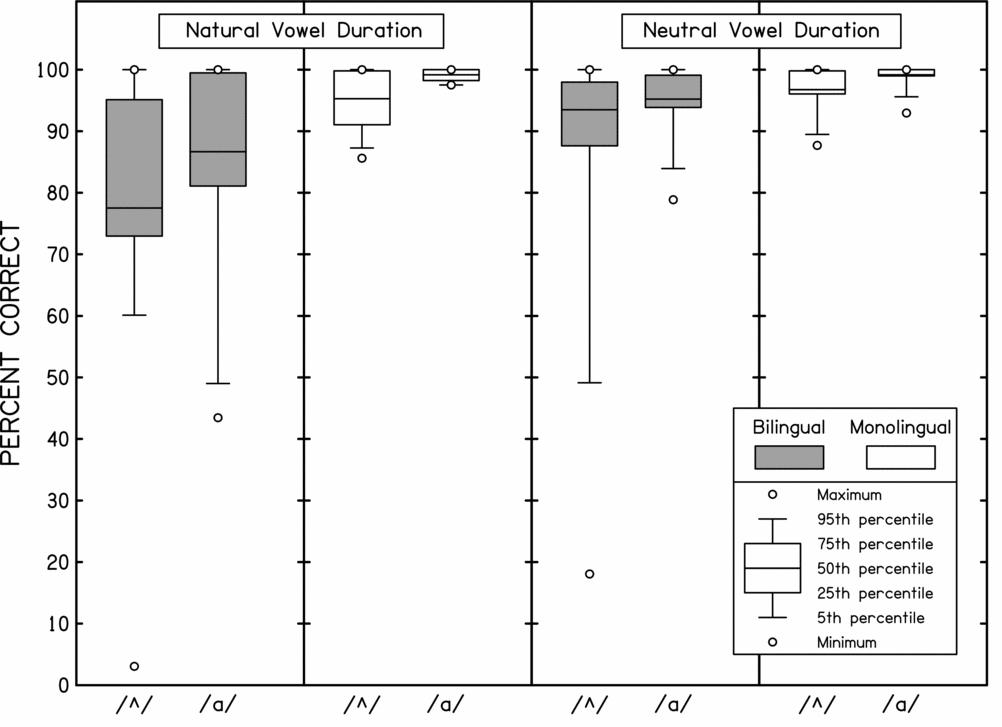
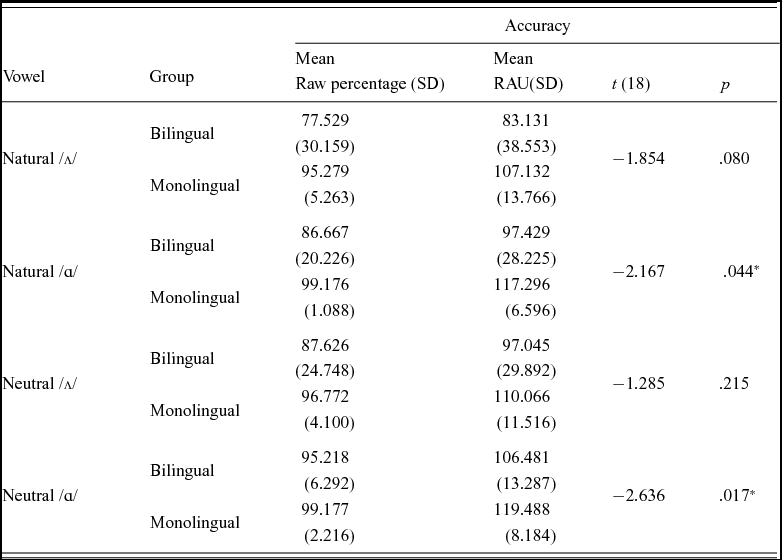
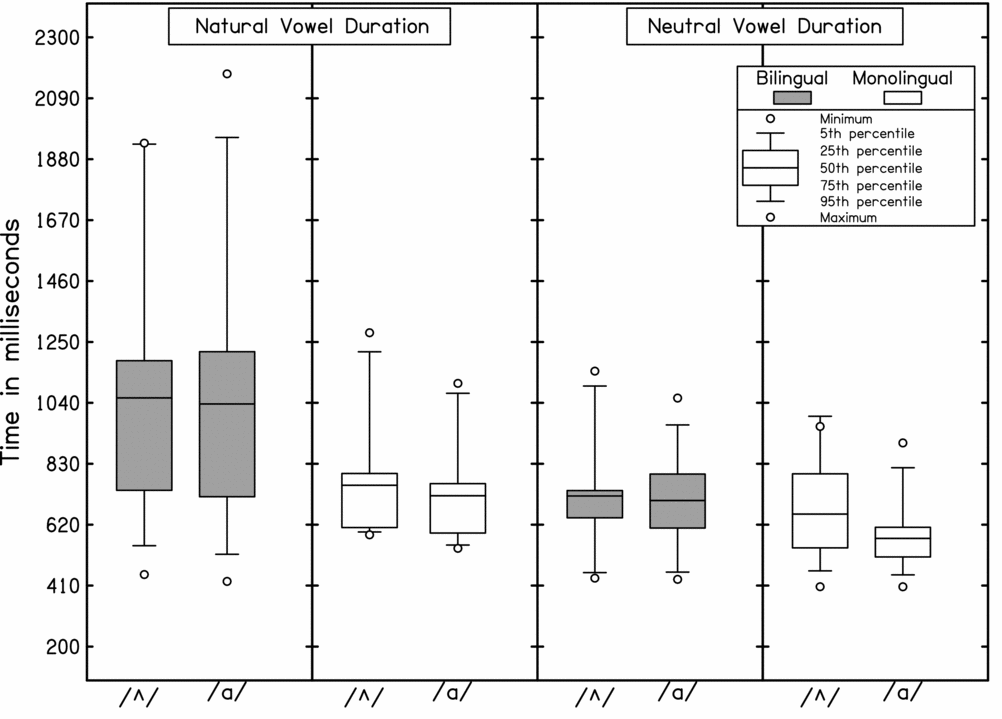
Figure 3 shows the median, interquartile ranges, 95th and 5th percentiles and outliers for accuracy (percent correct) in both groups. The bilingual group identified /ʌ/ with 77.53% and 87.63% median accuracy in the natural and neutral vowel duration conditions, respectively. Median identification accuracy scores for /ɑ/ were 86.67% and 95.22% in the natural and neutral vowel duration conditions, respectively. In contrast, the monolingual group identified /ʌ/ with 95.28% and with 96.77% median accuracy in the natural and neutral vowel duration conditions, and /ɑ/ with 99.18% median accuracy in both natural and neutral vowel duration conditions.
Vowel identification accuracy (percent correct). Bilingual (N =10) and Monolingual (N=10) groups during the natural and neutral vowel duration conditions.

The distribution of these accuracy scores was examined for skewness and kurtosis. Accuracy scores included outliers on the lower end of the scale corresponding to vowel /ʌ/ in the natural (3.0%) and neutral (18%) vowel duration conditions. Based on standardized values for skewness (-2.917) and kurtosis (9.449) the distribution of scores was negatively skewed and peaked. Accuracy was re-examined after cases identified as outliers were removed. No additional outliers were identified and the distribution appeared to be approximately normal (skewness = -1.456 and kurtosis = 1.784).
To determine whether outlier scores influenced accuracy differences between the bilingual and monolingual groups, the ANOVA was conducted twice, including and excluding outliers. Both analyses (outliers included: F (1, 18) = 7.880, p = .012, η p 2 = .304; outliers excluded: F (1, 17) = 7.005, p = .017, η p 2 = .292) revealed a significant difference in accuracy between groups.
Independent samples t-tests were conducted to explore vowel identification accuracy differences between groups. Results indicated that the bilingual group obtained significantly lower accuracy compared to the monolingual group for only the vowel /ɑ/, in both vowel duration conditions (natural and neutral) (see Table 2).
Vowel identification accuracy for bilingual and monolingual groups. RAU (Rationalized Arcsine Units) were used in the statistical analysis. Independent samples t-tests.

*p ≤ .05
3.1.2. Reaction time
Figure 4 illustrates reaction time scores for both groups in natural and neutral vowel duration conditions.
Reaction time for vowel identification (ms). Bilingual (N = 10) and Monolingual (N = 10) groups during the natural and neutral vowel duration conditions.

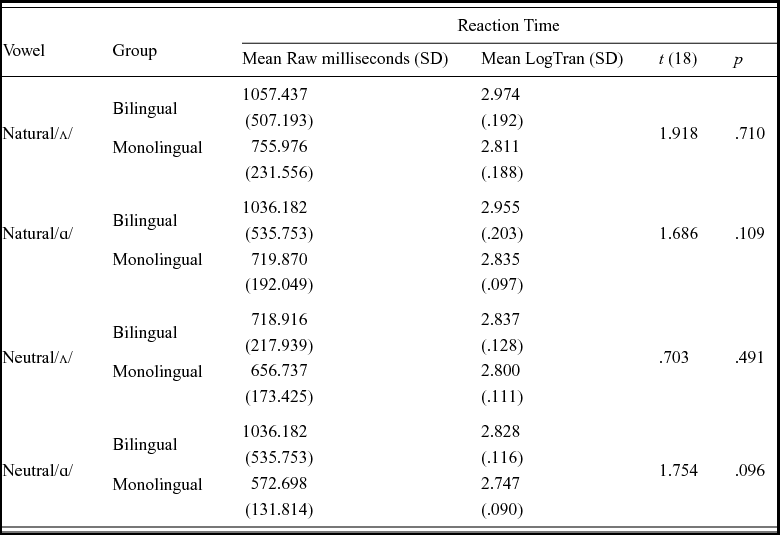
The reaction time (RT) scores (Log-transformed) were submitted to a mixed-design 3-factor ANOVA comparing language group (Bilingual vs. Monolingual), condition (natural vs. neutral), and vowel (/ɑ/ vs. /ʌ/). Results showed that RT differences between groups were not significant (F (1, 18) = 3.283, p = 0.087, η p 2 = .154). However, a significant main effect of Condition (F (1, 18) = 10.323, p = .005, η p 2 = .364) showed that both groups were slower to identify vowels in the natural condition compared to the neutral condition. These unexpected results indicate that durational cues in the vowels were not indispensable for any group to make decisions about vowel identity. There were no significant interactions. Planned comparisons revealed no significant group differences in RT for identification of vowels (/ɑ/-/ʌ/) in any conditions (see Table 3).
Vowel identification RT differences between monolingual and bilingual groups. Independent samples t-tests.

* p < .05
In summary, compared to the monolingual group, Spanish–English bilingual listeners were significantly less accurate at identifying vowel /ɑ/ in both experimental conditions (natural vs. neutral vowel duration). The groups did not differ in accuracy for identifying AE vowel /ʌ/. This finding could be due to the larger variability in the bilingual group (SD = 38). Similarly, although the bilingual group was slower than the monolingual group to identify the AE vowels, the difference was not statistically significant.
3.2 Neurophysiological results
3.2.1 Non-attended task – MMN component
A typical characteristic of MMN topography is a frontal-central maximum negativity while a positive deflection (polarity inversion) is observed at mastoid electrodes (Näätänen, Reference Näätänen1990; Sussman, Wrinkler, Kreuzer, Saher, Näätänen & Ritter, Reference Sussman, Winkler, Kreuzer, Saher, Näätänen and Ritter2002). An analysis comparing amplitudes of the neurophysiological response at mastoid electrodes and the frontal (Fz) electrode in each group revealed no amplitude difference for the bilingual group (F (1, 9.000) = 1.007, p = .342, ηp2 = .101). However, for the monolingual group, this difference was significant (F (1, 9.000) = 6.502, p = 0.031, ηp2 = .101). This amplitude difference, and the presence of the expected polarity inversion, suggests that MMN responses were elicited in the monolingual, but not in the bilingual group.
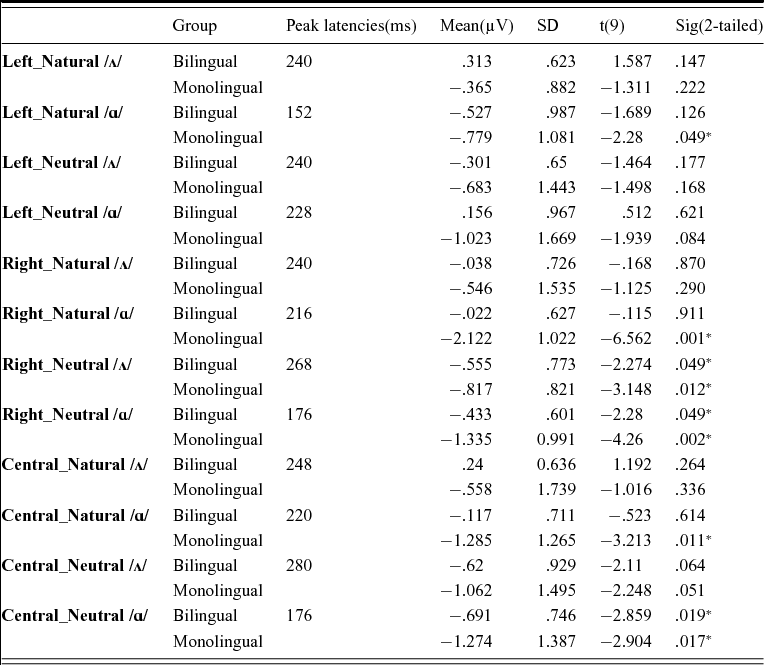
One-sample t-tests indicated that for the bilingual group, difference waves were different from zero only over right montage electrodes in the neutral condition for both vowels /ʌ/ /and /ɑ/ (p = .049), and over central electrodes for the neutral vowel /ɑ/ (p = .019). For the monolingual group, difference waves were significantly different from zero over electrodes in left, central and right montages in the natural condition only to vowel /ɑ/ (p = .049, p < .001, and p = .011, respectively). However, in the neutral condition, difference waves were different from zero for both vowels over central (/ɑ/: p = .017; /ʌ/: p = .051) and right electrodes (/ɑ/: p = .002; /ʌ/: p = .012), but not over left montage electrodes (/ɑ/: p = .168; /ʌ/: p = .084). Table 4 presents means and SD of the difference waves for each group by vowel, condition and montage.
Non-attended task. MMN difference wave mean peak latencies (milliseconds) and amplitude (µV) for Bilingual (Spanish–English) and Monolingual (English) groups in the natural and neutral vowel duration conditions (independent samples t-tests for amplitude differences are shown).

*p < .05
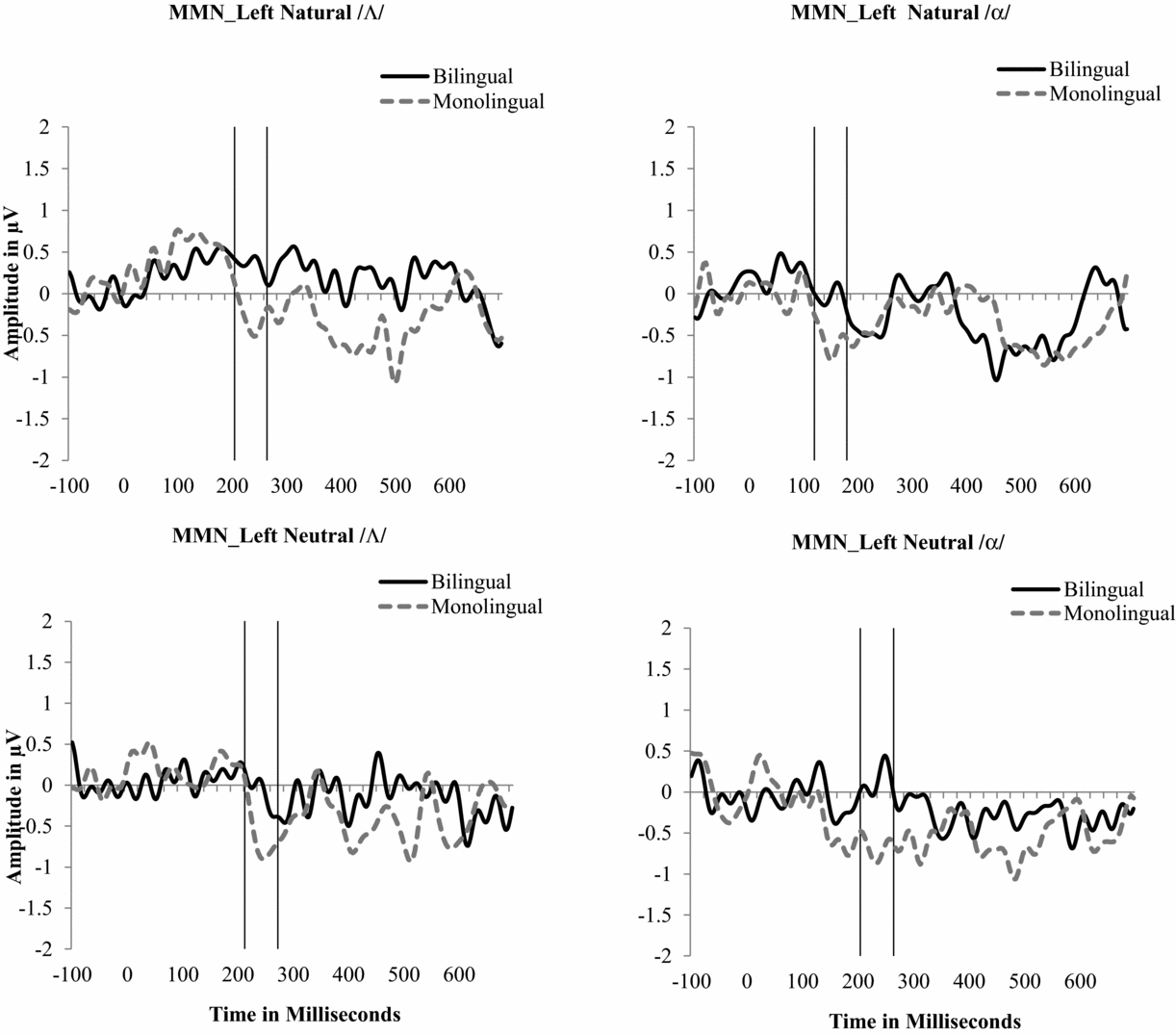
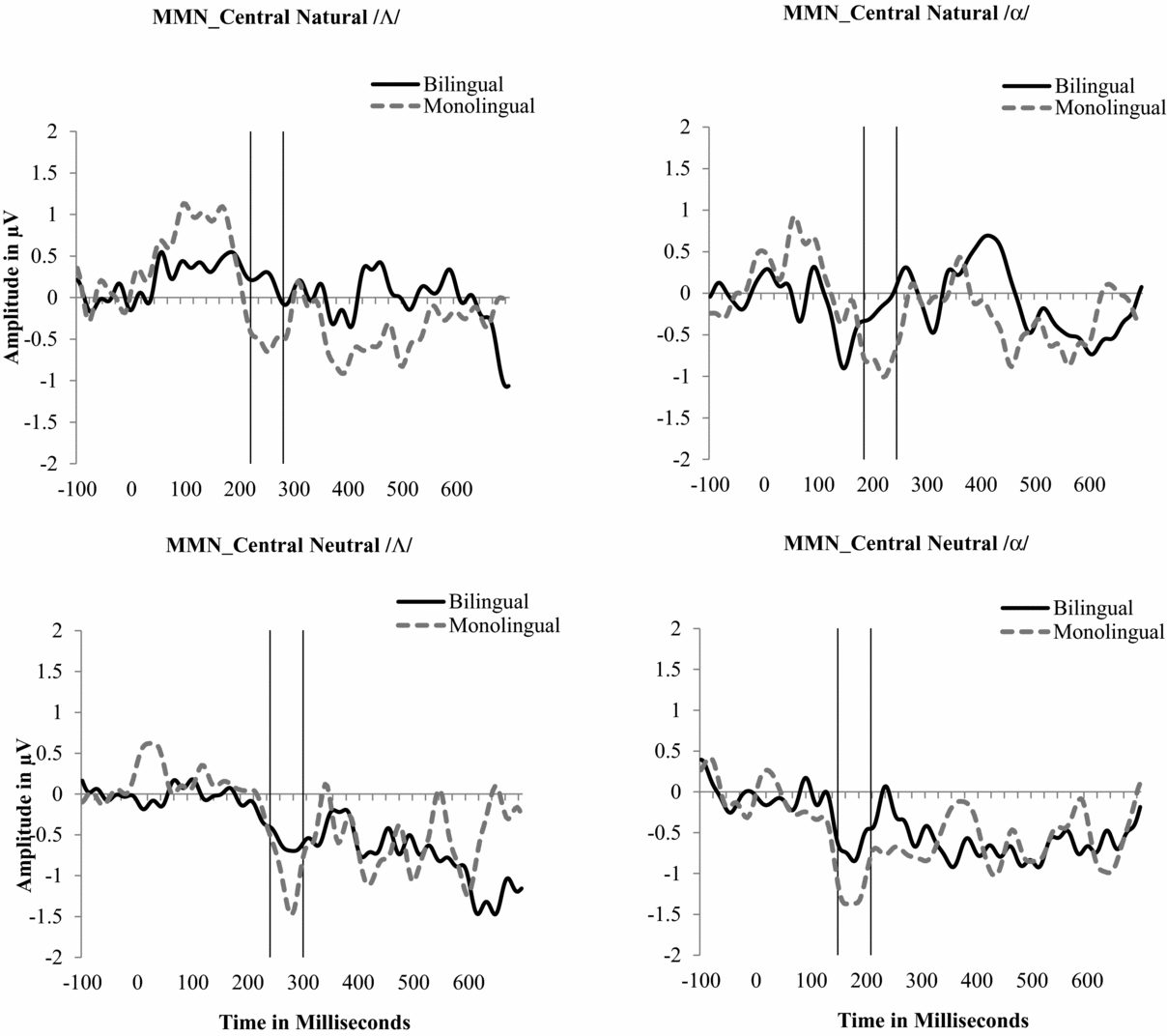
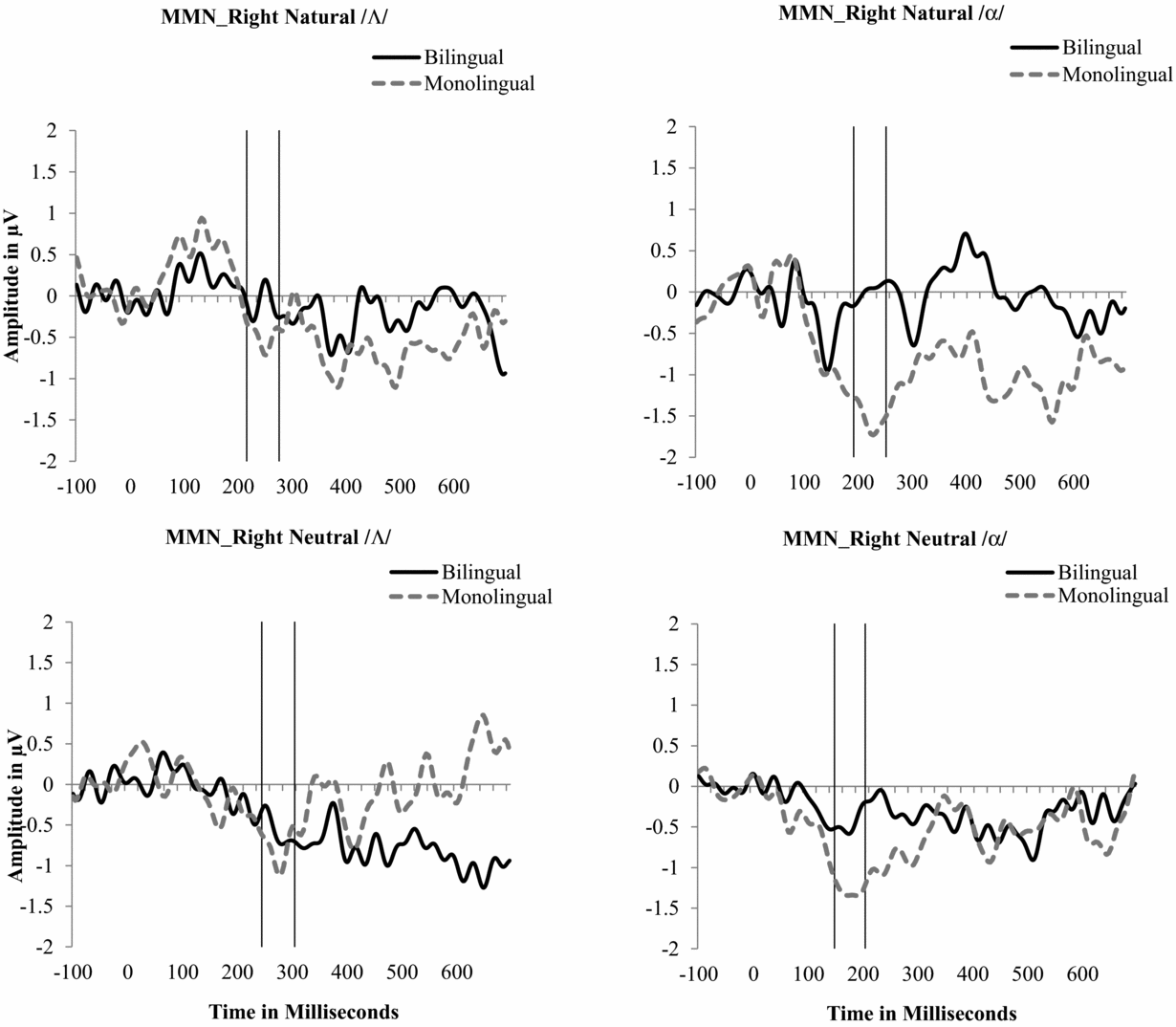
Figures 5, 6, 7 show MMN difference waves for bilingual and monolingual groups in response to the non-attended task, in natural and neutral vowel duration conditions, per electrode montage (left, central, right respectively). ANOVA revealed that the groups differed in the amplitude of MMN responses to the vowels (F (1.000, 18.000) = 17.384, p = 0.001, ηp 2 = .491). A significant main effect of montage (F (1.000, 18.000) = 4.513, p = .025, ηp 2 = .200), and a significant interaction between montage, condition, vowel and group (F (1.000, 18.000) = 6.769, p = .018, ηp 2 = .273) suggest that mean MMN amplitudes differed between the groups at each montage site, for each vowel and condition.
MMN difference waves in response to vowels /ʌ/ (left) and /ɑ/ (right) during the non-attended task in the natural and neutral vowel duration conditions in bilingual and monolingual listeners at the left hemisphere (electrodes 7, 13, 20 and 24). The vertical lines indicate the 60 ms around the most negative peak used for analysis.

MMN difference waves in response to vowels /ʌ/ (left) and /ɑ/ (right) during the non-attended task in the natural and neutral vowel duration conditions in bilingual and monolingual listeners at the central electrodes (11, 6, 12, 5). The vertical lines indicate the 60 ms around the most negative peak used for analysis.

MMN difference waves in response to vowels /ʌ/ (left) and /ɑ/ (right) during the non-attended task in the natural and neutral vowel duration conditions in bilingual and monolingual listeners at the right hemisphere (electrodes 106, 112, 118 and 124). The vertical lines indicate the 60 ms around the most negative peak used for analysis.

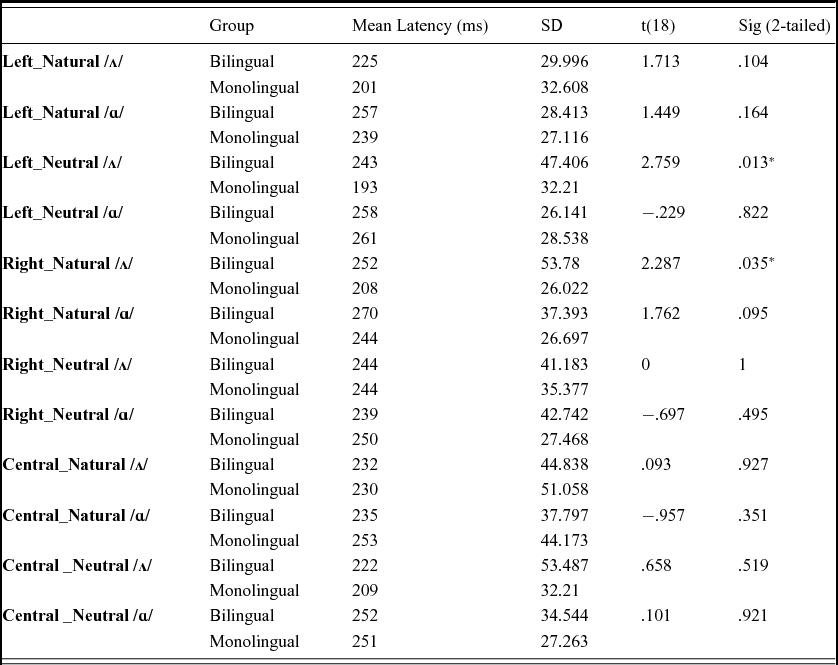
ANOVA conducted on MMN peak latencies (in ms) revealed a significant main effect of vowel (F (1.00, 18.000) = 24.785, p < 0.001, ηp 2 = .579), and a significant interaction between montage, condition and vowel (F (1.907, 34.328) = 6.769, p = .031, ηp 2 = .178). Independent samples t-tests showed that, compared to the bilingual group, the monolingual listeners’ MMN response was faster (shorter latency) only to /ʌ/, in the natural condition over right hemisphere electrodes (p = .035) and in the neutral condition over left hemisphere electrodes (p = .013). Table 5 shows mean MMN peak latency in milliseconds for each group by vowel, condition and montage.
Non-attended task. MMN mean latency (milliseconds) for Bilingual (Spanish–English) and Monolingual (English) groups in the natural and neutral vowel duration conditions (independent samples t-tests for latency differences are shown).

*p < .05
In summary, the bilingual group did not show significant MMN responses to any of the vowels in the deviant status in the natural condition, but showed a right-lateralized MMN response to both vowels in the neutral vowel duration condition, suggesting that when duration was neutralized the bilingual group processed these vowels based on spectral properties. Unexpectedly, the monolingual group showed a significant MMN response to /ɑ/ in the natural duration condition, over right, left and central electrode montages, but not to /ʌ/. Since these are native vowels for the monolingual group, we expected no differences in MMN responses to either vowel. Like the bilingual group, monolingual listeners had significant right-lateralized MMN responses to both vowels in the neutral vowel duration condition. These responses from the monolingual listeners suggest that processing /ɑ/ involved acoustic and phonetic analysis, as evidenced by the presence of the MMN response in all three montages (right, central and left) and both natural and neutral conditions. Conversely, the responses of the bilingual listeners resembled those of the monolingual group only in the neutral condition, and reflected right-lateralized acoustic processing of the speech stimuli.
3.2.2 Attended task (targeting the P300 component)
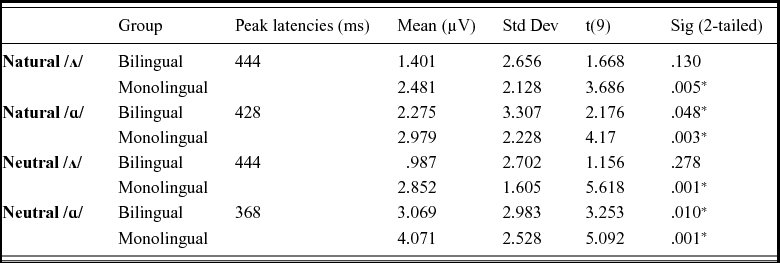
Independent samples t-tests showed that difference wave amplitudes between 250 and 500ms were significantly different from zero in the bilingual group in response to vowel /ɑ/ in both conditions (natural /ɑ/, p = .048; neutral /ɑ/, p = .010). In the monolingual group, difference waves in response to both vowels in both conditions were significantly different from zero (p < .005). See Table 6 for summary statistics and t-tests.
Attended task. P300 difference wave mean peak latency (milliseconds) and amplitude (µV) for Bilingual (Spanish–English) and Monolingual (English) groups in the natural and neutral vowel duration conditions (independent samples t-tests for amplitude differences are shown).

*p < .05
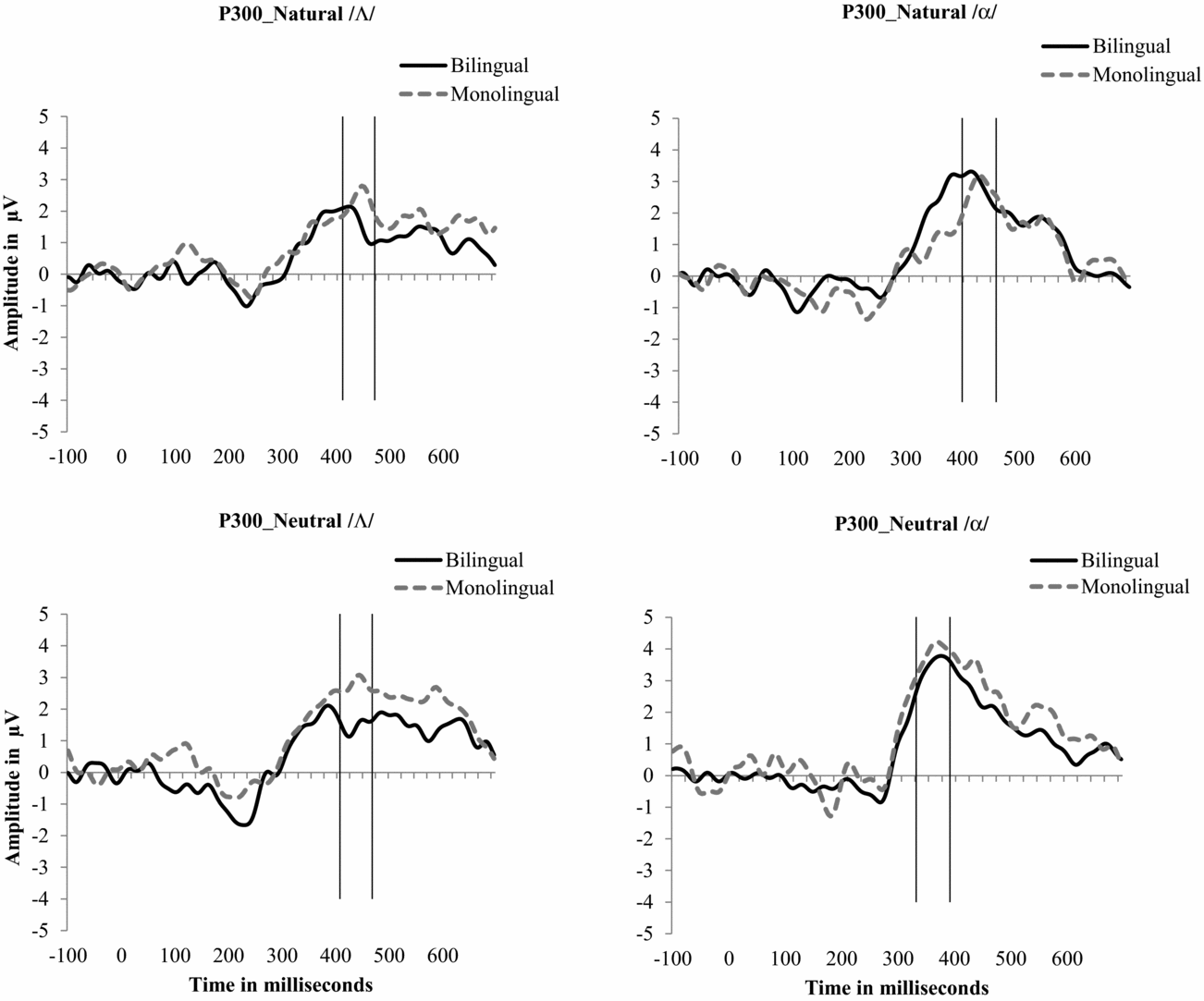
ANOVAs revealed a significant main effect of vowel (F (1.000, 18.000) = 9.851, p <.006, ηp 2 = .354), indicating that P300 responses between groups differed according to vowel. No other significant main effects or interactions were observed in the analysis. Figure 8 below shows bilingual and monolingual listeners’ P300 responses to the vowels during the attended task in natural and neutral vowel duration conditions.
P300 responses to vowels /ʌ/ (left) and /ɑ/ (right) during the attended task in the natural and neutral vowel duration condition in bilingual and monolingual listeners at central-parietal electrodes (31, 55, 80, 37, 54, 79, 87, 42, 53, 61, 62, 78, 86, and 93). The vertical lines indicate the 60 ms around the most positive peak used for analysis.

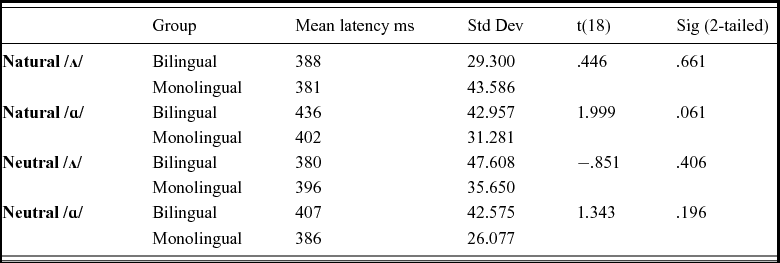
There were no significant differences in mean peak latency between groups for the P300 component (F (1, 18) = 4.443, p = .049, ηp 2 = .407). See Table 7.
Attended task. P300 mean latency (milliseconds) for Bilingual (Spanish–English) and Monolingual (English) groups in the natural and neutral vowel duration conditions (independent samples t-tests for latency differences are shown).

*p < .05
In summary, regardless of vowel duration, the bilingual group did not show significant MMN responses in the non-attended task. However, during the attended task, they had significant P300 responses to vowel /ɑ/, but not /ʌ/. In contrast, the monolingual group showed significant MMN responses to vowel /ɑ/, but not /ʌ/ in the non-attended condition, while having significant P300 responses to both vowels in the attended condition.
4. Discussion
The purpose of this study was to examine behavioral and neurophysiological responses (ERPs) of adult sequential Spanish–English bilinguals to the AE vowel contrast /ɑ/-/ʌ/, compared to monolingual English-speaking listeners. Both groups of listeners carried out passive listening (non-attended) and identification (attended) tasks under two listening conditions: (1) natural vowel duration and (2) neutral vowel duration. Neurophysiological studies have shown that learning to perceive non-native speech sounds changes brain responses known to index aspects of phonological representation (e.g., Näätänen & Alho, Reference Näätänen and Alho1997; Winkler et al., Reference Winkler, Kujala, Tiitinen, Sivonen, Alku, Lehtokoski, Czigler, Csépe, Ilmoniemi and Näätänen1999). Such changes should be reflected by brain activations at very early stages of perceptual processing, when detection of language-specific parameters is automatic (Kirmse et al., Reference Kirmse, Ylinen, Tervaniemi, Vainio, Schröger and Jacobsen2008, Rivera-Gaxiola, Csibra, Johnson & Karmiloff-Smith, Reference Rivera-Gaxiola, Csibra, Johnson and Karmiloff-Smith2000; Ylinen et al., Reference Ylinen, Uther, Latvala, Vepsäläinen, Iverson, Akahane-Yamada and Näätänen2010; Tamminen, Peltola, Toivonen, Kujala & Näätänen, Reference Tamminen, Peltola, Toivonen, Kujala and Näätänen2013) as well as later in the processing stream, when attention is involved in discrimination/identification processes (Hisagi et al., Reference Hisagi, Shafer, Strange and Sussman2010; Lipski, Escudero & Benders, Reference Lipski, Escudero and Benders2012). The present study capitalized on the availability of ERPs indexing each of these stages of processing, and aimed to identify specifically the differences associated with bilingual adults’ discrimination of a vowel contrast specific to AE: /ʌ/ versus /ɑ/.
Behaviorally, it was predicted that the bilingual group would be significantly less accurate and slower than the monolingual listeners to identify the AE vowels /ɑ/-/ʌ/, because these vowels are not part of their native vowel inventory. Neurophysiologically, it was predicted that if the bilingual group perceived the vowel contrast in the non-attended (MMN) and attended (P300) tasks, relying on both spectral and durational cues in the natural vowel duration condition, or on spectral cues alone in the neutral vowel duration condition, then the ERP responses would resemble those of monolingual English-speaking listeners. On the other hand, non-significant neurophysiological responses (MMN and P300) to the vowel contrast would have indicated that the Spanish–English bilingual group was not able to pre-attentively discriminate between, or consciously identify, the AE vowels /ɑ/-/ʌ/.
Conversely, since these vowels are part of the native vowel inventory for monolingual English-speaking listeners, it was predicted that their MMN and P300 responses to the listening and identification tasks would reflect discrimination (non-attended task) and identification (attended task) of the vowels in both natural and neutral duration conditions. This would reflect a reliance primarily on spectral (rather than durational) cues to discriminate between the two vowels.
Behavioral responses to the AE vowel contrast /ɑ/- /ʌ/ obtained during the attentional task revealed significant differences in identification accuracy between groups, indicating, as expected, that the bilingual group was significantly less accurate in identifying the AE vowel /ɑ/ than the monolingual group. On the other hand, there were no significant differences in identification accuracy for /ʌ/, possibly due to the large variability in accuracy scores for the bilingual group. Similarly, differences in reaction time between groups did not reach significance. It is possible that the labeling task was too easy, so that the lack of cognitive demands reduced any possible group difference.
Neurophysiological results indicated that, when not attending to the vowel sounds, bilingual listeners did not show indices of discrimination of the AE vowel contrast /ɑ/- /ʌ/ in the natural vowel duration condition. This was indicated by non-significant MMN responses to the vowel contrast over left hemisphere sensors during the non-attended task. However, significant MMN responses to the vowels in the neutral condition over the right hemisphere suggest that the bilingual group did engage in acoustic processing of the duration-neutralized vowels (Näätänen, Reference Näätänen2001).
The bilingual group's neurophysiological data revealed indices of attentional identification of the AE vowel /ɑ/, but not /ʌ/, indicated by significant P300 responses to /ɑ/ in its deviant status during both natural and neutral vowel duration conditions. This finding suggests that the bilingual group may not have had pre-attentional access to mental representations corresponding to the non-native vowels /ɑ/- /ʌ/ between 100 and 300ms after stimulus onset, but they do appear to be able to access relevant acoustic-phonetic information about the vowels later in time, between 250 and 500ms, when they were (actively) attending to the stimuli. In addition, these findings indicate no automatic detection of differences between the non-native vowels, but attentional and cognitive resources that are recruited later in processing did facilitate the identification of the challenging non-native vowel /ɑ/. Our results support previous findings indicating that perception of some L2 phonemes may not occur pre-attentively, and that MMN responses are larger to native phonemic contrasts compared to non-native ones (Kirmse et al., Reference Kirmse, Ylinen, Tervaniemi, Vainio, Schröger and Jacobsen2008; Näätänen, Paaivlainen, Rinne & Alho, Reference Näätänen, Paavilainen, Rinne and Alho2007). The current findings are also in line with work showing that, when non-native listeners attend to L2 speech sound contrasts, detection of deviant features can improve (Hisagi et al., Reference Hisagi, Shafer, Strange and Sussman2010; Ong, Burnham & Escudero, Reference Ong, Burnham and Escudero2015). This suggests that attention may facilitate the perception of non-native speech sounds.
This study's results are influenced by factors such age of acquisition of the language (early vs. late), length of exposure to sounds of the L2, use of the second language, and type of L2 learning (e.g., classroom vs. immersion). Peltola, Tamminen, Toivonen, Kujala and Näätänen, (Reference Peltola, Tamminen, Toivonen, Kujala and Näätänen2012) found that the nature of an L2 learning experience can influence pre-attentive responses to non-native vowels. They observed that balanced Finnish–Swedish bilinguals (who learned both languages from birth and used them daily) had longer MMN latencies to vowels compared to dominant Finnish–Swedish bilinguals (who learned both languages sequentially, and had a high L2 proficiency level). They proposed that dominant bilinguals, who were hypothesized to have separate representational systems for each language, can inhibit native language categories and access non-native categories faster than balanced bilinguals, hypothesized to have just one language system and therefore a larger pool of categories to search. More recently, Tamminen et al. (Reference Tamminen, Peltola, Toivonen, Kujala and Näätänen2013) observed longer MMN latencies and overall smaller amplitudes in response to non-native Swedish vowels in balanced Finnish–Swedish bilinguals compared to monolingual Finnish listeners, suggesting that even skilled bilinguals show slower and smaller effects of pre-attentive processing than native speakers.
Along similar lines, sequential bilingual listeners in this study showed smaller MMN amplitudes in response to non-native vowel contrasts than the monolingual group. It is possible that, similar to findings in Peltola, Kujala, Tuomainen, Aaltonen & Näätänen (Reference Peltola, Kujala, Tuomainen, Ek, Aaltonen and Näätänen2003), the extensive classroom instruction experience (14–15 years) and the various lengths of exposure to AE speech sounds (6 months to 5 years) were not sufficient to allow the bilingual listeners to develop and/or access native-like categories for classifying the non-native vowels, at least pre-attentionally (at MMN latencies).
The desensitization hypothesis proposed by Bohn (Reference Bohn and Strange1995) suggests that, when spectral differences are not available for listeners to differentiate vowel contrasts, they will rely on durational differences. In addition, the L2LP model (Escudero, Reference Escudero2005; van Leussen & Escudero, Reference van Leussen and Escudero2015) posits that L2 learners whose first language does not use duration contrastively may begin to use this new dimension, hence relying on durational cues at some stages of the learning process, and eventually learning to weight primary and secondary acoustic-phonetic cues in a native-like fashion. The behavioral and neurophysiological findings from this study suggest that the bilingual participants may have access to spectral information in the AE vowels, and may have reached the stage at which, when attentional resources are engaged, they rely primarily on spectral cues to distinguish /ɑ/ from /ʌ/. This discriminative ability did not, however, appear to assist them in the opposite contrast, distinguishing /ʌ/ from /ɑ/. This may be counter-intuitive, but the present study also provides evidence that the vowel /ʌ/ may be perceptually less salient than /ɑ/, even for monolingual native speakers of AE; this point is addressed further below.
The monolingual group from the present study showed expected indices of discrimination of the AE vowel contrast /ɑ/-/ʌ/ during the non-attended task, as indicated by significant MMN responses to /ɑ/ in its deviant status, during both natural and neutral vowel duration conditions. Unexpectedly, this group did not show statistically significant MMN responses when /ʌ/ was the deviant sound in the natural duration condition. They did, however, show indices of automatic discrimination over the right hemisphere during the neutral duration condition, reflecting the detection of acoustic differences between the speech sounds (Näätänen, Reference Näätänen2001). During a conscious decision-making process, when attention was engaged in the task, the monolingual group showed a significant P300, indicating expected identification of both /ɑ/ and /ʌ/ in natural and neutral conditions. These results suggest that, unexpectedly, attention also played a role for the monolingual group in identifying /ʌ/. It is possible that the representation of the mid-central AE vowel /ʌ/ is not as defined as the low-back vowel, which is also peripheral in relation to the central one, rendering /ʌ/ less salient than /ɑ/, even for monolingual AE speakers.
The pattern of neurophysiological results was similar to that observed behaviorally, in that enhanced ERP responses (MMN and P300) were observed in response to /ɑ/ in both groups, further suggesting a perceptual vowel asymmetry favoring /ɑ/ over /ʌ/. Asymmetry in vowel perception has been described as a phenomenon in which a vowel presented against the background of another vowel is more easily discriminated when the standard vowel is more peripheral in the vowel space, acting as a perceptual ‘anchor’, than if the presentation is in the reverse order (Polka & Bohn, Reference Polka and Bohn2003; Reference Polka and Bohn2010). In general, vowel perception asymmetries have been described as reflecting perceptual preferences for vowels located in the periphery of the vowel space, as they provide an anchor for comparison (Polka & Bohn, Reference Polka and Bohn1996; Reference Polka and Bohn2003; Reference Polka and Bohn2010; Schwartz, Abry, Boë, Ménard & Vallée, Reference Schwartz, Abry, Boë, Ménard and Vallée2005). Polka and Bohn (Reference Polka and Bohn1996) argued that one vowel in a contrast pair always plays the role of an anchor, regardless of its status in the listener's phonological system. Therefore, the observed perceptual preference for /ɑ/ over /ʌ/ in the monolingual group during the non-attended, and in the bilingual group in the attended, task, for both vowel duration conditions, could be interpreted as an instance of asymmetric vowel perception phenomena. It appears that /ɑ/ acted as the anchor vowel for both groups.
The Natural Vowel Referent framework (Polka & Bohn, Reference Polka and Bohn2010) suggests that asymmetry effects in native vowel perception can be present in infancy, but such effects are expected to reduce for native vowel contrasts and enhance for non-native contrasts by adulthood (Polka & Bohn, Reference Polka and Bohn2010). However, previous studies have shown asymmetries in English-speaking adults discriminating native vowel contrasts (Cowan & Morse, 1986; Repp & Crowder, Reference Repp and Crowder1990). The current findings are more in line with the Dispersion-Focalization Theory (DFT) (Schwartz et al., Reference Schwartz, Abry, Boë, Ménard and Vallée2005). Under this view, vowels that have focal (or close) values for F1 and F2 offer a benefit for speech perception. In the current study, /ɑ/ has close values for F1 and F2 (F1= 903.964, F2= 1319.61), and appears to be more perceptually salient than /ʌ/ (formant values: F1= 880.027, F2= 1545.569). Hence, /ɑ/ becomes a reference for discrimination. Behavioral studies (Karypidis, Reference Karypidis2007; Nishi, Strange, Akahane-Yamada, Kubi & Trent-Brown, Reference Nishi, Strange, Akahane-Yamada, Kubi and Trent-Brown2008; Sebastián-Gallés, Echeverria, and Bosch, 2005) have shown vowel asymmetries that reveal consistently better discrimination for peripheral vowels in non-native listeners; and neurophysiological studies (Aaltonen, Niemi, Nyrke & Tuhkanen, Reference Aaltonen, Niemi, Nyrke and Tuhkanen1987; Sharma & Dorman, Reference Sharma and Dorman2000) have found larger MMN responses to deviant vowels with low F1 and high F2 values. An alternative explanation of the apparent perceptual salience of the AE vowel /ɑ/ in this study could be that the targets /bʌb/ and /bɑb/ were hyper-articulated (Johnson, Flemming & Wright, Reference Johnson, Flemming and Wright1993), despite our efforts to ensure that they were not over-enunciated during recording; this could have rendered the formant values for /ɑ/ more extreme.
Although both groups showed perceptual preference for AE vowel /ɑ/, there was a difference between groups regarding the level at which this preference was apparent. The monolingual group showed a perceptual preference for the AE vowel /ɑ/ in the passive listening task, where minimal cognitive resources are required. In contrast, the bilingual group did not show discrimination of either target vowel when attention was not required; instead, they showed discrimination of /ɑ/ only when attention, working memory load, and other cognitive resources were recruited to consciously identify the vowels. Similarly, attentional resources may have facilitated identification of /ʌ/ during the attentional task in both natural and neutral vowel duration conditions for the bilingual group. However, due to its non-salient status, this vowel remained difficult for bilingual listeners even when such resources were recruited. Shafer, Schwartz and Kurtzberg (Reference Shafer, Schwartz and Kurtzberg2004) have suggested that attention is important for discriminating difficult speech sound contrasts, even for native listeners. Other studies have presented similar findings indicating facilitation of speech sound perception and enhanced neurophysiological responses to specific speech sound contrasts when conscious attention is directed to auditory speech stimuli (Hisagi et al., Reference Hisagi, Shafer, Strange and Sussman2010; Sussman, Kujala, Halmetoja, Lyytinen, Alku & Näätänen, Reference Sussman, Kujala, Halmetoja, Lyytinen, Alku and Näätänen2004).
An additional source of potential confound in this study, though difficult to control, is the dialectal heterogeneity of the monolingual participants, even though all were native AE speakers. Cross-dialectal spectral variation has been described in different dialects of AE vowels (Fox & Jacewicz, Reference Fox and Jacewicz2009), indicating that perceptual parameters for discriminating vowels may be slightly different among listeners from different AE dialects. However, it is clear that all AE listeners use spectral information as a primary cue for vowel discrimination. These factors may have introduced variability in behavioral and neurophysiological responses to the vowel stimuli in this experiment.
The lexical frequency of the syllables used in this study (/bɑb/ and /bʌb/) might have influenced behavioral and neurophysiological responses in both Spanish–English bilinguals and English monolingual groups. Both syllables are real words in American English, but while /bɑb/ is high frequency (91.4902 instances per million), /bʌb/ is much lower frequency (1.6272 per million) (Marian, Bartolotti, Chabal & Shook, Reference Marian, Bartolotti, Chabal and Shook2012). This suggests that /bɑb/ may have been more familiar to listeners in both groups, and raises the question whether observed asymmetries could be partially explained by the fact that /ɑ/ was presented in the context of a more frequent real word (/bɑb/), while /ʌ/ was presented in the context of a less frequent word (/bʌb/). The view that the apparent perceptual salience of /ɑ/ is related to its representational properties is supported by the Natural Vowel Referent hypothesis (Polka & Bohn, Reference Polka and Bohn1996; Reference Polka and Bohn2003; Reference Polka and Bohn2010) and Dispersion-Focalization Theory (Schwartz et al., Reference Schwartz, Abry, Boë, Ménard and Vallée2005), as discussed; however, a future study specifically directed at examining the lexical properties of carrier stimuli (e.g., contrasting real and pseudo words) would provide valuable insights into other possible causes for the vowel asymmetry affecting this particular contrast.
Although the perceptual salience of /ɑ/ may explain the MMN asymmetry observed in monolingual listeners, the fact that neutralization of the durational cues supported discrimination of both vowels at the acoustic level raises questions about how the unavailability of secondary cues would make the acoustical distinction between these vowels apparently easier for monolingual listeners at the pre-attentive level. Based on previous findings indicating that Spanish-speaking learners of English rely primarily on durational cues to identify English vowels /ɪ/-/i/ (Escudero & Boersma, Reference Escudero and Boersma2004; Escudero Reference Escudero2005; Morrison, Reference Morrison and Diaz-Campos2006; Reference Morrison2008; Reference Morrison2009), and Dutch vowels /aː/-/ɑ/ (Lipski et al., Reference Lipski, Escudero and Benders2012), it was expected that the bilingual group would also show reliance on vowel duration to discriminate the AE vowel contrast /ɑ/-/ʌ/. However, the bilingual group showed no differences in discrimination between the two experimental conditions (natural vowel duration vs. neutral vowel duration). In a training study comparing learning lexical tones in unattended vs. attended conditions, Ong et al. (Reference Ong, Burnham and Escudero2015) found that when attending to the stimuli, without explicitly directing attention to relevant speech cues, listeners learned the tones. The significant P300 responses in the attended task in this study indicated that, when attentional resources were recruited, the bilingual group discriminated /ɑ/ but not /ʌ/. For this to occur, they must have been relying only on available spectral differences, since durational cues were neutralized; therefore, durational information was not necessary for the bilingual group to detect the AE vowel /ɑ/ when it was presented as a deviant stimulus. Furthermore, as expected, the monolingual group did show indices of discrimination for /ɑ/ when not consciously attending to the vowel sounds, and identification of both vowels /ɑ/-/ʌ/ when attention was required, in both natural and neutral vowel duration conditions. These findings, therefore, indicate that durational information is a secondary acoustic-phonetic cue that is dispensable, if other cues are available, for both native and non-native discrimination of the AE vowels /ɑ/-/ʌ/.
The L2 Linguistic Perception model (L2LP; Escudero, Reference Escudero2005) proposes that, in initial learning stages, Spanish learners of English will create new categories along a new auditory dimension (length) that has not been previously implemented in their L1 because Spanish does not use duration as a contrastive cue for speech sound processing. Such listeners will also have to create extra categories along an already-used auditory dimension (height). This model predicts that at the end of the learning process, if there is enough L2 input, learners may achieve native-like perception of L2 speech sounds. In the present study, it appears that the adult Spanish–English bilingual participants are at a stage in which they rely primarily on spectral information (similar to native English speakers) to perceive at least one of the AE vowels, namely /ɑ/, in the vowel contrast /ɑ/-/ʌ/. However, they must recruit attentional and cognitive resources in order to utilize spectral information for vowel discrimination. Given the present findings, it seems that even after mainly classroom instruction, limited exposure to the native English sounds, and adult age of arrival to an English-speaking environment, sequential bilingual listeners can recruit cognitive resources that permit access and identification of non-native speech sounds, even when these contrasts are not available pre-attentively.
Although we expected the bilingual group to show response patterns similar to those reported for the English vowel contrast (/i/-/ɪ/), this was not the case. It is possible that different L2 vowel contrasts require different perceptual adjustments in the use and weight of specific acoustic-phonetic cues. In addition, the unexpected finding that native AE listeners showed no significant MMN responses to /ʌ/ generates new questions regarding the status of that vowel in the phonetic representations of native listeners; therefore, generalization of findings at this stage may not be possible.
To conclude, the objective of this study was to examine neurophysiological responses (MMN and P300 event-related potentials) of adult sequential Spanish–English bilinguals to AE vowel contrasts /ɑ/-/ʌ/ compared to monolingual English-speaking listeners, in two tasks requiring perceptual discrimination and identification under two listening conditions: natural and neutral vowel duration. In general, study findings indicate that adult sequential Spanish–English bilinguals are less accurate than English monolinguals in discriminating the AE vowel contrastive pair /ɑ/-/ʌ/. Bilingual listeners did not show neurophysiological indices of perception of the AE vowel contrast /ɑ/-/ʌ/ at the pre-attentional level. However, when attentional and other cognitive resources were recruited, identification improved, at least towards the most perceptually salient vowel in the pair, /ɑ/. The monolingual group showed pre-attentional neurophysiological indices of discrimination towards AE vowel /ɑ/, but not to /ʌ/. When attentional resources were recruited, the monolingual group showed neurophysiological indices of identification of both vowels in the contrast. The apparent perceptual preference for /ɑ/ was observed at the behavioral and neurophysiological levels for the monolingual group, and at the neurophysiological level for the bilingual group. Non-significant ERP differences between natural and neutral vowel duration conditions suggested that the bilingual group did not use durational information as the most important cue to discriminate and identify AE vowel contrast /ɑ/-/ʌ/ at the attentional level. Instead, they seemed to rely on spectral cues primarily, as do native English listeners.
These findings strongly suggest that Spanish–English bilingual listeners are able to recruit attentional resources for some non-native speech sound contrasts that are signaled by spectral and durational cues, and this approach has implications for perceptual learning in second language acquisition.