How co-operative behavior in humans developed despite the one-off benefits of selfishness fuels major research agendas in biology, anthropology, economics, psychology and neuroscience. One prominent theory emphasizes the evolution of social preferences – concern for others’ well-being and the desire to uphold ethical norms – such as altruism and trust. As Bowles and Gintis argue, humans became a ‘co-operative species’ because co-operation with insiders was highly beneficial to the members of groups who practiced it, and we were able to construct social institutions that minimized the disadvantages of those with social preferences in competition with fellow group members, while heightening the group-level advantages associated with the high levels of co-operation that these social preferences allowed. These institutions proliferated because the groups that adopted them secured high levels of within-group co-operation, which in turn favored the groups’ survival as a biological and cultural entity in the face of environmental, military and other challenges.Footnote 1
In short, humans evolved social and political institutions to resolve social conflicts from within and without. These processes presaged the complex institutions that modern democratic states use to channel conflict among competing social groups and to fight external enemies.Footnote 2 For some scholars, the rise of such institutions marks the end of the evolutionary story of co-operative social preferences. And for classic social theorists like Hobbes,Footnote 3 who argued that without institutions social life would be a ‘war of all against all’, perhaps it was. But for observers of contemporary democracy’s paradoxical nature, the story is just beginning.
Interpersonal trust is perhaps the co-operative social preference most central to democratic governance because it helps resolve the collective action problems and conflicts over public and private goods that are comparatively frequent in liberal political and economic systems.Footnote 4 Therefore, Warren reasons, democracy requires more trust than other forms of governance but, paradoxically, tends to produce trust within political groups and distrust across them.Footnote 5 Such outcomes are potentially toxic to democracy since, as Dahl notes, ‘conflicts are more threatening among people who distrust one another. Public contestation requires a good deal of trust in one’s opponents: they may be opponents but they are not implacable enemies’.Footnote 6 Rather, he posits, democracy is ‘favored by the beliefs that emphasize the possibility and the desirability of both conflict and cooperation particularly, perhaps, where political conflict can be seen as an element in, and restrained by, a higher order of cooperation’.Footnote 7
Yet in the United States (and possibly other democracies), many citizens and politicians seem more committed to the conflict involved in representative democracy than to its role in co-operation. Indeed, new evidence finds that Americans discriminate interpersonal trust along party lines – Democrats trust each other more than Republicans, and vice versa.Footnote 8 This observation begs the question of how democratic institutions themselves shape co-operative social preferences, namely trust. We posit that political competition drives intergroup trust discrimination in contemporary electoral democracies. This supposition, viewed against the backdrop of classic theories of intergroup relationsFootnote 9 and party system formation,Footnote 10 raises three questions about the relationship between political competition and interpersonal trust.
First, does partisanship generally shape interpersonal trust in electoral democracies, or is the United States idiosyncratic? Secondly, does channeling conflict that was previously waged across social cleavages into institutionalized electoral competition alter the salience of these divides for interpersonal trust? On one hand, such competition could diminish intergroup trust discrimination by translating social identities into less visceral partisan identities. On the other hand, it could amplify the trustworthiness stereotypes party labels impart. Thirdly, does partisan trust discrimination reflect the dynamics of intergroup competition? Depending on political conditions, partisan identities may be more or less salient in interpersonal trust decisions.
Answering these questions will contribute to our understanding of social preference formation and the tension between two otherwise felicitous phenomena in plural, democratic societies: trust and partisanship. How much (and who) we trust remains an open question.Footnote 11 And individuals may apportion their trust based on ascriptive markers – such as gender and ageFootnote 12 – or on indicators of social distance like race,Footnote 13 ethnicity, religion,Footnote 14 nationality,Footnote 15 class,Footnote 16 ideology and region.Footnote 17 Yet partisan trust bias highlights a non-obvious trade-off. Partisanship ostensibly provides an enduring psychological link between citizens and political parties and, thus, ‘functions as ballast in the electoral system, stabilizing party competition amidst shifting political currents’.Footnote 18 But if it encourages trust discrimination, the relationship between partisanship and a democratic society is more nuanced. Namely, it could foster the zero-sum politics of, ‘what you gain, I lose, and what I lose, you gain’Footnote 19 and spur ‘bonding’ social capital over the more advantageous ‘bridging’ sort, which connects dissimilar groups.Footnote 20 If so, partisan trust discrimination may have far-reaching implications for how politics, social relations and markets function in democratic systems.
In the next section, we theorize how political competition and partisan stereotypes condition intergroup trust. Then we discuss our measure of trust and test our theory’s observable implications vis-à-vis the three research questions using data from behavioral trust games conducted in eight countries selected for differences and similarities on key contextual factors. We find inter-partisan trust gaps in a wide array of democracies and societies that are significantly wider than trust gaps based on the social identities corresponding to the party systems’ underlying social cleavages. Perceptions of party polarization and evidence from an exogenous shock – the killing of Osama bin Laden – are consistent with the notion that partisan trust discrimination tracks with the salience of intergroup competition. Finally, we calibrate inter-partisan trust gaps by comparing them to inter-group trust gaps in other studies and in our own minimal-group treatment. We conclude by underscoring the theoretical and substantive importance of partisanship’s role in trust and co-operation.
Partisanship, Competition and Interpersonal Trust
Interpersonal trust connotes the ‘intention to accept vulnerability based upon positive expectations of another’.Footnote 21 Thus, trust reflects the perceived trustworthiness of others.Footnote 22 Political competition, we theorize, activates party-based stereotypes of trustworthiness that encourage partisan trust discrimination: co-partisans trust each other more than they trust rival partisans. This expectation aligns with theoretical perspectives from social psychology, cognitive psychology and political psychology.
Seminal theorizing in social psychology assumes identities shape social perceptions, attitudes and behaviors – including trust.Footnote 23 According to social identity and self-categorization theories, once individuals categorize themselves and others, they begin to identify psychologically with the category to which they belong – their ‘in-group’ – and to show favoritism to fellow in-group members.Footnote 24 Brewer posits humans adapted this behavior because survival depends on co-operation with others. Yet she notes, a ‘cooperative system requires that trust dominate over distrust. But indiscriminate trust is not an effective individual strategy […] [i]t must be contingent on the probability that others will cooperate as well’.Footnote 25 In-groups raise the expectation of trustworthiness by promoting positive emotions and stereotypes and, thereby, produce in-group favoritism. While active out-group distrust is rare, Brewer predicts it could arise ‘when the groups are political entities’. Indeed, she claims, ‘[s]ocial differentiation provides the fault lines in any social system that can be exploited for political purposes’Footnote 26 because competition for political power exacerbates inter-group perceptions of moral superiority, threat and fear, and social comparison.
Relatedly, cognitive psychology’s intergroup bias theory views bias in three components: cognitive (stereotypes), affective (emotional prejudices) and behavioral (discrimination).Footnote 27 Since ‘social animals must determine, immediately, whether the “other” is friend or foe (i.e. intends good or ill) and, then, whether the “other” has the ability to enact those intentions’,Footnote 28 evolutionary pressures fuel the development of stereotypes that vary on two universal dimensions – perceived warmth or trustworthiness, and perceived competence.Footnote 29 Inter-group relations determine the content of stereotypes which, in turn, color affective emotions – the most proximal cause of discrimination. Specifically, group competition feeds ‘not warm’ stereotypes among in-group members who then experience a negative affect toward and discriminate against the out-group.Footnote 30 By the same token, group co-operation produces warm-trustworthy and/or competent stereotypes, which foster positive affective and behavioral biases.
Political psychologists often link political decision making in low-information environments to cognitive heuristics: sets of ‘principles which reduce the complex tasks of assessing probabilities and predicting values to simpler judgmental operations’Footnote 31 in individuals’ decision-making processes. In low-information decisions, such as how much to trust a stranger, heuristics help compensate by providing cognitive guideposts for understanding social and political realities. With the aid of heuristic cues, such decisions are not mental coin tosses but, rather, systematic and predictable based on the cue’s real or stereotypical nature (positive, negative, ambivalent) and how it is processed. Boundedly rational decisions do not, therefore, require complete information about the political world when individuals can fall back on cognitive heuristics.Footnote 32 In this vein, partisan stereotypes may also inform trust decisions through cognitive heuristics.Footnote 33
Partisanship cues potentially elicit two types of heuristic processing. First, if individuals view the rival political party or their leaders as untrustworthy, they may view people or organizations associated with it as untrustworthy by extension.Footnote 34 Secondly, party stereotypes may function ‘as “best guesses” […] about the characteristics of individual party members, especially those individuals wearing the party’s mantle, partisan stereotypes would not be unreliable guides in the absence of other information’.Footnote 35 That is, they may contain a degree of real information about policy, behavior, traits and performance. Because individuals apply stereotypes automatically – heuristically – to members of the stereotyped group,Footnote 36 both processes predict partisanship will foment trust biases. For example, we would expect Republicans to employ simple heuristics – such as ‘Republicans are trustworthy so if a stranger is a Republican that person can be trusted’ and ‘Democrats are not trustworthy so if a stranger is a Democrat that person cannot be trusted’ – to navigate low-information trust decisions. Thus cognitive heuristics (and the underlying stereotypes in which they are nested) can greatly influence interpersonal and intergroup cognition.
In sum, partisan identities should produce in-group/out-group trust biases by altering stereotypes. In electoral democracies, parties presumably form on the basis of shared political goals and typically compete with each other or, at the very least, do not work to achieve each other’s (divergent) goals. When groups compete directly over resources or seek to exploit each other, rival group members are perceived as threats and earn a stereotype of ‘unfriendly and untrustworthy (i.e. not warm)’.Footnote 37 So when faced with the decision of whether to trust a rival partisan, stereotypes of untrustworthiness should spark a negative affect toward rival parties and/or trigger heuristic processing of partisan cues – both of which will fuel interparty trust discrimination. These adapted – and nested – social and cognitive strategies, therefore, suggest that the formation of political parties to compete for power in elections alters inter-partisan social preferences, especially trust.
This theory aligns with conceptualizations of partisanship as a social identityFootnote 38 and evidence of political biases in trust,Footnote 39 altruism,Footnote 40 affectFootnote 41 or all three.Footnote 42 Moreover, the inference that inter-group trust discrimination reflects trustworthiness stereotypes is a common thread running through behavioral studies of dyadic trust.Footnote 43 Within this theoretical framework, we can begin to address the questions motivating this research: is inter-partisan trust discrimination widespread in electoral democracies? If so, does the institutionalization of social conflict into electoral contests between competing parties increase or diminish the salience of sociological cleavages for interpersonal trust? And, as a corollary, does partisan trust discrimination hew to changes in the salience of intergroup competition?
Social Cleavages and Partisan Trust Discrimination
Parties and party identities derive from fundamental social cleavages and their corresponding social identities. Sometimes these cleavages and identities represent deep social divisions and even bloody histories. Does shoehorning cleavage-based social conflict into party-based electoral competition affect the salience of social divides for interpersonal trust? Put another way, does knowing a stranger’s social identity – race, ethnicity, class, etc. – generate more or less trust discrimination than knowing his or her political partisanship? Legitimate arguments can be made either way.
Institutionalized electoral competition is often considered the antidote to contentious social struggle. Elections achieve social peace by granting space for a broader array of social interests and concerns, and empowering citizens to choose a government. Lipset and RokkanFootnote 44 and LijphartFootnote 45 point to the organizational and institutional mechanisms by which visceral social-cleavage identities translate into reasoned partisan identities. Psychologically, the boundaries of social categories are better demarcated by ascriptive characteristics than the ideological packages associated with political categories.Footnote 46 If the above is true, we should observe lower levels of trust discrimination on the basis of party identities than on the basis of social identities.
Electoral party competition that largely overlaps with social divides could, however, magnify inter-partisan distrust. While elections are less risky paths to power than rebellion and other forms of contentious politics, they can legitimate inter-group – partisan and social – hostility in the name of competition. Parties and candidates regularly couch appeals in ‘us versus them’ terms and play up partisan trustworthiness and competence stereotypes in multiple domains. And when elections in plural societies present choices between candidates from distinct social bases, candidates may choose to ‘play the race card’ or ‘wage class warfare’ – or accuse each other of doing so – to mobilize voters. This favors the internalization of negative stereotypes toward rival candidates and parties and, potentially, the heuristic use of such stereotypes in dealings with rival partisans. By saturating party identities with trustworthiness stereotypes, elections may raise levels of inter-partisan trust discrimination above what we would otherwise observe on the basis of social groups.
Beyond these contrasting expectations about the salience of social and political identities for trust discrimination, we expect ecological factors to further influence the salience of political identities. Social identities are fairly fluid and elastic since most individuals identify with multiple groups. Group identities may overlap or nest hierarchically in superordinate and subordinate identities. As such, their salience can wax and wane in response to changing conditions.Footnote 47 This line of theorizing leads to two final hypotheses. First, party system polarization should increase inter-partisan trust discrimination. By raising perceptions of out-group threats and the stakes of betrayal, perceived polarization should boost the salience of partisan identities, the trustworthiness information party labels convey and, in turn, inter-partisan trust discrimination. Secondly, and at the same time, political conditions that deactivate partisan identities ought to lower inter-partisan trust discrimination. Common threats or goals theoretically reduce conflict and promote intergroup co-operation.Footnote 48 We expect accomplishing a major foreign policy goal will reduce inter-partisan trust discrimination.
Research Design and Case Selection
Given our desire to measure trust behaviorally, and to draw inferences that can potentially be generalized to a wide range of contemporary democracies, we employ a most-different-systems design based on eight cases: the United States, Chile, Uruguay, El Salvador, Mexico, South Africa, Spain and Portugal. These cases vary greatly on ecological factors that could drive interpersonal and inter-partisan trust.
Research suggests interpersonal trust is lower in less developed, less egalitarian and more fragmented contexts.Footnote 49 Among our cases, development ranges from a high of $51,704 per capita in the United States to a low of $7,316 in El Salvador, and several countries have middling income levels. Income inequality varies from some of the highest Gini coefficients in the world in South Africa, Chile and El Salvador to fairly low ones in Spain and Portugal.Footnote 50 On ethnic, linguistic and religious fractionalization measuresFootnote 51 our cases vary from extensive (South Africa) to limited (Portugal, Chile, Uruguay) social fragmentation. Catholicism dominates in the Iberian and most Latin cases, while Protestantism dominates in South Africa, the United States and, increasingly, El Salvador.
Political institutions and governance differ across these cases as well. Whereas Spain and Portugal are former imperial powers, the rest have institutional legacies as former British (United States), Dutch (South Africa) and Spanish (Chile, Uruguay, El Salvador, Mexico) colonies. Democratic regime types include presidential (the Western hemisphere cases), parliamentary (Spain, South Africa) and semi-presidential (Portugal). In the presidential systems, executive legislative powers are high (Chile, Uruguay), moderate (El Salvador) and weak (United States, Mexico). Two-party competition is the norm in the United States and El Salvador, while robust multi-partyism reigns in all others. The social cleavage structures undergirding the party systems are cross-cutting in the United States, Mexico and Chile; overlapping in El Salvador, South Africa, Portugal and Uruguay; and orthogonal in Spain. Uninterrupted free and fair electoral competition stretches over two centuries in the United States to just over a decade in Mexico. Finally, these cases fluctuate on the World Bank’s governance indicatorsFootnote 52 from generally low levels in Mexico, El Salvador and South Africa, to fairly high levels in the United States and Spain, and middling scores in Portugal, Chile and Uruguay.
In sum, the wide cross-case variation in ecological conditions that might influence the degree of partisan trust discrimination allows us to simultaneously control for competing explanations and increase our findings’ generalizability beyond the eight cases. Within these cases, we leverage variation in the salience of social and political identities by comparing the degree of social class trust discrimination to that of partisanship in El Salvador and South Africa. Additionally, we examine the marginal effects of class information on trust discrimination beyond those of partisanship in El Salvador. In South Africa and the United States, where race creates a highly salient social cleavage, we compare race- and party-based trust biases. To test whether making partisan identities more salient raises trust discrimination, we test the association between perceptions of party system polarization and partisan trust gaps across five cases in our sample. Conversely, we examine whether activating superordinate identities lowers partisan trust bias using a natural experiment in the United States immediately before and after the capture of Osama bin Laden.
Measuring Partisan Trust in Multiple Contexts
To measure partisan trust, we adopt Berg, Dickaut and McCabe’s behavioral approach, the ‘investment’ or ‘trust’ game.Footnote 53 In its basic form, the game is played by two randomly assigned anonymous players who do not meet before playing and never know each other’s identity. Player 1 is given a sum of money, say $10, and told she can share some, none or all of it with Player 2, who was also given $10.Footnote 54 Player 1 is told that any sum shared will be tripled before giving it to Player 2, and that Player 2 will have the option to return some, none or all of it to Player 1. There are no enforcement mechanisms or methods of punishment regarding either player’s choice. The game’s design allows trust to be measured as the amount Player 1 sends to Player 2.
Since Player 2 has no incentive to return any of the money, the unique sub-game Nash equilibrium is for Player 1 to pocket the $10, passing none to Player 2. However, both players give above the equilibrium amounts, on average.Footnote 55 That is, Player 1’s trust tends not to be completely misplaced because Player 2 often reciprocates, thereby behaving in a trustworthy manner. So whereas individualistic preferences produce a no trust/no reciprocity equilibrium, humans’ evolved social preferences produce starkly different empirical outcomes.Footnote 56
Although Player 1’s trusting behavior in the trust game poorly correlates with responses to the common General Social Survey trust question (‘Generally speaking, would you say that most people can be trusted or that you can’t be too careful in dealing with people?’), it strongly correlates with reported trusting actionsFootnote 57 and stated trust in strangers.Footnote 58 The game-based measure is also related to social value orientations.Footnote 59 Biologically, fMRIs of subjects’ brain behavior during the trust game link Player 1’s actions to activity in the aMPFC,Footnote 60 the area of the brain considered responsible for processing strategic interactions and integrating perspectives of self and other.Footnote 61
Modifying an approach developed by Fehr et al.,Footnote 62 we embedded trust games in an online survey instrument. Subjects played several games (for example, anonymous, co-partisan, rival partisan, etc.) prior to answering a short questionnaire on political attitudes and socio-demographics. Conducting trust games online presents some challenges, not least of which are incentives and pay-outs (lab experimenters simply use cash on cite). In our games, both players began each game with an allotment of ten virtual lottery tickets,Footnote 63 each with an equal chance of winning one of several (three to eight) lotteries for cash prizes of roughly $100 in local purchasing power. Given the game’s tripling aspect, the maximum number of tickets any subject could obtain was forty per game; the minimum was zero. Once we completed a given study, we conducted lotteries and delivered payments. Since there is no fixed number of lottery tickets, players may be hesitant to send any tickets since the tripling mechanism decreases the value of any single ticket; however, we find no evidence to suggest this rather complex cognitive calculation affects results. Overall, our trust game results are similar to those in the literature and, more importantly, subjects in Spain and Portugal, who played the games with points redeemable for goods from the survey, displayed similar behavior to the subjects who played with lottery tickets. Because the subjects in Spain and Portugal began the games with 5 points, for comparability we double the point allocations made in Spain and Portugal in the analyses below to match the ten tickets available to subjects in the other cases.
Using the framework outlined above, the information regarding Player 2 that Player 1 received was manipulated in each game. First, subjects were given no information about the other player – the ‘anonymous’ game – which provides a baseline measure of trust in strangers. In games subsequent to the anonymous treatment, Player 1 subjects were told solely the self-identified partisanship of the other player. To account for the potential conditioning effects of multiple treatments, we randomized the order of the partisan information games. For example, if a South African subject was told in one game that she was playing with a person who identified with the African National Congress (ANC), in the next game she would have been told she was paired with a different person who identified with the Democratic Alliance (DA). Results from the partisan treatments are used to measure the partisan trust gap: the intra-subject difference between what a subject sends to a co-partisan and to a rival partisan.
Coordinating these sequential games to avoid deceiving subjects also presented challenges. To do so, we conducted the trust games in two waves. In the first wave, one-half of the sample played as Player 1 trustors. In the second wave, the other half played as Player 2 trustees responding to real ticket allocations made by Player 1 trustors in the first wave. Since the distribution of partisanship between the two samples was not identical, a sequencing problem arose similar to that of trust games embedded in public opinion surveys. We address the imbalance between the Player 1s and 2s by randomly matching Player 2s with real ticket allocations from a Player 1 in an ex post fashion.Footnote 64 Hence, the subjects were accurately told they were interacting with real people. With this approach we conducted a most-different-systems design in eight cases from 2009 to 2012 with the following sample sizes of Player 1s (partisans and non-partisans): Chile, n=288; El Salvador, n=175; Mexico, n=168; Portugal, n=480; Spain, n=634; South Africa, n=551; United States, n=60; Uruguay, n=234. In total, 2,590 subjects participated as Player 1s, making this one of the largest trust game studies ever conducted.
Our samples consisted of student subjects at major universities contacted during the academic year except for in Spain and Portugal, where nationally representative quota samples were accessed through NetQuest, a Spanish online public opinion firm.Footnote 65 These are among the first online national trust game experiments outside the United States. As such, they can illuminate the extent of partisan trust bias beyond young, educated populations and expand our knowledge of anonymous trust in other developed, democratic societies.
Neither the usage of student samples in six cases, nor an internet-based survey instrument in all of them, should unduly limit the applicability of our findings to other contexts. Student samples, Druckman and KamFootnote 66 argue, do not undermine external validity because students and non-students differ very little on most politically relevant variables. If partisanship is weaker among students, many of whom may still be forging party identities, this suggests that parties are low-salience social groupings and have weaker informational cues.Footnote 67 However, students and non-students may hold distinct social preferences;Footnote 68 namely, students may be more trusting in general,Footnote 69 and thus trust others regardless of party stereotypes. If anything, this would make the use of student samples a more stringent test of our hypotheses. Yet we find no difference in the average number of tickets sent by student age (eighteen to twenty-five years old) and other subjects in any game type in the Spanish and Portuguese national studies.
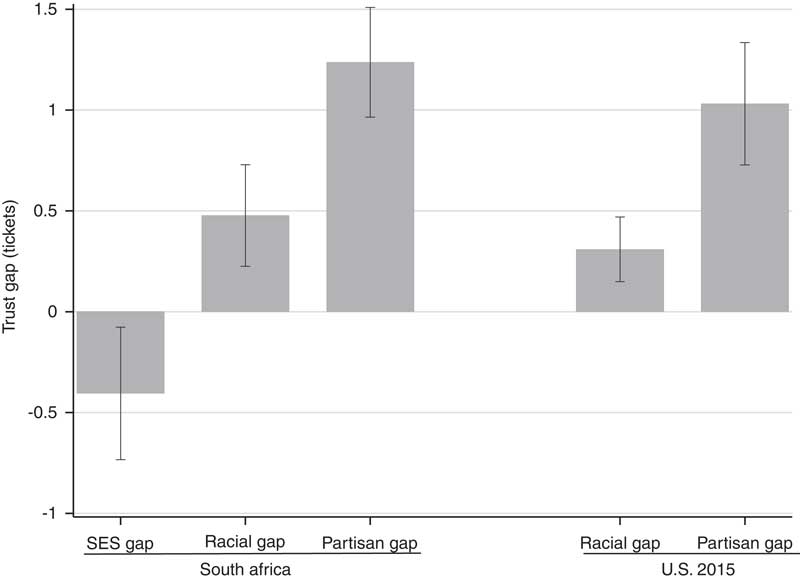
As a further test of the external validity of our partisanship and race results, we conducted another study in the United States in 2015 using a non-student sample recruited via Mechanical Turk (n=466 Player 1s). Subjects played partisan and racial trust games and answered a very brief socio-demographic questionnaire. As Figure 3 shows, the non-student sample produced results indistinguishable from the US 2011 student sample for partisan games (p=0.833) and from the partisan and racial games in South Africa. In sum, convergent results between the nationally representative and student samples on the anonymous, partisan and racial information games enhance our external and internal validity.
Another indicator of validity is how well results from a given sample comport with results from other samples. According to a meta analysis of anonymous trust game studies on student and non-student samples around the world, the proportion sent by Player 1 ranges from 0.22 to 0.89 with a mean of 0.50 and a standard deviation of 0.12.Footnote 70 On average, Player 1s in our student samples sent between 0.4 and 0.45 in the anonymous game (4 and 4.5 tickets), well within a standard deviation of that mean (see Figure 1). This result also aligns with trust games conducted on nationally representative samples in Germany.Footnote 71 Finally, the main validity concern of internet-based trust games is that subjects tend to trust more when they doubt they are playing against a real person.Footnote 72 Since we do not find higher-than-average levels of trust in these samples, online game play does not appear to harm validity.
Co-partisan, rival partisan and anonymous trust in eight contexts

Partisan Trust Gaps in Electoral Democracies
Our first research question is whether inter-partisan trust gaps are found in a variety of electoral democracies, and thus are not merely an idiosyncratic result confined to the United States.Footnote 73 If so, it would be consistent with our claim that institutionalized competition for political power creates party-based trust biases. The results from our most-different-systems design shed some light on the question.
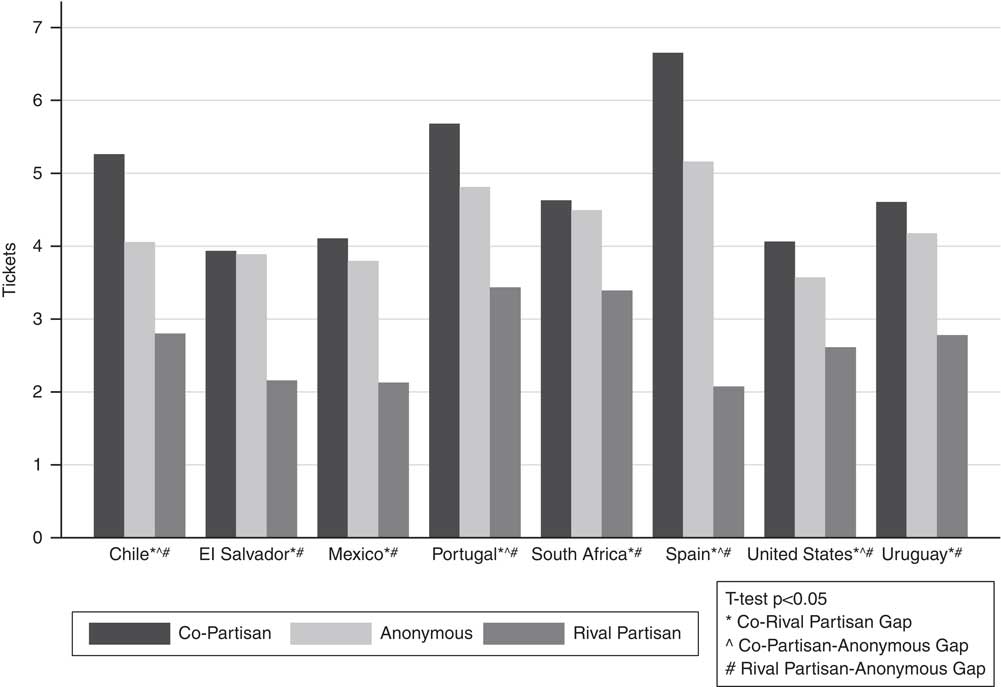
Figure 1 shows the average number of tickets sent to co- and rival partisans and anonymous individuals. Rival partisans are based on the following pairings:Footnote 74 United States, Democrats v. Republicans; Chile, Concertación (PS, PPD, PDC) partisans v. Alianza (RN, UDI) partisans; Uruguay, Frente Amplio v. PC and PB; El Salvador, FMLN v. ARENA; Mexico, PRI v. PRD v. PAN; South Africa, ANC v. DA; Portugal, PS v. PSD v. CDS v. PCP; and Spain, PP vs. PSOE. In each case, parametric (t-test, reported in legend) and non-parametric (Wilcoxon signed-rank tests, not reported) tests suggest subjects sent significantly more tickets to co-partisans than rival partisans, on average.
The widest co-/rival partisan trust gaps, and the most momentous shifts in the distribution of tickets (see Appendix Figure A2), are observed in Spain (4.6), Chile (2.41), Portugal (2.24), Mexico (2.06) and Uruguay (2.24). El Salvador (1.7) and the United States (1.45) have more moderate gaps. South Africa’s trust gap (1.23) is the smallest, but even that differential implies that subjects sent rival partisans a non-negligible 30 per cent fewer tickets than they sent co-partisans. These partisan trust gaps are similar in size to or larger than the one Carlin and LoveFootnote 75 found in their 2009 US study (1.28), which was, at the time, one of the largest intergroup trust gaps ever reported. In sum, across these eight diverse cases, knowing a stranger’s partisanship consistently influences trust decisions.
Figure 1 also helps adjudicate whether the partisan trust gap is driven by in-group favoritism, out-group hostility or both. The evidence is mixed. We observe in-group favoritism – a significant gap between tickets sent to co-partisans and anonymous players – in five of the eight cases. Yet extensive partisan out-group derogation – significantly more tickets were sent to anonymous players than to rival partisans – is observed in every case. So while partisan trust gaps partially reflect in-group favoritism, a more satisfying conclusion is that political competition drives out-group distrust.Footnote 76
Social Cleavages, Parties and Interpersonal Trust
A rich literature concludes that party system cleavages often reflect enduring cleavages – ethnic, racial, economic or post-conflict – that permeate society.Footnote 77 This section addresses our second research question: does channeling conflict across social cleavages into interparty competition raise or lower the salience of these divides for interpersonal trust? To examine this question, Player 1 subjects in El Salvador, South Africa and Spain played trust games with information on Player 2’s social identity. The Salvadoran and South African party systems are both rooted in deep socio-economic cleavages; a racial one is salient in South Africa. In Spain we test for class bias in a party system with less severe social divides.
El Salvador’s party system, dominated by FMLN and ARENA, arose from class-based struggle and a civil war from 1979 to 1992. FMLN was the umbrella organization of leftist fighters against a small but powerful landed elite and military in the thirteen-year civil war and elections following the peace process. The party received backing from the Soviet Union during the war and still represents the symbols, identity and rhetoric of socialism. FMLN’s rival, ARENA, inhabits the right-wing neoliberal part of the political spectrum. During the civil war it was responsible for some of the most infamous killings, including the assassination of Archbishop Oscar Romero. ARENA’s electoral support base is the upper and middle classes and military families. El Salvador’s civil war and post-conflict politics have revolved around issues of economic structure, class and divisions caused by historical legacies of the conflict. Race and ethnicity are not socially or politically salient. For this reason, our Salvadoran subjects played trust games under a socio-economic treatment in which they were told whether Player 2 came from a family that made above or below the national median household income. Additionally, subjects played games with both partisanship and socio-economic information so we could test whether partisanship is merely masking trustworthiness information derived from social cues, and vice versa.
South Africa’s party system reflects longstanding social divides crystallized under apartheid. The ruling ANC party’s base of support is almost entirely black, while the DA has the support of most whites (about 9.2 per cent of the population) and many colored (8.8 per cent) and Asian citizens (2.6 per cent). In our sample, no self-identified ‘whites’ identified with the ANC. South Africa is also one of the most economically unequal countries in the world, and the class divide largely breaks along racial lines. To compare the effects of social-cleavage-based identities to those of partisanship, South African subjects played trust games with information about Player 2’s self-identified racial category (white or black only) and socio-economic status. Like in El Salvador, socio-economic status was determined by whether Player 2’s family fell above or below the national median income. Unlike in El Salvador, no treatment combined socio-economic status with race or partisanship cues.
Finally, we conducted a small replication study in the United States in 2015 to examine the effect of race in a party system shaped by racial cleavages but not completely dominated by it, as in South Africa. For the past sixty years African Americans have strongly identified with the Democratic Party; however, white non-Hispanic Americans have identified with both the Democratic and Republican parties at high rates. As mentioned above, this was a non-student sample drawn from Mechanical Turk, and thus we can compare the results from it to the student sample drawn in South Africa to bolster external validity.
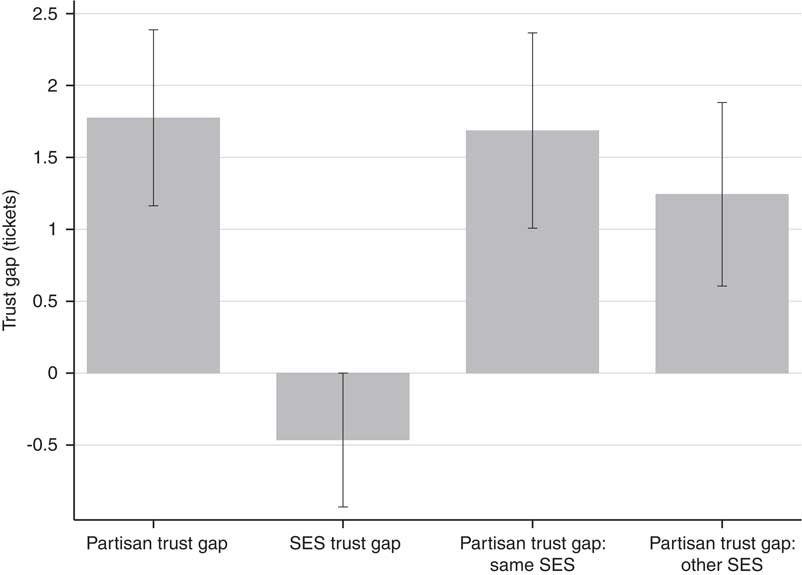
Figure 2 shows the effects of partisan and class cues on the decision to trust in El Salvador. We find no evidence of in-group bias for the socio-economic status treatment. If anything some reverse discrimination is at work,Footnote 78 which is not an uncommon finding in inter-class trust games.Footnote 79 Most importantly, when we combine socio-economic and partisanship information into the same treatment, the results essentially replicate the effects of partisanship information alone. Therefore, partisanship is not merely a heuristic substitute for class.
Class, partisanship and trust in El Salvador (95% confidence interval)

In South Africa, as Figure 3 illustrates, class does not produce us-against-them biases in trust decisions. Race, however, matters for trust in both South Africa and the United States. While racial cleavages played a central role in shaping South Africa’s party system structure and, to a lesser extent, the division between the main parties in the United States, the trust gap created by racial identities is significantly smaller than those created by partisan identities (p<0.05 for both countries). On average, individuals’ partisan trust gaps are triple the size of their racial trust gaps in both South Africa and the United States. Thus the underlying social cleavage that gave birth to party systems has less influence than the political identities themselves. Results from the Spanish sample (Appendix Figure A4) mirror those for El Salvador and South Africa: mistrust along class lines cannot explain robust partisan trust discrimination.
Class, race, partisanship and trust in South Africa and the United States, 2015 (95% confidence interval)

These results, together with related studies,Footnote 80 imply that funneling social divides into politically competitive organizations does not reduce in-group/out-group discrimination; rather, as Brewer postulated, the politicization of groupings increases intergroup bias.Footnote 81 If our theory is correct, this heightened trust bias can be partially explained by a process in which party competition transforms partisan identities more reliably into social cues of trustworthiness than the social identities upon which the party system is built. This would imply that while social groupings – tribes, nations, regions, ethnicities, etc. – are common bases of competition over resources in the absence of working democratic institutions, partisan identities (and the distributional preferences they imply) supersede social identities where electoral democracy is installed.
Exogenous Shocks, Partisan Identity Salience and Trust
The evidence above strongly suggests that political competition imbues partisanship with trustworthiness stereotypes that go beyond those imparted by the social cleavages that undergird party competition. But partisan trust gaps may be shaped by competition at a higher level: the nation. That is, competition with a common out-group may reduce the salience of subordinate partisan identities and raise the salience of superordinate national identities. If so, a dramatic national security event should shrink partisan trust gaps. The killing of Osama bin Laden affords an opportunity to test this expectation.
Immediately after the data collection for our United States sample, bin Laden was killed in a raid by US Navy Special Forces in Pakistan. This event was the foreign policy highlight of President Obama’s first term and received massive positive media coverage as well as retrospective coverage of the 9/11 attacks and other al-Qaeda attacks against the United States. The president enjoyed a small and short-lived bump in approval ratings.
To capitalize on this serendipity, we expanded subject recruitment from a similar pool. We account for any differences across subsamples by 1–3 propensity score matching subjects who participated in the study after bin Laden’s killing with subjects who had participated two weeks prior on confounders for gender, age, family income, race, partisanship, strength of partisanship, religious service attendance, hometown size, voting in 2010 and political knowledge.Footnote 82 Table 1 reports three models testing whether Osama bin Laden’s death affected party-based trust decisions. Each controls for the variables in the matching procedure to capture any remaining imbalance,Footnote 83 but we do not report these coefficients because, since the data are matched, they have no substantive interpretation.
International Events and Partisan Trust

Note: standard errors in italics. Models 1–3 matched dataset with controls for gender, age, family income, race, partisanship, strength of partisanship, religious services attendance, size of hometown, voting in 2010 and political knowledge. A matching model employing a more limited set of covariates (partisanship, gender, age, religious attendance) produces identical results. See Appendix Table A3 for details. *p <0.1, **p< 0.05, two-tailed
Model 1 shows the killing of bin Laden clearly had a major impact on how individuals use partisan cues in trust decisions. As we saw in our discussion of Figure 1 above, the average partisan trust gap for subjects who participated before bin Laden’s death was 1.45 tickets. However, the negative coefficient for After bin Laden’s Death suggests the event cut the average partisan trust gap by roughly the same number of tickets (1.25) or 86 per cent. In short, the robust inter-partisan trust gap observed before the bin Laden raid evaporated in its aftermath.
What accounts for the vanishing partisan trust gap shown here? It may simply reflect a decline in co-partisan trust. If so, it would imply that external threats and victories dampen, rather than enhance, overall trust. This explanation, however, lacks empirical support. The diminished partisan trust gap owes to higher rival partisan trust (Model 2), not lower co-partisan trust (Model 3). Rather, we suspect that group competition at a higher, superordinate level diminishes the salience of subordinate identities for trust decisions. While we cannot directly test this suspicion, it is consistent with interpretations of the sharp uptick in interpersonal trust and co-operation, both in general and across ethnic divisions, observed following 9/11.Footnote 84
Party Polarization and Partisan Trust Gaps
If political competition foments partisan trust discrimination, as the socio-economic and race treatments and the bin Laden study indicate, perceived party system polarization should be closely linked to partisan trust gaps. While parties may polarize on any set of issues, the left-right socio-economic spectrum constitutes an enduring (and often the most politicized) axis of party competition.Footnote 85 Therefore we posit a subject’s perceived level of party system polarization should be related to their behavior in the partisan trust games.
Two inter-related psychological mechanisms support this assertion. First, as Fiske, Cuddy and Glick underscore, ‘[w]hen perceivers view the goals of an outgroup as differing from or conflicting with goals of the ingroup, they ascribe negative traits and experience negative emotions towards the outgroup’,Footnote 86 which precede behavior toward outgroups. When rival partisans perceive their goals as increasingly divergent, as in polarized contexts, heightened out-group derogation should decrease their mutual trust. Secondly, Nicholson argues that ‘[i]n an environment characterized by intergroup disagreement, the desire to seek difference with the outgroup will likely be strong’.Footnote 87 Indeed, in highly polarized contexts citizens see parties as complete opposites of each other.Footnote 88 By this logic, perceived polarization should increase the perceived competition between partisans at opposite poles and, in turn, amplify positive (negative) stereotyping of in-groups (out-groups) as trustworthy (untrustworthy). Both mechanisms augur for the expectation that greater perceived party polarization corresponds to wider inter-partisan trust gaps.
While the proposed link has not been explicitly examined in previous research, after Hillary Clinton conceded to Barack Obama in the 2008 Democratic primary, Rand et al.Footnote 89 observed in-group favoritism in altruism among supporters of the opposing candidates that only subsided after the Democratic National Convention in September 2008. If intraparty competition and polarization can drive group-based differences in social preferences, interparty competition and polarization should do so a fortiori.
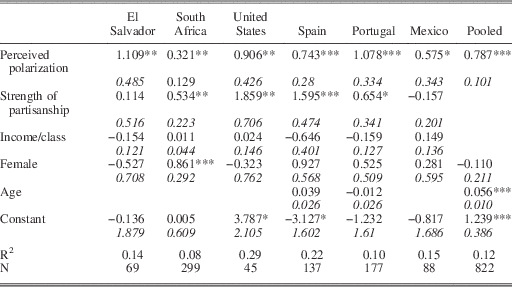
To test this contention, following the trust games in El Salvador, South Africa, the United States, Spain, Portugal and Mexico, subjects were asked to place themselves and the parties on a left-right scale. From these individual-level perceptions, we created a least-squares index of individual perceived party polarization based on Gallagher’s formula,Footnote 90 which accounts for party locations relative to the respondent’s self-placement.Footnote 91 Mathematically, this scale’s properties allow it to capture perceived polarization equally well in both two-party and multiparty systems.Footnote 92 In Table 2, we regress the partisan trust gap (that is, the absolute difference between the number of tickets sent to co- and rival partisans) on the perceived polarization scale, controlling for the strength of partisan attachment. Also included in the models, but not shown, are controls for income, gender, partisanship and, in South Africa, race.Footnote 93 In the last column we pooled the data from all of the studies.Footnote 94 Ordinary least squares point estimates and standard errors are reported, but results from Tobit regressions return the same inferences.Footnote 95 We expect perceived party system polarization and partisan trust gaps to be positively correlated even after accounting for strength of partisanship.
Perceived Party Polarization and the Partisan Trust Gap

Note: robust standard errors in italics. Controls for parties (and race in South Africa) are included in models but not displayed. Full model results in Appendix. *p <0.1, **p< 0.05, ***p< 0.01 two-tailed
Table 2 displays the results for each country. All six models show a strong relationship between perceived polarization and the width of partisan trust gaps. The more polarized a subject views the party system to be, the more he or she discriminates trust between co- and rival partisans. In fact, polarization is the only variable that has a systematic bearing on the partisan trust gap. In the El Salvador, Portugal and US models, polarization’s coefficients are similarly large, and subjects in these samples also reported similar levels of party system polarization. For Spain and Mexico, the coefficients are more modest but still meaningful. For example, a standard-deviation increase in perceived polarization (1.18) in Mexico is predicted to increase the partisan trust gap by 0.64 tickets: 30 per cent of Mexico’s average partisan trust gap. In the South Africa model, the somewhat reduced effects of perceived polarization on partisan trust gaps reflect subjects’ perceptions that the ANC and DA are only weakly polarized – the least polarized of the eight cases. Taken together, the smaller effect size and lower levels of perceived polarization may explain why South Africa exhibited the slimmest, yet significant, partisan trust gap in Figure 1 above.
Are Political Parties Minimal Groups?
Perhaps partisan trust gaps have little to do with political parties or political identities in general. For over forty years, social psychologists have elicited group-based discrimination with weak and arbitrary group identities.Footnote 96 This ‘minimal group’ paradigm suggests that the importance of partisanship-based trust discrimination should be assessed not against the null hypothesis (no effect), but rather against minimal-group treatment effects. Such a comparison allows us to discern whether partisanship provides a stereotype beyond simple in-group/out-group identities.
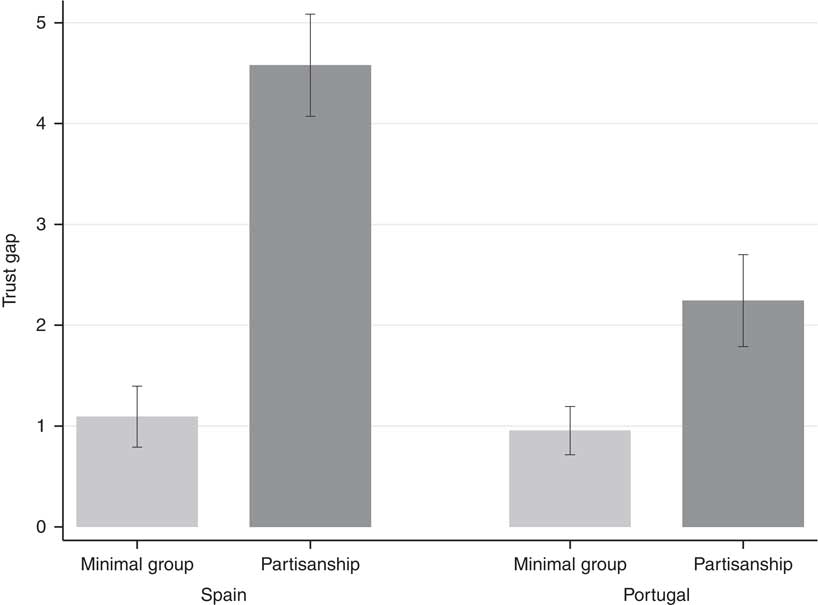
To answer this question, a subset of subjects in Spain and Portugal played a trust game under a minimal-group treatment immediately after the anonymous game. Player 1s were told they were assigned to one of two groups: blue or green. Before making their allocations they were told whether Player 2 belonged to the blue or green group. Each subject played randomly ordered games with an in-group member and an out-group member; all they knew about their counterpart was the color of their group.
Figure 4 displays the average trust gap based on the minimal-group treatment and its confidence interval. While the minimal-group trust gaps are significant, they are much smaller than the inter-partisan trust gaps in Spain and Portugal (see Figure 1). Indeed, the minimal-group effect is less than half the partisanship effect in both cases; paired t-tests and Wilcoxon signed-rank tests find both differences are significant (p<0.001). Such evidence augurs strongly in favor of the conclusion that partisanship conveys additional trustworthiness stereotypes beyond those provided by simple in-group/out-group identities.
Relative size of minimal-group and partisan trust gaps in Spain and Portugal (95% confidence interval)

Furthermore, the minimal-group effects observed in Spain and Portugal suggest the need for a new reference point for hypothesis testing when assessing the relevance of group identities for trust and other social decisions. The results in Figure 4 are roughly on the order of group effects based on ascriptive characteristics and markers of social distance reported by social psychologists and behavioral economists. For example, in Buchan, Croson and Solnick and Garbarino and Slonim,Footnote 97 gender trust gaps are smaller than the minimal-group effects observed in Spain and Portugal. And Gabrarino and Slonim’sFootnote 98 finding of age trust discrimination, Fershtman et al.’s findings vis-à-vis religionFootnote 99 and Burns’Footnote 100 racial trust gaps are no larger than the minimal-group effects reported here. In light of the minimal-group results, for most social identities a lack of an effect can be of much greater importance than a significant effect.Footnote 101
Conclusion
Understanding what helps and harms people’s ability to work together for the benefit of themselves and society is fundamental to understanding how communities improve the wellbeing of their members. A vast, multi-disciplinary research program on the evolution of co-operative behavior has generated unparalleled insight into the common, but seemingly biologically maladaptive and economically irrational, decisions to co-operate with strangers, even if the chance that cheating will be detected and punished is low.Footnote 102 Social scientists have linked the development of high levels of trust and co-operation to a variety of societal benefits, including democracy and development. But neither research program considers how the identities forged in the crucible of competitive, electoral democracy might affect the formation of trust. In short, politics – and its psychological effects on co-operative social preferences – are largely left out of these equations. Against this backdrop, the current study examines how interpersonal trust hinges on identification with the core political groupings in electoral democracies: political parties.
Guided by the premise that party labels convey trustworthiness stereotypes that are used heuristically, it finds large trust gaps between co- and rival partisans in eight electoral democracies from four world regions with diverse institutional, historical and social contexts. Partisan cues influence trust decisions more than cues based on the very social cleavages that gave birth to the party system, not to mention ‘minimal groups’. This highlights the role electoral competition plays in transforming erratic intergroup social conflict into routinized partisan conflict. Specifically, it suggests that in electoral democracies, partisanship becomes more relevant than most other social identities in the institutionalized competition for resources and power.
The nature of political competition more generally influences the salience of partisan identities for trust decisions. While American subjects displayed great partisan trust discrimination prior to Osama bin Laden’s assassination, in its immediate aftermath they trusted rival and co-partisans equally. Yet perceptions of left-right party polarization are positively associated with the width of partisan trust gaps in all eight electoral democracies studied. Therefore, political conditions that alter the salience of partisan competition can also alter trust discrimination between partisans.
Altogether, the results support two related propositions. First, representative democracy based on multiparty electoral competition allows groups to form and compete on the basis of identities that represent distributional preferences (partisanship) as opposed to less specifically political social identities that form on the basis of ascriptive or non-political socially constructed identities. In turn, political competition appears to shape trust decisions more powerfully than underlying social identities. Secondly, and at the same time, partisanship’s effects on trust are not constant, but rather reflect the nature of political competition. Representative democracy allows groups to form and compete on the basis of explicitly political social identities. When group competition creates centrifugal forces between parties within a party system, party labels generate more partisan trust bias than when centripetal forces dominate. Yet these identities may become subordinated to superordinate identities that permit nations to galvanize against an external threat. While more research is necessary to fully substantiate these claims, the evidence provided here is quite suggestive.
The power of partisanship and party competition to shape trust creates a serious tension. On one hand, partisanship stabilizes electoral competition and advances democracies toward the ideal of representation. Parties channel social divides into peaceful, routine political competition rather than violent conflict. Polarization, for its part, benefits voters by delineating competing party platforms. The more easily voters can locate parties in policy space, the more easily they can select the party that best represents their interests.Footnote 103 Thus from a public choice perspective, highly partisan and polarized contexts benefit democratic representation. On the other hand, these benefits could be offset by inefficiencies and collective action problems among citizens and elected officials.
Among citizens, partisan trust gaps suggest the proliferation of what PutnamFootnote 104 calls ‘bonding’ at the expense of ‘bridging’ social capital as perceived polarization intensifies. Not unlike Banfield’sFootnote 105 ‘amoral familialism’ or Granovetter’sFootnote 106 ‘strong ties’, bonding social capital depicts norms of trust and reciprocity confined to tight-knit homogenous groups and limited interaction and trust beyond them. Social capital of the bridging sort, like ‘weak ties’, however, connects people from heterogeneous social groupings. Whereas bonding social capital creates myriad social inefficiencies and lowers institutional effectiveness, bridging social capital spurs the collective action necessary for well-functioning democracies and markets. Therefore the ability of citizens of different political stripes to work together is diminished when they need it most: when they see a great chasm between themselves and partisan rivals. Among elected officials, vast rival partisan trust gaps will erode incentives to co-operate across party lines. Worried about being dubbed ‘appeasers’ at election time, officials will disavow compromise and hotly contest the legitimacy of the policies their partisan rivals propose or implement.Footnote 107 Such actions risk undermining the ‘politics of robust civility’ and compromise,Footnote 108 the very premise of democracy. And a breakdown of trust among elites is likely to fuel further mistrust at the citizen level.
Taken together, partisan trust discrimination at the citizen and elite levels could prove devastating to the body politic. In the short run, polarized polities will fail to overcome collective action problems due to trust deficits between rival actors whose co-operation is required. Extrapolating party polarization over the long run, partisan (positive and negative) trustworthiness stereotypes could become ‘normal’ expectations in social exchange. That is, inherently non-political interactions between citizens will reflect political biases derived from stable behavioral expectations. Ironically, reliance on partisan trustworthiness cues appears to be a suboptimal strategy, leading to lower levels of co-operation on average.Footnote 109 Certainly, a culture of distrust, in which social exchange is tainted by misplaced partisan biases, would take its toll on development and democracy.
In their path-breaking comparative study of political culture and democracy, The Civic Culture, Almond and Verba dedicated Chapter 10 (‘Social Relations and Civic Cooperation’) to understanding how social attitudes influence co-operation in democratic societies. Regarding partisanship, they concluded, ‘the fact that one is partisan … does not impede his ability to co-operate with one’s fellow citizens. It is only when partisanship becomes so intense as to involve rejection, on personal grounds, of those of opposing political views that the state of partisanship in a nation may be said to limit the ability of its citizens to co-operate’.Footnote 110
The evidence presented here demonstrates that these concerns are well founded and applicable to a wide range of electoral democracies. Investigating the extent to which partisan mistrust influences social and political participationFootnote 111 (and other ecological conditions that ease or hinder co-operation among partisans) remains a pending task. By focusing on how the nature of political competition affects inter-partisan trust, this study takes a step in this direction and highlights the potential trade-offs between partisanship and generalized trust in democratic societies.
Supplementary Material
To view supplementary material for this article, please visit http://dx.doi.org/10.1017/S0007123415000526