INTRODUCTION
Knowledge about why people behave ecologically aids environmental conservation and preservation efforts on scales from the local to the global. Efforts to understand ecological behaviour have emphasized moral (for example Kaiser Reference Kaiser2006) and protective reasons (for example Schultz Reference Schultz2001). It is possible that positive, personally gratifying experiences in natural environments also motivate ecological behaviour.
One common form of positive experience in nature involves the restoration of adaptive resources that a person has depleted while meeting the demands of everyday life. Restoration may involve, for example, winding down physiologically and emotionally after a stressful day or recovering the capacity to focus attention after prolonged work on a difficult task (Ulrich et al. Reference Ulrich, Simons, Losito, Fiorito, Miles and Zelson1991; Kaplan Reference Kaplan1995; Hartig Reference Hartig and Spielberger2004). Such restoration is essential to a person's continued well-being and effectiveness, and it proceeds better in some places than in others. Natural environments rank highly among such restorative places. Since the early 1960s, surveys have consistently identified stress reduction and escape from stressors as important reasons for outdoor recreation (see reviews by Hartig Reference Hartig1993; Knopf Reference Knopf, Stokols and Altman1987; Schreyer Reference Schreyer1989). These benefits do not owe only to an activity, but to an activity in combination with a natural environment.
Experimental research has shown that the greater a person's need for psychological restoration, the greater is his or her preference for walking in a natural area versus an urban centre (Staats et al. Reference Staats, Kieviet and Hartig2003; Staats & Hartig Reference Staats and Hartig2004; Hartig & Staats Reference Hartig and Staats2006). Field experiments have found that attentional restoration and psychophysiological stress recovery during a walk are better supported by locally typical natural environments than by urban environments (Hartig et al. Reference Hartig, Mang and Evans1991, Reference Hartig, Evans, Jamner, Davis and Gärling2003). Laboratory experiments with visual simulations of natural and urban environments have produced results in keeping with those of the field experiments (see for example Hartig et al. Reference Hartig, Böök, Garvill, Olsson and Gärling1996; Van den Berg et al. Reference Van Den Berg, Koole and Van der Wulp2003; Berto Reference Berto2005; Pretty et al. Reference Pretty, Peacock, Sellens and Griffin2005).
Because destruction of natural environments can eliminate possibilities for restorative experiences, appreciation of such experiences may stand as an initial source of motivation for a variety of ecological behaviours, through which people can indirectly reduce human impacts on natural environments. To our knowledge, however, research has not yet directly addressed this possibility.
As an intermediate step toward more ecological behaviour, restorative experiences in nature might promote increased concern about the environment. Environmental concern is commonly treated as an evaluation of or an attitude towards facts or behaviours with consequences for the environment; it may thus refer to ‘a specific attitude directly determining intentions’ to behave ecologically or ‘a general attitude or value orientation’ that guides action more generally (Fransson & Gärling Reference Fransson and Gärling1999, p. 370). Value orientations include ecocentrism (concern about the ecosystem itself), anthropocentric altruism (concern for the health of people generally as affected by declining environmental quality) and self-interest (concern about personal harm stemming from environmental problems) (Fransson & Gärling Reference Fransson and Gärling1999; see also Stern Reference Stern1992). Here we refer to this last orientation, as it is of a kind with the use of nature for psychological restoration
Numerous studies have linked some representation of environmental concern to more or less specific measures of ecological behaviour (see Kaiser et al. Reference Kaiser, Wölfing and Fuhrer1999). Other studies have also examined relations among positive experiences in nature, environmental concern and/or ecological behaviour. For example, Brun (Reference Brun2001) found that the degree to which Norwegian adolescents liked to spend time in natural settings had a stronger positive association with their ecological behaviour than sociodemographic and environmental concern variables in a regression analysis. Also, following Dunlap and Heffernan (Reference Dunlap and Heffernan1975), many studies have investigated whether participation in outdoor recreation activities promotes environmental concern and ecological behaviour (for example Nord et al. Reference Nord, Luloff and Bridger1998; Teisl & O'Brien Reference Teisl and O'Brien2003). However, no empirical research has apparently specified the restorative benefits of nature experiences as a basis for environmental concern, nor have any studies assessed the role of environmental concern as a mediator of the relationship between the use of nature for restoration and ecological behaviour.
Within a given population, some people may want to behave in ecologically ‘friendly’ ways and yet not do so because they lack structural supports, such as community recycling programmes, or they face other constraints, such as the cost of domestic solar panels. Given our interest in a particular source of motivation for ecological behaviour, we sought to measure ecological behaviour in a way that would also reflect on a person's motivation to behave ecologically. Our measurement approach does this by looking at the performance of a variety of behaviours through which a person can reduce his or her ecological impacts. It does this while also taking into account the influence of structural supports and constraints. The approach yields a score for a person's engagement in the pursuit of an overall ecological goal that is the composite or compound of all the behavioural means that the person directs at that goal (see Kaiser & Wilson Reference Kaiser and Wilson2004). It provides an indication of the person's motivation, framed as the degree to which he or she has overcome structural obstacles in performing given behaviours.
Some elaboration is in order. A composite assessment of goal-directed ecological behaviour assumes that people select from multiple behavioural alternatives to realize their ecological ambitions. For example, instead of running an energy-efficient washing programme, they might abstain from using a dryer. Any one of the behaviours they perform involves costs, as it requires effort or other personal resources, such as time, money or courage. Presumably, people select prudently from the behavioural means to express their motivation to act ecologically, and they prefer the more convenient and less socially problematic actions over the more complicated, strenuous, or pricey ones. That people favour relatively less demanding actions over more demanding or difficult ones is ultimately reflected in the relative popularity of various behaviours, or the relative number of persons in the given population who perform them. Thus, the overall popularity of a behaviour is seen as a function of two components: (1) the average motivation of people to act in an ecological manner, and (2) the combination of all of the figurative costs of the particular behaviour, or the difficulty involved in realizing it. The Rasch model, the classical one-parameter logistic model within item response theory, can be used to describe this functional relationship, and this motivational measure is at the same time a reliable and valid ecological performance measure (see Kaiser Reference Kaiser1998; Kaiser & Wilson Reference Kaiser and Wilson2004; Kaiser et al. Reference Kaiser, Oerke and Bogner2007).
Our aim in the present study was to investigate whether the use of natural environments for psychological restoration relates to performance of ecological behaviour, and whether that relationship is mediated by environmental concern. We used data from a survey of Norwegian adults to test the hypothesis that those who more strongly endorse the use of nature for their restoration also behave more ecologically (hypothesis 1). With a view to the mediating role of environmental concern, our additional hypotheses followed the logic of mediation tests (Kenny et al. Reference Kenny, Kashy, Bolger, Gilbert, Fiske and Lindzey1998). Specifically, we predicted a positive association between the use of nature for restoration and environmental concern (hypothesis 2), a positive association between environmental concern and ecological behaviour (hypothesis 3), and a significant reduction in the strength of the association between restoration and ecological behaviour with entry of environmental concern into the analysis (hypothesis 4).
We included age, gender, education, income, size of community of upbringing, size of community of current residence and distance from current residence to an outdoor recreation area as additional predictors of ecological behaviour for two main reasons. First, we wanted to contribute to the research on sociodemographic correlates of the use of nature for motives related to psychological restoration (Knopf Reference Knopf, Altman and Wohlwill1983, Reference Knopf, Stokols and Altman1987). Second, with these variables included in the multivariate analyses, we could better estimate the relative influence of the use of nature for restoration on ecological behaviour (cf. Brun Reference Brun2001).
METHODS
Procedures and participants
To represent the Norwegian adult population, 3865 people were randomly selected from the national telephone network's subscriber list, with quotas imposed for gender and county. The survey had two mailings. Advance consent had not been sought from respondents before the first mail-out, and no selection was attempted at the household level. Before the second mail-out, respondents were recruited in advance by telephone. To improve the age balance in the sample, recruiting targeted the youngest person in the household. It took about 30 minutes to complete the questionnaire, which could be returned with a prepaid self-addressed envelope.
Twenty questionnaires were returned as undelivered because of an incorrect address or deceased addressee. Of the 3845 questionnaires delivered, 1455 (37.8%) were returned. Incomplete answers rendered some of these unusable, so we base the analyses in this study on a final sample of 1413.
Not surprisingly, the proportions of men (47.5%) and women (52.5%) in the sample match those in the Norwegian population above 15 years (men: 49.5%; women: 50.5%: χ21 = 2.1; p = 0.85). By contrast, the age distribution of the sample deviates from that of the population (χ27 = 175.6; p<0.001), in that it includes a larger proportion of middle-aged people. The population data come from the 1999 census (Statistics Norway 2000), the most recently published data at the time of the survey.
Measures
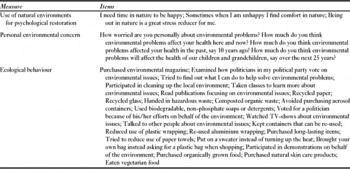
We assessed the use of natural environments for psychological restoration (hereinafter ‘restoration’) with three items from Gagnon-Thompson and Barton's (Reference Gagnon-Thompson and Barton1994) ecocentrism scale (see Table 1). The respondents answered these items using a five-point response format (1 = strongly disagree, 5 = strongly agree). We treated missing values (no more than 1.2% of all responses for any item) as neutral responses (i.e. we coded non-responses as neither agreement nor disagreement). Internal consistency among the items was acceptable (Cronbach's α=0.82).
Survey items used to create the measures employed in the analyses.

We considered a score based on the sum of these three items as unsatisfactory, since it would conceal patterns of response involving seemingly self-contradictory or internally inconsistent statements, such as agreeing with the statement, ‘I need time in nature to be happy’ and disagreeing with the statement ‘Sometimes when I am unhappy I find comfort in nature.’ In light of this concern, we used the three items to create groups through reference to patterns of endorsement of all three items. To reduce the number of response patterns and so make the task more manageable, we recoded responses to each item to disagree, neutral and agree. Thus, the first version of the new restoration variable had a minimum value of –3, assigned when the respondent had disagreed with all three items (i.e. nature consistently not endorsed for restoration), and a maximum value of +3, assigned when the respondent had agreed with all three items (i.e. nature consistently endorsed for restoration). Intermediate values on the negative end of the scale represented different ratios of non-affirmative to neutral responses (i.e. 2:1 and 1:2). The zero point on the scale represented complete neutrality. Intermediate values on the positive end of the scale represented different ratios of affirmative to neutral responses (i.e., 1:2 and 2:1). Thus, patterns of response consistent with this approach included all combinations of disagree and neutral responses, as well as all combinations of neutral and agree. Some 120 respondents (8.5% of the sample) showed inconsistent patterns of agreement across the three items (one agree, one neutral, one disagree; one agree, two disagree; two agree, one disagree). Excluding them, we still had 1293 respondents with a restoration score suitable for analysis and, inevitably, we increased the internal consistency of the original three-item set from α=0.82 to α=0.88.
Of the seven constituent groups, all but three had small sample sizes. Most Norwegian people do value natural environments as settings for restorative experience; each of the four groups formed on the basis of non-endorsement had relatively few members (1.7–3.3% of the 1293 valid cases). To more precisely determine whether the groups varying in the level of non-endorsement and neutrality engaged in less ecological behaviour than the groups defined by some level of positive endorsement, we combined all non-endorsing and completely neutral respondents into one group (n=120). The remaining groups had the following sizes: endorsed one statement (n=135), endorsed two statements (n=199), full endorsement (n=839).
As indicated, we assume that the three restoration items concerned what respondents appreciated having done and might continue to value to do, namely resort to nature for psychological restoration. We thus recognize that the items reflect both appreciation of certain activities as well as their conduct, and so can be understood as evaluative behavioural responses, or indicators of attitudes toward behaviours, and not simply reports concerning performance of those behaviours (see Eagly & Chaiken Reference Eagly and Chaiken1993). Evaluative behavioural responses nevertheless constitute behavioural data as well as data on the appreciation of those behaviours; responses to the items rest on knowledge of the behaviours involved, which we assume our respondents acquired through personal experience.
We used four items adapted from the Health of the Planet (HOP) survey (Dunlap & Mertig Reference Dunlap and Mertig1995) to assess personal environmental concern. Three of the items concerned beliefs about the link between environmental problems and personally relevant health, in the past, present and future (Table 1). The fourth item addressed personal concern in a more global fashion, without specific reference to the health of the subjects or their children or grandchildren. The respondents used a five-point response format to reply (where 1=very little and 5=very much). A scale based on these four items had adequate internal consistency (α=0.82). Missing values amounted to no more than 1.4% of all responses for any of the four items. We did not impute values for missing responses, but calculated a score with the available data, given that the respondent had answered at least three of the items. For the 1398 people for whom we could calculate a score, the mean was 3.40 (SD=0.79). This indicates a moderate degree of personal concern about the environment. The internal consistency of the scale remained the same with or without the 120 people who had an inconsistent pattern of agreement for the restoration items (α=0.82).
The survey included 26 questions about personal behaviours that can affect the environment (Table 1). These behaviours form five groups: acquiring knowledge about environmental issues, becoming politically involved, consumer actions, waste reduction and energy use. Respondents indicated how often in the last year they had performed each behaviour using a five-point response format. To reduce error variance (for example Kaiser & Wilson Reference Kaiser and Wilson2000), and following common practice, we recoded ‘never’ (=1), ‘seldom’ (=2) and ‘sometimes’ (=3) to ‘does not reliably perform this behaviour’ (=0), and we recoded the responses ‘often’ (=4) and ‘very often’ (=5) to ‘reliably performs this behaviour’ (=1).
We calibrated the 26 behaviour items with the Rasch model (for example Bond & Fox Reference Bond and Fox2001). As expected from previous calibrations of this kind (Kaiser Reference Kaiser1998; Kaiser & Wilson Reference Kaiser and Wilson2004), the item fit statistics were acceptable. None of the behaviours had a mean square value >1.15, which would have indicated excess variability between model-prediction and data reality of 15% (representing modest unpredictability).
The separation reliability for the Rasch scale was 0.80. This represents the ratio between true and estimated variance of people's ecological behaviour, and is thus in line with a classical definition of reliability (for example Bond & Fox Reference Bond and Fox2001). Consequently, the scale also showed adequate internal consistency (α=0.82). When we excluded the 120 people whose responses to the three restoration items showed an inconsistent pattern, the internal consistency of the behaviour measure improved (α=0.89). We could not estimate a behaviour score for 31 of the 1413 respondents because they had no variation in their responses.
For the 1382 people with valid behaviour estimates, the mean was −1.11 logits. Logits represent the natural logarithm of the odds ratio for endorsed versus non-endorsed items (Bond & Fox Reference Bond and Fox2001). Because the zero point in an interval scale is arbitrary, negative/positive logits are not as such meaningful. A person's logit score speaks to his or her overall ecological motivation and reveals the level of difficulty that he or she has overcome in performing a particular set of behaviours. Performance difficulties are, by contrast, estimated with the data from the sample as a whole regardless of any motivational differences; difficult behaviours are those that few people report performing, while easy behaviours are those that most people report performing. Negative logit values speak to the performance of those behaviours that involve relatively little difficulty (most people report doing them), whereas positive values indicate the performance of difficult behaviours (relatively few people report doing them). The present mean performance score expressed in logits is equivalent to a mean sum score of 8.9 behaviours being performed, out of 26. When the Rasch model accurately represents the data, the correlation between respondents' logit values and sum scores will typically be high; in the present sample r=0.98.
Sociodemographic predictors
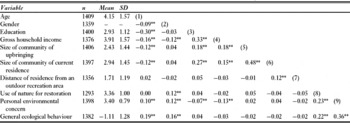
Our multivariate analyses also included the following sociodemographic variables as predictors: age (1=19 or younger; 2=20–29; 3=30–39; 4=40–49; 5=50–59; 6=60–69; 7=70–79; 8=80 or older); gender (1=man; 2=woman); education (1=completed secondary school [9 years]; 2=secondary school, plus 1–2 years further education/people's high school [c. 10–11 years]; 3=completed ordinary high school [12 years]; 4=education beyond ordinary high school, university/college exam [>12 years]); gross household income in Norwegian crowns (1=under 100 000; 2=100 000–199 000; 3=200 000–299 000; 4=300 000–399 000; 5=400 000–499 000; 6=over 500 000); size of community of upbringing and size of community of current residence in number of inhabitants (1=a large city [100 000–500 000 inhabitants]; 2=a suburb of or on the outskirts of a large city; 3=a medium-sized city [10 000–100 000 inhabitants]; 4=a small town [< 10 000 inhabitants]; 5=a rural area); and distance of residence from an outdoor recreation area in kilometres (1=<0.5; 2=0.5– 1; 3=1.1–1.5; 4=1.6–2; 5=>2). The number of missing cases for these variables can be derived from the data (Table 2), given a sample size of 1413.
Means, standard deviations (SD) and Pearson correlation matrix for the variables in the analyses. *p < 0.05; **p < 0.01.

Statistical analysis
We first calculated the bivariate associations among the predictors. To clarify the nature of the relations between use of nature for restoration, personal environmental concern, and ecological behaviour, we completed pairwise comparisons of the groups formed in terms of endorsement of the restoration items. We tested for mediation by environmental concern in hierarchical regression analyses that included sociodemographic characteristics at the first step, our restoration measure at the next step and our measure of environmental concern at the third step (Baron & Kenny Reference Baron and Kenny1986; Kenny et al. Reference Kenny, Kashy, Bolger, Gilbert, Fiske and Lindzey1998). We then examined the coefficient for the relationship between restoration and ecological behaviour to determine whether inclusion of environmental concern substantially reduced its magnitude. Such a reduction would constitute evidence of mediation. We performed the Sobel test to assess the statistical reliability of the degree of mediation. For the regression analyses, we examined collinearity diagnostics, statistics for the residuals (Mahalanobis distance and measures of influence), and the residuals plotted against the predicted values to identify problems with distorted estimates due to multivariate outliers and non-adherence to the statistical assumptions (see Tabachnik & Fidell Reference Tabachnik and Fidell2001).
RESULTS
Sociodemographic characteristics and use of natural environments for psychological restoration
The sociodemographic variables correlated weakly at most with the use of nature for restoration (Table 2). The only significantly correlated variable was gender, reflecting the fact that women outnumbered men in the group that fully endorsed the use of nature for restoration, whereas men outnumbered women in the partial and non-endorsement groups.
Psychological restoration and ecological behaviour
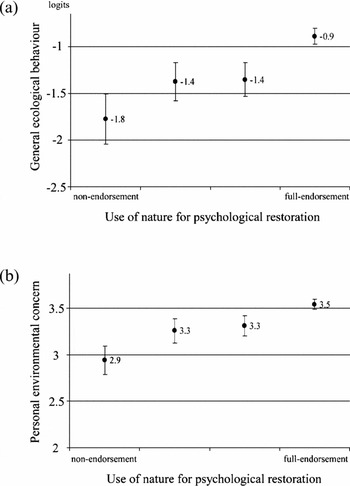
Higher ecological behaviour scores attended more complete endorsement of the use of natural environments for psychological restoration (F(3, 1261)=22.98; p <0.001; η2=0.052), conforming to hypothesis 1 (Fig. 1a). Those respondents who fully endorsed the use of natural environments for psychological restoration showed the highest mean level of ecological behaviour, with approximately 9 out of 26 behaviours performed. The pairwise comparisons (Dunnett's C, suited to unequal variances) indicate that the other three groups all had lower performance levels (one-tailed p ≤ 0.05). Those who did not endorse the personal use of natural environments for restoration showed the lowest mean level of ecological behaviour, though not reliably lower than that of the respondents who endorsed only one of the three statements about the use of nature for restoration. In contrast, those who endorsed two of the three statements behaved significantly more ecologically than the non-endorsers, but not reliably more so than those who endorsed only one of the three statements. The pattern of means thus suggests that ecological behaviour might relate to the use of nature for restoration by either a linear or a step function.
(a) General ecological behaviour and (b) personal environmental concern as a function of the use of natural environments for psychological restoration. Bars represent 95% confidence intervals.

Psychological restoration and personal environmental concern
Personal environmental concern also had a modest though significant positive association with the use of natural environments for psychological restoration (F(3,1275)=25.31; p < 0.001; η2=0.056; Fig. 1b), conforming to hypothesis 2. The pairwise comparisons (Bonferroni adjustment; one-tailed p ≤ 0.05) indicate that the respondents who endorsed all statements about restoration in nature reported higher environmental concern on average than the respondents in the other groups. Those who did not quite fully endorse the use of natural environments for restoration had higher environmental concern scores on average than those who gave no endorsement.
Test of mediation
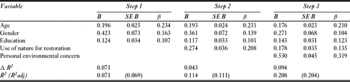
Entered at the first step in the hierarchical regression analysis, the sociodemographic characteristics explained c. 7% of the variance in general ecological behaviour (Table 3). However, gross household income and the three residential variables (size of community of upbringing, size of community of current residence, distance of residence from an outdoor recreation area) did not have statistically significant coefficients (β=−0.036–0.025). This did not change appreciably at subsequent steps of the analysis, and those variables were therefore excluded from the model. Their exclusion did not substantially modify the magnitude and pattern of results at the second and third steps of the initial model; however, it did mean that the data for subjects who had a missing value on any of the excluded variables came back into the analysis, thereby returning lost statistical power. For the final model n=1192, reflecting the loss of cases to missing values on the remaining variables, as well as the deliberate exclusion of four cases that residual statistics indicated had an undue influence on the regression equation (Table 3).
Summary of final hierarchical regression analysis with personal environmental concern treated as a mediator of the relationship between use of natural environments for psychological restoration and the dependent variable, general ecological behaviour (n=1192). B=regression coefficient, SE B=standard error of the regression coefficient and β=standardized regression coefficient. All coefficients and changes in R2 are significant (p ≤ 0.001).

In the final model, as in the initial model, the restoration variable was related to general ecological behaviour when entered at the second step. After adjustment for the sociodemographic variables, it contributed an additional 4.3% of explained variance in ecological behaviour. At the third step, personal environmental concern also had an independent association with general ecological behaviour, conforming to hypothesis 3 and contributing an additional 9.4% of explained variance in ecological behaviour.
With the entry of personal environmental concern (step 3), the size of the coefficient for the relationship between restoration and ecological behaviour decreased, an indication of mediation (Table 3). The Sobel test, which provides a more exact assessment of this mediation, required the regression coefficient and its standard error for the relationship between psychological restoration and personal environmental concern. A regression analysis that also included age, gender and education as predictors, in line with the previous model, yielded B=0.18, SE B=0.022, β=0.23 (t=8.07, p < 0.001). The product of this B coefficient and the B coefficient for the relationship between concern and overall behaviour corresponded to the reduction in the size of the restoration-behaviour coefficient from step 2 to step 3 (i.e. 0.18×0.53=0.0954≅0.274−0.178; Kenny et al. Reference Kenny, Kashy, Bolger, Gilbert, Fiske and Lindzey1998). The Sobel test itself yielded z=6.7 (p < 0.001), which conforms to hypothesis 4. Personal environmental concern however did not fully mediate the relationship between psychological restoration and ecological behaviour, as the coefficient for that relationship remained statistically significant at step 3.
As expected from the bivariate correlations (Table 2), the diagnostics obtained with the analysis indicated no reason for concern about collinearity (for example no predictor in the analysis had a tolerance < 0.89). The residuals plotted against the predicted values indicated satisfactory conformity with the normality and linearity assumptions of the regression, and modest heteroscedasticity (Tabachnik & Fidell Reference Tabachnik and Fidell2001).
DISCUSSION
Our results indicate that Norwegian adults generally value natural environments as settings for restorative experience. Only a small proportion of the people in our sample did not endorse any of the statements which constituted our measure of the use of nature for restoration. This positive regard for nature did not, however, have a close counterpart in general ecological behaviour. Our respondents tended to perform a small number of relatively easy behaviours, such as recycling paper and glass, taking care of containers suitable for re-use, and cycling or walking to destinations.
Restoration predicted overall ecological behaviour, but to a rather low degree, perhaps because of the relatively small degree of variation in restoration. Restoration also predicted personal concern for the environment, which in turn predicted ecological behaviour. When personal concern entered the regression model after restoration, the relationship between restoration and ecological behaviour diminished, which is an indication that personal concern mediates the relationship between restoration and ecological behaviour. However, personal concern did not appear to fully mediate that relationship; at the final step, restoration remained a significant predictor of ecological behaviour. Thus, the use of nature for restoration may have both direct and indirect motivational effects on ecological behaviour.
The pattern of means suggests that ecological behaviour can increase linearly with the use of nature for restoration. The means also allow for the possibility that a step function could describe the relationship between the two variables, such that increasing use of nature for restoration eventually brings a person over successive motivational thresholds, each reflected in a distinct upward step in the intensity of ecological behaviour performance. Given the small number of non-endorsers, further efforts to study the contribution of endorsement of nature for restoration to ecological behaviour might more fruitfully look to known groups than rely on population sampling (for example Manzo & Weinstein Reference Manzo and Weinstein1987). Such studies could test alternative, non-linear associations between restoration and ecological behaviour.
Previous research has found that sociodemographic characteristics such as age, gender, income, education and residential circumstances have a mixed pattern of associations with environmental concern and ecological behaviour (Van Liere & Dunlap Reference Van Liere and Dunlap1980; Fransson & Gärling Reference Fransson and Gärling1999; Diamantopoulus et al. Reference Diamantopoulos, Schlegelmilch, Sinkovics and Bohlen2003). We also found a mixed pattern of associations; age, gender and education, but not income or residential variables predicted both ecological behaviour and environmental concern. The more novel finding is the general absence of significant associations between the use of nature for restoration and the sociodemographic characteristics of our respondents. Specifically, we found that the use of nature for restoration did not correlate with age, education, gross household income, size of community of upbringing, size of community of current residence, or the distance of the residence from an outdoor recreation area. Only gender had a significant association with our restoration variable; women endorsed the use of nature for restoration to a greater degree than men. Altogether, this suggests that use of nature for restoration by Norwegian adults transcends some important social categories.
The study has several limitations. First, our conceptual model implies causal relations, yet our correlational data do not allow statements about causality. We cannot rule out the possibility that ecological behaviour or personal concern caused the use of nature for restoration; however, both of those possibilities strike us as implausible. Nor can we rule out the possibility that some unmeasured variable affected all three of the variables in focus here and so inflated the associations among them. Any such variable would presumably not have correlated strongly with any of the other predictors we did include in our analyses. Arguments regarding the plausibility of our model aside, we acknowledge that our data do not support strong causal inferences (see Shadish et al. Reference Shadish, Cook and Campbell2002).
Second, with all variables measured with self-reports on a pencil-and-paper instrument, we faced the issue of common method bias and addressed this by checking construct validity. In a factor analysis of the combined item sets from the three scales, we found that the restoration, environmental concern and ecological behaviour items did not simply represent the same construct. As to response bias, the respondents used different response formats in answering the restoration and ecological behaviour items. Should respondents have shown a preference for particular points on the scales, independent of item content, a linear association between restoration and ecological behaviour would have been more pronounced. Had respondents preferred the midpoint or endpoints of the scales, then larger n values would have been expected for the three groups defined by uniform use of those scale points for the restoration items (i.e. complete disagreement, complete neutrality and complete endorsement) and each group's variability in ecological behaviour would have been smaller. Moreover, Kaiser et al. (Reference Kaiser, Frick and Stoll-Kleemann2001) have observed close correspondence between self-reported and overt ecological behaviour.
Third, social desirability provides another alternative explanation for the association between the use of natural environments for restoration and ecological behaviour. In a previous study (Hartig et al. Reference Hartig, Kaiser and Bowler2001), social desirability predicted ecological behaviour scores, but did not appreciably reduce prediction by the restoration measure (perception of restorative qualities in an unspectacular natural environment). Also, Kaiser (Reference Kaiser1998) found no significant social desirability effect on ecological behaviour with adults more mature than those in Hartig et al. (Reference Hartig, Kaiser and Bowler2001).
Finally, the associations that we have assessed in this sample of Norwegian adults may not readily be generalized to other populations. Conceivably, in populations that enjoy less ready access to natural areas, the use of natural environments for psychological restoration may be less uniformly endorsed, and the greater variability in responses regarding the use of nature for restoration may enable the detection of stronger associations with environmental concern and ecological behaviour.
The question arises whether the use of nature for restoration is a proximal or distal motivation for ecological behaviour. As with other aspects of linkages between attitudinal components and behaviour, the distance may depend on the psychological distance of the environment; the use of nature for restoration could be a proximal motivator if the issue is the threatened destruction of a particular environment that a person uses for restoration.
The potential importance of participation in outdoor recreation for encouraging pro-environmental attitudes and ecological behaviour has been often recognized (see Dunlap & Heffernan Reference Dunlap and Heffernan1975; Teisl & O'Brien Reference Teisl and O'Brien2003; Pretty Reference Pretty2006). Indeed, one strategy used by environmental groups has involved bringing members of the voting public and their legislators out to places threatened by some form of development or resource extraction activity. These visitors may perceive something of the restorative quality of those places, perhaps experience restoration while in them, and may then modify their attitudes regarding their protection and take action to protect them. We do not want to overstate the magnitude of such effects; a single visit may do little. However, ongoing use of particular natural places for restoration may promote attachment (Korpela et al. Reference Korpela, Hartig, Kaiser and Fuhrer2001) and a greater willingness to take protective actions of varying kinds, both specific to particular places and, as our results suggest, more generally, for example through ecological behaviours such as recycling.
ACKNOWLEDGEMENTS
We thank Thomas Öst, Nils Hertting, Per Gustafson, Eva Sandstedt, Helen Ekstam and two anonymous reviewers for their constructive comments. The survey was in part made possible by a grant from the Research Council of Norway's programme on Environmental Quality of Life.