Natural disasters are becoming more frequent and intense. 1 Mass displacements and damage caused by disasters can disrupt the treatment adherence support for tuberculosis (TB) patients. Damages to drug stocks and treatment documents, cut-off access and infrastructure damages to service delivery sites, displacement of health staff and trained community volunteers, and displacement of patients and disruption of routines that support adherence add to the severity of this disruption. 2-4
LOCAL SETTING
Kerala, a state in southern India, with a population of 34.1 million, has made impressive improvements in its population’s conditions of living. Despite having a low per capita income, its indicators of social development – such as the human development index (0.84), infant mortality rate (10/1000 live births), sex ratio (1084 females to 1000 males), and female literacy rates (92.07%) – are comparable to those of many developed countries. 5,Reference Thankappan and Valiathan6
Primary health care services have been systematically organized in the state with a network that extends to village level. There are 230 community health centers and 845 primary health centers (approximately 1 per 30 000 population) in the state. There are 5500 female and 3500 male multi-purpose health workers (MPHWs). MPHWs provide primary promotive and curative health care for all of the national health programs and outreach activities in catchment villages catering to a population of approximately 5000 individuals. Accredited social health activists (ASHAs) who are community health workers for every village (1 per 1000 population) facilitate the community outreach and enhance beneficiary coverage and support to MPHWs.
Kerala state achieved complete population coverage for the Revised National Tuberculosis Control Program (RNTCP) in 2000. 7 The total number of TB cases notified in 2017 in the state was 20 591 (60 per 100 000 population). TB services are provided mostly in the public health system. TB services are well integrated with the primary health care system. The majority of TB cases in Kerala are males (70%) and in the age group of 45–64 years (50%). The state also adopted RNTCP’s change in policy from intermittent to daily regimen and from strict directly observed treatment to a more patient-centric treatment support. In Kerala, ASHAs are the treatment supporters for most of the TB patients. They contact the patients on a regular basis concerning treatment and ensure public health actions, for instance, the monitoring and adherence of treatment support from MPHWs for all TB patients.
KERALA FLOODS 2018
The rainfall in Kerala during June, July, and August 1–19 was 15%, 18%, and 164%, respectively, above normal. A severe spell of rainfall started from August 14 and continued till August 19. Coming on top of an already above normal rainfall, which had filled all of the reserve space to store water, this led to unprecedented floods in 13 out of 14 districts of the state. 8 The National Disaster Management Authority (NDMA) had declared it a Level 3 Calamity (NDMA classifies disasters from Level 0 to Level 3, Level 3 being “most severe”) or a “calamity of a severe nature.” There were major landslides, which left many hilly habitats isolated. One-sixth of the total population of Kerala had been directly affected by the floods and related incidents. It is estimated that 10 319 houses were fully and over 100 000 partially damaged. Trains were suspended and road transport was disrupted in the flood-hit regions. Over 3274 relief camps were opened to accommodate the flood victims. An estimated 1 247 496 people found shelter in these camps. The number of people accommodated per camp varied from 150 to 800 with an average of 380. Over 483 people died, and 15 are missing. A Post Disaster Needs Assessment was conducted by United Nations’ agencies in Kerala and estimated that the state would need about INR 310 billion for recovery and reconstruction. Flood water started receding by August 19 in most of the districts, and 80% of the relief camps were closed by September 2.
HEALTH SYSTEM RESPONSE DURING THE FLOOD
The health system’s initial response was to provide medical needs of evacuees, including injuries, snake bites, and stress-related disorders. A state and district level control rooms coordinated the logistics of human resources and medicines and evacuation of referred cases. This included sourcing additional work force and drugs, ensuring medical services at relief camps, coordinating a supply of drinking water, and setting up temporary hospitals.
Strategies to control communicable diseases, prevent treatment interruption for people with non-communicable diseases, and provide psychological support were formulated and implemented. One MPHW was given control of each relief camp and was entrusted to coordinate public health measures in camps, including ensuring food safety and sanitation. A review was conducted twice daily at all district and state control rooms chaired by higher health officials. A health call center was established, and the phone number was published widely for the common people to call, report, and request for help. The disruption of TB treatment was a major concern for the health department, and a decision was taken for active follow-up of all TB cases.
DISRUPTION OF TB SERVICES DURING THE FLOOD
The TB situation was reviewed at state level on August 17. The first area of intervention was to assess the structural damage to and functionality of microscopy centers in flood-affected areas. Nine (out of 536) designated microscopy centers for testing TB had become non-functional. One microscope was damaged permanently. Except the damaged one, all laboratories were made functional within 10 days, and the last one reopened on September 13. RNTCP documents were damaged by flood waters in 19 (out of 1024) peripheral health institutions (PHI), and RNTCP drugs were spoiled in 17 PHIs. Three of the peripheral health centers could not conduct regular outpatient services for more than a week.
LOCATING DISPLACED TB PATIENTS AND PREVENTING TREATMENT INTERRUPTION AMONG THEM
While paper records at medical institutions were damaged, patient records and contact details were available from Nikshay, the web-enabled, case-based surveillance system of RNTCP. 9 All MPHWs were instructed to contact the TB patients in their jurisdiction personally or by phone. This process was coordinated by senior treatment supervisors and senior treatment laboratory supervisors (RNTCP key staff were available for every 500 000 population). The information was consolidated by the District TB officers and reported to State TB Cell, which is the state level administrative unit for implementing RNTCP. State and district machinery also contacted patients directly by phone using the phone numbers available in Nikshay.
People with drug-sensitive TB were contacted either directly, through their relatives, or treatment supporters. An active search was held in relief camps for patients who could not be contacted by mobile phone. All possible places to which the patient could move were identified from relatives, neighbors, or treatment supporters, and an active search was held in those locations with close coordination among the frontline health workers facilitated through control rooms. Specific attention was taken to ensure confidentiality and prevent stigmatization during the search and providing services at relief camps.
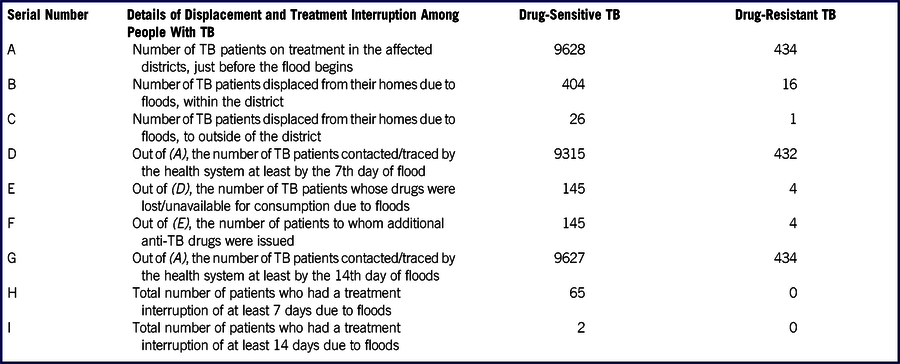
All patients with drug-resistant TB (DRTB) were contacted individually by the DRTB coordinators at district with the help of MPHWs. State TB Cell monitored treatment of each patient. Of the 434 DRTB patients, 417 did not have any disruption in treatment. Seventeen were shifted to relief camps, and all of them were ensured a continuous supply of drugs.
Of the notified 9608 drug-sensitive TB patients, 9460 did not have a treatment disruption; 146 drug-sensitive TB patients had moved to relief camps while 258 were residing along with their relatives or friends in other places. An additional 2-week supply of anti-TB drugs was issued to 148 patients, who lost/could not access their drugs. One patient on treatment died following a myocardial infarction. Details of displacement and interruption of TB treatment have been summarized in Table 1.
Details of Displacement and Treatment Interruption Among People With TB

As part of general management, 1 MPHW had been assigned the coordination of medical services at each relief camp. They also ensured RNTCP services, including identifying TB patients, identifying presumptive TB and referral for diagnosis, ensuring treatment adherence support to the TB patients in each camp, and ensuring airborne infection control.
The health department ensured drug supply and monitored adherence to treatment as long as the patients remained in the relief camps or shelters. Health staff successfully coordinated to continue treatment of 24 patients relocated to other districts and to start treatment for 2 patients from other districts who were diagnosed with TB before the flood but had not started on treatment. One more patient was initiated on treatment as the patient himself called and asked for help in the flood control room number provided by the health services department. Seven case-patients who were previously undiagnosed were diagnosed with TB from relief camps and initiated on treatment.
AIRBORNE INFECTION CONTROL AT RELIEF CAMPS
A locally adapted guideline for airborne infection control and TB control in relief camps based on WHO recommendations for TB care in displaced population was prepared and issued for implementation by state TB cell on August 17. 10 A signage describing airborne infection control practices was prepared and displayed in each relief camp. Five hundred surgical masks were made available in each camp for the use of patients with respiratory symptoms.
If a case of smear positive pulmonary TB was identified in the relief camp, the person was educated on cough hygiene, provided with masks, and efforts were made to move the patient to a room in the relief camp with good ventilation without stigmatizing. This was possible because most of the relief camps were schools where classrooms typically were constructed with good cross ventilations and plenty of open spaces.
IMPLICATIONS AND LESSONS LEARNED
In Kerala, the entire intervention of communicable disease prevention and ensuring treatment adherence was executed meticulously by the general health system without the support of any external aid agencies. Routine strength of the program, including good rapport with patients, MPHWs and treatment supporters, patient-centric treatment support systems, high literacy rate of general population, well-integrated primary health care system delivering TB services, and coordinated and timely response from all stakeholders in TB care, were the factors that led to preventing major disruptions of services during and after the disaster.
A rapid recovery of mobile networks helped in communications. The practice of maintaining buffer stocks of TB medicines at PHI level and district level has ensured that additional drugs were available locally for extra supply. Real-time entry of patients in Nikshay has helped preserve the entire patient information, including phone numbers available at multiple levels. The plan to incorporate 3 phone numbers in Nikshay – either of patient or relatives – is meaningful.
Identification of all patients on treatment was possible because of strong top administrative commitment to track every patient, the effort of frontline health workers and coordination among them, and the pre-existing good relations with each patient on treatment so that every patient could be tracked through their treatment supporters. MPHWs were overburdened during that time with many tasks, including first aids, prevention and surveillance of communicable diseases, ensuring food safety and sanitation at camps, and most of them worked on a 24-hour basis during the initial disaster response period. Some of the MPHWs, primary health care staff, including doctors, also were victims of flood and sought shelter at relief camps. However, they voluntarily owned the rescue and public health responsibilities of those camps. The government mobilized MPHWs from non-affected areas and hired a few based on needs on daily wages. New MPHWs or those who were not familiar with the patients in the area had to take extra steps to trace the patients. RNTCP key staff (senior treatment supervisors, senior treatment laboratory supervisors, and TB health visitors) guided and helped them in such situations. There were no special provisions made for the personal and familial needs of those MPHWs or treatment supporters, who were impacted by the floods. The government acknowledged their sincere efforts by handing over appreciation certificates signed by the highest official in the department.
There might have been delay in initiating public health actions like contact investigations and chemoprophylaxis during the acute flood response period, but we have not captured the same. Also, we have not specifically looked into the long-term effects of flood on TB epidemiology like triggering activation of TB disease due to acute malnutrition that might have occurred during the flood time.
MPHWs generally will master in the art of maintaining confidentiality and preventing stigma routinely as part of their work culture. Because they handle all of the national health programs, including maternal and child health, communicable disease prevention and surveillance, and non-communicable diseases control, usually their visits will not lead to stigma in the community. Even during routine visits to a TB patient, they will do a conscious effort to ensure that they visit a few more houses in the locality and enquire about any fevers or immunization or do vector source reduction so that the community could not tag their visit to search for a TB patient. In relief camps, anybody with an infectious airborne disease, including flu or respiratory tract illness or chicken pox, were also offered face masks. This reduces stigma for wearing face masks. We have not done a follow-up specifically to look at the effectiveness of confidentiality and anti-stigma measures.
The situation would have been better managed if the population displacement could have been anticipated. The health system would then have been prepared with a proper response plan. However, the sudden onset of floods and the lack of prior experience did not allow this to happen. Psychological assistance was needed for some who had suffered major losses during disaster, to continue TB treatment.
Kerala floods also reiterate the lesson learned from many other disasters that all TB control programs should consider planning for emergencies that might result in mass displacement of patients or in disruptions in health services access. 2–4 The disaster provided an opportunity for us to develop a preparedness plan for continuity of TB patient care. Our new disaster plan has incorporated measures to educate and provide patients residing at disaster prone locations with medications to self-administer during the time of disaster. A specific plan is being prepared for each institution to move drugs, reports, and equipment to safer places in case of early warnings and also to make health facilities disaster resilient. In August 2019, when the state experienced localized floods in some areas, a significantly high proportion of TB patients who were forced to displace took their medicines also with them in consultation with their treatment supporters and MPHWs. This has reiterated that anticipation of the situation and enhanced patient education for self-administered treatment could help support adherence in any setting where disasters threaten to disrupt TB treatment.
The learnings are important not only for TB control, but also for any public health program especially dealing with non-communicable diseases and other chronic diseases. The approach for ensuring uninterrupted treatment extends well beyond just the realm of TB therapy. Maintaining a strong and integrated primary health care system, electronic patient management information system, setting up routine patient-centric treatment support systems, and empowering and educating patients along with a preparedness plan for continuity of care during emergencies are important lessons for preventing treatment interruption, during disasters, of any diseases that require medications for a long time.
Conflict of Interest Statement
The authors have no conflicts of interest to declare.