


Under what conditions do individuals withdraw support from dominant parties in nondemocratic regimes? A burgeoning literature broadly agrees political parties are often a linchpin of the survival of any such regime (Brownlee Reference Brownlee2007; Geddes Reference Geddes1999; Huntington Reference Huntington1968; Svolik Reference Svolik2012). While most research on these parties’ strength has focused on elite sources (Levitsky and Way Reference Levitsky and Way2010; Reuter and Remington Reference Reuter and Remington2009; Smyth, Wilkening, and Lowry Reference Smyth, Wilkening and Lowry2007), related work finds that mass support is also crucial (Hale Reference Hale2006; Magaloni Reference Magaloni2006; McFaul Reference McFaul2005). It can come in two forms. The more straightforward is what we call sincere support, pro-dominant-party behavior that corresponds with views actually held by the individual. Insincere support—or what Kuran (Reference Kuran1995) has called “preference falsification”—has also been found to stabilize regimes led by dominant parties. That is, even if everyone privately dislikes the party, it can remain comfortably in control so long as most people publicly support it as a result of social pressures (possibly including threats from the regime). We use the term “defection” to refer to withdrawals of public support from a regime or dominant party, regardless of whether either the original support or its withdrawal are sincere or insincere. By “public,” we mean that the individual is willing to express this preference to strangers, a category that would include interviewers conducting a public opinion survey.
Many have observed that when mass support for a regime party drops, it sometimes does so in the form of a dramatic and potentially overwhelming cascade. If anyone doubts the power of such dynamics, they need only look to the collapse of Eastern Europe's communist party governments in 1989 (Kuran Reference Kuran1991; Lohmann Reference Lohmann1994; Pfaff Reference Pfaff2006; Yurchak Reference Yurchak2005) or the downfall of Arab governments in the uprisings of 2011 (Kuran Reference Kuran2011; Patel Reference Patel2013; Pearlman Reference Pearlman2013).
We know remarkably little about such cascades. Different theories posit that different things are cascading, with possibilities including information about the regime's quality (Lohmann Reference Lohmann1994), a sense of security in numbers (Kuran Reference Kuran1991), and emboldening emotions (Pearlman Reference Pearlman2013)—or some complex combination of these (Kuran and Sunstein Reference Kuran and Sunstein1999). Accordingly, it is unclear what determines the specific preferences and thresholds that propel the cascade: Why would some people who once supported a ruling party be more likely or quicker than others to shift to opposing it? Further complicating the picture is that not everything that appears on the surface to be a cascade is in fact a cascade, with another possibility being near-simultaneous changes in views driven by a shift in underlying shapers of public opinion (Celen and Kariv Reference Celen and Kariv2004; Smith and Sørensen Reference Smith and Sørensen2000).
To be sure, studies with strong empirical components have addressed the defection of elites (Bueno de Mesquita et al. Reference Bueno de Mesquita, Smith, Siverson and Morrow2003; Slater Reference Slater2010; Svolik Reference Svolik2012). These afford us little leverage on the bulk of regime supporters, who do not control major economic or political assets but are still indispensable to regime survival. Some important work tracks macro-level trends in public opinion leading up to a ruling party's downfall (Magaloni Reference Magaloni2006) or analyzes factors, such as economic performance, that may influence public opinion (Reuter and Gandhi Reference Reuter and Gandhi2011). But without being able to observe the dispositions of the same individuals both before and after, such studies cannot tell us which specific people at the micro level are actually doing the defecting and why. Other scholarship examines what kinds of individuals participate in uprisings or antiregime protests (Beissinger Reference Beissinger2013; Javeline Reference Javeline2003; Onuch Reference Onuch2014). This is not the question at hand for us. We are interested not in who protests, but in who goes from support to nonsupport of the regime, whether or not they turn out in the streets.
The small though growing empirical literature devoted to regime defection cascades, usually denied direct measurements of the public or private opinions of the same individuals before and after a cascade, tends to rely either on observing dynamics in aggregate public opinion or on qualitative evidence about individuals’ changes that is often, though not always, gathered after the fact (Ellis and Fender Reference Ellis and Fender2011; Kuran Reference Kuran1995; Lohmann Reference Lohmann1994; Pearlman Reference Pearlman2013; Rubin Reference Rubin2014). But this is also problematic. Aggregate public opinion trends leave opaque which specific individuals are actually changing their positions, and research into preference falsification finds that many people misrepresent their prior dispositions after a cascade has run its course, with erstwhile regime supporters now identifying with the victorious revolutionaries and denying they had ever sincerely backed the old order. This, and the related problem that cascades can alter the information available to researchers in retrospect, complicates even the most careful examinations of the historical record (Kuran Reference Kuran1995, 256–7).
A rich interdisciplinary literature on cascades in nonpolitical spheres ranging from investment markets to software adoption has made an end run around this problem by creating cascades to study in laboratory settings (Anderson and Holt Reference Anderson and Holt1997, Reference Anderson, Holt, Plott and Smith2008; Celen and Kariv Reference Celen and Kariv2004), with some even examining the neural correlates of cascade behavior (Huber, Klucharev, and Rieskamp Reference Huber, Klucharev and Rieskamp2015; Innocenti, Rufa, and Semmoloni Reference Innocenti, Rufa and Semmoloni2010). But this leaves the relationship between the laboratory and the real-world settings unclear. A few behavioral realms have allowed for the direct observation of cascading, as in the analysis of online movie ratings (Lee, Hosanagar, and Tan Reference Lee, Hosanagar and Tan2015) or field experiments involving financial markets (Alevy, Haigh, and List Reference Alevy, Haigh and List2007). But nothing of the sort has been accomplished yet for defection cascades from nondemocratic political regimes, where information is hard to come by and cascades are too uncommon and unpredictable for researchers to get into place the necessary precascade measures.Footnote 1 The empirical microfoundations of regime defection cascades remain mysterious, and cascade theory in general would benefit from new findings regarding who precisely is most likely to join in.
The present article is based on an empirical strategy designed to overcome many of the difficulties just described. The strategy—to our knowledge unique in the literature—is to employ an original panel survey that measures the same individuals’ support for one nondemocratic regime's dominant party at the peak of its dominance and then again just after it suffered its most severe political crisis since its founding, one where a great deal of anecdotal evidence suggests that a cascade of defections took place among some regime supporters in the broader population. The context is Russia, where the United Russia Party founded by Vladimir Putin went from dominance in 2008 to a major drop in support and an unprecedented tsunami of protest—widely believed to be fueled by social media—shook the regime and forced it into a series of concessions in late 2011 and early 2012 before it ultimately regained control.Footnote 2
On this basis, we find general support for the theory of “availability cascades,” the notion that regime defection can gain momentum in a highly complex process. Chains of people learn about the nature of the regime from the defection of prior individuals at the same time that some safety in numbers accrues as the cascade unfolds, leading more socially vulnerable and less personally interested people to join in. Among our most important findings, early and eager movers in such a cascade are people who live in the largest communities, lack higher education, are young, are male, believe some party other than the ruling one has a chance to come to power in the foreseeable future, and think that Putin lacks majority support. Defection from Russia's dominant party had little to do with movement toward a more open and competitive political system and was much more about the party's more authoritarian elements shifting their loyalties to other parties that were no less autocratic. Perhaps surprisingly, mass media (including patterns of social media use and consumption of information from more independent outlets) are essentially a nonfactor, failing to predict who defects and who does not. Our theory would lead us to expect similar patterns in other countries roughly as repressive as Russia was at that time, though our major contribution is to open this up as a set of propositions for testing in other contexts. Altogether, our findings suggest we have much to learn about authoritarian stability from rigorous exploration of the microfoundations of regime defection cascades.
DEFECTION FROM A DOMINANT PARTY: CASCADE THEORY
In this section and the next, we draw on existing theory to produce a set of propositions with testable implications as to what kinds of individuals are most likely to join a wave of defection from a regime's dominant party. Since some of the relevant literature does not distinguish between ruling party and regime, and since ruling parties are tightly connected to the regimes they support, we sometimes use the term regime defection cascades with the understanding that defection from a ruling party is typically part of such a cascade. We begin by discussing a literature on “informational cascades,” then proceed to alternatives arising out of cascade theory, in particular notions of “reputational cascades” and “availability cascades,” before considering alternatives to cascade theory.
The key condition for an informational cascade, as first developed in two seminal models (Banerjee Reference Banerjee1992; Bikhchandani, Hirshleifer, and Welch Reference Bikhchandani, Hirshleifer and Welch1992) and refined to account for regime defection cascades by Lohmann (Reference Lohmann1994), is that each individual in society lacks reliable information about whether a regime is good or bad, usually because the regime represses or distorts the flow of information.Footnote 3 A given individual may have had a bad personal experience with the regime, but knows that this may be an aberration and cannot know the personal experiences of others. But this individual can learn more about the regime by observing the behavior of others. If someone else is observed speaking out against the regime with all the risks that entails, a data point is gained: That outspoken dissenter, with some probability, likely had a bad experience with the regime, too. Of course, people understand that some citizens are political activists who always protest. Thus, what supplies the best information that a regime is bad is when ordinary people (whom Lohmann calls “moderates”) turn out in force—that is, when the number of people expressing opposition is greater than expected. Assuming that people vary in levels of risk aversion, different individuals will require different numbers of others to join the opposition before they themselves conclude the regime is on balance bad, producing a cascade dynamic as each person's decision to defect triggers others to do so. What makes a cascade, then, is that the public information revealed by the number of other defectors overwhelms people's private information. Numbers generate more numbers. And this means cascades are not always correct in their assessments of the regime: Because people start relying on others more than on their own experiences, there is always a chance that a few people who defect early on but happen to be in the minority can trigger a cascade that masks the actual majority view.
In contrast, a reputational cascade of regime defection can take place when many people hold what Kuran (Reference Kuran1995, 21) terms “dual preferences.” That is, unlike with informational cascades, individuals already believe that the regime is bad; they just do not know how widely their sentiments are shared and fear that expressing their opposition publicly could subject them to social disapproval or political punishment. Thus they harbor a private preference for changing the regime but express a public preference for keeping it. As more people publicly give voice to their inner opposition, some safety in numbers arises and people can start to believe that opposition to the regime will become the dominant, socially desirable view. Because different kinds of people are more susceptible to social pressures or have other incentives to favor one outcome or other, they will have different thresholds for defection, and early movers trigger others to move later, resulting in a cascade. At later stages of the cascade, with the old regime increasingly discredited, even its supporters can sense that they may be best off jumping on the “revolutionary bandwagon” (Kuran Reference Kuran1995, 251), presenting themselves as supporters of the new regime in a new form of preference falsification.
While informational and reputational cascades have distinct logics, most research acknowledges that they tend to go together, and theory has advanced accordingly (Kuran Reference Kuran1995, 256; Lohmann Reference Lohmann1994, 55). In one particularly noteworthy development that only mentions applicability to regime defection cascades in passing, Kuran and Sunstein (Reference Kuran and Sunstein1999) specify how informational and reputational cascades not only coexist, but reinforce each other and jointly interact with powerful cognitive heuristics that amplify the cascading process. Particularly important is the availability heuristic, which “involves estimating the probability of an event on the basis of how easily instances of it can be brought to mind” (Kuran and Sunstein Reference Kuran and Sunstein1999, 706). In short, an availability cascade of regime defection would involve people both updating their information about a regime and deciding how best to navigate social pressures, with each new revelation about the regime increasing the cognitive availability of that idea, therefore making people more likely to adopt it uncritically, which in turn further fuels both informational and reputational cascading. While Pearlman (Reference Pearlman2013) disputes Kuran's terms, her argument can be interpreted as a variation on his more basic “dual preference” model: People overcome preference falsification (which she attributes not to social pressures but to “dispiriting emotions” like fear, sadness, and shame) when the prior actions of others trigger “emboldening emotions” like anger, joy, and pride. To the list of cognitive mechanisms that can fuel cascade behavior consistent with a dual-preference model, the literature on voting might contribute a well-documented human tendency to prefer winners (Bartels Reference Bartels1988; Callander Reference Callander2007), in which case one might support a regime or opposition that one would otherwise reject only because it appears likely to win.
Inasmuch as regime defection cascades can involve a variety of reinforcing cognitive processes, much will ultimately depend on individuals’ thresholds for defection. As Granovetter (Reference Granovetter1978, 1424–5) points out in a seminal article, if one person's defection is needed to trigger a second (be it through informational, reputational, emotional, or availability reasons), and a third requires that two others defect first, and so on and so on, then the initial person's defection triggers a chain reaction that can bring everyone out onto the streets. But just raise the third person's threshold by one, and the cascade of defections never gets beyond the first two people. Yet this literature has tended to leave the discussion of individual thresholds at a very general level. While there is a good case to be made that individuals’ thresholds are subject to change across time and situation (Granovetter Reference Granovetter1978, 1436–7; Pearlman Reference Pearlman2013, 390), it behooves us as social scientists to explore what is predictable and generalizable and what is not.
THE DETERMINANTS OF THRESHOLDS
The present study takes a step in the direction of a more robust theory of thresholds by drawing out the implications of existing studies and testing them empirically. In his pioneering article, Granovetter (Reference Granovetter1978, 1436) argues that thresholds generally will be “affected by most of the causal variables typically studied as determinants of individual behavior.” Fortunately, research into cascades does not leave us bereft of more specific propositions that can be tested with panel survey data.
Let us turn first to what informational cascade (IC) theories might lead us to expect if this were the underlying process driving an observed surge in defections from a dominant party. Initially, IC theory would lead us to expect people with better private information about the state of affairs in their country to be less likely to cascade because they would be more inclined to rely on their own private information and less responsive to the crowd (Alevy, Haigh, and List Reference Alevy, Haigh and List2007; Lohmann Reference Lohmann1994; Smith and Sørensen Reference Smith and Sørensen2000). Assuming that information possession is correlated with formal education, we might expect:
H1. Individuals with higher levels of education will be less likely to defect than those with lower levels.
In addition, Lohmann (Reference Lohmann1994, 53) posits that cascading is more likely in heterogeneous communities than in homogeneous ones because there is a greater likelihood that some moderates (as opposed to anti-status-quo extremists) will be activated. Because large urban communities are usually more diverse than small rural ones, we obtain:
H2. Individuals in larger communities will be more likely to defect than those in smaller communities.
It also follows from IC theory that people who have had more negative private experiences with the regime (more negative “priors,” to use Bayesian terminology) will be more likely to defect, ceteris paribus. Since there could be many such negative experiences with the regime, ranging from low material well-being to disagreements about redistribution (Ellis and Fender Reference Ellis and Fender2011, 765), we state the following general proposition here:
H3. Individuals who have had more negative experiences with the regime (in realms commonly associated with regime support in the context at hand) will be more likely to defect than those with more positive experiences.
Because the focus of this study is defection cascades from a nondemocratic regime, we are particularly interested in whether threshold-lowering dissatisfaction arises in large part from the regime's undemocratic nature. This is widely assumed to be the case not only with respect to the specific instance studied here (see below), but also such cases as the 2011 Arab uprisings and the postcommunist “color revolutions” (see review in Hale Reference Hale2013). If this assumption is valid, we should observe:
H3.1. Individuals who have stronger beliefs in democracy will be more likely to defect than others.
In order to have the informational effect that IC theory expects, the defection of an individual must become known to others. Lohmann (Reference Lohmann1994, 56) posits that people who are more “socially connected” will be more likely to cascade. Since media are key conduits of such information, we would expect:
H4. Individuals who are more connected through the Internet (especially social media) will be more likely to defect than those who are less connected. And
H5. Individuals who consume information from media outlets that cover the authorities more critically will be more likely to defect than those who do not.
Lohmann's (Reference Lohmann1994, 51) model also supposes that people are willing to send costly informational signals (publicly expressing opposition) because there is a chance that a given individual's action could be decisive, triggering a cascade that topples the regime. We would thus also expect:
H6. Individuals who believe a regime's fall is more probable will be more likely to defect than those who think its fall is less probable.
Finally, because IC theory holds that information is reflected in numbers, we obtain the following proposition:
H7. Individuals who think that more other people support the regime will be less likely to defect than those who think fewer others support the regime.
Now let us turn to dual-preference models, including availability cascades but privileging the reputational cascade (RC) component that involves a logic clearly distinct from informational cascades. In many instances, as Kuran and Sunstein (Reference Kuran and Sunstein1999) argue, RC logic points in the same direction as the IC logic, albeit for different reasons. For one thing, support for H3, a finding that people with more negative experiences with the regime are more likely to defect, would be consistent not only with IC theory (these people are starting with more negative prior information) but also with RC theory: People who are more dissatisfied with the regime tend to have lower thresholds for overcoming their fear of social pressures and going into public opposition (Kuran Reference Kuran1995, 257).Footnote 4 IC and RC theory would also find support if H4 and H5 are borne out and strong media effects are detected because mass media technologies are crucial conveyors not only of the preponderance of different views but also the nature of social pressures (Kuran and Sunstein Reference Kuran and Sunstein1999, 762; Makowsky and Rubin Reference Makowsky and Rubin2013). Similarly, confirmation for H6 and H7 would also be consistent with the RC perspective: People who expect a regime to fall and who believe many others disapprove of the regime are less likely to be cowed by social pressure into supporting it (Kuran Reference Kuran1995, 71–3, 253). H6 and H7 should also be upheld if cascade behavior is driven by the desire to back a winner for its own sake (Bartels Reference Bartels1988; Callander Reference Callander2007).
Reputational cascade theory, and some empirical research in a variety of fields, does point to several distinct propositions, however. Contradicting IC theory, which expects the best informed to be less likely to join a regime defection cascade as expressed in H1, RC theory generally anticipates the opposite: Better informed people will likely be quicker to understand patterns of thresholds in society and the potential for gaining safety in numbers through early defection regardless of whether they privately think the regime is good or bad (Ellickson Reference Ellickson and Hechter2001). Thus, assuming again that education levels correlate with being informed about society:
H8. Individuals with higher levels of education will be more likely to defect than those with lower levels.
While Kuran and other RC theory trailblazers do not make the following point, a recent study of cascading online movie ratings finds that when there is a larger audience for one's own public expressions, an individual is more likely to voice positive than negative positions due to social pressure, becoming less likely to join negative cascades (Lee, Hosanagar, and Tan Reference Lee, Hosanagar and Tan2015). If we assume that one's community is an important expected audience, the following proposition that contrasts with IC theory should be true if this finding extends to regime defection cascades:
H9. Individuals in larger communities will be less likely to defect than those in smaller communities.
Youth are also anticipated to be among the earliest and most eager defectors because “new entrants to society” are more likely to engage in independent thinking and be less resistant to novel ideas (Kuran Reference Kuran1995, 188).Footnote 5 In addition, the young will have more of their life to live under whatever future regime exists and so would stand to benefit more from a positive regime change (Shadmehr and Haschke Reference Shadmehr and Haschke2016), and greater expected benefits to regime change should lower the threshold for defection (Kuran Reference Kuran1995, 254). Hence:
H10. Younger individuals will be more likely to defect than older ones.
Since RC theory begins from a situation in which social pressures lead people to suppress private opposition to the regime, we would expect people who are the most vulnerable to proregime social pressures to be the most resistant to joining a defection cascade. This might apply to those on state pensions, which would be another reason to expect H10 to hold. Recent research has also demonstrated that vulnerability can be particularly strong for people whose livelihoods depend on state-sector employment (Frye, Reuter, and Szakonyi Reference Frye, Reuter and Szakonyi2014; Jiang and Yang Reference Jiang and Yang2016). One might also expect ethnic or religious minorities and women to be more vulnerable than majority groups or men.Footnote 6 This yields:
H11. Individuals employed by the state will be less likely to defect than those who are not employed by the state.
H12. Ethnic and religious minorities will be less likely to defect than those in the majority groups.
H13. Women will be less likely to defect than men.
Finally, if Pearlman's interpretation is correct that regime defection cascades hinge on emotions, we anticipate:
H14. Individuals who experience dispiriting emotions when thinking about regime actions will be less likely to defect than others.
THE CASE OF UNITED RUSSIA'S CRISIS 2011–12: A PANEL SURVEY
A panel survey can be a unique tool for empirically testing theories of defection from ruling parties. By interviewing the very same individuals before and after a defection cascade, we gain true and comparable measures of public support. The measures are true because the very act of telling a stranger who appears at one's doorstep and claims to be from a polling agency whether one supports the regime is itself a measure of public support. That is, there is no need here to assume that responses to our survey are in each and every case accurate reflections of people's actual private views or for whom they voted. Instead we treat these responses as important forms of public (non)support in their own right. While the forms of public support for a regime are many, the type we study here is as good as any for testing theories of regime defection cascades.
Russia between 2008 and 2012 presents a strong context for such analysis because (a) it is widely agreed then to have been a nondemocratic regime featuring a dominant party, Putin's United Russia Party; (b) this party went from a high level of support to a much lower level in this period; and (c) observer accounts provide masses of firsthand evidence that these defections featured a strong element of cascading. United Russia's dominance was arguably at its peak when it won an outright two-thirds majority (enough to amend the constitution on its own) in the parliamentary election (to the lower and more important house of parliament, the State Duma) of December 2007 and then claimed victory in the presidential contest, as its nominee Dmitry Medvedev handily dispatched of rivals in the March 2008 election (his patron Putin had made room for him by shifting to become prime minister). By fall 2011, however, the party's standing in the polls had noticeably declined and other signs of latent discontent had been building (Robertson Reference Robertson2013; Volkov Reference Volkov2012). A pivotal moment, by many accounts, was Medvedev's announcement on September 24, 2011, that he was sacrificing his political ambitions to allow Putin to return to the presidency. His accompanying statement that this had been planned long ago seemingly cast much of Medvedev's own presidency as a charade and voters as dupes, offending many citizens (Hale Reference Hale2011; Krastev and Holmes Reference Krastev and Holmes2012). The pre-election decline in support translated into a stunning drop of even its official vote count to below 50% in the December 2011 Duma election (49.3%, to be exact, down 15 percentage points from 2007). The regime was revealed as unable or unwilling to save the party from its poor result by fraud, although there was considerable public evidence of sufficient fraud taking place to have kept United Russia's announced result from being even worse (Enikolopov et al. Reference Enikolopov2013).
In this context, initially small efforts at protest shocked almost all observers (even their organizersFootnote 7 ) when they resulted in tens of thousands of people turning up in Moscow's streets in two major rallies in December 2011 and accompanying events in other cities—the largest such manifestations since the early 1990s. Reports related euphoria in what seemed to be a sudden public revelation of widespread dissatisfaction with United Russia (and even the regime itself). This included many media personalities and other public figures who had before been content to suppress any dissatisfaction with the regime in order to make their careers but who now suddenly decided to take a stand. For example, the well-known writer Grigorii Chkhartishvili (pen name Boris Akunin) was asked in a February 2012 interview why, after years of avoiding active politics, he suddenly joined the protest movement in December 2011. In terms that Kuran could hardly have improved upon, he replied that he had nursed discontent since Putin had been elected but had limited himself only to “muttering” a few things on a very few occasions because:
[T]he time was not right. . . I considered my selfish opposition (fronderstvo) accordingly, as a strictly personal gesticulation, not having any social significance. But in December (2011), I saw that around me there had suddenly appeared very many who thought like me. And this was already something serious. Serious enough to make possible putting aside all personal projects (Akunin Reference Akunin2012).
Regime representatives were stunned as Moscow protests reached over 100,000 people by some accounts. Showing signs of panic, the authorities evidently concluded they could not repress such large crowds in this moment of weakness and responded instead with some makeshift liberalizing reforms to placate the protesters. This included relaxing the media environment, even allowing on the main television stations some opposition voices that had long been absent except where portrayed in a negative light. The Kremlin then remobilized, conducting a massive campaign to rebuild support for Putin and his return to the presidency in the March 2012 election based on “conservative” values that had strong support outside the rebellious cities (Petrov, Lipman, and Hale Reference Petrov, Lipman and Hale2014; Smyth and Soboleva Reference Smyth and Soboleva2014). The campaign downplayed United Russia, though he still accepted the party's nomination. These actions, leaving most fundamental controls on the election process intact, did take much of the steam out of the protest movement and allowed Putin to recover his support. By the time of his reelection victory, United Russia's ratings had revived somewhat, too, far behind its 2008 popularity level but still comfortably ahead of rival parties even by the most independent surveys. All the same, many were still predicting the party's continued decline as of late spring 2012 (e.g., Ivanov and Samokhina Reference Ivanov and Samokhina2012; Krastev and Holmes Reference Krastev and Holmes2012; Wolchik Reference Wolchik2012). In September 2016, in the next Duma election, conducted under new mixed-system rules (half of the seats allocated on the basis of national party lists and half in territorial districts), United Russia would more than hold its own.Footnote 8
What apparently happened in 2011–12, then, is at a minimum a significant wave of defection from United Russia and, by many field accounts, a cascade that the regime was ultimately able to stanch through tactical concessions and a countermobilization that built on strong genuine support that the regime had long been believed to hold among certain large segments of the population with concentrations in more rural areas.Footnote 9
We were able to measure the “before” and “after” levels of public support through the Russian Election Studies (RES) series of surveys of voting-age subjects that have been regularly conducted right after Russian federal election cycles. Crucially, the spring 2008 and spring 2012 surveys included a panel component, asking the same set of respondents each time many questions pertinent to both the parliamentary elections of 2007 and 2011 and the presidential elections of 2008 and 2012.Footnote 10 This survey accordingly captured the high water mark of the United Russia Party's dominance in March–May 2008 and spanned the party's 2011–12 nadir, with the second wave in the field during April–May 2012, just after Putin's and United Russia's ratings had begun to recover. While it would have been ideal to have organized additional waves of the panel in, say, September 2011 and early January 2012, when the outlook for the regime was most uncertain, such is fate that this was not possible. But it makes methodological sense to begin the study at the party's peak of dominance (2008), and the April–May 2012 wave of the survey nevertheless captures patterns of support after the posited cascade had fully run its course but also when it was still unclear whether the defection wave would ultimately succeed or fail.
Our survey panel consists of 661 people from the original 2008 sample of 1,130 whom we were able to re-interview in 2012. Of the 1,130, 516 said that they had cast a vote for United Russia in 2007, and 334 of these were successfully re-interviewed in 2012. Naturally, the set of successfully re-interviewed people cannot be considered fully representative of the population as of 2012. It will exclude people too young to be polled in 2008 but who were adults by 2012, and may well under- or over-represent other groups in the population. To get a sense of how severe this representativeness issue is, we estimated a logit model to test whether any of the factors that interest us as possible correlates of dominant party defection are indeed correlated with selection into the sample. The results, presented in OA Table 1 in the Online Appendix, indicate that only two variables of interest are statistically significantly (using 95% confidence intervals) correlated with disappearing from the set of 2008 United Russia supporters in the 2012 survey wave. Those living in larger urban communities and those with lower levels of education are more likely to drop out, and if one very slightly relaxes the confidence interval cutoff to 95.7%, men are also more likely to drop out. Presumably, this is because they are more mobile social groups in the Russian context. While the theory discussed above gives us reason to expect all of these variables to be related to defection from a ruling party, the concept of mobility is not part of this logic. We do not expect this slightly patterned sample attrition to significantly impact our findings even for these three variables other than potentially to reduce the chances we find them significant since we have fewer data points on them to analyze. To confirm, we ran the main regression analysis reported below with a Heckman probit selection model, which models the attrition process as well as the equation of primary interest. This exercise resulted in only insignificant changes in our findings.Footnote 11
DEFECTING FROM UNITED RUSSIA
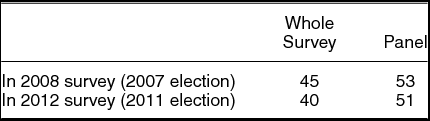
We adopt as our chief measure of public support whether a respondent said in a postelection survey that they voted for United Russia in that election. While cascade theorists often treat voting as a process that reveals private information due to secret ballot assurances (Kuran Reference Kuran1995, 341; Kuran and Sunstein Reference Kuran and Sunstein1999, 724), actual voting is not precisely what we are studying. Instead, we are studying people's public statements (given to a stranger, the survey interviewer) about how they voted. Reading the results in this light, our survey registers a net decline in public United Russia support amongst the population between 2008 and 2012. As Table 1 illustrates, such dominant party supporters constituted 45% of the population in 2008 and 40% in 2012.Footnote 12 This change gets reduced somewhat when we move from estimates based on the whole survey population to estimates based on the set of respondents in the panel, those who were successfully re-interviewed. Using the panel only, 53% claimed to have voted for United Russia in 2008 and 51% in 2012. Of course, the figures here for 2012 reflect not only United Russia's losses relative to 2008 but new supporters that the party managed to bring in on the coattails of Putin's comeback presidential election campaign in early 2012. OA Table 2 in the Online Appendix provides more information about the distribution of relevant dispositions in Russia as of 2008 and 2012, both among the population as a whole and United Russia supporters.
Percentage of United Russia Supporters in 2008 and 2012 (shares saying they voted for United Russia in 2007 and 2011)

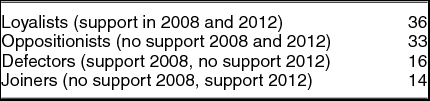
We break the panel down into four categories with respect to whether respondents claim to have voted for United Russia in 2007 and/or 2011. These are summarized in Table 2. We dub loyalists those individuals, comprising about a third of our panel, who both times claim to have cast their ballots for Russia's dominant party. We call oppositionists those who would not say in either wave of the survey that they voted for it, a category making up another third of the panel respondents. The category that interests us most here is the defectors: those who claimed in 2008 to have voted for United Russia in 2007, but did not tell survey researchers in 2012 that they had done so in 2011 when asked. About 16% of our panel falls into this category. This is slightly more than the 14% turning up in the category of joiners, those who did not support United Russia in 2008 but wound up supporting it in our 2012 survey.
Patterns of Self-Reported Voting for United Russia

Note: Percent of population, N = 661.
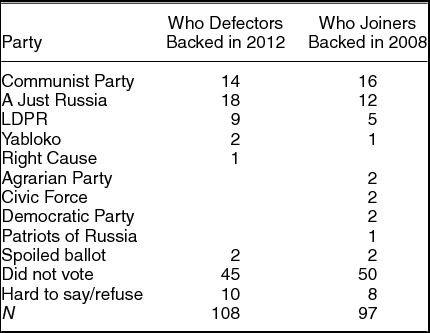
Whither the defectors in 2012 and whence the joiners? Table 3 indicates that in both cases, a plurality moved in or out of the category of self-declared nonvoters. Some 45% of defectors said that they did not vote at all in 2011, while 50% of joiners had said in 2008 that they did not cast a ballot in the 2007 Duma election. A tenth of defectors and 8% of joiners moved in and out (respectively) of the category of those unable or unwilling to venture a response, the kind of behavior which Carnaghan (Reference Carnaghan1996) finds can indicate a form of apathy or withdrawal. When defectors did say they went to the polls in 2011, they tended most often to support A Just Russia, a left-of-center party which observers typically consider a loyal opposition group (March Reference March2009) but which did take a sharply critical line against the Kremlin and United Russia in 2011 (Hale Reference Hale2011). The LDPR, which captured 9% of our defectors’ self-reported votes, is also widely regarded as a loyal opposition party, though one interpreted as regularly capturing protest votes due almost entirely to its leader Vladimir Zhirinovsky's flamboyant rhetoric. The more clearly opposition Communist Party (leftist) and Yabloko Party (liberal) got 14% and 2% of defectors’ self-reported votes, respectively, and another 2% claimed to have spoiled their ballots. About two-fifths of joiners came from other parties, mostly A Just Russia and the KPRF.
For Which Parties Did Defectors Say They Voted in 2012 and Joiners Say They Voted in 2008?

Note: percent of defectors/joiners.
APPROACH
As noted above, the data tell us that about a third of respondents in our panel switched either to or from supporting United Russia between 2008 and 2012, with the share of defectors being a bit larger than the share of joiners. One possibility is that this movement reflects standard measurement error: Surveys are imperfect measures of true dispositions that can be thrown off by question wording, interviewer effects, and respondents’ own awareness or mood on a given day (Green, Palmquist, and Schickler Reference Green, Palmquist and Schickler2002). Because such factors are random with respect to the important variables in our study, if this were the only explanation for the difference between the two waves in our panel survey, we should not find theoretically interesting variables to be systematically correlated with defection from United Russia. As the tables below make clear, this is not the case; instead, we seem to be dealing with nonrandom changes in support for United Russia between 2008 and 2012.
To study patterns of defection, we examine the 334 respondents in our 2008 survey who originally said that year they had cast a ballot for United Russia in the December 2007 Duma elections and who were successfully re-interviewed in 2012. This number is naturally not as large as we would have chosen had greater funding been available and had we anticipated a regime defection cascade with sufficient credibility to raise such funding. But since such obstacles are inherent to research on complex and mercurial phenomena like regime defection cascades, our dataset represents the best opportunity of which we are aware to study the microfoundations of a regime defection cascade. An N of 334, while not ideal, supplies enough information for meaningful tests of the propositions developed above.
For those respondents who supported United Russia in 2008, we created a dummy variable coded 1 for those who had defected by 2012 and 0 for those who had not. This is our primary dependent variable, and since it is binary, it is appropriate to use the well-established logit model. Following Miller and Shanks (Reference Miller and Shanks1996) and Colton (Reference Colton2000), we report the magnitude of the “effects” as total effects since these are highly intuitive.Footnote 13 A total effect is the change in likelihood of defection that would be generated by an otherwise typical individual (someone who has the median score on all other relevant variables) moving from the lowest value of a given factor to the highest value, factoring in information we have that some independent variables may be influenced by other independent variables. That is, if factor A influences defection both on its own and by influencing factor B, the total effect measures both the direct and indirect effects. This is accomplished by reporting factors’ effects as estimated only with controls that are at the same or prior stages in a causal chain. For example, H10 posits that young people are more likely to defect from United Russia simply by virtue of being young. Some readers might suspect young people also to be more likely to use the Internet, a media form which H4 leads us to expect will also promote defection. If the effects of both youth and Internet usage were calculated only when both were included in the same equation, the model would not take into account the fact that we know the direction of any causal relationship there might be between youth and Internet usage: Being younger can make one more likely to use the Internet, but using the Internet cannot make one any younger. We are safe in calculating the total effect of youth by including only “age” and other “first-stage” variables such as gender in the equation. But to calculate the total effect of Internet use (a secondary-stage variable in this simple example), we must include age as a control. Following prior practice (Colton Reference Colton2000; Miller and Shanks Reference Miller and Shanks1996), the analysis that follows begins by assuming the following stages, with latter-stage variables being placed downstream because it is believed they are more influenced by the preceding variables than the other way around: demographic variables (stage 1), perceptions of economic well-being (stage 2), values (stage 3), partisanship (stage 4), presidential performance evaluations (stage 5), and patterns of media use (stage 6).Footnote 14 In the tables that follow, the stage of each variable is indicated by the number in subscript.
To sharpen the focus on cascading, our analysis controls for the possibility that defection results not only from cascading but also from correlated but not interdependent shifts in public beliefs. For example, if the economy suddenly collapses and each individual suffers severely, each person might cease supporting the regime based on his or her own private information regardless of what others are observed doing; these individuals’ changes will be correlated with each other but not dependent on each other.Footnote 15 We thus include four control variables that capture this possibility in different ways. First, we consider the extent of change in individuals’ positions on major policy issues in a given direction between 2008 and 2012 (attitudes on how Russia should treat the West and attitudes toward market reform). Second, we examine whether people reported different pocketbook economic trends in 2012 than they did in 2008. And third, because we would expect those who display strong party identification to be the most likely to take cues on what to believe from their party and hence not to be changing their levels of support for the party due to any changing views they might have on particular issues, we include a measure of partisanship for the ruling party.
The analysis proceeds in four steps. First, we take advantage of the panel design and consider the overall pattern of defection we find in the data using only predictors from 2008, where we have the most confidence that we are free of endogeneity concerns.Footnote 16 Second, we test those parts of the theory elaborated above that can only be evaluated with data gathered in 2012 because either the questions are about what has happened since 2008 or the questions happened to not be asked in 2008. Variables that can only be tested using 2012 data are treated as later stages in the total effects calculations; that is, the total effects of 2008 variables are calculated without the 2012 variables included in the equation, but the total effects of the 2012 variables are calculated with all of the 2008 variables in the equation.Footnote 17 Third, we explore the determinants of different patterns of defection, considering why some defect by moving to true opposition parties while others simply decide not to vote. And fourth, we present an analysis of patterns among those who began in 2008 as nonsupporters of United Russia but in 2012 joined it, going against the net flow but likely responding to state authorities’ comeback effort in early 2012. For the sake of presentation, we discuss the specific measures we use for the different propositions as we present the results, referring readers to the Online Appendix for the specific wording of the survey questions utilized.
CORRELATES OF DEFECTING FROM UNITED RUSSIA 2008–12
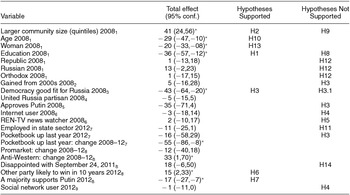
Table 4 presents our core findings on the relationship between variables of interest and defection from United Russia during the interval 2008–12 and relates them to our hypotheses. Several results are in line with informational cascade theory. For one thing, typical 2008 United Russia supporters who lived in Russia's largest cities were 41 percentage points more likely to defect than those in Russia's smallest quintile of population points. And in follow-up analysis, we find that the effect is specifically about community size, not anything special about Moscow and St. Petersburg as some might suspect.Footnote 18 IC theory also successfully predicts a finding that specialists on Russia are likely to consider counterintuitive: Otherwise ordinary people with the lowest levels of education, once other demographics are controlled for, were 36 percentage points more likely to defect than were those with the highest levels. Instead of educated people being more associated with opposition, it appears that they were more likely cautiously to rely on their own private information, leaving the rush to defection to consist more of people with lower levels of education relying on the crowd for information about what to do. Even more direct evidence that defection involved relying on the crowd comes from two additional findings: Average people who believed that a party other than United Russia had a chance to win in the next ten years were 15 percentage points more likely to defect than were those who did not (in line with H6), and individuals who thought that a majority supported Putin were 17 percentage points more likely to act in line with that perceived majority by not defecting (consistent with H7).Footnote 19 In what is likely to be a surprise for analysts who have emphasized the role of social media in fueling Russia's 2011 protests (e.g., White and McAllister Reference White and McAllister2014), we find no evidence that the Internet and more-independent sources of information promoted defection from United Russia.Footnote 20
Correlates of Defecting from United Russia 2008–12

Note: Among panel respondents who reported voting for United Russia in 2008; logit model, total effects (%), 95% confidence interval in parentheses, subscripts indicating stages in the total effects calculations. *p < 0.05. N = 334.
There is only limited evidence that people with more negative “priors” were more likely to defect, and the pattern found is surprising. To begin, bad economic experiences under Putin and even approval of Putin's performance as of 2008 did not make one any more or less likely to defect.Footnote 21 Nor is there evidence that the 2011–12 defection wave was driven by previously latent democrats among the party's base. In fact, average party supporters who thought democracy was a “very good fit” as a system of government for Russia were 43 percentage points less likely to defect than those who thought democracy was a very bad fit for Russia. While this finding might seem puzzling to Russia watchers, reframing it makes it more sensible: What we seem to have witnessed, in part, in 2011–12 is United Russia's less democratic elements abandoning it for more authoritarian alternatives that were abundantly available among parties registered at the time—an interpretation that finds further support in results reported in the next section. Thus we wind up disconfirming H3.1 at the same time that the more general H3 is confirmed.
There is also evidence consistent with dual-preference models, in particular theories of reputational cascades. In three instances, results that support IC theory also support RC theory: the findings that expectations of opposition success and beliefs about Putin's popularity are significant predictors of defection (in line with H6 and H7) and the (albeit thin) correlation between negative regime experiences and defection (H3). Conversely, the negative findings regarding media defy both RC and IC theory (H4, H5). Distinct evidence of reputational cascades (not anticipated by IC theory) comes from two other results, however: Women, arguably more vulnerable to social pressures than men, are 20 percentage points less likely to defect than men; and the youngest individuals, thought more ready to embrace new ideas and standing to gain more from future change, are 29 percentage points more likely to defect. It may also bear noting that were we to have adopted the slightly less strict 90% significance standard, two other socially vulnerable populations would have been found less likely to defect: people employed in the state sector and ethnic minorities (non-Russians). Significant findings contradicting hypotheses emerging out of RC theory are those for education, where IC theory performs better, and potentially for larger communities, though in principle the idea that the greater social heterogeneity found in urban areas could make cascading more likely is consistent with RC logic as well as IC logic despite the argument of Lee et al. (Reference Lee, Hosanagar and Tan2015). We also include the best measure available in the survey to test Pearlman's theory of emotions, creating a binary variable coded 1 for people who responded with a dispiriting emotion (disappointment) to the September 24 announcement that Putin and Medvedev would switch posts. The disappointed prove to be no more or less likely to defect than anyone else.Footnote 22
There is an indication that at least some of the defection wave may have resulted from people changing their opinions between 2008 and 2012 on issues linked to regime support. In particular, otherwise typical United Russia supporters whose personal material fortunes had deteriorated the most the year prior to the 2012 survey relative to how they had fared prior to the 2008 survey were 55 percentage points more likely to defect.Footnote 23 Interestingly, changes in material conditions in the year prior to 2012 alone do not appear associated with defection; what matters is whether these changes were better or worse than the changes leading up to the 2008 vote. And people who had become more anti-Western between 2008 and 2012 were more likely to defect than others,Footnote 24 though a change in one's views on the market did not appear to impact defection.Footnote 25 United Russia's partisans were also no less likely to defect than were others who had backed the party in 2008.Footnote 26 These findings are not inconsistent with cascading, however, instead simply indicating other processes were at work too.
EXPLAINING DIFFERENT KINDS OF DEFECTION
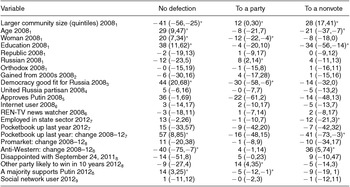
While the main story is conveyed in Table 4, our study also finds some important nuances in the precise form defection took. As summarized in Table 3, some defectors said they voted for another party, while others declared they did not vote at all. Table 5 goes a step beyond Table 4, reporting results from a multinomial logit analysis that tells us what variables are correlated with remaining loyalFootnote 27 and with two sorts of defection: saying one voted for another party and not saying one voted for another party.Footnote 28 This distinction is of significance in light of a voting strategy prominently advanced ahead of the 2011 Duma election by leading opposition blogger-politician Aleksei Navalny.Footnote 29 Navalny (Reference Navalny2011) argued that in Russia's proportional representation voting system (since modified), United Russia's opponents should vote for any other party likely to clear the representation threshold (then 7%, since modified), even if this party may not be a genuine opposition party, on the grounds that this would act to reduce United Russia's share of the seats in parliament. If Russia's opposition abstained from voting, on the other hand, United Russia would be left as the party with the largest share of votes cast and hence the most seats. If its opponents cast spoiled ballots, United Russia, as the leader in the vote count, would get the majority of the seats corresponding to these spoiled ballots. Since only 3% of all respondents said they voted for a party that did not clear the threshold (Yabloko or Right Cause), our distinction between defecting to any party and defecting to an expressed nonvote can be interpreted as a distinction between forms of defection that are more and less damaging to the dominant party's standing.
Correlates of Different Forms of Defection from United Russia 2008–12

Note: Among panel respondents who reported voting for United Russia in 2008; multinomial logit, total effects (%), 95% confidence interval in parentheses, subscripts indicating stages in the total effects calculations. *p < 0.05. N = 334.
Examining the results summarized in Table 5, we find only one factor to be a significant predictor of both kinds of defection. People living in the largest quintile of communities are 12 percentage points more likely to defect to a party and 28 percentage points more likely to express a nonvoting defection than are those living in the smallest quintile of settlements. All other significant factors correlate strongly with one form of defection only, supplying us with additional information about the nature of their effects.
Factors associated with defecting to another party include being a man (total effect of 12 percentage points), being an ethnic Russian (8 percentage points), holding that democracy is a poor fit for Russia (30 percentage points), thinking another party has a chance to win in the next decade (14 percentage points), and believing Putin lacks majority support (5 percentage points). Considering who the alternative parties are helps us understand these patterns. As Table 3 reports, the parties raking in the most defectors were the Communists, the LDPR, and A Just Russia—all regarded as having strong authoritarian tendencies and positing an assertive or even aggressive nationalism relative to Putin and United Russia, with the LDPR especially being associated with appeals to a virile hard line (Sperling Reference Sperling2014). Bearing special mention, the fact that antidemocratic defectors are going precisely here, as distinct from a professed nonvote, adds confirmation to the idea that the “democracy” result in Table 4 does not reflect an irregularity in the data but is in fact capturing a tendency for United Russia's most authoritarian supporters to abandon ship for even more authoritarian alternatives. And the association of Russian ethnicity with defecting to nationalist party alternatives also supplies some support for H12 and reputational cascade theory, as the more socially vulnerable non-Russians are more likely to remain loyal to United Russia.Footnote 30 The finding that a belief in other parties’ potential for victory correlates precisely with defecting to a party rather than to a nonvote position adds to our confidence that this variable is capturing what is expected. It is less clear why believing that a majority supports Putin would correlate specifically with defecting to a party as opposed to a nonvote position, a nuance we leave for future research to explore.
Turning to nonvote defection, it appears this is more characteristic of some of the least empowered defectors, including youth (21 percentage-point total effect), the uneducated (34 percentage points), and those whose pre-election pocketbook trends were worse in 2012 than in 2008 (41 percentage points). The finding that people who are not employed by the state are 12% more likely to engage in nonvote defection is consistent with research findings that state employees are prone to being mobilized to vote by their bosses (Frye, Reuter, and Szakonyi Reference Frye, Reuter and Szakonyi2014).Footnote 31 It is somewhat surprising that people who became more anti-Western in their outlook between 2012 and 2014 tended to defect more to nonvoting (a 36 percentage-point total effect) than to one of Russia's nationalist parties, leaving us with another wrinkle to explore in future research.
PATTERNS AMONG UNITED RUSSIA JOINERS
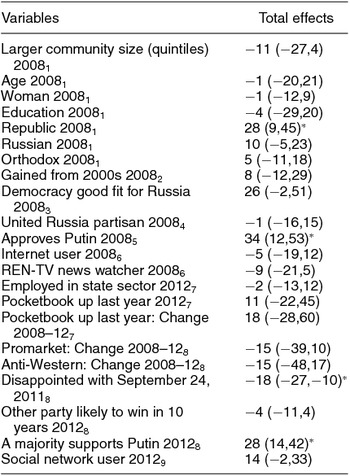
Just to make sure that defectors from United Russia are not being replaced by virtually identical joiners, a pattern that might suggest we are only witnessing some kind of structured fluctuation in and out of party support instead of patterned defection, we also conducted an analysis of the 327 people in our panel who were not United Russia supporters in 2008 to see who had gravitated to United Russia by 2012. Remarkably, our central finding is the statistical insignificance of almost all of the variables considered in our analysis of defection presented above (see Table 6). The only two variables observed in 2008 that turn out to be good predictors of being pulled into the ruling party's orbit by 2012 are living in an ethnic-minority-designated republic (28 percentage points more likely to become a joiner) and approval of Putin's performance in office as president (34 percentage points more likely to become a joiner). Only two variables measured in 2012 were correlated with joining: the belief that a majority supported Putin (total effect of 28 percentage points) and not being disappointed with the September 24 announcement that Putin and Medvedev would swap posts (18 percentage-point total effect).
Correlates of Rallying to United Russia in 2012 among People Who Did Not Say in 2008 that They Had Voted for United Russia in the Most Recent Election

Note: Logit, total effects (%), 95% confidence interval in parentheses, subscripts indicating stages in the total effects calculations). *p < 0.05. N = 327.
All this (plus the finding in Table 3 that fully half of joiners were nonvoters in 2008) would argue that while defection is highly patterned in the ways anticipated by theory, the people the party was able to regain were drawn primarily by the person of Putin and from a pool of people who had largely abstained from public politics in the past. This makes sense in the Russian context. As discussed above, after suffering a large wave of defection reflected in official voting results and tracking polls, the party's recovery came on the heels of Putin's comeback in the 2012 presidential campaign where his personal status as father of the nation was emphasized and United Russia's qualities as a party deemphasized. Russia's ethnic republics have been found to be among the country's most disciplined political environments, where leaders are most capable of mobilizing resources in support of such a campaign (Hale Reference Hale2003). And the correlation with the perception of Putin's majority support implies that people here, too, are following what they perceive to be the crowd; they just have a different view of where the crowd is moving than do the defectors. Whereas the party's aggregate support in spring 2012 looked on the surface not too dissimilar to that of spring 2008, the losses from the defection wave were being compensated by attracting a different sort of person, primarily those drawn to Putin's personality.
CONCLUSION
Our panel survey data spanning a wave of defections from the dominant United Russia Party between 2008 and 2012 supply significant leverage for building theory as to the behavioral microfoundations of regime defection cascades and cascading social phenomena more generally.
Regarding regime defection, this study confirms the insight from availability cascade theory that regime defection cascades are enormously complex processes, involving interactions among both informational and reputational chain reactions while still leaving room for some ordinary opinion change to occur. Particularly potent evidence of cascading is that United Russia supporters’ decisions to defect were strongly linked to their beliefs about how many other people supported the regime and how likely any other party was to come to power in the foreseeable future. Strong evidence of informational cascading is IC theory's anticipation of an otherwise unexpected finding on education: While many observers would expect the educated to be most likely to go into opposition, informational cascade theory suggests they may be among the latest to join a wave of defection because they rely more on private information and are thereby less susceptible to jumping to the conclusion that a rapidly developing crowd must be right. IC logic also correctly predicts that defection is most likely to occur in the largest urban communities because the resulting diversity of thresholds makes a cascade more likely to propagate.
Findings that youth and socially vulnerable populations (women, ethnic minorities, and people employed by the state) are less likely to engage in defection are supportive of the notion that Russia's 2008–12 regime defection cascade also involved a significant reputational component. In line with both IC and RC theory, we find that negative prior experience with the regime makes one more likely to defect, but in a surprising way. The dissatisfaction appears not to be with a lack of democracy, but too much of it: The defectors were among United Russia's more authoritarian supporters, many of whom defected to relatively authoritarian parties. Also surprising is the almost complete insignificance of media variables, touted in nearly all theories to be major purveyors of cascades and beliefs. This may reflect that Russia as of 2008–12 was not nearly so closed an information space as some have presumed, and media exposure may gain significance in more closed media environments like communist East Germany or today's China.
Many of the results presented here are relevant not only for the study of political regimes, but for our understanding of cascading human behavior in general, an interdisciplinary research agenda that spans everything from financial markets to online movie ratings to media frenzies regarding both real and apparent social dangers (e.g., Alevy, Haigh, and List Reference Alevy, Haigh and List2007; Kuran and Sunstein Reference Kuran and Sunstein1999; Lee, Hosanagar, and Tan Reference Lee, Hosanagar and Tan2015). At the most general level, this study confirms that informational and reputational cascades indeed tend to go together, validating the broader concept of availability cascades. Only a step down the ladder of generality, the findings remind researchers how important self-fulfilling prophecies can be in driving social behavior, including cascades, and should prompt us not to neglect measuring and explaining people's expectations in our research designs. Some of the more specific findings may also travel to other kinds of cascades, including findings that youth, the less educated, and the least socially vulnerable populations (e.g., men or representatives of the ethnic majority) have the greatest propensity to engage in cascade behavior once one controls for other factors. And the surprising insignificance of media in driving this cascade supports arguments that their role in cascades may be more complex and contingent than often supposed, neither clearly promoting nor counteracting cascading behavior that might also involve the spread of “fake news” or major shifts in accepted standards of morality (Farrell Reference Farrell2012; Reuter and Szakonyi Reference Reuter and Szakonyi2015).
Because our method is replicable in many contexts, including authoritarian ones where surveys can still be conducted (Gandhi and Lust-Okar Reference Gandhi and Lust-Okar2009), we hope our study will encourage others to follow our lead in different countries so that we can better study how different contexts influence outcomes. A major methodological hurdle, of course, is that theory holds that cascades are by their nature highly unpredictable, all the more so when we have so little research at hand into their empirical microfoundations. But researchers often can, for example, leave a public opinion study undertaken for other purposes open for “paneling” just in case a cascade happens to take place at a time when enough original respondents can still be re-interviewed. As Kuran notes, cascades can seem “unthinkable” before they actually happen, but a low-cost dose of preparation can pay off in the longer run should such an event happen at a time useful for the research.
SUPPLEMENTARY MATERIALS
To view supplementary material for this article, please visit https://doi.org/10.1017/S0003055416000642.



Comments
No Comments have been published for this article.