INTRODUCTION
Land-use policies, whether internal or external, play a pivotal role in determining land use and land cover (LULC) dynamics (Geist & Lambin Reference Geist and Lambin2002; Lambin et al. Reference Lambin, Geist and Lepers2003; Achard et al. Reference Achard, Mollicone, Stibig, Aksenov, Laestadius, Li, Popatov and Yaroshenko2006; van Meijl et al. Reference van Meijl, van Rheenen, Tabeau and Eickhout2006; Brannstrom et al. Reference Brannstrom, Jepson, Filippi, Redo, Xu and Ganesh2008; Kuemmerle et al. Reference Kuemmerle, Kozak, Radeloff and Hostert2009). Land-use policies can enable or restrain particular crops or forms of land use as new agricultural areas are established or existing agricultural boundaries expand, contract or stagnate (Redo et al. Reference Redo, Millington and Hindery2011). Empirical case studies show that internal policies established within a country are a major underlying driver of LULC change (Geist & Lambin Reference Geist and Lambin2002). For example, state-led afforestation campaigns have generally led to an increase in forest cover in Vietnam (Clement et al. Reference Clement, Orange, Williams, Mulley and Epprecht2009). In portions of south-central Chile, forest cover is increasing through the establishment of plantations as a result of government forestry policies (Patterson et al. Reference Patterson and Hoalst-Pullen2011). Conversely, deforestation in south-eastern Bolivia has generally continued to increase under agrarian reform and new forestry laws, as farmers clear forested land in order to avoid expropriation (Redo et al. Reference Redo, Millington and Hindery2011). In today's globalized world, external policies are just as crucial as internal policies in understanding the underlying drivers of LULC change, because policies in one country can have indirect and/or unintended effects on another by removing trade barriers through the elimination of tariffs (for example see NAFTA [North American Free Trade Agreement] and MERCOSUR [Common Market of the South]), thereby increasing interdependency between nations (Lambin et al. Reference Lambin, Geist and Lepers2003). However, there are few if any case studies that show how the establishment or changes in the policy of one nation influence another, and how this is related to changes in LULC.
The Pampas (from the Quechua word, meaning plain) of Uruguay is a prime example of how both internal and external land-use policies affect LULC dynamics. As one of the world's richest grasslands, Uruguay has undergone profound changes in the last decade owing to changes in economic, agriculture and forestry policies, both internally in Uruguay and externally in Argentina, which have indirectly resulted in the sudden expansion of soybean cultivation and afforestation of exotic tree species. Between 2000 and 2009, the area under soybeans rose from 89 km2 to 8000 km2, thus surpassing wheat as Uruguay's most dominant crop (FAOSTAT [Food and Agriculture Organization of the United Nations Statistics] 2010; USDA [United States Department of Agriculture] 2010) and occurring largely at the expense of remaining native grasslands, and traditional crops and grazing pastures. In addition, large-scale Eucalyptus spp. and Pinus spp. plantations have further reduced herbaceous cover, and have been linked with environmental destruction and numerous social injustices (Olmos & Siry Reference Olmos and Siry2009).
Linking policy to actual environmental change is a challenging task as most impacts are ambiguous and indirect. To partially overcome this, we combined remotely-sensed satellite imagery at the regional scale using MODIS (MODerate Resolution Imaging Spectroradiometer) MOD13Q1 imagery (resolution 250 m) and land-use data compiled at the municipality level. This was supplemented by an analysis of peer-reviewed articles, newspaper articles and government, producer organization and non-governmental organization (NGO) documents that discussed policy establishment and reform in Uruguay and Argentina. Our objective in this paper was to describe vegetation change at the municipality scale for the entire country of Uruguay from 2001 to 2009, and assess the relationship between land change and economic, agricultural and forestry policies. More specifically, we aimed to answer the questions: how did land-use and land-cover in Uruguay change between 2001 and 2009, and what were the effects of internal and external policies on land-use and land-cover change?
METHODS
Study area
With an area of 176 215 km2, Uruguay is the third smallest country in South America, and has a population of c. 3.4 million of whom more than half live in the capital, Montevideo (INE [Instituto Nacional de Estadistica] 2011). The Pampas of Uruguay and neighbouring Argentina and Brazil are one of the world's richest grasslands. Since the mid-1500s and the introduction of European livestock, beef and dairy cattle and sheep have been a major part of the nation's economy (FAOSTAT 2010). Although crop production has been far less important, it has expanded rapidly in the last decade and could soon pass animal production as Uruguay's most profitable source of capital in terms of gross production value (multiplying gross production by output prices at farm gate). Today, the five main crops in Uruguay according to harvested area are soybeans, wheat, rice, barley and maize (FAOSTAT 2010). These systems are usually rotated with planted pastures and predominantly take place on fertile luvic phaeozems and eutric vertisols soils (ISRIC [International Soil Reference and Information Centre] 2005) in the south. Exotic tree plantations are another important land use in the Pampas. Beginning in the mid-1970s, industrial monoculture tree plantation companies began operations in Uruguay (Dirección General Forestal 2010), and the most common species are Eucalyptus grandis (flooded gum), Eucalyptus globulus (blue gum) and Pinus taeda (loblolly pine) (Geary Reference Geary2001).
Classification of satellite imagery to map LULC
The land-use and land-cover classification methods follow Clark et al. (Reference Clark, Aide, Grau and Riner2010) and Clark and Aide (Reference Clark and Aide2011). To map LULC classes, we used the MODIS MOD13Q1 (16-day L3 Global 250 m) product, a 16-day composite of the highest-quality pixels from daily images (Huete et al. Reference Huete, Didan, Miura, Rodriguez, Gao and Ferreira2002). There are 23 samples available per year from 2001 to present. For each pixel, we calculated the mean, standard deviation, minimum, maximum and range for enhanced vegetation index (EVI), and red, near-infrared (NIR) and mid-infrared (MIR) reflectance values from calendar years 2001 to 2009. These values were calculated for all 12 months, two six-month periods and three four-month periods. The MOD13Q1 pixel reliability layer was used to remove all unreliable samples (value = 3) prior to calculating statistics.
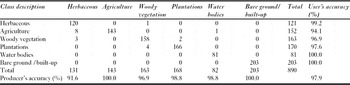
Reference data for classifier training and accuracy assessment were collected with human interpretation of high-resolution imagery in Google Earth (GE, see http://earth.google.com) using a web-based tool and interpretation criteria discussed in Clark and Aide (Reference Clark and Aide2011). GE provides high-resolution imagery from data sources such as DigitalGlobe, GeoEye-1, IKONOS and EarthSat with spatial resolutions often as fine as sub-metre to 4 m. Thus, GE images are similar in detail to aerial photographs, which are a common source for accuracy assessment (Jensen Reference Jensen2007). In Uruguay, most imagery is from DigitalGlobe's QuickBird satellite with resolutions as fine as 2.4–2.8 m. Samples with no high-resolution QuickBird imagery were removed from the sample set, resulting in a total of 890 samples (Table 1). Samples were placed only in areas with high-resolution QuickBird imagery, well within patch types for the corresponding land-cover classes and > 1000 m apart. Training samples corresponded to six distinct classes for all years between 2001 and 2009, following definitions in Clark et al. (Reference Clark, Aide, Grau and Riner2010) and Clark and Aide (Reference Clark and Aide2011), namely herbaceous vegetation (where grasslands and pasture cover > 80% of the pixel), agriculture (annual crops cover > 80% of the pixel), woody vegetation (trees and shrubs cover > 80% of the pixel), plantations (all forms of exotic tree plantations and perennial agriculture cover > 80% of the pixel), water bodies (rivers and lakes cover > 80% of the pixel) and bare ground/built-up areas (< 20% vegetation, man-made or artificial structures cover > 80% of the pixel).
Error matrix for the random forest (RF) classifier used for classification. All units indicate number of training points, unless otherwise noted.

The land-use and land-cover maps were produced using a classifier trained on reference data from the Uruguayan savannah ecoregion (Olson et al. Reference Olson, Dinerstein, Wikramanaya, Neil, Burgess, Powell, Underwood, D'Amico, Itoua, Strand, Morrison, Loucks, Allnutt, Ricketts, Kura, Lamoreux, Wettengel, Hedao and Kassem2001), part of the Tropical and Subtropical Grasslands, Savannahs, and Shrublands biome, with borders defined by municipalities. This ecoregion covers all Uruguay and a portion of the state of Rio Grande do Sul in Brazil. Predictor variables were MODIS-derived statistics extracted for the year corresponding to the GE image year (range 2002 to 2009) for each reference sample. For the biome map, an initial random forest (RF) classifier was generated with 2000 trees. RF was designed for classification and regression, and is based on a forest ensemble of binary decision trees generated from random sampling of the reference data (Breiman Reference Breiman2001). The outlier function in RF was used to eliminate samples with an outlier metric >10, and a final RF was generated from the remaining samples. We used a custom programme to apply the final RF object to every pixel in each map for each year from 2001 to 2009 (see Clark et al. Reference Clark, Aide, Grau and Riner2010, Reference Clark and Aide2011). After clipping the area of interest (namely Uruguay), this classification procedure resulted in land-change maps for each year from 2001 to 2009 for the entire country.
Overall accuracy was very high at 97.9% (Table 1). The largest error was between the herbaceous and agriculture classes, where eight samples for the herbaceous class were classified as agriculture. However, accuracy was still high for the herbaceous class at 91.6%. No ground truthing was conducted owing to the large size of the study area (Uruguay is larger than, for example, the state of Florida, USA), cost associated with covering such an extensive area, and access to high-resolution imagery in GE, which provided us with 890 sample observations covering the nine-year time span. The most serious problem associated with collecting field data was temporal mismatch. A ground survey would have had to occur when the imagery was collected (between 2001 and 2009). GE, however, has a temporal database of free high-resolution imagery (similar to aerial photography) covering the time periods and much of the area of this study.
Linking changes in LULC to policy changes
Linking policy to actual environmental change is a challenging task, as most impacts are ambiguous and indirect. The linkages depend upon several factors which must be matched by association and inference. First, the time period of LULC change must correspond to the time period the policy was instituted (namely the time period of this study, 2001–2009). Second, the type of LULC that the policy was intended to change or modify must be linked to the type of class that has changed. Lastly and more importantly, the trajectory of policy intention and consequences (or unintended consequences) of those intentions must match the trajectory of LULC change. In other words, is the policy aimed at reducing or increasing a particular land-use or land-cover and are we seeing the same trajectory during mapping of land use and land cover? Once these criteria are met, we can then infer the effect of policy on LULC change.
RESULTS
Land change extent and distribution (2001–2009)
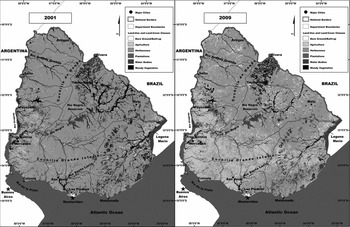
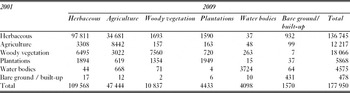
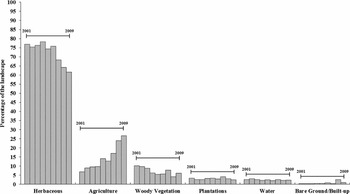
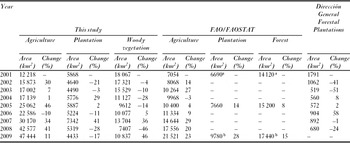
In 2001, approximately 77% of Uruguay was classified as herbaceous vegetation, followed by woody vegetation (10%), agriculture (7%) and plantation (3%) (Fig. 1). Over the course of the decade, the herbaceous vegetation class declined by 15% from 136 745 km2 to 109 569 km2, and was largely replaced by the expansion of the agriculture class (Table 2 and Fig. 2), which by 2009 covered 26.7% of the landscape (47444 km2). Most expansion occurred in the south-central portion of the country (in the Departments of Florida, Lavalleja, Flores and San José) being between the two centres of cultivation along the western and eastern borders that were present in 2001. In addition to expanding into the herbaceous vegetation class, agriculture also replaced c. 3000 km2 of woody vegetation. The woody vegetation class fluctuated in extent over time, but decreased by 10506 km2 from 2001 to 2009. Much of the woody vegetation that was lost was riparian and was replaced by the herbaceous (6495 km2), agriculture (3022 km2) and plantation (720 km2) classes, particularly along the upper tributaries of the Río Negro and tributaries which feed into the Laguna Merín. Similar to the woody vegetation class, the percentage of the landscape under plantations also fluctuated over time, but declined overall from 3.3% (5868 km2) in 2001 to 2.5% (4433 km2) of the landscape in 2009. In general, plantations were replaced by the herbaceous (1894 km2), woody vegetation (1354 km2) and agriculture (619 km2) classes. The two remaining classes, water bodies and bare ground/built-up, occupied only a small percentage of the landscape.
MODIS imagery land-use and land-cover maps of Uruguay, 2001 and 2009.

Change in land use and land cover (km2) between 2001 and 2009.

Annual land-use and land-cover change statistics of Uruguay, 2001 to 2009. Each bar for each class represents an individual year, starting with 2001 and ending with 2009, in chronological sequence.

Tree plantation dynamics
For plantations, our data tend to overestimate the total area compared to the Uruguayan Dirección General Forestal (2010) although the per cent change was similar. For example, in 2001, the Dirección General Forestal reported 1791 km2 of plantations, while we mapped 5568 km2. This difference could be due to plantation farmers only reporting the area currently under production or ready for harvesting, and it does not take into account areas which were recently harvested or those about to be planted, whereas our maps included plantations at all stages of the harvest cycle in the plantation class. The discrepancy could also be due to classification confusion between natural vegetation (namely woody vegetation) and plantations, but only two of 168 samples were misclassified (Table 1). However, according to the FAO (Food and Agriculture Organization of the United Nations 2010), our figures underestimated the area of plantations and showed plantation area as having increased instead of decreased. FAO (2010) reported a planted area of 9780 km2 for the year 2010, while we identified an area of 4433 km2 as plantations. The FAO figures also differed from those of the Dirección General Forestal (2010), in that the FAO (2010) found that plantation area had increased over the last decade. Because the FAO used a minimum height of 5 m and 10% crown cover to define a forest pixel, these differences may also be due to classification confusion between ‘forest’ and plantations.
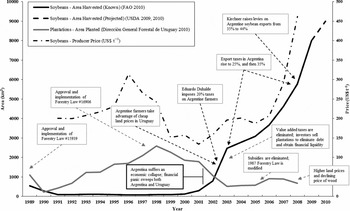
We also compared our map for 2006 with the documented plantation holdings in 2006 of Botnia and ENCE-EUFORES (two of the largest pulp manufacturers in Uruguay) in western Uruguay's ‘Litoral’ Region (EcoMetrix 2006, p. B2.8), as well as a 2006 forest map produced by the Dirección General Forestal. Both maps highlighted plantations and areas of natural forest and showed good agreement with our maps. In some instances, our map underestimated what was reported by Botnia and ENCE-EUFORES, but matched the map from the Dirección General Forestal almost exactly in both the spatial distribution and quantity of plantations and forest (though it is likely not the same data reported by the Dirección General Forestal 2010; see Table 3 and Fig. 3). Therefore, between the government statistics and holdings actually reported by the forestry companies, our estimates fell somewhere in the middle. Regardless, our results and those of the Dirección General Forestal (2010) show plantations declined on average by 40% during the last decade.


Agricultural dynamics and soybeans
Our LULC results are comparable to previous analyses in that, in general, herbaceous cover was declining and being replaced by cropland. For example, in portions of the Río de la Plata Grasslands (Argentina, Brazil and Uruguay), grassland cover decreased from 67.4% to 61.4% (151320 km2 to 137 817 km2) and the area under agriculture increased from 22.0% to 25.9% (49 348 km2 to 58 057 km2) during 1985–1989 and 2002–2004 (Baldi & Paruelo Reference Baldi and Paruelo2008). However, comparisons with governmental and international organizations highlight discrepancies with our analyses, but also between organizations. The largest inconsistencies between our analysis and those listed by the FAO and the Uruguayan Dirección General Forestal are for the agriculture and plantation classes (Table 3). For example, in 2009, we report the area of agriculture to be 47444 km2, while the FAO reported a value of only 21521 km2. It is possible that we overestimated the amount of agriculture, but our accuracy for this class is 100%; 143 out of 143 samples were classified correctly.
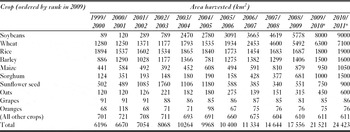
Historically, soybeans have not been an important crop in Uruguay. In the 1990s, planted area never exceeded 285 km2 (although prices in 1996 were at an all-time high of US$ 313.60 t−1 and this price ceiling was not exceeded until 2008 [FAOSTAT 2010]; see Fig. 3). However, between 2000 and 2009, Uruguay underwent a soybean production boom; during this time, the area under soybeans increased from 89 km2 to 5778 km2 (Fig. 3), and surpassed wheat as Uruguay's most dominant crop (Table 4). The producer price (US$ t−1) from 2000 to 2008 increased 193% from US$ 157.50 t−1 to US$ 461.80 t−1 (FAOSTAT 2010). In 2007, soy exports totalled more than US$200 million, representing one-third of Uruguay's total agricultural exports (Barrios et al. Reference Barrios, Gandelman and Michelin2010). As the LULC change analysis shows, the increase in soybeans has largely occurred at the expense of herbaceous cover. For the 2009–2010 growing season, the USDA (2009) estimated that the planted area exceeded the expected 6500 km2 and reached 8000 km2 (USDA 2010). Post forecasts for the 2010–2011 growing season show that soybean planted area is expected to reach 9000 km2 (USDA 2010) as a result of Uruguay's biodiesel mandate and projects to increase biodiesel production using soybean oil. According to the USDA (2010), nearly all soybean production in Uruguay is exported internationally. Global demand and price have obviously played an important role in driving soy expansion in Uruguay. However, price alone cannot account for the sudden expansion post-2002, considering that prices were relatively high in the mid-1990s.

Linking changes in LULC to policy changes
Internal policies regarding tree plantations have had a significant impact on the quantity and distribution of LULC change in Uruguay. This study shows the area in plantations declined during 2001–2009 by 1435 km2, a drop of 24%. However, policies already introduced included several tax and tariff exemptions, as well as subsidies for producers to plant forest plantations such as land tax, rural property taxes, the Global Tariff Rate and value added taxes on imports. The area under plantations rose accordingly and then declined when nearly all of those incentives were removed in the early to mid-2000s. Our data capture that removal, thus meeting the aforementioned criteria of linking policy to LULC change; the time periods match, the policy was intended to modify the area under plantation, and the consequences of policy removal and incentives match the trajectory of LULC (namely the rise and decline in the area of plantations).
External policies, such as soybean export taxes in Argentina, have had a direct impact on the quantity and distribution of LULC change in Uruguay. Our results show that from 2001–2009, the area in agriculture increased by 35226 km2, a rise of 288%. The reason for this dramatic increase is largely due to relatively lower land prices and a lack of export taxes in Uruguay, and high land prices and high agricultural taxes in Argentina introduced in the early 2000s. Thus, the effects of external policies on LULC change once again meet the time period, spatial location and intention criteria for linkage.
DISCUSSION
Internal policies: tree plantations dynamics
Eucalyptus and several species of Pinus were introduced to Uruguay in 1896, but for the next 90 years the forest sector in Uruguay was limited. There were abortive attempts to increase the nation's forest cover through the first Forestry Law in 1968, but they failed owing to incomplete provisions and lack of funding (Snoeck et al. Reference Snoeck, Casacuberta, Domingo, Pastori and Pittaluga2007; Olmos & Siry Reference Olmos and Siry2009). In 1987, following the approval and implementation of Forestry Law 15939, the area of exotic tree plantations increased rapidly (Mendell et al. Reference Mendell, Morales, Bennadji, Moreno and Siry2007; Andrade-Núñez & Aide Reference Andrade-Núñez and Aide2010). The objective of this law was to replace marginal and unprofitable farming and ranching on poor soils with plantations for exporting pulpwood to Europe (Snoeck et al. Reference Snoeck, Casacuberta, Domingo, Pastori and Pittaluga2007). This law identified priority regions and soils for planting, and provided financial incentives such as subsidies, tax relief and targeted loans to investors, which all encouraged large-scale plantations on low fertility soils (Geary Reference Geary2001; Mendell et al. Reference Mendell, Morales, Bennadji, Moreno and Siry2007). For example, those engaged in forestry activities were exempt from the land tax (1.25% of land value and scaled to soil productivity), rural property taxes, the global tariff rate, and value added taxes on imports by forest product firms for 15 years on goods such as fertilizer and machinery (Mendell et al. Reference Mendell, Morales, Bennadji, Moreno and Siry2007). Today, only the property tax relief is still in effect. Value added taxes were eliminated in 2002 and subsidies were eliminated in 2005 (Barrios et al. Reference Barrios, Gandelman and Michelin2010). Loans covering up to 80% are also provided and repayment does not begin until 10 years after the loan is made.
Forestry firms benefit from two regulations enacted by Forestry Law 15939, namely ‘Investments Promotion and Protection’ and ‘Free Trade Zone Firms’. The former provides tax relief for investments if the firm meets the following outline requirements: specific financial benefits; description of costs and benefits; environmental impact study; and proof of additional funding (Mendell et al. Reference Mendell, Morales, Bennadji, Moreno and Siry2007). The latter allows firms to be installed in free trade zones, assuming that the firm can prove it is economically viable and will benefit the country. As a result, these firms enjoy exemption from all national taxes (except social security contributions), and goods and services produced in the free trade zone are exempt from taxes.
The effects of Forestry Law 15939 were immediate, as Eucalyptus and Pinus grow rapidly in Uruguay's temperate and humid subtropical climate. The average growth rate for Eucalyptus is 35 m3 ha−1 yr−1 and Pinus taeda grows at 25 m3ha−1yr−1 (Geary Reference Geary2001). In 2006, FOSA (Compañia Forestal Oriental SA), a company owned by Botnia, reported growth rates of 40 m3 ha−1yr−1 for Eucalyptus grandis and Eucalyptus dunnii. Between 1990 and 1998, the planted area increased by over 1000%, from 223 km2 to 2585 km2 (Fig. 3), particularly in the Departments of Rivera and Tacuarembó, the ‘Litoral’ Region along the Río Uruguay (Departments of Paysandú, Río Negro and Soriano) and in the central and south-east parts of the country (Departments of Durazno, Florida, Lavalleja, Maldonado and Cerro Largo) (Fig. 1). This represented the highest afforestation rates in all of Latin America (Olmos & Siry Reference Olmos and Siry2009). Much of the pulpwood is exported to Europe, particularly Spain, Norway, Finland and Portugal; lumber went to Italy, the USA and Japan (Olmos & Siry Reference Olmos and Siry2009).
In 1998, Forestry Law 16906 promoted national and foreign direct investment and allowed foreign investors to freely remit profits and transfer capital abroad (Mendell et al. Reference Mendell, Morales, Bennadji, Moreno and Siry2007). Uruguay already had several characteristics attractive for investors: political stability; high tree growth rates; relatively low costs (for example labour and fresh water); state upkeep of the necessary highway facilities to transport timber to the mill at no expense to the companies; USA dollar denominated forestry assets preferred by international investors (relative to the Uruguayan peso); membership of MERCOSUR; and highly-literate trained forestry professionals (Mendell et al. Reference Mendell, Morales, Bennadji, Moreno and Siry2007). As a result of Forestry Laws 15939 and 16906, the forestry sector in Uruguay is currently characterized by the presence of large vertically-integrated firms, in addition to several small-scale primary producers, and a dominant base of foreign investors (Olmos & Siry Reference Olmos and Siry2009). Major multinational firms in the forestry sector include: Metsä-Botnia (Finland); ENCE-EUFORES (Spain); Weyerhaeuser Forestlands International (USA); Stora Enso (Finland-Sweden); Arauco SA (Chile); and URUPANEL SA (Chile). All together an estimated 5000 km2 of Eucalyptus and Pinus are in the hands of large foreign corporations (Zibechi Reference Zibechi2008).
With the rapid explosion of plantations after the implementation of the 1987 and 1998 Forestry Laws, NGOs, environmentalists and social scientists sounded the alarm that Uruguay would become one vast plantation, despite the fact that the forest sector had a net positive impact on the economy from 1989 to 2005 (see Olmos & Siry Reference Olmos and Siry2009). For example, it was predicted that by 2020, exotic tree plantations would cover 9000 km2 (Torres & Fossati Reference Torres and Fossati2004). While this may certainly prove prophetic, more recent statistics show that this is highly unlikely, although the FAO denotes that this baseline was reached and exceeded in 2010 (Table 3). During the 1990s, the area planted increased substantially, but eventually peaked in 1998 (Fig. 3). Tree plantations declined for the next few years and then plummeted between 2001 and 2002, as shown by this study and the Dirección General Forestal (2010). During that time, the country entered a deep financial crisis, as it suffered contagion effects from the financial panic which swept neighbouring Argentina (the same crisis which indirectly caused Argentineans to buy lands for soybean cultivation in Uruguay). This resulted in a depositor run on banks, massive currency devaluation and a massive default on foreign debt (Barrios et al. Reference Barrios, Gandelman and Michelin2010). The consequence was currency devaluation and the national acquisition of private banks, from which backing from World Bank and IMF (International Monetary Fund) was obtained. Local investors attempted to sell their plantations in order eliminate their debts and obtain financial liquidity.
In 2003 and subsequent years, the economy recovered but the tree plantations did not. The planted area in 2008 was below 1993 levels, although some of this may be due to the maturation and harvesting of plantations started in the late 1980s and early 1990s. In addition, the decline in plantations may also be the result of the elimination of both the value added taxes in 2002 and subsidies in 2005 by then incumbent president, Tabaré Vázquez. The Vázquez administration also modified the 1987 Forestry Law to avoid excess supply and dependence on Eucalyptus, promote geographical diversification of agriculture and plantations, and avoid conflicts with ‘traditional’ agriculture (cattle and dairy) and NGOs. The following revisions were added concerning new plantation establishments or projects: at least 25% of projects should be small, involving ‘family’ businesses; at least five projects should jointly involve cattle ranchers and/or dairy producers; and at least 100 ha of new species should be planted (Barrios et al. Reference Barrios, Gandelman and Michelin2010). Higher land prices and the declining price of wood and wood products are also thought to partly explain the decline in the area of plantations (EcoMetrix 2006).
External policies: agricultural dynamics and soybeans
The underlying cause for the soybean boom in Uruguay lies with the country's western neighbour, Argentina, which began its soybean boom in the early 1970s (Fig. 3). Today, Argentinean investors control over half of soybean production in Uruguay (Zibechi Reference Zibechi2008). In 2000, it was estimated that only 10% (c. 18 000 km2) of Uruguay's land was foreign owned; by 2006, nearly 25% of all arable land (c. 44 000 km2) was foreign owned by firms from around the world (Zibechi 2008). These include companies such as PGG Wrightson Ltd of New Zealand and Adecoagro of Argentina. The reasons are two-fold. First, the price of quality agricultural land in Uruguay is much cheaper than in Argentina. In 2008, prime land on the Río Uruguay cost US$7000 ha−1 (compared with US$3000 ha−1 in 2005), while across the river in Argentina a hectare sold for as much as US$10700 ha−1 (Craze & Rebella Reference Craze and Rebella2008). On average, the cost of land in Uruguay in the late 2000s ranged from US$2000 ha−1 to US$3000 ha−1 for good cattle pasture and US$4500 ha−1 to US$5000 ha−1 for prime crop land to produce soybeans, wheat and/or corn. In 2000, before the economic crisis, the same land sold for only US$400 ha−1 (Zibechi Reference Zibechi2008). Farmers in Uruguay lease land for US$70 ha−1yr−1 for dairy farming; they can lease the same land to Argentinean soy farmers for US$200 ha−1 yr−1 (Zibechi Reference Zibechi2008).
Although lower land prices are an obvious attraction, lower export taxes in Uruguay (or retenciones in Argentina) are an even stronger attraction for Argentinean soybean farmers. In 2002, Argentina suffered an economic collapse as loans defaulted, gross domestic product shrank, unemployment reached 25% and the currency depreciated 70%. In that same year, there was no export tax on grain in Argentina. However, in 2003, incumbent president Eduardo Duhalde imposed higher taxes on Argentine farmers (at a level of 20%) in order to raise government revenue and pull the country out of its economic crisis. Farmers accepted the increase and further increases when the taxes were raised to 25% and then 35% in subsequent years. However, in March 2008, President Cristina Kirchner introduced a taxation system for agricultural exports (namely on soybeans). This effectively raised levies on soybean exports from 35% to 44% (the variation depending on the value of international commodities). The fact that the new tax proposal was announced in the middle of the harvest and without consultation with the producer organizations only exacerbated the situation. The result was a nationwide lockout by farming associations and massive protests nationwide, with the aim of forcing the government to back down on the new taxation scheme. Kirchner defended the higher taxes as a key part of her economic plan to contain inflation and redistribute wealth from a commodities boom. With tensions escalating due to the protests, the President finally decided to send it to Congress for debate. In July 2008, Kirchner's own vice-president, Julio Cobos, cast the deciding vote in the Senate to reject a steep tax increase on soy exports. Effects on Uruguay occurred mainly because of the initial taxes imposed back in 2003.
Unlike Argentina, Uruguay does not levy export taxes on grains. The Uruguayan government imposes a 25% income tax on farmers (Craze & Rebella Reference Craze and Rebella2008), but the effective rate can be as low as 10–20% with allowable deductions. On small farms, where income is < US$ 205000 yr−1, income tax is capped at US$ 5125. Uruguay also has no asset tax (even for corporations), low property taxes that average 0.2% or less, and no value added tax or sales tax on most supplies, machinery and sale of farm products. Lower taxes likely explain much of the sudden growth in agricultural and soybean cultivation areas (Fig. 3). Much of this expansion took place in the fertile Río de la Plata coastal lowlands and the fertile uplands of the Cuchilla Grande Inferior. Soybean cultivation largely displaced cattle ranching, dairy farming and, initially, so-called ‘traditional’ crops such as sunflower, wheat and sorghum (although these three crops are currently increasingly cultivated, owing to similar economic drivers to those that promoted soybean cultivation; Table 4).
CONCLUSIONS
During 2001–2009 in Uruguay, the amount of land under herbaceous cover declined and was largely replaced by cropland, particularly soybeans, while the area under plantations generally declined. These changes can be attributed to economic, agricultural and forestry policies implemented by the Uruguayan and Argentinean governments, and the economic collapse which occurred in 2002. The emergence of soybeans was largely due to the availability of fertile cheap land, lack of export taxes in Uruguay and high taxes in Argentina. The emergence of exotic tree plantations may be attributable to incentives provided by the Uruguayan government, while the present decline can be explained by the more recent retraction of such policies.
Given the increasing global demand for soybeans, it is likely that the area of soybeans in Uruguay will continue to grow. With high global demand for wood products, coupled with large investments from multi-national firms, the forestry industry will undoubtedly remain important in Uruguay for the foreseeable future. In 2007, Botnia built the world's largest pulp facility near Fray Bentos, a port facility on the Río Uruguay; this was the single largest investment in the country's history (Olmos & Siry Reference Olmos and Siry2009). In 2011, construction was also set to begin on an even larger pulp plant (Psetizki Reference Psetizki2011). Economic development is important to the Uruguayan government, as shown by the lack of export taxes, incentives given to foreign investors and recent investments in port facilities. This situation is unique in Latin America, since many governments in the region (such as those of Bolivia and Venezuela) have instead engaged in resource expropriation from private corporations to state ownership (thus creating stronger national government) and lent their support to common property regimes as opposed to private property ownership (see Redo et al. Reference Redo, Millington and Hindery2011). Uruguay is also dissimilar from the rest of Latin America in being almost entirely dominated by grasslands instead of forest, and only < 1% of national territory has protected status (WDPA [World Database on Protected Areas] 2011). Given the virtual lack of protected areas, the dominance of grasslands, as opposed to forest, and the current trajectory of land change, the expansion of the Uruguayan protected areas network will be a very difficult challenge, no different than other grassland ecosystems around the world that also have < 1% under protected status (WDPA 2011). Unless this situation changes, these and other dryland ecosystems around the will be the ones most sacrificed to agricultural expansion.
ACKNOWLEDGEMENTS
This research was funded by a grant from the Dynamics of Coupled Natural and Human Systems programme of NSF 0709598 and 0709645). We thank the anonymous reviewers who helped to significantly improve this manuscript. We also thank George Riner at Sonoma State University for his assistance with satellite image processing.