I. INTRODUCTION
Photosensitivity of chalcogenide glasses (ChG) is known almost from the earliest stages of the invention of their semiconducting properties in 1950s by B.T. Kolomiets and N.A. Goryunova.Reference Kolomiets and Goryunova1 Since that time, different effects induced by bandgap, sub-bangap, and above-bandgap light are reported,Reference Kolobov2–Reference Kovalskiy, Miller, Jain and Mitkova12 and numerous models of photoinduced structural transformations are developed.Reference Kolobov2, Reference Shimakawa, Kolobov and Elliott13–Reference Tanaka, Saitoh and Terakado17 Photoinduced darkening/bleaching effect,Reference Kolobov2, Reference Zakery and Elliott3 optomechanical effect,Reference Krecmer, Moulin, Stephenson, Rayment, Welland and Elliott4, Reference Stuchlik, Krecmer and Elliott5 photoexpansion/photocontraction,Reference Ganjoo, Ikeda and Shimakawa6, Reference Kuzukawa, Ganjoo and Shimakawa7 photofluidity,Reference Tanaka8, Reference Trunov, Nagy, Takats, Lytvyn, Kokenyesi and Kalman9 photomelting/photocrystallization,Reference Poborchii, Kolobov and Tanaka10, Reference Tallman, Weinstein, Reznik, Kubota, Tanioka and Rowlands11 and photodiffusionReference Kovalskiy, Miller, Jain and Mitkova12 are only a few examples of the achieved progress in the field. At the same time, little attention was paid to the photostructural transformations associated with light-assisted physical aging phenomenon in ChG. This effect, however, is very important for practical application of these materials, since exploitation characteristics of ChG-based devices (such as optical elements, fibers, etc.) can undergo an uncontrolled drift with time and/or under the light exposure, significantly decreasing durability and reliability of the devices.Reference Struik18–Reference Lucas, King, Horner, Johnson and Sundaram21
Recent investigations of light-assisted physical aging were focused mostly on the compositional trends in Se-based ChG using sub-bandgap light (laser sources) with wavelengths from almost transparent region of ChG spectra for excitation.Reference Lucas, King, Doraiswamy and Jivaganont20–Reference Calvez, Yang and Lucas22 The magnitude of the observed photorelaxation phenomena was shown to be dependent upon the intensity of sub-bandgap light, as well as upon the thermal prehistory of the samples.Reference Lucas, King, Doraiswamy and Jivaganont20–Reference Lucas23 A summative bond breaking mechanism discussed within a concept of strong/fragile glass-formersReference Lucas23 was assumed for explanation of the observed phenomena. On the other hand, the physical aging effects produced by bandgap or above-bandgap light exposure in ChG were not considered to be significant in bulk ChG because of too low penetration depth of the corresponding photons (<0.1 μm). The first who questioned this common opinion was J.P. Larmagnac and co-authors.Reference Larmagnac, Grenet and Michon24 Using conventional differential scanning calorimetry (DSC) technique, they have recorded for amorphous Se films (6 μm thickness) an unusual increase in the relaxation rate under the above-bandgap light exposure (404, 546, and 643 nm wavelengths): the highest value of photorelaxation was achieved with 404 nm light, which had the lowest penetration depth into material (∼0.04 μm).Reference Larmagnac, Grenet and Michon24 It was assumed that photoinduced excitations in the form of valence alternation pairs (VAPs) diffused from the surface layers, where they had been created by light illumination, into the rest bulk of the investigated film effectively promoting physical aging effect as probed by DSC.Reference Larmagnac, Grenet and Michon24 Later on, similar wavelengths dependence of photostructural relaxation induced by the above-bandgap light exposure (404, 546, 581, and 643 nm wavelengths) was reported for GexSel00−x films (5-μm thickness).Reference Vautier, Derrey, Saiter and Lebaudy25 The conclusion was made about the significant role of Se chains, which again was considered as a main source of VAPs created by the illumination.Reference Vautier, Derrey, Saiter and Lebaudy25 More recent studies revealed also a considerable athermal physical aging effect in Se-rich bulk As–Se ChG caused by the above-bandgap light exposure.Reference Golovchak, Kozdras and Shpotyuk26 The mechanism of the observed photoinduced enthalpy losses was assumed to be connected with dissipation into bulk of elastic strains produced at the surface layers of the sample by light excitations.Reference Golovchak, Kozdras and Shpotyuk26
However, all of the above investigations were fragmentary, restricted by Se-based glasses and illumination wavelengths taken independently from sub-Reference Lucas, King, Doraiswamy and Jivaganont20–Reference Lucas23 or above-bandgapReference Larmagnac, Grenet and Michon24–Reference Golovchak, Kozdras and Shpotyuk26 regions of optical spectra. More comprehensive investigations of light-assisted physical aging in broader spectral diapason, using discrete wavelengths from above- and sub-bandgap regions simultaneously, were not performed for any of ChG systems, sulfide glasses remaining out of the scope at all.
So, we can put forward a natural question: what is the spectral dispersion of light-assisted physical aging in bulk ChG and how it depends on a nature of chalcogen atoms, as well as on a choice of cations? In the present article, we report the first results on comprehensive studies of spectral dependence of isochronal light-assisted physical aging in selenide and sulfide binary glasses, using for excitations the light of discrete wavelengths from sub- and above-bandgap optical regions of these materials. The influence of chalcogen atoms (Se and S) is discussed from a comparison of the results obtained for As–Se and As–S systems, while the role of cations (As and Ge) is estimated by comparing As–Se and Ge–Se ChG.
II. EXPERIMENTAL
The glasses of AsxSe100−x (x = 10, 20, 30, and 40), AsxS100−x (x = 25, 30, 40), and GexSe100−x (x = 5, 10, 20) compositions were prepared by conventional melt-quenching route in evacuated quartz ampoules from a mixture of high-purity precursors, as described elsewhere.Reference Golovchak, Gorecki, Kozdras and Shpotyuk27–Reference Golovchak, Kozdras, Kozyukhin and Shpotyuk30 These typical compositions were chosen owing to the glass-forming regions of the above ChG systems and previous data on the kinetics of physical aging effects in dark and under the influence of various external factors.Reference Golovchak, Gorecki, Kozdras and Shpotyuk27–Reference Golovchak, Kozdras, Kozyukhin and Shpotyuk30 We have restricted our studies with floppy and unstressed rigid glass-formers (average number of covalent bonds per atom Z less or equal to 2.4) to avoid any ambiguities associated with stress relaxation of initially stressed-rigid fragile networks with Z > 2.4 and phase separation effects.Reference Boolchand, Lucovsky, Phillips and Thorpe31 The row of studied S-rich AsxS100−x glasses is limited to x≥25 compositions, because of strong ability of sulfur atoms in ChG with x < 25 to detach from the glass backbone, forming S8 rings.Reference Tsuchihashi and Kawamoto32 Therefore, the DSC signal and the effect of connectivity on light-assisted physical aging cannot be analyzed unambiguously in such glasses.
Amorphous state and composition of the as-prepared ChG were controlled visually by a characteristic conch-like fracture, data of X-ray diffraction and X-ray photoelectron spectroscopy. Bulk samples in the form of thick (∼3 mm) plates, prepared for DSC measurements, were used for investigations. Before the experiment had started, all samples were rejuvenated by heating ∼40 °C above the corresponding onset values of glass transition temperature (T g) to erase any thermal prehistory of the samples. The cooling rate during rejuvenation procedure was equal to the rate of DSC measurements in heating mode (5 °C/min). One part of the rejuvenated ChG samples was stored in the dark under average room temperature. The other part was exposed to a continuous light of different discrete wavelengths (430, 505, 590, 620, 660, 720, 780, 970 nm) obtained from light-emitting diode (LED) sources (Roithner LaserTechnik GmbH, Vienna, Austria) at the same room temperature. The power of every LED was chosen to keep a constant number of photons per cm2 per second (∼2.5·1016) for each wave length. It was controlled during the whole period of light irradiation by Optical Power Meter PM100A equipped with Thermal Power Head S302C (Thorlabs, Goteborg, Sweden). Using of low-power (not exceeding ∼12 mW) LEDs instead of traditional laser sources allowed us to enhance nomenclature of the available wavelengths, as well as to exclude any possible thermal component of the effect related to a direct heating of the samples by laser beam. Additionally, the temperature was controlled by thermocouples maintained at the free edges of the samples, and no essential deviations from room temperature (TR = 25 ± 2 °C) were detected during the illumination.
The DSC measurements were performed on NETZSCH 404/3/F microcalorimeter (Netzsch, Selb, Germany) precalibrated with a set of standard elements, the DSC traces being recorded in dark (ex-situ) at the ambient atmosphere with 5 °C/min heating rate. Three independent DSC measurements were performed in each case to confirm the reproducibility of the obtained results, raw DSC data being processed with NETZSCH software package.
III. RESULTS
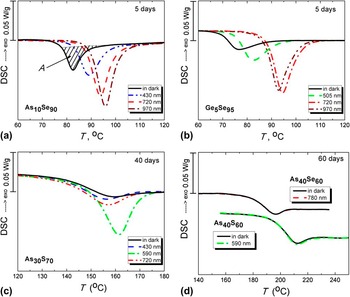
It is known that chalcogen-rich glasses, which are typical representatives of inorganic polymers, kept far below their glass transition temperature (T g) or subjected to different external influences, lose with time their excess of configurational entropy, enthalpy, or free volume (gained during melt quenching) to reach a more favorable thermodynamic state. This physical aging effect is well revealed by DSC technique through distinguishable changes in the glass transition region.Reference Saiter, Arnoult and Grenet19–Reference Golovchak, Kozdras, Kozyukhin and Shpotyuk30 Strong endothermic peak superimposed on the endothermic step of the glass transition signal, and a displacement toward higher temperature of T g, appeared as a result of prolonged storage/annealing,Reference Saiter, Arnoult and Grenet19, Reference Golovchak, Gorecki, Kozdras and Shpotyuk27, Reference Golovchak, Kozdras, Shpotyuk, Kozyukhin and Saiter28 photoexposure,Reference Lucas, King, Doraiswamy and Jivaganont20–Reference Golovchak, Kozdras and Shpotyuk26 or maintenance in stationary high-energy radiation fields,Reference Golovchak, Kozdras, Gorecki and Shpotyuk29, Reference Golovchak, Kozdras, Kozyukhin and Shpotyuk30 was attributed to the enthalpy relaxation caused by these factors. The corresponding area A under this endothermic peak in DSC curve is related to the enthalpy losses ΔH: the greater A, the greater ΔH, thus, the closer to equilibrium of supercooled liquid is glassy state.Reference Saiter, Arnoult and Grenet19–Reference Golovchak, Kozdras, Kozyukhin and Shpotyuk30 In further considerations, the ΔA difference between A values (determined as shown in Fig. 1) of the aged and rejuvenated samples will be used as a main parameter to characterize physical aging induced by the photoexposure or the dark storage in the investigated ChG (the accompanied changes in T g values are beyond the scope of this article). Strictly speaking, ΔA values determined by the above method do not exactly coincide with enthalpy losses ΔH caused by physical aging because the shift in T g is not taken into account. However, small endothermic step in the vicinity of glass-to-supercooled liquid transition on DSC curves of chalcogen-rich samples (where the largest changes in T g are recorded) means that uncertainty between ΔA and ΔH quantities is not enough to change the qualitative spectral dependence of the latter. At the same time, it is the qualitative consideration, which is important for further discussion of the dispersion of light-assisted physical aging in ChG.
Typical DSC curves of the investigated As10Se90 (a), Ge5Se95 (b), As30S70 (c), As40S60 and As40Se60 (d) ChG recorded after same periods of dark storage and light exposure at different wavelengths. The method for A determination (cross-hatched area) is shown at the example of DSC curve for As10Se90 sample (a), aged during 5 days in dark.

Typical DSC curves recorded for the investigated ChG samples after equal time intervals of dark storage and irradiation with light of different wavelengths are shown in Fig. 1. A measurable light-assisted physical aging effect at room temperature is recorded for all of the investigated ChG with Z < 2.4 regardless the choice of chalcogen (S, Se) or cation (As, Ge) atoms. The samples with Z = 2.4 (As40S60, As40Se60, or Ge20Se80) did not exhibit any significant changes in DSC curves during 60 days neither under the dark storage nor under the light exposure at any of the used wavelengths (Fig. 1). Therefore, in further consideration we will focus only on the dispersion of light-assisted physical aging effects in floppy (Z < 2.4) chalcogen-rich glasses.
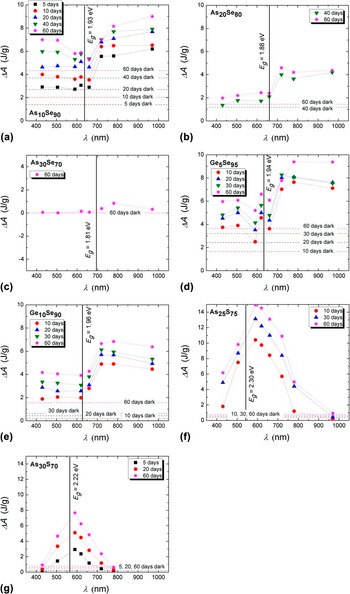
The results on the influence of light exposure with different discrete wavelengths on the physical aging processes in the investigated ChG with Z < 2.4 (expressed through ΔA values) are presented in Fig. 2. The effect of physical aging in the same glasses caused by isochronal dark storage is indicated by horizontal lines (Fig. 2). In chalcogen-rich selenide glasses (As10Se90, As20Se80, Ge5Se95, Ge10Se90), the ΔA values show almost threshold increase at the energies, lower than the optical gap of corresponded material (E g),Reference Shimakawa33–Reference Zohair El Gharras38 after that slightly decreasing in the transparent region of ChG spectra with further decrease in the energy of incident photons (Fig. 2). The overall magnitude of ΔA values in selenide glasses decreases significantly with increasing the connectivity (Z) or As(Ge) concentration in the samples (Fig. 2). In the investigated sulfide glasses, the light-assisted physical aging effect is almost one order of magnitude greater than in selenide glasses of the same compositions (compare, for example, As30S70 and As30Se70 samples in Fig. 2). It shows maximum in spectral dependence at the illumination wavelengths comparable to the optical gap of these glasses (see As25S75, As30S70 samples in Fig. 2), almost vanishing with deviation of the incident photon energies from E g value in both directions. So, from the obtained results, it is evident that dispersion of light-assisted physical aging differs for S- and Se-based ChG, while influence of cation type (Ge or As) is not so essential. Therefore, type and number of chalcogen atoms play a key role in the light-assisted physical aging effects in ChG.
Dispersion of light-assisted physical ageing in typical representatives of the investigated AsxSe100-x (a)-(c), GexSe100-x (d)-(e) and AsxS100-x (f)-(g) glasses expressed through DA values (calculated as the difference between A values of the aged and rejuvenated samples). The connection lines are drawn as guide for the eyes. Value of physical ageing effect caused by isochronal dark storage is given by dashed lines.

IV. DISCUSSION
The mechanisms of photostructural transformations in ChG usually are considered in respect to three phenomena: photodarkening, photoinduced volume changes, and photoinduced carriers/defects creation (related to photoconductivity).Reference Shimakawa33 Recent in-situ studies and simultaneous kinetics measurements of these effects suggest rather on the absence of direct relationships between them.Reference Shimakawa33 Therefore, it is interesting to compare the observed wavelengths dispersion of light-assisted physical aging with known spectral dependences of photoconductivity, photodarkening effects, and photoinduced volume expansion in the investigated materials. As far as spectral dependence of the latter still remains to be established, we will focus on the photodarkening effect and photoconductivity, in which spectral dependences are relatively well studied for the considered ChG compositions.Reference Tanaka34–Reference Averyanov39
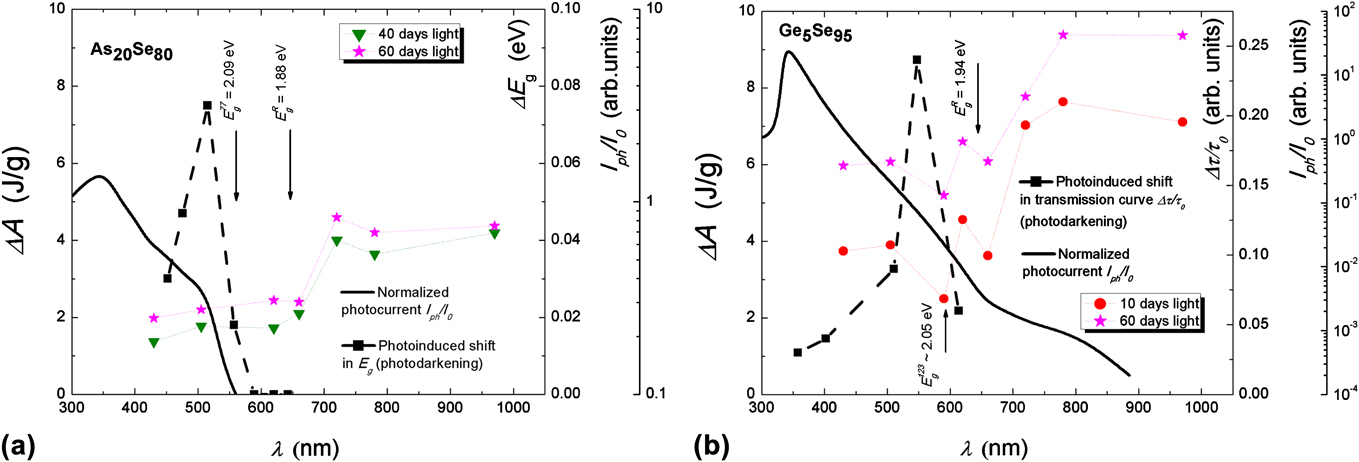
Within the considered row of the effects, maximum on spectral dependence of photoconductivity is observed at the highest energies of the incident photons above ChG optical gap, which is demonstrated at the example of vitreous As20Se80 and Ge5Se95 samples (Fig. 3).Reference Zohair El Gharras38, Reference Averyanov39 The photocurrent decays monotonically toward E g value of the glass (Fig. 3), which is consistent with the trend in the observed spectral dependence (decrease) of the magnitude ∆A of light-assisted physical aging in Se-rich glasses (As10Se90 and Ge5Se95 compositions) within 400–600 nm region. So, we can assume that light-assisted physical aging under the above-bandgap light exposure is somehow connected with generation of the carriers by this light. Indeed, when the energy of incident photons exceeds the bandgap value, we have direct excitation of the electrons from top energetic levels in the valence band (in the case under consideration they are formed by lone-pair and bonding electrons of Se)Reference Golovchak, Kovalskiy, Miller, Jain and Shpotyuk40 into the conduction band producing electron–hole pairs and broken covalent bonds. Owing to a low penetration depth of the above-bandgap light and low mobility of electrons in ChG (usually these materials possess p-type of conductivity),Reference Feltz41, Reference Mott and Davis42 these excitations should be effective only in the surface layers of the sample, where the above-bandgap incident light is directly absorbed. They cause transient and metastable displacements of the atoms from their most energetically favorable positions in the glass structure because of the thermalization of excited electrons through inelastic collisions with surrounding atoms (note, ChG are characterized by strong electron–phonon coupling),Reference Feltz41, Reference Mott and Davis42 switching or restoration of the destructed covalent bonds, and possible VAPs formation processes. In turn, the disturbed atomic sites ultimately cause elastic stresses at their nearest surroundings in the covalent network, which on further relaxation, we believe, promotes physical aging effect into the rest volume of the glass like it happens in surface-modified Se-rich fibers.Reference Shieh and LaCourse43, Reference McEnroe and LaCourse44 In other words, the surface under continuous above-bandgap light excitation conditions plays a role of “mechanical hummer” for the rest of the bulk volume. In such a way, the changes produced by above-bandgap photoexposure near the surface of the samples diffuse into their depth, producing a measurable effect for DSC technique (which is known to be an integral method sensitive to bulk properties of materials). The effect produced by above-bandgap light exposure (in the region of 400–600 nm) decreases significantly with increasing of the connectivity of glass backbone (or Z). It almost vanishes in As30Se70 (Z = 2.3) ChG and fully disappears in As40Se60 (As40S60) glass with Z = 2.4 (Fig. 2), where the structure is supposed to be built of corner-shared pyramids. Same compositional behavior is observed also for Se-rich GexSe100−x glasses, where effect fully disappears in Ge20Se80 composition (Z = 2.4). As far as the physical aging effect under above-bandgap light exposure is margin for ChG with Z > 2.2, it is natural that we do not observe it in the investigated AsxS100−x glasses, where the row of investigated compositions is restricted to x≥25 (Z≥2.25), because of the ability of sulfur atoms in glasses with x < 25 to detach from a glass backbone in the form of S8 rings.Reference Tsuchihashi and Kawamoto32, Reference Borisova45
Comparison of spectral dependences for the photoconductivity, photodarkening and light-assisted physical ageing in As20Se80 (a) and Ge5Se95 (b) glass.Reference Nagels, Tichy, Mertens and Callaerts35–Reference Averyanov39 Optical gap values measured at room and lower temperatures (indicated by superscript Eg index) are shown by arrows.Reference Nagels, Tichy, Mertens and Callaerts35, Reference Averyanov39

Spectral studies of photodarkening effects in ChG, associated with long-wave shift of their optical absorption edge, have provided important insights into the understanding of microstructural mechanisms of these phenomena.Reference Tanaka34–Reference Oheda36, Reference Tanaka46, Reference Tanaka47 It has been demonstrated that photodarkening can be induced by bandgap illumination with photon energy hν ∼ E g,Reference Tanaka34–Reference Oheda36 as well as sub-bandgap illumination with photon energy hν < E g, but at much higher intensities (∼100 W/cm2).Reference Tanaka46, Reference Ho, Laniel, Vallee and Villeneuve48 If the intensity of light is fixed, then the maximum of photodarkening effect is observed at the photon energies comparable with ChG bandgap (hν ∼ E g).Reference Tanaka34–Reference Derrey, Saiter and Vautier37 Position of this maximum is slightly shifted from corresponded E g values toward high-energy side of the optical spectrum, like it is shown at the examples of As20Se80 and Ge5Se95 glasses (Fig. 3).Reference Nagels, Tichy, Mertens and Callaerts35, Reference Derrey, Saiter and Vautier37 The developed microstructural mechanism of photodarkening in amorphous ChG films is based on the chemical bonds switching processes, presumably, accompanied also by VAPs formation.Reference Kolobov2, Reference Frumar, Firth and Owen14–Reference Tanaka, Saitoh and Terakado17 It is also known, that magnitude of the induced darkening effect decreases in the row S → Se → Te and with increasing temperature (reversible component of the effect can be erased by near-T g annealing at T/T g ∼0.75).Reference Tanaka34, Reference Tanaka49 Therefore, one order increase in the magnitude of light-assisted physical aging effect in arsenic sulfide glasses (As25S75 and As30S70 compositions) observed around optical gap can be correlated with greater efficiency of the mechanisms responsible for the photodarkening in sulfide glasses compared to selenide ones. The small overshoot in ΔA (λ) dependence of As10Se90 and Ge5Se95 glasses at λ ∼620 nm, presumably, has the same origin owing to a lower value of photodarkening effect in selenide glasses.Reference Tanaka34 The shift between the maximum of photodarkening and this overshoot (Fig. 3) is due to a fact that measurements on photodarkening were carried out at low temperatures (much lower than the room temperature).Reference Tanaka34, Reference Nagels, Tichy, Mertens and Callaerts35 If we corrected the position according to the difference between E g values at room temperature and at the temperature of photodarkening measurements (shown as superscripts to E g in Fig. 3),Reference Tanaka34–Reference Averyanov39 we roughly obtain coincidence between the ΔA overshoot and maximum of photoinduced darkening in Se-rich samples. On the other hand, the photodarkening is observed even in stoichiometric compositions (like As40S60 and As40Se60) with Z = 2.4,Reference Kolobov2 while the light-assisted physical aging is not (Fig. 1). Owing to a reversible nature of photodarkening, which is typically erased when approaching T g,Reference Kolobov2, Reference Tanaka49 this is quite understandable that we do not observe it in stoichiometric compositions during DSC measurements at T g. In other words, the irradiated (after light illumination) As40S60 and As40Se60 glass samples lose the reversible effect produced by light exposure when approaching temperature 0.75T g during DSC scans. As a result, we cannot see any signature of reversible photodarkening effect in DSC curves of these glasses during their structural relaxation through T g. We probe with DSC technique only the irreversible structural rearrangements, which are responsible for light-assisted physical aging. They could be facilitated by the mechanisms responsible for a photodarkening (through VAPs formation, bonds switching), but the effect itself cannot be seen with DSC. Moreover, significant bonds redistribution should cause changes in ΔCp values on DSC curves, which are not observed.
The maximum of light-assisted physical aging effect in selenide glasses is shifted toward photon energies lower than the corresponded E g values (Fig. 3). In this case, the energy of the incident photons is not enough to excite electrons from valence to conduction bands directly. The VAPs formation also is doubtful because of the lower probability of bond breaking. So, only weak two-photon absorption processes, phonon-assistant electronic transitions or inelastic photon scattering can be considered as a reason for light-assisted physical aging under the sub-bandgap illumination. However, owing to a much greater penetration depth of sub-bandgap light, these processes occur in a whole volume of the sample, not only in surface layers as in the case of above-bandgap photoexposure. Therefore, sub-bandgap light can produce greater light-assisted physical aging effect in comparison to the above-bandgap light because of greater statistics of the photoperturbation events (more network sites of the bulk are involved).
It was established recentlyReference Golovchak, Shpotyuk, Kozdras, Bureau, Vlcek, Ganjoo and Jain50 that microstructural nature of physical aging effect in Se-based glassesReference Vautier, Derrey, Saiter and Lebaudy25–Reference Golovchak, Kozdras, Kozyukhin and Shpotyuk30 relies on twisting of chalcogen atoms between configurational states in double-well potential. It is obvious that energetic characteristics of these states depend on the nature of neighbored atoms, which are directly bonded to twisting chalcogen. According to the composition of the investigated samples, we can distinguish three possible environments for chalcogen (Ch) atom: Ch-Ch-Ch fragments within S(Se)n chains (number n of S or Se atoms in chain here is considered as a number of chalcogen atoms between cations), C–Ch–Ch and C–Ch–C, where C denotes cation atoms (Ge or As in the case under consideration). Each double-well potential associated with these fragments has different energetic barrier and configurational parameters of states. Therefore, the activation energies for overbarrier transitions or tunneling of chalcogen atoms between two states in double-well potential should be different, giving variety of possibilities to be externally activated. It is shown that twisting of chalcogen atoms within double-well potential associated with Ch–Ch–Ch fragments is responsible for a fast component of natural physical aging effect in ChG during their dark storage.Reference Golovchak, Shpotyuk, Kozdras, Bureau, Vlcek, Ganjoo and Jain50 Such a twisting leads to alignment of longer (Chn ≥3) chains, their better space utilization followed by a fast shrinkage of surrounding network.Reference Golovchak, Shpotyuk, Kozdras, Bureau, Vlcek, Ganjoo and Jain50 According to “chains crossing” model,Reference Bureau, Troles, LeFloch, Smektala, Silly and Lucas51 the Chn chains with n≥3 should fully disappear in glass backbone of AsxSe(S)100−x ChG when x≥25 and in GexSe100−x ChG when x≥20.Reference Golovchak, Kozdras, Shpotyuk, Kozyukhin and Saiter28 This leads to vanishing of relatively fast alignment-shrinkage processes in (S)Sen chains. On the other hand, twisting of chalcogen atoms within double-well potential of C–Ch–Ch fragments and associated shrinkage of underconstrained glass network (all ChG with Z < 2.4 are considered as underconstrained in full correspondence with Refs. Reference Bureau, Troles, LeFloch, Smektala, Silly and Lucas51 and Reference Golovchak, Shpotyuk, Kozdras, Vlcek, Bureau, Kovalskiy and Jain52) are shown to have very slow kinetics in dark (as testified by natural physical aging at room temperature).52,53
Owing to the observed compositional behavior of light-assisted physical aging effect in the investigated ChG, it can be associated with same microstructural mechanisms. The only difference is in the initiating factors of the processes. During natural storage, the elementary relaxations of chalcogen atoms within double-well potentials, associated with Ch–Ch–Ch and C–Ch–Ch fragments, have fluctuation nature. Randomly started at different sites in a sample bulk, they initiate further shrinkage of a glass network because of the contraction of free volume released during twisting (or alignment of chalcogen polymeric chains).Reference Golovchak, Shpotyuk, Kozdras, Bureau, Vlcek, Ganjoo and Jain50, Reference Golovchak, Shpotyuk, Kozdras, Vlcek, Bureau, Kovalskiy and Jain52 In the case of light-assisted physical aging, these processes are facilitated by light via direct and indirect mechanisms, like bond breaking/switching, VAPs formation, thermalization of the excited electrons, inelastic photon scattering, phonon-assistant transitions, or two-photon absorption. The effectiveness of each of these processes, however, depends significantly on the choice of chalcogen atom (S or Se).
V. CONCLUSIONS
Physical aging effect induced by the photoexposure depends significantly on the wavelengths of incident light. The above-bandgap light produces a measurable effect of light-assisted physical aging in chalcogen-rich glasses, which is associated with dissipation into bulk of elastic strains produced in the surface layers of the sample by light excitations. The bonds breaking mechanism and VAPs formation under close-to-bandgap light exposure give the additional possibility for structural relaxation of corresponded glass networks. This effect is especially well expressed in sulfide glasses. The light-assisted physical aging effect induced by sub-bandgap light should rely on inelastic photon scattering, phonon-assisted electronic transitions, and two-photon absorption processes character for ChG in almost transparent regime. It is more expressed in Se-rich glasses, than the physical aging induced by above- and close-to-bandgap light, because of greater penetration depth of sub-bandgap light into material. Connectivity of glass backbone fully determines the value of the observed light-assisted physical aging effect within sulfide or selenide ChG, which is vanished at compositions with Z = 2.4 independently on the choice of As or Ge atoms.
ACKNOWLEDGMENT
The authors acknowledge International Visegrad Fund for partial financial support of this work.