1. Introduction
This paper examines the contribution of Horae Subsecivae to Joseph Wright's (1855–1930) English Dialect Dictionary (Reference Wright1896–1905) (EDD). Horae Subsecivae (‘spare hours’) is an obscure manuscript glossary that was possibly compiled by Robert Wight of Wotton-under-Edge in c.Reference Wight1777–78, and is now preserved amongst Wright's papers at the Bodleian Library as Bodl. MS Eng. lang. d. 66. Even though it has received little scholarly attention, Horae Subsecivae has a substantial dialect element, with a large number of words cited from Devonshire, Dorset, Cornwall, Gloucestershire, Somerset, Wiltshire and Worcestershire. The manuscript went largely unnoticed by 18th- and 19th-century collections, and remains virtually unknown today perhaps owing to its extensive use of Latin, but it drew the attention of Joseph Wright, who employed it frequently to represent some western dialects. Drawing on the electronic version of the EDD (EDD Online; Markus, Reference Markus2019a), the paper is situated within forensic dictionary analysis (Coleman & Ogilvie, Reference Coleman and Ogilvie2009), which ‘uses evidence-based methodologies to interrogate the dictionaries themselves about decision-making processes involved in their compilation’ (1). In this framework, I combine archival material with quantitative and qualitative approaches to the data retrieved from EDD Online in order to ascertain the proportion of words that are cited from the manuscript, and to assess the treatment they are given. Attention is paid to their function in the context of the dictionary, labels, the western dialects about which the manuscript provides more extensive information, as well as the entries in which it is cited as the only source for words, ascriptions and senses. This paper highlights the outstanding contribution of Horae Subsecivae to the EDD, while stressing that it notably improves our knowledge of lexical variation in the dialects of the South West and the lower West Midlands. They can only benefit from further inspection as they ‘are neither as easily found nor as well researched as those of the north’ (Melchers, Reference Melchers and Hickey2010: 82).
2. EDD sources: A brief overview
As is well known, the EDD remains the most authoritative historical dialect dictionary to date. It provides unique insight into the rich dialect diversity of the 18th and 19th centuries, and is one of the major projects undertaken in the history of English dialects alongside Alexander John Ellis's (1814–1890) unprecedented The Existing Phonology of English Dialects (1889) and, more recently, the monumental Survey of English Dialects (Orton et al., Reference Orton1962–1971). Penhallurick (Reference Penhallurick and Cowie2009: 305) explains that ‘[f]or its time, the EDD represented a major advance’ and states that ‘a direct line of descent can be traced from Joseph Wright's achievements to much of’ the work ‘carried out by dialectologists in Britain in the twentieth century’ (307).
Like other historical compilations, the EDD built upon an impressive number of sources that were carefully scrutinised to document over 60,000 entries in nearly 4,700 pages that form the six volumes of the dictionary. Broadly, these sources can be divided into two types, which Wright himself arranged into two sections in the bibliography appended to the sixth volume. On the one hand, the ‘principal books, MSS., etc. quoted in the dictionary’ (1–42) which comprise the core materials of the EDD, including reference works on the history of English dialects (e.g. Ellis, Reference Ellis1889) along with localised glossaries and specimens of dialect writing (e.g. Ray, Reference Ray1674) that are classified by county. Therefore, they feature prominently amongst the sources listed in this section and have received scholarly attention (e.g. Beal, Reference Beal, Markus, Upton and Heuberger2010; Ruano–García, Reference Ruano–García2014). On the other hand, we find a large number of documents that do not report on 18th and 19th-century dialects, yet provide historical insight into the words recorded, which were employed for etymological purposes or otherwise. They include the works of William Shakespeare (1564–1616) as well as bilingual and etymological dictionaries. In addition, Wright arranged a ‘Select bibliographical list represented by numbers’ with 98 localised glossaries, many of which issued by the English Dialect Society (1873–1896). They played a pivotal role in the compilation of the EDD and were identified with abbreviations and numbers. For example, Wright referred to James F. Palmer's Glossary to ‘A Dialogue in the Devonshire Dialect,’ by a Lady (1837) as ‘Dev.1’.
Apart from these printed sources, Wright also relied on the invaluable assistance furnished by hundreds of helpers from different parts of the country (see White, Reference White1987), including a remarkable number of women who, Russell (Reference Russell2018: 116) points out, amounted to ‘[n]early a third of the dictionary's voluntary readers’. These helpers contributed unpublished lists of dialect words and expressions that have gone elsewhere unrecorded. For the most part, as Markus (Reference Markus, van Ostade and van der Wurff2009: 277) notes, they were amateur local collections that ‘contributed knowledge of a very specific kind’ from their own personal surroundings. However, the manuscript materials that laid the foundation of the dictionary are of a different kind; they are considered in EDD Online amongst the printed sources and include large compilations that offer comprehensive overviews of dialect vocabulary from different counties in the tradition of Francis Grose's (bap. 1731–1791) celebrated Provincial Glossary (1787). A clear example is Horae Subsecivae, which was transcribed by Lionel R. M. Strachan (1876–1954), one of the EDD helpers, who, Wright himself explained, did ‘a great deal of work for the dictionary’ (Bodl. MS Eng. lang. d. 66: iv).
3. Horae Subsecivae
Horae Subsecivae is an obscure manuscript glossary of the late 18th century that is now preserved at the Bodleian Library.Footnote 1 Even though it is not signed, the manuscript has been attributed to Robert Wight of Wotton-under-Edge (South Gloucestershire), who was identified by Lionel Strachan during the time he was working on its transcription for the EDD. Thanks to internal evidence from the manuscript and help from the vicar of Wotton, Strachan found that Wight was a native of Gloucestershire who was born in 1704 and matriculated from Oriel College (Oxford) in 1721. He was prebendary of Exeter and died in 1778 (see Milfull & Couper, Reference Milful, Couper, Markus, Upton and Heuberger2010: 232). The glossary is dated 1777 on its title page, although reference to ‘This Day (viz Janry the 16th. 1778)’ in the entry for a free marten shows Wight at work during the following year.Footnote 2
The title of the manuscript reveals that it was originally conceived as an addition to Etymologicum Anglicanum, work of the Germanic philologist Franciscus Junius (1591–1677) and first published in 1743 by the Anglo-Saxon scholar Edward Lye (bap. 1694–1767).Footnote 3 The glossary is thus framed within the antiquarian and etymological scholarship of the seventeenth and 18th centuries that saw dialect words as important evidence to investigate the origins of the English language. Indeed, dialect vocabulary features prominently in Horae Subsecivae, which consists of over 2,540 entries in which Wight likewise recorded items in common use from different fields of the lexicon (e.g. beverage) as well as some words and phrases that he labelled as ‘Archaisms, Anomalies, Barbarisms’. For example, he referred to ‘The Third Person of a verb singular for the First’ in cases such as I says, I writes, I sends him word, which, he noted, were barbarisms ‘much used by the Cockneys’ (4). The substantial dialect element of the glossary is represented by 1,377 entries, with a total of 1,460 items if we consider that in some of these entries Wight cited lexical variants that he localised to dialect as well (e.g. whang in [1]). As detailed on the title page, Horae Subsecivae provides information mostly about the vocabularies of the dialects of Devonshire, Dorset, Cornwall, Gloucestershire, Somerset, Wiltshire and Worcestershire. Some of these regional items are ascribed to different varieties; thus, the total number of dialect ascriptions in the manuscript amounts to 1,604.
(1) Dum: / Gl: A Ting / A Tang cingulum cinctorum, a large Girt or Surcingle used by Carriers & Others to fasten the Load, or the Panniers, on the Pack Saddle—a Lat: Teneo, vel potius a Gr: τεινω tendo, stringo—AS.ðƿanʒ lorum, unde Northanhymbricum Whang—vid: Glossarium Northanhymb: apud Raium— (432)
Example (1) shows that the structure of the glossary entries is quite simple, consisting of (a) the headword; (b) the definition, which is often given in Latin and English; (c) label(s) (e.g. Dum: and Gl: in the example); (d) etymological information that attempts to map the origin of a word; (e) cross-references to other sources or entries of the glossary; (f) citations. While features (a)–(d) are regular components of the entries, cross-references and citations are not provided in all of them. Of special relevance are the labels, which are chiefly concerned with reporting on the dialect distribution of words. As in example (1), they are regularly included at the beginning of the entry before the headword in the form of Latin abbreviations that Wight explained on the manuscript title page. Hence, Dum: is employed for ‘Dumnoniis’ (i.e. Devonshire), Gl: for ‘Glocestrensibus’ (i.e. Gloucestershire), D.Exm: for ‘Dialecto Exmoriensi’ (i.e. Exmoor), Wilt: for ‘Wiltunensibus’ (i.e. Wiltshire), etc. Other forms that are not explained are: Isc. Dum: and Exon: to designate respectively Isca Dumnoniorum and Exonia (i.e. Exeter), and Cantab: for Cantabrigia (Cambridge).
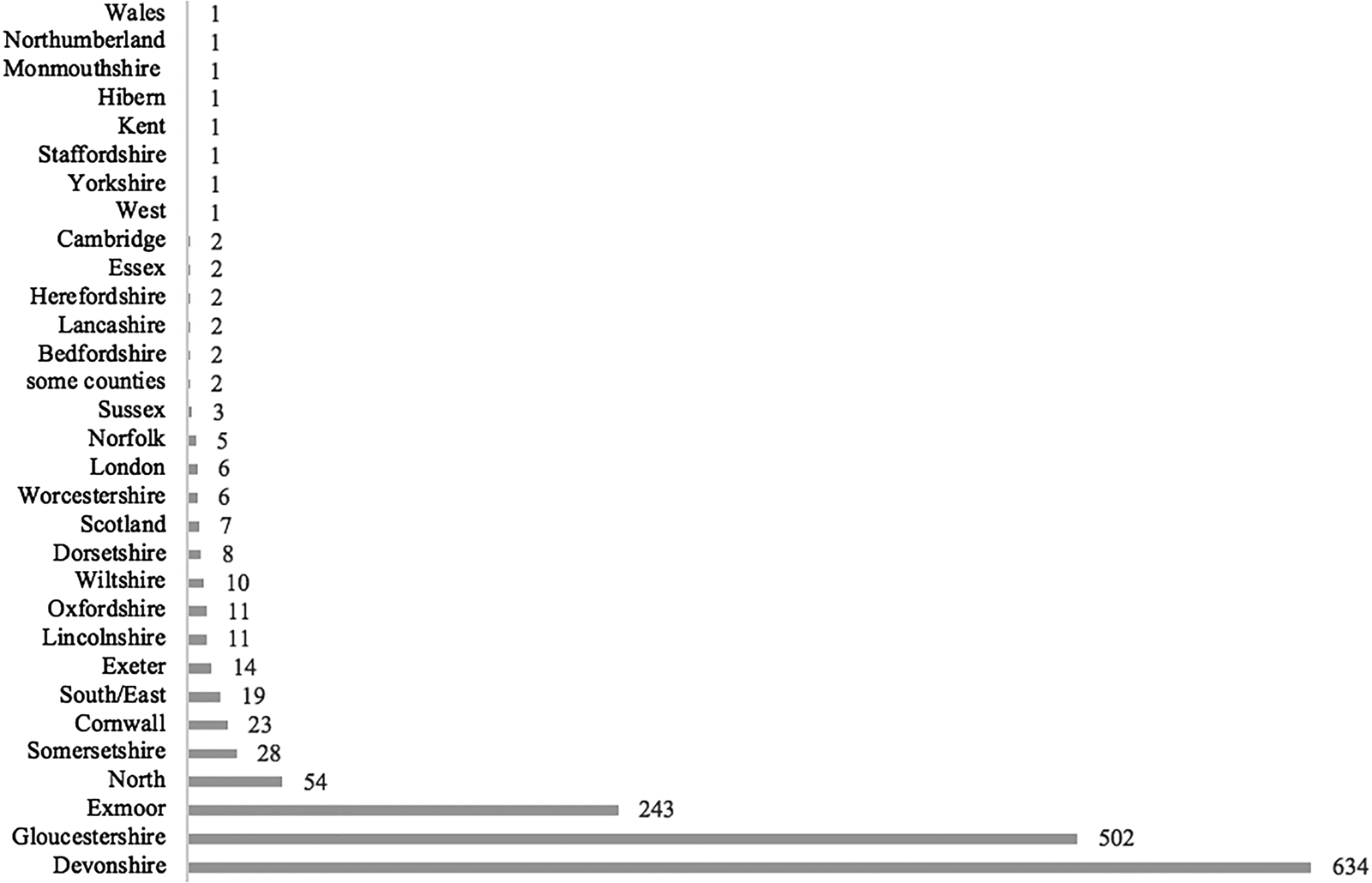
Figure 1 shows that the south-western element of Horae Subsecivae is strongly pronounced, with a remarkable amount of material representative of the dialects of Devonshire, Gloucestershire and Exmoor, followed by words cited from Somerset and Cornwall. The manuscript likewise offers some insight into the vocabulary of other counties and localities, including Bedfordshire, Essex and London in the South East, Lancashire and Yorkshire in the North, West Midland dialects like Staffordshire, alongside a few isolated words localised to Wales and Scotland. Examples are the verb avach ‘avouch’ (Bedfordshire) and the Lancashire noun hambark, which was used to designate what Devonshire people named hames ‘the wooden part of the collar, unto w[hi]ch the traces are fast'ned’.
Distribution of dialect words in Horae Subsecivae (total numbers)

The western words report on different fields of the lexicon that afford a valuable glimpse into everyday life in these counties. They include names of animals, husbandry practices, games, festivities, names of food, drinks and superstitions. Wight explained, for example, that in Gloucestershire the noun stuck designated ‘a certain number of sheaves or bundles of corn set up in a field after reaping’, which in Devonshire was known as stitch. Here, people ate the pestle pye ‘a large standing pye, w[hi]ch contains a whole gammon, and sometimes a neat's tongue’, which was ‘a noted dish at country fairs & wakes, & sometimes a Xtmass treat’. Meanwhile, the tadago pye ‘made of stratted pigs’ was cooked in Cornwall, which was not ‘quite so elegant, as one made of peepers’. Examples of popular customs are ram-racketting ‘Xtmass Gambols, w[h]ere all is capering & dancing, noise & rattling’ (Devonshire) and cock skailing ‘to throw at cocks with a skailer or squailer’ that Exeter people practised at Christmas time; it was a custom of Shrove Tuesday elsewhere in the West, at least in Gloucestershire, Somerset and Wiltshire. Likewise characteristic of the western counties was the game called rise & go lodge, for the King's a come, which Wight described as ‘when all leave their Seats & catch Places’ (s.v. a muss). There are also instances of grammatical words that are worth highlighting: byleer ‘just now’ (Somerset) and otherguess ‘otherwise’ (Devonshire). Wight also recorded interjections, such as gach (used by Gloucestershire children to show disgust) (s.v. tata) and hay! he! ‘a clownish form of answering a question instead of Sir, Madam, & such like’ (Gloucestershire).
Such interesting dialect material went unnoticed by contemporary compilations, including Grose (Reference Grose1787) and William Humphrey Marshall's (1745–1818) ‘Provincialisms of the Vale of Glocester’ (Reference Marshall and Skeat1789) and ‘Provincialisms of West Devonshire’ (Reference Marshall and Skeat1796). The contribution of Horae Subsecivae to the history of some western dialects is all the more significant, since many of these words derived from Wight's own experience as a native of Gloucestershire and his pastoral work in Devonshire. Although this work remains unpublished, some of its valuable material can now be recovered thanks to the ‘fascinating research possibilities provided by the EDD Online interface’ (Markus, Reference Markus2017: 881).
4. The reception of Horae Subsecivae in the EDD
Horae Subsecivae is listed together with the sources representative of the Devonshire dialect in the bibliography appended to the EDD (vol. 6, 1–42), where it is referred to as ‘Horae Subsecivae, 1777 (MS.)’. In this list there are other important 18th-century works, namely the anonymous dialogues Exmoor Courtship and Exmoor Scolding (1746), which are two of the earliest extant representations of the dialect, Marshall (Reference Marshall and Skeat1796), and the anonymous The Obliging Husband and Imperious Wife (1717). Even though Horae Subsecivae has a large number of items marked for other dialects, Wright's choice to include it as a Devonshire work points that the bulk of the regional material recorded is ascribed to this dialect, as we have seen.
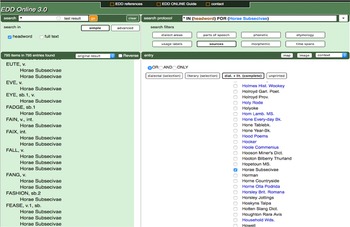
In order to evaluate the treatment given to Horae Subsecivae, all references to the manuscript have been identified thanks to the search facilities provided by EDD Online. Following the standard procedure described by Markus (Reference Markus2019b), I have activated, first, the filter ‘sources = dial. + lit. (complete) = Horae Subsecivae’.Footnote 4 Then, I have activated the simple search mode and typed in an asterisk in the search box, which has allowed me to retrieve an alphabetical list with the entries where Wright referred to the glossary. The number of entries is identified with the term hits in this paper. Because some of the entries contain more than one reference to Horae Subsecivae, the term references is employed here to indicate the total numbers. Figure 2 shows that a simple headword query for Horae Subsecivae in EDD Online retrieves 795 hits and 933 references in total. In other words, there are 795 entries where the glossary is cited, some of which contain more than one reference to it; examples are the entries for faix int.; fall v.; and fease v.1, sb. As in the original manuscript, some words and senses were ascribed by Wright to more than one dialect. I have counted them separately as instances of different dialects. By way of example, cottrel-cremaster ‘a hook on which to hang the pot over the fire’ is marked with two dialect ascriptions in EDD (Devonshire and Cornwall), hence counted as a word characteristic of both dialects. As such, the entry for cottrel-cremaster is treated here as one hit with one reference and two ascriptions. Thus, there are 795 hits and 933 references to the glossary in the EDD with a total number of 963 ascriptions, which indicates that the dictionary cites c.64% of the manuscript dialect words (933/1,460), and some 60% (963/1,604) of its dialect ascriptions. These are clearly significant numbers, especially considering that Horae Subsecivae is an unpublished work.Footnote 5 The manuscript is actually cited on a more frequent basis than other renowned works like the Exmoor dialogues. Headword queries for these sources in EDD Online show that there are 108 hits with reference to Exmoor Courtship, whereas the Exmoor Scolding is cited in 405 entries.
Query routine for the list of entries where Horae Subsecivae is cited (as of May 2020)

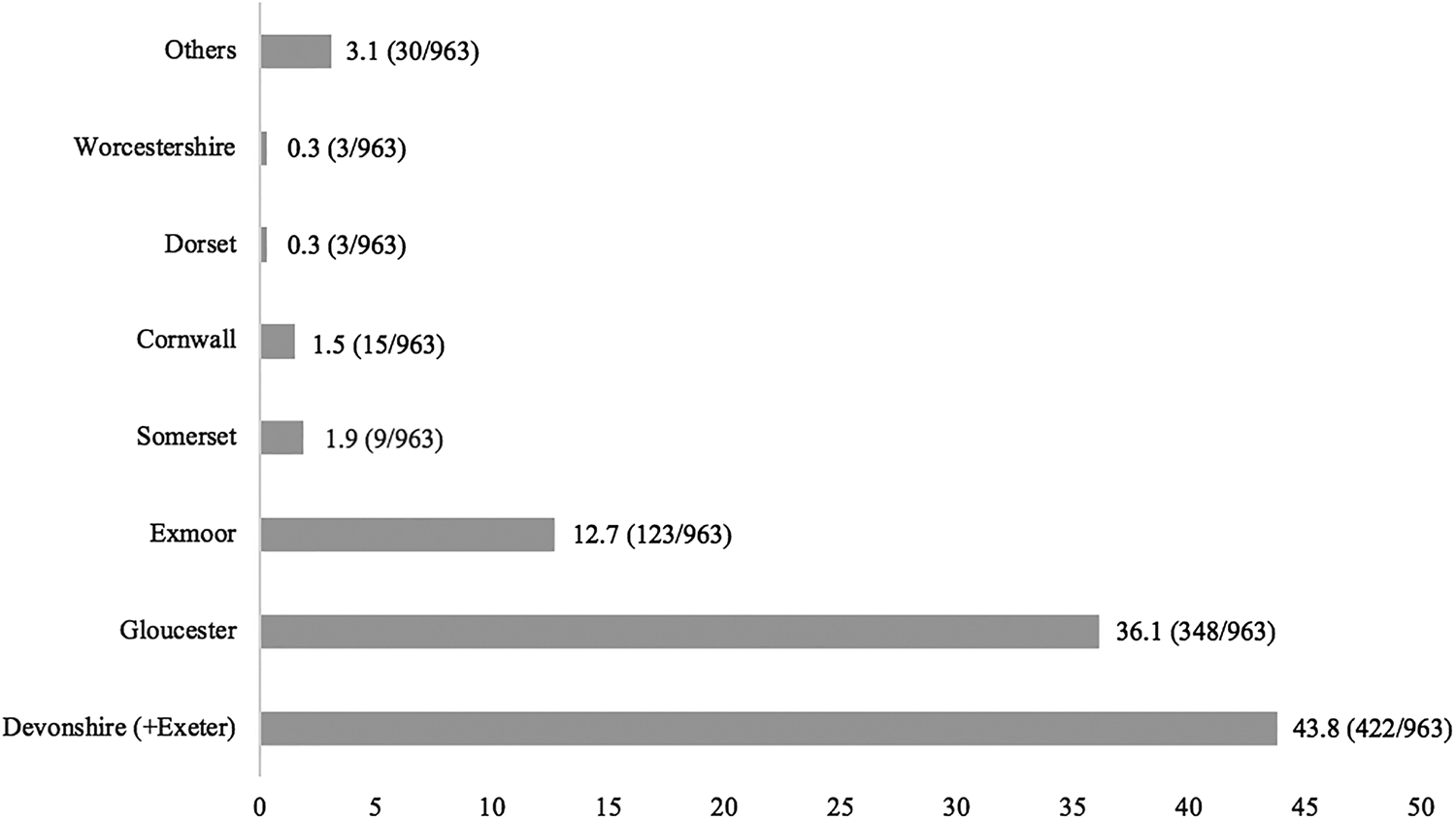
Quantification of the data reveals that the EDD relied on Horae Subsecivae most frequently for Devonshire words (43.8%) followed by Gloucestershire and Exmoor items, with 36% and 12.7% of the material, respectively.Footnote 6 Examples of Dorset and Worcestershire words are comparatively few in accordance with the representation of both dialects in the original manuscript. Figure 3 shows that Wright likewise drew upon the glossary for items marked for other varieties, including Bedfordshire (e.g. flapsy ‘lazy’), Norfolk (e.g. hodmandod ‘a snail with its shell’), and Surrey (e.g. esh ‘roughings’), which Wright often cross-referred to other sources; they amount to c.3% of the data.Footnote 7
Distribution of the words that the EDD quotes from the manuscript (percentages)Footnote 8

Wright quoted from the manuscript to support the inclusion of items from different fields of the lexicon. The material he chose to include does not seem to suggest that the manuscript was employed seeking to document specific domains. Rather, we can find terms from a variety of registers such as husbandry: ee-grass ‘aftermath or after-grass’ (Gloucestershire), which was known as eddish in Dorset, where people employed litt to designate ‘a sheep-walk or pasture’. Also, Wright borrowed items denoting utensils (e.g. hurdy-gurdy ‘a rustic instrument, consisting of a single string and a bladder fastened to a bent stick’, cited from Gloucestershire), along with household terms like twycrooks ‘little crooks bent contrary-ways in order to lengthen out the trammels on which the pot-hooks were hung’ (Gloucestershire). Often quoted are provincial terms of abuse: we may refer to fustilugs ‘a big coarse person, a dirty slattern’ (Somerset), lirripoop ‘a silly, empty creature, an old dotard’ (Devonshire), and zidle-mouth ‘an ugly fellow’ (Exmoor). Exclamations and interjections likewise feature amongst the material reproduced, with examples like faix ‘mild expletive: ‘faith’’ (Gloucestershire) and whenny ‘make haste! be nimble!’ (Cornwall). At the same time, the EDD reports on nicknames (e.g. gubbins, which designated ‘the natives of Dartmoor’), as well as clothing and ornaments (e.g. gallitrap ‘an unbecoming ornament or head-dress’, Devonshire), along with grammatical words such as byleer ‘just now’ (Somerset).
A careful scrutiny of the treatment given to this material points that it was in line with Wright's lexicographical practice and treatment of sources. References to Horae Subsecivae are chiefly made in the form of citations included in the body of the entries.Footnote 9 As with other sources cited in the dictionary, Wright reproduced from the glossary either in full (i.e. full citation, as in [2]), or just by referring to the manuscript by means of the corresponding abbreviation indicated in the list of Devonshire sources, which I refer to as short citations (e.g. [3]), thus:
(2) DRINGINGLY, adv. Obs. Dev. Also in form dringing. Sparingly, grudgingly. Dev. Spoken of a covetous person, or of anything that goes on heavily, and against the grain, Horae Subsecivae (1777) 133.
(3) HILLIER, sb. Chs. Nhp. War. Glo. I.W. Som. Also written hilliar Som.; hillyer Nhp.1 1. One who covers houses with any material but thatch; a ‘hellier’; a slater; a tiler. See Hill, v.2
Chs.13, Nhp.1, War.3, Glo. Horae Subsecivae (1777) 209. I.W.1
[ . . . ]
The number of short citations (566) outnumber full reproductions from the manuscript (366), yet both types of citation serve the same purposes in the context of EDD. On the one hand, they are employed to show the distribution of a word, thus justifying the label attached to it, as in example (3). On the other, Wright relied on the manuscript to illustrate the meaning and usage of an item, as in the entry for dringingly and the following:
(4) MURCHY, sb. Dev. Cor. Also written merchie Dev.2; mirchy Dev.1; murtchy Dev. [ . . . ]
2. A name given to the devil. See Mischief, 4.
Dev. The Old Murchy take you, Horae Subsecivae (1777) 300.
Of special relevance are those citations that acknowledge that a definition has been reproduced from the glossary. Their number is not especially pronounced (some 97), but still revealing insofar as they served as the only evidence to explain some senses:
(5) CORE, sb.1 Glo. Ken. 1. The contents of an ulcer; matter, pus. Glo. Horae Subsecivae (1777) 105. 2. The inside of a hay-rick [ . . . ]
(6) PARWHOBBLE, sb. and v. Shr. Hrf. w.Cy. Dev. Also written parwobble Dev. [ . . . ] 1. sb. Obs. A parley or conference. Dev. Horae Subsecivae (1777) 320. Cf. parable, 2. 2. v. To talk continuously, so as [ . . . ]
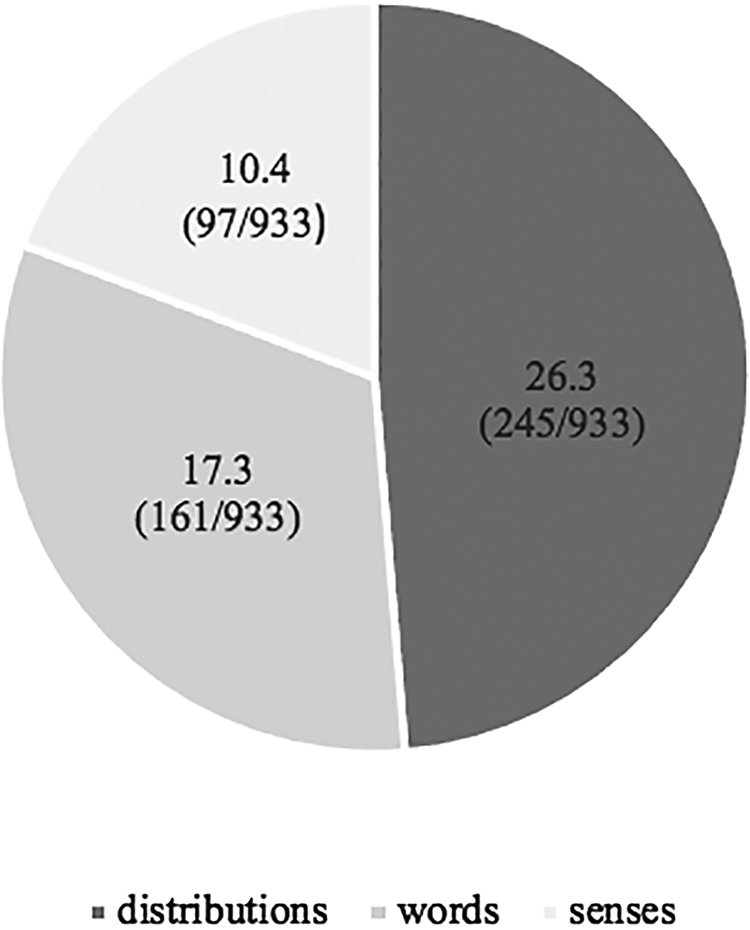
The EDD entries refer to Horae Subsecivae as unique evidence of not only senses, but also an important number of words and distributions. More specifically, c.54% (503/933) of the data reproduced from the glossary is treated as such. Figure 4 shows that in some 26.3% of cases (245/933) the manuscript is employed as the only available source to exemplify the western distribution of items, while it is referenced as sole authority for words in c.17.3% (161/933) of the glossary material included in the EDD. Amongst the former, we can find the verb drash ‘to thresh corn’ (s.v. drash, v. 3), whose distribution in Gloucestershire is based on the manuscript, which Wright likewise cited in support of the Wiltshire usage of lissom ‘a narrow strip of anything’ (also quoted from Gloucestershire). Examples of the latter include dringingly ‘sparingly’, aclomed ‘welcomed, well entertained’ (s.v. aclomed, pp.), which is marked as an obsolete Worcestershire word, and the Devonshire adjective peddle-backed ‘having a pack on one's back; round-shouldered’, likewise labelled as obsolete. Of course, such instances are especially interesting and valuable for what they can tell us about vocabulary used in these western counties and has gone elsewhere unrecorded. In this vein, there are phrases cited in the EDD as unique to Horae Subsecivae, which have not apparently been documented in the OED. For example, the Devonshire phrase to be in a zog ‘to lie half asleep in a sweat’ (EDD s.v. sog, v.3 and sb.3, 4) is related to the noun sog ‘a doze, a short sleep: drowsiness; lethargy’, which Wright quotes from 19th-century Devonshire and Cornwall (s.v. sog, v.3 and sb.3, 3), and the OED (s.v. sog, n.2) registers in dialect and US usage from 1874 with the meaning ‘a drowsy or lethargic state; a sleep, doze, stupor’. In like manner, Horae Subsecivae provides the earliest dating for to dress upon the spine ‘to lay manure upon the greensward’, which the EDD also quotes from Devonshire and relates to the south-western noun spine ‘the surface of the ground; greensward, turf’ (s.v. spine, sb. and v., 3). The noun is defined in the OED as ‘greendward, sward; turf’ (s.v. spine, n.2, 1), which is ascribed to the south-western dialect and first documented in 1786.
Manuscript data cited as sole evidence for words, distributions and senses (percentages)

In this regard, it is also worth noting that the EDD cites the manuscript as the earliest evidence for an important number of words, distributions and senses. Quantification based on EDD Online shows that first attestations amount to 57.5% of the data reproduced from the glossary (537/933), with examples of distributions and senses altogether being especially conspicuous (54.7%, 511/933).Footnote 10 The meaning of podge ‘a miry place; a pit, hole; a cesspool’ (s.v. podge, sb.1, 2), for example, is first documented in Horae Subsecivae, which is also recorded as the earliest witness to the Somerset usage of snape ‘a spring; a moist, boggy place in a field’ (s.v. snape, sb.1). Similarly, Wright traced some 26 words to the manuscript, including haystall ‘a small portion of wood on the outskirts of a large wood’ (s.v. hay, sb.2, 3) (Gloucestershire), impingall ‘an ulcer, cancer, abscess’ (Devonshire) and kitteback ‘a kind of buskin’ (Devonshire).
Comparison of the EDD citations against the original manuscript points that the information was carefully reproduced. This is clearly visible in the case of definitions and senses that Wright repeated, excluding etymological remarks and Latin equivalents that proved of little help for the purposes of the dictionary:
-
(7a) Horae Subsecivae (87) Dum: Chitty Faced–facie lentiginosâ–Freckled–ab Chitt Lentigo–male refertur a Skinnero ad Chechiface–facie macilenta instar Avari [ . . . ]
-
(7b) EDD (s.v. chitty-faced, ppl. adj.)
Obs. Dev. Freckled. Horae Subsecivae (1777) 87.
In some other cases, we find Wright at work rewording, filtering or rearranging the information from the manuscript according to the structure of the dictionary entries. For example, in (8a–b) part of the original definition was employed with the same purpose in the EDD, whereas the rest of it was taken as full citation. In (9a–b), Wright shortened the wording of his source by selecting from the definition provided:
-
(8a) Horae Subsecivae (243) Dum: The Land Share or Shire–[ . . . ]–That Part of the Forehead or Furrow Head, w[hi]ch is next to the Ditch, commonly cover'd with Thorns & Briars.
-
(8b) EDD (s.v. land, sb.1, v., 1. In comb. (54))
(54) -share or -shire, the part of the furrow-head which is next to the ditch; (55) -shut, [ . . . ]
(54) Dev.Commonly cover'd with thorns and briars, Horae Subsecivae (1777) 243.
-
(9a) Horae Subsecivae (153)
Gl: To Filter vel Felter, intricare, implicare, To felter ones Hair to intangle it so, as if You were making felt of it, for a Hat or a Cap [ . . . ]
-
(9b) EDD (s.v. felter, v. and sb., 1) 1. v. To entangle, intertwine, mat together. [ . . . ] Glo. To felter one's hair, Horae Subsecivae (1777) 153.
The manuscript dialect ascriptions were faithfully reproduced too; they were rendered in English and designated by means of Wright's own set of labels, as previous examples have shown. There are yet some isolated words that Wright labelled otherwise or whose ascriptions, as documented in the glossary, were not fully repeated. By way of example, wagmire ‘a quagmire’ is labelled in the EDD as peculiar to Gloucestershire even though it is cited from Devonshire in Horae Subsecivae. Similarly, the manuscript ascribes the compound long cripple ‘a snake’ to Devonshire and Cornwall, whereas the dictionary labels the manuscript as an example of its distribution in Cornwall alone (s.v. long, adj., adv.1, sb., 1. In comb. [31a]). It is hard to elucidate the rationale behind such choices, and it is a matter for further research to determine whether there is a pattern between what Wright chose to reproduce and what he chose to interpret. Nevertheless, from the evidence analysed here, we may surmise that in some cases Wright's decisions may have been motivated by the amount of information provided by alternative sources from which he also quoted. In this sense, he referred to four different sources in support of the Devonshire distribution of long cripple, whereas its Cornish usage is represented by just one of them in addition to the manuscript glossary.
In line with this, the availability of other sources supporting words, distributions and senses may account for the dialect material Wright chose to exclude (c.36%). There are cases like angle-twitch ‘a worm used for a bait’ (Devonshire) that the EDD traces to five Devonshire sources (s.v. angle-twitch, sb. 1), whereas afeard ‘afraid’ is documented in a large number of works attesting to its widespread dialect use throughout Scotland, Ireland and England; Horae Subsecivae, however, restricted it to Gloucestershire and Dorset. It may be speculated that in these cases Wright preferred other sources because the Horae offers no specialised senses nor has citations that add to the information recorded in other 19th-century works:
(10) Gl: & Dur: Affeard territus–ab AS. afæꞃan terrere– (9)
(11) Dum: Angle-twitch–Lumbricus, a Worm used for a Bait–vid: Dictionar: Goth: & Saxon: in Anʒel-tƿicca–et Lye in Twitch–(15)
Similarly, Wright relied on other sources to exemplify the distribution of items which the manuscript glossary cited second-hand. An example is shandy ‘wild’ (North), which the Horae quotes from Ray (Reference Ray1691). As these and other examples suggest, Wright scrutinised his evidence with care and weighed his materials against other sources that were also available to him. It remains a question for future work to investigate this excluded material so as to understand Wright's policy more precisely.
5. Concluding remarks
In this paper, I have sought to explore the impact of Horae Subsecivae on the representation of some western dialects in the EDD on the basis of EDD Online. Horae Subsecivae is a late 18th-century manuscript compilation with a remarkable dialect element that remains virtually unknown today despite the valuable insight it provides into the vocabularies of Devonshire, Dorset, Cornwall, Gloucestershire, Somerset, Wiltshire and Worcestershire. The search facilities of EDD Online have made it possible to interrogate the dictionary to discover, first, that Wright reproduced a sizeable amount of material from the manuscript, which he listed as a source characteristic of the Devonshire dialect. It was employed for citation purposes to document lexical variation concerning a number of fields that range from husbandry practices and local customs to names of games and grammatical words. As noted, not only does the EDD refer to the manuscript for items characteristic of Devonshire, but also quotes words from other western dialects, especially from Gloucestershire and Exmoor in accordance with their representation in the original manuscript. Wright treated it as a reliable source for these dialects given Wight's provenance and connection with Devonshire and Gloucestershire. Secondly, a detailed inspection of the EDD entries has shown that the manuscript was taken as first attestation and sole authority for an important number of words, ascriptions and senses, thereby supporting their inclusion in the dictionary and underlining the usefulness of Horae Subsecivae for dialect enquiry. Indeed, it was faithfully reproduced by Wright, who treated it carefully as a valuable source, one that contributed ‘much useful material’ (Bodl. MS Eng. lang. d. 66, iv).
In sum, the combination of archival evidence with tools of the digital age proves helpful to delve deeper into the making of the EDD, while illustrating how EDD Online can be used to undertake electronic analysis of the dictionary. This has enabled us to uncover forgotten material that casts light upon the rich dialect diversity of the English language.
 JAVIER RUANO–GARCÍA is Associate Professor of English Language and Linguistics at the University of Salamanca. His main research interests include historical regional lexicography, historical dialectology of the early and late modern English periods, and corpus linguistics. He is the author of Early Modern Northern English Lexis: A Literary Corpus-Based Study (Peter Lang, 2010) and has edited White Kennett's Etymological Collections of English Words and Provincial Expressions for Oxford University Press (2018). He is also one of the compilers of The Salamanca Corpus. Email: fjrg@usal.es