INTRODUCTION
Fish is a major source of food for mankind, providing a significant amount of the animal protein diet in many countries. Consumption of fish has been linked to health benefits, such as reduced risk of coronary heart disease, which are largely attributable to the polyunsaturated fatty acids (PUFAs) in fish oils (Paige et al., Reference Paige, Liao, Hajjar, Foisy, Cory, O'Brien and Gwathmey1996). An increase in seafood consumption, especially fish, has been suggested as an alternative to elevate the ω-3 PUFA level in the western diet. Another alternative that is being well accepted by the population is the use of food supplements based on sea oils, with a high ω-3 PUFA concentration (Sidhu, Reference Sidhu2003). Dietary fat quality influences the activity of enzymes involved in the desaturation of fatty acids in the body. Serum desaturase indices have been consistently associated with adverse cardiovascular outcomes. Replacement of dietary saturated as well as trans-fat with unsaturated fat has been recommended for decades in the prevention of cardiovascular disease (CVD), but trial evidence has only been suggestive and relatively few prospective cohort studies have provided support for this advice, with the exception of fish and fish oils (Erkkila et al., Reference Erkkila, de Mello, Riserus and Laaksonen2008).
The American Heart Association (AHA) has recommended, for individuals with established coronary heart disease, a combined intake of DHA + EPA of 900–1000 mg/day and 4 g/day for those with hypertriglyceridaemia, without specifying the proportion of the mixture which should be represented by each of the two components. (Hartweg et al., Reference Hartweg, Farmer, Holman and Neil2009). Furthermore, eicosapentaenoic acid (EPA) and docosahexaenoic acid (DHA) may have individually potential roles in the function of human organisms, since EPA-enriched supplements significantly improved psychological distress and depressive symptoms during menopausal transitions and have been suggested as an effective anti-cachexia anti-inflammatory agent (Lucas et al., Reference Lucas, Asselin, Merette, Poulin and Dodin2009). DHA is essential for the growth and functional development of the brain in infants and is also required for the maintenance of normal brain function in adults, while it is taken up by the brain in preference to other fatty acids (Horrocks & Yeo, Reference Horrocks and Yeo1999; Sidhu, Reference Sidhu2003; Navarro-Garcia et al., Reference Navarro-Garcia, Pacheco-Aguilar, Bringas-Alvarado and Ortega-Garcia2004). Since the brain has a very limited capacity for the synthesis of new ω-3 fatty acids, replacements must be imported. Marine phospholipids can greatly facilitate the transport of ω3 fatty acids over the blood–brain barrier thus preventing the potential problems of their deficiency in the brain (Miniadis-Meimaroglou et al., Reference Miniadis-Meimaroglou, Kora and Sinanoglou2008). Therefore, the assessment of fatty acid composition in fish muscle (edible part), is seen as being useful for the evaluation of their contribution to human health. Quantification of the desired ω3 fatty acids is necessary to know the amount of EPA and DHA ingested and the actual level presented in the tissue, in order to start with known amounts, so that the formulation of diets becomes more precise.
The orange-spotted grouper (Epinephelus coioides), an economically high valued marine food fish species belongs to the subfamily Epinephelinae (family Serranidae) (Nelson, Reference Nelson1994). However, due to over fishing and habitat destruction, the wild populations of the orange-spotted grouper have declined greatly in recent years and this species has been classified as nearly threatened (IUCN, 2011). Over the last decades, various attempts have been made to conserve this grouper species. The most important achievement is successful practices in aquaculture for the orange-spotted grouper, which can alleviate the fishing pressure on wild populations (Tupper & Sheriff, Reference Tupper, Sheriff, Lovatelli and Holthus2008).
The Sobaity seabream (Sparidentex hasta) is a marine demersal fish species belonging to the family Sparidae. It occurs in shallow coastal waters to moderate depths in tropical marine and brackish water around the Western Indian Ocean, Persian Gulf and coasts of India (Bauchot & Smith, Reference Bauchot, Smith, Fischer and Bianchi1984).
In recent years the Iranian Fisheries Organization selected this fish as a suitable marine fish species for mariculture development so surveying their body composition is very important. In the context of the above, the present comparative study focuses on the fatty acids profile in the edible part (muscle tissue) of cultured S. hasta and its wild relative as well as Epinephelus coioides, in order to evaluate their nutritional value for human health in respect to their lipid composition in Hormozgan Province conditions.
MATERIALS AND METHODS
Fish sampling
Fresh samples of cultured and wild Epinephelus coioides and Sparidentex hasta, with average length and weight of 20.60 ± 1.5 cm and 395 ± 50 g for the wild E. coioides, 19.70 ± 5.3 cm and 350 ± 80 g for the cultured E. coioides and 22.5 ± 4.5 cm and 257 ± 60 g for S. hasta, respectively, were collected from Hormozgan Province, Iran. The cultured E. coioides and S. hasta were collected from Tiab earthen culture ponds in June 2011. The wild samples of E. coioides were caught from Qeshm Island, while S. hasta were caught from Khore-e Khoran bay, by gillnet during the same season (summer). Cultured fishes were fed on the commercial diet ‘Biomar for Marine fish' consisting of 48% protein, 12% fat, 18.5% carbohydrate, 1.5% fibres, 10% moisture and 10% ash. The fish samples were all kept in iced boxes and transported to the laboratory where they were washed with cold water, weighed and measured. Then, samples of muscle (15 g from each fish species) were taken; they were weighed and afterwards separately homogenized.
Lipid analyses
Lipids of fish species were extracted (separately) according to the Bligh & Dyer (Reference Bligh and Dyer1959) method. After phase equilibration, the lower chloroform layer (TL) was removed and dried in a rotary vacuum evaporator at 32°C. The extracted lipids were redissolved in chloroform/methanol (9:1, v/v) and finally stored at 0°C until used.
Fatty acid methyl esters and gas chromatographic analyses
Separation of the methyl esters was done by gas chromatography, using a Varian Mod. 3300 gas chromatograph equipped with a flame ionization detector and a fused silica DB-WAX capillary column (30 m–0.25 mm i.d.) (J&W Scientific, California, USA). The operation parameters were as follows: detector temperature, 280°C; injection port temperature, 250°C; column temperature, 170°C for 16 minutes, programmed to increase at 2°C/minute up to 210°C with a final holding time of 25 minutes; carrier gas, hydrogen at 0.8 ml/minute, linear velocity of 38 cm/second, with an oxygen filter coupled to the line; nitrogen was used as the makeup gas at 30 ml/minute, hydrogen and synthetic air at 30 ml/minute and 300 ml/minute for the detector; split injection at 1:100 ratio. All the stages, from the transesterification to the final injection, were accomplished under nitrogen. Retention times and peak area percentages were automatically computed by a Varian 4290 integrator. Fatty acid methyl esters used as GC standard were: lauric acid M-E, L7272, cis-5,8,11,14,17-eicosapentaenoic acid M-E, E2012 and cis-4,7,10,13,16,19-docosahexaenoic acid M-E, D2659 (purity ≥98%) and they were purchased from Sigma Chemical Co; Matreya Bacterial Acid Methyl Esters CPTM Mix, Catalog No: 1114; SupelcoTM 37 Component FAME Mix, Catalog No: 47885- U. All solvents used for sample preparation were of analytical grade and the solvents used for GC analysis were of HPLC grade from Merck (Darmstadt, Germany). All water used in this work was re-distilled. All reagents used were of analytical grade from Mallinckrodt Chemical Works (St Louis, MO) and from Sigma Chemical Co (Sigma-Aldrich Company St Louis, MO) (Afkhami et al., Reference Afkhami, Mokhlesi, Darvish Bastami, Khoshnood, Eshaghi and Ehsanpour2011).
Statistical analysis
Statistical analysis of data was carried out with SPSS (ver. 19.5) software and Excel. Data normality was checked by using the Kolmogorov–Smirnov test. Significant difference between chemicals characteristic between two fishes was determined by using a t-test about 5% probabilities. Data are expressed as means; N values are given for each test.
RESULTS
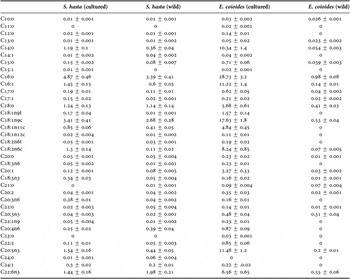
The muscles fatty acid composition (TFA) of Epinephelus coioides and Sparidentex hasta (wild and cultured) are depicted in Table 1.
Fatty acid composition of Epinephelus coioides and Sparidentex hasta (cultured and wild) (mg/ml) (mean ± standard deviation).

Palmitic acid (C16:0), stearic acid (C18:0) and myristic acid (C14:0) were important saturated fatty acids (SFA) in the fish samples. The main polyunsaturated fatty acids (PUFAs) found in the analysed samples were DHA (C22:6n3) and EPA (C20:5n3). While the main monounsaturated fatty acids (MUFAs) were oleic acid (C18:1n9c) and palmitoleic acid (C16:1). There was low concentrate of linolenic acid (ALA, C18:3n3) in all analysed samples (Table 1). The more fatty acid distribution was seen in cultured grouper (115.83 mg/ml). There was a significant difference in the sum of fatty acids distribution on cultured and wild grouper (P < 0.05).
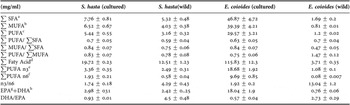
Significantly higher values of SFA, MUFA and PUFA were found in cultured grouper. Altogether, the amount of SFA was more for MUFA and continued with PUFA in other species, except wild grouper (Table 3). Results showed that more distribution of EPA + DHA was found in cultured grouper (Table 2). Significant difference was shown between levels of ∑MUFA, ∑SFA and ∑PUFA in species (P < 0.05).
Fatty acid composition of Epinephelus coioides and Sparidentex hasta (cultured and wild) (mg/ml) (mean ± standard deviation).

a∑ SFA, C10:0+ C11:0+ C12:0+ C13:0+ C14:0+ C15:0+ C16:0+ C17:0+ C18:0+ C20:0+ C21:0+ C22:0+ C23:0+ C24:0; b∑ MUFA, C14:1+ C15:1+ C16:1+ C17:1+ C18:1n9t+ C18:1n9c+ C18:1n11c+ C18:1n12c+ C20:1+ C22:1n9+ C24:1; c∑ PUFA, C18:2n6t+ C18:2n6c+ C18:3n6+ C18:3n3+ C20:2+ C20:3n6+ C20:3n3+ C20:4n6+ C22:2+ C20:5n3+ C22:6n3; d∑ fatty acid, ∑ SFA + ∑ MUFA + ∑ PUFA; e∑PUFA n3, C18:3n3+ C20:3n3+ C20:5n3+ C22:6n3; f∑PUFA n6: C18:2n6t+ C18:2n6c+ C18:3n6+ C20:3n6+ C20:4n6; gEPA: eicosapentaenoic acid; hDHA: docosahexaenoic acid.
Amount of SFA, MUFA and PUFA in Epinephelus coioides and Sparidentex hasta (cultured and wild) (%).

Omega fatty acids ratios are shown in Table 4. Results showed that the highest level of ∑PUFA ω3 was 29.72 (%) in wild grouper, while it was less in cultured grouper (16.13 %) (P < 0.05). Altogether there was no significant difference in levels of ∑PUFA ω3 for wild Sobaity seabream (19.92%) and cultured Sobaity seabream (17.03%) (P > 0.05). Also there was no significant difference in levels of ∑PUFA ω6 for wild Sobaity seabream (3.52%) and cultured Sobaity seabream (2.94%) (P > 0.05). The ∑PUFA ω6 level was higher in cultured orange-spotted grouper (1.08%) and wild orange-spotted grouper (0.21%). Results of this study showed a significantly higher ratio of ω3/ω6 in wild fish species; altogether, it was important for grouper (Table 2). The EPA + DHA level did not show a significant difference in cultured Sobaity seabream (2.98 mg/ml) and wild Sobaity seabream (2.42 mg/ml) (P > 0.05). It was significantly higher in cultured orange-spotted grouper (18.04 mg/ml) than in wild grouper (0.76mg/ml) (P < 0.05).
Amount of ω3, ω6 and ω9 in Epinephelus coioides and Sparidentex hasta (cultured and wild) (%).

DISCUSSION
Cultured fishes were found to contain significantly higher values of SFA, while their wild relative contained higher levels of MUFA followed by PUFA. The higher levels of SFA in cultured fishes resulted from an increase of myristic acid (C14:0), and also increased stearic acid (C18:0) in Epinephelus coioides. The higher levels of MUFA in cultured fishes showed an increase in palmitoleic acid (C16:1) and oleic acid methyl ester (C18:1n9c) in two species of cultured fishes. That increase was a result of an increase of C18:1n11c and C20:1 in Epinephelus coioides, also. The nutritional importance of fish consumption is to a great extent associated with the content of omega-3 fatty acids (ω-3 FAs). Sea food is known as a rich source of the ω-3 FAs, and most marine oils are good sources of eicosapentaenoic acid (EPA; 20:5n-3) and docosahexaenoic acid (DHA; 22:6n-3). These fatty acids, particularly the DHA, are known to play a major role in several biochemical processes, both in vivo and in vitro (Calder, Reference Calder1997). Polyunsaturated fatty acids are important fatty acids in human feed, where a high level of PUFA was found in all samples. Furthermore, our results are in line with previous studies (Lewis, Reference Lewis1967; Allen, Reference Allen1968; Romashina, Reference Romashina1983). Results of this study showed that the higher level of PUFA resulted from an increase of linoleic acid (C18:2n6c) and EPA (C20:5n3) in cultured Sparidentex hasta, while it resulted from an increase of (C18:2n6c), EPA (C20:5n3) and DHA (C22:6n3) in Epinephelus coioides.
The ω3/ω6 ratio was significantly higher in wild fishes and was highest (13.04) in wild Epinephelus coioides. The ω3/ω6 ratio is an important index of the role of fatty acids in human health. The appropriate balance for ω3/ω6 ratio, as recommended by Simopoulos (Reference Simopoulos2002) varies from 1/1 to 1/4 depending on the disease under consideration. The ω-3/ω-6 ratio is an appropriate indicator for the relative comparison of the nutritional value of fish fat (Tokur et al., Reference Tokur, Ozkutuk, Atici, Ozyurt and Ozyurt2006). Piggott & Tucker (Reference Piggott and Tucker1990) suggested that the ω3/ω6 ratio is a better index in comparing relative nutritional value of fish oils of different species. A ω3/ω6 ratio of 1:1 is considered to be optimal for nutritional purposes (Simopoulos, Reference Simopoulos1989), particularly when ω-3 FAs consist mainly of EPA and DHA. Today, this balance in the usual diet has been severely shifted and the amount of ω-3 FAs in the diet has decreased, while the amount of ω-6 FAs has increased (Loukas et al., 2010). A dietary intake of fish with a high ratio of ω3/ω6 would, therefore, be beneficial. Results of this study showed that the wild fishes had a higher ratio of ω3/ω6 than the cultured fishes. Altogether, this ratio was significantly higher in wild Epinephelus coioides than wild Sparidentex hasta. The ω3/ω6 ratio differences may be explained by the large variability of the oil level in the fish muscle, which depends on the species, period of the year, age, size, reproduction period, the specific species as well as the fatty acid composition of the diet (Sirot et al., Reference Sirot, Oseredczuk, Bemrah-Aouachria, Volatier and Leblanc2008). Consequently, the ω-3/ω-6 ratio was found to have the highest value in wild Epinephelus coioides muscles, followed by wild Sparidentex hasta, while the same ratio had the lowest value in the cultured fishes (Table 2). On the contrary, in a previous study ω-3/ω-6 ratios were higher in wild gilthead seabream (Sparus aurata) species than in the cultured ones (Grigorakis et al., Reference Grigorakis, Alexis, Taylor and Hole2002). Data derived from various long-term epidemiological studies, which investigated fish intake in relation to a reduced mortality from cardiovascular disease, suggest a combined DHA/EPA intake of 500 mg/day for normal healthy adults (ISSFAL, 2004). This intake is both safe and achievable by diet alone, even for pregnant and lactating women (ISSFAL, 2004). For instance, most animals cannot synthesize longer chain polyunsaturated fatty acids, such as eicosapentaenoic acid (EPA; 20:5ω3), arachidonic acid (AA; 20:4ω6) and docosahexaenoic acid (DHA; 22:6ω3). Instead these are formed by phytoplankton and some bacteria and are transferred through the food web (Volkman et al., Reference Volkman, Jeffrey, Nichols, Rogers and Garland1989; Brown et al., Reference Brown, Dunstan, Jeffrey, Volkman, Barrett and LeRoi1993) such that high levels of these fatty acids are suggestive of a herbivore. The EPA and DHA were higher in surveyed fishes in this study, especially in cultured fishes. In all studied wild fish species, DHA was the most abundant PUFA, followed by EPA. Altogether, EPA was the more abundant followed by DHA in the cultured species. Many pelagic fish species have a tendency to accumulate DHA from the marine food chain. In general, higher concentration of ω-3 PUFA may originate from phytoplankton (Loukas et al., 2010). Generally, in cultured fish, the percentage of ω-3 PUFA was usually lower than in their wild relatives, possibly because of the lack of lipids, originating from marine phytoplankton and other marine organisms (Rueda et al., Reference Rueda, Lopez, Martinez, Zamora, Divanach and Kentouri1997). The DHA/EPA ratio in cultured fishes was lower than in the wild fish. This ratio in cultured Epinephelus coioides muscles presented the lowest value (0.57) in contrast to the wild Sparidentex hasta, in which this ratio presented a much higher value (4.5). This was according to the findings of Loukas et al. (2010), where they reported on wild and cultured Trachinus draco and Trigla lyra. Regarding the sum of EPA and DHA (ω-3 PUFA), wild Sparidentex hasta showed the highest percentage, followed by wild Epinephelus coioides while the lowest EPA + DHA percentage was found in the cultured Epinephelus coioides followed by cultured Sparidentex hasta. Loukas et al. (2010) reported the same as our results on wild and cultured fishes. As far as the sum of ω-6 PUFA in the studied fish species is concerned, it was found in a lower percentage in the wild fishes while higher in the cultured fish.
Cultured fishes were found to contain a higher percentage of linoleic acid than the wild fishes, Epinephelus coioides and Sparidentex hasta, as well. This fatty acid is also not a normal constituent of the marine food chain (Grigorakis et al., Reference Grigorakis, Alexis, Taylor and Hole2002). It is contained in plant lipids and because it is included in the commercial diet with which cultured fish are fed, it accumulates unchanged in the lipids of marine fish because of its reduced capacity for chain elongation and desaturation (Mnari et al., Reference Mnari, Bouhlel, Chraief, Hammami, Romdhane, El Cafsi and Chaouch2007). It has also been found in higher percentages in cultured rather than in wild populations of other studied marine species (Sirot et al., 1998; Grigorakis et al., Reference Grigorakis, Alexis, Taylor and Hole2002).
Conclusion
According to the data of the present study, cultured Epinephelus coioides and Sparidentex hasta muscles are a rich source of ω-3 FA, especially DHA and EPA. Consequently, the cultured Epinephelus coioides and Sparidentex hasta proved to be the species most suited to a rich-based diet as a result of its DHA + EPA content and could be used in balanced diets when the objective is to increase the amount of DHA and EPA. Therefore, they all represent a very good food choice for the maintenance of human health.
ACKNOWLEDGEMENT
We express our special thanks to Hossein Panahi, the Head of Young Researchers Club, Islamic Azad University, Bandar Abbas Branch, for their kind assistance.