Introduction
Globalization is a complex, multidimensional process involving the movement of people, technology, finance, media, and ideologies across borders. This dynamic flow continuously shapes and reshapes cultural identities across borders, transforming communities in diverse ways. Therefore, “the issues of normality become quite complex.”Footnote 1 As Appadurai notes, local individuals and communities are not passive recipients of modernity and globalization. Instead, they actively adopt and adapt global influences and selectively incorporate new resources to fit their contexts. This active participation redefines their identities within the interconnected world. Therefore, global influences contribute to how local communities reshape the social, cultural, and political contexts they create for themselves.Footnote 2 People around the world “are, now, living in a highly complex world, in which the speed of time supersedes the speed of space.”Footnote 3 Language plays a crucial role as a bridge for cross-cultural communication and a medium through which global ideas and identities are transmitted and transformed. “As a result of this mobility, many language varieties are born and reborn, evolved and revolved.”Footnote 4
Onysko, on the other hand, defines language contact as encompassing “the individual performance of a single speaker and to the collective performance of entire speech communities.”Footnote 5 In the study of world Englishes, language contact is examined at both individual and community levels, involving “the processes of borrowing/loan, codeswitching/codemixing, and different types of calquing.”Footnote 6 Notably, nouns are more readily borrowed across languages, highlighting how language contact influences the development of English varieties globally.Footnote 7
Additionally, the nativization of English, as Pandharipande describes, involves “the changes which English has undergone as a result of its contact with various languages in diverse cultural and geographical settings.”Footnote 8 Kachru also discusses that “the linguistic exponents” of English are “significantly altered” when English is “nativized by the use of devices such as mixing, switching, lectal blend, variety shift, and so on.”Footnote 9
English, adapted and blended into numerous languages worldwide, creates unique linguistic hybrids that reflect cultural exchanges. As Kay indicates, “[b]orrowed words inevitably acquire culture-specific meanings, to varying degrees.”Footnote 10 English loanwords often change in meaning due to a limited understanding of their original context and an absence of cultural pressure to retain their original sense. This adaptability allows these words to integrate smoothly into the host language and evolve with societal trends. Kay argues that Japanese speakers can communicate with English speakers even without knowing English. While changes in pronunciation and meaning can sometimes lead to confusion, English loanwords can foster understanding, much like how English speakers recognize certain words in Romance languages due to shared roots.Footnote 11
Salakhyan argues that the use of English as a lingua franca varies worldwide, shaped by speakers’ unique language backgrounds, needs, and communication strategies. This diversity means no standard features or proficiency level defines effective English use, yet speakers with varying English skills can communicate successfully. Eastern European English, therefore, is “a product of an interrelation of various speaker-specific dimensions.”Footnote 12
MacKenzie also explains that English words are commonly adopted in European languages. Terms for visible, concrete entities and distinct activities can spread quickly across languages. Once integrated, these loanwords are often used by monolingual speakers who may be unaware of their foreign origins. MacKenzie continues that some loanwords do not introduce new concepts and have native equivalents, but are used in English for their “prestige,” especially in media and entertainment.Footnote 13 Even more interesting than prestige borrowing is the rise of false Anglicisms: terms such as “autostop (hitchhiking), basket (basketball), and block notes (note pad)” are “primarily coined for stylistic purposes. They mimic English but cannot “be recognized or understood by monolingual English native speakers.”Footnote 14
Utilizing English loanwords by speakers of languages other than English is prevalent worldwide. As “the world’s leading language today,” non-English speakers use English extensively, and the use of English loanwords is a common practice around the world.Footnote 15 Recent scholars have investigated the scope and role of the use of English by non-English speakers in different contexts and settings. These studies address the worldwide “immediate manifestations of globalization” and highlight the use and impact of English in “major parts of the modern world.”Footnote 16 Bolton refers to this practice as the “nativization of English,” which is “accompanied by the ‘Englishization’ of indigenous languages, leading to complex patterns of contact linguistics, including lexical transfer, code-switching and code-mixing, and discoursal and syntactic change and accommodation.”Footnote 17
“Linguistic borrowing,” which can be found in all aspects of language, indicates “cultural change,” and “Persian is a very fertile field for studying the various aspects of linguistic borrowing.”Footnote 18 “English is associated with power and differentiation,” and using English has multiple functions for Iranians.Footnote 19 In Iran, “globalization” is a major “context in which language is practiced.”Footnote 20 Furthermore, mixing English words and phrases with Persian, especially on social media, is a sign of prestige for Iranians.Footnote 21 Jazayery refers to the practice of using loanwords in Persian as an attempt at “Westernization” and “modernization” in Iran, and Yarshater believes that association with the West is “the most potent factor in the evolution of Persian in modern times.”Footnote 22
Since many Iranians do not have the opportunity to travel abroad and experience what it means to speak English outside of Iran, their extensive use of social network platforms gives them a “sense of belonging to the global community.”Footnote 23 Using English is also a tool to introduce Iran’s rich resources, history, and values to the rest of the world, especially on the Internet.
Notably, Persian has also contributed to English. English is “indebted to Persian, often through the intermediary of another language.”Footnote 24 Persian loanwords, such as scarlet, sugar, and sherbet, are ubiquitous in English, as they have “entered the English lexicon by various paths” and “via mediating language[s].”Footnote 25 A great number of Persian words have been transliterated into English, and other Persian words have been “altered beyond recognition either in meaning and/or spelling” when used in English.Footnote 26
Today, Persian speakers demonstrate a noticeable inclination to creatively integrate English words and phrases into their communication, giving rise to what is commonly referred to as Persianized English. This fusion of English and Persian has become pervasive in everyday Iranian dialogues, reflecting Iran’s ongoing sociolinguistic globalization. This dynamic demonstrates Iranians’ profound respect for their rich linguistic and cultural roots while simultaneously embracing the flexibility and interconnectedness of the modern world.
The primary aim of this article is to shed light on the phenomenon of English loanwords and expressions in Iranians’ daily interactions, focusing on a non-colonized country where English has historically been a foreign language. By examining the prevalence and integration of English within Persian, the article seeks to illustrate how these linguistic borrowings contribute to the dynamic interplay between the two languages in Iran’s sociolinguistic landscape, impacting social interactions, identity formation, and cultural practices in Iranian society. The study employs a qualitative research methodology based on field interview data.
A brief history of English in Iran: language, culture, and modernity
English was introduced to Iran as early as the 17th century and became relatively widespread by the 18th century.Footnote 27 In the 19th century, Christian missionaries from Europe opened schools in Iran and brought modern education and Western development, generating local interest. In the 19th century, American and British missionary schools began promoting English and, in the 1950s, English swiftly replaced French as the most desirable foreign language in Iran.Footnote 28 In the 1920s, Iran began its modernization, with tuition-free schools and universities modeled along the lines of the American educational system, adapting American textbooks and resources for Iranian universities.Footnote 29
In 1979, Iran’s American and British-modeled educational system underwent the process of Islamization. As a result, while linguistic elements of English remained in school curricula, the social and cultural features of the language were eradicated.Footnote 30 Since the 1980s, all university students have been required to take English-as-a-foreign-language courses, and all professional degree candidates have been required to pass an English proficiency test to graduate.
The use of English is also very popular among educated Iranians today. Universities on Iran’s Kish Island, for instance, feature English as the sole language of instruction. Moreover, private institutions offer professional development courses in English in various Iranian cities and numerous private English-language institutes prepare students to use English in academia.
Today, English competency and code-switching between English and Persian forms “a middle-class educated identity for younger Iranian generations.”Footnote 31 Other functions of English in Iran include the translation of documents for international affairs and a subject of study in schools and universities.Footnote 32 English is also creatively “nativized” in Iranian public spaces, daily communications, graffiti, and social media.Footnote 33 The use of English for creativity and innovation in Iran manifests in different ways, including borrowing words that are “nativized to some degree” and inventive applications of English in public settings.Footnote 34
In Iran, the nativization of English reflects a blend of global influences and local traditions, showcasing the country’s approach to integrating global elements while also preserving its cultural identity. For Iranians, English, especially American English, is highly admired as the language of modernization, global economy, and technology. This is evident in everyday contexts such as street signs, media, and popular culture, where English words are subtly adapted into Persian, symbolizing both a connection to global trends and a distinctly Iranian interpretation. This linguistic interplay highlights the adaptability of Iranians’ engagement with the globalized world while maintaining their unique cultural identity.
Despite the Academy of Persian Language and Literature efforts to protect Persian from the invasion of foreign words by coining Persian words for English terms, loanwords such as “bank” and “police” entered the everyday Persian lexicon for “[P]honetic considerations and simplicity.”Footnote 35 Additionally, some words identified as English loanwords entered Persian via French (e.g., television, radio), the world’s lingua franca until the 1960s.
It is helpful to examine a few examples of how this process has played out. To start, the term چرخبال (/tʃærxbɔl/; rolling wing) was introduced as a replacement for “helicopter” in Persian.Footnote 36 However, in reality, Iranians use هلی کوپتر (/hɛlikʊptɛr/; helicopter) in daily conversation, with some individuals likely completely unaware of the existence of the former term and baffled if/when encountering it. Other coined words include: دورنگار (/dʊrnɛgɑr/; fax), رمزینه (/ræmzɪnɛ/; fax), and پیام گیر (/pæjɔm gir/; answering machine). Such words, mostly word-for-word translations of English words, are used in official communication and formal contexts.Footnote 37 Other examples of Persian equivalents for English words include: پهباد (/pæhbɔd/; drone), پیامک (/pæjɔmæk/; text message), and صفحه نمایش (/sæfhɛ næmɔjɛʃ/; monitor). Interestingly, the word پیامک (/pæjɔmæk/; text message) is a combination of the Persian word پیام (/pæjɔm/; message) and the Persian suffix ک (/k/; short). Another example of a word coined by combining a Persian word and Persian suffix is چراغک (/tʃɛrɔɣæk/; “little lamp”), meaning “warmer.”Footnote 38
Commonly, Iranians want to both learn and use English in all of their communications, formal and informal. Zarrinabadi and Mahmoudi-Gahrouei indicate that Iranians are among the top users of Telegram and Viber.Footnote 39 “To enhance English proficiency, private institute instructors [in Iran] encourage English learners to hone their language skills through social media.”Footnote 40 The popularity of these social networks has led to the incorporation of multiple English terms into Iranian users’ daily language. “Using these social networks has introduced new English words to the everyday communication of Iranian people.”Footnote 41
The use of English in everyday discourse in Iran is considered a sign of intellect, sophistication, intelligence, elegance, and modernity. Knowledge of English, especially American English, in Iran is highly valued by academic institutions and employers as well as frequently practiced in social interactions. “English language proficiency is favored in job announcements. Iranian job applicants are encouraged to indicate their level of familiarity with English in submitted curriculum vitae.”Footnote 42
Among Iranian families, investing in learning English is very common. The number of private English-language institutes is growing rapidly across the country, particularly in urban areas, serving “fee-paying students interested in learning English across all ages and proficiency levels.”Footnote 43 Proficiency in English brings a wide range of opportunities, including interactions with “global citizen[s], multilingual consumer[s], bilingual executive[s], [and] international traveler[s].”Footnote 44
Proficiency in the English language is highly valued in professional settings. Hiring committees prefer candidates who speak English and applicants are advised to highlight their English-language skills on applications. Zarrinabadi and Mahmoudi-Gahrouei note that employers want staff members who achieve high scores on English proficiency tests – such as the Test of English as a Foreign Language (TOEFL) and the International English Language Test System (IELTS) – as this ensures that their teams are conversant and held in high regard.Footnote 45 Some companies require their employees to pass English proficiency tests, treating a passing score as a certificate. Iranians also use the word مدرک (/mædræk/; diploma) in reference to passing such proficiency tests. Additionally, competency in English also empowers “women to broaden their horizons and expand the range of opportunities available to them,” as they can teach English at private language institutions and “have greater independence and freedom of choice in determining their future identities.”Footnote 46
English is also widely used in linguistic landscapes and publicly visible street signage in Iran. The use of English in magazine advertisements, product packaging, clothing, greeting cards, restaurant menus, and food labels suggests quality and reliability. In Iran, bookstore shelves are filled with English books, from language-teaching to novels and poetry.
Methodology
Having experienced teaching English to Iranians both in the United States and Iran over the years, this article’s author observed a number of patterns Iranian English learners use. Noting these patterns motivated an investigation, leading to a research study guided by two questions:
• How do Iranians Persianize English loanwords and phrases in daily conversation?
• What are some of the broad patterns of the Persianization of English in Iranian daily discourse?
The study
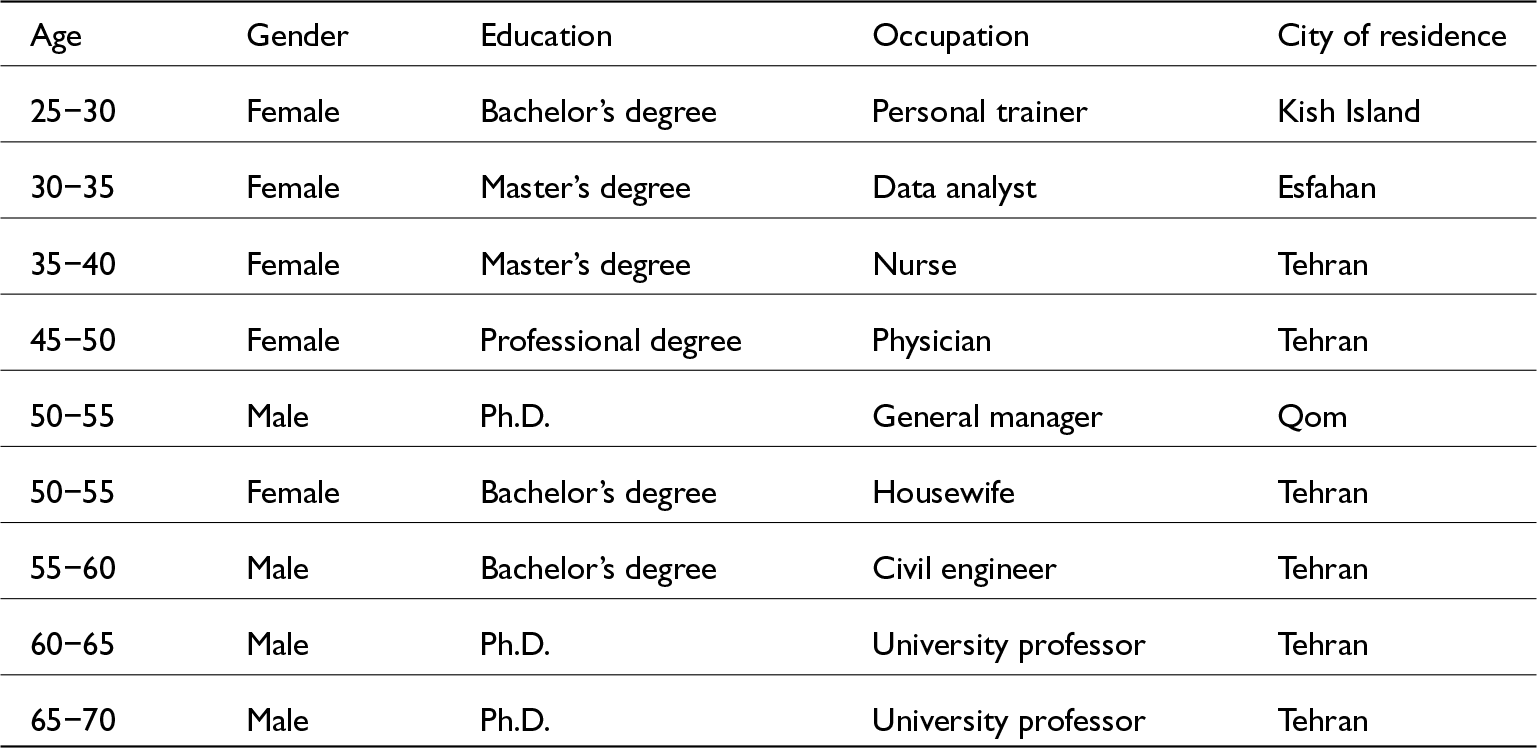
This study investigates the ways in which English loanwords and phrases are Persianized in daily conversation in Iran. Data was collected through nine semi-structured interviews with educated Persian speakers residing in Iran, as detailed in Table A1 in the Appendix, conducted virtually in January and February 2020. Participants were selected to include a diversity of educational backgrounds, places of residence, ages, and genders, as well as a broad range of linguistic experiences relevant to the focus of this study.
Interviews were conducted over WhatsApp, using both its text messaging and video call functionalities, which were particularly accessible during the COVID-19 lockdown in 2020.
Interviews were conducted in Persian, allowing for a natural code-switching when participants used English words. This setting aimed to capture how English is integrated and adapted in real-time conversation. The interview questions, designed to explore the frequency and context of English usage in Persian conversations, included:
• Can you recall and share any English words you commonly use in daily conversation? What are they? How do you use them in sentences?
• Can you share any examples of code-switching between English and Persian in your conversations? What prompted the switch?
• What do you think influences your choice to use English words in Persian conversation?
• Have you noticed any situations in which using English words seems more appropriate than Persian words? If so, could you describe those situations?
• When you use English words in Persian conversation, do you think it is because there is no direct Persian equivalent or for other reasons? Explain.
• How do you feel about using English words in Persian contexts? Does it change the tone or formality of the conversation?
• Do you believe using English words in Persian conversation reflects a trend toward modernization, or does it pose a risk to the Persian language?
• Do you find that certain groups (e.g., age, profession, or education level) are more likely to use English words in Persian conversation? If yes, could you explain why you think that is?
Data analysis
With the interview questions in place, the responses provided valuable insight into how English is integrated into Persian conversations, illustrating the dynamics of code-switching and its underlying motivations. These insights formed the foundation for the subsequent data analysis. Notably, as an English and Persian speaker teaching both languages in Iran and the United States, the author observed and documented various patterns of Persianization of English words and phrases. However, the focus of this analysis is firmly grounded in the specific data gathered from the study’s participants, all of whom were educated and had intermediate to advanced proficiency in English, allowing them to discern and consciously reflect on the use of English loanwords in Iranian contexts.
The author recorded and analyzed interview responses using Saldaña’s coding methodology, which facilitated the identification of recurring patterns in the use of English words and phrases in Persian conversation.Footnote 47 This coding approach revealed not only the frequency of English terms in Persian dialogues but also the contexts in which participants incorporated them. Participants were not only frequent users of English loanwords but also exhibited an acute awareness of how these loanwords are adapted and integrated into daily Persian conversation. For example, several participants noted the subtle modifications in pronunciation or grammar when English words are used in Persian contexts, a reflection of their linguistic proficiency and educational background.
The coding approach revealed not only the frequency of English terms but also the specific contexts in which participants employed them, such as professional, academic, and social settings. The data showed that participants were more likely to use English terms when discussing specialized subjects, such as technology, business, or education, subject areas with a higher prevalence of English terms in Iranian discourse. Participants’ English proficiency enabled them to discern the origin and adaptation of these loanwords, critically reflecting on the presence and role of English in their daily communication.
Through this coding process, the author, drawing on both analysis of the data and personal observation, was able to classify the distinct ways in which participants, considering their educational background and language skills, integrated and adapted English loanwords. For instance, those with more advanced English proficiency tended to use English terms more fluidly and accurately, while those with intermediate proficiency displayed a greater tendency to modify loanwords to fit Persian phonology and syntax. These findings, specific to the sample, provide nuanced insight into the evolving Persianization of English loanwords in Iran, particularly among educated individuals with substantial exposure to English.
Findings
Derived from the interview data, the findings reveal several broad patterns in the Persianization of English. Participants commonly adapted English words by altering them to fit Persian phonetics and syntax, a process often influenced by the need to maintain conversational fluency and cultural relevance. For instance, one participant used آپدیت (/ɔpdeɪt/; update) and integrated it seamlessly into a Persian sentence structure. These adaptations were not just linguistic; they also indicated deeper cultural assimilations, as participants often chose English words that conveyed specific concepts more effectively in contemporary contexts.
Results: فارسی سازی انگلیسی (/fɔrsi sɔzi e ingilisi/; Persianization of English)
The incorporation of English into Persian conversations reflects a broader trend of language adaptation and cultural reinvention in Iranians’ attempt to join the globalized world. English, as Persianized, has become Iranian’s “home dialect.”Footnote 48 Hence, “a very creative negotiation of [English] codes and values” is evident in Iranian discourse.Footnote 49 English is “embedded into” Iranian daily discourse and there is “constant switching between clauses, sentences, and longer utterances” from Persian to English.Footnote 50 As the spread and influence of English and Western culture are prevalent in Iran, “a momentum of [linguistic] playfulness” that is “cognitively creative and culturally appropriate” is evident in Iranians’ local linguistic and social interactions.Footnote 51
Iranians’ use of English demonstrates how they adapt and transform the language to align with their cultural context, resulting in a unique hybrid language reflecting both global influences and local values. Sahranavard and Lee’s research on Tehran’s linguistic landscape revealed that “English is appropriated and reinvented via characteristics unique to the Iranian context as both a linguistic and cultural phenomenon, operating in a discursive field delinked from its indexes to Western culture.”Footnote 52 This process results in what they called the “Persianization” of English, wherein the borrowed language takes on new meanings and connotations that align with Iranian cultural norms and values.
Building on this concept, this article explores how English words and phrases are Persianized in Iranians’ everyday interactions. Through the interview responses and subsequent data analysis, it became clear that English terms and set phrases are not only used as-is but often creatively adapted to suit the Persian context. This adaptation can involve changes in pronunciation, meaning, or usage, reflecting a unique blend of linguistic influences. Even individuals with limited English proficiency engage in this process, demonstrating its widespread acceptance and influence in modern Iranian communication. The initial analysis revealed that code-switching between English and Persian is a common occurrence, with participants integrating English words to convey concepts, adding a sense of modernity and sophistication to their communication. This integration is not limited to formal contexts; it is prevalent in everyday conversations, indicating that English has become an intrinsic part of the Persian discourse.
In what follows, this article examines how English words and phrases are Persianized in everyday interactions among Iranians. These words and phrases are creatively adapted, adopted, and appropriated to fit the Persian context, even by those with limited or no knowledge of English. The following list offers examples of Persianized English terms, but is not comprehensive. This section demonstrates how Persianized English words and phrases reflect Iranians’ linguistic identity and are used in contemporary Iran.
Persianization of English: phonemic modification
Iranians tend to modify and Persianize English phonemes based on their linguistic background when code-switching into English in everyday interactions. In Iran, English words “undergo a fast process of adaptation on the phonological level and the language community assimilates them readily and fully.”Footnote 53 English words “are pronounced somehow differently” in Iran, as they have become “localized and indigenized” to satisfy “important local function.”Footnote 54 English words and phrases are often adapted and changed to suit local Iranian contexts. This process of (re)appropriation alters the form of English, leading to new variations unique to Iranians. These “intentional and unintentional” English variations, “with or without conscious effort on the part of” Iranians, enable them to use English in ways that reflect Iranian identities, cultures, and preferences, even though potentially differing from standard or traditional English.Footnote 55 The “local appropriations of English-related forms,” especially those that significantly “play with and modify what we conventionally recognize as ‘English,’” serve people around the world by allowing them to use the language “in their own way.”Footnote 56 This adaptation illustrates the flexibility and adaptability of English, as it is reshaped by local users to fit their specific circumstances.
Persianized English words sound slightly different than their English counterparts, as they are subject to Persian phonological and environmental restriction rules, which, unlike English, require inserting a vowel sound to separate the juxtaposition of two neighboring consonants at the beginning or middle of certain consonant clusters – such as /bl/, /fr/, /kr/, /pl/, /pr/, /sk/, /sn/, /st/, /kl/, and /tr/ – when code-switching to English. Specifically, Persianized English words add the /ɛ/ vowel sound before the /s/ sound followed by another consonant. For instance, “Winston,” “Instagram,” and “institute” undergo phonological modification, pronounced as if written: “Wineston,” “Inestegram,” and “inestitude.”
Another example helps clarify the comparative phonological analysis of the two languages. “Snapp” is an Iranian vehicle-for-hire company and mobile application for transportation services in Iran. Not only is the spelling of the company’s name and mobile application a modification of the word “snap,” but it is transliterated and pronounced اسنپ (/ɛsnæp/) in Persian. It is notable that the added /ɛ/ phoneme appears in the word’s Persian transliteration. Other commonly used Persianized English words include: اسکی (/ɛskɪ/; ski), استوری (/ɛstorɪ/; story), استایل (/ɛstaɪl/; style), استاندارد (/ɛstɔndɔrd/; standard), and استار (/ɛstɔr/; star).
Examples of Persianized English as phonemic modifications adding a vowel sound in the middle of consonant clusters include: برند (/bɛrænd/; brand), پروتوکول (/porotokol/; protocol), کرم (/kɛrɛm/; cream), کراش (/kɛrɔʃ/; crush), بلاک (/bɛlɔk/; block), پلات (/pɛlɔt/; plot), کنترل (/kontorol/; control), کلوپ or کلاب (/kʊlʊp/ or /kɛlɔb/; club), کیلیپ (/kilip/; clip), پلاتفورم (/pɛlɔtform/; platform), ترند (/tɛrɛnd/; trend), ترک (/tɛræk/; track), and ترای (/tɛraɪ/; try). It should be noted that consonant clusters such as /hm/, /hn/, /hr/, /hd/, /rb/, /rh/, /rn/, and /ʃt/ do exist in Persian phonology, but their phonological environment differ from English. Thus, Iranians pronounce all of these consonants in consonant clusters without adding a vowel or dropping a consonant. Examples of Persian words containing consonant clusters include: صحرا (/sæhrɔ/), فرهاد (/færhɔd/), and تهران (/tɛhrɔn/).
Moreover, Iranians replace /d/ with /t/ when the phoneme appears at the end of the word. کارت پستال (/kɔrt postɔl/; card postal), سیم کارت (/sim kɔrt/; SIM card), and پاسپورت (/pɔsport/; passport) are examples of such replacements.
Both English vowels and consonants are modified and Persianized in Iran. Vowel sounds such as /æ/ modify to /ɔ/ and /i/ shifts to /eɪ/ in words such as استاتوس (/ɛstɔtus/; status), پالاس (/pɔlɔs/; palace), کلاس (/kɛlɔs/; class), پکیج (/pækeɪdʒ/; package) and مسیج (/mæseɪdʒ/; message). Iranians pronounce the vowel sound /ɪ/ as /i/ in words such as بیزینس (/bizines/; business) and بیزی (/bizi/; busy), and the phoneme /i/ is pronounced /ɛ/ in مدیا (/mɛdijɔ/; media) and سریال (/sɛrijɔl/; serial). Iranians also treat diphthongs as vowels. For instance, they pronounce /aʊ/ as /ɔ/ when using loanwords such as کانتر (/kɔntɛr/; counter) and پاند (/pɔnd/; pound).
Iranians also tend to replace /w/ with /v/ when Persianizing English words. For example, social media users often use فالور (/fɔlovɛr/; follower) and وب سایت (/vɛb saɪt/; website). For example, a billboard advertises a وب سمینار (/vɛb sɛmiɔr/; web seminar) in which the /w/ is replaced with /v/. Although English is absent from the billboard, the word وب سمینار (/vɛb sɛmiɔr/) is creatively coined from the words “web” and “seminar,” meaning a webinar, with both وب (/vɛb/; web) and سمینار (/sɛmiɔr/; seminar) as much more familiar loanwords for Iranians than the relatively newer term “webinar.”
It is noteworthy that, in Iranian contexts, some English words undergo significant pronunciation changes, often resulting from reinterpretations by individuals with limited English proficiency. For instance, “surprise” becomes سوپرایز (/supraɪz/), “luxury” transforms into لاکچری (/lɔktʃɛrɪ/), “Thank God” is altered to تنکس گاد (/tænks gɔd/), and “fast food” pronounced as فست فوت (/fæst fʊt/). These versions, often introduced by individuals with varying levels of English literacy, have spread and become commonly used among Persian speakers. This adaptation process reflects the way language evolves within a specific cultural context, with words being reshaped to fit phonetic patterns the local population finds more intuitive. This process is clearly observable in daily Iranian discourse, where these nativized terms have become a part of everyday language. As a result, localized versions of English words not only facilitate communication but also demonstrate the dynamic nature of linguistic exchange in Iran.
Persianization of English: semantic adaptation
Iranians’ interest in and effort to join the pace and race of globalization by using and owning English in their everyday discourse is not limited to the phonemic modification of English; it goes beyond the level of pronunciation. There is a thin semantic shift between English words that are Persianized in Iranians’ everyday communication and the words’ English meaning, as they do not “depend on a preconstituted form for meaning.”Footnote 57 For instance, Iranians use the word ترور (/tɛror/; terror) to refer to “assassination.” Another interesting English word incorporated and modified in Persian is کانال (/kɔnɔl/; canal), as both the meaning and pronunciation of the word have undergone changes. The sound /ə/ is modified to /ɔ/ and the word’s meaning is adapted to “having a connection.” For instance, one might say بزن کانال (/kɔnɔl bɛzæn/) to refer to rubbing shoulders with a powerful person in order to ask for a favor.
The word مارک (/mɔrk/; mark) indicates “designer,” as in designer clothes, shoes, or accessories, and also refers to the physical labels on the items themselves. The word فانتزی (/fɔntezɪ/; fantasy) refers to fancy, chic, and modern, and as such, نان فانتزی (/nɔnɛ fɔntezɪ/) refers to any type of bread made based on Western recipes. The word سس (/sos/; sauce) is used for salad dressing, هایپرمارکت (/hɪpɛrmɔrket/; hypermarket) or simply هایپر (/hɪpɛr/) refers to a supermarket that sells grocery items – such as coffee, chocolate, or toiletries – imported from Western countries, ترافیک (/tɛrɔfɪk/; traffic) means traffic jam, رژیم (/rɛʒɪm/; regime) indicates a weight loss diet, کیس کامپیوتر (/keɪsɛ cɔmpɪʊtɛr/) is used for a computer tower, and لیزینگ (/lɪzɪng/; leasing) is used to refer to the newly developed business of financing cars, not renting them. It should be noted that the US concept of leasing or renting cars does not exist in Iran, and لیزینگ or financing cars appeared only in the last seven years or so.
Another semantic adaptation of an English word in today’s Persian is the use of the word ورک شاپ (/vork ʃɔp/; workshop). Although کارگاه (/kɔrgɔh/) is the Persian equivalent of “workshop,” Iranians prefer to use the English word. Moreover, Iranians use ورک شاپ when referring to a talk, lecture, or speech in order to make the experience of attending a “talk” appear more attractive, as opposed to the traditional concept of preaching associated with the word سخنرانی (/soxænrɔnɪ/; speech). It should be noted that Iranians have also appropriated the pronunciations of all of the above terms, as English words and phrases acquire new articulations in Iranian contexts.
Persianization of English: innovative adaptation and combination
Alongside phonetic and semantic modifications of English, Iranians also innovate their own version of the language. In fact, the coined words “Finglish” (Farsi and English) or “Pinglish” (Persian and English) are sometimes used to refer to the transliteration of Persian words into Roman alphabetic letters. In Iran, such nativization of English in innovative ways has various uses and degrees.Footnote 58
Iranians Persianize English words and create new ones by adding Persian inflectional and derivational morphemes. In other words, Iranians might be said to “activate complex pragmatic strategies that help them negotiate [words’] variable form.”Footnote 59 For instance, لیزری (/leɪzeri/) is a combination of the English word “laser” and the Persian derivational morpheme ی (/i/), and refers to an object made by laser, an action done by laser, and light, amplification, emission, or radiation. On the other hand, پلاک لیزری (/pɛlɔk leɪzerɪ/; laser plaque) is the name used for the newer type of car license plates. Here, لیزر does not have any reference to “laser,” it simply differentiates the old type of license plate from the new one. Another example is کات کردن (/kɔt kærdæn/), which is a combination of the English word “cut” and the Persian verb کردن (/kærdæn/), and means ending a relationship or friendship with someone. The phrase به تیپ هم زدن (/bɛ tippɛ hæm zædæn/) is a combination of the English word تیپ (/tip/; type) used in a Persian phrase meaning having a heated argument with someone; اسکای کال (/ɛskaɪ kɔl/) consists of the English words اسکای (/ɛskaɪ/; sky) and کال (/kɔl/; call) and was coined for online payment methods; خوش تیپ is a combination of the Persian word خوش (/xoʃ/; nice) and the English word تیپ (/tip/; type); and شورتک (/ʃortæk/; shorts) is made up of the English loanword “shorts” and the Persian suffix ک (/k/; short). In the last example, the word شورتک undergoes some grammatical appropriation as well. Iranians drop the morpheme “s” in “shorts” based on Persian grammatical rules of singular/plural nouns, and then add the Persian suffix ک (/k/; short) to distinguish شورتک from شورت (/ʃort/; underwear). Another example of the coinage of an English word with a Persian suffix is فیلمک (/filmæk/; short film), which combines the English word “film” and the Persian suffix ک (/k/; short).
Another example of these creative adoptions and combinations is فاکتور گرفتن (/fɔktor gɛrɛftæn/), which is a combination of the English loanword “factor” and the Persian verb گرفتن (/gɛrɛftæn/; take). The phrase means excluding somebody or something, nowhere near its meaning in English. Furthermore, instead of using the Persian word افسرده (/æfsordɛh/) or ناراحت (/nɔrɔhæt/), Iranians often prefer to use the English word “depressed” to express feelings of sadness or gloom. They also creatively cut and blend the English word with a Persian verb: دپرس شدم (/dɛprɛs ʃodæm/) combines the English word “depress” with the Persian verb شدم (/ʃodæm/; I became). Iranians also use the question ؟چرا دپی (/tʃɛrɔ dɛpi?/) creatively, as a way to ask someone the reason for being sad. This example highlights how Iranians, especially the younger generation, blend English and Persian in everyday speech to create new, expressive forms of communication as “part of [their] social and local activit[ies].”Footnote 60
Persianization of English: set phrases
In addition to adopting and adapting English terms, Iranians also use set phrases borrowed from English in their daily discourse. In this case, speakers translate phrases literally from English into Persian by substituting English words with Persian words without considering or focusing on the specific meaning those set phrases carry. Examples of this include: بدنه دانشجویی (/bædænɛ dɔnɛʃdʒʊɪ/; student body), روز من رو ساختی (/rʊzɛ mæn ro sɔxtɪ/; you made my day), میره رونروم (/mirɛ rʊ nɛrvæm/; get on someone’s nerves), درپوست خودم خوشحالم (/dær pʊs ɛ xodæm xoʃhɔlæm/; comfortable in one’s own skin), دوسربرد (/dosær bord/; win-win), مخ زدن (/mox zædæn/; hit over the head), یه بقل به من بده (/ˈjɛ bæghæl bɛ mæn bɛdɛ/; give me a hug), در حد مرگ کسی را دوست داشتن, (/dær hædɛ mærg kæsɪ rɔ dʊst dɔʃtæn/; love someone to death), and توپ در زمین توست (/tʊp dær zæmɪnɛ tost/; the ball is in your court). Other examples of Persianized English set phrases include بست فرند (/bɛst fɛrɛnd/; best friend), گرل فرند (/gɛrl fɛrɛnd/; girlfriend), and بوی فرند (/bɔɪ fɛrɛnd/; boyfriend), while ازدواج سفید (/ɛzdɛvɔdʒɛ sɛfɪd/) or ازدواج سپید (/ɛzdɛvɔdʒɛ sɛpɪd/) is a phrase used based on the concept of “white marriage.” In these situations, both Western culture and the English language are appropriated in Iranian linguistic and cultural contexts.
Another set phrase that has entered Persian is با کفش کسی راه رفتن (/bɔ kæfʃɛ kæsɪ rɔh ræftæn/; walking in someone else’s shoes), which is very similar to the Persian idiomatic expression پا تو کفش کسی کردن (/pɔ tʊ kæfʃɛ kæsɪ kærdæn/), which also has the keywords “someone else” and “shoes,” and means being nosy or overly curious about another person’s affairs. In some cases, Iranians use these two idiomatic expressions interchangeably, effectively negating the original meanings of each expression. As discussed, Iranians sometimes adopt English terms and integrate them into Persian discourse by translating set phrases literally, often without considering the specific meanings those phrases carry in English. This kind of literal translation involves substituting English words with Persian equivalents, which can lead to slightly altered interpretations reflective of the Persianization of English: when English words or expressions are adopted to take on new meanings and thus function essentially as Persian words.Footnote 61
Viewing English in terms of local practices, Pennycook discusses how, as English spreads, social, cultural, and geographic contexts lead to deviations from the core language, which evolves and adapts in different settings.Footnote 62 As English words and phrases are appropriated by Iranians, they acquire new articulations and nuances within Iranian contexts based on Persian linguistic characteristics.
Persianization of English: simple sentences
It should be noted that Iranians’ use of English in everyday communication extends beyond simple code-switching or integrating English words and phrases into Persian. Many Iranians incorporate entire English sentences and clauses into their conversations, mixing them with Persian sentences. Examples include brief statements such as “Do you understand?” and affectionate expressions such as “Miss you.” Other common English expressions used in daily communication include casual phrases such as “What’s up,” “See you later,” “I don’t care,” “Sounds good,” “Good job,” “I love you,” and “Take care.”
In professional or academic settings, common phrases include: “Let’s start”; “Any questions?”; “No questions”; “Welcome, everyone”; “Any updates?”; and “Send me an email.” Social media and technology users often use: “Like and share”; “Follow me”; “Tag me”; “Download the app”; and “Direct message me.” Many Iranian technology users who incorporate English into their everyday communication may not know the original English words or phrases or be familiar with how they are spelled in English. This is often because they encounter these terms aurally, through conversation, social media, or other digital platforms, without necessarily having seen the terms in writing. For example, someone may use the term “hashtag” in Persian conversation after hearing it frequently on social media platforms, but they may not be able to spell it in English or understand the intricacies of its use. In such cases, users often rely on the sound and context of these borrowed English terms, fitting them into Persian discourse as needed.
It is worth noting that Iranians frequently use the WhatsApp application for daily communication. They also Persianize various English words and phrases, adapting them to the Persian alphabet for text messaging. These instances of linguistic blending and transliteration of English words, phrases, and sentences reflect a broader trend of the influence and use of English in Persian communication, showcasing how English can seamlessly integrate into local contexts.
Conclusion
This article explores how Iranians incorporate English into their daily communication, driven by their unique needs and linguistic backgrounds, and reflects the broader trend of linguistic globalization within the nation. This process of cultural appropriation reflects Iranians’ creativity in adapting English, merging its global elements with local linguistic traditions. As English becomes woven into Persian communication, it acquires new meanings and cultural significance. This integration results in a hybrid mode of expression that blends traditional Persian elements with contemporary English influences. English, as Persianized by Iranians, creates a new identity and has various personal and professional purposes. Contemporary Persian is not only rapidly evolving but also swiftly adapting to meet the challenges of a globalized world.
The Persianization of English also reflects the intricate balance between embracing global trends and preserving cultural and linguistic identity. The integration of English into Persian discourse demonstrates not only the language’s practical utility in connecting with the global community but also a broader cultural shift toward openness and adaptation. This phenomenon has implications beyond language; it signifies a deeper engagement with global culture and a willingness to adopt new ideas while retaining a sense of local heritage and identity. The Persianization of English showcases the creativity and resourcefulness of Persian speakers as they navigate the complexities of globalization.
In light of these trends, further research into the evolving use of English in Persian contexts is crucial. Future research on public discourse could illuminate the abundance and trajectory of these changes, as well as the degrees to which Iranians are receptive to such changes and their effects on daily cultural practices. Studies examining Iranians’ public discourse, media, education, and everyday verbal and non-verbal communication could provide valuable insight into how these linguistic changes influence Iranian society and culture. Additionally, a study on Iranians living in the diaspora, investigating how they Persianize English or how Persian affects their use of English at home, with the next generation, is another avenue to be explored.
Appendix
The demographic information of the participants