The late fourteenth century was a time of conflict and uncertainty in many parts of the central and eastern Islamic worlds. After the fall of the Ilkhanids in 1335, Persia was plunged into chaos and their successors’ skirmishes over territory continued throughout the rest of the century. In the Lands of Rūm, the situation was not dissimilar with lands divided between small Turcoman dynasties, ambitious Mongol governors and numerous local lords.Footnote 2 It was also a period of turbulence in the Mamluk realm. The descendants of al-Nāṣir Muḥammad (r. 1285–1341) faced constant threats to their power from Mamluk magnates and local rebellions. From the mid-fourteenth century onwards, recurrent bouts of bubonic plague ravaged urban centres throughout the Middle East, undermining economic growth and demographic recovery.
However, when looking at the illuminated manuscript record of the fourteenth century, the picture is quite different. This is perhaps not surprising given the elite associations of illuminated manuscript patronage. From Egypt, Persia and Rūm, we have numerous surviving examples of the arts of the book that reveal much about the nature of production and patronage in the late fourteenth century.Footnote 3 This article contributes to ongoing scholarly discussions concerning this compelling period in the history of Islamic manuscripts by focusing on a single-volume copy of the Mas̲navī-i Maʿnavī (see cat. 8 of Table 1 and ‘Appendix’ below for additional details). This copy was produced exactly 100 years after the death of its author Jalāl al-Dīn Rūmī (d. 672/1273). It was completed by Muḥammad ibn Ḥusayn al-Mawlawī (the Mevlevi) in Shaʿbān 774 (January–February 1373) for one Tāj al-Dīn Shaykh Ḥusayn Bey.Footnote 4 The medium-sized manuscript is currently housed in the Süleymaniye Library in Istanbul as Halet Efendi 171 and is extensively and expertly illuminated. It has been discussed in the literature before and (probably correctly) attributed by Zeren Tanındı to Erzincan on the basis of its dedication inscription.Footnote 5 However, this manuscript deserves further scrutiny due to interesting aspects of its text, codicology, inscriptions and superb illuminations.
Extant illuminated copies of the Mas̲navī, thirteenth–fourteenth centuries. Source: Author

Including the manuscript being presently discussed, there are 13 extant, illuminated copies of Rūmī's Mas̲navī that were produced in the thirteenth and fourteenth centuries, which for the sake of clarity, are recorded in Table 1 (note that not all of the manuscripts are complete).Footnote 6 Of these, only four (Cats 1–3 and 5) contain colophons noting their place of production, which in all cases is Rūm (two in Konya, one in Sivas and one in Tokat). Of the remaining nine, three (including the 1373 manuscript under discussion) can be ascribed to Rūm with a degree of confidence, while the provenance of the others is a matter for further study, which lies beyond the scope of this article.Footnote 7 According to the group listed in Table 1, Rūm appears to be the primary location for the production of illuminated copies of the Mas̲navī in the thirteenth and fourteenth centuries, which is perhaps unsurprising given the location of Rūmī's shrine in Konya and the spread of the Mevlevis across the region.Footnote 8 Of course, many copies of the text remain unattributed and a Rūmī origin should not be automatically assumed since there is manuscript evidence to show that Mevlevis operated beyond Rūm's borders from a relatively early period. For instance, non-illuminated copies of the Mas̲navī from first two decades of the fourteenth century were produced in Damascus, Cairo and Saray-Batu (north of present-day Astrakhan in south-eastern Russia).Footnote 9
The seven copies of the Mas̲navī that were (or probably were) produced in thirteenth- and fourteenth-century Rūm (Cats 1–3 and 5–8) are part of a larger body of extant illuminated and illustrated material that is securely attributed to the region.Footnote 10 This group numbers approximately 25–30 and consists of a variety of texts, including other works by Jalāl al-Dīn Rūmī and his son Sulṭān Walad (d. 712/1312), Qur'ans, histories such as Ibn Bībī's work on the Seljuks, al-Awāmir al-ʿalāʾiyya, texts on taṣawwuf including Mirṣād al-ʿibād by Najm al-Dīn Rāzī Dāya (d. 654/1256) and astrological almanacs (taqwīms). All of this material is written in Persian or Arabic with, thus far, no illuminated Turkish texts from this period known to scholarship. In terms of appearance, material from thirteenth- and fourteenth-century Rūm varies greatly. We have small, pocket-sized manuscripts as well as large, monumental tomes. Some illuminated manuscripts have only single, modest headpieces, while others have dozens of intricately decorated pages. In some cases, this reflects the use of illumination in guiding the reader by marking divisions in the text. Of course, other aspects of illumination were used to record important information about dating and patronage or to embellish and glorify the text, which we see particularly with large, endowed copies of Mevlevi texts. While some elements of illumination (and calligraphy) were adopted from the Ilkhanid and Mamluk arts of the book, there are also several motifs present in Rūm manuscripts that appear to be distinctive to the region, and particularly the city of Konya, which is where the majority of Rūm manuscripts were produced.Footnote 11 These motifs include large, freestanding pointed oval frontispieces, alternating circle-and-pointed-oval borders, four-pointed stars and half-palmettes formed into repeating circles.Footnote 12 Calligraphy in this period was, by comparison, quite conservative, with naskh used for most manuscripts including small, personal copies and large, institutional endowments. Muḥaqqaq was also used in some copies of the Qur'an.Footnote 13 There is, unfortunately, very little to say on bookbinding as there appear to be very few original bindings from this period.Footnote 14
Since the establishment of the field in the late nineteenth century, Islamic art scholarship has tended to favour figurative painting (illustration) over calligraphy and non-figurative painting (illumination).Footnote 15 As most illuminated manuscripts from Rūm do not contain figurative illustration, the corpus as a whole has thus been relatively neglected in broader surveys of the field in favour of pictorial material. One effect of this has been the erroneous impression that the arts of the book in the era before Ottoman dominance were rather lacklustre when, in fact, the opposite is true. The 1373 copy of the Mas̲navī is a noteworthy example of this group of manuscripts. It contains several significant elements that warrant further discussion, including a missing preface, paper pseudo-‘guard’ sheets and extensive illumination of an extremely high standard. These, and other features, will be discussed in ‘Text and codicology’ and ‘The illumination of the 1373 Mas̲navī’ below. Finally, in ‘The manuscript's patron’, I will develop the discussion concerning the identity of Tāj al-Dīn Shaykh Ḥusayn Bey for whom the Mas̲navī was produced. In addition to the figure of Pīr Ḥusayn (d. 781/1379), whom Zeren Tanındı has reasonably suggested as being the most likely patron, I suggest a few more possibilities in identifying Tāj al-Dīn Shaykh Ḥusayn Bey.
Text and codicology
The author of the Mas̲navī and patron saint of the Mevlevis, Jalāl al-Dīn Muḥammad Rūmī, lived in Konya for most of his life after moving to Rūm as a very young child. He entered the region in around 608/1212 with his father, Bahāʾ al-Dīn Walad (d. 628/1231), a Ḥanafī scholar from Balkh (present-day northern Afghanistan).Footnote 16 Initially, Rūmī was a murīd (disciple) of Sayyid Burhān al-Dīn who himself was a former pupil of Rūmī's father. After the death of his tutor in around 637/1239–40, Rūmī moved to the well-established scholarly centres of Aleppo and Damascus to continue his education. Rūmī and his father apparently shared an interest in taṣawwuf and asceticism but a meeting with the Qalandarī shaykh Shams al-Dīn Tabrīzī in Konya in 642/1244 transformed the nature of Rūmī's devotion, which then took on a more ecstatic form.Footnote 17 By the time of his death on 5 Jumādā II 672/17 December 1273, Rūmī had established a substantial and loyal following that encompassed both the upper and lower classes of Rūm's towns.Footnote 18 This is evident in surviving manuscript material, some of which was commissioned by wealthy Mevlevi disciples and copied by Mevlevi scribes, some of whom were freed slaves (see Cats 1–3, 5 and 7–10 in Table 1, for example).
The Mas̲navī, a work of narrative Persian poetry written in six books (daftars) of rhyming couplets, is a text of enormous cultural and religious importance that uses stories and anecdotes to explore and explain aspects of spiritual life and practice. The earliest clean copy of the text was completed in Rajab 677 (November-December 1278) by Muḥammad ibn ʿAbdallāh al-Qūnawī al-Waladī, i.e. a follower of Sulṭān Walad, the son of Rūmī who became leader of the Mevlevis in 683/1283 (see Cat. 1 in Table 1).Footnote 19 Rūmī probably started composing the text between 1258 and 1261 in honour of his eventual successor, Ḥusām al-Dīn Çelebi (d. 683/1283). He finished it in the late 1260s or 1270s.Footnote 20 A waqf (endowment) record dated 678/1279–80 on folio 325b of the earliest 1278 copy details how the manuscript was assembled from Rūmī's drafts and corrected by Ḥusām al-Dīn.
Like the 1278 Mas̲navī, the text block of the 1373 manuscript is arranged into four columns which was a relatively common page format in the late fourteenth century especially for poetic works such as the Mas̲navī, or the Khamsa of Niẓāmī.Footnote 21 The four-column format was, however, used from at least the late thirteenth century in several manuscripts of works by Rūmī and Sulṭān Walad, including the aforementioned 1278 Mas̲navī as well as Cats 4–13 in Table 1.Footnote 22 The main script of the Mas̲navī is naskh that is solid black in colour. The script, while reasonably neat and consistent in terms of its letter forms, has a rather cramped appearance overall. The main script of the illuminated text is a restrained and accomplished tawqīʿ written in gold or white and outlined in black. The text of the upper and lower illuminated panels is copied in white thuluth.
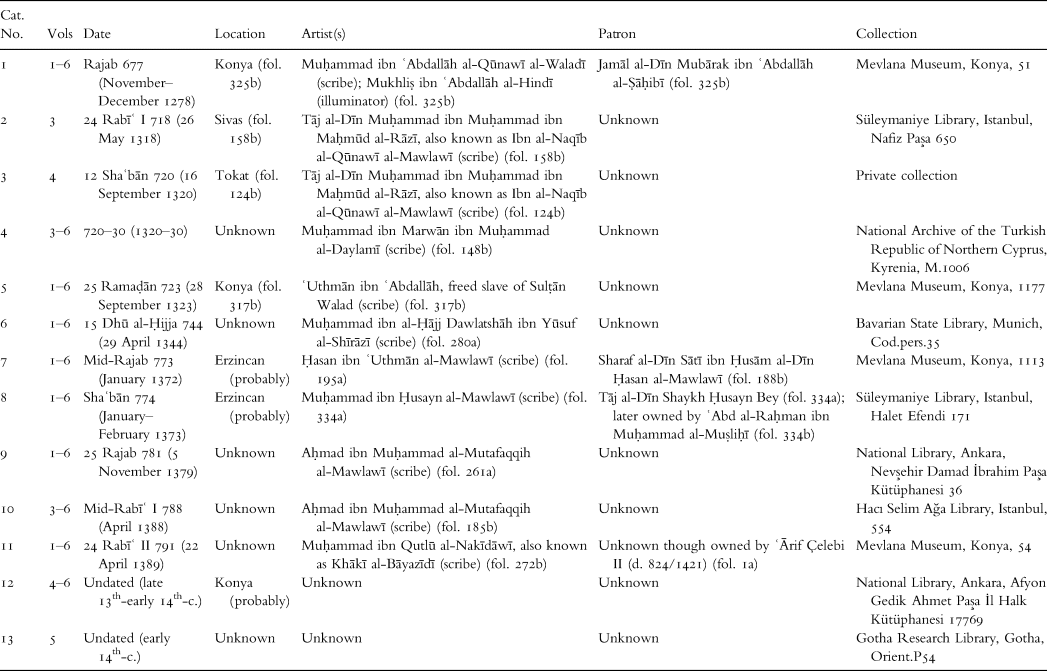
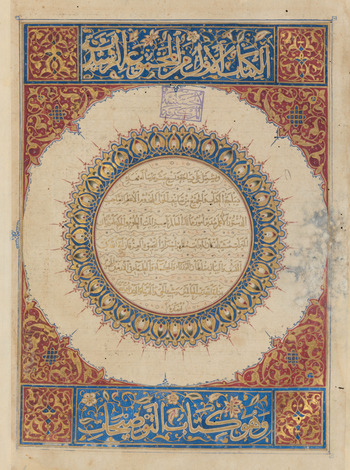
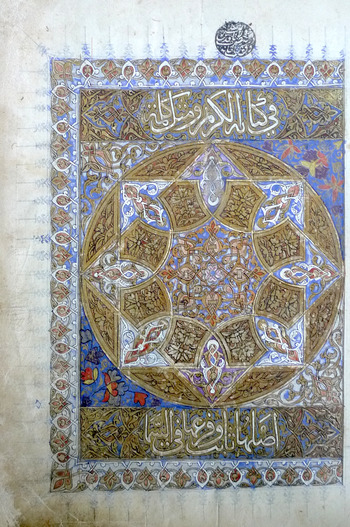
Red sketching lines are visible underneath some illuminated parts. These red lines are also visible on some of the manuscript's pseudo-‘guard’ sheets. Within the manuscript are eight paper folios that feature geometric cut-out designs that roughly correspond in shape to the facing illuminated page [Fig. 1]. Although these sheets are adjacent to all pages that contain full-page illuminations, the cut-outs preclude full protection from dust or pigment transfer. It is possible they served a decorative function, as well as providing a minor defence against wear and tear. These sheets appear to have the same chain and laid line structure as the main paper and may therefore be contemporary to the manuscript (although this does seem rather hard to believe). Suffice it to say, the presence of these sheets is extremely unusual and currently unexplained.Footnote 23
Full-page illumination and pseudo-'guard' sheet, Mas̲navī, Jalāl al-Dīn Rūmī, 1373, Süleymaniye Library, Istanbul, Halet Efendi 171, fols 212b–213a. Source: Türkiye Yazma Eserler Kurumu Başkanlığı, Süleymaniye Yazma Eser Kütüphanesi.

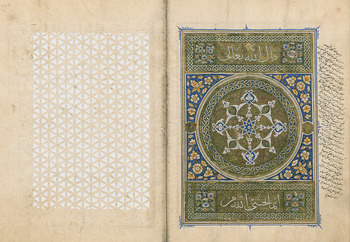
The text of the manuscript is mostly complete, and no pages appear to have been removed. However, there is an unusual omission from the fifth book which is missing its prose preface. These prefaces precede each of the Mas̲navī's six books. In this particular manuscript, they are written in gold or white and are elaborately illuminated [Fig. 2]. However, where the preface should appear just before the main poetry of the fifth book, we instead find two fully illuminated pages with Qur'anic inscriptions in the upper and lower panels [Fig. 1].Footnote 24 The missing preface has been added by a later owner in the margins (a later date being evident from the use of a refined nastaʿlīq). The omission of the Book Five preface is hardly likely to have been a mistake, or a later modification. First, the style of illumination is exactly the same as seen in the rest of the manuscript, so if it was decorated later it would have been very soon after the text was completed. Second, it is doubtful that the preface was omitted in error since the construction of such a lavishly illuminated manuscript would have been a major and carefully supervised undertaking, given the high cost of producing such an object. Such a glaring mistake would have been relatively easy to rectify by sewing or pasting in additional folios. Moreover, inscriptions in other early copies of the Mas̲navī show a specific concern for avoiding the circulation of errors.Footnote 25
Illuminated prose preface of Book Two, Mas̲navī, Jalāl al-Dīn Rūmī, 1373, Süleymaniye Library, Istanbul, Halet Efendi 171, fol. 54b. Source: Türkiye Yazma Eserler Kurumu Başkanlığı, Süleymaniye Yazma Eser Kütüphanesi.

There are a few thirteenth- and fourteenth-century Mas̲navīs that also omit this preface.Footnote 26 The first of these is the earliest 1278 manuscript (Cat. 1 in Table 1). Seeing as the manuscript was produced for and endowed to Rūmī's shrine in Konya (as mentioned above), it is not clear why the text would be missing this preface. For the same reasons cited above, it can hardly have been an accident, especially as we have clear evidence on fol. 325b of how the text was carefully assembled and corrected by Rūmī's followers after his death. The preface was included in full from at least 720/1320–21 (Cat. 4 in Table 1) and possibly earlier.Footnote 27
The preface of Book Five discusses the relationship between sharīʿa (Islamic law or the exoteric path) and ṭarīqa (a Sufi school or the esoteric path). The preface contends that the desired attainment of ḥaqīqa (the ultimate Truth) is only achieved through employing both the sharīʿa and the ṭarīqa. To clarify his point, Rūmī uses an analogy regarding alchemy: “the sharīʿa is akin to learning the science of alchemy from either a teacher or a book; the ṭarīqa is using those remedies and rubbing copper on the philosopher's stone; the ḥaqīqa is the copper becoming gold”.Footnote 28 Considering the manuscript's paramount cultural and spiritual importance, it is unclear why the preface was omitted. No satisfactory explanation has yet emerged. Perhaps some members of the ʿulamāʾ (or others) objected to the comparison of sharīʿa to alchemy.Footnote 29 Alchemy was considered controversial by some medieval Islamic scholars such as Ibn Sīnā (d. 428/1037), Shams al-Dīn Muḥammad al-Dimashqī (d. 727/1327) and Ibn Taymiyya (d. 728/1328).Footnote 30 However, attitudes towards alchemy in medieval Konya are less clear. The Mevlevi hagiographer Shams al-Dīn Aflākī employs similar alchemical analogies many times in his work on the early Mevlevis, Manāqib al-ʿĀrifīn. However, one anecdote sees Ulu ʿĀrif Çelebi (d. 719/1320), grandson of Rūmī, angrily condemning a group of alchemy-practising dervishes as “donkeys” (khar).Footnote 31
Due to the missing prefaces, it is tempting to suggest that the 1373 copy being presently discussed was directly copied from the 1278 manuscript. However, an analysis of the wider text suggests that this was unlikely to have been the case. A comparison of the text of Cats 1 and 5–8 (see Table 1) does not reveal a clear source for the 1373 manuscript, but it does show that, of this group of manuscripts, the 1372 copy (Cat. 7), almost certainly produced in Erzincan, is the closest in its text.Footnote 32 There are numerous textual changes present in both manuscripts that do not occur in earlier copies. For example, verse 34 from Book One, “āyina(t)-dānī chirā ghammāz nīst” (Why does a mirror-case reflect nothing?), appears in this form in Cats 1, 5 and 6. In Cats 7 and 8 (the 1372 and 1373 Mas̲navīs), it appears as, “āyinat-i jānat az ān ghammāz nīst” (From that, the spirit of the mirror is not reflected). However, the 1372 copy is not missing the Book Five preface. Although this indicates that it is unlikely to be the direct source for the 1373 manuscript, the numerous similarities in the text suggest that they could have been copied in the same milieu, perhaps from a different common source. It is also possible that the 1373 Mas̲navī was copied from a complete manuscript that included the Book Five preface and then, for some unknown reason, the fifth preface was purposefully omitted.
The illumination of the 1373 Mas̲navī
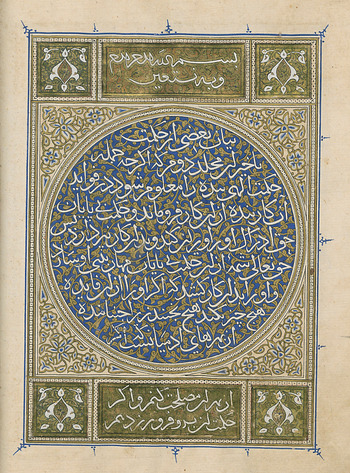
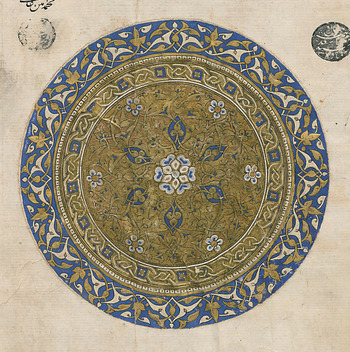
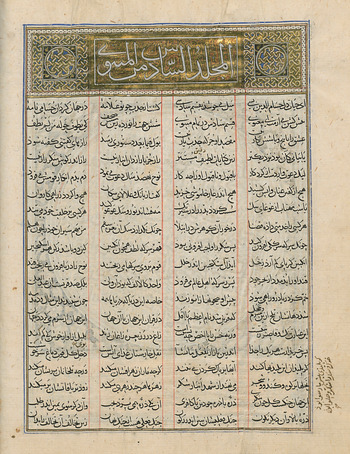
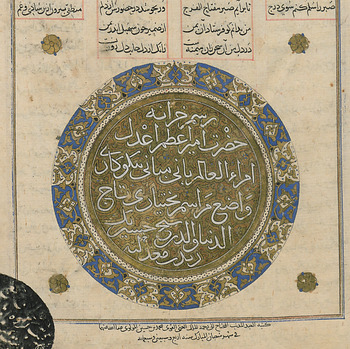
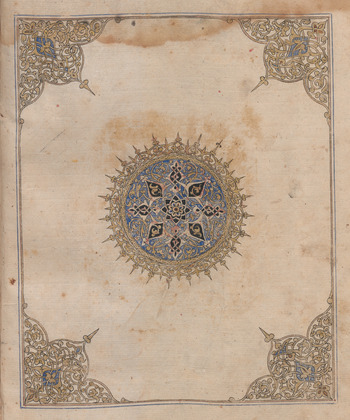
As mentioned above, we find two fully illuminated pages where we would have expected the Book Five preface to appear [Fig. 1]. In addition to these two pages of illumination, the manuscript also contains a freestanding circular frontispiece medallion, or shamsa, on fol. 1a (diameter, 118mm) [Fig. 3], 14 pages of illuminated prefaces [Fig. 2], six slim headpieces that mark the beginning of the main text of each of the six books [Fig. 4] and a freestanding dedication medallion on fol. 334a (diameter, 108mm) [Fig. 5]. Additionally, all titles within the text, which are written in red, are flanked by small, gold rosettes and all of the main text is framed with thin gold and blue lines. Although the decoration is rather dense, with most areas of ground filled with flowers or scrollwork, it is very skilfully and delicately executed. The use of simple shapes such as squares and circles prevents the illumination from appearing cluttered. Aside from the frequent use of squares and circles, other elements that appear several times include thick gold strapwork and knotwork, small lotuses with touches of orange and blue pigment, six-petalled flowers, interlacing split palmettes and gold scrollwork. Many of the manuscript's illuminated mise-en-pages and motifs relate to contemporary manuscripts produced in Rūm, Iraq, Iran and Egypt in the fourteenth century. As we shall see, some of these elements continue to be employed in subsequent periods, albeit in somewhat modified forms.
Frontispiece shamsa, Mas̲navī, Jalāl al-Dīn Rūmī, 1373, Süleymaniye Library, Istanbul, Halet Efendi 171, fol. 1a. Source: Türkiye Yazma Eserler Kurumu Başkanlığı, Süleymaniye Yazma Eser Kütüphanesi.

Headpiece and opening text of Book Six, Mas̲navī, Jalāl al-Dīn Rūmī, 1373, Süleymaniye Library, Istanbul, Halet Efendi 171, fol. 273b. Source: Türkiye Yazma Eserler Kurumu Başkanlığı, Süleymaniye Yazma Eser Kütüphanesi.

Dedication and colophon, Mas̲navī, Jalāl al-Dīn Rūmī, 1373, Süleymaniye Library, Istanbul, Halet Efendi 171, fol. 334a. Source: Türkiye Yazma Eserler Kurumu Başkanlığı, Süleymaniye Yazma Eser Kütüphanesi.

The two fully illuminated pages that appear before the main text of Book Five, as well as the prefaces for Books Two and Six (six pages in total) are arranged into the same format, in that there is a central circle surrounded by a closely set square that is then placed into a larger rectangle [see Figs. 1–2]. This page format is not particularly unusual and appears in Persian manuscripts from at least the early twelfth century.Footnote 33 It also occasionally appears in early fourteenth-century Mamluk manuscripts as well.Footnote 34 On the six aforementioned illuminated pages, the upper and lower panels are divided into three parts: a central inscribed rectangle with a square on either side containing decoration (for example, lotuses and small flowers) [Fig. 1]. This is also the case for the six headpieces [Fig. 4]. Again, this way of dividing the panel is not new and appears in several Ilkhanid manuscripts, as well as in some eleventh-century Qur'ans from eastern Iran and Central Asia.Footnote 35
Two examples of the tripartite panel from the Ilkhanid sphere are particularly pertinent to the manuscript currently under discussion. The first is a copy of the Majmūʿa of Rashīd al-Dīn Faḍlallāh Hamadānī, vizier of the Ilkhanids from 697/1298 until his execution in 718/1318. This manuscript was copied in Tabriz by Muḥammad ibn Maḥmūd ibn Muḥammad, known as Amīn Zūdniwīs al-Baghdādī between Shaʿbān and Ramaḍān 711 (December 1311–February 1312) [Fig. 6]. The second is a copy of Athār al-Bilād from 729/1329 produced in Shiraz.Footnote 36 Aside from the presence of tripartite panels, both manuscripts also feature motifs in the corner squares that consist of interlacing split palmettes. These are very similar to a motif that is present in the corners of the upper and lower panels of folios 54b and 56a of the 1373 Mas̲navī [Fig. 2]. This same motif, in fact, appears many further times in the same manuscript, in the centre and border of the frontispiece medallion [Fig. 3], the headpiece of Book Two, the central circular design of the full-page illuminations [Fig. 1] and in the border of the dedication medallion [Fig. 5].
Frontispiece, Majmūʿa, Rashīd al-Dīn Faḍlallāh Hamadānī, 1311–12, Tabriz, Museum of Islamic Art, Doha, MS.6.1998 (formerly MA.006.98CH), fol. 51a. Source: Museum of Islamic Art, Doha.

Indeed, if we consider additional material from the mid-to-late fourteenth century, this split palmette motif is found in several manuscripts from Persia and Egypt as well as Rūm.Footnote 37 For the purposes of analysing the 1373 Mas̲navī, we can make a particularly close comparison between the circular split palmette motif in the centre of the manuscript's full-page illuminations [Fig. 1] and similar motifs in two further manuscripts. Although these two manuscripts lack any mention of a production location, they were both probably produced in Rūm, perhaps Erzincan since both manuscripts have a connection to the town. The first is a copy of Sulṭān Walad's Mas̲navī that was completed on 10 Dhū al-Ḥijjah 767 (18 August 1366) for Sharaf al-Dīn Sātī ibn Ḥusām al-Dīn Ḥasan al-Mawlawī, the Erzincani patron of Cat. 7 in Table 1 (the 1372 Mas̲navī).Footnote 38 The motif appears on folios 77b–78a in the centre of medallions marking the beginning of the manuscript's final section [Fig. 7]. The second manuscript is a copy of Sulṭān Walad's Dīvān that was copied in Jumādā II 793 (May–June 1391) by Aḥmad ibn Muḥammad al-Mutafaqqih (student of fiqh) al-Mawlawī.Footnote 39 This scribe also copied Cats 9–10 in Table 1. The manuscript contains a double illuminated frontispiece that features this same motif of interlacing split palmettes in the centre of each folio [Fig. 8]. This copy of the Dīvān was owned (and perhaps commissioned) by Mustanjid, the son of Sharaf al-Dīn Sātī, as shown by an inscription on folio 122a of the Dīvān dated to 10 Rabīʿ II 795 (23 February 1393).Footnote 40 Like his father, Mustanjid was a member of Erzincan's Mevlevi community.Footnote 41 Ultimately, this style of interlacing split palmettes that we see in these three manuscripts from Rūm likely derived from the Ilkhanid context where similar forms appear in some imperial Qur'ans from the early fourteenth century.Footnote 42 This motif continued to be employed by illuminators in subsequent centuries, though mainly in the context of borders and with somewhat thinner full palmettes.Footnote 43
Frontispiece (detail), Mas̲navī-i Valadī, Sulṭān Walad, 1366, Erzincan (probably), Austrian National Library, Vienna, Cod.Mixt.1594, fol. 77b. Source: Österreichische Nationalbibliothek, Vienna.

Frontispiece, Dīvān, Sulṭān Walad, 1391, Mevlana Museum, Konya, 75, fol. 2a. Source: Mevlana Müzesi, Konya.

In addition to the frequent use of interlacing split palmettes, lotus motifs appear frequently in the 1373 Mas̲navī. Adapted from Chinese art and popularised by the Ilkhanids, lotuses occur frequently in the fourteenth- and fifteenth-century arts of the book, albeit in a variety of forms.Footnote 44 In the 1373 Mas̲navī, for instance, they sit on a single stem and consist of six petals with a central teardrop-shaped petal [Fig. 2]. This is most similar to numerous instances of lotuses in early Injuid manuscripts from Shiraz, where they also consist of six or eight petals with a central teardrop-shaped petal.Footnote 45 Lotuses are still used in Persian manuscripts after the early Injuid period, but they are of modified forms. For example, in a Shirazi manuscript from the late 1340s or 1350s, the shape has become slightly stretched which is particularly noticeable in the central (now pointed oval-shaped) petal.Footnote 46 In the Muzaffarid period, this develops into “butterfly-like” lotus-type blossoms that bear little resemblance to the lotuses featured in the 1373 Mas̲navī.Footnote 47 We also find lotuses in several Mamluk manuscripts that date from around the 1360s onwards which may be due to artists moving to Cairo following the collapse of the Ilkhanid empire and subsequent turbulence in the region. These lotuses tend to be more similar to early Injuid types than to their later (butterfly-like) Muzaffarid and Timurid counterparts, consisting of six petals and a central teardrop-shaped petal.Footnote 48
The final motif that I will discuss in relation to the 1373 Mas̲navī is one that is very widespread across many regions and periods of the Islamic arts of the book. However, its specific appearance in the manuscript in question necessitates further discussion. The Mas̲navī features a few instances of ‘S-shaped’ strapwork [Fig 1, where it borders the upper and lower panels, and Fig. 4], ‘four-point cross’ strapwork [Fig 1, where it borders the central medallion] as well as one instance of strapwork incorporating coloured squares [Fig. 3]. The ‘S-shaped’ style of strapwork appears in manuscripts produced in Konya and the Ilkhanid realm. For example, it borders the dedication pages of a pocket-sized Qur'an produced on 30 Rabīʿ II 677 (19 September 1278) by Ḥasan ibn Chūbān ibn ʿAbdallāh al-Qūnawī for one Sayf al-Dīn Sunqur ibn ʿAbdallāh al-Ṣāḥibī.Footnote 49 This manuscript was copied in the (no longer extant) madrasa of Saʿd al-Dīn Köpek in Konya. ‘S-shaped’ strapwork also appears on the border of a pointed oval frontispiece of a dispersed Qur'an that was almost certainly produced in Konya in the late thirteenth or early fourteenth century.Footnote 50 The strapwork type also makes an appearance in Ilkhanid manuscripts from Baghdad and Tabriz.Footnote 51 The particular design of this strapwork probably derived from earlier types since a similar motif appears in a Qur'an dated 419/1028 that was likely produced in Fatimid Cairo.Footnote 52
The ‘four-point cross’ style of strapwork is more unusual but does appear in the frontispiece border of a 661/1262 copy of Kalīla wa Dimna attributed by Leïla Benouniche to Konya on the basis of its small amount of illumination and textual overlaps with another copy of the text produced in Konya in 676/1278.Footnote 53 It also appears in the portal niche of the Sahip Ata Külliyesi in Konya.Footnote 54 The motif again probably derives from earlier strapwork types since very similar designs appear in a Qur'an from Afghanistan from circa 1073–93 and in a copy of Kitāb al-Aghānī produced in 616/1219 in Mosul.Footnote 55 I have not yet come across the ‘four-point cross’ variety of strapwork in fourteenth-century illumination from Egypt or Persia. Strapwork incorporating coloured squares features once in the 1373 Mas̲navī, in the frontispiece shamsa. This strapwork type appears in Ilkhanid manuscripts from the early fourteenth century and is quite common in Mamluk manuscripts from 1339 onwards.Footnote 56 It also continues to be used into the Timurid and early modern Ottoman periods but seldom appears in Rūm manuscripts before the fifteenth century.Footnote 57
In all of their appearances in the 1373 Mas̲navī, the various types of strapwork as well as knotwork are lined with bright white pigment. This is particularly significant because this distinctive way of decorating strapwork and knotwork appears in several manuscripts produced in Konya from the late thirteenth century through to the fourteenth century and is rarely seen elsewhere.Footnote 58 Thin, faint white lines are visible on some instances of strapwork in Ilkhanid manuscripts, but this does not resemble the clear, bold white used in manuscripts from Konya. Strapwork and knotwork with bright, white ‘highlights’ also appear in limited amounts in manuscripts produced for Sātī ibn Ḥasan, including the 1372 Mas̲navī (Cat. 7 in Table 1).
The manuscript's patron
The penultimate page of the manuscript contains the dedication and colophon [Fig. 5]. The colophon, which is written in Arabic in extremely small naskh script just below the bottom of the text block frame, states that the manuscript was copied by Muḥammad ibn Ḥusayn al-Mawlawī (the Mevlevi) in Shaʿbān 774 (January-February 1373). The dedication, which is written in a mixture of Persian and Arabic, reads:
[This book] is for the treasury of the lord, the great commander, the most just of the commanders of the world, the maker of pious edifices [and] benevolence, the creator of the signs of prosperity, the crown of the state and the faith, Shaykh Ḥusayn Bey, may his administering of justice ever increase.
The manuscript gives no further information concerning the identity of its patron or where it was produced, though it did have later owners. The last page of the manuscript (fol. 334b) contains poetry by Sulṭān Walad copied at the beginning of Shaʿbān 835 (April 1432). The scribe was ʿAbd al-Raḥman ibn Muḥammad al-Muṣliḥī, who describes himself as the qāḍī (judge) of Amasya in this later inscription. Sixteen years after this inscription was made, ʿAbd al-Raḥman made an endowment (waqf) to the Halifet Gazi Türbesi in Amasya at the end of Muharram 852 (April 1448), but the Mas̲navī contains no indication that it was included in this particular endowment.Footnote 59 As indicated by seals on folios 1a and 334a, the manuscript eventually entered the collection of the Ottoman diplomat and politician, Mehmed Said Halet Efendi (1761–1822) before being absorbed into the collection of the Süleymaniye Library.
The draughtsmanship of the illumination and the quality of the pigments are of a very high standard. If the paper pseudo-‘guard’ sheets are contemporary to the manuscript's production, they suggest that the patron was particularly concerned with the overall visual presentation of the manuscript. The resulting expense of producing such a manuscript and employing skilled artists implies that the patron was probably of a reasonably high standing.Footnote 60 Previous scholarship concerning the 1373 Mas̲navī has suggested that the manuscript was probably produced in Erzincan.Footnote 61 This is primarily due to identifying Tāj al-Dīn Shaykh Ḥusayn Bey with Pīr Ḥusayn (d. 781/1379), the ruler of Erzincan from 1362 to 1379. Although the identification is probably correct, it has not been discussed in detail before. According to a taqwīm (almanac) authored by Mustanjid, son of Sātī ibn Ḥasan (see Cat. 7 in Table 1), Pīr Ḥusayn was a young bey of Köğonya (present-day Şebinkarahisar in north-eastern Turkey).Footnote 62 Upon the death of the ruler of Erzurum, Erzincan and Bayburt, Ghiyāth al-Dīn Akhī Ayna Bey (r. 1348–62), Pīr Ḥusayn became ruler of Erzincan on 14 Shaʿbān 763 (8 June 1362).Footnote 63 Both rulers acknowledged Eretnid authority on their coinage but appear to have largely acted independently which was not unusual in the fractured political landscape of late fourteenth-century Rūm.Footnote 64 By the end of Ramaḍān 763 (July 1362), Pīr Ḥusayn had also defeated the amīrs of Erzincan, who fled to the nearby towns of Tercan and Bayburt. He then captured the fortress of Bayburt on 21 Dhū al-Qaʿda 763 (11 September 1362) which was being defended by Sātī ibn Ḥasan, amongst others.Footnote 65 After Pīr Ḥusayn died, his territories were appropriated by Muṭahhartan (r. 1379–1403).Footnote 66 Although he may have commissioned the 1373 Mas̲navī, Pīr Ḥusayn is not mentioned in any Mevlevi sources. This is actually not unusual given that there exists a large gap in Mevlevi historical writings from 754/1353–4 until 951/1544.Footnote 67 Furthermore, many named patrons of early illuminated Mevlevi manuscripts are also not referred to by contemporary hagiographers.Footnote 68
There are three further possibilities for the identity of ‘Tāj al-Dīn Shaykh Ḥusayn Bey’ that have not been discussed in previous scholarship. They are probably less likely contenders, but it is worth briefly noting them here for the sake of thoroughness and with the acknowledgement that additional evidence may be discovered in future research that strengthens their candidacy. The first is Tāj al-Dīn Dawlatshāh, also known as Qarā Dawlatshāh. Tāj al-Dīn was the son of Malik Nāṣir al-Dīn Bakhtiyār Bey ibn Dawlatshāh, the ruler of Ankara before the rise of the Ottomans.Footnote 69 Although formerly allied to Ḥājjī Şadgeldi, the amīr of Amasya, Tāj al-Dīn changed allegiance to Burhān al-Dīn Aḥmad, the former Eretnid vizier and ruler of Sivas (r. 1381–98). Tāj al-Dīn was then given the governorship of Turhal, a town between Amasya and Tokat.Footnote 70 After being made a lieutenant of Tīmūr at some point in the late fourteenth century, Tāj al-Dīn tried to occupy Amasya and was killed by Ottoman ruler Mehmed I (r. 1413–21) in around 1402.Footnote 71 There is, however, no record of ‘Ḥusayn’ being part of the name of Tāj al-Dīn Dawlatshāh. Another ‘Tāj al-Dīn’ (again without the name of ‘Ḥusayn’) is Tāj al-Dīn Bey ibn Doghanshāh (d. 788/1386) who founded a minor dynasty centred around Niksar, after seceding from the crumbling Eretnid state at the end of the 1360s or beginning of the 1370s.Footnote 72 This dynasty is usually referred to by scholars as the ‘sons of Tāj al-Dīn’ (avlād-i Tāj al-Dīn, or, Taceddinoğulları) or the Emirate of Canik.Footnote 73 Although Tāj al-Dīn Bey was also formerly an ally of Ḥājjī Şadgeldi, the two rulers eventually turned against each other in a competition for territory.Footnote 74 Later inscriptions in the 1373 Mas̲navī show that the manuscript was in Amasya by 1432, which could link it to the sphere of Tāj al-Dīn Dawlatshāh or Tāj al-Dīn Bey ibn Doghanshāh, both of whom were based relatively close to the town. The absence of ‘Ḥusayn’ from their names, however, is possibly a hindrance in identifying either as ‘Tāj al-Dīn Shaykh Ḥusayn Bey’. The final candidate is Sulṭān Ḥusayn Jalāyir (r. 1374–82) who certainly would have been in a position to commission such a lavish manuscript.Footnote 75 There are few extant manuscript dedications to Jalayirid rulers (and, notably, none so far mentioning Sulṭān Ḥusayn). However, even a brief look at surviving examples demonstrates that they tended to be described in a more esteemed way than the patron of the 1373 Mas̲navī. For example, Sulṭān Ḥusayn's father, Shaykh Uvays (r. 1356–74), is titled ‘Shaykh Uvays Abū-l-Fatḥ Bahādur Khān’ in a copy of al-Tuḥfa al-Najībiyya produced in Tabriz in 775/1373–4.Footnote 76 Shāh Walad (r. 1410–11) is named as ‘Muʿizz al-Dīn Shāh Walad Khān’ in a copy of Kalīla wa Dimna that was produced in 794/1392, long before he even became the Jalayirid ruler.Footnote 77 The use of the royal title ‘khān’ is notable in both instances. It would then seem somewhat odd that Sulṭān Ḥusayn (who, additionally, was usually known as ‘Jalāl al-Dīn’ not ‘Tāj al-Dīn’) would be named as ‘Amīr Tāj al-Dīn Shaykh Ḥusayn Bey’.Footnote 78
Conclusion
This article has analysed the text, codicology, illumination, inscriptions and wider historical context of the 1373 Mas̲navī as well as discussed what the many features of the manuscript tell us about the arts of the book and manuscript production and patronage in late fourteenth-century Erzincan. According to the contents of the dedication, the manuscript was produced for a patron named Tāj al-Dīn Shaykh Ḥusayn Bey who, as Zeren Tanındı has suggested, is probably to be identified with Pīr Ḥusayn, the ruler of the eastern Anatolian city of Erzincan between 1362 and 1379. Considering his seventeen-year rule over the culturally and economically important town, it is likely that he would have had the financial means and artistic resources to produce such a manuscript.
There are some aspects of the manuscript that are rather unusual and require further explanation that is not currently possible. The pseudo-‘guard’ sheets, for example, have no contemporary parallels. They of course may not be contemporary to the manuscript's production but are, in general, quite rare in the Islamic arts of the book. The missing prose preface of Book Five is similarly puzzling though not unprecedented since the earliest clean copy of the text (Cat. 1 in Table 1) is also without this preface. This irregularity in the text perhaps strengthens the attribution to the region of Rūm. Given the desire to correctly disseminate the text, it seems unlikely that manuscripts with substantial omissions would have circulated far beyond Rūm, especially seeing as the preface was reinstated from at least 720/1320–1. Although the 1372 Mas̲navī (Cat. 7) includes the Book Five preface, there are several textual alterations shared between the 1372 and 1373 copies suggesting that they possibly had a common source manuscript or were copied in a similar context. Since the patron of the 1372 Mas̲navī, Sharaf al-Dīn Sātī, was based in Erzincan (like Pīr Ḥusayn), this again circumstantially links the 1373 manuscript to the town. The fact that the manuscript was in the possession of an Amasya qāḍī several decades after it was completed could indicate that it was produced somewhere relatively nearby, but manuscripts were obviously highly mobile and could travel great distances over short periods of time.
The manuscript is extensively and skilfully illuminated and displays several links to the arts of the book of the Ilkhanid, Injuid and Mamluk spheres, as well as to the illuminated manuscripts of Rūm. Particularly noteworthy is the use of bold white pigment to ‘highlight’ the contours of the gold strapwork, which, as I have mentioned, appears to be a trait distinctive to Rūm manuscripts, according to material seen thus far. In addition to Cat. 7 (the 1372 Mas̲navī), the article has mentioned another of Sharaf al-Dīn Sātī's manuscripts: a copy of Sulṭān Walad's Mas̲navī dating from 767/1366.Footnote 79 Given that there was, in fact, a third manuscript produced for Sātī (not mentioned here) with lavish illumination similar to his other two manuscripts,Footnote 80 it would seem that there was a well-developed artistic community in eastern Rūm by at least the 1360s which may well have enabled Tāj al-Dīn Shaykh Ḥusayn Bey to access the skills and materials necessary to produce the extensively decorated 1373 Mas̲navī. Considering that Sātī, his son, Mustanjid, and the scribes of Sātī's, Mustanjid's and Tāj al-Dīn Shaykh Ḥusayn Bey's manuscripts all used the ‘al-Mawlawī’ epithet, the production of the 1373 Mas̲navī and Satī's commissions in this context also highlights the enthusiasm that the Mevlevis of Erzincan had for the arts of the book in this period. There are many further manuscripts that may belong to this context (some mentioned here, some not)Footnote 81 and, given this, there is certainly scope for further research to uncover how prolific this artistic network might have been.
Appendix
Title: Mas̲navī-i Maʿnavī
Author: Jalāl al-Dīn Rūmī (d. 1273)
Date: Shaʿbān 774 (January-February 1373)
Place of production: Erzincan (probably)
Artists: Muḥammad ibn Ḥusayn al-Mawlawī (scribe)
Patron: Amīr Tāj al-Dīn Shaykh Ḥusayn Bey
Later owners: ʿAbd al-Raḥman ibn Muḥammad al-Muṣliḥī, the qāḍī (judge) of Amasya (d. after 1448), Mehmed Said Halet Efendi (1761–1822)
Seals: Six (four illegible). Mehmed Said Halet Efendi (fols 1a and 334a) and ‘Muḥammad banda-yi āl-i Muḥammad’ (Muḥammad, servant of the family of Muḥammad) (fol. 1a).Footnote 82
Folios: 334
Size: 265 mm (length) by 190 mm (width)
Text block: 200 mm (length) by 142 mm (width); 23 lines in four columns
Script and ink: Naskh; black with red rubrics and red preliminary sketches; tawqīʿ used for prose prefaces and dedication; thuluth used for chapter headings.
Pigments: Gold, blue, light blue, orangey-bronze, light brown, white, black
Description of paper: Pale yellow-cream, smooth with visible burnishing, quite fibrous; ten folios = 1.5 mm approximate thicknessFootnote 83
Chain and laid lines: 20 horizontal laid lines = 20 mm; alternating groups of two and three vertical chain lines spaced 40 mm apart with 12 mm between lines (all paper including pseudo-‘guard’ sheets)
Binding: Dark red-brown leather, Ottoman, nineteenth century
Quires: Quaternions (possibly)
Condition and later repairs: Cropped due to rebinding; very good condition
Collection information: Süleymaniye Library, Istanbul, Halet Efendi 171