Introduction
Vegetable soybean, also known as edamame, is a specialty type of soybean harvested near the full-seed stage (approximately R6) as either a podded or shelled product. In contrast to grain-type soybean, vegetable soybean cultivars have been selected for large seeds meeting specific sensory and nutritional characteristics. Historically, most vegetable soybean consumed in the United States was imported from China and Taiwan (Mentreddy et al. Reference Mentreddy, Mohamed, Joshee, Yadav, Janick and Whipkey2002). Domestic production of vegetable soybean has been facilitated in part by the development of nascent weed management systems, including the registration of several herbicides used in grain-type soybean (Williams and Nelson Reference Williams and Nelson2014; Williams et al. Reference Williams, Hausman and Moody2017). Herbicides registered in vegetable soybean often fail to control waterhemp.
Waterhemp ranks number one as the most common and most troublesome weed in North American soybean production systems (Van Wychen Reference Van Wychen2016). Such notoriety is driven in large part by the weed’s high fecundity, discontinuous emergence pattern, rapid growth rate, and resistance to multiple herbicide modes of action. Currently, waterhemp populations exist throughout the Midwest with resistance to glyphosate, 2,4-D, acetolactate synthase-, protoporphyrinogen (PPO), photosystem II-, or 4-hydroxyphenylpyruvate dioxygenase (HPPD)-inhibiting herbicides (Heap Reference Heap2018). Several waterhemp populations in the Midwest are multiple-herbicide resistant, particularly to glyphosate and ALS inhibitors (Schultz et al. Reference Schultz, Chatham, Riggins, Tranel and Bradley2015).
Until innovation and novel technologies offer new ways to diversify weed management systems, existing herbicides are short-term solutions to existing weed problems (Westwood et al. Reference Westwood, Charudattan, Duke, Fennimore, Marrone, Slaughter, Swanton and Zollinger2018). In the case of waterhemp, several PRE herbicides currently are useful in managing susceptible populations of the weed in grain-type soybean. For instance, PRE applications of flumioxazin, a PPO inhibitor, has been shown to control waterhemp populations resistant to glyphosate or HPPD-inhibiting herbicides (Hausman et al. Reference Hausman, Tranel, Riechers, Maxwell, Gonzini and Hager2013; Spaunhorst et al. Reference Spaunhorst, Siefert-Higgins and Bradley2014). Other PRE herbicides found useful for control of herbicide-resistant waterhemp populations include chlorimuron (an ALS inhibitor), metribuzin (a photosystem II inhibitor), and acetochlor or pyroxasulfone (a very long chain fatty acid synthesis inhibitor), often in tank mixture with flumioxazin (Hausman et al. Reference Hausman, Tranel, Riechers, Maxwell, Gonzini and Hager2013; Schryver et al. Reference Schryver, Soltani, Hooker, Robinson, Tranel and Sikkema2017; Spaunhorst et al. Reference Spaunhorst, Siefert-Higgins and Bradley2014). None of these herbicides is registered for use on vegetable soybean.
Registration of pesticides on “minor crops” by the US Environmental Protection Agency involves pesticide residue testing and establishment of allowable residues (Baron et al. Reference Baron, Holm, Kunkel, Schwartz and Markle2016). One additional hurdle is the unknown level of crop tolerance to the proposed herbicide. Recent research has documented excellent crop tolerance among vegetable soybean cultivars to pyroxasulfone (Williams et al. Reference Williams, Hausman and Moody2017). However, vegetable soybean tolerance to chlorimuron, flumioxazin, and metribuzin is unknown. Grain-type soybean cultivar sensitivity has been reported for chlorimuron (Newsom and Shaw Reference Newsom and Shaw1992; Pomeranke and Nickell Reference Pomeranke and Nickell1988), metribuzin (Edwards et al. Reference Edwards, Barrentine and Kilen1975; Wax et al. Reference Wax, Stoller and Bernard1976), and flumioxazin in certain cases (Taylor-Lovell et al. Reference Taylor-Lovell, Wax and Nelson2001). The objective of this research was to quantify vegetable soybean tolerance to flumioxazin-based treatments for early-season waterhemp control. The guiding hypothesis of the experiment was flumioxazin-based treatments are as safe and effective in vegetable soybean as grain-type soybean.
Materials and Methods
Germplasm
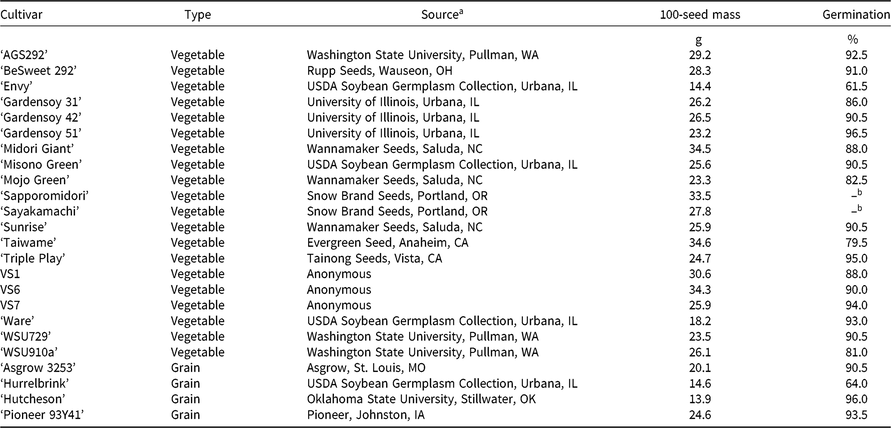
Both types of soybean, vegetable and grain, were examined. Twenty vegetable soybean cultivars from nine sources were selected on the basis of seed availability (Table 1). Most entries are grown commercially in the United States. In addition, four grain-type soybean cultivars were included as controls. Two grain-type cultivars, Asgrow 3253 and Pioneer 93Y41, are believed to exhibit tolerance to flumioxazin, chlorimuron, metribuzin, and pyroxasulfone, given their widespread use in Illinois and lack of reports of crop injury. Cultivars Hurrelbrink and Hutcheson were included because of previously documented sensitivity to metribuzin and chlorimuron, respectively (Newsom and Shaw Reference Newsom and Shaw1992; Wax et al. Reference Wax, Stoller and Bernard1976).
Source, 100-seed mass, and germination of vegetable and grain-type soybean cultivars used in field experiments near Urbana, IL.

a Abbreviations: –. no data; USDA, US Department of Agriculture.
b Incomplete germination data.
Seeds of all cultivars were characterized for 100-seed mass and germination (Table 1). Germination was determined by incubating 100 seeds per cultivar on moistened germination paper at 21 C and 90% relative humidity. Germinated seeds were counted and removed daily until germination ceased. Before planting, a fungicide seed treatment of mefenoxam (3.37 g 100 kg−1 of seed) plus fludioxonil (2.27 g 100 kg−1 seed; Apron Maxx®, Syngenta Crop Protection, Greensboro, NC) was used.
Experimental Approach
Field experiments were conducted using a single protocol in 2016 and 2017 at the University of Illinois Vegetable Crop Farm near Urbana, Illinois (40.08°N, 88.26°W). Experiments were located in different fields each year. The previous year’s crop was soybean. The soil was a Flanagan silt loam (fine, smectitic, mesic Aquic Argiudolls) averaging 3.3% organic matter and a pH of 5.8.
Although waterhemp was known to exist at the Vegetable Crop Farm, experimental sites were overseeded to reduce spatial heterogeneity of the waterhemp seedbank. The seed was from a local population of waterhemp that was harvested the previous fall, threshed, and stored at 24 C. Seed was sown by hand at a density of approximately 50 seed m−2 followed by a pass of a field cultivator to prepare the field for planting.
The experimental design was a strip plot with four blocks (replications). Each block consisted of vertical strips of a flumioxazin-based “treatment” factor and horizontal strips of a “cultivar” treatment factor (horizontal strips orthogonal to vertical strips). Herbicide treatment plots measured 2.5-m wide by 18.3-m long. Cultivar plots consisted of single rows (76-cm spacing) of individual cultivars transecting all herbicide treatment strips. Each treatment-by-cultivar combination consisted of a single, 2.5-m row planted with 50 seed. Flumioxazin-based treatments included flumioxazin alone (Valor®, Valent USA Corp., Walnut Creek, CA) and four flumioxazin-based premixes (Valor XLT®, Fierce®, Fierce XLT®, all from Valent USA Corp.; and Trivence®, DuPont, Wilmington, DE) at use rates in grain-type soybean, plus a nontreated control. Those rates included flumioxazin (90 g ha−1), flumioxazin plus chlorimuron (90 + 31 g ha−1), flumioxazin plus pyroxasulfone (90 + 114 g ha−1), flumioxazin plus pyroxasulfone plus chlorimuron (90 + 114 + 24 g ha−1), and flumioxazin plus chlorimuron plus metribuzin (90 + 27+ 312 g ha−1).
Soybean was planted June 3, 2016, and May 30, 2017. The crop was seeded into moisture at a depth of 2 cm. Herbicides were applied within 24 h after planting with a compressed-air backpack sprayer calibrated to deliver 185 L ha−1 spray volume in 275 kPa. After herbicide application in 2017, water (1.0 cm) was applied through a sprinkler irrigation system to incorporate herbicide treatments, because no rainfall was forecast the following week.
Data Collection
Soybean response to flumioxazin-based tank mixtures were quantified using four approaches. Crop emergence was determined 2 wk after treatment (WAT) using stand counts as a percentage of seed planted. Response to herbicides was assessed visually 2 and 4 WAT. Injury, relative to the nontreated control, was rated on a scale from 0% (no visible symptoms) to 100% (all plants dead). Crop injury was a cumulative measure of stunting, delayed growth, and leaf damage. Crop biomass was determined at 4 WAT by randomly selecting three plants per subplot, cutting plants at the soil surface, then measuring mass of oven-dry plants.
Control of waterhemp was determined by seedling counts 4 WAT. Four randomly placed, 0.25-m2 quadrats per main plot were used to determine waterhemp density. Daily rainfall and temperature data were obtained from a nearby weather station (Illinois State Water Survey, Champaign, IL).
Statistical Analysis
Treatments with no variance in herbicide response (e.g., weed density of 0 plants m−2) were removed before data analysis. With the exception of crop injury data, variances were found to meet ANOVA assumptions of normality. Normality of crop injury data could not be improved with transformation. Response variables were analyzed using the Mixed procedure in SAS, version 9.4 (SAS Institute, Cary, NC). The statistical model for crop responses included fixed effects of herbicide treatment, soybean cultivar (or type), and their interaction. The statistical model for waterhemp density included the fixed effect of herbicide treatment. For both models, random effects included year plus appropriate interactions of year with treatment factors, as well as replicate nested within year plus appropriate interactions with treatment factors. Herbicide treatment means were compared using the protected, Bonferroni-corrected multiple comparisons (Neter et al. Reference Neter, Kutner, Nachtsheim and Wasserman1996). Confidence intervals (95%) were constructed around means that were to be compared with means with zero variance so that significant differences could be determined. All effects were declared significant at P < 0.05.
Results and Discussion
Weather
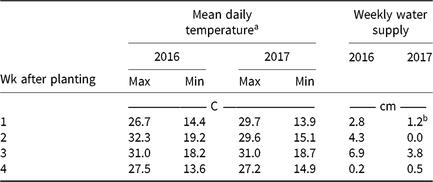
Growing conditions after planting varied between years. Warm and wet conditions were observed in 2016, when 7.1 cm of rainfall occurred within the first 2 wk (Table 2). Although relatively warm conditions also were observed in 2017, a single rainfall event of 0.2 cm one day after planting was the only precipitation the first 2 wk of the experiment. Hence, the single irrigation event 3 days after planting was essential to herbicide incorporation. Additional rainfall occurred in weeks 3 and 4 of 2017.
Weekly mean air temperature and rainfall in field experiments near Urbana, IL.

a Abbreviations: Max, maximum; Min, minimum.
b On June 2, 2017, 1.0 cm water was applied through the sprinkler irrigation system.
Emergence
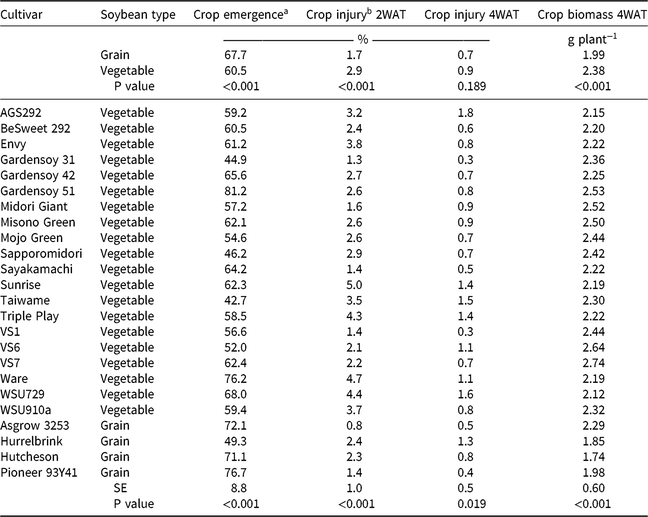
No interaction was observed between soybean type (or cultivar) and herbicide treatment on crop emergence (P = 0.886). Furthermore, soybean emergence was unaffected by flumioxazin-based treatment (P = 0.285). However, grain-type cultivars had 7.2% higher emergence than vegetable soybean (Table 3). Poor emergence is problematic in vegetable soybean production (Duppong and Hatterman-Valenti Reference Duppong and Hatterman-Valenti2005; Rao et al. Reference Rao, Bhagsari and Mohamed2002) and others have shown field emergence is less than that of grain-type soybean in side-by-side comparisons (Williams Reference Williams2015). More recent studies have shown agronomic practices that influence crop emergence, including seed treatments and planting depth, have yet to be optimized for vegetable soybean (Crawford and Williams Reference Crawford and Williams2019; Williams and Bradley Reference Williams and Bradley2017).
Soybean cultivar response to flumioxazin-based treatments in field experiments near Urbana, IL.

a Determined 2 wk after planting.
b Abbreviation: WAT, weeks after treatment.
Crop Tolerance
Crop injury from flumioxazin-based treatments was negligible (Table 3). Vegetable soybean 2 WAT was injured to a greater extent than grain-type soybean (i.e., 2.9% compared to 1.7%, respectively), and no differences were observed 4 WAT. The exceptionally low level of injury calls into question any practical concern with this low level of transitory injury. After all, yield losses from PRE applications of these herbicides are rare, even when plant density reduction or significant crop injury has been observed. For instance, grain-type soybean injury was no more than 4% and no yield losses were observed from use rates of flumioxazin or flumioxazin plus pyroxasulfone applied PRE (McNaughton et al. Reference McNaughton, Shropshire, Robinson and Sikkema2014). Despite higher levels of crop injury (approximately 20%) and occasional crop density reduction, Taylor-Lovell et al. (Reference Taylor-Lovell, Wax and Nelson2001) observed no yield loss from 105 g flumioxazin ha−1 at Urbana, IL. Additional research on pyroxasulfone showed vegetable soybean cultivars have a high level of tolerance to PRE and early POST applications (Williams et al. Reference Williams, Hausman and Moody2017).
Although grain-type cultivars ‘Hurrelbrink’ and ‘Hutcheson’ were included as sensitive controls to metribuzin and chlorimuron, respectively, they were no more sensitive than other cultivars to herbicide treatments tested in this research (Table 3). Cultivar ‘Hurrelbrink’ was previously identified as sensitive to soil-applied metribuzin at a rate of 840 g ha−1 (Wax et al. Reference Wax, Stoller and Bernard1976). Cultivar ‘Hutcheson’ was reported sensitive to hydroponic solutions of chlorimuron (Newsom and Shaw Reference Newsom and Shaw1992). Separate, single recessive genes are believed to account for sensitivity to the herbicides (Edwards et al. Reference Edwards, Barrentine and Kilen1975; Pomeranke and Nickell Reference Pomeranke and Nickell1988). The minimal injury of ‘Hurrelbrink’ from treatments containing metribuzin (312 g ai ha−1) and minimal injury of ‘Hutcheson’ from treatments containing chlorimuron (24 to 31 g ai ha−1) is likely a function of herbicide dose, whereby use rates and soil applications in the present research lowered the plant’s herbicide uptake to a noninjurious level.
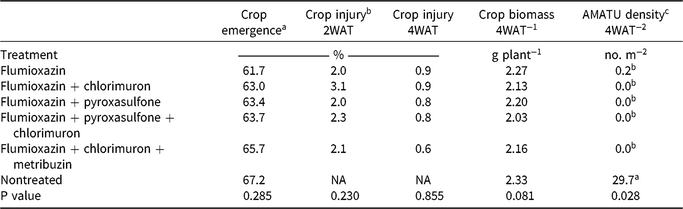
No differences in crop injury were observed among flumioxazin-based treatments (Table 4). Mean crop injury was less than 3% and less than 1% at 2 and 4 WAT, respectively. From a practical standpoint, visual assessment data indicate vegetable soybean appears no more sensitive to flumioxazin-based treatments than does grain-type soybean.
Mean soybean and waterhemp responses to flumioxazin-based treatments in field experiments near Urbana, IL.

a Determined 2 wk after planting.
b Abbreviations: WAT, weeks after treatment; NA, not applicable.
c Values followed by the same letter are not significantly different.
Crop biomass data 4 WAT showed flumioxazin-based treatments did not compromise seedling growth (P = 0.081). Vegetable soybean attained 20% greater seedling biomass in 4 wk than grain-type soybean (Table 3). Three of the four grain-type cultivars were smallest. Research has shown early season growth of vegetable soybean is superior to grain-type soybean. For instance, a comparison of 136 vegetable soybean entries to 14 grain-type cultivars in central Illinois showed vegetable soybean grew taller, had greater leaf area, and denser leaves at 3 wk after planting (Williams Reference Williams2015). Attributed to seed-size mediate effects, the accelerated seedling growth characteristics of vegetable soybean potentially has implications for integrated weed management. For instance, Crawford and Williams (Reference Crawford and Williams2018) showed “large” seed of vegetable soybean had greater tolerance to velvetleaf (Abutilon theophrasti Medik.) interference than smaller seed of the same cultivar.
Waterhemp Control
Flumioxazin-based treatments provided excellent waterhemp control. At 4 WAT, the nontreated control averaged 29.7 weeds m−2 (Table 4). In contrast, flumioxazin alone had 0.2 weeds m−2, and no waterhemp was observed in other flumioxazin-based treatments. Results of waterhemp control with flumioxazin-based treatments are consistent with previous research. Standard use rates of flumioxazin and metribuzin, tested separately in central Illinois, reduced waterhemp density 77% to 95% and provided 85% to 89% control 6 WAT (Hausman et al. Reference Hausman, Tranel, Riechers, Maxwell, Gonzini and Hager2013). In similar experiments in Ontario, Canada, researchers found 91% or greater control 4 WAT from use rates of flumioxazin, metribuzin, pyroxasulfone, and flumioxazin plus pyroxasulfone (Schryver et al. Reference Schryver, Soltani, Hooker, Robinson, Tranel and Sikkema2017).
Implications
Flumioxazin applied alone or in tank-mixture with chlorimuron, metribuzin, or pyroxasulfone is safe and effective in vegetable soybean. Crop injury was minimal (<5%) and vegetable soybean emergence and early-season growth was unaffected by the herbicides when applied at use rates in grain-type soybean. Vegetable soybean cultivars grown in the United States for commercial production have the same high level of tolerance to flumioxazin-based treatments as grain-type soybean.
Given waterhemp’s success in evading weed management systems of grain-type soybean, the weed’s persistence in vegetable soybean comes as no surprise. Although nine herbicides from eight modes of action have been registered on vegetable soybean in recent years (Williams and Nelson Reference Williams and Nelson2014; Williams et al. Reference Williams, Hausman and Moody2017), these products fall short of controlling waterhemp. Registration of flumioxazin, chlorimuron, metribuzin, and pyroxasulfone would provide the industry with additional options for managing waterhemp.
Author ORCIDs
Martin M Williams II https://orcid.org/0000-0002-6302-7724
Acknowledgements
This research was supported by US Department of Agriculture (USDA), Agricultural Research Service research project no. 0500-00007-107-00-D. Mention of a trademark, proprietary product, or vendor does not constitute a guarantee or warranty of the product by the USDA and does not imply its approval to the exclusion of other products or vendors that also may be suitable. No conflicts of interest have been declared.