Introduction
The Peace, Equanimity, and Acceptance in the Cancer Experience (PEACE) questionnaire was developed to assess peaceful acceptance and struggle with terminal illness (Mack et al., Reference Mack, Nilsson and Balboni2008). It contains the Peaceful Acceptance of Illness subscale and the Struggle with Illness subscale. Questions focused on the extent to which patients were able to accept the cancer diagnosis and feel a sense of inner peace, and on the extent to which patients struggled with the illness, such as by feeling angry about it or by feeling that the illness was unfair. Mack et al. reported that patients who used more negative coping strategies tended to have higher Struggle with Illness scores and lower Peaceful Acceptance scores, and patients who considered themselves either moderately spiritual or very spiritual tended to have higher Peaceful Acceptance scores and lower Struggle with Illness scores. It suggested the association between peaceful acceptance, struggle with illness, coping, and spirituality. The PEACE questionnaire was used as an outcome measure in previous studies. Bernacki et al. (Reference Bernacki, Paladino and Neville2019) evaluated peacefulness at the end of life (EOL) among patients in a randomized clinical trial of the Serious Illness Care Program. An et al. (Reference An, Ladwig and Epstein2020) assessed bereaved caregivers’ experiences with EOL cancer care using three items from the PEACE questionnaire. It might be used not only for patients but also for expanding the indication to caregivers.
Prognosis communication has become a focus of palliative care (Enzinger et al., Reference Enzinger, Zhang and Schrag2015; Mori et al., Reference Mori, Fujimori and Ishiki2019). EOL discussions offer patients the opportunity to define their goals and expectations for the medical care that they want to receive near death (Wright et al., Reference Wright, Zhang and Ray2008). Prior research has reported that patients with advanced cancer who were cognitively aware of their terminal status and who considered themselves “at peace” had lower rates of psychological distress and higher rates of advance care planning than patients who were not peacefully aware (Ray et al., Reference Ray, Block and Friedlander2006). Tang et al. (Reference Tang, Chang and Chen2016, Reference Tang, Chou and Chang2019) conducted studies on cancer patients’ emotional acceptance/preparedness for death and suggested that death preparedness for Asian patients might not be the same as for those in Western countries. In contrast to studies conceptualizing a good death in Western countries, Japanese culture may differ in a few key ways (Steinhauser et al., Reference Steinhauser, Christakis and Clip2000; Miyashita et al., Reference Miyashita, Sanjo and Morita2007). One difference relates to religious coping. Whereas most of the patients in the U.S. emphasized “being at peace with God” and “prayer,” fewer patients relied on religion to cope with cancer in Japan. One aspect of a good death in Japan that was not identified in Western countries was “fighting against cancer.” There might be differences between Western countries and Japan regarding peaceful acceptance and struggle with cancer at the EOL. Though peaceful acceptance of one's terminal illness might play an important role in EOL discussions, there is no study to investigate the effects of peaceful acceptance among Japanese patients with cancer. The purposes of this study were to investigate the validity and reliability of the Japanese version of the PEACE Questionnaire and to evaluate the association between the PEACE subscales and Japanese patient characteristics.
Methods
Subjects and procedure
We conducted a cross-sectional web-based survey in 2018. Inclusion criteria were (1) patients with cancer being followed as out-patients and (2) aged 20 years old or older. Participants were self-reported as being diagnosed with cancer and whether they have cancer recurrence or metastasis. A web-based survey company (Macromill, Ltd.) recruited potential participants out of 10 million registered people across Japan by convenience sampling and sent questionnaires to them online. Those who live in Japan and are 6 years old or older can register in the database of the survey company, if they wish. However, minors need parental consent. Potential participants first read introductory statements that summarized the contents of the questionnaire and explained they could feel free to withdraw at any time if they wished so. Responses were considered consent to participate. Responses to the questionnaire were voluntary, and confidentiality was maintained throughout all investigations and analyses. The participants were not paid for study participation, but they received 70 Macromill points. One point is worth one yen. If they have 300–500 points, they can use them for shopping. This study was approved by the institutional review board of Serei Mikatahara General Hospital and was conducted in accordance with the principles laid down in the Helsinki Declaration.
Instruments
The PEACE questionnaire
The PEACE questionnaire is a 12-item questionnaire that was developed to assess the patient's sense of acceptance, calmness or equanimity, and peace, as well as their sense of struggle or desperation concerning their illness. It contains the 5-item Peaceful Acceptance of Illness subscale and the 7-item Struggle with Illness subscale. Responses are rated on a 4-point scale ranging from “1, not at all” to “4, to a large extent”; total scores range from 12 to 48. Higher scores of the Peaceful Acceptance of Illness subscale indicate a greater sense of peace. High scores of the Struggle with Illness subscale indicate a tendency to feel angry because of the illness and to feel that the illness is unfair. This study was conducted with permission from the developers of the PEACE scale (JWM and HGP). The forward–backward translation method was used to develop the Japanese version. In the translation process, the items were first translated into Japanese by a psychiatrist (YU) and a clinical psychologist (MF), and then back-translated into English by a translator who was both conversant with the appropriate terminology and was fluent in Japanese. After that, the English back-translated items were compared with the originals by the original author (HGP).
Coping Inventory for Stressful Situations (CISS)
The CISS measures three dimensions of coping — task-oriented coping, emotion-oriented coping, and avoidance-oriented coping — and comprises 48 items in total. Responses are rated on a 5-point Likert scale (1, not at all to 5, very much) to determine which coping strategies they use for different stressful situations (Endler and Parker, Reference Endler and Parker1990). Evidence supports the validity and reliability of the Japanese version of the CISS (Watanabe et al., Reference Watanabe, Yokoyama and Furukawa2015).
Functional Assessment of Chronic Illness Therapy — Spiritual Well-being (FACIT-Sp)
The FACIT-Sp assesses quality of life (QOL) and contains an additional self-rating scale on spirituality (Peterman et al., Reference Peterman, Fitchett and Brady2002). The FACIT-Sp includes 7 physical items, 7 family and social items, 6 emotional items, 7 functional items, and 12 spirituality items. Responses are rated on a 5-point Likert scale (0, not at all to 4, very much) for each question. Evidence supports the validity and reliability of the Japanese version of the FACIT-Sp (Noguchi et al., Reference Noguchi, Ohno and Morita2004).
Demographic and medical characteristics
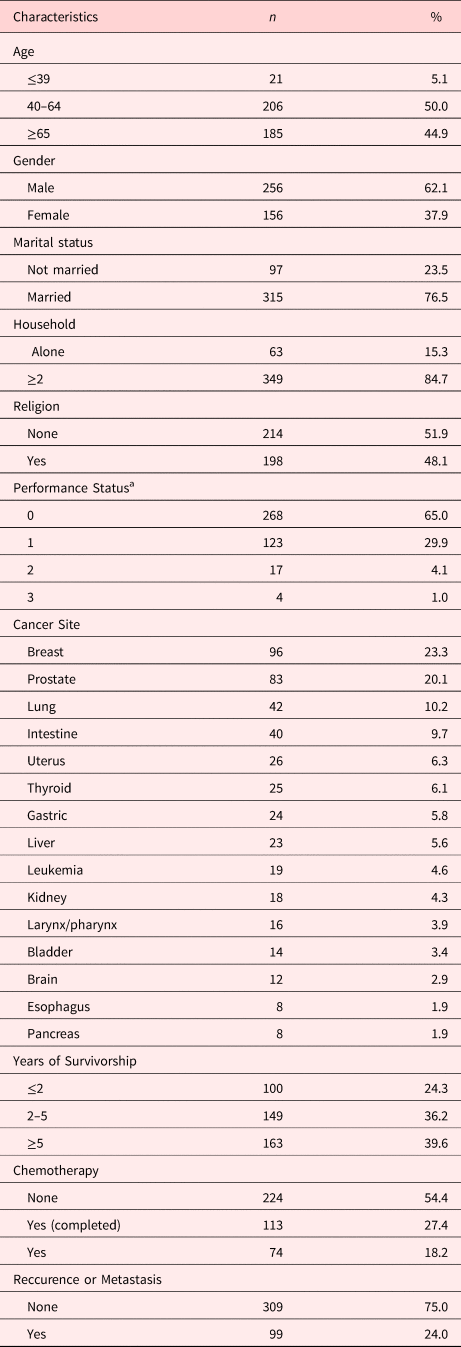
The participants were asked their demographic and clinical information, as listed in Table 1. Functional performance status was assessed using the Eastern Cooperative Oncology Group (ECOG) Performance Status (PS) scale. The ECOG PS scale measures how the disease affects the daily living abilities of the patient. It is rated on a 5-point scale with 0 being “fully active, able to carry on all pre-disease performance without restriction” and 5 indicating that the patient is deceased.
Patient characteristics (n = 412)

a Defined by the Eastern Cooperative Oncology Group.
Statistical analysis
Factor validity was evaluated using a maximum-likelihood method with promax rotation to explore the subscale structure of the PEACE questionnaire. The representation of the same factor structure found in the original scale was expected. A confirmatory factor analysis was conducted to evaluate the overall goodness-of-fit of the original PEACE questionnaire model using chi-square (χ 2), where a small, nonsignificant statistic indicates good model-data fit. However, nonsignificant chi-square values are seldom obtained in large samples. Therefore, we also assessed other fit-indices: (1) the goodness-of-fit index (GFI), (2) the adjusted goodness-of-fit index (AGFI), (3) the comparative fit index (CFI), and (4) the root mean square error of approximation (RMSEA). Values of these indices range from 0 to 1. For the GFI, AGFI, and CFI, the acceptable fit criterion is >0.90. For the RMSEA, values <0.08 is viewed as indicating reasonable fit. PEACE questionnaire subscales with the five subscales of the FACIT-Sp and the three dimensions of the CISS were calculated to assess the concurrent validity. The Cronbach's α and the item-total correlation of each subscale of the PEACE questionnaire were calculated to assess internal consistency reliability. The associations between the patient characteristics and the PEACE subscale score were examined with an unpaired t-test and one-way analysis of variance as appropriate.
Data were analyzed with the SPSS version 26.0 (IBM). A significant difference was defined as a p-value of <0.05.
Results
Participants
Four hundred and twelve patients responded and completed the survey (62.1%; 256 male). The participants’ median age at the survey was 62 years (range: 25–88 years). The majority of participants were married and lived with their family. The married category does not include those who live with a partner and the unmarried category includes those who are single or divorced. The most common type of cancer was the breast (23.3%), followed by the prostate (20.1%) and the lung (10.8%). Seventy-four participants (18.2%) were undergoing chemotherapy and 99 participants (24.0%) had cancer recurrence or metastasis. The socio-demographic and clinical characteristics are shown in Table 1.
Feasibility
There was no missing data.
Validity
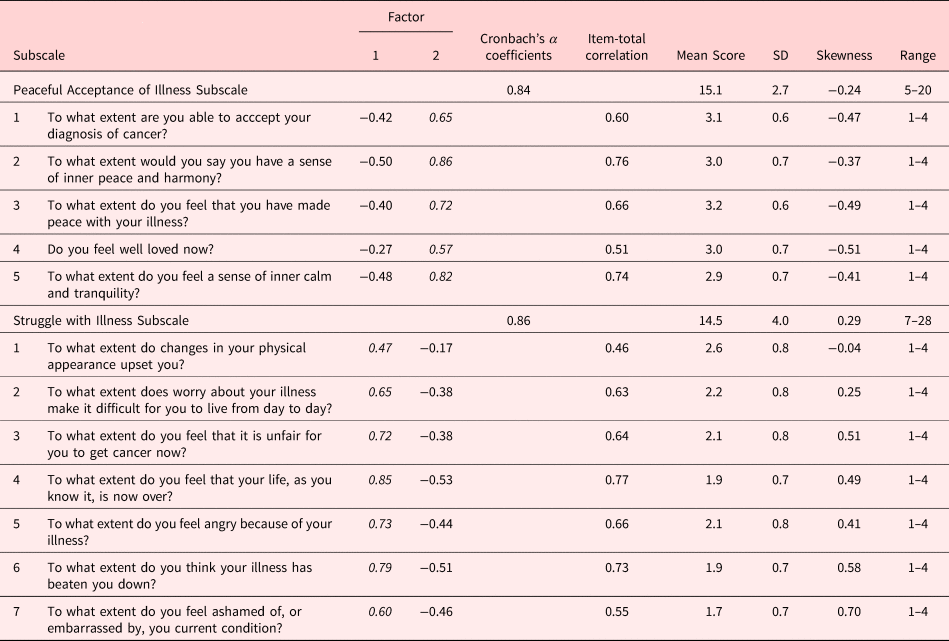
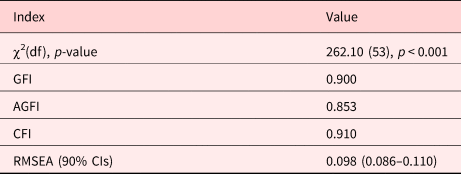
Table 2 shows the results of the exploratory factor analysis on 12 items of the PEACE questionnaire. Using the criterion of factor loading of 0.4 or above, the first and second factors included 7 and 5 items, respectively. The 12 items were classified into two factors. The number of factors and the full factor structure were consistent with the original. Table 3 shows the results of the confirmatory factor analysis. Although the overall goodness-of-fit chi-square statistic was large and significant, the GFI and CFI were >0.90, and the AGFI closely approached the 0.90 benchmark. The RMSEA slightly exceeded the criterion value for reasonable fit. Collectively, the fit indices can be interpreted as suggesting an adequate fit of the data to the original PEACE questionnaire model.
Factor structure, Cronbach's α coefficients, item-total correlation, and descriptive statistics for the PEACE questionnaire items

SD, Standard Deviation.
Goodness of fit of the PEACE questionnaire factor model

GFI, goodness-of-fit index; AGFI, adjusted goodness-of-fit index; CFI, comparative fit index; RMSEA, root mean square error of approximation; CIs, confidence intervals.
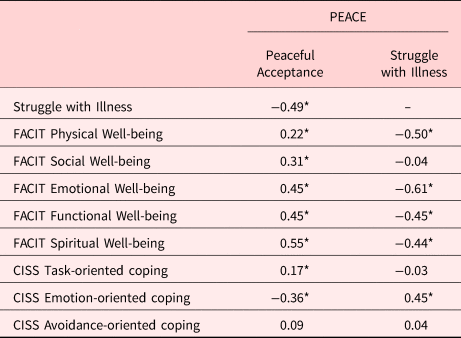
To evaluate the concurrent validity, the Pearson's correlation coefficients of the PEACE questionnaire subscales with the five subscales of the FACIT-Sp and the three dimensions of the CISS were calculated (Table 4). There were small to moderate correlations between associated subscales, including the Peaceful Acceptance of Illness subscale to each subscale of FACIT (r = 0.22–0.55, p < 0.01); the Peaceful Acceptance of Illness subscale to CISS task-oriented coping (r = 0.17, p < 0.01) and emotion-oriented coping (r = −0.36, p < 0.01); the Struggle with Illness subscale to each subscale of FACIT (r = −0.44 to −0.61, p < 0.01); and the Struggle with Illness subscale to CISS emotion-oriented coping (r = 0.45, p < 0.01).
Correlation between each subscale of PEACE and FACIT-Sp and CISS

FACIT, Functional Assessment of Chronic Illness Therapy; CISS, Coping Inventory for Stressful Situations; PEACE, Peace, Equanimity, and Acceptance in the Cancer Experience.
* p < 0.01.
Reliability
Table 2 shows the internal consistency using the Cronbach's α coefficients (α = 0.84–0.86) and the individual item to the subscale correlation value. Most items indicated a strong to moderate correlation with the subscale. The mean score for the Peaceful Acceptance of Illness subscale was 15.1 (SD = 2.7, skewness = −0.24), and the mean score for the Struggle with Illness subscale was 14.5 (SD = 4.0, skewness = 0.29) (Table 2).
Associations between patient characteristics and the PEACE subscales
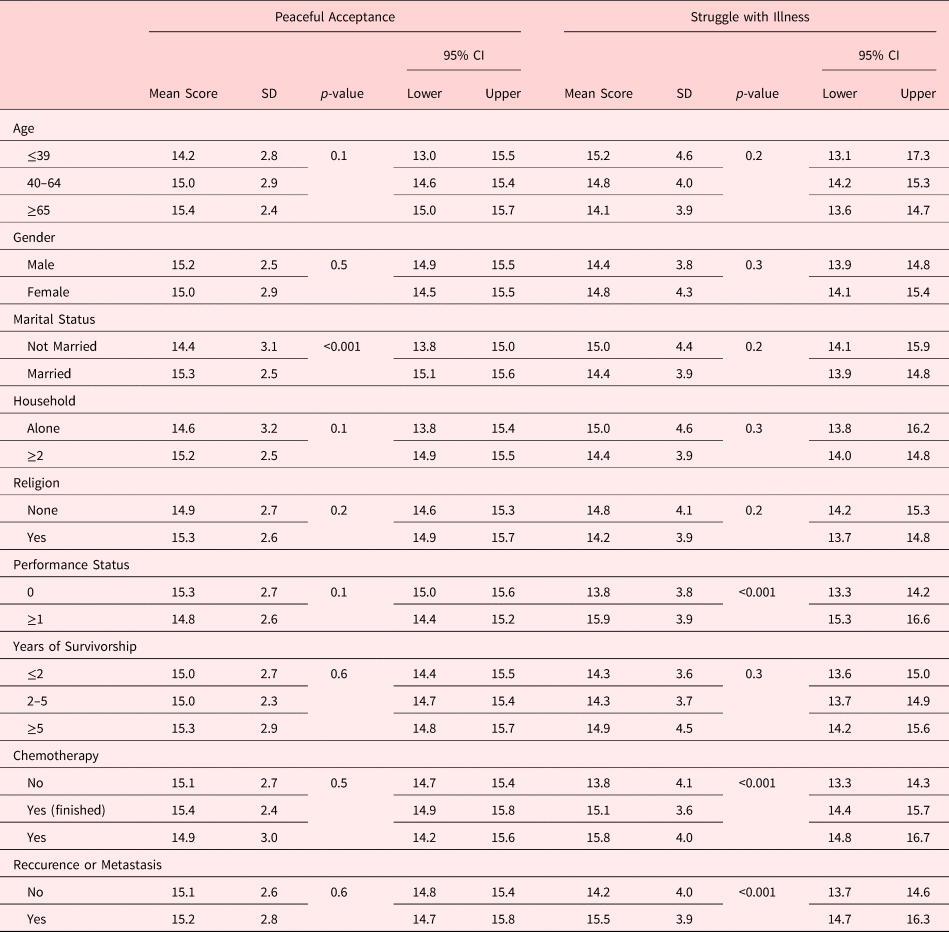
The mean scores of the PEACE subscales were compared for each socio-demographic and medical factor (Table 5). “Marital status (married)” was significantly correlated with higher Peaceful Acceptance scores (p < 0.001). Factors that were significantly correlated with higher Struggle with Illness scores were: “performance status (≥1)” (p < 0.001); “chemotherapy (yes)” (p < 0.001); and “recurrence or metastasis (yes)” (p < 0.001).
Associations between patient characteristics and the PEACE subscales

PEACE, Peace, Equanimity, and Acceptance in the Cancer Experience; SD, Standard Deviation; CIs, confidence intervals.
Discussion
The results of this study suggest the validity and reliability of the Japanese version of the PEACE Questionnaire. The exploratory factor analysis reproduced an identical factor loading pattern as that of the original version, and the confirmatory factor analysis indicated an adequate fit of the data to the original PEACE questionnaire model. In a previous study, Mack et al. (Reference Mack, Nilsson and Balboni2008) examined and reported the associations between PEACE subscale, coping, and spirituality. For this reason, we also examined the associations between the PEACE subscale and the FACIT-Sp and the CISS to evaluate the concurrent validity. Regarding the concurrent validity, there were moderate correlations between the Peaceful Acceptance of Illness subscale and higher spiritual well-being and task-oriented coping style. Furthermore, there were also moderate correlations between the Struggle with Illness subscale and lower spiritual well-being and emotional-oriented coping style. These results imply that the validity of the Japanese version of the PEACE Questionnaire is good. High Cronbach's α coefficients, above 0.84 in both subscales, indicated the structural reliability of each subscale in the Japanese version. These values compare favorably to those for the original version (0.78–0.81) (Mack et al., Reference Mack, Nilsson and Balboni2008). A strong to moderate correlation value was indicated for the individual items to the subscale.
The Peace Acceptance of Illness subscale scores tended to be higher in married patients. A meta-analytic review showed that the acceptance of cancer was more strongly correlated with depressive and anxiety symptoms among cancer patients without a spouse or partner (Secinti et al., Reference Secinti, Tometich and Johns2019). Spouses and partners share psycho-social burden of the illness with patients, and caregiver support may facilitate patient acceptance through enhanced emotional and cognitive processing of cancer information. Consistent with the previous study (Mack et al., Reference Mack, Nilsson and Balboni2008), a poorer performance status was associated with higher Struggle with Illness scores. Patients with chemotherapy and recurrence/metastasis also had higher Struggle with Illness scores, as we expected. This result suggests that avoiding late-stage chemotherapy might reduce struggle with cancer.
While our ultimate goal is to better understand experiences with EOL discussions and factors that affect EOL care outcome among Japanese patients by using the Japanese version of the PEACE Questionnaire, we might be able to broaden the adaptation of this questionnaire like as previous studies (Bernacki et al., Reference Bernacki, Paladino and Neville2019; An et al., Reference An, Ladwig and Epstein2020). Bereaved caregivers’ experiences with EOL cancer care were assessed by the PEACE questionnaire (An et al., Reference An, Ladwig and Epstein2020). Meaning/peace significantly predicted depressive symptoms among cancer survivors (Gonzalez et al., Reference Gonzalez, Castaneda and Dale2014), and it was strongly associated with QOL among patients undergoing chemotherapy (Kamijo and Miyamura, Reference Kamijo and Miyamura2020). The peaceful acceptance and struggle might be important indicators related to QOL not only for advanced cancer patients but also for survivors and caregivers.
There are several limitations to the study. First, this study examined subjects’ responses at only one point in time. A test–retest reliability needs to be conducted to fully examine the stability of the Japanese version of the PEACE questionnaire. Second, few participants had recurrent or metastatic cancer. Originally, the questionnaire was developed to measure the extent to which patients with advanced cancer have a sense of peaceful acceptance of their terminal illness. Further study on advanced cancer patients needs to be conducted. Third, we did not have data on the participation rate or refusal rate, because a web-based survey company recruited potential participants out of registered people and we got the data from those who responded with interest. Fourth, participant medical information was self-reported.
In conclusion, the results of this study indicated that the Japanese version of the PEACE questionnaire is a valid and reliable measure of the patient's sense of acceptance, calmness or equanimity, and peace, as well as their sense of struggle or desperation concerning their illness. Further studies are expected to be conducted with this questionnaire in order to understand factors that affect EOL care outcome.
Acknowledgments
MM, MF, and YU designed the study. JWM and HGP, who are the original authors to develop the PEACE questionnaire, permitted this study. HGP confirmed the Japanese version of the questionnaire after backward translation. KH, MO, and MF analyzed and interpreted the data. MO and MF were the major contributors in writing the manuscript. All authors read and approved the final manuscript.
Funding
This study was supported by a Health, Labor and Welfare Sciences Research Grant: Research for Promotion of Cancer Control Programs (H29-Cancer Control-general-017).
Conflicts of interest
The authors have no conflicts of interest to declare.