


Whenever someone talks to me about my missing loved ones, it makes me worried because if someone is dead, you know that the person is dead. That is understandable. But this – they went missing. It hurts a lot.
– Shaibu (relative of disappeared person)Footnote 1
Introduction
Prior to the advent of Boko Haram insurgency in north-east Nigeria, Ali – a thirty-nine-year-old man from Gwoza, a town and local government area in Borno State – lived peacefully with his kith and kin and, with the proceeds from his agribusiness, took care of his family. This situation changed when Boko Haram terrorists invaded Gwoza, leading to the death, displacement, and disappearance of several persons in his community: ‘After the Boko Haram crisis started, we were separated from our families and relatives. Two of my brother’s children, my brother’s wife, and my junior brother all went missing during the conflict.’ Now living for ten years in a squalid, makeshift camp for forced migrants in Abuja – the capital city of Nigeria – he habitually reminisces on the good old days when he spent quality time with his missing kin and received support from them:
My relatives who are missing are wonderful people. We spent time together. We ate together. We traded together. We visited one another. During sallah, we celebrated together. Life with them was so good. When I was together with them, if I had any problems, I went to them, and they helped me. We helped each other – even with food.Footnote 2
With the loss of these familial relationships coupled with his protracted displacement in the internally displaced persons (IDP) camp in Abuja where I met and interviewed him, Ali has been subjected to immense physical, emotional, financial, and mental stress, with hardly any social support system to lighten his burdens.Footnote 3
Ali’s experience as a victim of disappearance is not an idiosyncratic case but is shared across many conflict-affected societies bedevilled by the violences of (counter)terrorist operations. In terrorism studies – a subfield of the broader security studies field – the long-term, complex, subjective impacts of (counter)terrorist operations on victims – primary and secondaryFootnote 4 – are under-researched in spite of the fact that there are a growing number of victims of (counter)terrorism operations globally.Footnote 5 Indeed, victims’ issues are peripheral, fragmented, and profoundly under-researched in terrorism studies for at least two reasons. The first reason is the prevailing tendency in terrorism studies to foreground perpetrators, as ‘[t]errorism is predominantly understood by reference to the nature of the perpetrator, their ideology, their motivations, and their justifications’.Footnote 6 This leads to an oversimplification of terrorism as victims’ experiences – which are vitally important for a holistic understanding of terrorist violence – are sidelined. As Javier Argomaniz and Orla Lynch aptly put it:
Victims of terrorism are a party to terrorist violence, as are their families, their communities and, at times, their governments; and therefore, understanding the experience of victimhood in this context is vital if we are to comprehend the entirety of the complexity of terrorism.Footnote 7
The second reason has to do with methodological conundrums in terms of not only the emotional and psychological stakes involved in interviewing victims of terrorism but also the difficulty of accessing and conducting research with victims of (counter)terrorism in conflict-affected societies. These two reasons jointly contribute to the systematic negligence of victims’ experiences in terrorism studies. This article contributes to terrorism studies by demonstrating that disappearance constitutes a systematic but under-researched consequence of (counter)terrorist operations in violent contexts. It shows how both terrorist violence and state counterterrorism practices produce enduring civilian harm through ambiguity, administrative silence, and unresolved loss – all forms of violence that remain invisible within dominant terrorism metrics and policy frameworks. In so doing, this article broadens the terrorism studies literature on the significance of victims’ experiences for a holistic – and fuller – comprehension of the inherent complexities of terrorism and the layered consequences of (counter)terrorism operations by foregrounding disappearance as a central modality through which (counter)terrorism reproduces everyday (in)security.
Drawing on two-year ethnographic data derived from interviews with victims of disappearance in conflict-affected north-east Nigeria, I examine the various patterns of disappearance, the search for the disappeared, and the long-term gendered impacts of disappearance on victims, that is, families of the disappeared. Furthermore, the choice of Nigeria as a pathway case to assess the long-term impacts of disappearance on victims is not entirely arbitrary. Whilst disappearance is ubiquitous throughout similar conflict-affected societies in Africa, I have chosen to focus my attention on Nigeria because it is the state most affected by disappearance amidst (counter)terrorism in the continent with more than 25,000 disappeared persons, due in no small measure to the Boko Haram insurgency in the north-east, according to a recent report by the International Committee of the Red Cross (ICRC).Footnote 8 Although disappearance is commonplace across African societies bedevilled by (counter)terrorist violence, minimal scholarly attention has been given to it beyond intermittent, succinct reports by the media, journalists, and eminent international humanitarian organisations such as the ICRC, Human Rights Watch, and Amnesty International.Footnote 9 I analyse the long-term impacts of disappearance on victims beyond the tokenistic approach given to it in contemporary Africa.
This article is organised around six sections. In the first section, I draw on Pauline Boss’s theoretical framework of ambiguous loss and feminist security studies to develop a framework for the analysis of circumstances of extreme – profound – loss, such as disappearance, where there is generalised uncertainty regarding the fate and whereabouts of the disappeared. In the second section, I clarify the methodology employed to gather as well as analyse the data on the nature of disappearance in the north-east region of Nigeria. In the third section, I briefly discuss the emergence of Boko Haram insurgency and the Nigerian state’s counterterrorism operations. In the fourth section, I examine the patterns of disappearance and begin to discuss the empirical material, focusing on the three ways individuals disappear as a consequence of the violent activities of state and non-state actors. In the fifth section, I discuss the search for life – that is, the search for the disappeared – by families of the disappeared in the context of (counter)terrorist operations in the conflict-affected north-east region. In the sixth section, I assess the long-term gendered impacts of disappearance on families of the disappeared, with a particular focus on the sociological and psychological impacts associated with disappearance. I conclude by reiterating my contention and contribution to terrorism studies regarding the dearth of rigorous ethnographic research on victims’ experiences in the context of (counter)terrorist operations and by encouraging more scholarly research in terrorism and security studies on the long-term gendered impacts of disappearance as well as the plight of victims – that is, families of the disappeared – in similar contexts plagued by (counter)terrorist violence beyond the case I examine here.
Disappearance, ambiguity, and feminist security studies: An integrated analytical framework
Ambiguous loss is a ‘situation of unclear loss resulting from not knowing whether a loved one is dead or alive, absent or present’.Footnote 10 It is ‘caused when loved ones suddenly vanish. For the families left behind – when soldiers are declared missing in action or relatives disappear during political unrest and civil conflict – not knowing whether a loved one is dead or alive defies emotional comprehension.’Footnote 11 It is, in other words, a type of loss that defies closure, leaving families in anxiety and anguish over the absence of their missing loved ones. Ambiguous loss is qualitatively distinct from ordinary loss – that is, death – in that ‘the person is still here, but not all here. Part is gone, part remains. As a result, there is no possibility of resolution or closure.’Footnote 12 Ambiguous loss theory was first advanced by the American psychologist Pauline Boss in the 1970s when she studied the families of pilots declared missing in action in Vietnam and Cambodia.Footnote 13 Over time – precisely, from the 1980s and 1990s – Boss extended her theory to cases of families struggling to cope with the psychological absence of their loved ones as a consequence of neurodegenerative disorders such as Alzheimer’s disease.Footnote 14 This empirical research served as the foundation for Boss’s development of a robust theory that explains myriad lived experiences of individuals, families, and communities in situations of profound loss across cultural contexts.
Boss contends that there are two basic types of ambiguous loss – physical and psychological.Footnote 15 The first type of ambiguous loss – the focus of this article – is a situation of physical absence with psychological presence. In the case of physical ambiguous loss, ‘families do not know where their loved ones are or whether they are dead or alive. A person is physically absent, yet kept psychologically present because there is no proof of death or permanent loss. Families call this “gone, but not for sure”.’Footnote 16 Examples of physical ambiguous loss include missing soldiers during war, missing civilians in the aftermath of terrorism, work relocation, divorce, military deployment, young adults leaving home, kidnapping, desertion, missing bodies due to plane crash or murder, immigration, incarceration, and so forth. By contrast, psychological ambiguous loss is a situation of physical presence with psychological absence. In this case, a ‘family member is physically present, yet psychologically missing, as a result of some cognitive impairment or memory loss from illness, injury, addiction, or obsession. … Family members refer to this type of ambiguous loss as “here, but not here”.’Footnote 17 Examples of psychological ambiguous loss include various cases of psychological absence despite physical presence due to dementia, obsessions, depression, autism, coma, traumatic brain injury, chronic mental illness, and so on. Whether a loved one disappears in body or mind, Boss maintains that ambiguous loss provokes ‘frozen grief’,Footnote 18 with families of the disappeared in prolonged physical and emotional exhaustion without any resolution.
Indeed, with ambiguous loss – either physical, psychological, or both – ‘[m]eaning is ruptured, relationships go awry, and family conflict increases. When a loved one is here but not here, or gone but not for sure, the family as a whole, and the individuals in it struggle as their story continues without an ending.’Footnote 19 Put differently, it is an agonising experience psychologically and sociologically for the individuals, families, and communities left behind, as they remain in a liminal state without closure.Footnote 20 In addition to the psychological stress that accompanies ambiguous loss,
[s]ociologically, ambiguous loss ruptures a family’s structure and function. With a person missing, family members become confused about who is in or out, and who does what to make the family function in daily life. … Daily tasks remain undone, and roles are confused.Footnote 21
Hence, the conjunction of psychological and sociological effects makes ambiguous loss the most traumatising loss to overcome in human life.Footnote 22
It must be emphasised that although physical and psychological ambiguous loss are conceptually distinct in Boss’s outline of ambiguous loss theory, they are not discrete categories and ofttimes occur simultaneously or overlap. Indeed, ethnographic experiences of disappearance often reveal that these categories are neither fixed/static nor mutually exclusive. Rather, the boundary between physical and psychological ambiguity is porous, with each form of loss shaping and reinforcing the other over time. In contexts of conflict-related disappearances, individuals who are physically absent may remain psychologically present through memories, material traces, embodied habits and routines, hopes, dreams, and enduring emotional attachments. Yet, prolonged uncertainty can simultaneously generate forms of psychological absence as families struggle to maintain a stable image of the disappeared person, whose fate and whereabouts become increasingly enigmatic. The disappeared person thus occupies an unstable position between presence and absence. These dynamics suggest, I think, that physical and psychological ambiguous loss are not – in empirical terms – discrete conditions but interconnected processes that interact through uncertainty. Families may move between hope and despair, remembrance and detachment, mourning and anticipation, within the same period. Ambiguous loss therefore extends beyond the binary or discrete category of physical or psychological presence and instead reflects an ongoing affective negotiation of uncertainty.
Comprehending disappearance through this lens highlights how absence is not merely a physical condition but also a relational and affective experience in which psychological presence and absence continually overlap, producing enduring forms of ambiguity that resist closure. Boss is not unaware, as I understand it, of the ‘blurred boundaries’Footnote 23 between physical and psychological ambiguous loss, as she contends that both can simultaneously occur in the same family and that ‘[d]espite differing circumstances, families left behind share common concerns. How to cope? How can they grieve when there is no body to bury?’Footnote 24 For instance, she posits that
families affected by the attack on the World Trade Centre may have included a missing parent whose remaining partner is so depressed and preoccupied with the missing mate that children are ignored and feel as if they have lost both parents – one physically, the other psychologically.Footnote 25
This shows that physical and psychological ambiguity often overlap and simultaneously appear in families of the disappeared in conflict-affected contexts.
Ambiguous loss theory ‘represents the most complete framework for understanding the impact of disappearance on families and formulating appropriate interventions’.Footnote 26 It can lucidly explain the interior feelings, behaviours, and attitudes of families of the disappeared in response to losses without closure – especially their despair, hope, and quest for life and meaning in the absence of credible news on the fate and whereabouts of missing loved ones. Given its explanatory power, ambiguous loss theory has been utilised to make sense of the lived experiences of families of the disappeared in many parts of the world affected by violent armed conflicts, such as Spain, Syria, Lebanon, Northern Ireland, Argentina, Mexico, Nepal, Brazil, and Uruguay, to mention but a few contexts.Footnote 27 Despite its theoretical import, ambiguous loss theory is quite limited by what I call psychologism – that is, its excessive treatment of disappearance as a personal emotion rather than a political act that can engender collective resistance, its neglect of the gendered experiences of disappearance, and its tendency to evade the gendered impacts of disappearance on the everyday lives of persons situated in conflict-affected societies. Feminist security studies (FSS) transcends the psychologism of ambiguous loss theory.Footnote 28 The feminist perspective on ambiguous loss such as disappearance argues that the personal and the political are intricately intertwined: disappearance is not merely a private psychological trauma but a deeply political and structural issue that builds community and fosters collective resistance but also has differential gendered impacts on men and women. In her analysis of feminist approaches to disappearances in the context of violent conflicts, for instance, FSS scholar Élise Féron argues that ‘feminist analyses show that disappearance is a highly gendered phenomenon, in the sense not only that it affects more men than women, but also because the way in which it affects different genders is deeply related to their specific social status and roles’.Footnote 29 Further, feminist approaches contend that, although men tend to be the primary agents and victims of disappearance in conflict settings, women
frequently bear the brunt of the aftermath when male relatives disappear, as they often face exacerbated social, economic, and psychological hurdles, in particular in societies where men are the primary heads of household. When men disappear, women are thrust into the role of sole providers for the families, which can be challenging due to existing gender inequalities in employment opportunities.Footnote 30
FSS scholarship
invites us to rethink and expand our frames of analysis and our responses to disappearances. This could, for instance, entail a broader understanding of accountability that would not only focus on the disappearance of the individual, but would also address its gendered social consequences, including from a multi-generational perspective.Footnote 31
Finally, feminist scholarship on disappearance in violent conflicts contends that women are not just passive victims but also active agents who raise awareness of disappearances, challenge dominant narratives of disappearance, and actively participate in transitional justice initiatives in search of disappeared individuals in their families and communities. Indeed,
[i]n the media, in the streets, and in local communities, but also in areas where bodies might have been buried, women have taken the lead in searching for the disappeared, denouncing disappearances, supporting the aggrieved families, and ensuring that who the missing were, and what happened to them, is not forgotten.Footnote 32
In sum, feminist scholarship shows that disappearance is gendered in terms of its differential impacts on men and women and that resistances to hegemonic narratives that mask the nature and patterns of disappearances in violent conflicts are equally gendered, as women, more than men, tend to engage in collective mobilisation efforts in search of the disappeared and to support aggrieved families.
This article develops an integrated analytical approach that brings together ambiguous loss theory and FSS to examine how conflict-induced disappearances generate gendered forms of insecurity. Whilst FSS has long demonstrated that security extends beyond military threats to encompass everyday (in)security, ambiguous loss theory underscores the profound consequences of prolonged and unresolved absence and the uncertainty surrounding disappeared persons. Integrating these perspectives allows for a more comprehensive understanding of the afterlives of political violence. Rather than theorising disappearance as a merely personal or psychological concern, this integrated analytical framework reveals how disappearance restructures social relations and produces long-term insecurities that are invariably experienced unevenly across gendered lines. In other words, this integrated analytical approach theorises disappearance in conflict situations characterised by ‘violent absences, haunting presences’Footnote 33 as gendered in relation to patterns of disappearance, the nature of collective resistance against disappearances, and the long-term impact on victims of disappearances. In so doing, the analytical framework provides an invaluable lens for analysing political violence, such as the Boko Haram terrorist insurgency, where disappearance has generated prolonged uncertainty and transformed the everyday lives of affected families and communities.
I apply this integrated analytical framework to the pathway case of disappearances in north-east Nigeria and explore how and why individuals disappear; the search for the disappeared by women-led civil society organisations in a highly patriarchal socio-cultural context characterised by the structural and patriarchal violence of gender inequality; the provision of social, financial, and emotional support to families and relatives of the disappeared by women civil society leaders who simultaneously interrogate and resist hegemonic narratives regarding the fate and whereabouts of the disappeared; and the long-term gendered impacts of disappearances on victims, not least in sociological and psychological terms. In the next section, I explain in detail the methods used to gather and analyse the empirical data on disappearances in terrorism-affected north-east Nigeria.
Methodological details
This research is part of larger intensive ethnographic research on the dynamics of terrorism and counterterrorism in the Lake Chad region conducted between October 2023 and June 2025, which received institutional and ethical approval from my university based in the United Kingdom. This research on disappearance and the lived experience of ambiguous loss amongst families of the disappeared centres, and critically analyses, the narratives of forty-five (45) research participants. I adopted the phenomenological research method, main aim of which is ‘to capture, as closely as possible, the way a phenomenon was lived by people who participated in the phenomenon’.Footnote 34 This method was deemed apposite for the study, not least because it allows the researcher to understand, describe, analyse, and explain the lived experiences of individuals and groups, elucidating not only what they directly experienced but also how they experienced it.Footnote 35 The phenomenological method is characterised by two central emphases: first, the description of events derived from research participants’ narratives; and second, the understanding and explanation of the meaning of the lived experiences of the research participants.Footnote 36 Indeed, as social anthropologist Michael Agar has rightly argued, ‘[n]o understanding of a world is valid without representation of those members’ voices’.Footnote 37 To comprehend how individuals disappeared and the impacts of such ambiguous loss on families of the disappeared in the context of terrorism and counterterrorism, we need to listen to and amplify the voices and lifeworlds of those who have witnessed and experienced the phenomenon as either survivors or (ex-)combatants.
As is the convention with phenomenological research, purposive sampling was utilised to recruit research participants.Footnote 38 In short, research participants were specifically recruited based on their lived experiences of disappearance in the course of the terrorist insurgency. I expanded my sample size through snowballing by asking research participants to recommend others with comparable lived experiences for interviewing. Through a conjunction of purposive and snowball sampling, I recruited and interviewed the research participants. Written consent was obtained from all research participants – I explained the purpose of my research, the risks and benefits of the research, the voluntary nature of research participation, and confidentiality to circumvent risks to participants. I asked research participants questions about their thoughts and feelings when the insurgency commenced, the disappearance of their loved ones, the personal qualities of their disappeared loved ones, and the impact of disappearance of loved ones on their lives. Given the principle of data saturation that is emblematic of phenomenological research, I did not recruit more research participants when research participants did not introduce novel perspectives on the phenomenon.Footnote 39
Although disappearance affects the entire Lake Chad region, which comprises four states – Niger, Chad, Nigeria, Cameroon – all interviews were conducted in north-east Nigeria, precisely because it is the epicentre and birthplace of Boko Haram terrorism and the terrain with the highest number of disappearances and disappeared persons in the conflict-affected region – and, by extension, in the African continent – with more than 25,000 disappearances.Footnote 40 This is why north-east Nigeria was chosen for this phenomenological research. Interviews for this research were conducted in three different strategic locations in Nigeria – Abuja (the capital city of Nigeria), Madagali (a town and local government area in Adamawa State) and Maiduguri (the capital and largest city of Borno State) – which I chose for reasons of safety and accessibility in addition to the salient fact that they are relatively safe locations for many families of disappeared persons who have been displaced by the terrorist insurgency (Figure 1). In Abuja, I conducted in-depth phenomenological interviews in seven (7) IDP camps – Wassa, Kuchigoro, Area One (Durumi), Kabusa, Waru, Takushara, and Peji-Kuje.
Fieldwork in Malaysian Gardens IDP Camp in Abuja.

I administered semi-structured, in-depth phenomenological interviews, which I audio-recorded with permission of the interviewees. All interviews were conducted in Hausa and Kanuri – the two dominant languages in north-east Nigeria – and lasted for approximately thirty minutes. Verbatim responses were transcribed and translated into English by local researchers. To protect the identity of interviewees, I used pseudonyms in place of the real names of research participants except for the founder of Jire Dole Network – a network of survivors and relatives of the disappeared – Hajiya Gana AbdulkareemFootnote 41 (see Table 1), whom I personally interviewed in Maiduguri. I pored over the interview data repeatedly to become familiar with the words and perspectives of interviewees in a holistic manner, summarised each interview, delineated units and clusters of meaning to generate themes, and deciphered general themes common to all the interviews. These primary sources were combined with existing secondary sources – such as books, journal articles, news articles, reports from local and international organisations – on terrorist insurgency in the region to make for a holistic comprehension, description, and explanation of the phenomenon.
Research participants’ demographics.

Source: Author’s compilation
In the next section, I succinctly discuss the emergence of Boko Haram and counterterrorist operations in north-east Nigeria. This will be followed by an extensive discussion of the patterns of disappearance of individuals in the north-east region from the interiority of interlocutors who either witnessed or survived the violent episodes surrounding the disappearances.
Terrorism and counterterrorism operations in north-east Nigeria
Much ink has been spilled on the origins, evolution, and ideology of the terrorist group Jama’atu Ahlis Suna Lidda’awati Wal-Jihad (JAS) – or, as the group is commonly nicknamed in the regional Hausa language, Boko Haram.Footnote 42 Founded by Mohammed Yusuf in 2002 in Yobe State as a social movement,Footnote 43 the group’s fundamentalist Salafist ideology increasingly diffused to not only other states in north-eastern Nigeria – Adamawa and Borno – but also neighbouring states in the Lake Chad basin (Niger, Cameroon, and Chad). However, it was only in April 2014 that Boko Haram came into the global limelight with the abduction of more than 270 female schoolchildren in Chibok in Borno State, which sparked reactions from around the globe.Footnote 44
After Yusuf’s demise in 2009, the extremist group became more violent under the leadership of Abubakar Shekau, who pledged allegiance to the Islamic State in Iraq and Syria (ISIS) in 2015 and adopted the name Islamic State West Africa Province (ISWAP). But internal divisions within the group meant that ‘in 2016 Shekau’s critics broke away, with that secessionist splinter both keeping the ISWAP name and securing recognition from ISIS. Shekau and his followers organised themselves in a separate faction, reverting to the JAS designation.’Footnote 45 The group – whose name ‘Boko Haram’ translates as ‘Western education is forbidden’ – opposes Western-style modernity, which it associates with the postcolonial Nigerian state, and aims to create an Islamic caliphate to ‘purify’ state and society from the malaises of political corruption, poor governance, and moral depravity that secular politics symbolises.Footnote 46 Boko Haram’s interdiction of Western modernity is about not solely Western formal education – of course, this is a part of its anti-Western rhetoric – but also Western civilisation, which it juxtaposes with Islamic civilisation.Footnote 47 Africanist historian Murray Last argues that Boko Haram is against Western civilisation in its entirety, which cannot be plausibly reduced to Western-style formal education.Footnote 48 In the same vein, Daniel Agbiboa contends that
[t]o be yan boko [child of the book] is to be spiritually and morally corrupt, lacking in religious piety, and guilty of enriching oneself rather than dedicating oneself to the Muslim umma (community). Not only are the yan boko seen as the root of Nigeria’s problem, but their Western education is troubled.Footnote 49
Boko Haram’s mission – as the group’s leadership has invariably stated in messages disseminated to the public – is something of an ‘Islamic revolution’ with the sole objective of Islamising not only northern but also virtually every other part of Nigeria.Footnote 50 For instance, in a 2009 broadcast, Boko Haram’s leadership drew a distinction between ‘Western education’ and ‘Western civilisation’:
Boko Haram does not in any way mean ‘Western Education is a sin’ as the infidel media continue to portray us. Boko Haram actually means ‘Western Civilisation’ is forbidden. The difference is that while the first gives the impression that we are opposed to formal education coming from the West, that is Europe, which is not true, the second affirms our belief in the supremacy of Islamic culture (not Education), for culture is broader, it includes education but not determined by Western Education. In this case we are talking of Western ways of life which include: a constitutional provision as it relates to, for instance the rights and privileges of women, the idea of homosexualism, lesbianism, sanctions in cases of terrible crimes like drug trafficking, rape of infants, multi-party democracy in an overwhelmingly Islamic country like Nigeria, blue films, prostitution, drinking beer and alcohol and many others that are opposed to Islamic civilisation.Footnote 51
Under Abubakar Shekau’s leadership, the terrorist group
evolved from an urban insurgency using terror attacks into a rural guerrilla movement. JAS fighters proceeded to seize control of a substantial part of Borno state and to move into other north-eastern states, as well as the border regions of Nigeria’s neighbours around Lake Chad – Niger, Chad and Cameroon.Footnote 52
In this article, I use Boko Haram to mean both the JAS and ISWAP factions.Footnote 53 In its bid to impose shariah law and its extremist brand of Salafism in the north-east region, Boko Haram not only engages in violent attacks on churches, mosques, schools, police stations, and military barracks but also invades rural communities where thousands of people are either massacred or disappeared. This has led to violent confrontations between the terrorist group and state security forces. Since 2009, the Nigerian state has conducted numerous counterterrorism operations to oust Boko Haram from its stronghold in the Sambisa forest and in neighbouring areas in the Lake Chad region.Footnote 54 Many people have disappeared in the course of the confrontations between Boko Haram and the state, with the fate and whereabouts of more than 25,000 persons unknown to their families and relatives.Footnote 55 In the next section, I discuss the three patterns of disappearance in the north-east with a focus on the violent activities of both Boko Haram and the Nigerian state.
Patterns of disappearances in north-east Nigeria
There is an epidemic of disappearances in Nigeria’s north-east as individuals – men, women, and children – disappear virtually every single day. This is under-reported and problematic because, as I write, the Nigerian state does not have a centralised national database that documents the exact number of disappeared persons, even though it accounts for the highest number of missing persons in Africa. This is corroborated by Sadiya Farouk – Nigeria’s minister of humanitarian affairs, disaster management, and social development – as follows:
Currently, Nigeria has no national structure or Standard Operating Procedure (SOP) to address humanitarian consequences of disappearances. To date, there is no reliable national data on the number of missing persons in Nigeria because there is no official register.Footnote 56
However, individuals do not disappear in the same way. Some are disappeared by the Nigerian state as part of its counterterrorism operations against Boko Haram. Others are disappeared by Boko Haram terrorists who perceive disappearance as a tactic to accomplish their political aims. Still others are disappeared as a consequence of the violent activities of the Nigerian state and Boko Haram terrorists, as individuals who flee communities end up separated from their kith and kin. In the following subsections, I assess the three main ways thousands of individuals have disappeared amidst the violent confrontations between the terrorists and the state in Nigeria’s troubled north-east region.
Disappearances by state agents
The first kind of disappearance is orchestrated by the Nigerian military. As the state strives to counter the terrorist insurgency, the Nigerian military has engaged in the disappearances of persons suspected to be members of – or sympathetic to – the insurgent group. This is the experience of Kellu – a thirty-year-old Kanuri woman – who, when Boko Haram attacked her village in Bama, fled to Cameroon with her husband and family. It was in Cameroon that Kellu’s husband and other men were disappeared by the Nigerian military under the guise of bringing them back home. As she put it:
The Nigerian military came to Cameroon where we were displaced and took them. The Nigerian military told us that they will bring them back to Nigeria, their fatherland. We actually don’t know where the military took them to. That was how they disappeared them.Footnote 57
Since her husband’s disappearance, Kellu has heard conflicting stories about his fate and whereabouts, but he remains missing: ‘I don’t know if he is alive or dead. Some people said he is in the Niger Delta. Others said he is in Marwa, Cameroon, whilst still others said he is in prison. Until now, neither the army nor the government have clarified us about their fate and whereabouts.’Footnote 58
Kellu’s experience is not peculiar to her. Across many rural communities ravaged by terrorist violence, the Nigerian military is quite notorious for arbitrary arrests, illegal detention, extrajudicial killings, mass burials, and forced disappearances of non-combatants – especially of non-combatant males.Footnote 59 Indeed,
[i]n areas of Boko Haram activity, Nigerian troops, often with the support of Civilian JTF members, have arbitrarily arrested at least 20,000 people. On numerous occasions, particularly following Boko Haram raids, soldiers have gone to the town or village, rounded up hundreds of men and boys and taken into custody those identified as Boko Haram by paid informants.Footnote 60
A classic case of state disappearance of men in the terrorist insurgency is the forgotten men of Gallari – a group of forty-two men who were disappeared by the Nigerian military in Gallari village in 2014 and whose fate and whereabouts remain uncertain, with deleterious effects on families left behind.Footnote 61
Hannatu has neither seen nor heard from her sixteen-year-old son as a consequence of the military’s vigorous counterterrorism operations:
We have never seen or heard from him. He was amongst the youth the soldiers captured and took to the barracks. At the time, Boko Haram were destroying the whole area – that was the reason the soldiers were capturing the youth. The soldiers released some of them whilst others never returned. It happens that my son was amongst those who have never returned. It is getting to 15 years now. We asked but nothing.Footnote 62
Similarly, Aisha’s father and brother were forcibly disappeared by the military:
My father and brother were captured by soldiers during a gun battle with Boko Haram. It was so unfortunate that they were caught in the middle of situations. The military went with the intention of rescuing civilians and repelling attacks by Boko Haram in the community, but they ended up abducting any male in the name of suspect of Boko Haram without proper investigation.Footnote 63
This was equally the experience of Yagana – a thirty-year-old Kanuri woman and resident of Bama – whose husband and several men were disappeared by the military:
The Nigerian army came and surrounded our town. They assembled all the men in the town and gathered them in the traditional leader’s residence. The army then brought someone with a veiled face and pointed at my uncle and my husband together with about nine men and took them away. The next day, our elders in town followed them to New Marte where they were told to go to Gubio town, but they didn’t know where the army took them and don’t know their whereabouts since that day. It is about twelve years since this incident happened, and we don’t know where they are until now.Footnote 64
Given the Nigerian state’s counterterrorism operations are often accompanied by abuses, many men have been disappeared by the Nigerian military. Some families have encouraged their men and boys to flee their communities in order to circumvent raids by state security forces that target non-combatant males, who are frequently suspected of participating in terrorist activities and of sympathising with Boko Haram terrorists, even without sufficient evidence that they are members of Boko Haram. This point is captured in a detailed report by Human Rights Watch:
During raids into communities, soldiers have set fire to houses, shops, and cars, randomly arrested men from the neighbourhood, and in some cases, executed them in front of their shops or houses. These raids have become so common in Maiduguri, especially after Boko Haram attacks on the JTF, that parents have advised their sons to flee as soon as they hear of an attack.Footnote 65
For this reason, then, ‘it is undeniable that the fate and whereabouts of thousands of people arrested by the military in north-east Nigeria remain unknown’.Footnote 66 However, as I shall discuss in the following, the state is not the only actor that disappears individuals in Nigeria’s north-east region.
Disappearances by non-state actors
Although the state is involved in disappearances in its bid to quell the insurgency, it is not the sole ‘disappearing agent’Footnote 67 in the north-east. Indeed, the second kind of disappearance is perpetrated by Boko Haram insurgents, who often arrive in pickup trucks and disappear men, women, and children with reckless abandon. There are numerous instances of disappearances by the insurgents, with the most notable being the 2014 Chibok kidnapping, which brought Boko Haram to the global limelight through the disappearance of 276 schoolgirls,Footnote 68 the 2014 Gumsuri kidnapping,Footnote 69 the 2015 Damasak kidnapping,Footnote 70 the 2015 Malari kidnapping,Footnote 71 and the 2018 Dapchi kidnapping,Footnote 72 to mention but just a few cases. More recently, in early March 2026, Boko Haram invaded Ngoshe town in Gwoza and disappeared more than 300 civilians.Footnote 73
Whilst all these cases are significantly important and have helped shape conversations on the various atrocities committed by Boko Haram terrorists, it should be noted that numerous cases of disappearances by the terrorists – which are essentially an everyday reality in rural communities in the north-east – seem not to garner media attention. Many persons abducted by the insurgents have not been found, leaving families without closure regarding the fate and whereabouts of their loved ones. Falmata, whose sister was abducted by the insurgents, recounted the episode surrounding her sister’s disappearance to me:
She was taken when our hometown was invaded by Boko Haram in Monguno. During that attack, whilst everybody was running and trying to escape, Boko Haram went after young girls and boys, and unfortunately, my elder sister was amongst the young girls who were abducted.Footnote 74
Rebecca’s father-in-law, who took care of her when her husband disappeared, was abducted by the insurgents: ‘One day, Boko Haram just came out of nowhere and abducted my father-in-law and since that day we have not seen him again. They came to the house and abducted him.’Footnote 75
Boko Haram disappears people not only from their houses and schools but also along the roads and on farms. Rifkatu explained that her son was disappeared by the insurgents when he went farming: ‘One of my sons is missing. He is a family man – he has a wife and three children. One day he went to the farm. Sadly, Boko Haram were all over the farm and they abducted my son. Since then, I have not seen or heard from him.’Footnote 76 Further, Umate – a forty-six-year-old farmer of Glavda ethnicity – explained the disappearance of his wife to me:
I farm to earn a living. I am not educated. As farmers, we go to places to farm. … I went to Monguno one of the days to trade, then these boys [Boko Haram] came and abducted women who went to farm in the bush. The usual arrangement with my wife was that whenever I went to trade in Monguno, she would direct the labourers to the farm and sometimes supervise them. The Boko Haram boys had been threatening the women and because these women had no alternative source of livelihood they still went to farm. That is how on one of my trips to Monguno to trade and my wife taking the labourers to the farm, she was abducted alongside other women and, until now, I have not heard anything about her – it has been eight years now. We had been married for nine years before she went missing. … When it all happened, my children were at home whilst my wife was on her way to the farm when she was abducted.Footnote 77
There are numerous reasons why people – men, women, and children – are disappeared by Boko Haram. Scholars have underscored that women are disappeared by the insurgents because of their ‘sociobiological utility’Footnote 78 in terms of Boko Haram’s population expansion through sexual slavery and forced marriages, in addition to their utility as suicide bombers, bargaining chips, and domestic servants tasked with doing household chores.Footnote 79 Zainab – a survivor of the insurgents’ gender-based violence against women – corroborated much of this to me:
Their main aim in abducting women is to marry them, make them slaves, and ask for ransom from others. They use some as slaves to work for them, some to look for firewood and to cook whilst others are forced into marriage. If they approach you for marriage and you show no interest, they would threaten you and you would have to accept that in the end to save your life.Footnote 80
In contrast to women, men – particularly young men – are typically disappeared to recruit them as fighters and workers. Indeed, when Boko Haram surround a town or village, they give men two options: join the group or be executed.Footnote 81 These two options have engendered the death (in cases of refusal to join the group) and disappearance (in cases of compliance with the group’s demands) of countless men in the north-east. As Idris told me:
They [Boko Haram] abduct men because they are the ones who can be sent into battle, or they can serve as workers. For instance, when they [Boko Haram] go for war and one is injured or sick, they [men] can help in bringing one back home. That is why they usually abduct men – and if you show them noncompliance, they can easily eliminate you and move on with those compliant.Footnote 82
Similarly, Liman’s brother was disappeared because of his skills as a medical doctor:
My brother is a senior doctor in Dikwa. He also ran away and hid in a village and Boko Haram still followed him. They [Boko Haram] knew him as a doctor, so they took him away because they want him to be their doctor there. Since then, I haven’t heard from him again.Footnote 83
When it comes to children, Boko Haram disappear them to train them for manifold roles requisite for the accomplishment of the group’s objectives, as has been highlighted by terrorism researchers.Footnote 84 Habiba explained to me that the reason they [Boko Haram] abduct children is to train them. It is said that children are the leaders of tomorrow, so whenever they don’t have strength, the children will take over from them. … Once they notice the child is of age, they start sending him on missions, sometimes going to peoples’ farms to kidnap them.Footnote 85 It is not a coincidence, I think, that Boko Haram terrorists engage in disappearance to accomplish their aim of creating a caliphate governed by their puritan version of Islamic jurisprudence.
Disappearances by separation
In addition to disappearances by the state and by terrorists, there is a third kind of disappearance that occurs in the north-east region that my interlocutors discuss in terms of family separation and that I call, faute de mieux, disappearance by separation. In these peculiar cases, families fleeing from armed attacks by either state agents or terrorist groups are separated and consequently neither know the fate and whereabouts of their loved ones nor have a clear picture of who the disappearing agent is after the flight. The word ‘scatter’ was often employed by my interlocutors in descriptions of how their loved ones disappeared after complete pandemonium ensued from sporadic armed attacks. Hauwa clarified to me that her younger brother disappeared after Boko Haram launched an attack, but she is uncertain about what really happened to him:
They were many going for political election when they got ambushed by Boko Haram, then so many of them got scattered in the process of fleeing and, until now, I don’t know anything regarding my brother’s whereabouts – whether he is still alive or dead, or whether he was also killed like others because many people died during the attack.Footnote 86
This is also akin to Yafanna’s experience when her husband went missing after an armed attack by an undetermined armed group in her community: ‘My husband was disappeared during the insurgency. We are not sure if this was perpetrated by Boko Haram or the military because when an attack occurred, we all ran away, and everybody went into hiding. He just disappeared during that incident and never came back.’Footnote 87 For Zarah, there is ambiguity regarding whether it was the Nigerian military or Boko Haram that disappeared her husband in Marte: ‘Both Boko Haram and the military used to capture any man found within the town at the time. So, I cannot say it is Boko Haram that took him or the military, but military were the ones who took many of the men.’Footnote 88 Gwarram had a similar experience when her younger brother and aunt suddenly disappeared after Boko Haram visited her community in Shuari village:
When my mother’s sister, Yagana, my younger brother, Mohammed, and my mother were finally leaving Bama, on our way out, my mother remembered that she forgot something and decided to go back home to get it even though we tried to convince her not to go. My aunty Yagana said we should be ahead that our mother will join us later, but I told her not to carry on and that I wanted to wait for my mother; so, she went ahead with my brother Mohammed. They had left after which I began to see cars of Boko Haram people approaching the village, so I found a place to hide till they passed where I was. Then I ran back to meet my mom, but I met her along the way. We waited for the Boko Haram people to leave before we went toward the direction that aunty Yagana and Mohammed followed but we couldn’t find them, and that is how both of them disappeared for seven years now.Footnote 89
Moreover, Shaibu – a forty-four-year-old male survivor from Gwoza whose words constitute this article’s epigraph – explained to me that many persons disappeared after attacks on their community, which led to the displacement and disappearance of persons in different directions:
I should tell you all about the people who went missing, right from my neighbours, my wife’s relatives, and my own blood relatives. Those who are missing, right from my wife’s relatives to my own relatives are up to 16 persons. They went missing since 2014. Until the present, we have not seen or heard from them. We don’t know whether they are dead or alive. When the crisis started, Boko Haram were burning our houses. We all ran away. Some ran through the east, south, north, and so on. We all scattered.Footnote 90
In the context of flight to circumvent the violent activities and abuses of state security forces and terrorist groups in Nigeria’s north-east, thousands of persons – men, women, and children – have disappeared. This form of disappearance is distinct from the other two that I discussed because of the ambiguity regarding the actual agent implicated in the disappearance. Without a clear picture of who the disappearing agent is, families of the disappeared do not know who to turn to for news or information about the fate and whereabouts of their disappeared loved ones.
In the first two forms of disappearance, families expect to receive information about disappeared loved ones from the state and await the terrorist group’s release of captives or captives’ escape from terrorist camps across the vast Sambisa forest and islands in the Lake Chad basin. However, in the third form of disappearance – that is, disappearance by separation whilst escaping armed groups’ attacks, where the disappearing agent is either unknown or unknowable – this is exceptionally challenging because families do not know where their disappeared loved ones might be (in military detention or in terrorist camps), where to turn to (the state or the terrorist group), or if they are dead or alive. This liminality makes disappearances by separation excruciatingly painful and grim.
The search for life in north-east Nigeria
Scholars of disappearance in violent conflicts have underscored that disappearance is intimately connected to a search for life by families of the disappeared. Political ethnographer Graham Denyer Willis contends that disappearance is not a ‘condition of absolute foreclosure’ in large part because
[t]hough disappearance may imply absence and nothingness, it speaks immutably of a fight for a better politics; an ethos of determination to not let disappearance define the status quo. Against efforts to forget, to let the absence of people become the absence of memory, there is astonishing movement.Footnote 91
Indeed, in many contexts around the globe where disappearance has reared its ugly head, there are movements created by families to decipher the truth about the fate and whereabouts of disappeared loved ones. This search is gendered, as women are often active agents who found civil society organisations to search for disappeared individuals and to demand accountability from the state, which American political scientist Janice Gallagher calls ‘bootstrap justice’.Footnote 92 For instance, the Grandmothers of Plaza de Mayo in Argentina,Footnote 93 the Saturday Mothers and the Yakay-Der in Turkey,Footnote 94 the Association of Families of the Detained–Disappeared in Chile,Footnote 95 the Madres Buscadoras and Las Rastreadoras de El Fuerte in Mexico,Footnote 96 the Mothers of the Cathedral Square in Brazil,Footnote 97 the Association of the Parents of the Disappeared Persons in the Kashmir Valley,Footnote 98 and the mothers of the disappeared in Peru, Cyprus, Guatemala, Uganda, and Srebrenica are but a few cases.Footnote 99
In the north-east region – precisely, in Borno State where I met with, and interviewed, many families of the disappeared – there is similar women-led human rights activism called the Jire Dire Network, which has nine branches – including the Knifar movement, which is a group of women whose husbands and male relatives were disappeared by state agents on suspicion of being Boko Haram sympathisers. The Jire Dire Network’s aim is to search for the disappeared and to provide relief to families of the disappeared (see Figure 2).Footnote 100 It receives support from the Allamin Foundation for Peace and Development founded by Hamsatu Allamin in 2015.
Members of the women-led Jire Dole Network in Maiduguri.

Hajiya Gana Abdulkareem – the founder of Jire Dole Network – explained to me that ‘Jire Dole’ is a Kanuri word that literally means ‘truth is a must’. Based on her account, she clarified to me that she is the first individual to campaign for victims of disappearances in the north-east:
I am the founder of the movement, the leader and first lady who came out for peaceful protest in 2012 because of bad things happening to our children by the Nigerian Army. When the Army came and asked for the reasons. I told them we are looking for our children who have been disappeared for no reason.Footnote 101
The ‘mandate of the movement’, Hajiya further explained, ‘is to fight the injustice perpetrated by the Nigerian army against innocent civilians who are disappeared on a daily basis’.Footnote 102 Through Hajiya’s relentless human rights activism, the Jire Dole Network has been able to provide many families – especially women – with credible news of their disappeared loved ones as well as social, economic, and financial support to enable them start life anew or cope with the impacts of disappearance. As she herself told me: ‘Amongst the successes achieved from my movement include providing freedom to thousands of children and men who are unlawfully detained by the military on suspicion of ties with Boko Haram’.Footnote 103
Hajiya’s claim is, as I understood from interviews with members of the movement, not unfounded. Many members of the movement whom I interviewed corroborated that the burdens of absences have been lightened because of the financial, emotional, and psychosocial support the movement provides to hundreds of its members, who are mostly women. Aisha explained: ‘Before joining the Jire Dole Network, I was deeply troubled and couldn’t sleep at night due to worries about my missing loved ones. The organisation has helped me cope with my grief and anxiety.’Footnote 104 Similarly, Fanta asserted that ‘Jire Dole has provided valuable psychosocial support through counselling, teaching us coping mechanisms for such difficult situations’.Footnote 105 This sentiment was also shared by Faltaram – a thirty-year-old victim from Bama – who explained the impact of Jire Dole Network on her as follows:
The Jire Dole founder told us that we are the network of success and supported us in skill acquisition. I know how to knit caps and that has been supporting me to cater for my children. They gather us together to share our personal stories and experiences with one another and that gives us hope – especially when you hear someone’s story that is touching and worse than yours, it gives you hope and at least a little comfort.Footnote 106
Scholars have argued disappearances can create ‘moments of communitas’Footnote 107 and that victim-led organisations can be
valuable recognition resources for the participation of families in the search. They can steer victims in the right direction when they feel lost, provide them with the relevant information to know where to go and how to proceed in an often bureaucratic and complex process, as well as offer sympathy.Footnote 108
Although Jire Dole Network investigates cases of state disappearances, from interviews with its members I understand its human rights activism to extend to all forms of disappearance, including those perpetrated by Boko Haram terrorists and family separation during flight where there is generalised unclarity regarding the identity of the disappearing agent.
Apart from collective resistance in search for the disappeared through the Jire Dole Network, there are also individual forms of resistance whereby – in the absence of any movement to coordinate families of the disappeared who have shared experiences – individuals commit their own resources to search for missing loved ones. It is worth noting that Jire Dole Network’s work is limited to Borno State, as the movement does not have branches in neighbouring states in the north-east region, where the crisis of disappearance is widespread. Indeed, many of my interlocutors who live in camps for IDPs in Abuja outside Borno State underscored that they have individually searched for their disappeared loved ones to no avail. Saratu, whose brother-in-law has not been found in the eight years since his family’s separation during flight from violence, made the following remarks: ‘We searched for him so many times but could not find him to date. We went to different places searching for him. We looked for his dead body amongst the dead, but we couldn’t find him.’Footnote 109 In like manner, Ladi told me that her family has continued to search for their missing six-year-old relative: ‘We never give up in searching for him. We ask other people who travel outside the IDP camp, NGOs, and those who come for interviews if they hear anything about him but there is nothing positive’.Footnote 110 Ummi, whose relatives were disappeared roughly ten years ago, narrated her experiences: ‘We have been searching for them. We ask people from other camps. We also ask those who escaped from Boko Haram’s captivity if they might have seen them. We carry their photos along.’Footnote 111
But there are also scenarios where the search for missing loved ones is beset by despair as a consequence of the apparent impossibility of finding them. This is usually the case with disappearances perpetrated by Boko Haram terrorists and the impracticality of assessing terrorists’ camps in the vast forests in the north-east – especially the notorious Sambisa forest – in search of missing relatives. This sentiment is clear in the assertions of Rifkatu, whose son was disappeared by the insurgents: ‘We searched for him but couldn’t find him. Someone even told me that he saw my son with Boko Haram – they are training him to be part of them. There is no way for us to go to the bush and search for him because Boko Haram are all over the bush.’Footnote 112
Consequently, even in the absence of social movements like the Jire Dire Network, individuals and families displaced by the insurgency and inhabiting cities, towns, and villages far away from their native homelands in the north-east region mobilise independently in search of disappeared loved ones and relatives.
Whether organising individually or collectively, families of the disappeared who have received no concrete information about the fate and whereabouts of their loved ones remain in what Sheila Tully calls a ‘painful purgatory’Footnote 113 as they wend their way through life and struggle to cope with the scars of ambiguous loss. Families of the disappeared have been afflicted in multiple ways by the absence of their relatives – husband, wife, children, brother, sister, brother-in-law, and sister-in-law – such that an assessment of their experiences would be incomplete without delving into the long-term impacts of disappearance on their lives and livelihoods.
In the next section, I employ the phenomenological interviews I conducted to examine the impacts of disappearance on families of the disappeared in the context of terrorism and counterterrorism in the north-east region, focusing in particular on the sociological and psychological dimensions. This will serve to highlight how disappearance is not so much a figment of the human imagination but rather a phenomenon that has had real-world impact on the lives and livelihoods of families left behind.
The long-term impacts of disappearance on victims in north-east Nigeria
Disappearance undoubtedly has long-term impacts on families of the disappeared, in large measure because relations are constitutive of human existence. Disappearance disrupts the social order, severs ties, traumatises individuals, and leaves families in perpetual limbo as they investigate the fate and whereabouts of disappeared loved ones. Anthropologists Laura Huttunen and Gerhild Perl aver that disappearance engenders ‘disturbed intimacies’ as the ‘sudden disappearance of a loved one intrudes subjectivities and leaves families to struggle with unanswerable questions, agonising fears or nagging feelings of guilt and shame’.Footnote 114
Aisha told me that the disappearance of her loved ones has shattered her, as she often oscillates between despair and hope: ‘Sometimes I cope, sometimes I cry, sometimes I think, sometimes I become hopeful, sometimes I get angry, and sometimes I give up.’Footnote 115 Eminent British political scientist Jenny Edkins contends that, when anyone disappears, what we lose is a
part of the warp and weft of the relations that constitute us – a part of what tells us who we are, as irreplaceable beings, irreplaceable in a sense only because of the relations within which we have our being, and the encounters that have taken place and that compose them.Footnote 116
In north-east Nigeria, the families I interviewed shared their experiences with me regarding how they have been severely impacted by the disappearance of their loved ones. Based on the responses of my interlocutors to the phenomenological interviews, I identified two central themes in relation to the long-term impacts on families of the disappeared in Nigeria’s north-east: (1) sociological impact and (2) psychological impact. Of course, whilst the impact of disappearance may be more than what I examine here, I focus on these two because all my interlocutors underscored one or both of them in their explanations of the deleterious effects of disappearance on their lives and livelihoods.
Sociological impact
Scholars have emphasised that the disappearance of a loved one tends to have an economic impact on families left behind – it plunges families into poverty as they struggle to eke out a bare existence in the absence of a missing relative who happened to be the breadwinner of the household.Footnote 117 Many families of the disappeared I interviewed indicated that the disappearance of their loved ones has affected their livelihoods. This is more acute for women because northern Nigeria – like much of Nigeria and contemporary Africa – is a gendered society oriented around patriarchal institutions, with men designated as breadwinners and symbols of power, whilst women are restricted to the lower rungs of society, expected to carry out household chores. Indeed, as Agbiboa observes based on his ethnographic fieldwork in the conflict-affected region, ‘Northern Nigeria is a patriarchal society that confers on men the power over women. Here, women typically rely on men or male guardians for status, access to resources, and physical and social mobility.’Footnote 118 The gendered and patriarchal nature of Kanuri culture and society is evident from the responses of my interlocutors, like Aishatu, who told me that a
true Kanuri woman has to respect her husband and not go against her husband’s will. She is always clean and takes care of the house and the children. She always attends to her husband’s sexual needs. She is always at home taking care of the house and doing the house chores. She doesn’t go out anyhow except for a purpose and with the permission of her husband. She must be a submissive woman to her husband.Footnote 119
Men, in contrast, are expected to ‘provide food for the family, to take care of his family, to go to farm and work to provide food for the family, to provide the needs of his wife’.Footnote 120 Put differently, in Kanuri culture, masculinity is a symbol of power that entails men assuming the role or responsibility of protector and provider of their kinfolk. As Maryam told me in explaining what is expected of a ‘real’ Kanuri man in Kanuri society and culture:
A real Kanuri man is one who is capable of providing the needs of his family – this includes food, shelter, clothing, and even protection from the enemy. He has to be married and also able to manage his wife and children. He always helps people around him – that is, people come to him for help. He should also protect his family against the enemy. He should own a house of his own. He makes sure that his family lacks nothing, and he shoulders all the responsibilities of his family.Footnote 121
Connell has written about hegemonic masculinity as the culturally exalted form of masculinity that subordinates women and other expressions of masculinity.Footnote 122 Hegemonic masculinity has dual dimensions:
it is hegemonic in the sense that it is the dominant, culturally glorified form of masculinity in a particular cultural, social and historical setting. It is also hegemonic in the sense that the characteristics attributed to hegemonic masculinity are those that act as the justification for some men having power over other men and over women.Footnote 123
In Kanuri society, men who fail to live up to this culturally exalted ideal are not respected by women and their fellow men. Further, for Kanuri women, hegemonic masculinity means that the absence of a husband is tied to loss of protection and challenges with the provision of basic needs. Kellu explained that her husband’s disappearance has subjected her and her children to poverty as she can no longer cater for their needs: ‘His disappearance has affected me economically because my children and I became beggars in the street. … I made both my male and female children to engage in hawking because I don’t have any means to provide for our day-to-day needs.’Footnote 124 In the same vein, Aisha lamented that the disappearance of her father and brother has plunged her and the entire family into absolute poverty: ‘My father catered to our needs, taught us business skills, and helped us develop social skills. With his absence, we now struggle to support ourselves financially. We’ve had to take on additional responsibilities, including paying rent.’Footnote 125 Amma, whose parents were disappeared by Boko Haram terrorists in Konduga, told me that their absence has made it challenging to feed and clothe herself:
Previously, I used to get clothes and money from my parents, and everything that was done for my siblings was done for me too; but now, I don’t get anything because they are not here with me, so I have to sew native caps to and sell for ₦5000 [$3.25] or ₦6000 [$3.91] before I can meet my needs.Footnote 126
However, for Kolo, whose elder brother was disappeared by the terrorists, the impact of his disappearance extends beyond the lack of food, clothing, and shelter to the sphere of educational disruption, as she and her siblings have dropped out of school due to their inability to pay tuition fees:
You know, the way things are now, if someone should provide you with food, he has really helped you. My brother gives us money for business. When we were going to school, he was the one paying our school fees and giving us money. But since his disappearance, nothing is moving anymore. We cannot even do anything now. Sometimes I cannot even eat food if I remember him. Now we cannot go to school to study because not everybody can do that for anyone. Even if he does not eat, he would find and bring for us.Footnote 127
In addition to the lack of basic needs – food, shelter, clothing – and educational disruption wrought by the absence of a male breadwinner, some of my interlocutors highlighted that the social roles played by a disappeared loved one are immensely difficult to fulfil. For Rani, whose younger sister was disappeared by Boko Haram insurgents in her presence, the social role her sister played in her life, especially during and after childbirth, was significantly important: ‘Each time I remember her, I feel very bad because anytime I put to bed [give birth to a baby], she used to be the one helping me to take of other things including my children. I miss her so much.’Footnote 128 Zarah told me that, apart from the lack of shelter caused by her husband’s disappearance, she missed being someone’s wife, as her husband is nowhere to be found: ‘If I remember my friends living with their husbands now, I miss being someone’s wife, too. I miss him a lot – I feel devastated and broken.’Footnote 129 In like manner, Khadijah stated that her elder sister was ‘a mother to me because she took care of me like my mother would, scolding me, and correcting me’.Footnote 130 She further explained that her elder sister’s disappearance has left her devastated socially and economically, with no one else to support her endeavours or to play the critical role of an elder sister in terms of care, advice, and pedagogy:
Whenever I think about her … I feel bad because I can’t be with her and sometimes wish I were dead instead. The way she took care of me then, honestly, I don’t get that kind of care anymore. Whenever there’s a wedding that we need to buy or sew a dress, we call our father to buy for us and if he says that he doesn’t have the money to buy the dress, my sister will do her best to see that she gets the wedding dress for me. And she always ensures that I have my basic needs and toiletries. She would read to me so that I can understand better and, mostly, she scolds me because of the way I used to go out a lot, but now nobody does all of that for me.Footnote 131
The social impact of disappearance is especially true in the case of married partners, for whom the disappearance of a spouse affects not only the supply of basic necessities but also child-rearing responsibilities that parents are expected to perform to ensure the social, cultural, and emotional development of their children. Umate, whose wife was disappeared by the insurgents, told me that he had to remarry because he could not take care of the children all by himself: ‘It wasn’t easy for me to take care of them [children]. I remarried because I couldn’t take of them myself.’Footnote 132 Despite his remarriage, Umate lamented that child-rearing responsibilities still pose a significant problem for him, and his burdens have not been lightened not least because his agribusiness – which had thrived owing to his missing wife’s support – has stalled in the aftermath of her disappearance. He clarified this to me:
I had a farm – I was running my business and had livestock. Life was good then but now it has completely changed. This whole ordeal has been disheartening for me because she would have been here to see our daughters grow to become women, helping her out with house chores. Even my daughters aren’t really happy because they don’t have their mother with them. … There’s no peace of mind and I’m always thinking of her. If she were here, she would have relieved me the stress of looking after the children but now I have to do everything. Whenever I see my daughters waiting for me to get home whenever I stay out late, I feel broken because if their mother were here, they would be with her.Footnote 133
The responses of my interlocutors suggest that disappearance has had enormous socio-economic impact on families of the disappeared in the northern region, which manifests in not only economic deprivation but also social dislocation. For women, wives, and daughters of disappeared men, the absence of a male breadwinner often means absolute poverty and educational disruption. This coheres with the findings of FSS scholars regarding the interaction between the disappearance of a male breadwinner and the deprivation of women, wives, and daughters. For instance, Kapur asserts that
[w]omen experience more severe poverty and victimisation when the disappeared is the family’s main or even sole breadwinner and may be forced into low-paying, insecure jobs, often far away from their family. This in turn increases their risk of exploitation and jeopardises their children’s well-being and education.Footnote 134
To be sure, the fact that the disappearance of a male breadwinner disproportionately affects women does not necessarily entail that men are immune from the negative effects of a missing wife. As is clear from Umate’s lived experiences, discussed earlier, the disappearance of a wife equally disrupts the social order and constitutes emotional and financial stress for men who have to single-handedly cater to and care for the family without any support from their wives. In the same fashion, individuals without a mother or sister tend to lack sufficient nurturing and pedagogy that are profoundly germane to their well-rounded development. All of this means, I think, that the disappearance of anyone – men and women, husbands and wives, brothers and sisters – in the north-east region has had immense sociological impact on families of the disappeared.
Psychological impact
The negative effects of disappearance transcend the socio-economic dimension, as families of the disappeared also experience emotional and mental stress that unsettle them. Indeed, in many cases, as scholars such as Pauline Boss and Jenny Edkins have noted, disappearance is accompanied with psychological conditions – stress, anxiety, trauma, mental pain, and depression.Footnote 135 Put differently, what is sometimes missed about a person is not so much their social and economic contributions but their admirable, unique, personal qualities, which generate happiness in the family. In these cases, the disappearance of a loved one causes immense sadness and despair in families.
The families of the disappeared whom I interviewed communicated to me that the disappearance of their loved one has taken a psychological toll on them. There were frequent mentions of sadness, mental pain, insomnia, and overthinking. Narrating the circumstances surrounding his uncle’s disappearance, Adamu explained that he is distressed whenever he remembers his uncle: ‘Every time I remember him, it hurts me so much. I remember him and I get worried, but I pray for him all the time. Every time I remember him, my heart hurts.’Footnote 136 Haruna complained about experiences of insomnia and sadness in relation to his missing wife: ‘Her disappearance has been a great loss because I lost my smile for a long time. Life hasn’t been the same. I couldn’t sleep much ever since then. I can even say I got insomnia for that trauma.’Footnote 137 Anthony, whose uncle and friend disappeared as a result of the insurgency, has only felt emotional pain: ‘Whenever I remember them, it really hurts me. I feel the pain until the present. This is something we cannot do anything about; we don’t have the power to take action to deal with it, so it keeps hurting us.’Footnote 138 Altine clarified that she still struggles to eat whenever she remembers her disappeared loved one: ‘It hurts so much to the extent that I can’t eat whenever I remember him.’Footnote 139 Yakellu likewise told me that her happiness has evaporated with the disappearance of her son by the insurgents:
To be honest with you, I’m missing my son, Muhammad. As small as he was then, he was really a source of happiness in our entire home, our entire family. I’m missing his jokes. Today we hardly get anyone to fill his place, someone who can put a smile on our faces like Muhammad did. I sometimes shed tears and cry alone. Muhammad used to wake us all early in the morning and say: ‘Hello everyone, Dr Muhammad is awake! Give him food him go to school.’ Whenever I see his mates around, it disturbs me a lot. I had to go somewhere to get engaged in some social activities that could take my mind away from thoughts of him. Though he was small to support me financially or economically, he was my personal messenger. He doesn’t get tired of me sending him within the community to deliver messages. He helps me in taking care of his younger brother. He helps me in taking care of his younger brothers. He pets them very well and allows me to focus on house chores and other things. Whenever I think of Muhammad, it troubles me.Footnote 140
Beyond emotional distress, overthinking was a common occurrence reported by families of the disappeared whom I interviewed in the north-east region. Regarding her missing fifteen-year-old son, Yana remarked:
It has affected me psychologically because I think a lot especially when I see his agemates, I do feel bad and think negatively. He was a small boy and didn’t play any breadwinning role for the family, but psychologically he really had impact on me because of my closeness with him. We shared a close bonding with my son.Footnote 141
Amina told me that her husband’s disappearance is connected to her overthinking: ‘It has impacted me a lot psychologically. I do think about him a lot, especially when I remember the good things he did for our family by providing and taking care of us.’Footnote 142 In the same vein, for Binta, the disappearance of her younger sister leads to overthinking: ‘Whenever I see her agemates, I think a lot, and it feels like a new wound inside of me. Whenever I start discussing issues or think about her disappearance, I do use to think a lot and feel bad and think a lot.’Footnote 143 Muhammad experienced similar anxieties that led to his overthinking, due in no small measure to the disappearance of his two brothers: ‘It makes me worried. I’m always thinking about them. I always have them in mind – it really makes me cry.’Footnote 144 Innah bemoaned her brother’s disappearance, which has caused her to overthink: ‘Honestly, it affects me a lot when I remember the kind of life we had together, and now he is nowhere to be found. It worries me a lot, and I do a lot of thinking, feeling like the world is somehow bad to me.’Footnote 145 And, for some interlocutors like Fatima, whose younger sister was disappeared by Boko Haram insurgents before her very eyes, thoughts of her missing younger sister are not only upsetting and traumatising but also emotionally paralysing, as every aspect of her daily life has been affected by the absence. As she explained to me:
I feel like I myself would not survive too. So, I cry every time I remember when my sister was taken. I can still remember that she was wearing blue hijab/himar the day she was disappeared. Even when eating food and I remember she is not here, I do not enjoy. Where she sleeps, that is how it has remained since her absence. And with her clothes which are still in the house, I feel like she is still here, so I gave them to other children.Footnote 146
It is worth nothing that there are quite a few extreme cases where disappearance engenders nihilism such that families of the disappeared whom I interviewed feel that life has become meaningless without their loved ones. This was the experience of thirty-year-old Kaka, who told me that her uncle, elder brother, and cousin were all disappeared in Gwoza, leaving her psychologically shattered to the extent that she feels there is no meaning to her life: ‘Whenever I remember my relatives who went missing during the Boko Haram crisis, I feel different in my entire life. Sometimes I feel so frustrated to the extent that my living in this world is valueless [worthless].’Footnote 147 Kaka’s feelings of meaninglessness and the responses of other interlocutors discussed in this subsection corroborate the empirical findings of numerous scholars that disappearance is associated with psychological conditions such as chronic anxiety, depression, insomnia, chronic headaches, major depressive disorder, and prolonged grief disorder.Footnote 148 Exactly because disappearance is, in the strictest sense, a ‘relational disorder’,Footnote 149 families of the disappeared in the context of the gruesome Boko Haram insurgency in the north-east exude trauma, emotional distress, and immobilisation as they strive to navigate the psychological impacts that stem from physically absent but psychologically present loved ones.
Some interlocutors additionally highlighted that the psychological stress led to the development of chronic medical conditions such as high blood pressure (hypertension) and ulcer. Take, by way of example, Liman’s experience as a person whose brother is missing: ‘I was very worried to the extent that I developed high blood pressure and ulcer, all due to the absence of my mother and my brothers and sisters. A little thought about them and my blood pressure rises.’Footnote 150 In the same vein, Christiana, whose thirteen-year-old daughter was disappeared by Boko Haram insurgents when they went farming in Damboa, told me that her blood pressure rises whenever she thinks about her missing daughter: ‘Whenever I remember how she was taken away from me, it hurts so very much. I now have high blood pressure because of too much thinking. I can never stop remembering her. She is a young girl – just 13 years old. I never stop crying.’Footnote 151 Musa likewise remarked in relation to his missing relatives: ‘It was because of this I developed high blood pressure and I now have problems with my heart.’Footnote 152 For Louise, the disappearance of her sister by Boko Haram terrorists remains an open wound that ostensibly cannot heal: ‘Anytime I remember my missing sister, I cry and leave the rest to Allah because I later became hypertensive as a result of the situation.’Footnote 153 In extreme cases, some interlocutors pointed out that their parents developed high blood pressure, became severely ill, and died. This was the experience of Binta, whose sister disappeared with no clarity regarding the identity of the disappearing agent: ‘My father was paralysed and died because of her disappearance and my mother got ill, had high blood pressure, and died also as a result of overthinking.’Footnote 154
The experiences of my interlocutors lend significance to the findings of scholars of disappearance that psychological stress – overthinking, anxiety, insomnia – are often comorbid with chronic medical illnesses.Footnote 155 In Sri Lanka, for instance, researchers have found that, amongst families of the disappeared, there are ‘[f]requent references to “mental scars”, “scars of the mind”, “psychological harm”, “immense suffering”, and “trauma”, and to being deeply emotionally and mentally affected’.Footnote 156 For the families of the disappeared, as I understood from the interviews conducted, the absence of a loved one has caused hypertension with seemingly no cure and no end in sight as they struggle to make sense of the ‘absent-presence’Footnote 157 of disappeared relatives in the context of terrorism and counterterrorism in Nigeria’s troubled north-east region.
Conclusion
Despite the growing number of victims of (counter)terrorism globally, the long-term impacts of (counter)terrorist acts and campaigns have received minimal attention in terrorism studies. The tendency in terrorism studies is to focus on the perpetrators of terrorism in order to understand their beliefs, motivations, ideologies, justification, expansion, and organisational structures. I addressed this gap in terrorism studies by assessing the myriad impacts of (counter)terrorism operations on victims through the lens of disappearance. I developed an integrated analytical framework that combines ambiguous loss theory and FSS and drew on exhaustive ethnographic fieldwork with families of the disappeared in conflict-affected north-east Nigeria to thoroughly examine how and why people disappear within contexts of terrorism and counterterrorism in contemporary Africa. The ethnographic data reveal that people disappear in myriad ways due to the violent activities of state and non-state armed actors but that they are also disappeared by terrorists for various reasons, not least for expansionist purposes – to recruit fighters, sex slaves, and workers and to expand their population. Further, I discussed how families of the disappeared are not merely passive but also active agents as they search unrelentingly for disappeared loved ones both individually and collectively through the Jire Dole Network.
For families in potentially perpetual limbo, due in no small measure to the absent-presence of their disappeared loved ones, I examined how this liminality affects them sociologically and psychologically. The ethnographic data reveal that disappearance is gendered and that victims of (counter)terrorism campaigns – that is, families of the disappeared – experience severe economic deprivation, social dislocation, and psychological stress and even develop chronic medical conditions. Interviews with families of the disappeared contribute to everyday security scholarshipFootnote 158 by illuminating how insecurity is experienced, negotiated, and managed in the absence of definitive knowledge about a loved one’s fate and whereabouts. Whilst existing research often focuses on physical threats, state responses, or patterns of violence, the experiences of families reveal the everyday consequences of disappearance and prolonged uncertainty. Through families’ lived experiences and accounts, it becomes possible to examine how (in)security shapes daily routines, livelihoods, relationships, emotional well-being, and everyday interactions. The interviews equally underscore families’ search for information and struggle to maintain hope amidst chronic uncertainty. By foregrounding these lived experiences, my research on the families of the disappeared advances everyday security literature beyond state-centric understandings of security and reveals how (in)security is produced, contested, and experienced within households and communities affected by violent conflict. Although this article is inevitably limited by its empirical emphasis on Nigeria – the state with the highest number of disappearances in contemporary Africa – future research could examine disappearances ethnographically in similar violence-affected contexts where (counter)terrorism operations are a mundane reality with long-term real-world gendered impacts on the lives and livelihoods of individuals inhabiting conflict-affected communities like Ali’s, where the disappearance of kith and kin is an agonising experience that language itself is inherently ill equipped to fully grasp.
Promise Frank Ejiofor is a PhD candidate in development studies and Gates Cambridge Scholar at the University of Cambridge as well as a Hans J. Morgenthau Fellow at the University of Notre Dame, USA. He holds an MPhil in social anthropology from Trinity College, Cambridge, and an MA in political science from Central European University (CEU). His research focuses on the cultural and political production of threat, insecurity, and violence in postcolonial societies with a regional focus on Africa. His research has been published in Studies in Conflict and Terrorism, British Journal of Politics and International Relations, Journal of Ethnic and Migration Studies, Third World Quarterly, Small Wars and Insurgencies, Civil Wars, Ethnic and Racial Studies, Critical Studies on Terrorism, and Nationalities Papers, amongst others. He is a member of the editorial board of Ethnopolitics.
Acknowledgements
I am indebted to my PhD supervisor, Professor Graham Denyer Willis, for his mentorship and support, which birthed this research at the University of Cambridge. I am also grateful to Timothy Ali Yohanna for his extraordinary support throughout the ethnographic fieldwork conducted for this research and the two anonymous reviewers whose insights into terrorism and security studies shaped this article. All errors are mine.
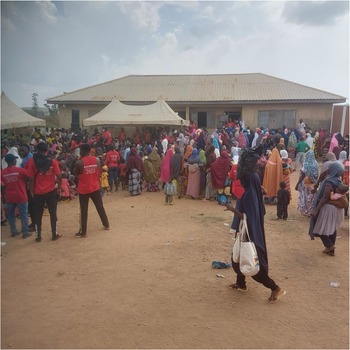
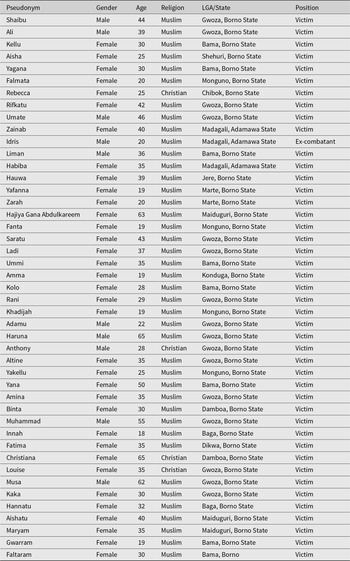
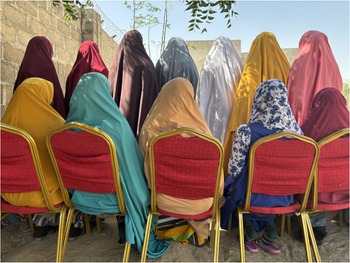

 Open access

