1. Introduction
When closing his letter, the author of Colossians makes mention of a Laodicean letter that the Colossian Christians are also expected to read (Col 4.16).Footnote 1 It seems that the Laodicean letter has been lost.Footnote 2 This was the view, evidently, of the author of the Letter to the Laodiceans, a pseudepigraphical text probably dating to the second half of the second century ce. The author seeks to fill the lacuna in the Pauline canon by composing a new document that, purportedly written by Paul in chains (as in Colossians), nonetheless draws on a number of Paul's other letters, not least Philippians.Footnote 3
But how successful was this unknown author in constructing a viable Pauline text? Has his interest in weaving together Pauline phrases within a single text resulted in a powerful testimony to the apostle's voice, a second-rate text that is structurally flawed and conceptually threadbare, or something in-between? Theological, rhetorical and structural components all interweave within the question, and usually the verdict on this short text is non-complimentary.
Over a century ago, for instance, Adolf Jülicher declared that the text was ‘short, unimportant and colourless'.Footnote 4 Twenty years later Montague Rhodes James claimed that the epistle was ‘wholly uninteresting’, having been ‘feebly constructed’ from authentic Pauline phrases simply to ‘explain St. Paul's mention of the letter from Laodicea in Col. iv. 16’.Footnote 5 Likewise, J. B. Lightfoot claimed the text to be ‘a cento of Pauline phrases strung together without any definite connexion or object … [and without] ulterior aim … Thus it is quite harmless, so far as falsity and stupidity combined can ever be regarded as harmless.’Footnote 6 The resultant product, in the opinion of these scholars, is a lifeless text without any hope of passing as a Pauline letter.
Towards the end of the twentieth century, not much had changed. Wilhelm Schneemelcher deemed the text to be a miserable failure, a ‘clumsy forgery’ that comprises a ‘colourless and dull composition of Pauline sentences’ in which ‘a definite theological intention’ is wholly vacuous.Footnote 7 Richard Bauckham also characterised the text as ‘nothing but a patchwork of Pauline sentences and phrases’, being ‘remarkably incompetent’ and failing ‘to communicate any clear message’.Footnote 8 Because the text is devoid of a specific Sitz im Leben of the addressees, it is a ‘poor example’ of a pseudepigraphical letter that attempts to achieve a didactic purpose.Footnote 9
Do such estimates go too far, however? Is the structure of the text really so feeble? Is the text really so devoid of conceptual rigour and theological merit? With issues of this kind on the table, the place to start is the structure of the text. Meaning is always embedded within structures, so that understanding a message requires an understanding of the overall organisation. But is there a structure embedded within the Letter to the Laodiceans, and if so, does it go beyond a ‘worthless patching together of Pauline passages and phrases’? We propose that there is a discernible structure. This is not to deny that the letter is highly derivative of canonical Pauline letters, of course. But derivative does not necessarily suggest defective, at least when estimating the letter's overall construction. As we seek to demonstrate, the Letter to the Laodicieans possesses an internal structural coherence, animating a conceptual strategy that is not itself theologically deficient.
2. Recent Appreciative Readings
Although negative assessments of the text can be found littered throughout scholarly discourse, a few scholars have made an appreciative case for the Letter to the Laodiceans. These authors peg their appreciation to structures recognised within the text. The recent works of Richard I. Pervo and Philip L. Tite are deserving of mention here.
In a section of his book The Making of Paul, Pervo investigates the Letter to the Laodiceans together with 3 Corinthians and the correspondences between Paul and Seneca. These texts provide examples that ‘show ongoing use of the pseudonymous letter in various circumstances’ after Paul's death.Footnote 10 Pervo affirms that the popular declaration of Laodiceans as a mere ‘pastiche, cento, or catena’, as noted above, is indeed a mistaken conclusion. Rather, he claims that the Letter to the Laodiceans ‘has the formal features of a letter and is not a hodge-podge or a patchwork’.Footnote 11
The author follows the content and flow of Paul's letter to the Philippians in crafting his pseudonymous text – a text for which Pervo articulates ‘a clear structure’:

Pervo discerns an obvious literary outline, which the author uses to piece together passages from Paul's previous missives. The text serves as a condensed précis of the Pauline message, which could be committed to memory by Christian communities with little effort.Footnote 13 Sections iii and iv parallel one another by applying the topics of salvation, good works, joy and prayer first to Paul as the prime example and then to the Laodicean Jesus-followers.Footnote 14 Thus, in light of these findings, the only accusation that can be laid upon the author of the Letter to the Laodiceans, in Pervo's view, is not forgery but a lack of imagination.Footnote 15 Essentially, the text reproduces Paul's own words from his extant letters and does not attempt any creative invention in the name of the apostle. We have here the work of an editor who shows ‘pseudepigraphical restraint’ by producing ‘a portrait of Paul that wishes to be ordinary and is therefore evidence of normal – as opposed to elite – Christian activity’.Footnote 16
Only one monograph on this short text can be located in the scholarly literature. In his 2012 book The Apocryphal Letter to the Laodiceans: An Epistolary and Rhetorical Analysis, Tite argues that this text ‘has an internal logic, through which the author constructs a rhetorical situation that, although certainly fictive, is well developed through the incremental progression of the letter’.Footnote 17 Tite's analysis leads him to conclude that the author of Laodiceans is not an incompetent editor compiling excerpts from Paul's epistles heedlessly; the construction and arrangement of the text rather points to the editor's creativity and should signal for us the sophisticated work of his hand.
Tite analyses the letter in terms of ancient epistolary categories while highlighting ancient parallels and the redaction of the authentic Pauline epistles in composing the document. The body of the letter in vv. 4–9 evinces a literary structure based on ‘transitional markers’, which results in five subunits.Footnote 18 Although one does not find grammatical links, in Tite's opinion the six verses comprising the letter body ‘articulate a clear thematic parallel between these units’.Footnote 19 Tite's chiastic structure for the letter body reads as follows:
A1 v. 4: Potential threat to the church (Body Opening)
B1 v. 5: Implication of divine activity (co-workers) (Body Middle)
C v. 6: Pseudo-Paul's suffering as moral exemplar (Body Middle)
B2 vv. 7–8: Implication of divine activity (Pseudo-Paul) (Body Middle)
A2 v. 9: Need for unity in the church (Body Closing)Footnote 20
Thematic connections pair the situation of the Laodicean Jesus-groups in sections A1 and A2, followed by the divine activity associated with pseudo-Paul's co-workers and pseudo-Paul himself in sections B1 and B2. This leaves pseudo-Paul's own experience of faithful suffering as the centre of the letter body (section C). According to Tite, Paul's faithful suffering functions as the moral exemplar to encourage the same within the Laodicean audience.
3. The Letter to the Laodiceans in Fresh Light
These efforts have moved in the right direction in rehabilitating the reputation of this small pseudonymous letter. There is, however, more to be observed in terms of the structure of the letter as a whole and, in effect, appreciating the coherence that enhances the rhetorical effectiveness of this short text. As we will see, the author structures this text in a fashion that would permit its audience to ‘carry it with them’, with certain structural features enhancing their ability to remember the flow of its text units.
The issue around which the letter revolves lies at the centre of the text in vv. 6–8.Footnote 21 That short paragraph highlights Paul's own situation. Just as in Philippians and other letters, the Paul of this text is in chains. But he is not ashamed of his current situation. Instead, through his suffering he rejoices and is glad. His chains do not diminish his honour, but enhance his ‘eternal salvation’ (salutem perpetuam). If the Holy Spirit has a role in assisting Paul towards that goal, so too do the Laodiceans, by means of their prayers for Paul's endurance (v. 7). In this way, they are participants in the narrative of Paul's life, death and joyous eternal blessing.
There are downsides to Paul's situation, however. Although the apostle can rejoice in his sufferings, his addressees are undergoing difficulties of their own, and evidently this is because of his sufferings. Since the Laodicean Jesus-groups are aligned with Paul, his disgrace reflects also upon them. Accordingly, ‘vain speech’ (vaniloquia) has arisen and threatens to ‘creep into’ (insinuantium) the Laodicean communities – speech directed perhaps against their apostle, against them as his supporters, or perhaps both (v. 4). Their apostle is open to mockery; their reputation has been tarnished. This is a socially realistic scenario that unites the apostle and his communities in a bond of reputational association.
What is of ultimate concern for the Paul of this text is the honour of the Laodiceans not in relation to others but in relation to God. Paul worries that the ‘vain speech’ plaguing their community is threatening to cause the Laodiceans to abandon ‘the truth of the gospel’ (veritate evangelii) that he had preached to them (v. 4). As we know from his undisputed letters, Paul closely associates his apostolic reputation with the legitimacy of the gospel that he preached and the legitimacy of the communities he founded. In much the same way, the Letter to the Laodiceans attempts to overcome the shaming of Paul and (by extension) the Laodicean communities by bolstering their commitment to the gospel that Paul preached, despite opposition from those who would engage in ‘vain speech’ against him and/or them.
Paul is convinced that disparaging words will not result in the Laodiceans' defeat, since in v. 5 he affirms that God will enable them ‘to continue serving to increase the truth of the gospel and to produce works of goodness unto the salvation of eternal life’ (et nunc faciet Deus ut qui sunt ex me ad profectum veritatis evangelii deservientes et facientes benignitatem operum que salutis vitae aeternae). This will come as God works God's mercy among the Laodiceans, so that they need not be intimidated in their faith (vv. 9–12). In fact, if stresses and strains are mounting within Laodicean Jesus-groups as a consequence of the degradation of their apostle's stature, Paul urges them to ‘have the same love and be of one mind’ (ut eandem dilectionem habeatis et sitis unianimes), withstanding the pressures currently exerted on them (v. 9). The narrative of their past persistence is to inform their present and their future, so that they ‘hold fast and work in the fear of God’ (ita retinete et facite in timore Dei), despite the obstacles that are currently mounted against them (v. 10).
If the foregoing points serve as the primary interests of this pseudonymous text, it is important to note the structure that animates these interests. Getting to the heart of the issue has taken us to the centre of the text, that is, to vv. 6–8, where Paul directly addresses his own situation. On either side of that centre, however, are two instances in which the apostle addresses the audience regarding their situation, with the interests of the first paragraph (vv. 4–5) flowing directly into the interests of the second (vv. 9–12). Both of these sections, which bracket the central section of vv. 6–8, start and finish by emphasising that God is at work in the actions of the audience (vv. 5, 9 and 11–12). Accordingly, a small chiasm appears to animate vv. 4 through 12:
A 4Do not let the vain speech of anyone creep in that they may lead you away from the truth of the gospel that I have preached. 5Now, regarding those who are from me, may God cause (faciet) them to continue serving to increase the truth of the gospel and to produce (facientes) works of goodness (benignitatem operum) unto the salvation of eternal life (salutis vitae aeternae).
B 6Now my bonds are seen, which I suffer in Christ, on account of which I rejoice and I am glad. 7This is for my eternal salvation (salutem perpetuam), which comes through your prayers and the help of the Holy Spirit, whether by life or by death. 8Truly to me, to live is in Christ, and to die is a joy.
A‘ 9He will work (faciet) the same in you in his mercy, so that you will have the same love and be of one mind. 10Therefore, beloved, as you have heard in my presence, so hold fast and work (facite) in the fear of God, and eternal life (vita in aeternum) will be yours, 11since it is God who works (operatur) in you. 12Do (facite) whatever you do (facitis) without inhibition.
In a chiastic structuring of these three paragraphs, two items stand out in particular. First, the theme of continuous life/salvation is shared by all three, with the mention of Paul's ‘eternal salvation’ in the centrepiece (salutem perpetuam in v. 7). This reference to Paul's salvation is matched by two references to the Laodiceans' ‘eternal life’ in each of the paragraphs surrounding the centrepiece (salutis vitae aeternae in v. 5 and vita in aeternum in v. 10).
Second, the two paragraphs pertaining to the Laodiceans' situation in A and A’ place an accent on the ‘work’ (faciet) of God to accomplish this salvation. The prayer wish made by Paul in v. 5 that God would bring about the works of goodness unto eternal life is again emphasised in vv. 9–12, where Paul asserts his confidence that God ‘will work the same in you in his mercy’ (et id ipsum in vobis faciet misericordia sua). In both sections, the action of God precedes and prompts the Laodiceans' own work ‘in the fear of God’ (in timore Dei, v. 10). It is God who causes them to produce works of goodness (v. 5) and who works in them (est enim Deus qui operatur in vos, v. 11); consequently, they should perform their calling ‘without inhibition’ (et facite sine retractu quaecumque facitis, v. 12).Footnote 22
Going to the beginning and end of the Letter to the Laodiceans adds support for a chiastic interpretation of this text as a whole. Most of the ingredients at these parts are wholly standard forms of Pauline expression and fall into position in wholly Pauline places – as recognised by both Tite and Pervo in their epistolary analyses. At the start of the text, in v. 1, the identification of the sender (‘Paul, an apostle, not of men or because of men, but because of Jesus Christ’)Footnote 23 echoes the opening of Galatians and resonates with the very purposes of the letter itself; and the blessing (‘Grace to you and peace …’)Footnote 24 is unexceptional in its Pauline content as part of the letter opening. At the end of the text, standard Pauline phrases animate the letter closing, including the salutation (cf. Rom 16.16; 1 Cor 16.20; 2 Cor 13.12; 1 Thess 5.26) and the blessing (cf. 1 Cor 16.23; 2 Cor 13.13; Phil 4.23; and Phlm 25).
If these are all standard forms of Pauline expression placed in standard structural locations, it needs to be noted that the placement of the final sentence of the text is exceptional, without precedent in the Pauline corpus. Every Pauline letter, whether disputed or undisputed, ends with a theological note of some kind. Often this is simply an encouraging ‘grace be with you’ or ‘the grace of our Lord Jesus be with you’ (ἡ χάρις τοῦ κυρίου Ἰησοῦ μεθ᾽ ὑμῶν: i.e. Rom 16.20; 1 Cor 16.23; Phil 4.23; cf. 1 Tim 6.21; 2 Tim 4.22),Footnote 25 or variations on that phrase (i.e. 2 Cor 13.13; Gal 6.18; 1 Thess 5.28; 2 Thess 3.18; Phlm 25; cf. Eph 6.24; Col 4.18; Tit 3.15); once it is an elaborate restatement of the theological thrust of the text (Rom 16.25–7).Footnote 26 Evidently, when Paul wrote letters, this was his established pattern, and when others wrote in his name they imitated this stylistic characteristic. The Letter to the Laodiceans, however, presents an exception to this rule. The text does not end with a theological gesture of some sort. Instead, after the expected blessing is pronounced in v. 19, an additional instruction follows in v. 20: ‘Cause [this letter] to be read to the Colossians and [that] of the Colossians to you’ (et facite legi Colosensibus et Colosensium vobis). Quite simply, this text follows a pattern different from all of the extant Pauline texts.
We might think that in this regard the author was simply clumsy, with a ‘feebly constructed’ ending emerging as a consequence. That impression might be accentuated in light of Col 4.16, which the author of this text clearly knew: ‘And when this letter has been read among you, have it read also in the church of the Laodiceans; and see that you read also the letter from Laodicea’ (καὶ ὅταν ἀναγνωσθῇ παρ’ ὑμῖν ἡ ἐπιστολή, ποιήσατε ἵνα καὶ ἐν τῇ Λαοδικέων ἐκκλησίᾳ ἀναγνωσθῇ, καὶ τὴν ἐκ Λαοδικείας ἵνα καὶ ὑμεῖς ἀναγνῶτε). In Colossians, that sentence appears before the final ‘grace’ of 4.18. Since the author of the Letter to the Laodiceans was building on Col 4.16, he would certainly have noticed that the placement of a similar sentence referencing the Colossian Christians within his own text should appear prior to the final ‘grace’; instead, he placed it after that point of standard closure.
Is this a sign of a second-class mind at work? Not necessarily. If a chiastic structure were to animate the text not only in its central paragraphs but also at the opening and concluding points as well, then the placement of the final sentence makes perfect sense. At the start of the text, the letter is situated in relation to Paul's apostolic ministry (v. 1); this then is paired chiastically at the end of the text, where the letter is situated in relation to other urban groups of Pauline Christians (v. 20). As the chiastic partner to the first sentence, the last sentence is not improperly situated; instead, it falls quite naturally into place at that point.
As a consequence of this chiastic demarcation, the second sentence of the text (v. 2) can be easily recognised as a chiastic partner to the three prior to the last sentence (vv. 17–19). Both of these partners highlight ‘grace’ (gratia, vv. 2 and 19) and ‘peace’ (pax, vv. 2 and 17). The signifier ‘Lord Jesus’ (Domino Ihesu Christo/Domini Ihesu, vv. 2 and 19) also appears in both sections, with none of these being found elsewhere in the letter.Footnote 27
This leaves us with the following chiastic structure for the opening and closing of the text, with the components of A referring to the text's situation (i.e. from Paul the apostle to the Laodiceans, then to the Colossians) and the components of B consisting of standardised Pauline forms of theological expression at the start and finish of letters:
A 1Paul, an apostle, not of men or because of men, but because of Jesus Christ, to the brothers who are in Laodicea.
B 2Grace (gratia) to you and peace (pax) from God the Father and the Lord Jesus Christ (domino Ihesu Christo).
B’ 17Peace (pax) will be with you. 18The saints greet you. 19The grace (gratia) of the Lord Jesus (domini Ihesu) be with your spirit.
A’ 20Cause [this letter] to be read to the Colossians and [that] of the Colossians to you.
If chiastic relationships are evident at the start, the closure and centre of the text, perhaps the same is true for the two paragraphs of the text not yet examined (v. 3 and vv. 13–16). In fact, they also can qualify as a chiastic pair. The first component of the chiastic partners is found in the third sentence of the text (v. 3), which draws on Paul's standard thanksgiving in order to laud the Laodiceans for their perseverance and progress in the Christian life, while awaiting ‘the promise [of salvation] in the Day of Judgement’ (promissum expectantes in diem iudicii). Precisely what perseverance and progress look like is outlined in the chiastic partner in vv. 13–16, which itself is built around the notion of being ‘steadfast in the mind of Christ’ in v. 14 (et estote firmi in sensu Christi). This involves a few moralising entries, such as ‘avoiding those dirtied with wealth’ (v. 13) and doing ‘what is sound and true and modest and just and lovely’ (v. 15). In essence, however, it comes down to holding onto what they have ‘heard and accepted’ in v. 16 (et quae audistis et accepistis in corde retinete) – no doubt with the confidence of the promised salvation that awaits them on the Day of Judgement (v. 3). As Tite rightly notes, an eschatological promise demarcates the end of both vv. 3 and 16, which in our proposal demarcates the end of two paired units within a larger chiastic structure.Footnote 28
Thematic links might be further evident in the coupling of vv. 3 and 14. In those verses, we find that the author pairs Paul's own ‘prayers’ (orationem) for the Laodiceans in v. 3 with the ‘petitions’ (petitiones) of the Laodicean communities on his behalf in v. 14. In this way, the ‘endurance’ (permanentes) and ‘perseverance’ (perseverantes) of the Laodiceans (v. 3) are coupled with an exhortation that they remain ‘steadfast in the mind of Christ’ (firmi in sensu Christi, v. 14).Footnote 29
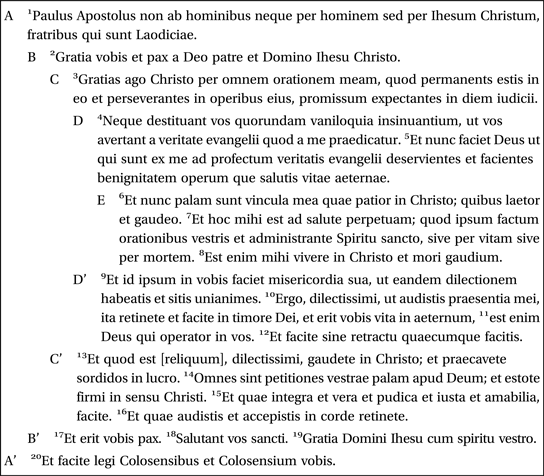
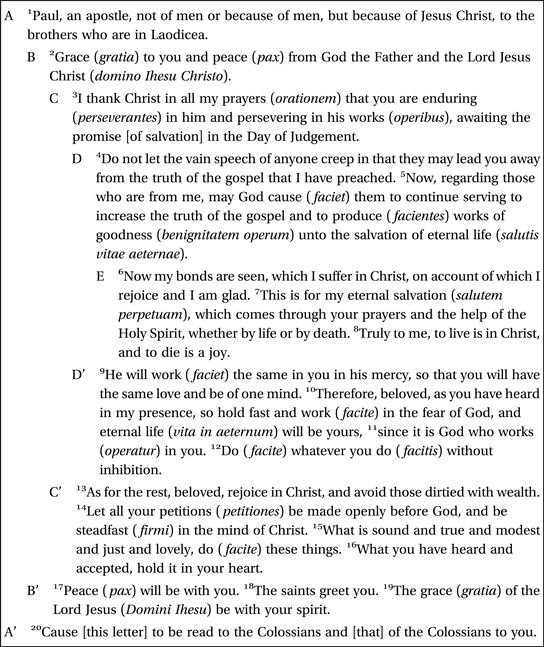
It would seem, then, that a chiastic structure lies embedded throughout the Letter to the Laodiceans (see Tables 1 and 2). This proposal is not to suggest that theological components within the chiastic partners are wholly self-contained within delineated parameters; chiastic structures rarely enjoy such pure formulations. But this structural demarcation takes account of the content predominant in the various parts of the text, which are easily contained within a chiastic form.Footnote 30 This, in turn, allows them to play off in relation to each other. Accordingly, a chiastic structure enhances the conceptual relationships within the text and animates the theological components that overlay the text's structure.
A chiastic structuring of the Latin text
A chiastic structuring of the English translation
4. Conclusion
The chiastic organisation of the Letter to the Laodiceans presented here represents more than literary flourish. Indeed, in this light, the Letter to the Laodiceans would seem to repel many of the criticisms typically charged against it in the scholarly literature. Evidently, the text's author thought carefully about the way in which the Pauline voice should be presented in a fresh literary construct. The text is not a ‘colorless and dull’ pastiche created by a ‘remarkably incompetent’ editor. Instead, it is an engaging attempt to speak Paul's voice in a compositionally coherent presentation that, in both its brevity and its sleek structure, enables audiences to carry it easily within the archives of their mental library.Footnote 31