Implications
There is strong evidence that oxidative stress (OS) plays a central role in the initiation, progression and maintenance of several pathologies. However, at present, there is disagreement as to whether or not dairy cows suffer an oxidative challenge around parturition, partly because of the differences in the methodologies used. This study demonstrates that measurement of both pro-oxidants and antioxidants allows determination of an oxidative stress index (OSi) that was utilized to quantify and demonstrate that the transition period is a time of increased OS in dairy cows. Moreover, the better timeframe for antioxidant supplementation, in terms of OS, was identified to minimize the incidence of postpartum diseases.
Introduction
Oxidative stress (OS) plays a key role in several pathological conditions connected with animal production, reproduction and welfare (Lykkesfeldt and Svendsen, Reference Lykkesfeldt and Svendsen2007), and is attributable to an imbalance between oxidant and antioxidant substances in the body. OS can be particularly dangerous as no clinical symptoms are shown.
One of the most critical moments in dairy health, with consequences for production variables, is the transition period (Goff and Horst, Reference Goff and Horst1997) when the capacity of antioxidant defenses is exceeded by the production of reactive oxygen substances (ROS). The influence of OS in ruminant health in this period is a relatively recent field of research; however, unfortunately, differences between models and methodologies make it difficult to make meaningful comparisons (Celi, Reference Celi2011) with practical conclusions.
Therefore, it is necessary to provide useful OS markers that would help to analyze it with accuracy to define protective nutritional strategies on the basis of antioxidant supplementation. We consider that it is important to evaluate not only concentrations of oxidants and antioxidants separately, but also analyze their relationship through a proportion or ratio, because it is the imbalance between oxidants and the antioxidants that defines the concept of OS (Castillo et al., Reference Castillo, Hernández, Bravo, López-Alonso, Pereira and Benedito2005).
The first approach using this ratio was made in human medicine by Sharma et al. (Reference Sharma, Pasqualotto, Nelson, Thomas and Agarwal1999). For dairy cattle, Celi (Reference Celi2011) in a review article proposed the use of the ratio pro-oxidants/antioxidants as an index indicative of an animal's risk to develop disease. Thus, an increase in the ratio indicates risk of OS because of the increase in ROS production or defensive antioxidant consumption.
In line with these considerations, the approach we have used aims to test, under field conditions in a commercial dairy herd, the use of an Oxidative Stress index (OSi, based on the ratio between ROS and serum antioxidant capacity (SAC), that is, ROS/SAC), comparing the information given by this parameter with those given by ROS and SAC separately. Moreover, the usefulness of this index is evaluated in the most complex stage: around parturition (2 months before parturition to 2.5 months after it) that includes the transition period.
Material and methods
This study involved the collection of serum samples at different stages of the transition from gestation to lactation in dairy cows in order to compare the differences between these stages in terms of oxidative status. Permission for the procedures of the experiment was granted by the Bioethical Committee of the University of Santiago de Compostela (Spain).
Animals, nutrition and husbandry
The study was conducted on a commercial dairy herd located in Arzúa (Galicia, NW, Spain), with an average 305 days normalized milk production of 10.235 kg/cow, and where economics play the main role in farm decisions. At this herd, we sampled fortnightly 25 cows from 2 months before the expected date of parturition until 2.5 months after it. The data obtained from three animals were discarded because one animal needed a caesarean section at calving, and another two of them developed clinical mastitis and left displacement of the abomasum, respectively; therefore, only data from cows (n = 22) that had a normal calving and a healthy postpartum were included. Samplings took place between October and February, when the climate conditions (average (±s.d.) maximum temperature: 13.3°C (±4.23); average (±s.d.) minimum temperature: 5.1°C (±2.37) and average (±s.d.) relative humidity: 83.3% (±5.61)) are not supposed to increase the production of ROS because of heat stress (Bernabucci et al., Reference Bernabucci, Ronchi, Lacetera and Nardone2002).
As there are no published reference values for oxidative status biomarkers at present (Celi, Reference Celi2011), it was necessary to establish a control group to have a baseline value to compare with those values obtained from transitional cows. This control group (CTR, n = 40) was formed with animals between the 4th and 5th month of pregnancy when neither lactation nor pregnancy were major metabolic burdens as described by Castillo et al. (Reference Castillo, Hernández, Bravo, López-Alonso, Pereira and Benedito2005).
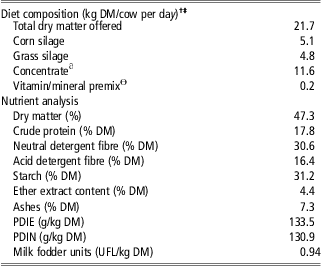
During the study period, all animals were kept under identical conditions. The diet for all cows consisted of a base ration fed as a daily total mixed ration (Table 1). Cows were dried off 60 days before the expected date of parturition and supplemented with a vitamin complex injection (see Table 1). Lactating cows were fed ad libitum, whereas dry cows were allowed only twice a day to feed, after every milking of lactating cows.
Ingredients and chemical composition of the diet supplied in the present study
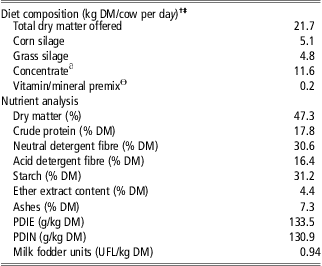
DM = dry matter; PDIE = protein supplied when energy is limited in the rumen; PDIN = protein supplied when nitrogen is limited in the rumen. UFL = ‘Unité Fouragère Lait’. UFL is the net energy for lactation equivalent to 1 kg standard air-dried barley.’
†The diet was fed as a total mixed ration. Lactating cows were fed ad libitum, whereas dried cows only had access to the feedbunk twice a day, although water and straw were available without restriction.
‡Fifteen days before expected parturition the cows received a vitamin complex injection (Hipravit-AD3E-Forte® Hipra Laboratories, Girona, Spain) at a dose of 0.10 ml/kg BW, containing each ml 75 000 IU of cholecalciferol, 50 mg of α-tocopherol acetate and 500 000 IU of vitamin A.
∂Concentrate composition (% as fed): rapeseed meal (26.2), corn (20.0), wheat DDGs (15.9), soybean meal (11.5), calcium soap (3.2), sugarcane (1.6), bicarbonate (1.6), calcium carbonate (0.9) and sodium chloride (0.8).
θContained: 14% Ca, 4% P, 6% Na, 5% Mg, 650 000 IU/kg vitamin A, 130 000 IU/kg vitamin D3, 2600 IU/kg vitamin E, 9700 ppm Zn (oxide), 8100 ppm Mn, 8100 ppm Fe, 2000 ppm Cu, 100 ppm I, 40 ppm Cu, 40 ppm Se and 30 ppm Mo.
Blood samplings and groups
Blood samples were obtained by coccygeal venipuncture with evacuated tubes without anticoagulants, between 1800 and 1830 h. Tubes for serum collection were rapidly cooled on crushed ice and transported to the lab, where they were centrifuged at 2000 × g for 20 min and the supernatant serum was frozen at −20°C until analysis, within the first 3 months after collection.
In order to relate our results with the production stage of the transitional cows, the samplings of these animals were grouped ex post into four stages: (1) late lactation (LL) from 2 to 1 months before parturition, (2) prepartum (PrP) from −1 month until delivery, (3) postpartum (PsP) from delivery to 1 month after parturition and (4) peak of lactation (PkL) from +1 to +2.5 months after delivery. In each sampling, at least one control cow was also sampled, thereby trying to minimize any possible temporal effect.
Analytical determinations
ROS were assayed as described by Trotti et al. (Reference Trotti, Carratelli, Barbieri, Micieli, Bosone, Rondanelli and Bo2001) using the spectrophotometric d-ROM test (Diacron International, Grosseto, Italy), which determines hydroperoxides (breakdown products of lipids as well as of other organic substrate, generated by the oxidative attack of ROS) through their reaction with the chromogen N,N-diethylparaphenylenediamine. Results are expressed in arbitrary ‘Carratelli Units’ (CarrU), where 1 CarrU is equivalent to the oxidizing power of 0.08 mg H2O2/dl. Intra- and inter-assay CV were 3.22% and 8.19%, respectively.
SAC was estimated with the OXY-Adsorbent Test (Diacron International) (Trotti et al., Reference Trotti, Carratelli, Barbieri, Micieli, Bosone, Rondanelli and Bo2001). This test exploits the capacity of a massive solution of hypochlorous acid (HClO) to oxidize the complete pool of antioxidants in serum (albumin, bilirubin, uric acid, thiol groups, vitamins, glutathione, glutathione peroxidase, superoxide dismutase, catalase, etc.). Thus, SAC considers the cumulative action of all the antioxidants present in serum, rather than simply the sum of measurable antioxidants. Results are expressed as μmol HClO/ml. Intra- and inter-assay CV were 2.85% and 5.10%, respectively.
Both variables were used previously in bovine studies and managed according to the manufacturer's instructions. The OSi was calculated as ROS/SAC, expressed as CarrU/(μmol HClO/ml). Both ROS and SAC were measured on an UV/VIS absorption spectrophotometer (Clima MC-15; RAL Técnica para el Laboratorio, Barcelona, Spain).
Statistical procedure
Data for each parameter were checked for normal distribution with the Kolgomorov–Sminorv test. A repeated measurement ANOVA was used to compare means among the different stages of the transition period, with the individual cows as experimental unit. Following the ANOVA, significant inter-group differences were detected by Bonferroni test. To compare the means of each transitional stage with the mean of the CTR group, the Student t-test was used. The criterion for statistical significance was established at P < 0.05. All statistical procedures were carried out with the IBM SPSS v19.0 for Windows software package.
Results
Table 2 shows the results of the oxidative status markers in all the studied stages. Values in CTR cows can be considered as the baseline values for dairy cows under field conditions, taking into account that they were obtained in animals with the theoretically lowest metabolic burdens than can be achieved in lactating cows in a commercial dairy farm. Thus, the values obtained from cows at the transitional stages will be compared and discussed with those values obtained from CTR cows.
Mean values of oxidative status markers throughout the studied stages

ROS = reactive oxygen substances; SAC = serum antioxidant capacity; OSi = Oxidative Stress index; CTR = control cows (between the 4th and 5th month of gestation); LL = late lactation (between 1 and 2 months before parturition); PrP = prepartum (from 1 month before parturition until delivery); PsP = postpartum (from delivery until 1 month after calving); PkL = peak of lactation (from 1 month after parturition until peak lactation); RMSE = root mean squared error.
A repeated measurement ANOVA with cow as experimental unit was used to compare the means within the transitional stages, whereas the means of these stages were compared with the means of the CTR group through the Student t-test. Means with different superscript alphabets within rows are significantly different (P < 0.05).
Mean ROS values did not differ significantly between control and any stage of the transition period. ROS progressively increased from LL to PsP with a slight decrease in the next stage. Although values in PkL were higher than those before parturition, they did not achieve statistical significance.
Similarly, mean SAC values did not statistically differ between CTR and transitional cows at any stage; nonetheless, it can be noted that there was an increase in the antioxidant barrier in PrP, with a subsequent decrease after delivery, reaching the lowest activities at PkL.
Despite the lack of statistical significance in the differences among transitional stages, and with the CTR group in either ROS or SAC separately, the evaluation of the oxidative status of the animals with the OSi found a significant difference between the means of OSi in lactating and dried animals. However, the values of CTR cows only differed significantly with the animals at PkL. It is noted that the values in dried animals were lower than in CTR ones; which were considered to be the baseline levels.
Discussion
This experiment studied the differences between the separate and the joint evaluation of pro-oxidants and antioxidants at blood level throughout the transition period of dairy cows. Serum samples were taken at different stages of the transition from gestation to lactation and compared among them and a control group.
Pro-oxidants
Changes in ROS during the study were in accordance with previous reports that showed an increase in oxidant species after parturition, attributable to the metabolic challenges associated with this stage (Bernabucci et al., Reference Bernabucci, Ronchi, Lacetera and Nardone2005; Dobbelaar et al., Reference Dobbelaar, Bouwstra, Goselink, Jorritsma, van den Borne and Jansen2010). Furthermore, during lactation, energy partitioning associated with milk production contributes to maintain a metabolic stress, favoring high ROS production (Castillo et al., Reference Castillo, Hernández, Valverde, Pereira, Sotillo, López Alonso and Benedito2006).
Antioxidants
Unlike other studies (Sharma et al., Reference Sharma, Pasqualotto, Nelson, Thomas and Agarwal1999) that used the biological antioxidant potential (BAP) as an estimation of antioxidant capacity, we decided to estimate the SAC by the plasma barrier to oxidation (OXY-Adsorbent test). This was because, in addition to the ‘scavengers’ antioxidants (those determined by BAP), this test can also measure the so-called ‘shock adsorbers’, that is, all the antioxidants that are not active from the chemical point of view but are able to ‘plug’ the oxidant action of ROS. This provides information on the structural component of the antioxidant barrier of which the period of recovery is relatively slow, in comparison with the antioxidants of lower weight, or at least a more rapid turnover, included in the BAP determination. Therefore, we are measuring the cumulative capacity of the antioxidant defense against a particular oxidant aggression (how the animal has been accumulating and disposing its antioxidants reserves to specific, predictable and expected situations such as delivery and early lactation), rather than measure the short-term antioxidants at the time of sampling.
The prepartum period is characterized by a depleted antioxidant status and, consequently, OS (Bernabucci et al., Reference Bernabucci, Ronchi, Lacetera and Nardone2002 and Reference Bernabucci, Ronchi, Lacetera and Nardone2005), and therefore these cows were supplemented with a vitamin complex before parturition, which is a recommended practice to minimize the risk of postpartum diseases (Politis, Reference Politis2012). This fact prevents us from getting the clear picture of the natural cycle of OSi; however, on the other hand, it shows the oxidative status that might be observed in dairy cows in commercial farms. Under these conditions, the slight increase in SAC values at PrP can be considered as a result of the preventive vitamin complex administration (Dobbelaar et al., Reference Dobbelaar, Bouwstra, Goselink, Jorritsma, van den Borne and Jansen2010). The small drop at PsP is not only the consequence of the utilization of antioxidants in colostrum production (Goff and Horst, Reference Goff and Horst1997), but also the consequence of antioxidant consumption, in an attempt to cope with the metabolic production of oxidants. As lactation progresses, antioxidants continue to decline because of the depletion of fat-soluble antioxidants by milk, in combination with their consumption by endogenous ROS production (Castillo et al., Reference Castillo, Hernández, Bravo, López-Alonso, Pereira and Benedito2005 and Reference Castillo, Hernández, Valverde, Pereira, Sotillo, López Alonso and Benedito2006).
OSi
Currently, there is no agreement on whether or not dairy cows undergo OS during the transition period . Previous studies suggested that dairy cows experience OS during the peripartum period (Bernabucci et al., Reference Bernabucci, Ronchi, Lacetera and Nardone2005; Castillo et al., Reference Castillo, Hernández, Bravo, López-Alonso, Pereira and Benedito2005). However, in contrast with these studies, some authors do not report an oxidative challenge in the periparturient period (Wullepit et al., Reference Wullepit, Raes, Beerda, Veerkamp, Fremaut and De Smet2009; Dobbelaar et al., Reference Dobbelaar, Bouwstra, Goselink, Jorritsma, van den Borne and Jansen2010).
While with a separate evaluation of our results of ROS and SAC, apparently these cows did not undergo OS, as no significant difference was found between the studied stages neither for ROS nor for SAC. When the oxidative status is studied by a combined evaluation of pro-oxidants and antioxidants with the OSi, statistical differences between the foregoing and subsequent parturition stages were found, suggesting in fact that these cows experienced an oxidative challenge after parturition. This finding suggests that it may be a better practice to evaluate jointly both oxidants and antioxidants rather than separately, as OS could either be a consequence of an excessive production of ROS production and/or a decrease in the body antioxidant defense, and therefore these parameters are strictly interdependent.
This agrees with a study in human medicine, in which the relationship between the level of OS and pathology was higher when oxidants and antioxidant defense measurements were combined as a ratio (Sharma et al., Reference Sharma, Pasqualotto, Nelson, Thomas and Agarwal1999). However, care must be taken when interpreting these results, taking into account the higher variance associated with the base measurements. Marked individual variations were already reported for other oxidative status biomarkers in periparturient dairy cows, with many factors influencing it (Castillo et al., Reference Castillo, Hernández, Bravo, López-Alonso, Pereira and Benedito2005 and Reference Castillo, Hernández, Valverde, Pereira, Sotillo, López Alonso and Benedito2006).
Of particular interest is the observation that in peak lactation, when theoretically the cow is metabolically adapted to milk production (Castillo et al., Reference Castillo, Hernández, Valverde, Pereira, Sotillo, López Alonso and Benedito2006), there is the maximum risk for OS, with values of the OSi significantly higher than CTR cows. This reason can be attributed not only to the slight decrease in ROS, as the results of a lesser metabolic burden, but also to the larger decrease in SAC. For these reasons, and although no clinical symptoms of disease were observed in the studied animals, these findings suggest us the convenience of extending antioxidant supplementation from the dry period until peak of lactation.
Conclusions
Under the conditions of this study, the OSi provides an objective assessment of the relationship between oxidants and antioxidants, not seen by the determination of both components separately.
In addition, baseline levels of oxidative status biomarkers under field conditions for commercial high-yielding dairy cows are reported, which will bring a step forward to their applicability in farms. It was also found that dairy cattle show an increase in the levels of OS after parturition, and hence to develop preventive actions that would minimize the effects of production diseases after parturition, further studies should study the effects of antioxidant supplementation from 1 month before parturition until the peak of lactation.
Acknowledgments
This study was supported by the Xunta de Galicia (Spain) (10MRU261004PR). The funding source played no role in the design of study, collection, analysis and interpretation of data, or preparation or approval of the manuscript. A. Abuelo is a FPU fellowship holder (Ref. AP2010-0013) from the Spanish Ministry of Education. The authors thank Lucía Casanova Iglesias for her expert technical assistance.
Preliminary data of this study were presented as an oral communication at the 6th European Congress of Bovine Health Management, held in Liège (Belgium) in September 2011.