J. S. Bach’s Cello Suites were most likely completed, like his Violin Solos (“Sonatas and Partitas”), around the middle of his tenure as Capellmeister and director of chamber music for Prince Leopold of Anhalt-Cöthen (1694–1728). Since Leopold’s reformed Calvinist court chapel did not require elaborate church music or organ playing, Bach’s responsibilities during his Cöthen period (1717–23) centered around composing instrumental music and secular cantatas to satisfy his patron’s demand for musical divertissements. A devoted music enthusiast, Leopold sang and played harpsichord, violin, and viol (also known as viola da gamba).1
Despite the traditional portrait of Bach as an industrious, disciplined musician and teacher, he did not always get on well with his various employers.2 Yet he enjoyed a notably good rapport with Leopold, who was nine years his junior. The prince paid Bach handsomely, showcased his talents during two trips to the fashionable spa in Carlsbad (Bohemia), and was godfather to his son Leopold Augustus (1718–19), suggesting a personal dimension to their relationship.3 Even after financial and other personal circumstances led Leopold to scale back musical activities at his court, prompting Bach to seek other employment in Leipzig, the composer nevertheless retained the title of Capellmeister in Cöthen on a nonresident basis for the rest of the prince’s life. Bach’s devotion to his princely patron is evinced by his regular return visits to perform in Cöthen, usually together with Anna Magdalena Bach (1701–60), the last of which was to provide music for Leopold’s state funeral in 1729. In a letter written the following year, Bach reminisced fondly about his time in Cöthen: “There I had a gracious Prince, who both loved and knew music, and in his service I intended to spend the rest of my life.”4 Bach’s assessment was echoed some decades later by composer Johann Adam Hiller (1728–1804): “This Prince Leopold was a great connoisseur and champion of music; he himself played the violin not badly and sang a good bass.”5
In its focus on secular music, the Cöthen position was unique among the posts Bach held throughout his career. Compared to his more extensive duties as court organist and chamber musician in Weimar (1708–17) and especially as cantor and music director in Leipzig (1723–50), the lighter responsibilities in Cöthen afforded Bach the time, flexibility, and creative freedom to complete some of his most ambitious instrumental projects, including not only the highly original music for solo violin and cello but also the French Suites, the first book of the Well-Tempered Clavier, and the Brandenburg Concertos.6 Moreover, in the musicians of the Cöthen court Capelle, he had access to some of the finest performers he could have hoped for. A core group of eight soloists (plus Bach as Capellmeister), all distinguished virtuosos, lived in close proximity in the small town, rehearsing and performing together regularly, and their numbers were reinforced by additional ripienists (string section members) and guests when a larger ensemble was needed.
The Capelle’s serious rehearsal practices were unusual enough to receive special comment in a 1722 report by the cantor of Cöthen’s St. Jacobi Church: “The princely Capelle in this town, which week in week out holds its Exercitium musicum, makes an example that even the most famous virtuosos rehearse and exercise their pieces together beforehand.”7 This lauding account suggests a high artistic standard for the Capelle, and the members’ close working relationships seem to have fostered some lasting personal connections. Although much of the ensemble music Bach composed in Cöthen does not survive, it must have been a remarkably fertile period, owing to Leopold’s enthusiasm about and investment in musical life at his court, as well as to the inspiration of the outstanding musicians of the Capelle.8
Le Goût Français at German Courts
Although Bach never traveled to France, French manners, music, and dance were part of his upbringing and of the cultural atmosphere at Cöthen as he composed the Cello Suites. Leopold’s court included French paintings and tapestries and an orangery on the castle grounds.9 During Bach’s lifetime, the instrumental dance suite was understood in Germany largely as a French import. Whereas suites for unaccompanied cello were not an established genre among German composers, bass viol suites in the French tradition (pièces de viole) were almost certainly present at Cöthen and may in part have inspired Bach’s conception of the Cello Suites.10
One could not overstate the role of French dance masters as the most important tastemakers at German courts, with an influence that extended beyond dance and music to manners, social rituals, and fashion. A well-known (satirical) representation of a Parisian dance master providing instruction in both dance and manners is found in Molière’s Le Bourgeois Gentilhomme (1670). Pierre Rameau (1674–1748), dance master to the Queen of Spain, explained:
We can say, to the glory of our nation, that it has a true gift for beautiful dancing. Far from denying this, nearly all foreigners have, for nearly a century, come to admire our dances [and] to educate themselves at our performances and in our schools. There is hardly a court in Europe that does not have a dancing master from our nation.11
The appointment of Parisian dance masters and other musicians in many German courts brought about both the diffusion of French music through manuscript copies and printed parts and performance of French or French-inspired music, dance, and theater.12
Bach was first introduced to French music, dance, and courtly culture as a teenager in Lüneburg, where he was a choral scholar at St. Michael’s Latin School (1700–1702). Bach sang in the Matins choir with students from the adjacent Ritter-Academie, an elite school for noble youth, where French was the obligatory spoken language, where students had daily lessons in French language, dancing, and etiquette, and where entertainments included French theater and ballet.13 Bach almost certainly had contact with the dance master of the Ritter-Academie, Thomas de la Selle (dates unknown), a pupil of Jean-Baptiste Lully (1632–87) and a violinist at the French-styled ducal court of Celle. The renowned Celle Capelle was an ensemble of twenty-four musicians modeled after Lully’s orchestra at Versailles.14 Bach’s obituary states that hearing that “then famous band … consisting for the most part of Frenchmen … [afforded him] a thorough grounding in the French taste, which, in those regions, was at the time something quite new.”15 Since Bach himself was likely the ultimate source of this account, it would seem that his youthful introduction to French music and manners had made a lasting impression.
The infatuation of German princes with French courtly culture stemmed from the division of the Holy Roman Empire into some 300 small, sovereign principalities after the Thirty Years’ War (1618–48). Princes “with small domains and large ambitions … did everything conceivable to create a miniature Versailles at [their] court[s],”16 including by cultivating French language and manners and by mounting festivities that aspired toward the grandeur of those of Louis XIV (the “Sun King,” 1638–1715).17 German princes learned French from a young age and studied both dance and comportment with Parisian dance masters.
Leopold had cultivated French manners – including the language, dance, riding, fencing, and music – as a student at the Berlin Ritter-Academie (1707–10).18 At the time, musical life at the Prussian court in Berlin had become highly Gallicized under the influence of the dance master and concertmaster Jean-Baptiste Volumier (c. 1670–1728). Steeped in an opulent French cultural environment, the teenage Leopold must have been a devoted dance student since, in 1708–9, he and his younger brother performed among the “Dancers in the Entrée of the Amours and Plaisirs” in a magnificent opera produced for the royal wedding.19
Leopold’s grand tour, undertaken in 1710–13, reflected his devotion to music. He attended numerous opera performances; acquired a considerable amount of sheet music, including rare scores by Lully and Francesco Mancini (1672–1737); rented harpsichords in several locations; and engaged composer Johann David Heinichen (1683–1729) to join for a seven-month stretch of the journey.20 In 1713, while he was still on his tour, a rare opportunity arose for Leopold to significantly expand and enhance the Cöthen Capelle when he learned of the abrupt dissolution of the Prussian court Capelle in Berlin, an “act of cultural barbarism” committed by Friedrich Wilhelm I (the “Soldier King,” 1688–1740) just after his ascent to the throne.21 Leopold persuaded his mother (then governing as regent) to hire several of the leading Berlin musicians, six of whom arrived in Cöthen soon after, with the cellist Christian Bernhard Linike (1673–1751) joining in 1716. In a shrewd maneuver, Leopold thus transformed the Cöthen Capelle into one that, in its size and virtuosity, rivaled those of many larger, more established courts.
Given Leopold’s fondness for the viol, he must have been particularly pleased with the appointment of Christian Ferdinand Abel (c. 1683–1737), one of the finest German viol players, to the Cöthen Capelle around 1714. Having grown up at the French-styled court at Celle, where he probably served as a court musician, Abel was an accomplished virtuoso in the French viol tradition. His service at Cöthen afforded Leopold not only the pleasure of his performances but also opportunities to play with and to learn from him on the instrument.22 Bach’s three viol sonatas (BWV1027–29) were likely composed for Abel to play for or teach to Leopold.
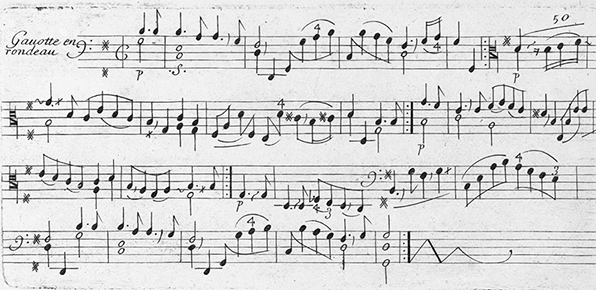
It has long been speculated that Abel may have been the first performer of Bach’s Cello Suites, given his close friendship with Bach.23 This theory is difficult to support, given the lack of evidence that Abel played the cello – besides his primary background as a viol player, Cöthen court records show him as a violinist – and moreover considering the presence at Cöthen of the excellent cellist Linike. On the other hand, Abel may have influenced the conception of the Cello Suites in a different way. German viol players such as Abel and Leopold were inheritors to an extensive and venerable tradition of pièces de viole – collections of preludes, dance movements, and character pieces for bass viol, a repertoire that flourished in France and that was imitated extensively by German and Dutch composers. Example 1.1 reproduces a gavotte en rondeau by Sieur de Machy (fl. c. 1660–90), an avid proponent of the viol as a solo (unaccompanied) instrument. In this piece, the viol conveys both melody and harmony, sometimes through chords and double stops, as well as through registral leaps that distinguish the bass line from upper voices.
Sieur de Machy, Pièces de violle (Paris, 1685), Gavotte en rondeau.
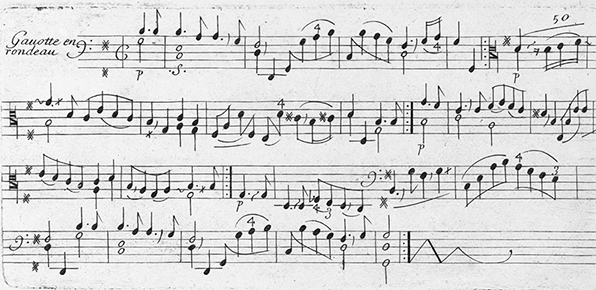
Example 1.1 Long description
The music is laid out in Western staff notation and is reproduced from a historical edition. The score extract comprises four systems of music, a total of twenty measures, with three segments marked with repeat signs. The single-staff layout indicates that this music is for a solo instrument. The music is notated in a combination of bass and alto clefs, and a key signature of one sharp indicating G major. The meter is notated with an alla breve symbol. Rhythmically, the music features a melodic figure of a dotted quarter followed by an eighth note, as well as eighth notes and some sixteenth notes. Texturally, the music features many three-note chords and double stops, as well as large leaps separating the bass line from the melody. The dynamic marking “p” for piano appears four times. The score also includes articulation markings like slurs and ornamentation symbols such as trills.
The French viol player Jean Rousseau (1644–99) described these features as the “harmonic” style (jeu d’harmonie) of viol playing, as opposed to the “melodic” style (jeu de mélodie), in which the viol simply plays the tune and requires extrinsic accompaniment.24 Whereas Rousseau advocated the melodic style, de Machy considered a viol player playing only melodies to be comparable to “a man who plays perfectly on the harpsichord or organ, [but] only with one hand.”25 In practice, the distinction between the two styles was sometimes blurred, as some collections were composed to be playable either solo or with basso continuo accompaniment. Music in the pièces de viole tradition – either by French composers or by Dutch and German composers who inherited and extended it – was very likely part of the musical atmosphere at Cöthen,26 considering that Leopold and Abel were both viol players whose musical sensibilities had been shaped in French-influenced courts.27
The “harmonic” style of viol playing broadly resembles the texture of Bach’s Cello Suites, which combine melody, harmony, and bass line in a similar way (compare Example 1.1 to the Gavotte I from Suite No. 6, shown in Example 2.6a). At the time Bach composed the Cello Suites, the cello – a member of the Italianate violin family – was a comparatively newer instrument than the illustrious French viol. Lacking a robust tradition of unaccompanied music, the cello was best known north of the Alps as an instrument suitable for bass lines in ensemble music,28 although one poised to grow in popularity as the viol was beginning to decline and as Italian instrumental music was gaining in prestige in German-speaking lands.29 Although seventeenth-century Bolognese cellists had composed for cellos tuned C–G–d–g (as in Bach’s Suite No. 5), including Domenico Gabrielli’s Ricercari for unaccompanied cello (1689), it is doubtful that this music would have been familiar to Bach or could have served as his prototype.30 On the other hand, bass viol playing exerted a clear influence on early cello techniques and repertoires. Given the cross-pollination between these instruments, it is entirely possible that Abel’s presence at Cöthen, and Leopold’s presumed penchant for pièces de viole and for French courtly and theatrical dance, may have inspired Bach to experiment with transposing the solo-viol tradition into suites for unaccompanied cello.
Bach’s Violin Solos and Cello Suites as “Opus” Collections
Starting during his appointment in Weimar (1708–17) and continuing in Cöthen (1717–23), Bach assembled some of his most impressive and original instrumental compositions into manuscript collections possessing what Christoph Wolff has called “opus character.”31 Although just a handful of Bach’s compositions were published during his lifetime – and he assigned a literal opus number only once (to the Clavier-Übung I, published in 1731 as “opus 1”) – various unpublished sets also stand out as touchstone collections, often comprising six pieces that were conceived or assembled with particular care and to which Bach attached special importance. Once these collections were polished into their final versions, Bach penned them in fair copies.
These “opus” collections aspire toward an encyclopedic ideal, as if Bach sought to reveal exhaustively the range of compositional possibilities of certain genres and instrumental forces. Musicians who play the six Brandenburg Concertos, for instance, encounter a variety of traditional and novel instrumental combinations, with many passages testing the limits of the soloists’ technique and with each piece instantiating the genre of concerto grosso in a different way. Likewise, a keyboard player who studies either book of the Well-Tempered Clavier will have Bach as a guide through a complete survey of all twenty-four major and minor keys, exploring a variety of styles and textures in preludes and contrapuntal techniques in the fugues. Such collections are not only a means for musicians to develop and display their virtuosity as instrumentalists; they are, moreover, demonstrations of Bach’s virtuosity as a composer.
The earliest writings to discuss Bach’s Violin Solos and Cello Suites in these terms are by his son Carl Philipp Emanuel (1714–88) and his student Johann Friedrich Agricola (1720–74), whose coauthored obituary of the elder Bach was published in 1754. Comprising a brief overview of his life and works, the obituary includes a list summarizing his published and unpublished music, mostly detailing vocal, organ, and other keyboard music. The list of unpublished music also includes “six sonatas for the violin, without [accompanying] bass,” “six of the same for the violoncello,” and finally “a mass of other instrumental pieces of all sorts and for all kinds of music.”32 The obituary is slightly imprecise as to the genres of these collections: alternating church sonatas and partitas for solo violin and suites for solo cello. That these pieces were the only non-keyboard instrumental works singled out for special mention illustrates that the authors – and probably the composer himself – regarded them as extraordinary achievements comparable to his most notable works in the genres for which he was best known (vocal, organ, and keyboard).33 C. P. E. Bach owned a manuscript copy of the Cello Suites, which he kept his whole life and of which he commissioned at least one copy (see discussion of Source C in Chapters 3 and 4).
Two decades later, C. P. E. Bach corresponded extensively with his father’s biographer Johann Nikolaus Forkel (1749–1818). In an oft-cited letter describing his father’s artistic traits, C. P. E. Bach wrote:
He heard the slightest wrong note even in the largest combinations. As the greatest expert and judge of harmony, he liked best to play the viola, with appropriate loudness and softness. In his youth, and until the approach of old age, he played the violin cleanly and penetratingly, and thus kept the orchestra in better order than he could have done with the harpsichord. He understood to perfection the possibilities of all stringed instruments. This is evidenced by his solos for the violin and for the violoncello without [accompanying] bass. One of the greatest violinists told me once that he had seen nothing more perfect for learning to be a good violinist, and could suggest nothing better to anyone eager to learn, than the said violin solos without bass.34
Although during his lifetime Bach was best known as an organ and keyboard virtuoso and only secondarily as a composer, this account emphasizes his intimate knowledge of string instruments. Bach had played the violin from a young age, almost certainly having picked it up as a child through his father, Johann Ambrosius, an accomplished violinist from whom Bach probably inherited his Stainer violin.35 According to C. P. E. Bach’s letter, his father’s expertise with string instruments was manifest not only in his masterful playing but also in his unaccompanied music for violin and cello, which explored those instruments to their full capacities.
Forkel likewise singled out the Violin Solos and Cello Suites for special mention in his 1802 biography of Bach. Noting that Bach composed concertos and other solo pieces for a wide variety of instruments, he observed that the composer “always contrived them so that his performers could, by their means, improve on their instruments.”36 He held that the Violin Solos and Cello Suites made up for the many instrumental pieces that had not survived, adding (in a gloss on C. P. E. Bach’s aforementioned letter): “For a long series of years, the violin solos were universally considered by the greatest performers on the violin as the best means to make an ambitious student a perfect master of his instrument. The solos for the violoncello are, in this respect, of equal value.”37 Forkel’s remarks were prescient as these pieces have since become central to the training repertoire for violinists and cellists. They are among the most frequently performed and recorded music for both instruments.
Bach’s Violin Solos and Cello Suites were conceived together as a two-part collection. Scholars have made various speculations as to their chronology, but there are good reasons to presume that the violin pieces were composed first.38 Since the complexity and originality of the Violin Solos suggest an extended gestation period, one might surmise that Bach probably began the set in Weimar. Although his primary Weimar post was as court organist, Bach also served as chamber musician and, after 1714, was promoted to concertmaster, roles that would have included both harpsichord and violin playing. It was during this period that Bach first showed an interest in the violin as a virtuoso, polyphonic instrument. His oldest surviving chamber music, the Fugue in G Minor for Violin and Continuo (BWV1026), was composed in Weimar and illustrates his development of virtuoso violin technique including complex double stops and polyphony.
Whenever he may have begun working on the Violin Solos, he finished by 1720, when he copied them out in an extraordinarily neat, calligraphic manuscript. Containing virtually no errors, corrections, or other signs of creative deliberation, that manuscript is clearly a fair copy made from earlier composing drafts. Such ornate, tidy manuscripts date only from the Cöthen period, when Bach’s relatively light duties permitted him to take such care with fair copies.39 The aesthetic beauty of this manuscript also reflects the value the composer attached to the Violin Solos.
Bach undertook the copying work for the Violin Solos while visiting the Carlsbad spa in May–July 1720 as a member of Leopold’s entourage. Since the autograph is written on paper manufactured nearby in Joachimsthal (Bohemia), Bach must have acquired the paper and begun the copying work during the extended trip.40 The manuscript’s title page is dated 1720 and bears the designation “Libro Primo,” suggesting that the Cello Suites were already well underway (if not complete) and that their fair copy was presumably planned as the “Libro Secondo.” However, to the great consternation of cellists worldwide, no such autograph manuscript is extant – neither a fair copy nor a composing draft.
Wolff offers a plausible explanation for the absence of an autograph fair copy. When Bach made his final copy of the Violin Solos in Carlsbad during spring 1720, the Cello Suites may well have been complete in draft form, ready to be copied into their final version (the would-be “Libro Secondo”). But Bach soon returned to Cöthen only to receive the shocking news that Maria Barbara Bach (1684–1720), his wife of almost thirteen years and mother of his first seven children, had died and been buried during his extended absence. This sudden personal tragedy was a devastating disruption for the Bach family. In the face of more pressing matters – including, just four months later, a long journey to Hamburg to give an organ concert as a candidate for a position at St. Jacobi Church41 – it may be that he never found the time to return to the project of creating a fair copy of the Cello Suites comparable to that of the Violin Solos. If this speculation is correct, and Bach only ever notated the Cello Suites in a draft, composing score – one lacking the neatness and clarity of a fair copy – that would partly explain the discrepancies and inconsistencies among manuscript copies made by other scribes (see Chapter 3).42
Even if Bach’s (presumed) plan for “sibling” fair copies of the Violin Solos and Cello Suites never came to fruition, their status as companion collections is confirmed by a manuscript copy written by Anna Magdalena Bach c. 1727–31 that combined both collections into a two-part manuscript made at the behest of violinist Georg Heinrich Ludwig Schwanberger (1696–1774), who studied with Bach in Leipzig in 1727–28 (see discussion of Source A in Chapter 3). A title page in Schwanberger’s hand designates the Cello Suites as “Pars 2” and bears the title “6 | Suites a | Violoncello Solo | senza | Basso | composées | par | S.r J. S. Bach. | Maitre de Chapelle.” Tellingly, “Maître de Chapelle” is the French equivalent of Bach’s Cöthen title (“Capellmeister”), which points to the Cello Suites having been completed there rather than in Leipzig.43 Bach similarly identified himself as “Maître de Chapelle” on the autograph of the Brandenburg Concertos, completed in Cöthen in 1721.
Some scholars have speculated that the Cello Suites (or at least Suite No. 6) might have been composed after Bach arrived in Leipzig, given his interest in five-string instruments in the years after he settled there.44 Around 1723, Bach worked with the Leipzig luthier Johann Christian Hofmann (1683–1750) to design a five-string instrument held on the shoulder called “viola pomposa.” In the ensuing years, he composed about a dozen cantatas that included an instrument designated “violoncello piccolo,” which in some cases appears to refer to a five-string instrument. Despite the apparent similarity between these instruments and the one that Suite No. 6 calls for, the relationship between the Cello Suites and the Leipzig cantatas is too oblique to override other compelling evidence that the Cello Suites were most likely composed in Cöthen.45
Bach’s Plan for the Cello Suites
The close relationship between the Violin Solos and Cello Suites notwithstanding, they nevertheless contain different kinds of music, as shown in Table 1.1. Whereas the Violin Solos are eclectic in terms of both the number, types, and length of movements, the Cello Suites each comprise an opening prelude followed by five dances. Whereas the dance movements of the violin partitas use a mixture of French and Italian titles (e.g., gigue vs. giga or bourrée vs. borea), the Cello Suites consistently use French titles. The “core” dances of each suite all follow the same order: allemande, courante, sarabande, and gigue, the standard sequence for instrumental suites composed after c. 1670, as in examples from Dietrich Becker’s Musicalische Frühlings-Früchte (Hamburg, 1668) and Zwey-Stimmiger Sonaten und Suiten (Hamburg, 1674), Johann Kuhnau’s Neuer Clavier-Übung (Leipzig, 1689–92), Johann Caspar Ferdinand Fischer’s Musicalischer-Parnasus (Augsburg, c. 1700), and Charles Dieupart’s Six suittes de clavessin (Amsterdam, c. 1701).
| Violin Solos | Cello Suites |
|---|---|
|
|
|
|
|
|
|
|
|
|
|
|
Between the sarabande and gigue of each Cello Suite, Bach includes a pair of other dances performed da capo: menuets in Suites Nos. 1–2, bourrées in Suites Nos. 3–4, and gavottes in Suites Nos. 5–6. These paired dances were known as galanteries (Galanterien), a designation reflecting their more modern, fashionable status compared to the core dances of the Baroque suite, which were older and had become more stylized by Bach’s lifetime. The distinction between the traditional core suite dances and the more modern galanteries is suggested by the title Bach used for the 1731 publication of his Partitas (BWV825–30): Clavir-Übung, Comprising Preludes, Allemandes, Courantes, Sarabandes, Gigues, Minuets, and Other Galanteries […].
In their number and order of movements, Bach’s Cello Suites follow the model of his earliest major collection of keyboard suites, the six English Suites (completed in Cöthen but probably begun in Weimar),46 which follow the pattern of Prelude–Allemande–Courante–Sarabande–[various galanteries]–Gigue. The Cello Suites adhere to a more regular plan for the type of galanteries, which tend to divide the cycle into three pairs of suites, grouping together the two with menuets, bourrées, and gavottes. The organization into pairs of suites is further reinforced by the special cello tunings called for in Suites Nos. 5–6. Whereas the first four suites are composed for a cello with standard tuning in fifths (C–G–d–a), the Suite No. 5 calls for a scordatura tuning, with the top string tuned a whole step lower than usual (C–G–d–g), and Suite No. 6 is composed for a five-string instrument (tuned C–G–d–a–e′). The final pair of suites is therefore marked by the special sonorities and chord voicings afforded by the distinctive tunings. The inclusion of suites for an altered or extended cello aligns with C. P. E. Bach’s and Forkel’s observations about the collection cultivating a cellist’s complete mastery of the instrument (in all its forms). Finally, unlike the Violin Solos, the Cello Suites are arranged approximately in ascending order of technical complexity, owing to challenges posed by the special tunings (Suites Nos. 5 and 6) and to the expanded range and brilliant passagework in Suite No. 6 in particular.
Cutting across the division of the cycle into three pairs of suites, it is also possible to conceive of the collection as two sets of three suites based on the key scheme: G–d–C (Suites Nos. 1–3) and E♭–c–D (Suites Nos. 4–6), where each trio of suites follows the pattern major–minor–major.47 Moreover, Suites Nos. 1–3 all use parallel major/minor keys for the galanteries (i.e., a menuet I in G major paired with a menuet II in G minor, etc.), whereas Suites Nos. 4–6 maintain the same key and mode for all movements. In Suite No. 4, it would have been impractical to compose the Bourrée II in the remote key of E♭ minor (with six flats!). However, no such constraint would have prevented Bach from using parallel keys for the paired Gavottes of Suites No. 5 (in C minor) or No. 6 (in D major). In sum, compared to the more varied kinds of music found among the Violin Solos, the tighter organization of the cello collection and the arrangement as three pairs of suites (or possibly two trios of suites) suggest an overall plan for the six-suite cycle.
Bach and the Solo Violin
Bach’s path from his early, organ-focused positions to more chamber-music-oriented roles in Weimar and Cöthen led to greater involvement with the violin. His near-exclusive focus on keyboard and organ music through around 1714 and his subsequent branching out to other instruments were, as Wolff observes, “related for the most part to changing official duties and self-chosen priorities” at his various major posts throughout his career: as town organist in Arnstadt (1703) and Mühlhausen (1707), then as court organist and chamber musician in Weimar (1708, with promotion to concertmaster in 1714), then as Capellmeister and director of chamber music in Cöthen (1717), and finally as cantor and music director in Leipzig (1723, where he later assumed additional duties as director of the Collegium Musicum).48
Whereas Bach was apparently the earliest German composer to explore the solo cello as a polyphonic instrument, in composing for solo violin he was following a well-trodden path. A significant tradition of contrapuntal solo music by violinist-composers in German-speaking lands included notable contributions from Heinrich Ignaz Franz Biber (1644–1704) and Johann Paul von Westhoff (1656–1705), as well as from Bach’s contemporaries Johann Georg Pisendel (1687–1755) and Georg Philipp Telemann (1681–1767).49 When Bach arrived in Weimar in 1703 for his initial, brief tenure as a minor chamber musician and servant (Laquey) in the ducal court,50 he would unquestionably have encountered Westhoff, who spent his final years there. Among the most distinguished German violinists of his generation, Westhoff had published an important collection of dance suites for unaccompanied violin (Dresden, 1696), the earliest known collection of its kind.51 Perhaps Bach’s return in 1708 to Weimar – the place where he had met Westhoff – may have planted a seed for him to conceive an extended solo-violin project.
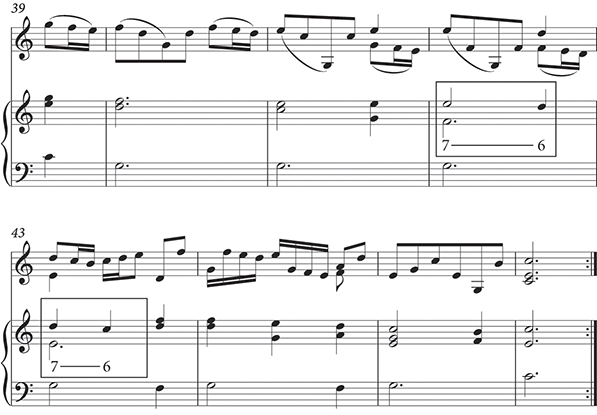
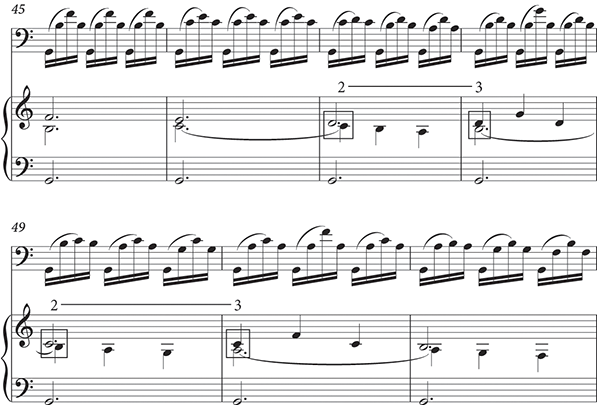
Another important catalyst for Bach composing solo-violin music may have been his contact with Pisendel, the foremost German violinist of their generation, who visited Weimar in 1709 and whom Bach almost certainly met again in Dresden in 1717. Pisendel’s Sonata à Violino Solo Senza Baßo (c. 1716) bears a title strikingly similar to the one Bach used in the 1720 autograph of his Violin Solos: Sei Solo à Violino senza Basso accompagnato. Dorian Bandy describes Pisendel’s penchant for nonmelodic, chordal writing played as arpeggios across two or more strings. In such passages, the left hand fingers the underlying chord progression, and the bowing provides the arpeggiated realization.52 Example 1.2 compares such a passage with a similar technique that appears in the Prelude to Bach’s Suite No. 3 over a climactic dominant pedal: As the cellist’s fingering involves chordal hand shapes, the bow flutters across three strings, expressing the harmonies as broken chords. Dissonances are prepared and resolved in the continuous voice leading felt by the cellist’s left hand, even though they are literally sounded as arpeggios.
Solo music with chordal models representing hand shapes.
Johann Georg Pisendel, Sonata for unaccompanied violin, Allegro.
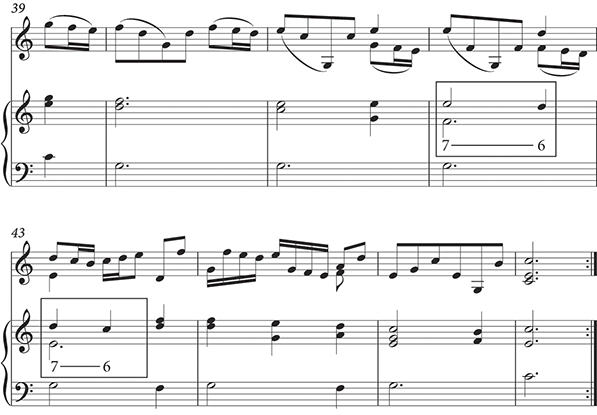
Suite No. 3 in C Major, Prelude.
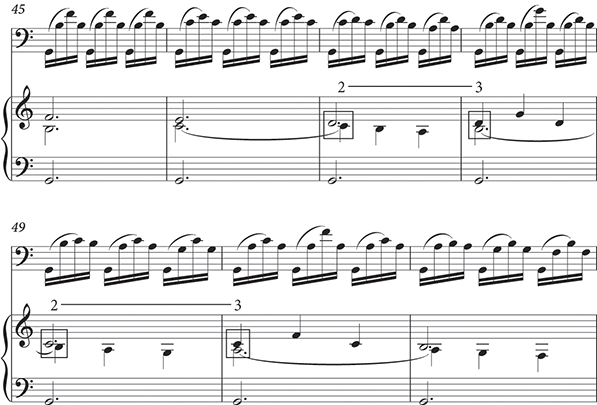
Example 1.2 Long description
Example 1a is a musical score excerpt with measures numbered 39 to 43. The top staff of each system is notated in treble clef and notates Pisendel’s music for solo violin. Below is a grand staff with a chordal reduction playable on a keyboard instrument. The violin music uses mostly eighth notes, with some sixteenth notes, quarter notes, and a dotted-half note for the final chord. It contains some double stops, as well as some slurred, leaping arpeggios. The chordal reduction includes some annotations of 7–6, indicating suspensions and resolutions. Example 1b is organized into measures numbered from 45 to 49. The top staff of each system is notated in bass clef with Bach’s music for solo cello, and below is a grand staff with a chordal reduction. The cello music is composed in slurred, arpeggiated sixteenth notes. The chordal reduction includes some annotations of 2–3, indicating suspensions and resolutions.
Bach and the Solo Cello; or, What Is a Violoncello?
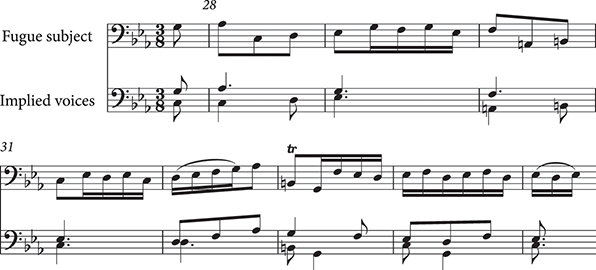
In setting out to compose six suites for unaccompanied cello, Bach took on a significant compositional challenge. Compared to the violin, the cello’s larger size demands greater stretches and more irregular fingerings, posing technical constraints that would preclude the sort of dense, chordal writing found in Bach’s solo-violin fugues and Ciaconna. To adapt the German solo-violin tradition or the French solo-viol tradition for the cello would call for creative solutions to surmount these technical constraints, using compositional artifice to imply polyphony that exists only in a listener’s mind, without relying on extensive chordal writing to express multiple voices more literally. The difference between Bach’s writing for violin and cello is illustrated by comparing his three solo-violin fugues to his solo-cello fugue in Suite No. 5. Whereas the former are rife with finger-twisting three- and four-note chords, the latter uses limited double stops (mostly involving open strings), suggesting polyphony largely through implication (see Example 1.3).
Suite No. 5, Prelude, fugue subject as compound melody.
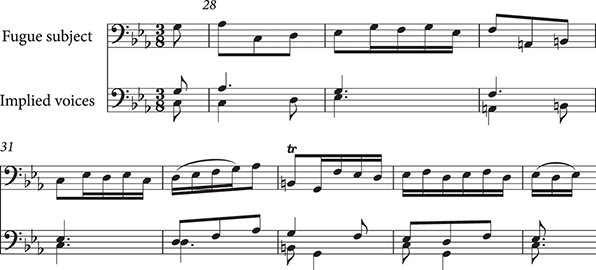
Example 1.3 Long description
The score is notated with Western staff notation and contains measures numbered from 28 to 35. Each system contains two staves notated in bass clef, with a key signature indicating C minor (with three flats) and a time signature of 3/8. The top staff, labeled “fugue subject,” reproduces Bach’s solo-cello fugue subject from the Prelude to Cello Suites No. 5. It is composed in a combination of eighth notes and sixteenth notes and is a single-line melody with no double stops. The bottom staff, labeled “implied voices,” is notated as a two-part duet based on the fugue subject. The melodic part of the duet is based on the high notes from the fugue subject, and the bass part of the duet is based on the lower notes. The duet is notated in slower note values, including dotted-quarter notes, quarter notes, and eighth notes.
What precisely motivated Bach to compose unaccompanied cello music is unclear. Like many of Bach’s “opus” collections, they may have been written to rise to a novel challenge, perhaps to illustrate compositional virtuosity by exploring the particularities, affordances, and constraints of the cello, which was only just beginning to emerge in German lands as a solo instrument.
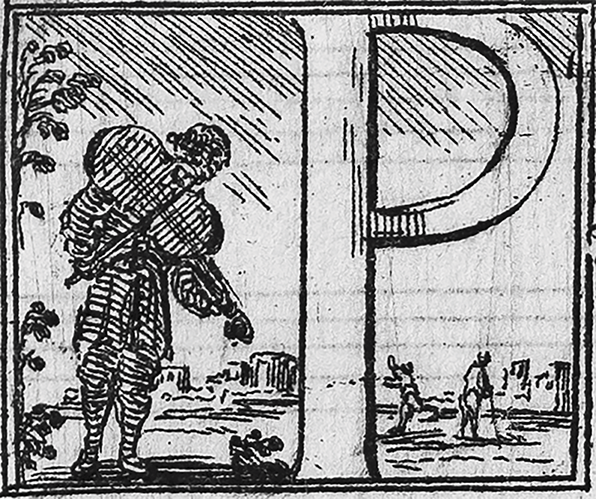
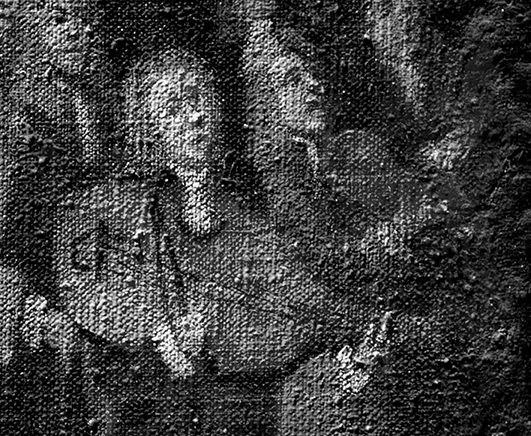
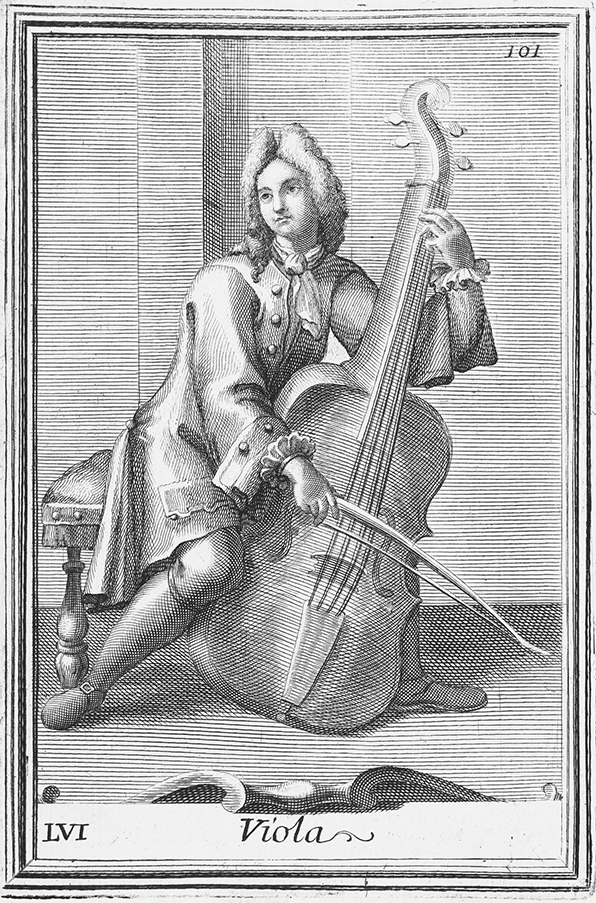
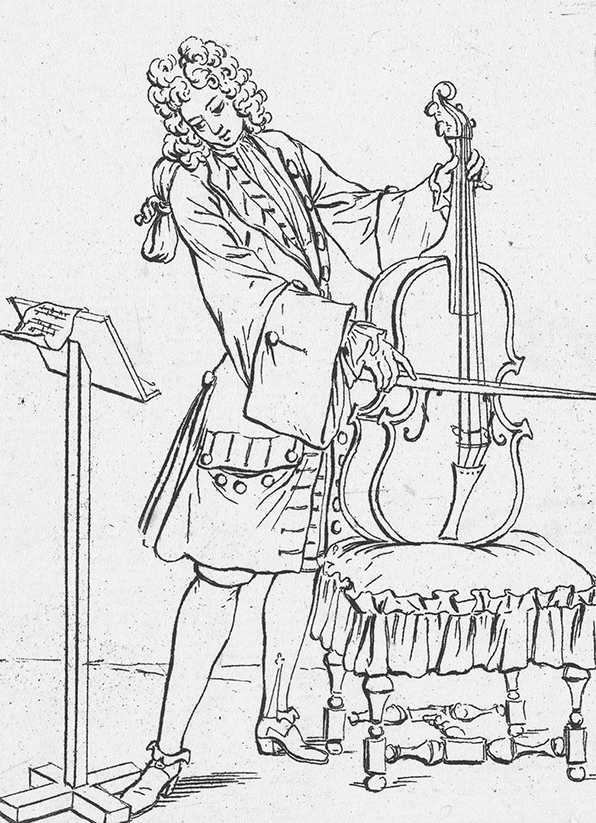
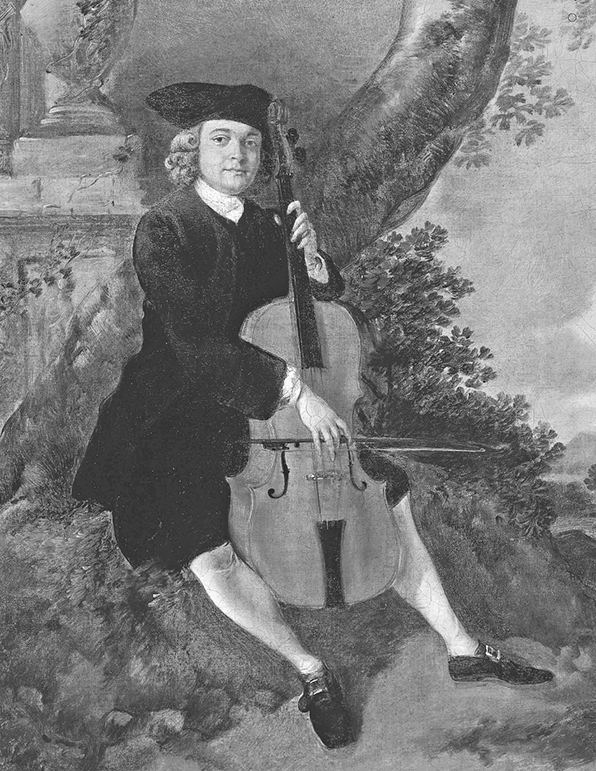
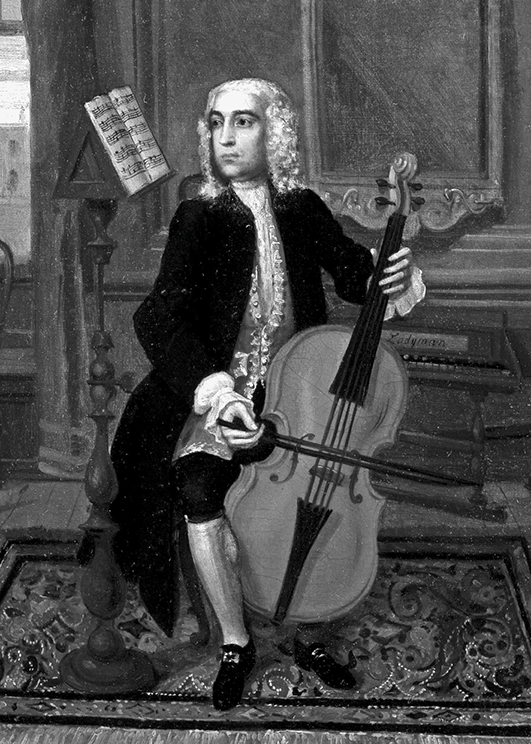
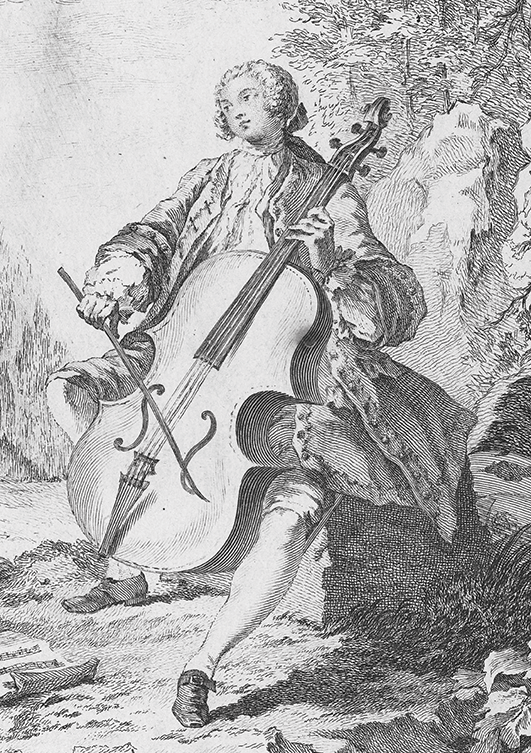
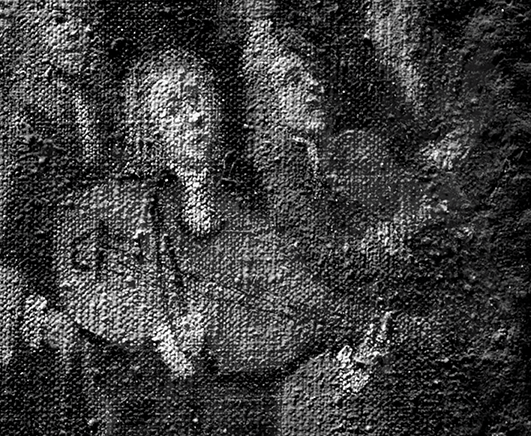
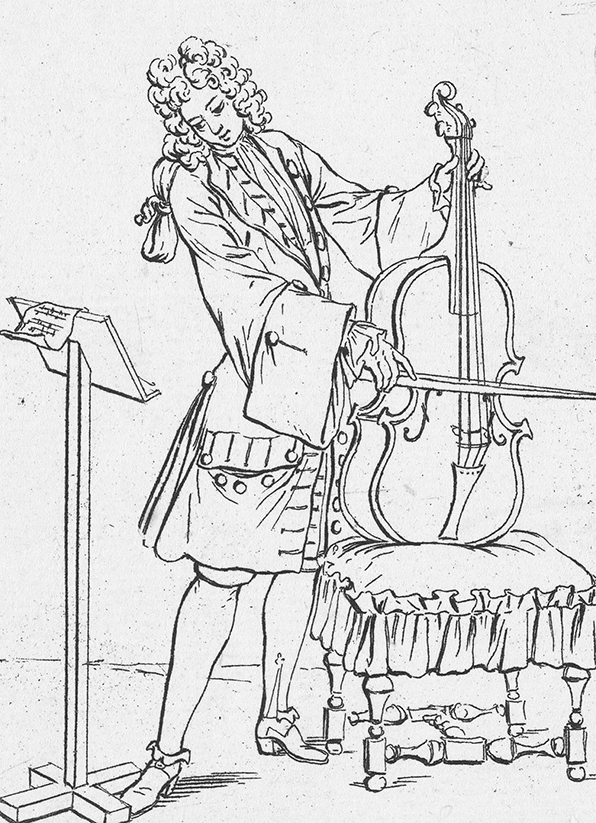
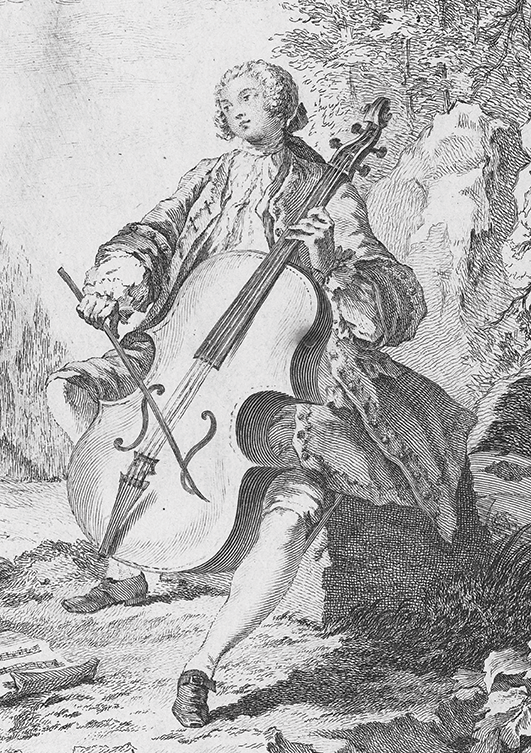
Did Bach play the cello? What sort of instrument was called “violoncello” during Bach’s lifetime? Surprisingly, both questions resist straightforward answers. Today, the term “cello” (short for “violoncello”) refers to a standardized instrument, with exactly four strings tuned in fifths, with a body length of 75 cm, fit with an endpin to support holding the instrument between the legs. However, for Bach’s contemporaries, it referred to instruments of various sizes, often with four strings but sometimes five. Whereas larger instruments were played between the legs, medium ones could be supported by a stool or else played at the shoulder with the support of a strap. The latter style, called “violoncello da spalla” (shoulder cello) or in German sources “viola di spala” (shoulder viola), was considered a form of cello playing. The modifier “da spalla” is not indicated in scores, since it referred more to a position or playing technique than to a specific kind of instrument.53 Figures 1.1–1.7 show images contemporaneous to Bach that depict various forms of cello playing, including viola da spalla.54
Figure playing viola da spalla (inhabited initial “P” for “prelude”). From Giuseppe Torelli, Concertino per camera a violin e violoncello (Bologna, c. 1687), violoncello partbook (detail).
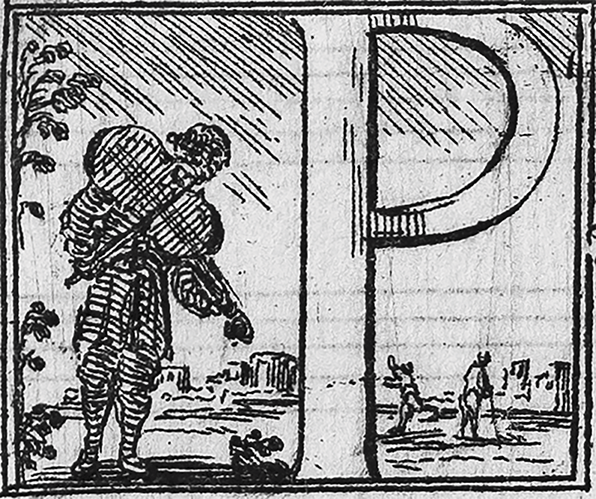
Figure playing viola da spalla. From Procession de la Fête-Dieu à Aix-en-Provence (c. 1710–40). Screen, oil on wood (detail).
Giovanni Battista Sintes and Arnold van Westerhout, engraving labeled “Viola,” after illustration by Stefano Sparigioni. From Filippo Bonanni, Gabinetto armonico (Rome, 1722).
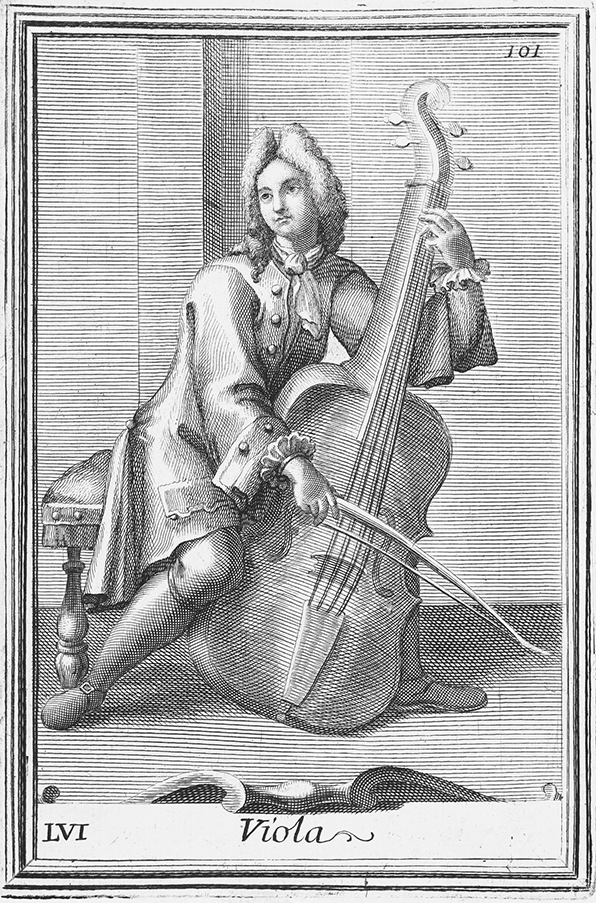
Figure 1.3 Long description
A large cello-like instrument with four strings is leaning vertically against the seated player’s left leg, to the left of the player’s body, with its base on the floor. The instrument has a thick neck and is played with a thick, heavy bow. The male musician is elegantly dressed with a wig and an elaborate jacket. His seated posture leans pronouncedly to his left as he plays at the frog end of a convex bow with a swan-style pointed tip.
Bernard Picart, figure playing cello (1704). Etching (detail).
Thomas Gainsborough, The Rev. John Chafy Playing the Violoncello in a Landscape (c. 1750–52). Oil on canvas (detail).
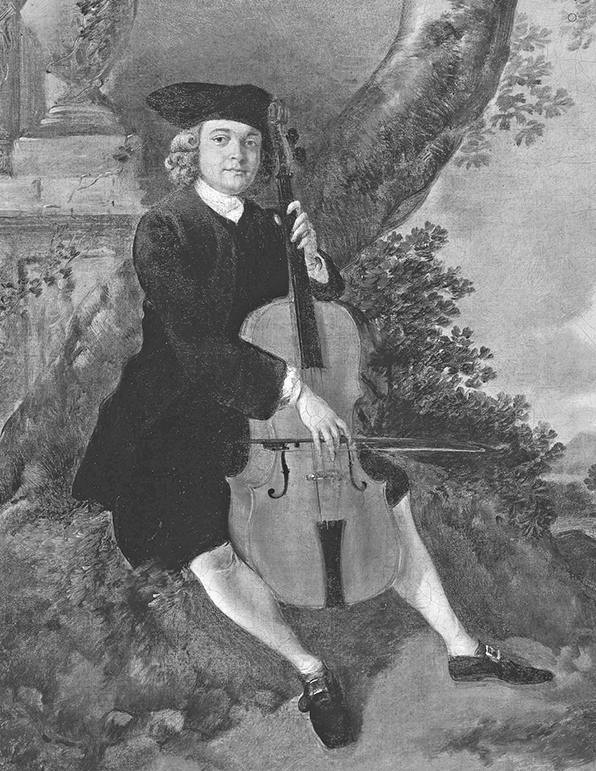
Attributed to Charles Philips, Portrait of a Gentleman with a Violoncello (c. 1720). Oil on canvas (detail), present whereabouts unknown.
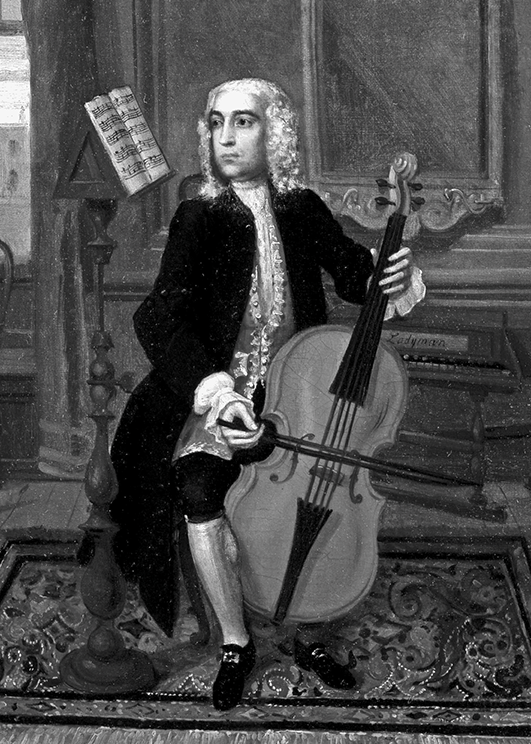
Figure 1.6 Long description
The seated male player in an ornate, lace shirt, jacket and wig holds the cello against his left leg similarly to Fig 1.3. He is seated with an erect posture, with the body of the cello leaning to his left, so that the scroll is somewhat far from his body. He holds how bow with an underhand bow hold, unlike the players in the preceding images. He is in a carpeted room, with a music stand to his right.
Jean-Jacques Flipart, engraving of violoncello player. Frontispiece to Michel Corrette, Méthode théorique et pratique pour apprendre en peu de tems le violoncelle dans sa perfection (Paris, 1741) (detail).
Since the various formats of cellos were all bass instruments and were generally suitable for the same repertoire, many musicians described them as being broadly interchangeable. In a discussion of the cello from 1710, the prolific musical critic and lexicographer Johann Mattheson (1681–1764) focused primarily on viola da spalla playing:
The distinguished violoncello, the bassa viola, and [the] viola di spala are small bass violins, in comparison with the larger ones with five or even six strings, on which one can play all manner of rapid passages, variations, and ornaments with less effort than on the large machines [i.e., the more unwieldy violone]. In particular, the viola di spala, or shoulder viola, has a great effect in accompaniment, because it can cut through strongly and express the notes cleanly. A bass [line] can never be brought out more distinctly or clearly than on this instrument. It is fastened with a band to the chest and thrown, as it were, onto the right shoulder, so that nothing stops or hinders its resonance in the slightest.55
A 1708 instructional manuscript by Bach’s cousin and friend Johann Gottfried Walther (1684–1748) asserted that the violoncello is played in a horizontal position supported by the arm. Surprisingly, he did not even mention the possibility of holding the instrument between the legs:
Violoncello, an Italian bass instrument not unlike a viola da gamba, is played almost like a violin. Namely, it is partly supported by the left hand, which [also] stops the strings. However, owing to its weight [it is also supported] by being attached to a coat button. It is played with a bow in the right hand [and] is tuned like a viola.56
As late as 1752, Johann Joachim Quantz (1697–1773) recommended that a cello soloist have two instruments, a larger one with thicker strings, stronger bow, and coarser (black) bow hair for ensemble (ripieno) playing, and a smaller one with thinner strings, suitable for navigating difficult passagework in solo music.57 Leopold Mozart (1719–87), writing in 1756, echoed Quantz’s remarks about the varying sizes of cellos, mentioning that they commonly have four strings, having formerly had five. But he added a telling detail in his discussion of the viol: Writing about the etymology of “viola da gamba” (literally “leg viola”), he observes that “nowadays the violoncello, too, is held between the legs.”58 Evidently, he considered the preference for playing the cello between the legs to be a recent development, implying that the viola da spalla technique had formerly been a prominent style. The organist Jakob Adlung (1699–1762) – a friend of Walther’s and student of another Bach cousin – simply asserted that the “violoncello is also called viola di spala.”59 In sum, these German sources show the diversity of cello instrumental types and playing styles, of which viola da spalla was an important and integral part.60
Viola da spalla offered the advantage that a player would use the same basic fingerings and technique for the full range of the violin family, from treble (violin) to bass (violoncello) – similar to consorts of recorders or viols (or, in modern contexts, to flutes, clarinets, and saxophones).61 An accomplished player of both violin and viola, Bach would certainly have been capable of playing viola da spalla. Although there is no record of Bach playing any kind of cello, his composition of virtuoso suites that draw maximum musical effect from the minimal instrumental resources of a solo cello suggest an intimate, possibly firsthand knowledge of the instrument’s idioms and capabilities.62 As son of the Eisenach town piper (Stadtpfeifer), Bach would have gained experience handling all sorts of instruments since childhood, having most probably been put to work at a young age assisting with the repair or restringing of instruments that passed through the family’s household.63 In adulthood, Bach amassed a large collection of instruments – for use by his family, students, and himself – that included three violas, two cellos, and a Bassetgen (a smaller instrument, probably with five strings, possibly synonymous with instruments called violoncello piccolo or viola pomposa).64
Aside from the varying sizes and formats of cellos, another perhaps surprising difference between historical and modern playing relates to the style of bowing. Among cellists who held their instruments between the knees, many of Bach’s contemporaries still used an underhand bow hold that today is adopted mostly by viol players (and a growing number of Baroque cellists).65 Linike – the cellist at Cöthen during Bach’s tenure and possibly among the first to play the Cello Suites – almost certainly would have used an underhand bow hold, which had been predominant at the time he learned to play.
The “modern,” overhand bow hold gained popularity first in France and England and gradually became the standard cello technique by c. 1800. This transition in bowing style was documented by British music historian Charles Burney (1726–1814). In the 1770s, Burney heard performances by two of Europe’s finest cellists, Antonio Vandini (c. 1690–1778) in Padua and Markus Heinrich Graul (d. 1799) in Berlin, remarking that both cellists “hold the bow in the old-fashioned way, with the hand under it.”66 Similar comments appear in an extended description from a 1799 review of a performance by cellist Johann Georg Christoph Schetky (1737–1824).67 These latter two musicians, among the most prominent German cellists of their time, were both within Bach’s musical orbit. Born in Bach’s hometown of Eisenach, Graul married into the family of a violinist and viol player who was personally acquainted with Bach, and he became a colleague of C. P. E. Bach at the Prussian court in Berlin in the 1760s. Schetky, a native of Darmstadt, was a close musical associate of Christoph Graupner (1683–1760), Bach’s one-time competitor for the St. Thomas cantorate in Leipzig.68
Players who use the (modern) overhand bow hold tend to prefer down bows (from frog to tip) where stronger strokes are needed, such as for chords and on downbeats (per the “rule of the downbow”). However, the opposite tends to be true for those using the underhand hold, where up bows (from tip to frog) are the stronger stroke. Quantz remarked in 1752 that “some [cellists] move the bow as it is customary on the viola da gamba, that is, instead of a down-stroke from left to right for the principal notes, they make an up-stroke from right to left, beginning from the tip of the bow.”69 The approach to bowings for the Cello Suites, therefore, would depend considerably on the type of instrument and bow hold. Many cellists contemporary to Bach (and his sons) used the underhand hold and would therefore have had bowing habits roughly opposite to those adopted by modern cellists. A viola da spalla player would essentially play the instrument like a very large violin, using the overhand bow hold and choosing bowings accordingly. Each of these playing styles – using a large instrument between the legs (with either underhand or overhand bow hold) or playing a smaller instrument as viola da spalla – would be conducive to different ways for the bow to navigate string crossings and slurs, resulting in various tendencies for articulation and phrasing.
One might wonder precisely which variety of cello and which bowing style Bach may have had in mind for his Cello Suites, but perhaps that may be the wrong question. Given that Bach had mastered all variety of keyboard instruments – organ, harpsichord, clavichord, and so on – with many compositions playable on various kinds, Wolff argues convincingly that Bach seems to have conceived the Cello Suites “to accommodate a fluid situation without being prescriptive” as to the precise type of instrument.70 Moreover, since the Violin Solos and Cello Suites were compiled as a two-part collection, together they offer a survey of styles and playing techniques that spans the range of the violin family, from treble to bass. This collection of music for solo violin and cello thus exemplifies C. P. E. Bach’s aforementioned remark about his father’s complete understanding of all string instruments. Bach’s conception of this project may well explain his rationale to compose not for solo viol – the instrument favored by his patron and his friend Abel – but instead to combine elements from the French pièces de viole and the German solo-violin traditions into an original synthesis for the more modern cello, then a novel solo instrument in German-speaking lands and one that belongs together with the solo violin as members of the same instrumental family. A musician who could play both books of this two-part collection would surely be considered a virtuoso on string instruments. And Bach, then known primarily as an organist and composer of keyboard music, proved his complete mastery of the violin family through the remarkably original and elaborate Violin Solos and Cello Suites, whose impact on solo-string playing and composition is felt even today.