I. INTRODUCTION
Lithium-ion batteries have emerged as the most competitive power source, and the search for new anode materials to improve energy density has been ongoing. The crucial factor for the development of advanced lithium-ion batteries is the high-performance electrochemical properties of electrode materials, such as stability and Li+ diffusion. Reference Ji, Lee and Nazar1,Reference Tarascon and Armand2 Among a large number of alternative Li-ion batteries negative materials, transition metal oxide, SnO2, has attracted much attention owing to its high theoretical specific capacity (782 mAh/g), which is more than twice that of conventional graphite. Reference Wang, Wang, Fang, Wan, Liu, Lian, Shao, Chen, Zhang and Cao3–Reference Du, Yin, Zhang, Hao, Wang and Wang5 However, the practical implementation of SnO2 is mainly frustrated by the large volume expansion–contraction (∼300%) during the charge–discharge process. Such volume variation results in pulverization and thus there is a loss of electrical contact that greatly limits the cycling life of electrodes. The use of nanostructured SnO2 (sometimes combined with other ancillary materials) is a popular approach to partially solve the above issue, since the morphology and size of this semiconducting metal oxide nanomaterial have been shown to drastically affect its properties. Reference Li, Dhanabalan, Gu and Wang6,Reference Zhu, Lu, Oo, Hng, Ma, Zhang and Yan7
In the past decade, to increase the surface areas and maximize their performances, great efforts have been devoted to synthesizing SnO2 nanostructures with different morphologies, including nanoparticles, Reference Juttukonda, Paddock, Raymond, Denomme, Richardson, Slusher and Fahlman8 nanorods, Reference Liu, Li, Huang, Ding, Hu, Jiang and Liao9 nanobelts, Reference Duan, Yang, Liu, Gong, Huang, Zhao, Zhang and Du10 nanotubes, Reference Ye, Zhang, Yang, Li and Qi11 nanowires, Reference Park, Kang, Wang, Dou and Liu12,Reference Park, Wang, Kang, Wexler, Dou and Liu13 hollow spheres, Reference Lou, Wang, Yuan, Lee and Archer14 and mesoporous structures. Reference Chou, Wang, Liu and Dou15,Reference Ba, Polleux, Antonietti and Niederberger16 These reports have attracted significant attention to structural modifications of SnO2 on the nanoscale, because the electrochemical performances of SnO2 seem to have a strong correlation to its structural features. Among them, mesoporous structures have attracted considerable research interests because of their high specific surface area, large pore volume, periodically distributed pores, and peculiar surface properties. The ordered mesoporous materials are regarded as excellent Li-ion batteries electrode materials, because their mesopore structures can decrease the distance of Li-ion diffusion, and their large specific surface area supplies more active sites for Li-ion insertion and extraction. Moreover, porous structure could also increase thermal and mechanical stability of the electrode materials. Reference Li, Feng, Ou, Wu, Fu and Tong17–Reference Luo, Wang, Xiong and Xia19
Although there have been some reports on the syntheses of mesoporous metal oxides by synergetic self-assembly between organic templates and inorganic precursors, Reference Liu, Lee, Tracy, Yan and Turner20–Reference Zhou, Lin and Honma22 those are less successful compared to the syntheses of mesoporous silica-based materials. One difficulty lies in the structural collapse during the mesostructure formations and during the removal of organic templates, which are probably due to high lattice energies of most metal oxides. Also, there is the other limitation when the metal precursors are not stable in solution enough to infiltrate them within the mesopores of silica template, due to their fast hydrolysis and precipitation. For example, the utilization of aqueous solution of SnO2 precursors such as SnCl2 and SnCl2·2H2O is very difficult, because the precursors are readily hydrolyzed to form precipitates within few minutes after the dissolution of precursors in water. Therefore, it is intriguing to find that nanowires or mesoporous SnO2 could be obtained by a similar nanoreplication method reported in the literature, Reference Wang, Wang, Fang, Wan, Liu, Lian, Shao, Chen, Zhang and Cao3,Reference Shon, Kong, Kim, Lee, Park, Park and Kim23,Reference Qiao, Li, Fu, Kumar, Wei, Cai and Huang24 since the filling degree of mesopores with the precursors is hard to control, and the formation mechanisms are poorly elucidated. Generally, to obtain a highly ordered mesoporous SnO2, it is necessary to fill the cavities of mesoporous silica template with the tin precursor as completely as possible. Otherwise, the obtained sample would be SnO2 nanowires or nanorods. Comparatively speaking, the molten state precursor is more inclined to totally fill the mesoporous channels of SBA-15 silica than that of dissolution of precursor in any solvent, since it excludes filling of pores with the solvent and does not require multiple impregnations to reach critical metal loading necessary for integrity of nanocasts, which will also hinder the rapid hydrolysis of tin precursor under solvent-free condition.
In this work, the mesoporous SnO2 and nanorods were synthesized by controlling the state of SnCl2·2H2O precursor with SBA-15 as hard template. The experimental results reveal that the mesoporous and nanorods SnO2 formation follows different mechanism, and the possible formation mechanisms for tin oxide nanocrystalline at different assembling modes inside the mesopores of SBA-15 are proposed. Moreover, the lithium storage properties of mesoporous SnO2, nanorods, and nanoparticles are discussed.
II. EXPERIMENTAL
A. Synthesis of mesoporous SnO2 (MP-SnO2)
The mesoporous SBA-15 silica was prepared in an aqueous solution using Pluronic P123 (EO20PO70EO20, M w = 5800, Aldrich, Lake Havana City, AZ) according to previously reported methods. Reference Zhao, Huo, Feng, Chmelka and Stucky25 To obtain a tin oxide-SBA-15 composite, first 1.0 g of mesoporous SBA-15 silica was activated for 1 h at 100 °C. Separately, 1.0 g of SnCl2·2H2O was melted within a glass bottle at 80 °C, and then the molten SnCl2·2H2O was poured into a polypropylene bottle containing the above preheated silica template. The bottle containing the mixture was closed and shaken vigorously to mix the SnCl2·2H2O and silica template. Subsequently, the bottle was put in an oven at 90 °C for 10 h for the spontaneous infiltration of SnO2 precursor within the mesopores of silica templates. Since the SnCl2·2H2O precursor with low melting point (m.p. 37–38 °C) is inclined to infiltrate within the mesopores of silica template and completely occupy all the mesoporous channels of SBA-15, the obtained products were then calcined at 500 °C in air for 4 h and the silica template was completely removed from the SnO2/SiO2 composite by treating with 10 wt.% HF aqueous solution for 5 h. Finally, the mesoporous SnO2 material was washed with distilled water several times and dried in a vacuum oven at room temperature overnight.
B. Synthesis of the rod-like SnO2 (R-SnO2)
0.5 g of SnCl2·2H2O was dissolved in 40 mL of 0.2 M HCl solution. 1.0 g of as-prepared SBA-15 was added to the solution. After 6 h of stirring, the mixture was dried at 80 °C. Then, the obtained products were calcined, washed, and dried by the same procedure with that of mesoporous SnO2.
C. Synthesis of SnO2 nanoparticles (SnO2-NP)
SnO2 nanoparticles were synthesized using hydrolysis depositing method by controlling the pH value of the reaction solution. Briefly, 5.0 g SnCl4·5H2O was dissolved in 50 mL of deionized water and stirred for 1 h. The pH of the solution was adjusted to 3 with ammonia solution. After being stirred for 0.5 h, the solid products were precipitated for 2 days and aged for 3 days. After the reaction was finished, the resulting solid products were centrifuged, washed with distilled water to remove the ions possibly remaining in the final products, and then dried in the air. Following, the SnO2-NP products were calcined at 300 °C for 4 h in the air.
D. Structural characterization
The morphology and microstructure of the samples were measured by a field-emission scanning electron microscopy (JEOL JSM-6700F, 15 kV, JEOL Ltd., Japan). The transmission electron microscope (TEM) observations were performed on a JEOL JEM-2010F electron microscope (JEOL Ltd., Japan) operating at 200 kV. X-ray diffraction (XRD) patterns at low angle (2θ range from 0.5° to 5°) and wide angle (2θ range from 20° to 80°) were obtained from Japan Rigaku D/max-2500 V powder x-ray diffractometer (Rigaku Co., Japan) operating at 40 kV and 30 mA and using Cu Kα radiation (λ = 0.15406 nm). The particle sizes of SnO2 nanomaterials were calculated by Scherrer equation (D = 0.89λ/Bcosθ) with XRD data.
E. Electrochemical measurements
Electrochemical experiments were carried out using two-electrode Swagelok-type cells. The working electrodes were prepared by mixing the active materials, acetylene black, and polytetrafluoroethylene (PTFE) at a weight ratio of 80:10:10 and pasting the mixture on pure Cu foil (99.6%, Goodfellow). The diameter and mass of the working electrode are approximately 14 mm and 4–6 mg, respectively. A microporous polypropylene film Celgard 2400 (Celanese Corporation, Charlotte, NC) was used as a separator. Pure lithium foil (ϕ = 15 mm, 1.0 mm thick, Aldrich) was used as a counter/reference electrode. The electrolyte consisted of a solution of 1 M LiPF6 in a mixture of dimethyl carbonate (DMC), diethyl carbonate (DEC), and ethylene carbonate (EC) (1:1:1 by weight) obtained from Ube Industries Ltd. (Tokyo, Japan). The cells were assembled in an argon-filled glove box. Electrochemical performances were tested at a current density of 100 mA/g (0.1 C) in the voltage range of 0.005–3.0 V using a LAND CT2001A battery test system (Wuhan, China).
III. RESULTS AND DISCUSSIONS
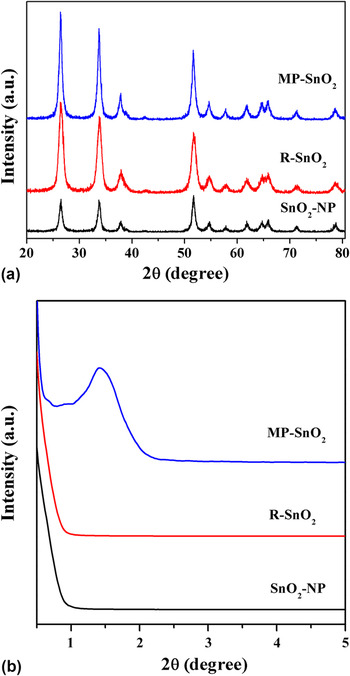
Figure 1(a) shows wide-angle XRD patterns of the MP-SnO2, R-SnO2, and SnO2-NP materials. All the broad diffraction peaks of the XRD pattern are in accordance with the tetragonal rutile SnO2 structure (JCPDS No. 41-1445, a = b = 4.74 Å, and c = 3.19 Å). No signals from possible impurities such as SnO residue are detected. By comparing the full width half maximum of the diffraction peaks, one can easily find that the diffraction peaks of mesoporous and nanorods are broader than that of nanoparticles, which may be attributed to different particle sizes of as-prepared SnO2 samples. The apparently high diffraction intensities indicate that the two former samples have better crystallinity with fewer lattice distortions along the c axis in the tetragonal system. Reference Park, Wang, Kang, Wexler, Dou and Liu13 Experimentally, the MP-SnO2 is synthesized through the spontaneous infiltration of molten state SnCl2·2H2O into the mesoporous channels of SBA-15 silica; therefore, it has an order mesostructure, which completely replicates the pore structure of the SBA-15 template in which nearly all the MP-SnO2 is present in the form of a connected mesostructured network. However, the R-SnO2 is obtained through impregnation of SnCl2·2H2O aqueous solution into the mesoporous of silica templates. As water evaporates during the drying and calcinations process, the insufficient amount of SnO2 species inside the mesopores within the silica framework of SBA-15 template results in the partial loss of mesostructures, Reference Shon, Kim, Kong, Hwang, Han, Kim, Park, Doo and Chang26 therefore the rod-like SnO2 is obtained. Figure 1(b) shows low-angle XRD patterns (2θ range from 0.5° to 5°) of the three samples. The as-synthesized MP-SnO2 sample exhibits a diffraction peak, indicating a highly ordered mesostructure, which will be further evidenced by the high resolution transmission electron microscopy (HRTEM) data [Fig. 2(d)]. Whereas, there are no diffraction peaks appeared in the low-angle region for R-SnO2 and SnO2-NP, which means that the mesoporous structure does not exist in these two samples.
X-ray diffraction patterns of SnO2 with different morphologies: (a) wide angle and (b) low angle.

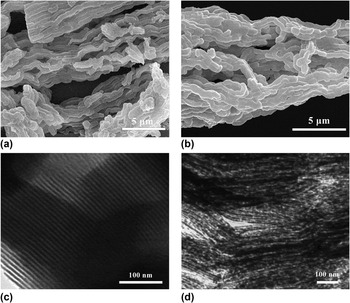
SEM and TEM images of the mesoporous silica templates (a, c) and mesoporous SnO2 (b, d).

Figure 2 shows scanning electron microscopy (SEM) and TEM images of the mesoporous silica templates and the replicated mesoporous SnO2 materials. A panoramic view of the as-synthesized SBA-15 reveals that the sample consists entirely of nanorods with a diameter of around 500 nm and length about 2–3 μm, as shown in SEM images [Fig. 2(a)]. Further TEM characterization [Fig. 2(c)] evidences the main mesopores of SBA-15 as open and parallel one-dimensional (1D) channels with a uniform size of around 9 nm. These remarkable structural features of SBA-15 make it ideal as the template for the synthesis of mesopores SnO2 by the infiltration of corresponding precursor (SnCl2·2H2O in this work) and followed by template elimination, of which the SEM image is shown in Fig. 2(b).
TEM examination [Fig. 2(d)] clearly shows that all the mesoporous SnO2 materials exhibit well-distinguishable mesostructures and highly crystalline frameworks, indicating the successful replication from the silica templates. The result is also consistent with the existence of XRD reflections at low angle of 2θ < 5° as shown in Fig. 1(b). The domain sizes of the SnO2 particles are about 8 nm, which are correlated to the channel diameter of the SBA-15 template. This value, however, is slightly smaller than the SBA-15 channel diameter (∼9 nm), which is due to the incomplete occupation of the pore space by SnO2 after annealing at 500 °C. On the other hand, this smaller particle size can also be attributed to the contraction of the SnO2 particles during the annealing process. Accordingly, the pore size of the mesoporous SnO2 is slightly larger than the pore-wall thickness of the SBA template. It should be noted that even after the removal of the supporting template, the MP-SnO2 are still well assembled to form ordered arrays with macroscopic rod-like shape without structural degradation such as fracture or amalgamation, indicating the good structural stability for practical utilization.
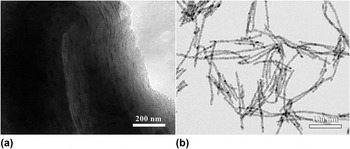
Figure 3 shows TEM images of the sample synthesized by impregnation of SnCl2·2H2O aqueous solution within the mesoporous of silica templates. As shown in Fig. 3(a), all of the SnO2 materials exhibit rod-like morphologies without the formation of any other SnO2 morphologies outside the silica template. After the silica template is removed by the HF solution, the meso–SnO2–HF material exhibits totally rod-like morphologies [Fig. 3(b)]. The TEM image shows that individual SnO2 rod has a diameter of about 6 nm and a length in the range of 150–200 nm. In general, metal oxides prepared from solvent-based SBA-15 template lead to aggregated nanorods or nanowires, and our rod-like morphology is quite similar to that of reported nano SnO2, CeO2, and In2O3. Reference Kim and Cho27–Reference Satishkumar, Titelman and Landau29
TEM images of the rod-like SnO2 with template (a) and without template (b).

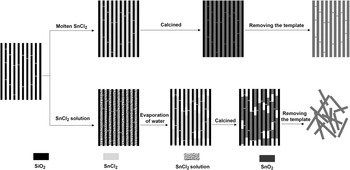
Based on the above experiments, the formation mechanism of mesoporous and rod-like SnO2 is described as follows (as shown in Fig. 4). For solvent-free infiltration method, a tin precursor with low melting point (SnCl2·2H2O, m.p. 37–38 °C) is infiltrated within the mesopores of silica template by simply heating a physical mixture of precursor and silica template. Then, the mesoporous channels of SBA-15 are almost completely occupied by molten tin precursor. When the precursor/SBA-15 composite is calcined at 500 °C in air, the precursor is converted into SnO2 phase, and the mesostructure of SnO2 is highly ordered and very similar to that of mother silica template. It consists of spherical nanoparticles with regular sizes and there are interconnections between the nanoparticles, maintaining the integrity of SnO2/SBA after removal of silica template. Therefore, the obtained SnO2 is a well-ordered mesostructure. Whereas for the aqueous solution based infiltration method, the sample is obtained by using the impregnation of precursors within the mesopores of silica templates after dissolution of precursors in an aqueous solution. As water evaporates during the drying and calcinations process, the insufficient amount of SnO2 species inside the mesopores within the silica framework of SBA-15 template results in the partial loss of mesostructures, especially after the removal of silica frameworks by HF solution, as compared with those of MP-SnO2 materials. Therefore, the resulting materials exhibit rod-like structures. The other possible reason for the mesostructure loss of the rod-like SnO2 is that a partial amount of SnO2 species, especially interconnecting species, are removed during the etching process due to the reactivity of SnO2 toward HF. As suggested above, mesoporous and rod-like SnO2 can be controllably synthesized by changing the states of tin precursors.
The schematic representing a proposed mechanism for the formation of the mesoporous and rod-like SnO2 using mesoporous silica templates.

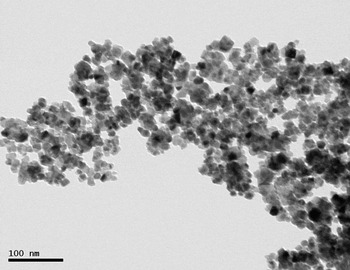
As comparison, SnO2 nanoparticles are synthesized using hydrolysis depositing method and the TEM image is shown in Fig. 5. It shows that the SnO2 nanoparticles agglomerated with main size of ∼20 nm, which is consistent with the results of XRD analysis based on the Scherrer equation.
The TEM image of SnO2 nanoparticles.

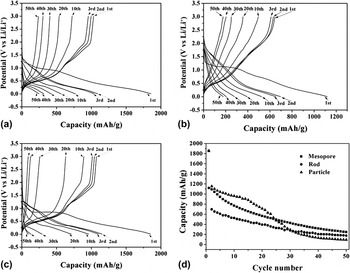
The electrochemical reactivity of the SnO2 nanomaterials at a constant current density of 100 mA/g in the potential range of 0.005–3.0 V was tested up to 50 cycles (Fig. 6). The profiles are qualitatively very similar indicating the same electrochemical pathway and are consistent with previous reports. Reference Liu, Li, Huang, Ding, Hu, Jiang and Liao9,Reference Ye, Zhang, Yang, Li and Qi11,Reference Kim and Cho27 The characteristic plateau around 1.0 V observed in the first discharge curves is associated with the conversion reaction: SnO2 + 4Li+ + 4e− → 2Li2O + Sn, Reference Park, Kang, Wang, Dou and Liu12 which is totally irreversible. Moreover, there is a slope around 0.5 V constantly existed during all the charge/discharge cycles for the three samples, indicating that the alloying/de-alloying reaction between Sn and Li, Sn + xLi+ + xe− → Li x Sn (0 ≤ x ≤ 4.4), Reference Liu, Li, Huang, Ding, Hu, Jiang and Liao9 is constantly reversible. The galvanostatic voltage profiles in Figs. 6(a)–6(c) show that these nanocomposites electrode exhibited high initial lithium insertion capacities, the values are 1856, 1119, and 1850 mAh/g for mesoporous, rod-like, and nanoparticles, respectively. Whereas, a relatively large loss of initial capacity is evident for all the three samples, about 55.5% for the mesoporous, 57.5% for the rod-like SnO2, and 57.9% for the SnO2 nanoparticles, which could be mainly ascribed to the irreversibility due to SnO2 reduction. This shows that the morphology do not affect largely on their initial coulombic efficiencies. After 50 continual charge/discharge cycles, there is still a visible plateau during lithiation process for mesoporous SnO2, whereas the discharge curve drops sharply at all voltage range for nanoparticles. Apparently, crystalline texture and surface atomic arrangement of synthesized nanostructures are the primary factors for the size- and morphology-dependent electrochemical properties. Though nanometer-sized particles have multifold merits, for example, preferable accommodation to the strain of Li+ insertion/extraction in the processes of discharge and charge to maintain the integrity of electrode materials, the high surface areas raise the risk of secondary reactions, including formation and/or decomposition of solid electrolyte interphase layers. And the secondary reactions may cause a large irreversible capacity loss (i.e., low coulombic efficiency) and consumption of active materials and result in a poor cycle life. Therefore, the cyclic performances of SnO2 varied for different sizes and morphologies.
The discharge–charge curves of (a) mesoporous SnO2, (b) SnO2 rods, (c) SnO2 nanoparticles, and (d) their cycle performances.

A comparison of the charge cyclic performances for mesoporous SnO2, nanorods, and nanoparticles is shown in Fig. 6(d). It shows that both of the mesoporous and nanoparticles electrodes in the initial four charge cycles show specific capacities of more than 1000 mAh/g. Whereas, the charge capacities for R-SnO2 are about 700 mAh/g in first several cycles. These tremendous capacity differences might be largely associated with Li+ transportation within SnO2 nanostructures and nanoscales. For example, in the ordered mesoporous SnO2 material, the pores are uniform in size (3–4 nm) and shape, and also being connected in a continuous three-dimensional networks, which are favorable for fast electrolyte diffusion and can provide a large number of active sites for lithiation/delithiation reactions. For SnO2 nanoparticles, the uniform three-dimensional nanosize (∼20 nm) is inclined to soak in the electrolyte, which will also reduce the distance of lithium-ion diffusion. Whereas, compared with the above two samples, the rod-like SnO2 has a complex stack structure, which is relatively much difficult for lithium ions intercalation/deintercalation, so its initial discharge capacity is the lowest.
From the 5th to 15th cycle, the capacity of mesoporous SnO2 decreased significantly from 943 to 657 mAh/g. In contrast, the capacity of SnO2 nanoparticles declines slowly from 1042 to 883 mAh/g. As pointed out before, the main reason for capacity fade is a large volume expansion of SnO2 material that occurs during lithium ions intercalation/deintercalation process, leading to fragmentation and pulverization of the electrode. Reference Paek, Yoo and Honma30 It is obvious that the state of nanoparticles is more effective in easing the volume change at an early stage. However, after a certain number of cycles, the tendency of agglomeration of SnO2 nanoparticles would induce a rapid capacity fade. For rod-like SnO2, though the reticular stacking structure would limit the intercalation of Li+ ions, the effect of volume expansion in this case upon cycling is insignificant. Moreover, the presence of sufficient interspace between the nanorods allows fast lithium-ion flux across the interface and mitigates the strain associated with lithium uptake, as well as prevents the nanostructures from agglomeration. Therefore, an improved cycle property can be obtained. By contrast, the mesostructure SnO2 tends to be stable after partial structural collapse at first few cycles. And the Li+ ions can readily intercalate and de-intercalate into/from its ordered channels structure, which would permit high lithium-ion flux across the interface, reduce lithium-ion diffusion distance, and facilitate electron transfer to the current collector (copper foil) through the mesoporous structure, providing a high capacity and stable cycling life property. After 50 cycles, the capacity retention rates compared to the second cycle are 22.7%, 25.5%, and 8.2% for SnO2 mesoporous, nanorods, and nanoparticles, respectively. Overall, the mesoporous SnO2 as electrode material shows the best electrochemical properties.
IV. CONCLUSIONS
The mesoporous and nanorods SnO2 were successfully synthesized using SBA-15 as a hard template. From the above study, it was confirmed that formation mechanism of metal oxide by nanocasting method depends upon the state of the precursor. As comparison, the SnO2 nanoparticles were also synthesized by hydrolysis depositing method. The lithium storage properties of the as-prepared samples demonstrate that electrochemical performance of SnO2 nanomaterials is likely to be related to their morphological features and nanoscales. For rod-like SnO2, though the reticular stacking structure would limit the Li+ ions to intercalate, the effect of volume expansion in this case upon cycling is insignificant. Nevertheless, the mesostructure SnO2 tends to be stable after partial structural collapse at first few cycles. And the Li+ ions can readily intercalate and de-intercalate into/from its ordered channels structure, which would provide a high capacity and an improved cycle property. After 50 cycles, the capacity retention rates compared to the second cycle are 22.7%, 25.5%, and 8.2% for SnO2 mesoporous, nanorods, and nanoparticles, respectively.
ACKNOWLEDGMENTS
This work is supported by the Natural Science Foundation of China (11275121, 21241002, and 21371116), the Science and Technology Committee of Shanghai (11DZ110020, 13DZ1200502, and 13XD1424600), and the Shanghai Leading Academic Disciplines Project (S30109).