




No CrossRef data available.
DISSOCIABLE SYSTEMS IN SECOND LANGUAGE INFLECTIONAL MORPHOLOGY
Published online by Cambridge University Press: 01 September 2004
Abstract
Pinker and Prince (1988) argued that two dissociable systems underlie the development of linguistic representations: one rule governed and the other associative. These two dissociable systems of representation and processing are claimed to be a linguistic universal (Pinker, 1999). Therefore, one should expect that nonnative speakers of a language also manifest the same kinds of dissociations in performance between rule-based and associative features of language as native speakers. The study reported here extends the work of Prasada and Pinker (1993) into the second language (L2) domain to test whether nonnative speakers (a) perform similarly to native speakers and (b) dissociate rule-based from associative features of language. In Prasada and Pinker, the degree of similarity between a nonce verb and a real English verb influenced past-tense generalizations on nonce irregular verbs but did not influence generalizations on nonce regular verbs. In the experiment reported here, first language (L1) and L2 participants of different ages and language groups were compared on the same task as that used by Prasada and Pinker. Participants overall produced more verbs with a past-tense suffix for nonce regular items than for the nonce irregular items. Significant group effects indicate that participants' varying levels of experience with English play an important role in their past-tense productions of nonce verbs. Furthermore, similarity influenced both the regular and irregular verbs on a production task. These results are discussed in terms of whether there are two dissociable systems underlying L2 linguistic knowledge and whether an alternative single associative learning mechanism could be responsible for the development of the system of regular and irregular inflectional morphology in both L1 and L2 learning.This research was partly funded by a Social Sciences and Humanities Research Council (SSHRC) grant (no. 752-94-1808). I appreciate the help of Jennifer Graham in collecting the data and am grateful to Nick Ellis, Nina Spada, Lydia White, and five anonymous SSLA reviewers for helpful comments on earlier drafts of this manuscript.
Information
- Type
- Research Article
- Information
- Copyright
- © 2004 Cambridge University Press
The past few decades of psycholinguistic research have included considerable discussion as to how linguistic representations are structured and developed. A central debate is whether linguistic knowledge is best understood as a system of hierarchically structured representations of principles and rules (e.g., Chomsky, 1986; Fodor & Pylyshyn, 1988) or whether linguistic behavior can be accounted for in terms of associative mechanisms and representations (e.g., MacWhinney, 1994; Rumelhart, Hinton, & McClelland, 1986). A hybrid model has emerged that incorporates both a rule-governed system and a system of associative memory (Pinker & Prince, 1994). This model—henceforth, the dual-mechanism model—is said to encapsulate the regular, systematic features of language, such as regular inflectional morphology in English, but also to account for more irregular, exemplar-based linguistic features, such as irregular English inflectional morphology (Marcus, Brinkmann, Clahsen, Wiese, & Pinker, 1995).
Much of the research supporting the dual-mechanism model has arisen from work within first language (L1) acquisition. More recently, however, second language (L2) researchers have explored whether the dual-mechanism model can help to explain the development of L2 grammars (e.g., Beck, 1997; Clahsen, 1995; Ullman, 2001). In fact, Pinker (1999) has claimed that the distinction between these two systems in general and the symbolic rule-based default in particular is a linguistic universal.1
Note that Pinker was not suggesting there is something inherently innate about the English past-tense system. Rather, he was suggesting that having one representational system for rule-based features and another system to represent associative features of language is a universal feature of how humans represent and process linguistic information.
DUAL-MECHANISM MODEL
An ongoing debate in cognitive science (see Bechtel & Abrahamsen, 1991; Clark, 1989; Pinker & Mehler, 1988) is whether a traditional symbolic account of cognition (e.g., Pinker & Mehler) is more effective in accounting for human development and cognitive performance than an associative, connectionist account (e.g., Elman et al., 1996). The traditional account proposes that knowledge of language, for example, can be best understood in terms of a system of hierarchically structured symbolic representations. The associative-connectionist account, on the other hand, suggests that language is not represented in terms of a system of symbolic representations but rather an associated network of distributed representations. One of the interesting issues generated by this debate was initiated in Pinker and Prince (1988). In their critique of Rumelhart and McClelland's (1986) connectionist model of past-tense formation, Pinker and Prince argued for a dissociation between the regular and irregular inflectional systems, where both the traditional symbolic and associative-connectionist forms of representation are relevant. Pinker and Prince (1994) outlined a number of strands of evidence that they believed supports the model. One such strand concerns the influence of frequency on lexical access.
Prasada, Pinker, and Snyder (1990, as cited in Pinker & Prince, 1994) argued that the token frequency of individual verb forms influences the speed to produce the past tenses of irregular but not regular items.2
Recall that type frequency refers to the number of items that belong to a particular category—that is, the number of verbs that belong to the class of verbs with [-ed] as the past-tense morpheme. Token frequency refers to the number of times an individual lexical item appears in language.
Please note that there are issues other than frequency that have been discussed regarding the support (or lack thereof) of the dual-mechanism model. Given the scope of this paper, the discussion must be constrained to examining only one line of evidence said to support the model. For further discussion, the interested reader should see Pinker and Prince (1994), Tomasello (1995), and Elman et al. (1996) for only a few examples of the debate surrounding the merits of the dual-mechanism versus a single-route account.
In contrast to the idea that token frequency only influences irregular forms (Prasada, Pinker, & Snyder, 1990, as cited in Pinker & Prince, 1994), other research investigating lexical access has indicated that regularly inflected forms are also influenced by (token) frequency (e.g., Stemberger & MacWhinney, 1986). Stemberger and MacWhinney found that the rate of no-marking errors (i.e., failure to add the appropriate inflection onto the regular item) was higher for lower frequency regular forms than higher frequency forms. If all regular items are represented within the same system and are subject to the same processes, such differences in frequency within regularly inflected lexical items would not necessarily be expected.
Within SLA research, there are also studies that challenge the claim that frequency effects influence irregular but not regular verbs. For example, Ellis and Schmidt (1997) reported that participants who learned both regular and irregular features of plural forms of an artificial language exhibited frequency effects (on accuracy and reaction time) on both regular and irregular items early on in acquisition. Additionally, Beck (1997) found that, for both native and nonnative participants, frequency effects were observed both in regular and irregular sets of verbs. Interestingly, the frequency effects on the regular verbs in Beck's study were in the opposite direction, such that past-tense forms of low-frequency regular verbs required less time for participants to produce than high-frequency verbs.
As regular items are meant to be generated on-line by a computational rule, their type frequencies should not influence the execution of the rule. Plunkett and Marchman (1991) simulated past-tense development in children learning English as an L1, using a model in which the input approximated the type frequency of irregular verbs in English. Their connectionist model produced the same kinds of past-tense production errors as those of English-speaking children. Furthermore, the model's learning curve followed the same U-shaped developmental function characteristic of English-speaking children's past-tense development. Plunkett and Marchman argued that the variable frequencies of the different verb types in the training set led the model to simulate children's patterns of development.
In contrast, Marcus et al. (1995) suggested that by looking at the German “default” inflectional morphemes, past participle marker [-t], and plural marker [-s], we see that these are treated quite differently from irregular morphemes. The interesting issue here is that [-t] and [-s] are comparatively rare in the input (i.e., have quite low type frequencies), and as such, a mechanism relying solely on frequency would not be able to reinforce a pattern that is rare. However, Bybee (1995) proposed that differences in type frequencies of lexical items can lead to differences between regularly and irregularly inflected items. Bybee argued that the low type frequency of the plural [-s] is also responsible for its relatively low productivity in German. If the (type) frequency determines the productivity, then the plural [-s] in German cannot be an example of a symbolic rule (as Marcus et al. argued). Again, symbolic rules should not be influenced by characteristics of other items in the lexicon. By systematically comparing the performance of different types of single and dual-route simulations, more recent work by Hahn and Nakisa (2000) has also demonstrated that even with a low type frequency class (such as the German [-s]), an associative, single-route explanation outperforms dual-route models on tests of German plural inflection.
Furthermore, Hare, Elman, and Daugherty (1995) reported the findings of a connectionist model that was able to categorize novel items (items the model had not been trained on) as belonging to a category for which the model had only seen a few exemplars in training (out of other categories for which the model had seen many exemplars). Similarly, both Nakisa and Hahn (1996) and Plunkett and Nakisa (1997) have shown that generalization to novel forms in German and Arabic is more accurately predicted by their phonological similarity to existing forms than by a default rule. This research indicates that neural network models can learn or generalize about a small default class of items without requiring symbolic rules being distinct from associative mechanisms.
In summary, the dual-mechanism model predicts that differences in token frequencies influence processing of irregular but not regular forms and that the type frequencies of a regular verb class are not responsible for any differences found between regular and irregular items. We can see, however, that the evidence on frequency effects is not as clear-cut as originally presented in Pinker and Prince (1994) and Marcus et al. (1995). Thus, the validity of the model is open to further experimentation. One way to consider this model further is to test its validity in a different sample of language users—namely, NNSs. Such a test is particularly relevant given that the model is meant to incorporate properties relevant to all language learning contexts (i.e., the two systems of representation). Therefore, we would expect the same sorts of dissociations to be evident within the L2 domain.
Another example of evidence considered supportive of the dual-mechanism model concerns similarity. Similarity, like frequency, is said to influence the processing of irregular inflectional features but not regular ones. Bybee and Moder (1983) found that participants were more likely to generalize the past tenses of irregular items to nonce verbs than to regular ones. For example, spling would be inflected as splung more often than spiv would be inflected as spuv (see Pinker & Prince, 1994). This finding was presumably based on the similarity between the nonce (spling) and a real verb (e.g., fling). Prasada and Pinker (1993) examined this phenomenon further and tested the predictions of the dual-mechanism model against a more associative explanation. The focus of their study was to identify how participants make generalizations about the past tense of English. Prasada and Pinker considered rhyme a salient dimension and constructed two sets of novel verbs (one regular and the other irregular), each of which varied in terms of the degree to which they rhymed with existing regular and irregular verbs in English. For example, plip rhymes with many real English regular verbs (such as chip, clip, dip, and drip), so plip is considered a prototypical nonsense regular verb. Intermediate verbs share sequences of initial CC and V or final V and CC that do not appear in any English regular verb (e.g., brilth). Distant verbs use final CCs that never appear in English, initial CCs and vowels that never appear along with sequences of vowels, and final CCs that actually violate phonological constraints in English (e.g., ploamph). Prasada and Pinker generated two different groups of nonce verbs along this similarity dimension: nonce regular and nonce irregular. Thus, there were six different types of verbs:
Regular prototypical (e.g., plip; cf. drip, sip, flip)
Regular intermediate (e.g., smeeb; cf. beam, cream, gleam)
Regular distant (e.g., ploamph; cf. croak, choke, joke)
Irregular prototypical (e.g., spling; cf. cling, fling, sling)
Irregular intermediate (e.g., cleef; cf. bleed, breed, feed)
Irregular distant (e.g., goav; cf. blow, know, grow)
Using these verbs, Prasada and Pinker (1993) conducted a series of experiments (and connectionist simulations) to investigate how participants would rate and produce possible past tenses to the novel verbs. Recall that the crucial distinction in the stimulus set is how similar to an existing English verb the novel verb is; there are two sets of novel verbs—one regular and one irregular. The model predicts that participants' ratings or production of past tenses should not vary on the basis of their similarity to the regular set. Participants should prefer [-ed] on regular prototypical verbs, but this preference should also apply to regular distant verbs, as suffixation would be operating as the default. In essence, no difference is predicted across the three similarity dimensions for the regular nonce verbs. The model makes different predictions, however, for the irregular set because similarity influences irregular but not regular verbs. Participants should produce irregular past tenses that match existing irregular past tenses for the prototypical irregular verbs, as they are looking them up in their associative memory system and using the similarity between the prototypical irregular stem and the existing irregular system to make the generalization. However, the further away from the prototypical irregular the novel irregular verb is, the more likely participants will prefer the [-ed] on those irregular verbs. That is, participants should not be able to use similarity to form the past tenses of irregular distant verbs, as there is no verb that is similar to the distant irregulars in their associative memories. Therefore, the default would be applied and these verbs would take the [-ed] suffix.
In Prasada and Pinker's (1993) experiments 1 and 2, participants were asked to rate possible past tenses (suffixed or vowel changes) on the novel set of verbs. For example, participants would see the following sentences (with appropriate counterbalancing): “John likes to plip,” “Yesterday, John plipped,” and “Yesterday, John plup.” Participants in both studies preferred the suffixed past tenses over the past-tense forms derived from an interval vowel change. The participants' preferences for an irregular past tense decreased as a function of distance from an existing irregular verb. Thus, the predictions of the model were borne out on the preference task. In experiment 3, participants were asked to produce the past tense for these novel verbs. Participants produced an equal number of [-ed] forms for the regular nonce verbs, regardless of similarity to existing regular verbs, but produced more [-ed] forms on irregular verbs as a function of distance from the prototypical irregular verb.
In summary, Prasada and Pinker (1993) reported that participants' behavior conforms to the claim that regular and irregular inflections are dissociated, at least in the domain of L1 knowledge. Yet, as previously described, the dual-mechanism model is not without criticism, and the data used to support it can be interpreted using an alternative single-mechanism account. For example, Prasada and Pinker's findings were simulated within a purely associative connectionist model (MacWhinney, 1993), and yet the same differences between past-tense generalizations to regular and irregular nonce words were found. Therefore, dissociations between regular and irregular items could be due to factors other than discrete systems of representation. We have also seen that some researchers have investigated these issues in the L2 learning context. For example, Clahsen (1995), Lardiere (1995), and Murphy (2000) investigated compounding in L2 learners and found that L2 participants produced more irregular plurals within compounds than regular ones. Beck (1997) showed that L2 learners exhibit frequency effects in producing the past tenses of English regular and irregular verbs. Furthermore, in their artificial L2 learning experiment, Ellis and Schmidt (1997) reported that L2 learners show frequency effects on both regular and irregular verbs early on in learning about inflectional properties of the L2.
These studies remain somewhat unclear, however, with respect to how strongly they argue that L2 performance is explained by the dual-mechanism model. For example, whereas Clahsen (1995) suggested that a dissociation of plurals within compounds supports the model's extension to L2 learning, Murphy (2000) was more cautious in using the compounding task as a test of the model and suggested that the associative alternative might better account for regular and irregular dissociations in compounding. Additionally, Beck (1997) and Ellis and Schmidt (1997) found results not predicted by the dual-mechanism model (i.e., frequency effects on regular verbs) in NNSs and learners of an artificial language, respectively. Furthermore, although there has been some indication that a connectionist model (using a single-route, associative-learning mechanism) could account for the results obtained in Prasada and Pinker (1993), the context of that discussion was within the L1 domain, and it remains to be determined exactly how such dissociations may (or may not) emerge within the L2 context. Surprisingly few studies have systematically investigated the claims of the dual-mechanism model within the L2 learning context. It is important to do so, however, because if these two systems (one rule governed and the other associative) underlie the development of L2 grammars and knowledge, then we will be closer to understanding which cognitive mechanisms are implicated in L2 learning. Investigating L2 knowledge in this way also enables us to identify the ways in which L2 learners represent their L2 knowledge. Do they represent knowledge in two different systems (symbolic and associative) as suggested by the dual-mechanism model, or do L2 learners rely more or less on one of these systems as has been suggested by some past research (Beck, 1997; Ullman, 2001)? Some important differences between L1 and L2 development might be better understood if L2 learners do rely more heavily on one system than another, relative to L1 learners. The first step, however, is to identify whether and to what extent L2 learners manifest the same kinds of dissociations between rule-governed and associative linguistic features and the extent to which predictions of the dual-mechanism model are borne out in the L2 domain. Once it is clearly established that these questions are relevant for the L2 learning context, we can explore these issues in much greater detail and identify how these issues determine the shape and course of L2 learning.
Pinker (1999) has argued that the two dissociated systems are an artifact of the human mind. Therefore, one would predict that L2 learners would also be subject to the same constraints on representation and processing as predicted by the dual-mechanism model. One needs to first establish whether there is any evidence that L2 learners manifest the same sorts of dissociations as L1 speakers. Having done so, one can then start a more specific and careful examination of the extent and nature of the differences between rule-based and associative processes in L2 learning. It seems well justified, therefore, to conduct further tests of the model to (a) determine how relevant it is in describing the development of L2 grammars and to (b) ascertain whether its predictions are borne out in different learning contexts. As previously mentioned, given that the symbolic default is considered a linguistic universal (Pinker), we should find that NNSs dissociate regular from irregular items. The experiment described in the next section was developed with these questions in mind.
EXPERIMENT
Recall that the stimuli developed in Prasada and Pinker (1993) were based on similarity with real English regular and irregular verbs. The predictions, which were supported by their experiments, were that similarity should not influence performance on the regular items but should influence ratings, productions, or both of past tenses of the irregular nonce verbs. That is, similarity should affect the associative mechanism(s) but not the computational rule-application mechanism. The associative mechanism crucially depends on prior exposure and representation on which to base an analogy. In the case of L2 learners, if participants had little prior experience with the English past-tense system, then it could be more difficult for them to use similarity as a basis to form the past tenses on irregular verbs. However, as long as they had already learned the rule for adding the suffix [-ed]—even with minimal experience with the English past-tense system—they should not manifest a difference between the three categories of nonce regular verbs (prototypical, intermediate, and distant). Variation in exposure to English then should influence performance on the nonce irregular verbs but should not influence performance on the nonce regular verbs (provided participants have learned the rule). This prediction led to the development of the research presented here, where a group of NS children, NS adults, and NNS adults were compared on the same nonce word task as Prasada and Pinker's experiment 3.
It was anticipated that the NS adults in this study would perform as the adults in the original Prasada and Pinker (1993) study, whereas the NNS adults and the NS children would vary in terms of how they produce their past tenses—both with respect to each other and with respect to the NS adults. If the systems underlying L2 acquisition are fundamentally different from L1, one would predict that the NS adults and NS children would produce similar past-tense forms, whereas the NNS adults would produce quantitatively and qualitatively different responses. One possibility, for example, is that both regular and irregular past-tense knowledge are in associative memory for NNS adults, with dual systems being relevant for L1 acquisition only. Another possibility, however, is that the NS children and the NNS adults could pattern together if “time-on-task” at learning English were an important variable. Prasada and Pinker's study only tested adult L1 participants. It is possible that, by looking at what younger L1 participants do with these nonce verbs, we will find that they produce the same patterns as older participants who have learned English relatively recently. If the dual-mechanism model is relevant for all participants, variability in past-tense production should only be found for irregular verbs.
Assuming that the dual-mechanism model is applicable to learning L2 grammars (as proposed by Pinker, 1999), the specific predictions of this research are the following:
1. The NNS adults should manifest the same patterns of performance as the NS adults and the NS children. That is, all groups should add more [-ed] forms to the regular nonsense verbs than the irregular nonsense verbs.
2. Similarly, consistent with Prasada and Pinker (1993), there should be no effect of similarity on the regular nonsense verbs for all groups of participants, but there should be an effect of similarity on the irregular nonsense verbs, again, for all participants.
3. As previously discussed, because the NS children and the NNS adults differ from the NS adults with respect to the amount of exposure and experience with English, these two groups (relative to the NS adults) could differ in the production of irregular past-tense forms but not regular ones. The exact direction of this difference is not easy to predict, however, as no previous research has compared these groups on such a task. Comparing these three groups thus results in two separate, but related, predictions:
a. The NS children could pattern with the NS adults if L1 and L2 learning are fundamentally different.
b. However, the NNS adults and the NS children might pattern together, as they have spent less time with English than the NS adults.
In either case (3a or 3b), any group differences should be manifest on the irregular and not the regular forms.
METHOD
Participants
A total of 60 participants were involved in this study. Twenty NS children were recruited from a Hertfordshire junior school (8 males, 12 females; mean age = 8.9; range = 8.5–9.4). Twenty Anglophone psychology undergraduates at the University of Hertfordshire (mean age = 24.4; range = 20.5–49.9) volunteered to participate in the NS adult group (7 males, 13 females). The NNS adult group consisted of 20 adult beginner English as a second language (ESL) students (12 males, 8 females; mean age = 22.2; range = 20.1–24.6).
The NNS adult participants were recruited from a local language school under the jurisdiction of the Educational Authority in Hertfordshire, England. Their previous exposure to English ranged from about 3 months to 8 years. The time they had spent in England ranged from 1 to 6 months. All students completed the language school's in-house proficiency test, and all were registered in a beginner-level class. Importantly, this test identified that all participants had knowledge of the past-tense rule of adding [-ed] in English. The L1s spoken by these participants included French, Italian, Korean, Spanish, Turkish, and Croatian.4
The focus of this study was not directed at predicting or examining specific L1 transfer effects.
Materials
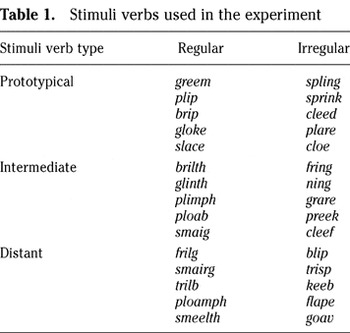
The stimuli used in this study were 30 of the nonce verbs developed by Prasada and Pinker (1993). Half (15) of the items were nonce regular and half (15) were nonce irregular verbs. Within each of these two categories, the verbs varied in terms of their similarity to real English verbs. Prototypical nonce verbs rhymed with real English regular and irregular verbs, intermediate nonce verbs shared some initial CCV_ and _VCC sequences with real English regular and irregular verbs, whereas distant nonce verbs did not. Thus, there were six categories of verbs. Six real English verbs (three regular and three irregular) were used as practice stimuli. The stimuli (from Prasada and Pinker) are presented in Table 1.5
Some problems with these stimuli have been pointed out by Lee (1994), who suggested that the use of nonexistent CC and VC sequences could bias participants' responses against using analogy because analogy to the whole word is logically impossible. Furthermore, Prasada and Pinker's (1993) classifications of distance from real English verbs may not have been consistent across the regular and irregular verbs. Nonetheless, their original stimuli were used here because it was important to be able to compare the results of this research with the results reported in Prasada and Pinker, given that their results and arguments have significantly contributed to the question as to whether multiple systems characterize linguistic representation.
Stimuli verbs used in the experiment

For each verb, a drawing (from Windows 96 clip art) was presented that showed a figure performing an ambiguous action (i.e., one cannot determine what the figure is actually doing). Beneath each picture was a sentence-completion task (from Bybee & Slobin, 1982): “This is X” (where X represents the name of the figure). “X is a man who knows how to V.” “X is Ving.” “Yesterday, he _____.” An example is presented in Appendix A. All participants received the same stimuli. Presentation order was counterbalanced such that, within each group of participants, half received one order of presentation, and the other half received the other order.
Procedure
The procedure for the three different participant groups was identical. Participants were tested in groups, and they were presented with a booklet where each trial was presented on a single page. The experimenter read the text on each card out loud, while the participants looked at their test booklets containing the same trial information. Participants were asked to write down what they thought was the correct past-tense form of the verb on each page of the booklet. When the experimenter had confirmed that each participant in the group had made a response, the group moved to the next trial (i.e., the next page in the booklet). After completion of the practice trials the participants were informed that they were going to undertake the same task but this time with some “funny” verbs they had never heard before.6
It is important to note that this methodology does not faithfully replicate the original methodology of Prasada and Pinker's experiment 3. Prasada and Pinker presented these nonsense verbs within a semantic context, which was not used in this study. Ramscar (2002) has noted how semantic context can bias the participant to produce a particular (i.e., regular or irregular) form. As the primary focus of this research was to identify how phonological and not semantic similarity might influence generalization of past tenses, no semantic context was provided.
RESULTS
Following Prasada and Pinker (1993), all participants' responses were scored as being suffixed or nonsuffixed. Spelling errors, such as double consonants at the end of a nonsense word (greem → greemmed), were discounted. Suffixed forms were those that ended in [-ed] or ended in [-d] if the verb stem ended in /e/ or ended in [-t] if the final C of the stem was [-voice]. Nonsuffixed forms had either an internal vowel change or no change between the base and past-tense forms.7
There were two examples where both a vowel change and a suffix were produced on a past tense. In these cases, the response was coded as suffixed. These two examples were slace → sleced and ploamph → ploomphed. Both of these examples were from the NS children. These two examples were coded as suffixed because they were both regular nonsense verbs, and therefore the conservative estimate was that the participant intended a regular. Coding both of these as regular verbs would also have been what the dual-mechanism model would have predicted.
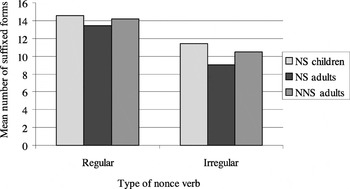
There was a main effect of verb type because, overall, participants were more likely to suffix a nonce regular verb than a nonce irregular verb, F(1, 57) = 233.24, p < .001, ω2 = 0.56 (partial omega squared), as found by Prasada and Pinker (1993). There was a reliable effect of group: The NS children produced more suffixed forms overall than the NS adults, F(2, 57) = 5.67, p < .006, ω2 = 0.05. There were no reliable differences between the NNS adults and the NS adults, or between the NS children and the NNS adults. These results are illustrated in Figure 1. It is interesting to note that there was no Group × Verb Type interaction (p > .12), which suggests the group effects were similar for both regular and irregular items. An interaction would have indicated that different groups treat regular and irregular verbs differently. One prediction of the dual-mechanism model is that as long as all participants are able to apply the rule “Add [-ed],” there should be no difference between groups on the regular items. Given that differences in exposure and familiarity to items would influence processing of only those items in associative memory, group effects should have been evident on the irregular items only, if at all.

Mean number of suffixed nonce verbs.
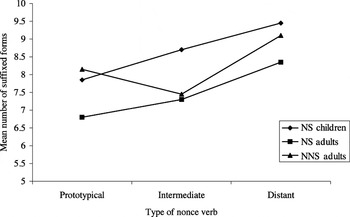
There was a reliable effect of similarity, F(2, 114) = 69.1, p < .01, ω2 = 0.17, with nonce verbs being more likely to be suffixed as a function of distance from the prototypical English verb. There was also a Group × Similarity interaction, F(4, 114) = 3.94, p < .01, ω2 = 0.06. Post hoc Scheffé tests indicated that the reliable interaction stems from a group difference between the children and the NS adults only (p < .001). This effect is illustrated in Figure 2. Overall, participants produced more suffixed verbs the further away from the prototypical English verb the nonce verb is, as predicted by the model. Recall that there were 10 verbs of each similarity type. The dual-mechanism model crucially predicts that there will be a Verb Type × Similarity interaction. That is, similarity should influence participants' productions on the irregular verbs but not on the regular verbs. Essentially, participants should be at ceiling in producing suffixed forms for the regular verbs, while showing a steady increase in the production of suffixed verbs on the irregulars. The analysis indicated that there was indeed a Verb Type × Similarity interaction, F(2, 114) = 62.63, p < .001, ω2 = 0.40. To further appreciate the nature of this interaction, two separate analyses are presented, looking first at the irregular, then the regular verbs.

Mean number of suffixed prototypical, intermediate, and distant nonce verbs.
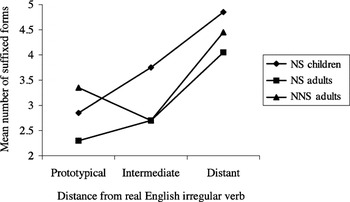
A repeated-measures ANOVA with one between-subjects factor (group, tested at three levels: NS adults, NNS adults, and NS children) and one within-subjects factor (similarity, tested at three levels: prototypical, intermediate, and distant), examining only the irregular verbs was carried out on the data. This analysis revealed a group effect, F(2, 57) = 4.9, p < .01, ω2 = 0.04, a similarity effect, F(2, 114) = 69.07, p < .001, ω2 = 0.43, and a Group × Similarity interaction, F(4, 114) = 4.73, p < .001, ω2 = 0.04. These effects are illustrated in Figure 3. NS children overall produced more suffixed irregular verbs than either the NS adult or NNS adult participants. The NS children and NS adults also showed an increase in the number of suffixed irregular verbs as a function of distance from the prototypical. The NNS adults, however, showed a somewhat different pattern of results as revealed by post hoc Scheffé tests (p < .01) and implicated in the reliable Group × Similarity interaction. Unlike the NS children and the NS adults, the NNS adults suffixed fewer intermediate than prototypical verbs, but like the other two groups of participants, they suffixed more distant than intermediate irregular verbs.

Mean number of suffixed irregular verbs.
The second analysis on the Verb Type × Similarity interaction examined whether similarity affected the regular verbs as well. A repeated-measures ANOVA with one between-subjects factor (group, tested at three levels: NS adults, NNS adults, and NS children) and one within-subjects factor (similarity, tested at three levels: prototypical, intermediate, and distant) examining only the regular verbs revealed a group effect, F(2, 57) = 4.36, p < .02, ω2 = 0.04, and a reliable similarity effect, F(2, 114) = 4.93, p < 0.01, ω2 = 0.03. Unlike the irregular verbs, there was no Group × Similarity interaction.
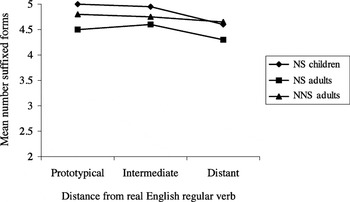
Figure 4 illustrates that the effect of similarity is in the opposite direction to the similarity effect found in the irregular verbs. That is, there is a decrease in suffixation on the regular verbs that are distant. Although the direction is different, a reliable similarity effect is found for both the irregular and the regular verbs, unlike the findings of Prasada and Pinker (1993).

Mean number of suffixed regular verbs.
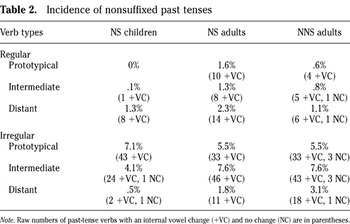
Participants did not differ in their patterns of nonsuffixed responses. Nonsuffixed responses constituted 17%, 18%, and 13% of the total responses for the NNS adults, NS adults, and NS children, respectively. The majority of the nonsuffixed past tenses were generated on the pseudo-irregular set of verbs (88%, 79%, and 85% for the NS children, NS adults, and NNS adults, respectively). The majority of these nonsuffixed responses involved vowel changes. Table 2 provides a breakdown of nonsuffixed past tenses produced for each of the nonce verb types and by each group. Also included in Table 2 is the total number of past tenses formed with an internal vowel change (+VC) or no change (NC). The pattern of responding for the three groups of participants was similar, with no (for the NS adults) or few no-change responses across each type of verb. In other words, when participants did produce a nonsuffixed past tense, they preferred a vowel-change over a no-change response. The vowel-change responses included changes that are found in irregular verbs (e.g., spling → splang), as well as other vowel changes (blip → bloop; frilg → frulg).
Incidence of nonsuffixed past tenses

The results can be summarized as follows: (a) Overall, participants were more likely to suffix regular than irregular nonce verbs, (b) NS children produced more suffixed verbs than either the NS adults or the NNS adults, (c) there were similarity effects on the irregular verbs, (d) there were also reverse similarity effects on the regular verbs, and (e) participants produced a similar proportion of nonsuffixed past tenses, with a similar proportion of vowel change to no change responses.
DISCUSSION
This study provides some support for the predictions of the dual-mechanism model, but also some contradictions.8
It is worth remembering that the model predicts dissociations between regular and irregular items. Recall from the introduction that there is a considerable (and growing) body of evidence that calls this assumption into question. That is, dissociations between items could be explained through associative learning mechanisms and representation, without having to rely on a dual-route system. Nonetheless, the purpose of this study was to extend the results of Prasada and Pinker (1993) to different participant populations and different language learning contexts. Therefore, in discussing the results of this study, dissociations between items (regular and irregular) are also considered.
One goal of this research was to ascertain whether there would be group differences in production of the past tenses of these nonce verbs. In particular, the study was designed to ascertain whether there are any fundamental differences between English NSs (both adult and child) and NNS adults (prediction 3a). Figure 1 shows that there were group differences, but the locus of the difference was found between the NS children and the NS adults. Thus the fundamental difference in this study lies not between L1 and L2 but rather between the NS children and NS adults. Furthermore, there was no Group × Verb Type interaction, which indicates that all three groups of participants showed the same difference between regular versus irregular verbs. This evidence suggests that the issues raised by the dual-mechanism model are relevant to the L2 learning context, as these participants treated regular verbs reliably differently from irregular verbs. This finding also suggests that L1 and L2 learning are not fundamentally different in this respect, given that there were no differences between the NS and NNS adults. Thus, prediction 3a is not supported, as the NS children did not pattern with the NS adults. However, prediction 3b is partially confirmed, as there were no statistically significant differences between the NNS adults and the NS children. However, it cannot be fully supported because the NNS adults were not statistically different from the NS adults, either. Both the NNS adults and NS children had less exposure and experience with English than the NS adults. To accept this evidence as supportive of the dual-mechanism model, however, one would have to also accept that dissociations between regular and irregular inflectional features are a direct result of two separate systems. Such an assumption may be erroneous given the weight of evidence suggesting that dissociations can arise without having to invoke two separate processing-representational routes.
A further issue concerning potential group effects was whether they would be present on both types of verbs. Recall that, to generalize one's knowledge of an irregular past tense to a novel item, one must have already stored in associative memory a representation of some form of a past-tense verb. For example, if one is to generalize the past tense of swing to the nonce verb spling (and hence produce splung as a possible past tense), one must have swung stored as a past tense in associative memory. Therefore, participants who vary in terms of how much exposure, familiarity, or both they have had with the language in question might reasonably be expected to perform differently on the set that is influenced by associative memory (i.e., the irregular verbs). If, however, all participants have knowledge of the rule of forming the past tense by adding [-ed], then one might reasonably expect to find no group differences on the regular set of nonce verbs.
The crucial issue regarding the potential group effects and the dual-mechanism model concerns the interaction between regular and irregular items. Assuming all three groups of participants had knowledge of the [-ed] rule, then any group differences should have only been apparent on the irregular items. Figures 3 and 4 illustrate that on both the irregular (Figure 3) and regular (Figure 4) verbs, group effects were evident. Specifically, NS children produced more suffixed verbs on both the irregular and regular verbs than the NS adults. Recall that the NS children in this study were between 8 and 9 years old. One might reasonably conclude, therefore, that they had had sufficient exposure to English and sufficient knowledge of the English past-tense system to enable them to perform this task. Therefore, all participants in this study would have had sufficient knowledge of the [-ed] rule but also would have had knowledge of a variety of different irregular verbs.9
The instructional materials the NNS adults were exposed to in their English classes indicate they had considerable exposure to the English past-tense system within their classes, through explicit focus-on-form instruction and also through reading comprehension exercises. Furthermore, all the NNS adults were living in England, using English in their communities.
One possible explanation as to why NS children suffixed more than the NS adults might come from what Pinker and Prince (1994) referred to as the blocking principle. In attempting to understand how the regular and irregular systems interact with one another, Pinker and Prince suggested that retrieval (from memory) of an irregular past form blocks the application of the rule. They also suggested that in real time, participants would search through memory for a past irregular stem but, at the same time, feed the stem into the regular rule mechanism. A match from memory then blocks the rule application. However, if there is no match from memory, the rule-application mechanism proceeds, and the verb is suffixed. This blocking principle might account for the NS children suffixing more than the NS adults. Pinker and Prince noted that “children's memory traces are not strong enough to guarantee perfect retrieval” (p. 344). That is, their memory traces and connections between stem and past forms in associative memory will not be as strong as adults. A consequence of weaker connections is that successful retrieval from memory will fail more often in children than in adults. According to the blocking principle, then, if there are more failures at retrieving an item from memory, there will be a commensurate increase in the number of suffixed verbs.
There are at least two problems with this suggestion. The first is that in discussing weaker memory traces in children, Pinker and Prince (1994) were referring to much younger children than the ones tested in this study. Indeed, Pinker and Prince were discussing the tendency to add [-ed] to either irregular stems (e.g., break → breaked) or to already inflected irregular past forms (e.g., eat → ate → ated) in children around 3 or 4 years old. Although it may be true that children as young as 3 or 4 have weaker associations between irregular stems and past forms, it is less obvious that children between 8 and 9 will also show such weak connections in memory as to cause greater suffixation.
A second problem with the blocking-principle account relates to the NNS performance. There was no statistically reliable difference between the NNS and NS adults (or the NNS adults and the NS children) in terms of number of verbs suffixed. One might have predicted NNS adults to suffix more, given that they had spent the least amount of time learning and using English and hence could arguably have had the weakest memory traces for these forms. If this were the case, one would have expected at least a difference between the NS adults and the NNS adults. One would have to suggest, counterintuitively, that something inherent in being a child (of 8 or 9 years) causes weak memory traces and thus results in greater suffixation, despite the fact that arguably the NNS adults actually had less exposure and familiarity with English than the NS children.
Another possible explanation for greater suffixation by the NS children than the NS adults might be related to attentional processes. The individual items may have been more salient for the NS adults, the NNS adults, or both than for the NS children. Many researchers have argued that L1 learning is largely implicit, which suggests children are not in any conscious way attending to the specific linguistic forms. Contrast that idea with Schmidt (1994), who argued that language learners must “notice” a particular linguistic feature to learn it. In the context of this study, it is likely that all participants would have noticed that the verbs presented to them were odd in some specific ways. Indeed, there may be an inherent explicitness to a task that requires participants to find an analogy on which to base a new past tense. If this is true, and if children of 8–9 years of age have weaker attentional processes, then they might be expected to suffix more.
The roles of attention and memory have been considered to be powerful determinants on learning in general (e.g., Cowan, 1997) and learning language in particular (Ellis, 1994, 2001; Gathercole & Baddeley, 1993). Early theories of attention suggested that if input is not attended to, then it will not be encoded so as to be recalled later on (e.g., Broadbent, 1958)—an idea similar to Schmidt's noticing hypothesis (1994). In the past-tense generalization task of this study, participants have to hold the nonce verb in their working memories as they search through their longer term associative memories to determine if there is a similar form on which to base an analogy. If children have weaker attentional processes, it may be harder for them to hold and process the nonce verb in working memory. If this were true, it may be more difficult for them to find an appropriate lexical item in their associative memories on which to base their analogies. Such a problem could then lead the child to suffix the verb as they would be less likely to find an analogous item in their associative memory. There is some evidence that older children are able to search through their memories faster than younger children (Cowan, 1992; Cowan et al., 1994), which suggests a developmental progression in memory retrieval processes. If the adults were able to search through their memories faster than the children in this experiment, then they would have been more successful at finding the appropriate analogous representations and would have suffixed less than the children.
It is difficult to determine at this stage whether such an explanation could account for increased suffixation by the children. Further research is needed to identify more precisely the role of attention, memory, and language learning in both L1 and L2 learning contexts for both children and adults.
An additional focus of this study was to examine the second prediction that similarity effects would only be manifest on irregular items. Recall that the dual-mechanism model predicts that similarity should only influence irregular verbs. Figure 3 illustrates that, as predicted, there was a similarity effect on the irregular verbs because more irregular verbs were suffixed as a function of distance from the prototypical irregular verb. Interestingly, Figure 4 also indicates a similarity effect on the regular verbs. The effect is in the opposite direction in that fewer regular verbs are suffixed as a function of distance from the prototypical.10
Instead of suffixing the nonce regular distant verbs, participants tended to produce a past tense with an internal vowel change (e.g., plip → ploop).
If the differences between the original Prasada and Pinker (1993) study and this one are due to this methodological difference, it would strongly suggest that phonological properties (and importantly, participants' perceptions of the similarity between real English and nonsense verbs) lead participants to inflect verbs in ways that are inconsistent with the predictions of the dual-mechanism model. The findings in the present study are important because they provide an opportunity to identify how the phonological similarity alone (without recourse to any possible influence from semantics) influences generalization of English past-tense inflection.
Similarity is assumed not to influence processing of regular verbs, as suffixation is in some sense a blind computational procedure. At the very least, as Prasada and Pinker (1993) suggested, processing of the regular verbs does not depend on similarity in the way it does for irregular verbs. Prasada and Pinker claimed that generalizations of regular inflections are made on the “basis of a process that is not dependent for its success on how similar the phonological properties of the stem are to previously encountered verbs undergoing that morphological alternation” (p. 28). This suggests that, although similarity might influence processing of regulars, it does not have to, whereas it does have to for the irregular items. Interestingly, Prasada and Pinker reported the mean suffixation for the regular prototypical, intermediate, and distant items as 9.5, 9.2, and 8.9, respectively. Although this difference in means was not significant in their study, the pattern is in the same direction as the significant effect found in this research. The results of the present experiment would then indicate that, without semantic context, similarity does influence both regular and irregular verb formation. To reconcile these results with the dual-mechanism model, one would have to suggest that under some circumstances (no semantic context), similarity can influence regular as well as irregular verbs, but in others (semantic context), similarity does not influence past-tense generalization on regular verbs. However, such a suggestion directly contradicts many claims Pinker (1999) has made concerning associative factors influencing only irregular items and is neither predicted nor explained in current accounts of the dual-mechanism model.
Another approach that might help explain these findings is found in Ullman (2001). Ullman's declarative-procedural model claims that the lexical and grammatical systems are distinct systems (as the dual-mechanism model). Ullman's model also maintains that one component (declarative) adheres to an associative memory structure, whereas the other (procedural) underlies a symbol-manipulation system (again similar to the dual-mechanism model). However, the declarative-procedural model differs from the dual-mechanism model in that each of these two systems is subserved by its own set of more domain-general, nonlinguistic functions or mechanisms. Ullman examined neurological evidence from patients with aphasia and other forms of language impairment to support these claims.
The research presented in this paper was not designed to test Ullman's (2001) declarative-procedural model. However, it is interesting to examine some of the predictions of Ullman's model within the context of this paper, especially because he makes some specific predictions about L2 learning. Ullman stated that markers of associative memory (like frequency) should be found for memorized items (items ostensibly in the declarative system) and not for those items computed by grammatical rules. Similarity (as discussed previously in the introduction) is also a marker of associative memory, and therefore within the declarative-procedural framework, we should expect that similarity should primarily influence the production of the irregular nonsense past-tense forms. The data presented in this paper illustrate that similarity does influence the irregular past-tense productions but also influences the regular productions. Certainly, the pattern of the similarity effect for both the regular and irregular nonsense verbs was different, and whereas the presence of a similarity effect on the regular forms is strictly prohibited by the dual-mechanism model, perhaps such an effect could be somehow accounted for in the declarative-procedural framework through recourse to the nonlinguistic factors that subserve the computational system. More research clearly needs to be done on this issue to test and, more specifically, identify how these nonlinguistic factors relevant for both the declarative and procedural systems affect specific tasks such as the one described in this paper.
Additionally, Ullman (2001) predicted that L2 learners who have learned their L2s later in life are more likely to rely on the declarative (associative) component for all aspects of linguistic processing. In other words, the procedural component seems most affected by being an older language learner. This study does not test for this assumption, nor was it intended to. However, this claim could explain why the NNS adults manifest a similarity effect on both the regular and irregular verb forms. If the NNS adults rely more heavily on a system that is more influenced by factors such as similarity and frequency, one might expect them to show such an effect on items typically under the jurisdiction of the computational or procedural component. Although this idea is helpful in understanding the similarity effect for the NNS adults, it does not necessarily or directly explain the similarity effect on the regular forms found in the NS adults and NS children (unless the nonlinguistic factors underlying the computational-procedural system are responsible). In any case, Ullman's work presents a new and interesting framework within which to test these ideas. For the present, however, as this study was not designed to test the predictions of Ullman's model, we have to be cautious in concluding the extent to which these results support or refute some of the claims of the declarative-procedural model.
Prasada and Pinker (1993) argued that a connectionist theory would have trouble accounting for the regular system but can account for processing and representation of the irregular system. MacWhinney (1993) has shown, however, that a connectionist model can account for both the regular and irregular systems and accurately simulate both the regular and irregular nonce verb generalizations. Therefore, models that operate on purely associative processes can show the same kinds of dissociations presented and discussed in Prasada and Pinker.
We have already seen that behavioral dissociations between regular and irregular items of the kind cited by Prasada and Pinker (1993) and Pinker and Prince (1994) as supportive of the dual-mechanism model can be accounted for by single-route associative accounts. We have also seen in this study that some of the key predictions of the Prasada and Pinker (1993) study were not replicated. We can provisionally conclude, then, that an associative account of processing and representation is the better candidate at explaining these results for both L1 and L2 speakers. Importantly for the L2 learning context, the results of this study indicate that NNS adults, like NS children and NS adults, use similarity to make their past-tense generalizations for both irregular and regular verbs. The lack of reliable differences between the NS adults and the NNS adults suggests that these two groups use similar processes both in terms of the number and type of verbs they suffixed and in terms of the type of irregular nonsuffixed responses they produced. These results also parallel those presented in Lee (1994).
As previously discussed, Lee (1994) pointed out a number of ways in which the stimuli developed in Prasada and Pinker (1993) were problematic. Lee developed what he considered more “principled” pseudo-irregular and regular verbs and used them in a past-tense production task—in the form of a cloze passage—to both NSs and NNSs. His data matched closely with those discussed in the present study. First, Lee found that similarity influenced the irregular forms in that more items were suffixed as a function of distance from the prototypical. For Lee's nonce regular verbs, there was a marked decrease in the number of suffixed distant regular verbs relative to the prototypical and intermediate regular ones. Thus, Lee also found a similarity effect on the regular items—with stimuli that were putatively more realistic and where the distance between the three categories of verb was varied consistently. As in the case of the results reported here, the adult NSs and NNSs in Lee's study produced similar patterns of responses, which suggests that both groups of participants use analogy as a basis for generalizing their knowledge of past tense.
The issue of the reliability of the items used in this and Prasada and Pinker's (1993) studies remains problematic, however. One could argue that the reliable effects found in this study were due to characteristics of specific items. In examining the items closely, we see for example that plip is considered a prototypical regular verb, whereas blip is considered a distant irregular one. If the distant irregular verbs were like the prototypical regular ones, then we might expect subjects to suffix the distant irregular forms more, which is what they did in the present and Prasada and Pinker's studies. This problem with the items could have potentially biased the results in the direction of supporting the dual-mechanism model (again, assuming that a dissociation between regular and irregular items is the kind of evidence needed to support the model). The purpose of the present study was to extend the original Prasada and Pinker study to a different sample of participants; therefore, it was important to use the same stimuli. It is interesting to note that Lee (1994) also found the same pattern of results even after attempting to resolve some of the problems associated with constructing the items. Item effects, however, do not pose a problem for an explanation based on principles of associative learning but present difficulties for a symbolic rule-based account. If the findings of this and past work are due solely to features of individual items, then it precludes the possibility of a blind computational, symbolic process at work.
The results of this study alone do not portray a sufficiently clear picture to warrant unequivocal support of a single-route associative system, either in L1 or L2 processing. However, when these results are taken in the context of other research investigating similar issues, it becomes clear that the dual-mechanism model as described by Pinker and Prince (1994) cannot be supported. For example, as discussed earlier, empirical work with humans investigating the dual- versus single-route hypotheses has indicated that dissociations between regular and irregular inflectional features could be accounted for within a single associative account. Ellis and Schmidt (1998) found that adult participants learning morphosyntax show frequency effects on the regular items early on. It is only later on the learning curve that the effect of frequency on the regular forms diminishes relative to the irregular forms. Ellis and Schmidt suggested that a ubiquitous law of learning—“The Power Law of Practice” (see Anderson, 1982)—can account for this putative change in behavior. That is, the extent of improvement on a particular task decreases as a function of an increase in frequency or practice on the task. There are considerably more regular than irregular verbs in English; thus, the regular morpheme is by far the most frequent past-tense form in English. Any difference, therefore, between regular and irregular features could be a direct result of the increased frequency and amount of exposure that learners have with the regular features.
Other research with human participants has indicated that they can sometimes exhibit putative dissociations between different grammatical categories. For example, Bates, Friederici, and Wulfeck (1987) and Blackwell and Bates (1995) have discussed how otherwise neurologically sound participants manifest dissociations on agreement marking relative to other linguistic features under conditions that put severe burdens on the working memory systems. The important point here is that dissociations may not always indicate fundamental differences at the learning or representational levels, or both.
Additionally, the work reported in the present research suggests that processing of irregular items may not even be dissociated from processing regular forms (i.e., even if a dissociation means separate processing and representational systems). Similarity influenced how participants generalize their knowledge of past tenses to novel items. The direction of the differences varied in that similarity caused fewer items to be suffixed in the regular set and more items to be suffixed in the irregular set as a function of distance from the prototypical. The point remains, however, that similarity influences both category of verbs. Beck (1997) also reported that frequency influences processing of both the regular and irregular sets of verbs.
Given this evidence, one can reasonably question the claim that there are two dissociable learning systems underlying language learning and representation for both L1 and L2 learning. That is, there are a number of indications that a more parsimonious account invoking a single set of associative learning mechanisms could account for the development of inflectional properties of language.
CONCLUSION
Both L1 and L2 participants exhibited similar types of behavior in tasks that compare performance on irregular versus regular inflectional features. Variation in exposure to English affected performance on both irregular and regular features, and similarity exerted a powerful influence on how participants generalized their knowledge of the English past tense to novel verbs, regardless of language learning context. At least within the context of inflectional morphology, both the human experiments and the connectionist simulations discussed in this study suggest that it is not necessary to understand those differences in terms of fundamentally unique and dissociable learning systems. One focus of this study was to identify whether NNSs of English would manifest the same pattern of performance as NSs on a task that was shown to identify dissociations between regular and irregular items. The results indicated that indeed the NNS adults were like the NS adults and showed a different pattern of results for regular and irregular items. However, the similarity effect on both the regular and irregular items, for all participants in this study, raises serious questions about the nature of the results reported in Prasada and Pinker (1993). The lack of success in replicating Prasada and Pinker, in conjunction with the growing body of evidence questioning the assertions of the dual-mechanism model, leads to the preliminary conclusion that a single-route associative explanation seems to be able to capture the phenomena manifested in both the L1 and L2 learning contexts.
APPENDIX A: EXAMPLE OF A TRIAL USED IN THE EXPERIMENT

References
REFERENCES
Anderson, J. R.
(1982).
Acquisition of a cognitive skill.
Psychological Review,
89,
369–406.CrossRefGoogle Scholar
Bates, E.,
Friederici, A., &
Wulfeck, B.
(1987).
Comprehension in aphasia: A cross-linguistic study.
Brain and Language,
32,
19–67.CrossRefGoogle Scholar
Bechtel, W., &
Abrahamsen, A.
(1991).
Connectionism and the mind.
Oxford:
Blackwell.
Beck, M.-L.
(1997).
Regular verbs, past tense, and frequency: Tracking down a potential
source of NS/NNS competence differences.
Second Language Research,
13,
93–115.CrossRefGoogle Scholar
Blackwell, A., &
Bates, E.
(1995).
Inducing agrammatic profiles in normals: Evidence for the selective
vulnerability of morphology under cognitive resource limitation.
Journal of Cognitive Neuroscience,
7,
228–257.CrossRefGoogle Scholar
Broadbent, D. E.
(1958).
Perception and communication.
New York:
Pergamon Press.
Bybee, J.
(1985).
Morphology: A study of the relation between meaning and form.
Amsterdam:
Benjamins.CrossRef
Bybee, J.
(1995).
Regular morphology and the lexicon.
Language and Cognitive Processes,
10,
425–455.CrossRefGoogle Scholar
Bybee, J., &
Moder, C. L.
(1983).
Morphological classes as natural categories.
Language,
59,
251–270.CrossRefGoogle Scholar
Bybee, J., &
Slobin, D. I.
(1982).
Rules and schemas in the development and use of the English past
tense.
Language,
58,
265–289.CrossRefGoogle Scholar
Chomsky, N.
(1986).
Knowledge of language: Its nature, origin, and use.
New York:
Praeger.
Clahsen, H.
(1995).
German plurals in adult second language development: Evidence for
a dual-mechanism model of inflection. In
L. Eubank,
L. Selinker, &
M. Sharwood Smith (Eds.),
The current state of interlanguage: Studies in honor of William E.
Rutherford (pp.
123–137).
Amsterdam:
Benjamins.
Clark, A.
(1989).
Microcognition: Philosophy, cognitive science, and parallel
distributed processing.
Cambridge, MA:
MIT Press.
Cowan, N.
(1992).
Verbal memory span and the timing of spoken recall.
Journal of Memory and Language,
31,
668–684.CrossRefGoogle Scholar
Cowan, N.
(1997).
Attention and memory: An integrated framework.
Oxford:
Oxford University Press.
Cowan, N.,
Keller, T. A.,
Hulme, C.,
Roodenrys, S.,
McDougall, S., &
Rack, J.
(1994).
Verbal memory span in children: Speech timing clues to the
mechanisms underlying age and word length effects.
Journal of Memory and Language,
33,
234–250.CrossRefGoogle Scholar
Ellis, N. C. (Ed.).
(1994).
Implicit and explicit learning of languages.
San Diego, CA:
Academic Press.
Ellis, N. C.
(2001).
Memory for language. In
P. Robinson (Ed.),
Cognition and second language instruction (pp.
33–68).
New York:
Cambridge University Press.
Ellis, N. C., &
Schmidt, R.
(1997).
Morphology and longer distance dependencies: Laboratory research
illuminating the A in SLA.
Studies in Second Language Acquisition,
19,
145–171.CrossRefGoogle Scholar
Ellis, N. C., &
Schmidt, R.
(1998).
Rules or associations in the acquisition of morphology? The
frequency by regularity interaction in human and PDP learning of
morphosyntax.
Language and Cognitive Processes,
13,
307–336.CrossRefGoogle Scholar
Elman, J.,
Bates, E.,
Johnson, M.,
Karmiloff-Smith, A.,
Parisi, D., &
Plunkett, K.
(1996).
Rethinking innateness: A connectionist perspective on development.
Cambridge, MA:
MIT Press.
Fodor, J. A., &
Pylyshyn, Z. W.
(1988).
Connectionism and cognitive architecture: A critical analysis. In
S. Pinker &
J. Mehler (Eds.),
Connections and symbols (pp.
3–72).
Cambridge, MA:
MIT Press.
Gathercole, S. E., &
Baddeley, A. D.
(1993).
Working memory and language.
Mahwah, NJ:
Erlbaum.
Hahn, U., &
Nakisa, R. C.
(2000).
German inflection: Single route or dual route?
Cognitive Psychology,
41,
313–360.Google Scholar
Hare, M.,
Elman, J. L., &
Daugherty, K. G.
(1995).
Default generalisation in connectionist networks.
Language and Cognitive Processes,
10,
601–630.CrossRefGoogle Scholar
Lardiere, D.
(1995).
L2 acquisition of English synthetic compounding is not constrained
by level-ordering (and neither, probably, is L1).
Second Language Research,
11,
20–56.CrossRefGoogle Scholar
Lee, B. P. H.
(1994).
Generalisation of regular and irregular inflectional patterns:
Towards a language processing model for both native and non-native
speakers of English.
Cambridge University Working Papers in English and Applied
Linguistics,
1,
15–33.Google Scholar
MacWhinney, B.
(1993).
Connections and symbols: Closing the gap.
Cognition,
49,
291–296.CrossRefGoogle Scholar
MacWhinney, B.
(1994).
The dinosaurs and the ring. In
S. D. Lima,
R. L. Corrigan, &
G. K. Iverson (Eds.),
The reality of linguistic rules (pp.
283–320).
Amsterdam:
Benjamins.
Marcus, G. F.,
Brinkmann, U.,
Clahsen, H.,
Wiese, R., &
Pinker, S.
(1995).
German inflection: The exception that proves the rule.
Cognitive Psychology,
29,
189–256.CrossRefGoogle Scholar
Murphy, V. A.
(2000).
Compounding and the representation of L2 morphology.
Language Learning,
50,
153–197.CrossRefGoogle Scholar
Nakisa, R. C., &
Hahn, U.
(1996).
Where defaults don't help: The case of the German plural
system. In
G. W. Cottrell (Ed.),
Proceedings of the 18th annual conference of the Cognitive Science
Society (pp.
177–182).
Mahwah, NJ:
Erlbaum.
Pinker, S.
(1999).
Words and rules: The ingredients of language.
London:
Weidenfeld & Nicholson.
Pinker, S., &
Mehler, J. (Eds.).
(1988).
Connections and symbols.
Cambridge, MA:
MIT Press.
Pinker, S., &
Prince, A.
(1988).
On language and connectionism: Analysis of a parallel distributed
processing model of language acquisition.
Cognition,
28,
73–193.CrossRefGoogle Scholar
Pinker, S., &
Prince, A.
(1994).
Regular and irregular morphology and the psychological status of
rules of grammar. In
S. D. Lima,
R. L. Corrigan, &
G. K. Iverson (Eds.),
The reality of linguistic rules (pp.
321–351).
Amsterdam:
Benjamins.
Plunkett, K., &
Marchman, V.
(1991).
U-shaped learning and frequency effects in a multi-layered
perceptron: Implications for child language acquisition.
Cognition,
38,
43–102.CrossRefGoogle Scholar
Plunkett, K., &
Nakisa, R. C.
(1997).
A connectionist model of the Arabic plural system.
Language and Cognitive Processes,
12,
807–836.CrossRefGoogle Scholar
Prasada, S., &
Pinker, S.
(1993).
Generalisation of regular and irregular morphological patterns.
Language and Cognitive Processes,
8,
1–56.CrossRefGoogle Scholar
Ramscar, M.
(2002).
The role of meaning in inflection: Why the past tense does not
require a rule.
Cognitive Psychology,
45,
45–94.CrossRefGoogle Scholar
Rumelhart, D. E.,
Hinton, G. E., &
McClelland, J. L.
(1986).
A general framework for parallel distributed processing. In
D. E. Rumelhart,
J. L. McClelland, &
the PDP Research Group (Eds.),
Parallel distributed processing: Explorations in the microstructure
of cognition: Vol. 1. Foundations (pp.
45–76).
Cambridge, MA:
MIT Press.
Rumelhart, D. E., &
McClelland, J. L.
(1986).
On learning the past tenses of English verbs. In
J. L. McClelland &
D. E. Rumelhart (Eds.),
Parallel distributed processing: Explorations in the microstructure
of cognition: Vol. 2. Psychological and biological models (pp.
216–271).
Cambridge, MA:
MIT Press.
Schmidt, R.
(1994).
Implicit learning and the cognitive unconscious: Of artificial
grammars and SLA. In
N. C. Ellis (Ed.),
Implicit and explicit learning of languages (pp.
165–209).
San Diego, CA:
Academic Press.
Stemberger, J. P., &
MacWhinney, B.
(1986).
Frequency and the lexical storage of regularly inflected forms.
Memory and Cognition,
14,
17–26.CrossRefGoogle Scholar
Tomasello, M.
(1995).
Language is not an instinct.
Cognitive Development,
15,
131–156.CrossRefGoogle Scholar
Ullman, M. T.
(2001).
The neural basis of lexicon and grammar in first and second
language: The declarative/procedural model.
Bilingualism: Language and Cognition,
4,
105–122.Google Scholar
Stimuli verbs used in the experiment
Mean number of suffixed nonce verbs.
Mean number of suffixed prototypical, intermediate, and distant nonce verbs.
Mean number of suffixed irregular verbs.
Mean number of suffixed regular verbs.
Incidence of nonsuffixed past tenses
 You have
Access
- 12
- Cited by