On June 15, 2007, Spain celebrated 30 years since the 1977 elections inaugurated the current democratic political system. These were the first democratic elections in 40 years—the last were held during Spain's first experience with mass democracy during the Second Republic (1931–1936). This essay explores why and how to incorporate the Spanish case into syllabi on comparative democratization. I suggest a few interesting topics to explore and more fully develop how the Spanish case can be used to illustrate explanations of democratization, namely modernization theory and elite pact making.
I am primarily writing this essay for an audience that is broadly familiar with the theoretical debates on democratization but might be less familiar with the Spanish case, and secondarily for those familiar with the Spanish case but have not yet used it in a course on comparative democratization. In addition to its use in a comparative democratization course, the case study can be adapted for an introduction to comparative politics or a European politics unit on democratization.
Why Spain?
There are several reasons to consider incorporating Spain into a comparative politics syllabus in addition to the theoretical importance of the case for democratization studies.
First, U.S. students are interested in Spain. An indication of this is that Spain is ranked as the third “Top Host Destination” for U.S. study abroad students (Institute of International Education 2007). In 2004, 32,237 students studied in the United Kingdom, 21,922 in Italy, and 20,080 in Spain. France and Australia came in forth and fifth by a wide margin, with 13,718 and 11,418, respectively. Spain is also a top-five destination for students from Argentina, Chile, Colombia, Finland, Mexico, Morocco, Portugal, and Venezuela.
Second, many students in U.S. institutions of higher education have Spanish-language skills. Spanish has by far the largest enrollments in U.S. institutions of higher education (Welles 2004). In 2002, Spanish enrollments were 746,267, trailed by French (201,979), German (91,100), and Italian (63,899). In fact, enrollments in Spanish-language classes surpassed enrollments in all other languages combined in 1995 and this continued to be the case in 2002. Therefore, students can employ their language skills in research assignments by consulting Spanish newspapers (such as, El País, ABC, El Mundo, La Vanguardia, etc.), and Spanish-language books and journals.
Third, Spain is an important country in the world economy and world politics. In 2005, with a population of approximately 43 million, Spain ranked as the eighth largest economy based on total GDP in U.S. dollars, and 11th at purchasing power parity in international dollars (World Bank 2005). Furthermore, the Spanish people enjoy a high quality of life as measured by the Human Development Index. Spain was ranked 19th out of 177 countries in 2006, just behind Italy (17) and the United Kingdom (18), and ahead of New Zealand (20) and Germany (21) (UNDP). Spain has growing international political relevance; for example, it has evolved into a major political player in the European Union. Also, public awareness of Spain in the U.S. has increased partially due to the devastating train bombings in Madrid on March 11, 2004, which killed 191 people and wounded more than 1,800. In 2007, 29 suspects, who are alleged to be tied to Islamist terrorism, were on trial for the bombings. Subsequent to the attacks the newly elected Partido Socialista Obrero Español (PSOE) government of José Luis Rodríguez Zapatero withdrew Spain's troops from Iraq, reversing the previous Partido Popular (PP) government's decision to support the U.S. in the Iraq war.
Finally, Spain is part of the so-called third wave of democratization (Huntington 1991) and its transition to democracy and subsequent consolidation has been hailed as particularly successful. While not without its democratic deficits, Spain attained a Freedom House ranking of “Free” in 1977, which it has maintained ever since (www.freedomhouse.org). Przeworski (1991, 8) refers to Spain as nothing less than “a miracle: one of a handful of countries that since World War I have escaped the economics, the politics, and the culture of poor capitalism.” The prolonged period of democratic governance amongst third wave democracies allows for the evaluation of debates that are far more difficult in more recent transitions where uncertainty remains high.
Democratization Syllabi
An unscientific review of comparative democratization syllabi posted online reveals several topics that appear regularly.1
Clearly what is listed on a syllabus is only a rough guide to what is discussed in the course. This schematic analysis is of listed topics. I thank Katelyn Hoover for her research assistance in gathering syllabi of democratization courses.
Topics that are either presented within these broader categories or as separate units include: (1) culture and religion; (2) economic development; (3) social cleavages (ethnic, nationalist, and religious divisions); (4) modes or processes of transition; (5) political elites; (6) political institutions;2
Discussions of electoral systems and the presidential versus parliamentary debate predominate, but some syllabi mention federal versus unitary system debates and very few mention political parties or party systems
What is it a Case of?
The Spanish case could be incorporated into a number of the above-mentioned units. Here I briefly refer to a few interesting topics and puzzles prior to developing the use of the Spanish case to explore two approaches to democratization.
Multinationalism
Most scholars would agree that national unity is helpful when attempting democratization. However, Spain is a multinational state that instituted a democracy without broad-based mass violence and maintained the same national boundaries. The so-called historic nationalities in Spain are the Catalans, Basques, and Galicians. Four languages are spoken: Castilian Spanish (74%), Catalan (17%), Galician (7%), and Basque (2%) (CIA 2007); the first is an official language in the entire country and the latter three are co-official languages in their respective communities. While often depicted as a successful multinational democracy, particularly due to the brutal Spanish Civil War (1936–1939) in which nationalism was an important cleavage, ETA terrorism (a Basque independence organization) has been responsible for more than 800 deaths (BBC 2007) and continues to generate violence inside and outside of the Basque country. The most recent attempts by the Zapatero government to negotiate a permanent peace with ETA were frustrated by a car bomb, for which ETA claimed responsibility, that exploded at the Barajas airport in Madrid at the end of December 2006, and in June 2007 ETA announced the formal end of the most recent cease fire. Therefore Spain is an excellent case to use to explore the complex relationship between democracy and multinationalism.
International Dimensions
The Spanish transition occurred before much of today's international democracy promotion and assistance infrastructure, which includes programs by national governments, intergovernmental organizations and non-governmental organizations, was created. Nonetheless, west European political parties, such as the German Social Democrats, and European institutions, particularly because Spain's entry into the European Community would require democratization, are widely perceived as important in Spain's democratization process. Also, we should not forget that the third wave began next door in Portugal—a more radical transition to democracy that did not go unnoticed by Spanish political elites. However, there is fairly broad consensus that the Spanish transition to democracy was largely generated by internal conditions and/or actors. This provides an interesting case to contrast with several more recent transitions or attempted transitions toward democracy where the impetus for liberalization or democratization came primarily from external forces or actors.
Civil Society and Social Actors
Spain is also a case of successful democratic consolidation with a historically weak civil society (Encarnación 2003). Additionally, while not denying the importance of elite actors, several analysts argue that democratization in Spain was not simply a top-down process, but rather social forces, particularly workers (Fishman 1990) and students, conditioned that process from the bottom up. The Spanish case can therefore be used to evaluate the debates surrounding the importance of civil society and social actors in bringing about transitions to democracy and their role in consolidation.
Modernization or Elite Pact-making? The Spanish Case
One of the major debates in the democratization literature concerns the relative merits of structural versus strategic approaches. That is, between explanations that are based on some sort of prevailing condition, such as the level of economic development, cultural values, and so forth, or on the strategic choices of various actors and the interaction between actors. For example, the Spanish case can be used to illustrate both modernization theory and strategic theory based on elite choices. Spain is a country that experienced dramatic economic development prior to its transition to democracy and is a paradigmatic case of a transition by pact or elite settlement (Gunther 1992). My teaching goals for this unit include: (1) to illustrate with an empirical case two approaches to democratization; (2) to compare structural and actor-based explanations; and (3) to get students to think critically about existing approaches.
Modernization Theory
I first present the empirical basis for modernization theory, which is the strong correlation between economic development and democracy (Lipset 1959; Przeworski et al. 2000). As the class has already discussed regime types, we define the independent variable: what is economic development? Once students have gotten an image in their minds of the characteristics of economic development, we proceed to measurement.
What would a strong correlation between economic development and democracy look like on a graph? Using what kind of data? This provides the instructor with the opportunity to discuss indicators and expose students to available data. This includes the strengths and weaknesses of different aggregate indicators of economic development, such as GDP per capita (real or constant dollars, purchasing power parity) and the Human Development Index. Students use the World Bank's World Development Indicators and the United Nation Development Programme web sites (www.undp.org/) for data. We also discuss the availability of and debates surrounding the quantitative measures of democracy by Freedom House and the Polity IV dataset (www.cidcm.umd.edu/polity/). I also ask the students to produce a graph depicting a high correlation between economic development and democracy, which typically looks something like Figure 1.

Correlation between Economic Development and Democracy
What are the hypotheses regarding the potential causal relationship between economic development and democracy? We generate a list of a variety of mechanisms that have been advanced to explain the link, including a changed social class structure (rise of the middle class, moderation of class conflict); cultural changes (tolerance, efficacy, and so forth); the reduction of political organization costs due to such factors as communications and urbanization; the reduced value of capturing the state; the rise of intermediary organizations; and so forth. We also analyze other relationships that are compatible with the graph in Figure 1, e.g., democracy causes economic development, the Przeworski et al. (2000) thesis on the survival of wealthy democracies, and how to assess if a county case is evidence for or against the modernization hypothesis.
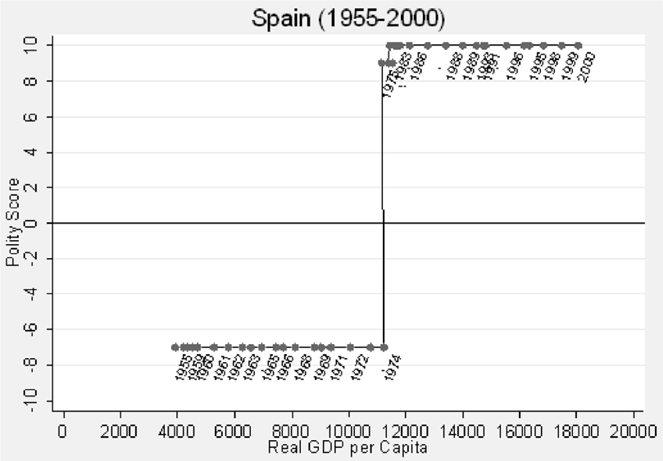
In addition to assigned readings, one homework assignment is that students construct a graph relating economic development and democracy in Spain using Polity or Freedom House scores and GDP/capita. Alternatively, students analyze a variety of countries, including Spain, using Jack A. Goldstone's Dynamic Graphs of Democracy and Development (http://mason.gmu.edu/%7Ejgoldsto/regions_index.htm). The relationship between economic development and democracy in Spain is depicted in Figure 2.3
Polity Score (−10 = high autocracy; 10 = high democracy); real GDP per capita (Laspeyres index, constant 1996 international $).

Spain, Economic Development and Democracy
Source: Jack A. Goldstone, Dynamic Graphs of Democracy and Development: http://mason.gmu.edu/%7Ejgoldsto/regions_index.htm. Accessed May 14, 2007.
This exercise leads to a concrete discussion of the dramatic transformation of the Spanish economy and society particularly in the 1960s. Spanish economic policy changed beginning in the late 1950s from a form of state capitalism and protectionism toward greater economic liberalization. Subsequently, Spanish GDP grew on average 7.2% (6.1% per capita) per year between 1961 and 1974 (World Bank 2005). This compares to world average GDP annual growth rates of 5% overall and 3% per capita. Economic growth in the 1960s and early 1970s placed Spain second only to Japan in terms of gross national product growth (Newton 1997, 4). Industrial growth rates in Spain were even higher, averaging 15% per year (Maravall and Santamaría 1986, 74). While not coming without costs, this meant that GDP per capita increased from $3,716 (constant 2000 USD) in 1960 to $8,472 in 1974 (World Bank 2005).
There was substantial migration from rural to urban centers and from agriculture to industry and services. In 1950, 48.8% of the population was employed in agriculture and fishing and by 1970 this had declined to 29% (Newton 1997, 4). Economic change also had the predicted effect on the social structure by increasing the size of the urban working class and what Carr and Fusi (1981) call the new middle classes. In contrast to the “traditional” middle class, the new middle classes did not depend directly on the state for their livelihood (see Carr and Fusi 1981, 82–6). Working class organization and militancy also grew throughout this period. As an indication, 1.5 million working hours were lost to strikes in 1966, and this increased to 8.7 million in 1970 and to 14.5 million in 1975; political demands also increased over the period from only 4% of strike demands in 1963 to 45% after 1967 (Maravall and Santamaría 1986, 77). Student protests in the universities, demanding democratization of student unions and of the Spanish political system, also became a regular feature of Spanish public life in the 1960s (Carr and Fusi 1981). Overall, Spanish culture was dramatically transformed from a more conservative, Catholic culture to a more liberal, secular and Europeanized one. The Spanish economy was hit hard by the oil price shocks and recessions of the mid-1970s, bringing an end to the “economic miracle.”
Subsequent to the dramatic changes of the 1960s and early 1970s, Francisco Franco, the ruling dictator since 1939, died in November 1975. Less than a year later his hand-chosen successor as head of state, King Juan Carlos, appointed Adolfo Suárez on July 3, 1976, to be head of the government. By the end of that year, Suárez's blueprint for a transition to a democratic regime, the Law for Political Reform, was approved by the Francoist parliament (November 16, 1976) and in referendum on December 15, 1976. Democratic elections were held on June 15, 1977, and a new constitution was passed in December 1978.
I highlight several key points: (1) there is a certain inevitability in the structural approach and actors appear to simply respond to a script, i.e., the structural conditions of economic modernization produced political democratization; (2) modernization theory cannot explain certain aspects of the Spanish case well, such as the very important role the working class played in pressuring for democratization in Spain, the timing of the transition (why the mid-1970s as opposed to the mid-1960s or 1980s), and why at x GDP/capita and not y GDP/capita; and (3) the factors that may be missing from the explanation, such as the role of economic crisis.
Elite Pact Making
The Spanish case can also illustrate elite-centric strategic approaches. The idea behind strategic approaches is that there are no prerequisites for democracy and that favorable structural conditions are not sufficient explanations of democracy; rather, whether democracy emerges or not depends on the strategic interactions between political actors. One such strategic explanation is that bargaining between authoritarian regime softliners and opposition moderates is most favorable for democracy. Along similar lines, elite pacts are hypothesized to foster the installation of democracy. O'Donnell and Schmitter define a pact as “an explicit, but not always publicly explicated or justified, agreement among a select set of actors which seeks to define (or, better, to redefine) rules governing the exercise of power on the basis of mutual guarantees for the ‘vital interests’ of those entering into it” (1986, 37). The basic argument is that democracy can emerge (or not) in a variety of structural contexts if the interaction between actors occurs in the “correct” way. Skillful leadership, timing, and even luck play a role in successful democratization.
In the Spanish case, the death of Franco can be viewed as a legitimacy crisis that split the elites within the regime between those favoring the continuation of Francoism without Franco and those favoring a political opening. In employing the Spanish case, it is important to develop its past history of contentious elite politics during the Second Republic, viewed as contributing to the fall of the democracy, and the subsequent devastating Civil War. Both experiences affected elite decision making during the transition to democracy and likely contributed to moderation, compromise, and pact making. The transition in Spain was negotiated by the incumbent authoritarian regime and the democratic opposition. As prescribed by the laws of the Franco regime, Juan Carlos I was crowned King of Spain upon Franco's death. King Juan Carlos confirmed the incumbent head of government, Arias Navarro, in December 1975. Though Arias Navarro appointed several ministers considered to be reformists, the first post-Franco government was never willing or able to make definite progress toward regime change. In fact, this period can be characterized as one of failed reform and increasing polarization between the regime and the democratic opposition, and between the right and the left. During this period, the opposition demanded a clean break or rupture with the Francoist past.
The formal beginning of the transition started with the king's appointment of Adolfo Suárez on July 3, 1976; in the strategic model Suárez and the king represent the softliners, while the so-called Bunker, which included sectors of the Francoist political elite and the military, represent the hardliners. On July 16, 1976, the new Suárez government promised elections by June 30, 1977. Suárez initiated a transition to democracy from within the regime and used the established rules of the Francoist state. Suárez and his team negotiated the terms of the transition with hardline sectors of the regime and with representatives of the opposition, most prominently with leaders of the Spanish left—PSOE and Partido Comunista de España (PCE)—and regional nationalist leaders. Initial negotiations with the opposition over the dismantling of the regime did not include the communists. However, Suárez later established contact with Santiago Carrillo, leader of the PCE, and on April 9, 1977, Suárez surprised everyone by legalizing the PCE. In exchange Carrillo committed the PCE to accepting the monarchist flag, the monarchy, and a future social contract (Preston 1986, 114). This was a tremendously significant event as communism was the principal enemy of the Franco regime. The opposition ultimately moderated their positions and accepted a negotiated “break” with the regime. On April 15, national parliamentary elections were called for June 15, 1977.
In Spain, negotiation and consensus between softliners and the moderate opposition are well documented in the dismantling of the Franco regime, defining the terms of the transition, and in setting up provisional governments in the historic regions. Following the founding elections in 1977, collaboration amongst most of the significant political parties (including Suárez's UCD) included consensual negotiations of socio-economic accords, or Pactos de la Moncloa, signed by the UCD government and the main opposition parties in October 1977; regional devolution of power to the historic regions; and the new constitution approved in 1978 (Gunther 1992). It also extended to the approval of laws in the Congress between 1977 and 1982 (Field 2005). The style of politics during this period became known as la política del consenso (consensus politics).
I emphasize several points regarding the strategic approach: (1) the actors, not the structural environment, determine the political outcome. Just as Suárez had the political will and the political skill to carry out the transition, Arias Navarro did not. The individual matters. (2) Also, it is possible to envision a different outcome. If a consensual approach was not adopted, such as occurred during Arias Navarro's term, it might not have resulted in democracy. (3) Actors appear unconstrained or unassisted by structural conditions. Had a King Juan Carlos emerged in 1950s Spain, would a transition have been as successful? This provides the opportunity to discuss the critiques of strategic approaches, such as the claims that they are overly voluntaristic, excessively descriptive as opposed to theoretical, and elitist—this approach also does not address the role of mass actors. (4) The potential positive and negative effects of pact-making also need to be addressed (Encarnación 2005; Field 2005, 2006).
Conclusion
While space limitations prevent a full discussion of this point, the seeming ability of both approaches to explain quite well, though with limitations, successful democratization in Spain allows for a discussion of the limits of a single case study and provides the opportunity to incorporate comparative cases of pact making in distinct structural environments, such as in Colombia and Venezuela in the 1950s or South Africa in the 1990s, and of transitions toward democracy at various levels of economic development.