Context
In the not distant past, universities by and large viewed their educational role more in terms of the altruistic transfer of knowledge than in terms of developing work-relevant skills and competencies in their students. In the last decade or two, though, with employers calling for graduates better prepared for the workforce, the higher education sector has increasingly acknowledged it has a fundamental role to play in actively preparing students for life post-studies. Strategies designed to boost graduate outcomes and ensure workplace readiness of students sprang to life in many universities. Now, considerations of how to foster generic learning outcomes – known in the higher education sector as ‘graduate attributes’ – that will be used in the workplace increasingly drive higher education programme structures. Work Integrated Learning programmes support the integration of learning from study with learning in workplaces, government, business and industry (Cooper et al., Reference COOPER, ORRELL and BOWDEN2010). Capstone courses – final-year courses aiming to synthesise and apply prior learning, and help develop in students a professional identity to facilitate their transition to employment – have become a common strategy for many institutions (Kift et al., Reference KIFT, BAILEY, ANDREWS, GRAY, VAN ACKER and WOODS2011). Service learning and community engagement activities educate students for civic and social responsibility, important to life beyond the degree (ETR Associates, 2013).
In most cases, with rare exceptions, these activities are designed and implemented for the undergraduate level. In postgraduate masters degrees based on coursework, the prevalence of professionally oriented activities varies significantly from country to country, institution to institution, and discipline to discipline, though it is not unusual for them to be offered or even required as a part of a programme. In Australia, where this study is based, fee-paying coursework post-graduate degrees tend to be more industry focused while Higher Degrees by Research (HDR) students receive little by way of structured activities and, consequently, little guidance about preparing for employment. This less than desirable situation is arguably a function of higher research degrees, which characteristically (in the UK and Australia, at least) contain limited or no coursework. Nevertheless, the doctorate is still considered the entry-level qualification for a career in academia.
The Australian government ensures that HDR programmes are provided fee-free to domestic students, with an expectation that higher education institutions will respond to that generosity by contributing an appropriate level of training that matches employer and industry needs. As Chan and Parker (Reference CHAN and PARKER2007) observe of the Australian context, this has tended to give rise to government and university surveys and evaluations that examine and assess issues relating to the postgraduate research experience, including resourcing, training, institutional support and the quality of supervision (e.g. Borthwick & Wissler, Reference BORTHWICK and WISSLER2003). Academic research investigating HDR graduate capabilities and competencies has also flowed from this, and the issue has found its way firmly onto the research agenda in the last decade (Aanerud et al., Reference AANERUD, HOMER, NERAD, CERNY, Maki and Borkowski2006; Buckley et al., Reference BUCKLEY, BROGAN, FLYNN, MONKS, HOGAN and ALEXOPOLOUS2009; Enders, Reference ENDERS2004; Gilbert et al., Reference GILBERT, BALATTI, TURNER and WHITEHOUSE2004; Kiley & Mullins, Reference KILEY and MULLINS2004; Manathunga et al., Reference MANATHUNGA, LANT and MELLICK2007; Pearson et al., Reference PEARSON, EVANS and MACAULEY2004). Nevertheless, academic research into the issue of workplace readiness among HDR students is relatively scarce compared with that relating to undergraduate students.
This paper explores the perceptions of music HDR students about their work readiness, and critically examines these against desirable graduate capabilities and industry and workforce needs. The student participants in the study have projects that largely focus on music performance, and therefore the outcomes are not purely related to preparation for careers in higher education. This research was conducted within the context of a wider Australian-led research project that aimed to improve pedagogical practices and learning outcomes in music higher research degrees, and to identify innovative strategies to support successful practices (Harrison, Reference HARRISON2013).
Methods
The methods employed for the broader project were designed to gather data for this project, as well as to develop academics’ supervisory capabilities, to cultivate approaches to research education that mentor students into academic life, and to enhance the HDR student experience. This paper focuses on the aspects of the project relating to mentoring students for academic life, while other papers from the project have emphasised the HDR experience and supervisor capabilities (Harrison & Dwyer, Reference HARRISON and DWYER2014)
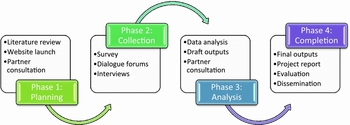
The larger project embraced four key phases (Figure 1). While the project was based in an Australian conservatoire, a number of partner institutions were involved in other Australian states, and internationally. The international partners were located in Hong Kong, the UK, Finland, Belgium and the Netherlands. Partner consultation, while most intensive during Phases 1 and 3, was ongoing through the project and assisted in making the outcomes of the project more broadly applicable to other contexts. Collaborating institutions were invited to share HDR education experiences and approaches, as well as resources, exemplars and information about other HDR education strategies such as interactive colloquia and wiki-based resources. These generated further ideas for innovative approaches to the training of HDR students in music.
Project phases

Phase 1 included mapping and benchmarking of current resources, pedagogies and practices for HDR students in performing arts projects, particularly at the host and partner institutions, but also more widely as indicated by the existing literature. In this phase, national and international advisors and partners were consulted on methodology and approach, including the design of a survey (as described in the next paragraph). This phase also included securing ethical clearance through standard institutional processes, and the establishment of the project website hosted by the authors’ home institution. The website was updated and maintained throughout the Fellowship, and continues to be active (see http://www.olt.gov.au/resources/good-practice).
Phase 2 involved data collection through a survey, dialogue forums and semi-structured interviews. The survey aimed to capture existing supervisory/training practices, identify exemplary practices, and pinpoint key issues of interest and concern for both students and supervisors. It was distributed through the project website and institutional HDR lists, and remained open from November 2012 to May 2013. HDR students and supervisors at host, partner and other institutions were encouraged to take part. A total of 145 responses (not all of them complete) were collected from across 11 countries in Europe, Asia, Australia, Africa and North and South America, with an almost-equal balance of supervisors and students among respondents (72 and 73 respectively), and a slight gender imbalance (58 female, 41 male) that may be broadly representative of supervisors and students in music institutions generally.
The majority of student respondents (41, or 62%) were enrolled in a PhD programme; 13 were undertaking a DMA, and the remainder (13) were enrolled in a masters degree (MPhil or MMus). Perhaps surprisingly, then, 29 students (44%) considered more than 50% of their research programme to be practice-based, while only 17 students (26%) considered that their research programme had no practice-based component at all. These data suggest that in music, in the views of students, even PhDs (rather than practice-based degrees such as the DMA) incorporate practice-based components. This corroborates with statistics for supervisors: although most supervisors (35 of 61, or 57%) reported that the majority of their students were enrolled in the PhD, more than half (32 of 61, or 53%) also reported that more than half of their students were engaged in practice-based research. Most supervisors (31 of 61, or 51%) were currently supervising fewer than five students, and almost half (28 of 61, or 46%) had supervised fewer than five students to completion. Among student respondents, the most common year of enrolment was first year (23 students, or 34.8%); 10 students (15%) had already submitted their research. Preliminary findings of the survey were presented to partners at a combined meeting in September 2012, and final data were discussed at a supervisors’ forum at the host institution in May 2013.
The dialogue forums, each with between four and 11 participants, were conducted with supervisors and candidates over a period of six months from September 2012 to February 2013. Dialogue forums can be described as an activity or an event in which a number of participants engage in a process of communication to explore issues and relationships on an equitable basis. In the public policy arena, it has been found that dialogue forums ‘promote many different types of learning’ and ‘challenge and change participants’ attitudes and opinions as ideas are discussed and negotiated’ (Davies et al., Reference DAVIES, MCCALLIE, SIMONSSON, LEHR and DUENSING2008). A critical element of the dialogue forum is the provision of information so that ‘opinions can be formed or challenged in order for dialogue to take place’ (Davies et al., Reference DAVIES, MCCALLIE, SIMONSSON, LEHR and DUENSING2008). The literature on dialogue forums indicates that there can be barriers to dialogue taking place; for the purposes of the project careful consideration was given to the structure of the forum, the skills and ‘outsider’ positioning of the facilitator, and ways to promote an environment whereby participants interact and create meaning from the dialogue. In contrast with the survey and interviews, the dialogue forums simultaneously represented a means of data collection for this project and a step towards its aims: they yielded in-depth qualitative data that fed into the development of approaches to improving higher research education in the host and partner institutions, but also served an end in themselves by creating a platform for collegial support and the exchange of ideas and knowledge among participants.
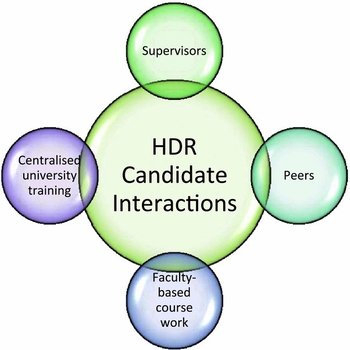
Using a case-study methodology, further semi-structured interviews with supervisors and candidates (individually) examined the ways in which candidates engage and interact with four aspects of their HDR journey: centralised university training, faculty-based course-work, supervisors, and their peers (see Figure 1). Broadly, the interviews explored how engagement with these aspects prepares research candidates for ‘life beyond’ in the broader academic and musical community as academics and critical reflective practitioners.
Phase 3 was characterised by analysis of the data. This phase overlapped and interplayed considerably with the data collection phase. The four aspects of research student engagement with HDR training shown in Figure guided the analysis of data. This phase included drafting of several project outcomes, and culminated in an interim report on pedagogies in HDR programmes in the partner institutions.
Phase 4 involved the development and implementation of improved HDR education practices at the host institution (including student-staff dialogue forums, student writing groups, and supervisor forums); evaluation of project outcomes; an intensification of dissemination strategies across institutional, national and international performing arts education forums (including sharing findings with students and supervisors directly involved with the project).
Research student engagement with aspects of HDR training

While the practical applications of the project have been enacted at the host institution and some partner institutions, the authors sensed that there was a need to present the findings for a broader audience, and a number of publications have ensued (Harrison, Reference HARRISON2013; Harrison & Dwyer, Reference HARRISON and DWYER2014).
Graduate capabilities and workplace readiness in music
This article seeks to illuminate those aspects of the study that related to graduate attributes. For some areas of tertiary study, like (arguably) dentistry or teaching, the specific qualities and capabilities required of graduates may be relatively easily identified, and therefore fostered. In others, including music, they are elusive. One reason for this is the diversity of possible paths a music graduate may take after completing studies. Hannan (Reference HANNAN2003) outlines over 150 possible careers in music, categorised into the broad areas of composition, performance, production, instrument making and repairing, broadcasting, music business, retailing and wholesaling, teaching, writing and research, arts administration, music therapy, libraries, archives and information services, and digital and online employment. In many cases, a ‘portfolio’ career that combines diverse employment arrangements and activities will eventuate, demanding an equally diverse bank of skills (Bartleet et al., Reference BARTLEET, BENNETT, BRIDGSTOCK, DRAPER, HARRISON and SCHIPPERS2012). This is true for HDR students too, for whom not only academic skills but also robust employability (that is, a diverse and relevant skill-set) are increasingly essential (Cumming et al., Reference CUMMING, KILEY, THOMAS, HORT, PIKE, EVANS and MAIN2009).
Another reason for the elusiveness of desirable graduate attributes in music sector is the disquieting pace of change of career opportunities and practices in the music industry, at a time when universities in general are ‘prepar[ing] graduates for careers not yet imagined’ and when students are likely to engage in ‘a lifetime of specialised work requiring multiple advanced skill sets in which they will continually learn and re-learn skills for performance in roles that may not have been invented yet’ (Bridgstock & Hearn, Reference BRIDGSTOCK, HEARN, Rooney, Hearn and Ninan2012, p. 108). For a cohort of music HDR students moving through a 3- or 4-year doctoral programme, it is eminently conceivable that the industry and workforce needs shift to an extent that those skills and capabilities that were deemed most desirable at the start of their degree are no longer so by the end of it.
Given these heightened challenges to employability and workforce readiness particular to the music sector, it is perhaps not surprising – but still worrying – that almost half of all students who participated in the survey felt only ‘a little prepared’ or ‘not prepared’ for life beyond their degree (24 of 51 respondents, or 47%), and that this sentiment arose also in student dialogue forums and interviews. The survey responses of some students suggested that their anxiety about life post-graduation was a function of challenging employment circumstances and lack of job opportunities. One placed this in the context of her limited work experience:
I do feel disadvantaged by the fact that I will be over 30 by the time I finish my doctorate and will never have had a full-time job. I am also aware that it will be close to impossible for me to find a full-time job in Australia, let alone [my home city], so in that sense I feel quite unprepared.
Some other students expressed doubt that their research studies would be useful in terms of finding suitable employment:
I am afraid my degree will not give me satisfying job opportunities and I am not satisfied with the job I have at the moment.
My areas of interest/research may not lead to employment opportunities. I am not necessarily prepared to be able to capitalise on my research.
For other students, though, the concerns raised about life-post-studies related less to the availability of suitable employment opportunities than to their own perceived insufficiencies. Several students felt trepidation for this reason:
[I] lack the networking skills and knowledge of how academia works, both of which are needed to make an academic career.
I am apprehensive about being seen as an ‘expert’ in my field, able to respond to frequent requests to provide answers, workshops, papers etc.
I am unsure how well I will cope in an academic position without a supervisor I know well to turn to for advice.
Another student felt confident in knowing the requirements to pursue an academic career, but felt incapable of executing them, and therefore felt ‘little prepared’ for life beyond studies:
I think I know what needs to be done to pursue academic life but I also don't think I have any time or means to make those preparations, hence when the end comes I [am] going to be out in the cold. I fear it is going to be a train wreck, actually.
Student participants in this study generally indicated an awareness of the need for a well-rounded skill set upon graduation, including generic skills to stand them in good stead in the face of changing work or industry practices. Students reported that a wide range of study-related experiences contributed positively to their learning, including presenting at conferences; participating in faculty-based colloquia and seminars, university-wide training sessions, and reading and writing groups; reading other dissertations; reading books on the research process; preparing articles for peer review; networking with colleagues; interacting with visiting professionals and researchers; accessing website-based institutional training resources; engaging in reflective practice and observation, and becoming involved in ‘the practical side’ of the research field beyond their studies. With regard to the content of supervision, survey results revealed that students felt it was most important for their supervisors to advise them on professional development opportunities, publishing, scholarships, symposia, and other matters that may have an impact on their ‘overall progression and development’ during their studies and beyond. One student, for example, stated the importance of supervisory advice about:
things that will effect [sic] the progress of the thesis and effect [sic] my employment once I have graduated: scholarships, development opportunities, university employment (tutoring, etc. – or where to find out about this), my progress. I expect that I would also do this myself – but it would be nice to think that my supervisors have an interest in my overall progression and development.
Supervisors, on the other hand, generally found it more important that supervision focus on the more technical aspects of research, such as locating resources (33 of 47, or 70%, of survey respondents felt this was ‘very important’), developing writing skills (30, or 64%), and academic protocols and processes (28, or 60%). All supervisors (n = 50) felt that it was ‘very important’ or ‘quite important’ for their students to develop research methods and writing skills. Despite these opinions about the content of supervision, however, the supervisors generally placed slightly more weight than students on importance of supplementary research education: 35 of 48 (73%) supervisors felt that presenting at conferences were a ‘very valuable’ part of their students’ research education, as opposed to 53% of students, for example. Supervisors reflected on a number of other experiences not mentioned directly in the survey that had a positive effect on their students’ learning, including preparing journal articles, school-based (creative arts) seminars, public presentations, media interviews, performances, workshops, training in research and writing skills, reading, travel, studies abroad, and work experience.
The disparity between perceptions of students and supervisors on their preferred content of research supervision, combined with the indication that supervisors believe supplementary activities to be important to their students, points to some potential mismatched conceptions about the supervisory role. Arguably, the kinds of skills emphasised in the current one-to-one model of HDR supervision in music (as in other disciplines) centre on cognitive and discipline-specific skills, like the following three skills identified in the Australian Qualifications Framework guidelines as required of doctoral-level graduates:
• cognitive skills to demonstrate expert understanding of theoretical knowledge and to reflect critically on that theory and practice
• cognitive skills and use of intellectual independence to think critically, evaluate existing knowledge and ideas, undertake systematic investigation and reflect on theory and practice to generate original knowledge
• expert technical and creative skills applicable to the field of work or learning (AQF, 2013).
Less likely to be explicitly taught or developed through traditional models of HDR supervision (or even HDR education more broadly) are practical workplace skills, including those social capabilities relating to communication, presentation, and networking (among other things) that are necessary for musicians to maintain a career (Bennett, n.d.). The isolation of the musician's early training (working alone in practice rooms for many hours) is also a factor here. The musician participants in Bennett's study emphasised that ‘communication skills are imperative to a musician's ability to create and sustain professional networks, and are essential to musicians’ practice regardless of their roles’ (‘skills’ section); they also highlighted the need for business and entrepreneurial acumen:
Small business skills were used by 72% of respondents, who emphasised the importance of skills in marketing, administration, financial management and people management: ‘One thing I have learnt from this industry is that the only way you will ever make it as a professional musician is to get up and personally promote yourself. No one ever taught me this at university’. (Bennett, n.d., ‘skills’ section)
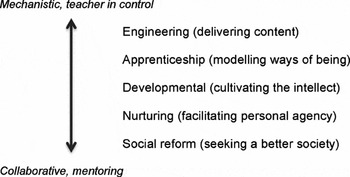
Possible roles of the HDR music supervisor may be clarified through recourse to the series of approaches to teaching and learning outlined by Pratt (Reference PRATT1992), which range from ‘engineering’ (delivering) on the one end of the spectrum of control to ‘social reform’ (seeking a better society) on the other (see Figure 1). Recently, this framework has been usefully invoked in relation to pedagogical approaches to one-to-one music tuition: Gaunt et al. (Reference GAUNT, CREECH, LONG and HALLAM2012) argue that Pratt's ‘nurturing’ and ‘social reform’ are more aligned with a mentoring-style relationship that many students appreciate and desire, whereas some research indicates that a one-to-one learning context ‘can result in outcomes that contradict the goals of a mentoring approach’ since students risk developing a passive approach to learning and over-dependency on the ‘teacher’ (p. 27). Comparably, the findings of this present study indicate that the participating HDR music students tended to value supervisory content that aligned with a ‘nurturing’ and ‘social reform’ approach to HDR education, while supervisors tended to placed importance on an approach somewhere towards the middle or other end of Pratt's scale.
Pratt's series of approaches to teaching and learning (Reference PRATT1992).

Preparing work-ready HDR music graduates
Quite aside from the disparity in student and supervisor concepts of what constitutes quality supervision, it appears distinctly unlikely that all eight dimensions of graduate capability identified by Cumming et al. (Reference CUMMING, KILEY, THOMAS, HORT, PIKE, EVANS and MAIN2009) – inquiring, analysing, producing, communicating, teaching, managing, thinking and interacting – may be soundly acquired through the one-to-one model of research supervision, the default model of research pedagogy in higher degrees. As Lee and Green note, ‘despite growing recognition that doctoral education is a ‘shared responsibility’ among many participants, there is a persistent administrative and conceptual defaulting to the one-to-one relationship’ (Reference LEE and GREEN2009, p. 616). As with other forms of music pedagogy, the responsibility for the students’ success does not rest solely with the supervisor–student dyad. In undergraduate music performance, a team of teachers – one-to-one teacher; the orchestra conductor; the chamber music coach; the musicianship and music history lecturers assist the student. This remains true for music and other creative disciplines, many of which are relative newcomers to the university context. All institutions represented in this study had in place a system of HDR education that included one-to-one supervision, though many also offered supplementary activities for research education, such as HDR forums and seminars.
Like undergraduate music students, HDR music candidates need a team approach as they:
generally require a broader set of skills than previously, to be ‘resilient’ and to navigate successfully through the professional landscape . . . In addition, they need to develop flexibility and entrepreneurialism, personal confidence, communication skills and artistic imagination (Creech et al. Reference CREECH, PAPAGEORGI, HADDON, POTTER, MORTON and DUFFY2008). They also need to be much more acutely aware of their abilities and passions and adept at finding ways to apply these within the workplace. This means that they must be able to work creatively and collaboratively, often in a wide range of artistic, social and cultural contexts. (Gaunt et al., Reference GAUNT, CREECH, LONG and HALLAM2012, p. 26)
The diversity of desirable graduate capabilities implies the necessity of an equally diverse model of research education. Some of Cummings’ eight dimensions of capability (like inquiring and analysing) may be best acquired through structured learning, such as formal courses so often absent in the HDR experience. Other capabilities (like communicating and thinking) may be more easily developed through semi-structured (peer-learning, dialogue, mentoring) or even unstructured learning (like student-initiated internships or through paid employment).
The future for HDR?
How, then, to better prepare music HDR students for life beyond their studies? Manathunga and Goozée (Reference MANATHUNGA and GOOZÉE2007) assert that current models of research education are based on the false assumptions that students have the skills to work autonomously and that academics know how to be effective supervisors because they were once students. If this is true, the necessity of exploring new models of research education is urgent. New models of hold promise to improve graduate outcomes and better prepare students for life post-degree (in addition to other benefits, such as reducing isolation and building stronger support networks; (Harrison, Reference HARRISON2013; Harrison and Dwyer, Reference HARRISON and DWYER2014). In line with the recommendation of Boud and Lee (Reference BOUD and LEE2005) that ‘more systematic attention . . . be paid to the breadth and diversity of learning activities and relationships in research education’, the findings of the current study suggest that music HDR program structures might move beyond traditional dyadic models of student-supervisor to a model where a supervisor is only one of many resources at the students’ disposal (see ([author name removed], under review). Besides, HDR music students come from a wide range of backgrounds, professional experience, and life experience, and a diversity of research education approaches seems best placed to cater for the range of needs arising from this situation.
Clearly, HDR music students also need to be assisted to develop adaptive and flexible approaches to learning, since desirable capabilities of music HDR graduates in the workforce are as vicissitudinous as the music industry itself. By developing this ability, students build a resilience that prepares them well for dealing with challenges that arise in the course of their careers, and in life beyond studies generally (Carey et al., Reference CAREY, BRIDGSTOCK, MCWILLIAM, TAYLOR and GRANT2013); it also helps develop the entrepreneurial skills that are increasingly needed to forge a successful career in the arts (Bridgstock, Reference BRIDGSTOCK2013). Gaunt et al. raises this issue in relation to undergraduate music students, and it remains true for HDR students too:
The most reliable feature of a [professional music] career is likely to be its unpredictability (Rogers 2002). As the nature of employment diversifies, many traditional fields of work are contracting, while opportunities to engage new audiences and devise innovative, often interdisciplinary works are emerging. The implications for supporting students in Higher Education are that, in addition to developing individual craft skills, it is equally important to enable creativity, the ability to collaborate and the flexibility to meet the changing demands of professional work. (Gaunt et al., Reference GAUNT, CREECH, LONG and HALLAM2012, p. 26)
Students who are most likely to successfully find employment in their chosen field post-studies will have developed both generic and discipline-specific skills, where generic skills and attributes are those with ‘a direct connection to the students’ employability regardless of their research topic and/or discipline base’ (Chan & Parker, Reference CHAN and PARKER2007). Many music HDR students build their practice-based (discipline-specific) skills during their studies; some already have a robust professional identity and practice before they even commence higher degree research. Relevantly, Chan and Parker suggest that the development of generic skills may be particularly pertinent to postgraduate research students from a studio-based background (they refer to design studies, but their comment is equally applicable to music HDR students), who may need to further develop their skills in areas such as academic writing, conference presentations and grant applications. Those authors also note that academics ‘may not be in the position to supervise as well as teach all aspects of generic skills’, and conclude that this indicates a need to provide generic skills training for teaching staff (Chan & Parker, Reference CHAN and PARKER2007). An alternative and arguably more sustainable solution (given the typically heavy academic workloads) would be to diversify research education activities and resources for students, as recommended earlier.
Whatever the model of supervision, one implication of this study for supporting HDR students is that, in addition to developing research-related technical skills and cognitive or intellectual capabilities, students need and want guidance or mentoring in matters relating to the development of their professional skills and identity. One step towards this end may be the model of research education, used by some institutions represented in this study, wherein the responsibility for a single student is distributed and shared among a team of supervisors, whose various skills and strengths may then aid the student in complementary ways. This model enables the provision of more rounded support and a wider range of approaches to learning than would be possible from a single supervisor (Harrison & Dwyer, Reference HARRISON and DWYER2014). Another possible strategy that develops flexibility in learning is the ‘collaborative cohort model’ (CCM) of HDR supervision (Burnett, Reference BURNETT1999), where students meet to discuss their own and other students’ research, facilitated by a mentor academic. Burnett found that students who attended these meetings were not only more likely to complete their studies, but also developed a wider range of skills than those who did not. Other collaborative models of learning, peer learning and mentoring approaches (Renshaw, Reference RENSHAW2009) may also prove useful.
Concluding thoughts and future directions
It is anticipated that the programme of activities, resources and outcomes of this project will continue to improve teaching skills among current supervisors and inform best practice for future generations of HDR supervisors and candidates in music and other creative arts. A community of learning is desirable, as Pearson and Brew (Reference PEARSON and BREW2002) contend, as well as a range of activities in which students interact with their peers around the university through seminars and discussion groups, in professional and community contexts and in disciplinary networks (p. 141). The need for a flexible approach to the creation of learning communities in doctoral education (Parker, Reference PARKER2009) is further emphasised by the diverse doctoral student population, particularly within the creative arts disciplines. However, the provision of a rich environment is not in itself sufficient. Boud and Lee call for
an expanded conception of research education pedagogy [and] the need for more distributed and horizontalized conceptions of pedagogy which pay attention both to the actual material practices and relationships deployed by students, as well as to the differential uptake by different students of learning opportunities for relationships within the public environment. (2005, p. 514)
The research-based approaches, strategies and tools to increase HDR student engagement and HDR completion developed through this project stand to significantly benefit both the host institution and the broader higher education sector. The findings give rise to the following notions for improving supervisory and educational practice in music higher degree students:
(1) Consolidate a shared understanding among supervisors of current and emerging resources, pedagogies and evaluations of HDR programmes in music;
(2) Provide collegial opportunities for supervisors to explore collaborative, innovative approaches to resource development, pedagogical strategies and evaluation processes relating to music HDRs;
(3) Facilitate non-hierarchical and open platforms for dialogue and exchange of knowledge and skills between supervisors and students, for example using dialogue forums; these platforms may also serve to develop skills for workplace/professional readiness as well as focusing on specific aspects of research;
(4) Embed opportunity for regular student-led activities that cultivate specific skills or address issues of particular interest or concern to students, thereby also providing a means for focused and needs-based exchange of experiences and knowledge;
(5) Provide student and supervisor development opportunities around optimising the nature and effectiveness of the student-supervisor relationship and supervisory practices; and
(6) Implement a mechanism to encourage self-evaluation of supervisory practices among supervisors on an ongoing and regular basis.
With these six foci in mind, the higher music education sector has a framework from which to develop supervisory practices that embrace the challenges in the higher education workforce, and help to provide opportunities for graduates to leave our institutions with capabilities that better prepare them for the life beyond their degrees.
Acknowledgements
Thanks are due to all the HDR supervisors and students who participated in this study, and to host institution Griffith University. Support for the production of this article was provided by the Australian Government Office for Learning and Teaching, through a National Teaching Fellowship awarded to the first-named author. The views expressed in this article do not necessarily reflect the views of the Australian Government Office for Learning and Teaching. More information on the Fellowship project can be found at www.musicresearchspace.com.au.