Among the changes wrought by the Reformation was the transformation of the sacerdotal, intercessory Catholic priesthood into a preaching, catechizing, protestant ministry.Footnote 1 Expectations that clergy should have some measure of education, reside in a single benefice, and live uprightly had existed in the late Middle Ages, but the protestant Church of England fostered these ideals with more resolve, and ultimately with more success, than its Catholic predecessor had had.Footnote 2 The Church of England's protestant ordination ritual, first issued in 1550, outlined the church's expectations of ministers. They were to be educated, honest, upright men who were intimately connected to their communities. In the Welsh-English frontier, including Wales and the diocese of Hereford—a part of the realm where many people spoke Welsh rather than English—this hinged on a minister's ability to communicate with his parishioners. Whether these standards were actually implemented is another matter entirely. While ordinands became remarkably more educated between 1540 and 1640, the most significant challenge for the church in Wales and the diocese of Hereford remained the linguistic differences between the Church of England and its Welsh-speaking members.
Focusing on the three dioceses of Wales for which records are extant—Bangor, St. Asaph, and St. David’s—and the English border diocese of Hereford allows the historian to examine the progress of the Reformation in a conservative agrarian area far from typical protestant hotbeds in London and southeast England. This region posed particular problems even for an enthusiastic parish minister. It had few formal educational institutions and a language barrier between the Anglophone ecclesiastical hierarchy and the many Welsh-speaking laity. Benefices in this area consistently tended to be much poorer than those in the southeast of England. The average benefice in the diocese of Hereford in 1535 was worth £8 11s. 4d., compared to £14 1s. 5d. for Essex; by the 1650s the average Essex benefice had increased in value to £72 12s. 9d., but the average Herefordshire living was now worth only £40 9s. 11 1/2d.Footnote 3 Because the population, especially in Wales, was thinly spread over the land, parishes were large in area. The upland, sometimes mountainous terrain often hindered transportation and communication.
During this discussion, two alternative directions for the study of the Reformation in these areas will become clear. First, the political and administrative border between England and Wales was permeable. This would seem to be common sense, as anyone living in the southwestern United States or Alsace-Lorraine is aware. Little in the historiography of Britain reflects this porosity of borders, although the evidence points to border regions as places of cultural, social, and linguistic intermingling.Footnote 4 For instance, so many Welsh speakers lived in the diocese of Hereford that its bishops were ordered to procure Welsh editions of the Book of Common Prayer, hence the inclusion of that diocese in this study.Footnote 5 This region was less a border area with obvious boundaries than a frontier, or a “meeting place of peoples in which geographic and cultural borders were not clearly defined,” to use the terminology employed by Jeremy Adelman and Stephen Aron.Footnote 6
The second point concerns the conditions necessary for the success of the Reformation in Wales, if success is defined as the internalization of protestant belief in heart and mind rather than the rote practice of a weekly ritual. The eminent historian Glanmor Williams, to whom all in this field are deeply indebted, has argued in his extensive corpus that the publication of the first Welsh Bible in 1588 marked the success of religious reform in Wales.Footnote 7 Professor Williams's emphasis on the importance of the vernacular is surely correct. Wales, however, needed not only Welsh Scriptures and prayer books; Wales needed as well protestant ministers competent in speaking Welsh. This, too, would seem to be common sense: if most people are illiterate in any language, a Bible in one's own tongue does no good if the clergy cannot understand that language. Finding Welsh-speaking clergy remained a significant challenge for the church long after 1588, and varying responses to this problem help to explain why Protestantism eventually took hold in Wales and Scotland but not in Ireland.
Before attempting to determine if this need for educated, Welsh-speaking clergy was met, one should first examine the church's expectations of the clergy as they were presented through a widely circulated medium: the Church of England's protestant ordinal. This book received approval from a parliamentary commission early in 1550 and was published in March of that year as A forme and maner of makyng and consecratyng of Archebisshopes, Bisshopes, Priestes and Deacons.Footnote 8 In 1552, it was appended to the Book of Common Prayer, which all parishes in the kingdom were required by statute to purchase. Every minister ordained in the Church of England from 1550 onward, with the exception of priests ordained during Mary I's restoration of Catholicism from 1553 to 1558, would have undergone at least once the rite prescribed by the ordinal.
Before candidates for orders underwent the ritual of ordination, the ordinal stipulated, they had to meet several basic qualifications. Eligible candidates had to be at least twenty-one years old to be ordained deacon and twenty-four to proceed to the presbyterate. They were to be examined privately by the bishop or his representative to ensure their knowledge of Latin, sufficient instruction in Scripture, and virtuous living.Footnote 9 This private examination was publicly affirmed by the archdeacon and confirmed by the bishop at the beginning of the ordination rite. The bishop ensured that candidates were “inwardly moved by the Holy Ghost” and “truly called according to the will of our Lord Jesus Christ.”Footnote 10 The public examination also required candidates for both orders to declare that the canonical Scriptures contained all things necessary for salvation and to take the Oath of Supremacy to the monarch.Footnote 11 The ordination rite provided laypeople with an opportunity to approve candidates when the bishop asked the assembled congregation to declare “any impediment, or notable crime, in any of these persons presented to be ordered … for the which, he ought not to be admitted.”Footnote 12 This assent of the laity was negative rather than a positive endorsement of the candidates, and there is little evidence that laypeople actually attended ordinations. Still, laity had some responsibility in and thus made a contribution to the selection of clergy, if a minor one.
The ordination ritual clearly outlined the expectations the church placed upon its ministers. Deacons were to assist the priest in distributing communion, to read Scripture and homilies to the congregation, to catechize the parish's young people, and to baptize and preach if they were permitted to do so by the bishop. In addition to these duties, a deacon provided pastoral care to the community: “It is his office to search for the sick, poor, and impotent people of the parish and to intimate their estates, names, and places where they dwell to the curate, that by his exhortation they may be relieved by the parish or other convenient alms.”Footnote 13 A series of biblical allusions summed up the role of presbyters, who were “to be the messengers, the watchmen, the pastors, and stewards of the Lord, to teach, to premonish, to feed and provide for the Lord's family: to seek for Christ's sheep that be dispersed abroad, and for his children which be in the midst of this naughty world, to be saved through Christ for ever.”Footnote 14 In practical terms, this meant providing the sacraments, teaching their congregations through catechism and preaching, administering discipline, and warding off heretical and erroneous belief.Footnote 15 This entailed complete devotion to the church and its needs, as the bishop's exhortation stated baldly: “Ye see how ye ought to forsake and set aside (as much as you may) all worldly cares and studies.”Footnote 16
The ordinal further established a close link between clergy and the communities they served. The deacons’ task of coordinating poor relief demanded that they know the social circumstances of all members of their congregations in detail in order to recognize both parishioners’ needs and their ability to give charity. Deacons were also to be “constant in their ministration” to their people.Footnote 17 Presbyters likewise were exhorted to “see that you never cease your labor, your care and diligence, until you have done all that lieth in you, according to your bounden duty, to bring all such as are, or shall be committed to your charge, unto that agreement in faith, and knowledge of God, and to that ripeness, and perfectness of age in Christ, that there be no place left among them, either for error in religion, or for viciousness in life.”Footnote 18 They could accomplish this through public and private counsel and by maintaining peace in their communities.Footnote 19 The ordinal's standards meant that merely reading services and preaching on Sundays did not fulfill the duties of a clergyman. Ministry had to be lived daily; it required deep engagement with God, the church, and parishioners. It was not simply a job; it entailed shouldering heavy responsibilities as a permanent, sometimes draining way of life.
According to the ordinal, then, the charges given in Scripture connected protestant clergy intimately to their parish and the larger Christian community. Their ministry of sacraments, teaching, evangelism, and pastoral care of their congregations was rooted in the Bible, as were the church's expectations that their lives would serve as examples of proper Christian behavior. Clergy were to obey the king, bishops, and other chief ministers of the church. To ensure that the needs of the church and its laity were met, candidates for ordination had to meet basic standards of fitness before proceeding to orders.
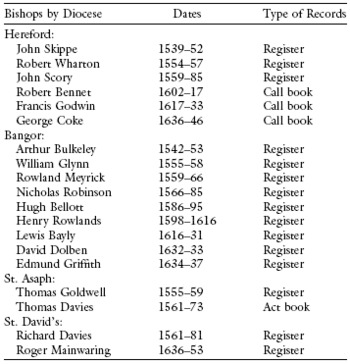
These theoretical and theological statements of the role of protestant ministry of course appeared rather different once they were put into practice. We turn now to the men who were ordained according to the rites of the Church of England in Wales and the diocese of Hereford. For this study, 646 ordinations, comprising some 1,248 ordinands, have been drawn from the extant episcopal registers, act books, and visitation call books of this period and region. Previous analyses of ordinands have been based on printed calendars instead of on the actual registers themselves, and no previous study of religion in Wales also includes a diocese in England.Footnote 20 This sample covers all sixteen bishops whose registers or act books recorded ordinations—three from Hereford, nine from Bangor, two from St. Asaph, and two from St. David’s—as well as three bishops of Hereford whose ordinands served in that diocese in the early seventeenth century and were registered in the diocesan call books (table 1).Footnote 21 The dates of the ordinations in question range from 18 September 1540 to 24 September 1640. At a minimum, the registers give the name of the candidate, the order to which he was admitted, the date, and the name of the ordaining bishop. Often the educational qualifications of the candidate, his university or college affiliation (if any), his diocese of origin, the name of his patron, and the title to which he was ordained are also included.Footnote 22
Other information given in the registers are the interval between orders, if the candidate received more than one, and his ethnicity. Determining these two pieces of data can be problematic. For instance, occasionally a scribe will record that a candidate for the presbyterate is the same man ordained to the diaconate above. This, however, is relatively rare. The Roger Bull ordained a presbyter in Hereford on 22 March 1562 is almost certainly the same Roger Bull who became a deacon two weeks earlier, as no other Roger Bulls appear in John Scory's register.Footnote 23 But one cannot always make this assumption. A William ap Ievan became an acolyte on 30 May 1556, and a man of the same name was ordained to the priesthood on 20 October 1560: because of the commonness of the ap Ievan patronymic, the length of time between the orders, and the Elizabethan restoration of Protestantism
—Bishops in Wales and the Diocese of Hereford

that occurred in that interval, one cannot assume that these two are the same person.Footnote 24 Ethnicity in this context refers to the ethnicity of a person's surname. Traditional Welsh patronymics and their anglicized versions have been used to determine the ethnic origins of ordinands. Obviously, this identifies men only by their father's ethnicity and does not recognize men of mixed heritage. It is a crude indicator, but in the absence of better evidence, it is all that is available.Footnote 25
An average of 1.93 men received orders at each ordination. Variation is evident even within one bishop's records: the prolific Roger Mainwaring of St. David’s, who ordained sixty-four men in twenty-seven months, often ordained them one at a time, but at a massive ceremony on 19 May 1638, he admitted forty-five men to orders.Footnote 26 The three Marian bishops who have left registers—Robert Wharton of Hereford, William Glynn of Bangor, and Thomas Goldwell of St. Asaph—ordained a total of seventy-six men, but only sixteen of them were presbyters. The number of men who began the process of becoming Catholic priests by presenting themselves for minor orders during the restoration of Catholicism—Wharton ordained seven acolytes, Glynn sixteen, and Goldwell twenty-four—suggests either some enthusiasm for the medieval church, resignation to conformity among men who felt called to a vocation, or pressure from patrons who wished to fill vacant
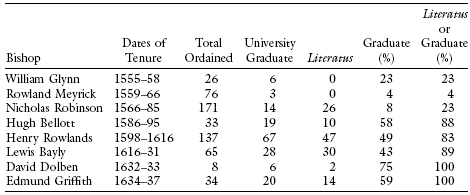
—Education of Ordinands in Bangor Diocese, 1555–1638
Source. —National Library of Wales, B/BR/2.
benefices.Footnote 27 Six of these Marian priests probably remained in their parishes after 1559; one of them, Nicholas Robinson, later became bishop of Bangor.Footnote 28
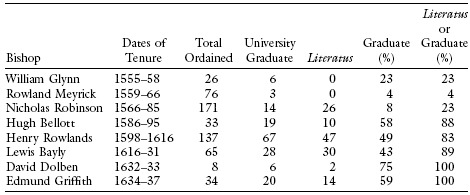
The most striking trend apparent in the ordination records is the increase in the percentage of ordinands who had received some education, whether it was basic literacy in Latin (indicated by the term literatus) or an advanced degree. Education was crucial to the Reformation because only educated ministers were competent to preach the word of God, a critical plank of the protestant platform. Only the register of Arthur Bulkeley of Bangor does not record the education of ordinands.Footnote 29 The records of the diocese of Bangor, the most complete in this study, reveal this pattern clearly. Here we find that the percentage of graduates rose unevenly from 19 percent under Bulkeley's successor, William Glynn, to well over 50 percent by the 1630s (table 2).Footnote 30 Of the 116 graduates whose university affiliation can be determined, ninety-two were Oxford alumni; the other twenty-four were Cantabrigians.Footnote 31 Nine of these twenty-four hailed from that hothouse of puritans, Emmanuel College, while one more graduated from Sidney Sussex.Footnote 32
The increase in those ordinands identified as literatus, able to read Latin, is similar, so that where 19 percent of Glynn's ordinands were either literatus or graduate, the number jumps to over 90 percent by the 1630s (table 2).Footnote 33 Parallel developments occurred in Hereford, St. Asaph, and St. David’s. These men could meet the ordinal's demand for reading knowledge of Latin; clearly, in this respect protestant ministers became better qualified between 1540 and 1640.
The same cannot be said for another indicator of clerical quality (or episcopal conscientiousness)—the length of time between orders. The 1550 ordinal prescribed that a deacon “must continue in that office of a deacon the space of a whole year at the least (except for reasonable causes, it be otherwise seen to his ordinary) to the intent he may be perfect, and well expert in the things appertaining to the ecclesiastical administration, in executing whereof, if he be found faithful and diligent he may be admitted by his diocesan to the order of priesthood.”Footnote 34
In 1604, the Hampton Court conference reiterated this rule, prohibiting men from receiving the orders of deacon and presbyter on the same day.Footnote 35 That the conference forbade this, using a much laxer standard than the ordinal’s, implies that many men were being ordained deacon and priest simultaneously in defiance of the prayer book. The evidence supports this conclusion. John Scory, Elizabethan bishop of Hereford, ordained nineteen men to the presbyterate less than a year after they had received the diaconate; three of them received both orders on the same day.Footnote 36 None of the eight men Rowland Meyrick of Bangor ordained deacon and presbyter waited a year between orders, while only three of fourteen recipients of both orders from Thomas Davies of St. Asaph did.Footnote 37 Richard Davies of St. David's ordained thirty men to both the diaconate and presbyterate in less than a year, and his Caroline successor, Roger Mainwaring, did not enforce the yearlong interval for any cleric.Footnote 38 Only for Nicholas Robinson of Bangor does the waiting period seem to be related to an ordinand's level of education: just one of his five graduates to receive both orders had to wait a year between diaconate and presbyterate, while thirty-five of the forty-seven men not identified as graduate, scholar, or literatus did. This stands in contrast to the practice of Thomas Dove, bishop of Peterborough from 1601 to 1630, who regularly ordained men to the diaconate and presbyterate on consecutive days. Dove's contravention of the canon seems to indicate a generally lax attitude toward the examination of ordinands; he ordained one in eight of the nonconformists ejected from their livings in 1662.Footnote 39 The same may be true for frontier bishops. The ordinal did allow a bishop discretion to waive the waiting period, but it seems that the one-year interval was a mere formality that only a few were required to fulfill.
One reason for this apparent laxity may be that bishops believed that their examinations of candidates were sufficient to maintain standards of learning. The Marian Thomas Goldwell of St. Asaph refused to ordain two subdeacons because they were illiterate; while 95 percent of his ordinands had never been near a university, he appears to have weeded out truly unqualified candidates from those he did ordain.Footnote 40 His successor at St. Asaph, Thomas Davies, enjoined eight of the fourteen presbyters he ordained on 31 October 1568 “to say by heart perfectly the whole epistle of St. Paul to the Romans and the 6th of the gospel of St. John, and to appear before his Lordship [Davies] this day twelvemonth to repeat the same … upon pain of excommunication.” The thirteen deacons ordained that day were also required to learn “the first half part of the said epistle” by rote and demonstrate their knowledge before Davies.Footnote 41 It is unclear why Davies's mandate did not extend to the other six presbyters. While they were not listed as graduates or scholars, they may have performed better on their preordination examination than their colleagues. In any case, Davies demanded a certain amount of scriptural knowledge at least from those eight men.
Clergy already in orders who failed to meet a bishop's educational standards might be required to prove that they had studied basic elements of the faith. Thomas Pierson, rector of Brampton Bryan in the diocese of Hereford from 1612 to 1634, convinced Bishop Robert Bennet to authorize the foundation of a combination lecture based in Leintwardine. Besides providing sermons to a parish without a preacher, the lecture gave remedial education to clergy selected by Bennet's deputies. A month in advance of the lecture, these ministers were assigned a relatively simple topic—“some article of the creed, or petition in the Lord's Prayer, or one of the Ten Commandments”—upon which they were to expound. Any clerk who refused to participate was to be referred to the bishop for punishment. On the day of these exercises, all the clergy in attendance shared dinner, after which “some question of controversy, or some case of conscience or the interpretation of some difficult place of Scripture should be propounded, and those that were present entreated to consider of it, that they might be provided to deliver their opinions that day month.” Pierson's seventeenth-century biographer claimed that the Leintwardine lecture “was the means of so much good, that by degrees in time the country thereabouts came to be furnished in most places with ministers of commendable abilities.”Footnote 42 Whether this is hyperbole or not, these exercises provided a means by which insufficiently educated clerics might receive encouragement and training from their peers, backed up by the stick of episcopal discipline.
A more obvious and serious abuse than ignoring the waiting period between orders was that of an ordinand holding a benefice prior to receiving orders. Congregations in such parishes received services from a curate, a presbyter who was paid only a small stipend, not the full income of the parish, if at all. Given the poverty of this area, the curate was likely to hold several curacies simultaneously, with negative effects on the spiritual welfare of his parishioners. The Marian bishop of Hereford, Robert Wharton, ordained two subdeacons who held benefices.Footnote 43 His counterpart in Bangor, William Glynn, ordained two acolytes and one deacon who did the same.Footnote 44 Some protestants, including Scory and Robinson, also ordained beneficed deacons, but the protestant Church of England's canons allowed deacons to hold livings with the cure of souls, and thus ordaining beneficed men to the diaconate was not considered an abuse provided that such deacons were admitted to the presbyterate within a year.
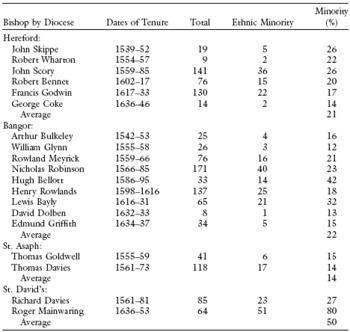
The ethnicity of ordinands provides insight into the nature of the relationship between Wales and the border regions of England and indicates how well clergy could be intimately linked to their parish communities, as the ordinal demanded. Most historiography of the Reformation treats England and Wales as completely separate entities.Footnote 45 A statistical survey of the ordination records of Wales and Hereford, which has not been previously attempted, suggests otherwise. On average, 14 percent of St. Asaph ordinands, 22 percent of Bangor ordinands, and 50 percent of St. David's ordinands bore English surnames. The English had staffed the church in Wales with Englishmen as a means of subduing the Welsh since the Norman Conquest of Wales in 1283–84, so these numbers themselves are not surprising. But 21 percent of Hereford's ordinands had Welsh surnames (table 3). Welshmen formed a significant minority of the clergy in the diocese of Hereford, as Englishmen did in Welsh dioceses.
The implications of these numbers are twofold and refer to the two points previously mentioned—that the Welsh-English border, like others, was porous, and that Welsh-speaking ministers were crucial to the success of the Reformation in this area. Migration between England and Wales was common, and the Church of England's administrative machinery did not necessarily discriminate between Welsh people and English.
Second, the close connection between minister and parishioners that the ordinal envisioned hinged on the ability of both parties to communicate with one another. A common language was obviously central to this, and for many people in Wales and the diocese of Hereford, that language was Welsh. Nearly 90 percent of people in Wales used Welsh for everyday communication.Footnote 46 Welsh-speaking pockets existed in the diocese of Hereford, for instance, around Clun in Shropshire and also in Oswestry, Shropshire, where the churchwardens routinely purchased Welsh prayer books, Bibles, catechisms, and psalters.Footnote 47 Moreover, late fifteenth-century church court records reveal some monoglot Welsh speakers, who were possibly migrant agricultural laborers, far into the English parts of Herefordshire, outside the border districts.Footnote 48 Conversely, some parts of Wales, notably southern Pembrokeshire and the Gower Peninsula, were Anglophone; George Owen estimated in the late sixteenth
—Ethnicity of Ordinands

Sources. —National Library of Wales, B/BR/2, SA/BR/1, SA/MB/14, SD/BR/2, SD/BR/3; Herefordshire Record Office, AL19/14, AL19/15, HD5/1/6, HD5/1/14.
Note. —Minority defined as Welsh in the diocese of Hereford, and English in Wales.
century that seventy-four parishes in Pembrokeshire spoke only English and sixty-four only Welsh, while six were bilingual.Footnote 49 The churchwardens of St. Mary's in Swansea procured the Bible and books of homilies in both English and Welsh.Footnote 50 Anglophones also lived in the Welsh-speaking “dark corners” of Wales, far from the English border. The parish of Llanbryn-mair in the diocese of St. Asaph lay almost in the geographic center of Wales, yet Robert Vaughanne, the curate there, recorded in his will that “the Englishmen of Llanbryn-mair … do owe unto me for the procuring for an order for them to have the service in the English tongue for my charges the sum of 10s.”Footnote 51 Clearly, Vaughanne ordinarily used Welsh in his parish but made special allowance for these members. Two languages were spoken in Wales and the diocese of Hereford. If parishioners were to become protestant and if ministers were to integrate into their communities as the ordinal expected, many ministers in England had to speak Welsh, and many ministers in Wales had to speak English.
The Church of England did make, rather belatedly, attempts to meet the catechetical and liturgical needs of these Welsh-speaking ministers. An official, complete Welsh version of the Book of Common Prayer appeared in 1567, the entire Welsh Bible in 1588, and Welsh books of homilies (to be read in place of sermons by nonpreaching clergy) in 1606. These translations, however, did Welsh laity little good if their Anglophone ministers could not understand the language, and even Glanmor Williams, for all his emphasis on the vernacular, has never made this connection between clergy and the language they spoke. Ordaining Welshmen, the vast majority of whom could probably speak Welsh, was the most efficient way of staffing Welsh-speaking parishes appropriately. It is certainly possible that some English clergy learned Welsh in order to serve in Wales, as the twentieth-century poet and Anglican priest R. S. Thomas did, but there is no record of this happening.Footnote 52 The bishops of Hereford attempted to ordain sufficient Welsh clergy to serve their Welsh-speaking parishes (table 3). The evidence for Welsh dioceses is less conclusive. The bishops of Bangor ordained too many Englishmen, given the relative scarcity of the English language in the northwestern portion of Wales. Since a substantial number of parishes in St. David's spoke exclusively English, Richard Davies's balance of English and Welsh ordinands probably fit the needs of his diocese. Roger Mainwaring, on the other hand, grossly oversupplied St. David's with Englishmen; nearly 80 percent of his ordinands were English, while only about half of his parishes spoke that language.Footnote 53
The lack of ministers competent in speaking Welsh was evident even at the end of the period under study. In 1640, 318 Welshmen, including seven who described themselves as “preachers of the Word of God,” signed a petition to Parliament begging redress for their grievances concerning religion in their country. Much of this petition criticized bishops, “the causes and upholders of all these evils,” but the opening item claimed,
In the Principality of Wales containing thirteen shires, and therein about a thousand parishes, there are not (as far as upon diligent search we can find, or hear of), neither have there been in our time thirteen constant preachers at one time which preach twice, or preach and expound the catechism, every Lord's Day in the Welsh tongue in their own cure, so that for the want of vision and teaching of God's word the people perish and the ignorance and superstition, and the excess of all sin is very lamentable: and this is the more to be wailed because the people are ingenious, devout and as ready to receive the gospel soundly preached with all alacrity and zeal as any nation (we have heard of) in Christendom.Footnote 54
The presbyterian authors of this petition obviously had motives beyond merely increasing preaching—namely, ridding the country of bishops—in mind when they drafted it. It is, however, significant that their initial complaint was of the underprovision of preachers who could speak Welsh. This was a grievous situation to the petition's authors. Even considering that this petition likely underestimated the number of preachers working in Wales to magnify the extent of the problem, there was a demand for Welsh-language sermons, and it was not being met.
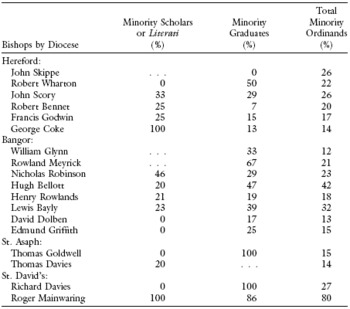
Not only were there too many Englishmen in Welsh-speaking parts of Wales; English clerics there tended to be more educated than their Welsh counterparts. In every diocese in Wales, English clergy were disproportionately likely to hold degrees, compared to Welsh ordinands (table 4). Thus clergy who could meet the church's demand for education (and were more likely to preach) were less likely to speak the same language as the parishioners in their charges. The diocese of Hereford, by contrast, had a low percentage of Welsh graduates compared to the total proportion of Welshmen but more Welsh scholars and literati relative to the number of Welshmen. This suggests that many young Welsh clergymen, while they were in their formative years at university, chose England's more lucrative employment prospects over Welsh parishes, where their services were desperately needed. Welsh bishops therefore had to ordain men of fewer qualifications simply to fill vacant parishes. The bishop of Bangor, William Roberts, admitted as much in his 1638 report of his diocese to Archbishop William Laud: “By reason of the poverty of the place, all clergymen of hope and worth seek preferment elsewhere. … [Thus] some weak scholars must be ordained, or else some cures must be left altogether unsupplied.”Footnote 55 This siphoning of Welsh-speaking talent from Wales to England, and the clerics of poorer quality left in Wales in its wake, reduced even further the ability of the Church of England to transmit Protestantism to Welsh laity.
That so many men with Welsh names received orders in Hereford and that so many Englishmen were ordained in Wales suggest that the social and cultural border between Hereford and Wales was not clearly defined. The issue of language and its relationship to religious change indicates similarities between Wales, Scotland, and Ireland and the progress of reform in those areas. Recent scholarship of the Reformation in Britain suggests a broad thesis: the Reformation was most successful in instilling protestant belief in the laity when it negotiated with the existing language and culture. In Scotland and Ireland, as in Wales, a language barrier divided most protestant reformers from some laypeople (those who spoke Scots Gaelic or Irish). Yet a handful of forward-thinking Scottish protestants recognized the importance of evangelizing in the Gaelic tongue. Liturgies, preaching, and catechizing in Gaelic rapidly became a standard feature of protestant worship
—Education of Ethnic-Minority Ordinands

Sources. —National Library of Wales, B/BR/2, SA/BR/1, SA/MB/14, SD/BR/2, SD/BR/3; Herefordshire Record Office, AL19/14, AL19/15, HD5/1/6, HD5/1/14.
Note. —Minority defined as Welsh in the diocese of Hereford, and English in Wales. Ellipsis dots indicate that no ordinands with that education level were recorded for that bishop.
in the Highlands. Protestant nobles, especially Colin Campbell, earl of Argyll, ensured that the Gaelic-speaking churches in their lands were properly supplied with ministers.Footnote 56 The Scottish kirk also permitted aspects of traditional culture, such as wedding banquets, in exchange for a modest fine.Footnote 57
In contrast to the Scottish kirk and the Church of England in Wales, the Church of Ireland pursued an aggressively anglicizing reformation.Footnote 58 Anglophones were concentrated in the narrow strip of the Pale in the east of Ireland; most native Irish people spoke only Irish. The English government expected these Irish speakers to become protestant, but virtually no provision was made for them. While an Irish-language protestant catechism appeared in 1571, the New Testament in Irish was not published until 1607, and the Irish Book of Common Prayer not until 1611—“a gestation that hardly indicates urgency,” as Patricia Palmer notes.Footnote 59 Ireland, like Wales, had precious few preachers, and most of them could not speak Irish.Footnote 60 This linguistic chasm between the church and the Irish people provided Jesuits and seminary priests with an ideal opportunity to entrench Catholicism in Ireland. The antipathy of many Irish people toward the English presented a formidable challenge to any reform imposed by the English, yet the refusal to use the vernacular seriously hindered the Reformation in Ireland before it even began.
Wales and other non-English-speaking parts of Britain, like the Scots Gaelic-speaking Gaidhealtachd, eventually became protestant because the need to offer reformed religion in the native language was recognized. The Reformation was accessible to English speakers nearly twenty years before monoglot Welsh speakers had a wide opportunity to encounter it, so reform in Welsh-speaking areas necessarily took hold at a later date than it did in English areas. While Welsh speakers in Oswestry had to wait longer than their Anglophone neighbors for protestant services in their own language, they did receive them. Nothing similar occurred in Ireland.
Clergy who were not only educated and resident but who could also communicate with their congregations would have met more than the minimal requirements: they could have satisfied the ordinal's expectations that a presbyter be intimately connected to his parish. By understanding the language and culture in which their parishioners lived, these ministers could offer more personal pastoral care and sermons. They could ensure that their flocks knew the catechism. The church in Wales and the diocese of Hereford made a remarkable amount of progress toward this goal in the century after 1540, but it was still a goal, not yet a thing realized.