Throughout tropical ecosystems, herbivorous insects play an important role in their impact on plant life and nutrient cycling (Coley & Barone Reference COLEY and BARONE1996, Massad et al. Reference MASSAD, BALCH, DAVIDSON, BRANDO, MEWS, PORTO, QUINTINO, VIEIRA, JUNIOR and TRUMBORE2013, Metcalfe et al. Reference METCALFE, ASNER, MARTIN, SILVA ESPEJO, HUASCO, FARFÁN AMÉZQUITA, CARRANZA-JIMENEZ, GALIANO CABRERA, BACA, SINCA, HUARACA QUISPE, TAYPE, MORA, DÁVILA, SOLÓRZANO, PUMA VILCA, LAUPA ROMÁN, GUERRA BUSTIOS, REVILLA, TUPAYACHI, GIRARDIN, DOUGHTY and MALHI2014), as well as prey for their natural enemies (Ruiz-Guerra et al. Reference RUIZ-GUERRA, RENTON and DIRZO2012, Young et al. Reference YOUNG, MCCAULEY, DUNBAR, HUTSON, TER-KUILE and DIRZO2013). Top-down control through predation pressure (Hairston et al. Reference HAIRSTON, SMITH and SLOBODKIN1960) is essential in understanding population dynamics of herbivorous insects. While a number of studies have addressed this aspect for individual habitats (Howe et al. Reference HOWE, LÖVEI and NACHMAN2009, Koh & Menge Reference KOH and MENGE2006, Richards & Coley Reference RICHARDS and COLEY2007), comparisons of predation pressure between countryside and natural forest sites within the same area are rare (Posa et al. Reference POSA, SODHI and KOH2007). Large spatial distances between disparate habitat types may introduce confounding factors such as differences in climate and predator community composition. To maximize comparability, we therefore assessed predation pressure between countryside and adjacent near-natural lowland rain-forest habitat. We tested the following three hypotheses: (1) predation pressure is higher in countryside than in old-growth forest; (2) arthropods represent the main predator group in both habitat types; and (3) birds have a relatively higher impact in countryside with less canopy cover compared with forest habitats.
Our study was conducted in the Golfo Dulce region situated in the Pacific lowlands of south-western Costa Rica. Field work was carried out in proximity to the La Gamba Field Station (8°61′42′′N, 83°97′12′′W; 78 m asl) near Golfito in August 2014. The region is characterized by a wet season between May and November and a dry period from December to April. The average annual precipitation and temperature in this area is about 5800 mm and 28 °C, respectively (Weissenhofer & Huber Reference WEISSENHOFER, HUBER, Weissenhofer, Huber, Mayer, Pamperl, Weber and Aubrecht2008).
The forest site encompassed an old-growth rain forest located in the south of the Piedras Blancas National Park (140 km2). This site is characterized by wet soil conditions, a clearly stratified vegetation structure, trees growing up to 30 m tall, and high canopy closure, interrupted only by occasional tree-fall gaps. Adjacent countryside habitat was characterized by a mosaic of active and fallow pastures, as well as rice fields with scattered shrubs and trees, and correspondingly low canopy cover (<20%). More comprehensive information on characteristics of the study area can be found in Weissenhofer et al. (Reference WEISSENHOFER, HUBER, MAYER, PAMPERL, WEBER and AUBRECHT2008).
To compare predation pressure between habitat types we used artificial caterpillars. This experimental approach has become popular in recent years (Low et al. Reference LOW, SAM, MCARTHUR, POSA and HOCHULI2014). Artificial caterpillars (25 mm long, 4 mm in diameter) were made from oil-based non-toxic modelling clay (Koh-I-Noor Hardtmuth brand). Dark green and brown colours were used to imitate two very common colourations among undefended caterpillars (i.e. lacking urticating hairs or spines and aposematic colouration indicative of chemical defence). Within each habitat, 162 artificial caterpillars were placed on suitable structures (e.g. leaves, branches, stems) along a 1200-m transect with a minimum distance of 5 m from each other. Locations were situated 0.5–2.0 m above ground depending on accessibility, since such minor variation in height was deemed unlikely to affect predation (Koh & Menge Reference KOH and MENGE2006, Posa et al. Reference POSA, SODHI and KOH2007). Transects in both habitats were located at a distance of at least 50 m from the forest edge and within the same narrow altitudinal range (about 80–100 m asl). Artificial caterpillars were visited at 24-h intervals and remained in the field for 3 consecutive days. Bite marks were classified according to Low et al. (Reference LOW, SAM, MCARTHUR, POSA and HOCHULI2014) as either arthropod, bird or small-mammal attacks.
We analysed predation pressure using Generalized Linear Models (GLMs) based on Poisson distribution and log-link function. Prior to analysis, data from locations where at least one replica was lost or showed undetermined bite marks were excluded (n = 11, 3.5%). The remaining 939 caterpillar-days comprised 151 and 162 artificial caterpillars in countryside and forest habitat, respectively. For each artificial caterpillar individual, the number of predation events across the 3 d of observation was aggregated resulting in attack scores between 0 and 3.
Neither birds nor arthropods showed a preference for one colouration over the other (Table 1). Parallel to assumptions concerning green caterpillars forwarded by Howe et al. (Reference HOWE, LÖVEI and NACHMAN2009), this indicates that brown specimens are perceived as palatable and non-toxic by visually oriented predators in a similar manner.
Effects of habitat type (near-natural forest–countryside) and artificial caterpillar colour (brown–green) on mean number of attacks per caterpillar accumulated over 3 d in Golfo Dulce region, Costa Rica. Overall predation, arthropod predation and bird predation were analysed separately by GLMs with Poisson-type error structure. For all three analyses n = 313.

During the 939 caterpillar-days of exposure, most attacks were attributed to arthropods (n = 216), followed by birds (n = 67) and small mammals (n = 3), resulting in an overall predation (mean ± SE) of 29.2% d−1 ± 2.6% d−1 across both habitats. Twelve artificial caterpillars were attacked by two different predator groups. Overall, our findings correspond to an intermediate predation pressure which is nearly identical to the grand mean (29.1%) across a wide range of studies reported by Remmel et al. (Reference REMMEL, DAVISON and TAMMARU2011) for similar experiments using artificial caterpillars.
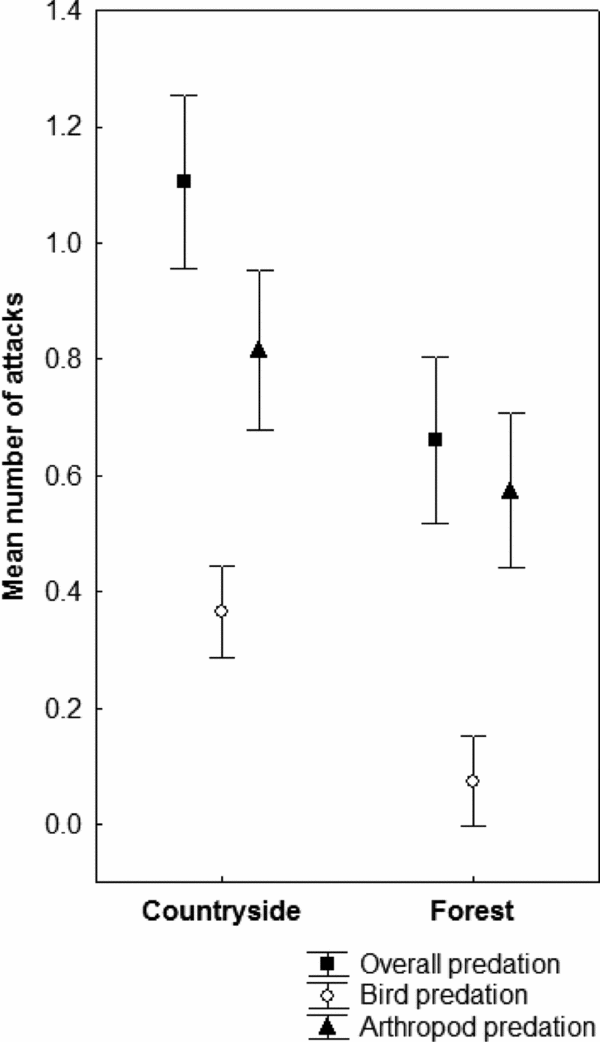
Mean number of attacks per caterpillar (± SE) accumulated over 3 d was significantly higher in countryside (1.11 ± 0.08) compared with the forest habitat (0.66 ± 0.07, Figure 1) indicating, if extrapolated to real caterpillars, that predation pressure is much higher in human-disturbed countryside than in near-natural rain forest.
Mean number of attacks (±95% CI) per caterpillar during 3 d of exposure in forest (n = 162) and countryside habitat (n = 151), Golfo Dulce region, Costa Rica. Incidences of attacks were significantly lower (P < 0.001) for overall predation, bird predation and arthropod predation in forest habitat (GLM, Poisson-type error structure).

Arthropods emerged as the principal predators of artificial caterpillars in both habitats (>75% of all predation events), although their mean number of attacks (± SE) accumulated over 3 d was significantly lower in the forest (0.57 ± 0.06) compared with countryside (0.81 ± 0.08, Figure 1). This is contrary to the findings of Posa et al. (Reference POSA, SODHI and KOH2007) who observed higher predation by arthropods in closed-canopy forest than in rural areas in the Philippines. Ants can safely be assumed to act as chief predators of caterpillars as they are the most abundant group of predatory arthropods in the tropics (Floren et al. Reference FLOREN, BIUN and LINSENMAIR2002, Hölldobler & Wilson Reference HÖLLDOBLER and WILSON1990, Loiselle & Farji-Brener Reference LOISELLE and FARJI-BRENER2002, Richards & Coley Reference RICHARDS and COLEY2007, Sam et al. Reference SAM, KOANE and NOVOTNY2014). Although species richness of ants is typically higher in mature tropical forests, ant abundance may increase with the level of disturbance, since some dominant ant species can attain very large colony sizes in open grass and shrub land (Brühl & Eltz Reference BRÜHL and ELTZ2010, Philpott et al. Reference PHILPOTT, PERFECTO, ARMBRECHT, PARR, Lach, Parr and Abbott2010). This may also account for the higher predation pressure in countryside observed in our present study.
Attacks by birds were significantly more common in countryside than in rain forest (mean number of attacks (± SE) accumulated over 3 d: 0.36 ± 0.05 vs. 0.07 ± 0.02; Table 1, Figure 1). The comparatively low predation by birds in near-natural forest was unexpected, since a study by Schulze & Riedl (Reference SCHULZE, RIEDL, Weissenhofer, Huber, Mayer, Pamperl, Weber and Aubrecht2008) in the same research area revealed similar densities of insectivorous birds in forest habitat and neighbouring countryside. Instead of reflecting the abundance of predatory birds, our findings seem to support the suggestion by Posa et al. (Reference POSA, SODHI and KOH2007) that birds may more easily locate prey in open habitat compared with closed-canopy forest. Increased predation pressure in open sites near the forest edge may consequently be due to some understorey birds foraging in adjacent habitat (Hughes et al. Reference HUGHES, DAILY and EHRLICH2002). Furthermore, the relative importance of avian predators differed between habitats. Birds accounted for a third of overall predation events in countryside (32.9%), but only for 11.2% at forest sites, while arthropod attacks showed a corresponding increase from 69.1% to 86.1%. Thus, the proportional impact of birds as caterpillar predators apparently declines from countryside to forest, whereas arthropods show the opposite trend. In conclusion, our experiment revealed that caterpillars in tropical countryside habitat directly adjacent to a rain-forest reserve may experience even higher predation pressure than inside near-natural rain forest.
ACKNOWLEDGEMENTS
For providing research permits we thank the Ministerio de Ambiente y Energía, San José, Costa Rica. We thank Tobias Dreschke, Dominik Rabl and Christian H. Schulze for field assistance and helpful hints to the manuscript, and the managers and staff of the La Gamba field station for their support. Furthermore we thank two anonymous reviewers for their comments. Supported by travel grants through the Faculty of Life Sciences, University of Vienna.