Introduction
Human populations are increasing faster than the rate of livestock production, especially in developing and underdeveloped countries (Steinfeld et al., Reference Steinfeld, Wassenaar and Jutzi2006). Undernourishment is highest in sub-Saharan African countries, where around half the population live on USD 1.90 a day or less. In Ethiopia, cattle, numbering 53.99 million, are the major source of red meat (CSA, 2013). Livestock accounts for 20% of the Ethiopian economy but could contribute more; however, livestock diseases are an important constraint on this resource (Biffa et al., Reference Biffa, Jobre and Chakka2006). Diseases cause significant economic losses through mortality, reduced growth or weight gain, and rejection of edible organs and carcasses at slaughterhouses (Jobre et al., Reference Jobre1996). Also, some zoonotic diseases can be transmitted to humans by direct contact, indirectly from the infected farm environment, or through the consumption of infected raw or undercooked meat and milk (Swai and Schoonman, Reference Swai and Schoonman2012).
Abattoirs are vital in the detection and surveillance of animal diseases. Abattoir records can help in tracing an infected carcass back to the farm from which it originated. Abattoirs also aid in diagnosing chronic or subclinical infections during post-mortem examination, which may have gone unnoticed during ante-mortem examination. Epidemiological findings based on abattoir records are useful in assessing the risk of human exposure to zoonotic diseases. In recent years, abattoir records have been recognized as a valuable syndromic surveillance tool for the detection of emerging diseases (Dupuy et al., Reference Dupuy2013).
There is a need for detailed documentation of various causes of food (meat) wastage, especially in drought-affected and poverty-stricken countries such as Ethiopia. Surveys of food wastage have been reported for several parts of Ethiopia (Alembrhan and Haylegebriel, Reference Alembrhan and Haylegebriel2013; Assefa and Tesfay, Reference Assefa and Tesfay2013; Regassa et al., Reference Regassa2013). However, disease incidence varies with geographical area, and most of these surveys were short-term studies and focused only on parasitic diseases. Additionally, these studies did not assess abattoir losses due to partially condemned organs. Kombolcha ELFORA abattoir is the major abattoir in South Wollo, Amhara regional state, Ethiopia. This study determined the various causes of bovine carcass and organ condemnation at this abattoir, and estimated the associated economic losses, using 10-year abattoir record data to increase the precision of findings and minimize the effect of climate or other environmental variables.
Materials and methods
Study area
This retrospective study was based on 10-year (January 2005–December 2014) record data from Kombolcha ELFORA abattoir, located in the town of Kombolcha, Amhara, Ethiopia. Kombolcha is located 376 km north-east of Addis Ababa, 11°84′N and 0.39°46′ E, at an elevation of 1840 m above sea level; it has an average annual rainfall of 1248 mm and an average annual temperature of 15.9°C. The farming sector has grown substantially because of the suitable topography and agro-climatic conditions, and the availability of a large water reservoir associated with the Borkena River. According to CSA (2006), the animal population of the study area comprises 90,664 cattle, 43,010 poultry, 31,043 goats, 12,975 sheep, 7,758 donkeys, 866 camels and 489 horses.
The Kombolcha ELFORA abattoir was established by the Italian investor MR Sopral in 1957. It is privately owned and is the major source of inspected beef in Kombolcha city. A portion of this meat is supplied to the Kombolcha meat processing factory for canning. The size, hygiene and quality standard of the abattoir is comparable to other abattoirs in Ethiopia. Currently, one veterinarian and two meat inspectors work in the abattoir. Approximately 50–150 cattle are slaughtered per day, and slaughtering is usually done on alternate days. Tissue samples from the abattoir that require further laboratory testing are submitted to the adjoining Kombolcha Regional Veterinary Laboratory.
Study design
To assess the proportion of organs or carcasses condemned, along with the causes and associated financial implications, retrospective data were collected from the record book of Kombolcha ELFORA abattoir on 46,913 apparently healthy cattle slaughtered between January 2005 and December 2014. Data related to age, origin and body condition score for slaughtered cattle were not available, nor were data on sex or breed; however, as per the veterinarian and meat inspectors, most of the cattle brought to the abattoir are male and of indigenous zebu breeds.
Ante-mortem examination of animals is routinely carried out before slaughter, and only apparently healthy animals are passed for slaughtering. Routine meat inspection at the abattoir is carried out by the qualified veterinarian or by meat inspectors under the supervision of a veterinarian following the guidelines of the Ministry of Agriculture (Hailemariam, Reference Hailemariam1975). Decisions for total approval, partial approval, conditional approval and total condemnation are made only after thorough meat inspection. However, heart, head and tongue are totally condemned even if only minor abnormalities are observed. Total condemnation of a carcass was not practised in the abattoir for economic reasons. All pathological lesions responsible for organ or carcass condemnation are recorded on a daily basis on a standardized data sheet. Data records with missing or ambiguous information on diagnosis, date of slaughter and condemnation were excluded from the study.
Direct financial losses
Direct financial losses were estimated by multiplying the average price (per organ or per kg of carcass) and the sum of condemned organs (either partially or totally) and carcasses (in kg). Based on information from local butchers and customers in May 2015, the average cost of bovine lung, liver, heart, kidney, head, tongue and carcass (per kg) was ETB 30, 45, 25, 25, 75, 25 and 100, respectively. The value of a partially condemned organ was considered, on average, to be half the price of the whole organ.
Data analysis
Data collected from the abattoir record books were entered into a Microsoft Excel spreadsheet, then descriptive statistics were used to calculate the percentage of organs (partial or full) and carcasses (partial) rejected for human consumption. The associated economic losses over the 10-year study period were determined by taking into consideration the market prices of organs and carcasses, and by assuming a currency exchange rate of USD 1 = ETB 19.6846.
Results
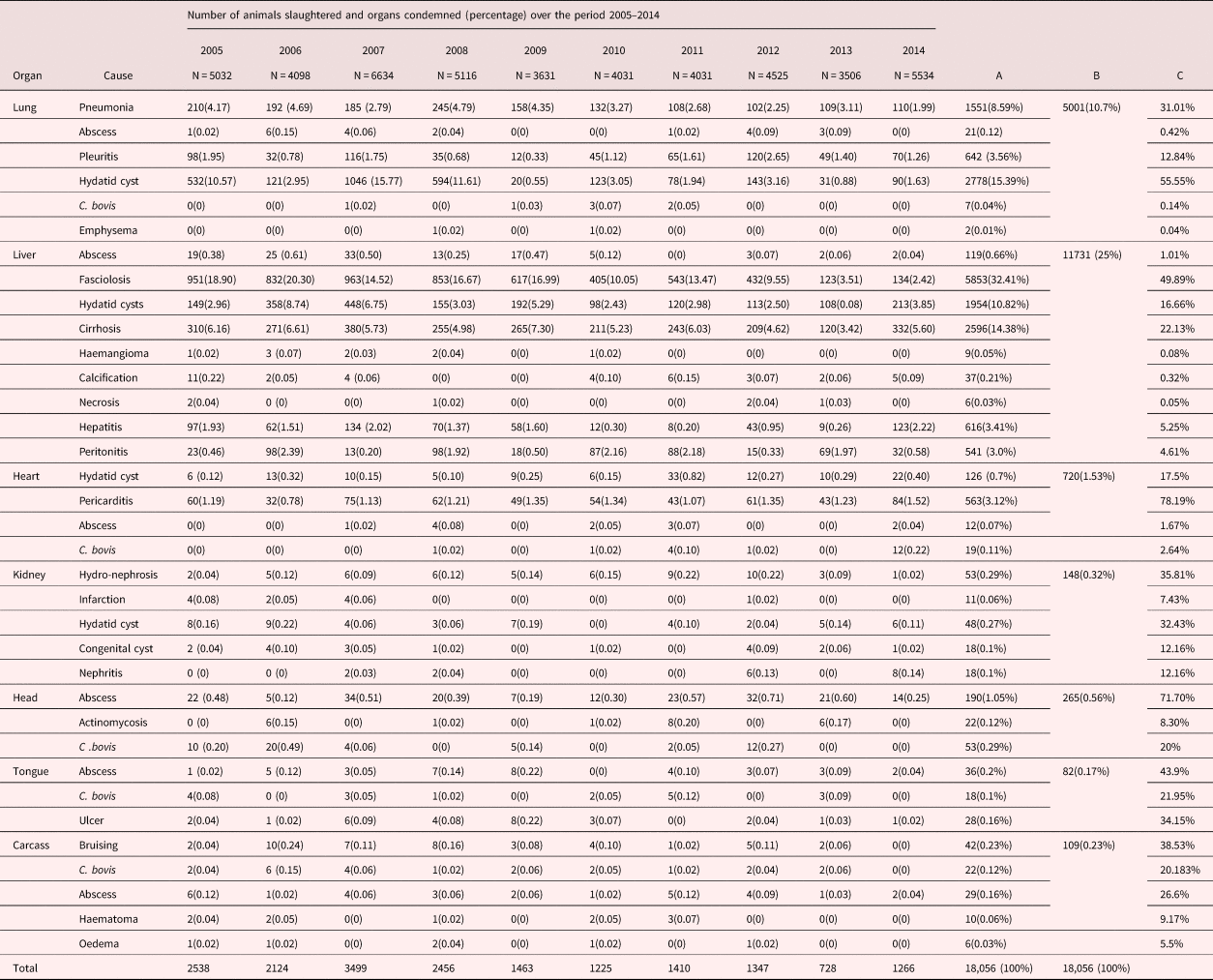
Of the 46,913 cattle slaughtered during the study period, 38.49% (n = 18,056) had one or more abnormalities leading to partial or total condemnation of organs or carcasses (only partial). Organ-specific condemnations were as follows: 11,731 livers (25%), 5001 lungs (10.7%) and 720 hearts (1.53%) (table 1). The least affected organs were the head (0.56%), kidney (0.32%) and tongue (0.17%). Approximately 0.23% (109/46,913) carcasses were affected with one or more pathological conditions, resulting in condemnation of 5030 kg of meat.
Causes of condemnations with respect to organs and carcasses in Kombolcha ELFORA abattoir in north-east Ethiopia between January 2005 and December 20014 (n = 46,913). N is the number of cattle slaughtered.

A: Number of specific organs condemned with a particular disease condition (percentage of the particular disease condition in total number of animals slaughtered)
B: Total number of specific organ condemned (percentage of specific organ condemned in total number of slaughtered animals)
C: Percentage of a particular disease condition in a specific organ causing its condemnation (B/A)
The main causes of liver condemnation were fascioliasis (49.89%), cirrhosis (22.13%), hydatidosis (16.66%), hepatitis (5.25%) and peritonitis (4.61%). In contrast, hydatid cysts (55.55%) were the leading cause of lung condemnation, followed by pneumonia (31%) and pleurisy (12.84%). Pericarditis (78.19%), hydatidosis (17.15%), Cysticercus bovis (2.64%) and abscess (1.67%) were the major causes for condemnation of hearts (table 1). Similarly, hydronephrosis (35.8%), hydatidosis (32.43%), congenital cyst (12.2%), nephritis (12.2%) and infarction (7.4%) were major causes of condemnation of kidneys, whereas the main causes for heads were abscess (71.7%), C. bovis (20%) and actinomycosis (8.3%). Abscess (36, 43.9%), ulcer (28, 34.15%) and C. bovis (18, 21.95%) were the major reasons for wastage of 82 tongues (table 1). Of the 109 (0.23%) partially condemned carcasses, bruise, abscess, haematoma and C. bovis were responsible for condemnation of 38.5%, 26.6%, 9.17% and 20.2%, respectively (table 1). The remaining portions of partially condemned carcasses were allowed for consumption after providing special treatment (e.g. chilling) if necessary.
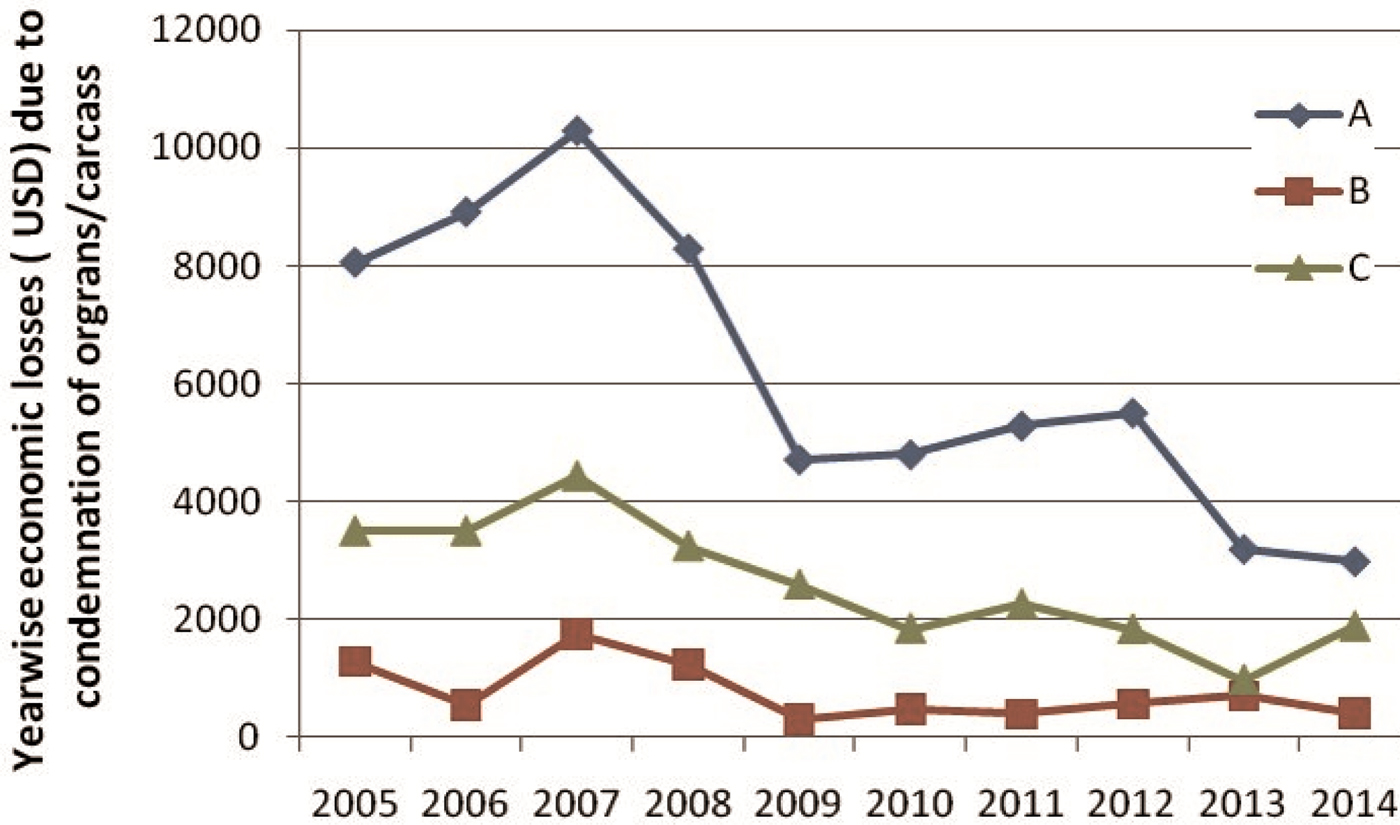
Monetary losses related to wastage of organs or carcasses from the 10-year record data were estimated to be ETB 1,219,399 (USD 61,946.9) (fig. 1). This included financial losses associated with organ wastage, which were calculated as USD 36,307.57, and carcass weight losses amounting to USD 25,639.33. A smaller percentage (3.57%) of these organs received partial condemnation. The main condemned organ was liver, responsible for losses of up to ETB 593,596.396 (USD 30,155.37), of which ETB 256,837.5 (USD 13,047.64) was associated with fascioliasis only (table 2). Year-wise distribution showed an overall decline of losses from 2005 to 2014, with highest losses of ETB 202,447.5 (USD 10,284.56) observed in 2007, and with the lowest values in 2014 (ETB 58,555 or USD 2975.36) (fig. 2).
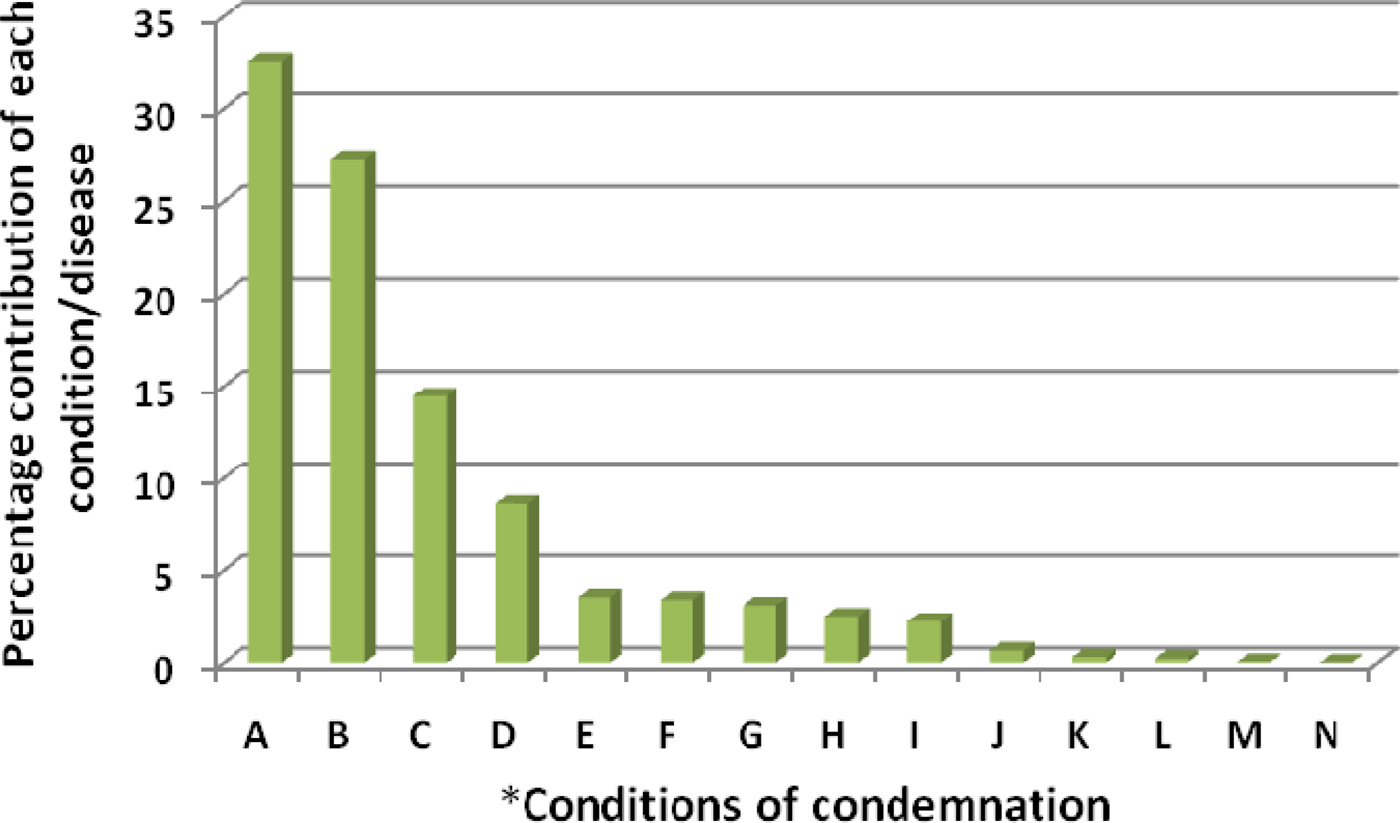
Graph depicting the trends of contributions of major reasons for wastage of organs/carcass in Kombolcha ELFORA abattoir in north-east Ethiopia. *A: fascioliasis; B: hydatidosis; C: cirrhosis; D: pneumonia; E: pleuritic; F: hepatitis; G: pericarditis; H: peritonitis; I: abscesses; J: C. bovis; K: hydronephrosis; L: carcass bruising; M: liver haemangioma; N: emphysema.

Annual trend of financial losses due to wastage of (A) all organs and carcasses, (B) livers only, and (C) lungs only, at Kombolcha ELFORA abattoir, Ethiopia, from 2005 to 2014.
Proportion of cattle infected with different parasitic diseases and associated estimated economic losses due condemnation of organs at Kombolcha ELFORA abattoir during the study period (n = 46,913).

*Includes losses due to both total condemnation and partial condemnation of organs
Discussion
Abattoirs gather information on animal diseases (especially chronic or subclinical disease), protect the public from consumption of infected and unhygienic meat, and are vital in improving overall management of animals, helping to reduce pre-slaughter problems (Jibat et al., Reference Jibat2008). The present study revealed that several different conditions resulted in the wastage of a large number of organs and carcasses, thereby reducing the availability of a cheap source of nutrients (including protein, vitamins and minerals), and depriving farmers and cattle traders of valuable income. Although similar work has been done on this abattoir in the past (Sheferaw and Abdu, Reference Sheferaw and Abdu2017), yearly trends of various conditions responsible and associated financial losses were not described and the economic losses due to partial condemnation of organs such as liver and lung were not included. Moreover, this study covers data from 10 years to minimize the influence of environmental variables on the overall findings.
Similar to our findings, liver and lung were reported to be major condemned organs in cattle in the same abattoir (Sheferaw and Abdu, Reference Sheferaw and Abdu2017), in slaughterhouses of other parts of Ethiopia (Alembrhan and Haylegebriel, Reference Alembrhan and Haylegebriel2013; Regassa et al., Reference Regassa2013) and in other countries, including Tanzania (Mellau et al., Reference Mellau, Nonga and Karimuribo2011) and Nigeria (Alawa et al., Reference Alawa, Etukudo-Joseph and Alawa2011). The most common causes of lung and liver condemnation were parasitic diseases, i.e. hydatidosis and fascioliasis, respectively. These organs are the first large capillary beds encountered by the blood-borne Echinococcus oncospheres (Kebede et al., Reference Kebede2009). The higher prevalence of hydatid cysts in lungs could be attributed to the larger capillary network in this organ compared to the liver (Getaw et al., Reference Getaw2010). Similarly, the liver is the first organ encountered by infective larval stages of fasciola and other pathogens that gain entry through the oral route. Similar findings of parasitic infections being major causes of liver and lung condemnations have been reported in Ethiopia (Borji et al., Reference Borji, Azizzadeh and Kamelli2012; Nurit et al., Reference Nurit, Zerihun and Serkalem2012; Terefe et al., Reference Terefe2012; Yibar et al., Reference Yibar, Selcuk and Senlik2015); Ahwaz, Iran (Borji et al., Reference Borji, Azizzadeh and Kamelli2012); Bursa province, Turkey (Yibar et al., Reference Yibar, Selcuk and Senlik2015); and Arusha, Tanzania (Mellau et al., Reference Mellau, Nonga and Karimuribo2011). The higher occurrence of fascioliasis (5853/46,913 or 12.5%) in the present study than in earlier reports in Ethiopia (9.26% by Assefa and Tesfay, Reference Assefa and Tesfay2013) and Turkey (2.8% by Yibar et al., Reference Yibar, Selcuk and Senlik2015) may be due to favourable local environmental conditions (higher humidity and temperate temperature), unavailability of effective control strategies and development of resistance to the routine lines of treatment in the study area. Although fascioliasis rarely causes mortalities in cattle, it affects meat production and results in liver condemnation during post-mortem examination in slaughterhouses (Kambarage et al., Reference Kambarage1995).
In the present study, more than one quarter (27.8%) of condemned organs were lungs, possibly due to the anatomical and histological structure suitable for the growth of pathogens and parasites. Hydatid cysts were the most common abnormality encountered in bovine lungs (5.2%) (table 2). This finding accords with Assefa and Tesfay (Reference Assefa and Tesfay2013) and Borji et al. (Reference Borji, Azizzadeh and Kamelli2012), who reported the occurrence of hydatidosis in lungs of slaughtered cattle as 5.1% and 3.8% in northern Ethiopia and south-western Iran, respectively. However, Efrem et al. (Reference Efrem2015), Tenaw et al. (Reference Tenaw, Feyera and Abera2015) and Sheferaw and Abdu (Reference Sheferaw and Abdu2017) reported higher prevalence of hydatidosis in western Ethiopia (12.17%), central Ethiopia (16.62%) and in the same abattoir (9.6%), respectively. This variation in prevalence of hydatidosis may be associated with factors such as control measures adopted, level of awareness, education and economic status of the local population, the presence of specific strains of E. granulosus, and agroclimatic conditions in the study area (Ibrahim, Reference Ibrahim2010).
In addition to livers and lungs, 720 hearts, 148 kidneys, 265 heads and 82 tongues were completely condemned during the 10-year period. The main cause of heart and kidney condemnation was found to be pericarditis and hydatid cysts, respectively. The primary agents that cause pericarditis in cattle include viruses, bacteria and mycoplasma, which mostly arise through the hematogenous route as in septicemic conditions or through perforation of the pericardial sac by an infected foreign body via the reticulum, or from direct extension of pathogens from nearby structures (FAO, 2007). Mesele et al. (Reference Mesele2012) also reported pericarditis and hydatidosis as the predominant reasons for condemnation of heart and kidney, respectively, in cattle slaughtered in Gondar, north-west Ethiopia, and Mellau et al. (Reference Mellau, Nonga and Karimuribo2011) and Sheferaw and Abdu (Reference Sheferaw and Abdu2017) reported pericarditis as the leading cause of heart condemnation in the Arusha region, Tanzania, and Kombolcha ELFORA, Ethiopia. Abscess was the major reason for head and tongue condemnation, similar to the findings of Mummed and Webb (Reference Mummed and Webb2015).
The proportion of carcasses affected with one or more pathological conditions was 0.23% (108/46,913), resulting in 5030 kg of meat loss by partial condemnation only. Bruises in cattle are usually associated with inappropriate handling or improper transportation during pre-slaughter stages (Edwards et al., Reference Edwards1999). A bruise rate of 0.089% (42/46,913) in carcasses observed in the present study was lower than the 17.05% and 21.71% reported by Mummed and Webb (Reference Mummed and Webb2015) and Negero and Ferede (Reference Negero and Ferede2017), respectively. This could be related to the negligence of meat inspectors in recording minor trimmed portions of carcass, which are usually associated with bruising. Similarly, abscesses were recorded to be prevalent in 0.059% (28/46,913) of carcasses, probably linked to injuries during transportation or improper injections, facilitating growth of bacteria. Most of the abscesses were located at injection sites (neck and gluteal region), indicating that the cause was probably the use of unsterilized needles or syringes or struggling of animals due to improper restraining, as indicated by the presence of broken needles in muscles of two carcasses. In contrast to our findings, Sheferaw and Abdu (Reference Sheferaw and Abdu2017) reported tuberculosis and tuberculosis-like lesions as the major cause of carcass condemnation in the same abattoir. This may be due to the fact that tuberculosis cases were excluded from our study because of insufficient or ambiguous information on diagnosis.
The total economic losses incurred were ETB 1,219,399 (USD 61,946.9), with average annual losses of USD 6,194.69 reported due to wastage of organs and carcasses from the slaughtered cattle during the study period. Highest losses (ETB 202,447.5 or USD 10,284.56) were recorded during 2007, which may be associated with the highest number of animals slaughtered (6634) during that year (fig. 2). The total annual financial losses due to the rejection of organs and carcasses showed an overall decline from 2005 to 2014 (fig. 2). For instance, the prevalence of fascioliasis declined from 18.9% in 2005 to 2.42% in 2014, while prevalence of hydatidosis was reduced by almost half (11.5% in 2005 to 5% in 2014). This suggests a steady improvement in veterinary delivery services, including anthelmintic treatment, greater awareness amongst farmers and the use of better control measures. Also, several livestock disease control measures were initiated by the government and NGOs in this decade to control parasitic infections. This disparity could partly be attributed to variability of climatic conditions such as humidity, rainfall and temperature, which are known to influence the development and survival of pre-parasitic stages of helminth parasites (Andersen et al., Reference Andersen, Levine and Boatman1970; Soulsby, Reference Soulsby1982; Hansen and Perry, Reference Hansen and Perry1994). During this survey of 10-year records, fascioliasis, hydatidosis and cysticercosis were responsible for direct economic losses of ETB 256,837.5 (USD 13,047.64), ETB 170,827.5 (USD 8678.23) and ETB 92,271 (USD 4687.47), respectively. As C. bovis and hydatid cysts infect multiple organs, economic losses per infected animal were higher for cysticercosis (61.68%), and hydatidosis (2.46%) than fascioliasis (2.23%) (table 2). Higher overall prevalence of fascioliasis led to higher financial losses per slaughtered cattle compared to other parasitic diseases (table 2).
Overall, parasitic diseases were the predominant cause of offal condemnation and were responsible for 42.64% (ETB 519,936 or USD 26,413.33) of the total losses due to the condemnation of organs and carcass. Several authors (Alawa et al., Reference Alawa, Etukudo-Joseph and Alawa2011; Assefa and Tesfay, Reference Assefa and Tesfay2013; Regassa et al., Reference Regassa2013; Tenaw et al., Reference Tenaw, Feyera and Abera2015; Yiber et al., Reference Yibar, Selcuk and Senlik2015; Assefa et al., Reference Assefa2017; Sheferaw and Abdu, Reference Sheferaw and Abdu2017) have reported parasites being the major cause of condemnation of organs or carcasses. Higher incidence of these parasitic infections in the current study indicates lack of effective control strategies, insufficient coverage of anthelmintic use and lack of awareness among the residents. Therefore, appropriate control measures involving awareness creation among residents about proper drainage of marshy areas, clearing of aquatic vegetation, proper disposal of condemned offal or meat, minimizing pasture contamination, and regular treatment of animals with broad-spectrum anthelmintics should be implemented. Moreover, the two major parasitic infections found in the present study (i.e. hydatidosis and fascioliasis) are of zoonotic importance. For instance, hydatidosis has been ranked second (after rabies) among 43 prioritized zoonotic diseases in Ethiopia (Pieracci et al., Reference Pieracci2016). Similarly, several fascioliasis cases have been reported in humans in Ethiopia (Bayu et al., Reference Bayu2005; Aregahagn and Asrat, Reference Aregahagn and Asrat2018). Therefore, effective implementation of control programmes for such zoonotic diseases requires a “One Health” approach involving interdisciplinary collaboration among veterinary and human health workers and environmentalists.
The recorded magnitude of different diseases and abnormalities in this abattoir in the present study may not depict the true situation. A number of abnormalities and lesions might remain undetected due to potentially inadequate meat inspection, the limited time available for inspection of each organ, the influence of butchers or owners on judgements made by meat inspectors, and substandard training of inspectors (Cadmus and Adesokan, Reference Cadmus and Adesokan2009). Another limitation of this study was that indirect losses related to the reduced growth rate (weight) due to diseases, the treatment losses and losses due to public health implications were not taken into account for estimating financial losses. Future research incorporating these aspects is warranted.
In conclusion, this 10-year retrospective study showed that parasitic infections, especially hydatidosis and fascioliasis, in cattle still remain a major challenge, as they were responsible for nearly half (43.7%) of all condemnations of organs in apparently healthy cattle slaughtered at Kombolcha ELFORA abattoir; this may also reflect the scenario in other slaughterhouses in Ethiopia. Moreover, the data showed that 38.3% of slaughtered cattle had one or more abnormalities, resulting in total losses of USD 61,946.9 (or annual average losses of USD 6194.69) due to various diseases in cattle. These losses are particularly a matter of concern for farmers and those associated with the livestock chain in sub-Saharan countries such as Ethiopia, which is struggling to cope with food insecurity due to El Niño and has low economic output and per capita income of USD 1 per day. Therefore, there is a need for countrywide implementation of appropriate control, prevention and treatment methods for diseases in cattle, especially the parasitic diseases identified in the present study.
Author ORCIDs
S. Nazir, http://orcid.org/0000-0002-7182-9540
A. Mohammed, http://orcid.org/0000-0001-8425-0936
Tarekegn Tintagu, http://orcid.org/0000-0001-8537-4746
Acknowledgements
The authors would like to acknowledge Kombolcha ELFORA abattoir management, meat inspectors and other officials for sharing their data and experiences and for providing full support during the research. We are also very grateful to Dr Hilary Cadman for editing of the paper.
Conflict of interest
None.
Ethical standards
Approval for the study was granted by the Institutional Animal Ethics Committee of Wollo University. Also, a permission letter was provided by the management of Kombolcha ELFORA abattoir for collection of the abattoir records used in this study.