INTRODUCTION
Hadrian's Wall was a novel type of monument, in both theme and scale. A massive message in stone, it proclaimed not battlefield victory, but battlefield obviation; its scale was not limited to a single city, but spanned an entire geographical feature. Although awe inspiring in Britain, the Wall and the novel policy it represented – territorial consolidation pursued across the empire – were difficult to incorporate into established means of social communication in Rome itself. Winning wars and securing peace was a well-understood subject, one that had been employed for centuries to praise leadership and frame it relative to various social classes of Rome. The same could not be said for avoiding wars to secure peace.Footnote 1 The Roman Senate thus faced a challenge. To continue the relationship by which the Senate offered public praise to the emperor in exchange for that emperor's favourable behaviour, the Senate would need to find a way to harmonise the unprecedented actions of Hadrian with the traditional means of elite expression.
The monumental reliefsFootnote 2 known as the Anaglypha Panels can be seen as a solution to this problem. At first glance they seem a distinct phenomenon from famous examples of military commemoration, such as the Columns of Trajan and Marcus Aurelius, which feature ascending helical friezes with depictions of violent battles in enemy territory. The Anaglypha Panels, in contrast, show the emperor attending to peaceful activities in Rome. Closer inspection, however, reveals that these contrasts run only skin deep. Instead the Anaglypha Panels represent a conscious effort to employ the same commemorative language of military prestige to the new topic of an imperial reign intent on a peaceful management model.
THE ANAGLYPHA PANELS: CURRENT APPROACH
The reliefs under discussion consist of two large, now detached panels (figs 1–4).Footnote 3 One side of each panel shows figurative scenes, while the other side features a procession of three animal victims (bull, ram, boar) required for a suovetaurilia ritual.Footnote 4 The panels were discovered together re-used in a medieval tower in the Forum Romanum (henceforth Forum), so their original function and context are highly debated.Footnote 5 Even an agreed-upon nomenclature has proved elusive, with both ‘Anaglypha’ or ‘Plutei’ commonly used, often with chronological denotations such as ‘Traiani’.
Audience Panel (J. Felbermeyer, D-DAI-Rom 68.2783).

Procession Panel (J. Felbermeyer, D-DAI-Rom 68.2785).

Composition of Audience Panel (after J. Felbermeyer, D-DAI-Rom 68.2783). Letters and numerals mark compositional blocks (see text) and figures within compositional blocks, respectively.

Composition of Procession Panel (after J. Felbermeyer, D-DAI-Rom 68.2785). Letters and numerals mark compositional blocks (see text) and figures within compositional blocks, respectively.

Scholars typically refer to the individual panels according to presumed narrative content (e.g. the ‘Adlocutio’ Relief). The problem with this approach is that it privileges narrative content, while obscuring our uncertainty on that very subject. In this article, therefore, I employ my own nomenclature derived from sculptural composition, a more objective metric than narrative. I call the relief with most figures standing still ‘the Audience Panel’ (figs 1, 3), to capture a sense of static action, and the relief with the majority of figures moving in a line ‘the Procession Panel’ (figs 2, 4).
The inclusion of the Anaglypha Panels (henceforth the Anaglypha) in a volume on Hadrian presupposes that the reliefs have something to do with that emperor. With no portraiture preserved, broad stylistic analysis suggests an unsurprising early to mid second-century date, and proposed chronologies cover Domitian to Marcus Aurelius.Footnote 6 Criteria cited range from historical events to coins to value judgements on emperors’ personal tastes in architectural moulding.
The most distinctive aspect of the reliefs is the Procession Panel's unusual topic, the ceremonial burning of tablets (fig. 2). This coincides neatly with the extensive commemoration across textual, epigraphic and numismatic sources of the extravagant debt remittance of Hadrian's early reign.Footnote 7 The simplest solution, therefore, is to accept that the Anaglypha commemorate Hadrian's notable debt reliefs (among other things), and most likely date to his reign. In contrast, arguments against this topic and date stem from a complicated debate about topography,Footnote 8 and necessitate either rejuvenating other debt reliefs that left much sparser records (reigns of Domitian and Trajan) or pushing the limits of stylistic criteria (Marcus Aurelius).
Dating a relief to the Hadrianic period does not mean attributing it to Hadrian or his court. Recent scholarship on monumental reliefs has emphasised their role in a continual ideological dialogue between the Senate who commissioned the reliefs and the emperor whose deeds they commemorated.Footnote 9 Although older scholarship placed emphasis on the roles of great individuals (either the emperor or a hypothetical maestro) in shaping relief monuments, we have no ancient evidence for the imperial court's direct involvement in this sphere. In contrast, extant dedicatory inscriptions specifically credit the senatus populusque romanus for relief monuments. Allowing for the agency of the Senate has encouraged scholars to see monumental reliefs not as documentary but as aspirational, a public and permanent way to signal and reward expected behaviour from the emperor.
It is through the lens of the Senate, then, that I will approach the Anaglypha. Unfortunately that is as far as modern audiences can fine-tune our understanding of patronage and artistry for any given monument, from commission to design to sculpting. Rather than speculate on agency for any particular feature, I will use the term ‘production team’ to encompass anyone involved in the planning and execution of the reliefs.
MEMETIC COMPOSITION IN MONUMENTAL RELIEFS
The idea that Roman art employed repeated stock imagery, from the level of the individual figure to that of scene type, is foundational to the field.Footnote 10 The emphasis, however, tends to be on content (e.g. the orator gesturing for emphasis, the adlocutio scene, the repetition of adlocutio scenes to indicate military harmony). Less attention has been paid to the role of compositional aspects (e.g. the paratactic arrangement of a figure facing a crowd). One promising area of research is how content, composition and context worked together to form visual networks that could evoke particular concepts. This is obviously a larger topic that cannot be addressed in full here. Nevertheless, the Anaglypha can serve as an informative case study to explore how such visual networks could be employed to serve ideological purposes.
For the purposes of this study, I will use the term ‘memetic element’ to refer to any aspect of the reliefs that draws connections between, and sometimes attention to, other monuments by relying on a wider, common visual network. This overlaps but is not coincident with standardised scene types, which imply a particular narrative content, and stock figures or poses, which have the sense of generic building blocks without any powers of reference to other particular monuments. Rather, I am interested in the potential combination of elements at all levels, from gestures to compositional structure, that could be drawn upon as appropriate for particular contexts or subjects. The term ‘memetic’ is useful for its associations with repetition and allusion, without a focus on narrative content.
One of the advantages of approaching this phenomenon from the idea of a visual network is that it can accommodate various types of reference, from direct, purposeful copying of one monument to a generalised common understanding of how to represent a particular concept. Similarly, it leaves room for numerous media, both preserved and lost (e.g. most metal statuary, triumphal paintings). In this paper I will restrict my attention primarily to monumental reliefs and coins, since both bore visual presentations of public concern, generated through various official channels.Footnote 11
BREAKING DOWN THE ANAGLYPHA PANELS
The Anaglypha belong to a rarified category of artifacts that are so familiar that modern viewers tend to recognise their imagery as holistic scenes, without considering individual components. In other words, we know them too well. It can be helpful, therefore, to break the compositions down to the component level, to remind ourselves how the images are assembled and structured. We need to return to the sort of formal analysis that we would employ if we were looking at a newly discovered relief.
Both panels feature the same basic compositional structure, namely a series of foreground elements in high relief, placed in front of an architectural backdrop in low relief.Footnote 12 The foreground elements can be broken up into compositional blocks that sit next to each other horizontally. It is these blocks that will be our focus.
AUDIENCE PANEL: COMPOSITIONAL BLOCKS
The Audience Panel can be broken up into five compositional blocks (fig. 3). For convenience, I will refer to these as Blocks A–E, starting from the viewer's left.
The leftmost compositional block (henceforth Block A) is a tight group of figures standing together on a platform and its ramp. The platform is decorated with one extant ship's prow, marking it specifically as a speaker's platform (henceforth ‘rostra’).Footnote 13 Six secondary figures (A1–6) wearing short travelling outfits are positioned leading up to the platform. The primary figure (A7) is identified through his toga, slightly greater scale, and position (fully on the platform, framed by the background temple). He faces away from his companions, his missing right arm extended and his lower left arm holding a rod.
The second compositional block (Block B) is a crowd of 13 figures arranged in two overlapping tiers (B1–13). The figures represent a spectrum of status, as indicated by their variant dress: those closest to the platform (B1–8) are apparently togate, while those at the back of the crowd (B9–13) wear simpler cloaks and tunics. All are inclined towards the primary figure (A7), and at least four raise their arms in acclamation (B1, 2, 8 and 12). The rightmost figure (B13) closes the composition by placing his outer hand on his companion's arm (B12).
The third compositional block (Block C) consists of only two extant figures, but probably originally featured four. The leftmost figure (C1) is a heavily draped female, standing turned slightly to her left. Based on similar compositions, areas of damage near both her arms can be restored as small children (Ca–b), with the babe-in-arms (Cb), whose small leg is preserved, reaching out to the remaining preserved figure (C2). Over life-sized and dramatically draped, C2 sits on an elaborate, if awkwardly rendered, lions-paw seat. There has been considerable damage to the area to his immediate left, but enough is preserved to indicate that his upright left arm once held a staff supported on the seat. His right arm is extended, palm up, towards the other figures (C1, a, b). All the block's figures are posed on a platform.
The fourth compositional block (Block D) consists simply of four figures (D1–4) standing closely grouped together and facing to the left. These figures strongly resemble the Block B figures immediately on the other side of Block C. Close inspection suggests that some of this resemblance may be due to later alterations, but for now it is enough to note that Block D essentially continued the same type of crowd composition as Block B.
The fifth and final compositional block (Block E) consists of only non-human elements: a fig tree on the left, and to the right a damaged anthropomorphic figure carrying a large wineskin slung over its shoulders. Both elements stand on their own small platform. Scholars have identified the tree and figure as the Ficus Ruminalis and Marsyas statue, both known from ancient sources to have stood on the Forum.Footnote 14 The tree stretches the entire height of the frame,Footnote 15 and the two form a single visual unit, with abutting platforms and the Marsyas tucked under the tree's branches. The result is a composition that effectively closes the action behind it and urges movement towards the next scene.
AUDIENCE PANEL: STRUCTURAL ANALYSIS
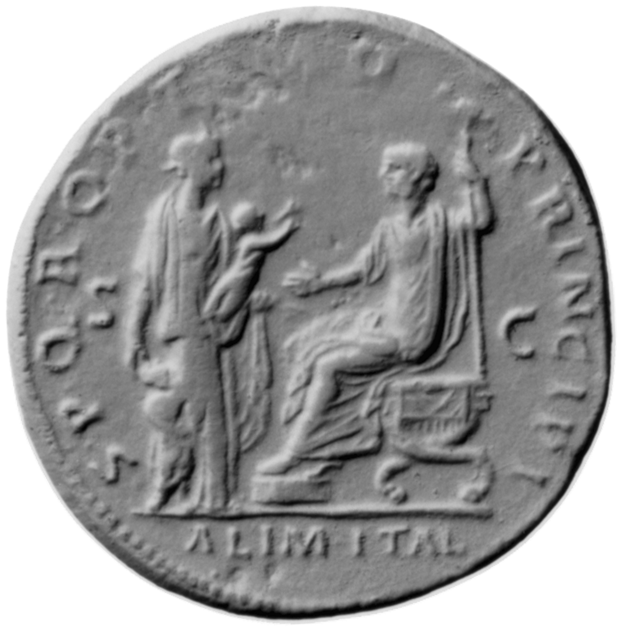
We can now see clearly that the Audience Panel's compositional blocks follow a basic pattern: platform with imperial action (Block A) + subject crowd (Block B) + platform with imperial action (Block C) + subject crowd (Block D) + inanimate objects (Block E). Reconciling this with a single narrative has proved difficult, with scholars uncertain how to relate these various units. Initially the most puzzling aspect was how to resolve the apparent tension between having two imperial actions (Blocks A and C) depicted contiguously. Eventually consensus coalesced around seeing Block C as a representation of a contemporary statue,Footnote 16 placed in the Forum and commemorating the institution of the alimenta.Footnote 17 This interpretation rests on three factors:
1. Block C's composition is nearly identical to a Trajanic coin design celebrating the alimenta (henceforth the Hammond Design: fig. 5).Footnote 18
2. The female figure (C1) is thought to be a personification.
3. Interpreting Block C as a statue group resolves any tension of having two primary figures (A7, C2), both of whom appear to represent an emperor, in the same scene.
Alimenta type: Trajan, female figure and two children design (MIR 358) (Woytek Reference Woytek2010, pl. 79.358a).

There are methodological issues, however, with this interpretation. Looking only at the Audience Panel itself, there is no distinction drawn between Blocks A and C to indicate that the former is a living scene and the latter a statue group. Both feature a primary figure and group of secondary figures, set off by similar platforms.Footnote 19 There is nothing extant on the sculpture that marks Block C's figures as symbolic rather than fully human.Footnote 20
Turning to the coins and following the same line of logic, there is no prima facie reason, aside from the Anaglypha themselves, to presume that the Hammond Design in particular represented a contemporary statue or was the basis for a posthumous one. The Hammond Design (fig. 5) lacks the prominent bases that other Trajanic coin types use to specify their representation of statues.Footnote 21 The Hammond Design is not even the only Trajanic numismatic design dedicated to the alimenta. Two other designs included some combination of the emperor, a female figure and children, as did a related type with the legend REST(ituta) ITAL(ia) (substituted in one design, probably mistakenly, by an alimenta legend).Footnote 22 Ultimately, the reconstruction of the Forum statue group rests on what could be seen as circular logic, with the numismatic design used to justify the singling out of the relief group as a historical statue, and vice versa.Footnote 23
To illustrate this problem further, one could use similar logic to justify interpreting Block A, rather than Block C, as a statue. Blocks A–B have their own numismatic doppelgängers. One Hadrianic design in particular shows a primary figure on a rostra, with a crowd below.Footnote 24 Similarities with the Audience Panel include: a larger scale for the primary figure; the detailed prows; an emphasis on the outstretched hands of both emperor and crowd; a background temple façade with an odd number of columns. Like the enthroned emperor cited by Hammond, the orator pose would be an unsurprising honorary statue type. Identifying Figure A7 as a statue would solve the double-protagonist ‘problem’ equally well as would C2; similarly, both solutions create their own problems in understanding the panel's depicted audiences. Identifying Blocks C–D as partially statuary thus requires a further step, namely justifying why the same cannot be done for Blocks A–B.
The debate over the interpretation of Block C is of interest here not for any details of what statue stood where when, but rather because it illustrates two prevailing assumptions within scholarship on Roman monumental reliefs: (a) the search for some way to understand compositions in a chronologically linear, if not strictly historical, narrative fashion; (b) an emphasis, or even insistence, on the mimetic rather than memetic nature of ‘copied’ elements. The first assumption argues that because they are in an undivided composition, Blocks A–B and Blocks C–D must represent the same moment in time, meaning that the primary Figures A7 and C2 must be different entities, only one of which can be the living emperor. The second assumption drives the line of logic that, because the alimenta numismatic and sculpted imagery is so similar, it must be understood in the same way, as referencing the same abstraction.
We should consider that, barring strong evidence to the contrary, both Blocks A-B and C-D may be meant to represent imperial actions. This is, after all, what they look like. The two groups are sufficiently discrete that they need not be coincident, despite appearing in the same frame. If we cease to look for a strictly historical narrative, then Figures A7 and C2 could each be the heroes of their own little drama, or even the same hero in two counterposed dramas.
The correspondence between the numismatic and sculptural compositions, furthermore, does not require a 1:1 correspondence in meaning, just as a Roman sculpture's lineage from a ‘Greek original’ does not equate the two. It would be better to consider that the various designs across media all represent different selections and combinations of related memetic elements that, while not independent, did not always represent the same exact thing. In other words, the coins may have functioned on a purely symbolic level, while the Audience Panel was meant to represent a literal, live imperial action, as indicated by its own particular context.
PROCESSION PANEL: COMPOSITIONAL BLOCKS
The Procession Panel is not as obviously divided into distinct compositional units as its companion. Nevertheless, the same sort of basic units can be distinguished, only with more overlap and smoother transitions. The Procession Panel features four compositional blocks that I will refer to as Blocks F–I, once again starting from the viewer's left (fig. 4).
The first compositional block encountered (Block F) repeats the last block of the Audience Panel (Block E), in that both consist of a fig tree (left) and Marsyas (right) on individual platforms. Here, however, the Marsyas is so close to the adjacent human procession that he seems almost to join it.
The second compositional block (Block G) takes up most of the composition. Nine figures (G1–9) process to the right towards a large pile of objects on the ground. Where it can be discerned, the men wear the hoisted tunics and distinctive belts of soldiers. All carry rectangular bundles, either on one shoulder (G1, 2, 4, 5, 6, 8) or in front (G3, 7, 9). The figures holding their bundles low do so in a way that (rather awkwardly) displays their contents, namely stacks of large, flat tablets, each featuring two writing surfaces surrounded by a raised frame. Similarly, the perspective of the pile is inconsistent, but also insistent on the easy identification of the tablets. It seems to have been very important for the viewer to understand clearly the contents of the carried bundles and pile. This suggests that this scene was unusual, requiring extra care to convey its impact, both narrative and symbolic, to the audience.
The division between Block G and the third foreground unit (Block H) is more blurred than anything seen on the Audience Panel. From a narrative perspective, two of the block's figures (H1, 2) belong to the preceding block's procession, since they carry tablets and move towards the pile. From a compositional perspective, however, H2 mirrors H4 in pose and dress, and completes the basic structure of Block H as an isocephalic, symmetrical group of standing figures centred on a primary figure (H4). This primary figure (H4) is set off from his companions in position, scale, and the framing device of the background architecture (fig. 6).Footnote 25 Dressed in a short travelling tunic, cloak and elaborate boots, he leans towards the pile and holds out something in his right hand, traditionally interpreted as a torch.
Procession Panel: detail of Blocks H–I (photo: author).

The final and fourth foreground unit (Block I) is mostly lost. A figure (I1) is seated at the very edge of a low rostra. All that is preserved is a heavily damaged foot, set on what appears to be a footstool, a bit of a lap, and just enough of an arm to imply a raised and outstretched pose. Although not much more can be said about the figure itself, its presence indicates that the composition of the Procession Panel must have extended originally to the right for an undetermined length. Since the pedimental façade is completed behind the very edges of I1, the background of Block I must have been distinct in some respect. This reinforces the idea that Blocks H and I were separate compositional units, despite some overlap.
PROCESSION PANEL: STRUCTURAL ANALYSIS
At first glance the compositional structure of the Procession Panel, as compared to the Audience Panel, recalls the two friezes of the Siphnian Treasury at Delphi, with one presenting discrete vertical units and the other a more integrated, dynamic composition. Closer inspection, however, reveals a similar underlying structure for both reliefs. Reading the Audience Panel left to right, the viewer encounters first a rostra and a group composed of a primary figure and his companions, with a temple for a backdrop (Block A). Next comes a group of figures against a backdrop of a colonnade: a visual focal point, Block C, subdivides the group into two uneven sections, with the left-hand section (Block B) almost twice as large as the right (Block D). Finally a paired tree and statue close the frame (Block E). Almost the exact same sequence is found by reading the Procession Panel right to left.
Another point of similarity between the panels is the presence of two highlighted figures, one standing (A7, H4) and one seated (C2, I1), without an obvious means to determine which is the living emperor. This is an unusual enough feature to be of note. Going further, both seated figures have strong visual parallels with imagery connected, at least possibly, with Trajan. Figure C2 has already been discussed. As many have noted, Figure I1 is similar in both pose and location to statues depicted on the Forum Panel of the Arch of Constantine.Footnote 26 The panel shows the emperor standing on the Forum's north rostra in front of a crowd. The precise topographic location is specified by the inclusion of the distinctive so-called Five Column Monument behind the platform.Footnote 27 Also depicted on either end of the platform are two seated emperors, their identity as statues made clear by the substantial bases beneath them. The right-hand statue still holds a globe and sceptre (fig. 7), as most likely did the other statue.
Arch of Constantine, Forum Panel: detail of right statue (photo: author).

The two enthroned statues on the Constantinian panel appear to represent Hadrian and Marcus Aurelius. However, close examination suggests that the right statue was in fact originally Trajan: the bowl cut hairstyle is a Trajanic touchstone, the figure's face is too small proportionally, and the beard is added by hatchmarks (fig. 7), rather than carved in relief like its companion.Footnote 28 Thus it is reasonable to suggest that the original depicted statues were of Trajan and Marcus Aurelius. This would make sense within the Arch of Constantine as a whole, where Trajan and Marcus Aurelius are given the most prominence, in terms of the spolia repurposed from earlier monuments, and Hadrian appears only in the smaller tondi. Footnote 29
There is no independent evidence that the figures on either the Hadrianic or Constantinian platforms represent historical statues, and there is no reason that they must. A good deal of effort has been made in the Constantinan depiction to associate the living emperor with statuary. Each of the crowning statues of the Five Column Monument is rendered in great detail (fig. 7), despite being barely visible from ground level,Footnote 30 and the vexilla are positioned just so to connect the emperor with the central Jupiter. This can be contrasted with the total omission of the prows seen on the Anaglypha. That the Constantinian tableau should be completed by statues of two of the emperors referenced in the arch's holistic design is suspiciously convenient. This is all the more true since the depicted statues present a useful means of incorporating the portraiture (and identities) of the revered second-century c.e. emperors, portraiture that had otherwise been obliterated, replaced and therefore obscured elsewhere on the arch.
Once again, the point at hand is not the existence of particular historical statues, but rather the assumptions that we bring to the reliefs. The standing (H4) and seated (I1) primary figures of the Procession Panel (I1) differ from their counterparts in the Audience Panel (A7, C2), in that they appear as part of the same depicted action. Nevertheless, as for the Audience Panel, it is possible to see the seated figure (I1) in the Procession Panel as memetic rather than mimetic, an accepted means of expressing an idea rather than a documentary fact. The motif of the seated emperor on a platform above a crowd was established numismatic imagery to celebrate specific acts of fiscal generosity, imagery that recently had been circulated widely under Trajan and appeared on Hadrianic coins as well.Footnote 31 By employing this motif, Blocks H–I of the Procession Panel conveyed the idea of a stable tradition of imperial generosity. Rather than representing a literal physical statue, the motif could evoke the broader concept that honorary statuary was intended to embody, namely a reciprocal, binding relationship across social groups and generations. This may be what is carried through to the Constantinian panel: the idea of expressing imperial ideological continuity by juxtaposing the living emperor with seated representations of former emperors.
THE ANAGLYPHA PANELS AND THE COLUMN OF TRAJAN
The use of standardised imagery and repeated scene types to represent the emperor's activities dated back to Augustus, but had reached new intensity under Trajan.Footnote 32 Not only were the number and diversity of such scene types greatly expanding, but in monumental reliefs there was also a significant (and from our perspective sudden) fluorescence of a particular compositional strategy: the paratactic arrangement of numerous vignettes, each depicting a discrete action. This strategy's exact origins are highly debated and cannot be probed here. But whatever its origins and predecessors, in the Hadrianic period the frieze around the Column of Trajan (henceforth the Column) would have been the most innovative, prominent and recognisable example of this distinctive strategy, and therefore the most potent reference in the minds of most viewers.Footnote 33
The structural analysis in the previous section has shown that, despite their civic subject matter and metropolitan setting, the Anaglypha were conceived and executed in much the same way as the Column: as a series of paratactic vignettes, constructed of memetic elements with ideological connotations. This observation in and of itself is hardly surprising. What is notable is that this goes much deeper than a general practice. Instead, the Panels conform closely to the Trajanic frieze, so as to draw conceptual links between the two monuments.
This begins with the particular arrangement of Block A on the Audience Panel. The composition implies, through the angled façade and the fasces emerging from behind it, that the men are marching through the arch directly onto the platform (figs 1 and 8). While this makes little sense within the topography of the Forum, it makes a good deal of sense within the narrative of troops setting out on campaign. On the Column, the set scene of troops processing under an arch is used to mark the beginnings of military campaigns,Footnote 34 most notably in the eye-catching Scenes 4–5, located in the bottom spiral of the monument.Footnote 35 Similarly, the inclusion of a prominent ramp in the Block A platform recalls the first equivalent platform on the Column (Scene 10).
Audience Panel: detail of Blocks A–B (photo: author).

Despite debate on the exact topic of the Audience Panel, the consensus has been that the primary figure (A7) is the agent performing some action (speaking, announcing, etc.), while the crowd (Block B and possibly Block D) reacts. This, however, overlooks a specific iconographic feature: the emphasis on the crowd's raised hands (fig. 8). Four men (B1–2, 5, 12) raise their hands prominently, most obvious in B1–2, whose clearly silhouetted hands extend to overlap the façade background and even staff of A7. Such emphasis on a crowd's raised, extended hands is found elsewhere, not in adlocutio scenes, but in acclamation scenes, where the crowd, not the emperor, is the active party. In contrast, the passive audience of adlocutio scenes typically hold their arms at their sides (or raise them slightly to provide compositional variation).Footnote 36
A crowd with raised hands within the specific topic of an acclamation appears on multiple innovative Trajanic coin types. These included metropolitan (Circus Maximus renovations) and military (acclamations of imperator) settings.Footnote 37 In monumental relief, the closest comparandum is Scene 77, at the close of the First Dacian War (fig. 9).Footnote 38 Trajan stands on a platform holding a rotulus, while his soldiers (one of whom rests his hand on his companion's shoulder) raise their hands to proclaim him imperator. All participants, including Trajan and his entourage, forgo the more overt armour (cuirass, helmets, mail) typical of adlocutiones.
Column of Trajan, Scene 77: imperial acclamation (photo: author).

All this implies that the particular occasion at hand (if any) of the Audience Panel is not an adlocutio, but rather some sort of acclamation, where the subjects, not the emperor, are the actors. This is to select a moment in time, since the subjects’ action is reciprocal, a reaction to some previous act of the emperor. This selection is significant, however, focusing agency on the people, rather than emperor. To convey this idea, the Anaglypha production team drew on several memetic models, including scenes depicting campaign profectiones, adlocutiones and acclamations, the last being a recent innovation. All of these scene types could be found on the Column.
Blocks C and D have their own parallels on the Column as well, despite their assumed reference to a purely Italic institution. Their composition can be read within a broader topic of subordinate entreaty, and its implied imperial response of generosity. A widespread theme in reliefs and on coins, it could be evoked by combining various memetic elements: the emperor, either standing or sitting, on the ground or on a platform, receiving supplicants of either sex, who either kneel or stand, and who often include children. Numismatic examples include those discussed above; the famous Hadrianic provincial series is notable here.
On the Column, one of the most common repeating motifs is the emperor interacting with entreating subjects (sometimes with children).Footnote 39 Of particular interest here is Scene 30, whose compositional parallels to the Anaglypha are striking (fig. 10). Part of a chiastic arrangement of four small vignettes (Scenes 29–30), this scene shows Trajan interacting with an individual barbarian woman.Footnote 40 He extends his hand to the regally dressed woman, who raises her bent and silhouetted arm in appeal, cradling a babe-in-arms on her other side. A crowd, including children, watch and echo the gesture. The raised-arm motif serves to connect all of the vignettes: the Romans (Trajan, the horseman, the women's guards) extend their arms fully and powerfully in their various actions, while the Dacians (men, women, children) hold theirs bent, a sign of appeal and distress. In another of the four tangential vignettes a horseman sets something aflame with a torch. The entire arrangement is closed by a tall tree that stretches the length of the frame.
Column of Trajan, Scenes 29–30: destruction of Dacian architecture, deportation(?) of Dacian women, flight of Dacian men, destruction of Dacian livestock (Coarelli Reference Coarelli2000, pl. 29).

Keeping all these ideas in mind, the composition of the Audience Panel becomes less a puzzlement and more a sophisticated structure, not of historical narrative, but of broadly construed cause and effect, tied together by the theme of reciprocity between the emperor and his subjects. Reading right to left, the viewer encounters a vignette evoking ideas of subject need and generous imperial provision. Moving left, the viewer sees the subject response, as the crowd in turn rewards the emperor with ritualised praise.
Blocks E and F, with their pairs of trees and statues, have their own parallels on the Column, which uses both trees and statues to indicate a shift in setting or narrative. The use of trees to divide scenes on the frieze is well known and needs no further comment here. Less recognised is the use of statues to indicate major shifts in the narrative. The Column includes only four examples of depicted statuary, all of which come in scenes that indicate the beginning of offensive campaigns (fig. 11).Footnote 41 While the fig tree and Marysas statue on the Anaglypha probably reference historical fixtures, this should not distract from their compositional role in their own sculptural context.Footnote 42
Column of Trajan, Scene 33: provision of troops for campaign (photo: author)

Turning to the Procession Panel, the most obvious precedent for the composition of Block G is the numerous scenes on the Column where soldiers move forward carrying burdens. That the figures on the Anaglypha Panel are also soldiers is made obvious by the emphasis on their distinctive heavy belts, swords, and elaborate shoes (caligae) (fig. 2).Footnote 43 Of particular note is Scene 33 (fig. 11). As on the Procession Panel, the rhythm of the background architecture (left to right: a series of arches, two independent structures separated by a gap) divides the composition into two blocks (left to right: a line of soldiers carrying burdens, the emperor flanked on both sides by companions). A tree and arches, one with crowning statuary, frame the scene. Thus while the topic of the Procession Panels – the forgiveness of debts – is historically specific and defined by its urban context, the composition is borrowed from military exempla.
Column parallels can even help address the problem of the Procession Panel's multiple protagonists. The primary argument against seeing Figure H4 as the emperor, despite the numerous compositional indications to that identity,Footnote 44 are apparent marks of lower status (fig. 6): his downward pose mirroring that of the common soldier to his right, his simple costume and his performance of a manual task. The Column, however, provides numerous models for this situation, where Trajan appears in a simple travel outfit but still flanked with all the other trappings of compositional honour, as seen in Scene 33 (fig. 11). Frequently the immediate topic is Trajan providing some sort of direct, practical interaction for his subjects.Footnote 45 Scene 84 specifically combines Trajan in travelling cloak, movement through an arch, children, and the acclamation of a crowd, as, more abstractly, does Scene 91. The frieze thus provides plenty of precedent for the emperor appearing in simple costume while assisting his people.
Allowing for this identification would resolve a somewhat thorny issue if we see Figure H4 as anyone but the emperor: his boots. The Procession Panel makes clear distinctions among the various social groups present through their footwear. The soldiers carrying the burdens wear the distinctive caligae seen throughout Roman art in particular association with the army (figs 9, 11). H4's companions (H3, 5, 6) sport the soft boots of the civilian elite. Only H4 wears the heavy military boot with decorative pelt flaps (fig. 6).Footnote 46 Such boots are associated exclusively with emperors and divinities,Footnote 47 making it highly unusual for H4 to be anyone less than the emperor. Similarly, on the civilian-themed Audience Panel, primary figures A7 and C2 are distinguished by the elaborate knot-work of their calcei patricii.
As seen in Scene 30, the Column provides models for the otherwise unusual topic of ceremonial destruction on the Procession Panel. In seven sequences the Roman army sets fire to barbarian architecture, supporting a major theme of the erasure of a negative way of life.Footnote 48 Similarly, on the Procession Panel the soldiers and emperor are involved in the destruction of a negative way of life. This time the destruction is within a metropolitan context and aimed specifically at the relative elite (anyone rich enough to have formal debts).Footnote 49 Taken together with the examples above, we can see that the Procession Panel combines memetic elements associated with ideas of imperial travel, provision for subjects, and cooperation with urban populations, as well as victory through destruction.
The final major point of similarity between the Anaglypha and the Column is their employment of architectural backgrounds to emphasise the urban setting of the depicted activities. I will address this complicated issue only briefly here and more extensively in another venue.Footnote 50 For now, it is enough to note that viewing these famous depictions in this light resolves some of the confusion endemic in attempts to connect the depicted architecture of the Anaglypha to the physical architecture of the Forum.Footnote 51
COMMEMORATING PEACE: THE SENATE VERSUS HADRIAN
The previous sections have demonstrated that the Anaglypha were designed and structured in much the same way as their immediate Trajanic predecessors: as a linear series of vignettes illustrating imperial actions, juxtaposed to convey ideological, rather than primarily historical, significance. While this may be interesting from an artistic perspective, it also has implications for understanding the import of the reliefs as a holistic unit.
From the Senate's perspective, the reigns of Trajan and Hadrian were drastically different.Footnote 52 While Trajan and the Senate had worked well together,Footnote 53 Hadrian's rapport with that august institution was tense throughout his reign.Footnote 54 These diametrically opposed relationships with the Senate (and the numerous factors that produced them) had direct consequences in policies both home and abroad.
Trajan's role as emperor was very much framed through the ideal of the Republican senatorial leader. His foreign policy evoked the career of a Republican senator: striking at one area, returning to pour loot into the city of Rome, then striking at the next. The expenditure of that loot in Rome was conspicuously traditionalist, albeit on an unprecedented scale. Trajan lavished attention on architecture with important Republican precedents, both new projects (a basilica, a forum, numerous arches) and renovated (the Circus Maximus, the Pantheon). Trajanic policy thus presented Trajan operating as the senator optimus.
Hadrian's attitude toward the Senate and Rome could hardly have been more different, without crossing the flexible bounds of acceptable behaviour.Footnote 55 Outside Rome, Hadrian pushed a comprehensive policy that stressed harmony and collaboration across all the provinces. By consolidating the borders, he cut off a major source of immediate economic and symbolic capital from the Senate. To add insult to injury, he stayed away from Rome for long periods as he moved through his empire on something akin to a royal commonwealth tour. He spent lavishly on provincial architecture, most famously in Athens, but also in Britain.Footnote 56 Looking at the Wall that is the subject of this series of papers, whatever its purpose(s) – defensive, economic, symbolic, an effort to busy the troops – it was certainly something brand new, and it was certainly not a forum in Rome. Every denarius that went to quarrying stone in Cumbria did not go to monuments in Augustus’ city of marble.Footnote 57
Within Rome, Hadrian favoured innovation over precedent. He famously did not emblazon his name on his architectural expenditures.Footnote 58 This flew in the face of Senatorial tradition in two respects: it rejected one of the primary means by which senatorial families had courted public approval, and it passed over a chance for the emperor to proclaim his dedication to the city of the Senate. He abandoned the conceit, started under Augustus, that the emperor dwelt in the senatorial neighborhood of the Palatine; instead he treated the facilities there as a pied-à-terre while spending lavishly at Tivoli.Footnote 59 Rather than more facilities for the Senate, Hadrian sponsored a temple at the opposite end of the Forum Romanum, closer to the imperial projects of the Esquiline than the haunts of Cicero.Footnote 60 Even the form of the temple, a bipartite peripteral design, was untraditional. In sum, the Hadrianic agenda sent an almost systematic message that he was not prima inter pares, but a separate category entirely.
We should analyse the Anaglypha in light of this broader context. The Anaglypha can be understood as the Senate translating their means of commemorating Trajan's military glory abroad, to apply it to Hadrian's peacetime accomplishments at home. The Roman Senate expressed their approval of particular aspects of Hadrian's rule that they saw as commendable, and did so in a particular medium that they found commendable. It was a conservative, traditionalist response to non-traditional policy.
At the level of logistics, the production team of the Anaglypha drew on a collection of memetic elements most prominently employed on the Column, assembled and arranged in a paratactic linear fashion to depict a series of imperial actions. This was probably not merely for convenience, but specifically to evoke the previous monument, since they incorporated numerous very specific features. The imperial acclamation, the appealing supplement, the march, the destruction, the suovetaurilia: all these appeared numerous times on the Column in specifically military contexts. By adapting these to civilian contexts, the production team encouraged connections and comparisons between the monuments and the emperors. Regardless of exact intent, the end result would have been that both monuments presented a highly detailed figural frieze, of globally similar figural scale and appearance, strikingly different from any major monuments in Rome. This fact alone would have drawn connections between the Column and Anaglypha.
Turning to content, the Anaglypha commemorated the sort of imperial achievements – official acclamations, gifts of fiscal support, the forgiveness of debts – that represented the best of interactions between Senate and Emperor. They could be summarised as freedom from want through direct imperial financial support, represented within the context of traditional ideals of Republican euergetism. Whether or not Blocks C + D referenced the alimenta scheme specifically, they employed memetic language that could also be used appropriately for that subject, and must have had associations of imperial providence and generosity. The Marsyas statue also acquired associations with libertas, probably in the sense of freedom from debt.Footnote 61 It is notable that the elements foregrounded and repeated on both reliefs, namely the rostra, ficus trees and Marsyas statues, all have their own Republican origins. This is especially significant given that by the Hadrianic period the actual Forum must have been crowded with imperial monuments that could have been chosen for inclusion, but were not.Footnote 62
Monumental reliefs could be not only commemorative, but also aspirational. By emphasising the prominent Republican monuments of the Forum, through compositional placement and repetition, the Anaglypha confirmed the proper setting of imperial action as Rome. The multiplication of imperial figures, four in two panels, also drove home this point. The generalised architectural background would recall not only the Forum Romanum, but also the urban infrastructure that was both a hallmark of the capital and a product of the senatorial and imperial classes. It placed the emperor where he belonged, in Rome in interaction with the people in general and the Senate in particular.
Finally, we should consider that if monumental reliefs could be aspirational, they could also be cautionary, the ‘or else’ in a request for good behaviour. Another appropriate topic for the visual vocabulary of appeal and generosity seen in Blocks C + D was the submission of foreign peoples, and indeed it is this sense that is most prominently on display in late Hadrianic coinage. It could be that this sense is alluded to on the reliefs as well. This could be a positive framing of Hadrian's policy towards the provinces. But it could also be a negative framing, an oblique warning against Hadrian's treating his own Senate as foreign supplements. This is supported by a possible secondary reading of the Procession Panel, one that references a particular Republican figure with his own problematic relationship with the Senate: Julius Caesar.
Julius Caesar, after all, was the last general to march his troops through Roman urban spaces outside the context of a triumph. He famously forgave debts of tax consortiums, further blurring the distinction between state finances and his own and raising the question of to whom the res publica was indebted. He was murdered by the Senate on the Ides of March, a day associated with settling debts. He notoriously sat enthroned like a god on a platform that served as a speaker's platform. He was particularly associated with a large fire set in a spot that itself eventually would be directly in front of a rostra. Pliny even mentions a fig tree that grew in the Forum Romanum from an open space created in the uproar following Caesar's funeral, and which specifically was associated with giving shade to the plebs,Footnote 63 as the depicted tree does for the Marsyas statue. As a god, his temple counterposed a rostra opposite the famous Republican rostra, while usurping the space of the Senatorial speaker's platform at the Temple of Castor. The Anaglypha Panel thus may draw an implicit contrast between two different models of Republican-style leaders interacting with the Senate: the extolled Trajan and the assassinated Caesar.
It is notable that both the ficus and Marsyas also had darker connotations. The myth of Romulus and Remus famously resolved a power struggle in Rome by the ‘patrician’ figure slaying his rival. Tacitus takes the withering of a fig tree on the Forum as a sign of impending doom for the tyrannical Nero.Footnote 64 While the particular Marsyas of the Forum gathered connotations of libertas, the myth of Marsyas displayed in elite houses saw him flayed alive for challenging the god of elite pursuits at his own game. If such a darker interpretation of the reliefs were present, it would hardly be the primary message. But it seems worthwhile to consider that monumental reliefs need not have been as deferential to the emperor as modern scholarship often assumes. The Anaglypha Panels may have been a more aggressive assertion of senatorial interests and prerogatives than a flattering recollection of imperial greatness.
CONCLUSIONS
The Anaglypha Panels are best understood as a direct response by the Senate to Hadrianic policy, at home and abroad. In evoking the Column frieze, the reliefs referenced a monument, and the themes and actions it extolled (appeal, destruction, liberation), that was associated with the frontiers. Although Hadrian himself had turned his focus to the provinces, the Anaglypha Panels took these themes and actions and centred them in Rome itself. This was underlined by another compositional trick borrowed from the Column frieze: setting the action against a distinctly urban background. It is notable that on the Anaglypha Panels the cancellation of debts and other actions are not presented as abstract ideals, but as a collection of direct, geographically specific interactions between the emperor and his subjects. The reliefs commemorated the sort of imperial achievements, in the sort of setting, that the Senate valued. To do so they drew on the most recent and influential Senatorial monument, the frieze of the Column dedicated to the Republican-styled emperor they deemed Optimus. This ideal runs directly counter to Hadrian's apparent approach to his reign. The reliefs thus can be read as an opposing response to the emperor.
Looking beyond the Hadrianic period, the Anaglypha Panels should not be seen as a divergent trend from the Column of Trajan, but rather a continuation of the same senatorial means of commemoration and negotiation with the emperor. Although not a helical column, the panels form a conceptual bridge between the Columns of Trajan and Marcus Aurelius. Indeed, the panels may even presage the Arch of Septimius Severus, which incorporated aspects of the Columns’ continuous friezes into separate but neighbouring panels. Rather than a curious feature peculiar to the Forum Romanum, the Anaglypha Panels were probably interpreted by an ancient audience as a successful integration of Hadrian's domestic policy, idealised according to Senatorial priorities, into a tradition of military discourse and Republican commemoration.
ACKNOWLEDGEMENTS
I would like to express my gratitude to Paul Bidwell for his invitation to contribute to this series of papers, and for his gracious patience with the exigencies and delays raised by the 2020–21 COVID crisis, during which I wrote this article. This manuscript was improved immensely in both content and references through the helpful comments of two anonymous reviewers. I also extend thanks to Crystal Rosenthal for her assistance with early drafts and bibliography, and to Ryan Knapp for creating 3D reconstructions that were immensely helpful in refining my theories. Having rethought my ideas on the Anaglypha Panels over many years, I am guilty in my earlier work of many of the assumptions I argue against here: mea culpa.