

If you ask someone to think of a doctor's office, chances are good that a waiting room will spring to their mind. It is, after all, the first port of call for patients in search of treatment, as well as where they often spend most of their time during a medical appointment.Footnote 1 It is also a site with unpleasant associations. Despite attempts to change the clinical waiting experience over the last twenty years, the doctor's waiting room persists in our collective consciousness more or less as it was described in a spate of late-twentieth-century articles lamenting the conditions found there. In 1988, the Los Angeles Times sardonically ranked waiting in the doctor's office as “among the richest of our queuing experiences” because it meets “all of the requirements for congestion—random customer arrivals [emergencies], variable lengths of treatment, often too many patients per doctor.”Footnote 2
We know the other classic waiting experiences. There are the bureaucratic backups at City Hall that spill out into ill-considered, poorly lit, uncomfortably furnished spaces, with old magazines and perhaps a television tuned to daytime talk shows perched in a high corner. As for the DMV, the wait there has become so notorious that many branches now feature webcams, so that poor souls in need of a new driver's license can glimpse beforehand the depth of the purgatory they will enter.Footnote 3 These holding zones have historically seemed almost spiteful in their disregard for the waiting bodies that inhabit them. Yet on top of the normal frustrations, clinical waiting rooms also added “worration,” as one doctor's waiting room occupant described the space of intense anxiety in which she found herself in 1981. Indeed, the anticipation of a medical encounter can elevate clinical waiting into a category of richness all its own.Footnote 4
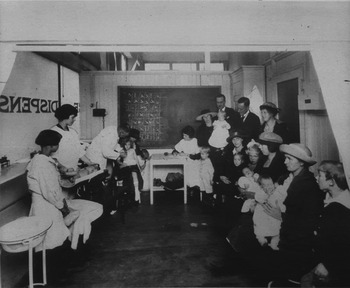
It was not always this way. Modern clinical waiting has at least one point of origin in late-nineteenth-century dispensaries, one of the earliest institutions dedicated to outpatient care. Although many dispensaries had waiting rooms, an improvement over standing in line to be sure, these rooms rarely served the exclusive function of waiting. Dispensaries were small and overcrowded. Because germs had not yet achieved their later reputation, and because conceptual distinctions between clinical and nonclinical spaces had yet to fully take shape, waiting rooms often doubled as, or were only halfheartedly separated from, examination and treatment rooms (Figure 1). Though the multipurpose nature of these rooms likely had uncomfortable, even unhealthy, consequences for dispensary patients, they at least did not have to conjure up what their own impending clinical interaction might entail: it was all happening right in front of them.Footnote 5
A typical multi-use waiting-treatment room at the People's Free Dispensary in Portland, Oregon c. 1920s.

Ironically, modern clinical waiting emerged out of the early-twentieth-century movement for medical efficiency. To early promoters of medical efficiency, waiting was a dirty word: the utter antithesis of productivity. In fact, the problematic inefficiency of the dispensary, as sociologist and medical reform activist Michael Marks Davis, Jr. argued in 1916, began in the waiting room. Outlining his vision for the future dispensary in his regular column for the journal The Modern Hospital, Davis looked to the factory as a model. The dispensary, he imagined, should function as a kind of medical processing plant that, by virtue of being in perpetual motion, obviated the need for waiting in the first place. In his ideal clinic, the “raw materials”—patients—would proceed through the entrance and immediately board a moving stairway that carried them up floor by floor. As they ascended, a variety of technician escorts would join them to fingerprint the patients for identification purposes (on floor 1), observe them (maybe floor 2), assess whether they would be paying and, if so, how much, and perhaps even give an initial examination (floor 3). These escorts would each hop off at the next floor, and then slide down poles or chutes to greet the next collection of “raw materials.” Patients, meanwhile, would continue their upward journey until they reached the very top of the building, where a clerk would receive them armed with an updated record (shot ahead of patients using a state-of-the-art pneumatic tube system), and immediately assign them to their proper clinics. These now semi-processed “materials” would then begin their descent, this time presumably for a more medically invasive version of the processing they experienced on the way up. One assumes that this final clinical processing could not have taken place in transit, but Davis leaves this possibility enticingly open by revealing almost nothing about the downward journey, as though patients on their way had little left to do than emerge, via a separate exit, as the dispensary's “finished products.”Footnote 6
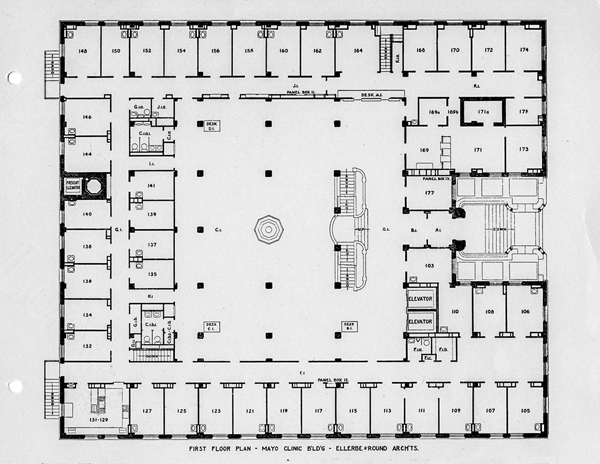
Envisioned during the heyday of the Progressive Era efficiency movement, Davis's dream dispensary might seem like a blueprint for a Charlie Chaplin satire. But it already had a concrete analogue. Constructed in 1914, the first building of the Mayo Clinic had been designed along similar principles, with carefully planned spaces that would facilitate highly choreographed routines and perpetual motion (Figure 2).
The floor plan of the 1914 Mayo Clinic Building designed by the Minneapolis-based architects Ellerbe & Round. A large lobby with its central staircase and fountain dominated the first floor, while dotted around the outside were the clinical rooms which processed patients clockwise around the perimeter. Reproduced from Richard Olding Beard, “The Mayo Clinic Building, Rochester, Minnesota” Journal-Lancet, 34, no. 16 (1914): 433. Courtesy of the Minnesota Medical Society

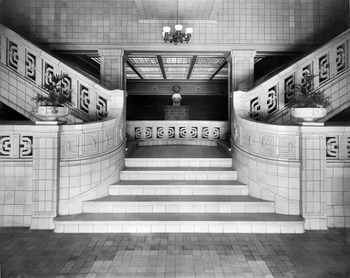
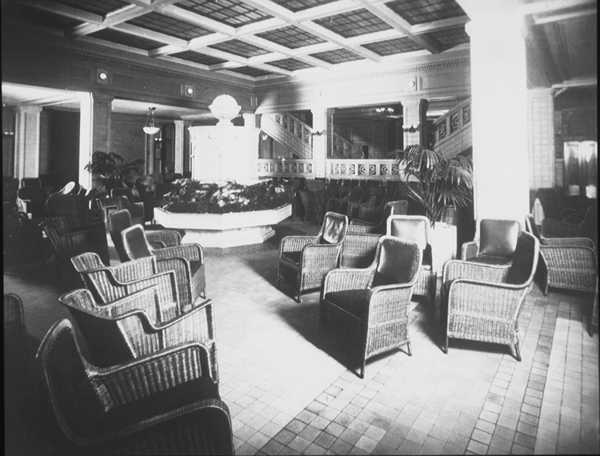
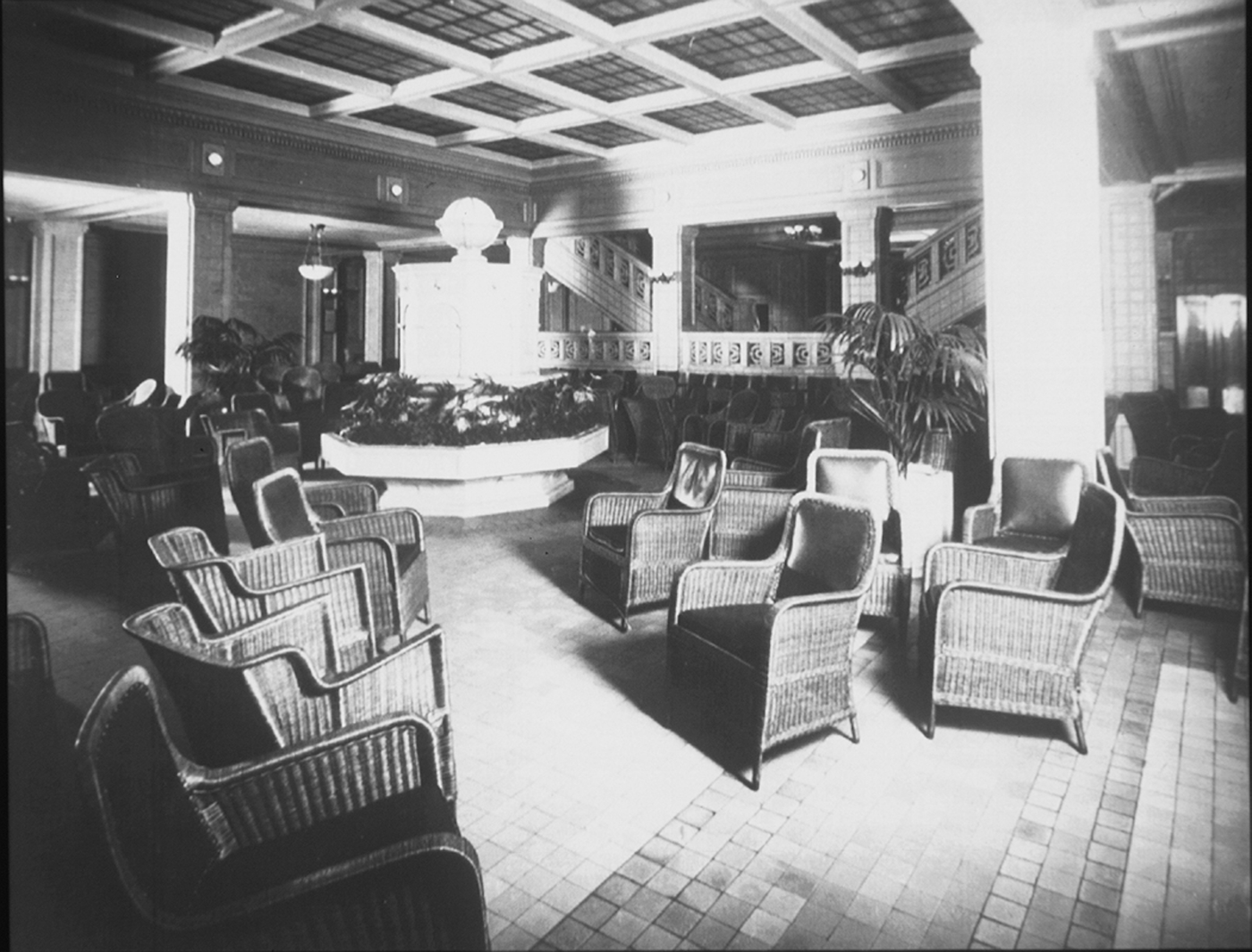
This new construction in Rochester drew inspiration not only from the factory, but also from modes of movement pioneered by modern systems of public transit: subways snaking their way under cities, and the elevators and escalators that enabled the verticality of skyscrapers and department stores. Helpful devices—“time clocks, [telegraph] tickers and signal lights”—had been built into the Mayo structure to maintain this choreographic precision.Footnote 7 Even air obeyed the metronome, as it was sucked inside by the ventilation system, heated or cooled by the fountain in the lobby, sent throughout the building, and recycled every three minutesFootnote 8 (Figures 3 and 4). Like the motion of Davis's ideal dispensary, the Mayo building pointed toward an assumption built into the concept of medical efficiency: that timely processing and effective clinical therapy were so intertwined as to be virtually indistinct. The former could and regularly did stand in for the latter.Footnote 9 Processing was in. Waiting was out.
The building's central staircase. In general, the choreography of the building dictated that patients ascend by the right hand stairs only, while the left hand were for those who had already been processed and were on their way down. Reproduced from Richard Olding Beard, “The Mayo Clinic Building, Rochester, Minnesota” Journal-Lancet, 34, no. 16 (1914): 427. Courtesy of the Minnesota Medical Society

The fountain in the clinic lobby served both aesthetic and mechanical purposes. The building's air was tempered by running it through the fountain's heated (in winter) or cooled (in summer) water. Reproduced from Richard Olding Beard, “The Mayo Clinic Building, Rochester, Minnesota” Journal-Lancet, 34, no. 16 (1914): 428. Courtesy of the Minnesota Medical Society
Yet the Mayo Clinic's system differed greatly from what was happening elsewhere, where patients waited and waited and waited, often in buildings so hastily converted into dispensaries that the inadequacies of their waiting rooms resulted in lines that extended out the door and down the block.Footnote 10 In response to a 1920s study that found New York's dispensaries in a state of mayhem, Davis, then the editor for the “Dispensary and Out-Patient Work” section of The Modern Hospital, suggested that those institutions not able to adopt the principles of perpetual motion might at least set up a “distribution” system of waiting rooms, with one general waiting area and several more dotted throughout the building in service to its various clinics. For dispensaries that lacked the physical space to accommodate even these reforms, Davis hit on another solution: appointments. The “block” system in use at the time required patients to “assemble before nine a.m. or two p.m. and then to wait often the whole morning or afternoon” to be seen. Setting appointments, Davis felt, would reduce patients’ wait times as well as those of physicians, who could schedule arrivals at a pace that would maintain an even flow of processing.Footnote 11
Physicians largely balked at Davis's suggestions. They noted not only that appointments required a clerical staff that they did not have, but also that patients were by and large not trustworthy enough to keep up their end of the appointment bargain. Davis smelled a rat. “The truth,” he averred, “is that the modern dispensary is conducted, primarily, with a view to the convenience of the dispensary physician, on the principle that it is better for forty patients seated on the benches to lose sixty hours’ time, than for the doctors to be subjected to the possibility of losing one half hour's time.”Footnote 12 Physician and patient efficiencies were turning out to be incompatible. Efficient processing was out. Waiting was in, just not for physicians.
By the latter decades of the twentieth century, clinical waiting rooms had become even more congested, despite the widespread adoption of appointment scheduling.Footnote 13 In some cases, this resulted in the venting of familiar frustrations associated with the inefficiencies of clinical waiting.Footnote 14 In others, however, the wait was a badge of quality that spoke to the popularity of a physician or the excellence of an institution. When a 1969 article in the Wall Street Journal reporting that a typical Monday morning at the Mayo Clinic saw the arrival of a thousand patients who would wait for hours to be seen, it was not a critique, but rather a testament to this institutional medical wonder. In a few short decades, a room full of waiting patients had shifted in value, from a clear and potentially embarrassing indication of a clinic's ineffectiveness to a tangible manifestation of clinical prowess.Footnote 15
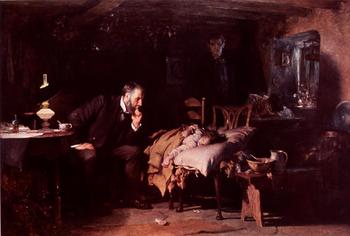
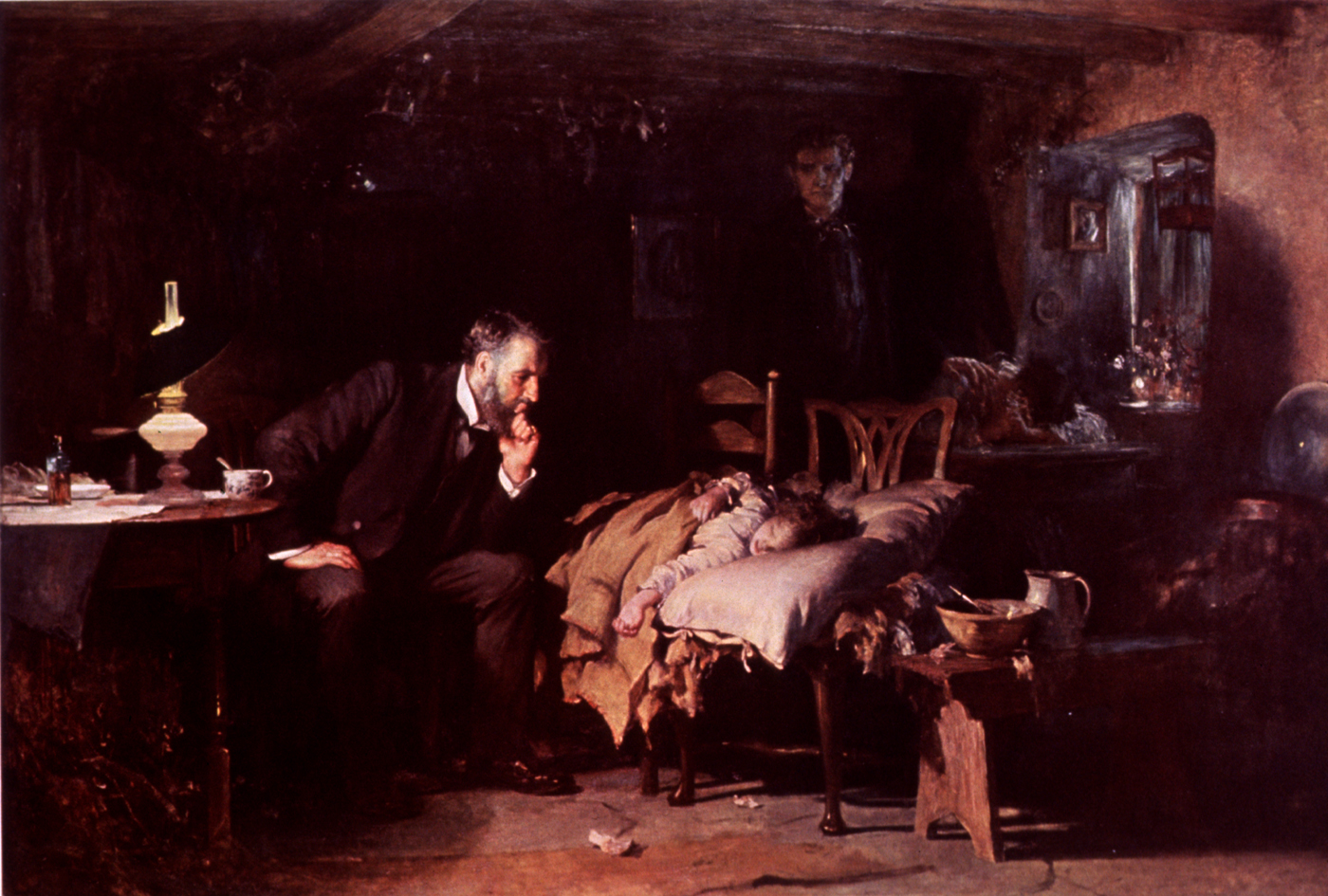
The emergence of the crowded waiting room as a status symbol was in no small part spurred on by the fights over the possibility of implementing national health insurance during and after the 1940s. Characterizing proposals for national health insurance as an attack on medicine, organizations like the American Medical Association (AMA) constructed a new image of medicine as fundamentally rooted in caring, personal relationships between medical practitioners and their patientsFootnote 16 (Figure 5). By contrast, they depicted national health insurance as a menacing technocratic effort that threatened, with its efficiency, the ineffable, sacred, explicitly inefficient bonds between doctor and patient. This rhetoric soon became the reality of medicine's late-century restructuring.
A reproduction of Sir Luke Fildes' The Doctor (1891). The American Medical Association (AMA) used this image with the tagline, “Keep Politics out of this Picture” in its fight against the various proposes for national health insurance in the 1940s.
It is perhaps little wonder, then, that those physicians who made the rest of their patients wait, sometimes for very long periods of time, were viewed as ideal doctors. Long waits were evidence of clinical inefficiency. And clinical inefficiency had become the hallmark of good patient-centered care.
Others, though, smelled the same rat that Davis did in the 1920s. Calling out the artifice of this waiting equation, one critic noted that clinics were, of course, free to change their appointment setting policies to accommodate the lengthier requirements of patient-centered care.Footnote 17 Physician responses to this critique cited medical emergencies, shifting models of reimbursement, and the pressures of the medical marketplace more largely, in their explanations as to why they could not meaningfully interact with each patient without requiring the sacrifice of other patients’ time. This back and forth indicated that long waits resulted primarily from administrative decisions that were only obliquely related to caring ambitions, and it also raised questions about how “patient-centered” medicine could actually be under these circumstances. “I would judge a physician who shows concern about a patient's time to be more likely to give full attention to his or her medical problem,” noted one critic.Footnote 18 Wasn't a long wait really a sign of care that, whatever the reason, was ultimately uninterested in patient needs?
Perhaps clinical waiting is merely one manifestation of the perverse complexity of healthcare in the twentieth and twenty-first centuries.Footnote 19 Its elimination has only rarely been a desideratum in recent decades, despite its potential to improve patient-centered care. This is even more surprising given the fact that the most celebrated attempt to eradicate clinical waiting at a Virginia Mason clinic in Kirkland, Washington, has seemed have had significant success.Footnote 20 Instead, waiting has become such a mainstay of the clinical appointment that waiting rooms have become more sprawling, albeit now with a facelift to disguise them as sites of work, play, or relaxation rather than waiting. The installation of vibrating pager systems, familiar to anyone who has frequented The Cheesecake Factory, has further expanded the waiting room, extending the impression that the activities of clinical waiting can be extensive and varied.Footnote 21 Waiting apps, which have already hit the restaurant industry, are not far behind.Footnote 22
Unlike our other waiting experiences, which perhaps do feel less wasteful for these technological fixes, the special qualities of clinical waiting—the anxiety, discomfort and even physical pain—might only be compounded by this unmooring. Without the usual spaces to contain it, some fear, clinical waiting will become concentrated in the activities of “worration” themselves, co-opting other, everyday activities and spaces into the medical experience along the way.Footnote 23
Whether to indicate efficiency or inefficiency, quality patient-centered healthcare or its opposite, clinical waiting has long reflected cultural expectations about what healthcare should be. As we wait now, whether in the comfort of a clinic's “living room” or in the conveniently located Starbucks next door, we might do well to ponder what it is exactly—what kind of health care, with what values—our new circumstances of waiting suggest that we are waiting for.
Author ORCIDs
Caitjan Gainty, 0000-0001-7760-4652