Introduction
The increased demand for Emergency Medical Services (EMS) workers is part of the overall demand for health care workers and is fueled by several factors. Between 2005 and 2030 the number of adults aged 65 and over is projected to almost double, bringing this population to over 70 million or 20% of the US population.Reference Chapman, Crowe and Bentley 1 These older Americans are expected to have higher rates of chronic disease and disability and will require more health care services than the younger population. 2 Emergency Medical Technician (EMT)-Basics and Paramedics will be needed in greater numbers and will need to be specially trained to care for this sicker patient population. 3 Because of this projected increase in future EMS need, it is important to explore the issues related to recruitment and retention of the EMS workforce.
Recent studies of EMS workforce satisfaction and retention have included EMT-Basics and Paramedics at various stages in their EMS careers. There has been little research on EMT-Basics and Paramedics who are new to the field. In this paper, factors are described that are important to the recruitment and retention of EMT-Basics and Paramedics new to the EMS field (defined as two years or less of EMS employment) through an analysis of 10 years of Longitudinal EMT Attributes and Demographic Study (LEADS) data.
In 2005, the National Highway Traffic Safety Administration’s Office of EMS (NHTSA; Washington, DC USA), initiated a project that included a systematic and in-depth assessment of the national EMS workforce. 4 This assessment found that EMS agencies were concerned about the recruitment of an adequate number of workers and their ability to offer compensation and career pathways that would improve retention. Other recruiting concerns expressed by key informants included the need to more accurately portray the realities of the job and finding ways to tap into minority populations who are currently under-represented in the EMS workforce. 4
In a focus group of EMT-Basics and Paramedics, several key themes emerged related to recruitment. 5 First, many participants indicated that EMS had not been their original career goal. This made it difficult to target potential recruits. A second theme for recruitment was that EMT-Basics and Paramedics shared a strong sense of camaraderie and the feeling of making a difference in peoples’ lives. The third theme raised by participants was that the educational process for EMT-Basics and Paramedics is underdeveloped and (recruitment) could be improved by offering college credits and increased career opportunities. 5
Recruitment and Retention of Rural and Volunteer EMS Workers
Rural areas in particular are more likely to rely on volunteer EMS staff. The recruitment and retention of providers is often cited as the greatest challenge facing rural EMS.Reference Patterson, Probst, Leith, Corwin and Powell 6 For example, in Nebraska (USA), about one-half of all EMS agencies reported a need for programs to assist them with recruitment and retention.Reference McGinnis 7 A trend of declining volunteerism and the inability of rural agencies to pay competitive wages and offer career advancement opportunities have been suggested as major problems for recruitment for rural EMS providers.Reference Mueller, Zhang and Lucas 8
Job Satisfaction and Retention
Job satisfaction has been identified in numerous studies as an important factor in retention. Findings from an Oregon (USA) study suggest that both gender and type of agency of employment affected job satisfaction.Reference Becknell and Ostrow 9 Factors related to satisfaction included pay and social rewards.
Urban EMT-Basics and Paramedics indicated that both the quality of training and physician interaction, along with career choice, were associated with overall job satisfaction. In a predictive model of overall satisfaction, career choice and the quality of physician interaction were positively associated with satisfaction.Reference Federiuk, O’Brien, Jui and Schmidt 10
Two early LEADS publications reported findings relevant to recruitment and retention.Reference Bowron and Todd 11 , Reference Brown, Dickison, Misselbeck and Levine 12 First, of interest from a recruiting perspective were data on the industry in which EMT-Basics and Paramedics were previously employed. Not surprisingly, many were students (11% of EMT-Basics and 19% of EMT-Paramedics). The next most common area of prior employment was in health care (14% of EMT-Basics and 11% of EMT-Paramedics).Reference Bowron and Todd 11 From a retention perspective, <5% of EMT-Basics and 7% of EMT-Paramedics indicated they would probably or definitely leave the profession within the next 12 months.Reference Brown, Dickison, Misselbeck and Levine 12
The second LEADS snapshot survey focused on compensation, benefits, and satisfaction, which presented a picture of a workforce which was fairly satisfied.Reference Brown, Dickison, Misselbeck and Levine 12 The main source of dissatisfaction reported was employee benefits: 35% of EMT-Basics and 30% of EMT-Paramedics were not satisfied with their employment benefits. Nearly all survey respondents (94%) believed that EMT-Basics and EMT-Paramedics were paid less than they deserve. One-third of the EMT-Basics (36%) and nearly one-half of the EMT-Paramedics (46%) were dissatisfied with recognition from their employer.Reference Brown, Dickison, Misselbeck and Levine 12
Additional studies of LEADS data reported that EMT-Basics and Paramedics were least satisfied with advancement opportunities, pay, and benefits. Furthermore, satisfaction with opportunities for advancement varied both by years of experience and EMS service work location. Consistent with previous findings, about 6% of respondents said they intend to leave the profession within 12 months.Reference Brown, Dawson and Levine 13 A 2007 study explored the correlates of intent to leave both the EMS job and profession and compared EMT-Basics with EMT-Paramedics.Reference Patterson, Moore, Sanddal, Wingrove and LaCroix 14 Measures of job satisfaction were identified as either intrinsic factors (content of the job such as an “exciting” job) or extrinsic factors (context of the work such as pay and benefits) through a principal component factor analysis. Findings indicated no differences between the two groups in intrinsic satisfaction but differences in extrinsic factors; EMT-Paramedics were significantly less satisfied than EMT-Basics with pay and benefits. For both groups, those who were more satisfied with extrinsic factors were less likely to report they intended to leave their job or profession.Reference Patterson, Moore, Sanddal, Wingrove and LaCroix 14
In a multivariate model drawing upon the LEADS 2007 snapshot survey, which controlled for personal and job-related variables, general job satisfaction was negatively associated with intent to leave. Occupational commitment was comprised of affective (liking the job), normative (feeling obligated to do the job), accumulated costs (having too much invested to change), and limited alternatives (having few other career options) measures. Affective and limited alternatives commitment variables were each significant negative correlates of intent to leave job and profession.Reference Chapman, Blau, Pred and Lopez 15
Most of these recent studies of EMS workforce satisfaction and retention have included EMT-Basics and Paramedics at various stages in their EMS career. There has been little previous research on EMT-Basics and Paramedics who are new to the field. The following questions are addressed about new recruits to the EMS profession in this paper:
-
1. Have the characteristics of new recruits to the EMS profession varied over time and do they differ between EMT-Basics and Paramedics?
-
2. How does job satisfaction vary over time for those new to the profession and does it differ between EMT-Basics and Paramedics?
-
3. Does the proportion of those new to the field, intending to remain in the profession, vary over time and does it differ between EMT-Basics and Paramedics?
Methods
The sampling methodology and weighting for the LEADS 10-year study is described by Levine in the first paper of this supplement. The length of time respondents reported working in EMS was the key selection variable for respondents in this paper, drawing upon the LEADS core survey question: “How many years have you worked as an EMT?” The EMT-Basics and Paramedics who had worked as an EMT-Basic or EMT-Paramedic for two years or less (aggregating the response categories of “less than one year” and “one to two years”) were selected. The final sample included 3,336 EMT-Basics and 876 EMT-Paramedics (n=4,212 respondents) over the 10 years. This research project was reviewed and approved by the American Institutes for Research’s Institutional Review Board (Washington, DC USA).
Measures
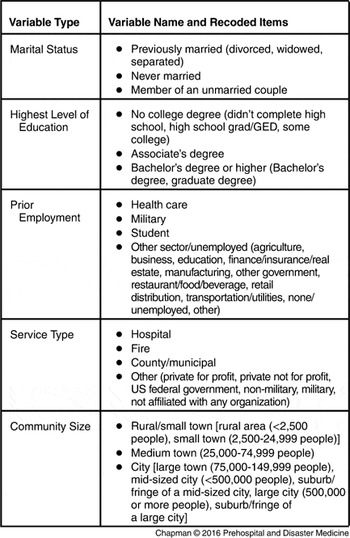
Several item categories were collapsed after a review of the initial frequency distribution to increase cell sizes for the analysis. Table 1 displays information on the recoded variables including the variable category used in this analysis and the variables from the original survey that are included in that category after recoding.
Variable Name and Recoded Items

Abbreviation: GED, General Educational Development.
Demographic Variables and Workplace Characteristics
Demographic characteristics included age, sex, marital status (married, previously married, single, unmarried couple), and highest level of education completed (no college degree, Associate’s degree, Bachelor’s, or higher degree). Other descriptive characteristics included current military service, physical fitness and overall health rating (excellent, good, fair/poor), and prior employment (health care, military, student, and other sectors/unemployed). Characteristics of the workplace were based on responses to four questions: (1) service type (hospital, fire, county/municipal, and other); (2) does your service transport patients? (yes/no); (3) volunteer status (yes/no); and (4) community size (rural/small town, medium town, and city).
Volunteer Status
From 1999 to 2003, respondents were asked to check a box to indicate whether they were a volunteer, whether they had more than one current EMS job, or if they did not have a job in which they performed EMS work. This item was replaced with an item explicitly asking, “Are you a volunteer EMT?” from 2004 to 2008.
Reasons for Entering the EMS Profession
The LEADS core survey included an 11-item measure with yes/no response options to the question, “We are interested in why you decided to enter the EMS profession. Please indicate whether each of the following factors were important in your decision to enter EMS.” Data were not available for 1999, the first year of the LEADS survey, due to data processing errors.
Satisfaction with EMS Position
The core survey included a nine-item measure of satisfaction stating, “Please indicate how satisfied you are with the following aspects of your EMS position.” In addition, there were two other measures of overall satisfaction, “How satisfied are you with your current EMS assignment?” and “How satisfied are you with the EMS profession?” Response categories for all three questions were: “Very Satisfied, Satisfied, Dissatisfied, and Very Dissatisfied.”
Analysis
Analysis was conducted using the statistical package Stata 12.1 (StataCorp; College Station, Texas USA). The tables display the proportion or mean of responses for each study variable with a 95% confidence interval (CI). Differences were tested for between EMT-Basics and Paramedics for each measure, over the 10 years of the survey as well as testing for differences within each group across years. Nonoverlapping CIs were used as indicators of statistically significant differences at the α=0.05 level.
Results
Annual Comparisons of EMT-Basics and Paramedics
Table 2 displays findings comparing EMT-Basics and Paramedics on descriptive demographic characteristics including age, sex, marital status, education, military service, physical fitness, overall health, and previous employment. New EMT-Basics were older than new EMT-Paramedics across all 10 survey years. On average, new EMT-Basics were between 31 and 34 years old, while new EMT-Paramedics were between 27 and 30 years old. In six of the 10 survey years these age differences were statistically significant. A higher proportion of EMT-Basics reported that they were married compared with EMT-Paramedics. These were significantly higher proportions in three of the survey years. More EMT-Basics than EMT-Paramedics reported that they did not have a college degree. There was a statistically significant difference in education between the two groups in six out of the 10 survey years.
Demographics of New EMT-B Compared with New EMT-P

Abbreviations: EMT-B, Emergency Medical Technician-Basic; EMT-P, Emergency Medical Technician-Paramedic.
In the first three years of the survey, a higher proportion of EMT-Basics reported their physical fitness status as fair or poor compared with EMT-Paramedics. However, that pattern reversed in several later survey years and in the last survey year, 2008, a significantly higher proportion of EMT-Paramedics reported fair or poor physical fitness status compared with EMT-Basics (30.5% EMT-Paramedic, 19.1% EMT-Basic). In nine out of the 10 survey years a greater proportion of paramedics reported “student” as their prior employment. Those differences were significantly higher for EMT-Paramedics in 1999 and 2000.
In eight of the survey years, between 12% and 25% of both EMT-Basics and Paramedics reported prior employment in health care, which is consistent with a prior LEADS analysis published in 2002.Reference Bowron and Todd 11
Findings regarding the workplace setting for those new to the EMS profession may be a useful indicator of the type of services or agencies that are hiring new EMT-Basics and Paramedics. These findings are presented in Table 3. There were small yet some significant difference in service types hiring new EMT-Basics and Paramedics. There were statistically significant differences between the proportions of EMT-Paramedics and EMT-Basics employed in agencies that transport patients in six of the survey years. While most new EMT-Basics and Paramedics were employed by agencies that transport patients, a greater proportion (73.9%-96.4%) of EMT-Paramedics reported being employed by these agencies across all the survey years. There were significant differences between EMT-Basics and Paramedics in the size of community in which the respondents did most of their work. In all but one year of the survey, the proportion of new EMT-Basics was significantly higher than the proportion of EMT-Paramedics employed in rural areas/small towns. The proportions ranged from 49.3% to 63.2% for EMT-Basics and from 11.4% to 46.0% for EMT-Paramedics across the survey years.
Workplaces Hiring New EMT-B Compared with New EMT-P

Abbreviations: EMT-B, Emergency Medical Technician-Basic; EMT-P, Emergency Medical Technician-Paramedic.
Closely related to community size is volunteer status. Rural communities are much more likely to rely on volunteers to staff EMS services. The proportion of new EMT-Basics who reported being a volunteer was significantly higher than EMT-Paramedics. These differences were large across all survey years; an average of 47.0% or greater for EMT-Basics and 22.4% or less for EMT-Paramedics.
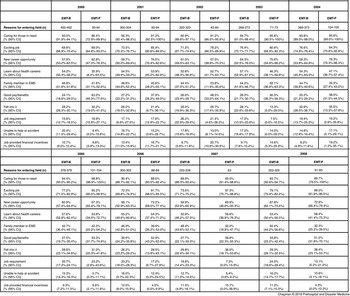
It is important for employers, recruiters, managers, and educators to know what draws new recruits to the EMS profession. Table 4 displays results on reasons for entering the EMS profession. In some survey years, there were statistically significant differences between EMT-Basics and Paramedics in several of the reasons for entering the EMS field: having a family member or friend who worked in EMS, wanting a job with good pay and benefits, inability to help at the scene of an accident, wanting an exciting job, and wanting a new career opportunity. A greater proportion of new EMT-Paramedics (37.9%-63.2%) reported, across survey years, having entered the EMS profession because they wanted a job with good pay and benefits compared with new EMT-Basics (24.1%-33.8%). These differences were statistically different in five of the survey years. In every year, when compared with EMT-Basics, a higher proportion of new EMT-Paramedics reported that they entered the EMS profession because they “wanted a job that is exciting.” These differences were statistically significant in five of the survey years. Proportionately, more new EMT-Paramedics were seeking a new career opportunity compared with EMT-Basics across all survey years except one. Another reason reported for entering EMS was reported inability to help at an accident or serious medical situation. More EMT-Basics than EMT-Paramedics reported this as one of their reasons for entering EMS in nine out of the 10 survey years.
Reasons for Entering EMS for New EMT-B Compared with EMT-PFootnote a

Abbreviations: EMS, Emergency Medical Services; EMT-B, Emergency Medical Technician-Basic; EMT-P, Emergency Medical Technician-Paramedic.
a Percentages indicate the proportion who reported that the reason was important in their decision to enter EMS.
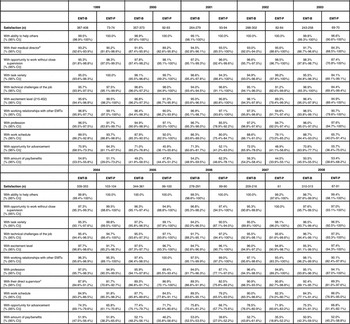
Table 5 displays results comparing EMT-Basics and Paramedics on items assessing satisfaction with the EMS profession and with other elements of one’s EMS position. Findings in the table combine proportions of those responding as satisfied or very satisfied. Overall, all of the satisfaction measures were consistently rated near 90% and above for both EMT-Basics and Paramedics except for satisfaction with work schedule, opportunity for advancement, and amount of pay and benefits. Satisfaction with pay and benefits was reported by a low of 35.5% of new EMT-Paramedics in one survey year and a low of 49.2% for new EMT-Basics in another survey year.
Satisfaction among New EMT-B Compared with New EMT-PFootnote a

Abbreviations: EMT-B, Emergency Medical Technician-Basic; EMT-P, Emergency Medical Technician-Paramedic.
a Percentages indicate the proportion who reported being “satisfied” or “very satisfied.”
b Asked in 1999-2003 only.
c Asked in 2004-2008 only.
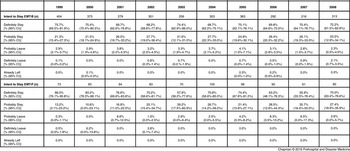
In every year, EMT-Basics reported being more satisfied with opportunities for advancement than EMT-Paramedics, with statistically significant differences in three years. Overall satisfaction with the profession was high for both new EMT-Basics and Paramedics. The vast majority of (94.0%-97.2%) new EMT-Basics were satisfied with the profession across all survey years compared with 85.5%-97.6% of EMT-Paramedics. It is important to assess retention early in the career of EMT-Basics and Paramedics so that managers and EMS services can identify those factors that are important in keeping new entrants in the field. Nearly all the new EMT-Basic and Paramedic respondents indicated that they intended to probably or definitely stay in the profession consistently across all survey years (Table 6). Although it was a small proportion overall, in 2006 and 2007 about 8% of new EMT-Paramedics indicated that they would probably leave the profession.
Longitudinal Comparisons for EMT-Basics and Paramedics
The analysis of trends over the 10 survey years for new EMT-Basics found slight differences from year to year in most demographic and descriptive characteristics. There were few significant differences. The proportion of EMT-Basics who reported that they were part of an unmarried couple increased from 3.5% in 1999 to consistently over 10% in the last four years of the survey. Between 2004 (7.4%) and 2005 (10.8%) this increase was statistically significant.
The analysis of trends over the 10 survey years for new EMT-Paramedics alone also found few significant differences from year to year in most characteristics. There was a statistically significant increase in the number of new EMT-Paramedics who reported their physical fitness status as fair or poor in the first three years of the survey (1999=9.2%, 2000=6.7%, 2001=13.5%) compared with the last year of the survey (2008=30.5%). There were no significant differences year to year for either new EMT-Basics or EMT-Paramedics in type of workplace, reasons for entering the EMS profession, or satisfaction measures. Similarly, there were no significant year-to-year differences within each group in their intent to leave the profession.
Intent to Stay in the Profession New EMT-B Compared with New EMT-P

Abbreviations: EMT-B, Emergency Medical Technician-Basic; EMT-P, Emergency Medical Technician-Paramedic.
Discussion
These findings concerning new entrants to the EMS profession have important implications for recruiters, educators, and employers of EMS workers. Knowledge of what attracts new recruits to the profession is important to recruiters and managers of EMS services. Understanding factors important for job satisfaction has significant implications for the retention of EMT-Basics and Paramedics for all employers of EMS workers.
Educational Background and Prior Employment
Having an adequate supply of educational programs will be critical to meeting the projected demand for 62,000 new recruits to the profession in the next decade.Reference Blau, Chapman, Pred and Lopez 16 It is important for recruiters to understand the pool of potential EMT-Basics and Paramedics, where they might be recruited, and what educational background they bring to the field. These findings over the 10 survey years show that more than one-half of the new EMT-Basics and about one-third of new EMT-Paramedics do not have a college degree before entry into the EMS field. Patterson et al 5 emphasized the lack of a clear educational process in EMS and argued that courses that offer college credits are needed in the EMS field. While at first glance these data may suggest that high schools might be fertile recruiting grounds, the average age of new EMT-Basics (31-34) and EMT-Paramedics (27-30) strongly suggests these new recruits are likely to have had another career or employment before joining the EMS profession.
Data on prior employment show that the majority of new entrants to EMS work came from a variety of industries or were unemployed. A smaller percentage reported being students. These findings offer little specific guidance to EMS recruiters. There is no clear picture of which industries recruiters might target in recruiting EMT-Basics and Paramedics. Some experts have suggested that other health care fields are a potential recruitment source. 4 Health care was the largest single prior employment for new entrants into EMS; between 12% and 15% for EMT-Basics and between 2% and 26% for EMT-Paramedics over the 10 years of the survey. However, it is not clear whether health care jobs lead to EMS or whether EMS leads to other health care occupations. About one-half to two-thirds of those new to the profession stated that an interest in learning about health careers was a reason for entering the EMS field, and may view EMS as a stepping stone to other health care occupations. More analysis is needed of specific types of health care jobs that preceded EMS as well as an analysis of those who leave EMS for other health care occupations.
Physical Fitness
It is important that EMS workers be in good health and physically fit. One must be able to lift and move patients, go up and down stairs, and generally be able to respond quickly in a variety of challenging physical settings. It might be of concern to EMS employers that a relatively high proportion of those in the field two years or less reported their physical fitness as only fair or poor consistently throughout the survey years; 15%-22% for EMT-Basics and 7%-31% of EMT-Paramedics. This trend will be important to continue to track in future surveys.
A lack of physical fitness may be associated with a greater risk of occupational injury. 17 A serious disabling injury may take an EMS worker out of the field temporarily or even permanently. Findings from this analysis may indicate that health and wellness programs at EMS agencies should focus on developing and supporting wellness programs from the beginning of an employee’s EMS career.
Recruitment to the EMS Field
Most respondents to the LEADS survey over the 10 years indicated that they entered the field because they wanted to care for people in need and wanted an exciting job. Other frequently cited factors were a desire to learn about health care career opportunities and a desire to pursue new career opportunities. Fewer new recruits to the profession cited pay and benefits or job requirements as reasons for entry into the field.
These findings may also be of value to recruiters in designing recruitment campaigns that portray a realistic and balanced view of the profession. Key informants interviewed for the NHTSA study stated expectations that EMS is always a fast paced, “adrenaline-laced” profession are overblown and often cause disappointment in new recruits. 4 As evidenced by the data on the type of agencies where these new recruits work, transporting patients is a substantial component of many EMS jobs.
The marketing of professions and the way in which individuals become aware of and choose a career is changing with technology and new methods of communication. For younger workers, the use of the Internet and social networking sites are a primary mode of communication. Social networking has implications for health care recruitment and EMS recruiters should be trained to use this technology.Reference Maguire, Hunting, Guidotti and Smith 18 Recruiters should be aware of websites geared particularly toward younger workers or students such as a California (USA) website, www.HealthJobsStartHere.com. Older workers seeking jobs due to displacement, unemployment, or career change may use Department of Labor state and county Workforce Investment Agencies. Recruiters need to ensure that EMS is promoted through these various avenues to EMS careers.
Job Satisfaction
In general EMT-Basics and Paramedics new to the profession were satisfied with most facets of the profession; between 80% and 100% satisfaction for most items on the survey over the 10 survey years. The two facets with lower levels of satisfaction were pay and benefits and opportunities for advancement. These findings are not new information for EMS managers and employers. Pay is consistently mentioned in surveys and literature as one of the largest sources of dissatisfaction with the EMS profession. 4 , 5 , Reference Bowron and Todd 11 - Reference Patterson, Moore, Sanddal, Wingrove and LaCroix 14 An earlier analysis of LEADS data found that a quarter of EMT-Basics and 10% of paramedics did not have health insurance offered by their employer.Reference Bowron and Todd 11
The proportion of new paramedics who reported being satisfied with opportunities for advancement was consistently lower for paramedics than for EMT-Basics across all survey years. The lack of a clearly defined career ladder within EMS is often cited as the key challenge in workforce retention.Reference Chapman, Crowe and Bentley 1 , Reference Bowron and Todd 11 , Reference Brown, Dickison, Misselbeck and Levine 12 , Reference Russell 19 It may be that more highly trained and skilled paramedics expect more from their positions than their EMT colleagues. EMT-Paramedics have invested more in training and may have differing career expectations starting at the beginning of their careers. The profession will need to become more creative and innovative in addressing these long-standing issues that have impacted recruitment and retention of the workforce.
Volunteer EMS workers may be distinct in many ways from employed EMS workers. It was found that new EMT-Basics were more likely to be in volunteer position than new EMT-Paramedics. In an industry that depends upon a significant volunteer workforce, employers and agencies should understand and address the issues of job satisfaction most important to volunteers in order to improve retention.
Retention of EMS Workers
Most EMT-Basics and Paramedics in the field for two years or less reported that they intended to stay in the profession. However, there are some sources of dissatisfaction discussed previously that may turn them into “leavers” later in their career. Perkins et alReference Freeman, Slifkin and Patterson 20 found that 9% of EMT-Basics in Montana (USA), who were at various stages of their career, intended to leave the profession within a year. Prior studies using LEADS data have made clear links between the elements of job satisfaction and commitment to the occupation and intention to leave the profession.Reference Patterson, Moore, Sanddal, Wingrove and LaCroix 14 , Reference Chapman, Blau, Pred and Lopez 15 The challenge in retaining those new to the profession is essentially “preventive” in nature in addressing those facets likely to cause dissatisfaction and contemplation of leaving the profession. Trends in intent to leave the profession should be assessed in future EMS workforce surveys.
Limitations
There are several limitations in this study. It is possible that some respondents are duplicated in that they responded as new to the field for two consecutive years due to the longitudinal design. Given the somewhat low response rate overall, there are likely to be only a small number of repeat responders in this analysis. The EMT-Paramedics responding as new to the field may have previously worked as an EMT-Basics and therefore have some experience in EMS. In addition, new EMT-Paramedics may be missing in this analysis who did not respond as being new to the profession because they counted their years as EMT-Basics. This study was unable to determine previous EMT-Basic experience for EMT-Paramedics in this data set. In addition, data on reasons for entering the EMS profession were coded as simply “yes” or “no” limiting analysis of the relative importance of these factors by respondent.
Conclusions
This analysis of 10 years of LEADS survey data centers on recruitment and retention of those new to the profession. Selected were those who had been in the profession for two years or less and survey data were analyzed that related to recruitment including demographic characteristics, hiring agencies, and reasons for choosing the EMS profession. Several areas were found where EMT-Basics and Paramedics differ. Findings from this analysis will be useful to recruiters, employers, EMS agencies, and policymakers who must address the challenges of recruiting and maintaining a satisfied, well-trained EMS workforce to meet the growing, changing needs of the US population.