Emerging and reemerging infectious diseases represent an increasingly important public health threat. Reference Feldmann, Czub and Jones1–Reference Lederberg, Shope and Oats3 In 2000, infectious diseases were responsible for 22% of all deaths and 27% of disability adjusted life-year (DALYs) worldwide.Reference Saker, Lee, Cannito, Gilmore and Campbell-Lendrum4 Developing countries are particularly affected. In Africa in 2000, for example, infectious diseases accounted for 50% of mortality and 52% of DALYs.Reference Saker, Lee, Cannito, Gilmore and Campbell-Lendrum4 A multitude of factors contribute to this situation, including a decline in control efforts, drug and pesticide resistance, unsuccessful vaccine development, urbanization, and increased population growth and mobility.Reference Feldmann, Czub and Jones1–Reference Lederberg, Shope and Oats3,Reference Wilson5 Increases in international trade of food and pharmaceuticals, and environmental changes in climate, water supply, and forestation also have had an enormous impact on the globalization of infectious diseases.Reference Saker, Lee, Cannito, Gilmore and Campbell-Lendrum4 Public health surveillance plays a critical role in controlling infectious diseases and requires dynamic, international solutions that address complex interactions among pathogens, vectors, hosts, and the environment.Reference Heymann and Rodier2,Reference Saker, Lee, Cannito, Gilmore and Campbell-Lendrum4,Reference Heymann and Rodier6,Reference Woodall7
In 2005 the World Health Organization (WHO) released its revised global legislation pertaining to infectious disease outbreaks, the International Health Regulations (IHR).Reference Gostin8, 9 The IHR, which became effective on June 15, 2007, require the WHO’s 193 Member States to develop and maintain effective global health surveillance systems for the early detection, confirmation, timely response, and reporting of infectious disease outbreaks. The IHR represents an important step in achieving global health security by promoting the prevention and control of communicable diseases within and across international borders.
This article addresses some challenges and potential solutions to the ability of national governments to adhere to global health surveillance requirements detailed in the IHR. Specifically, we briefly review some practical challenges such as inadequate surveillance and reporting infrastructure, and legal enforcement and maintenance of individual human rights.
INTERNATIONAL HEALTH REGULATIONS
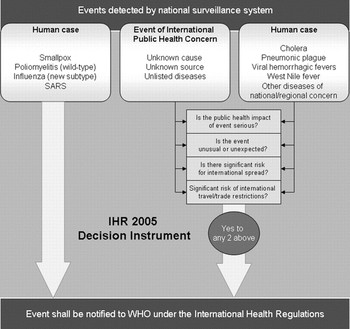
The IHR was developed in 1969 and focused on monitoring only a select few infectious diseases, including cholera, plague, and yellow fever.Reference Heymann and Rodier6, 10 The IHR was even amended in 1981 to exclude smallpox after its eradication in the late 1970s.Reference Baker and Fidler11, Reference Gostin, Bayer and Fairchild12 The 2005 revision has expanded its focus to include any disease with potential global public health threat. The IHR requires WHO Member States to investigate and report on any event that constitutes a public health emergency of international concern,9 including communicable infectious diseases and noncommunicable etiologies, such as chemical or radiological incidents (Fig 1). The IHR stipulates that national governments must assess the severity of an outbreak within 48 hours of initial detection and report to the WHO within 24 hours of confirmation. Reporting must include information about case definitions, laboratory findings, incidents of morbidity and mortality, communicable risk factors, and public health response.13
Decision instrument for assessment and notification of public health emergencies of international concern. Adapted from Annex 2 of the 2005 International Health Regulations.

Effective June 15, 2007, the IHR have called upon national ministries of health and foreign affairs departments to jointly establish a National Focal Point for health security monitoring and plan of action for infectious disease detection, confirmation, response, and reporting. National Focal Points must adhere to WHO Guiding Principles for International Outbreak Alert and Response.13, 14 These principles include establishing strong technical leadership during field responses, building local capacity for future epidemics, and ensuring respect for legal, human rights, and cultural sensitivities. By June 15, 2009, WHO expects that Member States will have met the necessary infrastructural requirements to fully implement global health surveillance systems, as stipulated by the IHR.
CHALLENGES IN GLOBAL HEALTH SURVEILLANCE INFRASTRUCTURE
The IHR requires national governments to implement and maintain outbreak surveillance systems at local or primary, state or intermediate, and national public health agency levels. This poses a formidable challenge to underdeveloped nations, which may not have adequate infrastructural capacity. Reference Gostin6,15,16 Ensuring appropriate surveillance infrastructure is particularly important in these contexts because developing countries have been the source of new diseases, including Marburg hemorrhaghic fever in Zimbabwe,Reference Gear, Cassel and Gear17 Ebola virus in the Democratic Republic of Congo,Reference Johnson, Lange, Webb and Murphy18 Lassa fever in west Africa,Reference Frame, Baldwin, Gocke and Troup19Vibrio cholerae 0139 in India,Reference Ramamurthy, Garg and Sharma20 and HIV in central Africa.Reference Sharp, Bailes, Chaudhuri, Rodenburg, Santiago and Hahn21 Moreover, it is recognized that the majority of the global infectious disease burden remains concentrated among the poorest 20% of the world’s population and often occurs in rural areas of developing countries where people have limited access to health care and clinical surveillance systems.Reference Saker, Lee, Cannito, Gilmore and Campbell-Lendrum4
The IHR does not tell nations how to conduct surveillance but rather tells them what results surveillance should produce. Although this offers national governments a great deal of freedom to determine their own contextually and economically appropriate surveillance mechanisms, it may also lead to passive public health reporting systems that have typically been insensitive and unreliable for early detection of infectious disease outbreaks. In a resource-scarce environment, clinical and syndromic surveillance methods may be favored over laboratory reporting. Potentially more timely, these data sources may, however, lack the required specificity for outbreak confirmation.Reference Mandl, Overhage and Wagner22 National governments would benefit from having explicit standards and guidelines to support the infrastructural development of their national infectious disease surveillance systems. This is especially important for developing countries that have limited infrastructural capacity and that may need support to establish these systems for the first time.
Countries with current or recent armed conflict may require additional support to establish sustainable national surveillance systems due to the destruction of health care and other basic infrastructure. In Ivory Coast, for example, it is estimated that 80% of health care facilities were destroyed or looted during conflict, and 90% of health professionals abandoned their posts.23 Twenty years of conflict in the Democratic Republic of Congo have rendered the health care system incapable of providing basic health care services to its citizens.Reference Van Herp, Parque, Rackley and Ford24 National organizations and national nongovernmental organizations (NGOs) can play an important role in strengthening the epidemiological surveillance capacities of national governments. Many international humanitarian aid organizations, such as the United Nations High Commissioner for Refugees, Doctors Without Borders, and Save the Children survey emerging and reemerging infectious diseases as part of their program planning. Lack of epidemiological expertise among some NGOs has led, however, to methodologically inaccurate surveillance analyses and reporting. NGOs assisting national governments in infectious disease surveillance would benefit from receiving standardized training to ensure that their surveillance methodologies are scientifically sound and reproducible.Reference Spiegel25
The WHO has suggested that international and national military forces may also be well positioned to strengthen infectious disease surveillance in conflict settings, given their logistic capacity and increasing involvement in peacekeeping and humanitarian relief operations. Successful examples of military involvement in public health surveillance have been noted in Peru and Thailand. Reference Chretien, Blazes and Coldren26–Reference Torres-Slimming, Mundaca and Moran28 In Peru, the national navy implemented the Ministry of Health’s national public health surveillance system, contributing to the identification of 31 disease outbreaks, including Peru’s first confirmed cyclosporiasis epidemic. In Thailand, technical assistance from the US Army enabled the national government to define risk factors for HIV infection, assess the impact of HIV prevention efforts on lowering incidence, and understand the natural history of epidemics.
Internet-based global systems can also provide valuable information for early detection of infectious disease outbreaks, especially in areas invisible to day-to-day global public health efforts.Reference Woodall29 This was demonstrated by the early identification via the Internet of the severe acute respiratory syndrome (SARS) outbreak in Guangdong Province, China.Reference Heymann and Rodier30, 31 A number of public and private global surveillance initiatives aggregate unstructured data from Internet-based discussion sites, news outlets, and blogs. Reference M’Ikanatha, Rohn and Robertson2,32,33 These initiatives include the Program for Monitoring Emerging Disease,Reference Woodall7,Reference Chase34–Reference Madoff and Woodall37 the Public Health Agency of Canada’s Global Public Health Intelligence Network,31, Reference Mykhalovskiy and Weir38 and other Internet-based global systems such as HealthMap,39, Reference Larkin40 MediSys,41 and Epispider.42 The WHO’s Global Outbreak Alert and Response Network depends largely on unstructured data to inform populations of outbreak verification activities.Reference Heymann and Rodier2, Reference Grein, Kamara and Rodier32 The increased uptake of unstructured Internet data by these organizations suggests that the public has an increasingly important role to play in global disease surveillance.Reference Keystone, Kozarsky and Freedman43
Despite the growing importance of these unstructured information sources for monitoring emerging infectious diseases, Internet-based reporting of infectious disease outbreaks is limited in developing countries due to lack of affordability, access, and education. The increasing digital divide between countries is demonstrated by huge variations in Internet access within and between countries.Reference Brodie, Flournoy, Altman, Blendon, Benson and Rosenbaum44 Economic challenges associated with the expansion of information and communications technology has been demonstrated in India. Increasing access to some 550,000 villages in India would cost the government 12.5% of its gross domestic product, diverting resources from other basic health interventions.Reference Bhatnagar and Schaware45 Developing countries will require increased multilateral support to effectively report and communicate information about emerging and reemerging infectious diseases to the public.
While developing countries with limited resources work toward strengthening their public health surveillance systems with assistance from international organizations, the military, and the public, emerging diseases may be also tracked by national sentinel surveillance and tourists returning home. A review of 60 sentinel sites in 29 countries by the Alumni for Global Surveillance network found that sentinel surveillance efficiently uncovered infectious diseases of international importance, including large numbers of influenza and dengue fever.Reference Arita, Nakane, Kojima, Yoshihara, Nakano and El-Gohary46 A review of Shigella dysenteriae serotype 1 (Sd1) incidence among European travelers suggests that this may be a viable method of alerting international public health officials to new outbreaks.Reference Guerin, Grais, Rottingen and Valleron47
These systems have the potential to generate increased, yet spurious and potentially inaccurate alerts. Countries that incorporate unstructured data in their national surveillance systems need to be cautious about publicly reporting information that has not been verifiedReference Bloom48, Reference Deodhar, Yemul and Banerjee49 because it can invite significant economic, social, and political damage on a country.Reference Gostin, Bayer and Fairchild12, Reference Cash and Narasimhan15 The negative consequences of premature, inaccurate reporting were illustrated in 1991 in Peru, when inflammatory reports of a cholera epidemic led national governments to boycott foodstuffs and issue travel warnings, incurring economic losses of US$770 million in trade.Reference Cash and Narasimhan15 A similar incident occurred in 1994 in India, when government officials declared an outbreak of plague before laboratory confirmation. Unfounded and premature outbreak reporting resulted in overreaction by the international community, stigmatization by media, and a loss of more than US$2 billion in tourist- and trade-based revenue.Reference Cash and Narasimhan15, Reference Deodhar, Yemul and Banerjee49
CHALLENGES IN LEGAL ENFORCEMENT OF THE IHR
The current system of global surveillance relies heavily on individual government participation and information. Government corruption and instability can have a negative impact on the effectiveness of a global surveillance system.Reference Arita, Nakane, Kojima, Yoshihara, Nakano and El-Gohary46 Some countries may not see the benefit of IHR compliance, especially if disease reporting has the potential to cause economic damage.Reference Gostin, Bayer and Fairchild12,Reference Cash and Narasimhan15,Reference Gostin16,Reference Fidler50 Other member states may be negatively affected due to travel or trade restrictions. There need to be guidelines for seeking compensation. In the recent outbreaks of avian influenza in Asia, some countries were hesitant to share the viral sequence with global authorities and vaccine manufacturers because they believed that they would never benefit from the development of a vaccine.Reference Schuklenk and Gartland51
Inadequate infectious disease reporting mechanisms can also hamper the ability of governments to respond to real emerging health threats in a timely manner.Reference Butler52 In Myanmar (Burma), delayed reporting of the avian flu virus to the public may have undermined government efforts to contain the epidemics because citizens unknowingly engaged in high-risk transport and sale of animals.Reference Beyrer, Suwanvanichkij and Mullany53 In China, the months of delay in the reporting of the SARS outbreak precluded implementation of an effective and timely international public health intervention.Reference Gostin, Bayer and Fairchild12
At the same time, there is no legal mandate requiring these systems to exist or specify the required quality of surveillance. The WHO has no formal means by which to enforce the IHR.Reference Gostin8, Reference Fidler50 These new regulations state that countries are “obliged” to report public health emergencies to the WHO (IHR 2005)9; however, compliance is voluntary and largely influenced by the reporting country’s ability to detect and respond to possible public health situations.Reference Cash and Narasimhan15 International law is difficult to enforce and has been largely disregarded.Reference Koh54 The HIV/AIDS pandemic has been a clear example of the limitations of the IHR, for which countries have developed exclusionary policies openly violating provisions of the health regulations.Reference Fidler55
Another level of ethical concern regarding global surveillance is the individual right. Although obtaining and sharing personal medical information in the context of a global emergency is necessary to ensure timely contact tracing, quarantine, or other public health measures,Reference Gostin, Bayer and Fairchild12 privacy of patient information is also important to ensure patient security.Reference Gostin8, Reference Schuklenk and Gartland51 The delicate balance between individual and public rights and public health surveillance was demonstrated in the recent example of an American man who traveled on several flights while infected with extensively drug-resistant tuberculosis. Failures to enforce a no-fly alert and detain the passenger led to dangerous public exposure to the virulent tuberculosis strain, and demonstrated the clear need for adherence to the IHR.Reference Tanne56 Due to media release of information there was a failure to maintain patient confidentiality, which has led to extreme stigmatization of the man in question.
CONCLUSIONS
As the new IHR entered into force on June 15, 2007, questions remained as to whether compliance with the IHR will be feasible given the significant challenges associated with infrastructural capacity, reporting mechanisms, multilateral coordination, and legal enforcement. Developing countries will require additional support to establish surveillance infrastructure; NGOs and the military may play important roles, especially in countries affected by armed conflict. The Internet could also play an important role in promoting early detection of outbreaks. These benefits must be carefully balanced with the adverse consequence of premature and/or inaccurate public infectious disease reporting. Legal enforcement of the IHR remains problematic in the absence of sanctions and in the context of maintaining individual human rights.
Authors’ Disclosure
This work was supported by the National Library of Medicine (R21LM009263-01), the National Institutes of Health, and the Canadian Institutes of Health Research.