In 1930, the U.S. government recorded Mexicans as a race for the first and last time in the census. After abandoning a separate racial category for Mexicans, the census bureau spent the next four decades experimenting with other indicators such as Spanish mother tongue, Spanish Surnames, and “Spanish Origin,” to enumerate Mexican Americans and Spanish Americans. This group of “foreign origin” was thought to be “straight forward” (Spanish Surnames 1950, 3c–5) but trying to put into practice a supposedly common-sense distinction proved quite difficult. As census enumerators took the same set of instructions across the country, they ended up including and excluding people differently. Census bureau officials understood that regional differences or individual enumerators’ sensibilities could cause problems for a uniform count. However, the results of the census in each period show that state boundaries also mattered. State policies developed state-specific racial landscapes, ones that would disrupt the attempt to make a uniform national count of individuals of Spanish or Mexican descent. The attempt to create a national ethno-racial taxonomy collided with varieties in subnational understandings, policies, and experiences of race and ethnicity.
Investigating the shifting markers used by the census between 1930 and 1970 contributes to our understanding of LatinoFootnote 1 racial formation both by looking at an underexplored period of the census racial formation and by centering state political development. Racial formation is “the sociohistorical process by which racial categories are created, inhabited, transformed, and destroyed” (Omi and Winant Reference Omi and Winant1994, 55). At the heart of this process is contestation between competing racial projects, which contain visions of the meaning and import of “race” as a marker and the boundaries of racial groups.Footnote 2 The census is a central site for such political struggle over the creation of racial taxonomies and the meaning of race (Anderson Reference Anderson1991; Nobles Reference Nobles2000; Hochschild and Powell Reference Hochschild and Powell2008; Prewitt Reference Prewitt2013; Schor Reference Schor2017; Perlmann Reference Perlmann2018) The years between 1930 and 1970 are key to understanding the racial formation of Latinos in the United States (e.g. De Genova and Ramos-Zayas Reference De Genova and Ramos-Zayas2003, 16–19; Mora Reference Mora2014). Therefore, investigating the census during this period is vital to understanding the construction of Latino identity in the United States.
Scholars have focused on the bookends: 1930, the appearance of “Mexican” on the census as a race, and 1980, the introduction of Hispanics as ethnic group and not a race (Nobles Reference Nobles2000; Rodriguez Reference Rodriguez2000; Schor Reference Schor2017; Telles Reference Telles2018).Footnote 3 Both of these decennial censuses elicited engagement from a large range of actors and interests outside of the census. Existing scholarship points to pressure from domestic forces, such as congress (Hochschild and Powell Reference Hochschild and Powell2008; Fox and Guglielmo Reference Fox and Guglielmo2012, 354) or nativists and eugenics movements (Molina Reference Molina2014), or world events, transnational companies, and foreign affairs (Calderón-Zaks Reference Calderón-Zaks2011) to explain the rise and fall of the raced category of “Mexican.” Similarly, the development of the 1980 census, which used five racial groups and an ethnic question about Hispanics, questions still in use today, is seen as a part of a broader civil rights movement. The in between years though, when the census experimented with different ways to count those of Spanish or Mexican descent, had less high-profile interest group engagement at the time and has received less scholarly attention since.Footnote 4
These quiet years reveal important dynamics about the racialization of Latinos in the United States and the key role of state political involvement in racial formation, as census markers resonated differently across states. Political battles within states’ borders over language, education, work, marriage, and governance created differing conceptions of race and belonging. These subnational understandings of identity emerge from mobilization in those battles and through the resulting policies and political landscapes. The experience of living with different governance regimes, ones that existed within the political boundaries of states, resulted in subnational specific racial landscapes that mediated census counts.
In scholarship on racial formation and Latino politics, region has been a key analytic lens with a strong focus on the southwest. Deviations from a shared national history with race often highlight regional differences in the United States. Some scholars have portrayed interregional differences in racial landscapes as overshadowing any intra-regional differences.Footnote 5 Additional, intra-regional differences have been sidelined because scholarship that does center states has tended to focused on the history of big states such as Texas and California; Latino’s history in these states become stand-ins if not for the nation, then for the Southwest. Variation in state racial projects within the southwest is a neglected story. States have a unique set of powers in the U.S. federal system, powers with a direct impact on the daily lives of residents making the state a central site for racial formation (Novkov Reference Novkov2008, 31; Smith, Kreitzer, and Suo Reference Smith, Kreitzer and Suo2020). There is a small but emerging set of scholarship exploring the historical legacies of divergent state responses to immigration and race relations.Footnote 6 This paper aims to shift our focus from the nation to the conversation between the nation and the states, to more fully understand the politics of racial formation.
To do this, I look at the census between 1930 and 1970 and engage in three forms of analysis for each decade. First, I analyze and contextualize the census bureau’s choice of indicators. I focus on bureau publications that provide a public-facing logic of racial taxonomies and ethnic taxonomies, ones that have an impact on population counts and reports, future census work, and on racial formation for the country. Second, I look specifically at the five southwestern states to investigate how the various measures for Mexican- or Spanish-origin populations used over time do different work in different states. How do the counts of those who use Spanish language differ from the counts of those who have a Spanish surname in any given state in the same year? Similarly, how do Spanish language counts in a state compare with contemporary estimates of Spanish descent populations at the time? Do the differences between measures or between measures and estimates vary across states?Footnote 7 This double comparison, within a state across markers, and across states, shows subnational and intra-regional variation in racial formation. States utilizing the same census instructions produced inconsistent results, in the end counting a different group of people, a group whose definition was mediated by the state’s racial political development. Finally, I turn to key policy choices that are connected to the indicators the census is using, state-level policies on marriage, language, or civil rights. With illustrative historical examples, we see how state policies can have legacies that generate subnational racial typologies of self and others. The goal is not to develop clear causal chains, nor to indicate that state policies are all that impact racial identify formation, but to indicate how divergent political development pathways in each state could influence census enumerators and respondents, and the reliability of census indicators.
Between 1930 and 1970, the census bureau was creating, not just counting, a national political group, what would become “Hispanics” in 1980; and to do so it had to coral various subnational racial landscapes into one U.S. racial taxonomy. The targets were a kaleidoscope of people including Tejanos, Hispanos, mestizos, and new migrants from diverse Spanish-speaking nations, those who were wealthy landowners and political elites, and those who were farm workers and laborers. Among these groups were different ideas and tensions around race, nation, and belonging (Guitérrez Reference Gutiérrez1995; Benton-Cohen Reference Benton-Cohen2009; Varsanyi Reference Varsanyi2020). There was no single uniform group of “Hispanics” for the census to count. As the bureau tried various indicators, counts within a state shifted, each measure drawing different people into the boundaries of this new group of interest. The way numbers shifted however was not consistent across states, as state-specific racial terrains mediated the counts. In the exploration of the census, we see these state racial landscapes collide with a federal body trying to create a uniform set of markers around racial and ethnic identities out of people with diverse histories, experiences, and identities. This reveals the key role of states’ political histories in the genealogy of the pan-ethnic-racial category Latino.
1930: Race
The Census publications in 1930 explained the introduction of a new racial category “Mexican” by pointing to the way “the Mexican element in the population has increased very rapidly.” Because “Mexicans” had become “important” (in census speak, this meant sizeable), the census report noted this group would be counted separately from whites (27). However, the census collected data on all immigrants of the first and second generation, so nativity questions for all whites could have been sufficient to capture Mexicans and Mexican Americans without a new racial category. Additionally, other racialized groups with small numbers, such as Malay or Siamese, had been recorded under an “other race” category, something that had never included Mexicans. The choice to mark Mexicans as nonwhite, then, was not merely a function of growth in the population as the census publications indicated, but was a transformation of the racial taxonomy resulting from congressional pressure and eugenic forces.Footnote 8
The instructions to enumerators reveal important dimensions of this new racial definition:
Practically all Mexican laborers are of a racial mixture difficult to classify, though usually well recognized in the localities where they are found. In order to obtain separate figures for this racial group, it has been decided that all persons born in Mexico, or having parents born in Mexico, who are not definitely white, Negro, Indian, Chinese, or Japanese, should be returned as Mexican (Appendix B, 1399).
Four key insights emerge about the definition of this new racial group. First, the group was defined in relation to the existing racial taxonomy. Those to be recorded as Mexican those “who are not definitely” one of the other “important” and known racial groups and have a linkage to the country of Mexico.Footnote 9 Second, note the definitional intersection with race and class embedded in the category of Mexican as the targets for this enumeration are “Mexican laborers.” Third, we see the complex and distinctive relationship between national origin and race for Latinos. Blood was a key criteria for other nonwhite racial categories.Footnote 10 For the newly created Mexican race however, family immigration history, not blood, is determinative.Footnote 11
Finally, the definition of “Mexican” makes a claim about the importance of local knowledge. The census jealously identifies those with regional experience and history where Mexicans have lived as having knowledge the federal census bureau wants to capture. In doing so, the bureau is calling on local ways of knowing but also transforming and disciplining them into a national identification schema. While formally, recent immigration history was the key defining element in the Mexican racial category, in practice it was more malleable. Estimates are that one-fifth of the 1,431,473 people labeled Mexican in the 1930 census were born in the United States and had parents born in the United States, those who should not have been counted according the enumeration instructions (Gratton and Merchant Reference Gratton and Merchant2015, 543). As with other racial categories, demographers recognized the problems of relying on enumerators with different racial sensibilities in different regions to assign individuals to a racial category (Longmore and Hitt Reference Longmore and Hitt1944). Demographers perceived the problem of enumerator variation in determination of “Mexicans” as uniquely problematic because of the regional concentration of the group with a unique history not well known outside of the southwest. However, the census results reveal not just regional or personal experience as mattering but also state-specific political development.
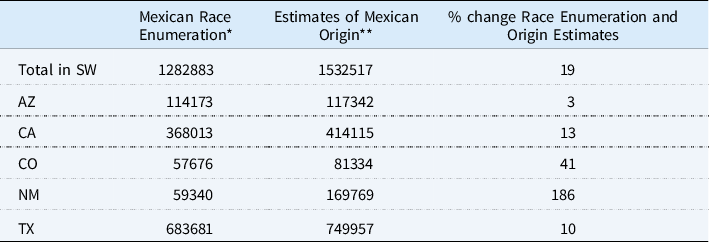
The federal attempt to racialize Mexicans ran headlong into states with different understandings of race. Comparing 1930 enumerations of Mexicans as a race with contemporary estimatesFootnote 12 of the Mexican-origin population at the time reveals the Mexican race question captured people with similar biographies differently depending on state residence (Table 1).
1930: Race counts and estimates

Source:
* Census (1930);
** Gratton and Merchant (Reference Gratton and Merchant2015).
In the five southwestern states, estimates of the Mexican-origin population are 19% higher than enumeration by Mexican race. This varies dramatically by state from a low of a 2% rise in Arizona to a high of a 186% percent increase of estimates over enumeration in New Mexico. While the census bureau cites a history with Spanish colonial powers as the reason for various possible undercounts, we should also turn to United States’ political history. The varying gaps between the Mexican race question and the estimates of Mexican-origin population across the five southwestern states are indicative of different understandings of race and belonging and different politics of inclusion or exclusion.
Looking at the two ends of the spectrum, Arizona and New Mexico, provides insight into how specific subnational racial terrains interfere with the census’s desire for uniform categories and tallies. Arizona and New Mexico, both areas incorporated by the United States through the Treaty of Guadalupe Hidalgo in 1848, shared much historically but took divergent approaches to the treatment of long-term natives of Mexican descent. New Mexico with a much larger population of Hispanos engaged in early power sharing, while Arizona recruited Anglo workers and pursued a strategy of domination (Jacobson, Tichenor, and Durden Reference Jacobson, Tichenor and Durden2018, 8–9). When each territory was making a case for statehood in the face of federal concerns about racial diversity, they continued to take different approaches to questions of race and belonging, informed by the demographic realities (Tichenor and Jacobson Reference Tichenor and Jacobson2020). Arizona assured the federal government that Anglos would dominate and put into place policies and practices that supported white supremacy politically, economically, and socially. New Mexico made an argument for pluralism arguing that Hispanos were Spanish Americans and should be considered like other Americans with European heritage (Noel Reference Noel2014; Jacobson, Tichenor, and Durden Reference Jacobson, Tichenor and Durden2018). These different notions of belonging and race reverberated through each state’s future political choices and set up different understandings about the meaning of Mexican heritage and race. Enumerators in each state in 1930 then had different understandings of same instructions asking for individuals “who are definitely not white.” New Mexico’s long history of resistance to the racialization of Hispanos extended from territorial politics and statehood struggles through the threats of World War I (Nieto-Phillips Reference Nieto-Phillips2008, Tichenor and Jacobson Reference Tichenor and Jacobson2020) and into the 1930 census counts, leading to lower counts of “Mexicans” as racial group. Arizona’s history of racial subjugation and segregation of Mexican Americans and Mexicans (Ruiz Reference Ruiz2001; Powers Reference Powers2008; Tichenor and Jacobson Reference Tichenor and Jacobson2020) unsurprisingly lead to greater correspondence between contemporary estimates and the “Mexican” race counts on the census. The federal category of Mexican as a race, then, was mediated by subnational notions of national belonging. To have an accurate count required a slow disciplining of subnational conceptions of belonging. For the census bureau, local and regional knowledge moved from one to be prized and captured in the 1930 census to one that was suspect and had to be circumvented.
While the census referred to Mexicans as a race, state battles were underway around similar categorization reflecting and developing subnational racial political landscapes. In 1933, a collaboration between a researcher at the University of New Mexico and the director of the state Department of Education’s Division of Statistics, funded by the Rockefeller foundation, sought to study the anti-Spanish prejudice through the distribution of a survey on “race attitudes” to high school students throughout the state. This would develop into a controversy that generated fierce grass roots protests and the involvement of many of New Mexico’s political leaders. While the central concern was about offensive characterizations of Spanish Americans, there was an additional worry that talking about potential racial prejudice could be creating it. The effect of an inquiry into racial discord could be seen as looking “to disturb the cordial relations between two people of different tongues and traditions” (Spanish Americans at Largely Attended Mass Meeting 1933). New Mexican leaders were resisting the categorizations of Spanish Americans as a racial group, three years after the introduction of such a racial group by the census bureau.
The racial taxonomy of New Mexico continued to be out of step with the national understanding, when, in 1933, the Federal Emergency Relief Agency asked states to conduct a census of relief recipients to be compiled by regional offices in the hopes of getting a clear picture of the needs of the nation. New Mexico however did not initially complete the form used across the country as the “whole state relief organization” was concerned about designation of “Mexican” as “colored.” Vernon Northup, a FERA field examiner, visited the state in an attempt to secure the information and discovered that “Since there are a large number of Spanish Americans residing in New Mexico and since race problems in this state are rather delicate, the State Relief Administration was afraid that the use of the schedule in its original form would create serious difficulties and would allow certain individuals to make political capital out of the issue” (Northrop 1933). A compromise was reached so New Mexicans would not be asked to place Spanish Americans or Mexicans in the colored box. The word “Mexican” was blacked out on the forms to be used in the state but the box remained, allowing the knowing census taker to place a check for all “Mexicans on the relief rolls” without advertising this to those being interviewed. As a handwritten note on the letter, presumably from someone in the governor’s office, indicated the “decision made to solicit such info surreptitiously”(Northrop 1933). Given this process, Winthrop suggested there should be some “slight remuneration for their efforts” for the normal volunteer census takers, and others agreed that this was “the only method that would prove satisfactory in this state.” Workers were provided state-specific instructions and pay to allow for circumvention of the difficult issue stemming from the lack of alignment between the federal government’s understanding of racial differences and New Mexico’s pre-civil rights era pluralism, central to which was the inclusion of Spanish Americans as white. Similarly, in 1935, the New Mexican senator reacted to a federal agricultural survey that was attempting to use the census bureau racial categorization of Mexicans. At the end of the exchange, the senator was promised that only those from Mexico would be listed as Mexican and they would instruct all people in the field in New Mexico that anyone of “Spanish” descent be categorized as White (Gratton and Merchant Reference Gratton and Merchant2016, 548).
The U.S. Census bureau continued to hope to rein in divergent forms of counting Mexicans, such as in New Mexico and elsewhere. While localities had often recorded Mexican births as white, the bureau wanted to change local practices through the introduction of the racial category of “Mexican” with the goal of more uniform recording practices (Fox and Guglielmo Reference Fox and Guglielmo2012, 356). However, the regional and local racial landscapes would not bend easily to an attempt at federal control. One census official noted it was “not easy to segregate Mexicans as the Mexicans have a prejudice against returning themselves as other than white, and seventy-five percent of the local registrars in New Mexico and lower California are Mexicans who credit themselves with being white” (Leon Truesdell, Chief Statistician for Population, quoted in Gratton and Merchant Reference Gratton and Merchant2016, 547). This was true outside of New Mexico and California. When the city of El Paso, Texas, decided in 1936 to record Mexican and Mexican Americans as “colored” in birth and death records, Mexicans and Mexican Americans in El Paso organized and resisted. City officials, driven by a desire to bring down white infant mortality rates, used the federal government as a shield suggesting they were just following the lead of the federal government and protestors should target the federal government, not the city. And they did, successfully. For Mexican Americans and for Mexicans, being labeled as “colored” was seen as a potential doorway to discriminatory treatment.
Pushback from Mexico and Mexican Americans led to the removal of the “Mexican” race from future census questionnaires.Footnote 13 By October 1936, the Department of Commerce agreed to eliminate the “Mexican” category and referred to inclusion of “Mexican” in 1930 as a “regrettable error” in correspondence with the Department of State (Calderón-Zaks Reference Calderón-Zaks2011, 347).Footnote 14 Rather than disciplining regional variation into a national schema, the regional variation successfully impeded national demography dreams. The documents from the census bureau advisory committee note that absent the “political complications resulting from what might be termed accidental circumstance” (quoted in Nobles Reference Nobles2000, 73–74) “Mexican” would have been retained. However, public-facing census publications do not mention political lobbying and pressure but report the racial category of “Mexican” was removed due to concerns over accuracy: “The seemingly straight forward approach of collecting and tabulating data on ‘Mexicans’ encounters the difficulty that in areas in which the Spanish-Colonial population is concentrated neither respondents nor enumerators regard persons of this type as ‘Mexican’, and thus, in such areas there was a gross undercount of this colonial group, which is reflected in the figures for native persons” (Census 1953, 5).Footnote 15
Despite the political challenges, officials in the bureau had become convinced of value of counting Mexicans. As PhDs in the social sciences took key roles in the bureau they envisioned vital statistics central to the mission of the census and “the emerging science of demography” (Gratton and Merchant Reference Gratton and Merchant2016, 557). Officials believed that group differences in fertility and infant mortality rates were essential information for accurate models of population growth. Bureau officials, however, lost an appeal to keep “Mexican” as a racial category (Schor Reference Schor2017, 219). The Census bureau had to accept the political decision not to continue with the racial category but they looked for alternatives. The Central Statistics board offered one that would presage the 1980 Hispanic ethnicity question: “It is urged, therefore that steps be taken in some way to meet this need, perhaps by two subheads under the category ‘white’ in column 13, namely ‘white except Mexican’ and ‘Mexican’”(Quoted in Schor Reference Schor2017, 219). Creative transposition of an existing question or procedure to a new demographic purpose proved easier for the census to adopt than the radical, new idea of dividing the white racial category. The bureau turned to their existing tool kit and Leon Truesdell, Chief of the Population division in the census bureau, hoped that the question on mother tongue, some used by the census bureau in 1910, 1920, and 1930, would “furnish a substitute for the abandoned racial category” (Schor Reference Schor2017, 218).
1940 mother tongue
The 1940 census attempted to use Spanish mother tongue as replacement for the race question. This path-dependent choice was a work around political pressures and a way to avoid variations in local interpretations of “Mexican” as a race. Data on mother tongue, the language spoke prior to immigration to the United States, had been collected on the foreign born in 1930. In 1940 mother tongue, “the principal language spoken in the home of the person in his earliest childhood,” (“Nativity and Parentage” 1940, 1) was collected regardless of nativity for a five percent sample of the population. The Census Bureau reported that the more fulsome accounting of the use of other languages beyond first- and second-generation immigrants could indicate “ethnic stock” especially for “national minorities which are obscured in the country of origin statistics.” While the data on mother tongue were collected from the sample of the entire population, it was only tabulated and presented for white people “since most persons of the other races speak one characteristic language—English for the Negroes, Chinese for the Chinese, Japanese for the Japanese, etc” (Census 1940). This use of language as a marker for white ethnicity attempted to draw a firmer line between race and ethnicity.
The contrast between counts based on race in 1930 and mother tongue in 1940 provided the census bureau new leverage on thinking about the reliability of the now-abandoned racial category. The contrast revealed that where one lived affected the likelihood that one would be labeled as “Mexican” in 1930. A census report bemoans the unreliability of local enumerators due to state-specific notions of belonging:
This situation is most clearly illustrated in the figures for New Mexico, the State in which the great majority of Spanish Americans are descendants of persons living in the territory prior to its acquisitions by the United States. In 1930 the number of foreign-born Mexicans was about 16,000; by 1940, it had decreased to about 8,000. In 1930, about 43,000 native persons classified as “Mexican” were enumerated, but, in 1940, about 214,000 native persons of Spanish mother tongue. Since there as not great influx of Spanish-speaking peoples into the State during the decade, it seems reasonable to assume that the figures refer to the same segment of the population, and since it is impossible that natural increase could account for a fivefold increase in number, it seems reasonable to conclude that the question on mother tongue provided a more complete count of the segment of population under consideration than did identification of “Mexicans” (Census 1950, 5).
Here we see subnational impediments to racial categories based on what census bureaucrats had thought were “common sense.” The census understood that race is “derived from that which is commonly accepted by the general public” (“Spanish Surnames” 1953, 3C–8). However, the racial terrain in the United States is state-specific. The disjuncture between the counts of the 1930 “Mexican” racial category and the 1940 “Spanish mother tongue” highlighted that there were multiple publics, not a general one, with different understandings of race and identity.
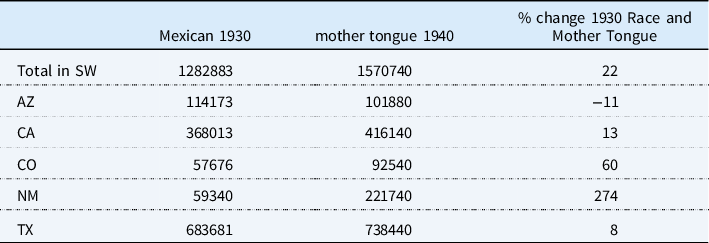
While in New Mexico, there are more individuals identified with Spanish mother tongue 1940 than “Mexican” in 1930, this varied across the United States. In the United States overall, Spanish mother tongue nets higher populations than “Mexicans,” 22% larger. In Texas, there was an 8% increase, California a 13% increase, and Colorado 60%. New Mexico had a 274% increase. Arizona in contrast had 11% fewer people listing “Spanish mother tongue” in 1940 than “Mexican” in the 1930 census (Table 2). The patterns hold when looking at the counts in 1930 and 1940 for only those born in the United States (Fig. 1).Footnote 16
Percentage Change using Mother Tongue (1940) instead of Race (1930). Source: “Persons of Spanish Surnames,” Census Bureau, 1950. pp. 3C–6 Table A.

1930 Mexican race and 1940 mother tongue counts

Source: Census (1930) and Census (1940).
This pattern is reflective not just of regional differences in the degree of the racialization of Mexicans but the legacies of policy choices in each state. Once again, New Mexico and Arizona, representing the ends of this spectrum, but also sharing deep historical origins, are telling. New Mexico, arguing Hispanos were Spanish Americans, similar to other American of European stock and resisting a racialization of Mexican heritage to achieve statehood, fully enshrined the rights of Spanish speakers in the constitution (Noel Reference Noel2014; Jacobson, Tichenor, and Durden Reference Jacobson, Tichenor and Durden2018). The political differences enforced by culture, history, and policy, resulted in a broader population of Spanish Speakers in New Mexico, and potentially more who would report a history of Spanish speaking to enumerators.Footnote 17 Arizona’s embrace of white supremacy to quiet concerns about race during its struggle for statehood stretched to questions of language. The state constitution required individuals to speak English to hold public office and that English be the language of instruction. In Arizona, it seems many people with Mexican heritage did not or did not report speaking Spanish at home as a child.
In Texas, there was an early pragmatic adoption of English and Spanish as modes of conducting official business and in education, without formal protections for Spanish speakers. However, both of these arenas saw changes in the 20th century with the adoption of English-only policies in schools and literacy tests for voting. California would also move in a more restrictive direction on Spanish language rights in public affairs. The state’s first constitution in 1849 required that all laws be published in English and Spanish, but 29 years later, when a convention was called to revise the constitution, the guarantee of bilingual publication of laws was removed and limited recording of all official proceedings to English. This English-only provision was in effect until 1966. However, Colorado’s original state constitution required that laws be published in both English and Spanish, reflecting the strength of political representation. Spanish Speakers were well represented among the founders of the Colorado Constitution (McMaken Reference McMaken2020).
Across the Southwest, politics within state boundaries around language left a legacy that stretched into the enumeration in 1940. States with historical initiatives protecting Spanish, Colorado, and New Mexico, saw the largest increases in counts when the indicator mother tongue was used. States with official restrictions on the use of Spanish saw less of an increase or even a decrease in counts when one used mother tongue instead of race. State-specific differences in language policies and practices pushed against the federal government’s attempt to count a “foreign group” of people. The subnational variation in notions of belonging and identity once again frustrated the census bureau’s attempt to get an “accurate” count of those of Mexican origin.
1950: Surnames
While broad interest in fully exploring the foreign born had declined by 1950 (Characteristics of the Population 1953, 36), census officials still had interest in and invested labor in counting Spanish Americans and Mexican Americans, those who even if not foreign born were understood as foreign. Race and mother tongue had created their own problems with national politics but also differing local political and racial terrains. For race they note, “The seemingly straight forward approach of collecting and tabulating data on ‘Mexicans’ encounters the difficulty that in areas in which the Spanish-Colonial population is concentrated neither respondents nor enumerators regards persons of this type as ‘Mexican’, and thus in such areas there was a gross undercount of this colonial group” (Persons of Spanish Surname 1953, 5). For Spanish mother tongue, they noted reporting challenges as well, citing as an example that 7% of those with Mexican born parents, clearly members of the group of Spanish Americans and Mexican Americans they were trying to capture, reported English as the mother tongue, not Spanish. They also note state variation in acceptance of Spanish as presenting differential undercounting. Unacknowledged state policies caused differences in acceptance of Spanish. These politics of language then forced the bureau to find another route, in the ongoing effort to categorize a set of people who shared no single history or ethnicity.Footnote 18
The Bureau turned to Spanish Surnames, “for the same general purpose” as Spanish mother tongue in 1940 and Mexican race in 1930, to obtain “data on the Spanish American and Mexican American population in designated states.” The bureau created a list of Spanish-origin names, starting with 6,000 Spanish surnames identified by the Immigration and Naturalization Service. They trained coders to look at the reports from the five southwestern states to enumerate the Spanish-origin population in those states. Intermarriages could disturb the utility of surnames in multiple ways, both drawing in those without Mexican origin into the count and missing wives who married “outside their country of origin group.” An undercount would be the result of male Anglos marrying those with Spanish origins. An overcount would be the result of males of Spanish origin marrying Anglo females. The census reports, while “not completely efficient indicators of Spanish-American descent… judged in terms of the results, the classification appears to have been adequate” (Persons of Spanish Surnames 1953, 3–5).
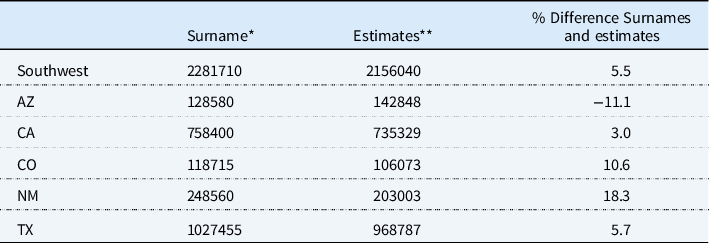
Contrasting the measures from the 1950 census with estimates of Mexican-origin population suggests that state effects were mediating the count by surnames. In the Southwest overall, surname counts were almost 6% higher than contemporary estimates. Spanish surname counts are higher than contemporary estimates of Mexican-origin population in every state except Arizona. In New Mexico, Spanish surnames are 18% higher and California 3% higher with Texas and Colorado falling in between. In Arizona, however, estimates of Spanish surnames are about 10% lower than estimates of Mexican-origin populations (Table 3). The ways in which surnames were an “adequate” marker as the census claimed differed across states lines, boundaries within which there were different policies and gendered patterns surrounding intermarriage.
1950: Surname counts and contemporary estimates

* Source: U.S. Census Bureau (1950), “Persons of Spanish Surnames,” 3C–6.
** Source: Gratton and Merchant (Reference Gratton and Merchant2015).
States in the southwest had varied histories of anti-miscegenation laws and gendered patterns of marriage between Anglos and Mexican or Mexican Americans. New Mexico, when permitted to legislate on marriage, created a law in 1860 that did not have racial barriers to marriage (Menchaca Reference Menchaca2008, 291). Colorado, while having early anti-miscegenation laws, had an exception for the southern region of the state, the area once part of Mexico. California passed anti-miscegenation laws in 1850 prohibiting white people from marrying black people. However, mestizos or Indians were allowed to marry anyone. The highly racially diverse Mexican population entered into detailed negotiations over each individual’s blood quantum as they navigated the politics of marriage.Footnote 19 Texas, one year after independence from Mexico in 1837, passed an anti-miscegenation ordinance banning whites or Mexicans from marrying anyone of African descent. People of “mixed” race were allowed to marry whites if they did not have African heritage in three generations. While Texas had originally recognized all marriages under Mexican rule, which included marriages between Mexicans with Afromestizos (Mexicans of African descent), additional anti-miscegenation laws adopted in 1854 made this more complicated. The legal and social acceptance of marriages between Anglo men and Mexican women, specifically those with darker skin, subsequently declined (Menchaca Reference Menchaca2008, 287).
Arizona stands out among the southwest states with the targeting of Mexican Americans through its anti-miscegenation regime. Arizona laws enforced a white/nonwhite color binary, prohibiting white people from marrying not just those of African descent but also Indians and Mongolians (Menchaca Reference Menchaca2008, 292). Arizona passed its first anti-miscegenation law in 1865. Statues did not mention Mexicans or blood quantums, something that would have increased the barriers to marriage partners for the predominantly male Anglo settlers. When political imperatives changed however, and the demand for female marriage partners shifted, Arizona introduced new anti-miscegenation laws that created barriers to marriage between Anglos and Mexican Americans. In 1913, Arizona prohibited marriage between descendants of “Caucasians” and descendants of African, Mongolian, or Indians. This reach into racial genealogy set up the bizarre world where some Mexican Americans, having descendants on both sides of the color line, could marry no one. Menchaca (Reference Menchaca2008) notes this law was “aimed at Mexican-Origin people” (302). Early gendered acceptance of male Anglo settlers marrying female Hispanos combined with a later restriction would set up the conditions for under which Spanish surnames would have a much smaller count that contemporary estimates in Arizona than in other states. Each state’s distinct legal rules around marriage created different historical legacies of intermarriage potentially affecting how well surnames would serve as a marker of Mexican origin.
For one quiet decade in 1960, the census used the same marker, Spanish surname, despite the acknowledged problems with undercounts that could result. It did so in combination with other previous measures such as mother tongue and birth or parentage. No new indicators were developed. It was not until the census bureau encountered external pressure from Mexican civil rights groups that they developed a new question to measure a group that seemed to defy definition.
1970: Self identification
In 1970, the census used a subjective question for the first time in addition to other objective markers to count “Spanish-speaking” people. In the wake of civil rights legislation, there was enhanced attention to racial and ethnic counts leading which created pressure for the bureau to include self-identification. The subjective marker however did not avoid state-level threats to reliability. While objective markers of earlier eras ran into legacies of state policies, self-identification collided with the different histories of social movements and ethnic organizing in each state. The 1970s, then, marks a turning point. It is the beginning of a shift to self-reporting, and a shift in the proximate influences shaping state census counts of Spanish-speaking people, from state policies to civil society.
The Civil rights protections, affirmative action, and Great Society programs of the 1960s created new imperatives for a full count of Mexican Americans and other Spanish-speaking people. Determination of discriminatory impact or eligibility for funding, for example, required knowledge of the size of subpopulations in the United States. The census bureau had planned to use a combination of three existing questions, surname, foreign stock (birth and parentage), and language in the 1970 census to count those of Spanish origin. The Inter-Agency Committee on Mexican American Affairs argued for an additional subjective measure, proposing a new question that allowed people to self-identify as having connections to various Spanish-speaking countries. By the time the White House told the Secretary of Commerce to include the measure on the 1970 forms, the census bureau had already printed all the materials. Trying to minimize reprinting costs, the question on origins was added to the questionnaire packet to be filled out by only 5% of the people in the United States. The question read:
Is this person’s origin or descent____ (Fill one circle):Footnote 20
-
Mexican
-
Puerto Rican
-
Cuban
-
Central or South American
-
Other Spanish
-
No, none of these
Of note, the new self-identification question asked about discrete national origin options without a pan-ethnic label, something that would not come for another decade. Despite not naming it an ethnicity for respondents, the census used this question, in combination with others about birthplace of individual or parents, Spanish surname (only in the Southwest), and persons of Spanish language,Footnote 21 as indicators of a single group. These markers were used to reflect “the population of Spanish ancestry living in the united states” or “people frequently referred to as ‘Spanish speaking’” (Census 1973). Census publications noted that the origin question and other markers, such as Spanish language and surname, were referring to “an ethnic and not a racial designation” (Census 1975, 4). This was in marked contrast to the 1950 census, which shied away from the language of ethnicity.Footnote 22 By 1970, however, the census bureau clearly named language and self-identification as indicators of an ethnic group of interest, marking the completed transformation from race in 1930 to an ethnic group with multiple countries of origins.
The census also expanded its geographic focus, producing for the first time a report that looked at Persons of Spanish origin and Spanish Ancestry from across the country, not just in the five Southwestern states. Demographers at the bureau felt regional differences in immigration patterns in the United States would make it challenging to use a single marker or index to measure this ethnic group. As a result, different clusters of markers were used to count “Spanish Heritage” depending on the region. In the Southwest, one was counted as having Spanish Heritage if they reported Spanish language or surname. In New York, New Jersey, or Pennsylvania, the marker of birth or parentage in Puerto Rico was used. In all other states, Spanish Language alone determined heritage.
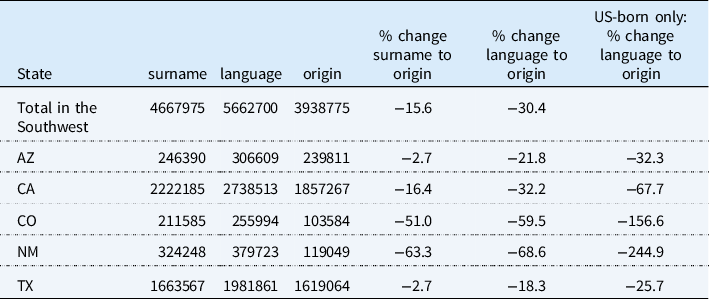
While the census was ready to acknowledge regional variation in immigration patterns, the bureau needed to consider that state differences within region mattered as well. By looking across markers in the same state in the southwest, we see the continued importance of subnational racial political development (Table 4).
1970: Surname, language, and origin self-identification

Source: “Data on the Spanish Ancestry Population.” U.S. Government Printing Office, Washington, DC (1975).
By 1970, the differences between counts based on Spanish Language and Surname are similar across states. On average across the Southwest, 21% fewer people were identified with surnames than with language. The range across each state was between 17% and 24%. The differences in each state between these objective measures and the new subjective origin question, however, varied dramatically. Self-identification had lower counts than language and surname in every state in the Southwest. Arizona and Texas saw the least difference, with only 2.6% fewer people declaring their Spanish origins than those who were coded with Spanish surnames. Colorado and New Mexico, on the other hand, had 51% and 63% percent smaller counts using the origin question compared with surnames. Similarly, the number of individuals reporting Spanish origin or descent is smaller than those captured by the Spanish language question. In Texas, the number who identify with Spanish origin is 18% smaller than language counts while in New Mexico that gap grows to 69%.Footnote 23
The disparities in the census data above highlight that political cultivation of Mexicanness or an ethnic connection with Spanish-speaking countries of origin happened differently across states. States that saw greater barriers to representational politics for Spanish-speaking individuals saw organizing and demands to address concerns about violence and discrimination, not through elites, but through other means such as civic organizations and social movements. In the absence of state-level political incorporation, then, civic organizations and social movements cultivated an ethnic identity to fight discrimination and to improve conditions. States that developed vibrant organizational ecologies also had higher levels of self-identification in the 1970 census compared to other markers. States that relied on elite leaders who often stressed assimilation saw lower levels of self-identification compared to other markers. The contrast between Texas and New Mexico is illustrative.
New Mexico had early and frequent representation of Latinos in both the state legislature and in the national congressional delegations. Political leaders in New Mexico provided an avenue for redress for civil rights complaints in the early and mid-20th century and encouraged incorporation and identification as American, above identification with an ethnicity or other national origin. For example, in 1921 Representative Nestor Montoya, the second Hispanic from New Mexico to serve in the House, wrote to the governor asking him to intervene in discriminatory treatment encountered in Deming, New Mexico reported to him by constituents:
“[T]hese men refuse to employ ‘Mexicans’ as they term them, but who in reality are American citizens and many of them ex-service men who have rendered services to our country, in my conception better citizens and more Americans that [sic] these people who make such discrimination could be. … remedy the evil and give every man a chance and a square deal. We have no ‘Mexicans’ or American distinction in our great and fair state, we are all Americans. People who raise the race question or make distinction as to our citizenship, have no place in the State of New Mexico and should not be tolerated”(Montoya Letter to Mechem 1921).
The request from Montoya moved Governor Mechem to action. Instead of grassroots mobilization, residents frequently turned to Montoya to intervene in the face of discrimination and exclusion, and he did so with arguments that cut against solidarity around ethnic or racial distinctions.
Two decades later, the first Hispanic senator from New Mexico, Dennis Chavez, continued a similar elite-driven liberal racial politics in New Mexico. Chavez worked for national fair employment legislation that would have protected Mexican Americans. When faced with obstacles at the national level, he successfully brought his work to the state house. In 1949, New Mexico enacted legislation that protected against discrimination in employment, housing, and public accommodations. While this legislation was supported by all but one state legislator with a Spanish surname, it was carefully framed in “national liberal ideology and so was not pointed enough to openly challenge on the ethic lines of conflict in New Mexico” (Gritter Reference Gritter2017, 151). Gritter notes that such variation among state policies on fair employment is often overlooked in narratives about the civil rights era that focus on the federal government. The long legacies of the politics around such policies on future identities are also overlooked. Chavez and other Spanish American politicians in New Mexico were elite institutional leaders, not leaders of a movement or of grassroots civic organizations. Those who were “incorporated politically and traditionally had not turned to the language of civil rights” (Gritter Reference Gritter2017, 154).
Such early political inclusion was not present in other southwestern states. CaliforniaFootnote 24 did not elect a Hispanic representative until the 1960s and Arizona did not elect a Hispanic representative to congress until 1990. In Texas, Mexican Americans lacked meaningful formal representation or voice in state politics due to poll taxes, white primaries, residency and language requirements, and persistent discrimination (Guglielmo Reference Guglielmo2006; Máarquez Reference Márquez2014, 7). Mexicans, once able to vote in Texas, could not do so after 1927. In the face of such political exclusion, an evolving web of local and statewide organizations arose to defend Mexican Americans and Mexicans from violence and discrimination (Guglielmo Reference Guglielmo2006; Orozco Reference Orozco2009, Chapter 3). In the 1920s, with the founding of the Order Sons of America (OSA), a “new kind of resistance to racial oppression” arose, one which would defend and support citizens “of Mexican or Spanish extraction.” OSA would join together with League of United Latin American Citizens (LULAC) in Texas to create one of the earliest and longest enduring Mexican American civil rights organizations.Footnote 25 The choice of the name Latin American was to connect them to “hispanidad and Spanishness”; activists were creating a new hybrid identity, a new ethnicity by “referring to themselves not only as Mexican Americans but also as Mexicans, and Americans, México Texanos, Spanish Latin American, and La Raza” (Orozco Reference Orozco2009, 223).Footnote 26 LULAC and associated organizations such as GI Forum, two of the central civil rights organizations for Mexican Americans in the 40s and 50s, flourished in Texas mobilizing Mexican Americans toward political action in the face of a history of political exclusion in the state (Kaplowitz Reference Kaplowitz2003, 193). The more robust local political organizing in Texas sustained and spread an ethnicity tied to “Mexican and Spanish extraction.” As LULAC evolved, it continued to press “a unique identity for Mexican Americans” to make clear the needs of people and to argue for government assistance (Kaplowitz Reference Kaplowitz2003, 199). Early Mexican American activism and unfolding organizing was responding to the political opportunity structure defined by state exclusion, lack of well-positioned elite leaders all of which may provide us insight into subsequent variations in subnational identification patterns.
The legacies of divergent state policies on inclusion created contrasting movement environments that developed state-specific imperatives for ethnic and racial identification. These legacies caused complications for a census bureau as they try to respond to national demands from civil rights organizations for counts of Spanish Americans in the 1970 census. Texas has the most resonance between other markers of Spanish or Mexican descent and the self-identification question. New Mexico, with more electoral political access and fewer grassroots organizations, had the least. In unexpected ways, self-identification provided a window onto the historical development of state-specific movements emerging from fights against political exclusion and resulted in smaller counts than the use of previous objective markers.
Conclusion
Census instructions and publications from 1930 to 1970 reveal a federal insistence that there is a Mexican-origin or Spanish-speaking people that needs to be counted, despite difficulties in naming or defining the group. Bureaucrats struggled to identify a marker that would categorize people consistently across the country, and even across the Southwest. Each measure devised ran headlong into differing subnational understandings of ethnicity, race, and Americanness. The federal government moved from depicting local knowledge as something to be prized, claimed, and amplified in 1930 to being suspect and a barrier to the mission of the census, which included clear nationally consistent racial and ethnic taxonomies. Local knowledge, according to federal bureaucrats, obscured an otherwise knowable “foreign population.” Race did not capture the group well, as state-sponsored narratives about race and belonging interfered with a national common-sense notion of race. Mother tongue also failed as a proxy for identifying this group because the politics of language resulted in the same indicator capturing people with different biographies in different states. In another failed attempt to circumvent subnational variations in notions of identity, the census moved away from Spanish mother tongue to Spanish surnames. Finally, the bureau landed on self-identification for political reasons and the possibility of minimizing the challenges associated with direct, objective markers tried thus far. Differences in social and political incorporation in states however still appear to have disrupted a uniform count. The move from race to language to surname to self-identification is a storytelling of the federal government in search of a way to count and define a group they believed existed but whose contours they could not specify. But it is also a story of a national notion of identity conflicting with state notions of belonging and the key role of politics and policy in generating incentives for identification. It is a story about the unintended consequences of categorization choices.
Driven in part by questions about civil rights and discrimination, Congress passed a law in 1976 requiring collection of data on “Americans of Spanish origin or descent.” A year later, the Office of Management and Budget issued a directive to all federal agencies on how to collect data on race and ethnicity, an attempt to create a uniform standard, understood as essential in efforts to enforce civil rights (Wallman Reference Wallman1998; Hattam Reference Hattam2005; Prewitt Reference Prewitt2013, 103–105). Directive 15 instructed agencies to use four mutually exclusive race categories (black, white, American Indian or Alaskan Native, and Asian or Pacific Islander) and one question on ethnicity (Hispanic). In 1980 and 1990, the census form asked: “Is this person of Spanish/Hispanic origin or descent?” The 1980 ethnicity question was the first time that an origin question was asked regardless of how many generations one was removed from the moment of immigration while not tied to a specific country of origin. The introduction of the Hispanic ethnic question then actually muddied the waters between race and ethnicity. While clearly named as not being a racial group, this specific affiliation was like a racial category in that it was understood as having persistent impact, regardless of the length of time one’s ancestors had lived within the United States. In 2000, the question no longer contained the language of origin or descent and simply asked is this person “Spanish/Hispanic/Latino?” This completed a move from a national origin or descent question to one of a pan-ethnic category. Activists and advocates looking for greater representation and attention to concerns of Latino had pushed for the creation of “Hispanics” (Perlmann Reference Perlmann2018, 345). The creation of the category was also the result of a dialectic conversation between the federal agency trying to find uniformity against a backdrop of various subnational racial landscapes.
In 2023, the Biden administration proposed changes to census forms that would combine questions on race and ethnicity, changing how the federal government has counted Hispanics for over 40 years. The new question would ask “What is your race or ethnicity?” and offer seven large categories: White, Hispanic or Latino, Black or African American, Asian, American Indian or Alaska Native, Middle Eastern or North African, Native Hawaiian or Pacific Islander. Under each, boxes would be available to provide additional, more specific information such as nation of origin or tribal affiliation. The history of the census from 1930 to 1970 raises important questions but not answer them for those grappling with this proposal. How will the political development of contesting racial projects respond to inclusion of Latinos as a “race or ethnicity”? When the count of Hispanics is still central to civil rights enforcement, what might be unintended consequences regarding inflation or deflation of the count relative to the current ethnic category? And how might such a shift resonate differently across the country given the diversity of state histories and racial landscapes? While our politics have become more nationalized in the intervening years, we have also seen a new era of immigration federalism. States have taken an increasingly active role in immigrant and immigration policies from developing sanctuary and inclusive policies, to engaging in state-level immigration enforcement and exclusion. These legislative and initiative battles have resulted in different state-level mobilization of Latinos and have increased the salience of differences in the subnational racial landscapes. The earlier period from 1930 to 1970 suggests close attention to the potential pitfalls and unintended consequences of federal attempts to create a new uniform national racial taxonomy right at a time of highly contested subnational understandings of race, ethnicity, and belonging.