Introduction
With the aging of the global population, the prevalence of dementia is increasing, particularly in Asia (Prince et al., Reference Prince2013). The Asian population in Taiwan is aging rapidly, and the prevalence of dementia is increasing more rapidly than most other developed countries (Wu et al., Reference Wu2013), which makes dementia a public health challenge in Taiwan. Because persons with dementia experience functional and cognitive impairment, this population is especially vulnerable to placement in nursing homes (Gaugler et al., Reference Gaugler2007). In Taiwan, dementia is the primary reason for placing a family member in a nursing home (Chen et al., Reference Chen2007).
Recently, there has been increasing attention to issues related to decisions regarding end-of-life (EOL) care for persons with dementia, particularly in nursing homes. A large percentage (50%–92%) of dementia-related deaths occur in nursing homes (Mitchell et al., Reference Mitchell2007) and, therefore, nursing homes are significant providers of EOL care for persons with dementia. EOL results from acute or fatal conditions that require family members to make decisions about whether or not to use life-sustaining treatment. Family surrogates are frequently the decision-makers for persons with dementia and these surrogates report experiencing psychological burdens of guilt, pain, and uncertainty in the decision process, particularly when the person with dementia has not provided an advance directive (AD) expressing their preferences regarding EOL and life-sustaining treatment.
Advance care planning (ACP) can be beneficial for both nursing home residents with dementia (RWDs) and their surrogates (van der Steen et al, Reference van der Steen2014; Vandervoort el al., Reference Vandervoort2014; Mignani et al., Reference Mignani, Ingravallo, Mariani and Chattat2017). ACP is a process that facilitates communication regarding a person's wishes, values, and preferences about future care, particular EOL care, which includes discussion and planning with representatives and care professionals, and ensures that these care preferences are met when persons lose the capacity to make decisions for themselves (van der Steen et al., Reference van der Steen2014). The process of ACP commonly results in ADs, which are formal written documents of those preferences (van der Steen et al., Reference van der Steen2014; Mignani et al., Reference Mignani, Ingravallo, Mariani and Chattat2017). Basic ADs include preferences regarding do-not-resuscitate (DNR), a healthcare proxy decision-maker, and living wills. Progressive ADs included feeding restrictions, do-not-hospitalize orders, medication restrictions, and other treatment restrictions (McAuley and Travis, Reference McAuley and Travis2003).
ADs are important for RWDs, as these residents will progressively lose decisional capacity with advancing illness and are more likely than people with other chronic conditions to suffer burdensome, costly, and non-beneficial treatment for quality of life or dying interventions, such as hospitalization or intrusive medical intervention (Mitchell et al., Reference Mitchell2007). Some evidences demonstrated that a better documentation of AD might increase use of hospice care, decrease hospitalization rates, and reduce costs when RWDs at EOL period (Robinson et al., Reference Robinson2012; van der Steen et al., Reference van der Steen2014). In addition, a strong association between having a written AD and a reduced burden for family members has been reported (Vandervoort el al., Reference Vandervoort2014); when EOL treatment decisions have been made ahead of time relatives or surrogates have fewer uncertainties regarding the person's wishes, which results in less stress, anxiety, and depression. However, the application of ADs for persons with advanced dementia is controversial (de Boer et al., Reference de Boer, Hertogh, Dröes, Jonker and Eefsting2010). Therefore, because the rate of cognitive decline is unknown, ADs should be carried out in the early stages of dementia (van der Steen et al., Reference van der Steen2014).
The benefits of ADs have gained the attention of national healthcare systems (Lingler et al., Reference Lingler2008; Triplett et al., Reference Triplett2008; Pasman et al., Reference Pasman2009). The first legislated natural death act in Asia was the Hospice Palliative Care Act, which was enacted in Taiwan in 2000 (Ministry of Health and Welfare, 2016). This act ensures that citizens with decision-making capacity have the right to create a living will in order to declare their wishes regarding hospice and palliative care and the right to prepare and sign an AD to request DNR or forgo life-sustaining treatment when approaching EOL and suffering from an incurable terminal illness. In addition, this act gives a close relative the right to give permission for DNR or forgoing life-sustaining treatment, if the patient is unconscious or unable to communicate his or her wishes (Ministry of Health and Welfare, 2016).
Although the Hospice Palliative Care Act has been in effect for almost 20 years, the attention on ADs has focused primarily on hospitalized people without impaired decision-making capacity, such as patients with cancer (Yang et al., Reference Yang2011; Wen et al., Reference Wen2013), and most have only a DNR directive (Lo et al., Reference Lo2010; Wen et al., Reference Wen2013; Ministry of Health and Welfare, 2016). In addition, preferences regarding important medical decisions, such as whether to provide artificial feeding, antibiotics, other treatments, and do-not-hospitalize directives have not been addressed. To date, Taiwan has not focused on nursing home dementia-specific issues or factors associated with the presence of ADs (except for DNR).
Studies about ADs for RWDs have been conducted primarily in and about Western countries, and findings indicated characteristics of RWDs and their nursing homes were predictive of a higher likelihood of having an AD. Characteristics of RWDS with ADs included older age and higher education (Lingler et al., Reference Lingler2008); significant health change within the past six months (Hirschman et al., Reference Hirschman2012); or lower cognitive function or more severe dementia (Lo et al., Reference Lo2010; De Gendt et al., Reference De Gendt2013). The characteristic of a nursing home with regards to religious affiliation or policy towards ADs can also influence the presence of ADs (Steinberg, Reference Steinberg2011; van Soest-Poortvliet et al., Reference van Soest-Poortvliet2015).
In general, the presence of ADs in Western countries is related to the patient's preferences or wishes rather than the surrogate's. The decisions about EOL-care differ in Asian countries; choices and decisions are often seen as a family process rather than an individual one. In Taiwan, family surrogates make most decisions about ADs for terminally ill patients, even when the patient is competent; surrogates signed 77%–82% of DNR orders for cancer patients (Wen et al., Reference Wen2013) and 91% for older adults in nursing homes (Lo et al., Reference Lo2010). In contrast to Western countries, family surrogates play a significant role in EOL decisions in Taiwan; therefore, characteristics of surrogates may be an important factor for decisions about ADs for RWDs in Taiwan (Lo et al., Reference Lo2010). However, little is known about how family surrogates in Taiwan feel about ADs for RWDs or how often family surrogates actually complete AD forms for RWDs.
Given the cultural sensitivity of EOL decisions and the lack of published data on ADs for RWDs in nursing homes in Taiwan, the purpose of this study was to determine the presence of ADs for this population, to investigate the types of ADs, and identify whether certain factors, were predictive of the presence of an AD. In the current study, an “AD” was defined as any written documentation in a resident's chart, which declares any type of directive regarding EOL care, including a living will for hospice and palliative care, DNR, forgoing life-sustaining treatment, do-not-hospitalize, or designated healthcare proxy decision-maker, etc. These findings may contribute to establishing references for developing optimal interventions and reform policies, which could increase the presence of ADs for persons with advanced dementia that are residents of nursing homes.
Methods
Study design
This cross-sectional survey employed baseline data from a longitudinal study for EOL-care decisions of advanced dementia residents in nursing homes. An explorative study was conducted to identify the presence and types of ADs as well as factors which influence the presence of ADs among nursing home RWDs.
Sample
Participants were recruited from nursing homes in northern Taiwan. To ensure the accessibility of the target population and minimize the influence of nursing home size and service quality on the presence of ADs, we selected only nursing homes with a capacity of more than 50 beds, an accreditation quality rating of grade A or higher, and caring for RWDs. All eligible nursing homes were invited to participate. Once the nursing homes agreed to participate, nursing home nurses sent a letter to the family surrogates of the RWDs inviting them to participate. RWDs-surrogate pairs were included if the following criteria were met: the residents had been diagnosed with Alzheimer's disease or another form of dementia, and admitted to their current facility for at least six months; surrogates were relatives > 20 years of age. Surrogates younger than 20 years of age or living abroad were excluded from the study invitation. The sample size was estimated by G*Power3 (Faul et al., Reference Faul, Erdfelder, Lang and Buchner2007). Setting the α level at 0.05, power at 0.80, and odds ratio 1.5–4.0 for logistic regression (Lo et al., Reference Lo2010), we estimated a sample size of 39–232 dyads was needed.
Based on the Nursing Home Accreditations (Ministry of Health and Welfare R.O.C., 2013) and Senior Welfare Institution Accreditations (Ministry of the Interior R.O.C., 2012), 41 nursing homes in northern Taiwan were eligible for the study. The nursing homes were dementia-specific (1), facilities with dementia special-care units (8), and mixed-care (non-dementia specific) nursing homes (32). Twenty-eight (68.3%) eligible nursing homes were unwilling to participate in this study. Their reasons for reluctance to participate included a lack of an AD policy in their facility (4), worry regarding family members of the RWD having an uncomfortable reaction about death issues (14), and no interest in the topic (10). The total number of nursing homes eligible to participate in the study was 13 (31.7%): most (8/13) were non-dementia specific nursing homes; the remainder included one dementia-specific nursing home, and four with dementia special-care units. Nine nursing homes did not specify any religious affiliation; three indicated a Catholic affiliation and one was Christian. The capacities of the study sites ranged from 50 to 248 beds. Initially, 184 dyads of RWDs and family surrogates were referred, and 143 (77.7%) dyads completed the study. Thirty-nine family surrogates declined to participate due to the issue's sensitivity, and one RWD was excluded because of scoring lower than 5 on the Global Deterioration Scale.
Procedures
The Chang Gung Hospital Institutional Review Board approved this research (IRB: 101–0868B). This study was conducted from August 1, 2012, to January 31, 2014. If a nursing home's chief administrators, residents, and family surrogates were eligible and agreed to be included in this study, oral and written information about the study and written consent were given before data collection began. For residents with advanced dementia who lacked consent capacity, consent for chart review was obtained from the RWD's family surrogate. A structured questionnaire was adopted to collect data about the family surrogates, which included their experience of ADs and followed a standard protocol for all participants; a trained research assistant conducted face-to-face interviews with family surrogates and chart reviews of the RWDs.
Measures
Presence of advance directives and a decision-maker
An “AD decision” refers to any written documentation in a resident's chart, which declares any type of directive regarding EOL care, including a living will for hospice and palliative care, DNR, forgoing life-sustaining treatment, do-not-hospitalize, or designated healthcare proxy decision-maker, etc. The signature of the person on the AD document was considered to be that of the decision-maker. We assumed that if the AD signature was not same as the name of the RWD, their surrogate made the decision for the AD. Following chart review, RWDs were classified as either RWDs with an AD or RWDs without an AD.
Characteristics of RWDs
Characteristics of RWDs included demographic and clinical characteristics. Demographics included age, gender, education level, and marital status. Clinical characteristics included length of nursing home stay, cognitive status, stage of dementia, number of chronic diseases, feeding and urination status, number of hospitalizations, pressure sores, and living unit.
Cognitive status
The Mini-Mental Status Examination – Taiwanese version (MMSE-T) (Shyu and Yip, Reference Shyu and Yip2001) measured cognitive status of the RWDs. Total scores range from 0 to 30, with lower scores indicating lower cognitive function.
Stage of dementia
The Global Deterioration Scale (Reisberg et al., Reference Reisberg1982) measures seven stages of dementia: stage 1, no subjective memory deficit; stage 2, subjective cognitive impairment; stage 3, earliest subtle deficits; stage 4, mild dementia; stage 5, moderate dementia; stage 6, moderately severe dementia; and stage 7, severe dementia. Only residents with a GDS of 5–7 were selected. The Global Deterioration Scale has been previously employed to determine the level of dementia in Chinese cultures, such as Taiwan (Sung et al., Reference Sung, Chang, Lee and Lee2006) and Hong Kong (Chan et al., Reference Chan, Choi, Chiu and Lam2003).
Physical conditions and living unit
Physical conditions of the RWDs were obtained by reviewing the residents’ medical records for the previous six months. Variables included the status for feeding (by mouth or tube feeding) and urination (catheterization or not), number of hospitalizations, number and size of pressure sores, and number of chronic diseases. Living unit in the nursing facility (special dementia unit or mixed unit) was also included in the data.
Characteristics of family surrogates
We collected data regarding demographic characteristics of family surrogates (age, gender, education level) as well as personal characteristics (relation to the RWD, religious affiliation). The surrogates also provided information regarding EOL care and ADs: Informed about ADs, asked whether nursing home care providers had provided information and, if yes, who had provided the information (such as nurse, social worker, physician, or others); Proxy experience asked whether surrogates had ever signed a DNR as a proxy for any other EOL relative; surrogates were also asked if the RWD had expressed their wishes regarding EOL care. Additional information was obtained using the instruments described below.
Surrogates perception of the RWD's quality of life
The surrogates’ perception of the family member's quality of life was measured with the Quality of Life in Late Stage Dementia instrument (QUALID) (Weiner et al., Reference Weiner2000). QUALID is an 11-item scale for determining a person's physical and emotional behavior for the previous week. It is administered in an interview format to a family member or caregiver familiar with the person with dementia. Responses are rated on a 5-point scale (1 = almost always to 5 = never); total scores range from 11 to 55, with lower scores indicating a perception of a higher quality of life. In our study, the surrogates were interviewed. The scale has a good inter-rater reliability (0.83) and has an acceptable level of internal consistency reliability (Cronbach's α was 0.77) (Weiner et al., Reference Weiner2000). In order to use the scale for this study, the authors translated and validated the English version of the QUALID. The authors translated the scale using forward- and back-translation from English to Taiwanese to confirm translation accuracy. A pilot study with six RWDs resulted in a Cronbach's α of 0.78. The Cronbach's α in the current study was 0.71.
Stress due to EOL-care decisions
The 6-item Stress of end-of-life care decision scale was developed from a qualitative study for decisions regarding EOL care for persons with dementia, which was conducted by the first author. This scale measured surrogates’ stress regarding decisions about ADs or EOL care. The scale contains six questions: (1) Does your family have a consistent view regarding EOL-care preferences of the relative with dementia? (2) Does your family have any conflict when making EOL-care decisions for the relative with dementia? (3) Does your family have any conflict when making major decisions? (4) Are you concerned about being blamed by outsiders or other relatives if you sign the DNR or forgo any life-sustaining treatment for your relative with dementia? (5) Are you concerned about being considered “unfilial” if you sign the DNR or forgo any life-sustaining treatment for your relative with dementia? (6) Are you concerned about being considered not trying enough, if you sign the DNR or forgo any life-sustaining treatment for your relative with dementia? Responses are rated on a 4-point scale (1 = never concerned or never conflicted to 4 = very concerned or frequently conflicted). The scale's content validity index (CVI) was 0.96. A pilot study was conducted with six RWDs to test the scale; the Cronbach's α of the 6-item scale was 0.68. In current study, the 6-item scale is divided into two subscales: family stress (3 items) and social stress (3 items); exploratory factor analysis determined the total variance of principal component analysis was 79.96%. The Cronbach's α for the two subscales was 0.86 and 0.89 and 0.80 for the total scale. Scores on each subscale range from 3 to 12, total scores range from 6 to 24; higher scores indicated surrogates perceived more stress from family and social norms.
Nursing home facility characteristics
Characteristics of the nursing homes included the facility's policy regarding ADs policy and the presence of a religious affiliation, which were obtained from each nursing home's chief administrator. The ADs policy referred to whether the HN had explicit AD documents and regularly informed residents or family surrogates of their right to an AD.
Statistical methods
All study variables were analyzed using predictive analytics software, version 22.0 (IBM SPSS Statistics). Descriptive statistics were used to present participants’ characteristics and AD information. All variables were examined for normality to decide the parametric or nonparametric statistical methods. Univariate comparison between residents with ADs and those without ADs were analyzed with χ 2 test or Fisher's exact test for categorical variables, independent t-test, or Mann–Whitney U-test for continuous variables. Multivariate logistic regression enter method was used to identify the factors significantly associated with the presence of ADs. The dependent variable was the presence of ADs, and the independent variables were selected from significantly associated factors in previous univariate analysis. Odds ratios were estimated for the associated variable. All tests were two-tailed. p values < 0.05 were considered statistically significant.
Results
Characteristics of participants
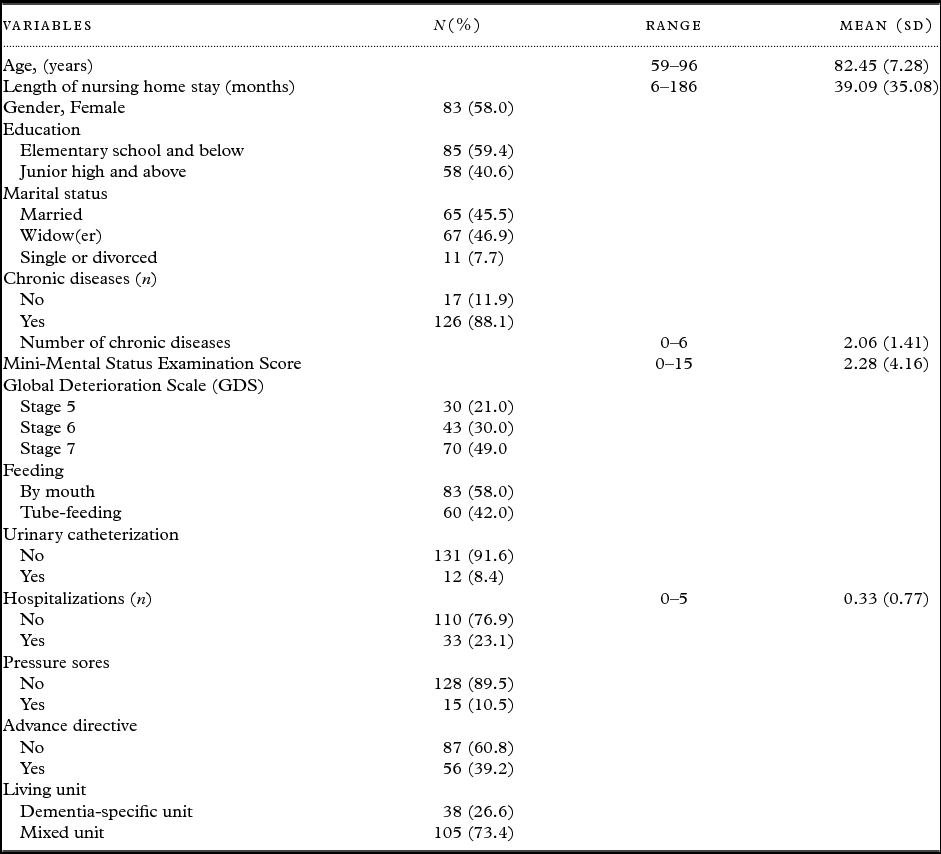
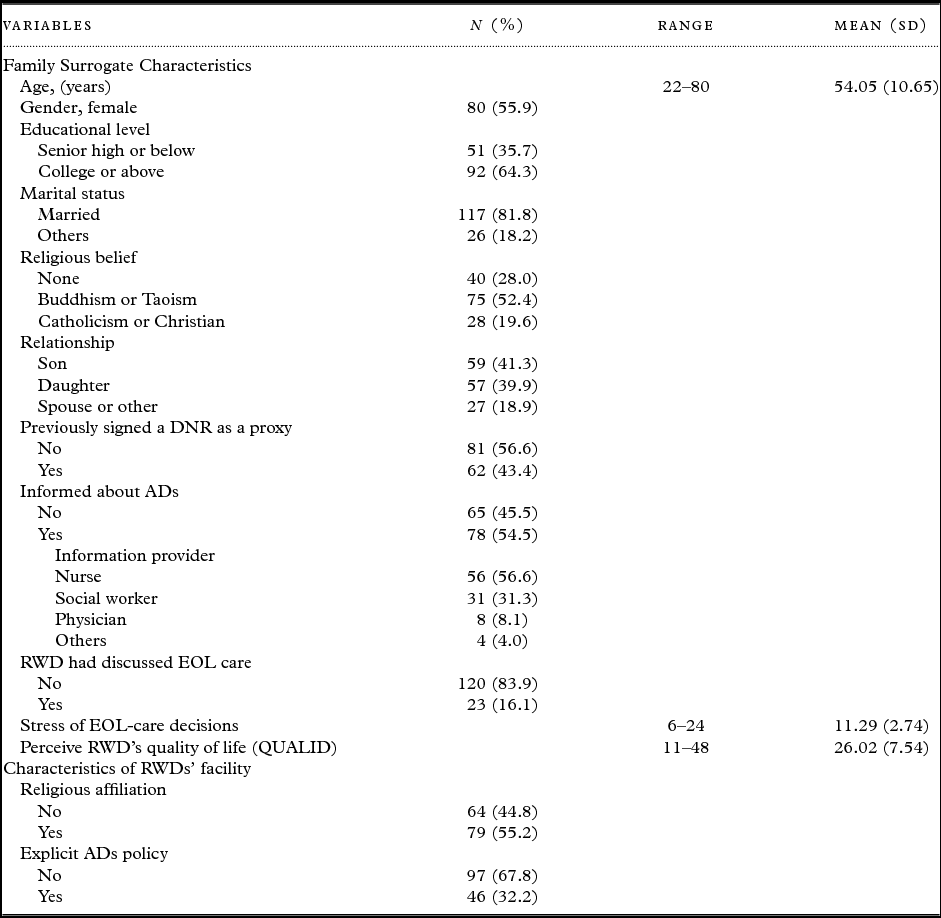
The demographic and clinical characteristics of RWD are shown in Table 1. The mean age of RWDs was 82.45 years, and mean length of stay in their current nursing home was 39.09 months. Approximately half (49%) of RWDs were stage 7 on the GDS. Most of the RWDs lived in a nursing home with no religious affiliation (55.2%). The characteristics of the family surrogates are shown in Table 2. Information regarding ADs was provided to 54.5% of the surrogates; the source of information was mostly nurses (56.6%) and social workers (31.3%); 43.4% of surrogates had previous experience signing a DNR by proxy, which was an EOL directive for another relative. Only 16.1% of surrogates reported that their relative with dementia had definitely expressed their opinion about EOL care. Five facility administrators claimed that their facilities had AD policies; however, only two facilities had formal documentation to describe this policy, and only one nursing home had a do-not-hospitalize document.
Characteristics of nursing home residents with dementia (N = 143)

Note: SD, standard deviation.
Characteristics of family surrogates and nursing home facilities (N = 143)

Notes: SD, standard deviation; DNR, do-not-resuscitate; RWD, resident with dementia; EOL, end-of-life; ADs, advance directives; QUALID, Quality of Life in Late Stage Dementia
Presence of advance directives
Less than half of the RWDs had some form of an AD (39.2%; 56 of 143) and 10.7% (6 of 56) had more than one AD. A DNR directive was most common (64.5% of ADs), followed by a living will for hospice palliative care (27.4%) and a do-not-hospitalize directive (8.1%). Family surrogates advocated 96.4% of these ADs. All ADs were signed after the residents were admitted to their nursing homes, and 73.2% of ADs were signed in the previous six months. However, no directive about feeding restriction, other restricted life-sustaining treatment directive, or appointing a lasting power of attorney was found. Only 25% of DNR orders had been noted on RWDs’ National Health Insurance IC cards.
Predictors of the presence of advance directives
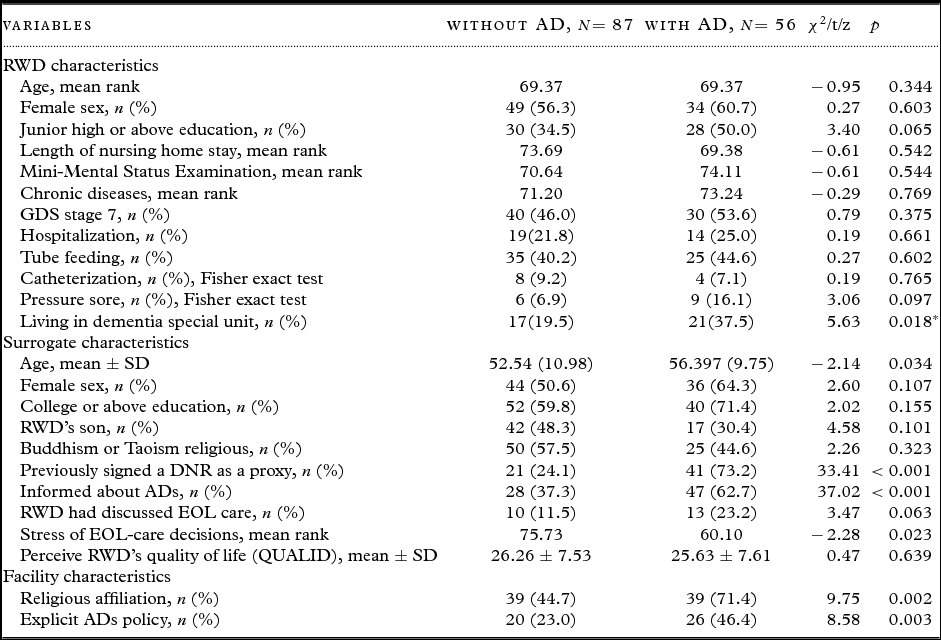
Univariate analyses showed that RWDs with ADs were significantly and positively correlated with surrogates’ age (t = −2.14, p = 0.034), a surrogate who had previously signed a DNR as a proxy (χ2 = 33.41, p < 0.001), and having been informed of ADs by nursing home care providers (χ2 = 37.02, p < 0.001). Furthermore, the presence of ADs was significantly higher among residents whose surrogates reported that they perceived less stress from family and social norms if they signed documents forgoing life-sustaining treatment for the RWD (Z = −2.28, p = 0.023). In addition, the prevalence of RWDs’ ADs was higher in a nursing home with religious affiliations and in those with AD policies, as well as among RWDs who lived in dementia-specific units than RWDs without these characteristics. There were no significant differences in characteristics of RWDs with and without ADs. There were also no significant differences between RWDs with ADs and those without regarding surrogate characteristics of sex, education level, kinship with RWD, or whether RWDs had definitely expressed their willingness to receive EOL care (Table 3).
Univariate analysis comparing factors for nursing home residents without and with an advance directive

Notes: SD, standard deviation; RWD, resident with dementia; ADs, advance directives; GDS, Global Deterioration Scale; DNR, do-not-resuscitate; EOL, end-of-life; QUALID, Quality of Life in Late Stage Dementia.
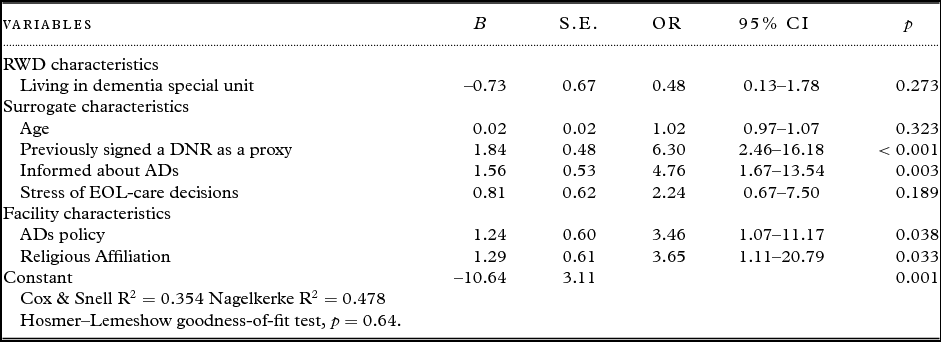
Multivariate analyses showed that surrogates who had previously signed a DNR as a proxy (odds ratio (OR) = 6.98, 95% confidence interval (95% CI) = 2.46–16.18, p < 0.001) and had been informed of ADs by nursing home care providers (OR = 4.76, 95% CI = 1.67–13.54, p = 0.003) were independent predictors of the presence of ADs for RWDs. Nursing homes with AD policies (OR = 3.46, 95% CI = 1.07–11.71, p = 0.038) and religious affiliation (OR = 3.65, 95% CI = 1.11–20.79, p = 0.033) were also independently associated with the presence of ADs for RWDs (Table 4).
Binary logistic regression model: factors associated with having an advance directive (enter model)

Notes: S.E., standard error; ADs, advance directives; DNR, do-not-resuscitate; RWD, resident with dementia; EOL, end-of-life.; OR, odds ratio exponentiated coefficient; CI, confidence interval.
Discussion
Prevalence of advance directives among nursing home RWDs
Our study results showed 39% of the RWDs in nursing homes had some form of AD. This is higher than the 16.4% previously reported for nursing home residents in Taiwan (Lo et al., Reference Lo2010). However, the percentage is far less than for other industrialized countries (Triplett et al., Reference Triplett2008; De Gendt et al., Reference De Gendt2013; Takezako et al., Reference Takezako2013). The lower proportion of ADs in Taiwan may be attributed to the lack of a regulatory policy (Lo et al., Reference Lo2010) and an incentive policy, which ensures that nursing home personnel universally provide information on ADs to RWDs and their surrogates (Takezako et al., Reference Takezako2013).
In spite of the passage of the Hospice Palliative Care Act nearly two decades ago (Ministry of Health and Welfare, 2016), this Act has neither a regulatory component to require introducing ADs to nursing home residents nor an incentive strategy to promote ADs. The development of ADs policy in nursing homes in Taiwan is still unpopular and lags behind other countries (De Gendt et al., Reference De Gendt2013); less than half (5 of 13) of the facilities in the current study claimed that they had an AD policy, and only two facilities had formal documentation to describe their policies. A national health policy requiring stipulating that nursing homes to develop AD policies and offer routine discussions to ensure residents and their surrogates are aware of ADs could increase the number of RWD who have an AD. Health policy-makers may want to consider setting an AD policy as one of the standard requirements for nursing home accreditation. Moreover, nursing home managers should develop strategies that guide professionals in initiating quality discussions regarding ADs.
Types of advance directives among nursing home RWD
DNR directives were the most common ADs for the RWD, which is in line with previous studies (Triplett et al., Reference Triplett2008). However, those studies focused on patients who required cardiopulmonary resuscitation, were terminally ill or very sick older adults; there is a lack of norms regarding DNR directives for persons with dementia and no studies are available about the approach to dementia in the early stages in Taiwan. Only 27.4% of the ADs for RWDs were living wills for hospice and palliative care, and no residents in the current study had formally appointed a lasting power of attorney or healthcare proxy. These numbers are far lower than previous studies, in which 61% to 65% of older adults who transitioned to long-term care settings had a living will or healthcare power of attorney (Lingler et al., Reference Lingler2008; Hirschman et al., Reference Hirschman2012). The lower numbers of living wills in our study may be due to the greater familiarity with DNRs for healthcare professionals and family surrogates in Taiwan compared with other types of ADs.
Our study found that family surrogates enacted 96.4% of ADs; and some family surrogates signed living wills. This result is slightly higher than the finding of Lo et al. (Reference Lo2010), in which family surrogates signed 91% of directives. Our higher percentage may be due to the fact that all of the ADs were signed after residents were admitted to the nursing homes and therefore the RWDs might have had cognitive impairments that were too severe to allow them to make their own decisions.
The phenomenon of family members signing ADs for persons with dementia implies that dementia has been not recognized as a terminal disease (van der Steen et al., Reference van der Steen2014). This may explain the lack of knowledge or strategies for developing ADs in early stages of dementia in the Taiwan healthcare system, which could guide persons with dementia and their families regarding goal setting. Second, some RWDs may be inappropriately excluded from participating in ADs discussions and decision-making processes because professionals often assume persons with dementia are not capable of reliable decision-making and therefore choose not to inform them of their right to ADs (De Vleminck et al., Reference De Vleminck2014). Third, the value of family consensus surpasses the individual's autonomy or decisions in Taiwanese society (Lo et al., Reference Lo2010; Wen et al., Reference Wen2013).
Appointing a healthcare power of attorney might depart from the social norm of the collectivist culture. Both family members and older adults believe it is unnecessary to appoint a legal surrogate because family proxy decisions are considered an unalterable principle in Taiwan. Individuals are only one part of a family unit in Taiwanese culture, and one's decision still often requires family approval (Lo et al., Reference Lo2010). In addition, the death issue is a taboo subject for older adults because Taiwanese people believe it will result in bad luck and unpleasant thoughts (Lo et al., Reference Lo2010). Therefore, professionals are usually inclined to discuss ADs or EOL-care decisions with family rather than with RWDs. However, the purpose of documenting ADs is to ensure that personal preferences for potential life-sustaining treatment are respected and honored during the period of impaired decision-making capacity. In order to balance the culture of family-centered decision-making and respecting RWDs’ autonomy, healthcare providers should engage in a more advanced discussion on EOL decisions with the RWDs, while they retain capacity, help families recognize the RWDs’ opinion and prevent family surrogates from overriding the wishes of RWDs (Lo et al., Reference Lo2010; De Gendt et al., Reference De Gendt2013; van der Steen et al., Reference van der Steen2014).
A previous study showed the do-not-hospitalize directive was unpopular among RWDs in nursing homes (Mitchell et al., Reference Mitchell2007). Our study supports this view; only one nursing home had executed a do-not-hospitalize policy. The concept of do-not-hospitalize is relatively new in Taiwan, which may explain the reluctance of the nursing homes in our study to implement these directives. Do-not-hospitalize directives do not appear in the AD documentation that is recommended by the Taiwan Hospice Organization or the Ministry of Health and Welfare. In addition, professionals, nursing home managers, and laypersons have a limited understanding of do-not-hospitalize, and the advantages of do-not-hospitalize are still absent due to the lack of support from health policies; National Health Insurance coverage does not involve EOL care in nursing homes. It is widely recognized that do-not-hospitalize could decrease hospital transfers and reduce costs and other burdens when RWDs are near the end of their lives (Mitchell et al., Reference Mitchell2007; Aaltonen et al., Reference Aaltonen, Raitanen, Forma, Pulkki, Rissanen and Jylhä2014). However, the practice of do-not-hospitalize needs more ancillary support, such as physician or nurse practitioner involvement in decision-making, and higher staffing ratios to provide EOL care to RWD with advanced disease (Mitchell et al., Reference Mitchell2007; Mann et al., Reference Mann2013). In fact, a lack of nurse practitioners or physician assistants on staff and low staffing ratios are still prevalent in most nursing homes. Therefore, it is very common for RWDs to be transferred to hospitals for terminal care.
We found no mention of restricted life-sustaining treatment (such as tube-feeding or medication restrictions) in the ADs in our study, which is in contrast to Western countries (De Gendt et al., Reference De Gendt2013). The apparent lack of awareness of the illness trajectory of dementia or comfort care for dementia may affect how professionals inform RWDs and their surrogates regarding ADs and treatments (van Soest-Poortvliet et al., Reference van Soest-Poortvliet2015). In addition, the standard document regarding restricted life-sustaining treatment lacks detailed description and guidance; restricted life-sustaining treatment has broad implications, which can make it difficult for the layperson to understand. Healthcare professionals need detailed explanations and recommendations regarding various forms of life-sustaining treatment. Customarily, medical treatment decisions and discussions are the physician's major responsibility, but physicians are often unavailable in general nursing homes, with the exception of those that are hospital-based. Thus, nursing home healthcare professionals – most of whom are register nurses or social workers – do not consider discussions regarding restricted life-sustaining treatment with RWDs and their surrogates their concern.
Predictors of advance directives among nursing home RWD
Our findings support those of previous studies showing that people made ADs for their relatives or themselves, based on past experience in making EOL decisions (McMahan et al., Reference McMahan2013; del Pozo Puente et al., Reference del Pozo Puente, Hidalgo, Herraez, Bravo, Rodriguez and Guillen2014). This finding suggests that the EOL decision-making experience of surrogates needs to be assessed in the discussion process of ADs. If the surrogate has no experience in EOL decision-making, more attention should be paid and more support given during the discussion process.
Our results showing that a surrogate who had been informed of ADs by nursing home care providers was a predictor of RWDs with ADs, which is in agreement with a previous study by van Soest-Poortvliet et al. (Reference van Soest-Poortvliet2015). Therefore, the frequency and quality of discussions between professionals and family surrogates and RWDs regarding RWDs’ ADs and EOL-care decisions should be integrated in nursing homes’ routine work.
Nursing homes’ having a religious affiliation was independently associated with the presence of ADs for RWDs. This supports prior findings that healthcare institutions’ religious affiliations influence AD policies (Steinberg, Reference Steinberg2011); in particular, Catholic healthcare institutions in Belgium made great efforts to develop written ethics policies on euthanasia (Gastmans et al., Reference Gastmans2006). Although the number of religiously affiliated facilities was low, three of the four were Catholic and 44.8% of the RWDs were in facilities with a religious affiliation. However, it should be noted that nursing homes affiliated with Taoism and Buddhism – Taiwan's traditional religions – were not involved in this study. The mechanism of religious affiliation in nursing homes on their AD policy or supporting RWDs and surrogates remains unclear and needs further research.
The fact that family stress about EOL decisions, which result from consensus and social pressure, was correlated with surrogate decision-making was identified in earlier studies on families’ willingness to complete ADs (van der Steen et al., Reference van der Steen2014; van Soest-Poortvliet et al., Reference van Soest-Poortvliet2015). In line with those studies, univariate analysis showed the surrogates’ stress of dealing with EOL decision-making was significantly related to the presence of ADs for RWDs. However, this variable was not a factor in our final predictive model after competing with other variables. Regardless, healthcare professionals should be aware of the potential effect of family dynamics and social pressure in the EOL-care decision process, and if possible, regular and planned family meetings may help surrogates decrease these unspoken decisional barriers.
Previous studies demonstrated that characteristics of RWDs such as older age (Lingler et al., Reference Lingler2008), high educational level (Lingler et al., Reference Lingler2008; Triplett et al., Reference Triplett2008), poor physical health, recent hospitalization (Hirschman et al., Reference Hirschman2012), and severity of dementia or poor cognitive function (Lo et al., Reference Lo2010; De Gendt et al., Reference De Gendt2013) were positively associated with the presence of DNR or EOL-care decisions for nursing home residents. However, these characteristics for the RWDs in our study were not associated with ADs. These results might be due to the fact that the surrogates in our study signed the majority of ADs. Further studies are needed to determine if characteristics of RWDs are associated the presence of ADs and whether surrogates tend to consider their own preferences rather than the perspective of RWDs (de Boer et al., Reference de Boer, Hertogh, Dröes, Jonker and Eefsting2010).
Limitations
This study had several limitations and, therefore, the findings should be interpreted with caution. Only grade-A facilities were investigated, which prevents generalizing the findings to all nursing homes in Taiwan. Also, because a universal database, such as the Minimum Data Set, is not available in all nursing homes, the quality of data that were extracted from chart records may vary. In particular, the decision for ADs often involves complex family issues and dynamics; we cannot extrapolate the role or power of the family surrogate on the decision process from chart review. Furthermore, the findings are susceptible to non-responding bias due to participation from only 31.7% of the eligible nursing homes of which only four had a religious affiliation, and data were collected only from family surrogates who agreed to participate. In addition, this study did not incorporate knowledge or attitude factors such as: awareness or knowledge of dementia, prognosis, or ADs; or beliefs and attitudes toward ADs. Several studies have reported a relationship between knowledge or attitude factors and completion of ADs (Yang et al., Reference Yang2011). One other limitation of our findings is the data obtained from two of the scales: the Taiwan version of the quality of life in late stage dementia, which has not been previously used in Taiwan population, and the stress of end-of-life care decision, which was newly developed for this study; these measures need to be tested further in other studies to confirm their validity and the reliability. Finally, the cross-sectional design of the study did not allow us to measure the process of AD decision-making.
Conclusion
This study provides insight into the predictive factors of the presence of ADs in RWDs among nursing homes in Taiwan. Less than half of this sample of RWDs had ADs, and family surrogates, rather than the RWDs, signed most. The characteristics of surrogates and nursing home facilities, especially facilities with AD policies, played a more prominent role than characteristics of the RWDs in explaining the presence of ADs. A policy for ensuring awareness of the right to an AD for all nursing home residents and their surrogates should be taken into consideration by health policy-makers. The findings suggest the need for interventions aimed at enhancing recognition of various ADs for RWDs and family surrogates, as well as healthcare professionals. Healthcare professionals should facilitate decisions regarding ADs and EOL-care preferences for persons with dementia as early in the course of the disease as possible, which could increase the likelihood adhering to the preferences of the patient. In addition, family surrogates should be encouraged to inquire into and respect the preferences of their family members with dementia in the proxy process.
Conflict of interest
None.
Description of authors’ roles
In conducting this study, the authors had the following roles: H. Huang, L. Weng, and Y. L. Shyu developed the concept of the study; H. Huang analyzed the data, and wrote the paper; L. Weng and Y. L. Shyu assisted with writing the paper; and K. Chen, and W. Hsu assisted in data collection, chart review quality assurance, and critical revisions of the paper. All authors have approved the final version of this manuscript.
Acknowledgments
This research was supported by the Ministry of Science and Technology (101-2314-B-182-077-MY3). We would like to thank all the RWDs and their family surrogates who took part in the study. We also thank all healthcare professionals who worked in nursing homes to refer participants for this study.