1. Introduction
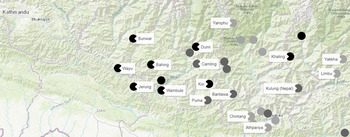
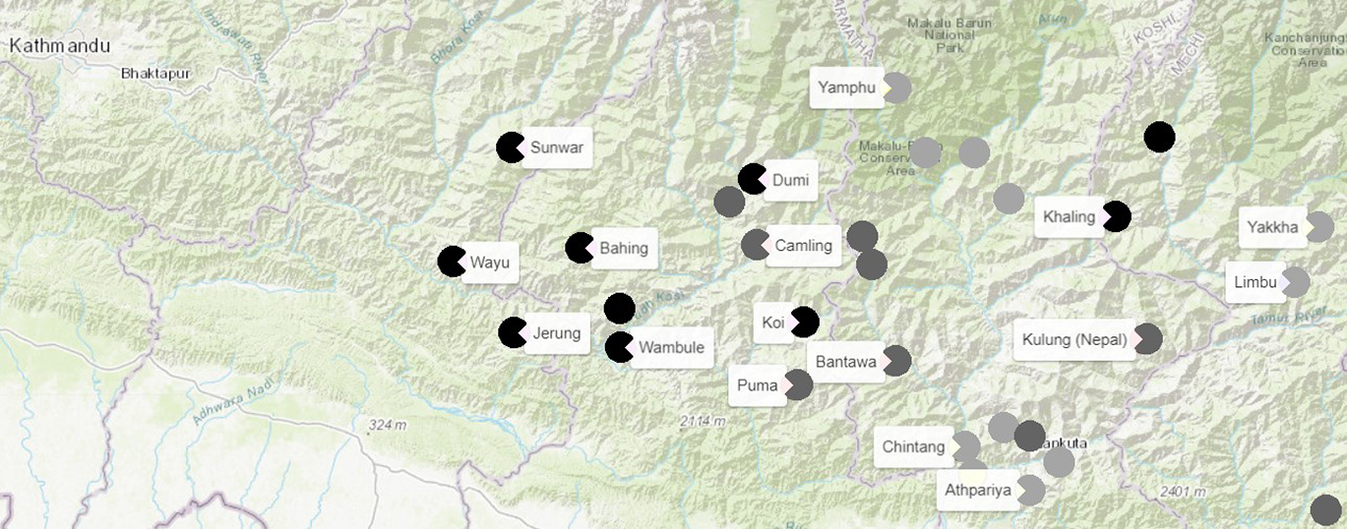
Kiranti languages are a group of about two dozen related languages spoken in the mountains of eastern Nepal (see Figure 1). Although it has not been proved unmistakably whether the family constitutes a valid genetic unit (Ebert Reference Ebert, Thurgood and LaPolla2003: 516), the languages share a number of typological traits and belong, unmistakably, to the Sino-Tibetan phylum.
Location of the Kiranti languages (Glottolog 3.0, Hammarström, Forkel & Haspelmath Reference Hammarström, Forkel and Haspelmath2017).
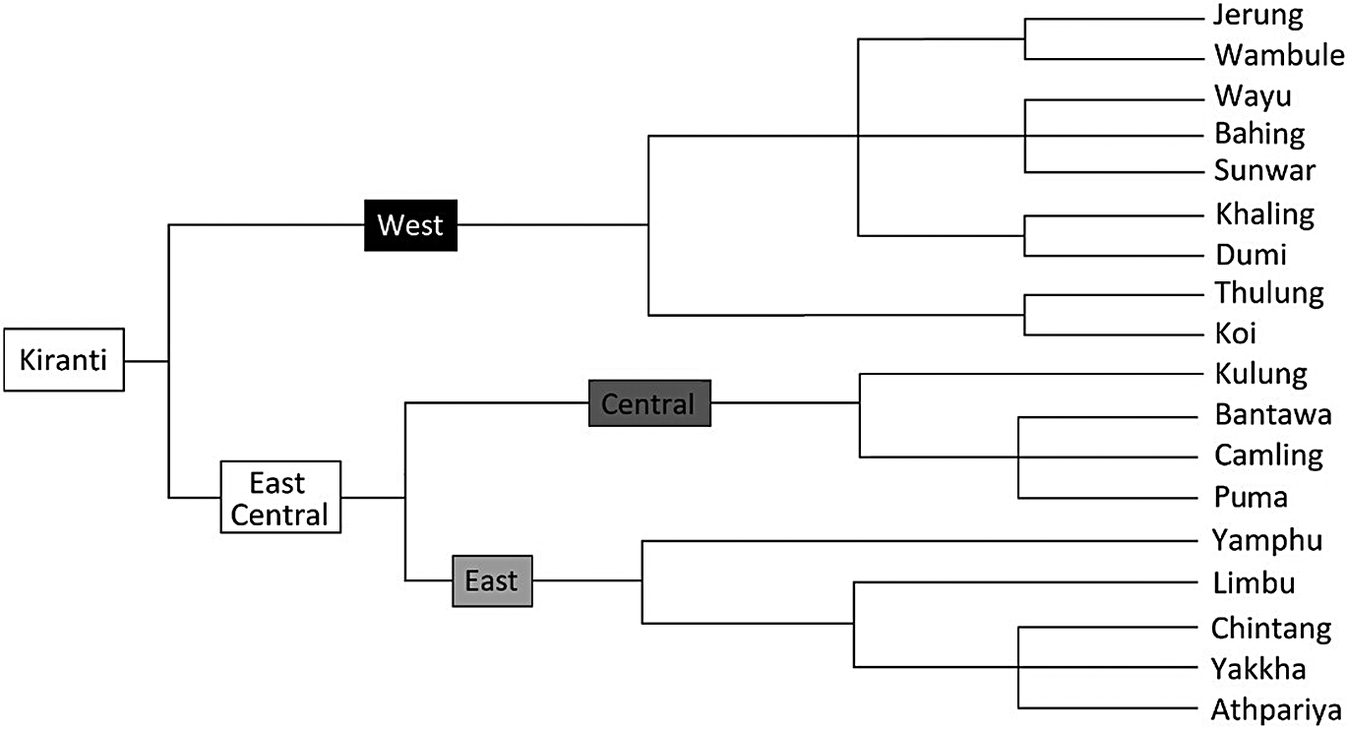
The internal genetic relationships within the family (particularly the higher order ones) continue to be uncertain to some degree, but according to the most recent hypothesis (Bickel & Gaenszle Reference Bickel and Gaenszle2015), the internal structure of the family may resemble the one in Figure 2.
Kiranti family tree (based on Bickel & Gaenszle Reference Bickel and Gaenszle2015).

Unlike most Sino-Tibetan languages,Footnote 2 Kiranti languages are characterized by their inflectional complexity, which reaches its greatest expression in the verbal domain. Kiranti verbs tend to agree in person (first, second, third) and number (singular, dual, plural) with agent and patient arguments. Clusivity distinctions are usually also present. Many inflectional endings are cumulative, or co-argument sensitive (Witzlack-Makarevich et al. Reference Witzlack-Makarevich, Zakharko, Bierkandt, Zúñiga and Bickel2016) in that they appear in specific combinations of agent and patient (e.g. 1du>2sg, 2pl>1, etc.) or in that they encode plurality or duality of agent and patient simultaneously. All of these characteristics make these languages particularly attractive to morphologists. It will be another morphological trait, however, that will constitute the focus of the present paper.
This other inflectional property, which is also widespread across Kiranti, is the presence of stem alternations in the verb. Ebert (Reference Ebert, Thurgood and LaPolla2003) mentions that in the languages to the southeast of the Kiranti area, the paradigmatic distribution of stem alternation tends to be relatively straightforward: one of the alternants is found before vowel-initial suffixes and the other elsewhere. In languages to the northwest, however, the situation appears to be more complex, according to her, and phonological/phonotactic constraints can no longer account for the distribution of stem alternants within a paradigm.
A further point of interest to be mentioned in connection with stem alternation in Kiranti is that, in many cases, stem alternations seem to be cognate, i.e. they are often based upon the same forms and most likely descend from a common ancestral paradigmatic alternation of some sort in the Proto-language (Jacques et al. Reference Jacques, Lahaussois, Michailovsky and Rai2011: 1127–1128). Often, the alternations involve a /t/ (voiced sometimes to /d/), as is illustrated in (1) and/or an /s/ extension to the stem, as is illustrated in (2).
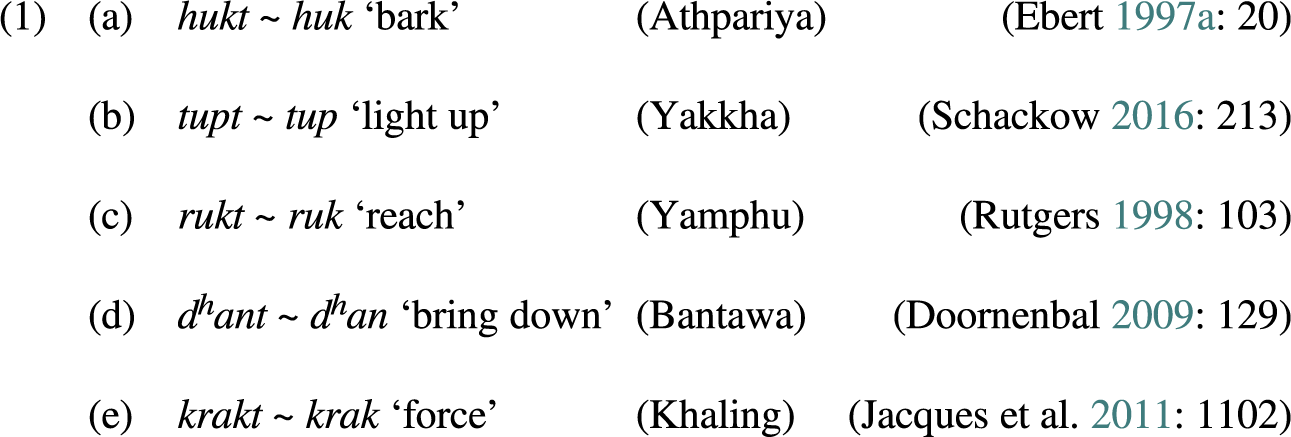
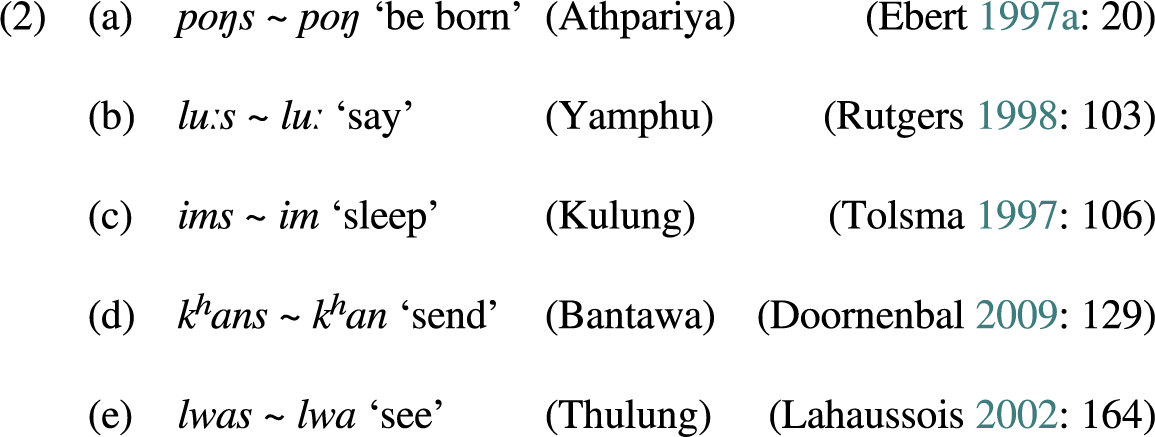
In the simplest case, these /t/ or /s/ augments tend to be present before a vowel. In such a context, they can behave as the onset of the following syllable. Before a consonant or at the end of the word, these /t/ or /s/ augments tend to be absent. This behaviour is understandable considering that complex codas (also complex clusters in general) are usually disallowed in Kiranti. Because, *hukt-ma ‘bark-inf’, for example, would contain an impossible cluster in Athpariya, a phonological readjustment of some sort is necessary in the syllable contact. The loss of the augment is the solution adopted by Athpariya (i.e. huk-ma) and other Kiranti languages.
The reason why it tends to be /t/ and /s/ that appear in this (unstable) morphotactic slot outside of the usual CVC structure of Kiranti stems demands, of course, some explanation. It is usually agreed that these forms go back ultimately to valency-changing suffixes that are widespread in Tibeto-Burman (Michailovsky Reference Michailovsky1985). Often, however, the suffixes appear to be lexicalized to some extent in most Kiranti languages (i.e. they are simply part of the root) and cannot be associated with any valency-increasing grammatical function synchronically. Although they sometimes vary quite substantially from one language to another, the stem alternations of Kiranti do not seem to encode any other grammatical value either and their paradigmatic distribution appears to be largely arbitrary. In the languages where these inherited stem alternations are not phonologically conditioned, therefore, they have to be regarded as ‘morphomic’ (i.e. purely morphological) in the sense of Aronoff (Reference Aronoff1994).
Most of the literature on morphomic stem alternations (e.g. Maiden Reference Maiden1992, Reference Maiden2018; O’Neill Reference O’Neill2011) emphasizes their productivity and diachronic stability. However, most of it has been concerned exclusively with Romance languages, which is unfortunate. Kiranti stem alternations constitute a particularly interesting object of enquiry because of the size and diachronic depth of the family and because of their variety in terms of the forms involved, their paradigmatic distribution, complexity, and extramorphological predictability. More importantly, Kiranti stem alternations appear to contradict some of the main current assumptions of what morphomes can be (like). The most remarkable finding of this paper is that phonologically-conditioned stem alternations (which are not usually considered morphomic) can also be extraordinarily resilient, maybe more so, it will be argued, than exclusively morphological patterns. Developments in Kiranti suggest that their paradigmatic distribution is learnt redundantly (rather than derived from the phonological context alone) and is actively perpetuated, reinforced, and defended against potentially disruptive changes, just like in more traditional Romance morphomes. Kiranti stem alternations also question the necessity of segmentation for morphological analysis, and highlight the importance of morphological predictability at the syntagmatic level.
The rest of this paper is structured as follows: Sections 2–4 will describe stem alternation in 18 Kiranti languages (all for which a sufficient description exists of the phenomenon). Each of the sections will cover a different branch of Kiranti (East, Central, and West). On the evidence of this synchronic picture, Section 5 will engage in cross-linguistic comparison and will discuss some observed diachronic developments and their implications for morphological theory in general and for our understanding of the morphome in particular. Finally, Section 6 will summarize the paper and reiterate findings and claims.
2. East Kiranti
2.1. Athpariya (data from Ebert Reference Ebert1997a)
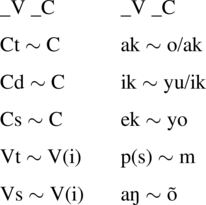
Most verbs in Athpariya have two stems, as only stems ending in a vowel or a nasal may lack stem alternation. One of the stems occurs without exception before vowels and the other one elsewhere, i.e. before consonant-initial suffixes and word-finally. Maybe as expected, pre-vocalic stems are most usually characterized by greater segmental material than preconsonantal stems. The following formal alternations occur:

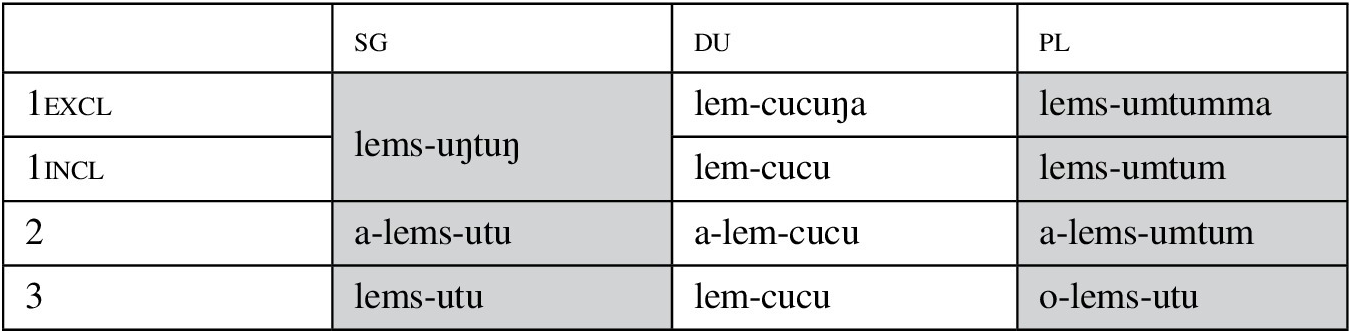
The most frequent of these are alternations involving the augments (t, d, s), followed by voicings and consonant deletions. The n ∼ l alternation (also the absence of alternation) is comparatively infrequent. Even if the distribution of stem alternation in the paradigm is completely predictable from the shape of the corresponding suffix, the paradigmatic distribution of the stems will be presented next for comparative purposes. Note that the inflection of transitive and intransitive verbs differs in various respects. For reasons of space and ease of visualization, only forms with a 3sg patient will be presented for transitive verbs. Shading in the tables in this paper is used to highlight the paradigmatic distribution of stems, with different shades marking different stems.
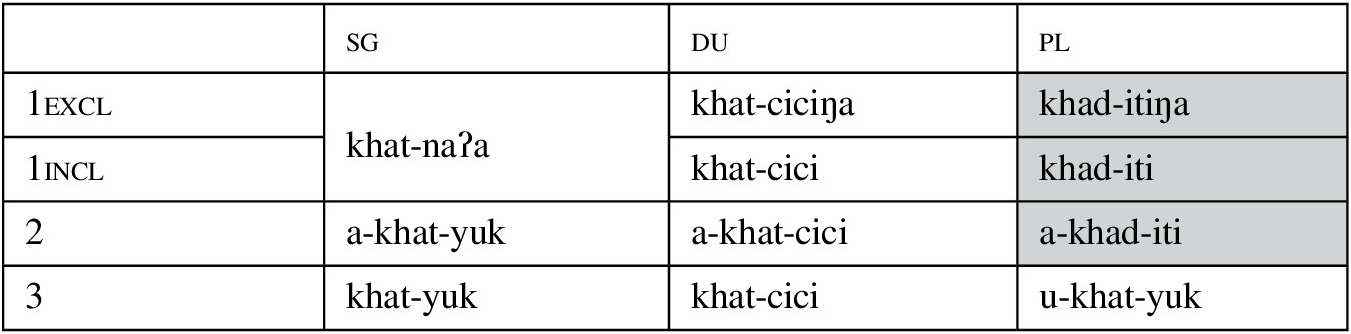
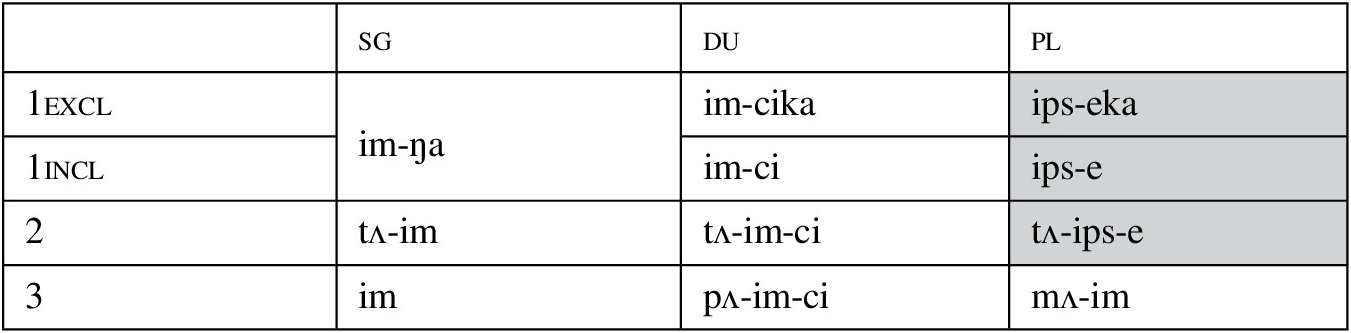
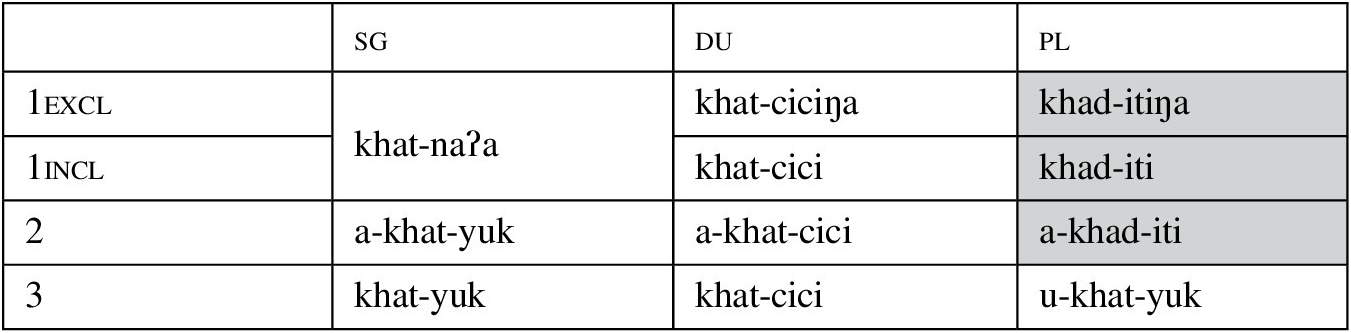
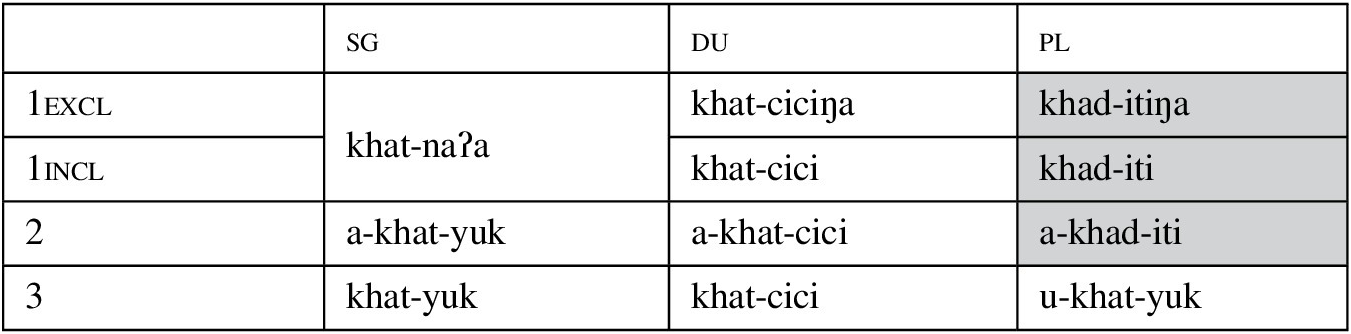
As displayed in Table 1, the prevocalic stem appears, in the non-past tense of intransitive verbs, in the first and second person plural. Past and perfect tense forms all contain the prevocalic stem. In the case of the past, this is so because a vowel /a/ appears before the person suffixes which are consonant-initial (1sg/du, 2du and 3du). In the case of the perfect, the prevocalic stem is due to a suffix -es(a) always following the stem.
Paradigm of Athpariya ‘go’ (khat- khad-) non-past, intransitive (Ebert Reference Ebert1997a: 163).
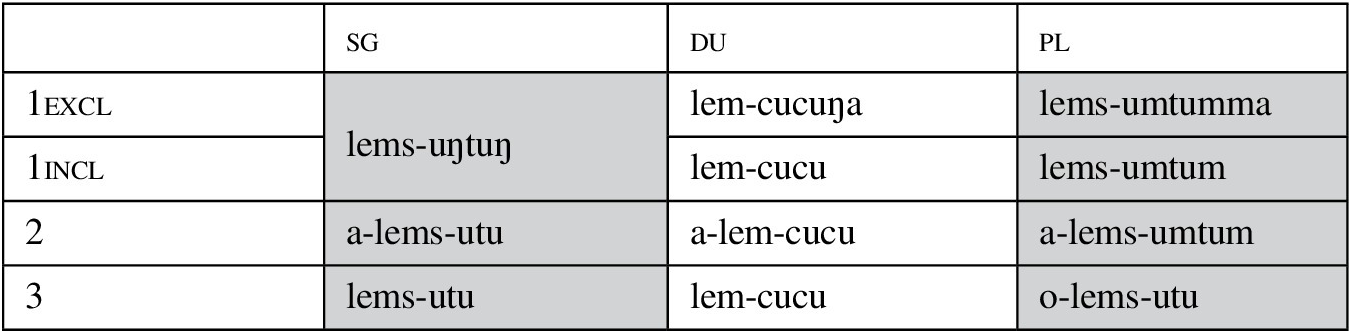
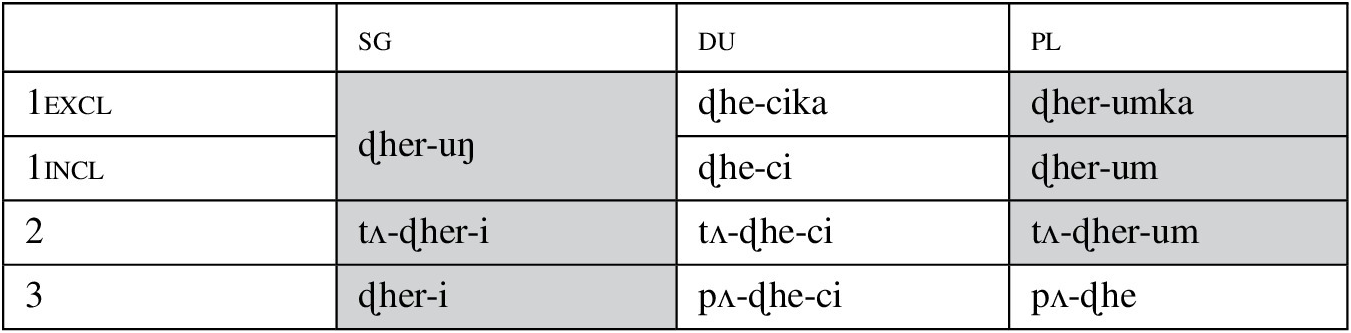
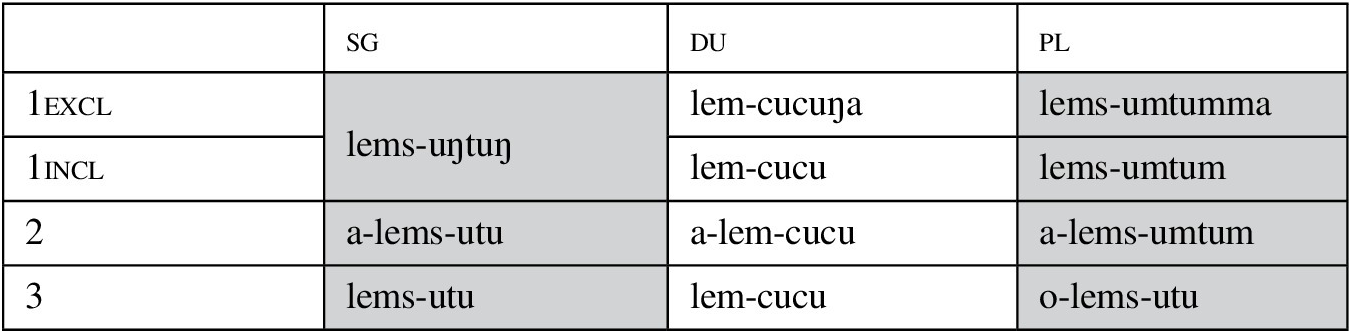
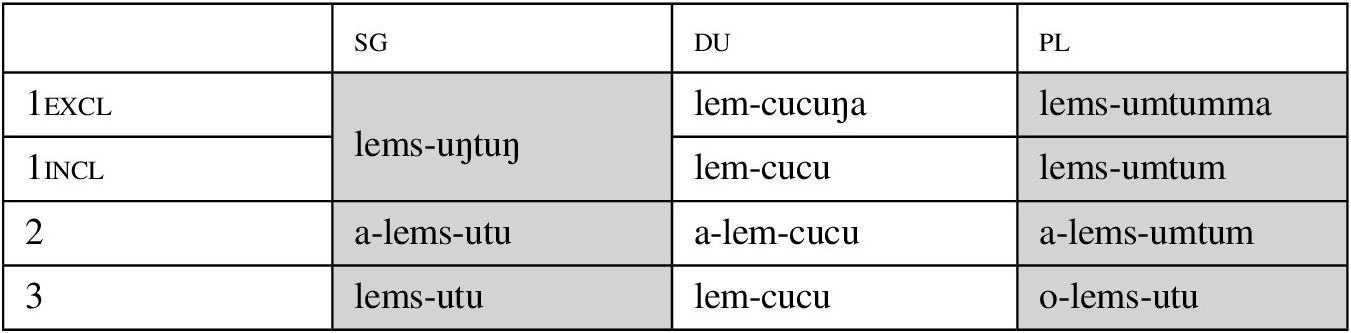
Because personal suffixes vary, the distribution of the stems is different in transitive verbs (Table 2). Here, the prevocalic stem appears in all singular and plural forms. The other two tenses (i.e. past and perfect) are characterized, as was the case in intransitive verbs too, by the prevocalic stem. In a way similar to intransitive verbs, this is because, in the past, a suffix /a/ appears before consonant-initial person suffixes (i.e. before the duals). In the perfect, this is due to a suffix -ues(a) always appearing after the stem.
Paradigm of Athpariya ‘beat’ (lems- lem-) non-past, transitive, 3sg patient (Ebert Reference Ebert1997a: 180).
2.2. Chintang (data from Paudyal Reference Paudyal2013)
The situation in Chintang is very similar to that of Athpariya, understandably due to their close genetic relation. Most verbs have two stems, except those ending in a vowel, /m/, /p/, /ŋ/, /k/ and some ending in /g/ which do not alternate. One of the stems is used before a vowel and the other before a consonant or at the end of the word. The formal alternations involved appear to be slightly more complicated than in Athpariya, however

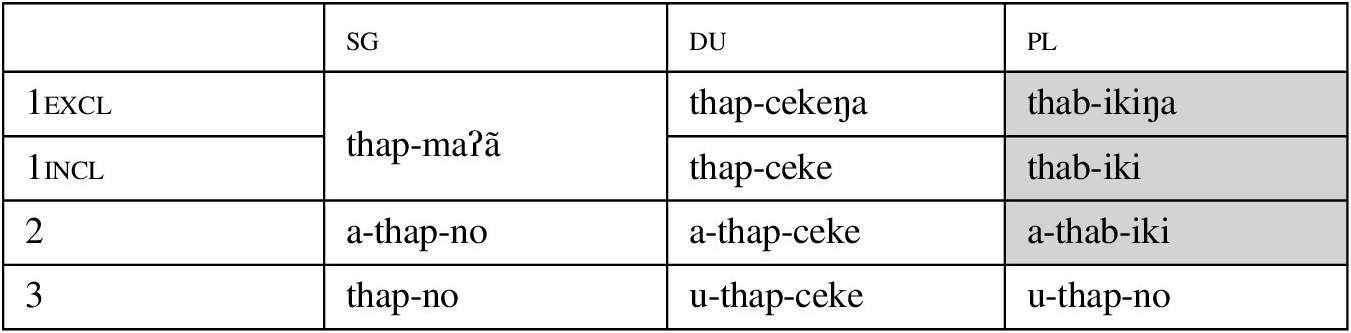
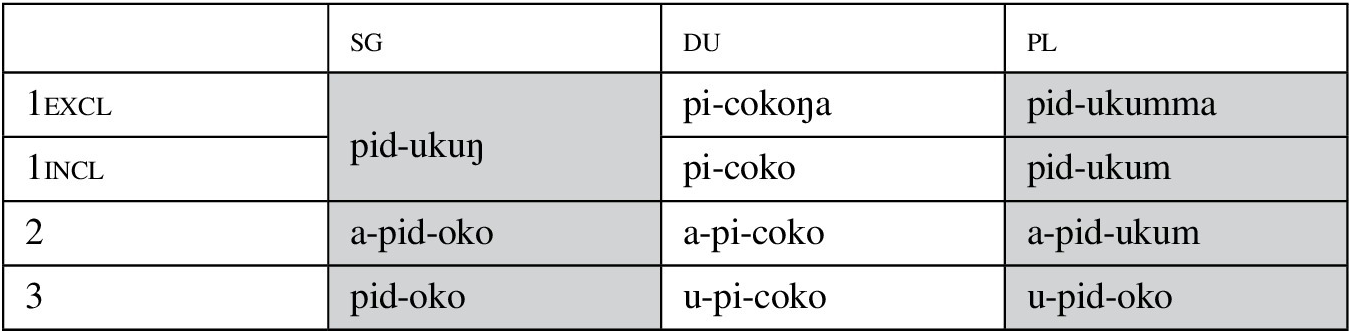
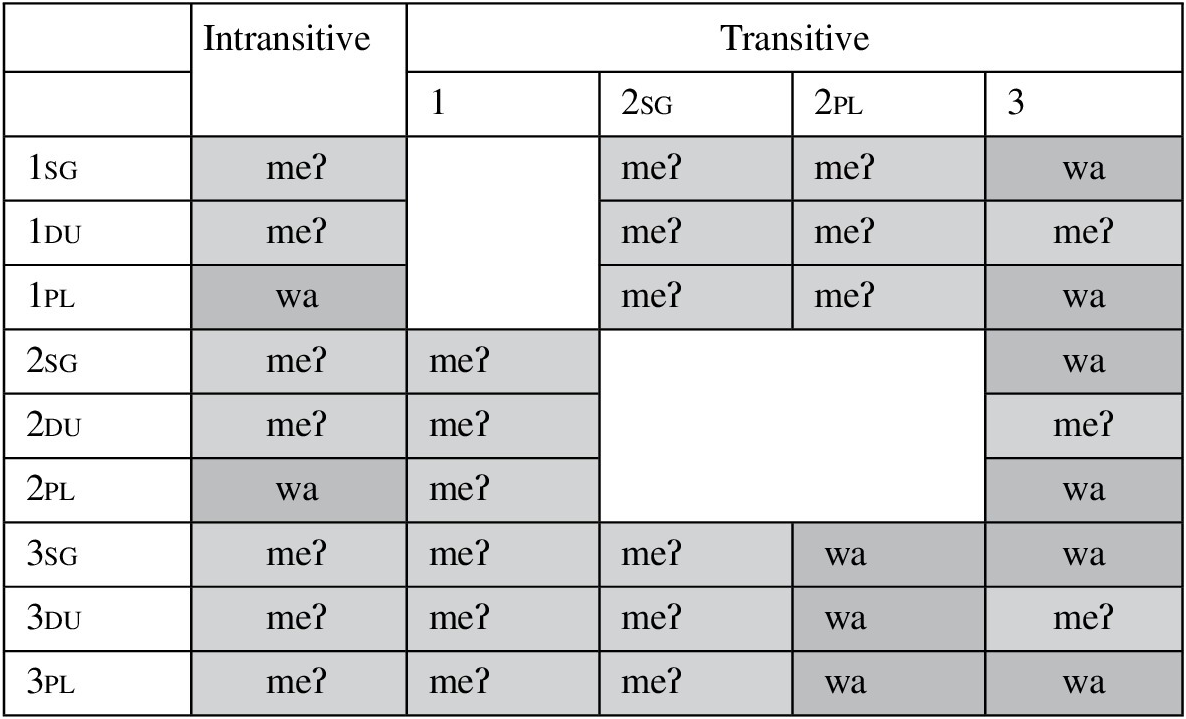
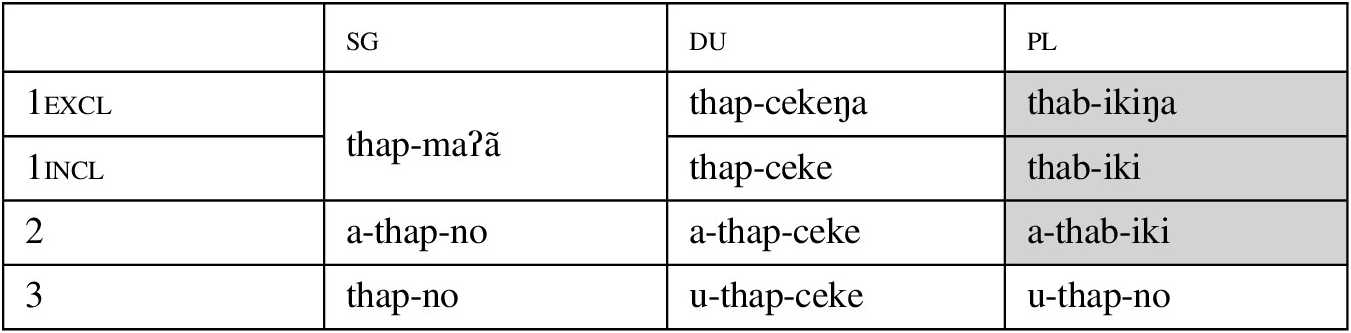
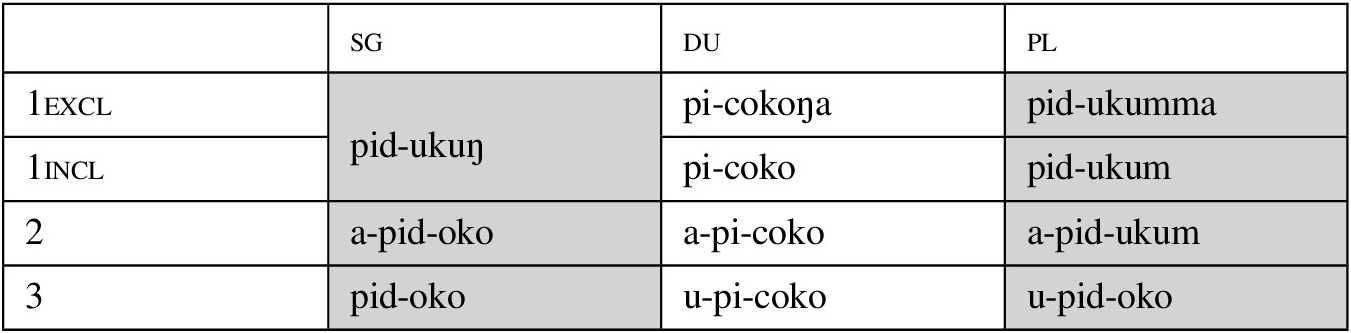
The most frequent of these are, again, those involving the augments. I present the paradigmatic distribution of the stem alternants in intransitive verbs in Table 3. Here, the prevocalic stem appears in the 1pl and 2pl of non-past intransitive verbs. Although the suffixes are sometimes different (e.g. -no vs. -yuk), this is the exact same situation that was described for Athpariya. Also like in this language, the past tense has the prevocalic stem (i.e. thab-) everywhere since a suffix -a appears before consonant-initial suffixes (the dual forms). The distribution of the stems in transitive verbs (see Table 4) is also the same as in Athpariya.
Paradigm of Chintang ‘come level’ (thap- thab-) non-past, intransitive (Paudyal Reference Paudyal2013: 86).
Paradigm of Chintang ‘give’ (pid- pi-) non-past, transitive, 3sg patient (built from Paudyal Reference Paudyal2013: 294).
2.3. Yakkha (data from Schackow Reference Schackow2016)
In Yakkha, as in closely related Athpariya and Chintang, the verb stem allomorphy is predictable from the form of the following suffix. Thus, we can distinguish between prevocalic (also /w/) stems and those that occur before consonants (other than /w/) or before word breaks. The following formal alternations are involved:

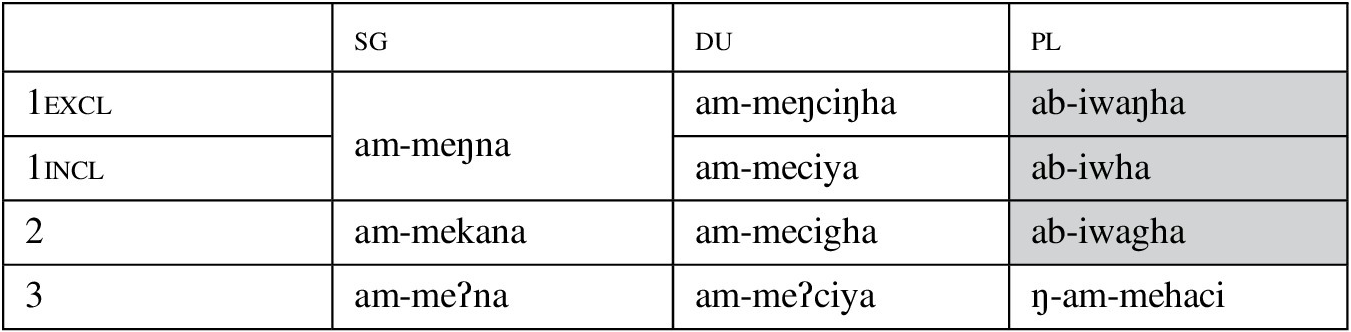
Although the form of the suffixes is different, the distribution in the paradigm of the two stems (see Table 5) is one which should result familiar by now. The prevocalic stem appears, in non-past tense intransitive verbs, in the 1pl and 2pl forms. Also in the same way as in the related languages presented so far, the past and the perfect forms in Yakkha contain exclusively the prevocalic stem alternant (i.e. ab-). This is so because the forms start with a suffix -a, except the 1pl and 2pl, which have -i.
Paradigm of Yakkha ‘come’ (ap- ab-) non-past, intransitive (Schackow Reference Schackow2016: 243).Footnote 3
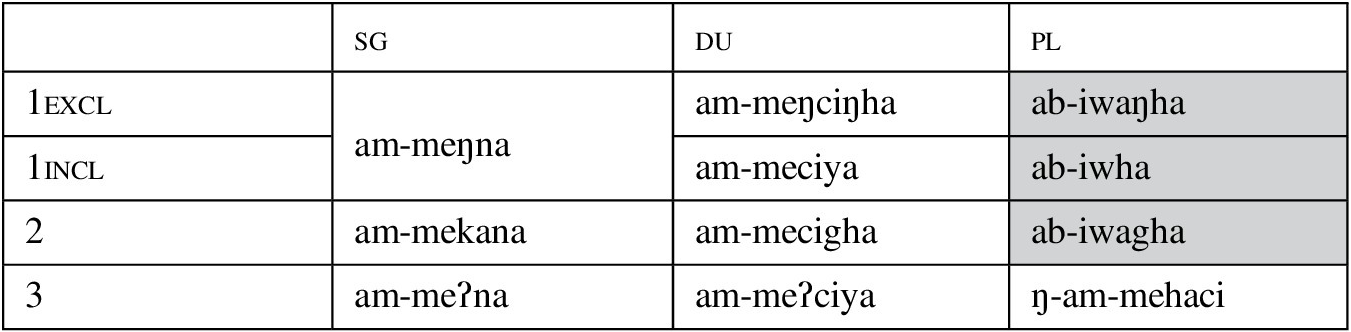
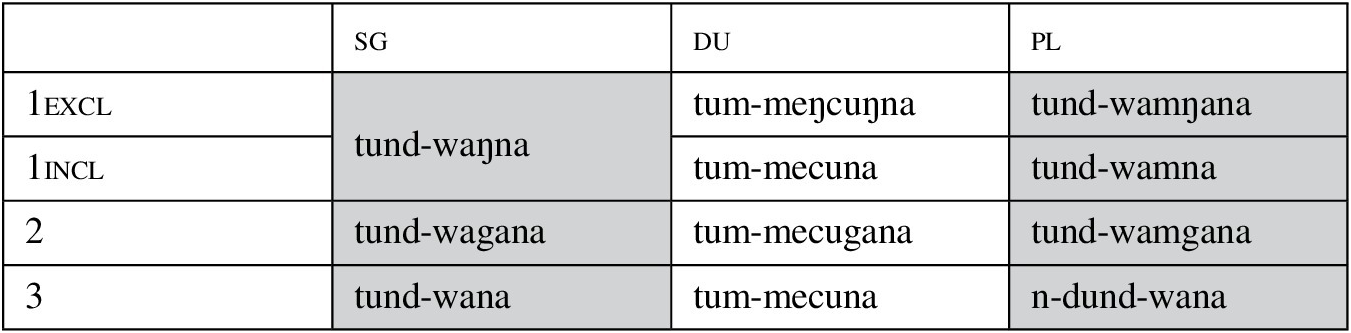
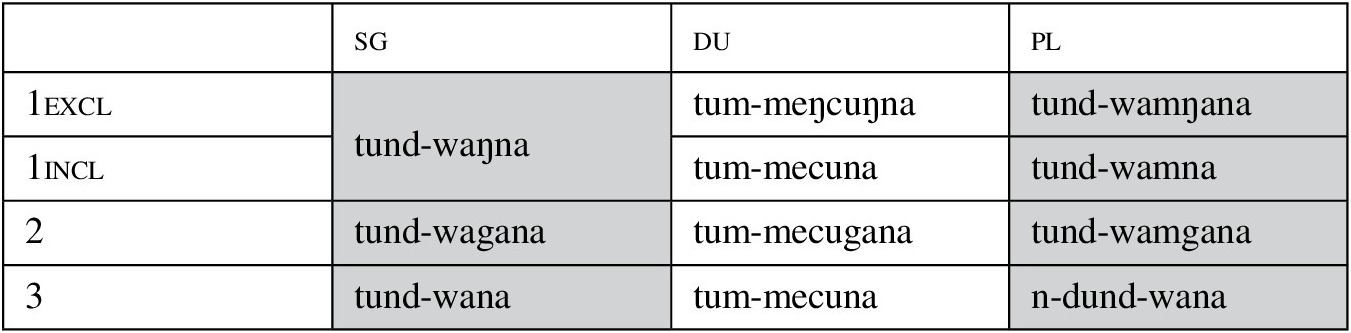
Consider now the allomorphy of the stem in transitive verbs (Table 6). As in other Eastern Kiranti languages, prevocalic stems appear before singular and plural forms. The past and the perfect, as in the intransitive conjugation, have the prevocalic stem throughout the paradigm as the prefix -a occurs before duals and -u elsewhere.
Paradigm of Yakkha ‘understand’ (tund- tun-) non-past, transitive, 3sg patient (Schackow Reference Schackow2016: 244).
2.4. Limbu (data from van Driem Reference van Driem2011)
Verbs in Limbu (except those ending in /m/ or /ŋ/ have two stems, whose distribution in the paradigm is also predictable from the vowel- or consonant-initial character of the suffixes. The formal alternations involved, however, are somewhat more complex and lexicalized compared to the Greater Yakkha languages presented so far:

As can be seen above, due to the nature of the alternations, a prevocalic stem cannot always be used to predict the corresponding preconsonantal one or vice versa. For example, /n/ is found in the preconsonantal stem of verbs with various prevocalic forms: -nd, -tch, -nch, -ʔr or -r. Conversely, a stem-final /r/ in a prevocalic stem can correspond variously to -Ø, -n, -t or -ʔ in the pre-consonantal stem. Because of this, and although predictability of the preconsonantal stem still holds generally, the alternants of some verbs need to be listed in the lexicon in some way despite their being distributed in the paradigm in a phonologically predictable way.
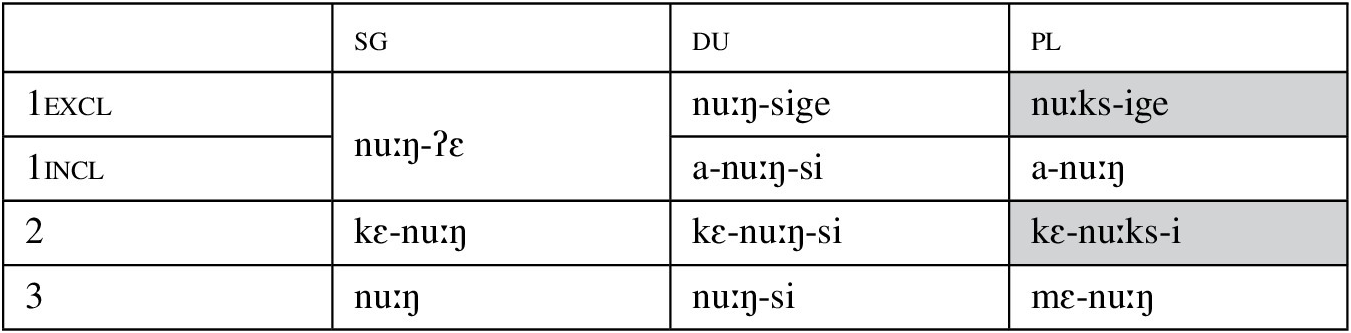
Table 7 shows the paradigmatic distribution of the stems in intransitive verbs. Prevocalic stems appear, in the non-past, only in the 1pl.excl and in the 2pl forms. As for the past tense, the stems in all the forms are prevocalic (a suffix -ɛ marks the past in most cases) except for the one in the 1pl.excl.
Paradigm of Limbu ‘return’ (nuːŋ- nuːks-) non-past, intransitive (van Driem Reference van Driem2011: Appendix II).
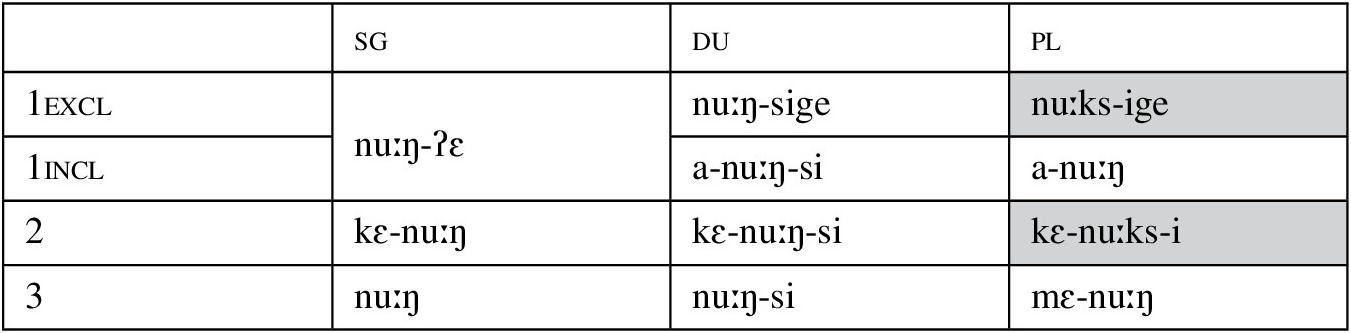
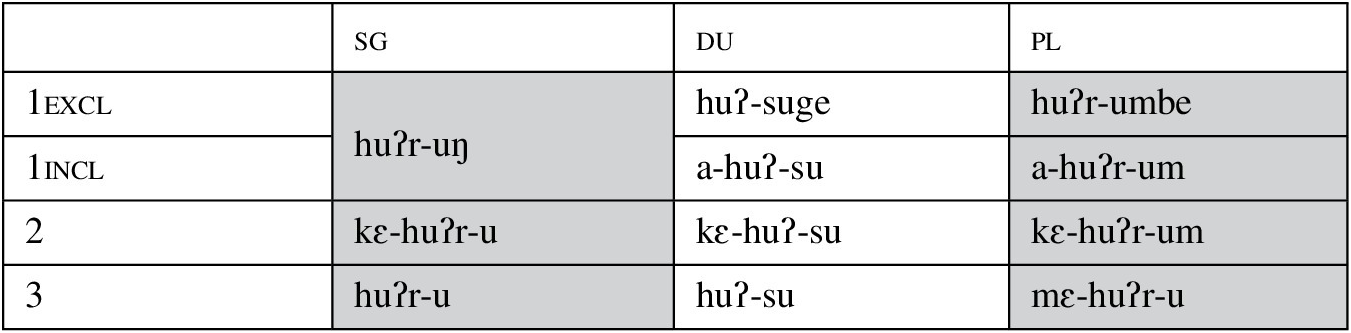
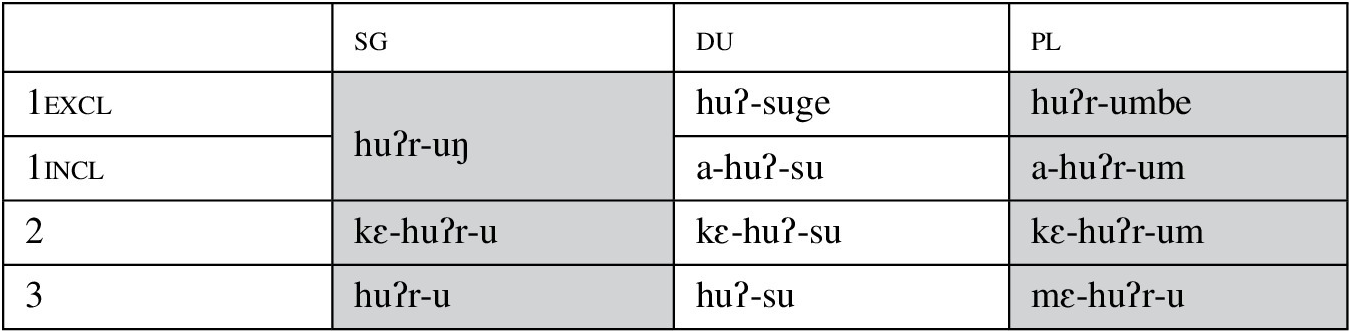
The distribution of stem alternation in transitive verbs is shown in Table 8. The same as in the other Greater Yakkha languages presented before, vowel anterior stems appear in the singular and in the plural. In the past, all forms are prevocalic except for the 1pl.excl which, as in the case of intransitive verbs, has the form -mʔna and lacks the -u suffix that characterizes other past forms.
Paradigm of Limbu ‘teach’ (huʔr- huʔ-) non-past, transitive, 3sg patient (van Driem Reference van Driem2011: Appendix II).
2.5. Yamphu (data from Rutgers Reference Rutgers1998)
Verb alternation in Yamphu is also structured according to the prevocalic versus preconsonantal dichotomy. The following alternations are found:
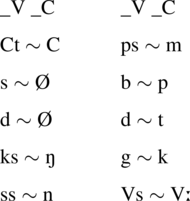
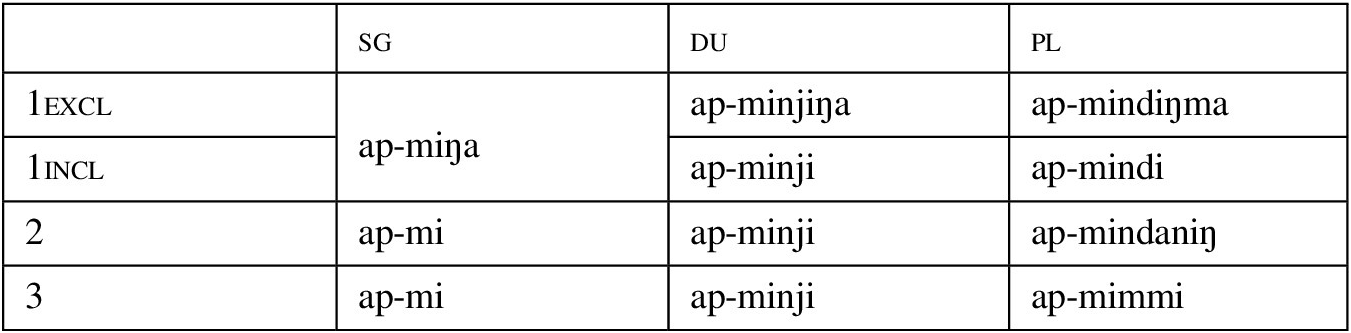
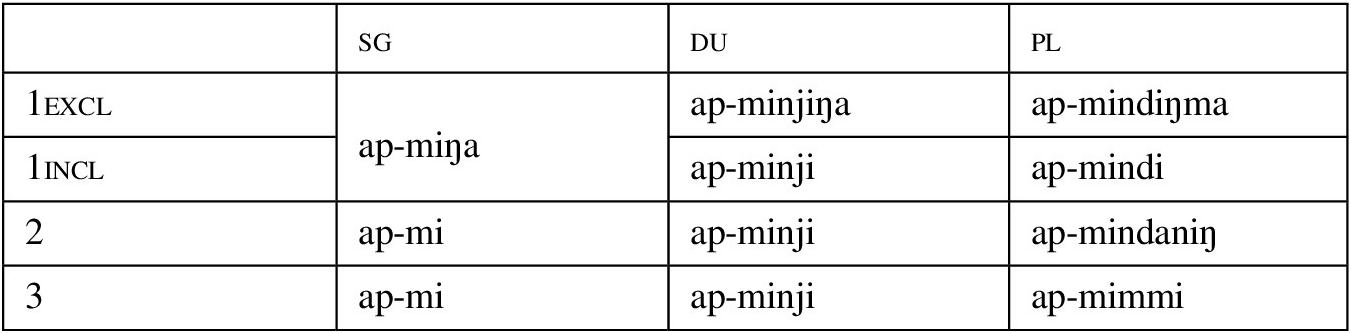
In addition to these, some verbs have a third stem in Vː which appears in the non-past and in the perfect (both paradigms with consonant-initial suffixes only). In the intransitive non-past paradigm (Table 9), only the preconsonantal stem can appear. Because all the suffixes start with a consonant (note the presence of a suffix -mi), only the preconsonantal stem (i.e. ap-) appears in the non-past. The same happens in the perfect, since all the forms start with t-. The opposite is the case in the past: because all the forms have a vowel (-i in 1sg and 1pl, -a elsewhere) immediately after the stem, the only alternant to appear in the past is the vowel anterior one (i.e. ab-).
Paradigm of Yamphu ‘come’ (ab- ap-) non-past, intransitive (Rutgers Reference Rutgers1998: 601).
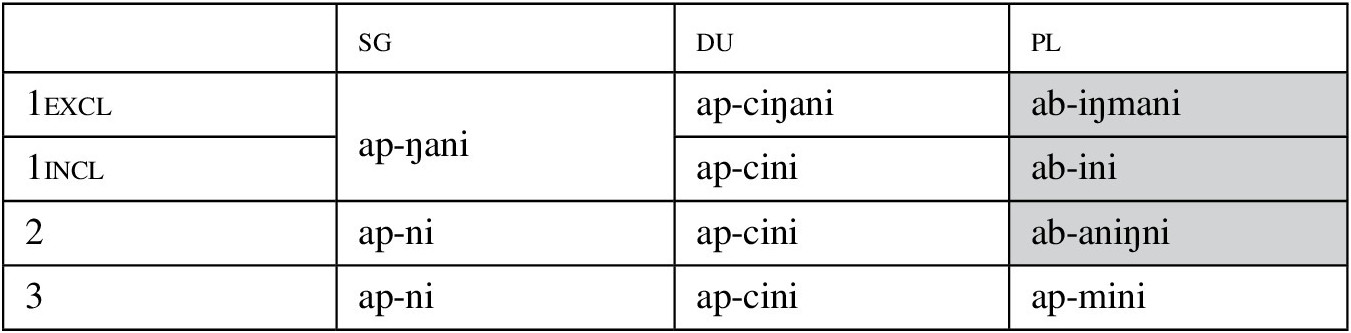
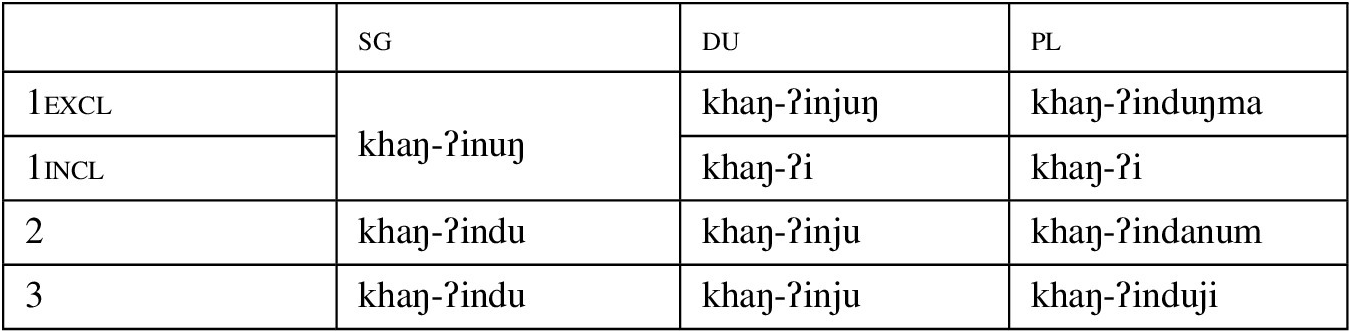
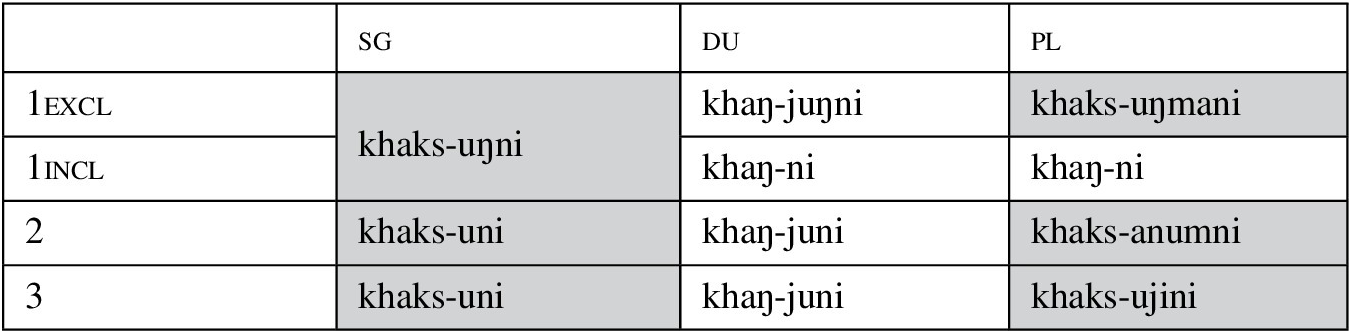
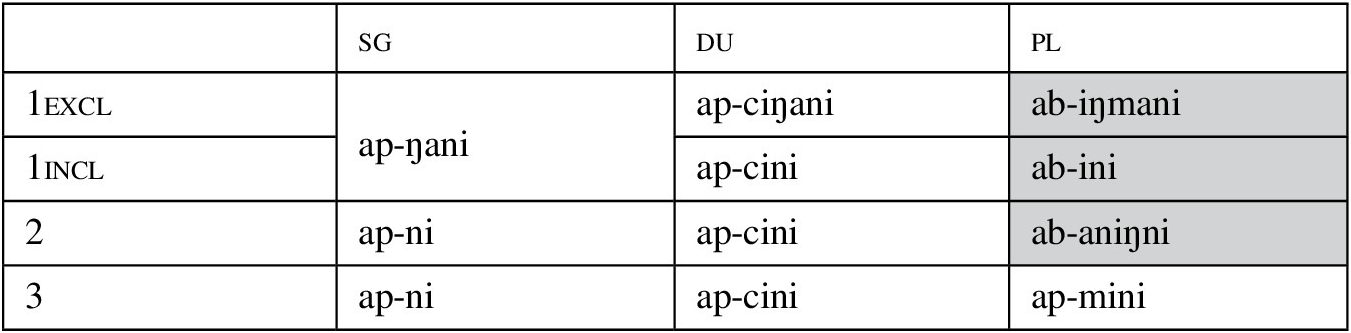
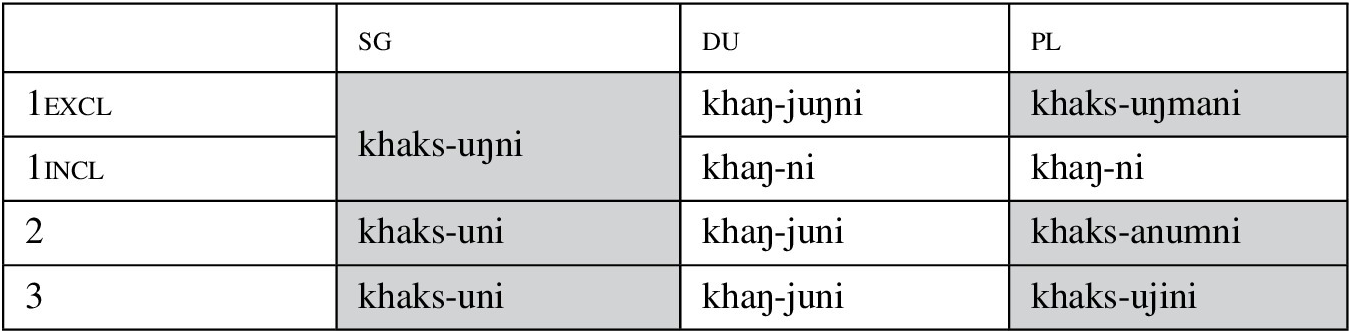
The only tense to display the two stem alternants in Yamphu is the negative non-past (see Table 10). In this paradigm, the 1pl and 2pl have the prevocalic stem, opposed to the preconsonantal one in the rest of the cells. Note that this distribution of stem alternation is the same that was present in the earlier languages Athpariya, Chintang and Yakkha. The picture in transitive verbs is similar to the one in intransitives (see Table 11), where the preconsonantal stem haŋ- is found all over the positive non-past, since all the forms start with the suffix -ʔi(n(d)). The same is true of the perfect, since all the forms start with -t. Also the same as in intransitive verbs, the past tense forms are all characterized by the prevocalic stem (i.e. khaks-) and the non-past negative by an alternation between the two stems (see Table 12). In this tense, similarly to stem alternation in other Eastern Kiranti languages, dual forms (and also, in Yamphu, the 1pl.incl which is syncretic in the language with the 1du.incl) have the preconsonantal stem and the other forms the prevocalic one.
Paradigm of Yamphu ‘come’ (ab- ap-) neg. n-past, intransitive (Rutgers Reference Rutgers1998: 602).
Yamphu ‘see’ (khaks- khaŋ-) non-past, transitive, 3sg patient (Rutgers Reference Rutgers1998: 113).

Paradigm of Yamphu ‘see’ (khaks- khaŋ-) negative non-past, transitive, 3sg patient (Rutgers Reference Rutgers1998: 113).
3. Central Kiranti
3.1. Bantawa (data from Doornenbal Reference Doornenbal2009)
Despite being related to East Kiranti languages much more distantly, Bantawa verbs are also usually structured around two stems, a prevocalic one and a preconsonantal one, which also appears word-finally. Stems with a final vowel, /m/ or /ŋ/ do not alternate. These are the forms involved:
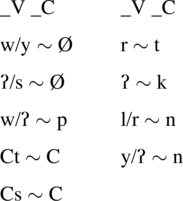
Even if the presence of one stem or another can be predicted from the shape of the suffixes, the form of a stem is not always predictable from the form of the other. As the forms above indicate, a prevocalic stem in -r, for example, can correspond to a preconsonantal one in -t or in -n. Conversely, a preconsonantal stem in -n can correspond to -l, -r, -y or -ʔ before a vowel. Because of this, some of the stems (or alternatively membership in one of the stem alternation classes) have to be stored in the lexicon somehow.
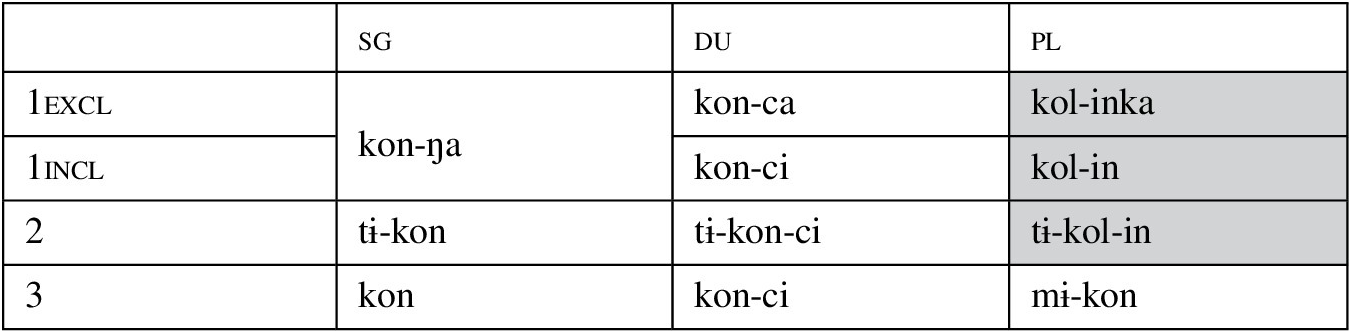
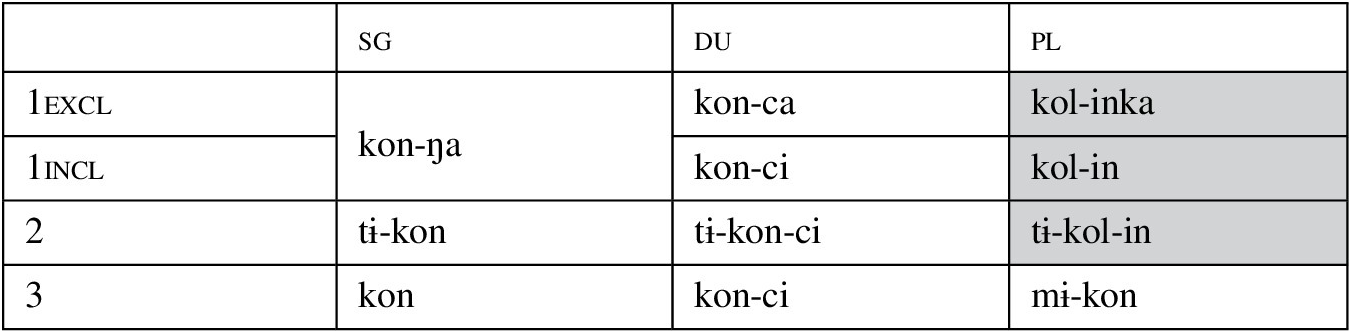
As in the Greater Yakkha languages (Athparira, Chintang and Yakkha), the prevocalic stem appears in Bantawa non-past intransitive paradigm (see Table 13) in the 1pl and 2pl forms. Also as in these languages, the past tense shows the prevocalic stem exclusively because a suffix -a characterizes all the forms except the 1pl and 2pl which are syncretic with the non-past.
Paradigm of Bantawa ‘walk’ (kon- kol-) non-past, intransitive (Doornenbal Reference Doornenbal2009: 391).
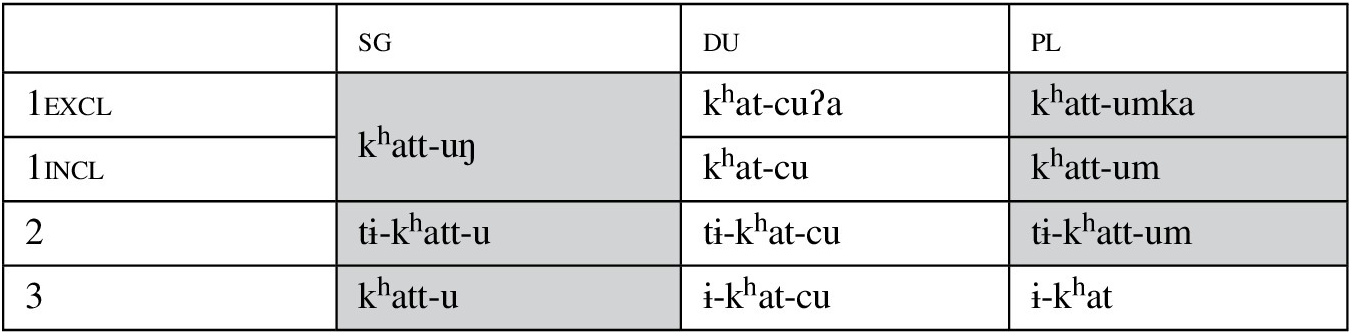
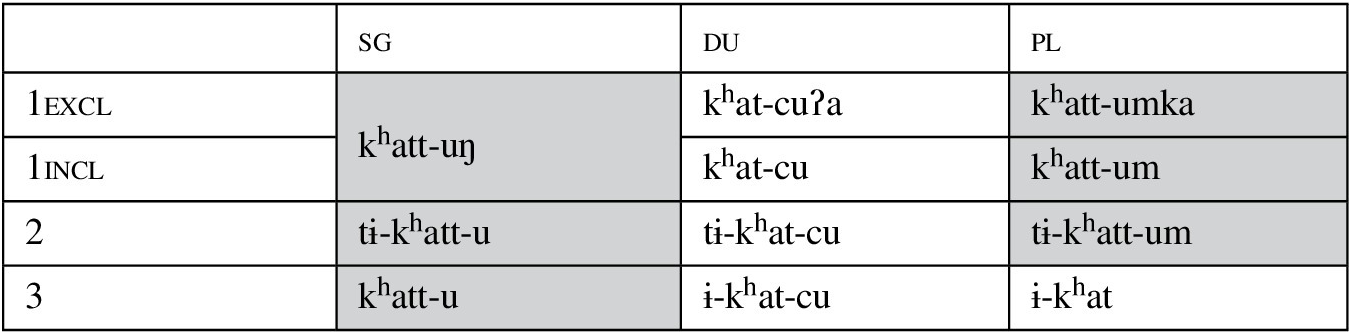
Similarly to East Kiranti languages again, Bantawa uses the prevocalic stem in the sg and pl (except for 3pl) forms of the transitive non-past paradigm (Table 14). As in these languages, the prevocalic stem is used in the past everywhere too except in 1>2 forms. du and 3pl forms take a suffix -a opposed to the rest of the forms which start with -u and are syncretic with the non-past.
Paradigm of Bantawa ‘take’ (kʰatt- kʰat-) non-past, transitive, 3sg patient (Doornenbal Reference Doornenbal2009: 397).
3.2. Puma (data from Sharma Reference Sharma2014)
The behaviour of stem alternation in Puma is similar to the one in Bantawa and East Kiranti languages and is also based on the same distinction between the stem in prevocalic and in preconsonantal contexts. The following forms have been found to alternate:

The paradigmatic distribution of these alternations is identical to the one that was presented for Bantawa in the previous section.
Looking at the intransitive paradigm (Table 15), it can be seen that the longer stem appears in the 1pl and the 2pl cells, which are the ones characterized by vowel-initial suffixes. Also as in Bantawa, only the prevocalic stem appears in the past tense.
Paradigm of Puma ‘sleep’ non-past, intransitive (Sharma Reference Sharma2014: 424).

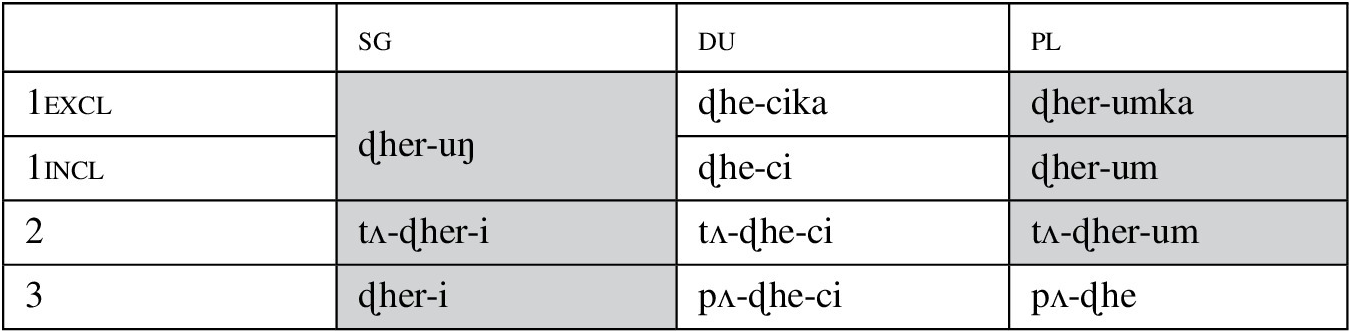
In transitive verbs (Table 16), sg and 1/2pl are characterized, as in Bantawa, by the longer, prevocalic stem. The past tense is characterized by the prevocalic forms as well.
Paradigm of Puma ‘beat’ non-past, transitive, 3sg patient (Sharma Reference Sharma2014: 439).
3.3. Camling (data from Ebert Reference Ebert1997b)
In Camling, verbs (except those ending in a vowel and most of those ending in a sonorant) also display prevocalic and preconsonantal stems. These alternations are found:
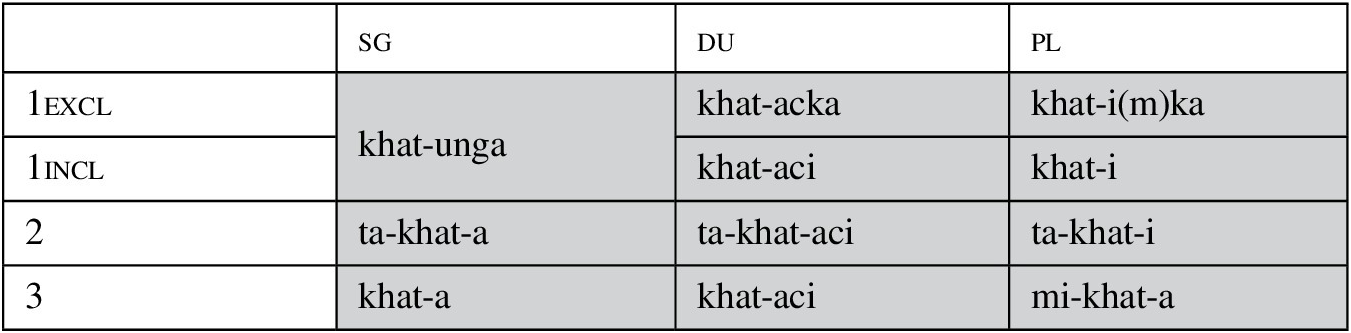
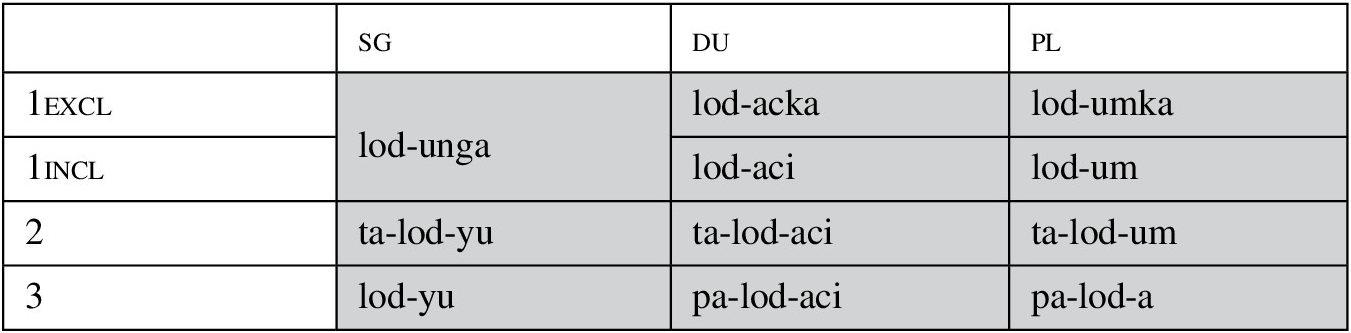
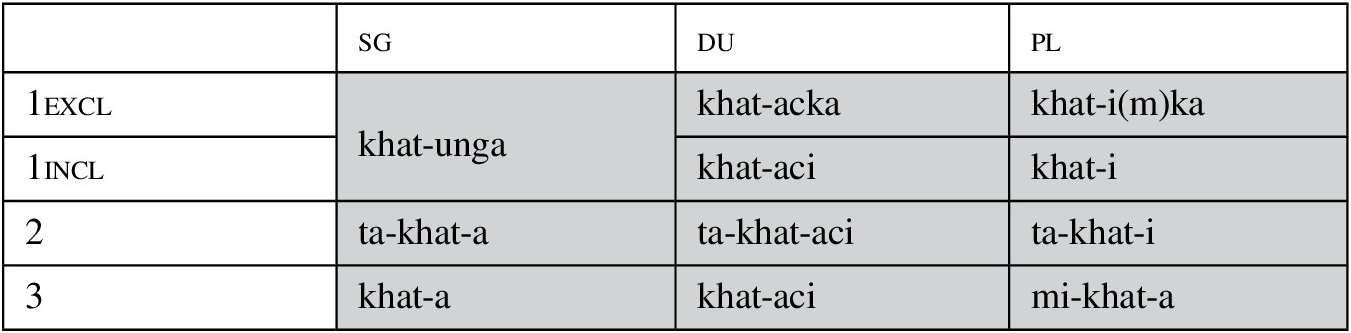
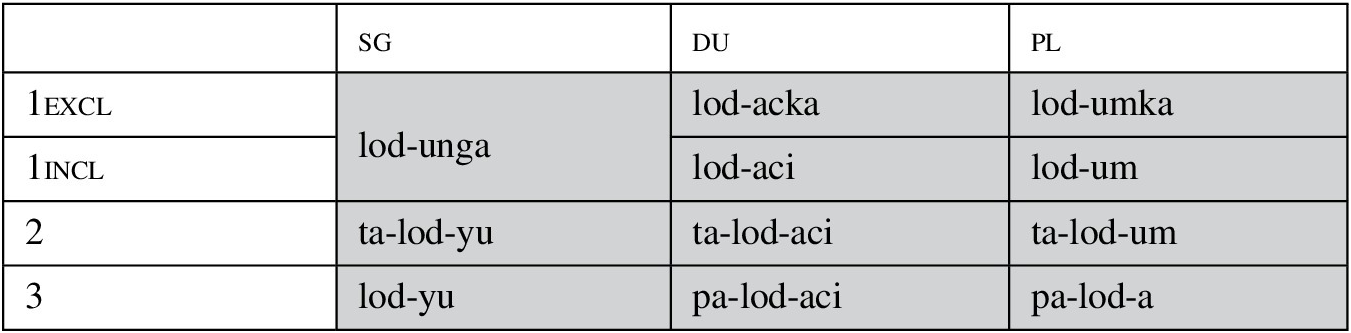
The tense system of Camling differs from that of other related Kiranti languages and appears to have been restructured into an aspect-based system opposing aorist to imperfective. The former tense is cognate with the past paradigm in other East Kiranti languages. This tense (Table 17) and also the imperfective contain exclusively the prevocalic stem. However, alternation can still be found in these verbs, for example, before the consonant-initial infinitive suffix khai-ma. A similar situation holds in the transitive paradigm (Table 18). All the forms with a 3sg patient have the prevocalic stem alternant. The preconsonantal forms can only be found in other forms such as the 1>2sg lo-na or the infinitive lo-ma.
Paradigm of Camling ‘go’ (khat- khai-) aorist, intransitive (Ebert Reference Ebert1997b: 69).
Paradigm of Camling ‘tell’ (lod- lo-) aorist, transitive, 3sg patient (Ebert Reference Ebert1997b: 72).
3.4. Kulung (data from Tolsma Reference Tolsma1997, Reference Tolsma1999)
Except those in stem-final -r, -l, or -m, most Kulung verbs have at least two, and sometimes more, stems (labelled here A, B, C, etc.) in their paradigm. Many of the forms involved in stem alternation in Kulung are familiar from other Kiranti languages:

There are also in Kulung a number of stem alternations involving just vowels (e.g. uː ~ u, iː ~ i, o ~ ə ~ a, etc.) which are, in general, more recent than the consonant alternations that are being addressed here. Because they constitute independent innovations of some of the daughter languages, they will not be the focus of the present paper.
As opposed to the Kiranti languages that have been surveyed here so far, stem alternation in Kulung has been completely morphologized. This means that stem alternation cannot be associated with any particular phonological context in the language. Thus, contrary to the varieties described so far, a factor such as the vowel-initial or consonant-initial form of the following suffix is not the deciding one for stem alternation in Kulung.
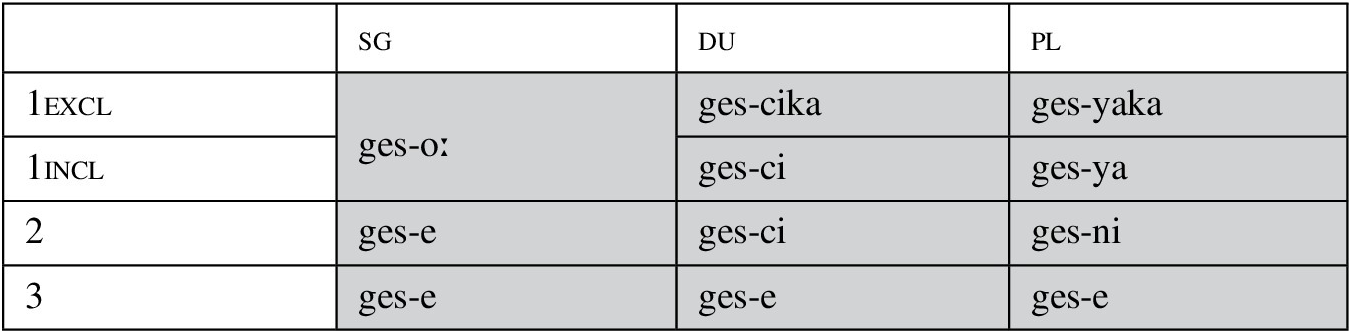
In the intransitive paradigm (Table 19), the longer stem (i.e. the prevocalic one in other Kiranti languages) appears in the paradigm of ‘laugh’ in every cell of the non-past regardless of the form of the suffix. This is also the case for the past and the negative non-past. Only in the negative past paradigm does the shorter stem ge- appear, again in all the forms and independently of the form of the suffix (compare e.g. 1du.incl maŋ-ge-ci to ges-ci or 1pl.incl maŋ-ge-yi to ges-ya).
Paradigm of Kulung ‘laugh’ (ges- ge-) non-past, intransitive (Tolsma Reference Tolsma1999: 182).
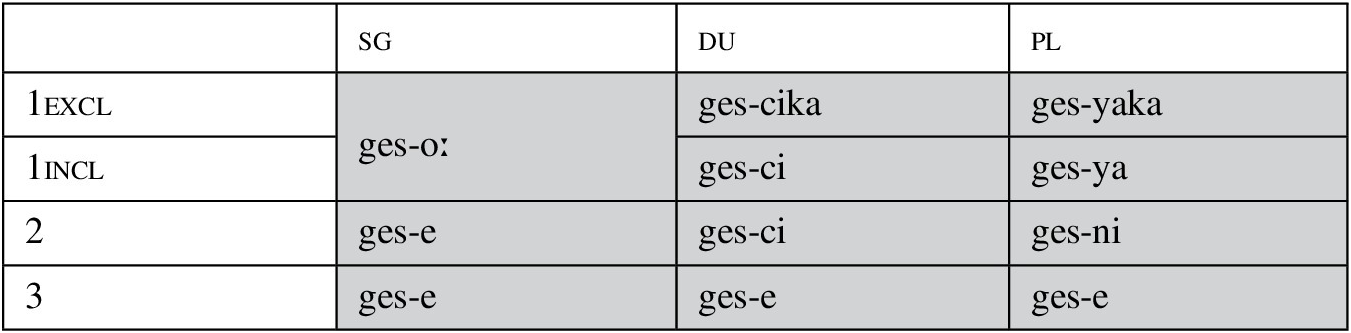
Even if the phonological determination account fails in synchrony, it has to be acknowledged that there is still a tendency for the longer stem alternant to occur before vowel-initial suffixes and for the shorter one to occur before consonant-initial suffixes. This is so because, for example, a preterite suffix -a usually follows the stem in the past positive forms (e.g. 1du.incl ges-a-ci, 3 ges-a) but this suffix is absent from the corresponding negative forms (e.g. 1du.incl maŋ-ge-ci, 3 maŋ-ge). Some other times, the person suffix of the negative past is consonant-initial (e.g. 1sg -ŋa, 2sg -na) whereas the one in the other tenses is vowel-initial (e.g. 1sg -o/-oː, 2sg -e/-a).
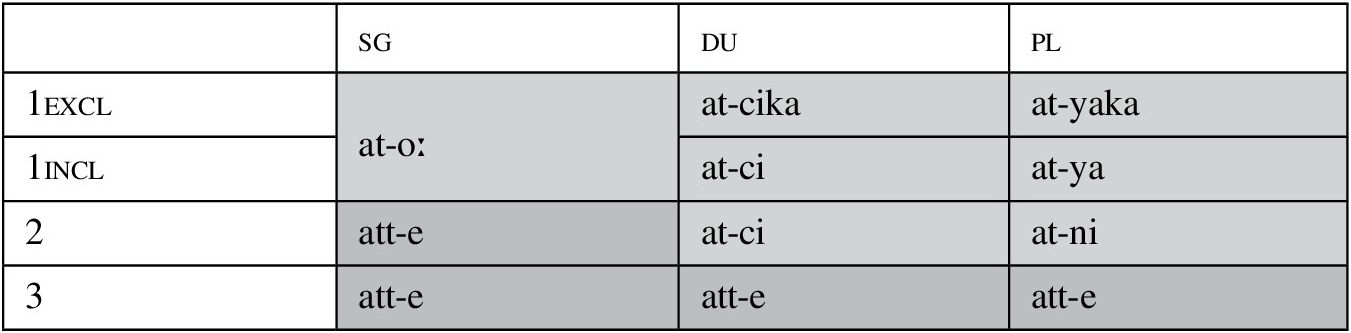
Those cases in which consonant alternations are present within a single tense involve three-way quantity alternations (i.e. tt ~ t ~ i, ss ~ s ~ Ø, ŋŋ ~ ŋ ~ Vː, nn ~ n ~ i, pp ~ p ~ m) that very much resemble consonant gradation as found in some Finnic and Saami languages (see Table 20). The longer stems tend to be found with the shortest affixes and the most lenited ones with the affixes with the most phonetic substance (i.e. with long vs. short vowels, or with two segments vs. one, etc.).
Paradigm of Kulung ‘return’ (att- at- ai-) non-past, intransitive (Tolsma Reference Tolsma1999: 157).
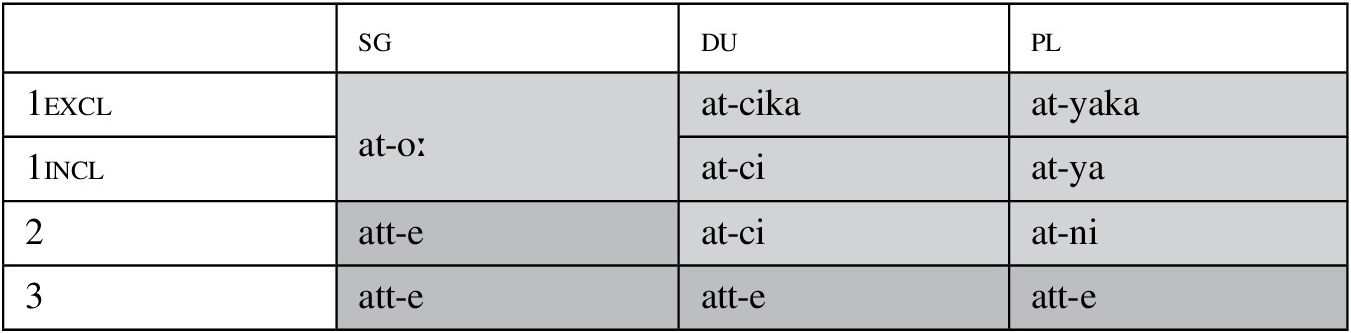
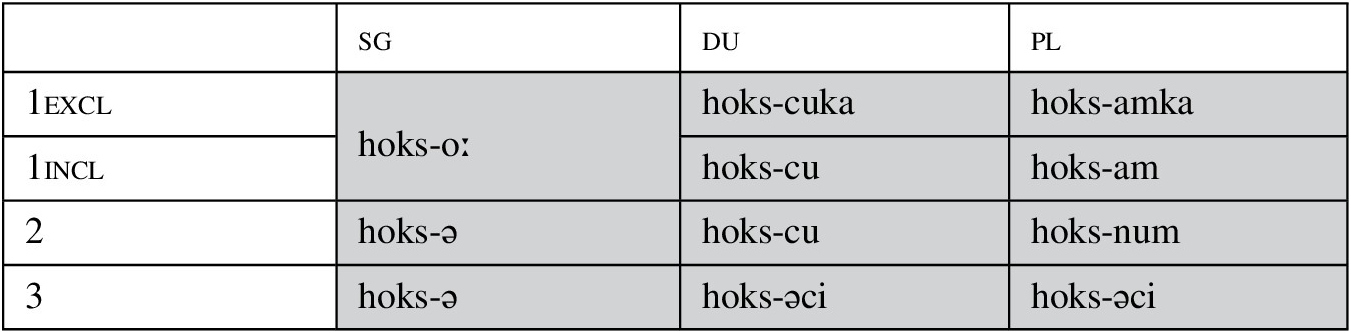
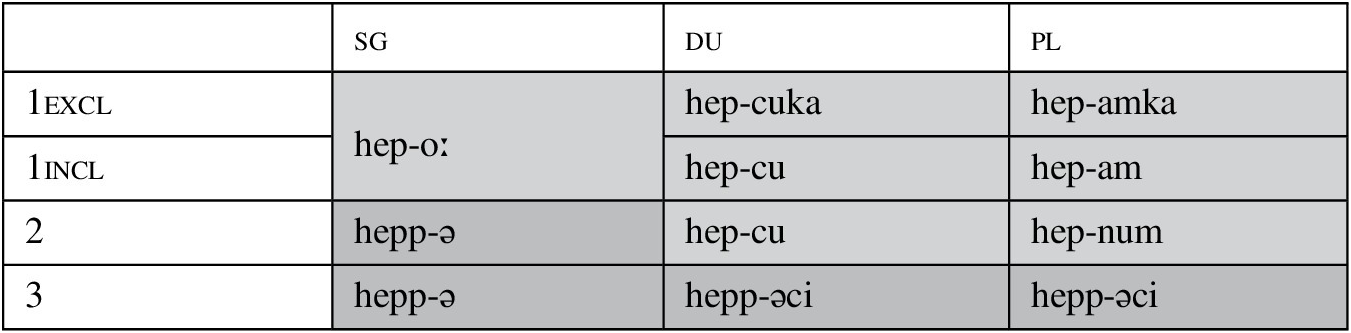
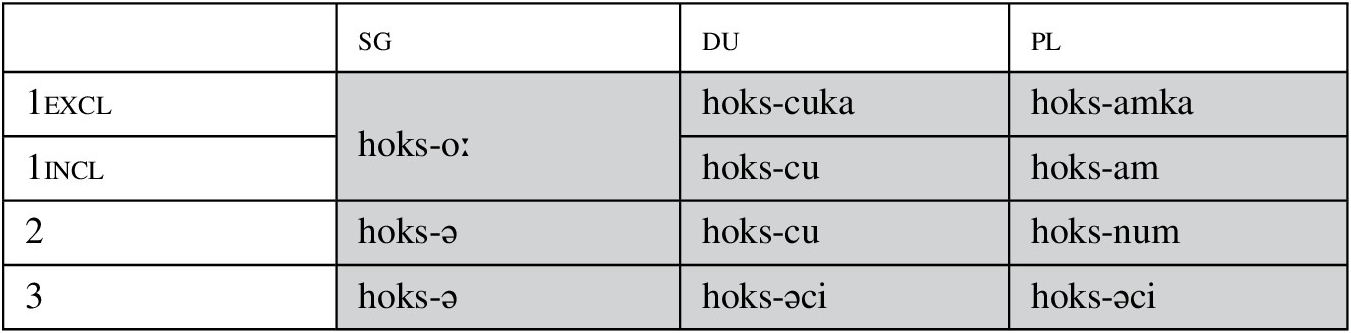
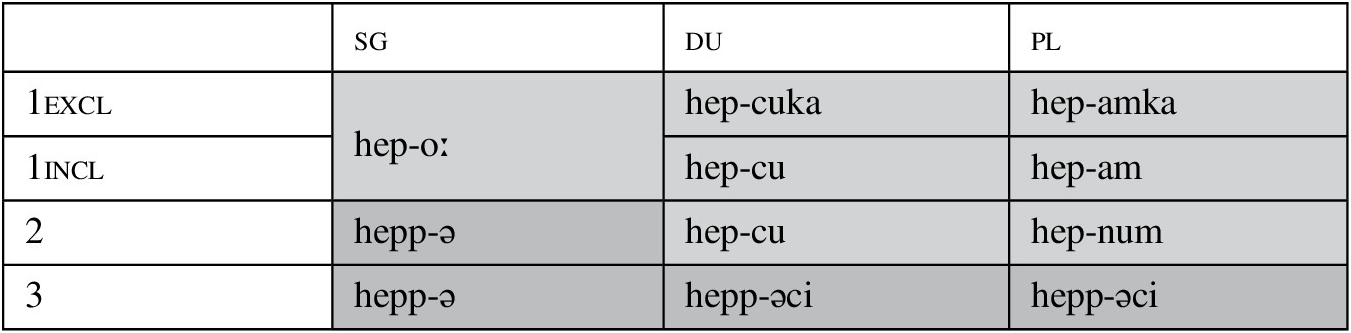
More concretely, the ‘strongest’ stem is found in the (syncretic) 2sg and 3 forms in both non-past (att-e) and past (att-a). In the negative non-past only at- is found. The most lenited stem(s) appear, as in the case of two-way alternations (e.g. ges- ge-), in the negative past. This is the situation found in Kulung intransitive verbs. Transitive verbs are note very different. As shown in Table 21, the longer stem hoks- appears, in the non-past, in every person with a 3sg patient. The short stem hoː- appears only in the 1sg>2 forms and, as in intransitives, through the negative past. Also as in intransitive verbs, only three-way quantity-based consonant alternations result in more than one stem appearing in a paradigm. In transitive verbs (Table 22), the ‘strongest’ stem is found, in the non-past, in the 2sg and 3 forms. In the past, however, the stem hepp- is restricted to the 2sg and 3sg forms (hepp-u) as 3nsg has hep-ci. As before, the most lenited stem hem- is found in 1sg>2 forms and through the negative past.
Paradigm of Kulung ‘throw away’ (hoks- hoː-) non-past, transitive, 3sg patient (Tolsma Reference Tolsma1999: 165).
Paradigm of Kulung ‘embrace’ (hepp- hep- hem-) non-past, transitive, 3sg patient (Tolsma Reference Tolsma1999: 171).
4. West Kiranti
4.1. Sunwar (data from Borchers Reference Borchers2008)
Sunwar verbs are very different from those of other Kiranti languages, both East and West. For example, unlike the languages presented so far, Sunwar transitive verbs agree only with their subject. In addition, also unlike in other Kiranti languages, there are different (affixal) inflection classes in the language.Footnote 4 According to Borchers (Reference Borchers2008: 110), there do not seem to be strong predictability relations between conjugation membership and stem alternation and because of this I will not refer to conjugations again here. Stem alternation in Sunwar is purely morphological and based upon the appearance, in certain cells of the past tense, of various segments to the right of the stem. The following formal alternations can be found:
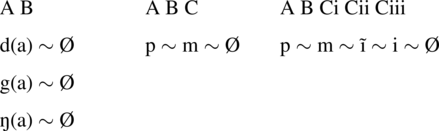
Verbs ending in -m, -r, -l or -p, and most of the ones ending in a vowel have an invariable stem throughout the paradigm. The non-past of a verb will be presented below to allow for comparisons with other Kiranti languages, but it should be emphasized that stem alternations can only ever be found in Sunwar in the past tense.
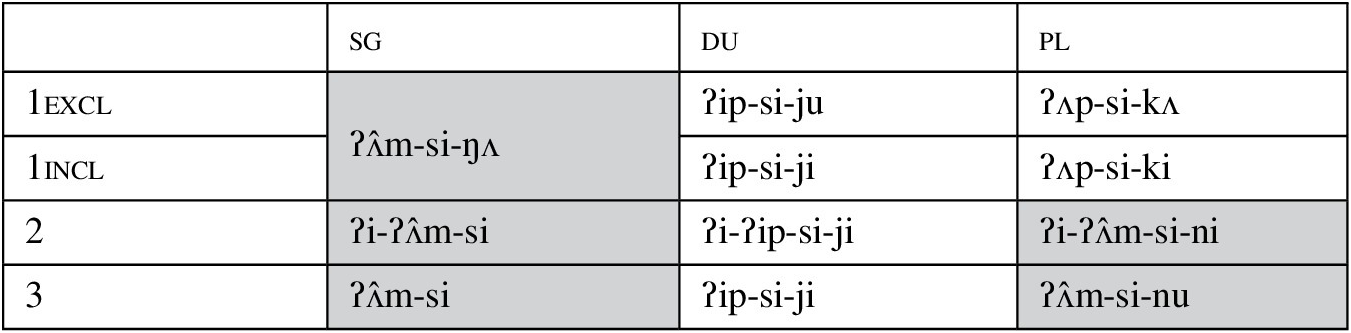
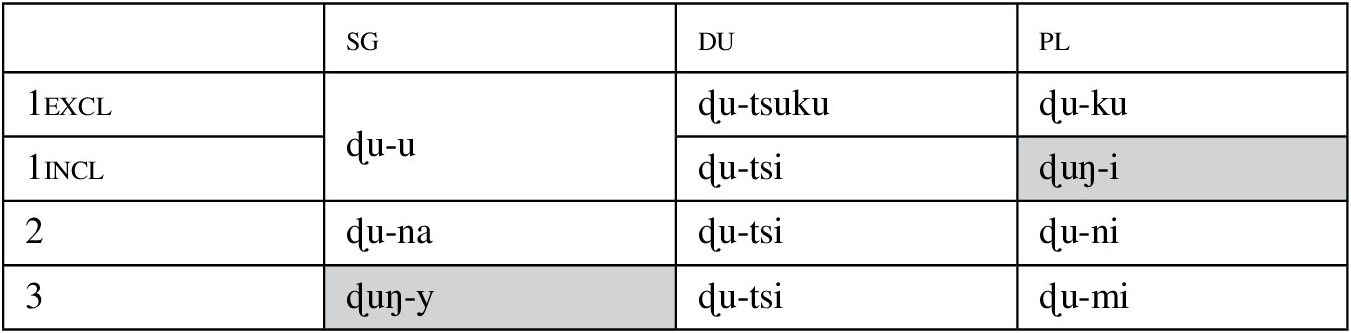
In the non-past, as Table 23 shows, only the shorter stem alternant may be found. This makes phonotactic sense in that all the non-past suffixes start in a consonant, usually -n. The same happens in the negative non-past, which makes use of the same suffixes. The situation is different in the negative past. In the case of ‘understand’, as Table 24 shows, the form -g(a) appears in the negative past in the SG and in the third person. In other lexemes, by contrast, these ‘stem extensions’ (-d, -g or -ŋ) only occur in the singular forms. Note that their exact form (e.g. -ga vs. -g) depends on whether the following suffix starts with a vowel or with a consonant, which is again phonotactically convenient. Other patterns of stem alternation in Sunwar are not. Consider, for example, the stem alternations that can be found in the positive past (Table 25). Here, a stem alternantFootnote 5 ending in -p occurs in the 2sg and 3sg and one in -m occurs in the 3du and 3pl. Note that these stem alternations of the past positive cannot be attributed to any phonological factor, since the stem here is always followed by the past suffix -t. The same forms occur in the main other stem alternation pattern in Sunwar (Table 26). To the forms already mentioned, this other stem alternation class adds a stem alternant in -ĩ in the first and second person dual and plural, and a stem in -i in all the non-past forms.
Paradigm of Sunwar ‘understand’ (jog- jo-) non-past (Borchers Reference Borchers2008: 200).

Paradigm of Sunwar ‘understand’ (jog- jo-) neg. past (Borchers Reference Borchers2008: 200).

Paradigm of Sunwar ‘know’ (cinep- cinem- cine-) past (Borchers Reference Borchers2008: 203).

Paradigm of Sunwar ‘do’ (pap- pam- paĩ- pai- pa-) past (Borchers Reference Borchers2008: 203).

4.2. Bahing (data from Hodgson Reference Hodgson1858 and Michailovsky Reference Michailovsky1975)
Stem alternation in Bahing has a certain resemblance to that of closely related Sunwar. The following forms can be involved in it:
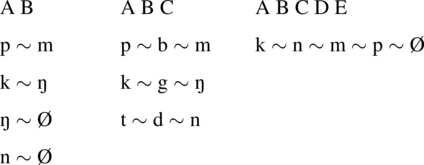
Unlike in Sunwar, however, transitive verbs continue to agree with the patient argument and their inflectional (and stem alternation) profile differs considerably from intransitives. For this reason they will be once again treated separately.
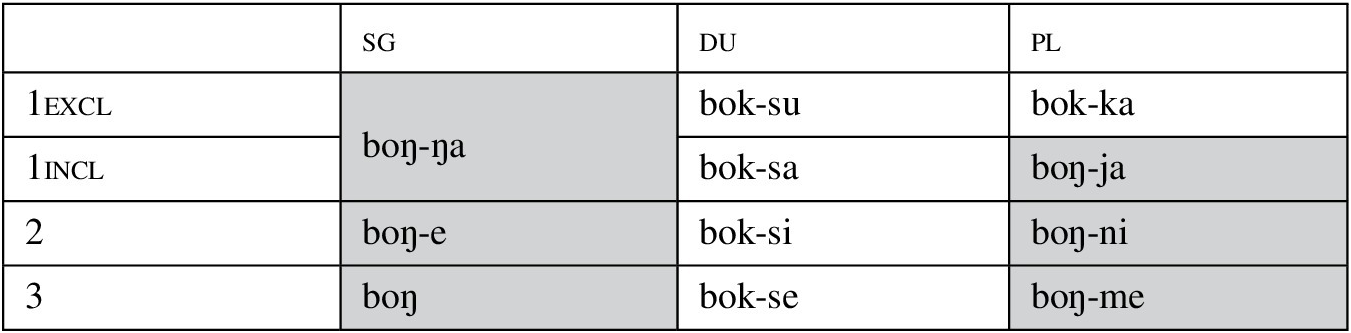
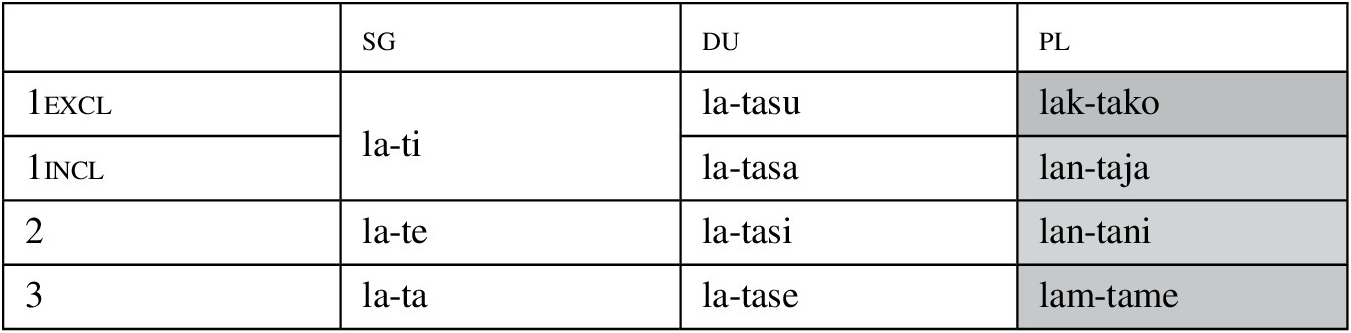
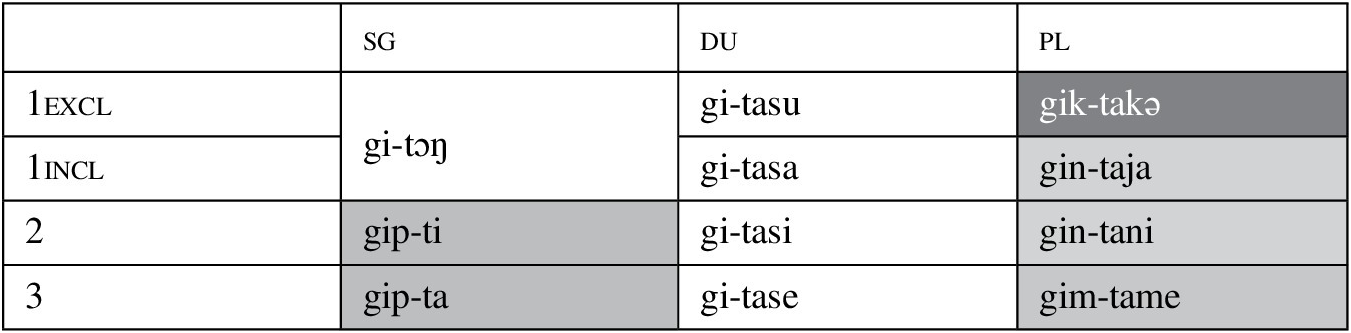
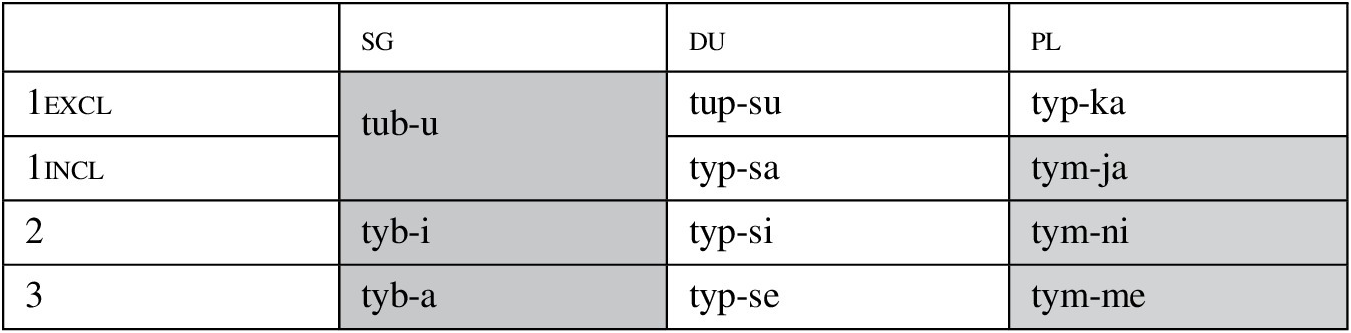
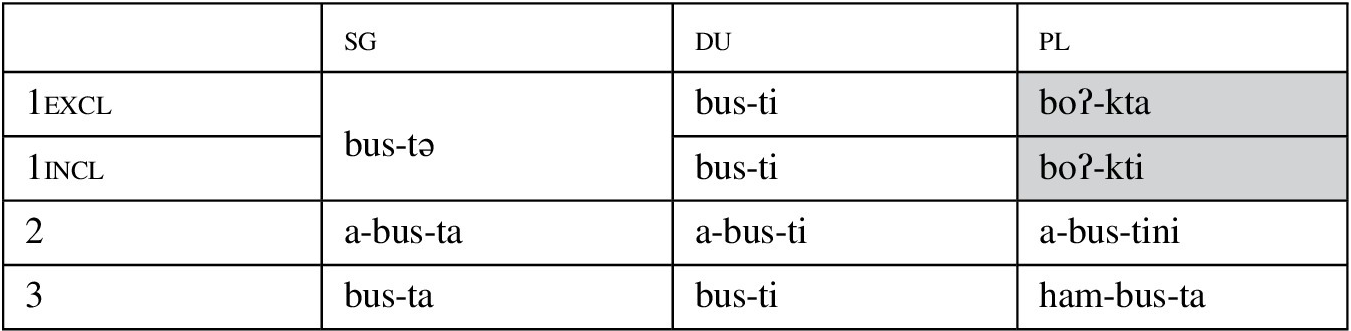
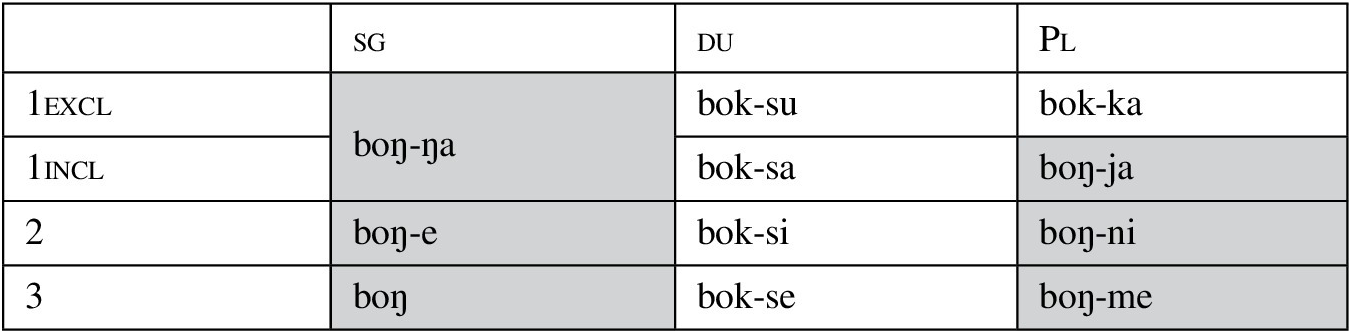
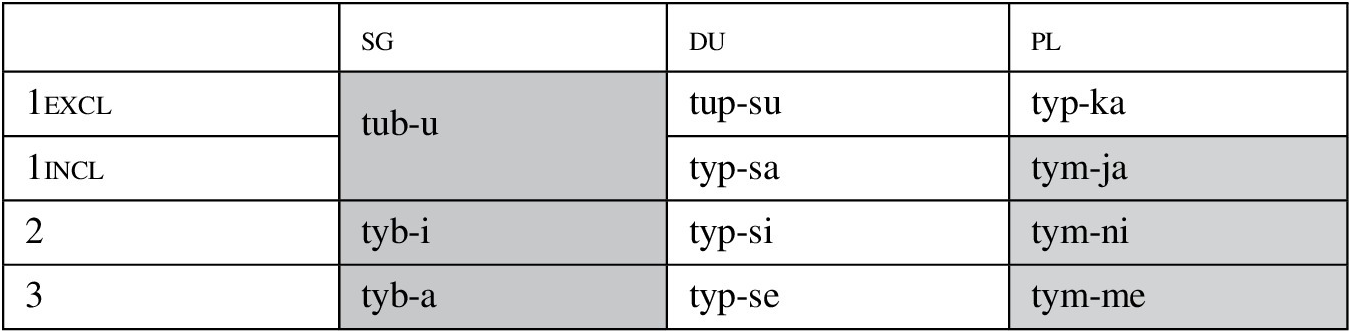
Table 27 shows an illustrative paradigm of the non-past intransitive. It shows that some stop-final stems have a nasalized allomorph in the singular and in the plural (except the 1pl.excl). The past has bok- throughout and is marked by a suffix -t. By contrast, in vowel-final stems (Table 28), alternations are found in the past. Various stem augments (-k, -n and -m, and also -p in transitives, see Table 29) appear in the past paradigm of open stem verbs in Bahing. Some of these were also found in closely related Sunwar, where their distribution in the paradigm, however, is not always the same. The stem alternation patterns characteristic of stop-final stems are given in Table 30. These involve voicing and nasalization. It must be noted that, despite what may appear to be the case in this table, these changes are not phonological (recall the 2sg imperative form typ-ə). The past tense forms are marked by a suffix -t and show only the stem typ-. Unlike in other Kiranti languages, the stems with the old valency-changing suffixes -t or -s do not give rise to any stem alternations because an epenthetic vowel -i is inserted in Bahing before consonant-initial suffixes (e.g. phikt-i-ka ‘dress.1pl.excl’).
Paradigm of Bahing ‘rise’ (bok- boŋ-) non-past, intransitive (Michailovsky Reference Michailovsky1975: 189).
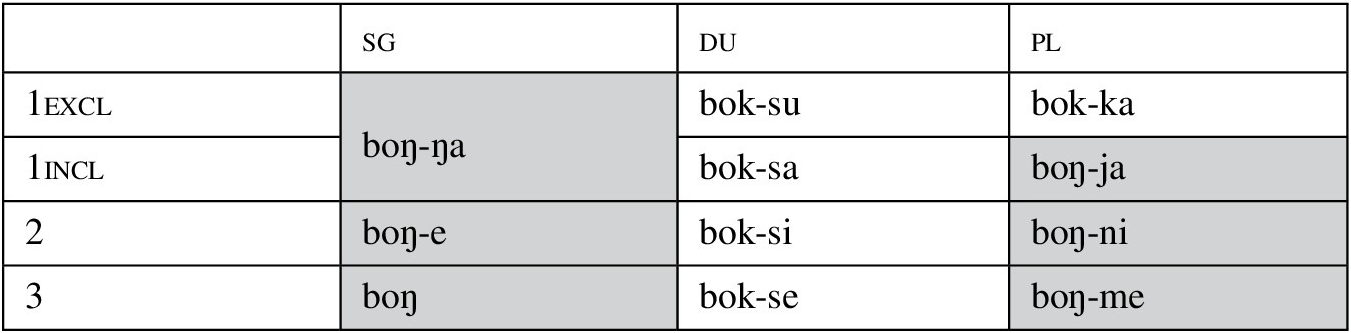
Paradigm of Bahing ‘go’ (lak- lan- lam- la-) past, intransitive (Michailovsky Reference Michailovsky1975: 189).
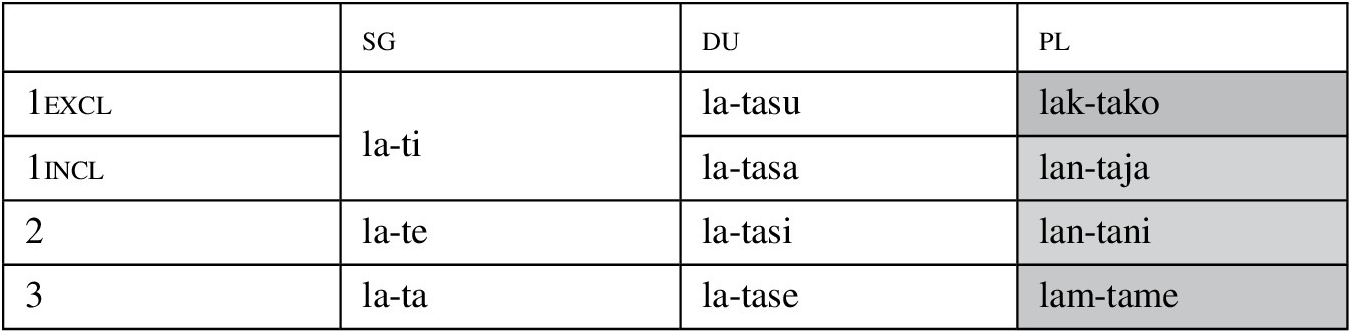
Paradigm of Bahing ‘give’ (gik- gin- gim- gip- gi-) past, transitive, 3sg patient (Michailovsky Reference Michailovsky1975: 194).
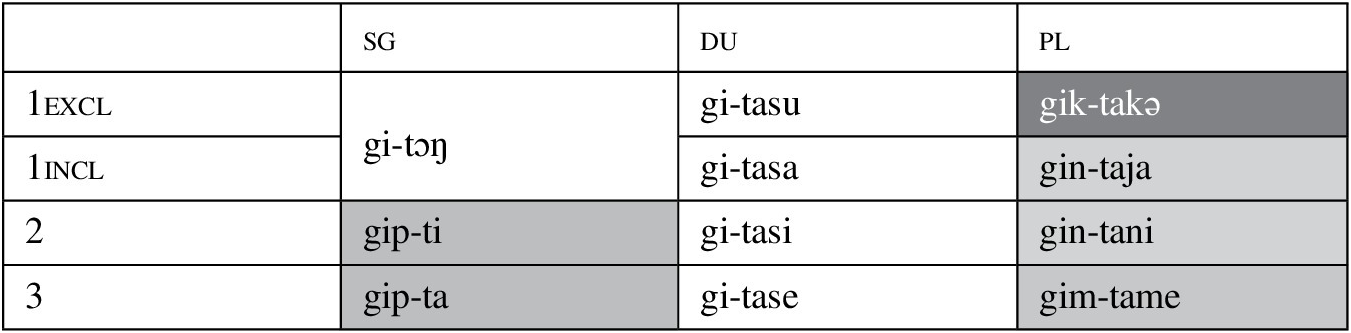
Paradigm of Bahing ‘beat’ (typ- tyb- tym-) non-past, transitive, 3sg patient (Michailovsky Reference Michailovsky1975: 190).
4.3. Wayu (data from Michailovsky Reference Michailovsky1988)
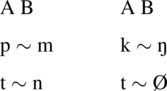
Consonantal stem alternation in Wayu is also purely morphological but relatively simple compared to other Western Kiranti languages. The formal alternations found in the stem are:
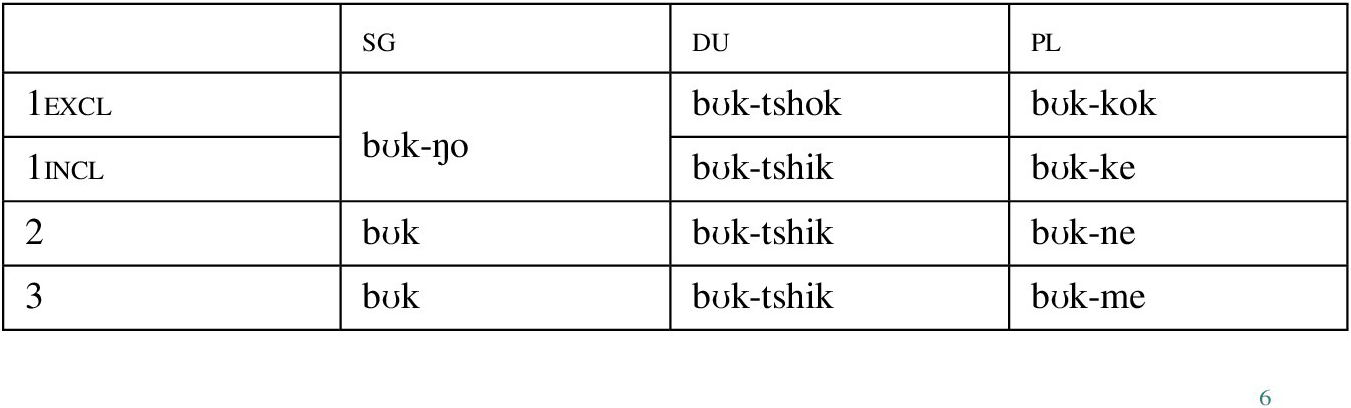
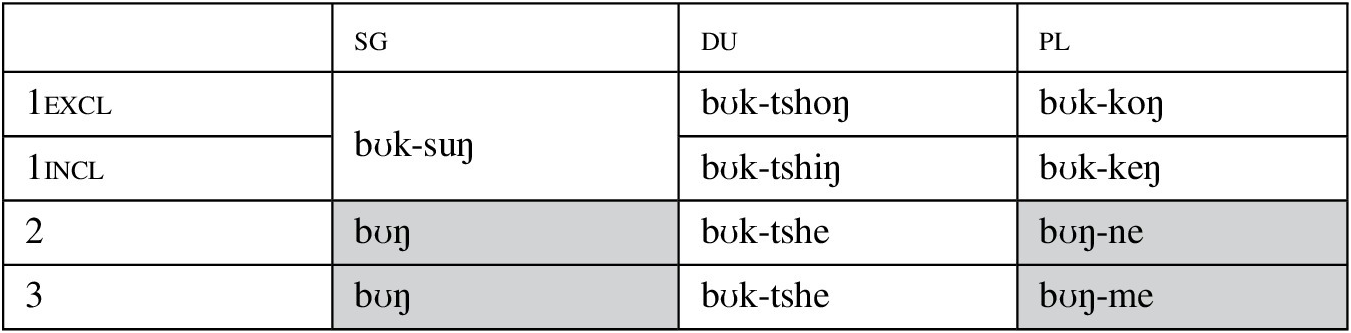
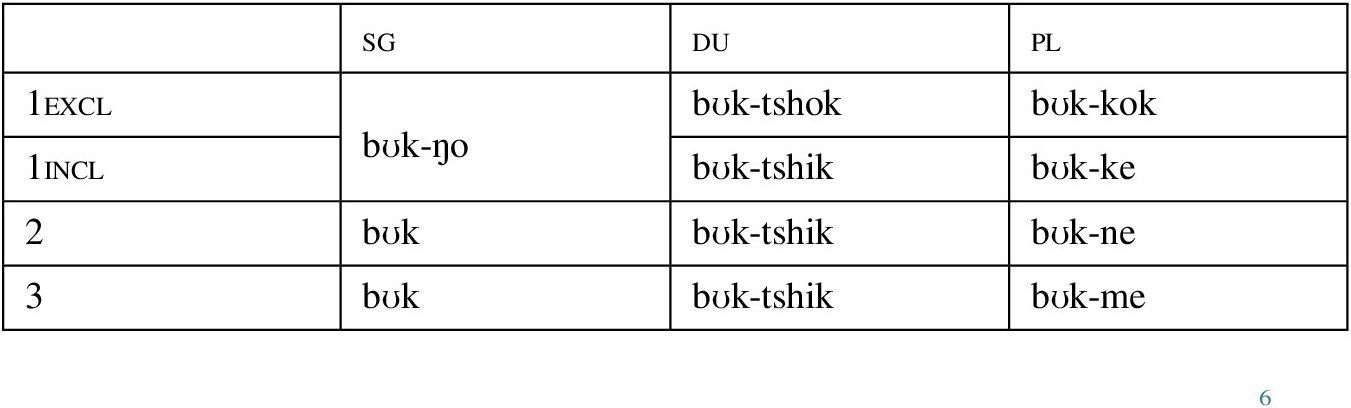
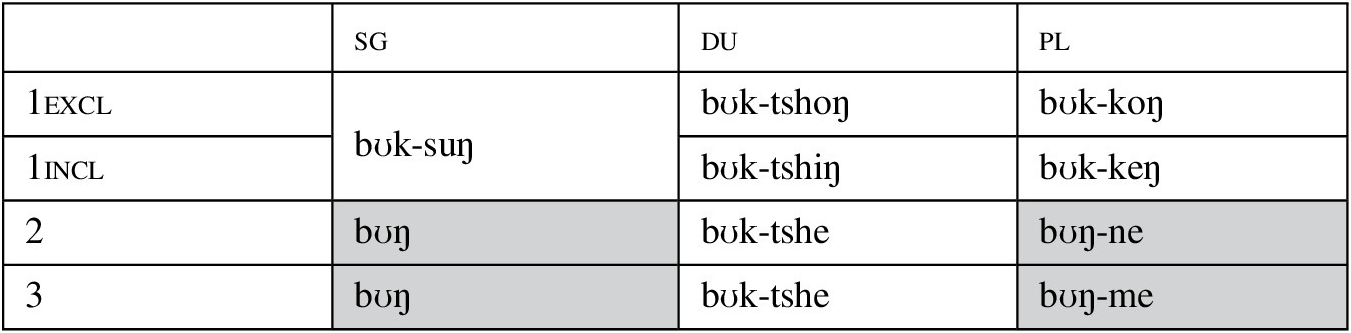
Unlike in Bahing, these stem alternations do not occur in the non-past (see Table 31). All the person-number combinations in this tense use the stem bʊk-. This, however, is not what we find in the past (Table 32), where 2/3sg and 2/3pl use the stem alternant bʊŋ-. In a polarity-like fashion, this alternation resembles the one found in Bahing non-past (Table 27).
Paradigm of Wayu ‘get up’ (bʊk- bʊŋ-) non-past, intransitive (Michailovsky Reference Michailovsky1988: 81).Footnote 6
Paradigm of Wayu ‘get up’ (buk- buŋ-) past, intransitive (Michailovsky Reference Michailovsky1988: 81).
The paradigmatic distribution of p ~ m and t ~ n is the same. In transitive verbs, the nasal stem alternant occurs, with a 3sg patient, in the 1sg non-past and in the 2pl past (2pl, 3sg and 3pl past are marked with the suffix -ko instead of the nasalized stem). As for the -t augment, alternating intransitive verbs in t ∼ Ø (there are also non-alternating ones with -t or Ø throughout the paradigm) have the shorter stem in the past and non-past (e.g. phi-ŋo ‘come-1sg.np’, phi ‘come.2/3sg.np’) and only participles and gerunds use the longer stem in -t (e.g. phit-ji, phit-ta, Michailovsky Reference Michailovsky1988: 137). In transitive verbs, the alternation between -t and -Ø may have a grammatical function. Unlike in most other Kiranti languages, the -t augment has sometimes preserved its valency-increasing function in Wayu and signals the applicative.
4.4. Khaling (data from Jacques et al. Reference Jacques, Lahaussois, Michailovsky and Rai2011)
Verb stem alternation in Khaling is morphological and very complex. Even limiting our attention to consonant alternations and thus leaving aside the numerous stem vowel changes found in verbal inflection, the number of possible alternations is still considerable:
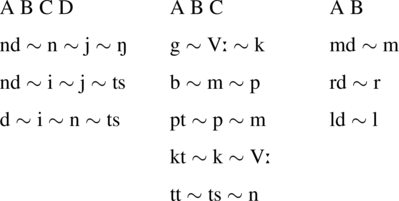
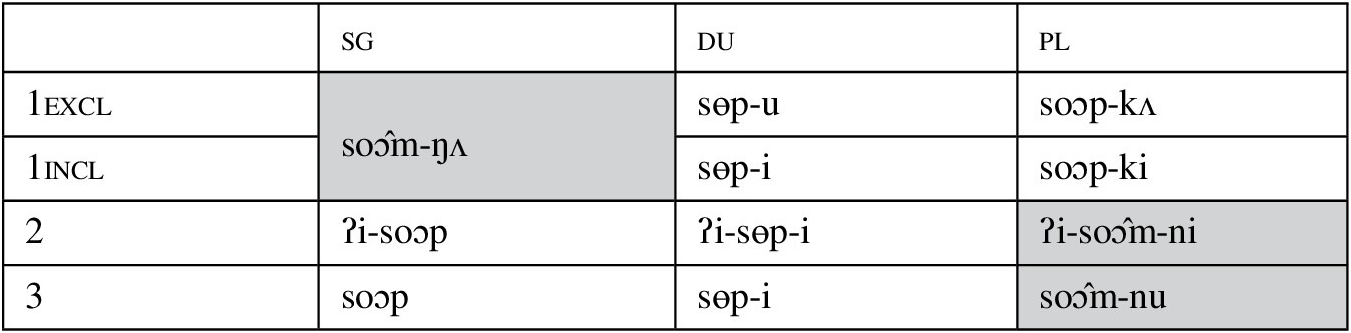
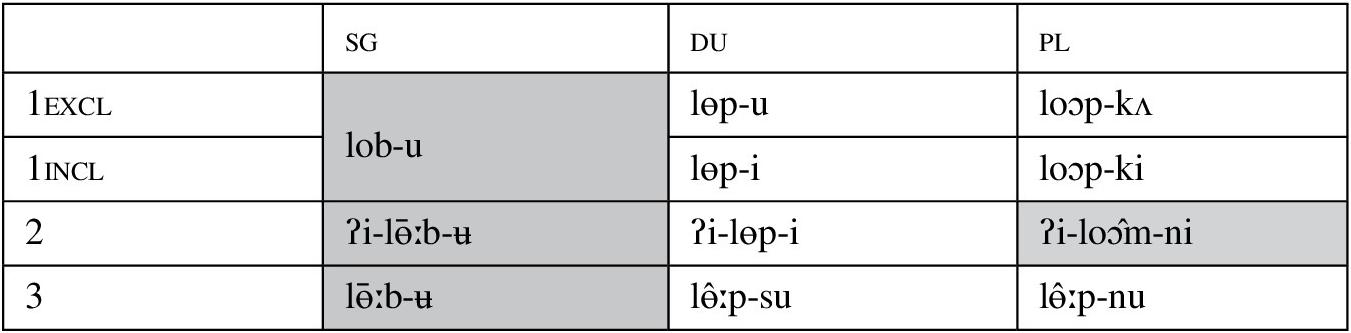
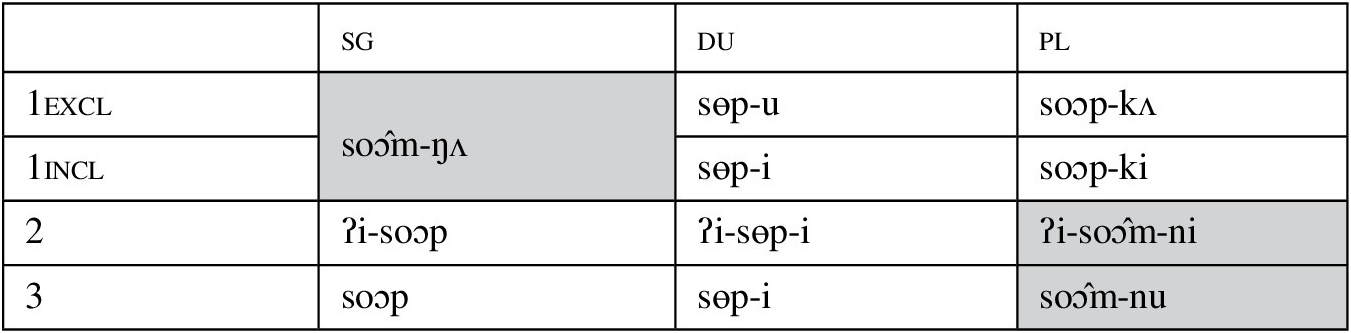
One can notice, however, that, despite the additional complications, the alternations usually involve the presence or absence of augments -t and -d and the voicings and nasalizations (e.g. p ∼ b ∼ m) that also appeared elsewhere in Kiranti. The distribution of these consonant alternations in the intransitive non-past paradigm of Khaling is shown is Table 33. Note that, despite what might seem to be the case in this table, the assimilation of /p/ to a following nasal suffix is not a regular phonological rule of the language and is purely morphological. This can be seen in forms like 3pl l̂ɵːp-nu in the transitive paradigm in Table 34.
Paradigm of Khaling ‘have enough’ (sop-) non-past, intransitive (Jacques et al. Reference Jacques, Lahaussois, Michailovsky and Rai2011: 1102).
Paradigm of Khaling ‘catch’ (lop-) non-past, transitive, 3sg patient (Jacques et al. Reference Jacques, Lahaussois, Michailovsky and Rai2011: 1102).
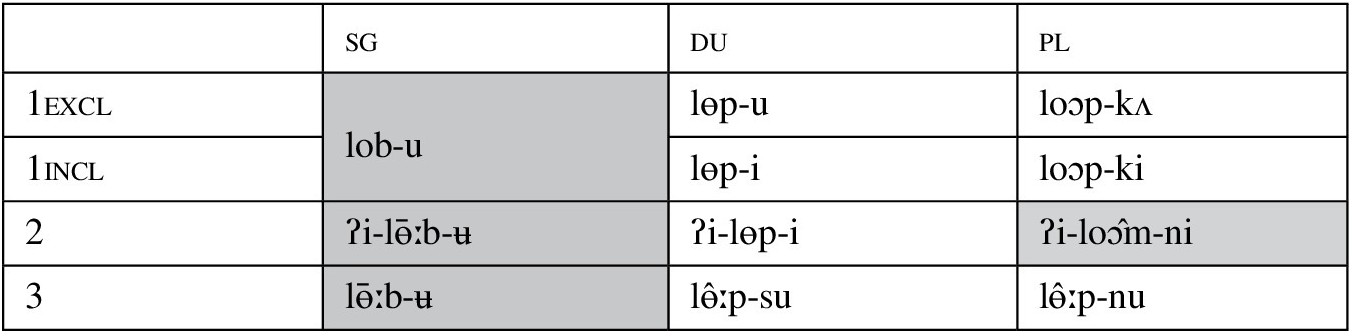
In transitive paradigms with a 3sg object held constant, the voiced stem-final consonant appears in the singular cells. This is the same pattern that was presented in Bahing (Table 30). In Khaling, this is also the domain for the occurrence of the stem augments in -t/d (see Table 35). These stems appear in the singular non-past only. It is absent from the past, understandably maybe, due to the fact that most of those forms are characterized by the past marker -t(ɛ) immediately after the stem. Note, however, that this (i.e. having an identical suffix generally) does not preclude the use of different stems (see Table 36), which proves again the morphological nature of stem alternation in Khaling. A nasal stem is found, in this paradigm in the singular and 2/3pl forms. Note the similarity to Bahing (Table 26) and Wayu (Table 32). In Khaling, however, this pattern is found in both past and non-past and (only second person) in the imperative.
Paradigm of Khaling ‘remember’ (mimt-) non-past, transitive, 3sg patient (Jacques et al. Reference Jacques, Lahaussois, Michailovsky and Rai2011: 1120).
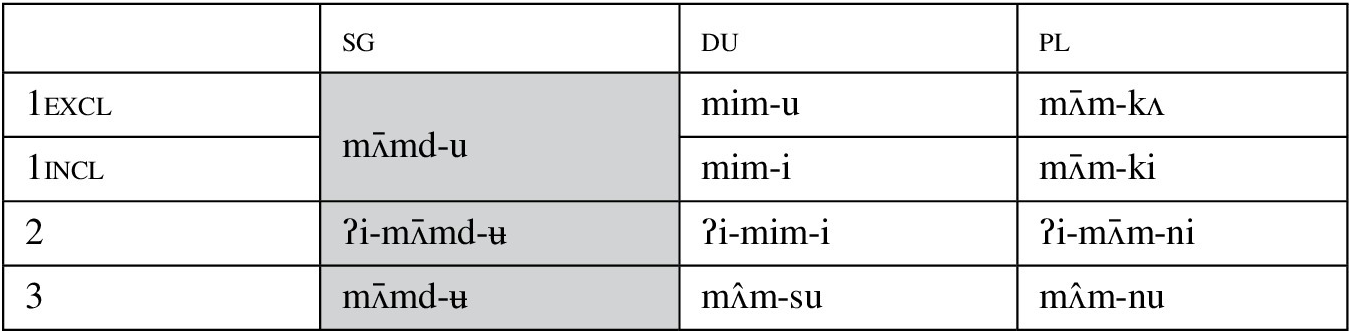
Paradigm of Khaling ‘sleep’ (ʔip-) past, reflexive (Jacques Reference Jacques2017).
4.5. Dumi (data from van Driem Reference van Driem1993)
Stem alternation in Dumi is morphologically determined (although automatic alternations also occur at morpheme boundaries) and very complex. Vowel apophony occurs as well but will not be analyzed here. The following consonant alternations can be found:
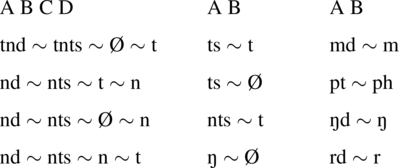
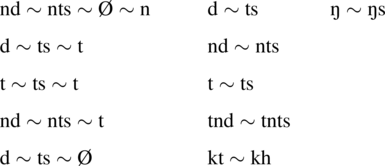
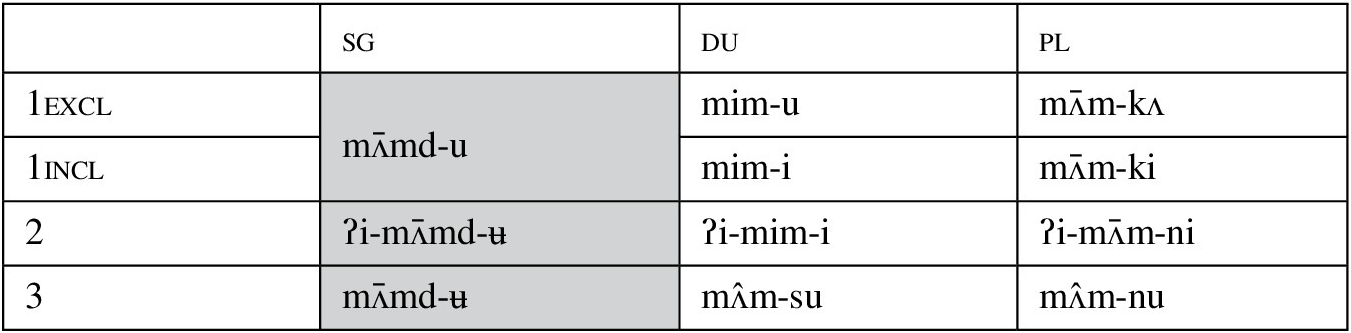
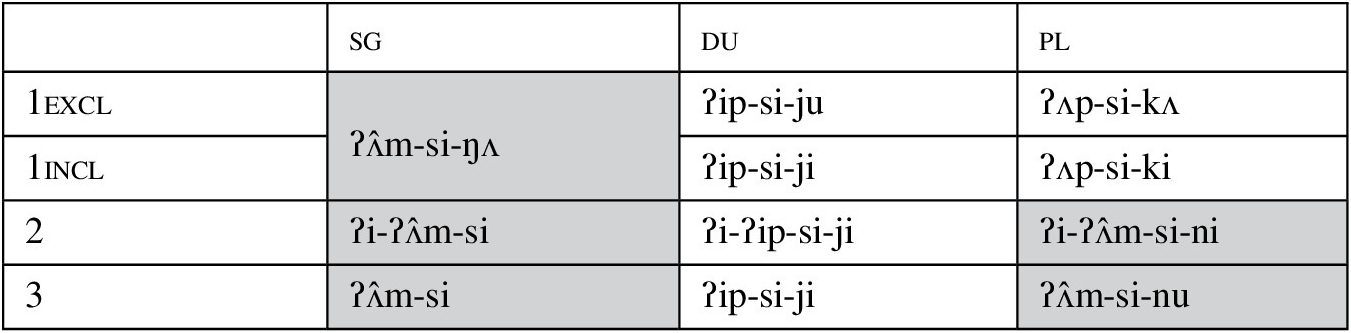
Different formal alternations are associated with different paradigmatic patterns. The pattern in Table 37 is a frequently encountered one in intransitive verbs. As illustrated here, a recurrent pattern of stem alternation opposes the 1pl stem to the one in the rest of the paradigm. The stem change can involve other forms like ts∼Ø or ŋ∼Ø. As Table 37 reveals, Dumi is characterized by a suffix -t in the non-past. The same pattern of stem alternation is found in the past, where the suffixes are the same except for the absence of -t.
Paradigm of Dumi ‘shout’ (buts- bot-) non-past, intransitive (van Driem Reference van Driem1993: 98).Footnote 7
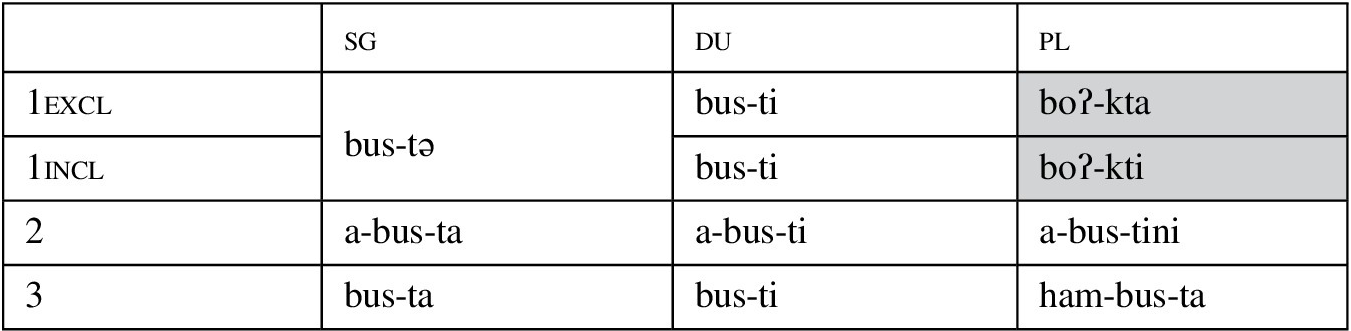
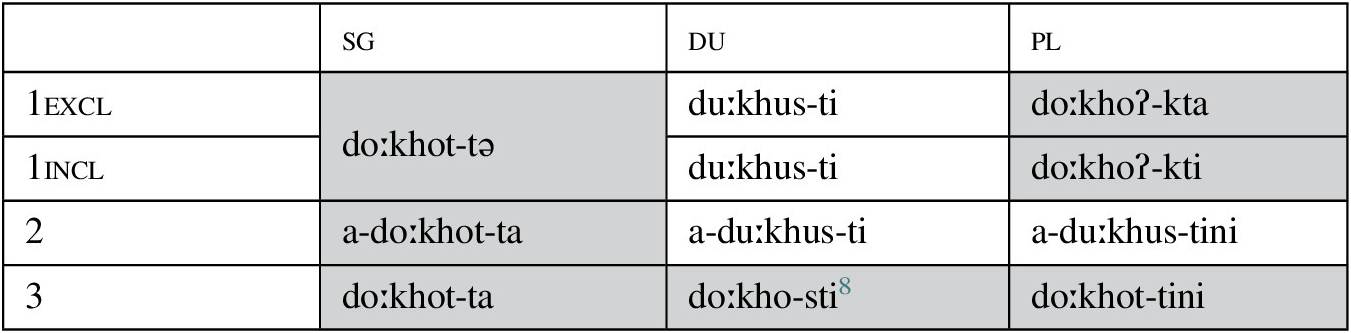
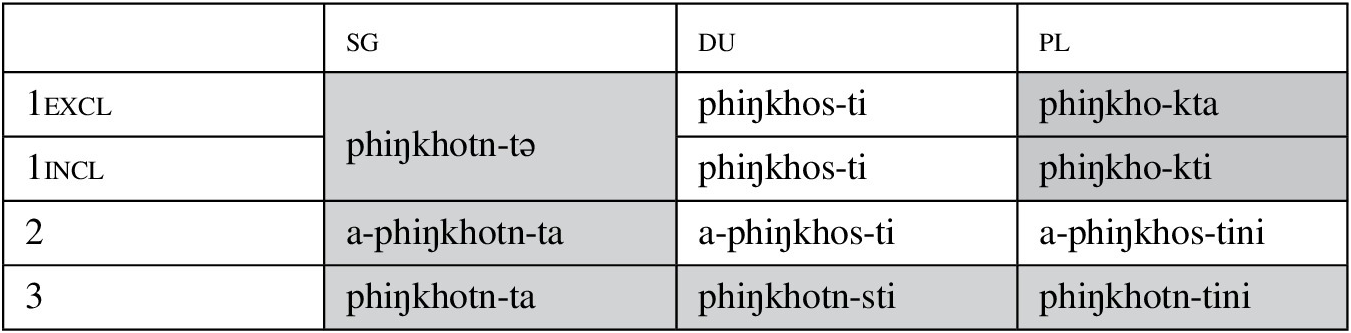
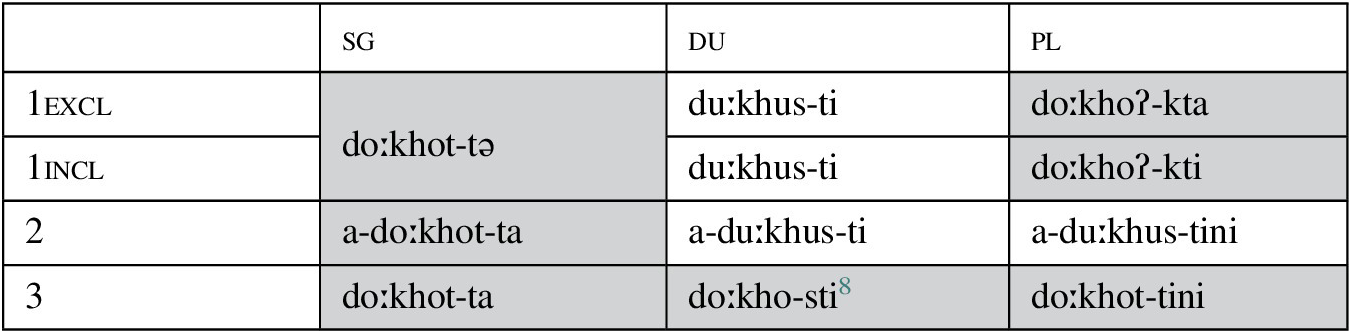
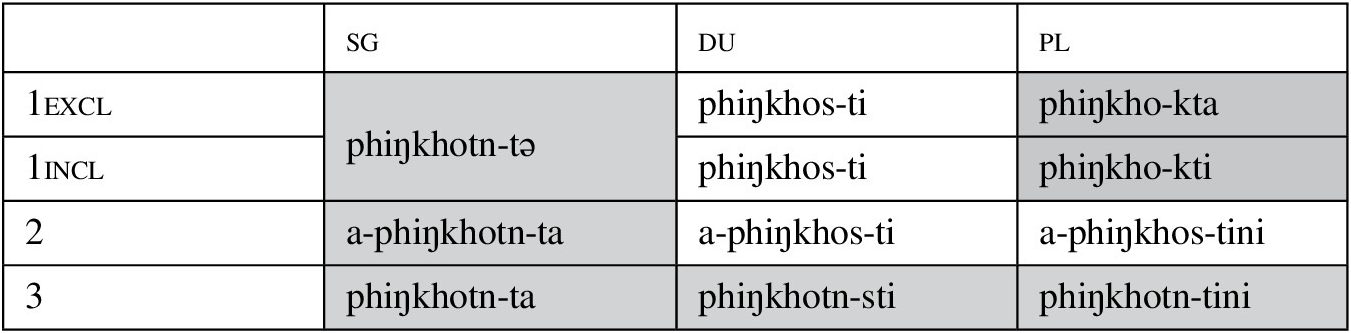
A different pattern is found in transitive verbs (Table 38), where the 1pl patterns with sg and third person paradigm cells (/t/ changes to /ʔ/ regularly before velars). Other forms such as, crucially, the augment (e.g. -kt (vs. -kh), -md (vs. -m), -rd (vs. -r), etc.) adopt this same paradigmatic distribution. In some other lexemes (Table 39), the stem of the sg+3 and that in the 1pl may differ.
Paradigm of Dumi ‘see’ (duːkhuts- doːkhot-) non-past, transitive, 3sg patient (van Driem Reference van Driem1993: 107–108).
Paradigm of Dumi ‘send off’ (phiŋkhotnd- phiŋkhotnts- phiŋkho-) non-past (van Driem Reference van Driem1993: 111–112).
4.6. Thulung (data from Allen Reference Allen1975 and Lahaussois Reference Lahaussois2002, Reference Lahaussois2011)
Stem alternation in Thulung is morphological but involves a relatively small number of forms. In addition, verbs distinguish a maximum of two stems:
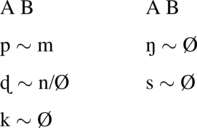
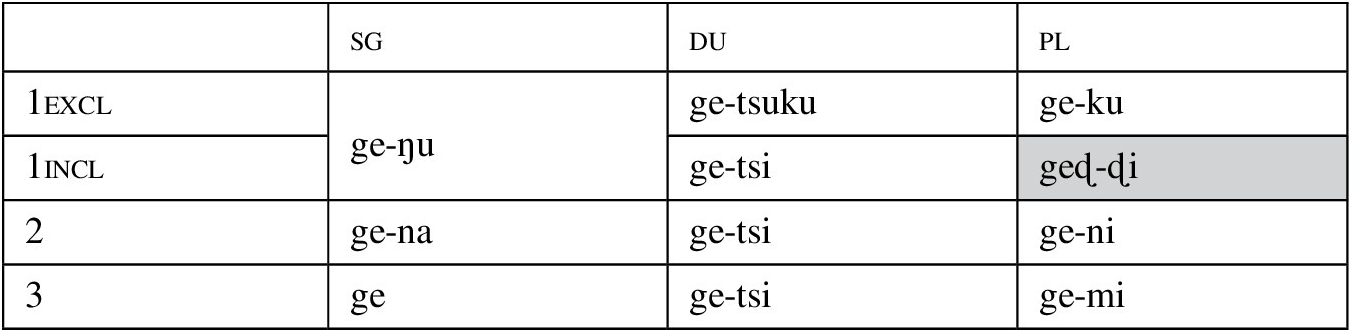
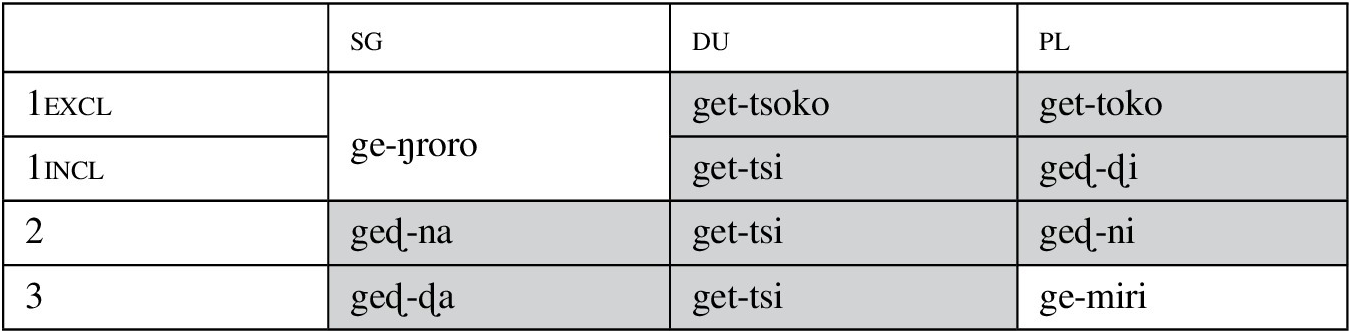
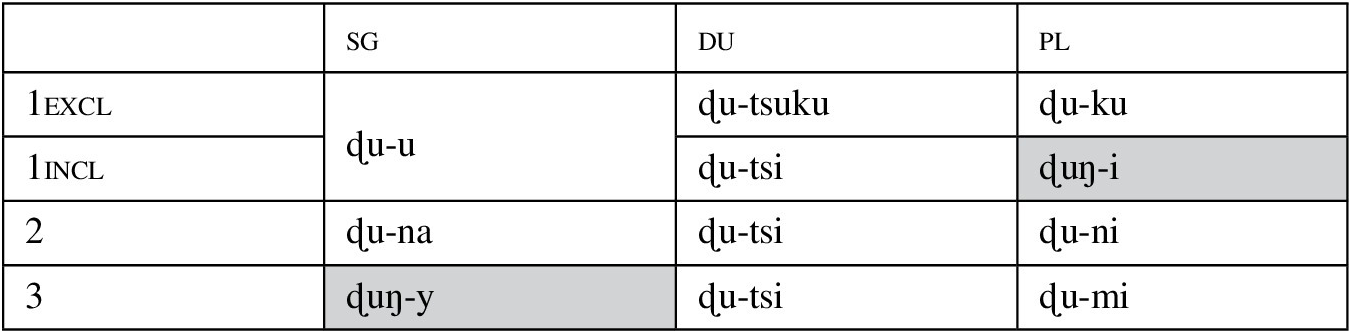
These alternations are distributed in the paradigm in different ways. Some involve the pattern in Table 40, which stays the same across tenses (non-past vs. past). The same pattern found in ‘drink’ is found with the stem extension -s in other verbs. In the intransitive paradigm, where 3sg is -Ø, these segments will be limited to the 1pl.incl. Other patterns of stem alternation are more complicated in that the distribution of the stems is also dependent on tense. In general, the longer or ‘stronger’ stem tends to appear in the past and the shorter or more lenited one in the present but the correlation to tense is not perfect. As Tables 41 and 42 illustrate, 1pl.incl of the present and all the past forms except the 1sg and 3pl have the longer stem in -ɖ (ɖ ~ t variation is allophonic). The forms -p (vs. -m), -k (vs. -Ø) and -ɖ (vs. -n) are also subject to the same paradigmatic distribution.
Paradigm of Thulung ‘drink’ (ɖu- ɖuŋ-) non-past, transitive, 3sg patient (Lahaussois Reference Lahaussois2002: 162).
Paradigm of Thulung ‘come (up)’ (geɖ- ge-) non-past, intransitive (built from Allen Reference Allen1975: 204).Footnote 9
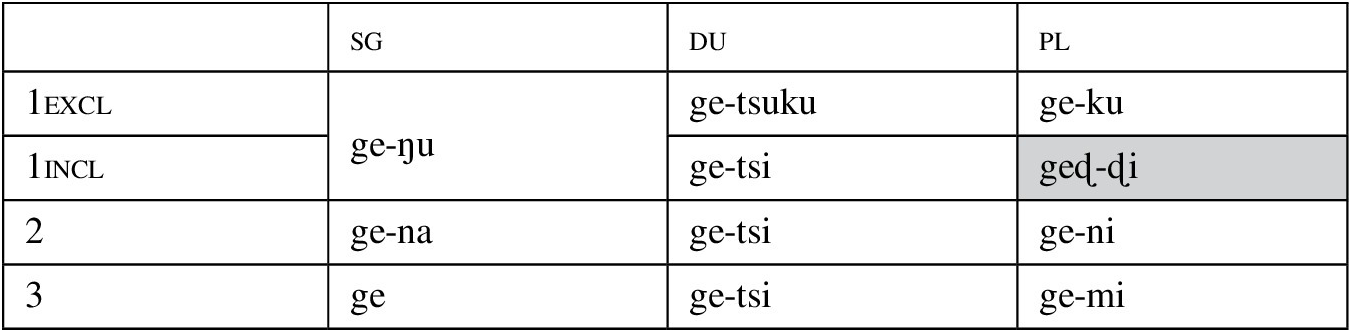
Paradigm of Thulung ‘come (up)’ (geɖ- ge-) past, intransitive (built from Allen Reference Allen1975: 204).
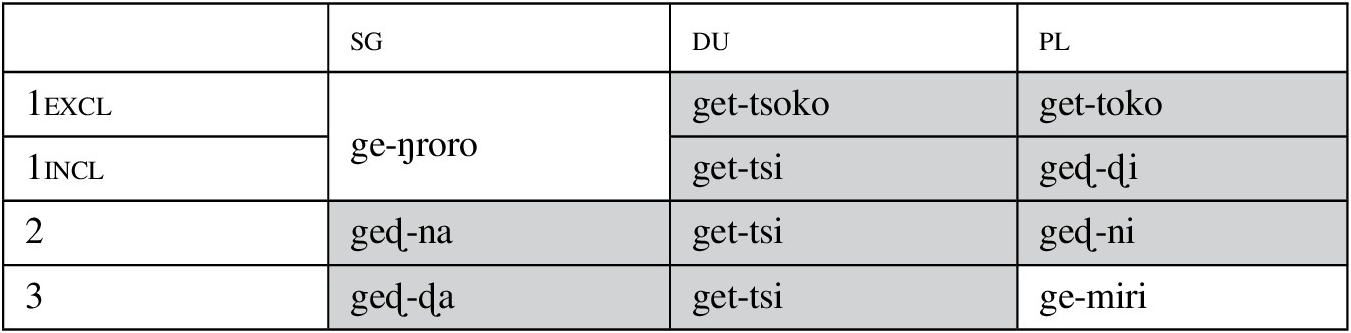
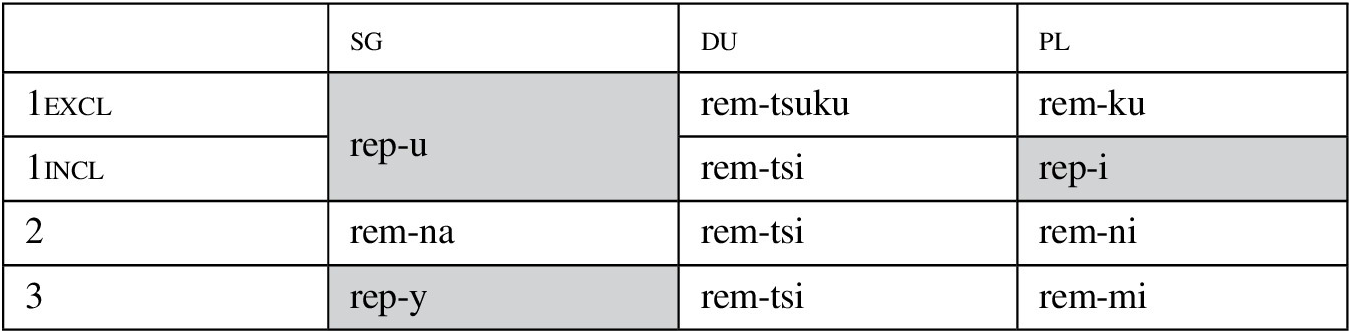
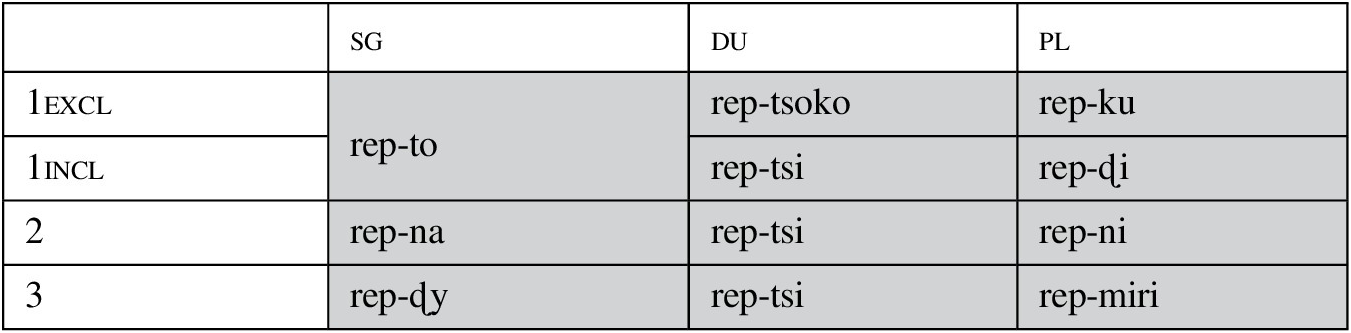
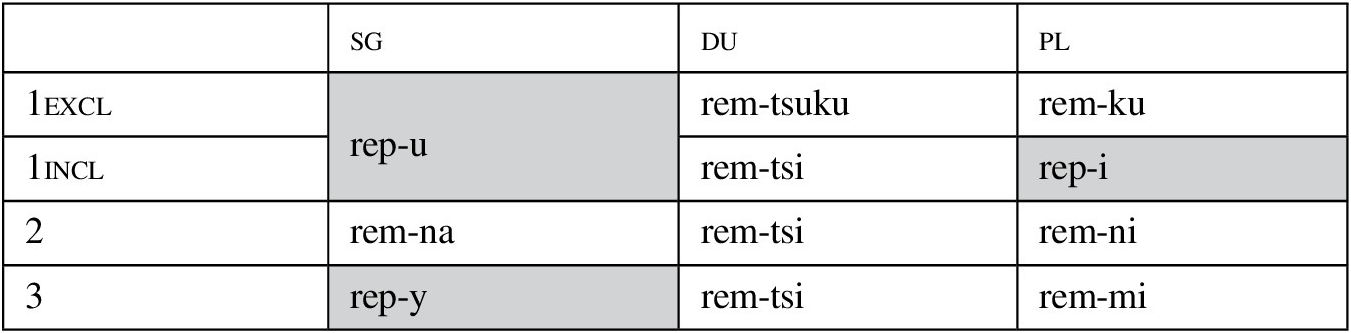
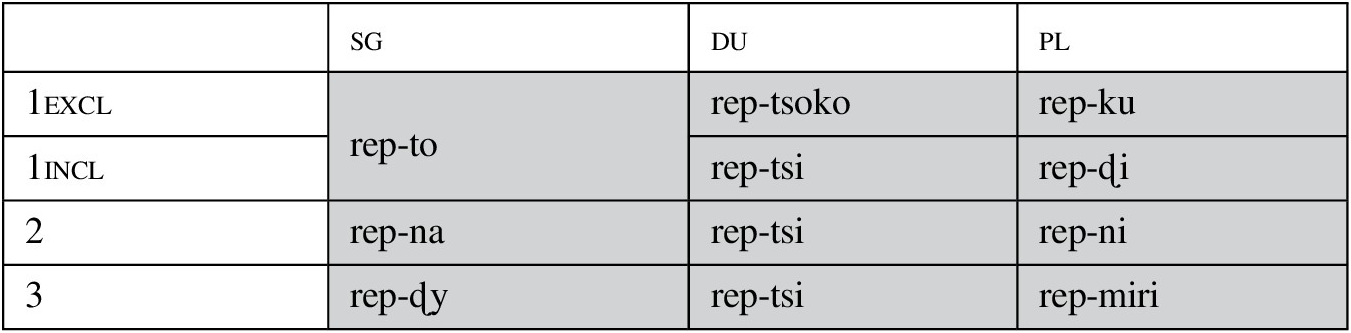
A similar situation (with a slightly different distribution) is found in transitive verbs (Table 43). The stronger stem appears, in the non-past, in the 1sg, 1pl.incl and 3sg (this stem can sometimes appear in the 3pl too). In the past (Table 44), however, this stem rep- appears in all person-number combinations (although the 3pl may occasionally inflect with the weaker stem). This pattern can also be instantiated with the forms -k (vs. -Ø) and -ɖ (vs. -n or -Ø).
Paradigm of Thulung ‘look’ (rem- rep-) non-past, transitive, 3sg patient (Lahaussois Reference Lahaussois2002: 158).
Paradigm of Thulung ‘look’ (rem- rep-) past, transitive, 3sg patient (Lahaussois Reference Lahaussois2002: 158).
4.7. Koi (data from Lahaussois Reference Lahaussois2009)
Stem alternation in Koi is difficult to classify. Different analyses (phonological conditioning and semantic, see Baerman & Corbett Reference Baerman and Corbett2012) have been proposed. Conceding that this system poses considerable analytical challenges, I will present Koi stem alternation here as essentially morphological in nature. Even though the stem alternations correlate perfectly to certain formal properties of the following suffixes (-C vs. -i/e vs. -a vs. -u), there is no reasonable phonological rule that could generate the attested alternations. In addition, the paradigmatic distribution of some of the suffixes appears to be arbitrary from a semantic point of view and thus purely morphological. The following forms might be involved:
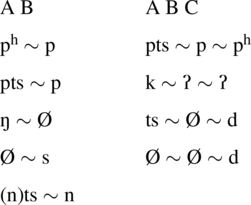
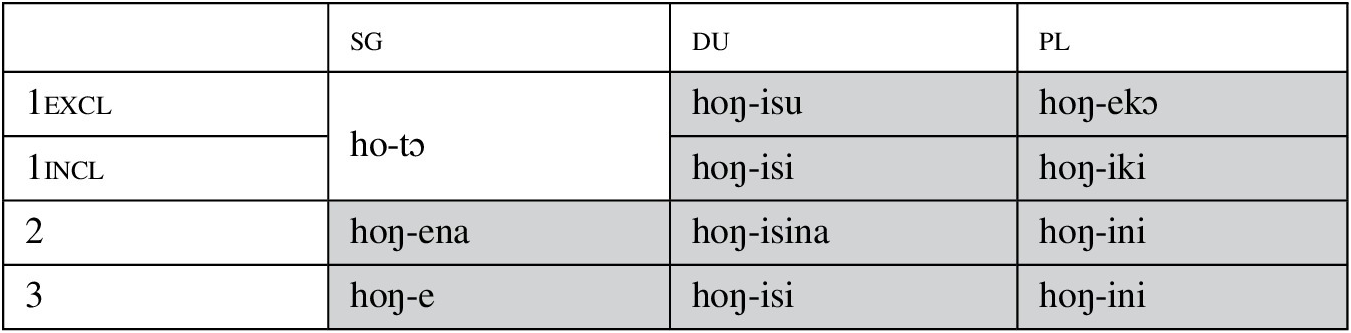
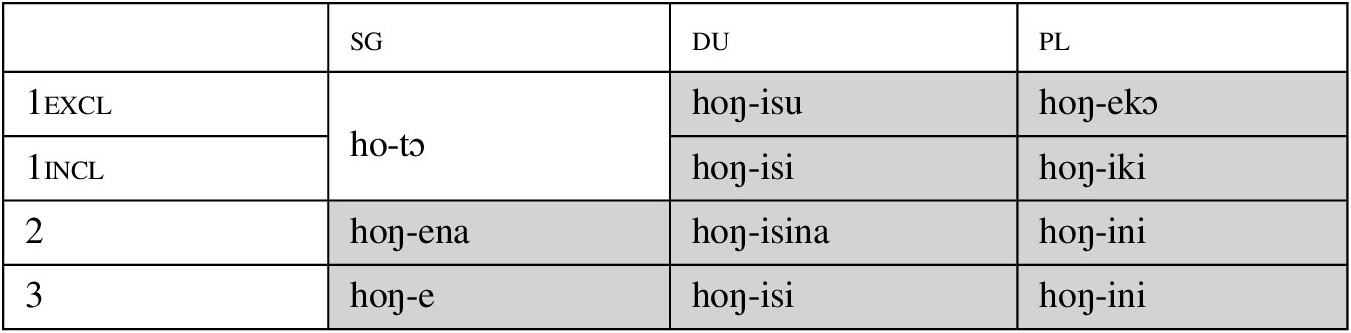
Stem-vowel alternations also occur but will not be described here. The distribution of consonantal alternations is relatively straightforward. In intransitive verbs (see Table 45) the 1sg takes one stem and the rest of the paradigm takes the other. This cell is also the one where a consonant-initial (as opposed to a vowel-initial) suffix follows the stem. The same distribution is found in the past, where the 1sg suffix also starts with a consonant and the rest with a vowel. This would point towards a phonological analysis in which the stem’s final consonant appears to be dropped (or changed) before a following consonant. Note however, that some consonant alternations (most notably between a stem-final -s before consonant-initial suffixes and Ø in the prevocalic stem) cannot be understood in the same terms but have the exact same paradigmatic configuration.
Paradigm of Koi ‘enter’ (hoŋ- ho-) non-past, intransitive (Lahaussois Reference Lahaussois2009: 13).
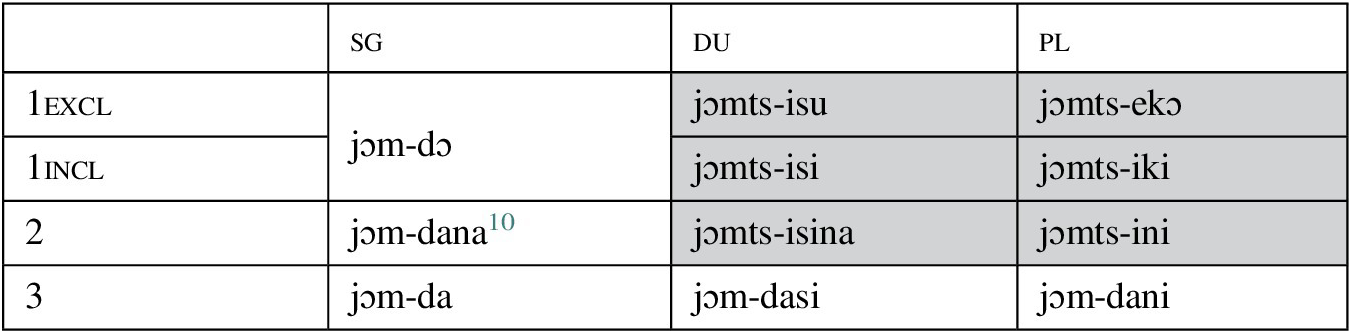
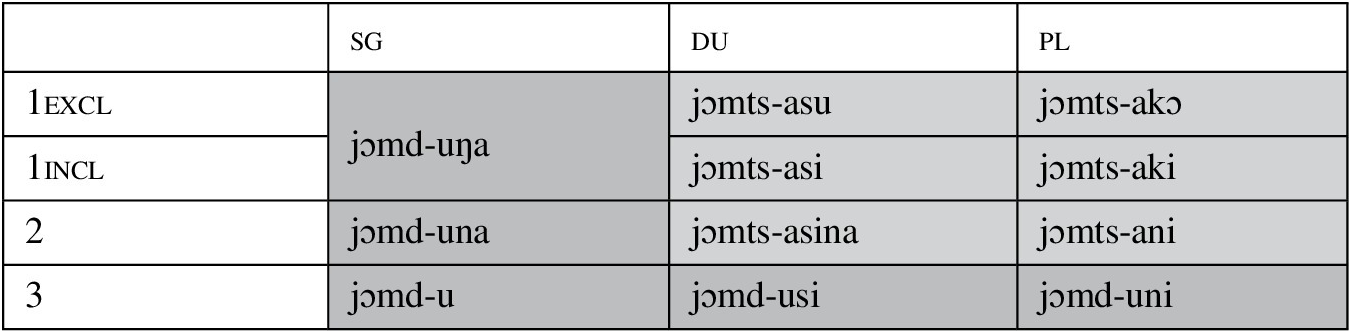
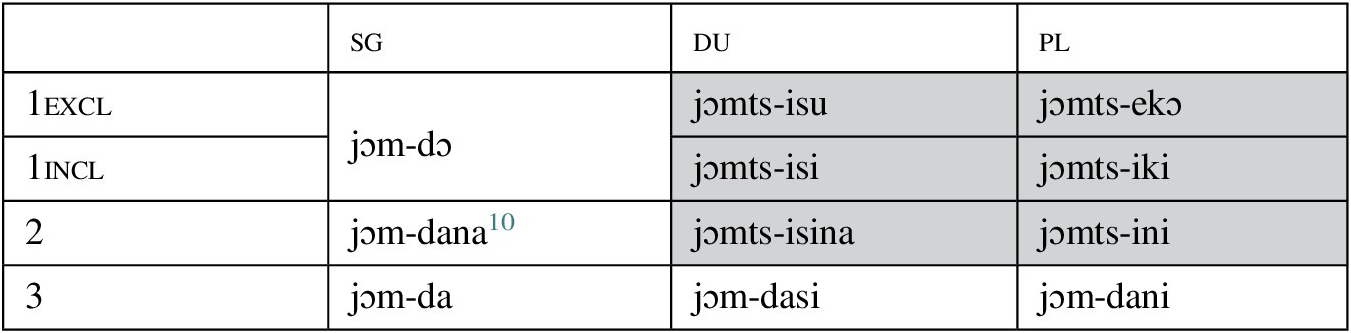
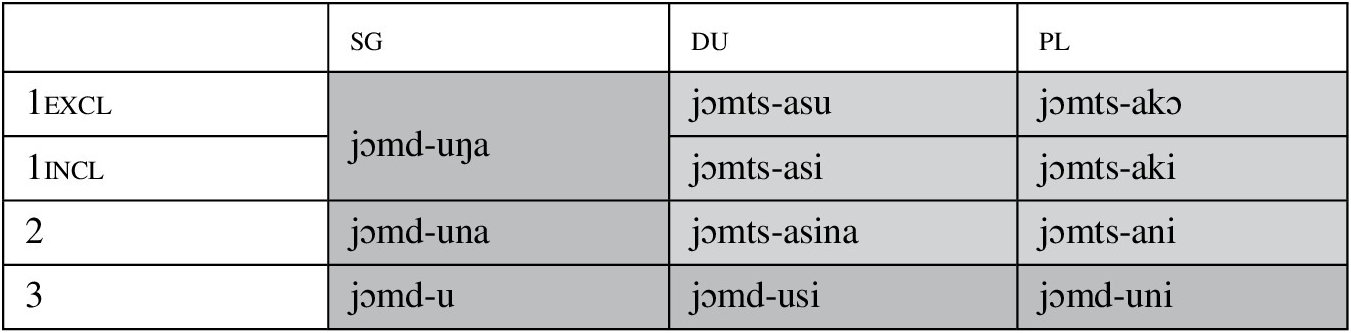
The situation is similar in transitive verbs. Suffixes in this paradigm are different from intransitive verbs and so is the stem alternation pattern, which appears to be governed at first sight also by the vowel-initial or consonant-initial status of following suffixes. Tables 46 and 47show that many transitive verbs have a different stem in the sg and third person forms of the paradigm. In the past, the alternation most often involves the augment -d already familiar from other Kiranti languages. These paradigm cells are also characterized by shared forms in the suffixes. The sg+3 cells have a d-starting suffix in the non-past and a u-starting suffix in the past. The other paradigm cells have -i/e in the non-past and -a in the past. The correlation of stem alternations to these suffixes might be synchronically relevant, even though the distributions of both affixes and stem alternants are semantically arbitrary.
Paradigm of Koi ‘hit’ (jɔmts- jɔm- jomd-) non-past, transitive, 3sg patient (Lahaussois Reference Lahaussois2009: 12).
Paradigm of Koi ‘hit’ (jɔmts- jɔm- jomd-) past, transitive, 3sg patient (Lahaussois Reference Lahaussois2009: 12).
4.8. Jerung (data from Opgenort Reference Opgenort2005)
Jerung stem alternation is morphological, since it does not correlate with any unified phonological environment. On the other hand, it is relatively simple, since it involves few forms and patterns. Consonantal alternations in the language may involve the following:
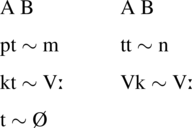
As shown above, they most frequently involve the augment -t already familiar from other Kiranti languages. Vowel alternations also occur in the stem but will not be considered here. Intransitive verbs can only show stem alternation between finite and non-finite forms (e.g. blaː-me ‘come-3sg’ vs. blak-cap ‘come-inf’; Opgenort Reference Opgenort2005: 327). There is, apparently, a tendency to level even these stem alternations in intransitive verbs by spreading the finite form of the stem to the non-finite ones.
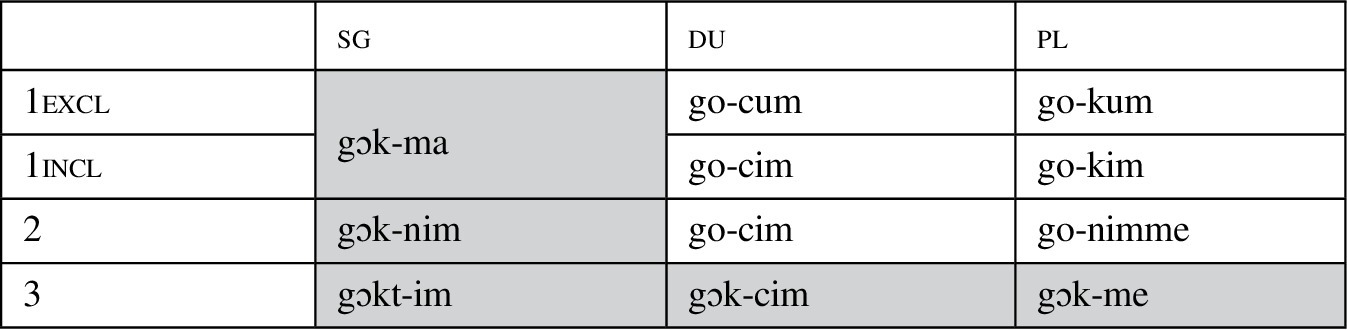
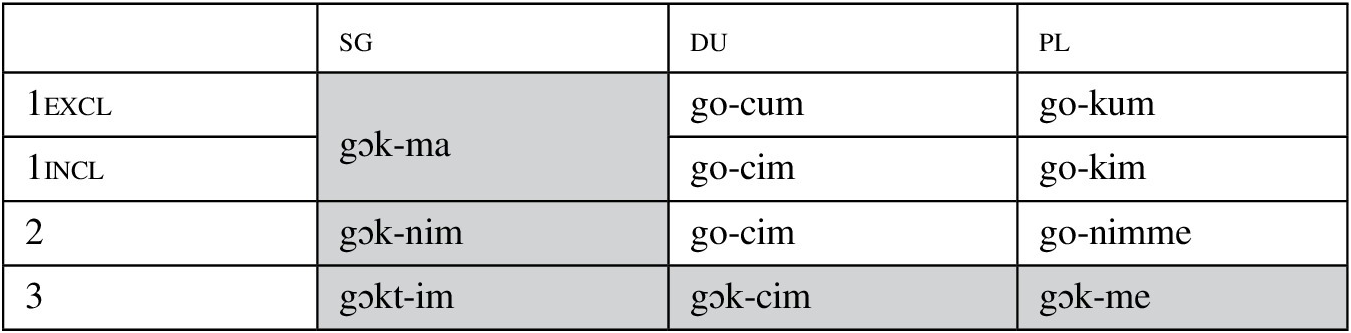
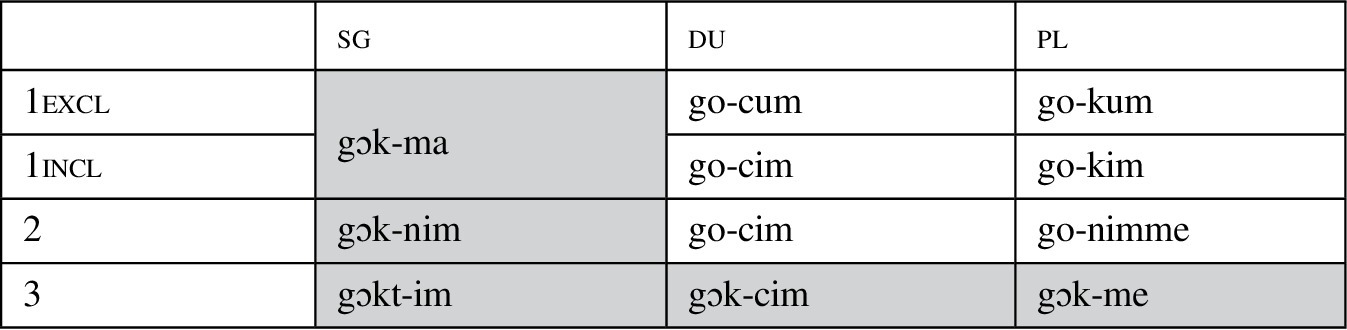
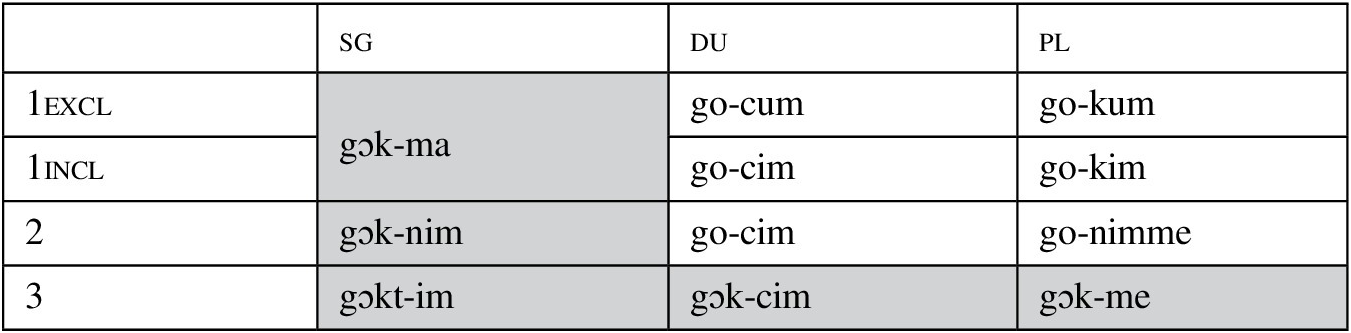
The most interesting stem alternations, therefore, are found in transitive verbs (Table 48). Consonant alternation in Jerung, similarly to the situation in Koi, involves a stem (augmented in Jerung) used in the sg and third person forms opposed to a phonologically shorter stem in the rest of the paradigm.
Paradigm of Jerung ‘give’ (gɔkt- go-) (Opgenort Reference Opgenort2005: 330).Footnote 11
4.9. Wambule (data from Opgenort Reference Opgenort2004)
Stem alternation in Wambule is very similar to the one in closely related Jerung. It is thus, morphological in nature but relatively simple in its instantiation since it involves few forms and patterns. The consonantal alternations at the end of the stem can be the following:
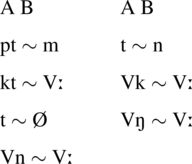
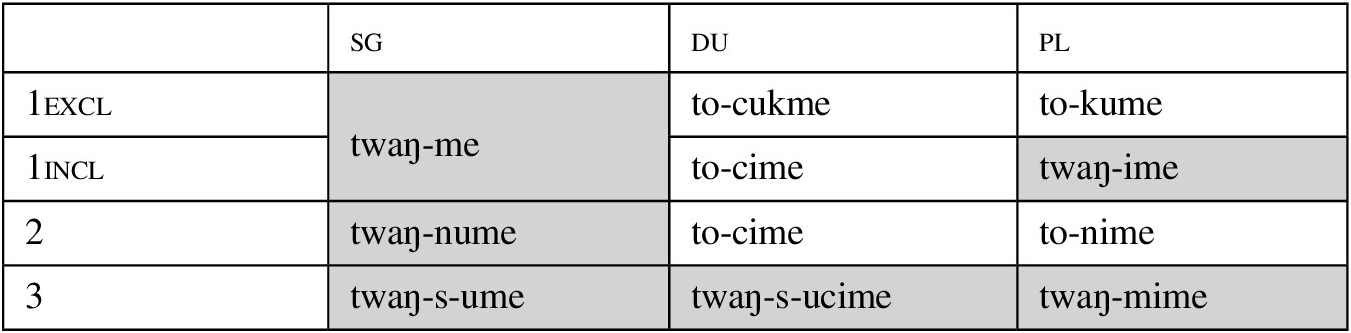
In intransitive verbs, the same as in Jerung, the only stem alternation that can be found is between the stem of finite and nonfinite forms of the paradigm (e.g. glak ∼ glaː ‘win’; Opgenort Reference Opgenort2004: 260), with the shorter stem used, as in Jerung, in finite forms, and the longer one in nonfinite ones. The distribution of stem alternation in transitive verbs is also similar (but not identical) to the one in Jerung (see Table 49). The main difference is the presence of the longer stem in the 1pl.incl as well and the presence of the stem augment -s in the 3sg and 3du of some verbs.
Paradigm of Wambule ‘drop’ (twaŋ- to-) (Opgenort Reference Opgenort2004: 874).

5. Discussion
Stem alternation, in some form or another, has been found to be present in the verbal inflection of every single one of the 18 Kiranti languages surveyed here. The nature of stem alternation in individual languages, however, is highly variable. We can find everything from the clearly phonologically conditionedFootnote 12 alternations of Athpariya and other East Kiranti languages to the starkly morphologized and complex stem changes of Khaling and Dumi, and most other West Kiranti languages.
In addition, it has been found that the broad type of system encountered in a particular language (i.e. phonological conditioning vs. morphological alternation) correlates very well with the phylogenetic tree (see Figure 2) that is nowadays assumed for the family. All East Kiranti languages (i.e. Athpariya, Chintang, Yakkha, Limbu and Yamphu) have a two-stem alternation based on the consonantal or vocalic nature of the following suffix. All the West Kiranti languages (i.e. Sunwar, Bahing, Wayu, Khaling, Dumi, Thulung, Koi, Jerung, and Wambule) have morphological stem alternation, i.e. patterns with various distributions and degrees of complexity but which, crucially, have to be learnt independently from the form of the inflectional suffixes. Central Kiranti languages show mixed traits in this respect. Bantawa, Puma, and Camling pattern with East Kiranti and distinguish prevocalic and preconsonantal stems. Kulung, however, patterns with West Kiranti and shows irreducibly morphological stem alternation.
It may seem that the languages with morphological stem alternation might be the most relevant and interesting for our understanding of morphology in general or the morphome in particular. It turns out here that, quite on the contrary, it is the languages with phonological conditioning of stem alternation that show the most interesting traits and developments. The most novel finding, in my opinion, is that paradigmatic distributional stability is by no means a property exclusive to purely morphological (or semantic) stem alternations. The diachronic resilience of morphomic patterns is an oft-cited property of these structures (e.g. Maiden Reference Maiden2005, Herce Reference Herce2020a). Semantically governed stem alternations (think of e.g. present vs. past in Germanic strong verbs) also seem to be very long-lived. East Kiranti, in turn, shows us that a pattern of stem alternation can also remain remarkably stable diachronically (i.e. may preserve its actual paradigmatic distribution) despite being phonologically conditioned synchronically.
Consider again, in Tables 50 and 51, the stem alternation patterns that were presented in Section 2.1 for Athpariya (Tables 1 and 2 above, from Ebert Reference Ebert1997a). As Table 50 shows, the prevocalic stem is found, in intransitive verbs, in the 1/2pl non-past (and in all the past forms). In transitives (Table 51), it is found in sg and in pl forms of the non-past (and in all the forms of the past). This exact same paradigmatic distribution is found in the close relatives Chintang (Tables 3 and 4) and Yakkha (Tables 5 and 6). An almost identical distribution of stem alternation is found as well in Limbu (Tables 7 and 8), Yamphu (Tables 10 and 12), and in the Central Kiranti languages Bantawa (Tables 13 and 14), and Puma (Tables 15 and 16).
Paradigmatic distribution of the prevocalic stem in non-past intransitive verbs.
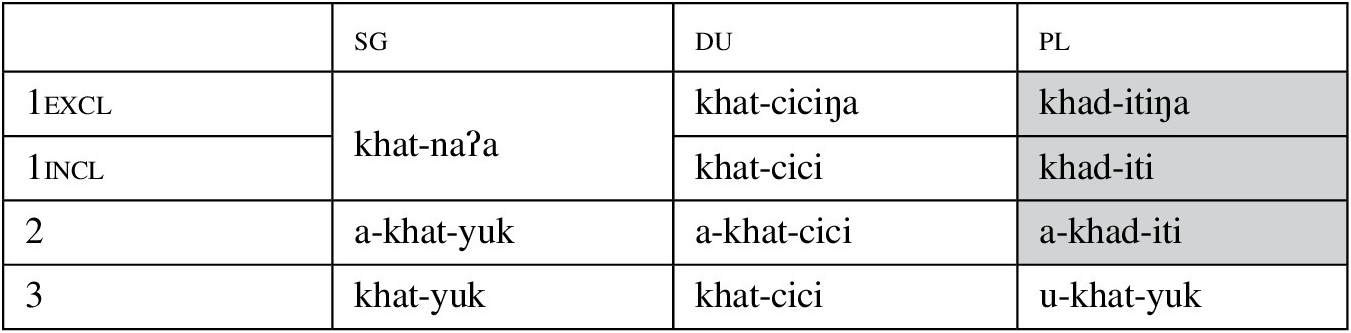
Paradigmatic distribution of the prevocalic stem in non-past transitive verbs.
This shared structure, however, is not merely due to the preservation of the same paradigms across all these languages. As a matter of fact, many suffixes have been replaced, lost or changed beyond recognition in the history of these languages. For example, the 3sg intransitive suffix is -yuk in Athpariya, -no in Chintang, -meʔna in Yakkha, -ni in Yamphu, and -Ø in Limbu, Bantawa, and Puma. The 3sg transitive suffix (with a 3sg object implied) is -utu in Athpariya, -oko in Chintang, -wana in Yakkha, -uni in Yamphu, -u in Limbu and Bantawa, and -i in Puma. The 1sg intransitive suffix is -naʔa in Athpariya, -maʔã in Chintang, -meŋna in Yakkha, -ʔɛ in Limbu, -ŋani in Yamphu, and -ŋa in Bantawa and Puma.
Comparable variation is found in the prefixes. The second person prefix is a- in Chintang and Athpariya, Ø- in Yakkha and Yamphu, kɛ- in Limbu, tɨ- in Bantawa, and tʌ- in Puma. The 3pl intransitive prefix is u- in Athpariya and Chintang, ŋ- in Yakkha, mɛ- in Limbu, Ø- in Yamphu, mɨ- in Bantawa, and mʌ- in Puma. The 3pl transitive prefix is o- in Athpariya, u- in Chintang, n- in Yakkha, mɛ- in Limbu, Ø- in Yamphu, ɨ- in Bantawa, and pʌ- in Puma.
The presence of many different (non-cognate) affixes in these languages necessarily means that formatives have been lost, acquired, replaced and/or changed independently in the history of these individual languages. Thus, the fact that the paradigmatic distribution of Tables 50 and 51, as well as phonological conditioning, have been preserved in the daughter languages is a most perplexing finding. Despite all the changes that have been happening in the inflectional paradigms, vowel-initial suffixes have continued to be vowel-initial and consonant-initial (or zero/Ø) suffixes have remained consonant-initial or zero.Footnote 13 This is not the case with the prefixes. Observe how the three mentioned above (e.g. the addressee prefix, consider Athpariya a- vs. Limbu kɛ-) contain both vowel- and consonant-initial variants in East Kiranti. This must be because whatever is constraining the possible changes and variants in suffixes does not operate in prefixes. This force can be no other than the phonologically conditioned stem alternation. My take on these developments is, thus, that the paradigmatic pattern observed in these languages’ verbal stems must be being learnt by language users of and by itself; that is, independently of the actual forms of the inflectional affixes themselves. This is the only way, in my opinion, to explain the stability of the pattern in the presence of so many affixal changes.
It seems that the prevocalic versus preconsonantal form of the stem in a particular cell poses a constraint on the kind of changes or suffix substitutions that may take place in the language. Thus, for example, a vowel-initial suffix may be disfavoured as a replacement for a consonant-initial suffix. Imagine, thus, that the dual transitive suffix -cucu were replaced by the suffix -utu in Table 51 (e.g. lem-cucu > lem-utu). That change would require a further change (i.e. lem-utu > lems-utu) if phonological conditioning of stem alternation were to be preserved in the language. This might make changes like this one less inconspicuous and thus disfavoured compared to other more structure-preserving changes.
It is my contention, thus, that there is after all, in East Kiranti languages, a morphomic paradigmatic pattern that is being acquired and interiorized as part of the grammar despite this being completely redundant in principle. The form of each individual suffix (i.e. /naʔa/, /juk/, etc.) has to be learnt no matter what. The paradigmatic extension of stem alternation can be derived straightforwardly from the form of the suffixes and, as such, the independent acquisition of the paradigmatic patterns in Tables 50 and 51 is entirely superfluous. However, the diachronic changes which are found across East Kiranti require that these patterns be learnt on their own and construed as grammatically relevant.
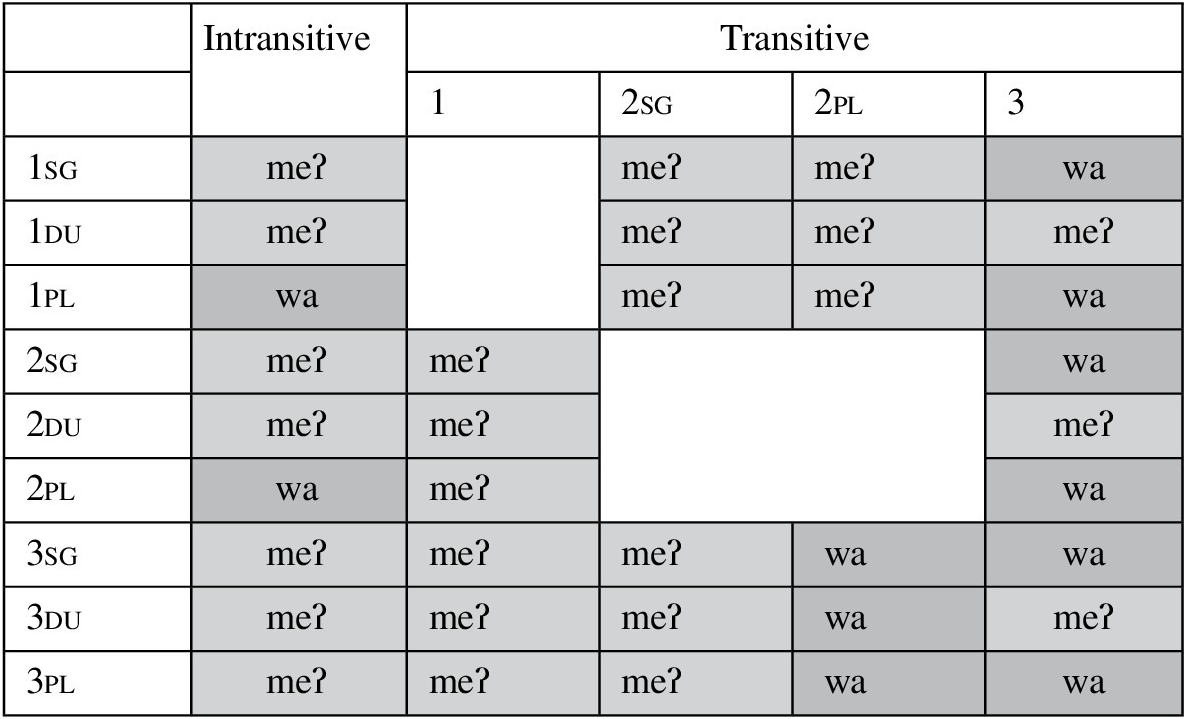
Particularly striking in this respect is the situation in Yakkha (see Tables 5 and 6, and Schackow Reference Schackow2016: 230–231). In this language, a suffix -meʔ has intruded into all and only those non-past cells that have a preconsonantal stem. Conversely, a suffix -wa has intruded into all and only those non-past cells that have prevocalic stems across East Kiranti. As Schackow (Reference Schackow2016: 230-231) explains, these suffixes (Table 52) go back ultimately to verbs,Footnote 14 which grammaticalized into the tense markers we find synchronically. This allomorphic distribution can only be explained if the paradigmatic patterns highlighted in Tables 50 and 51 above are acquired and integrated as part of the synchronic grammar and not if they are simply derived from the phonological shape of the suffixes.
Paradigmatic distribution of non-past allomorphs in Yakkha (Schackow Reference Schackow2016: 232).
It must remain clear that with this observation I am not denying the synchronic relevance of the phonological context in the paradigmatic distribution of stem alternation in these languages. Automatic phonological adjustment of a single stem root is out of the question in many cases.Footnote 15 However, the correlation of phonological environment and stem alternation is quite clearly still relevant synchronically. This is suggested by the fact that the two go hand-in-hand in the sparse cases (e.g. in the 1pl.incl non-past in Limbu intransitive verbs (Table 7), or in 3pl non-past in Bantawa and Puma transitive verbs (Tables 14 and 16)) where change does happen in the paradigmatic distribution of the alternation.
The traditional interpretation of phenomena like this has been that the change in the suffix somehow triggers or causes the change in the stem. This is because it is frequently assumed that, when a phonological environment and a stem alternant are co-extensive in synchrony, it is the former that is responsible for, or ‘conditions’, the latter. This is obviously the reason why the phenomenon is referred to as ‘phonological conditioning’ in the first place.Footnote 16 This seems to me to be an entirely unfounded assumption, however, and based on theoretical desiderata (e.g. that stems should not serve as grammatical exponents (see Spencer Reference Spencer, Luís and Bermúdez-Otero2016) or that all morphology is ‘really’ concatenative (Bye & Svenonius Reference Bye, Svenonius and Trommer2012)) rather than on empirical evidence alone. What we observe in Kiranti, for example, is that, in some cases, the irruption of a new suffix into the paradigm (e.g. non-past -ʔi in Yamphu, see Table 11), causes the stems to shift (to their preconsonantal form in this particular instance), and in other cases (e.g. the Yakkha non-past discussed in Table 52) it is the stem alternation pattern which provides the motivation (the ‘morphological niche’ in terms of Lindsay & Aronoff Reference Lindsay, Aronoff, Hathout, Montermini and Tseng2013) for the distribution of suffixes.
In either case, the coextensivity of stem alternation and a phonological environment has been actively perpetuated. It appears to be a desirable trait, therefore, which may be the reason why it has been preserved in all these East Kiranti languages even in the face of quite radical morphological and phonological changes. Whether it is the form of suffixes that produces the stem alternation pattern or the stem alternation pattern that affects the form of the suffixes, however, is a false dilemma, since influence is, as we have seen, bidirectional. Co-extensivity with a coherent phonological environment, thus, does not detract from the grammatical/morphological status of a pattern of stem alternation. In agreement with Maiden (Reference Maiden, Bowern, Horn and Zanuttini2017), the evidence of East Kiranti suggests that morphomicity and so-called ‘phonological conditioning’ are not mutually exclusive. If anything, it seems that, quite on the contrary, occurrence in a coherent phonological environment makes a particular stem alternation pattern more salient and resilient in language change.
Thus, the similarity/identity of the phonologically-conditioned stem alternations in East Kiranti contrasts with the heterogeneous nature of morphological stem alternations in West Kiranti. The only (mildly) recurrent pattern (Table 53) is that of a longer or augmented stem occurring in the third person and the singular forms. This appears in Sunwar (Table 24), Dumi (Table 39), Koi (Table 47) and Jerung (Table 48). Kulung (Table 20) and Wambule (Table 49) show similar patterns. Sometimes, however, it is not entirely clear whether (or which of) these structures are cognate, since they differ very substantially in their details (e.g. the tense where they appear and the forms that instantiate them). Even clearly cognate patterns in West Kiranti like those of closely related Jerung (Table 48) and Wambule (Table 49) have been found to differ in their paradigmatic extension, which means that change has happened in relatively short timescales.
Paradigm of Jerung ‘give’ (gɔkt- go-) (Opgenort Reference Opgenort2005: 330).
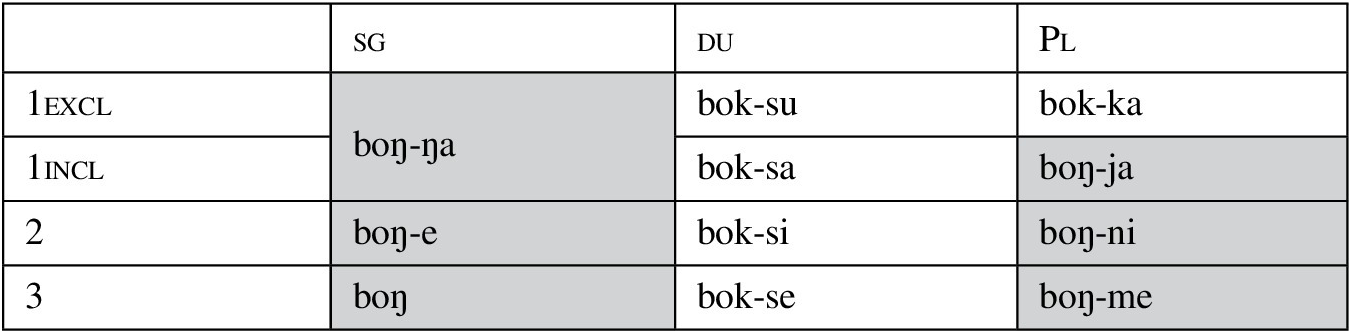
There is also another pattern which, the same as the previous one, appears with small differences in a number of West Kiranti languages. This involves the nasalization of stem-final stops. In Bahing, it has the paradigmatic extension highlighted in Table 54. In Wayu (Table 32), by contrast, the nasal stem occurs in the past, and only in the 2/3sg and 2/3pl. In Khaling (Table 33 and Table 36), various alternations involve nasal-final stems alternating with stops. They can be found, in both past and non-past, in various cells of the singular and the plural but never with the same distribution as in the other languages. In Thulung (Table 43), the nasal stem appears, mostly in the present, with a seemingly erratic distribution which paradoxically involves all the dual cells. Dumi, for all its complexity, does not appear to make use of stem-nasalization at all. The only possible conclusion, I believe, is that, unlike in East Kiranti, there do not seem to exist many generalizations available concerning stem alternations in West Kiranti.
Paradigm of Bahing ‘rise’ (bok- boŋ-) non-past, intransitive (Michailovsky Reference Michailovsky1975: 189).
The diversity of paradigmatic stem alternation patterns in West Kiranti is, thus, significantly greater than in East Kiranti languages. Even the lowest-level subgroups in West Kiranti (i.e. Koi/Thulung, Khaling/Dumi, Sunwar/Bahing/Wayu and Jerung/Wambule, see Figure 2) show internal diversity comparable to (and usually greater than) East Kiranti as a whole. Particularly relevant is the comparison of Sunwar and Bahing (Tables 26 and 29), and of Jerung and Wambule (Tables 48 and 49). These languages appear to be among the closest, genetically, in the whole of Kiranti (93% lexical similarity according to Opgenort Reference Opgenort2005)Footnote 17 and yet their cognate paradigms still show differences in the distribution of the stem alternants. The antiquity and progression of the branching of both subfamilies is currently very uncertain. However, based on our current state of knowledge and on the similarities and differences in the forms of inflectional suffixes, there is no reason to believe that this difference in the diversity of stem alternations is solely due to the greater antiquity of (the branching of) West Kiranti. The greater internal variation within West Kiranti alternation patterns, thus, would need additional explanation.
I contend here that the absence of a phonologically coherent environment around West Kiranti stem alternations may be the factor that has made the patterns comparatively more vulnerable to paradigmatic modification (i.e. analogy), or to disruption by other forms and sound changes. This may also explain similar developments in more well-studied language families like Romance. There we find, in languages like Spanish, Portuguese or Italian, that the morphomic patterns of stem alternation in verbs are quite stable, and distributionally largely unchanged from the ancestral language. Also in these languages, the phonological environments that originally created the alternations (stress, and a front- vs. back-vowel suffix) remain in place and with an identical paradigmatic distribution as the stem alternations themselves. In French, however, where these phonological environments have disappeared, the inherited alternations have disintegrated or have changed beyond recognition (see Esher Reference Esher2017). Although cases can be found where the original conditioning environment and the stem alternation pattern have become dissociated (e.g. Benasque Aragonese, Saura Rami Reference Rami and Antonio2003), it is more common for them to lead parallel lives, even when they change their paradigmatic distribution (see e.g. Surmiran, Anderson Reference Anderson2008).
6. Conclusion
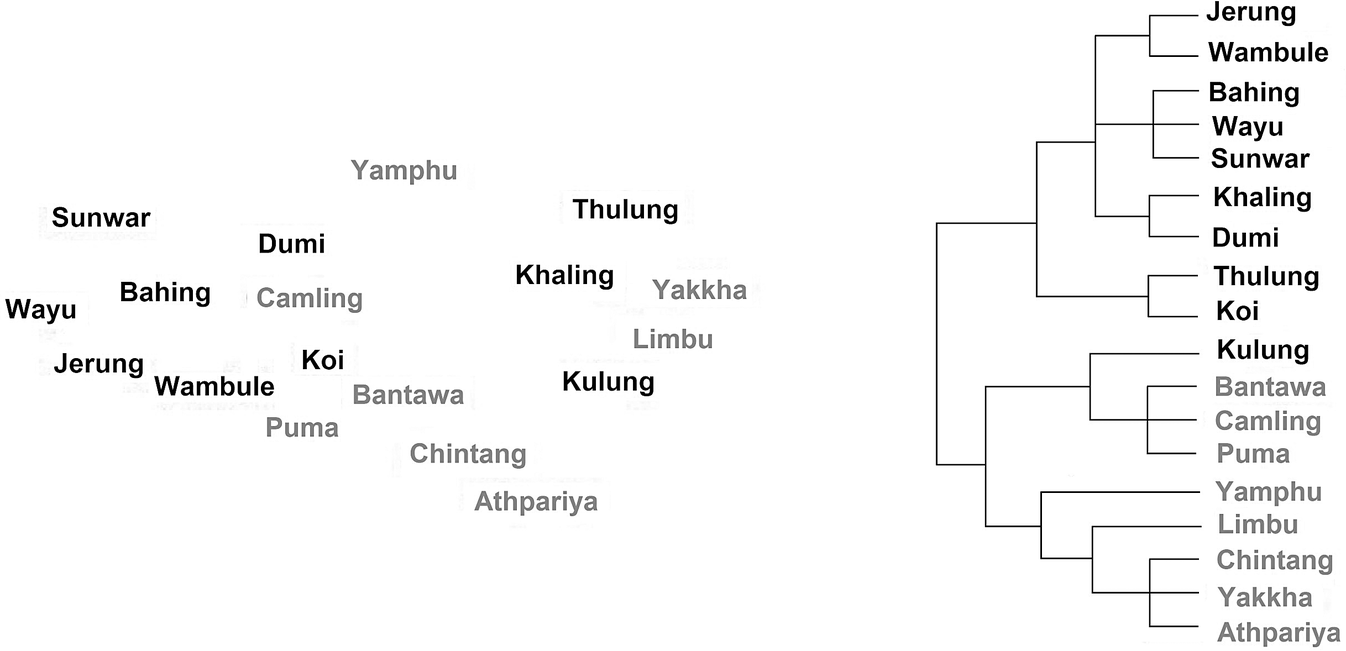
This paper has presented an overview of (consonantal) stem alternations in Kiranti verbal inflection. The broadest finding to emerge from it is the existence of a split in the family between those stem alternation systems that correlate with a coherent phonological environment (i.e. with consonant- vs. vowel-initial suffixes) and those that do not.
Areal (left) and genealogical (right) distribution of phonologically-conditioned (grey) and unconditioned (black) stem alternations in Kiranti.

This broad divide is seen in Figure 3 to correspond very closely to the genetic subdivisions within the family (phonological conditioning in East Kiranti vs. lack thereof in West Kiranti) and much less so to geographic or areal divisions (contra Ebert Reference Ebert, Thurgood and LaPolla2003). This is thus an important trait to consider in the field of Kiranti (and/or Trans-Himalayan phylogeny (see e.g. Gerber & Grollmann Reference Gerber and Grollmann2018).
Besides this one, the most interesting observation is that, in those languages where stem selection can be described in terms of phonological conditioning, the paradigmatic extension of the alternation patterns is virtually identical. A prevocalic form of the stem is found in intransitive verbs across East Kiranti, in the 1pl and 2pl of the non-past and in all cells of the past. In transitive verbs (with 3sg patient), that stem is found in the sg and pl forms of the non-past and throughout the past.
The few deviations that can be found from this family-wide pattern show us that the correlation between stem selection and the form of the suffixes continues to be synchronically relevant. However, the remarkable stability of the patterns (even in the presence of extensive affixal changes), as well as some of the diachronic developments (most notably that of Yakkha -me(ʔ) vs. -wa) suggest that these stem alternation patterns constitute a (morphomic) grammatical entity of their own. That is, despite stem selection being straightforwardly derivable in these languages from the forms of suffixes, stem alternation patterns are able, in turn, to have a say in the form of suffixes. Thus, phonological environment and stem alternation appear to ‘team up’ to make the patterns more salient and diachronically resilient in East Kiranti. By contrast, in West Kiranti, where stem alternation patterns cannot be associated with any phonological environment, the paradigmatic distribution of stem alternations is much more diverse synchronically, which suggests that the patterns are less resilient diachronically.
These findings have implications for our assumptions concerning morphomes in particular and morphology in general. Concerning the latter, it suggests that (some) cases of so-called ‘phonological conditioning’ should not be understood as one-directional determinations of the form of one exponent (the stem) by the other (the suffix). In Paradigm Function Morphology (PFM; Stump Reference Stump2001), for example, a stem alternation that correlates with different phonological environments would be formalized by means of a rule (called a ‘morphological metageneralization’ by Stump Reference Stump2001: 189) that refers back to the suffixes. Because the rules have to be ordered and because the lexicon should be free of redundancies, the East Kiranti data are problematic for PFM and for constructive approaches to morphology more generally.
These issues would not even arise, of course, in morphological models that do not rely on segmentation at all. In abstractive models, for example, the basic unit of analysis is the word. While derivation is the key notion in constructive approaches, predictability is the backbone of abstractive ones (Blevins Reference Blevins2006: 537). Because of the focus on whole words, predictability has been explored in these models almost exclusively in paradigmatic terms (i.e. predictability of one whole word form or paradigm cell on the basis of another). While it must also play a role in East Kiranti,Footnote 18 this type of predictability seems to be much less important here than in more morphologically irregular languages.
Another (much less researched) domain of predictability appears to play a bigger role in East Kiranti languages. As explained throughout this paper, at the syntagmatic level, the C- versus V-initial nature of the suffix is a perfect predictor of the form of the stem. The same thing can be stated, however, ‘from left to right’: in alternating stems, the form of the stem is a perfect predictor of the C/Ø vs. V form of the following suffix. This might seem a relatively unhelpful predictability intuitively, but has been seemingly reinforced and made less abstract in Yakkha, as stem alternants no longer predict only the phonotactic shape of the suffixes there but also their concrete segmental form. Because of the time-dependent nature of human language, syntagmatic predictability must be more relevant (e.g. for processing) ‘from left to right’ (i.e. from stem to suffix) that ‘from right to left’, as only what has been already heard/seen can logically be used to make inferences of any kind about what is still to come. This obvious fact has been hypothesized (see Diessel Reference Diessel2019: 78) to be the source of the suffixing preference in languages, and might also explain the tendency, observed in East Kiranti to preserve and even reinforce stem-to-suffix predictive relations.
Apart from these implications for theoretical morphological models, the East Kiranti facts also illustrate how the domains of phonology and morphology overlap often in non-trivial ways so that phonologically-derivable patterns do not necessarily fall outside the domain of morphology nor stay always paradigmatically underlearned (see Morin Reference Morin1988).Footnote 19 Concerning morphomes more particularly, the evidence from Kiranti suggests that the synchronic correlation (and, furthermore, the synchronic dependency) of a pattern of stem alternation and a particular phonological environment does not detract from the status of stem alternation as a self-standing morphological/morphomic phenomenon in the language.
The most usual definitions of what a morphome is (e.g. O’Neill Reference O’Neill, Cruschina, Maiden and Smith2013: 228–229; Maiden Reference Maiden2018: 24)Footnote 20 and also the disagreements on whether some stem alternation pattern should be considered morphomic or not (e.g. Anderson Reference Anderson, Goldbach, Hinzelin, Maiden and Smith2011 vs. Maiden Reference Maiden, Goldbach, Hinzelin, Maiden and Smith2011) have often revolved around the independence of that pattern from concrete phonological environments. The evidence from Kiranti suggests that, maybe surprisingly, some of the most typical quasi-definitionalFootnote 21 characteristics of morphomes such as diachronic resilience, productivity, and psychological reality seem to be enhanced, rather than diminished, in situations of phonological conditioning.
Although consistent with some of the literature (e.g. Esher Reference Esher2017), these findings contradict some frequently held assumptions about morphomes. On the basis of what he observes in Romance, Maiden (Reference Maiden2018: 6), argues that ‘morphomic distributions emerge as seemingly no less highly valued than those that appear to have phonological or semantic conditioning’. This is at odds with the Kiranti facts that have been presented here, where morphology-only stem alternation patterns (West Kiranti) appear to be less stable (and thus probably less productive and less psychologically real – recall footnote 14 above) than phonologically-conditioned stem alternations (East Kiranti).
On the basis of these Kiranti facts, the inevitable conclusion is that the properties of diachronic resilience, productivity, and psychological realityFootnote 22 are enhanced when phonology and morphology agree upon the same pattern. This stands to reason. Because these stem alternations will be able to rely on this extra cue or niche (Aronoff Reference Aronoff, Iacobini, Elia and Voghera2016), this should translate into more robust, more predictable, more learnable, and more stable patterns. As argued by Enger (Reference Enger2014), ‘two cues may be better than one’ (see also Herce Reference Herce2020b). Future research should be aimed at assessing whether (and/or how much) a morphological pattern’s coextensiveness with a coherent semantic or functional value also favours its learnability, stability and survival.