Introduction
Defining species is a difficult task and a variety of concepts are discussed in the scientific community. Species can further be subdivided into intraspecific units sharing specific traits. The subspecies is the lowest officially accepted taxonomic category regulated by the International Code of Zoological Nomenclature (International Commission on Zoological Nomenclature 1999). However, other terms have been used extensively by taxonomists (Mayr and Ashlock Reference Mayr and Ashlock1991). Within insects, for referring to interbreeding groups founded by a single ancestor and sharing phenotypic characters, and especially molecular traits, the term “strain” is sometimes used (Gotoh et al. Reference Gotoh, Bruin, Sabelis and Menken1993; Tabashnik et al. Reference Tabashnik, Carrière, Dennehy, Morin, Sisterson and Roush2003; Gould and Schliekelman Reference Gould and Schliekelman2004). Researchers have used different specifiers to define strains, e.g., climatic strains (Summers Reference Summers1998), race, or biotype (Hsaio Reference Hsiao1996) with biological differences in each geographic area. While strain is a typical term in the study of microbes and also for pest species, it is generally less commonly used in higher organisms, where the term lineage is more accepted. In this study, we use the terms strain and lineage synonymously.
Anthropogenic changes in species distributions have dramatically increased during the last century (Olden et al. Reference Olden, Poff, Douglas, Douglas and Fausch2004). The translocation of agricultural products might result in the introduction of invasive pests to new localities. In addition to negative effects to the economy, invasive species may change natural communities of native biota (Oliver Reference Oliver2006) or lead to the coexistence of multiple intraspecific mitochondrial lineages at the same time. Further, invasive populations may evolve quickly as a result of severe founder effects and new lineages can appear within short periods of time (Gould Reference Gould1991). The alfalfa weevil is a good example of an invasive pest with several strains found across its worldwide distribution.
The alfalfa weevil (Hypera postica (Gyllenhal); Coleoptera: Curculionidae) is a common pest of alfalfa (Medicago sativa Linnaeus; Fabaceae) (Summers Reference Summers1998; Sanaei et al. Reference Sanaei, Seiedy and Momtazi2015a). This weevil is a species autochthonous in the Palaearctic region (Skuhrovec Reference Skuhrovec2013), but was accidently introduced to other continents and geographic regions. Several introductions are well documented with examples from its Nearctic introduction in 1904 (Titus Reference Titus1909) and in Japan in 1982 (Kuwata et al. Reference Kuwata, Tokuda, Yamaguchi and Yukawa2005). Our knowledge on the biogeography of the species, despite its economic importance, is limited. So far, only three North American and Japanese strains have been characterised. The North American strains were first described by morphological (Pienkowski et al. Reference Pienkowski, Hsieh and Lecato1969; Bland Reference Bland1984) and ecological traits (Dewitt and Armbrust Reference Dewitt and Armbrust1972; Litsinger and Apple Reference Litsinger and Apple1973; Coles and Day Reference Coles and Day1977), and later studied with molecular markers further supporting their divergence (Erney et al. Reference Erney, Pruess, Danielson and Powers1996; Kuwata et al. Reference Kuwata, Tokuda, Yamaguchi and Yukawa2005; Böttger et al. Reference Böttger, Bundy, Oesterle and Hanson2013). However, we still have no data from many geographic regions, where the weevil is common, suggesting that additional geographic lineages remain undiscovered. In addition, the phylogenetic relationships between North American/Japanese strains, their distributions, as well as genetic variation in other parts of the world are unknown. The description of divergent lineages, however, is crucial, as such lineages often show pronounced ecological differences (e.g., North American strains), specific in their response to pest management strategies (e.g., to parasitoids (Hsaio Reference Hsiao1996) and pathogens (Radcliffe and Flanders Reference Radcliffe and Flanders1998). Hence, an accurate and quick identification of strains is fundamental for efficient integrated pest management (Böttger et al. Reference Böttger, Bundy, Oesterle and Hanson2013).
Even though there are some challenges and discussions about the use of mitochondrial DNA (mtDNA) for population genetic studies (Song et al. Reference Song, Buhay, Whiting and Crandall2008; Galtier et al. Reference Galtier, Nabholz, Glémin and Hurst2009), it is still commonly used as a marker for species identification (barcoding) (Hebert et al. Reference Hebert, Ratnasingham and de Waard2003) and to detect inter-population differentiation (Croll et al. Reference Croll, Wille, Gamper, Mathimaran, Lammers, Corradi and Sanders2008; Stockle and Hebert Reference Stockle and Hebert2008; Pons et al. Reference Pons, Fujisawa, Claridge, Savill, Barraclough and Vogler2011; Husemann et al. Reference Husemann, Ray, King, Hooser and Danley2012). In the case of H. postica, mtDNA was first used in 1996 to understand the divergence of North American strains (Erney et al. Reference Erney, Pruess, Danielson and Powers1996; Hsaio Reference Hsiao1996). At the same time Hsaio (Reference Hsiao1996) introduced the Xinjiang and Budapest strains based on mtDNA. Kuwata et al. (Reference Kuwata, Tokuda, Yamaguchi and Yukawa2005) used partial COI sequences to distinguish North American, Japanese, Xinjiang, and Budapest strains and determined their phylogenic relationships; this work indicated that two lineages coexist in Japan, which were categorised as western and Egyptian/eastern strains. Finally, Böttger et al. (Reference Böttger, Bundy, Oesterle and Hanson2013) illustrated that, while nuclear loci are unable to separate the North American strains, COI sequences can distinguish these strains reliably. The lack of resolution of nuclear loci and the power of mitochondrial markers suggests a recent separation of the North American strains (Böttger et al. Reference Böttger, Bundy, Oesterle and Hanson2013). In a recent study on Japanese strains, the results of nuclear and mitochondrial markers were incongruent as well (Iwase et al. Reference Iwase, Nakahira, Tuda, Kagoshima and Takagi2015a). Hence, in summary, currently two distinct lineages (western and Egyptian/eastern) can be distinguished reliably in North American and Japanese populations.
Despite the economic importance of the alfalfa weevil in the western Palaearctic (Kuwata et al. Reference Kuwata, Tokuda, Yamaguchi and Yukawa2005; Yardim et al. Reference Yardim, Yilmaz, Arvas and Candan2006; Skuhrovec Reference Skuhrovec2009; Coskuncu and Gencer Reference Coskuncu and Gencer2010; Khanjani Reference Khanjani2012; Sanaei et al. Reference Sanaei, Seiedy and Momtazi2015a), little is known about the genetic identity and relationships of European populations of the species. The central Palaearctic and the Middle East have been suggested as the origin of alfalfa (Moradi-Vajargah et al. Reference Moradi-Vajargah, Golizadeh, Rafiee-Dastjerdi, Zalucki, Hassanpour and Naseri2011) and accordingly it is likely that the origin of H. postica traces back to this region as well. The species is the most important pest in Iranian alfalfa fields and has a wide distribution in this country (Khanjani and Pourmirza Reference Khanjani and Pourmirza2004; Sanaei et al. Reference Sanaei, Seiedy and Momtazi2015a). A recent morphological and geometric morphometric study indicated a weak divergence between Iranian populations (Sanaei et al. Reference Sanaei, Seiedy and Momtazi2015a). Hence, we were interested to test if the Iranian populations are genetically diverged and how they are related to European populations. To determine patterns of genetic diversity and differentiation of Iranian populations, we analysed partial sequences of the mitochondrial COI gene for four Iranian populations (three western and one eastern population) and compared them to two European populations (Czech Republic and Poland). We further compared our data to preciously published sequences from North American/Japanese populations to gain a better perspective on the global diversity patterns of the species.
Material and methods
Sample collection and DNA extraction
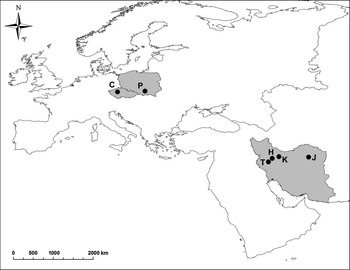
Specimens of H. postica were sampled during several field trips between 2011 and 2014. (Fig. 1, Table 1). Samples were first preserved in 96% ethanol and stored in a freezer at −20 °C until further processing. Four individuals per population were used for analyses. DNA was extracted from whole insect bodies using the Nucleospin Tissue kit (Macherey-Nagel, Düren, Germany). Amplification of a fragment of the mitochondrial cytochrome oxidase gene subunit I (COI) was performed using primer pairs C1-J-2183 and TL2-N-3014 (Simon et al. Reference Simon, Frati, Beckenbach, Crespi, Liu and Flook1994). The cycling profile for polymerase chain reactions was: 95 °C for four minutes, 35 cycles of 95 °C for 30 seconds, 50 °C for one minute, 72 °C for two minutes, and a final extension period of 72 °C for 10 minutes. Polymerase chain reaction products were purified using the (NucleoSpin gel and PCR clean-up kit, Macherey-Nagel) and sequenced using the Big-Dye Terminator v.3.1. Cycle Sequencing Kit (Applied Biosystems, Foster City, California, United States of America). Cleaned products were run on an ABI 3100 Automated Capillary DNA Sequencer (Gnomed, Warsaw, Poland).
Sampling locations in Iran (J, Jovein; K, Karaj; H, Hamedan; T, Tuyserkan) and Europe (P, Poland; C, Czech Republic).

Sampling list describing the sampling localities, coordinates, elevation, and date of collection; letter codes correspond to codes in figures.

Molecular analysis
We generated a total of 24 new sequences from six populations from Iran, Czech Republic, and Poland. All new sequences were deposited in GenBank (accession numbers KU236457–KU236472). Additionally, we used homologous sequences available in GenBank for H. postica from United Kingdom: HQ165561, H. miles (Paykull): HQ165603, H. conmaculata (Herbst): HQ165563, H. venusta (Fabricius): HQ165099, H. rumicis (Linnaeus): DQ155880, and H. nigrirostris (Fabricius): HQ164687. Sequences were checked and aligned using Bio-Edit v.7.0.5.2 (Hall Reference Hall1999) and ClustalX (Thompson et al. Reference Thompson, Higgins and Gibson1997). No indels or stop codons were observed in mtDNA fragments. Genetic diversity was assessed using DnaSP v.5.10 (Librado and Rozas Reference Librado and Rozas2009): we calculated base content, variable, and parsimony informative sites, nucleotide diversity, and haplotype diversity across the whole data set and for each population separately. Arlequin v. 3.5.1.2 (Excoffier and Lischer Reference Excoffier and Lischer2010) was used to estimate genetic divergence as pairwise genetic distances determining significance using 110 permutations.
We used two methods for phylogenetic reconstruction: maximum likelihood (ML) in RaxML Blackbox 8.1.11 (Stamatakis Reference Stamatakis2014) on the CIPRES Science Gateway v. 3.3 (Miller et al. Reference Miller, Pfeiffer and Schwartz2010) and the Bayesian approach implemented in MrBayes v. 3.2.1 (Ronquist and Huelsenbeck Reference Ronquist and Huelsenbeck2003). First we estimated the most suitable model of sequence evolution using MrModeltest v.2.3 (Nylander Reference Nylander2004). Using AIC we determined the GTR+I model to be most suitable for our data. The model was used for both analyses. MrBayes was run for 10 million generations sampling every 1000 generations yielding a total of 10 000 trees. Convergence was checked using the average standard deviations of split frequencies, which were below 0.005. We discarded a burn-in of 2500 trees (25%) and summarised the remaining trees using TreeAnnotator (Drummond et al. Reference Drummond, Suchard, Xie and Rambaut2012). The maximum likelihood analysis was performed with RaxML Blackbox on the CIPRES Science Gateway. Node support was assessed using bootstrapping for maximum likelihood and posterior probabilities (pp) for the Bayesian approach. Trees were visualised with Figtree v.1.3.1 (Rambaut and Drummond Reference Rambaut and Drummond2010). In addition, SplitsTree4 v. 4.11.3 (Huson and Bryant Reference Huson and Bryant2006) was used to construct a NeighborNet with equal angle representation. For this all outgroups were excluded.
We used the web application ABGD web service (Puillandre et al. Reference Puillandre, Lambert, Brouillet and Achaz2012) to determine the number of molecular operational taxonomic units (mOTU) in our data set. For this we excluded all outgroup taxa. The aligned data were used as input for ABGD under the default settings.
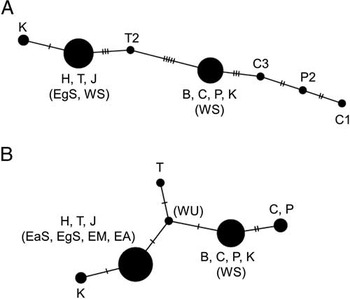
Finally, to provide a broader context for our data we generated two minimum spanning networks (Bandelt et al. Reference Bandelt, Forster and Röhl1999) with PopArt v. 1.7. (http://popart.otago.ac.nz) using 116 base pairs (HQ165561, AB159502, AB159507, AB159508, AB159501, AB159503, AB159505, AB159504, AB159506) and 60 base pairs (HQ165561, AB159502, AB159507, AB159508, AB159501, AB159503, AB159505, AB159504, AB159506, JX150995, U61177, JX150993, JX150994, U61175, U61176) of overlapping sequences from our data and additional sequences obtained from previous studies (Erney et al. Reference Erney, Pruess, Danielson and Powers1996; Kuwata et al. Reference Kuwata, Tokuda, Yamaguchi and Yukawa2005; Böttger et al. Reference Böttger, Bundy, Oesterle and Hanson2013).
Results
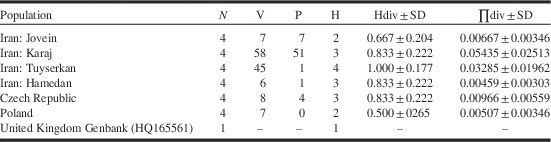
After trimming of ambiguous sequence ends an alignment of 690 base pairs (COI) was generated. No indels were observed. The most diverse populations were the ones from Karaj and Tuyserkan with three and four haplotypes, and 58 and 45 variable sites, respectively (Table 2). Polish and Czech Republic populations were much less variable with seven and eight polymorphic sites, respectively. The Polish population had two haplotypes and the Czech Republic population three haplotypes. Genetic distances were mostly significant (besides comparisons to the United Kingdom haplotype, due to a lack of power resulting from low sample size) (Table 3). Besides this, the comparison between the two European samples from Poland and the Czech Republic was non-significant. Further, the comparisons of Karaj and Tuyserkan and Hamedan and Tuyserkan were not significant.
Basic statistics of genetic diversity for the sampled populations and their genetic diversity.
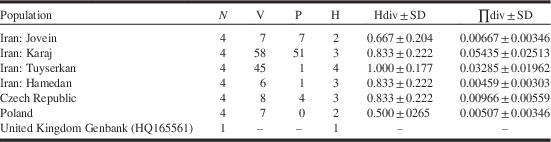
Notes: V, variable sites; P, parsimony informative sites; H, haplotype number; Hdiv, haplotype diversity; ∏div, nucleotide diversity; SD, standard deviation.
The length of sequences was 690 base pairs.
Pairwise genetic differences (below diagonal) between study locations and their significance (above diagonal) as estimated from 110 permutations in Arlequin; significant comparisons are marked bold.

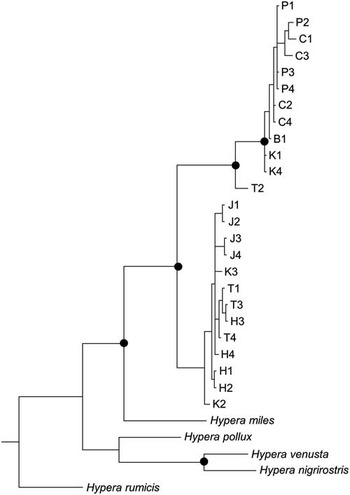
The two phylogenetic trees generated using maximum likelihood and Bayesian inference yielded similar results (Fig. 2). Hypera postica formed a well-supported monophyletic clade. Within the H. postica clade two subclades were formed, one of which was well supported. This strongly supported clade consisted of all European populations, but included also samples from Iran (individuals from Karaj and Tuyserkan). Within this clade the individual T2 from Tuyserkan diverged from the rest of the samples and represents the basal individual to that group. All other individuals from Iran grouped in another subclade with lower support (<95% bootstrap, 0.95 posterior probabilities). No subgroups within the two main lineages were detected.
Phylogenetic tree of Iranian and European populations of Hypera postica based on COI sequences; other Hypera species served as outgroups. The black circles represent nodes supported by both bootstrap values above 95 from maximum likelihood analysis and posterior probabilities above 0.95 from Bayesian analysis; abbreviations as in Figure 1 and Table 1, numbers after country codes relate to the individual number.

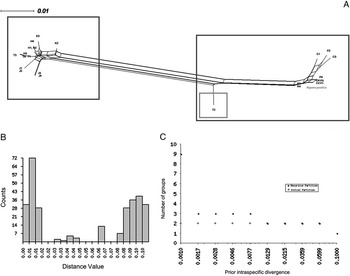
The unrooted Neighbornet supports the same pattern with a divergence into two large groups with the individual T2 being somewhat intermediate between the two groups, but with an affinity to the clade including all European samples (Fig. 3A). The ABGD analysis detected a clear barcoding gap (Fig. 3B) and provides further support for the main split. The programme suggests two molecular operational taxonomic units across the initial partition and for prior intraspecific divergence above 0.01 also for the recursive partition (Fig. 3C). For lower intraspecific divergence values a third mOTU represented by individual T2 was suggested.
(A) Neighbornet for Hypera postica sequences, two molecular taxonomic units inferred with ABGD are marked by dark grey boxes. The individual T2 may represent a third molecular taxonomic unit, this additional mOTU is visualised with a light grey box in the network; (B) shows the frequency of divergence classes across all samples derived from ABGD; a clear barcoding gap was discovered; (C) the numbers of groups detected by ABGD depending on the prior intraspecific threshold, the number of groups converges to two when an intraspecific threshold between 0.01 and 0.1 is used; when a lower threshold is used the recursive partition suggests three mOTUs.

Distances between other Hypera species were in the range of 10–16%. The distance between Hypera postica haplotypes and phylogenetically closest H. miles was 9–13%. Distances between haplotypes from Czech Republic and Poland were only up to 1%, similar to the distance found between Polish-Czech Republic haplotypes and those from individuals K1 and K4; individual T2 showed 4–5% divergence from these. Similarly low (up to 1%) distances were found in the purely Iranian clade. High distances were observed between the two main groups (between 8% and 11%).
The minimum spanning network for the longer fragment (116 base pairs) resulted in seven unique haplotypes, which were distinguished by two to six mutations (Fig. 4A). The haplotypes from the Egyptian strain and a single sequence from the western strain grouped with samples from Hamedan, Tuyserkan, and Jovein whereas the remaining sequences from the western strain shared the same haplotype with samples from Britain, the Czech Republic, Poland, and Karaj. Two samples from Karaj had a unique haplotype, whereas two Czech Republic samples and a Polish sample represented unique haplotypes. For the shorter sequence fragment (60 base pairs) we identified six unique haplotypes differing by two to three base pairs (Fig. 4B). Again, two samples from Karaj shared a unique haplotype. Samples from Hamedan, Tuyserkan, and Jovein grouped with sequences annotated as eastern strain, Egyptian strain, eastern Maryland strain, and Egyptian Arizona strain. A sequence annotated as western Utah strain represented a unique haplotype, as well as a sample from Tuyserkan. Samples from United Kingdom, Czech Republic, Poland, and Karaj shared the sample haplotypes with additional sequences annotated as western strain. Further sequences from Czech Republic and Poland represented an additional unique haplotype.
Minimum spanning networks generated from (A) 116 base pairs of aligned sequences including additional sequences from Genbank; (B) from 60 base pairs of aligned sequences including all sequences available from Genbank. Abbreviations: sites from this study as in previous figures and tables; Genbank data in brackets: (EaS, eastern strain; EgS, Egyptian strain; WS, western strain; EM, eastern Maryland strain; EA, Egyptian Arizona; WU, western Utah strain).

Discussion
Mitochondrial lineage divergence of Hypera postica
In our study we detected two highly diverged molecular lineages potentially deserving species status. Similar findings in the past have indicated that H. postica is subdivided into several strongly diverged lineages or strains: Hsiao (1996) calculated an average of 2% mitochondrial sequence divergence between North American strains based on 1302 base pairs of mtDNA. Erney et al. (Reference Erney, Pruess, Danielson and Powers1996) estimated 1–5% divergence between North American strains. Kuwata et al. (Reference Kuwata, Tokuda, Yamaguchi and Yukawa2005) found 3.74% divergence in a 1177 base pair fragment of mtDNA between two Japanese haplotypes. The Egyptian strain containing samples from Japan, North America, China, and Europe has between 1% and 4% sequence divergence for a 290 base pair fragment of mtDNA to the western strain, which contained North American and Japanese samples (Kuwata et al. Reference Kuwata, Tokuda, Yamaguchi and Yukawa2005). Böttger et al. (Reference Böttger, Bundy, Oesterle and Hanson2013) found 0.4% divergence between eastern North American and Egyptian strains and 4.7% between western North American and Egyptian/eastern strains. In our study, we detected two lineages (mostly European and Iranian) with even higher divergence (8–12% differences) compared with differentiation observed between typical North American western and Egyptian/eastern strains (~4.7%). Such high divergence would justify species status for these lineages.
Our comparative analyses implementing published sequences based on 116 base pairs and 60 base pairs of overlapping sequence suggest that we sampled the western and the Egyptian strains in Iran. Interestingly, our results somewhat resemble the findings by Kuwata et al. (Reference Kuwata, Tokuda, Yamaguchi and Yukawa2005), who also detected these two strains within the same area in Japan. Based on the data of Kuwata et al. (Reference Kuwata, Tokuda, Yamaguchi and Yukawa2005), Bundey et al. (Reference Bundy, Smith, English, Sutton and Hanson2005), and Böttger et al. (Reference Böttger, Bundy, Oesterle and Hanson2013) and our findings (Fig. 4) we suggest that the Egyptian/eastern strain is more common in Asia, Eastern Europe, and the eastern parts of the United States of America, whereas the western strain is found mostly in western Europe and western parts of the United States of America. Interestingly, there are multiple locations where both strains co-occur, e.g., in Japan, North America, and parts of Europe. There is some evidence for reproductive barriers between western and Egyptian strains potentially based on cytoplasmic incompatibility (CI) caused by their Wolbachia (Rickettsiaceae) symbionts (Hsiao and Hsiao Reference Hsiao and Hsiao1985). Wolbachia is a strong speciation agent, which can promote population divergence within short periods of time (Werren Reference Werren1998; Telschow et al. Reference Telschow, Hammerstein and Werren2002; Kajtoch et al. Reference Kajtoch, Korotyaev and Lachowska‐Cierlik2012). Recently, it has been shown that European and Japanese populations of H. postica have different Wolbachia strains (Iwase et al. Reference Iwase, Tani, Saeki, Tuda, Haran, Skuhrovec and Takagi2015b); however, the genetic diversity of Wolbachia did not reflect the phylogenetic relationships of their hosts. Future analysis should aim at detecting potential reproductive barriers and ecological differences between the lineages to determine their taxonomic status.
The large genetic divergence of some Iranian H. postica (likely belonging to the eastern/Egyptian strain) to European samples and some other Iranian specimens (representing the western strain) (Fig. 4) suggest a separation above species level (>5%). Interestingly, Iranian specimens further display an additional level of variation from typical North American eastern strains. It is no novel finding, that Asian populations of widespread insects are highly distinct from their relatives in other parts of Palaearctic region. In this region, many distinct species or evolutionary units with unsolved taxonomic status have been described, especially within the insects of southwesteren Asia (e.g., Martinsen et al. Reference Martinsen, Venanzetti and Bachmann2009; Mutun Reference Mutun2010; Kajtoch et al. Reference Kajtoch, Kubisz, Gutowski and Babik2014). This area is known to be one of the most important biodiversity hotspots and also a glacial refugee for Holarctic taxa (Hewitt Reference Hewitt1999; Myers et al. Reference Myers, Mittermeier, Mittermeier, Da Fonseca and Kent2000; Bilgin Reference Bilgin2011). Unexpectedly, however, is the sympatric occurrence of multiple lineages at some locations (i.e., Karaj and Tuyserkan). Here, one lineage (resembling the Egytian strain) is found together with the otherwise European clade (western strain) or with a potentially unique clade related to the European clade (Tuyserkan). The divergence between both main clades is easily explained by the large geographic distances and barrier effects of mountain ranges and water bodies. The co-existence of both clades in Iran is less trivial, but may be explained by accidental anthropogenic translocations of individuals. Under this hypothesis two scenarios are possible. The European (western) lineage has a Middle Eastern origin, similar to the host plant, and was translocated to Europe together with the host plant. In this case, both lineages would have evolved within the Middle East, but must have been separated by other barriers. On the other hand, the clade may have evolved in Europe and subsequently was translocated to Iran where it now co-occurs with the native lineage. Similar anthropogenic translocations of European populations are responsible for the colonisation of North America by H. postica in the beginning of the last century (Titus Reference Titus1909). Alfalfa weevils were introduced to North America via at least three separate routes during 1904–1952 (Bundey et al. Reference Bundy, Smith, English, Sutton and Hanson2005), which have also led to the invasion by the Egyptian strain. Further, anthropogenic translocations are responsible for the introduction of western strains from North America to Japan in 1982 (Kuwata et al. Reference Kuwata, Tokuda, Yamaguchi and Yukawa2005).
Status of Iranian populations
In this study we examined four Iranian populations of the alfalfa weevil. The populations were genetically highly diverse representing two genetic lineages. Yet, local populations could only partially be distinguished by COI sequences. Further, based on morphological analyses no significant differences among Iranian populations could be detected (Sanaei et al. Reference Sanaei, Seiedy and Momtazi2015a). However, geometric morphometric analyses showed that the Jovein population has significant differences in pronotum shape compared to other Iranian populations (Sanaei et al. Reference Sanaei, Seiedy and Momtazi2015b). In addition, the separation of the eastern population (Jovein) from other western populations was observed in some important ecological aspects (Sanaei and Seiedy, Reference Sanaei and Seiedyin press): immature life stage analysis indicated that the pupal stage of the Jovein population is one day longer than in the western populations (Sanaei and Seiedy, Reference Sanaei and Seiedyin press). Our mitochondrial data is compatible with these previous morphometric and life table data, but cannot support them strongly (Table 3). The lack of genetic divergence that lead to the homogenous gene pool may be the result of a combination of local selection on the phenotype and relatively strong gene flow. Human activities likely play the most important role in the admixture of populations. The free exchange of alfalfa products for livestock rearing is likely maintaining high levels of gene flow between populations, even across country borders, preventing genetic differentiation and promoting high diversity. Therefore, it is not surprising that Iranian populations are more diverse compared with European populations.
Taxonomy and evolutionary view on Hypera postica
The worldwide distribution of H. postica and strong genetic differentiation without major phenotypic differences have hampered taxonomic decisions (Warner Reference Warner1962; Hsaio Reference Hsiao1996). While morphological approaches have often been unable to determine the taxonomic status of alfalfa weevil strains, early molecular analyses have suggested the conspecific status of all strains (Hsaio Reference Hsiao1993, 1996). However, the recently detected strong genetic divergence may at least justify the treatment as distinct molecular operational taxonomic units, and maybe even support species status of the main strains. Determining the status of the strains is important for effective pest management strategies. Alfalfa plants have a high adaptive potential allowing them to grow in different soil types and under variable weather condition (Montazar and Sadeghi Reference Montazar and Sadeghi2008), possibly a result of high genetic diversity and large number of cultivars (Chandra and Pandey Reference Chandra and Pandey2011; Živković et al. Reference Živković, Radović, Sokolović, Šiler, Banjanac and Štrbanović2012). The alfalfa weevil occurs on most of these cultivars suggesting high adaptive potential. Further, H. postica can thrive on at least nine other genera of legume hosts (Radcliffe and Flanders Reference Radcliffe and Flanders1998; Skuhrovec Reference Skuhrovec2005; Chandra Reference Chandra2009). Adaptation to different host species may enhance population divergence (Yardim et al. Reference Yardim, Yilmaz, Arvas and Candan2006). Reproductive isolation may be facilitated by Wolbachia infection further enhancing divergence. Other evolutionary drivers, such as the resistance to chemical pesticides (Rauch and Nauen Reference Rauch and Nauen2003; Dalmon et al. Reference Dalmon, Halkett, Granier, Delatte and Peterschmitt2008), pathogens (Ferrari et al. Reference Ferrari, Müller, Kraaijeveld and Godfray2001; Salvaudon et al. Reference Salvaudon, Giraud and Shykoff2008; White et al. Reference White, Lawniczak, Cheng, Coulibaly, Wilson and Sagnon2011), and predators (Gould et al. Reference Gould, Kennedy and Johnson1991; Vervust et al. Reference Vervust, Grbac and Van Damme2007; Herczeg et al. Reference Herczeg, Gonda and Merilä2009) may further drive the divergence of alfalfa weevil strains.
This large diversity of evolutionary pressures has led to high intraspecific variability, leading to a variety of taxonomic problems. The alfalfa weevil belongs to the H. postica species group within the subgenus Hypera. The species group contains five additional closely related species (Hypera aegyptiaca (Capiomont), Hypera brunnipennis (Boheman), Hypera melancholica (Fabricius), Hypera ornata (Capiomont), and Hypera transsilvanica (Petri) and 29 synonyms (Skuhrovec Reference Skuhrovec2013). This suggests even higher species diversity than currently recognised. Hence, this group is in need of a complete morphological revision of all 36 types combined with a comprehensive molecular analysis including individuals from all type localities.
Acknowledgements
The authors would like to thank the editors and two anonymous reviewers for their valuable comments on previous versions of the manuscript. This study was supported by University of Tehran, a grant from the Czech Ministry of Agriculture (Mze ČR) RO0415 to J.S., and statutory funding of the Institute of Systematics and Evolution of Animals, Polish Academy of Sciences to Ł.K.