In 1575 the Clarenceux King of Arms, at the behest of Master Henry Harvey (d 1585), confirmed the arms for the ‘College or Hall of the Holy Trinity’, by then commonly known as ‘Trinite Hall’. The arms, blazoned as ‘Sables a cressant a border ermyns’, bear an entirely deliberate resemblance to those of the college's fourteenth-century founder, William Bateman, Bishop of Norwich (1289–1355).Footnote 1 This is in keeping with the common practice amongst many Cambridge colleges of appropriating the arms of their primary founders or benefactors for corporate use. Bishop Bateman did not make specific provisions for the college arms but he did give a unique set of instructions for the management of the college library that included a corporate signum or badge.Footnote 2 It is clear that the bishop's instructions were not followed for very long by the college bursar or librarian after the founder's death: only two books from the fourteenth century carry the signum, the college having, by the fifteenth century, abandoned the practice stipulated in the statutes.
Tradition states that Bateman was motivated to found his college in order to replace the losses of parish clergy following the 1349 plague.Footnote 3 Certainly, the material need for trained clerics in Bateman's diocese in the wake of the plague was real; however, it appears likely that Bateman entertained the idea of founding a college devoted to civil and canon law soon after his appointment as Bishop of Norwich in 1344. Bateman's extensive diplomatic missions required a large clerical retinue and in 1349 he increased the number of clergy attached to benefices in his diocese, appointments made before the plague took its greatest toll.Footnote 4
Bateman attended Cambridge himself, as a young man, where he studied civil law. Through the influence of William of Airmyn, then Bishop of Norwich, Bateman obtained appointments in the papal court at Avignon, the beginning of a remarkable career as a papal and royal ambassador.Footnote 5 The legal process of founding the new Cambridge college began in late 1349.Footnote 6 Bateman's intention to train new clerics for administrative and legal careers was explicit, in that the new foundation was expressly for ‘a perpetual college of scholars of civil and canon law’.Footnote 7 As Charles Crawley points out, this focus on law was ‘peculiar to Trinity Hall’ amongst the colleges in fourteenth-century Cambridge, considering that most focused on theology.Footnote 8 The first properties for the new college were obtained in 1350, which included a former hostel for the monks of Ely, close to the River Cam. The founding statutes, describing the rules for the college, were sealed at Bateman's Terling manor in June 1352.Footnote 9 The seals of the Archbishop of Canterbury and the University Chancellor were added in December of the same year.Footnote 10 Copies of the statutes were made, the surviving examples being Trinity Hall, Cambridge, ms 20 (part of what is often called ‘The Master's Statutes Book’); Cambridge University Archives, ms Luard 39; and Trinity Hall, Cambridge, Muniments 77.Footnote 11
For the founders of medieval English colleges, the provision of books was of considerable importance. Benefactors ‘took the view that a collection of books was so fundamental an attribute of a college that it should form part of its foundation endowment, antedating at times even the construction of collegiate buildings’.Footnote 12 Texts of liturgical and educational topics were considered essential tools for the scholastic and pastoral tasks of the colleges. Books are often listed in foundation documents alongside donations of silver, chapel vestments and other movable and fixed property. The management of the early college libraries often fell to the college bursar, library material being considered more as valued corporate property than as an intellectual resource.Footnote 13 Measures for the protection and care of this college property are often made explicit in founding documents where they describe instructions for the chaining of certain volumes, provision for annual inventories to be made before the Master and Fellows and injunctions against the removal or alienation of the texts from the college or its scholars.
Specific provisions for the management of college book collections became a standard part of college statutes in the thirteenth century. The supplementary ordinances of 1276 at Merton College, Oxford, state that all books were to be kept behind three locks and their use supervised by two Fellows. Dire warnings are made against any member who might ‘alienate, sell, pawn, hire, lett … any book … without the consent of the Fellows’.Footnote 14 Similar instructions were amended to existing statutes of older colleges, or were included in new statutes; such is the case with University College, Oxford, in 1292.Footnote 15 Bateman's 1352 statutes for Trinity Hall provided typical provisions for the election of a Master and Fellows and the proper management of college properties. Instructions were provided for the proper management of the college library and these instructions follow a model common to many of the colleges at Cambridge and Oxford, such as the chaining of reference texts, the necessity of locking the doors to the library room or book cases and the assignment of responsibility for management to specific college Fellows. The founding statutes for Oriel College, Oxford (1329), and Peterhouse, Cambridge (1344), likewise provide similar instruction for the management of college books.Footnote 16
Standard instructions are present in Bateman's statutes concerning the borrowing of books, the obligations of the Bursar and Masters for the security of the books and college property and rules for the regular inventory of the collection on an annual or semi-annual basis. Bateman's statutes also set out the usual rules about locks, chaining and the removal of books for repair or copying and Bateman reused many of these rules for library property in the 1353 statutes for the re-foundation of Gonville Hall.Footnote 17 However, Bateman added a few innovations to the standard model, adding more detail on the manner of the compiling of the inventories and stipulating that the collection should be divided into a kind of loan collection ‘for the poor scholars of the college’ and a reference collection ‘to remain continuously in the said chamber, fastened with iron chains for the common use of the Fellows’.Footnote 18 In addition, and of importance here, are the unique rules for a corporate badge and the detailed instructions for its use in Trinity Hall's library.
The instructions for Trinity Hall's signum appear in the 1352 statutes as part of a list of specific articles that Bateman donated for the college's immediate use and a shorter annex of additional items, mostly books, that would pass to the college upon the founder's death.Footnote 19 The books are predominantly on legal topics, but include some ecclesiastical volumes for research and pastoral care. Explicit instructions are given for the marking of the books in a specific way:
… praesentibus duximus inscribenda, et distincte specialiter nominanda; quos omnes libros, signo dicti Collegii, figurae inferius descriptae, in fine cujus libet libri, fecimus consignari … Footnote 20
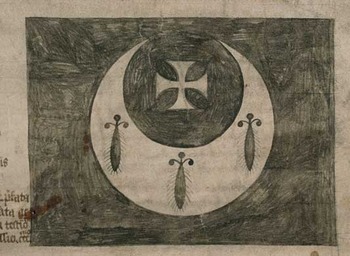
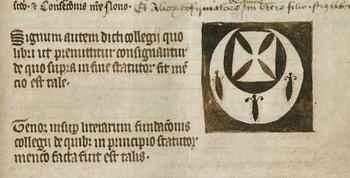
The instructions are clear that the books listed in the donation, as well as any books the college might own then, or in the future, are to be marked at the back (in fine) with the signum of the college ‘described and pictured below’. This signum appears at the bottom of the 1352 statutes with a brief note stating that it is the signum described in the passage immediately before the list of donations (fig 1). The signum is copied, with the rest of the statutes and the list of donations, in Trinity Hall, Cambridge, ms 20 (fig 2). In heraldic terms, the signum can be described as ‘a crescent ermine and a Maltese cross’ or ‘Sable, between the horns of a Crescent Ermine a Cross Patee Argent’.Footnote 21 In all cases where the signum is illustrated – the exemplar, in the copies of the statutes and in the extant manuscripts – it appears on a square or rectangular ground, called a billet, rather than on the shield-shaped field used for heraldic arms.Footnote 22
Detail from Trinity Hall, Cambridge, Muniments 77 (Exemplar Statutorum, dated 10 December 1352). Photograph: by kind permission of the Master and Fellows of Trinity Hall, Cambridge

Detail from Trinity Hall, Cambridge, ms 20 (‘The Master's Statute Book’), folio 22. Photograph: by kind permission of the Master and Fellows of Trinity Hall, Cambridge

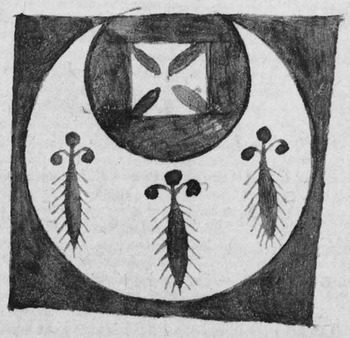
There are two extant examples of the badge in the college library, used in the manner directed by the statutes. Trinity Hall, Cambridge, ms 8, a repertorium and decretal, preserves the signum on its final leaf (fig 3). Clarke and Lovatt confidently identify this text with entry 55 or 56 in the donation list, as does M R James in his 1907 descriptive catalogue.Footnote 23 The signum appears again on the final leaf of Trinity Hall, Cambridge, ms 15, a Tabula Martiniana, produced in the second quarter of the fourteenth century (fig 4).Footnote 24 This manuscript cannot be matched to any entries on the extant lists of donations, nor in the later marginal notations that were made during the inconsistently managed inventories. Trinity Hall, Cambridge, ms 28 is thought to be another survival from Bateman's donation, or at least a fourteenth-century acquisition by the college, but it does not contain the college signum.Footnote 25
Trinity Hall, Cambridge, ms 8 (Repertorium and Third Book of Decretals), folio 130v. Photograph: by kind permission of the Master and Fellows of Trinity Hall, Cambridge

Trinity Hall, Cambridge, ms 15 (Tabula Martiniana Decretorum), folio 139v. Photograph: by kind permission of the Master and Fellows of Trinity Hall, Cambridge

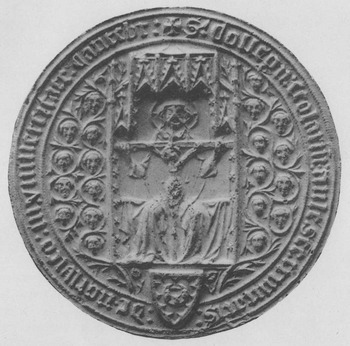
Previous descriptions of these manuscripts consistently refer to the signum as ‘Bateman's device’ rather than the college badge.Footnote 26 One of the college's earliest historians, Samuel Warren (1683–1744), discussed the college arms and seals in some detail; however, he did not comment on the corporate nature of the signum described in the statutes. Instead, he focused on the differences between the founder's arms as they appear on the bishop's seal and the subsequent alteration of the border to signify use by the college (fig 5).Footnote 27 The conflation of the signum with the founder's arms only complicates this interpretation, as the first books given to the college – including the one extant survival, Trinity Hall, Cambridge, ms 8 – have always been considered surviving gifts from the founder.
An impression of the seal of Trinity Hall, Cambridge, believed to date from the fourteenth century and depicting the Trinity and the founder's arms with the motto: ‘s’ collegii : scolariu : aule : sce : trinitatis : de norwico : in : universitate : cantebr’. Photograph: from Dale Reference Dale1911

The tendency is to assume that any book bearing the signum originally came from the bishop's personal collection. In this way the signum is understood to signify previous personal ownership by the bishop, the books having entered the college as part of the initial donation listed in the statutes.Footnote 28 Some writers, such as Lavinia Hinton, even refer to the signum in the statutes and the extant manuscripts as representations of Bateman's personal arms.Footnote 29 M R James and Elizabeth New are more careful in their identification of the badge as Bateman's personal arms but they both consider the badge as his personal mark of ownership, or at least an indication that the manuscript was a donation from his collection.Footnote 30
The language in the statutes, however, is explicit in stating that the signum illustrated was for use by the college, signo dicti collegii, and that the badge was to be placed in the books listed in the donation as well as any books that the college might own then, or in the future. It is possible that the badge was used by Bateman to mark his own books and that it was simply convenient to transfer it to the college for its own corporate use. If this were the case, executors may have found it difficult, following the bishop's death, to distinguish between books destined for the college and the rest of his collection – for though Bateman's donation of books to his new college was substantial, there is no indication that it represented his entire private collection.
It is important to remember that the signum illustrated in the statutes was not intended to act as the corporate arms of the college proper; rather, it was a sign or badge intended for marking college property, specifically the books. Provisions for arms, in statutes and other formal documentation, are consistent in their use of the Latin arma when referring to personal heraldic emblems. This is the case for the 1436 grant of arms to Richard Peshal, in which the heraldic arms are referred to as ‘scutum Armorum meorum’. The 1410 grant to William Criketot also refers to arma when discussing heraldic arms.Footnote 31 Grants in Anglo-Norman French are also consistent in their use of the term armes for personal heraldry. Although there are no explicit directions for the design of a college signum, or badge, this is not unusual; there are no specific instructions for corporate arms in any of the other statutes and founding documents for Cambridge colleges. The few references to arma found in these documents use the term in reference to weapons, and injunctions against carrying them on university or college grounds.Footnote 32 It may be tempting to think the signa provided by Bateman were intended for the college's arms, but the common use of the term arma rather than signa, for complete arms, does not support such an argument.Footnote 33
The use of the signum that Bateman assigned to the college declined rapidly after its foundation. Only the two previously mentioned manuscripts in the college library preserve the signum in its proper place and there are no examples of the badge in use in any other part of the college fabric. Those two manuscripts are the only survivals in the college library from a 1381 memorandum of law books; none of the small number of texts now in the library identifiable from the 1556/7 list, made by the Marian commissioners, have the statute's signum.Footnote 34 Neither do the earliest college seals – clearly not Bateman's personal seals – use the signum described in the statutes; instead, they appear to use Bateman's personal arms.Footnote 35 Clarke and Lovatt point out that the provisions for annual inventories included in many college statutes were rarely followed by Masters and Fellows and it is likely that the marking of the books with the specific signum for Trinity Hall likewise fell into irregular use and was eventually abandoned in preference of the founder's personal arms. There certainly is a close resemblance between Bateman's personal arms, as they appear on his seal and the badge in the statutes, and it appears Bateman and his clerical household used the crescent ermine in other official transactions. Such use appears in the notarial signum of John Wynestone, who acted for the bishop's estate in the 1356 ratification of the muniments of the Chantry of Bruisyard. Wynestone's seal incorporates three crescents ermine.Footnote 36
Marks of ownership in medieval and early modern books typically take the form of inscriptions or signatures, eventually supplemented by book-plates and stamps. Many of the armorial marks of ownership used in the medieval period were either applied to the bindings (and were frequently lost upon rebinding by later owners) or heraldic decoration was incorporated into, or added to, decorative elements within the text.Footnote 37 The use of heraldry for purposes of identification in medieval manuscripts has been the subject of some recent studies, in particular the study of armorial decoration as marks of ownership by the late John A Goodall, FSA. Goodall showed how decorative elements in manuscripts could double for representations of the owner or patron's arms and that this is the most common means of indicating ownership or patronage.Footnote 38 However, the purely utilitarian marking of books, such as stipulated in Trinity Hall's statutes, is less common, particularly regarding the use of a special signum. David Pearson notes a few examples of personal arms and heraldic badges placed in early printed texts as marks of ownership, but this practice is rarely discussed by medieval writers. Moreover, the common examples of personal arms as marks of ownership are frequently more decorative than Trinity Hall's badge.Footnote 39 More functional marks of ownership do appear in other books and documents, but these rarely mimic heraldic styles. Charles Sisson's survey of such practice provides examples that differ significantly from the signa that appear in Trinity Hall's statutes and books, and Sisson's marks tend not to represent corporate ownership.Footnote 40 It appears that the instructions Bateman detailed for the marking of the college's books in such a specific way – with a specific signum depicted in the statutes – has no parallel in late medieval Cambridge.
Acknowledgements
The idea for this paper grew slowly over a year spent at Trinity Hall as the spouse of a student. The early stages of research were made possible through the generosity and helpfulness of the Master and Fellows of the College of Trinity Hall, particularly the Fellow Archivist and Librarian, Dr John Pollard, and the Director of Library Services, Ms Dominique Ruhlmann. Thanks also to Dr Sharon Wright, of St Thomas More College, University of Saskatchewan, for her assistance with Latin translation. Special thanks are due to the anonymous reader who reviewed this paper for the editors of the Antiquaries Journal. The reader's recommendations and corrections on several key points were indispensable.
Bibliography
- Manuscript sources
- Cambridge University Archives, ms Luard 39
- Trinity Hall, Cambridge, Muniments 77 (Exemplar Statutorum, dated 10 December 1352)
- Trinity Hall, Cambridge, ms 8 (Repertorium and Third Book of Decretals); online version 〈http://www.trinhall.cam.ac.uk/library/old_library_page.asp?ItemID=919〉 (16 June 2010)
- Trinity Hall, Cambridge, ms 15 (Tabula Martiniana Decretorum)
- Trinity Hall, Cambridge, ms 20 (‘The Master's Statute Book’); online version 〈http://www.trinhall.cam.ac.uk/library/old_library_page.asp?ItemID=1155〉 (16 June 2010)
- Trinity Hall, Cambridge, ms 28