Introduction
As determined by the NASA Astrobiology Roadmap – the potential of microbes and other organisms has to be explored, to identify genetic trails and biochemical mechanisms they could use to survive in environments beyond our home planet (http://astrobiology.arc.nasa.gov/roadmap/g5.html). At the same time, exploration of the survival strategies of terrestrial organisms in an imitated Martian environment is crucial for the successful settlement of the artificial living constructions, and stable functionality of future human habitats on hostile planetary bodies.
For decades, a number of methods and tools have been invented, provided and employed in order to detect and/or identify possible life on the planet Mars. Among these, Mars Simulation Chambers (MSCs) are known to be one of the most convenient and fascinating technical achievements.
MSCs – research and engineering applications
The earliest engineering of MSC was described in 1959 when several organisms were tested for survival in simulated Martian conditions and this was reported at the International Astronaut Congress in London (Davis & Fulton Reference Davis and Fulton1959). Eventually, similar research was conducted in the USSR in cooperation with NASA scientists and the first results became available both in Soviet and International publications (Zhukova & Kondratyev Reference Zhukova and Kondratyev1965). These particular experiments were carried out within a climate-chamber named ‘Artificial Mars’−1965, which enables exposure of microbial cells to a simultaneous effect of temperature, pressure, gas composition and illumination like those on Mars. Still, in this chamber a single UV source lamp is used and micro-organisms are exposed to the membrane filters with a diameter of 23 mm or in special quartz cells of the same diameter size. However, no day–night cycles have been preserved, as well as spectral composition and the intensity variation as that of the Sun on Martian surface. Descriptions of the experiments carried at that time are available in the three-volume joint USA/USSR publication (Calvin & Gazenco Reference Calvin and Gazenco1979). It important to mention that analogue equipments are used even today (http://privetstudent.com/referaty/biologiya-referaty/135-iskusstvennyy-mars.html).
Scientific literature has reported about another Mars Ultraviolet Simulation Facility at NASA Research Center in 1966 (http://hulfactor.blogspot.com/) and revised in 1979. A facility was established for long-duration ultraviolet (UV) radiation exposure of natural and synthetic materials in order to test hypotheses concerning Martian soil chemistry observed by the Viking Mars Landers. The system utilized a 2500 Watt xenon lamp as the radiation source providing continuous UV irradiation on multiple samples for long periods of time under simulated Mars atmospheric and thermal conditions. Over 100 samples have been irradiated for approximately 100–700 hours (Zill et al. Reference Zill, Mack and DeVincenzi1979).
The Martian Environment Simulator – SAM is an interdisciplinary project of Astrobiology done at the University of Padua (Galletta et al. Reference Galletta2006). Within this chamber, experiments are conducted to test the survival of the bacterial cells under simulated diurnal and seasonal Martian cycles and UV radiation.
The Space Life Scientists Lab – SLS at NASA Kennedy Space Center owns the Mars chamber, where the scientists experiment with the limits of life within this unique Martian environment (http://www.nasa.gov/centers/kennedy/missions/xtremebacteria.html). Some of the results of the research suggest that bacteria on the sun-exposed surfaces of landing spacecraft are killed quickly by ultraviolet light. Bacteria hiding inside or underneath the craft may escape these lethal rays, but the extreme environment of Mars does not support their growth and reproduction (Smith et al. Reference Smith, Schuerger, Davidson, Pacala, Bakermans and Onstott2009; Berry et al. Reference Berry, Jenkins and Schuerger2010).
The possibility of the existence of local Martian life in the past or present is also under intense investigation within this facility (Schuerger et al. Reference Schuerger, Mancinelli, Kern, Rothschild and McKay2003, Reference Schuerger, Clausen and Britt2011, Reference Schuerger, Moores, Barlow, Clausen and Britt2012).
The MSC of the Rover Environmental Monitoring Station at NASA (http://cab.inta-csic.es/rems/rems_CAMARA_en.html) provides scientists with knowledge of the climate and in situ study on Mars that gives accurate information of the value range of the main meteorological variables: pressure and its temporal evolution, ground temperature, air temperature, wind speed and direction and sun radiation. With this information, the feasibility of life subsistence could be assessed as well as the possibility of sending manned missions to the planet. The MSC is used to create Mars surface environments in which pressure (8.5 mb), temperature (−80 °C, −40 °C, −10 °C, or 23 °C), gas composition (Earth-normal N2/O2 mix, pure N2, pure CO2, or a Mars gas mix), and UV-VIS-NIR influence rates (200–1200 nm) are maintained. The imitated Martian atmosphere gas mix is composed of CO2 (95.3%), N2 (2.7%), Ar (1.7%), O2 (0.2%), and the content of the water vapour is about 0.03% (Schuerger et al. Reference Schuerger, Mancinelli, Kern, Rothschild and McKay2003).
The Mars atmospheric simulation chamber at the University of Washington (http://www.aa.washington.edu/research/isru/facilities.html) has been engineered and constructed for the general purpose of simulating Martian pressure, temperature and humidity as well as its atmospheric composition over typical Martian diurnal cycles. This chamber is designed for conducting very specific research, which would assist a Manned Mars Mission for the subtraction of molecular water from the planet's ground and atmosphere (http://www.lpi.usra.edu/publications/reports/CB-955/washington.pdf) (Cloutis et al. Reference Cloutis, Craig, Mustard, Kruzelecky, Jamroz, Scott, Bish, Poulet, Bibring and King2007).
The Mars Environmental Simulation Chamber (MESCH) at the University of Aarhus, Denmark, simulates conditions on and immediately below the surface of Mars. The air is removed from the chamber with a vacuum pump, and replaced with a thin mixture of gases equivalent to those in the Martian atmosphere. The double wall is cooled with liquid nitrogen for the simulation of the cold temperatures during the Martian night. In this chamber, one sample at a time is exposed to ultraviolet-rich light from a xenon-mercury arc lamp and is rotated towards and against the light beam to mimic diurnal temperature variations on Mars (http://marslab.au.dk/en/marssimulationlaboratory/).
Dr Clifford A. Cerbus at the University of Dayton has expressed concerns about the high intensity of the ultraviolet light generated by the xenon-mercury lamp used in MESCH, which is approximately 35 times as intense as the Sun at Mars' surface. The major concern is if the results obtained with the operation of such an intense light source would be representative of what actually takes place on Mars.
So far, the University of Aarhus team has only published results with samples of sand, which demonstrated that the system produces temperature variations comparable with those on the Martian surface (Jensen et al. Reference Jensen, Merrison, Hansen, Mikkelsen, Kristoffersen, Nornberg, Lomstein and Finster2008).
At the Caltech Ice and Mars Simulation Laboratory, two small chambers are used to investigate the possibility that atmospherically derived water vapour that can deposit ice, via diffusion, into a cold soil and may be able to fill or even exceed the available pore space volume. In the Ice Lab, parameters such as the vapour diffusion coefficient and thermal conductivity are being measured using Martian soil simulants (Schorghofer & Aharonson Reference Schorghofer and Aharonson2005; Aharonson & Schorghofer Reference Aharonson and Schorghofer2006; Marinova et al. Reference Marinova, Aharonson and Asphaug2011).
The DRL - German Aerospace Center with the European Space Agency owns space simulation facilities for exobiological studies, one large planetary simulation facility and two smaller Mars simulation facilities which are under refurbishment (http://www.esa.int/Our_Activities/Human_Spaceflight/Human_Spaceflight_Research/DLR_-_Mars., http://www.dlr.de/pf/en/desktopdefault.aspx/tabid-152/1348_read-2900/). Survivability of various living organisms are tested within the DLR MSC, where the Martian atmosphere is replicated; a vacuum pump system ensures six millibars of air pressure, which enables the planetary researchers to simulate the Red Planet's tenuous atmosphere. Special diode radiation sources range from the ultraviolet to the infrared replicating Solar radiation on the surface of Mars. Finally, the organisms have to cope with temperatures that fluctuate between −50 °C to 23 °C (http://www.planetary.org/blogs/guest-blogs/20120515-earth-life-survive-mars.html).
The Mars atmospheric simulation chamber (MASC) at the Vrije Universiteit Amsterdam Brussels is capable of operating between 40 °C and −40 °C at sub mbar pressures. MASC was designed to allow large prototype instruments to be tested under Martian conditions. (http://meetings.copernicus.org/epsc2010/abstracts/EPSC2010-124.pdf). Initial work examined the behaviour of Raman vibration bonds in hydrated minerals (e.g., jarosite and amphibole) at Martian conditions (i.e., in a CO2 atmosphere at pressures of between 5 and 12 mbar and with a temperature range of −40 °C to 40 °C) compared with terrestrial measurements. As shown previously (http://astrobiology.arc.nasa.gov/roadmap/g5.html) low temperature has a significant influence on some Raman spectroscopic bands (Yu-Lei et al. Reference Yu-Lei, Guang and Zang2003). So far there has not been any biological research reported being performed within this particular chamber.
The Open University in the UK owns two Mars chambers: the smaller Mars chamber is a partially automated environmental chamber system, allowing automated simulation of the Martian surface environment. It is 0.7 m in diameter and 1.2 m in length, capable of testing large instruments/structures and exposure of large biological samples (−70 °C to 110 °C at 6 mbar, CO2/N2 atmosphere). The key capability of this chamber is the ability to automate pressure and temperature, allowing thermal cycling tests to be easily performed. In addition, it can also be used for DHMR sterilization tests, providing sustained temperatures of >110 °C for continuous periods (Duffy et al. Reference Duffy, Lewis, Mason and Patel2012). The chamber also has illumination ports for a dedicated lamp source that provides simulation of Martian UV conditions (Dartnell et al. Reference Dartnell, Patel, Storrie, Michael, Ward and Muller2012).
The larger Mars chamber is capable of recreating the Martian environment (−70 °C to 110 °C, 6 mbar, CO2/N2 atmosphere) with UV illumination.
The Cometary and Space Simulation Chamber at the Institute for Space Research in the Austrian Academy of Sciences in Graz, Austria is a Cryo-Vacuum chamber that could be used for experiments in a simulated space vacuum and in simulated planetary atmospheres like, in the case of Mars a CO2/N2 mixture. The chamber was used for performing experiments to determine thermo-mechanical properties of sublimation residua for ESA's Rosetta mission. Laboratory experiments showed that organic molecules like aliphatic hydrocarbons influenced the thermal conductivity of ice and dust mixtures, as they might occur on comets or the surface of icy satellites (Treffer et al. Reference Treffer, Kömle, Kargl, Kaufmann, Ulamec, Biele, Ivanov and Funke2006).
A new Mars environment simulation chamber is being developed at the Planetary Exploration Research Center, Chiba Institute of Technology (http://www.lpi.usra.edu/meetings/lpsc2010/pdf/1754.pdf); however, a present day description is not yet available.
In 2003, Leiden University in cooperation with the ESA conducted a series of experiments regarding habitability on Mars and tested once again the reliability of Viking's results (Ten Kate et al. Reference Ten Kate, Ruiterkamp, Botta, Lehmann, Gomez Hernandez, Boudin, Foing and Ehrenfreund2003).
The University of Madrid has the MSC that uses a UV irradiation source and regolith simulation to explore the survivability of the micro-organisms on Mars (Gómez et al. Reference Gómez, Mateo-Martí, Prieto-Ballesteros, Martín-Gago and Amils2010; Sánchez et al. Reference Sánchez, Mateo-Martí, Raggio, Meeben, Martínez-Frías, Sancho, Ott and De la Torre2012).
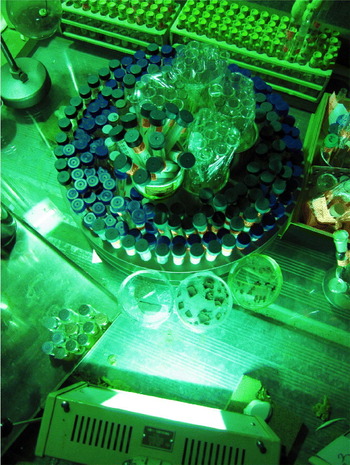
Mars Climate Simulation Chamber ‘Artificial Mars’ – MCSC (GEO PAT 12 522/01) (Fig. 1) at Ivane Javakhishvili Tbilisi State University has been engineered and built for the implementation of biological experiments related to the search for life as well as the colonization of planet Mars. The main purpose of the research projects carried out within MCSC is the elaboration of practical tools and methods for the solution to some of the most fundamental problems in astrobiology and cosmology such as:
1. Search for indigenous life ever evolved on planet Mars or other planets alike, and that might exist today.
2. Assurance of the safety and sustainability of long-term human missions on Mars.
3. Creation and testing of new technologies for the colonization and terraformation of planet Mars.
Biological experiments are conducted within MCSC, where the Solar irradiance intensity and spectral variations are imitated using computer programming based on the presented calculations.

Diverse astrophysical and biochemical experiments and manipulations are performed within MCSC for the exploration of extreme organisms and their survival strategies. A study of the metabolic pathways of genetically modified autotrophs in simulated Martian conditions would define necessary specifications for detectable bio-signatures during the search for life, not only on Mars, but subsequently, on discovered exoplanets as well.
Importance of biophysical cycles
It is well known that physical properties of planetary environments (e.g. Mars) are defined by the integral intensity and spectral distribution of Solar electromagnetic radiation reaching the surface of the planet or the outer levels of its atmosphere; and the values of these parameters change significantly during diurnal and/or annual planetary cycles.
Every single organism is affected by these circadian cycles in one form or another, the properties of which are determined by the orbital parameters of Earth, and the activity of the Sun (McClung Reference McClung2006). On our planet, the presence of a vast hydrosphere and the gravity of the massive Moon have triggered the creation of the most noticeable circadian adaptations, but biological Solar cycles still exist (Chizhevsky Reference Chizhevsky1976). Potentially, small Martian moons would have a minor influence on Martian organisms, bearing in mind the absence of the dense atmosphere and large aquifers on the planet's surface. In this case, the greater influence of the Sun would be especially noticeable in potential Martian organisms, and this influence would determine the evolution of biological adaptations to the Solar cycles.
Thus, accurate imitation of radiation–temperature parameters within planetary simulation chambers is of great importance, especially when conducting biological experiments and investigating the functionality and survivability of living organisms ‘on the planet’, where these parameters vary significantly and could have a significant influence on the environmental conditions, as well as the physiology and behaviour of life forms thriving for the survival in those conditions (Kumar Sharma Reference Kumar Sharma2003).
Surprisingly, the importance of the biological cycles determined by the astrophysical parameters of the living environments is often ignored. For example, the survivability of the organisms in simulated Martian conditions are simultaneously studied under constant (fixed) values of the irradiance and temperature, parameters of which significantly exceed actual durations and intensities of those in real diurnal and annual cycles on the Planet. As a result, the accuracy and reliability of the data obtained from these kinds of biological experiments is suspicious. As an example, there is no constant daylight or darkness on Mars with a duration of 120 days or more, as well as a permanent temperature with fixed values like −110 °C or 27 °C. There are regular variations of these environmental parameters during 12 hours 39 minutes of Martian day and night, with a dependence on the geographical coordinates and/or surface geology features of the Red Planet.
Biological importance of spectral distribution of the irradiance
In addition to the circadian rhythms, photobiology explorations underline the importance of the preservation of spectral parameters and intensities of the illumination (Bayraktar et al. Reference Bayraktar, Fields, Kralj, Spudich, Rothschild and Cohen2012; Heselich et al. Reference Heselich, Frohns, Frohns, Naumann and Layer2012), especially during biological experiments. The influence of the spectral parameters of the irradiance on Earth's life has been investigated during the experiments conducted for more than a century, and the discovery of biological phenomenon called Chromatic Complementary Adaptation (CCA) has to be considered as one of the most important achievements (Grossman Reference Grossman2003; Kehoe Reference Kehoe2010). The universal importance of this phenomenon is the fact that on our planet, there are specific environments, where distinct wavelengths of Solar electromagnetic radiation may be present (e.g. oceans, ice or underground), and this could provide significant clues for the investigation of life forms elsewhere in space, wherever different illumination conditions are present.
However, on Mars, the intensity of Solar irradiation may vary, but none of the wavelengths are presented distinctively on the planetary surface at any time of the day. In fact, the Solar radiation on the Martian Surface gives total incandescent flux from X-ray through the UV – starting at 100 nm and continues all the way through the VIS, IR at 3000 nm and even radio-waves. All of these wavelengths have a significant and very specific influence on living organisms and affect their physiology in one form or another; accordingly, biological experiments within MSCs have to be conducted under accurate imitation of spectral distribution under continuous Solar spectra, variations of which occur during diurnal and annual planetary cycles. The presence of plain UV spectra within Mars chambers, in our opinion, is insufficient and unacceptable.
It is not well known whether the X-rays are significantly absorbed by the dust in Martian atmosphere or rocks on the surface; however, use of X-ray sources requires special protocols. This is why X-ray experiments are not conducted by us within MCSC, but in special lead chambers. The rest of the spectrum of Solar electromagnetic radiation, within the range of 120–3000 nm is imitated within MCSC by special artificial illumination sources, and annual and diurnal intensities of which each are considered.
Astrophysical model of Mars surface irradiation
There are a number of theoretical models describing Mars surface irradiation and its specific parameters (Wilson et al. Reference Kumar Sharma1995; Saganti et al. Reference Saganti, Cucinotta, Wilson, Simonsen and Zeitlin2004; De Angelis et al. Reference De Angelis and Wilson2006, Reference De Angelis2007; Catling et al. Reference Catling, Cockell and McKay1999; Patricia Gonc et al. Reference Patricia Gonc2009). Most of these models focus on the safety of human space missions and investigate exposures to galactic cosmic rays (GCR). Some models are investigating variations of Solar radiation parameters during atmosphere and lithosphere paths, where the presence of air and dust and soil mineral components is taken into consideration.
For example, in De Angelis et al. (Reference De Angelis and Wilson2006), the Mars surface irradiation models are developed based on the calculations of the intensities of GCR and Solar Particle Events (SPE) on the planetary surface, where particle transport computations are performed with the deterministic (NZETRN – High Z and Energy Transport) code (Wilson et al. Reference Wilson1995) and the number values obtained are adjusted to human body radiation dose equivalents. Here, we have to mention that the radiation resistance of the Earth's extreme micro-organisms – which are of interest to us – significantly exceeds the values determined by these calculations. Although Martian atmospheric and ground volatile content and backscattering are also taken into account, our model does not rely on this data for the simple reason that the ground and atmospheric parameters are artificially imitated within MCSC.
In the model developed by Catling et al., the authors investigate UV radiation flux incident on the Martian surface that is calculated by a simple irradiative transfer equation. This particular work presents an updated Mars surface radiation model for UV radiation only (200–400 nm) that incorporates dust and more recent data for the Solar spectrum, atmospheric gas absorption and UV surface albedo. In this case, for the biological reasons stated above, our model is intended for the technical simulation of the overall Solar spectrum irradiation within MCSC and calculations are performed in a much wider wave-range that includes all wavelengths within 180–3000 nm. In our imitations, in addition to the UV spectrum, the biological importance of VIS and FR/IR spectra for the radiation-resistance organisms are taken into account. Therefore, in our model, sufficient values in numbers are given for the maximum range of waves within Solar electromagnetic spectrum.
Once again, a similar article from the Space Science Reviews (Saganti et al. Reference Saganti, Cucinotta, Wilson, Simonsen and Zeitlin2004) investigates the potential risks for future Martian astronauts and colonists due to the exposures to GCR. Here, the developed model estimates the number of heavy ion hits per human cell per year on the Martian surface. Calculations consider the transport of the GCR through the Martian atmosphere using Mars Orbiter Laser Altimeter (MOLA) topographical data, and values in numbers are given for the average body-shielding of the skin for humans.
What makes this particular model interesting is that extreme Solar-cycle scenarios are investigated with the calculations of near Solar minimum (with Solar deceleration parameter Φ = 428 MV) and Solar maximum (ϕ = 1050 MV), which are of biological importance. However, the influence of such extreme parameters of GCR and Solar irradiation at an overall planetary scale is of insignificant value for possible Martian inhabitants and therefore, is not considered in the calculations of our irradiation model.
Two Mars Energetic Radiation Environment Models (REM) have been developed recently by European Space Agency (ESA) Technological Research Programme science team (Patricia Gonc et al. Reference Patricia Gonc2009) for the prediction of an energetic radiation environment for future Mars missions. For this specific purpose, the high energy ionizing radiation environment has been investigated using the European Mars Climate Database (EMCD) model. Calculations include prediction capabilities for the ambient dose equivalents of GCR, Solar energetic protons and heavier ions, Solar X-ray spectra and α-particles. The analysis of De Angelis et al. (Reference De Angelis2007) gives in addition the dose equivalent of these particles with the comparison of Martian regolith for Solar minimum and maximum conditions.
If required, detailed numerical values from these two models could be compared with the data of Mars Radiation Environment Experiment (MARIE) from the Mars Odyssey spacecraft (Zeitlin et al. Reference Zeitlin2004). However, GCR-induced biological effects are investigated within our special lead chamber and are not considered for the technical simulation of the Solar irradiance within MCSC as an analogue to that for the Martian Equatorial Surface.
It is quite appropriate that Mars Science Laboratory (MSL) is conducting experiments with Radiation Assessment Detector (RAD) for the measurement of the fluxes of Solar energetic particles and GCR in daily rates (http://mars.jpl.nasa.gov/msl/mission/instruments/radiationdetectors/rad/, http://wrmiss.org/workshops/fifteenth/Hassler.pdf). Together with our model, the measured values of Solar irradiation will provide us with important data for the better assessment of the past and present habitability of Mars. Ideally, these new results will be considered for the construction of a better lead chamber in addition to the MCSC, for the characterization of life-limiting or mutational factors on planet Mars.
In the meantime, calculations for our model have been performed for a very specific task that was the simulation of the overall Solar electromagnetic radiation within MCSC for the conduction of biological experiments and the investigation of potential Mars habitability, as well as selection of extreme microbes for possible Ecopoesis purposes and investigation of their physiological functions.
Along with the complicated engineering of the constructions, exact values have been required for the imitation of the accurate hourly variations of surface irradiation as is on planet Mars at different space coordinates. The specific model of Mars Surface Radiation has allowed us to obtain data in a way that those have been transformed into the programmed electric scheme, which operates an illumination equipment within MCSC.
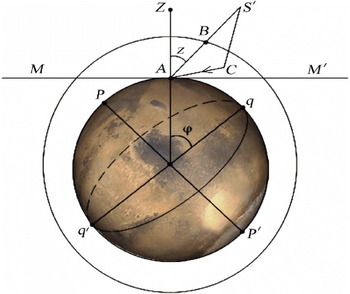
Intensity and spectral composition E(λ) of the illumination E on the Martian surface is determined by the amount of Solar irradiation at λ wavelengths reaching 1 sm2 of planetary surface per second (Fig. 2). At any planetary surface point A, these parameters depend on planetographic latitude φ (an angle between the vertical line passing point A and the planet's equatorial plain), distance r to the Sun S, altitude z in respect to zenith Z and atmospheric attenuation. During experiments φ is fixed, r changes due to elliptic planetary revolution, and z changes in accordance with the diurnal motion of the Sun around PP′-axis.
Martian celestial sphere: qq′, Martian equator; PP′, poles; φ, latitude of the observer A; MM′, horizon; C, atmospheric dispersion point; z, Sun's altitude in Martian sky.

The arrangement of the spring and autumn equinoxes as well as summer and winter solstice points in the Martian sky are discussed regarding the Mars perihelion. Annual orbital points and variability of Solar z min for different planetary latitudes are calculated for the 15 selected values of Mars's true anomaly, along with the illumination E for 12 hourly moments of Martian daytime on the Martian equator.
Surface illumination E on the planetary surface is given by the formula:
 $$E(r,z) = E_0 k_1 (r)k_2 (z)\cos z,$$
where E 0 is the Solar constant as the sum of all types of Solar electromagnetic radiation per unit area, at average orbital distance a between the planet and the Sun. It is determined by irradiance L = 4×1033 ergs cm−2 s−1, the total radiant energy output (of the Sun) per second, and is expressed by the formula:
 $$E_0 = L/4{\rm \pi} a^2. $$
Here, the multiplier k 1(r) describes the variation of the illumination E during the Martian year as the function of r via orbital motion of the planet, and is expressed as:
 $$k_1 (r) = \left( {\displaystyle{a \over r}} \right)^2. $$
Multiplier k 2(z) shows the attenuation of the Solar irradiance due to its absorbance, while passing BA path through the outer atmospheric boundary to the A point; here, z undergoes diurnal variations from noon Solar culmination z min to 90° declination at sunrise and sunset. Meantime, z min depends on φ and is altered during the planetary year. Multiplier cos z accounts for the depletion of the Solar irradiance at angular zenith distance z, measured from the Martian surface.
Values of k 2 multiplier are defined by the density and chemical composition of the atmosphere that is the number N of the absorbing particles at BA path (of the light beam), and it is calculated as the unit of the cross-sectional area of the column, expressed by the formula:
 $$k_2 = {\rm e}^{ - {\rm \tau}}, $$
where τ is the optical distance between B and A points and is dependent on λ as well.
For the complete data acquisition, direct apparent radiation of the Sun at point A (from the right-hand side of equation (1)) has to be summarized with the radiation scattered from all C atmospheric points and direct surface illumination on that same A point. This so-called diffuse member is very important, especially, when applied to the calculations of the illumination on the planets with dense atmospheres, but its value consistently zeroes for the planets with thin atmospheres, such as Mars.
For Mars, these parameters are as follow: semi-major axis, 1.524 AU (228×106 km); eccentricity of the orbit, e = 0.09344; perihelion and aphelion, r min = 206.6×10⁶ km and r max = 249.2×10⁶ km, respectively; sidereal period, 687 Earth Days; sundial, 780 days; ecliptic inclination to Earth orbit, 1.85°; rotation axis tilt, 64.8°; and equatorial axis tilt ε = 25.2° (http://en.wikipedia.org/wiki/Astronomy_on_Mars).
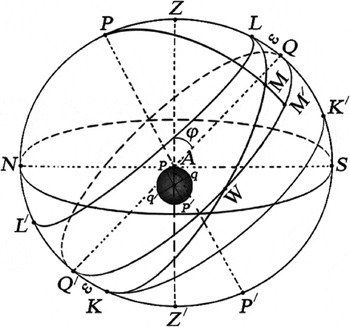
The visible motion of the Sun in the Martian sky is shown in Fig. 3. Here, within the small inner sphere, A is the point of the observer; PP′ is the axis of Mars, NS is the mathematical horizon, QQ′ is the celestial equator. QZ is equal to φ latitude of the point A; LK circle represents annual visible motion of the Sun in the Martian sky. QQ′, LL′ and KK′ circles show apparent diurnal motions of the Sun at Martian equinox and solstice moments. Q, L and K′ show upper, and Q′, L′ and K lower culminations of the Sun for the same equinox and solstice moments. Martian equinoxes E and W are the crosspoints of the orbital circles and celestial equator, whereas L and K solstice points are 90° apart from those. For the northern hemisphere of Mars, W is the beginning of the spring; L is the longest day and K is the longest night.
Visible motion of the Sun in Martian sky and its celestial coordinates: KL, Martian ecliptic; PP′, celestial axis; QQ′, celestial equator; NS, Mathematical horizon; LL′ and KK′, diurnal visible pathways of the Sun at solstices.

The atmosphere of Mars is very thin (http://www.space.com/16903-mars-atmosphere-climate-weather.html). Therefore, in our experiments within MCSC we consider that in equation (4) value τ is infinitely small. That means the intensity and spectral composition of Solar illumination on the Martian surface does not change significantly at any moment due to atmospheric absorption, e.g. e−τ≈1. Thus, Fig. 3 covers all the necessary data for the estimation of average annual and diurnal illumination intensities created by the integral Solar radiation on the Martian surface.
Considering the very low temperature environment on Mars, locations at the planetary equator (φ = 0°) seem to be the most convenient for the search of life signatures and/or the first colony settlements in terms of energy efficiency, especially regions like Hellas Planitia that demonstrates additional suitable geological features (Levine et al. Reference Levine, Garvin and Head2010). In our case point Q, as shown in Fig. 3, coincides with zenithal point Z, and thus the Sun's zenithal inclination varies from 0° at equinoxes to 25.2° at solstices showing noon surface irradiance varies insignificantly during the Martian year. In accordance with the data from (http://marsrover.nasa.gov/spotlight/20070612.html) the maximum temperature on the Martian surface can reach 27 °C and decreases rapidly by tens of degrees after sunset, reaching −100 °C before the dawn.
The tropical zone on Mars is covered by an area at |φ| ⩽ 25.2°, polar zones are covered by |φ| ⩾ 64.8° and temperate zones by 25.2°<|φ|<64.8°, respectively. The Sun's average declination point within the temperate zone at the latitude φ will be 90°−ϕ at equinoxes and 90°−φ∓ε or 64.8°−φ and 115.2°−φ on winter and summer solstice days. At the Martian equator the Sun's altitude is 90° at equinoxes and 64.8° at solstices.
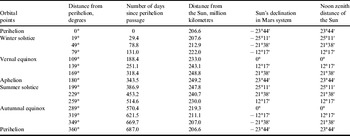
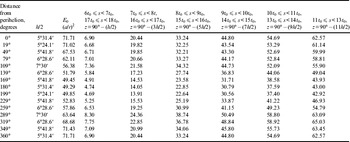
For the accuracy of calculations, value of E 0 on Mars has been considered to be only 43% of the Earth's Solar constant that is 59 mw cm−2. For further technical applications, e.g. selection of the illumination sources within MCSC, 15 orbital points have been selected within 12 hourly moments of the Martian day, and values of surface illumination have been estimated using equation (1) (Table 1).
Seasonal points along Martian orbit at Northern Hemisphere and variations of orbital and midday zenithal distances from the Sun; duration of Martian seasons in Earth days are given

Spring, 198.5 days; Summer, 183.5 days; Autumn, 146.0 days; Winter, 159.0 days.
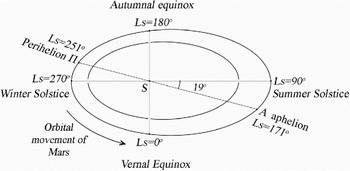
Average intensities of annual noon irradiances on Mars are determined by selected seasonal points, ecliptic longitudes of perihelion and vernal equinox along the planetary orbit. These values are dependent on equatorial coordinates αp and δp of the Martian North Pole and λper and λecl. At the epoch designation, values and centennial variations of these are as follows: 317.7°(−0.11°), 52.9°(−0.06°), 336.1°(1.84°) and 49.6°(+0.77°). In accordance with this data, the northern vernal equinox point on Mars is located 85° east of the Aries point, e.g. its ecliptic longitude is 85°. In this system, the longitude of the Mars perihelion is 251°, and 270° is that of the winter solstice. Thus, in the Martian orbit this point is located 19° east of the perihelion. The difference between the geocentric and ‘Marscentric’ longitudes is 85° (336° and 251°, respectively) (http://www.universetoday.com/14828/orbit-of-mars/) (Fig. 4); as an example, at Martian opposition on 31 August 2003 it was by 180° longer (339°) than the Solar longitude (159°). At the same time, the Sun passed the Martian perihelion Π on 28 August 2003, when its longitude coincided with the longitude of the Mars perihelion.
Locations of Martian perihelion and aphelion; solstice and equinox point and seasonal spans along Martian orbit.

Distances between Mars and the Sun on selected orbital points were calculated by the formula:
 $$r = a(1 - e^2 )/(1 + e\cos {\rm \upsilon} ),$$
where υ is the true annomaly angle ΠSP, made by radius-vector PS of the planet P, from its perihelion Π passage momentum t 0 to momentum t of reaching the orbital point p (Fig. 4). At the same time, υ can be expressed by the eccentric E anomaly:
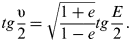 $$tg\displaystyle{{\rm \upsilon} \over 2} = \sqrt {\displaystyle{{1 + e} \over {1 - e}}} tg\displaystyle{E \over 2}.$$
Derived from Kepler's equation:
 $$E - e\sin E = M,$$
E is connected with mean anomaly M calculated by:
 $$M = (t - t_0 )n,$$
where n is the mean angular velocity of the planet:
 $$n = 360^{\scale55%\circ}/ {T},$$
where T is the period of planet revolution (Pikelner Reference Pikelner1976).
In definite, noon altitude of the Sun – z coincides with the declination module δ in the Martian system. In Fig. 3 declination circle PM is the passing point M at λ = WM. Martian ‘ecliptic’ longitude KL is crossing Martian celestial equator in point M′ (MM′ = δ), and creates a rectangular spherical triangle WMM′ to which spherical trigonometry sinus theorem gives:
 $$\sin {\rm \lambda} /{\rm sin}\, 90^{\scale55%\circ} = \sin {\rm \delta} /{\rm sin}\ {\rm \varepsilon}, $$
where ε = 25.2°. From equation (10) Sun's declination δ can be determined and plotted as the intensity values for the imitation with technical means within the Mars chamber.
Discussions and results
Therefore, the values of r were calculated by equation (5), and (t−t 0) by formulae (6) and (9); and Solar declination module δ by (10) for 15 orbital point values of υ. The results obtained and numbers for the Solar midday altitude z min are given in Table 1, from which Martian seasonal spans can be calculated as well.
Irradiation fluxes on the Martian surface for these 15 selected points have been modelled using data from Table 1, and equations (1), (4) and (11) have been derived for Mars:
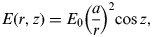 $$E(r,z) = E_0 \left( {\displaystyle{a \over r}} \right)^2 \cos z,$$
here, several discrete values of z have been incorporated, namely, Martian daytime values with the duration of T/2 Solar diurnal cycle, for which 12 hours 39 minutes was divided by 12 equal sections obtaining t 0 = 1 hour 3 minutes 3.96 seconds intervals. For biological experiments within MCSC, artificial illumination has been set in accordance with these T longitude time cycles (eventually, 3 minutes have been considered insignificant for future calculations). Conveniently, for the beginning of each cycle, the time value is s = 0, which is Martian midnight. Therefore, the values: s = 6t 0, s = 12t 0, s = 18t 0 and s = 24t 0 indicate the initial points of Martian sunrise, afternoon, sunset and midnight. Within MCSC, similar irradiation intensity values are set by the programming computer in accordance with this data by changing the number and combinations of the operating lamps.
Irradiation intensity values have been determined by the introduction of pace h of the Sun Zenith distance for each selected h = (90°−Z min)/6 daytime points; therefore z = z min at noon and z = 90° at sunset and sunrise. In general, for each of these i = 0, 1, 2,…, 6 moments, we could say z = z min+ih, as Martian daytime variations are s = (12+i)/t 0 and s = (12−i)t 0. Therefore, it is assumed that during each interval of time, the zenith distance of the Sun has average values as [s i, si +1], i = 0, 1,…, 5 and at the edges of these intervals we obtain z = z min+ih+(h/2) . Thus, the intensity of artificial illumination within MCSC changes symmetrically from the most intensive ‘afternoon’ irradiance peak to both altitude directions.
Calculated values of Martian surface irradiances for 15 orbital points and 12 daily intervals are presented in Table 2. During ‘equatorial night’ within MCSC, for 0 ⩽ s ⩽ 6t 0, 18t 0 ⩽ s ⩽ 24 intervals we assume that E(r, z) = 0, and the irradiance sources are turned off.
Conclusions
Our Mars Surface Irradiation Model has provided us a detailed description and values for the technical imitation of Mars surface irradiation within MCSC. For example, according to the Table 2, the maximum possible intensity of Solar irradiation on the Mars surface could be E = 62.5 mw cm–2; therefore, this intensity is present within MCSC during ‘Martian equatorial afternoon’. Namely, for such intensities four of the 400 wt incandescent spectrum illumination devices are placed 45 cm away from the research area. A calculation of this is based on an obvious equation:
 $$\displaystyle{{400\,{\rm wt}} \over {4{\rm \pi} r^2}} = E = 62.5\,{\rm mw}\,{\rm cm}^{ - 2}. $$
Thus, this afternoon intensity of the irradiation within MCSC is set in accordance with the real illumination conditions on the Martian equator for the same time of day, as are the intensities for morning and evening hours as well. We conclude that this imitated irradiation maximum and its daily variations provide intensities, which challenge the appearance of various adaptation mechanisms in biological structures.
Irradiation of Martian surface in mw cm−2 during 12-hour day at selected orbital points

At the same time, the results obtained from our model are used for precise imitation of variations of the Martian surface temperature within MCSC, programming of the supporting computer and electric scheme providing proper remote control of the environmental parameters analogue to 24 hours 39 minutes circadian cycle on the planet. In accordance with the discussions above, regarding the thinness of Martian atmosphere, the temperature is considered to be the function of the irradiance as determined by Planck's law (for the Sun at 6000 K) and is not imitated by separate equipments other than lamps emitting incandescent spectra within chamber MCSC – ‘Artificial Mars’.
The geology of Mars also plays a very important role in the radiation environment characterizations. In these terms, the prognosis is quite optimistic for the discovery of the indigenous Martian life under the surface. The majority of Mars irradiation models suggest that only ionizing radiation could penetrate a few centimetres into the planetary surface (Dartnell et al. Reference Dartnell, Desorgher, Ward and Coates2007). At the same time, our model demonstrates that the overall Solar radiation intensity is much lower, and perhaps the presence of reflected radiation could affect living organisms in some special circumstances. However, experiments within MCSC are conducted using artificial Martian ground created by the authors of this article (Tarasashvili & Aleksidze Reference Tarasashvili and Aleksidze2010), thus, secondary radiation values are not considered in calculations and the programming.
Spectral distribution (of the irradiance), humidity control, atmospheric composition and several other parameters are also remotely controlled within MCSC; however, details are not discussed in this particular article.